


Goldcrest
Golden-crested Kinglet · Regulus regulus
By the Birdfact teamChecked by Nathan Cope
On this page15 sections
How to recognise it
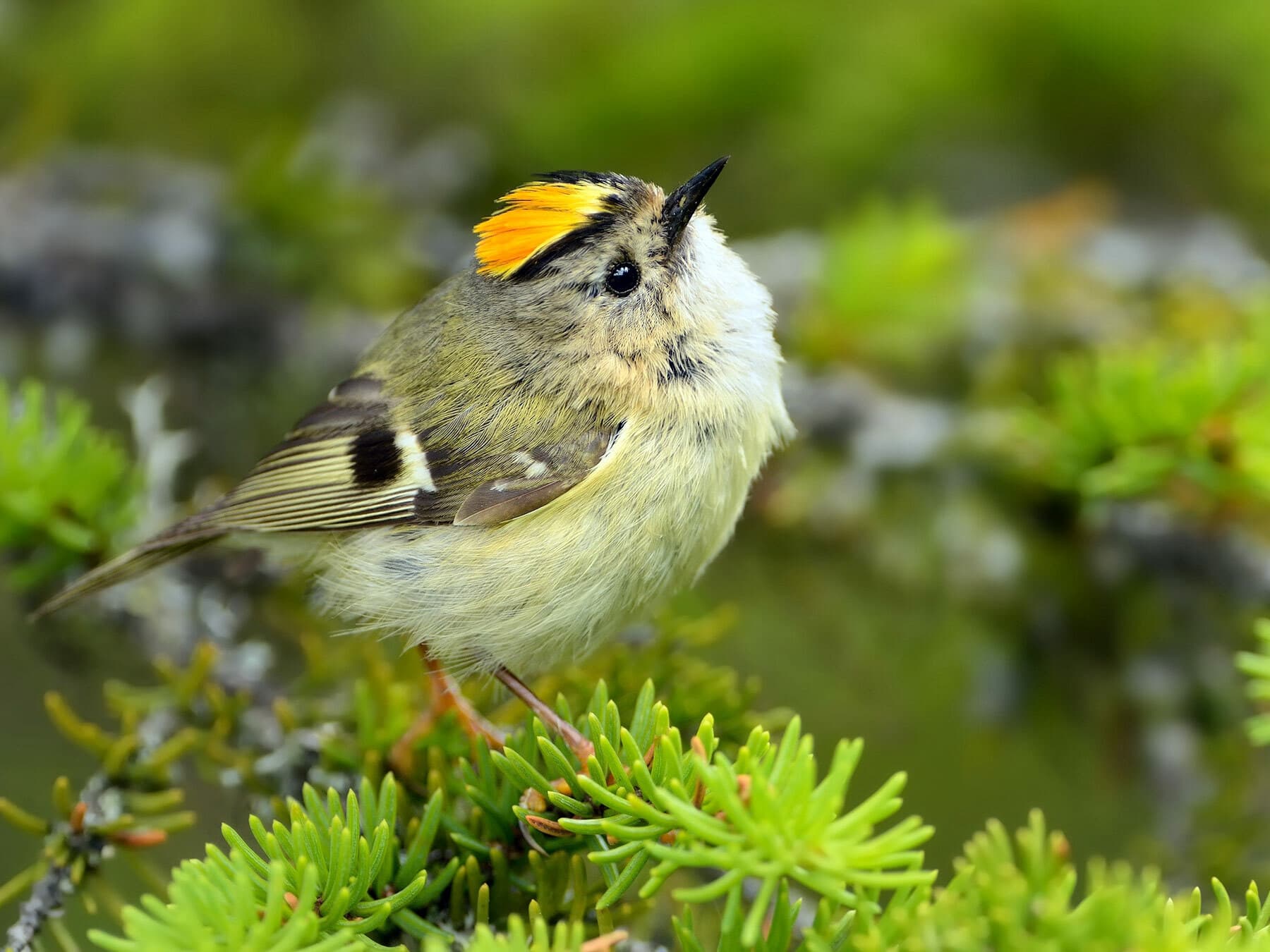
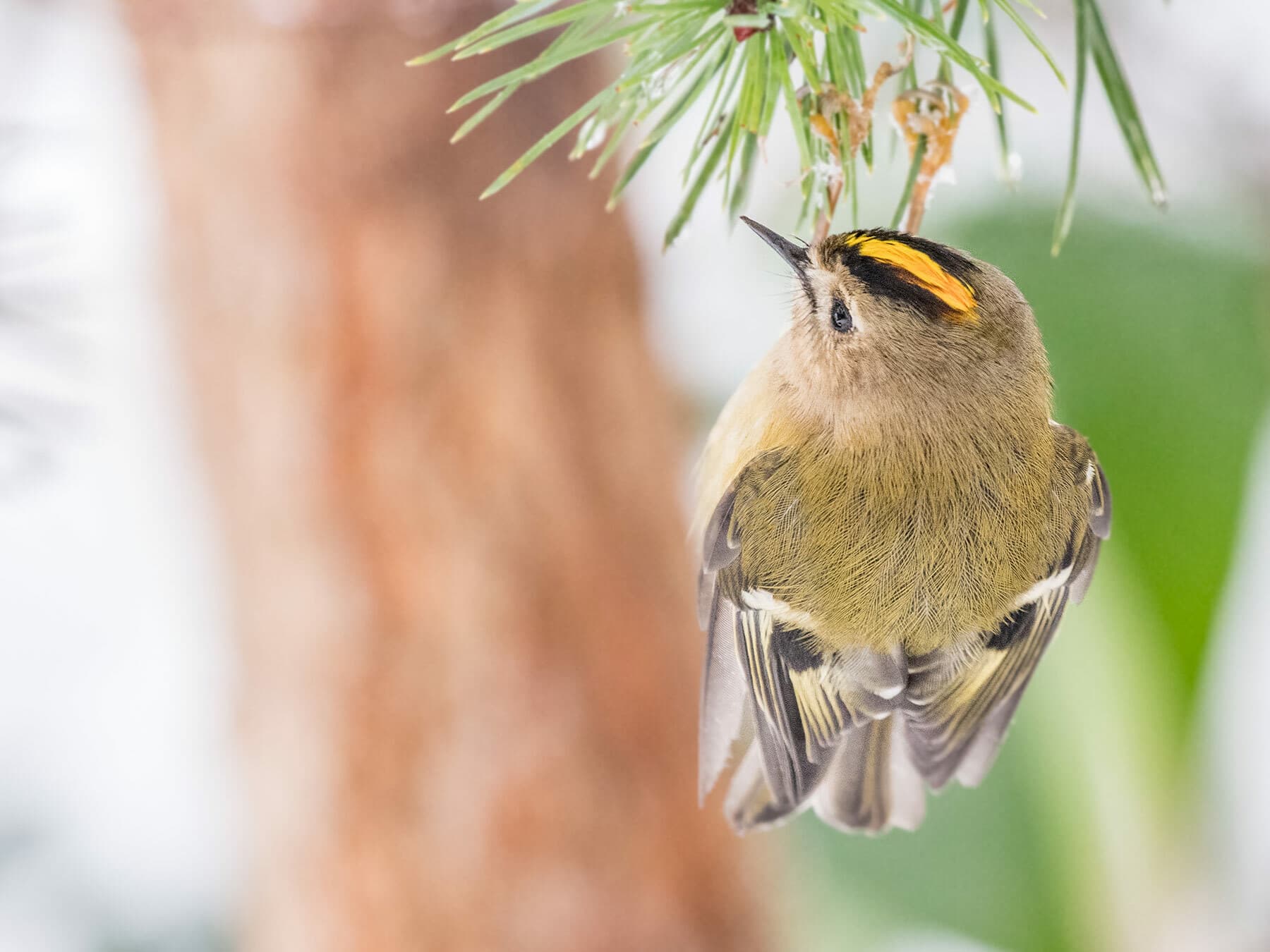
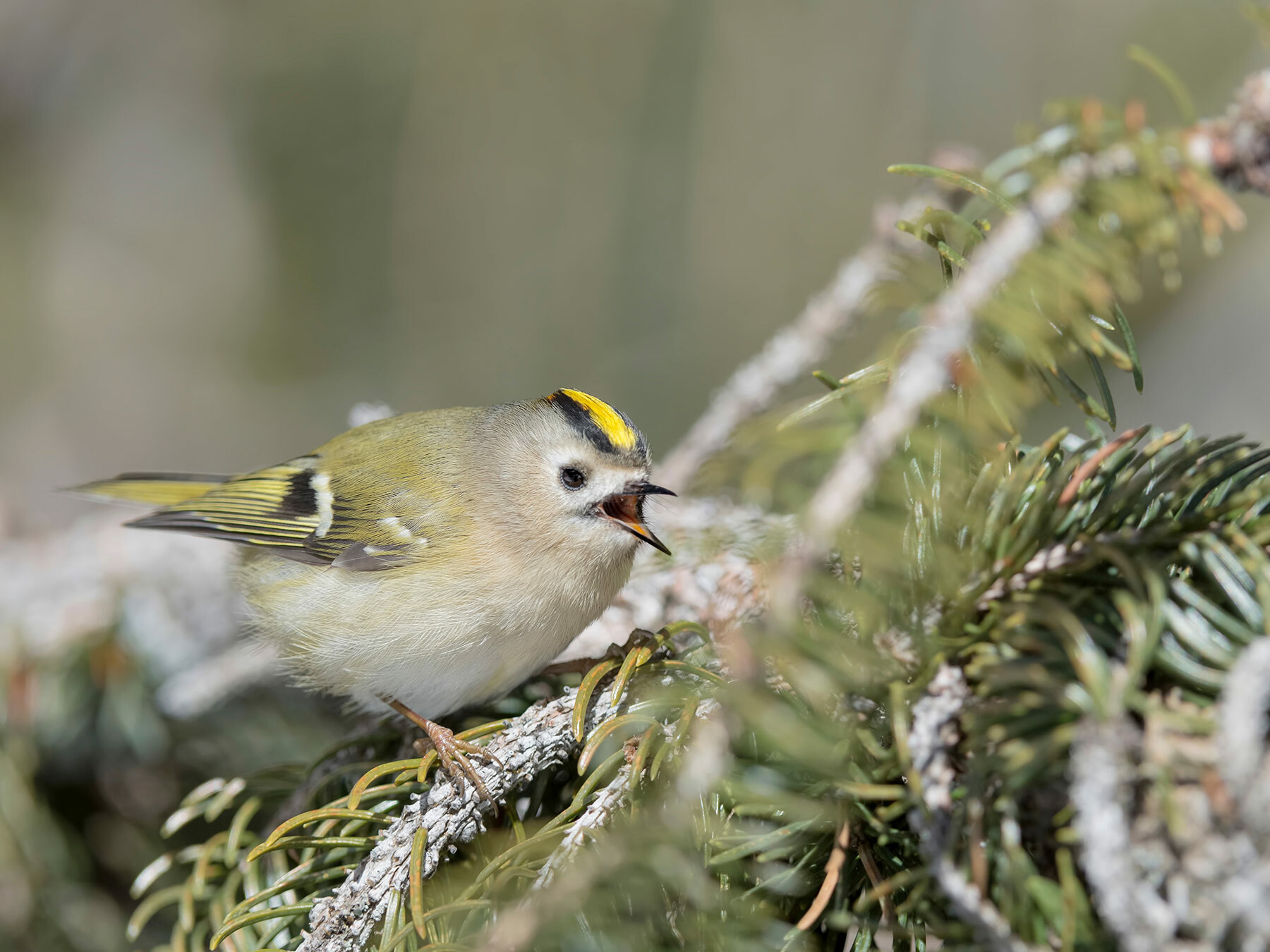
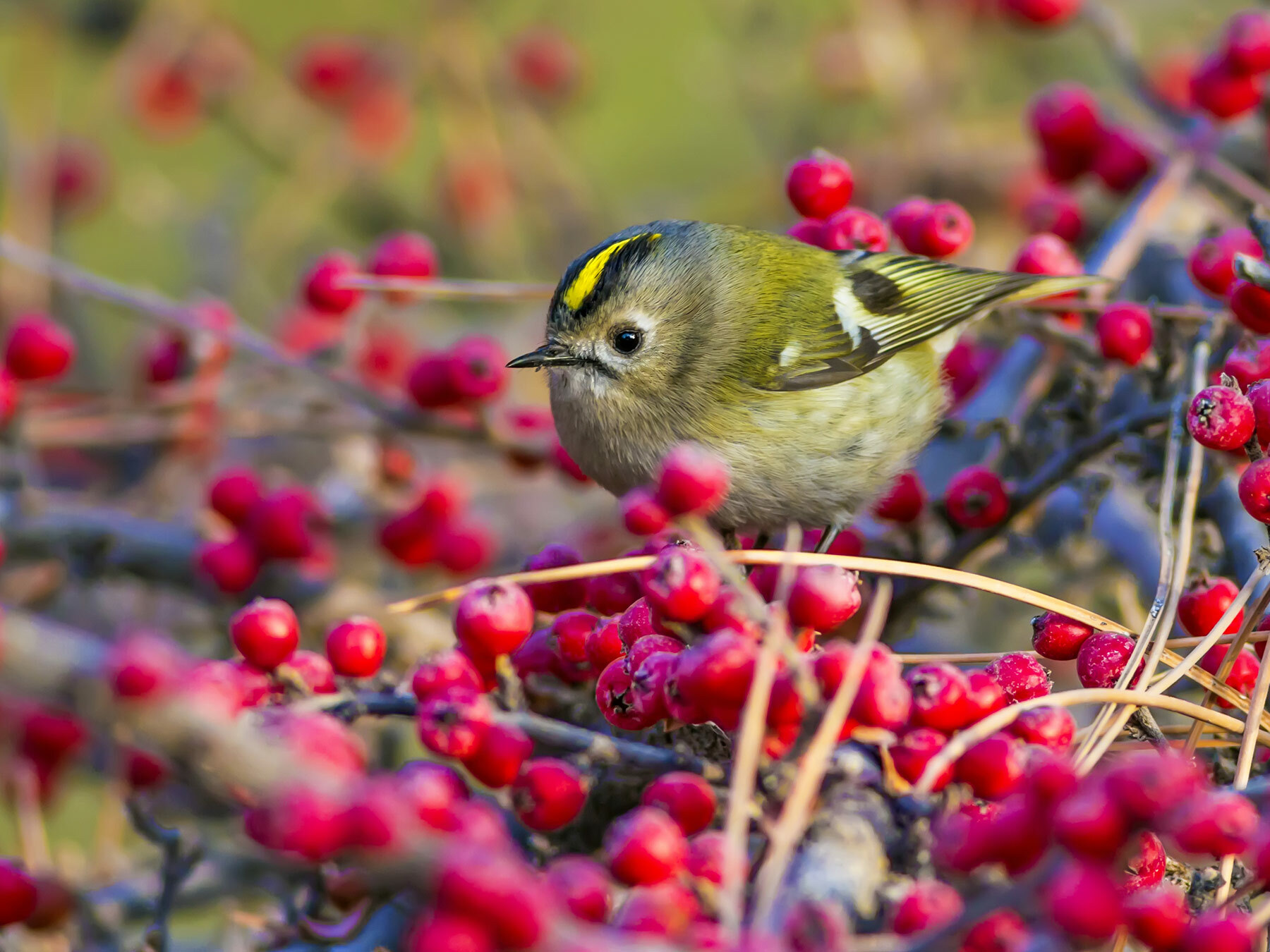
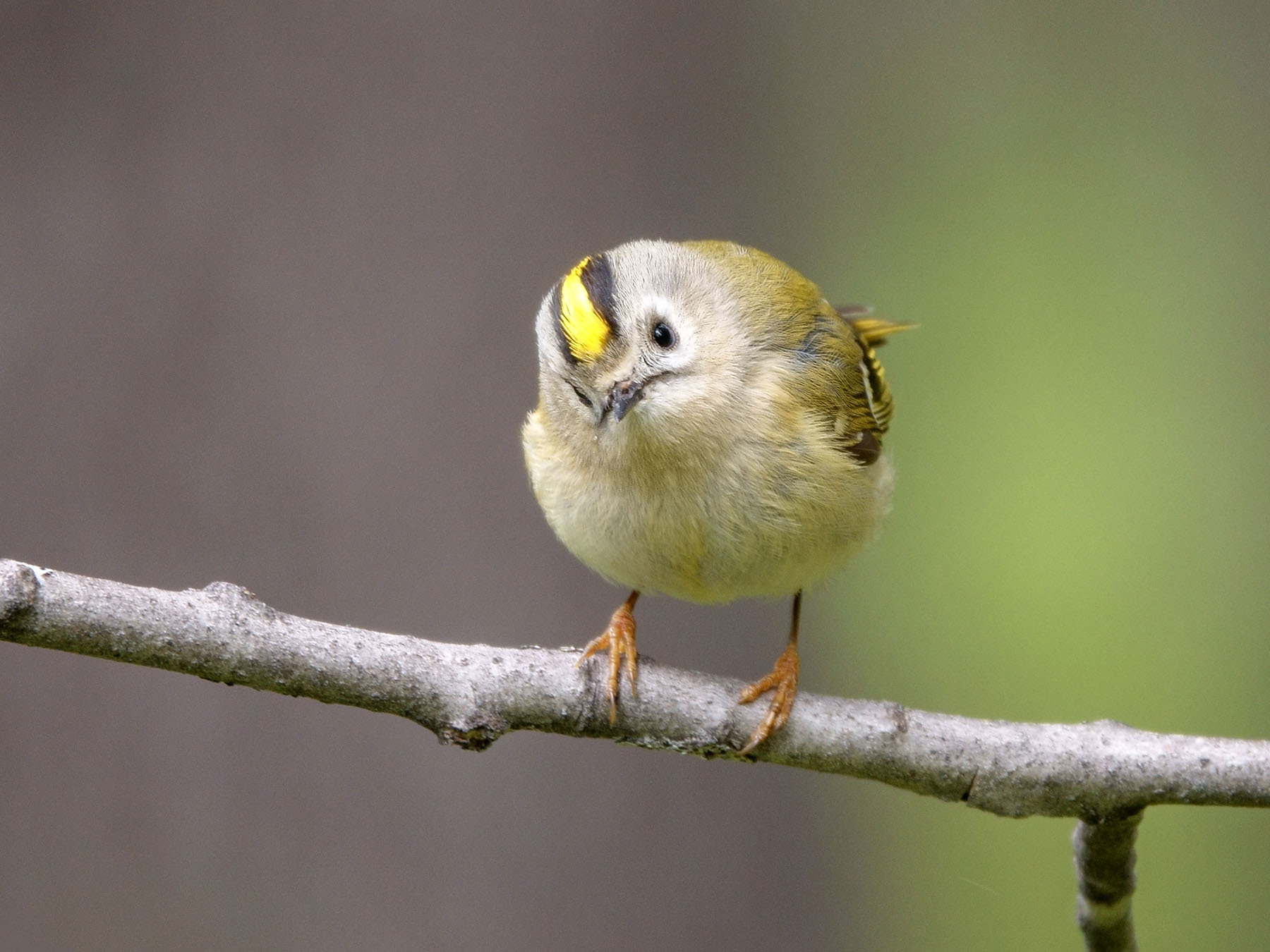
A Goldcrest is a tiny, round, olive-green bird with a pale belly. The mark to look for is on its head: a bright yellow stripe along the crown, bordered with black, which has an orange centre in males. A pale ring around the large dark eye makes the eye stand out, and the thin bill is made for picking insects from between pine needles.1
The face is plain, with a short dark line at the base of the bill, like a small moustache. The wings show two white bars with a black patch behind them, and the bill is needle-like and black-brown. The legs are brown.2
Size: the UK's smallest bird
The Goldcrest and the closely related Firecrest are the UK's smallest birds; the BTO says the two vie for the title.3 A Goldcrest is about 9 cm (3.5 in) long. Adults weighed by BTO ringers average 5.3 g, and most weigh between 4.7 and 6.1 g: about the weight of a 20p coin, which is 5.0 g.4 Firecrests weigh the same, give or take a tenth of a gram, so neither can claim the title outright.5
A Wren looks just as small, and is about as long, but it is much heavier: the BTO's ringing records put the average adult Wren at 9.9 g, nearly twice a Goldcrest's weight. Here is how the Goldcrest compares with other small British birds, weighed by BTO ringers:6
| Bird | Average adult weight | Length |
|---|---|---|
| Goldcrest | 5.3 g | 9 cm |
| Firecrest | 5.4 g | 9-10 cm |
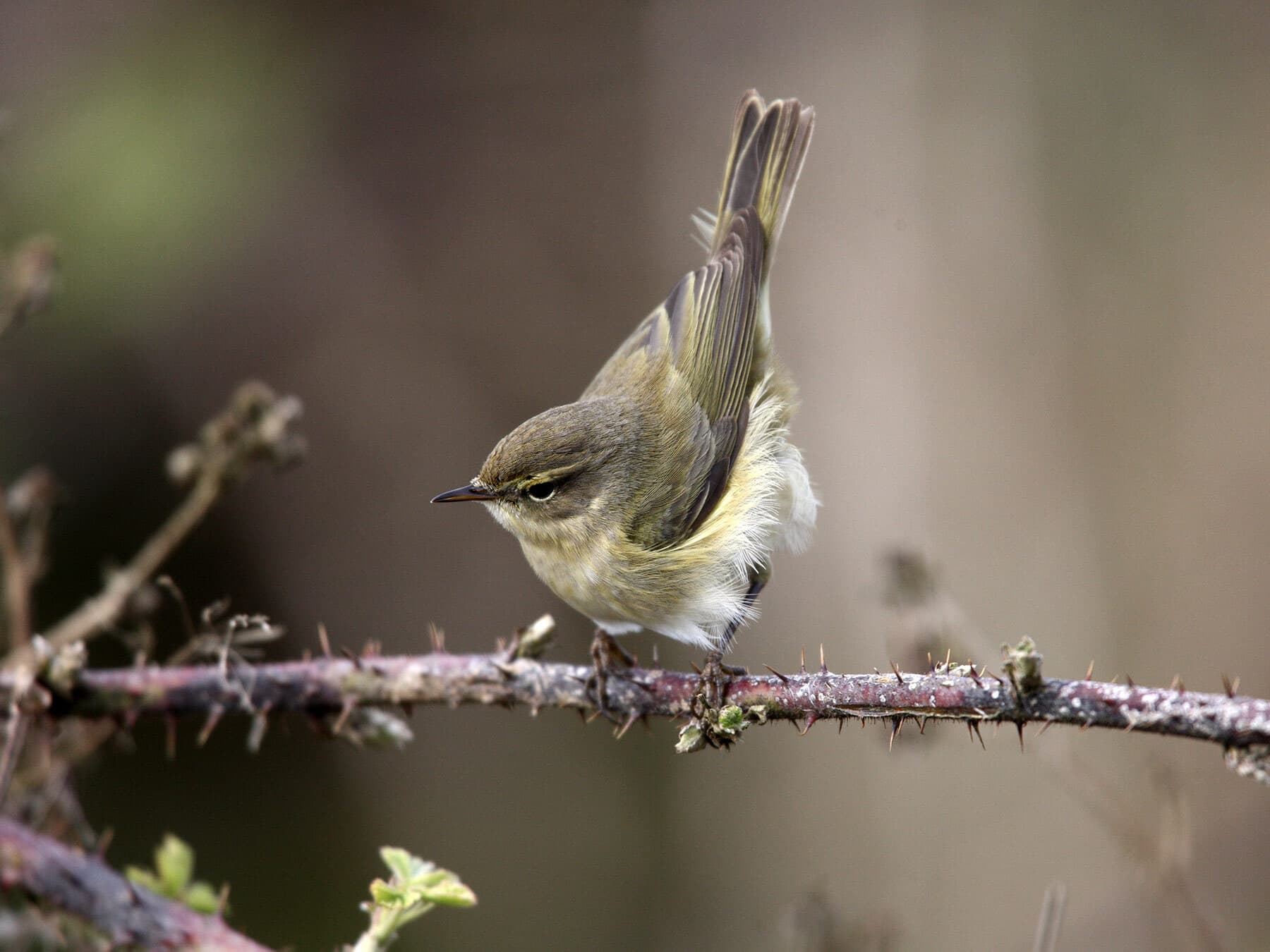
| Chiffchaff | 7.7 g | 10-11 cm |
| Long-tailed Tit | 7.8 g | 14 cm (much of it tail) |
| Coal Tit | 9.1 g | 11.5 cm |
| Wren | 9.9 g | 9-10 cm |
| Blue Tit | 10.9 g | 12 cm |
Lengths are the RSPB's; it gives the Firecrest as 9 cm in its key facts but also calls it slightly larger than a Goldcrest, about 10 cm.7, 8
Male, female and young
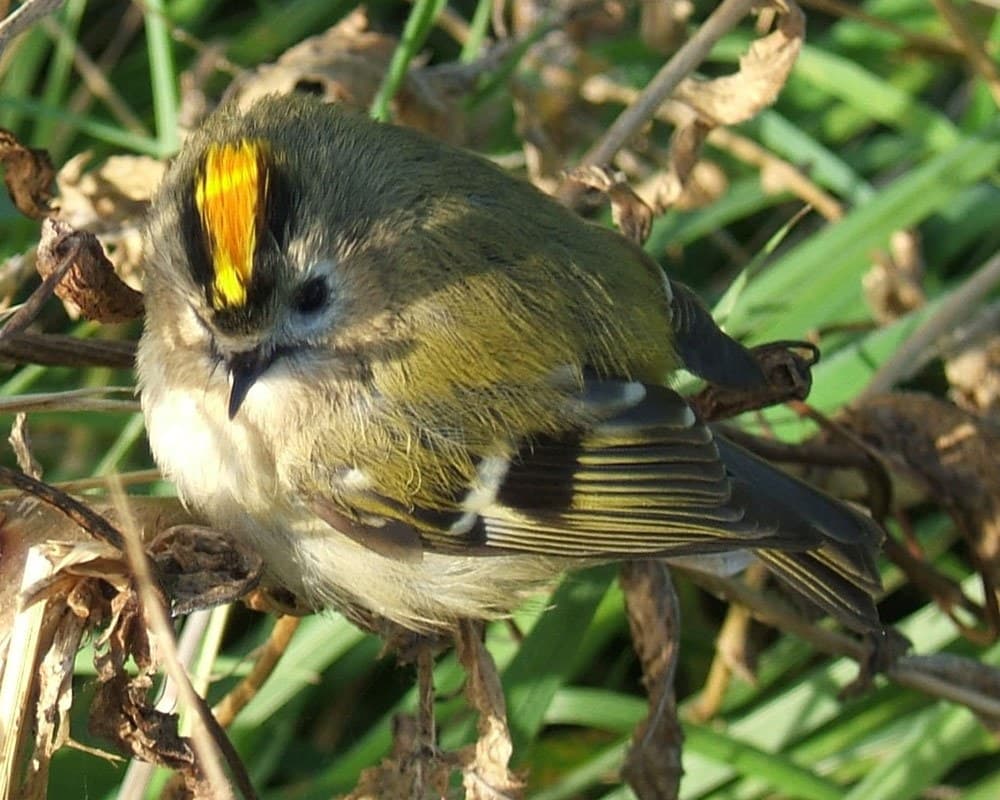
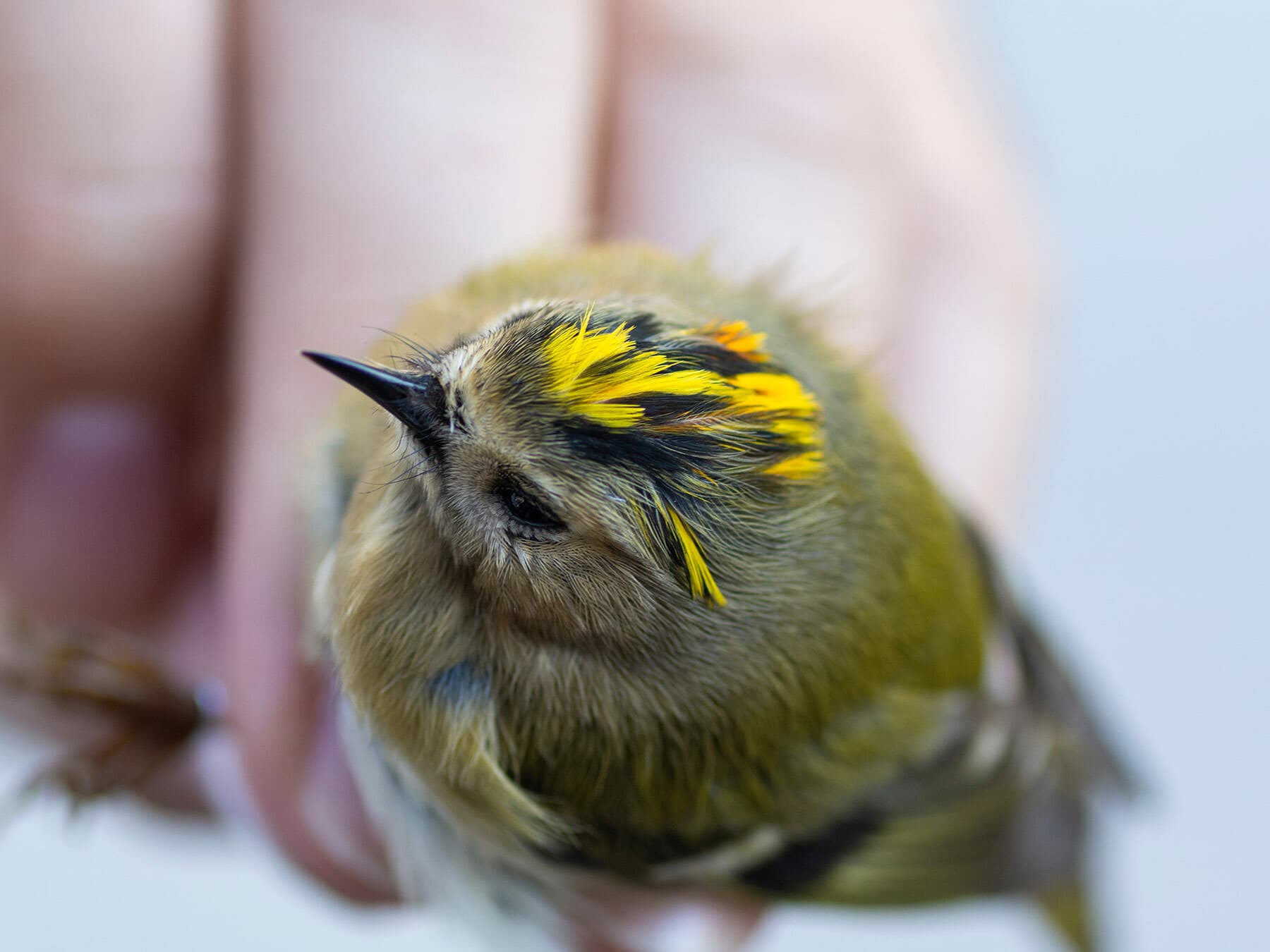
Males and females are alike except for the crown. A male's yellow stripe hides orange feathers in the middle, which show when he raises his crest; a female's stripe is paler yellow, with no orange. The orange is often hard to see on a bird at rest: bird ringers sex Goldcrests in the hand by gently parting the crown feathers to look for it.9
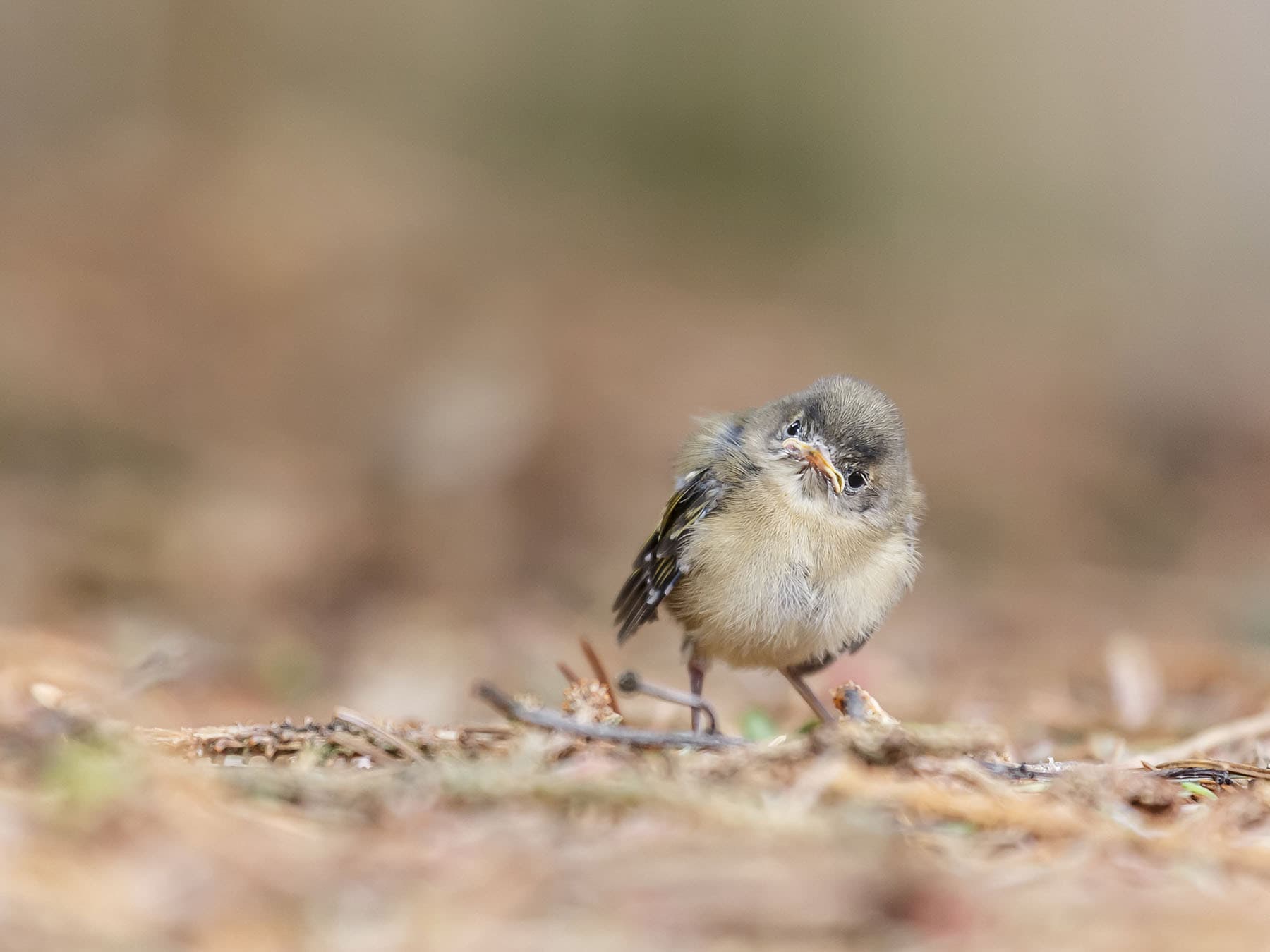
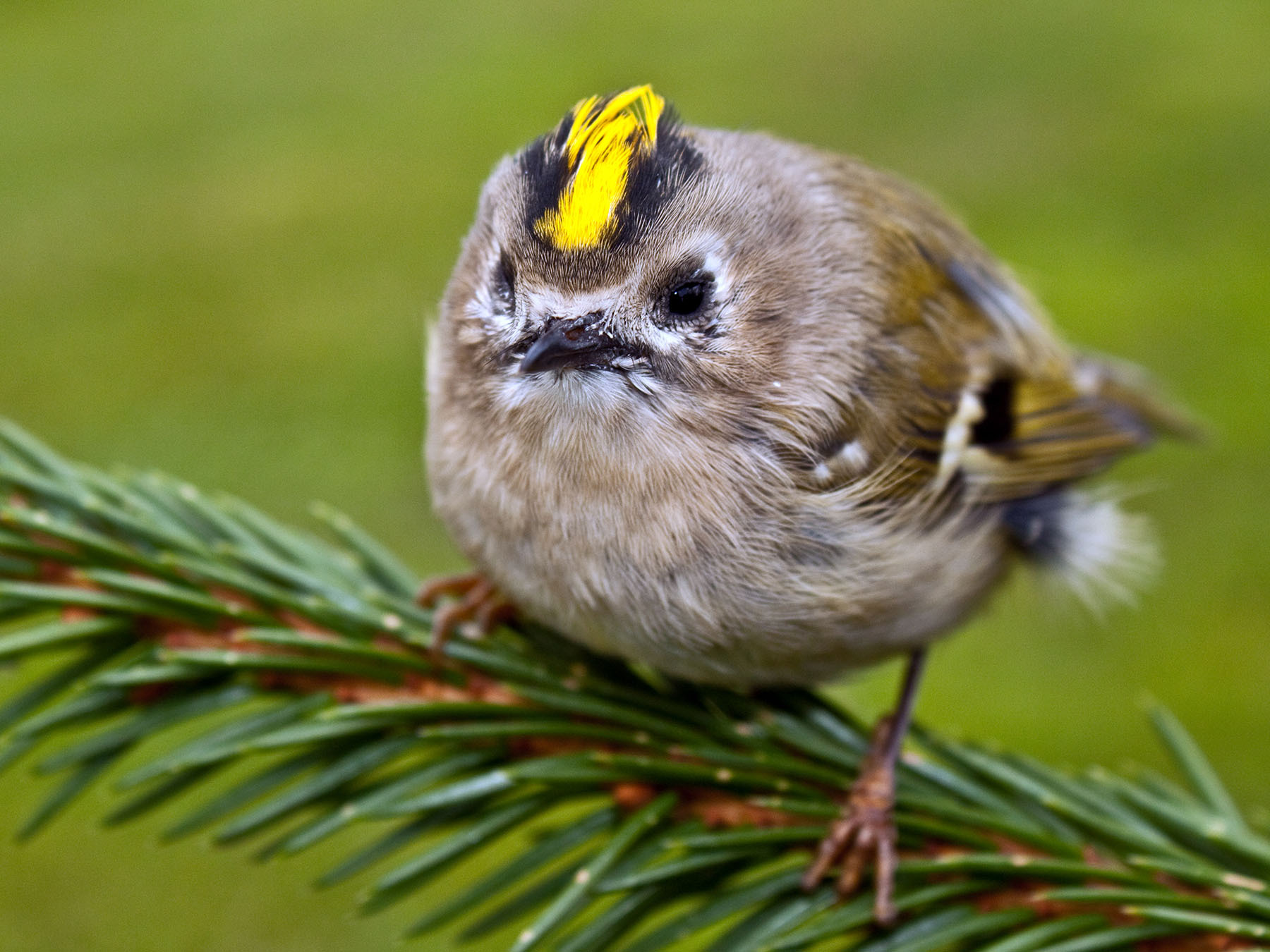
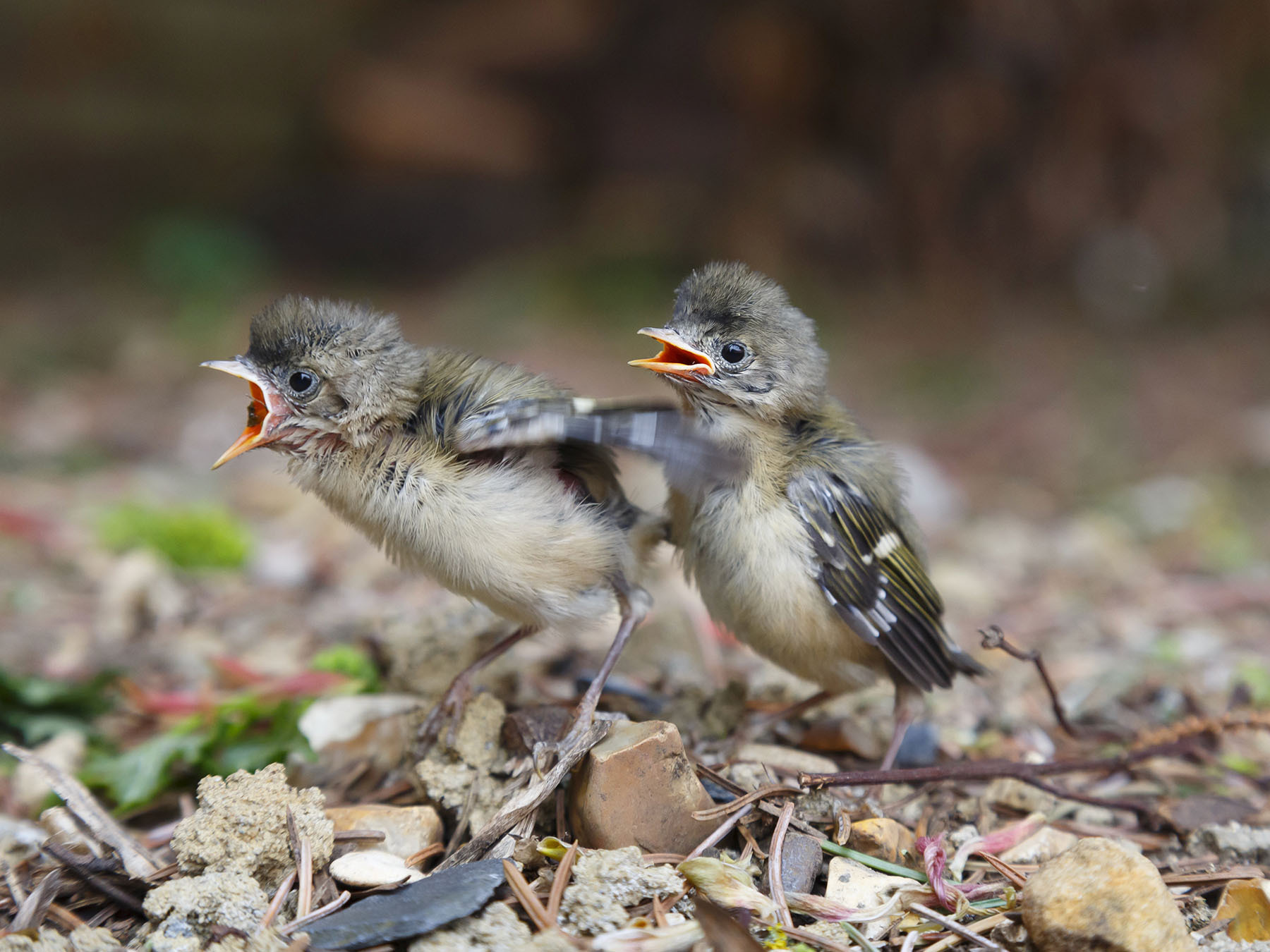
Young Goldcrests are duller and have no coloured crown at all. Their pale eye-ring is less obvious, with a thin dark ring inside it.
Identification: similar birds
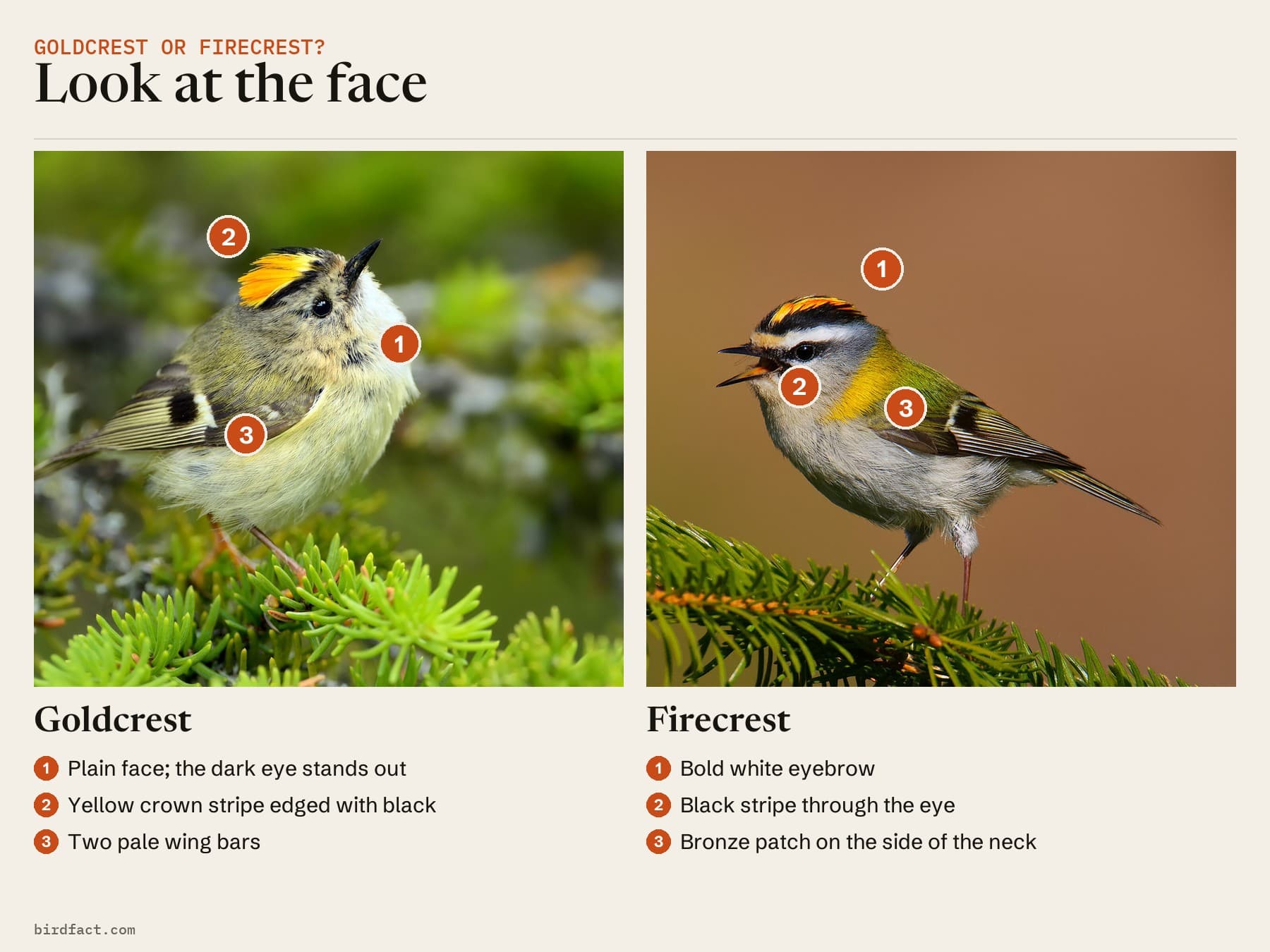
Firecrest. The Goldcrest's close relative the Firecrest is just as small and very similar. Look at the face: a Firecrest has a bold white eyebrow and a black stripe through the eye, and a bronze patch on the side of the neck. It also looks brighter and cleaner, with a greener back and a whiter belly. A Goldcrest's face is plain, so its dark eye stands out. Side by side, with photos: Goldcrest or Firecrest?
Firecrests are far scarcer. In Britain they breed mainly in south-east and eastern England, while Goldcrests are found almost everywhere there are trees.
Its size
Adults- Length
- 8.5–9.5 cm
- Wingspan
- 13–15 cm
- Weight
- 4.6–7.1 g
Its song and calls
Goldcrests are not always easy to see, but the song is easy to recognise. It is very high and thin: a repeated cycle of notes, rising and falling, that ends in a short flourish. The BTO's Bird Table magazine likens it to a "squeaky wheel".9 Each male has a repertoire of up to 28 different endings, and across the species' range the song differs so much from region to region that there are distinct dialects. The calls are thin, high and quiet, sometimes louder.
The song is so high that not everyone can hear it. The highest notes are the first part of our hearing to go as we get older, and many older birdwatchers can no longer hear Goldcrests at all.
Listen to recordings from Britain and see them drawn as spectrograms: Goldcrest song and calls.
- Song0:00 / 0:38
Recorded in Camberley in Surrey, England
Aubrey John Williams / The British Library Board · Wikimedia Commons · CC BY-SA 4.0
- Calls0:00 / 0:35
Recorded in Liverpool, England · June 2023
When and where to see it
OctoberPeak season
Most recorded in October
- 1. Neath Port Talbot3.5%
- 2. Longford3.3%
- 3. Tipperary3.2%
- 4. Bristol2.7%
- 5. Kildare2.7%
Each dot is a county, state or province: the bigger and darker, the larger the bird’s share of that place’s bird records that month. Grey dots: no regular records. The ringed point is the centre of the bird’s records this month; the arrow shows how it moved since last month, and the dashed loop its path through the year. “Arrivals” colours places where it becomes regular this month (orange) or is in its last regular month (grey). GBIF eBird Observation Dataset, 2019–2024. Map data: Natural Earth, US Census Bureau; place centres © OpenStreetMap contributors.
In your area
See when the Goldcrest is recorded in your county, state or province.
How often the Goldcrest turns up in the UK and Ireland through the year, from birdwatchers' records.
United Kingdom
Resident · all year · most records in October
Ireland
Resident · all year · most records in October
Show as a table
| Month | United Kingdom | Ireland |
|---|---|---|
| January | 0.75% (regular) | 0.90% (regular) |
| February | 0.77% (regular) | 0.97% (regular) |
| March | 0.71% (regular) | 1.0% (regular) |
| April | 0.56% (regular) | 1.1% (regular) |
| May | 0.50% (regular) | 1.1% (regular) |
| June | 0.52% (regular) | 0.99% (regular) |
| July | 0.42% (regular) | 0.82% (regular) |
| August | 0.46% (regular) | 0.77% (regular) |
| September | 0.66% (regular) | 1.0% (regular) |
| October | 1.2% (regular) | 1.4% (regular) |
| November | 1.0% (regular) | 1.3% (regular) |
| December | 0.87% (regular) | 1.1% (regular) |
Recorded regularly in
Worldwide: recorded regularly in 71 countries
Countries where it was recorded in at least 3 of the 6 years 2019–2024. Linked countries have their own bird list.
Europe (49)
- Åland Islands
- Albania
- Andorra
- Austria
- Belarus
- Belgium
- Bosnia & Herzegovina
- Bulgaria
- Croatia
- Czechia
- Denmark
- Estonia
- Faroe Islands
- Finland
- France
- Germany
- Greece
- Guernsey
- Hungary
- Iceland
- Ireland
- Isle of Man
- Italy
- Jersey
- Kosovo
- Latvia
- Liechtenstein
- Lithuania
- Luxembourg
- Malta
- Moldova
- Monaco
- Montenegro
- Netherlands
- North Macedonia
- Norway
- Poland
- Portugal
- Romania
- Russia
- San Marino
- Serbia
- Slovakia
- Slovenia
- Spain
- Sweden
- Switzerland
- Ukraine
- United Kingdom
Africa (1)
Asia (21)
- Armenia
- Azerbaijan
- Bhutan
- China
- Cyprus
- Georgia
- India
- Iran
- Israel
- Japan
- Kazakhstan
- Kyrgyzstan
- Lebanon
- Mongolia
- Nepal
- Pakistan
- South Korea
- Taiwan
- Tajikistan
- Turkey
- Uzbekistan
Data: EOD – eBird Observation Dataset (Cornell Lab of Ornithology), accessed via GBIF.org, CC BY 4.0. Records from 2019–2024, aggregated and filtered by Birdfact. How these lists are made
Goldcrests live across Britain and Ireland all year. In the last national atlas they were found in 87% of the UK's 10-km squares in the breeding season and 90% in winter, missing mainly from treeless country: the Scottish Highlands, the Outer Hebrides, the Northern Isles and the Fens. They are found at their highest densities in Ireland. In the breeding season British surveys find them most often in coniferous woods.3
They are birds of conifers: across their range, especially forests of spruce and fir. But they need very little: a single yew in a churchyard or garden can hold a nesting pair. Parks and gardens with mature trees suit them, and outside the breeding season they spread into broadleaved woods, scrub and gardens.
Spotting tips
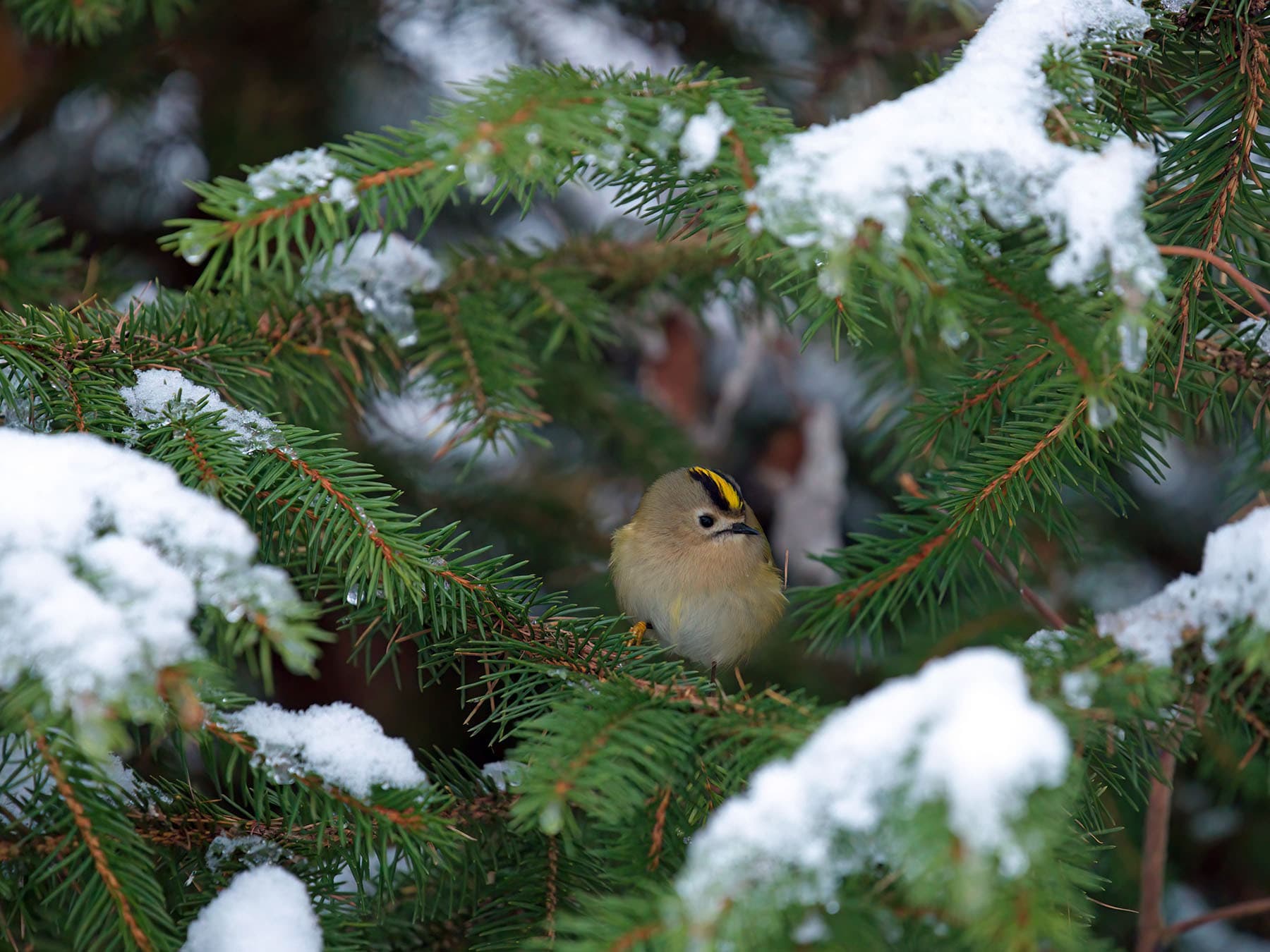
Listen first: the thin, high song and calls give them away. Then look into the treetops of conifers for a tiny, very active bird, often dangling upside down as it hunts for insects. In winter, check flocks of tits, which Goldcrests often tag along with. Winter is the best time of year to see one, when migrants from the continent boost the numbers.
Do they migrate?
British and Irish Goldcrests are resident, but each autumn they are joined by many more from across the North Sea, from Fennoscandia and further east. Large numbers can arrive on the east coast, resting in the dunes after the crossing. In autumn Goldcrests turn up on almost 30% of birdwatchers' complete lists, against about 15% the rest of the year.3
Ringing shows where they come from. The BTO has 351 reports of Goldcrests ringed abroad and found in Britain and Ireland, most from Norway (92), Sweden (60), the Netherlands (55) and Finland (35). One ringed in Latvia on 4 October 2015 was caught in Kent a week later, 1,399 km away.10 Some of the arrivals move on to winter in France.
For a bird this small, the crossing seemed hard to believe. In 1885 Charles Swainson recorded that Goldcrests were caught by hand in ships' rigging during the North Sea fishing, and that further north the bird was called the "woodcock pilot", because it was supposed to arrive two days ahead of the Woodcock.11 The RSPB tells a different version: that people thought Goldcrests hitched a ride on migrating Woodcocks.
What it eats
Tiny insects and spiders. Goldcrests take very small prey, especially springtails, which they favour outside the breeding season, as well as aphids, small moths and tiny spiders. On migration, when food is short, they take larger prey such as adult winter moths, beating the biggest items against a branch.2 Moth eggs and caterpillars are on the menu too.
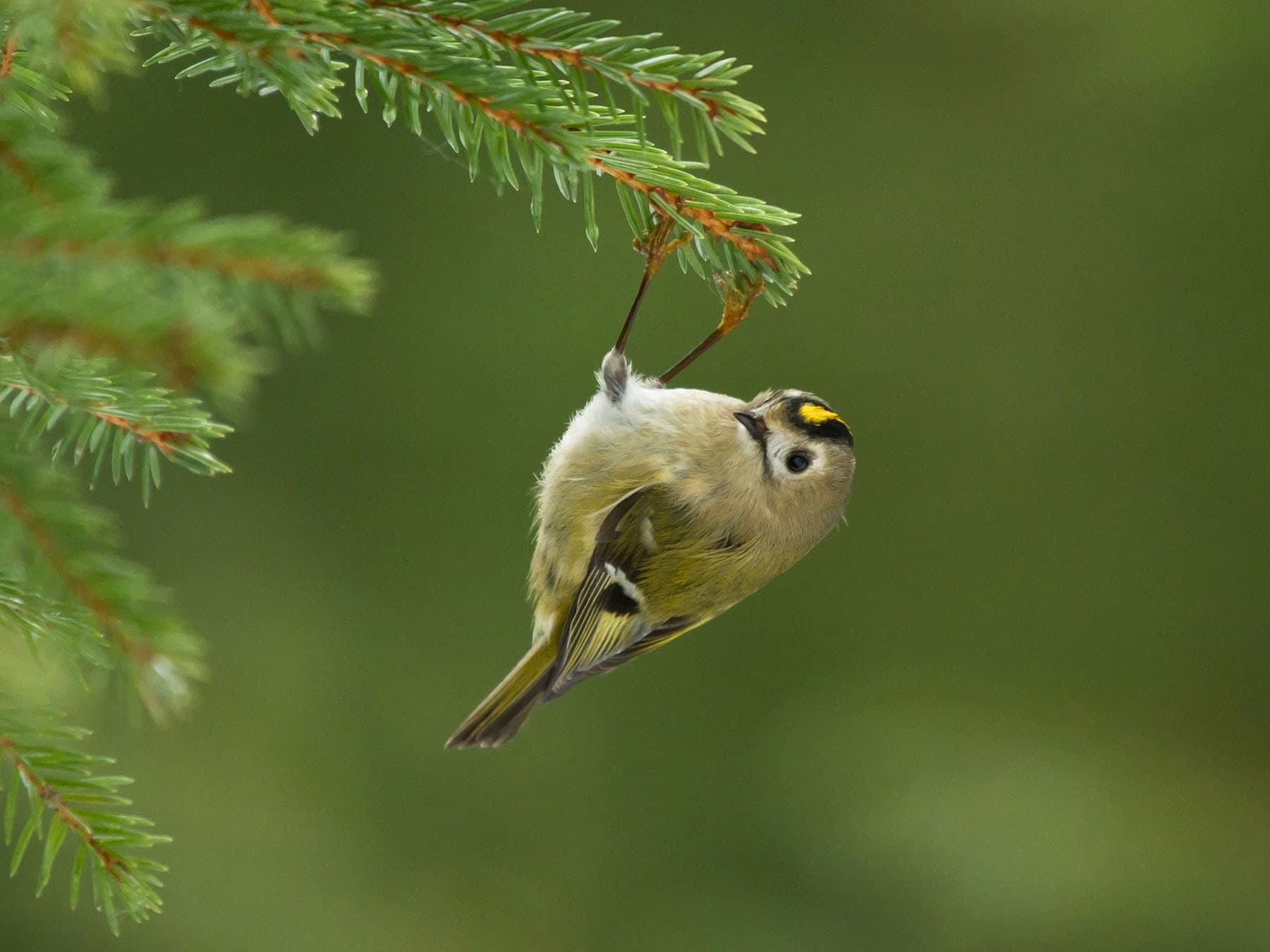
They feed mostly by clinging to and hanging from twigs, working up and down the vertical twigs of conifers and searching the undersides of branches. They also hover at the tips of branches to pick off insects, and sometimes hover at a spider's web to take the insects trapped in it; rarely, a Goldcrest gets caught in the web and may die.
Gardens and feeders
As insect-eaters, Goldcrests rarely come to bird feeders. They are seen more in gardens in winter, when harsh weather can push them to feeders and they travel with flocks of Blue and Great Tits.
Nesting and breeding
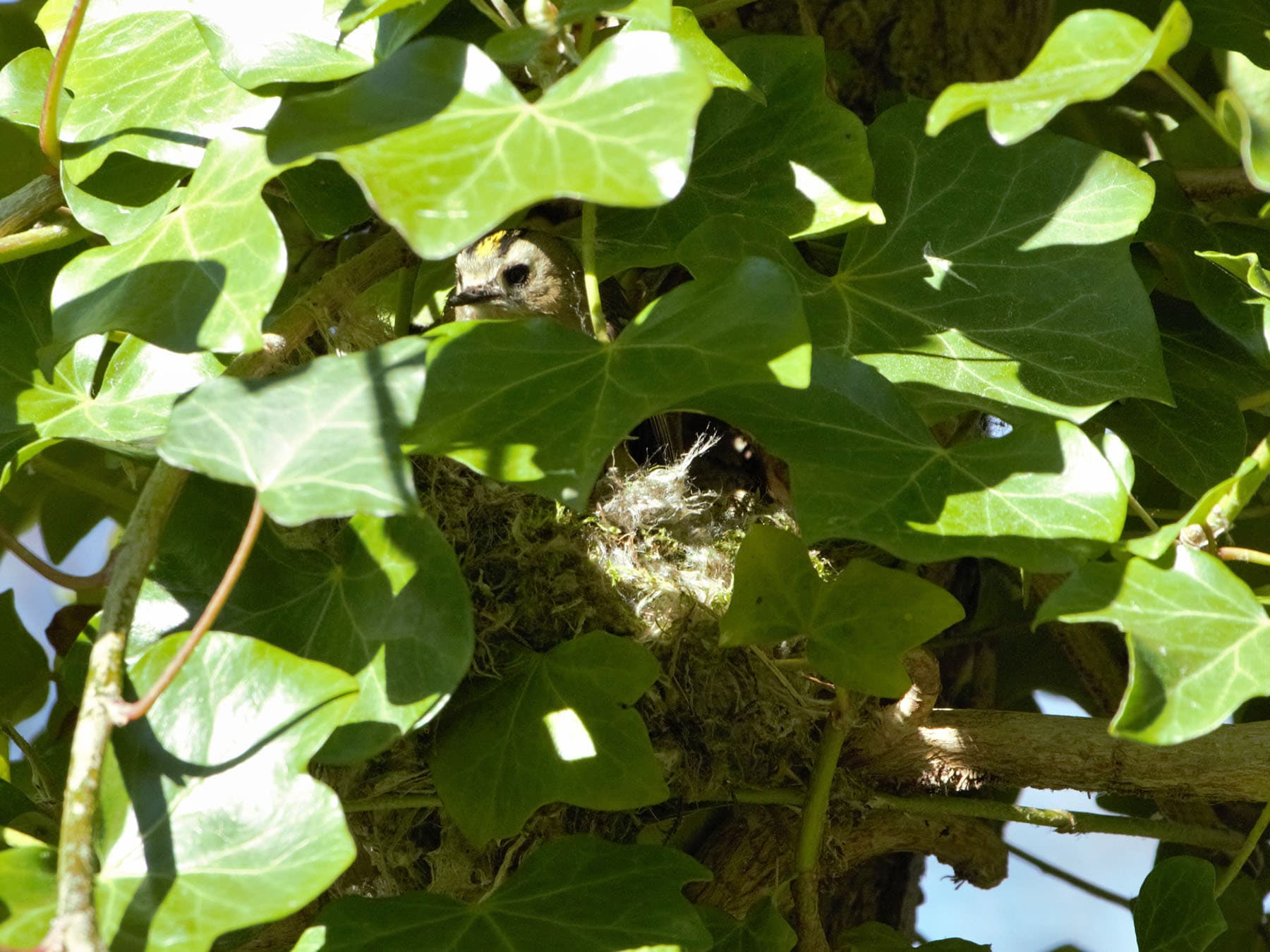
A Goldcrest's nest hangs. It is a deep cup with thick walls, built of lichen, moss and spiders' silk and slung among the twigs of a conifer branch, lined with feathers: up to 2,500 of them in one nest. Both birds build it. In Britain it is usually high up, towards the drooping tips of a level branch.
In Britain a clutch is usually 6 to 8 eggs and can be as many as 12; the BTO says 12 eggs weigh about one and a half times as much as the female. She incubates them for 16 to 19 days, and the chicks leave the nest at about 16 to 18 days. Pairs raise two broods a year.3 They often start the second before the chicks from the first have fledged. Goldcrests are not on any of the BTO's nest-box lists.12 More detail: Goldcrest nests, eggs and young.
Behaviour
Goldcrests are very active, always on the move through the foliage, hanging and hovering to feed. Outside the breeding season they often go about in small, loose groups and join mixed flocks of other small birds.
In the breeding season they can be conspicuous. When two males dispute a territory they chase each other, scolding, with their crests spread open to show the orange.9
Lifespan and predators
A Goldcrest that survives to breed typically lives about 2 years, and breeds when a year old. Winter is the hard part for a bird so small: the RSPB says "it's thought that eight out of ten Goldcrests die each winter", which is why such large clutches matter.1
The oldest Goldcrest on the BTO's ringing list was ringed in its first year at Ravensroost Wood, Wiltshire, in November 2015 and caught by a ringer on the Isles of Scilly in March 2021, 5 years 3 months 14 days later.13 The European longevity list, which estimates age rather than time since ringing, has a German bird of 6 years 11 months.14
Conservation
The Goldcrest is on the UK Green List and is of Least Concern worldwide. The BTO estimated 790,000 territories in the UK in 2016.
Its numbers swing with the weather. Harsh winters can cut them sharply, and numbers can recover within a few breeding seasons. The BTO's Bird Table magazine reported in 2014 that numbers had risen until 2008 after a run of mild winters, then a long spell of freezing weather cut the breeding population by 56%, and by over 60% in Scotland; numbers had recovered steadily since.9 Over the longer run, UK numbers changed little between 1995 and 2024 (up 16%, not a significant change),15 and the BTO classes the trend as stable.
Similar birds
Often mistaken for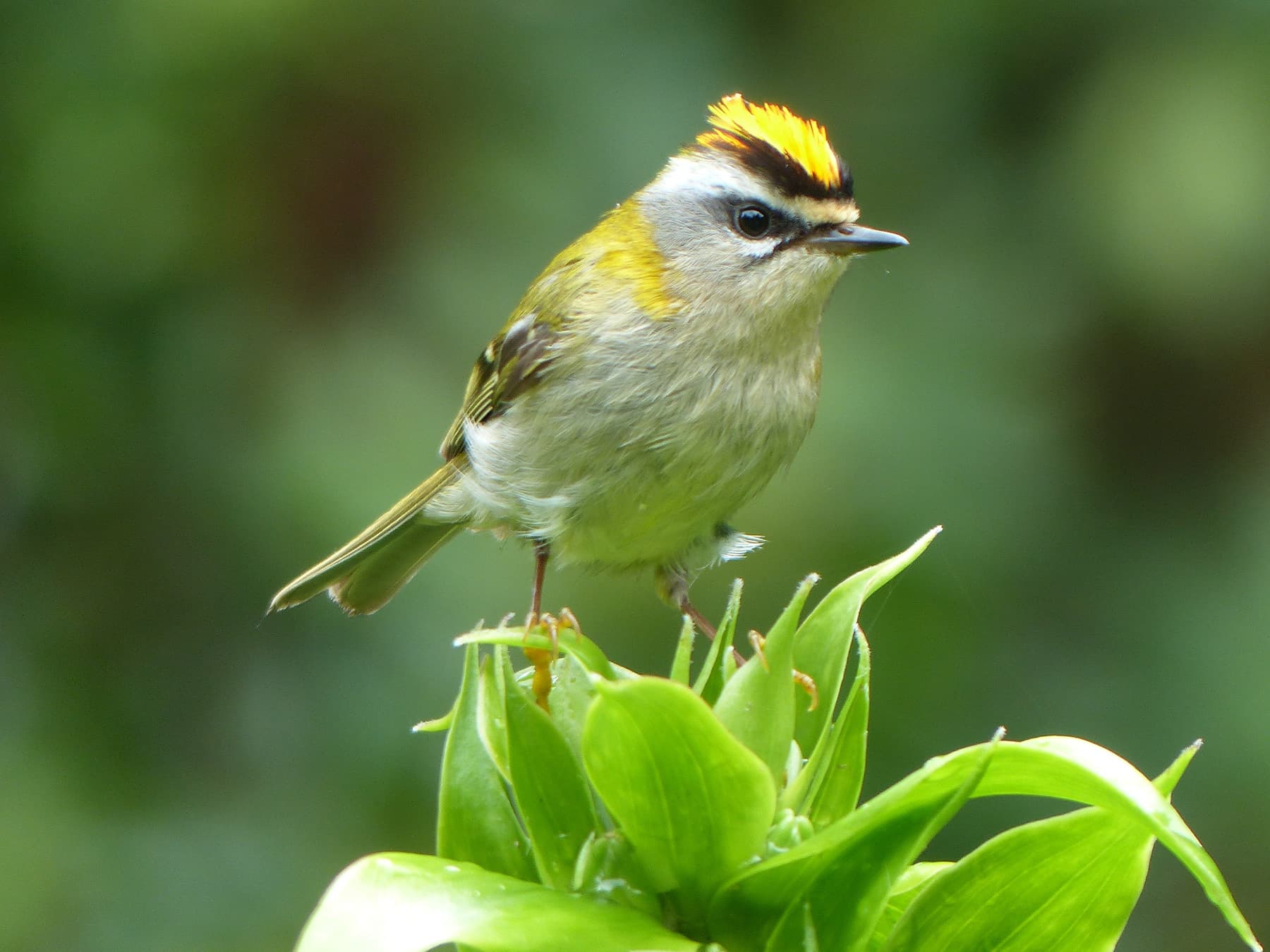
More photos
6 photos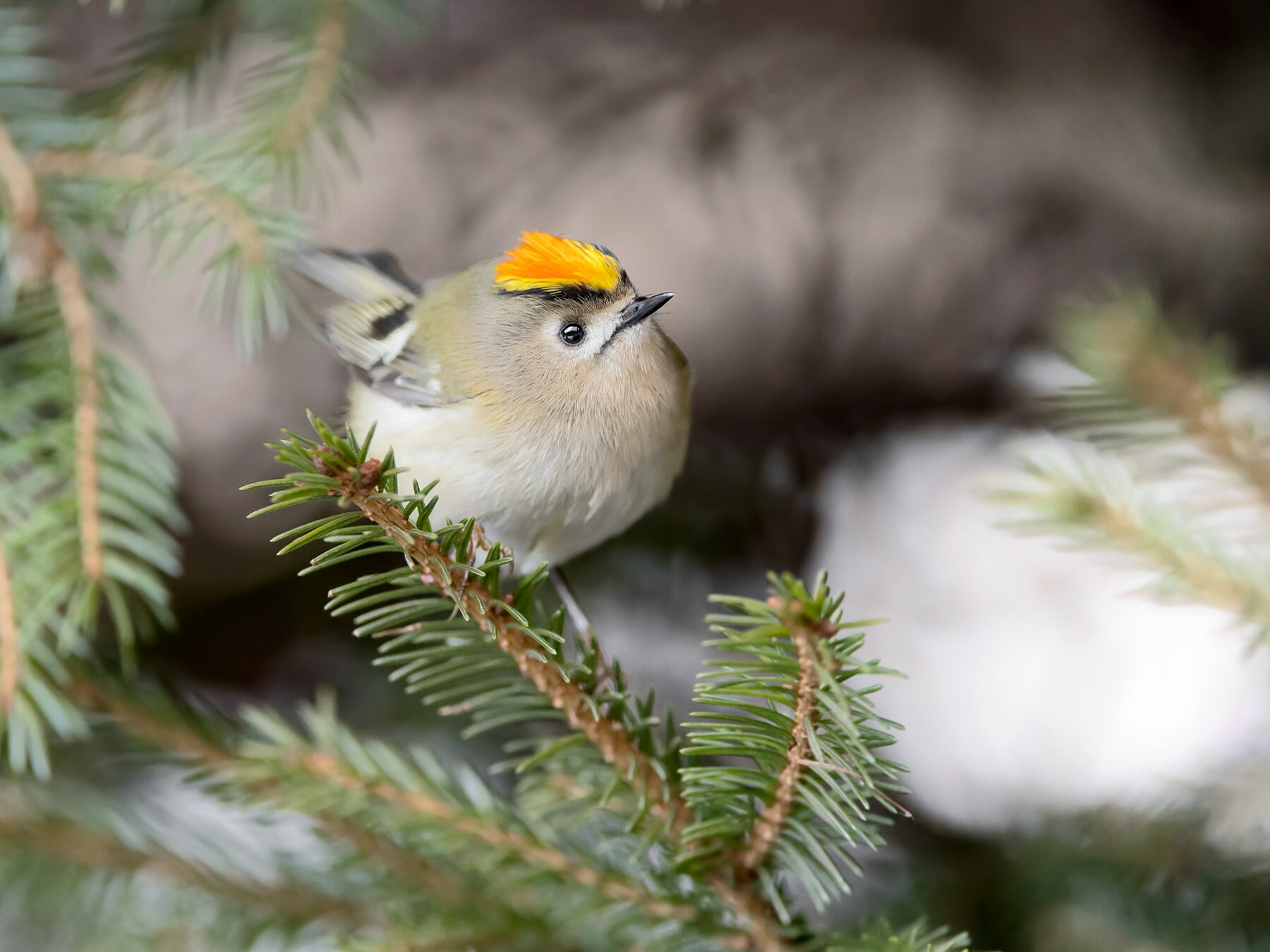
Goldcrest guides
4 guidesQuick facts
- Length
- 8.5–9.5 cm
- Wingspan
- 13–15 cm
- Weight
- 4.6–7.1 g
- Lifespan
- 2 years · oldest recorded 6.9 years · UK record 5 years 3 months
- Family
- Goldcrests & Kinglets
- Migration
- Partial migrant
- Global status (IUCN)
- Least Concern
- Population trend
- Stable in the UK since 1995 (BTO), though numbers rise and fall with winter weather
- Also called
- Golden-crested Kinglet
- Scientific name
- Regulus regulus
Questions
2Are they rare in the UK?
No. There were about 790,000 territories in 2016, and they are found in most of the UK wherever there are trees. Their close relative the Firecrest is the rare one. See conservation status.
Which is rarer, Goldcrest or Firecrest?
The Firecrest, by far: the UK had about 2,000 Firecrest territories in 2017. See Goldcrest or Firecrest?
Sources
17- 1RSPB. Goldcrest. RSPB Birds A-Z. Accessed 9 October 2026. Source (opens in a new tab)
- 2Martens, J. and Päckert, M. (2020). Goldcrest (Regulus regulus), version 1.0. Birds of the World (J. del Hoyo, A. Elliott, J. Sargatal, D. A. Christie and E. de Juana, editors). Cornell Lab of Ornithology. doi:10.2173/bow.goldcr1.01 (opens in a new tab)
- 3BTO. Goldcrest (Regulus regulus). BTO BirdFacts. Accessed 9 October 2026. Source (opens in a new tab)
- 4The Royal Mint. Twenty pence coin: design and specifications. The Royal Mint. Accessed 9 October 2026. Source (opens in a new tab)
- 5BTO. Firecrest (Regulus ignicapilla). BTO BirdFacts. Accessed 9 October 2026. Source (opens in a new tab)
- 6BTO. BirdFacts biometrics: Wren, Coal Tit, Long-tailed Tit, Blue Tit, Chiffchaff. BTO BirdFacts. Accessed 9 October 2026. Source (opens in a new tab)
- 7RSPB. Wren, Coal tit, Long-tailed tit, Blue tit and Chiffchaff. RSPB Birds A-Z. Accessed 9 October 2026. Source (opens in a new tab)
- 8RSPB. Firecrest. RSPB Birds A-Z. Accessed 9 October 2026. Source (opens in a new tab)
- 9Risely, K. (2014). Goldcrest: species focus. Bird Table 78 (BTO Garden BirdWatch magazine), Summer 2014, pp. 18-19. Accessed 9 October 2026. Source (opens in a new tab)
- 10Robinson, R. A., Leech, D. I. and Clark, J. A. (2025). Summary of all recoveries for Goldcrest (Regulus regulus). The Online Demography Report: bird ringing and nest recording in Britain & Ireland in 2024 (BTO). Accessed 9 October 2026. Source (opens in a new tab)
- 11Swainson, C. (1885). The Provincial Names and Folk Lore of British Birds. English Dialect Society / Trübner, London. Accessed 9 October 2026. Source (opens in a new tab)
- 12BTO. Nest boxes for birds. BTO, Helping birds. Accessed 9 October 2026. Source (opens in a new tab)
- 13BTO. Longevity records for Britain & Ireland in 2024. BTO Online Ringing and Nest Recording Report. Accessed 9 October 2026. Source (opens in a new tab)
- 14Fransson, T., Kolehmainen, T., Moss, D. and Robinson, R. (2023). EURING list of longevity records for European birds (1 September 2023). EURING. Accessed 9 October 2026. Source (opens in a new tab)
- 15Heywood, J. J. N., Massimino, D., Baker, L., Balmer, D. E. et al. (2026). The Breeding Bird Survey 2025. BTO Research Report 802. British Trust for Ornithology, Thetford. Accessed 9 October 2026. Source (opens in a new tab)
- 16Martens, J. and Päckert, M. (2020). Common Firecrest (Regulus ignicapilla), version 1.0. Birds of the World (J. del Hoyo, A. Elliott, J. Sargatal, D. A. Christie and E. de Juana, editors). Cornell Lab of Ornithology. doi:10.2173/bow.firecr1.01 (opens in a new tab)
- 17RSPB. Chiffchaff. RSPB Birds A-Z. Accessed 9 October 2026. Source (opens in a new tab)

Checked by
Nathan Cope, founder and editor
Nathan founded Birdfact and leads its writers and contributors in the UK, the US and Canada. He has watched and studied birds for more than ten years, and checks every article and species guide before it’s published.