Species Profile
Black-throated Green Warbler
Setophaga virens
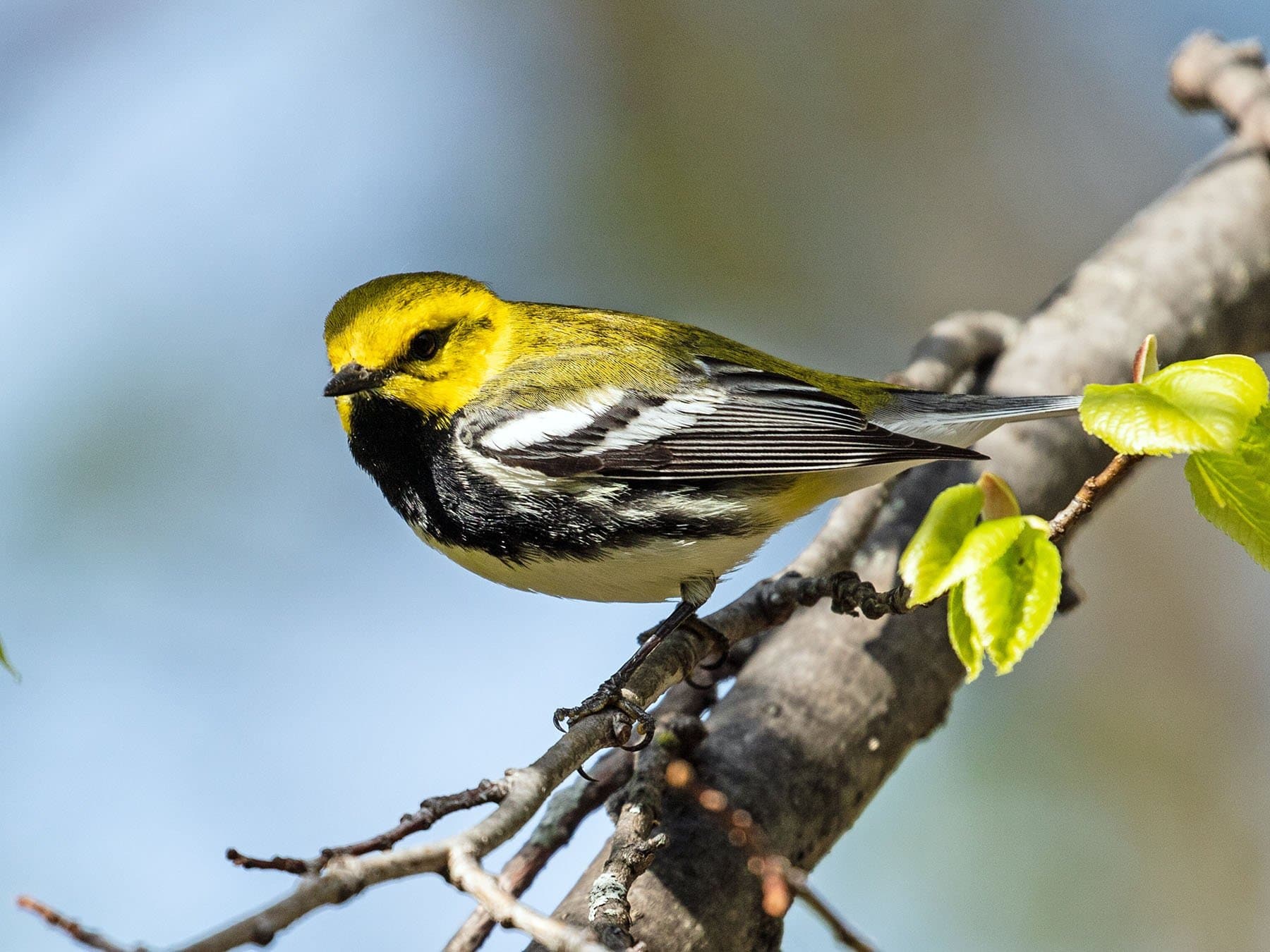
Black-throated Green Warbler perched on a bare branch with new green leaves. Features yellow head, black throat, white belly, and white wing bars.
Quick Facts
Conservation
LCLeast ConcernLifespan
3–6 years
Length
11–12 cm
Weight
8.5–11.3 g
Wingspan
17–20 cm
Migration
Long-distance Migrant
A lemon-yellow face blazing against a jet-black throat makes the male Black-throated Green Warbler one of the most instantly recognisable warblers in North America. This small but persistent songbird pours out its buzzy zee-zee-zee-zoo-zee from the conifer canopy with extraordinary dedication — one male was documented singing 14,000 songs over 94 hours. An estimated 51% of the global population nests in Canada's boreal forest, making this bird as much a symbol of the north woods as the spruce trees it calls home.
Think you've spotted a Black-throated Green Warbler?
Upload a photo and we'll confirm it instantly
Confirm with a PhotoAppearance
The adult male Black-throated Green Warbler is built around a single, arresting contrast: a brilliant lemon-yellow face set against a solid black chin, throat, and upper breast. The crown and entire upperparts — back, scapulars, and rump — are a rich olive-green, and two bold white wingbars cut across the dusky, slate-edged wings. The underparts are white to yellowish-white, with heavy black streaking along the flanks and sides. A broad olive-green postocular streak runs behind the eye, and the vent area carries a distinctive yellow wash. The outer tail feathers are largely white, a feature that becomes significant during foraging (see Diet).
In breeding plumage the black of the throat is solid and extensive. In non-breeding (autumn and winter) plumage, males may show slightly reduced black on the throat, though the pattern remains unmistakable. First-year males from August through March closely resemble adult females.
The species is sexually dimorphic. Females share the male's olive-green crown and back, yellow face, dusky olive ear patch, and two white wingbars, but are noticeably duller overall. The chin and upper throat are white to pale yellow rather than solid black, though some females show a scattering of black flecks. Black markings on the breast are present but less extensive and often broken or mottled rather than solid. The flanks retain the characteristic black streaking, and the vent shows the same yellow wash as the male. Immature birds of both sexes have pale yellow faces with a dusky ear patch and a white throat; side streaking can be crisp or messy depending on age and sex.
The bill is thick and straight, giving the bird a slightly heavy-headed look for its size. The body is plump and compact, with a shortish tail. The "Wayne's" subspecies (S. v. waynei), which breeds in coastal cypress swamps from Virginia to South Carolina, averages slightly smaller than the nominate population.
Identification & Characteristics
Male Colors
- Primary
- Olive
- Secondary
- Yellow
- Beak
- Black
- Legs
- Pink
Female Colors
- Primary
- Olive
- Secondary
- Yellow
- Beak
- Black
- Legs
- Pink
Male Markings
Brilliant lemon-yellow face; solid black chin, throat, and upper breast (male); olive-green crown and back; two bold white wingbars; heavy black flank streaking; yellow vent wash; white outer tail feathers
Tail: Short tail with largely white outer tail feathers, conspicuous when fanned; flicked during foraging to startle insects
Female Markings
Yellow face with dusky olive ear patch; white to pale yellow chin and throat (sometimes with black flecks); olive-green crown and back; two white wingbars; black breast markings less extensive and often broken; black flank streaking; yellow vent wash
Tail: Short tail with largely white outer tail feathers, as in male
Attributes
Understanding Attributes
Rated 0–100 based on research and observation. A score of 50 is average across all bird species. These attributes are relative and don't necessarily indicate superiority.
Habitat & Distribution
Across most of its breeding range, the Black-throated Green Warbler is strongly tied to conifers. In the northern boreal zone — which holds an estimated 51% of the global breeding population — it nests in spruce, fir, and pine forests stretching from eastern British Columbia and Alberta east to the Maritime provinces and Newfoundland. In the Appalachians it favours hemlock and mixed coniferous-deciduous forest; in the southern mountains it also occurs in deciduous forest on steep slopes. The species shows a preference for forest interiors over edges, making it susceptible to habitat fragmentation.
The "Wayne's" subspecies (S. v. waynei) is uniquely adapted to coastal plain wetland forests — bald cypress, Atlantic white cedar, and hardwood swamps — from southeastern Virginia to northeastern South Carolina. Small breeding populations also occur in pine stands in southern Indiana and the Arkansas Ozarks. Elevation range spans from sea level in coastal swamps to mountaintops in the Appalachians.
In winter, the species migrates to eastern and southern Mexico, Central America (particularly montane forests), the West Indies including the Bahamas and Greater Antilles, and southern Florida. Small numbers winter in south Texas and northern South America, with the southernmost records from Ecuador. Wintering birds are most commonly found in the canopies of tall mature forests among oaks and pines, though they also use shade-grown coffee plantations with native canopy trees and occasionally secondary growth.
During migration, the species occurs widely across eastern North America east of the Great Plains. In the US, it is a regular vagrant to western states including California, Arizona, Nevada, Colorado, Utah, Oregon, Idaho, and New Mexico, and has been recorded in Alaska. For birders in Canada, this is a widespread and often common breeding species across the boreal zone, particularly in Ontario, Quebec, and the Maritime provinces. In the United States, it breeds across New England, the Great Lakes region, and along the Appalachians south to northern Georgia and Alabama, and is a familiar migrant throughout the eastern states each spring and autumn.
Where to See This Bird
Explore regional guides for locations where this bird has been recorded.
Illinois
Indiana
Kentucky
Massachusetts
Maryland
Maine
New Jersey
Michigan
Alabama
North Carolina
Connecticut
District of Columbia
New Hampshire
New York
Ohio
Pennsylvania
Tennessee
Vermont
Wisconsin
West Virginia
Canada
New Brunswick
Newfoundland and Labrador
Nova Scotia
Ontario
Prince Edward Island
Quebec
Diet
During the breeding season, Black-throated Green Warblers feed almost exclusively on insects and other invertebrates. Non-hairy caterpillars are the primary prey in summer, supplemented by beetles, true bugs (Hemiptera), gnats, aphids, and spiders. The species capitalises on spruce budworm outbreaks, which can temporarily make it one of the most abundant breeding birds in affected boreal forests — a dramatic example of a predator tracking its prey at landscape scale.
The primary foraging technique is gleaning: the bird creeps along small branches and the bases of leaves, picking off insects with precise bill strikes. It also frequently hovers to take prey from the undersides of leaves, and occasionally hawks insects in mid-air. The white outer tail feathers are flicked during foraging, reportedly to startle insects into movement and reveal their position.
Diet shifts with the seasons. In late summer and during migration, berries supplement the insect diet — including the berries of poison ivy, which many birds exploit as a high-fat fuel source before and during long migratory flights. On the tropical wintering grounds, the species feeds on the protein corpuscles of cecropia trees in addition to insects, a dietary flexibility that helps it exploit a wider range of wintering habitats.
Males tend to forage higher in the canopy than females during the breeding season, a pattern that reduces direct competition between mates. In late summer, birds often join mixed-species foraging flocks, benefiting from the collective vigilance of chickadees and other warblers while working through the foliage.
Behaviour
Black-throated Green Warblers are active, restless foragers that spend most of their time working through the mid-to-upper canopy. Males tend to forage higher than females during the breeding season, a pattern that reduces competition between mates on shared territories. Outside the breeding season, birds often join mixed-species flocks with chickadees, other warblers, and kinglets — a strategy that improves predator detection and foraging efficiency.
The species occupies a defined position in the social hierarchy of co-occurring warblers. Black-throated Green Warblers are dominant over Blackburnian Warblers, Yellow-rumped Warblers, and Northern Parulas, but subordinate to Magnolia Warblers. This pecking order influences territory placement and foraging zones where multiple species breed in close proximity.
Males are exceptionally persistent singers. One individual was documented singing 466 songs in a single hour; another was recorded singing 14,000 songs over 94 hours. Males sing from exposed perches high in the canopy, where the bright yellow head is conspicuous against the dark foliage. Territorial disputes between rival males can escalate to chasing and physical fighting; after a dispute, the victor sometimes performs a shallow, moth-like display flight.
The white outer tail feathers are reportedly flicked during foraging to startle insects into revealing themselves — a behavioural trick also seen in some other small insectivores. In late summer, birds descend from the canopy to forage on fruiting shrubs, and will use virtually any wooded habitat during migration, including scrub, second growth, and herbaceous edges.
Calls & Sounds
The Black-throated Green Warbler has one of the most distinctive and easily learnt songs of any North American warbler. Males sing two functionally different song types, a distinction confirmed by research and rare among songbirds. The territorial song — used to proclaim and defend the nesting territory against rival males — is typically rendered as zoo-zee-zoo-zoo-zee, with the notes burry and buzzy in quality and the final note rising higher in pitch. The courtship song — used to attract a mate or communicate with the female — is zee-zee-zee-zoo-zee, a slightly faster, rising series. Both songs consist of approximately five notes, with the second-to-last note usually lower in pitch. The songs are often mnemonically transcribed as "trees, trees, I love trees."
Males are exceptionally persistent singers. One individual was documented singing 466 songs in a single hour; another was recorded singing 14,000 songs over 94 hours — placing this species among the most relentless singers in North American ornithology. Males sing from exposed perches high in the canopy, where the bright yellow head is conspicuous. Singing is most intense during spring migration and on the breeding territory, tapering off sharply once the young have fledged.
The call is a sharp, high-pitched tsip or chip note. A softer "tink" contact call and a thin, high flight call are also given. In autumn migration and winter, the species is much quieter, communicating mainly with chip and contact calls. Only males sing the full territorial and courtship songs; females are largely silent except for chip calls. The two-song system makes this species a useful model for studying the evolution of song function in birds — the territorial and courtship songs are not just variations on a theme but serve demonstrably different social purposes.
Flight
In flight, the Black-throated Green Warbler shows the typical profile of a small Parulid: compact body, relatively short rounded wings, and a shortish tail. The white outer tail feathers are visible as bright flashes when the bird fans its tail, a feature that can help clinch identification even when the bird is moving quickly through foliage. The wingbars — two bold white bars on the dark wing — are also visible in flight, though they require a reasonable view to appreciate.
Like most warblers, the Black-throated Green Warbler flies with a slightly undulating action, alternating bursts of wingbeats with brief pauses. It is highly manoeuvrable in the canopy, able to hover briefly to take insects from the undersides of leaves and to make short aerial sallies after flying prey. The species migrates primarily at night, as do most New World warblers, which reduces predation risk but increases vulnerability to collisions with illuminated structures such as buildings and communication towers.
During spring migration, birds can cover considerable distances overnight, and the species is capable of crossing the Gulf of Mexico directly — a non-stop overland-to-sea flight of several hundred kilometres — though most individuals travel overland around the Gulf through Mexico. The broad-front migration across eastern North America in autumn means that birds can appear almost anywhere east of the Great Plains, from coastal headlands to urban parks, during the peak passage period of late September and early October.
Nesting & Breeding
Males arrive on the breeding grounds several days ahead of females, establishing territories through persistent song and by chasing and fighting rival males. Females arrive approximately one week later, and pair bonds form shortly after arrival. Pairs are seasonally monogamous, remaining together until shortly after the young leave the nest.
The female selects the nest site, typically 1–3 metres above the ground — though occasionally up to 20 metres — in a small conifer, positioned close to the trunk where two or more small branches fork out. The "Wayne's" subspecies often nests higher and farther from the trunk, sometimes 15 metres or more up in cypress, oak, or magnolia. Both sexes contribute to nest construction, though the female does most of the work, taking 4–8 days to complete the structure. The finished nest is a small, tightly woven open cup, roughly 7–10 cm in diameter and about 5 cm tall, made of twigs, bark strips, grass stems, and spider silk, and lined with plant fibres, hair, moss, and feathers.
Clutch size is 3–5 eggs, typically 4. Eggs are whitish with variable brown blotches or speckles, measuring approximately 1.5–1.8 cm long. Only the female incubates, for 12 days. Nestlings hatch helpless with sparse down. Initially the female alone feeds the young; the male later contributes. Young leave the nest 8–11 days after hatching. After fledging, the pair splits the brood, each parent tending roughly half the fledglings for up to one month — an efficient strategy that maximises the survival of the entire cohort.
There is only one brood per season. Breeding begins in mid-April in the Appalachians, early May in the northern US, and as late as mid-May in Canada. In some areas, up to one-third of nests are parasitised by Brown-headed Cowbirds, which lay their eggs in the warbler's nest and leave the hosts to raise the cowbird chick — often at the expense of the warbler's own young.
Lifespan
The typical lifespan of a Black-throated Green Warbler in the wild is 3–6 years, with most individuals not surviving beyond their first winter. Annual survival rates for small migratory songbirds are generally low, with predation, starvation, and collision mortality all taking a significant toll during the long twice-yearly migrations. The oldest individual on record was a male banded in Nova Scotia in 2000 and recaptured there in 2004, giving a confirmed minimum age of 4 years and 11 months; the Smithsonian National Zoo cites a record of approximately 6 years.
The primary causes of mortality include predation by hawks, falcons, and nest predators (snakes, raccoons, and squirrels), collision with buildings and communication towers during nocturnal migration, and habitat loss on both the breeding and wintering grounds. Brown-headed Cowbird parasitism reduces reproductive success in some populations, with up to one-third of nests affected in certain areas, though the impact on overall population dynamics is difficult to quantify.
Compared to larger birds, the Black-throated Green Warbler's lifespan is relatively short, but this is typical for small migratory passerines. The closely related Golden-cheeked Warbler, which faces more acute conservation pressures, has similar longevity data. Captive individuals can live longer than wild birds, as they are protected from the hazards of migration and predation, but captive records for this species are limited.
Conservation
The Black-throated Green Warbler is listed as Least Concern on the IUCN Red List (2018), with a global population estimated at approximately 9.2 million mature individuals (Partners in Flight, 2020). North American Breeding Bird Survey data from 1970 to 2019 show a broadly stable overall trend, though regional declines have been recorded in parts of the northeast. Partners in Flight assigns a Continental Concern Score of 9 out of 20, indicating low overall conservation concern for the species as a whole.
The primary threats are habitat degradation and loss. As a forest-interior species, the Black-throated Green Warbler is susceptible to forest fragmentation. Invasive insects — particularly the hemlock woolly adelgid, introduced from Asia — have caused widespread death of eastern hemlocks across the Appalachians, leading to local population disappearances in areas where hemlock was the dominant nesting tree. Spruce budworm outbreaks, while temporarily boosting food supply, can also cause long-term forest damage. Deforestation on tropical wintering grounds reduces available habitat, though birds will use shade-grown coffee plantations with native canopy trees. Brown-headed Cowbird nest parasitism affects up to one-third of nests in some areas. Nighttime migration makes birds vulnerable to collisions with illuminated buildings and communication towers.
The species is listed as a Species of Special Concern in New Jersey, where breeding populations have declined in recent decades. The conservation picture for the species as a whole, however, is considerably more positive than for many of its Parulidae relatives, largely because of the vast intact boreal forest that holds the majority of the global population.
The most urgent conservation concern involves the "Wayne's" subspecies — see the dedicated section below for full details.
Population
Estimated: Approximately 9.2 million mature individuals (Partners in Flight, 2020)
Trend: Stable
Broadly stable overall (North American Breeding Bird Survey, 1970–2019), with regional declines in parts of the northeast US
Elevation
Sea level (coastal swamps) to mountaintops in the Appalachians; wintering birds typically in montane forests
Additional Details
- Family:
- Parulidae (New World Warblers)
- Predators:
- Hawks and falcons (especially Sharp-shinned Hawk and Cooper's Hawk), nest predators including snakes, raccoons, and squirrels; Brown-headed Cowbird nest parasitism affects up to one-third of nests in some areas
- Subspecies:
- Two recognised subspecies: S. v. virens (nominate, widespread) and S. v. waynei (Wayne's, coastal plain wetland forests of Virginia to South Carolina)
Waynes Subspecies
The "Wayne's" Black-throated Green Warbler (Setophaga virens waynei) is not merely a geographic variant — it is a subspecies in genuine crisis. Named after the ornithologist Arthur Trezevant Wayne, who first described it in 1910, this population breeds exclusively in coastal plain wetland forests: bald cypress swamps, Atlantic white cedar stands, and hardwood bottomlands from southeastern Virginia to northeastern South Carolina. It arrives on its breeding grounds in late March, nearly three weeks ahead of birds nesting at the same latitudes further inland, and nests higher and farther from the trunk than the nominate subspecies — sometimes 15 metres or more up in cypress, oak, or magnolia.
Over the past century, the Wayne's subspecies has suffered a population decline of approximately 90%, driven by commercial logging, industrial agriculture, wood pellet production, and urban sprawl development that have destroyed or degraded the coastal wetland forests it depends on. Conservative estimates place the remaining population at no more than 2,200 individuals — a number that puts it in the same bracket as some of the most endangered bird subspecies in North America.
In November 2023, the Center for Biological Diversity petitioned the US Fish and Wildlife Service for Endangered Species Act protection for the Wayne's subspecies. After the agency failed to make an initial finding within the statutory timeframe, the Center filed suit in February 2026 to compel action. The outcome of that litigation will likely determine whether this distinctive coastal population survives into the next century. Conservation of the Atlantic coastal plain wetland forests — already under pressure from sea-level rise as well as development — is the single most important action that could be taken to secure its future.
Superspecies And Evolution
The Black-throated Green Warbler belongs to a group of five closely related species sometimes called the "virens superspecies" or the "black-throated green complex": Townsend's Warbler (S. townsendi), Hermit Warbler (S. occidentalis), Golden-cheeked Warbler (S. chrysoparia), and possibly Black-throated Gray Warbler (S. nigrescens). All share a similar body plan and, in the males, a pattern built around a yellow or yellow-and-black head, olive or grey-green upperparts, and bold wingbars.
The most widely accepted explanation for this diversity is Pleistocene glaciation. During the ice ages, advancing ice sheets repeatedly fragmented the continuous forests of North America into isolated refugia — pockets of suitable habitat separated by ice or unsuitable terrain. Populations trapped in different refugia diverged genetically and morphologically over thousands of generations. When the ice retreated, the newly differentiated populations expanded back into contact, sometimes hybridising at range boundaries (Townsend's and Hermit Warblers hybridise where their ranges meet in the Pacific Northwest) and sometimes remaining reproductively isolated as full species.
The Black-throated Green Warbler represents the eastern lineage of this complex, adapted to the boreal and Appalachian forests of the east. Its closest relative is probably the Golden-cheeked Warbler, which breeds only in the juniper-oak woodlands of the Edwards Plateau in Texas and is listed as Endangered — a reminder that the evolutionary radiation that produced these species also produced some with very narrow habitat requirements and correspondingly high extinction risk. Understanding the evolutionary relationships within this group helps conservation biologists assess which populations are truly distinct and therefore merit independent protection.
Uk And Western Palearctic Status
As of 2025, the Black-throated Green Warbler has not been officially recorded in Britain or Ireland — but it is widely regarded as one of the Nearctic warblers most likely to eventually make it across the Atlantic. BirdGuides lists it as a "Mega" rarity for Britain and Ireland, reflecting both the anticipation and the absence of an accepted record. The species has reached the Western Palearctic in double figures, with records from the Azores and Iceland confirming that transatlantic vagrancy is well within its capabilities.
The mechanism is the same as for other Nearctic passerine vagrants: birds caught up in westerly airflows during autumn migration, displaced far to the east of their intended course, and carried across the Atlantic to European shores. The Black-throated Green Warbler's autumn migration peaks in late September and October, precisely the window when transatlantic vagrancy events are most likely. Its relatively common status — with a population of around 9.2 million — means that the pool of potential vagrants is large.
For UK and Irish birders, any autumn record would most likely involve a first-winter bird turning up in late October or November in a classic vagrant-trap location: the Isles of Scilly, Cape Clear in County Cork, Shetland, or the Outer Hebrides. The combination of the yellow face, black throat (reduced but present in first-winter males), olive-green back, and two white wingbars should make identification straightforward if a bird is found. Given the trajectory of Azores and Iceland records, the question for British and Irish birders is not really "if" but "when."
Birdwatching Tips
Spring migration — from late April through May — is the best time to find Black-throated Green Warblers across eastern North America. Males are singing persistently at this time, and the combination of the buzzy zee-zee-zee-zoo-zee song and the brilliant yellow face makes them easier to locate than many other canopy warblers. Listen for the song first, then scan the upper branches of conifers or mixed woodland for the flash of yellow.
In the US, the Appalachian Trail corridor offers reliable breeding-season encounters, particularly in hemlock ravines in Pennsylvania, Virginia, and North Carolina. In Canada, any boreal forest from Ontario eastward holds breeding birds; Algonquin Provincial Park in Ontario is a particularly productive site. During autumn migration (August–October), birds are quieter and more cryptic, but can turn up in virtually any wooded habitat, including urban parks and gardens during peak passage in late September.
The most similar species in the field is Townsend's Warbler of western North America, which shares the yellow face and black throat pattern but has a dark cheek patch and greenish-yellow streaking on the flanks. In the east, the Blackburnian Warbler shares the conifer habitat but has an orange rather than yellow face and a very different throat pattern. Female Black-throated Green Warblers can be confused with female Hermit Warblers in the west, but the two species' ranges barely overlap.
For UK and Irish birders, this species has not yet been officially recorded in Britain or Ireland, but has reached the Azores and Iceland in double figures and is considered one of the most likely Nearctic warblers to eventually appear. Any autumn vagrant would most likely turn up in late October or November in southwest England, Ireland, or the Northern Isles — keep an eye on the rarity alerts.
Did You Know?
- One male Black-throated Green Warbler was recorded singing 14,000 songs over 94 consecutive hours — and a separate individual managed 466 songs in a single hour, making this species one of the most persistent singers among all North American songbirds.
- The Black-throated Green Warbler is part of a "superspecies" of five closely related warblers — including Townsend's, Hermit, and Golden-cheeked Warblers — that likely diverged from a common ancestor during Pleistocene glaciations, when advancing ice sheets repeatedly isolated ancestral populations and drove speciation.
- An estimated 51% of the entire global breeding population nests within Canada's boreal forest — making the conservation of that vast ecosystem directly critical to this species' long-term survival.
- The "Wayne's" subspecies (S. v. waynei), which breeds in coastal cypress swamps of Virginia and the Carolinas, has suffered a 90% population decline over the past century and now numbers no more than an estimated 2,200 individuals, making it one of the most imperilled bird subspecies in eastern North America.
- Black-throated Green Warblers occupy a defined social rank among co-occurring warblers: they are dominant over Blackburnian, Yellow-rumped, and Northern Parula Warblers, but subordinate to Magnolia Warblers — a pecking order that shapes territory placement and foraging zones across the breeding forest.
Records & Accolades
Most Persistent Singer
14,000 songs in 94 hours
One male was recorded singing 14,000 songs over 94 consecutive hours — among the highest sustained singing rates documented for any North American songbird.
Boreal Forest Champion
51% of global population
An estimated 51% of the entire global breeding population nests within Canada's boreal forest, making this one of the most boreal-dependent warblers in North America.
Community Photos
Be the first to share a photo of the Black-throated Green Warbler
Upload a PhotoIdentify Any Bird Instantly
- Upload a photo from your phone or camera
- Get an instant AI identification
- Ask follow-up questions about the bird
Monthly Birds in Your Area
- Personalised for your location
- Seasonal tips and garden advice
- Updated every month with new species