Species Profile
Magnolia Warbler
Setophaga magnolia
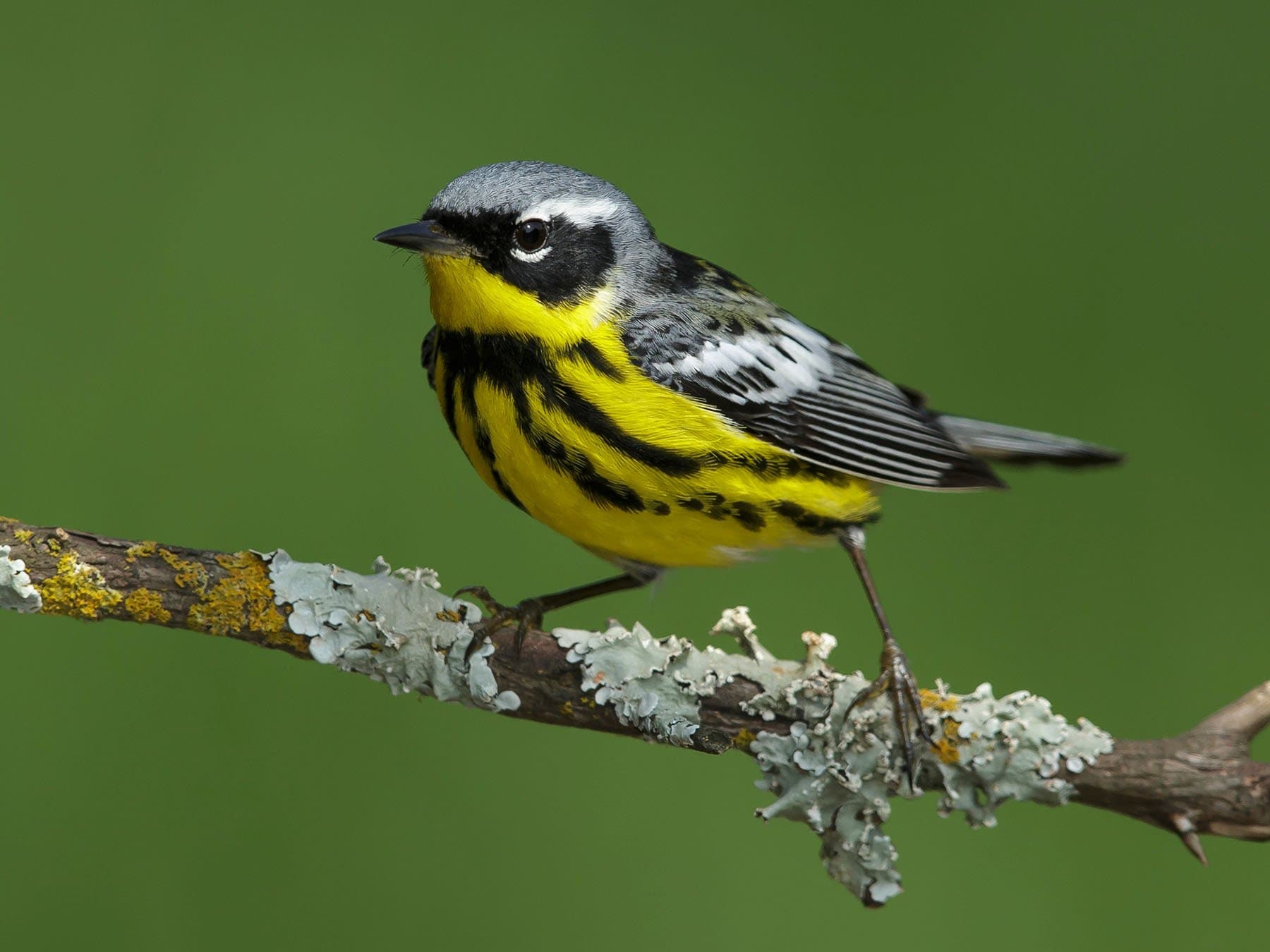
Magnolia Warbler perched on a lichen-covered branch. It has yellow underparts with black streaks, a gray head, black mask, and white wing bars.
Quick Facts
Conservation
LCLeast ConcernLifespan
3–7 years
Length
11–13 cm
Weight
6.6–12.6 g
Wingspan
16–20 cm
Migration
Long-distance Migrant
Few North American warblers stop birders in their tracks quite like the breeding male Magnolia Warbler — a bird so boldly patterned that Alexander Wilson, who named it in 1810, preferred to call it the "Black-and-Yellow Warbler." Measuring just 11–13 cm and weighing as little as 6.6 g, this boreal forest specialist makes a non-stop crossing of the Gulf of Mexico twice a year, nearly doubling its body weight in fat reserves before each flight.
Think you've spotted a Magnolia Warbler?
Upload a photo and we'll confirm it instantly
Confirm with a PhotoAppearance
The breeding male Magnolia Warbler is among the most boldly patterned of all North American warblers. The crown and nape are bluish-grey, the back is black, and a vivid yellow rump patch bridges the gap to the tail. The face is dominated by a broad black mask running from the lores through the eye, set off by a crisp white supercilium arc and a white swoosh extending back behind the eye. Below, the underparts are bright yellow with heavy black streaking that radiates down from a thick black chest band — giving the impression of long black tassels hanging from a necklace. The wings carry a large, conspicuous white wing patch. The tail is the species' single most diagnostic feature in all plumages: black with a bold white band across the middle of the outer tail feathers, so that viewed from below it appears half white at the base and half black at the tip, as though dipped in ink.
In non-breeding (autumn and winter) plumage, males become considerably duller. The black mask is replaced by a grey face with a neat white eye ring, the streaking is less pronounced, and the large white wing patch shrinks to two white wingbars. The yellow rump and the distinctive tail pattern are retained.
Females in breeding plumage share the grey head with white eye rings, yellow underparts, yellow rump, and the diagnostic tail pattern, but are paler and less boldly marked throughout. The back shows less black, the chest streaking is subdued, a faint grey band crosses the neck, and the wings show two thin white wingbars rather than a solid white patch. In autumn, females are slightly duller still. Immature birds (first-year) are the dullest of all plumages — olive-grey above, with minimal streaking and brownish tones — but always retain the species' signature black-tipped white tail. Bill length is 0.8–1.0 cm; tarsus 1.7–1.85 cm.
Identification & Characteristics
Male Colors
- Primary
- Yellow
- Secondary
- Black
- Beak
- Black
- Legs
- Dark Grey
Female Colors
- Primary
- Yellow
- Secondary
- Grey
- Beak
- Black
- Legs
- Dark Grey
Male Markings
Bold black chest band with heavy black streaking on yellow underparts; large white wing patch; diagnostic tail pattern — white basal half, black tip — visible in all plumages; yellow rump patch; black face mask with white supercilium arc (breeding male)
Tail: Black with a bold white band across the middle of the outer tail feathers; viewed from below appears half white at the base and half black at the tip — diagnostic in all plumages and all ages
Female Markings
Grey head with white eye rings; yellow underparts with subdued streaking; faint grey neck band; two thin white wingbars; yellow rump; diagnostic white-based, black-tipped tail pattern shared with male
Tail: Identical tail pattern to male: white basal half, black tip — the single most reliable identification feature for the species in all plumages
Attributes
Understanding Attributes
Rated 0–100 based on research and observation. A score of 50 is average across all bird species. These attributes are relative and don't necessarily indicate superiority.
Habitat & Distribution
Magnolia Warblers breed across a broad arc of boreal and mixed forest stretching from the Yukon, eastern Northwest Territories, and northern British Columbia eastward through Alberta, Saskatchewan, Manitoba, Ontario, Quebec, and the Maritime provinces, and south into the northern United States. US breeding populations occur in the Great Lakes states (Minnesota, Wisconsin, Michigan), New England, New York, Pennsylvania, and south along the Appalachian Mountains to Virginia and North Carolina. High breeding densities are found in northeastern Minnesota, Ontario, Quebec, Labrador, and British Columbia.
The species shows a strong preference for dense stands of young conifers — particularly second-growth spruce (Picea spp.) in the north and eastern hemlock (Tsuga canadensis) in the south — at an intermediate stage of forest regeneration, typically trees 5–10 metres tall. Unlike the Blackburnian Warbler, which nests high in the canopy, Magnolia Warblers consistently choose low, dense growth, rarely nesting more than 5 metres above ground. The species has benefited from post-logging forest regeneration across the boreal zone, which has expanded exactly this type of habitat.
During migration, the species passes through the entire eastern and central United States, with stragglers regularly reaching California, Nevada, Utah, Colorado, Arizona, and other western states, particularly in autumn. The wintering grounds extend from southern Mexico — most abundantly the Yucatan Peninsula — through Central America to Panama, and throughout the Caribbean, from sea level up to approximately 1,500 m elevation. Wintering birds use a wide range of habitats including cacao plantations, shade-grown coffee farms, orchards, mixed forests, and second-growth scrub.
In the United Kingdom, the Magnolia Warbler is a rare vagrant with just four accepted records to date. The first British record was a bird at St Agnes, Isles of Scilly, on 27–28 September 1981. A male was then recorded at Fair Isle, Scotland, on 23 September 2012. Most recently, two birds appeared in Wales in the same autumn: one at St Govan's Head, Pembrokeshire, from 20–26 September 2023, and another at Baglan Bay, Briton Ferry, Gower, from 24–29 September 2023. All four records fall in September, consistent with the pattern of Nearctic warblers drifting east to Britain on autumn westerly systems.
Where to See This Bird
Explore regional guides for locations where this bird has been recorded.
United States
Louisiana
Maryland
Maine
Michigan
Minnesota
New Hampshire
New York
Pennsylvania
Vermont
Wisconsin
West Virginia
Canada
Manitoba
Newfoundland and Labrador
Nova Scotia
New Brunswick
Northwest Territories
Ontario
Quebec
Prince Edward Island
Diet
Caterpillars form the core of the Magnolia Warbler's diet, and the species can consume them in extraordinary numbers when spruce budworm (Choristoneura fumiferana) reaches epidemic population levels across the boreal forest. During budworm outbreaks, Magnolia Warblers — along with Bay-breasted and Cape May Warblers — function as a natural population check on this destructive pest, which periodically defoliates millions of hectares of spruce and fir. Beyond caterpillars, the diet includes beetles, leafhoppers, aphids, plant lice, flies, worms, and spiders.
The primary foraging technique is foliage gleaning: the bird hops methodically along branches, inspecting the undersides of conifer needles, leaves, and twigs for concealed prey. It also makes short aerial sallies to catch flying insects and occasionally hovers briefly to inspect foliage — a technique more typical of the American Redstart but used opportunistically by Magnolia Warblers too.
When insects become scarce during cold or wet weather, the species supplements its diet with berries and fruit. On the wintering grounds in Mexico, Central America, and the Caribbean, fruit and nectar intake increases relative to the breeding season. The full composition of the winter diet is not completely documented, but is broadly similar to the breeding season diet with a greater proportion of plant material during periods of insect scarcity.
Behaviour
Magnolia Warblers are active, restless birds that spend much of their time hopping along branches and peering at the undersides of conifer needles. Males forage higher in the canopy than females during the breeding season, a consistent difference that likely reduces competition between paired birds sharing a territory. Outside the breeding season, both sexes frequently join mixed-species foraging flocks alongside chickadees, other warblers, and kinglets — a strategy that improves predator detection and prey flushing.
One of the species' most striking behavioural traits is tail-fanning. Males spread and fan the tail to flash the white tail spots both during courtship displays and as a warning to territory intruders — a behaviour reminiscent of the American Redstart, to which the Magnolia Warbler is closely related. This visual signalling supplements song as a territorial advertisement.
On the wintering grounds, the social structure shifts markedly. Unlike the shared breeding territories of summer, males and females each maintain separate individual territories in winter — a pattern unusual among migratory songbirds and one that ensures each bird has exclusive access to food resources during the non-breeding season. Singing largely ceases in winter, and birds communicate primarily through sharp call notes. During migration, the species is notably adaptable, turning up in virtually any wooded habitat from forest edges and woodlots to suburban parks and gardens.
Calls & Sounds
Male Magnolia Warblers produce two structurally distinct song types, each serving a different social function. The first — used in courtship and around the nest — consists of three short phrases with a clearly accented, rising ending, most often transcribed as "weeta-weeta-weeteo" or "weeta-weeta-weechew." The second song, deployed in territorial defence against rival males, is structurally similar but described as sweeter and less accented, with a flatter ending. The ability to distinguish these two song types is useful for observers trying to interpret what a singing male is actually doing: a rising, emphatic song near a female signals courtship; a softer, more even delivery near a territorial boundary signals a dispute with a neighbour.
Males sing most intensely at dawn and dusk but continue throughout the day, even while actively foraging — a sign of how important continuous territorial advertisement is during the breeding season. Females also sing, though less frequently, and have not been observed to use separate song types for different contexts in the way males do.
Both sexes produce a sharp, short call note — variously described as "tslip" or "tsip" — used for a range of alert functions. Females give this call when a human observer is watching them near the nest; males give it to signal the presence of a predator near offspring. On the wintering grounds in Mexico and Central America, singing largely ceases and birds communicate almost exclusively through these call notes. Males also perform a visual vocal supplement — spreading and fanning the tail to flash the white tail spots — both in courtship and as a warning to territory intruders.
Flight
In flight, the Magnolia Warbler shows the undulating, slightly bounding pattern typical of small wood warblers — a series of rapid wingbeats interspersed with brief wing-closes that produce a gentle rise-and-fall trajectory. The wingspan of 16–20 cm is relatively broad for the bird's size, providing good lift for both the short, agile manoeuvres of forest foraging and the sustained endurance required for long-distance migration.
The most distinctive flight feature is the tail pattern: the white basal half and black tip are clearly visible from below as the bird moves through foliage, and the species habitually fans and spreads the tail during short flights between branches — making the pattern flash conspicuously. This is both a social signal and a useful identification cue for observers. The yellow rump patch is equally eye-catching from above, particularly as the bird dips between branches.
During migration, Magnolia Warblers travel primarily at night, navigating by the stars and Earth's magnetic field. The trans-Gulf crossing — a non-stop flight of several hundred kilometres over open water — demands sustained aerobic effort over many hours. Birds departing the Gulf Coast of the United States in autumn must fly through the night and into the following day to reach the Yucatan Peninsula. Spring migrants make the same crossing in reverse, arriving on the US Gulf Coast exhausted and immediately beginning to feed to replenish depleted fat reserves.
Nesting & Breeding
Males arrive on the breeding grounds approximately 10–14 days before females and immediately begin establishing territories through persistent song. Once females arrive, the pair cooperates to build the nest over roughly one week, though the female does the majority of the construction work. Nest sites are almost always in dense, low conifers — most commonly spruce, balsam fir, or hemlock — placed on a horizontal branch close to the trunk, usually less than 3 metres above ground, though occasionally up to 10 metres.
The nest is a small, shallow, somewhat flimsy cup constructed of grasses, weed stalks, and fine twigs, lined with fine black rootlets and horsehair fungus (Marasmius spp.) — a distinctive lining material that helps identify the nest. The finished structure barely exceeds 10 cm in diameter. Clutch size is typically 3–5 eggs, most commonly 4. The eggs are white with variable speckles and spots of brown, lavender, olive, and grey, measuring approximately 16.3 × 12.3 mm.
Incubation is performed by the female alone and lasts 11–13 days; she does not begin incubating until the full clutch is laid, ensuring synchronous hatching. Chicks hatch helpless (altricial), covered in tufts of black down, with eyes opening at 3–4 days. Both parents feed the nestlings, though the female broods them and feeds them most frequently. Fledging occurs at just 8–10 days — remarkably fast — but the young remain dependent on parental feeding for up to 25 more days after leaving the nest. Full independence follows at approximately one month. The species typically raises one brood per year, though a second attempt may follow a failed first nest. Brown-headed Cowbird (Molothrus ater) nest parasitism has been recorded and represents a localised threat to productivity.
Lifespan
The typical lifespan of a Magnolia Warbler in the wild is estimated at 3–7 years, though annual survival rates for small migratory songbirds are heavily influenced by the hazards of long-distance migration. The oldest confirmed individual — a male banded in Ontario in 2005 and recaptured at the same location in 2013 — was at least 8 years and 11 months old at the time of its final capture, setting the longevity record for the species.
Mortality is highest during the first year of life, when inexperienced birds face the full gauntlet of two trans-Gulf crossings, unfamiliar wintering territories, and their first breeding season. Predation by Sharp-shinned Hawks and other raptors is a significant cause of death during migration. Building and television tower collisions during nocturnal migration kill large numbers of warblers annually across North America — a mortality source that disproportionately affects species that migrate at night, as Magnolia Warblers do.
Compared to the closely related Prothonotary Warbler, which shares a maximum recorded lifespan of around 8–9 years, the Magnolia Warbler's longevity is broadly typical for the Parulidae family. Larger-bodied species generally live longer, but the Magnolia Warbler's boreal breeding habitat — relatively free from some of the nest predation pressures faced by species nesting in more disturbed lowland environments — may contribute to reasonable adult survival rates once the first year is survived.
Conservation
The Magnolia Warbler is listed as Least Concern on the IUCN Red List, and its population trajectory is one of the more encouraging stories among Neotropical migrants. Partners in Flight estimated the global population at approximately 39 million individuals in 2019–2020. The North American Breeding Bird Survey recorded a population increase of nearly 1% per year from 1966 to 2019, and Partners in Flight data show an overall increase of approximately 51% between 1970 and 2014. The species scores just 8 out of 20 on the Continental Concern Score, indicating low conservation concern. Much of this success is attributable to the species' tolerance of second-growth and regenerating coniferous forest — habitat that has expanded as logged and cleared land has regrown across the boreal zone.
The most significant threats operate away from the breeding grounds. Building and television tower collisions during nocturnal migration are a substantial source of mortality across the eastern United States. On the wintering grounds, the expansion of sun coffee farming — now accounting for roughly three-quarters of global coffee production — destroys native forest habitats and eliminates the shade-grown coffee farms and cacao plantations that provide suitable wintering habitat. Choosing shade-grown, bird-friendly certified coffee is one of the most direct actions consumers can take to support wintering warbler populations.
Climate change poses a longer-term threat by altering the distribution and phenology of both breeding and wintering habitats, potentially disrupting the timing of insect emergence relative to the breeding season. Some local declines have been noted at the western fringes of the breeding range where balsam fir and spruce have become less common. Brown-headed Cowbird nest parasitism adds localised breeding pressure, particularly at forest edges.
Population
Estimated: Approximately 39 million individuals
Trend: Increasing
Increasing. The North American Breeding Bird Survey recorded a population increase of nearly 1% per year from 1966 to 2019. Partners in Flight data show an overall increase of approximately 51% between 1970 and 2014. The species scores 8/20 on the Continental Concern Score, indicating low conservation concern.
Elevation
Sea level to approximately 1,500 m (wintering grounds); breeding typically at low to moderate elevations in boreal and montane forest
Additional Details
- Predators:
- Sharp-shinned Hawks are the primary avian predator during migration. Nest predators include snakes, squirrels, and corvids. Brown-headed Cowbird brood parasitism reduces productivity at some breeding sites, particularly near forest edges.
Courtship & Display
Males arrive on the breeding grounds 10–14 days ahead of females and spend this window establishing and advertising territories through near-continuous song. Once females arrive, courtship intensifies. The male's primary visual display involves spreading and fanning the tail to flash the bold white tail spots — a behaviour that functions both as an advertisement to potential mates and as a warning to rival males. This tail-fanning display is strikingly similar to that of the American Redstart, and the two species' shared genus (Setophaga) reflects their close evolutionary relationship.
Males also perform wing-drooping displays and pursue females through the canopy in short chases. The two distinct song types play different roles in the courtship sequence: the accented, rising "weeta-weeta-weeteo" is directed at females and used most intensely when a female is nearby, while the softer, less accented territorial song is directed at rival males. Pairs are monogamous within a breeding season, sharing a single breeding territory. However, this monogamy does not extend to the winter: on the wintering grounds in Mexico and Central America, males and females each hold separate individual territories, meeting again only when they return to the breeding grounds the following spring.
Cultural Significance
The Magnolia Warbler has a small but notable place in the history of ornithological art and science. Alexander Wilson — the Scottish-born naturalist often called the "Father of American Ornithology" — collected the type specimen from a magnolia tree in Mississippi in 1810 and described it in his landmark nine-volume work American Ornithology (1808–1814). Wilson's preferred name, "Black-and-Yellow Warbler," was more accurate, but the incidental locality name he used — Magnolia Warbler — was the one that entered the scientific literature and has persisted ever since.
John James Audubon subsequently depicted the species as Plate 123 in The Birds of America (London, 1827–38), one of the most ambitious publishing projects in the history of natural history. Audubon's double-elephant folio plate shows a male and female among flowering raspberry, hand-coloured by the engraver Robert Havell Jr., under the title "Black & Yellow Warbler – Sylvia maculosa." Original copies of The Birds of America now sell at auction for millions of pounds, and individual plates — including Plate 123 — are prized by collectors worldwide. The species thus occupies an unlikely position at the intersection of American natural history, ornithological nomenclature, and the art market.
Birdwatching Tips
In North America, the best time to see Magnolia Warblers in full breeding plumage is late May through June, when males are singing from low conifers in boreal and mixed forest. In the United States, the Adirondacks of New York, the White Mountains of New Hampshire, northern Minnesota, and the Upper Peninsula of Michigan are all reliable breeding sites. In Canada, virtually any area of regenerating spruce or fir forest in Ontario, Quebec, or the Maritime provinces can hold good numbers. Listen for the song — a short, bright phrase often transcribed as "weeta-weeta-weeteo" — delivered persistently from low to mid-canopy.
During spring and autumn migration (late April to May, and August to October), Magnolia Warblers can appear almost anywhere in the eastern and central United States. They are particularly conspicuous during "warbler waves" following cold fronts in May, when dozens of species move through woodland edges and parks together. Central Park in New York City, Magee Marsh in Ohio, and Point Pelee in Ontario are celebrated hotspots. In autumn, first-year birds in dull olive-grey plumage can be tricky — look for the diagnostic tail pattern: white at the base, black at the tip, visible from below as the bird flits through foliage.
The tail pattern is the single most reliable identification feature in all plumages and all seasons. No other North American warbler shows this combination. In autumn, beware confusion with Nashville and Connecticut Warblers, which share the white eye ring but lack the yellow rump and distinctive tail. In the UK, any September vagrant warbler with a yellow rump and black-tipped white tail is almost certainly a Magnolia Warbler — check headlands and islands on the southwest and Scottish coasts after westerly Atlantic weather systems.
Did You Know?
- The name "Magnolia Warbler" is a geographical accident: Alexander Wilson collected the type specimen from a magnolia tree in Mississippi in 1810 during migration. Wilson himself preferred the more descriptive name "Black-and-Yellow Warbler," but the incidental name stuck — the species has no particular association with magnolia trees and is rarely found in them.
- The oldest known Magnolia Warbler was a male recaptured during banding operations in Ontario in 2013, at least 8 years and 11 months old — having originally been banded in the same area in 2005. For a bird weighing as little as 6.6 g, this is a remarkable survival record.
- Before making their non-stop crossing of the Gulf of Mexico, Magnolia Warblers nearly double their body weight in fat reserves. A bird that typically weighs 6.6–12.6 g can reach up to 15 g at pre-migratory stopover sites — the avian equivalent of carbohydrate-loading before a marathon.
- Rare hybrids between the Magnolia Warbler and the American Redstart (Setophaga ruticilla) have been confirmed on two independent occasions — in Ottawa County, Ohio, and Laval, Québec — verified by both morphological examination and genetic analysis. In both cases, the mother was a Magnolia Warbler and the father an American Redstart.
- John James Audubon depicted the Magnolia Warbler as Plate 123 in The Birds of America (London, 1827–38), showing a male and female searching flowering raspberry for insects under the title "Black & Yellow Warbler – Sylvia maculosa." The engraving was hand-coloured by Robert Havell Jr. and remains one of the most celebrated images in ornithological art.
Records & Accolades
Audubon's Plate 123
The Birds of America, 1827–38
Depicted by John James Audubon as 'Black & Yellow Warbler' in one of the most celebrated works in ornithological art history, hand-coloured by engraver Robert Havell Jr.
Longevity Record
8 years 11 months
The oldest known Magnolia Warbler — a male banded and recaptured in Ontario — survived nearly 9 years, exceptional for a bird weighing as little as 6.6 g.
Trans-Gulf Migrant
Non-stop Gulf crossing
Magnolia Warblers cross the Gulf of Mexico non-stop twice a year, nearly doubling their body weight in fat reserves before each flight.
Community Photos
Be the first to share a photo of the Magnolia Warbler
Upload a PhotoIdentify Any Bird Instantly
- Upload a photo from your phone or camera
- Get an instant AI identification
- Ask follow-up questions about the bird
Monthly Birds in Your Area
- Personalised for your location
- Seasonal tips and garden advice
- Updated every month with new species