
Mississippi Kite
Ictinia mississippiensis
By the Birdfact teamChecked by Nathan Cope
See it in 3D
3 plumages
An adult Mississippi Kite is 13.5–14.5 in (34–37 cm) long, bill to tail.
Adult
© 2026 NC Digital Limited (Birdfact). All rights reserved. This 3D model may be viewed on this page and shared by link only. Downloading, extracting, copying or reusing it, or using it to train machine-learning models, is not permitted without our written permission. Using our models
On this page15 sections
How to recognise it
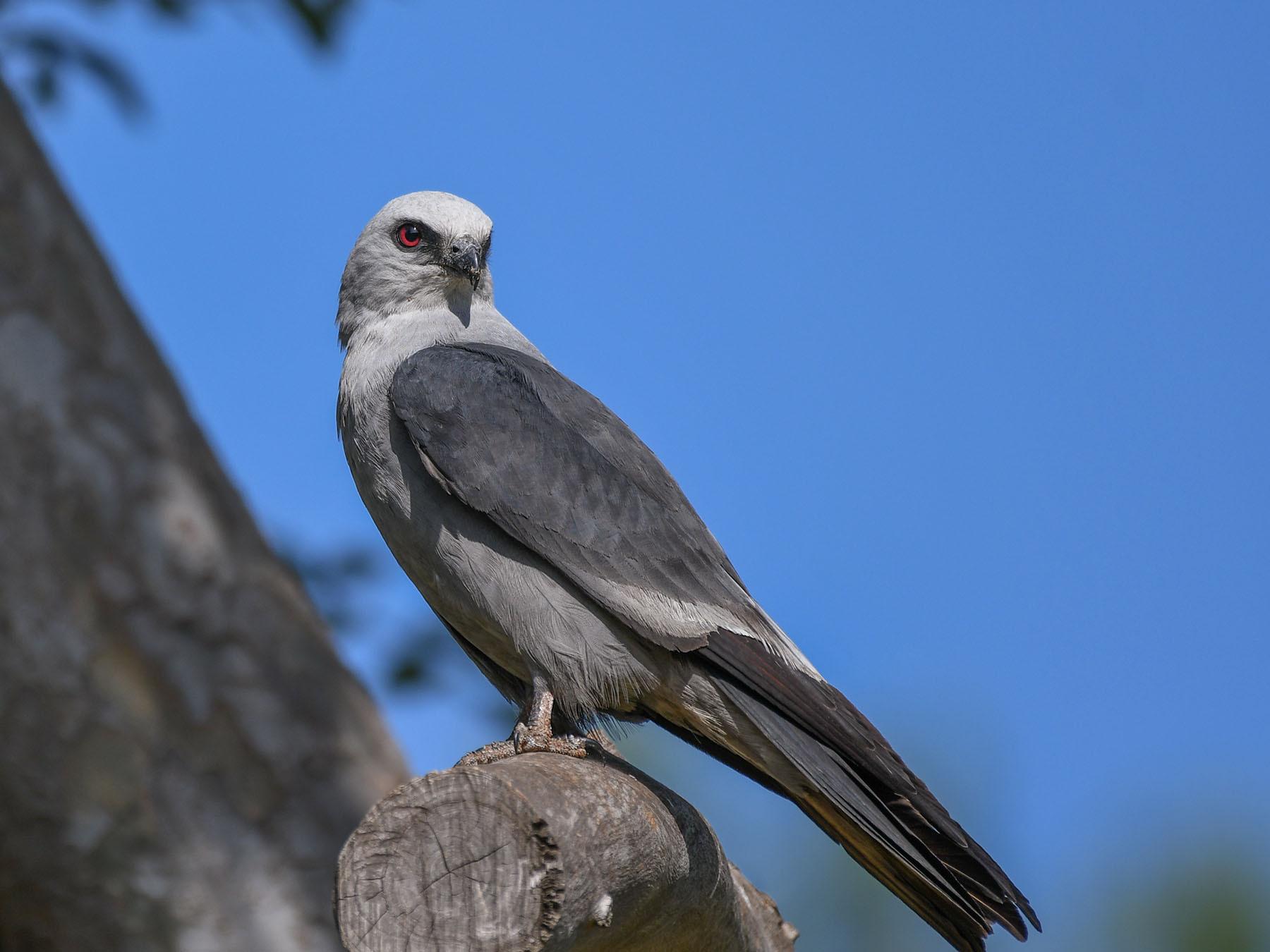
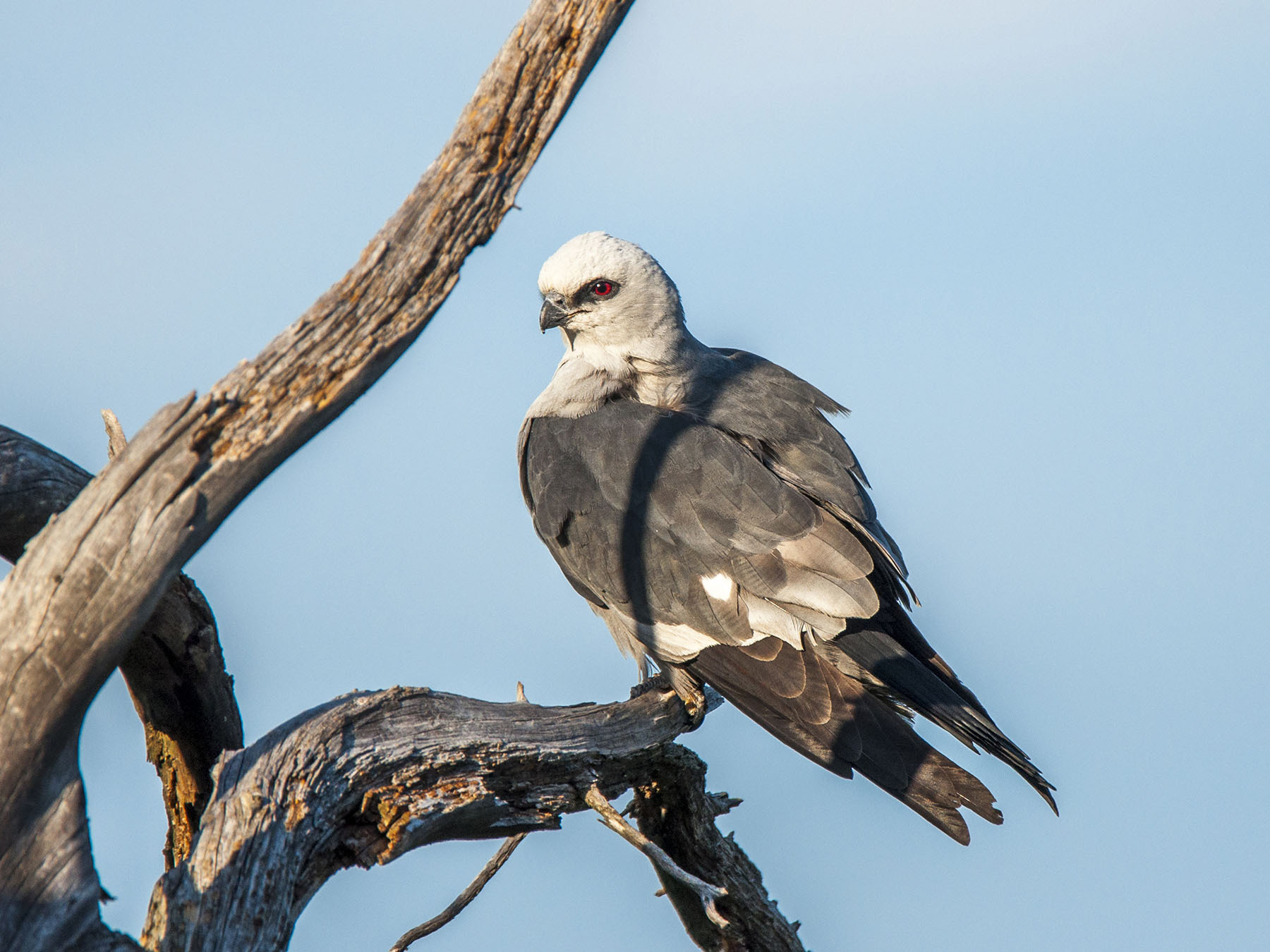
An adult is a sleek, gray bird of prey with long, pointed wings and a long black tail. The head is the palest part, almost whitish, and a narrow ring of black feathers around the red eye makes a dark eye patch. The back and upper wings are a darker gray, close to black.
The best mark from above is a pale patch on the inner wing: the secondaries are pale gray to silvery white against black outer flight feathers. The tail is plain black, square or slightly notched at the tip, and many adults show brownish-red patches in the primaries. The bill is black and the feet yellow to orange-yellow.
Size and weight
A Mississippi Kite is 13.4-14.6 in (34-37 cm) long and weighs 7.5-13.7 oz (214-388 g), larger than a Rock Pigeon and smaller than a Peregrine Falcon. Audubon's field guide gives a shorter length of 12-14 in (30-36 cm) and a wingspan of about 3 ft (91 cm), the only wingspan in the sources we read.1
Females are larger and heavier than males, though their weights overlap: males weigh 7.5-10.7 oz (214-304 g) and females 9.5-13.7 oz (270-388 g). In Oklahoma, 11 males averaged about 8.6 oz (245 g) and 5 females 11.0 oz (311 g), and among banded and museum birds adult males averaged 9.4 oz (266 g, n=20) and adult females 11.4 oz (324 g, n=18).2
Male, female and juvenile
The sexes look much alike. The male's head is usually paler than the female's. Females have pale gray to whitish patches on the inner vanes of the tail feathers, and the rufous in their primaries may be paler and less extensive. Taken together, size, head shade and tail sex a bird reliably in the field.
Juveniles, birds in their first plumage, look very different. The head and underparts are white or pale buff, heavily streaked with brown, rufous and gray, and some show a buffy eyebrow. The upperparts are dull black with pale feather edges, the wing linings are barred or mottled, and the black tail carries white spots that join into two or three pale bands. A juvenile can look like a slim Buteo hawk, and its wings look more rounded than an adult's. The eye is brown at first and turns orange-brown, then red.
First-summer plumage
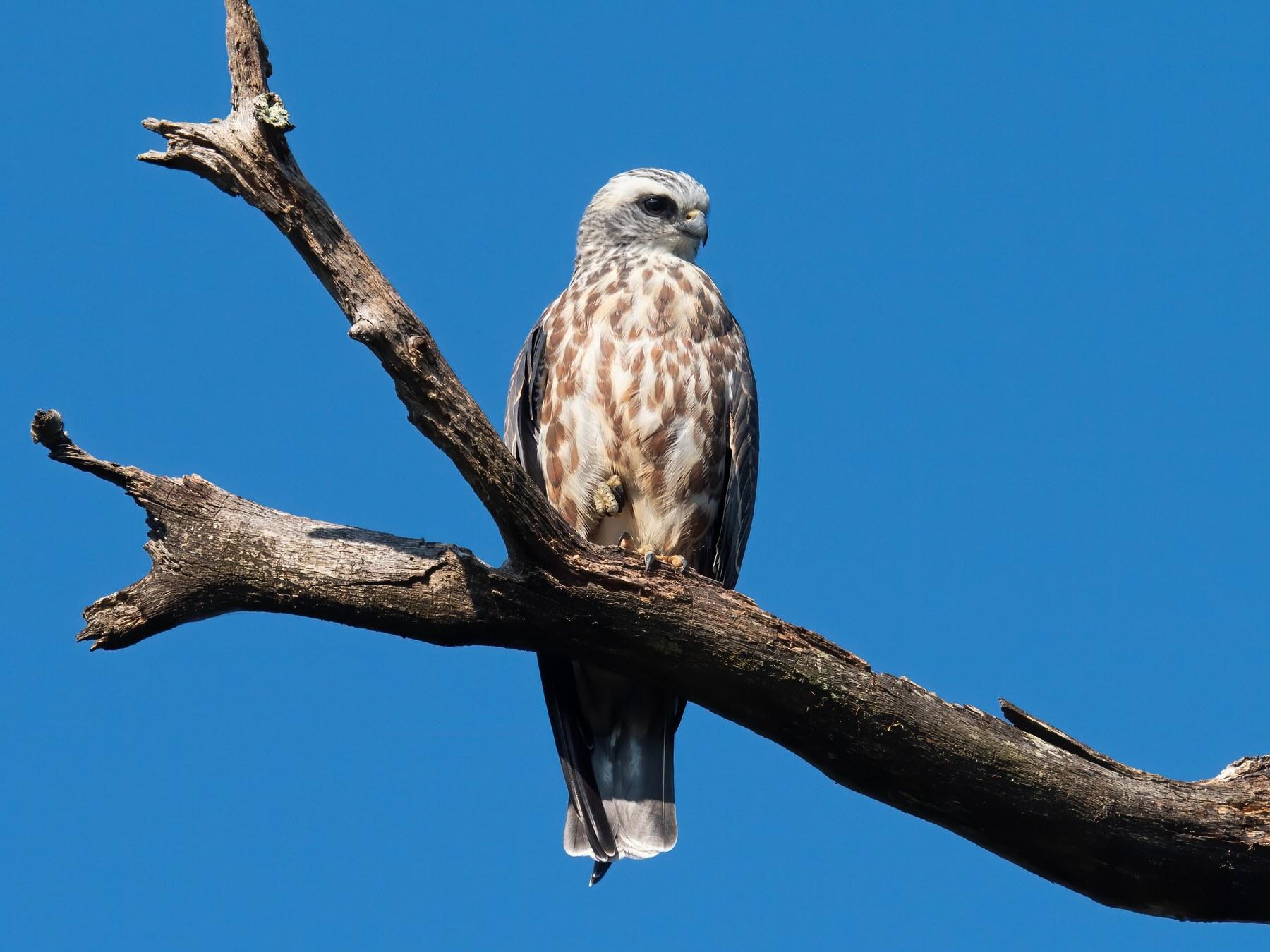
Young birds reach adult plumage by the fall of their second calendar year. In their first summer back from South America they are mostly gray like an adult, with a pale head, but they may keep streaked juvenile feathers on the belly, lower breast, wing linings and crown, and some banded juvenile tail feathers and older flight feathers. They also show white on the scapulars and back more often than adults. There is no separate breeding or winter plumage, no color morph and no subspecies.
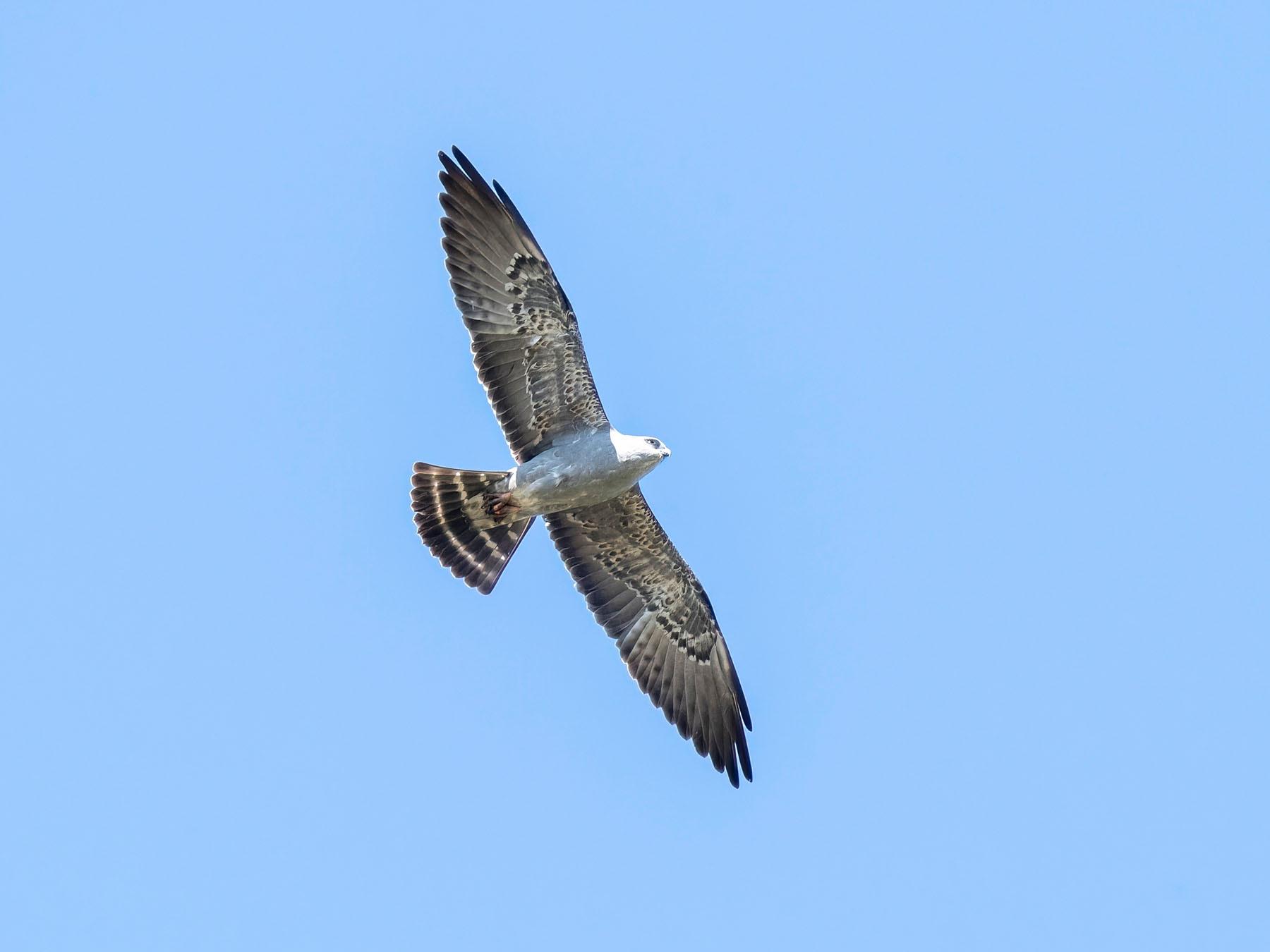
Identification in flight
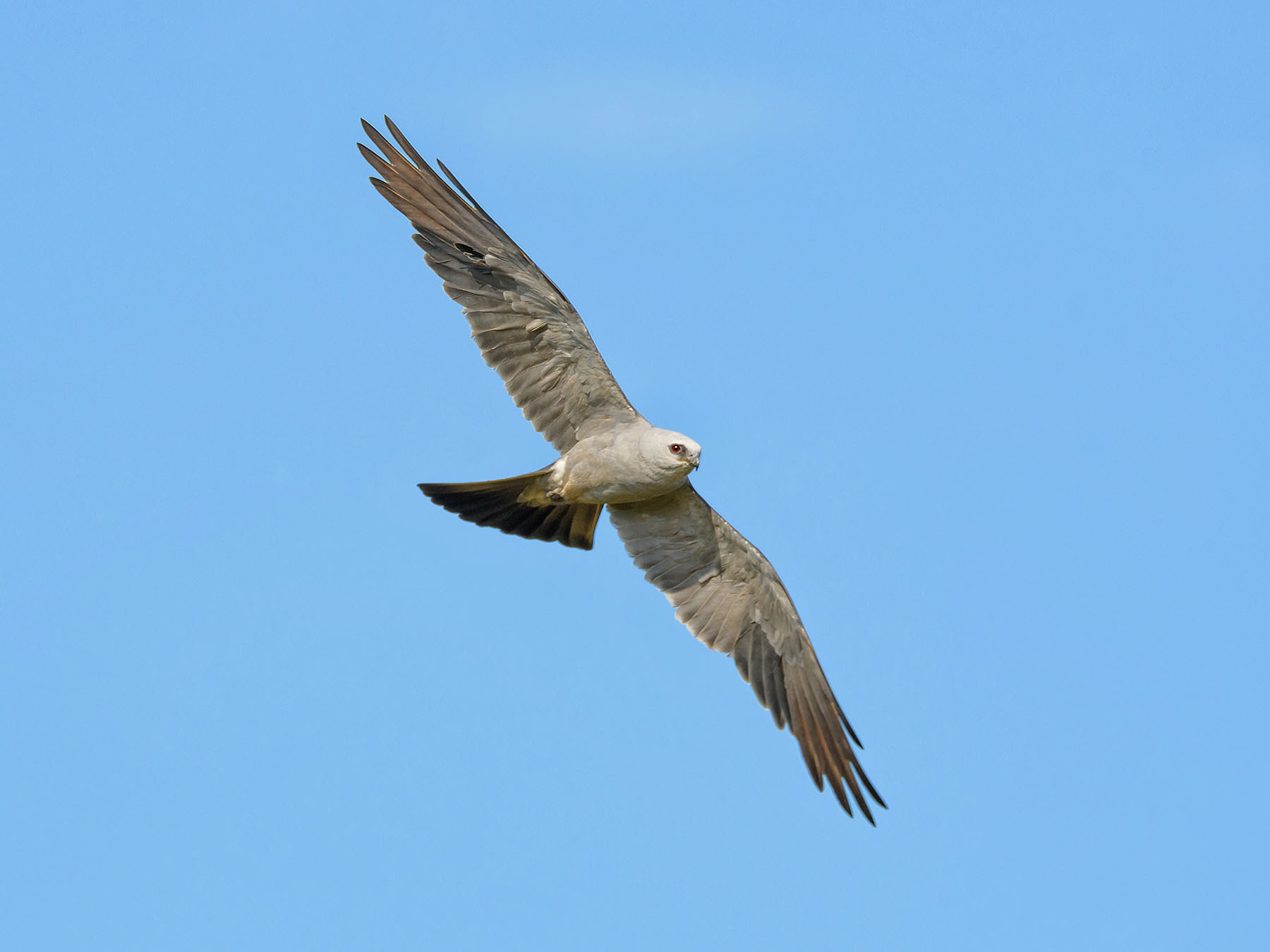
The flight is graceful, buoyant and acrobatic. In fast flight or a strong wind the bird looks falcon-like, but it also soars for long spells with its outer flight feathers and tail spread, which changes its shape a great deal. From below, look for the pale gray body and head and the black tail; from above, the pale inner-wing patch.
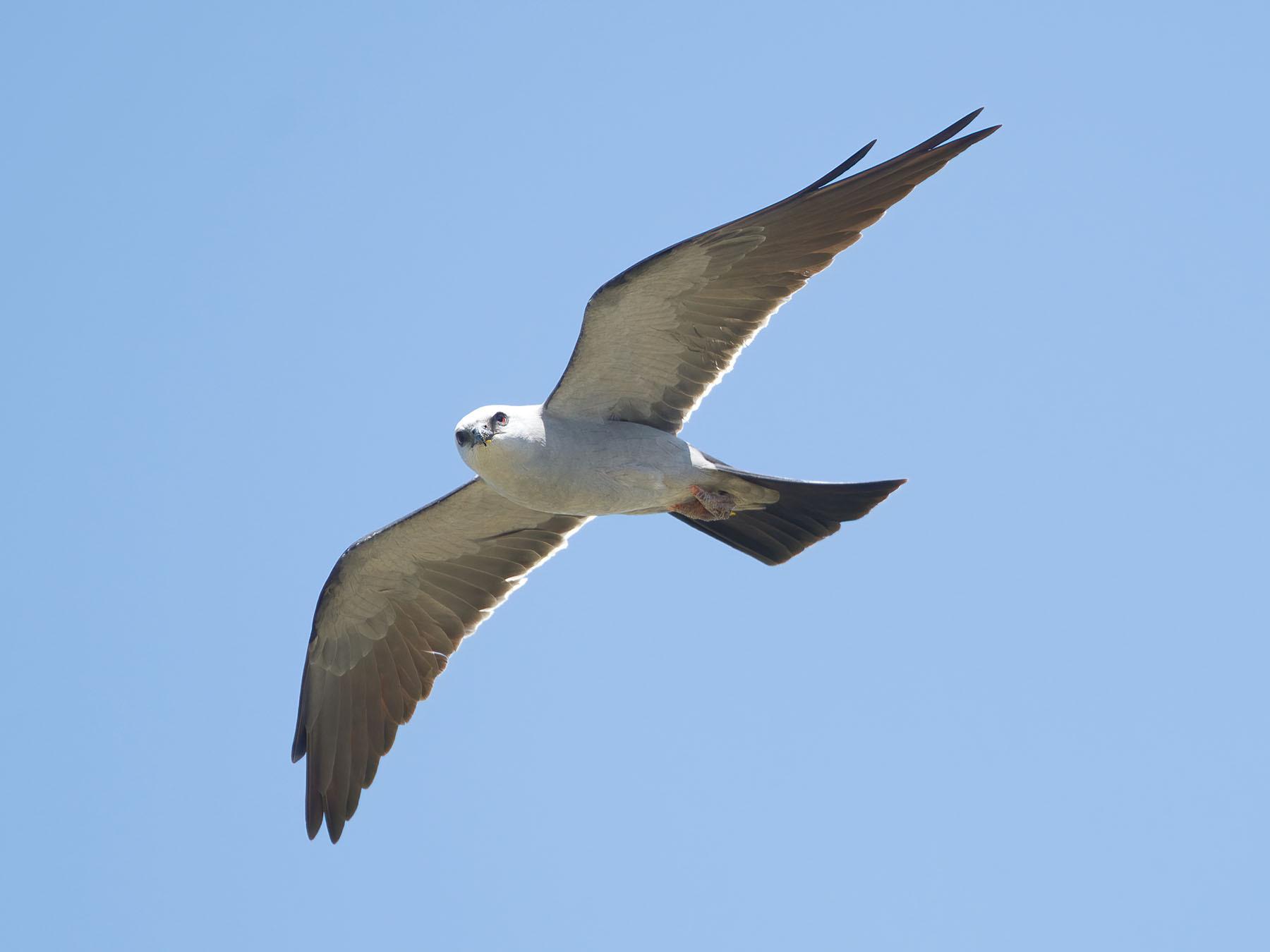
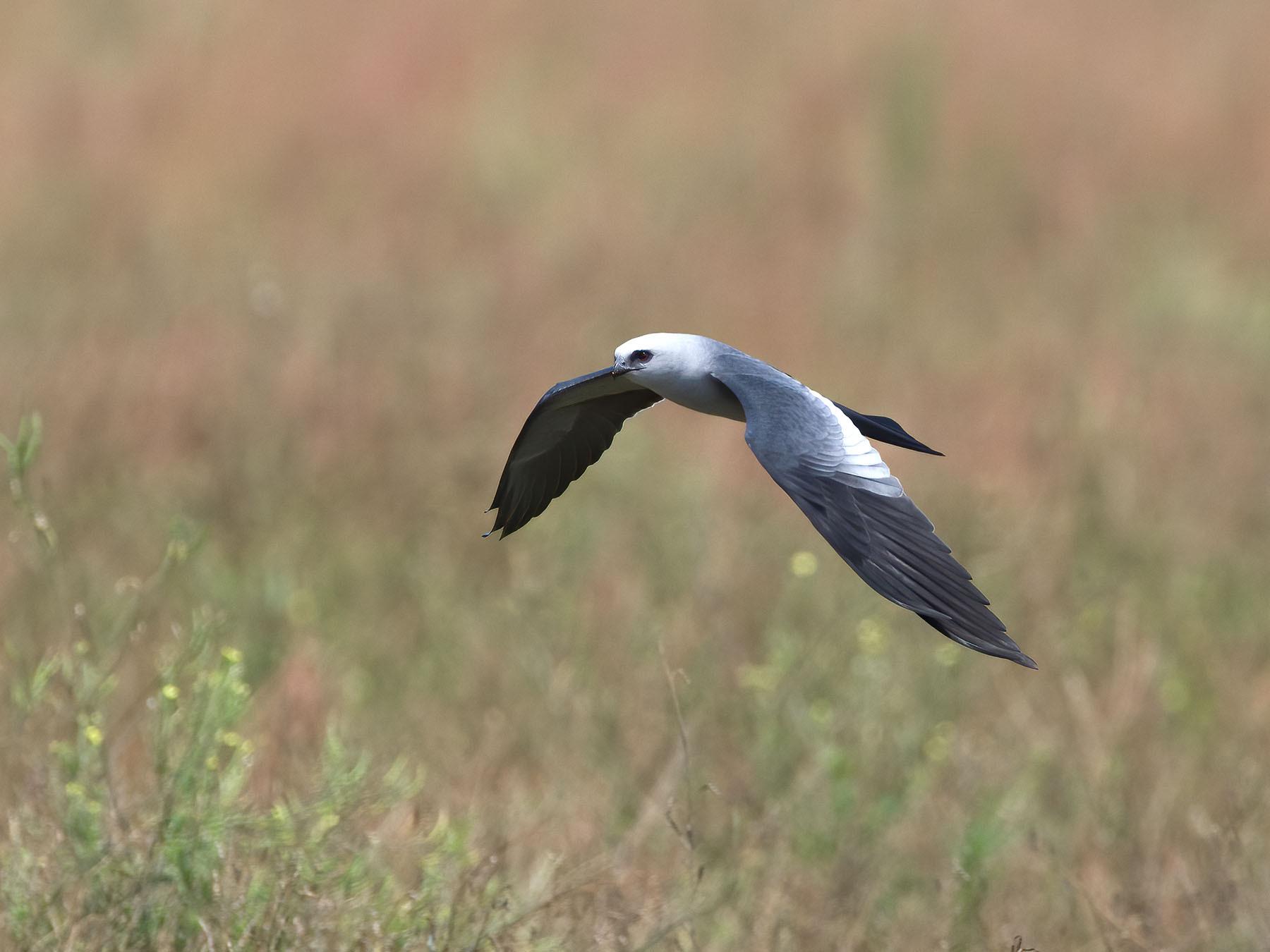
Identifying it from similar birds
A Peregrine Falcon is bigger, with a blackish stripe running down from the eye across the cheek, and adults are barred below. A White-tailed Kite is white below, with a long white tail, black shoulders and a black mark near the bend of the underwing, and it hunts by hovering. A Swallow-tailed Kite is bigger, with a white head and underparts against a black back and wings and a deeply forked tail.
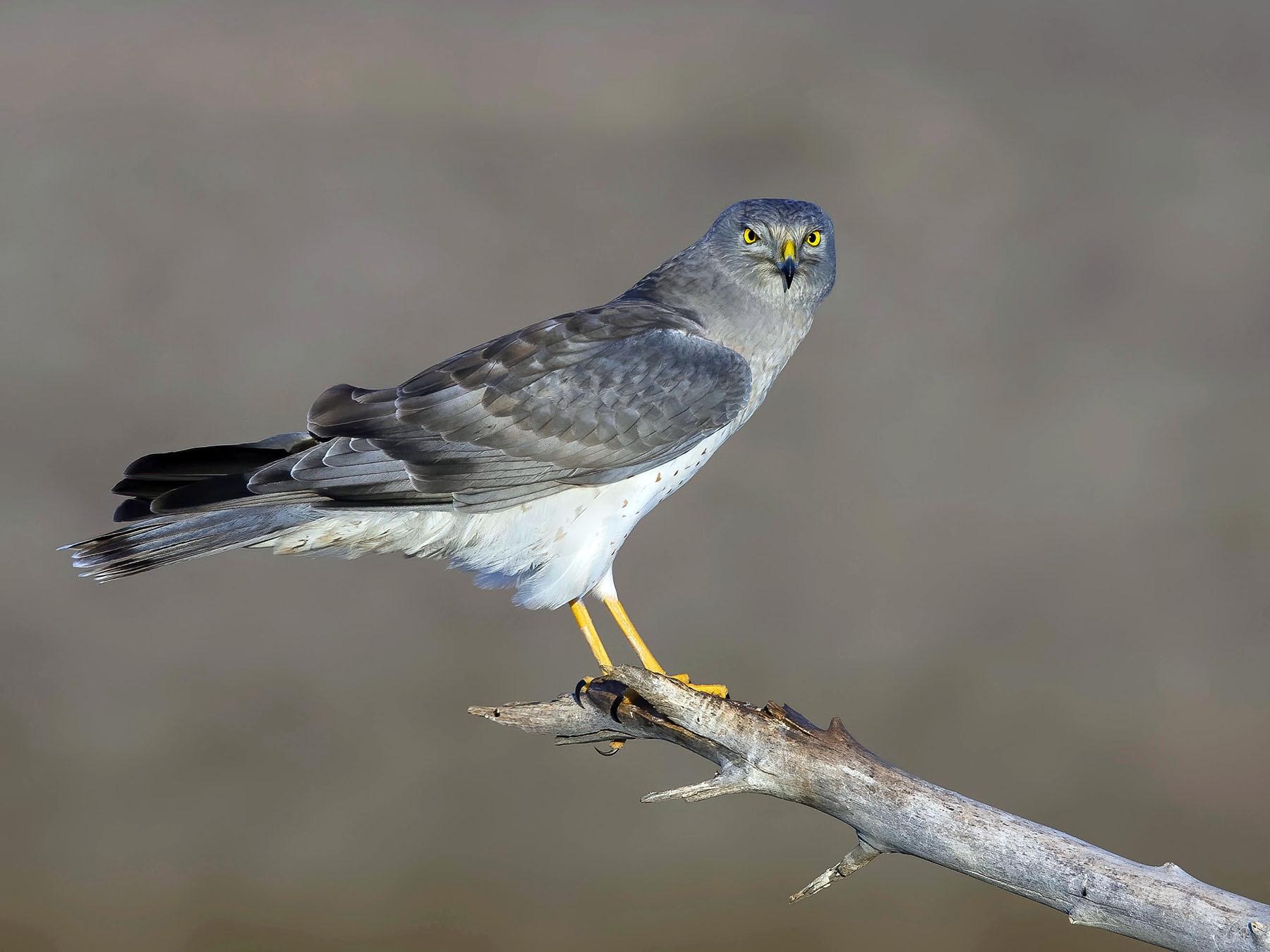
An adult Gray Hawk is finely barred gray and white below, with brown eyes and a black tail with three white bands, and at any age it shows a white U at the base of the tail above. A Northern Harrier has a white rump in every plumage, an owl-like face and a long tail, and it flies low over open ground with its wings raised in a shallow V.
The closest lookalike is the Plumbeous Kite, the only other member of the genus Ictinia, but the two meet only from Mexico southward, where Mississippi Kites pass on migration and spend the winter. A Plumbeous Kite is darker gray all over, with dark secondaries instead of a pale inner-wing patch, more rufous in the primaries and white bands on the tail. Juveniles of the two look the same in most field conditions.
Not sure it’s a Mississippi Kite? Check your photo: Birdfact names the bird and shows the look-alike side by side.
Its size
Adults- Length
- 34–37 cm
- Wingspan
- 91 cm
- Weight
- 214–388 g
Its song and calls
The Mississippi Kite has no song in the songbird sense. Its commonest call, written phee-phew, is a pure, high whistle of 1-2 seconds: a short first note, then a longer one that falls. Kites give it in flight or from a perch to show where they are, and a more emphatic version near the nest usually means a predator or a person is close.
A longer phee-ti-ti or phee-ti-ti-ti, a first note followed by usually three short ones, comes when birds are excited, as in courtship, when nest material is passed, when one adult relieves the other at the nest, and between parents and young. Both sexes apparently give both calls, and yearlings may too.2 Kites are not very vocal unless a predator is near or they are breeding. Nestlings give lisping peeps in their first week, then soft two-note calls, chippering and high squeals when the adults come in.
- Call0:00 / 0:37
Recorded in Texas, United States · July 2020
- Juvenile calls0:00 / 0:11
Recorded in Missouri, United States · September 2022
Heard one and not sure? Let the bird song identifier listen.
When and where to see it
November
Mostly absent
The year across North America
Choose a place on the map to see its year, or find yours.
Not regularly recorded in November
Up to 1.8% of a place’s bird records that monthHere in other months
How this map is made
Each county, state or province is shaded by the Mississippi Kite’s share of all the bird records there that month: the darker, the larger the share. A place with only a trace of records in a month is left unshaded. Shades compare places on this map with each other, not one bird with another. Records: GBIF eBird Observation Dataset, 2019–2024. Map: Natural Earth; place centres © OpenStreetMap contributors.
How often the Mississippi Kite turns up in the United States and Canada through the year, from birdwatchers' records.
United States
Summer visitor · regularly Apr–Sep · most records in August
Canada
Passage migrant · regularly May–Sep · most records in May
Show as a table
| Month | United States | Canada |
|---|---|---|
| January | – | – |
| February | <0.001% | – |
| March | <0.001% | – |
| April | 0.028% (regular) | – |
| May | 0.078% (regular) | 0.002% (regular) |
| June | 0.091% (regular) | <0.001% (regular) |
| July | 0.15% (regular) | <0.001% |
| August | 0.16% (regular) | <0.001% |
| September | 0.036% (regular) | <0.001% (regular) |
| October | 0.002% | <0.001% |
| November | <0.001% | – |
| December | <0.001% | – |
Worldwide: recorded regularly in 17 countries
Countries where it was recorded in at least 3 of the 6 years 2019–2024. Linked countries have their own bird list.
North America (11)
- Belize
- Canada
- Costa Rica
- Cuba
- El Salvador
- Guatemala
- Honduras
- Mexico
- Nicaragua
- Panama
- United States
Data: EOD – eBird Observation Dataset (Cornell Lab of Ornithology), accessed via GBIF.org, CC BY 4.0. Records from 2019–2024, aggregated and filtered by Birdfact. How these lists are made
The Mississippi Kite breeds only in the United States. On the central and southern Great Plains its range runs from south-central Kansas and southeastern Colorado through western and central Oklahoma to the Texas Panhandle and north-central Texas, and it also breeds locally in the Southwest: New Mexico, southeastern Arizona and western Texas. In the Southeast it breeds along and east of the Mississippi River, from South Carolina, Georgia, northern Florida and Alabama west to Louisiana and Arkansas, and north up the valley to western Tennessee, eastern Missouri and southwestern Illinois.
For nesting it needs trees, preferably tall ones, beside open country. In the East it nests mostly in large tracts of mature bottomland forest with open ground nearby. On the Great Plains it uses shelterbelts and wooded patches in mixed and shortgrass prairie, and in Arizona riverside cottonwood groves.
By the late 1990s small, isolated but persistent groups were breeding outside the main range, in northeastern Virginia, North Carolina, southwestern Indiana, central Iowa, southwestern Missouri, Nebraska and northeastern Colorado. Wanderers, mostly recorded in 1980-1998, have turned up well outside the range, in New England, New York, the Great Lakes states, Ontario and even Saskatchewan and California.2
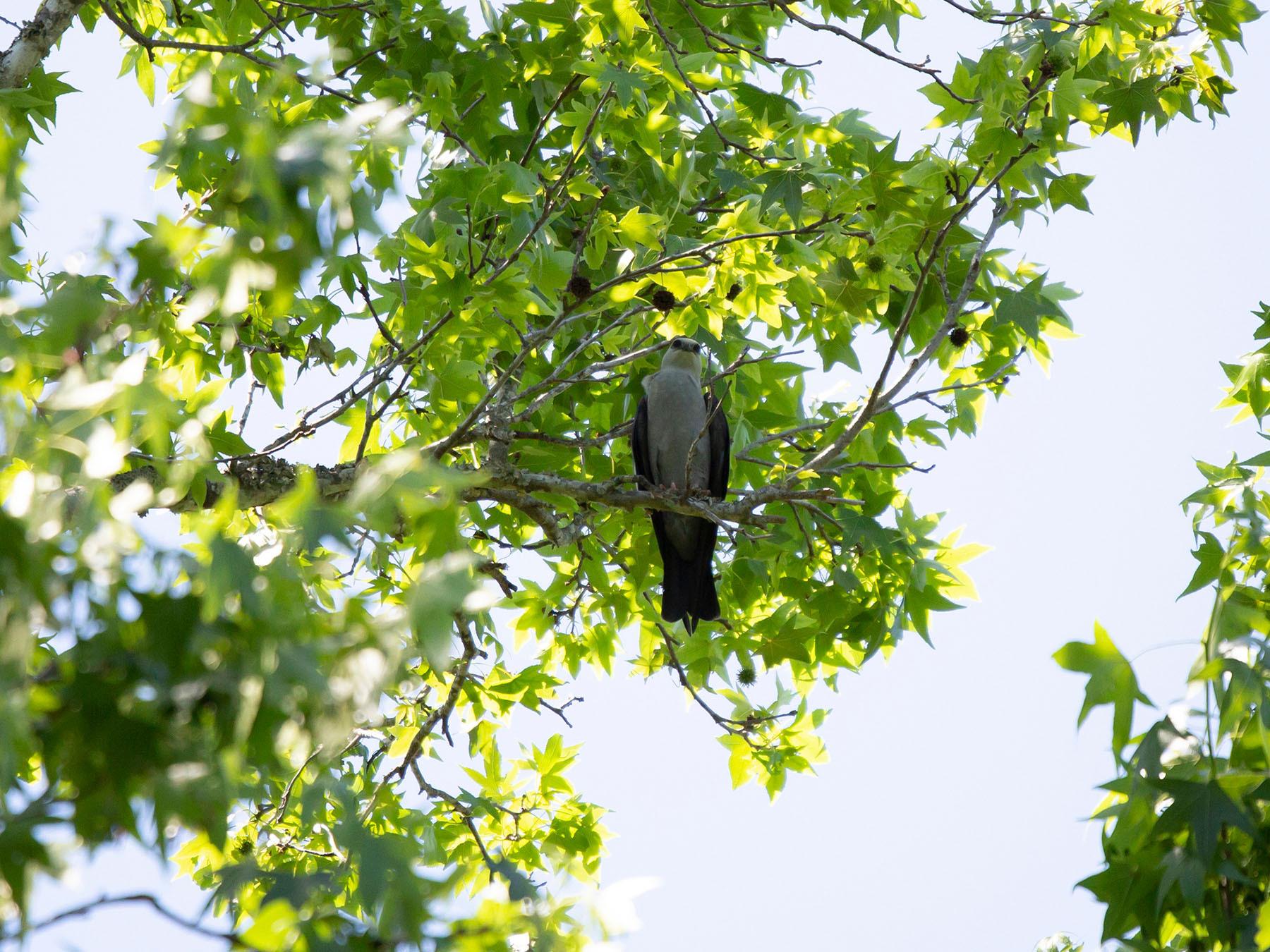
Habitat in towns and cities
On the southern Plains many kites now nest in towns, in city parks, along residential streets and on golf courses. Birds of the World's account, written in 1999, says town nesting began in the 1960s in scores, possibly hundreds, of towns in Kansas, Oklahoma and Texas, and later New Mexico, became abundant from the mid-1970s, and was first noticed in 1978. In 1999 it was still uncommon in towns along and east of the Mississippi River.2
In Lubbock, Texas, one observer monitored 52 nests in 20 city parks in 2022, one to eight per park.3
Migration and winter range
The Mississippi Kite is a long-distance migrant that leaves North America entirely. Most leave in late August to mid-September, flocks approaching or passing 1,000 birds move through southern Texas from late August to early October, and most are south of the US by mid-October. They travel in loose flocks, usually fairly low, about 80-330 ft (25-100 m) up but often much higher, and form kettles. The main route runs down the Gulf lowlands of eastern Mexico to the Isthmus of Tehuantepec.
Counts at Veracruz, Mexico, give a sense of the numbers: more than 11,000 kites between late August and mid-September 1992, nearly 48,000 in the same window in 1993, and about 186,000 over a longer window, late August to early November 1998. The windows differ, so the counts do not show a trend.2
It winters in central South America. Of 96 South American records from all seasons (1904-2010), 84 lie between 11° and 32° S, and the Chaco forest appears to be its chief wintering area, though the authors say more monitoring is needed.4 A juvenile at Punta Cana on 15 February 2013 was the first record for the Dominican Republic.5
Returning birds pass Panama in late March and early April and Mexico in April to early May.5 They settle on the breeding grounds mainly in late April and early May, and yearlings tend to come back later than adults.2
Spotting tips
Look up from late April to September over the southern Plains and the Southeast, especially over town parks, shelterbelts and river woods. Kites often hunt in groups, and early in the morning, before thermals form, they hunt from exposed perches. Late August and September bring the big southbound flocks through Texas.
What it eats
The Mississippi Kite lives mainly on medium and large insects. Cicadas, dragonflies, grasshoppers, katydids, locusts and beetles are all taken. Some kites and local populations, mainly in the West, also take vertebrates: bats and other small mammals, small birds, snakes, lizards, small box turtles, frogs and toads.
Up to the late 1990s, the only unbiased count of prey came from a small, new population in southeastern Arizona, outside the main range. There the cicada and leafhopper group made up 1,557 of the items, followed by beetles (311) and grasshoppers (80), with 56 bats, 15 lizards, 15 toads and 14 frogs. At least 14 species of birds have been recorded as prey.2 Audubon's field guide adds that it chases bats and flying birds, swallows and swifts among them.1
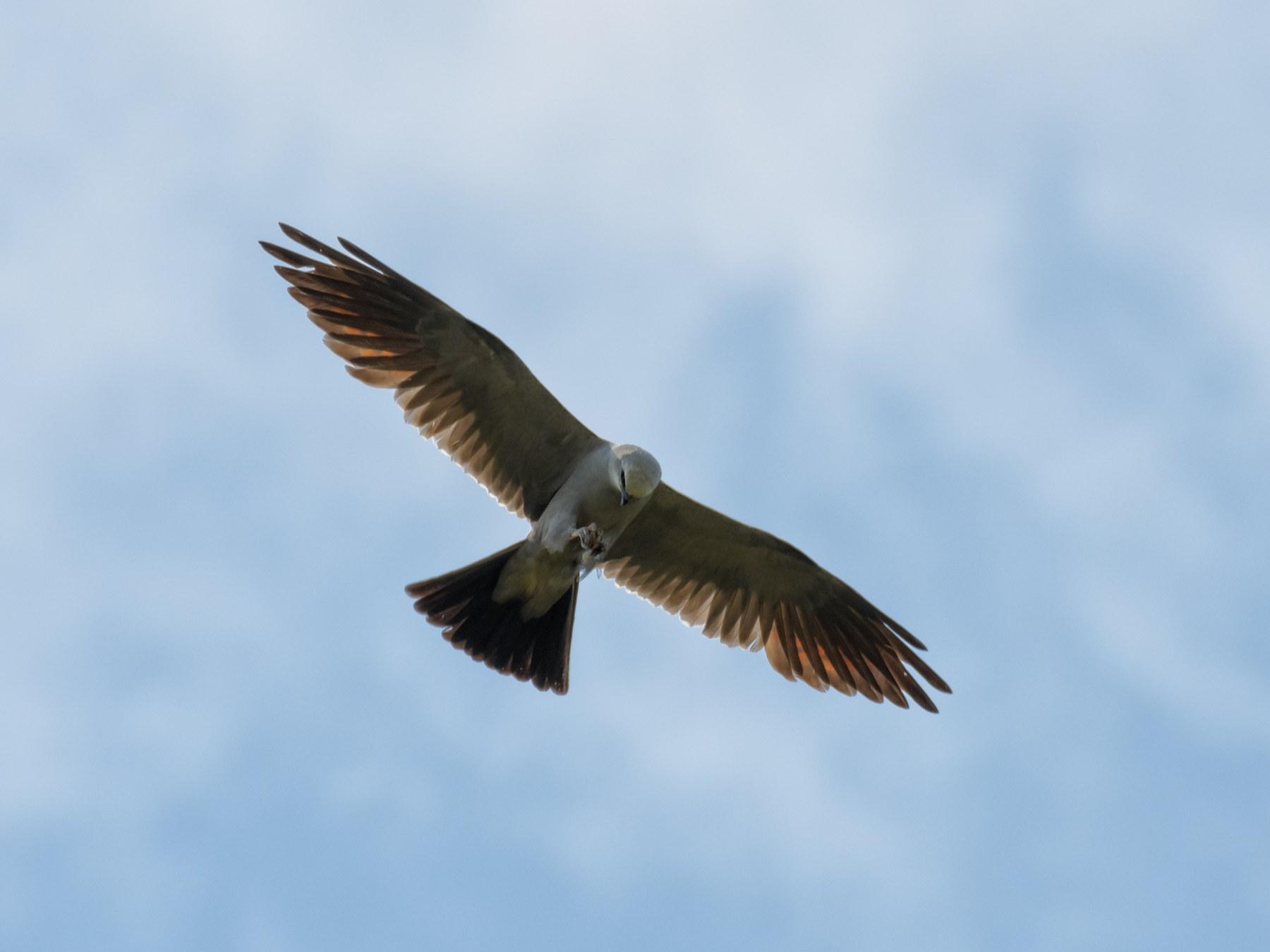
Feeding in the air
It takes most prey in the air, while soaring or from an exposed perch, and grabs it with one or both feet. Insects caught in the air are often eaten in flight, usually more than 33 ft (10 m) up, and the heads, wings and large legs are dropped. Larger items, such as swallows and bats, are eaten at a perch or the nest. Hawking from perches is the main method from about sunrise to 10:00, before thermals form, and hunting on the wing takes over after that. Kites may also catch insects disturbed by bison, horses, deer, people or fire.2
At Baton Rouge, Louisiana, on 15 May 2020, 6-7 kites hawked winged termites from a swarm just above the treetops, and the Chimney Swifts passing through the same swarm were not seen to interact with them.6 In southwestern Oklahoma, a flock that grew from 3 to 15 kites hunted bats at a cave mouth from about 04:45 to 07:30.2 Kites also scavenge: in Lubbock, Texas, in July 2022 they were twice seen landing on and pecking at road-killed White-winged Doves, trying to feed where the carcasses lay.7
Much prey is taken close to the nest, perhaps within about half a mile (1 km), though kites will hunt far from it. On migration in South America, cicadas and flying ants are the only insects known to be taken. Kites drink by landing at ponds and puddles, including puddles in town streets.
Nesting and breeding
Mississippi Kites nest in loose colonies, in almost any kind of tree, in a fork of a limb 10 to more than 115 ft (3 to more than 35 m) up. Elms, Osage orange, black locust and mulberry are used on the Plains, cottonwood and sweetgum in Illinois, and pecan in west Texas towns; evergreens are used only rarely. The nest is a loose platform of dead twigs with a shallow cup lined with green leaves and Spanish moss. Both sexes build it, the male more.
In Great Plains shelterbelts more than 90% of about 800 nests were in groups of 2-15, most often 4-6, and the nearest nests averaged about 380 ft (115 m) apart. The largest colony known by the late 1990s, at Meade State Park, Kansas, grew from a few pairs in the mid-1930s to more than 40 nests and 100 kites in 1961. Eastern birds are less likely to nest in colonies. Old nests are sometimes reused, about half in an Illinois study and about 16% of 391 on the Great Plains, and reused nests failed more often than new ones.2 We found no source saying that the same pair returns to the same nest.
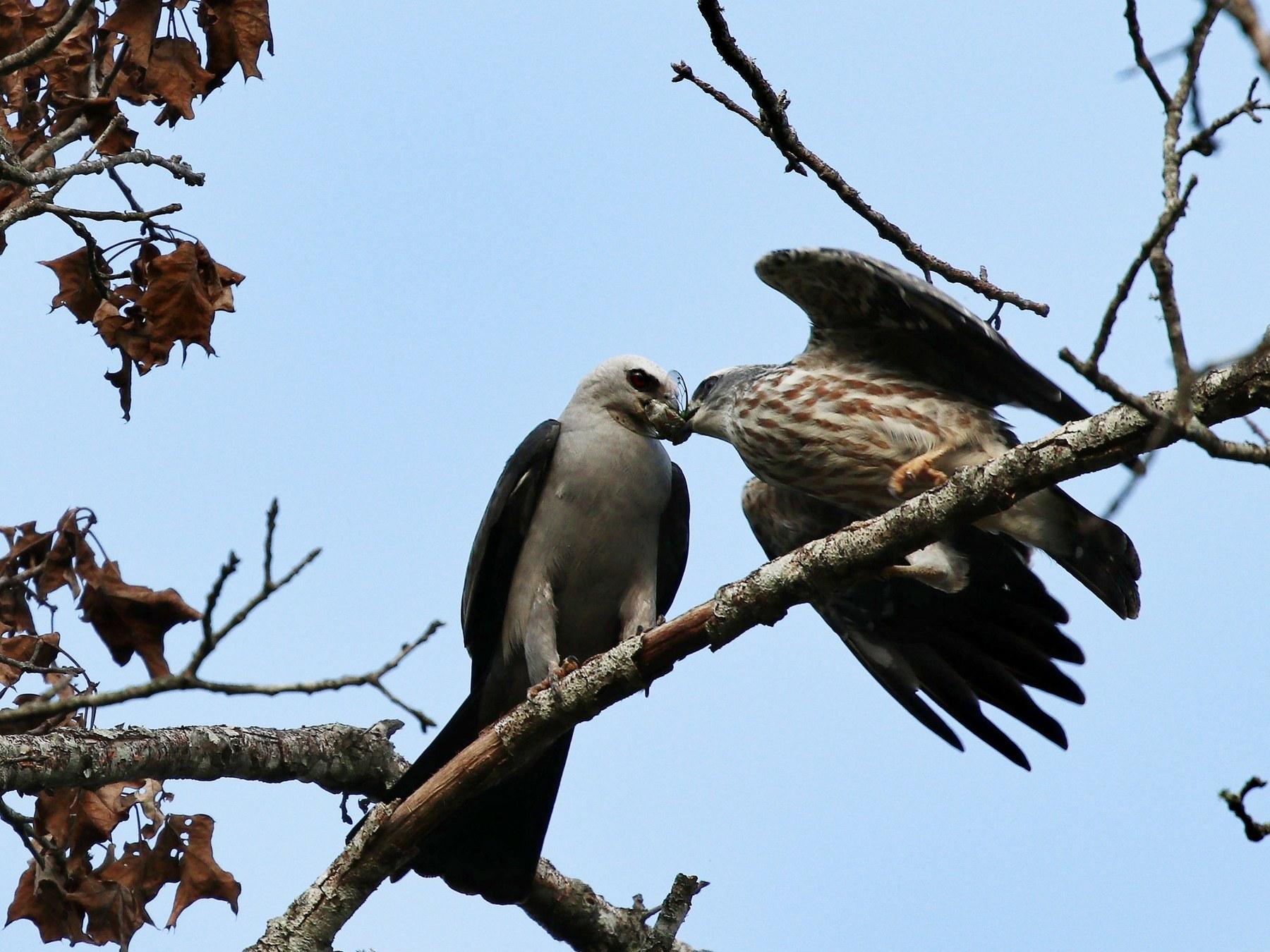
Eggs and young
Eggs are laid from about 10 May to late June, and laying within a colony often spans two weeks. The clutch is usually 2 dull white eggs, sometimes 1 and very rarely 3, and there is one brood a year. Both parents incubate for about 30 days (29-32), the female for longer, and the eggs are left alone only about 4% of the time.
The young climb out onto nearby branches at about 25-30 days and fly at 30-35 days. They are fed for at least 15-20 days after leaving the nest and hunt with the adults by 64 days. On the Plains young fledge from mid-July to mid-August. The male usually passes food to the female, who feeds the nestlings, and brooding is shared. Nestlings rarely fight, at least on the Great Plains; at one New Mexico nest they arranged nest material and preened each other and never fought over food.
Yearlings sometimes help. One, rarely two, was regularly seen with the breeding pair at 18 or more of 400 nests across several western states and at 14 of 16 Illinois nests, joining in nest defense, incubation and, rarely, brooding; their relationship to the adults is unknown. On the Great Plains, 72% of 81 nests with helpers succeeded against 48% of 396 without, which the researchers read as a benefit of helping. Most kites probably do not breed until they are two years old.2
Nest success and nest predators
In studies up to the late 1990s, nest success, meaning at least one young fledged, ranged from 42% of 24 rural nests in southeastern Missouri to 84% of 58 town nests in eastern New Mexico, with about 1.0-1.6 young per successful nest.2 At the White River refuge in Arkansas in 2004-2005, only 28.2% of 39 nests succeeded; among failures filmed on video, predation was the commonest cause, and western rat snakes took eggs and nestlings more often than any other predator.8
More widely, Great Horned Owls, other large birds of prey, raccoons and fox squirrels take eggs, nestlings and sometimes an adult sitting on the nest, and storms often destroy nests.2 In a grassland landscape, kites favored upland trees and shrubs over their more usual riverside woods, which the authors suggest could be explained by Red-tailed Hawks and Great Horned Owls using those woods, and nest survival fell the nearer kites nested to the predators' nests.9
Behaviour
Mississippi Kites are sociable all year. They hunt alone or in flocks, commonly of 5-50 and sometimes over 100, and use shared night roosts; groups of 5 to more than 20 may rest at midday close to active nests. They show little or no territorial behavior: nests can be close together, roosting birds typically perch less than about 6.5 ft (2 m) apart, and fights between kites are rare, though they try to snatch prey from each other.2
Pairs are monogamous. Most are already paired when they arrive in spring, and pairs stay together through the breeding season.
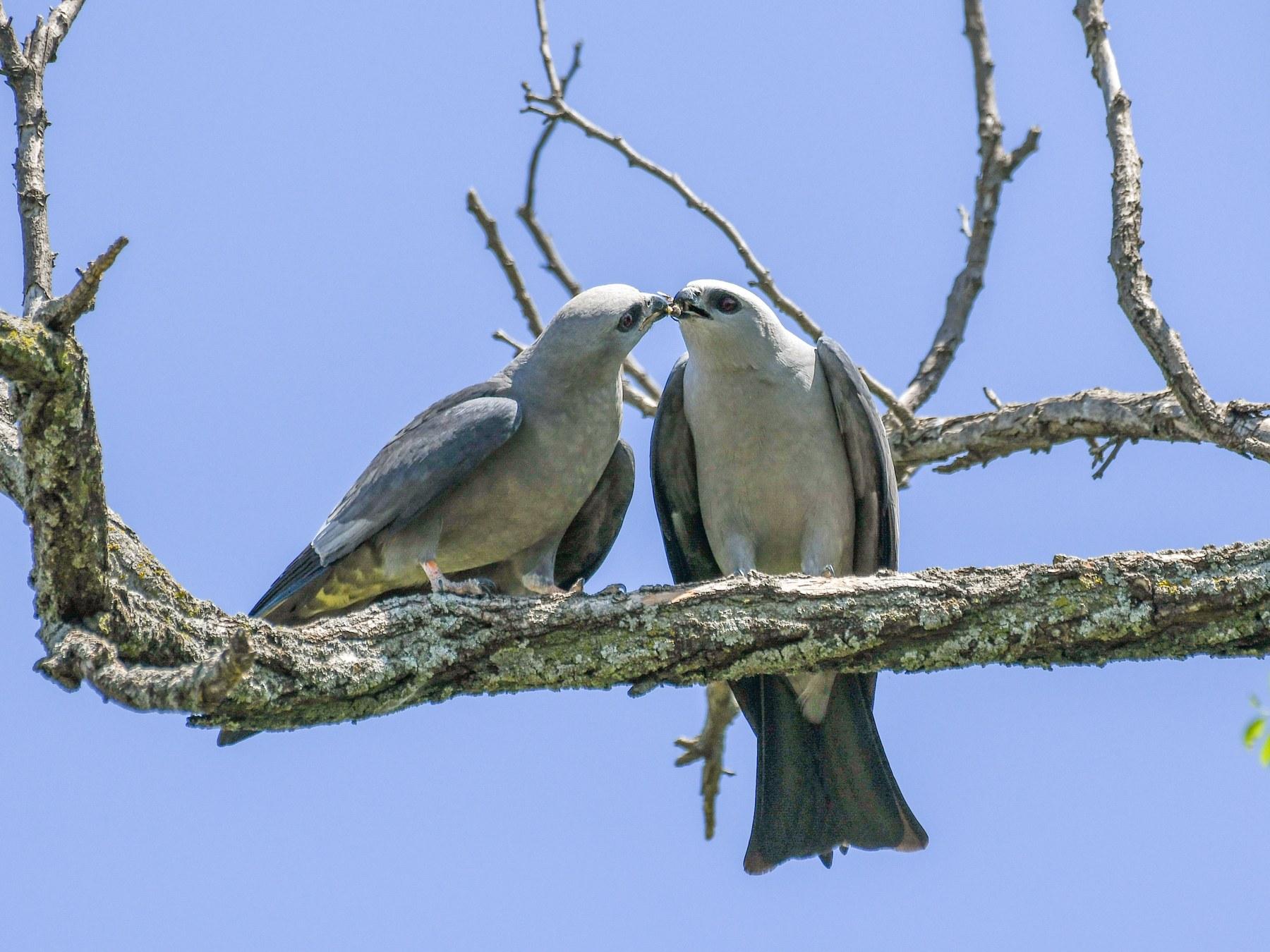
Defensive behavior near people
Near their nests, both sexes attack hawks, crows, ravens and owls, alone or in groups of more than 20, and go for Great Horned Owls hardest. They sometimes harass foxes and dogs, and some kites swoop at people who come close, occasionally making contact, mainly in towns.
By the late 1990s this diving had become a frequent public issue in at least five western states, including Kansas, New Mexico, Oklahoma and Texas. Birds of the World's 1999 account adds that diving kites are a minority, and those that hit people fewer still.2 In an experiment, people walked past kite nests in 84 trials of 252 passes over the first four weeks of the nestling period: 90% of passes drew no response, 8% a flight response and 2% an attack. Earlier experiments had drawn aggressive responses in 16-20% of passes beneath nests. The type of pass made no difference, responsiveness may be linked to the nestlings' age, and the authors say their results suggest aggression is uncommon, though some pairs may become persistently aggressive.10
Lifespan and predators
The oldest Mississippi Kite on the USGS Bird Banding Laboratory's longevity list was at least 11 years old: it was banded as a nestling in Kansas on 2 August 1984 and found dead in Texas on 11 August 1995.11
We found no measured typical lifespan. A 1974 estimate put life expectancy at 10.2-11.9 years, but Birds of the World says it rests on tenuous assumptions, among them a stable population and first-year survival of about 40-50%, and calls it conservative.2
Conservation
The Mississippi Kite is listed as Least Concern on the IUCN Red List (2024), and NatureServe ranks it G5, secure.12, 13 Partners in Flight estimates about 700,000 breeding-age birds, all breeding in the US (95% bounds 540,000-880,000), in figures dated around 2010, and scores it 9 out of 20 for continental conservation concern.14, 15
The North American Breeding Bird Survey shows no certain long-term change: +0.70% a year from 1966 to 2025, with a 95% credible interval of -0.38 to +1.63. Over 2015-2025, though, numbers rose clearly, by 3.25% a year (1.13 to 5.35), and the survey's index reached its highest value in 2025 after a low around 1999-2000. The southeastern state rows rise strongly since 1966, Georgia by 6.40% a year and Alabama by 5.14%, and Texas rises by 2.04% a year since 1967, while Oklahoma is flat to falling (-1.21% a year since 1967, interval -2.45 to +0.06).16
Conservation history
Numbers in the wooded East fell in the late 1800s and early 1900s, and near and east of the Mississippi the old range was largely re-occupied by the 1950s. On the southern Plains, tree planting, especially by the Civilian Conservation Corps in 1933-1942, gave kites new places to nest, and Birds of the World's 1999 text says Plains numbers began rising in the 1940s and 1950s. The same text calls the species secure in the US because Plains birds and some in the Southwest have taken to planted trees; loss of mature lowland forest is the main concern in the East.
Tissues of 20 kites from Kansas, Oklahoma and Texas in 1969-1972 held small amounts of DDT, DDE, dieldrin and aldrin with no apparent effect on breeding, while parathion sprayed on cotton was implicated in the deaths of 14 kites in southwestern Oklahoma. From 1983 to 1998, 280 nestlings were moved from Kansas and 266 released at three sites in west Tennessee; no released bird was detected later, but reports of kites and nests there increased.2 On the wintering grounds, much of the Chaco is now farmed, and how that affects the kites is unknown.4
Legal status
In the United States the Mississippi Kite is protected under the Migratory Bird Treaty Act and is on the federal list of protected birds (50 CFR 10.13): taking, killing or possessing the bird, its nest or its eggs is unlawful without federal authorization.17, 18 It is not listed under the Endangered Species Act.19 We did not read current state lists, so this page gives no state status.
Mexico lists it as subject to special protection (Pr) under NOM-059-SEMARNAT-2010, and international trade is controlled under CITES Appendix II, through the listing of the whole order of diurnal birds of prey.20, 21 In Canada, where it is only a rare visitor, the hawk and kite family is outside the Migratory Birds Convention Act, 1994.22
Similar birds
Often mistaken for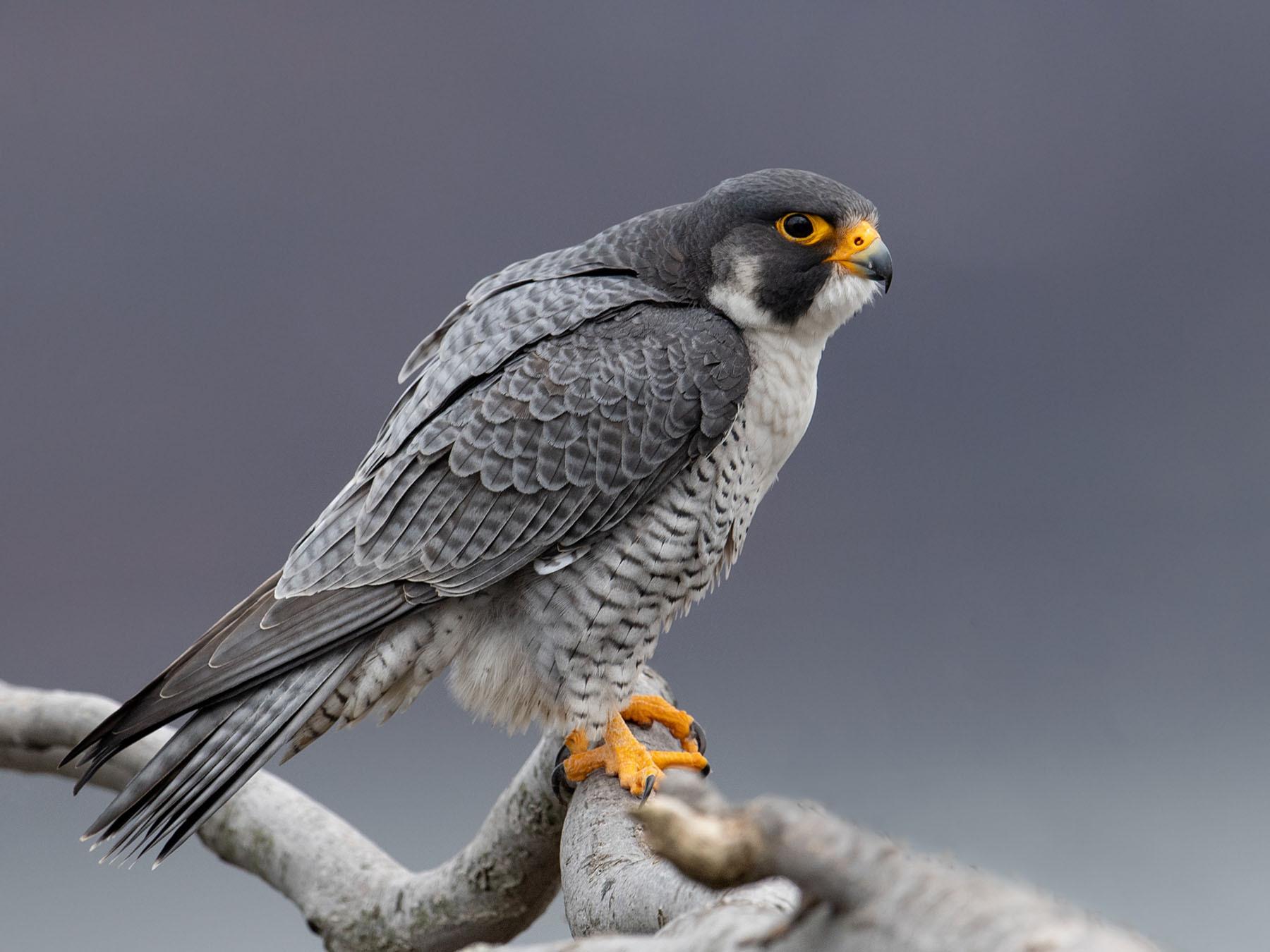
More photos
3 photos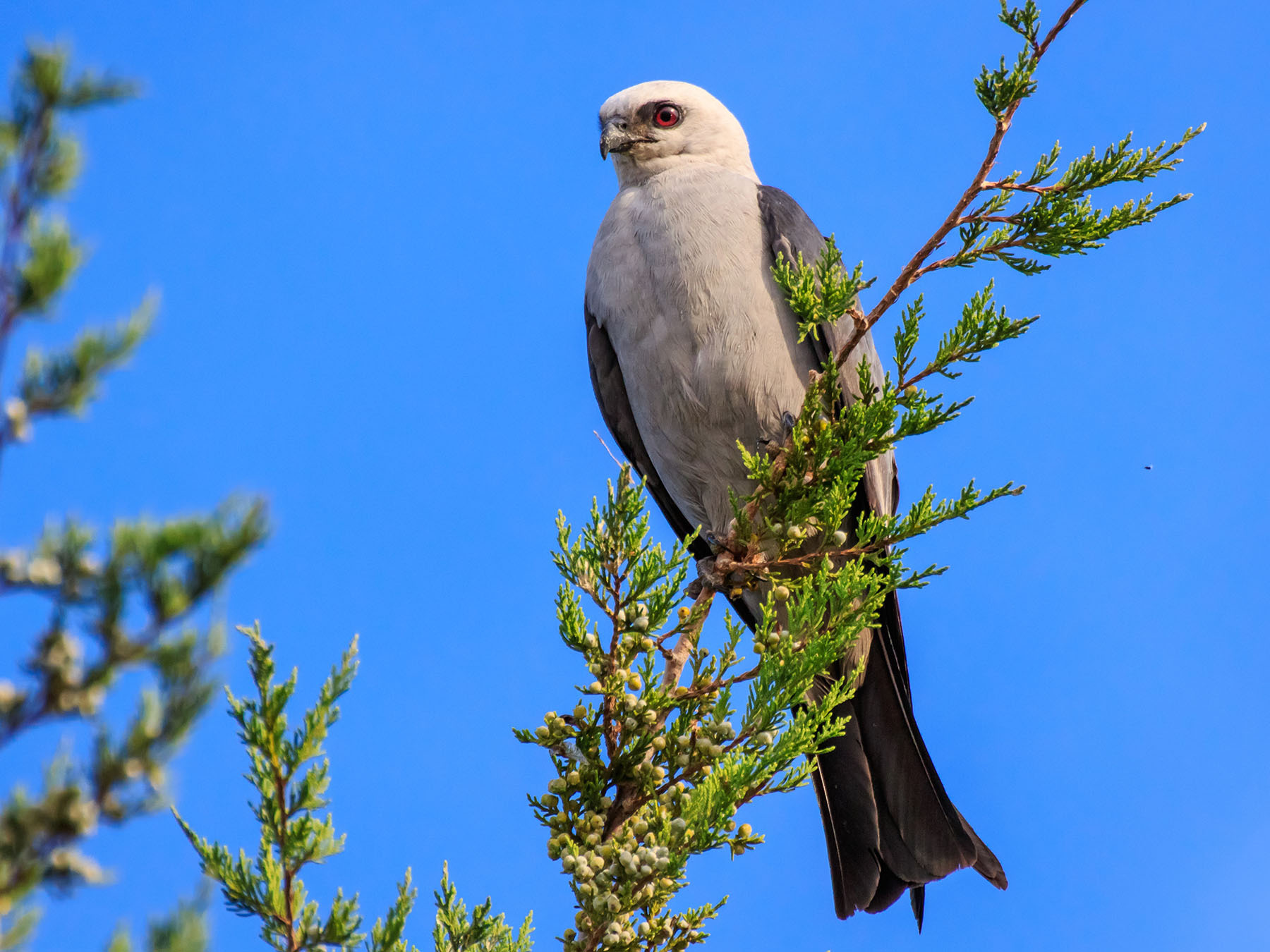
Quick facts
- Length
- 34–37 cm
- Wingspan
- 91 cm
- Weight
- 214–388 g
- Lifespan
- oldest recorded 11 years
- Family
- Hawks & Eagles
- Migration
- Long-distance Migrant
- Global status (IUCN)
- Least Concern
- World population
- About 700,000 breeding-age birds (Partners in Flight, around 2010)
- Population trend
- Stable over the long term: about +0.7% a year since 1966 in the North American Breeding Bird Survey, not statistically significant, but rising clearly over 2015-2025
- Scientific name
- Ictinia mississippiensis
Questions
4Why is it called the Mississippi Kite?
Is it a hawk or a falcon?
It is a kite, in the family Accipitridae with hawks, eagles and Old World vultures, and the only other species in its genus is the Plumbeous Kite. In fast flight it can look like a falcon, and a bird of any age can suggest a Peregrine Falcon, but its flight is different.
Can a Mississippi Kite pick up a dog?
We found no record of one doing so in the sources we read. Kites weigh only 7.5-13.7 oz (214-388 g) and live mainly on large insects, though near their nests they sometimes harass dogs.
Do Mississippi Kites mate for life?
Pairs stay together through the breeding season, and most arrive already paired. We found no source on whether the same birds pair up again in later years.
Sources
32- 1National Audubon Society. Mississippi Kite. Audubon Guide to North American Birds (text adapted from Kenn Kaufman, Lives of North American Birds, 1996). Accessed 27 November 2026. Source (opens in a new tab)
- 2Parker, J. W. (2020). Mississippi Kite (Ictinia mississippiensis), version 1.0. Birds of the World (A. F. Poole and F. B. Gill, Editors). Cornell Lab of Ornithology. doi:10.2173/bow.miskit.01 (opens in a new tab)
- 3Boal, C. W. (2023). Nest Usurpation by a Female Mississippi Kite (Ictinia mississippiensis). Journal of Raptor Research 57(3). doi:10.3356/jrr-22-103 (opens in a new tab)
- 4Juhant, M. A. and Areta, J. I. (2013). Distribution and migration of Mississippi Kites in South America. Journal of Field Ornithology 84(3): 255-261. doi:10.1111/jofo.12024 (opens in a new tab)
- 5Hayes, T. and Thorstrom, R. (2014). First record of a Mississippi Kite (Ictinia mississippiensis) in the Dominican Republic. Journal of Caribbean Ornithology 27: 25-26. doi:10.55431/jco.2014.27.25-26 (opens in a new tab)
- 6Platt, S. G. and Rainwater, T. R. (2022). Observations of Termite Insectivory by Mississippi Kites (Ictinia mississippiensis) at a Nuptial Emergence in Louisiana, USA. Journal of Raptor Research 56(4): 496-497. doi:10.3356/jrr-22-25 (opens in a new tab)
- 7Boal, C. W. (2023). Scavenging of Roadkill by Mississippi Kites (Ictinia mississippiensis). Journal of Raptor Research 57(1): 121-122. doi:10.3356/jrr-22-98 (opens in a new tab)
- 8Bader, T. J. and Bednarz, J. C. (2009). Reproductive success and causes of nest failures for Mississippi Kites: A sink population in eastern Arkansas?. Wetlands 29(2): 598-606. doi:10.1672/08-53.1 (opens in a new tab)
- 9Atuo, F. A. and O'Connell, T. J. (2018). Superpredator proximity and landscape characteristics alters nest site selection and breeding success of a subordinate predator. Oecologia 186(3): 817-829. doi:10.1007/s00442-018-4071-0 (opens in a new tab)
- 10Boal, C. W., Bibles, B. D., Pryor, M. M. and Skipper, B. R. (2022). Mississippi Kite Nest Defense: Is There an Influence of Nest Phenology or Human Activity?. Journal of Raptor Research 56(3): 356-361. doi:10.3356/jrr-21-74 (opens in a new tab)
- 11USGS Bird Banding Laboratory. Longevity records of North American birds (current table). USGS Bird Banding Laboratory, Bander Portal. Accessed 27 November 2026. Source (opens in a new tab)
- 12BirdLife International (2024). Ictinia mississippiensis. The IUCN Red List of Threatened Species 2024. IUCN Red List. doi:10.2305/IUCN.UK.2024-2.RLTS.T22695066A264593703.en (opens in a new tab)
- 13NatureServe. Ictinia mississippiensis, Mississippi Kite. NatureServe Explorer. Accessed 27 November 2026. Source (opens in a new tab)
- 14Partners in Flight (2024). Avian Conservation Assessment Database, version 2024.05.23. Partners in Flight. Accessed 27 November 2026. Source (opens in a new tab)
- 15Partners in Flight (2020). Population Estimates Database, version 2020.04.29. Partners in Flight. Accessed 27 November 2026. Source (opens in a new tab)
- 16Hostetler, J. A. et al. (2026). The North American Breeding Bird Survey, Analysis Results 1966 - 2025. U.S. Geological Survey. doi:10.5066/P1OSNSFC (opens in a new tab)
- 17U.S. Fish and Wildlife Service (2026). 50 CFR 10.13, List of Migratory Birds. Accessed 27 November 2026. Source (opens in a new tab)
- 18United States Congress (2023). 16 U.S.C. 703, Taking, killing, or possessing migratory birds unlawful. Accessed 27 November 2026. Source (opens in a new tab)
- 19U.S. Fish and Wildlife Service (2026). 50 CFR 17.11 and 17.12, Endangered and threatened wildlife and plants. Accessed 27 November 2026. Source (opens in a new tab)
- 20SEMARNAT (2019). NOM-059-SEMARNAT-2010 and its Annex III modification (DOF 14 Nov 2019). Accessed 27 November 2026. Source (opens in a new tab)
- 21UNEP-WCMC. Ictinia mississippiensis (taxon concept 8471). Species+. Accessed 27 November 2026. Source (opens in a new tab)
- 22Environment and Climate Change Canada. Birds protected in Canada. Accessed 27 November 2026. Source (opens in a new tab)
- 23Wilson, A. (1811). American Ornithology; or, the Natural History of the Birds of the United States, vol. 3 (p. 80, pl. 25 fig. 1). Internet Archive scan (OCR text). Accessed 27 November 2026. Source (opens in a new tab)
- 24Cornell Lab of Ornithology. Mississippi Kite: Overview, Identification, Life History and Range Map. All About Birds. Accessed 27 November 2026. Source (opens in a new tab)
- 25AviList (2025). AviList: The Global Avian Checklist, v2025b. doi:10.2173/avilist.v2025b (opens in a new tab)
- 26Atuo, F. A. and O'Connell, T. J. (2018). Scale-dependent resource selection and space use by Mississippi Kite (Ictinia mississippiensis) in a heterogenous mixed-shrub ecosystem. Journal of Ornithology 159(4): 901-911. doi:10.1007/s10336-018-1567-7 (opens in a new tab)
- 27Yu, H. (2020). Plumbeous Kite (Ictinia plumbea), version 1.0. Birds of the World. Cornell Lab of Ornithology. Accessed 27 November 2026. Source (opens in a new tab)
- 28Dunk, J. R. (2020). White-tailed Kite (Elanus leucurus), version 1.0. Birds of the World. Cornell Lab of Ornithology. Accessed 27 November 2026. Source (opens in a new tab)
- 29Meyer, K. D. (2020). Swallow-tailed Kite (Elanoides forficatus), version 1.0. Birds of the World. Cornell Lab of Ornithology. Accessed 27 November 2026. Source (opens in a new tab)
- 30White, C. M., Clum, N. J., Cade, T. J. and Hunt, W. G. (2024). Peregrine Falcon (Falco peregrinus), version 1.1. Birds of the World. Cornell Lab of Ornithology. Accessed 27 November 2026. Source (opens in a new tab)
- 31Bibles, B. D., Glinski, R. L. and Johnson, R. R. (2020). Gray Hawk (Buteo plagiatus), version 1.0. Birds of the World. Cornell Lab of Ornithology. Accessed 27 November 2026. Source (opens in a new tab)
- 32Smith, K. G., Wittenberg, S. R., Macwhirter, R. B. and Bildstein, K. L. (2020). Northern Harrier (Circus hudsonius), version 1.0. Birds of the World. Cornell Lab of Ornithology. Accessed 27 November 2026. Source (opens in a new tab)

Checked by
Nathan Cope, founder and editor
Nathan founded Birdfact and leads its writers and contributors in the UK, the US and Canada. He has watched and studied birds for more than ten years, and checks every article and species guide before it’s published.