Species Profile
White-winged Dove
Zenaida asiatica
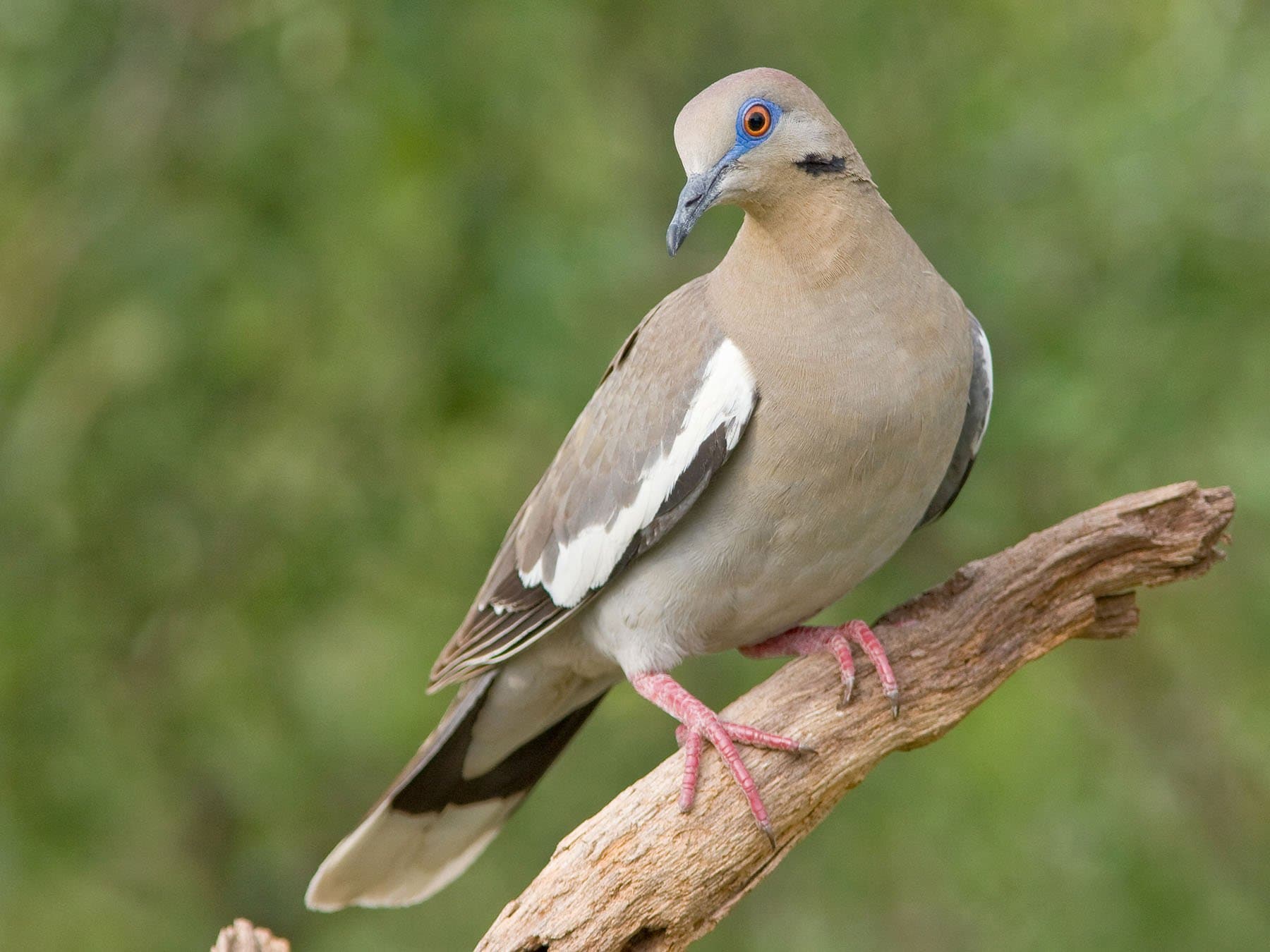
White-winged Dove perched on a brown branch, showing its tan body, distinctive white wing patches, and blue eye ring against a green background.
Quick Facts
Conservation
LCLeast ConcernLifespan
10–15 years
Length
27–30 cm
Weight
122–170 g
Wingspan
45–58 cm
Migration
Partial migrant
Bold white wing patches that flash like a crescent moon in flight, crimson eyes ringed with bare blue skin, and a call widely immortalised in a Stevie Nicks hit — the White-winged Dove is one of North America's most recognisable doves. Native to the deserts and subtropical woodlands of the American Southwest and Mexico, it has proved so adaptable to urban life that San Antonio, Texas alone hosts an estimated 1.3 million birds year-round.
Think you've spotted a White-winged Dove?
Upload a photo and we'll confirm it instantly
Confirm with a PhotoAppearance
Bold white crescents, crimson eyes, and bare blue orbital skin make the White-winged Dove one of the most immediately recognisable doves in North America — even at distance. The white wing patch — formed by white median and greater coverts — appears as a narrow white stripe along the lower edge of the folded wing at rest, but transforms into a brilliant white crescent in flight, contrasting sharply against the dark outer wing feathers.
The overall plumage is brownish-grey above and paler grey below. Adults carry a striking face: bright crimson eyes surrounded by a ring of bare, vivid blue skin, and a dark elongated "ear spot" — a patch of black feathers — below and behind the eye. The bill is slender and dark, and the legs and feet are bright pink to red. The tail is short and rounded, quite unlike the long, pointed tail of the Mourning Dove, and the outer tail feathers are tipped with bold white that flashes conspicuously in flight.
Males and females are very similar and difficult to distinguish in the field. Males tend to be slightly larger and may show a faint iridescent purple or violet sheen on the crown, neck, and nape, along with a bolder, more defined ear spot — but these differences are subtle and usually require close examination. Sexing by plumage alone is unreliable; cloacal examination is typically needed for certainty.
Juveniles are duller and more grey-brown than adults, lack the blue eye ring, have dark brown or black irises rather than red, and show pinkish-brown rather than bright red legs. Juvenile plumage is typically seen between March and October. Moult runs from June through November, occurring on the summer breeding grounds unless interrupted by migration.
Identification & Characteristics
Colors
- Primary
- Brown
- Secondary
- Grey
- Beak
- Dark Grey
- Legs
- Red
Markings
Bold white wing patch forming a white crescent in flight; crimson eye with bare blue orbital ring; dark elongated ear spot below and behind eye; white-tipped outer tail feathers
Tail: Short and rounded with bold white tips on the outer tail feathers, flashing conspicuously in flight
Attributes
Understanding Attributes
Rated 0–100 based on research and observation. A score of 50 is average across all bird species. These attributes are relative and don't necessarily indicate superiority.
Habitat & Distribution
The White-winged Dove's native range extends from the southwestern United States south through Mexico, Central America, and into parts of western South America — Colombia, Ecuador, and Peru — as well as throughout the Caribbean, including Cuba, Puerto Rico, Hispaniola, and Jamaica. In the United States, the species is most abundant in Texas, Arizona, and New Mexico, where it is a common to abundant resident and breeder.
Habitat preferences vary considerably across this range. In the Sonoran Desert of Arizona and northwestern Mexico, birds are closely associated with saguaro cactus communities and riparian woodlands of mesquite and palo verde. In Texas, they breed in dense, thorny subtropical woodlands along the Rio Grande, in citrus groves, and increasingly in urban and suburban areas with large shade trees such as pecan, live oak, and ash. Across the broader range, they also use scrubland, chaparral, open oak woodland, agricultural fields, and farmland — generally preferring areas where nesting woodland is interspersed with open feeding habitat. Breeding occurs from near sea level up to approximately 1,650 m (5,400 ft) in Texas.
Since the 1980s, the species has been expanding its range northward at pace. It now breeds regularly as far north as Oklahoma and appears with increasing frequency in Kansas, Arkansas, Colorado, and beyond. Vagrant individuals have been recorded across much of the continental United States, including Alaska, the Great Lakes states, New England, and the Mid-Atlantic. Florida hosts a largely permanent resident population descended from introduced birds. The species is not native to the UK or Europe and has not been recorded there as a vagrant — it remains firmly a bird of the Americas.
For US birdwatchers, Texas and Arizona offer the best opportunities. In Texas, the Lower Rio Grande Valley, San Antonio, and the Hill Country are all reliable; in Arizona, the Tucson area and Saguaro National Park are excellent from April through August.
Where to See This Bird
Explore regional guides for locations where this bird has been recorded.
Diet
White-winged Doves are primarily granivorous, and cultivated grains form a major part of the diet across much of their range. Wheat, sunflower, milo (sorghum), corn, safflower, and barley are all taken readily, and birds nesting near agricultural land may make daily foraging flights of 5–20 km to reach grain fields. Wild plant seeds also feature heavily, including spurge, panic grass, bristlegrass, Mexican jumping beans, Chinese tallow, leatherweed, lime prickly-ash, brasil, privet, pigeonberry, and ocotillo.
In the Sonoran Desert of Arizona and northwestern Mexico, the relationship with the giant saguaro cactus (Carnegiea gigantea) is particularly close. White-winged Doves feed on saguaro nectar, pollen, and fruit, and stable isotope analysis by Wolf and Martínez del Río (2000) demonstrated that desert-breeding birds derive the majority of their body carbon and water from saguaro during the breeding season — consuming the equivalent of approximately 128 saguaro fruits per season. Their Sonoran vernacular name, paloma pitayera ("pigeon that eats columnar cactus fruit"), reflects this deep ecological association. Organ-pipe cactus and other columnar cacti provide additional fruit, and smaller berries are taken throughout the range.
Compared to Mourning Doves, White-winged Doves tend to feed more slowly and prefer larger seeds, reflecting their bigger bill and gape. Their willingness to feed above ground level — on seedheads, berry clusters, and raised feeders — distinguishes them from most other doves. To support crop milk production during breeding, adults actively seek calcium by consuming snail shells and bone fragments, and may reduce seed intake in the days before hatching to keep the milk uncontaminated.
Behaviour
White-winged Doves are gregarious birds, particularly outside the breeding season, when they gather in flocks of dozens to thousands to feed on grain fields or roost in urban trees. Foraging is most active in the early morning and late afternoon, with birds often flying considerable distances — up to 40 km — between roost sites, feeding areas, and water sources. In arid desert environments, they regularly commute 25 miles or more to reach water, a daily journey that demands significant energy.
Within breeding territories, males are moderately territorial, calling persistently from elevated perches and occasionally chasing rival males. Aggression between individuals is generally limited to displacement at food sources and nest-site competition. At feeders, they can be assertive, using their larger body size to displace smaller doves such as the Mourning Dove or Inca Dove.
Unlike Mourning Doves, which forage almost exclusively on the ground, White-winged Doves regularly feed above ground level — on seedheads, berry clusters, and elevated bird feeders — a behavioural flexibility that has helped them thrive in urban gardens. They also consume grit (small stones) to aid seed digestion, and actively seek out calcium by eating snail shells and bone fragments, particularly during the breeding season when crop milk production places high demands on the body.
The species' adaptation to human-modified landscapes has been striking: urban populations in Texas cities are largely sedentary year-round, exploiting bird feeders, ornamental fruiting trees, and the thermal warmth of the urban heat island. This last factor is thought to be driving the species' ongoing northward range expansion.
Calls & Sounds
The White-winged Dove's signature call is a loud, drawn-out cooing sequence universally rendered as "who cooks for you" — with emphasis on the final note. David Sibley transcribes it as hhhHEPEP pou poooo; Audubon renders it as hooo-hooo-ho-hooo. The phrase begins with a long, breathy introductory syllable audible only at close range, followed by the four-note sequence. Males call from dedicated elevated perches, and calling is most frequent during the breeding season, peaking in May and June, with most activity just before dawn or in the late afternoon. Females give a slightly softer, more muted version of the same call.
What sets the White-winged Dove apart from all other North American doves is its use of two structurally distinct song types, regularly alternated. The long song lasts up to 10 seconds and ends with a distinctive sequence of alternating downward and upward voice breaks. The short song is the familiar four-note "who cooks for you" phrase. No other North American dove is known to alternate two such different song types in this way.
The short song is closely integrated with the male's courtship display in a coordinated audio-visual signal: as the male raises his wings to approximately 45 degrees above his body, the wing-flash is timed to coincide precisely with the first note of the call. A rarer two-note or three-note variant has also been documented, possibly functioning as a nest coo or female response call.
Nestlings begin vocalising at just 2 days old with a distress pipping call, and by 4–5 days produce a sur-ee or sur-eet food-begging call. The species also produces a loud wing-whistle during take-off, audible at close range — a feature shared with many members of the pigeon family.
Flight
In flight, the White-winged Dove is transformed. The bold white crescent across the upperwing — formed by the white median and greater coverts contrasting against the dark outer primaries — is visible at long range and is the species' single most diagnostic feature in the air. The white-tipped outer tail feathers flash conspicuously as the bird banks, lands, or takes off, adding a second burst of white that distinguishes it instantly from the Mourning Dove.
Flight style is direct and purposeful, with steady, rhythmic wingbeats and relatively little undulation — more like a small pigeon than the bounding, erratic flight of some smaller doves. The body is compact and the tail short and rounded, giving the bird a stockier silhouette than the Mourning Dove's elongated teardrop shape. Wingbeats are moderately fast and produce an audible wing-whistle on take-off, particularly when the bird launches suddenly from a perch.
White-winged Doves are capable of sustained long-distance flight. Banding studies have shown that desert-nesting birds routinely travel up to 8 km between nest and water, and migratory flocks can include up to 4,000 individuals. Autumn migration typically occurs in smaller groups of fewer than 50 birds flying at low altitudes. The species' wingspan of 45–58 cm gives it good aerodynamic efficiency for these sustained commutes.
Nesting & Breeding
White-winged Doves are monogamous, pairing for at least one breeding season. In Arizona, birds arrive on their breeding grounds from late March, with peak activity in April. In Texas, the season runs from late April through to August, with egg dates recorded as early as 16 April and as late as 13 August. Males establish territories by calling persistently from prominent perches and engaging in courtship displays (described in detail in the Courtship & Display section).
The female selects the specific nest site within the male's territory. Nests are placed in shrubs, trees, or cacti — typically 1.2–9 m (4–30 ft) above ground — on a horizontal limb, in a branch fork, or occasionally atop an old nest. In cities, large ornamental shade trees are favoured. The nest itself is a flimsy platform of twigs, sometimes incorporating grasses, weed stems, or Spanish moss, built over 2–5 days; the male gathers material and the female constructs. In dense habitat with abundant food nearby, birds may nest colonially at densities exceeding 25 pairs per hectare.
Clutch size is typically 2 eggs (range 1–4), creamy white to pale buff, smooth and dull-textured. Both parents share incubation in regular shifts — males typically incubate from mid-morning to mid-afternoon, females from mid-afternoon through the following morning. Incubation lasts 13–20 days, typically around 14 days. Chicks hatch asynchronously, the first egg hatching roughly a day before the second.
For the first four days, nestlings are fed exclusively on crop milk — a protein- and fat-rich secretion of the oesophageal lining, chemically similar to mammalian milk, produced by both parents. This is gradually supplemented with regurgitated seeds; by the second week the diet is mostly seeds.
Nestlings fledge at 13–18 days. The male continues to feed fledglings near the nest for up to four weeks while the female may begin a new clutch as early as three days after fledging. Pairs typically raise 2–3 broods per season, and research in Texas found that Eastern White-winged Doves successfully fledge an average of 2.2 chicks per breeding season.
Lifespan
A White-winged Dove banded in Arizona in 1958 and recovered in Mexico 21 years and 9 months later holds the longevity record for the species — and ranks among the longest-lived doves on record. Wild birds typically live 10–15 years, while captive individuals have been recorded to 25 years. By comparison, the closely related Mourning Dove has a maximum recorded lifespan of around 19 years, though its average wild lifespan is considerably shorter at 1–5 years.
Annual survival rates for White-winged Doves are not well documented across the full range, but hunting pressure is known to be a significant mortality factor — the species is the second most hunted game bird in the United States, and the Texas hunting stamp programme was introduced specifically to manage harvest levels. Other mortality causes include predation by raptors (Cooper's Hawks, Sharp-shinned Hawks, and Peregrine Falcons are documented predators), collisions with vehicles, buildings, and utility lines, and disease — trichomoniasis, a parasitic infection of the upper digestive tract, affects some populations.
Urban birds may benefit from reduced predation pressure and reliable year-round food from feeders, potentially skewing survival rates upward in city populations compared to rural or desert-nesting birds. The species' relatively long potential lifespan, combined with its capacity to raise 2–3 broods per season, gives it good demographic resilience — a key reason the Texas population was able to recover so dramatically from its mid-20th-century low.
Conservation
The White-winged Dove is listed as Least Concern by the IUCN. Partners in Flight estimates the global breeding population at approximately 14 million individuals, and BirdLife International (2024) considers the global population to be increasing slowly over three generations. North American Breeding Bird Survey data confirm population increases between 1966 and 2019, and Texas BBS trend data from 1980–2006 showed a statistically significant annual increase of +13.0%. In 2024, the Texas Parks and Wildlife Department survey recorded a record 12.8 million White-winged Doves in the state — 27% above the long-term average.
The primary historical threat was habitat loss through clearing of native woodland and agricultural conversion, particularly in the Lower Rio Grande Valley (LRGV) of Texas, where an estimated 90% of critical nesting habitat was destroyed by the 1930s. Compounded by intensive hunting pressure, this drove the LRGV population from an estimated 4–12 million birds in 1923 to around 500,000 by 1939 — one of the steepest documented collapses in North American dove history.
In 1971, Texas introduced a mandatory White-winged Dove hunting stamp; the state sold 1.4 million stamps in the first 30 years, generating $8.4 million for conservation programmes. The species is currently the second most hunted game bird in the United States.
Additional threats include collisions with utility lines, vehicles, and buildings; disease (trichomoniasis affects some populations); and climate change, which may alter the timing of saguaro flowering and fruiting in the Sonoran Desert, potentially disrupting the tightly synchronised migration of desert-breeding birds. Despite these pressures, the species' adaptability to urban environments has proved a powerful buffer, and its range and numbers have been expanding steadily since the 1980s.
Population
Estimated: Approximately 14 million (Partners in Flight global breeding population estimate); Texas alone recorded a record 12.8 million in 2024 (TPWD survey)
Trend: Increasing
Increasing. North American Breeding Bird Survey data show population increases between 1966 and 2019. Texas BBS trend data (1980–2006) showed a statistically significant annual increase of +13.0%. BirdLife International (2024) considers the global population to be increasing slowly over three generations.
Elevation
Sea level to approximately 1,650 m (5,400 ft)
Additional Details
- Predators:
- Known predators include Cooper's Hawks, Sharp-shinned Hawks, and Peregrine Falcons. Mammals such as domestic cats and raccoons may take eggs and nestlings. In the Sonoran Desert, Greater Roadrunners and various snake species are also documented predators of eggs and chicks.
Courtship & Display
The White-winged Dove's courtship display is one of the most precisely choreographed among North American doves, combining a distinctive flight display with a tightly coordinated audio-visual perch display. The male begins by performing a spiralling courtship flight: ascending steeply from his perch, then gliding back down on stiff, outstretched wings — a display visible from a considerable distance and used to advertise territory as well as attract females.
The perch display is where the real precision lies. The male lowers his body forward, raises his wings straight up and over his body to approximately 45 degrees, lifts and fans his tail to flash the black-and-white pattern, then rocks back upright — all while delivering the short "who cooks for you" call. Crucially, the wing-flash is timed to coincide precisely with the first note of the call, creating a combined audio-visual signal that is unique among North American doves. This synchronisation has been documented in detail by vocalisation researchers. It is thought to amplify the signal's effectiveness in dense vegetation, where visual cues alone may be obscured.
Males also bow repeatedly, puff up their iridescent neck feathers, and engage in mutual preening with the female as pair bonds develop. The male selects the general territory and nesting area; the female makes the final choice of specific nest site. In colonial nesting situations — where densities can exceed 25 pairs per hectare — males must defend their immediate nest vicinity vigorously, and territorial chases and wing-raising threat displays between neighbouring males are common throughout the breeding season.
Cultural Significance
No North American dove has a stronger claim to popular culture than the White-winged Dove. In 1982, Stevie Nicks released "Edge of Seventeen (Just Like the White Winged Dove)", which reached #11 on the US Billboard Hot 100 and is ranked #217 on Rolling Stone's 500 Greatest Songs of All Time. The song's origin is rooted in a specific encounter with the species: Nicks, who grew up in Phoenix, Arizona, was inspired by a restaurant menu that described the dove's call and its home in the saguaro cactus. She used the white-winged dove as a symbol of the spirit leaving the body, writing the song to process the near-simultaneous deaths of her uncle Jonathan and John Lennon in December 1980. The opening line — "Just like the white-winged dove / Sings a song, sounds like she's singing" — references the bird's distinctive cooing directly.
Beyond popular music, the White-winged Dove holds deep cultural significance in the American Southwest and Mexico, where it has been hunted, celebrated, and observed for centuries. In Texas, the species is embedded in the state's hunting culture — the opening of White-winged Dove season in the Lower Rio Grande Valley is a major annual event. It draws hunters from across the country and generates significant economic activity for border communities. The mandatory hunting stamp introduced in 1971 became a model for game bird conservation funding, demonstrating that regulated harvest could coexist with — and even fund — population recovery.
In the Sonoran Desert, the dove's vernacular name paloma pitayera encapsulates its ecological role: the pigeon that eats columnar cactus fruit. Indigenous communities across the Sonoran region have long recognised the bird's intimate relationship with the saguaro, and its arrival in spring has traditionally been read as a seasonal marker tied to the cactus's flowering.
Birdwatching Tips
The white wing patch is the single most reliable field mark at any distance. At rest, look for the narrow white stripe along the lower edge of the folded wing; in flight, the brilliant white crescent across the upperwing is unmistakable. The short, rounded tail with white-tipped outer feathers — flashing as the bird lands or takes off — is a useful secondary feature that immediately separates it from the long-tailed Mourning Dove.
At close range, the face pattern clinches the identification: no other North American dove combines a crimson eye, bare blue orbital ring, and dark ear spot. Juveniles are duller and lack the blue eye ring, but the wing patch is still present and diagnostic. In poor light or at distance, concentrate on wing and tail pattern rather than face colour.
In the United States, Texas and Arizona offer the most reliable sightings. In Texas, the Lower Rio Grande Valley, San Antonio, and the Edwards Plateau are excellent from late April through August; urban feeders stocked with sunflower seeds or milo attract birds reliably year-round in the south of the state. In Arizona, the Tucson area and Saguaro National Park are outstanding from April to August — watch for birds feeding on saguaro flowers and fruit at dawn.
Listen for the "who cooks for you" call — a loud, drawn-out four-note coo — from elevated perches in the early morning or late afternoon. Calling peaks in May and June. At feeders, White-winged Doves tend to be bolder and larger than Mourning Doves, often displacing them at platform feeders. Offering sunflower seeds, safflower, or milo on a platform feeder is the most reliable way to attract them to a garden in their range.
Did You Know?
- The White-winged Dove is the only North American dove known to regularly alternate two structurally distinct song types — a long song lasting up to 10 seconds and a short four-note phrase — a vocal behaviour undocumented in any of its close relatives.
- During the male's courtship display, the wing-flash is timed to coincide precisely with the first note of the "who cooks for you" call, creating a synchronised audio-visual signal unique among North American doves. Researchers believe this coordination amplifies the signal's effectiveness in dense vegetation, where visual cues alone may be obscured.
- The White-winged Dove inspired Stevie Nicks' 1982 hit "Edge of Seventeen (Just Like the White Winged Dove)", which reached #11 on the US Billboard Hot 100. Nicks, who grew up in Phoenix, Arizona, was inspired by a restaurant menu describing the dove's call and its home in the saguaro. She used the dove as a symbol of the spirit leaving the body, writing the song to process the simultaneous deaths of her uncle Jonathan and John Lennon in December 1980.
- Despite being an important saguaro pollinator, the White-winged Dove is simultaneously the cactus's main seed predator — consuming the equivalent of approximately 128 saguaro fruits per season. This asymmetrical relationship, where the dove benefits far more than the cactus, is unique among the saguaro's regular visitors.
- The Texas population underwent one of the most dramatic boom-bust-recovery cycles in North American bird history: from an estimated 4–12 million birds in 1923, it crashed to around 500,000 by 1939 due to overhunting and habitat loss, before rebounding to a record 12.8 million in 2024 — partly driven by a mandatory hunting stamp programme that generated $8.4 million for conservation over its first 30 years.
Records & Accolades
Pop Culture Icon
Stevie Nicks' "Edge of Seventeen"
The only North American dove to inspire a Billboard Top 20 hit — Stevie Nicks' 1982 song reached #11 on the US Hot 100 and is ranked #217 on Rolling Stone's 500 Greatest Songs of All Time.
Saguaro Specialist
~128 saguaro fruits per season
Desert-breeding birds derive the majority of their body carbon and water from saguaro cactus during the breeding season, consuming the equivalent of approximately 128 fruits per season (Wolf & Martínez del Río, 2000).
Urban Coloniser
1.3 million in San Antonio alone
By 2001, an estimated 1.3 million White-winged Doves were present year-round in San Antonio, Texas — one of the most dramatic urban colonisations recorded for any North American bird.
Longevity Record
21 years and 9 months
The oldest confirmed wild individual was banded in Arizona in 1958 and recovered in Mexico in 1980 — one of the longest lifespans recorded for any dove species.
Community Photos
Be the first to share a photo of the White-winged Dove
Upload a PhotoIdentify Any Bird Instantly
- Upload a photo from your phone or camera
- Get an instant AI identification
- Ask follow-up questions about the bird
Monthly Birds in Your Area
- Personalised for your location
- Seasonal tips and garden advice
- Updated every month with new species