
Cinereous Vulture
Eurasian Black Vulture, Monk Vulture · Aegypius monachus
By the Birdfact teamChecked by Nathan Cope
On this page14 sections
How to recognise it
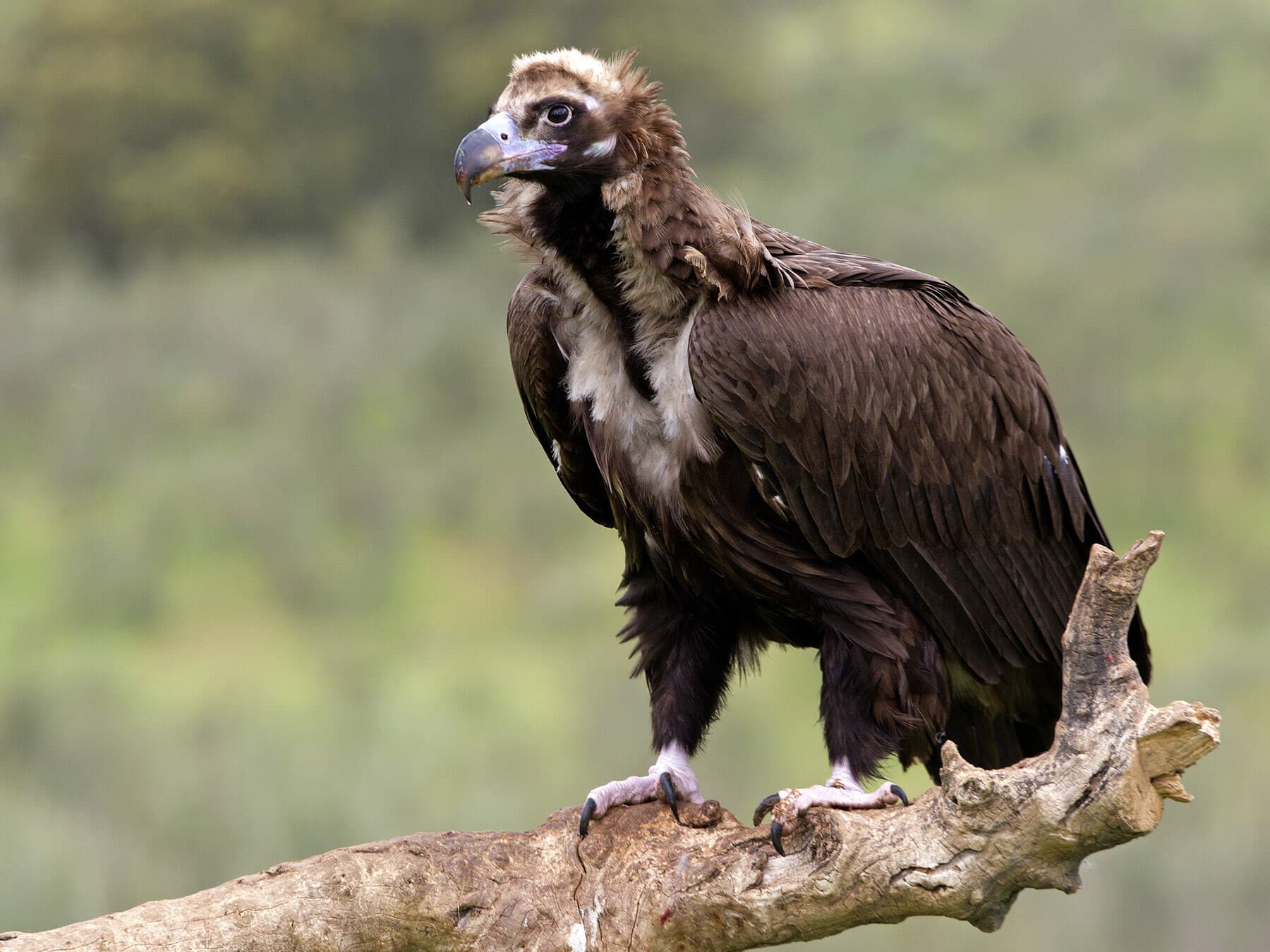
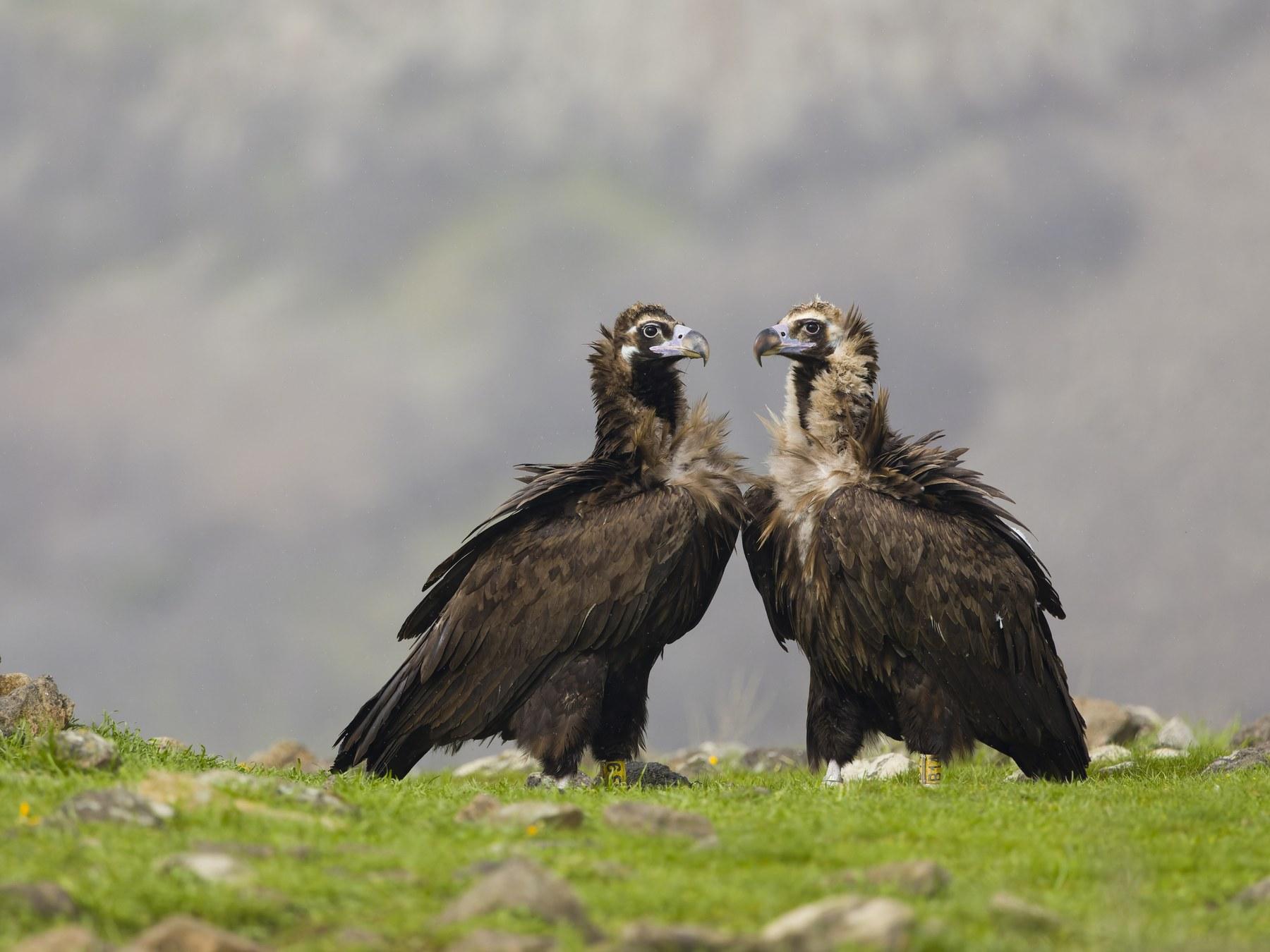
The Cinereous Vulture is a huge, broad-winged vulture with a large head, a heavy bill, a fairly short neck, very long, broad wings and a short, wedge-shaped tail. Adults are dark brown all over except for a paler head; young birds are blackish.
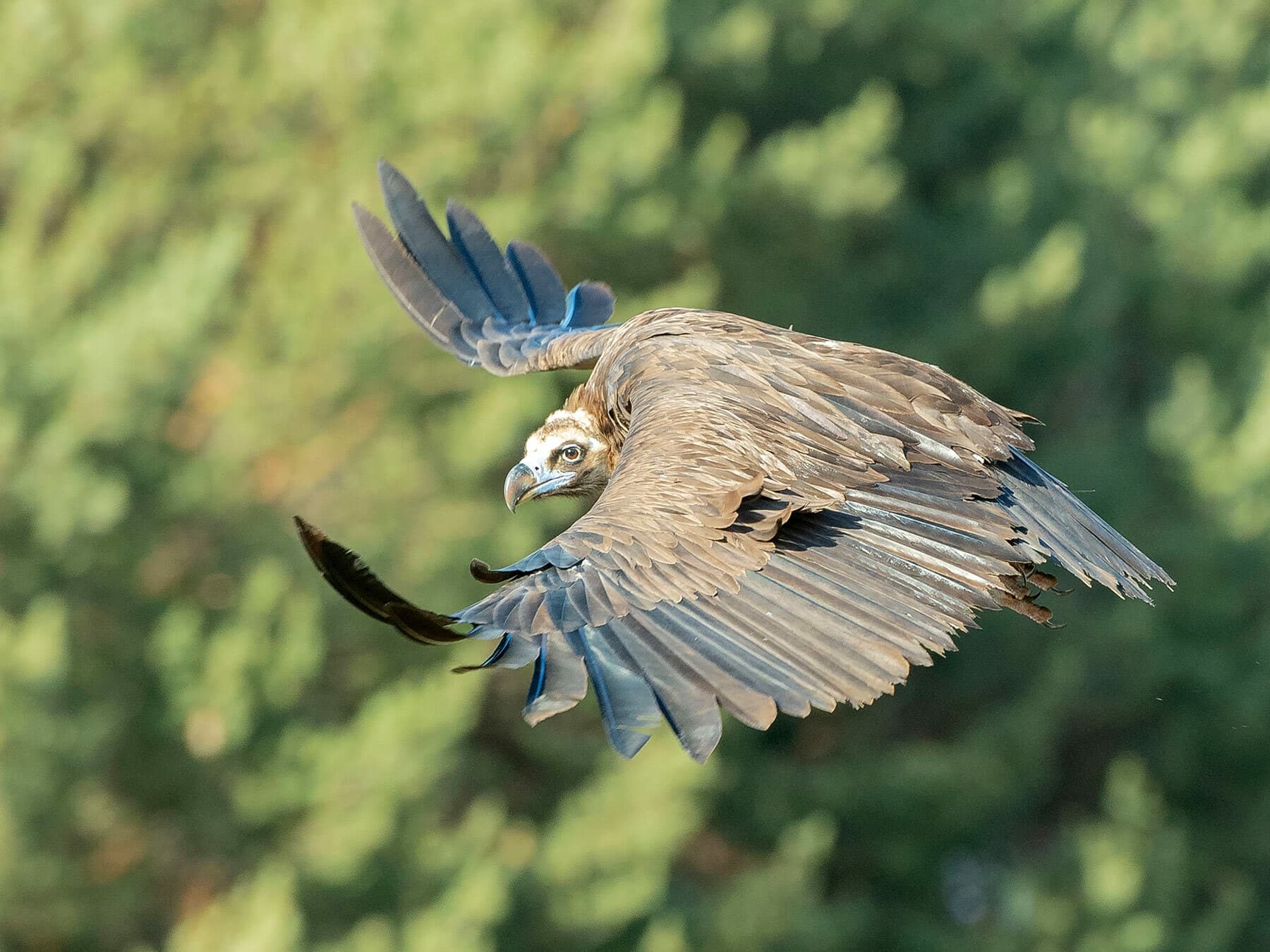
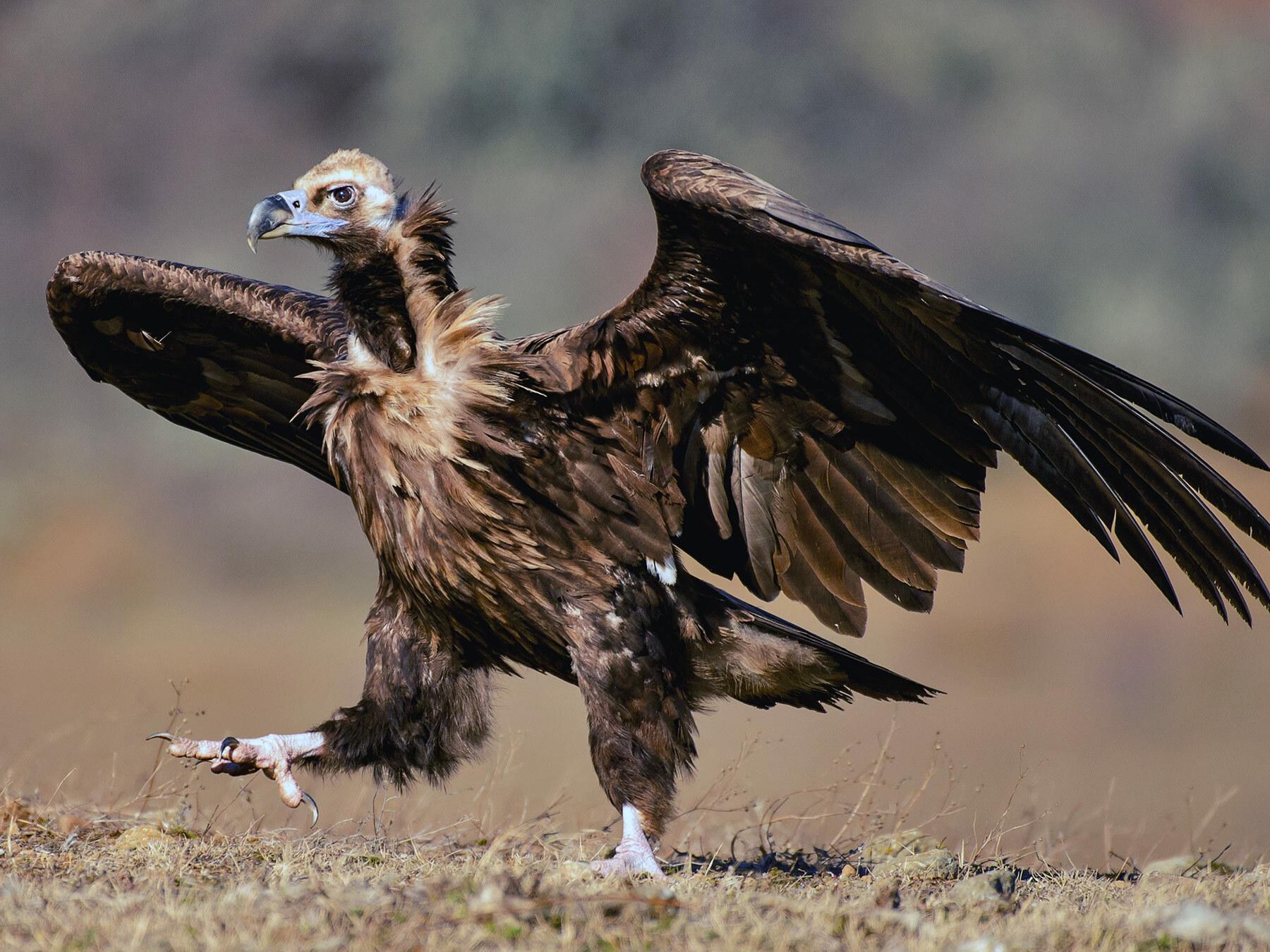
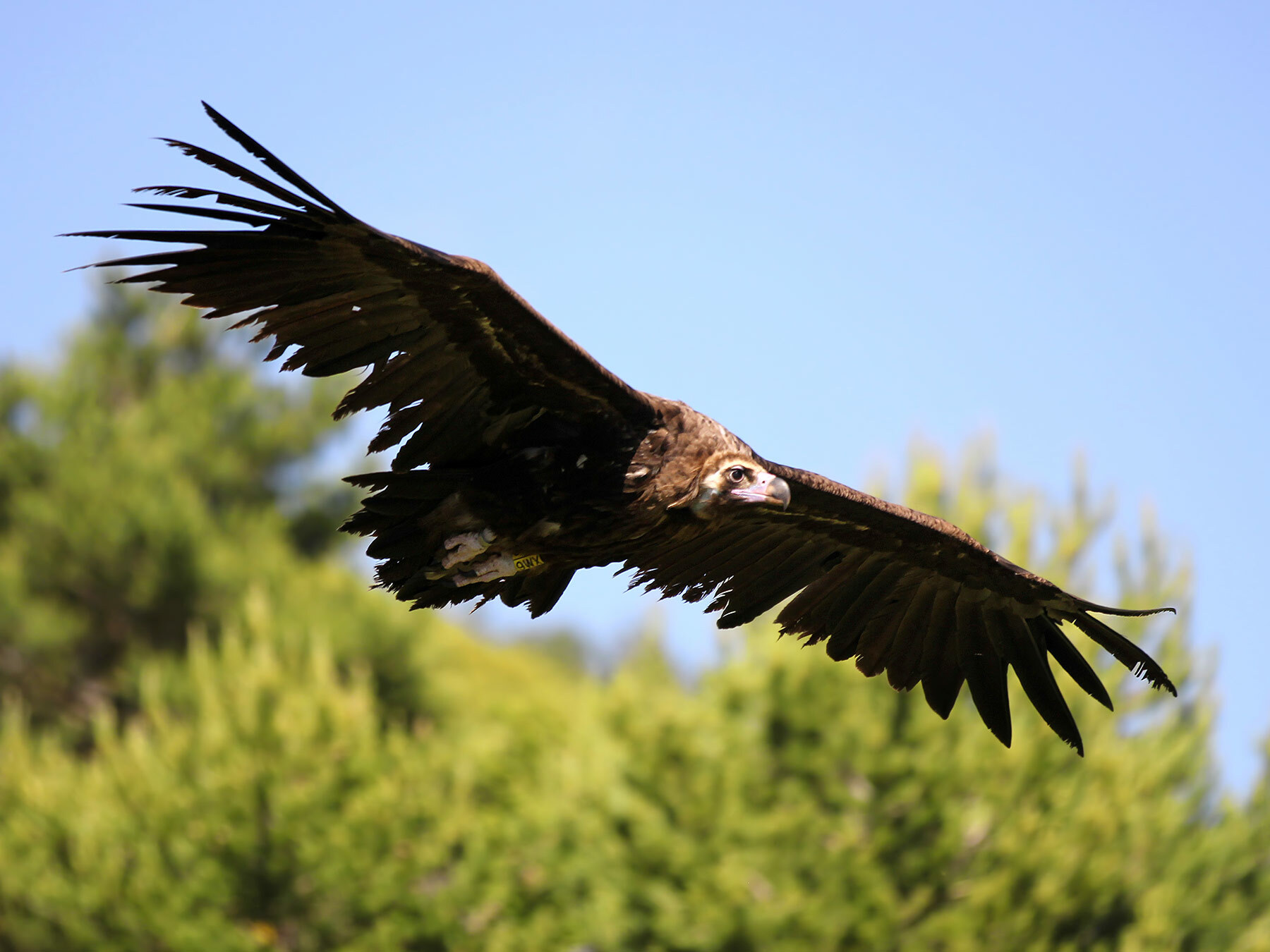
Close up, an adult's head is whitish to pale grey-brown, with a ring of blackish-brown feathers round the eye that runs down to the throat and foreneck. The bare skin of the face and neck is bluish grey, and pale feathers raised along the upper sides of the mantle make a light ruff. The massive bill is black with a grey, brown or yellowish base, and the legs and feet are whitish with pink, cream or pale blue tones. In flight the wings look long, broad and fairly rectangular, with notched outer primaries, and the whole bird looks evenly dark from below.
It is also called the Eurasian Black Vulture and the Monk Vulture, and Birds of the World still heads its account 'Black Vulture'. It is a different bird from the American Black Vulture, a New World vulture.
Its scientific name is Aegypius monachus. Linnaeus described it in 1766 from Arabia, and it is the only species in its genus, with no subspecies. Its closest relative is the Lappet-faced Vulture, and it is not a close relative of the Griffon Vulture. Aegypius comes from the Greek for vulture and monachus from the Latin for monk.
Size and weight
This is a very big bird, generally the largest bird of prey across its range in Europe, Asia, North Africa and the Middle East. It is 102-112 cm (40-44 in) long, with a wingspan of 250-295 cm (8 ft 2 in to 9 ft 8 in), and weighs 7.0-12.5 kg (15.4-27.6 lb).
Those length and weight ranges come from Romanian birds reported in 1910, 41 in all, and the wingspan is a handbook figure for both sexes.1 BirdLife gives a length of 98-107 cm.2
Females tend to be larger and heavier, but few birds have been measured. In the Romanian sample, males weighed 7.0-11.5 kg and females 7.5-12.5 kg. Mongolian nestlings close to fledging, sexed by DNA, averaged 8.6 kg for males and 9.0 kg for females, a difference that was only a tendency.1
Male, female and young
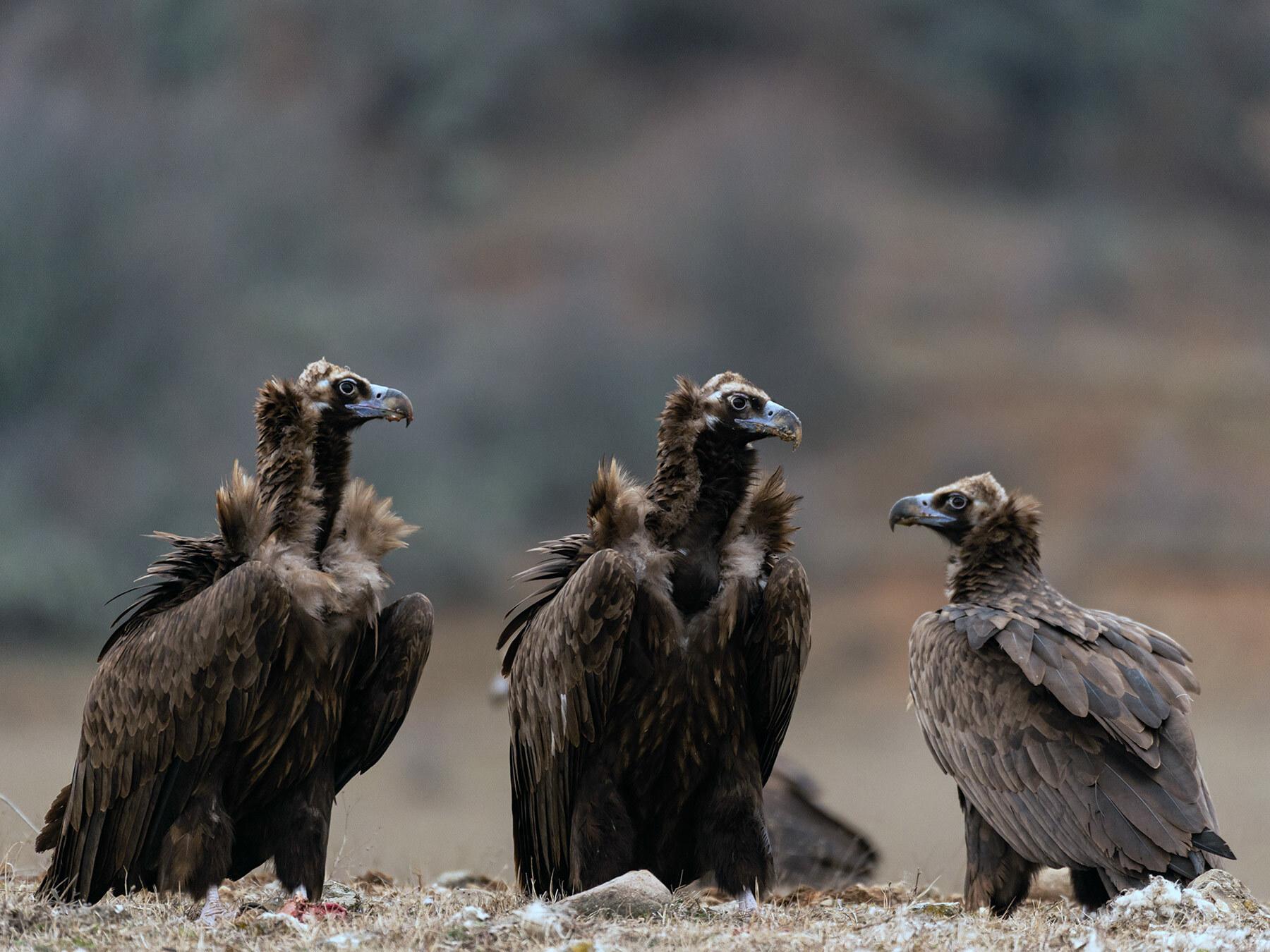
Males and females look alike in every plumage. Young birds can be told from adults: in their first year they are darker, almost black.
A juvenile has a dark mask of bare skin on the face, partly framed by dirty-white swellings at the base of the bill, and a narrow but clear stripe over the eye. Its flight feathers are all one age. Over the next few years the dark mask shrinks, a pale stripe grows from behind the eye to the bill, and the body shows feathers of mixed ages. Between the fourth and sixth plumages the dark down on the crown turns pale brownish-white.
Full adult plumage can usually be assumed from the fourth to sixth plumage cycle, though more study is needed, and some birds keep immature head features into the seventh or later.
Chicks wear white-beige or pale smoky-grey down at first, then a darker brown or grey down with a dirty-white hood.
Identification: similar species
Across southern Europe the bird to rule out is the Griffon Vulture, which shares its carcasses. A Griffon is smaller and paler, with a pale head, neck and ruff, a more curved wing profile and usually one or two light bands across the underwing, where a Cinereous Vulture is evenly dark.
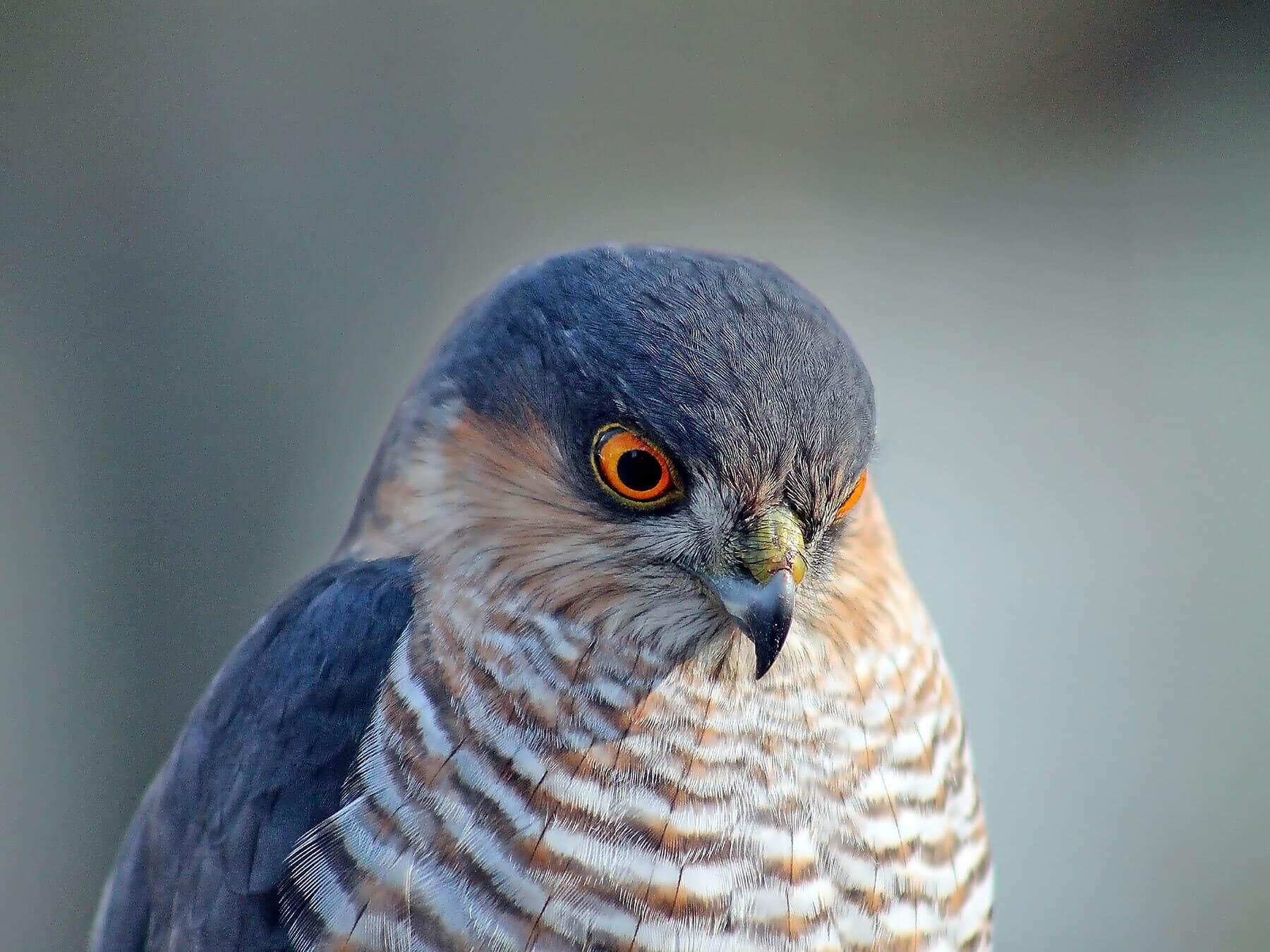
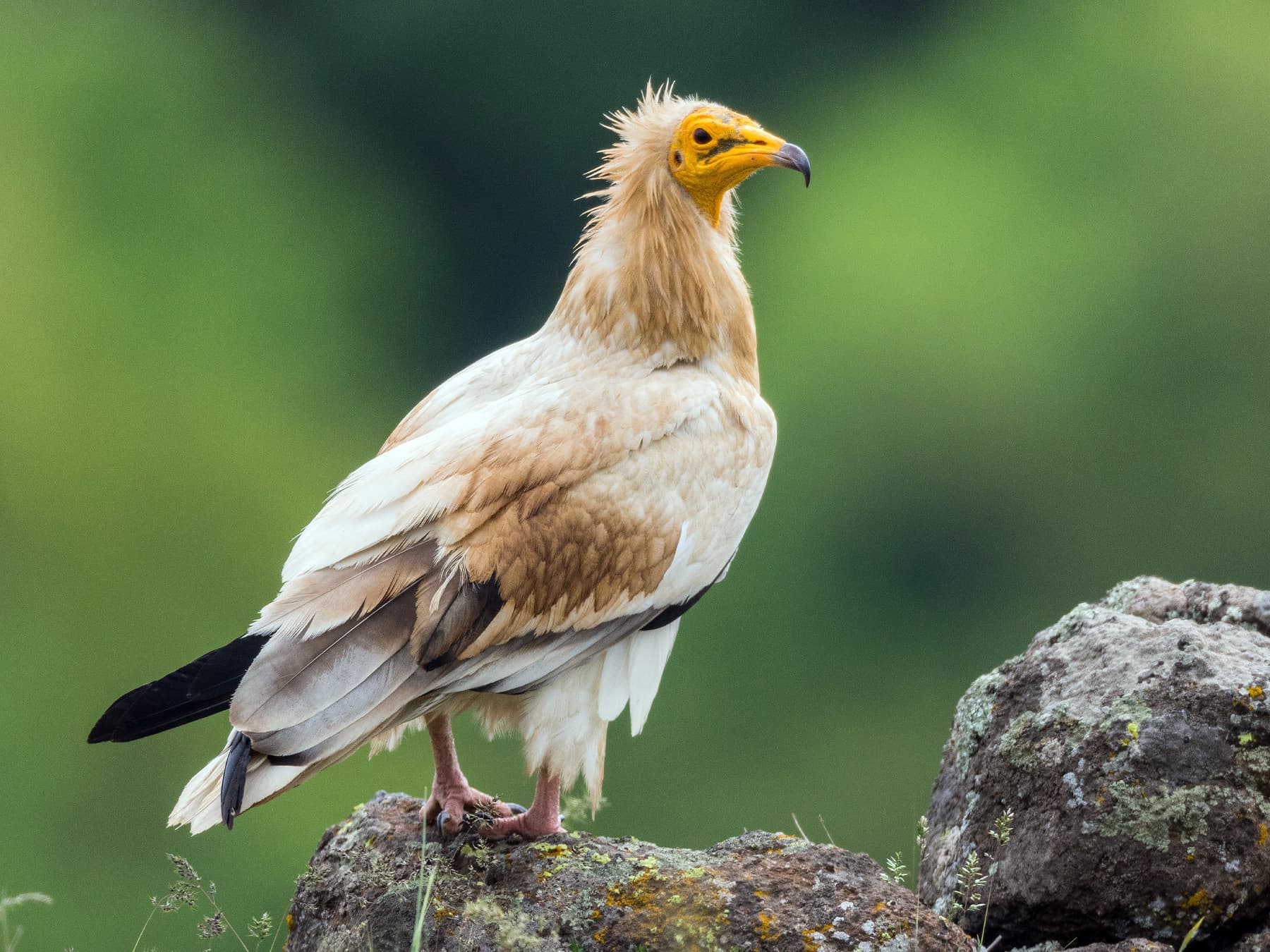
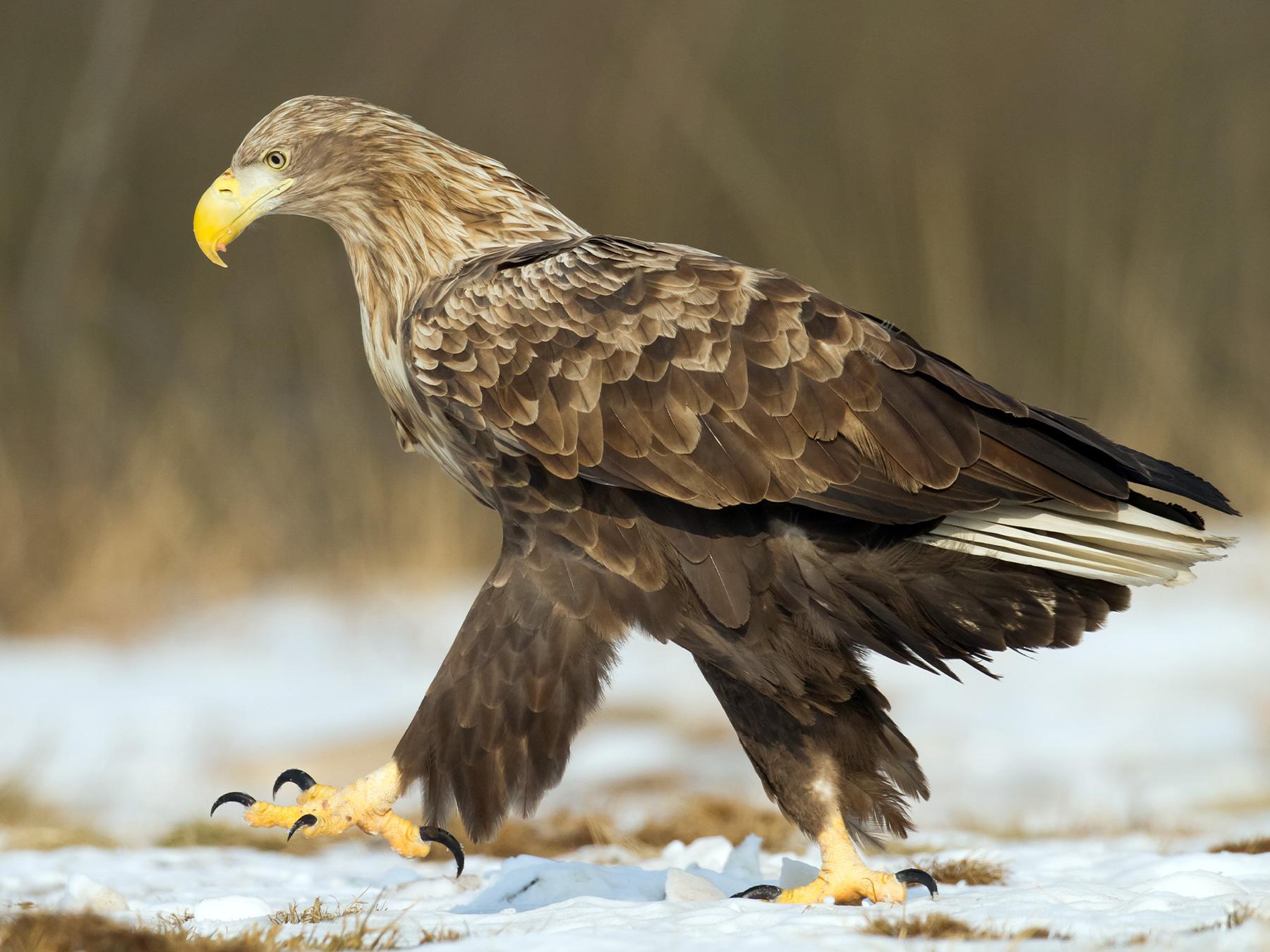
Several other big, dark birds of prey can be mistaken for it, young birds especially. A young Egyptian Vulture is much smaller, with a conspicuous wedge-shaped tail. A young White-tailed Eagle can look as dark, and so can adult Greater Spotted and Steppe Eagles, but all three have shorter, narrower wings, a longer tail and a more protruding head. A young Bearded Vulture is dark too, but its tail is much longer and diamond-shaped.
In North Africa and the Middle East, a young Lappet-faced Vulture has larger wing coverts and some paler body feathers. Rüppell's Vulture has shorter, less rectangular wings, and its black, pale-tipped coverts give it a scaly look.
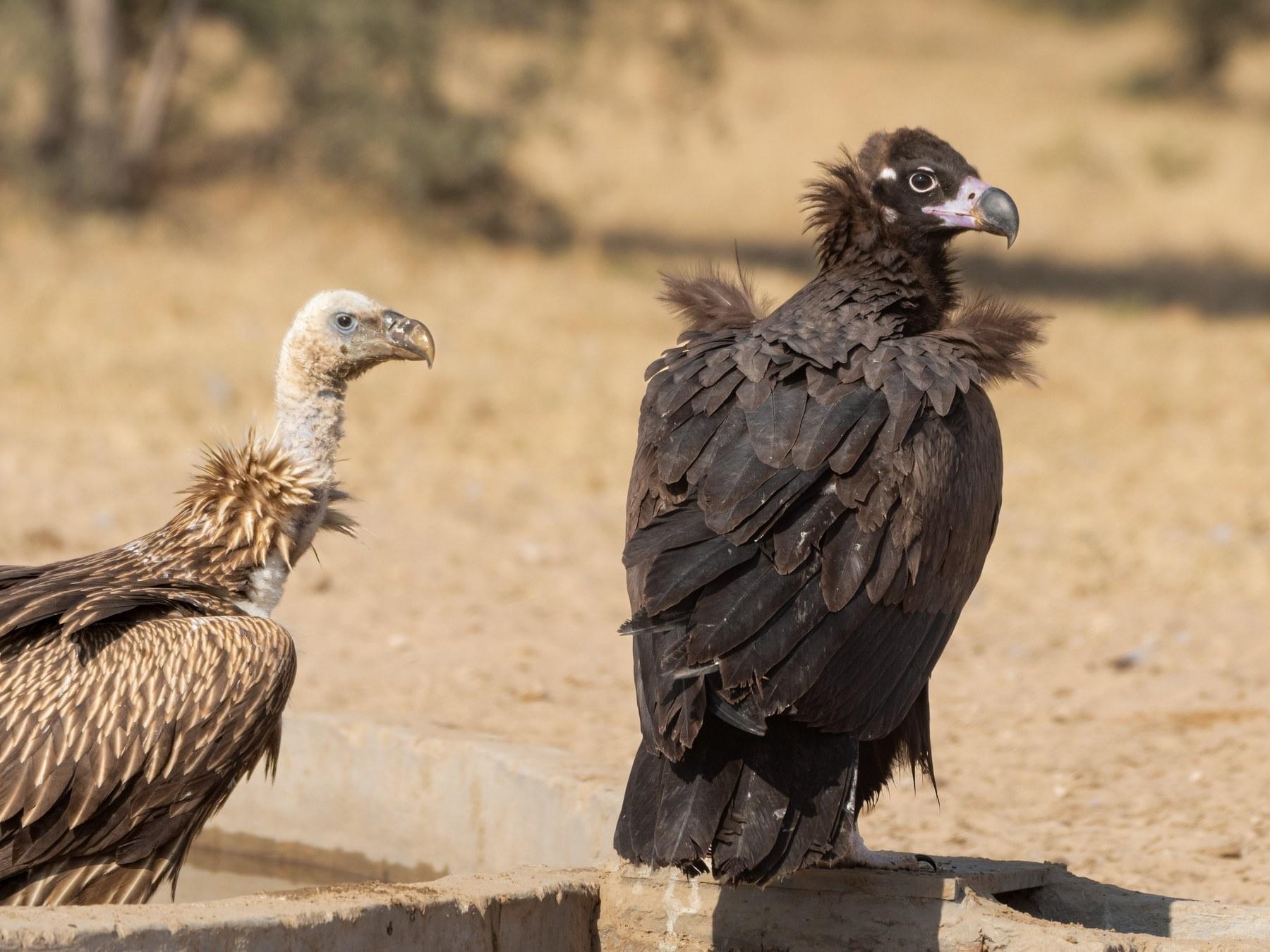
Not sure it’s a Cinereous Vulture? Check your photo: Birdfact names the bird and shows the look-alike side by side.
Its size
Adults- Length
- 102–112 cm
- Wingspan
- 250–295 cm
- Weight
- 7000–12500 g
Its song and calls
The Cinereous Vulture is generally silent, and it has no song in the songbird sense.
At carcasses it croaks, hisses and grunts, and in the breeding season it gives moans, hisses, roars and querulous mewing notes. Disturbed birds give grunting growls and a rising 'kokokoko'; pairs hiss or give a droning, whistled call when mating, and chicks beg with a thin, high-pitched note.
Its range of calls is still poorly known.
- Call0:00 / 0:06
Recorded in Aveyron, France · June 2024
Heard one and not sure? Let the bird song identifier listen.
When and where to see it
November
Here all yearHeading east
The year across Europe
Choose a place on the map to see its year.
Most recorded in November
Up to 0.33% of a place’s bird records that monthHere in other monthsThe way its records moved since last month
How this map is made
A country is shaded in the months the Cinereous Vulture is regular there, darker where it makes up more of that country’s bird records. It is shaded whole when the bird is regular anywhere in it, so a large country can show more ground than the bird uses; the United States, Canada and Australia are drawn by state or province. A place too small to see has a dot. The arrow follows the middle of the bird’s records from last month to this one, and the faint line its path through the year: it shows where the records move, not any one bird’s route. Shades compare places on this map with each other, not one bird with another. Records: GBIF eBird Observation Dataset, 2019–2024. Map: Natural Earth; place centres © OpenStreetMap contributors.
The Cinereous Vulture is not recorded regularly in the UK, Ireland, the United States or Canada.
Worldwide: recorded regularly in 29 countries
Countries where it was recorded in at least 3 of the 6 years 2019–2024. Linked countries have their own bird list.
Asia (19)
- Afghanistan
- Armenia
- Azerbaijan
- Bhutan
- China
- Georgia
- India
- Iran
- Israel
- Kazakhstan
- Kuwait
- Kyrgyzstan
- Mongolia
- Nepal
- Pakistan
- South Korea
- Tajikistan
- Turkey
- Uzbekistan
Data: EOD – eBird Observation Dataset (Cornell Lab of Ornithology), accessed via GBIF.org, CC BY 4.0. Records from 2019–2024, aggregated and filtered by Birdfact. How these lists are made
The Cinereous Vulture breeds patchily across southern Europe and Asia, from Spain and Portugal east to Mongolia and China. In Europe it nests in Spain, Portugal, Mallorca, south-east France, north-east Greece and, since its reintroduction, Bulgaria; further east it breeds in Crimea, Türkiye, the Caucasus, Iran, Afghanistan, Pakistan, northern India, the Central Asian republics, southern Siberia, Mongolia and western and central China.
In winter young birds reach North Africa and the Sahel, the Middle East and Arabia, the Indian subcontinent, Nepal, eastern China and the Korean Peninsula. In summer, wanderers reach central Europe as far north as Denmark and Estonia. We found no British or Irish record in Birds of the World, and among the UK's territories BirdLife lists only Gibraltar, as a vagrant.
It breeds mainly in wooded hills and mountains, in open oak and pine forest in Spain and montane forest and juniper woodland elsewhere, and in Asia also in steppe, semi-desert, desert edges and high alpine grassland. It forages over open country of many kinds. Across its range it is found from about 300 m up to 4,500 m, occasionally 4,900 m.2
Movements and migration
Breeding adults appear to stay put or move only short distances or up and down mountains. Migration is mainly by juveniles and immatures, heading south in October and November and returning between March and early May.
Adults GPS-tracked in Mongolia stayed in the country all year, while many young Mongolian birds winter in South Korea; tracked juveniles left Mongolia on 29 October on average and reached South Korea on 27 November.3, 1
In Iberia most birds are thought to stay put. Young birds roam widely over Iberia and southern Europe, females further than males.4 Only a few cross to Africa: in a Spanish GPS study of 2002-2022, which tracked 34 juveniles, 6 immatures and 12 adults, migration to Africa was recorded in only two juveniles.1
Spotting tips
Spain holds most of Europe's breeding birds. Look for a huge, evenly dark bird soaring alone over open country, or one among griffon vultures at a carcass. It soars on rising warm air, and rain can keep it perched for whole days; in winter it sets off close to sunrise to make the most of the light.
What it eats
The Cinereous Vulture is a scavenger. It lives mainly on the carcasses of medium-sized and large mammals, wild and domestic, and only occasionally takes live prey.
What it eats depends on what is available. Sheep carcasses were the staple food in all the Extremadura colonies studied in Spain, but where rabbits, hares and deer are plentiful, as at Cabañeros and Andújar, the diet is mostly wild animals.5 In Türkiye in the breeding season, sheep turned up in 76.6% of 120 pellets.6
Records of live prey include marmots, steppe tortoises and lambs in western Siberia, and attacks on gazelles, newborn lambs and Asian Houbara in Central Asia. It has also been seen taking tarbagan marmots, ground squirrels and a red fox from Steppe and Golden Eagles.1
Feeding at a carcass
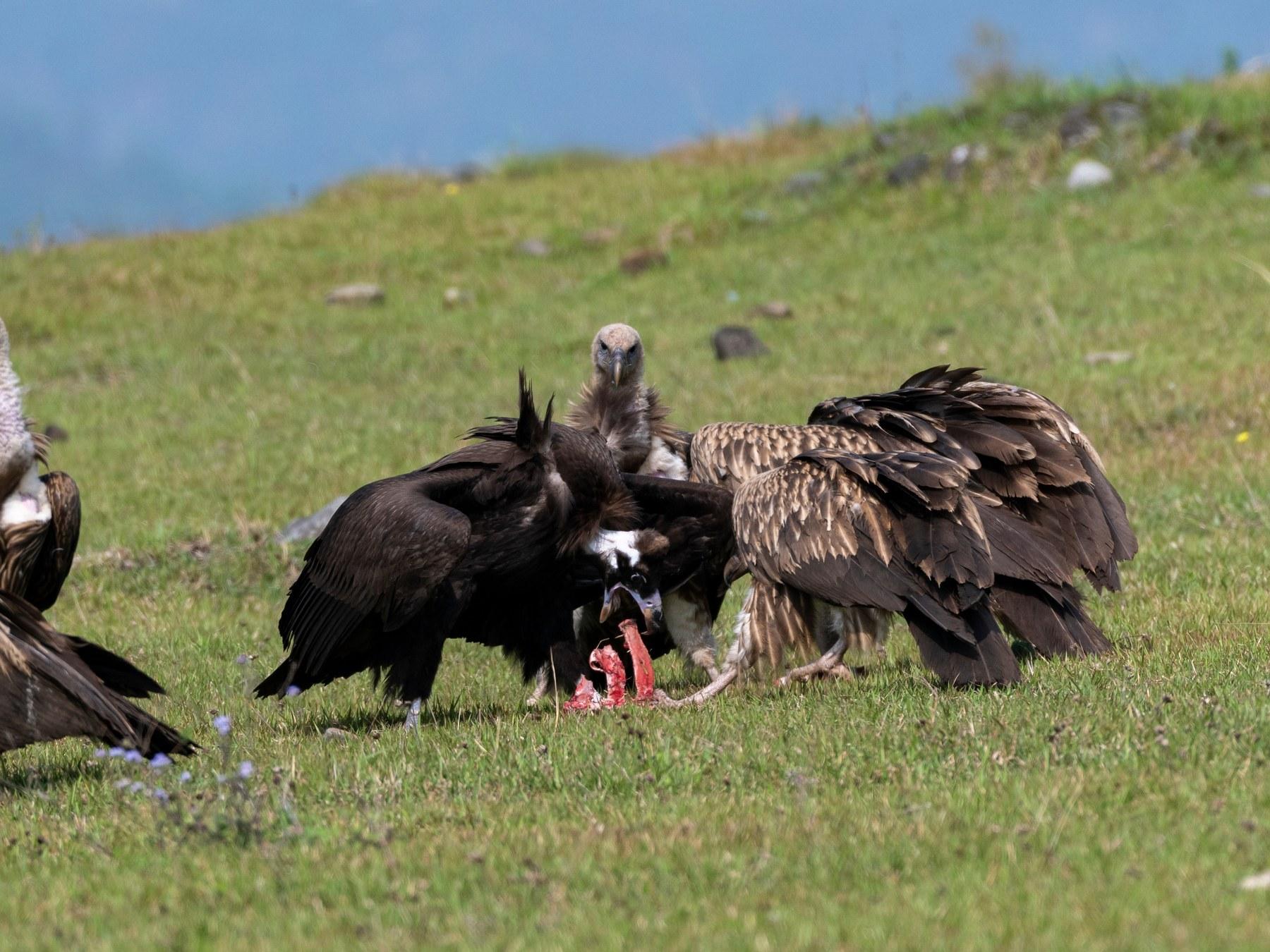
At a carcass it mainly tears off skin, tendons and tough muscle, and eats less of the soft meat and innards. At test carcasses in Spain it chose single, medium-sized pieces of muscle and small leftover scraps of meat and tendon.7
It is very aggressive at carcasses and dominates the other vultures. In a Spanish study of 1,049 contests, adult and subadult Cinereous Vultures won 75.4%, adult Griffons 70.6% and adult Egyptian Vultures 33.3%.1
It searches for food alone, circling slowly then gliding in fairly straight lines.
Nesting and breeding
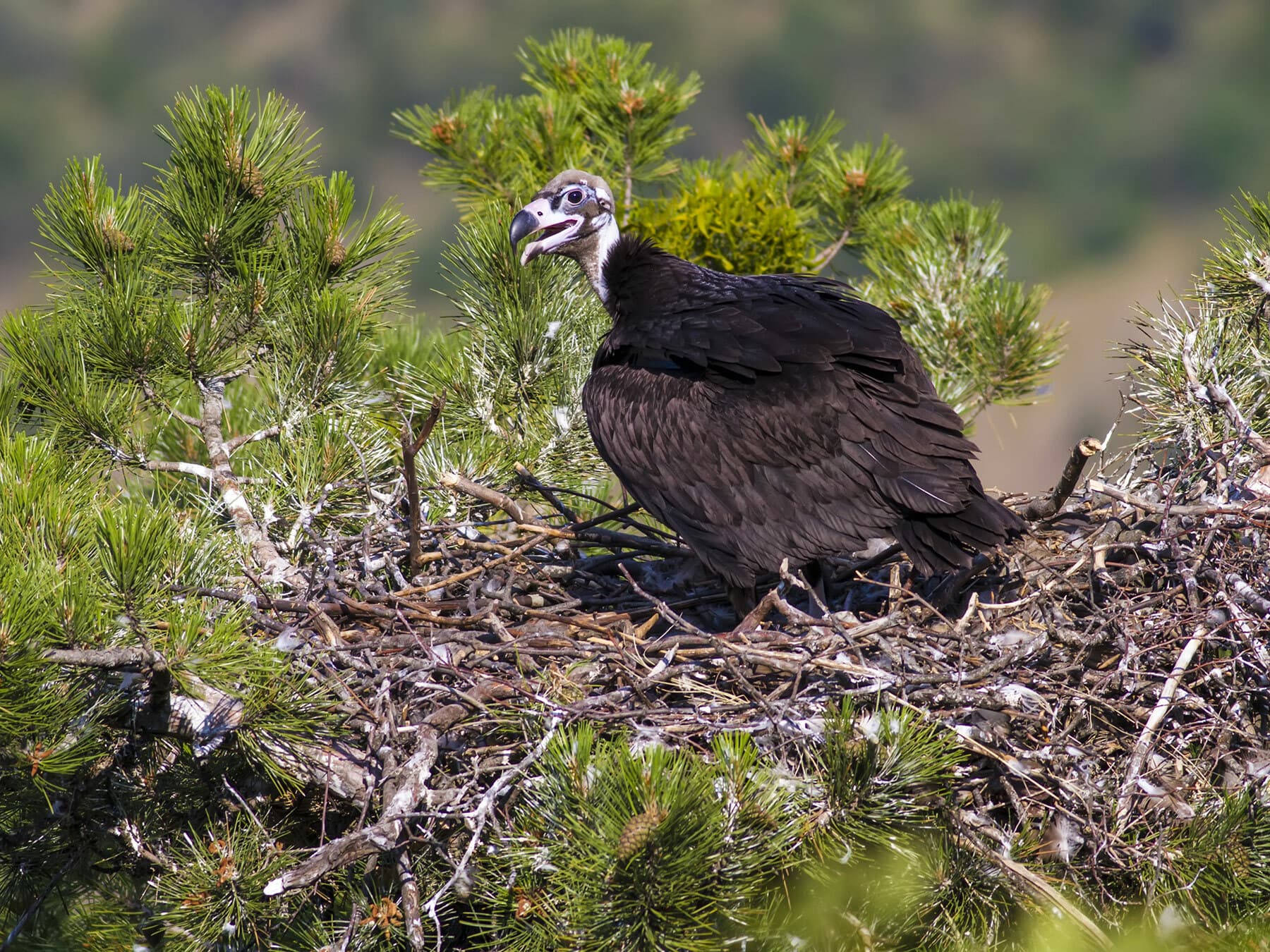
Cinereous Vultures nest in loose colonies, rarely as lone pairs, and each pair raises at most one brood a year, on a huge stick nest. Spain had 44 colonies and four solitary pairs in 2017, with 2 to 333 pairs in each.1
In Europe the nest is nearly always in a tree, usually on top of the crown; in Asia it is also built on rocky outcrops and cliffs. In 2003, 27 of the 42 active nests in one Mongolian reserve were built on rocks.8 In south-western Spain most nests are in cork or holm oaks and in the central mountains in pines; reintroduced birds in the Massif Central use Scots pine, and Greek birds black and Turkish pine.
The nest is a platform of sticks lined with finer twigs, wool, fur or pine needles. Fresh branches go on every year, and old nests grow until some collapse.
Courtship flights run from December to early February, the pair flying one above the other and sometimes tumbling with locked claws. Eggs are laid from early February to early May, and in Central Asia laying is reported to start as early as January. The clutch is one white or cream egg, usually spotted; two-egg clutches are rare.
Both parents incubate, for 50-68 days: 59 days on average at 25 nests in the Lozoya Valley, Madrid. The chick leaves the nest at 88-137 days old, 114 days on average at 28 Lozoya nests, in August or September.1
Raising the young
For the first two months one parent stays with the chick almost all the time. The parents feed it by bringing up food carried in the crop, and they go on feeding the young bird for several months after it leaves the nest. In two Spanish studies of four young each, young birds became independent at 202 and 217 days old on average.1
They first breed at three to seven years old.
Breeding success ranges from 0.25 to 0.92 young per laying pair, depending on the place, and in Spain's national censuses it rose from 0.59 young per laying pair in 2006 to 0.70 in 2017.1
Behaviour
The Cinereous Vulture is active by day and spends much of it in the air. It rises in thermals, soars in straight lines and glides with only an occasional wingbeat.
Pairs defend the nest and about 50 m around it, and neighbours sometimes fight in the air with locked talons. It has been suggested that the pair bond is lifelong or long-lasting, but there is no information from ringed birds to confirm it. Trios of one male and two females have been found in Spain; in one, a genetic test showed each female was the mother of one of the chicks.1
It is very sensitive to disturbance at the nest: in one Turkish mountain range, birds flew off at an average of about 280 m when people approached.1 It drinks and bathes at mountain springs and lakes, then dries itself with open wings.
Lifespan and predators
Nobody knows how long Cinereous Vultures live in the wild: there is no detailed information,1 and EURING's European list of longevity records (2017 edition) holds no record for the species.9
It has been suggested that wild birds can reach 25.5 years, and Birds of the World says the true lifespan is possibly about 40 years; in the reintroduced French population one bird was at least 28 years old.1 In captivity, one reached 39 years.10
In the reintroduced French population, annual apparent survival, estimated from resightings, is above 0.8 for young birds and above 0.9 for adults.11
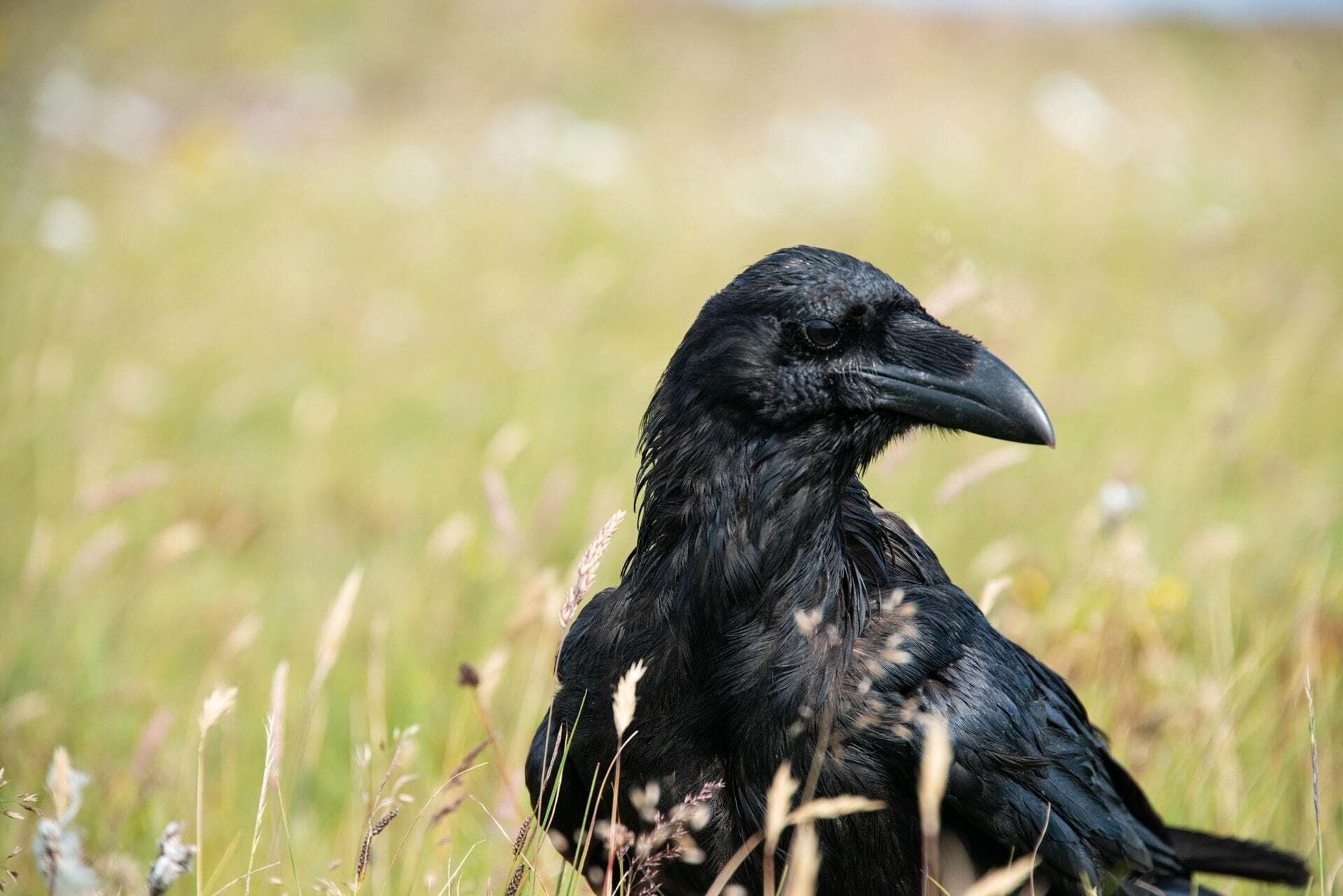
No predators of adults are known, though a Spanish Imperial Eagle was once seen to kill one that flew over its breeding territory. Ravens take eggs and small chicks, and single nestlings have been taken by an Eagle-Owl in Tuva and a lynx in Armenia.1
Conservation
The Cinereous Vulture is listed as Near Threatened on the IUCN Red List, in BirdLife International's 2021 assessment, and it has been Near Threatened in every assessment since 2004.2
Its numbers are thought to be falling overall: the much larger Asian population appears to be declining while Europe's grows, so BirdLife suspects, rather than has measured, a slow to moderate ongoing decline.
Population
BirdLife estimates 8,400-11,400 pairs, or 16,800-22,800 mature individuals, with 5,500-8,000 pairs in Asia (a 2004 figure) and 2,900-3,400 in Europe.2 Mongolia holds the most, about 5,000-7,000 pairs, and Spain had 2,548 pairs in 2017, 36 of them on Mallorca.1
Spain's recovery is the big success. Its breeding population grew from about 206 pairs in the 1970s to 2,068 pairs in 2011, largely thanks to active conservation, though food from big-game hunting may also have helped.1, 12
Europe's numbers fell from the 1850s to a low in the 1960s.1 They have risen since, mainly in Spain, and the European trend is increasing, while numbers fell or fluctuated in Armenia, Azerbaijan, Russia, Türkiye and Ukraine.2
In Asia the picture is patchy and poorly known.
Pressures on the population
The main pressures are deaths caused by people, accidental or deliberate, among them poisoning, electrocution, illegal killing and collisions with power lines and wind turbines, along with habitat loss, disturbance and a shrinking food supply.1, 2
In Spain, poisoned baits put out for predators are the most important unnatural cause of death.1 In 1990-2006, 241 incidents involving 464 vultures were recorded, and up to 98% of those investigated were intentional poisonings.13 In France, electrocution and collision with power lines were the commonest known cause of death, 39% of 41 birds in 1993-2020, ahead of poisoning at 15%.1
Veterinary drugs are a newer risk. In 2020 a Cinereous Vulture became the first confirmed death from veterinary diclofenac in Europe.2 All 14 nestlings of the species tested in one study carried livestock antibiotics.14
Dead birds recovered in South Korea in winter often carry high lead levels: 14 of 20 had potentially toxic levels in a 2009 study.15 In a 2026 study, 16.2% of 74 immatures recovered near the Demilitarised Zone had levels consistent with lead poisoning, with lead ammunition a likely contributor.16
Food has become scarcer in places. Declines in Georgia and Armenia may be linked to the end of sheep-farming subsidies after the Soviet era, and in Kazakhstan, by 2005, vultures were in severe decline after the saiga antelope crashed. In Europe, EU rules on disposing of carcasses once cut food, but newer rules allow feeding stations for scavengers.2
Collisions with wind turbines are very few across the range.1 For the small population of south-eastern Europe, 103 birds, though, a 2017 model predicted that building all the proposed wind farms would raise collision deaths to the equivalent of 44% of it. Careful siting could keep the loss under 1%, the model found, but only if the 5.2% mortality already caused by operating wind farms in the core area were fully mitigated.17
Conservation work and reintroductions
Protecting the Monfragüe colony in 1979 was the first major step for the species in Spain. At some pine colonies, such as the Lozoya Valley and Valsaín, forestry is timed outside the nesting season and kept 50-100 m from nests, and at oak and cork-oak colonies the main measures aim to keep cork harvesting and hunting away from February to August. Spain has run an Antidote Programme against poisoning since 1998 and has upgraded dangerous power lines. Feeding stations now support scavengers across most of Europe, and further east in places such as Türkiye and Kazakhstan.1
Feeding stations are a conservation tool for wild scavengers, not garden feeding. In Spain, Cinereous and other scarcer vultures did relatively better against Griffons when food was put out as smaller, scattered pieces rather than whole carcasses, a four-species study found.18
It has been reintroduced to France, first in the Grands Causses from 1992 and then the Baronnies and Verdon, and France had 53 pairs in 2022. It has also been reintroduced to Catalonia and Burgos in Spain, and to Bulgaria, where the released birds started breeding in 2021.1 It has started to recolonise Portugal this century: Birds of the World says naturally from Spain, while BirdLife links it to reintroduction programmes.1, 2 By mid-2022, 72 birds had been released in Bulgaria's Balkan Mountains: 63 immatures from Spain and nine zoo-bred juveniles.19
Legal status and protection
The Cinereous Vulture is on CITES Appendix II, which controls international trade, and on Annex A of the EU's wildlife trade rules.20 It has been on Appendix II of the Convention on Migratory Species since 1979, and it is on Annex I of the EU Birds Directive, which requires special measures to conserve its habitat.21, 22
Spain lists it as Vulnerable in its national catalogue of threatened species, a national category separate from the IUCN Red List. China lists it as a first-class national protected animal, and South Korea designated it Natural Monument No. 243-1 in 1973.23, 24, 25
Similar birds
Often mistaken for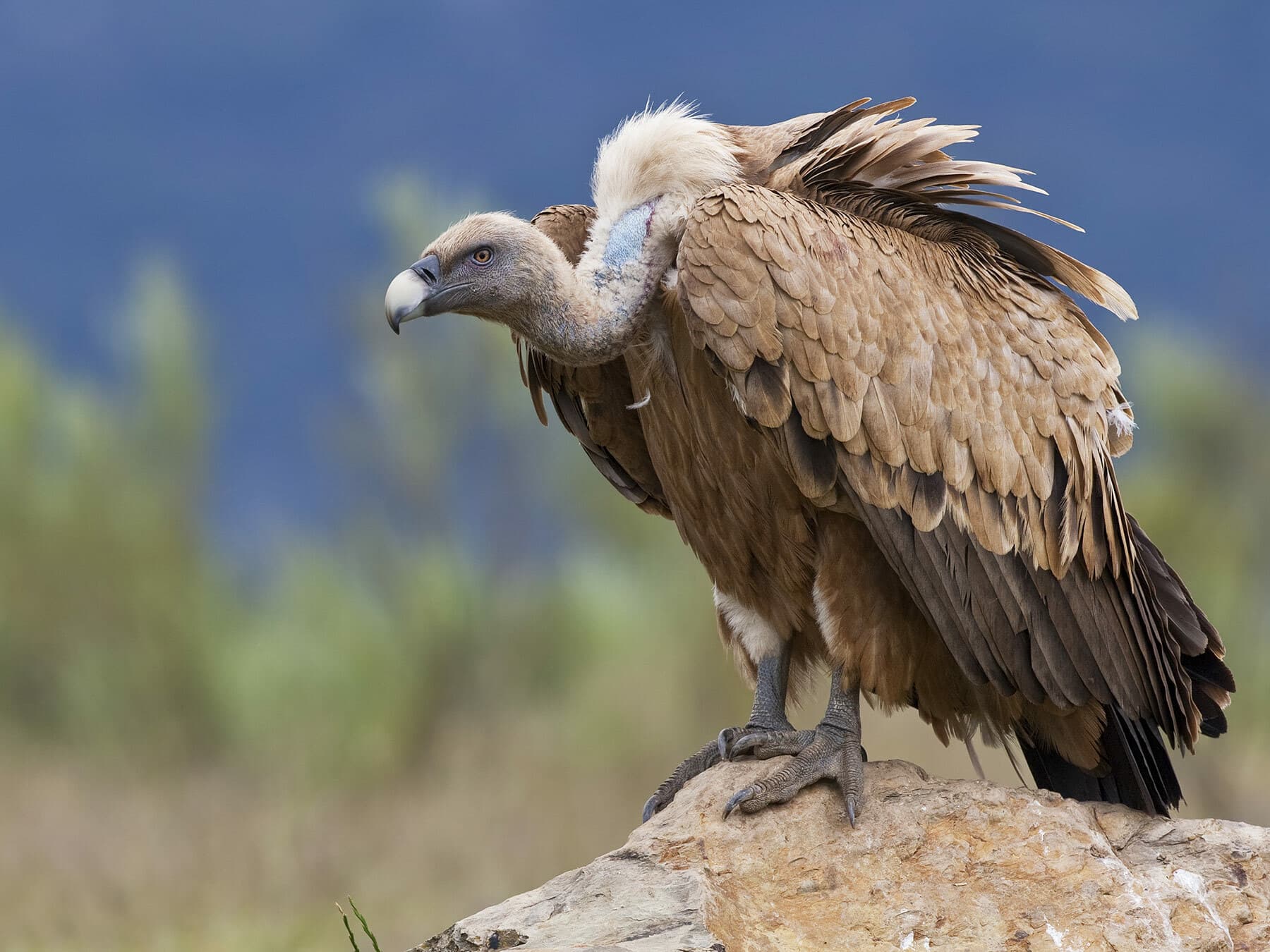
More photos
2 photos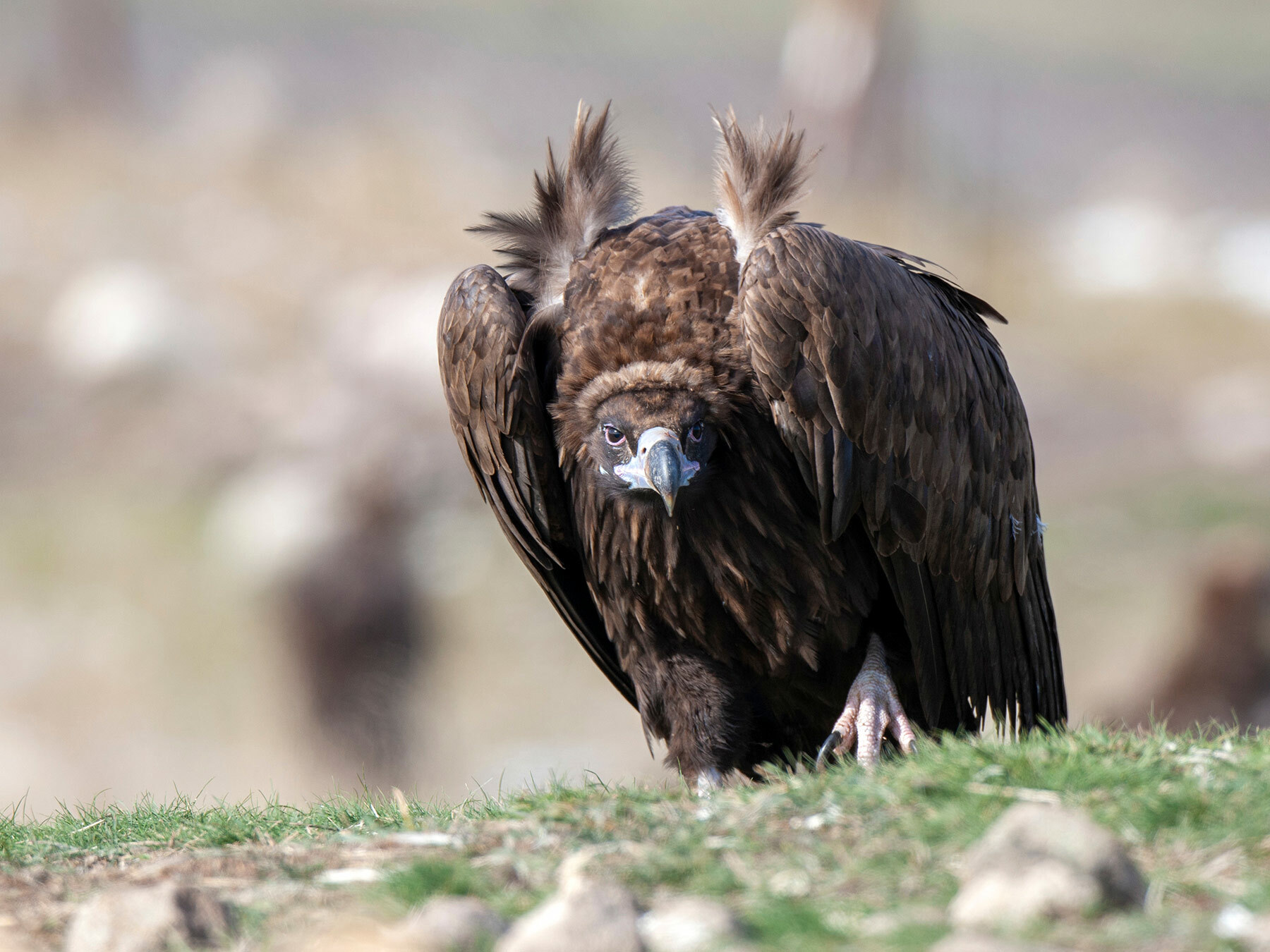
Quick facts
- Length
- 102–112 cm
- Wingspan
- 250–295 cm
- Weight
- 7000–12500 g
- Family
- Hawks & Eagles
- Migration
- Partial migrant
- Global status (IUCN)
- Near Threatened
- World population
- 16,800–22,800 mature individuals (BirdLife 2021 estimate)
- Population trend
- Decreasing (suspected; BirdLife 2021). Europe increasing
- Also called
- Eurasian Black Vulture, Monk Vulture
- Scientific name
- Aegypius monachus
Questions
2Is the Cinereous Vulture the world's biggest vulture?
It is one of the biggest: one of the largest Old World vultures, and generally the largest bird of prey wherever it occurs.1, 2 No source we read compares it by measurement with the condors of the Americas. See size and weight.
Is the Cinereous Vulture the same as the Black Vulture?
Not the American one. Birds of the World and the CITES database still use the name Black Vulture for this bird, but it is a different species from the American Black Vulture, a New World vulture. See how to recognise it.
Sources
36- 1Salvador, A. (2024). Cinereous Vulture (Aegypius monachus), version 3.0. Birds of the World (Cornell Lab of Ornithology). doi:10.2173/bow.cinvul1.03 (opens in a new tab)
- 2BirdLife International (2021). Species factsheet: Cinereous Vulture Aegypius monachus. BirdLife DataZone. Accessed 22 November 2026. Source (opens in a new tab)
- 3Reading, R. P. et al. (2020). Differential movement of adult and juvenile Cinereous Vultures (Aegypius monachus) (Accipitriformes: Accipitridae) in Northeast Asia. Journal of Asia-Pacific Biodiversity 13: 156-161. doi:10.1016/j.japb.2020.01.004 (opens in a new tab)
- 4Garcia-Macia, J. et al. (2023). Age, season and sex influence juvenile dispersal in the Iberian cinereous vultures (Aegypius monachus). Journal of Ornithology 165: 325-335. doi:10.1007/s10336-023-02126-z (opens in a new tab)
- 5Costillo, E., Corbacho, C., Moran, R. and Villegas, A. (2007). Diet Plasticity of Cinereous Vulture Aegypius monachus in Different Colonies in the Extremadura (SW Spain). Ardea 95: 201-211. doi:10.5253/078.095.0204 (opens in a new tab)
- 6Yamac, E. and Gunyel, E. (2010). Diet of the Eurasian Black Vulture, Aegypius monachus Linnaeus, 1766, in Turkey and implications for its conservation. Zoology in the Middle East 51: 15-22. doi:10.1080/09397140.2010.10638436 (opens in a new tab)
- 7Moreno-Opo, R. et al. (2010). Factors influencing the presence of the cinereous vulture Aegypius monachus at carcasses: food preferences and implications for the management of supplementary feeding sites. Wildlife Biology 16: 25-34. doi:10.2981/09-037 (opens in a new tab)
- 8Reading, R. P., Amgalanbaatar, S., Kenny, D. E. and Dashdemberel, B. (2005). Cinereous Vulture Nesting Ecology in Ikh Nartyn Chuluu Nature Reserve, Mongolia. Mongolian Journal of Biological Sciences 3. doi:10.22353/mjbs.2005.03.02 (opens in a new tab)
- 9Fransson, T. et al. (2017). EURING list of longevity records for European birds. EURING. Accessed 22 November 2026. Source (opens in a new tab)
- 10Tacutu, R. et al. (2023). AnAge: The Animal Ageing and Longevity Database, build 15. Human Ageing Genomic Resources. Accessed 22 November 2026. Source (opens in a new tab)
- 11Rousteau, T. et al. (2022). High long-term survival and asymmetric movements in a reintroduced metapopulation of Cinereous vultures. Ecosphere 13. doi:10.1002/ecs2.3862 (opens in a new tab)
- 12Moreno-Opo, R. and Margalida, A. (2014). Conservation of the Cinereous Vulture Aegypius monachus in Spain (1966-2011): a bibliometric review of threats, research and adaptive management. Bird Conservation International 24: 178-191. doi:10.1017/s0959270913000427 (opens in a new tab)
- 13Hernandez, M. and Margalida, A. (2008). Pesticide abuse in Europe: effects on the Cinereous vulture (Aegypius monachus) population in Spain. Ecotoxicology 17: 264-272. doi:10.1007/s10646-008-0193-1 (opens in a new tab)
- 14Blanco, G., Junza, A. and Barron, D. (2017). Food safety in scavenger conservation: Diet-associated exposure to livestock pharmaceuticals and opportunist mycoses in threatened Cinereous and Egyptian vultures. Ecotoxicology and Environmental Safety 135: 292-301. doi:10.1016/j.ecoenv.2016.10.009 (opens in a new tab)
- 15Nam, D.-H. and Lee, D.-P. (2009). Abnormal lead exposure in globally threatened Cinereous vultures (Aegypius monachus) wintering in South Korea. Ecotoxicology 18: 225-229. doi:10.1007/s10646-008-0275-0 (opens in a new tab)
- 16Hur, S., Kang, J.-H., Moon, J.-Y. et al. (2026). Flyway-scale lead and multielement exposure in globally threatened Cinereous vultures (Aegypius monachus) wintering on the Korean Peninsula: Insights from tissue burdens and stable lead isotopes. Journal of Hazardous Materials 518: 143871. doi:10.1016/j.jhazmat.2026.143871 (opens in a new tab)
- 17Vasilakis, D. P., Whitfield, D. P. and Kati, V. (2017). A balanced solution to the cumulative threat of industrialized wind farm development on cinereous vultures (Aegypius monachus) in south-eastern Europe. PLOS ONE 12: e0172685. doi:10.1371/journal.pone.0172685 (opens in a new tab)
- 18Moreno-Opo, R. et al. (2015). Manipulating size, amount and appearance of food inputs to optimize supplementary feeding programs for European vultures. Biological Conservation 181: 27-35. doi:10.1016/j.biocon.2014.10.022 (opens in a new tab)
- 19Ivanov, I., Stoynov, E., Stoyanov, G. et al. (2023). First results from the releases of Cinereous Vultures (Aegypius monachus) aiming at re-introducing the species in Bulgaria - the start of the establishment phase 2018-2022. Biodiversity Data Journal 11: e100521. doi:10.3897/bdj.11.e100521 (opens in a new tab)
- 20UNEP-WCMC and CITES Secretariat (2026). Species+ taxon concept 4164: Aegypius monachus (Linnaeus, 1766). Species+. Accessed 22 November 2026. Source (opens in a new tab)
- 21Convention on Migratory Species (2026). Aegypius monachus. CMS species page. Accessed 22 November 2026. Source (opens in a new tab)
- 22(2019). Directive 2009/147/EC on the conservation of wild birds (consolidated 26.06.2019), Annex I. EUR-Lex. Accessed 22 November 2026. Source (opens in a new tab)
- 23(2011). Real Decreto 139/2011 (Listado de Especies Silvestres en Regimen de Proteccion Especial y Catalogo Espanol de Especies Amenazadas), consolidated. Boletin Oficial del Estado. Accessed 22 November 2026. Source (opens in a new tab)
- 24(2021). List of National Key Protected Wild Animals (NFGA and MARA Announcement No. 3 of 2021). National Forestry and Grassland Administration. Accessed 22 November 2026. Source (opens in a new tab)
- 25Korea Heritage Service (2026). Natural Monument No. 243-1, 독수리. Korea Heritage Service open API. Accessed 22 November 2026. Source (opens in a new tab)
- 26Salvador, A. (2026). Eurasian Griffon (Gyps fulvus), version 11.0. Birds of the World (Cornell Lab of Ornithology). doi:10.2173/bow.eurgri1.11 (opens in a new tab)
- 27Kemp, A. C., Christie, D. A. and Sharpe, C. J. (2020). Lappet-faced Vulture (Torgos tracheliotos), version 1.0. Birds of the World (Cornell Lab of Ornithology). doi:10.2173/bow.lafvul1.01 (opens in a new tab)
- 28Orta, J. et al. (2020). Bearded Vulture (Gypaetus barbatus), version 1.0. Birds of the World (Cornell Lab of Ornithology). doi:10.2173/bow.lammer1.01 (opens in a new tab)
- 29AviList Core Team (2025). AviList: The Global Avian Checklist, v2025b. AviList. doi:10.2173/avilist.v2025b (opens in a new tab)
- 30GBIF and BirdLife International (2021). IUCN Red List copy for Aegypius monachus (GBIF taxon 176612934). GBIF. Accessed 22 November 2026. Source (opens in a new tab)
- 31MaMing, R., Liu, X., Wang, S., Wu, D. et al. (2017). Breeding Ecology of Cinereous Vulture in Tien-Shan Mountains, China. Raptors Conservation 35: 252-259. doi:10.19074/1814-8654-2017-35-252-259 (opens in a new tab)
- 32Garcia-Macia, J. et al. (2023). Analysis of the trans-Saharan migration and wintering areas of GPS-tagged Cinereous Vultures Aegypius monachus. Bird Study 70: 289-294. doi:10.1080/00063657.2023.2274312 (opens in a new tab)
- 33Hiraldo, F. and Donazar, J. A. (1990). Foraging time in the Cinereous Vulture Aegypius monachus: seasonal and local variations and influence of weather. Bird Study 37: 128-132. doi:10.1080/00063659009477048 (opens in a new tab)
- 34European Environment Agency and European Topic Centre on Biological Diversity (2014). Report under the Article 12 of the Birds Directive, Period 2008-2012: Aegypius monachus. EEA species factsheet. Accessed 22 November 2026. Source (opens in a new tab)
- 35Kang, J.-H. et al. (2019). Movement and home range of cinereous vulture Aegypius monachus during the wintering and summering periods in East Asia. Turkish Journal of Zoology 43: 305-313. doi:10.3906/zoo-1807-3 (opens in a new tab)
- 36(2026). 50 CFR 10.13, List of Migratory Birds (eCFR as of 2026-11-12). Electronic Code of Federal Regulations. Accessed 22 November 2026. Source (opens in a new tab)

Checked by
Nathan Cope, founder and editor
Nathan founded Birdfact and leads its writers and contributors in the UK, the US and Canada. He has watched and studied birds for more than ten years, and checks every article and species guide before it’s published.