


Black Vulture
American Black Vulture · Coragyps atratus
By the Birdfact teamChecked by Nathan Cope
On this page13 sections
How to recognise it
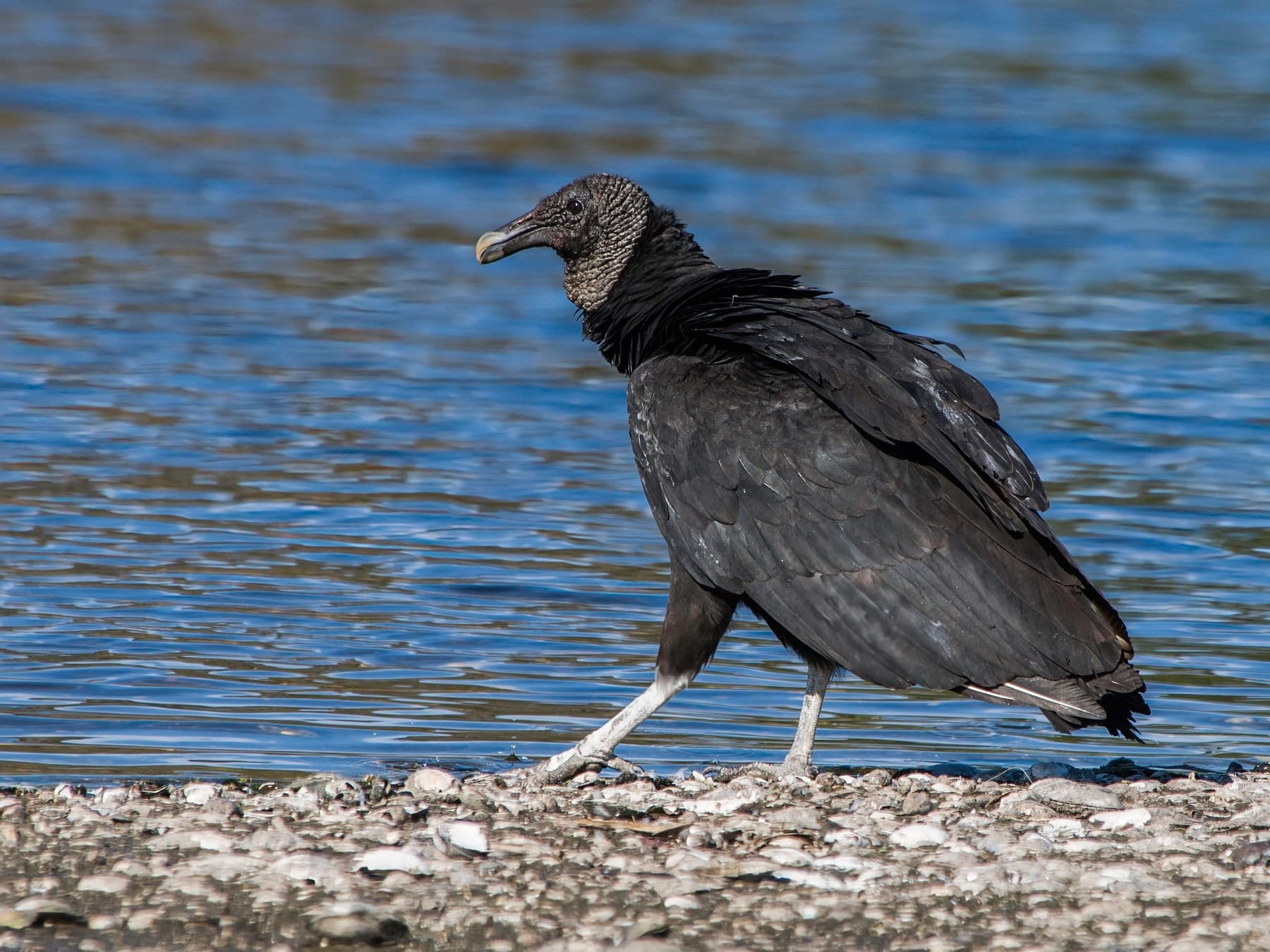
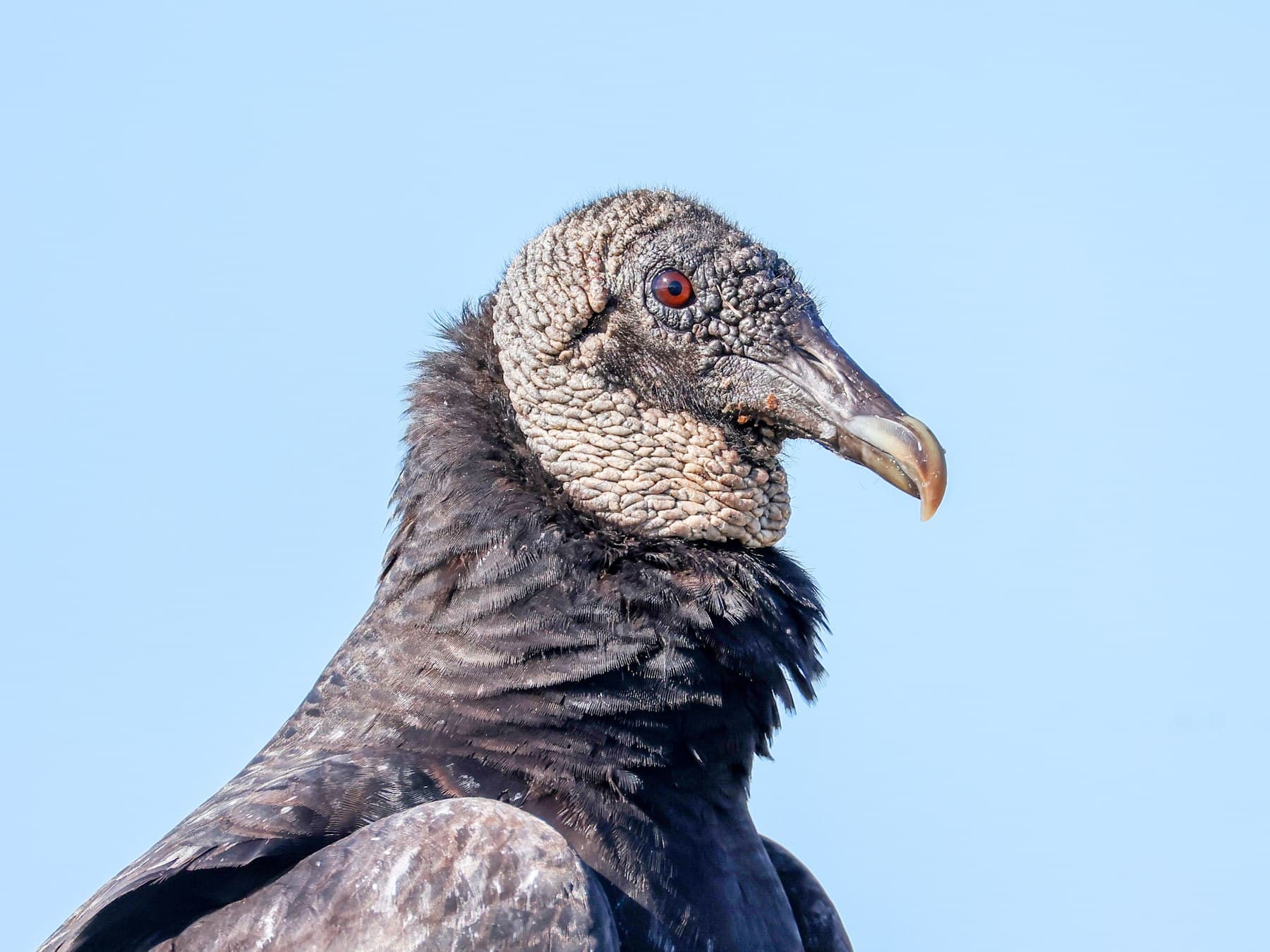
The Black Vulture is a stocky, all-black vulture with a bare, wrinkled, dark gray head and a very short, square tail. Up close, the bill is long, narrow and hooked, black with a pale ivory tip, and the eyes are dark brown.1, 2
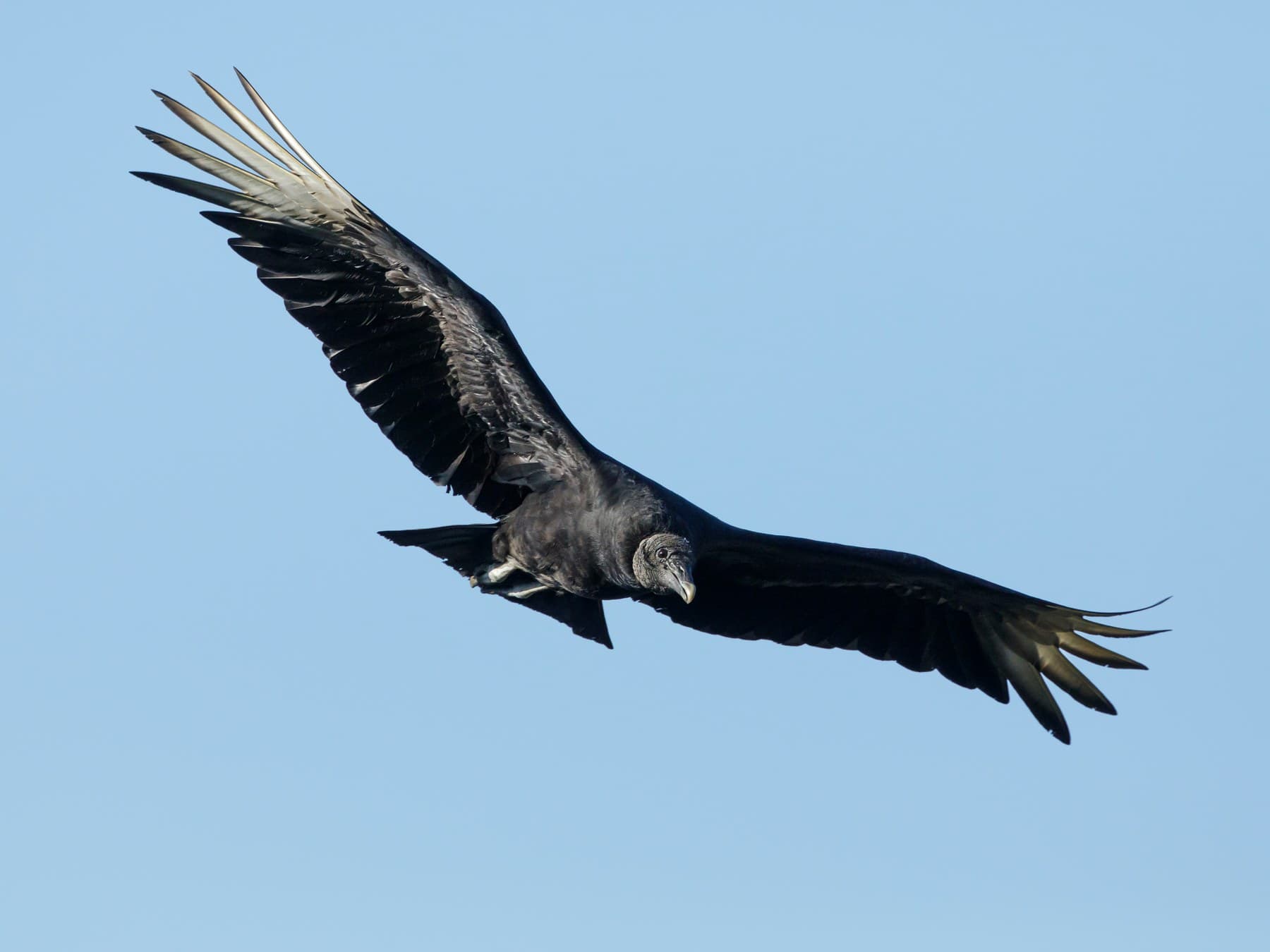
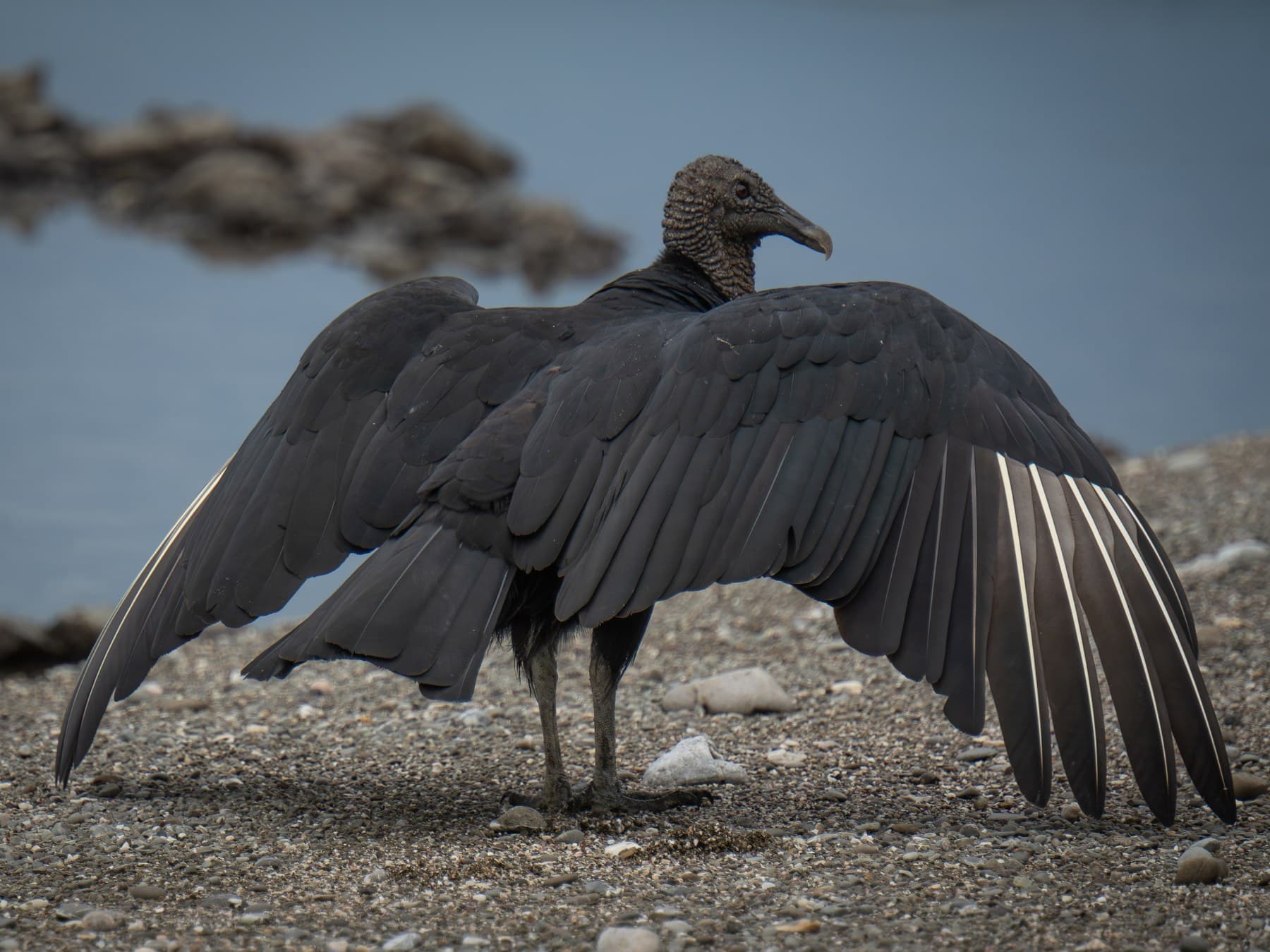
In flight it shows its best mark: a pale, silvery star near each wingtip, where the undersides of the outer six primary feathers are white or silvery, tipped and edged dark, though it can be hard to see far off or in strong light.
Its legs and feet are blackish brown but often look whitish, from a coating of its own droppings (more under behavior).
Identification in flight
Black Vultures soar on broad wings held flat, not raised in a shallow V like a Turkey Vulture's. They flap often, with quick, shallow wingbeats, about 4.3 a second, followed by a glide, and they rock far less than Turkey Vultures do.1 Look for the very short, square tail, the small bare head and the pale wingtips.
Size and shape
Black Vultures are 23.6 to 26.8 inches (60-68 cm) long, with a wingspan of 54 to 59 inches (137-150 cm). North American adults usually weigh 4.4 to 5.1 pounds (2.0-2.3 kg); birds of the tropical race are smaller.1
Next to a Turkey Vulture it is a little smaller in length and wingspan, with shorter wings and a much shorter tail, but with a body about the same size. It is slightly bigger than a Red-tailed Hawk.2, 3
Males, females and young
Males and females weigh about the same and have the same wing shape.4
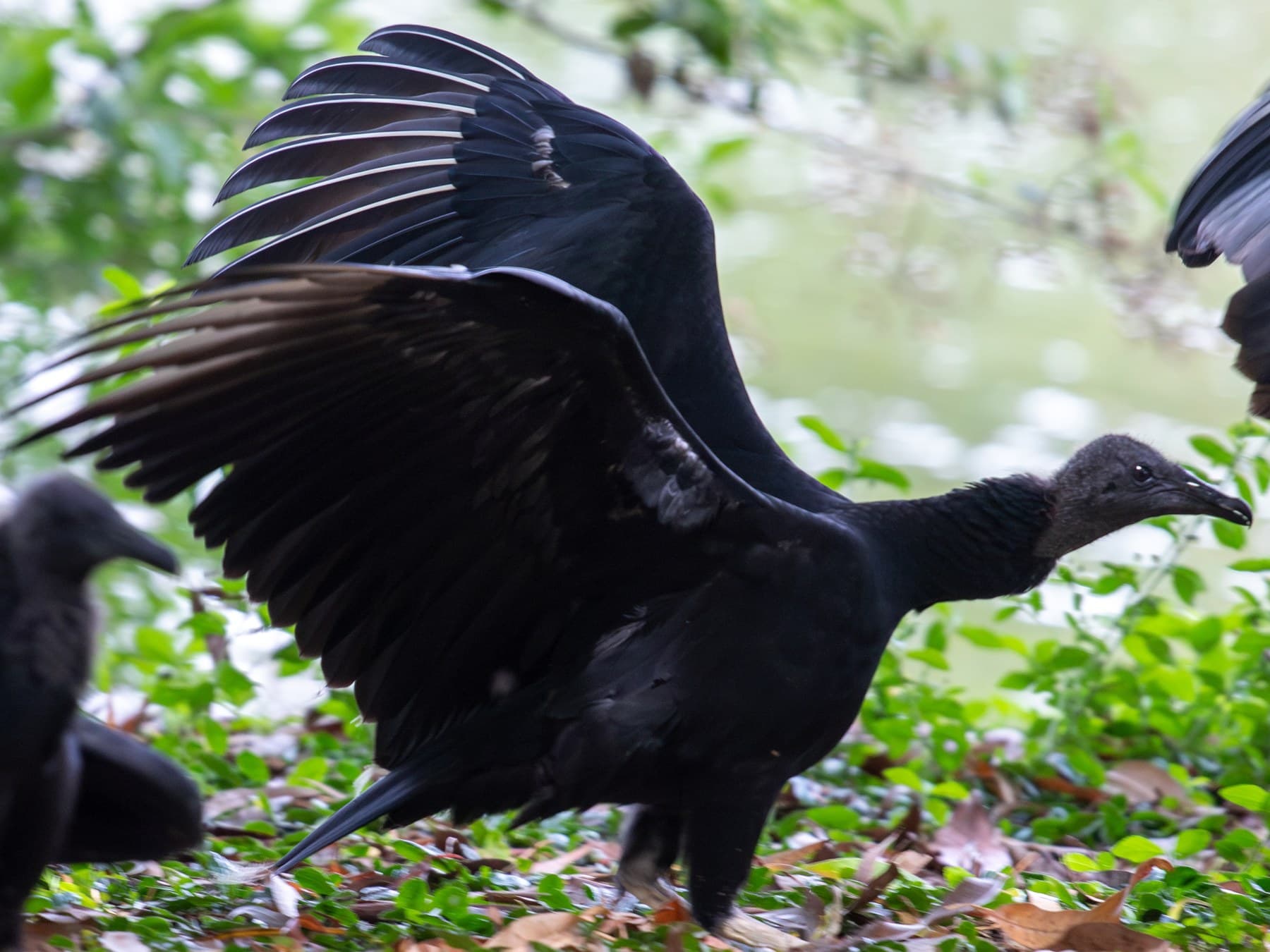
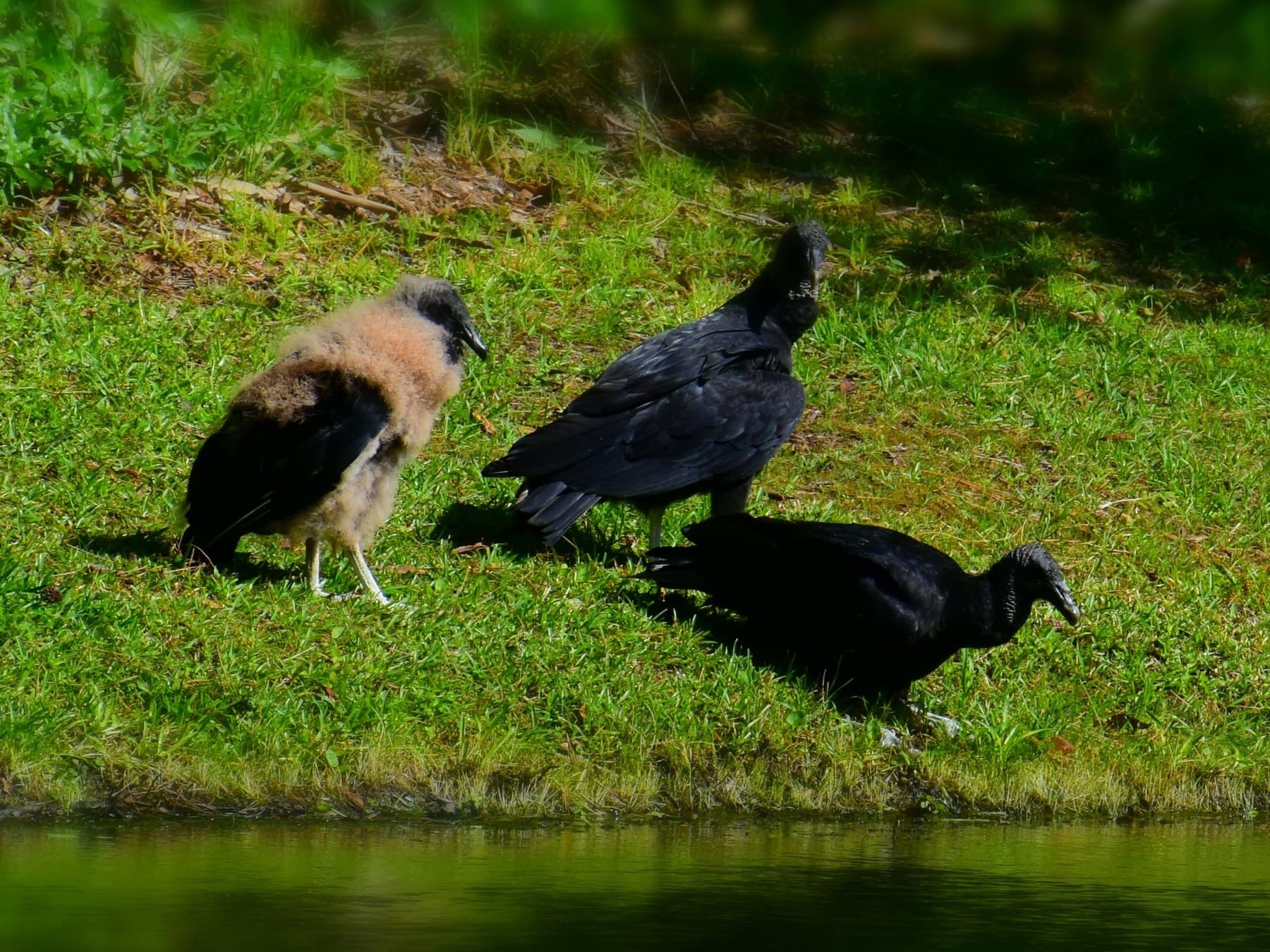
The sexes look alike in every plumage. Young birds in their first year are duller, brownish black with little gloss. Their heads are smoother and black-skinned, covered in short gray down or feathers, and the bill is dark, with at most a dull yellowish-gray tip, not the adult's ivory one. Over the first two years the head loses its feathering and turns gray, and it starts to wrinkle in the second year; the most heavily wrinkled heads may belong to birds in their fourth year or older.1
Adults are thought to replace their flight feathers slowly, in waves, almost all year round, so they keep flying well. Three subspecies are described (the tropical one, from Mexico to Brazil, is the smallest), but they look much alike and their validity is disputed.
Identification: similar birds
Turkey Vulture. The main lookalike, and the two often roost and feed together. A Turkey Vulture has a longer tail and longer wings held in a shallow V, and the whole rear edge of its underwing is pale, not just the tips. It wobbles as it soars. Adults have a red head and browner plumage; young Turkey Vultures have a dark head, so go by the shape, the wing pattern and the flight.
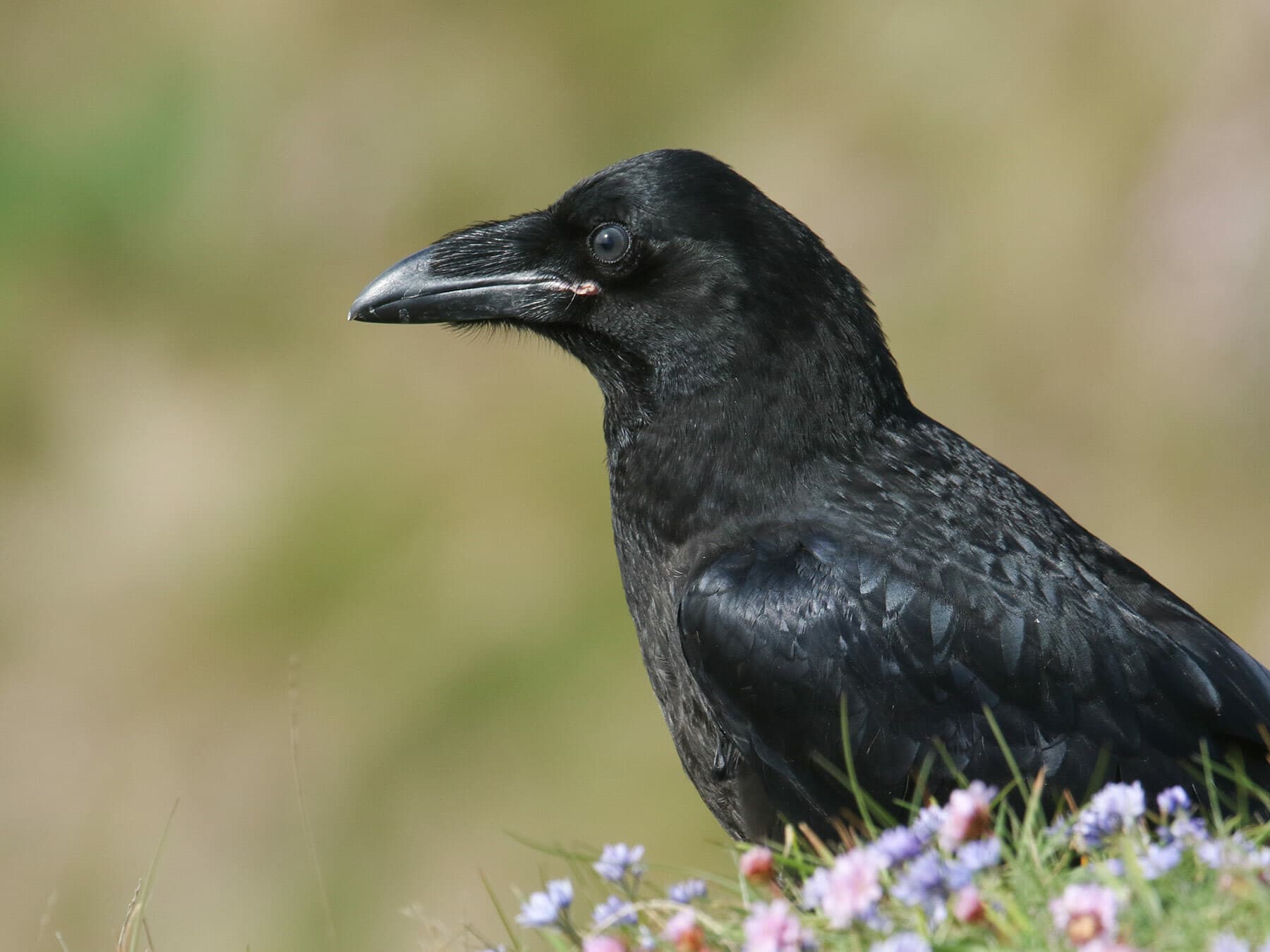
Common Raven. All black too, but with a feathered head, a heavy bill, shaggy throat feathers and a long, wedge-shaped tail, and no pale wingtips.
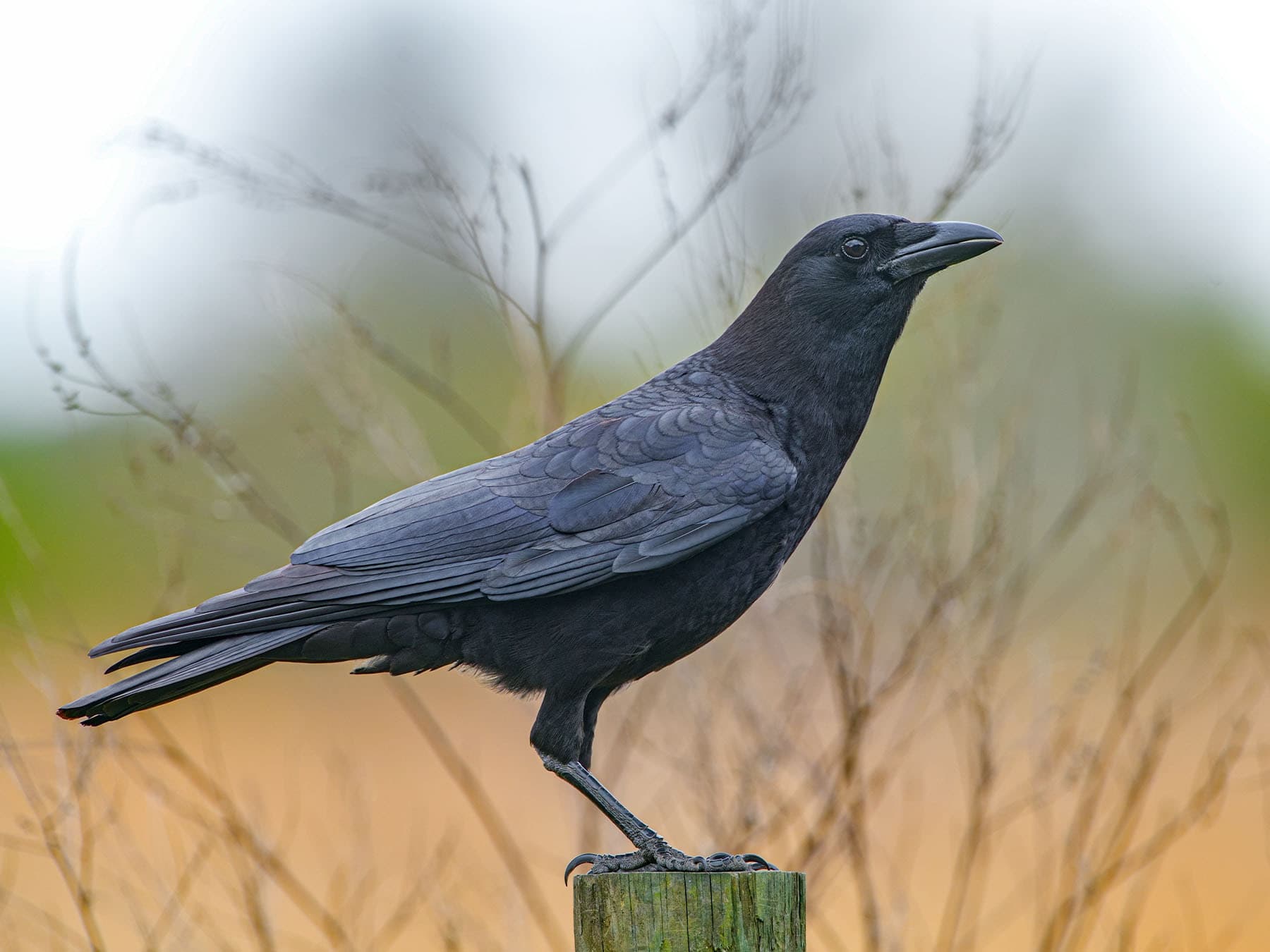
American Crow. Much smaller, with a feathered head, a heavy straight bill and all-dark wings with no pale tips.
Cinereous Vulture. Not a bird you will confuse in the field: it lives in Europe and Asia. It has been called the European Black Vulture, which is why the names get mixed up. The vultures of Europe, Asia and Africa belong to a different family, with the hawks and eagles.5 The Black Vulture is a New World vulture, whose closest living relatives are the Turkey Vulture and the two yellow-headed vultures.1
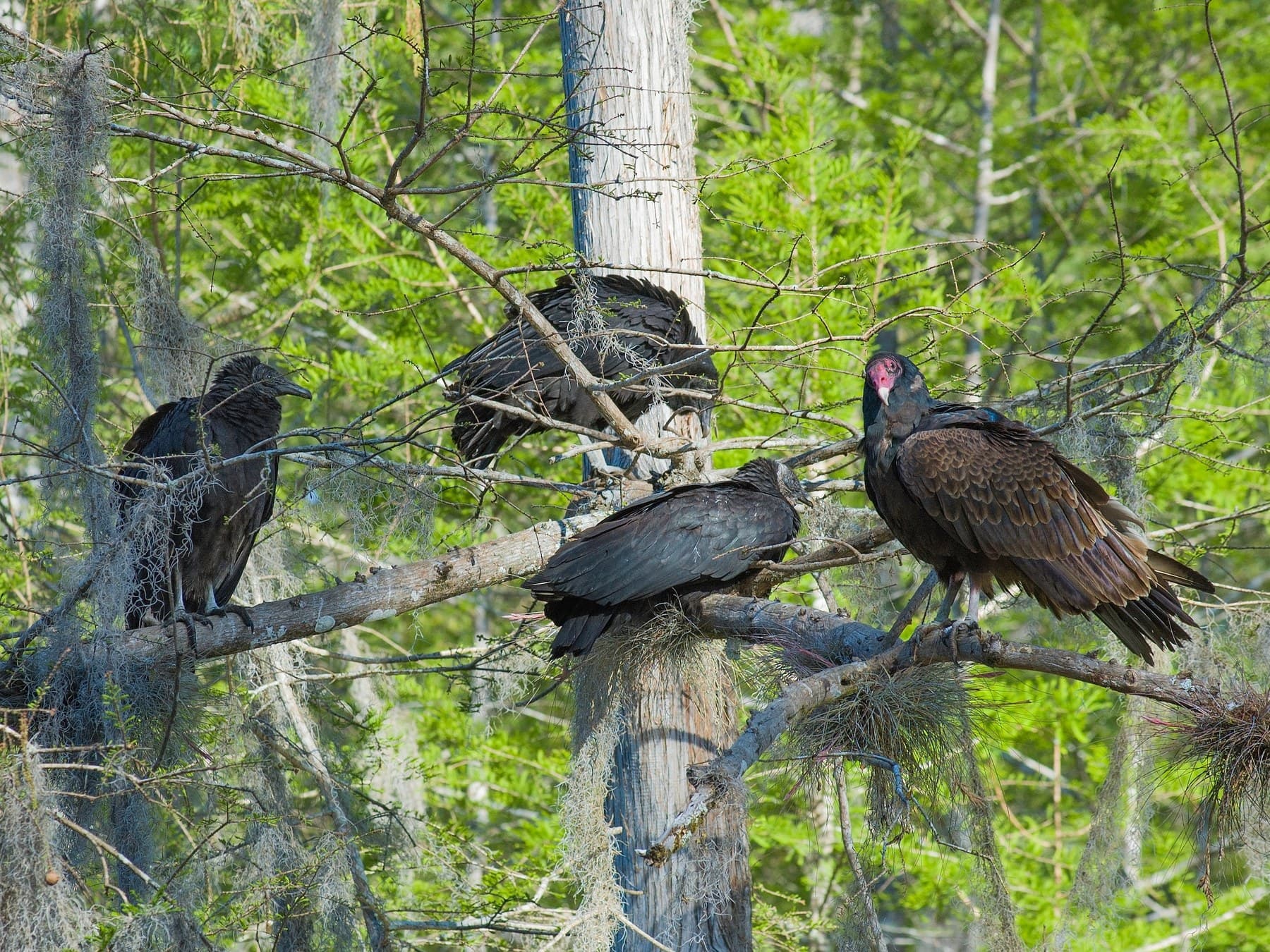
Not sure it’s a Black Vulture? Check your photo: Birdfact names the bird and shows the look-alike side by side.
Its size
Adults- Length
- 60–68 cm
- Wingspan
- 137–150 cm
- Weight
- 2000–2300 g
Its song and calls
Black Vultures have no syrinx, the voice box of birds, so they cannot sing. They hiss and grunt, mostly when feeding, squabbling or disturbed at the nest.1
Young at the nest give a long, deep hiss when disturbed and beg with low hissing or coughing sounds, and adults at the nest sometimes give a low, creaky coo. The sound you are more likely to notice is not a call at all: when a vulture drops steeply to food, the air rushing through its wings makes an audible whistle.
Heard one and not sure? Let the bird song identifier listen.
When and where to see it
Black Vultures live from the eastern and southern United States through Mexico and Central America to Patagonia in southern Argentina and Chile. They do not breed in the Caribbean, except on Trinidad.
In the US they breed north to western Massachusetts, southeastern New York, Pennsylvania, West Virginia, Ohio, southern Indiana, Illinois and Missouri, southeastern Oklahoma and central Texas, with a first breeding record in Vermont in 2020, and in south-central Arizona.
Look for them over open country and farmland mixed with woods: they forage over pastures, fields and roadsides, and nest and roost in woodland. They are most common on flat lowlands such as the coastal plain and avoid high, forested mountains. In Latin America they live in towns, scavenging in streets, dumps and slaughterhouses; in the US some live in semi-rural suburbs.1
Spotting tips
Watch the sky once the morning warms up and thermals form. Before that, look for groups perched in tall roost trees or on pylons and towers, often near water, and for birds at road kill.2
Where the range is spreading
The Black Vulture has spread far north since the early 20th century. In the 1930s it bred on the East Coast only as far as Virginia; it was first found nesting in New Jersey in 1981, New York in 1997, Massachusetts in 1998, Connecticut in 2002 and Vermont in 2020.1 The causes are not well understood; more road-killed deer and other food, a warming climate and recovery from pesticide losses have all been suggested.
Wanderers turn up north and west of the range, as far as British Columbia, the Yukon, California and the Canadian Maritimes.
Do they migrate?
Mostly not. Most birds stay all year, roaming widely between roosts, but some leave the northern edge of the range in winter, especially in bad weather; in Missouri, birds that leave come back in late February and early March.1
Banding shows how settled they are. Of about 840 birds recovered after banding in Louisiana in 1934-1946, 84% were found within 100 miles (160 km), though the farthest had gone 720 miles (1,160 km), to South Carolina.6 Vultures can no longer be fitted with leg bands in the US: because they squirt droppings on their legs to cool down, droppings build up under a band and cause sores.1
What it eats
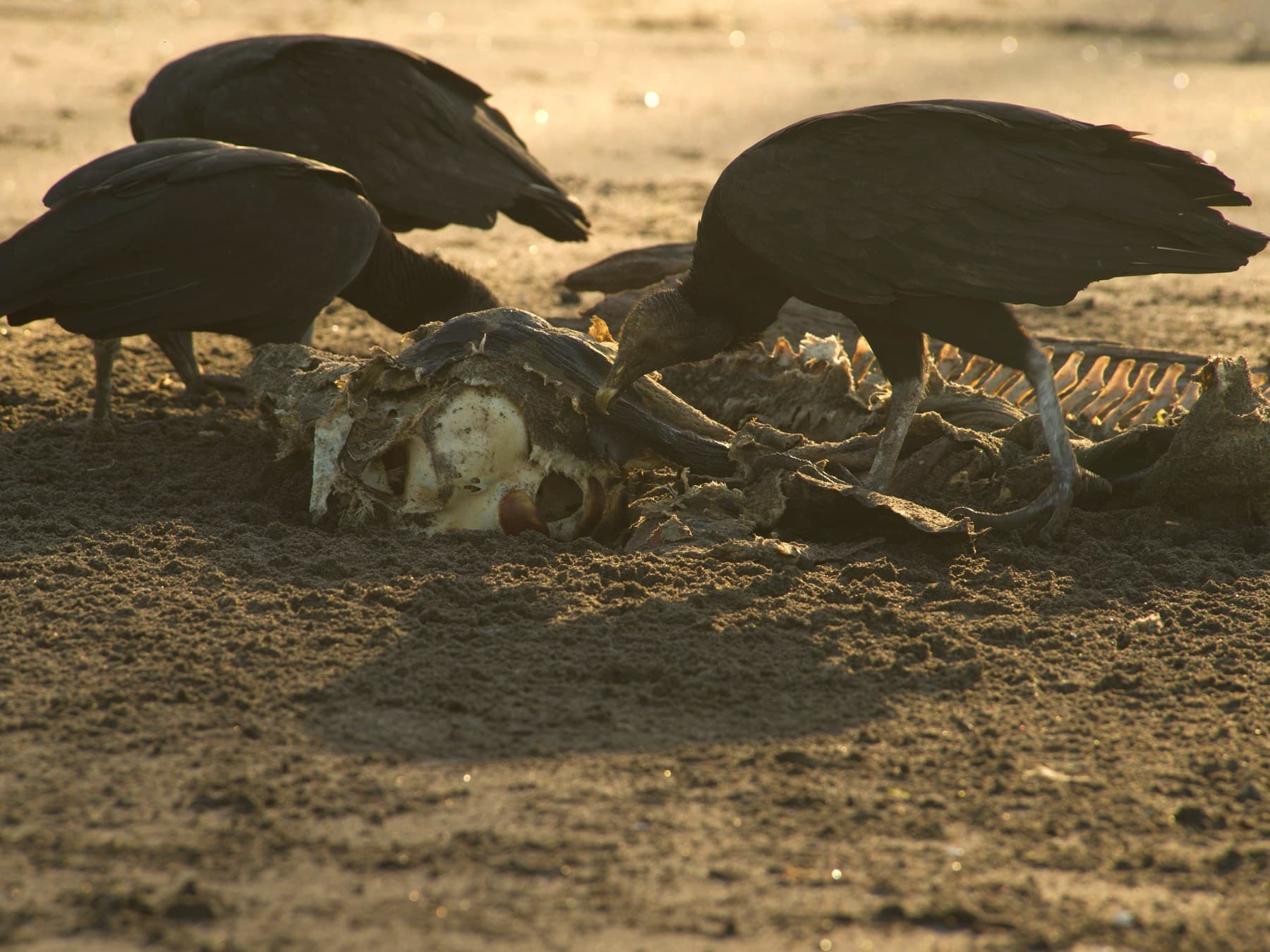
Black Vultures eat almost nothing but carrion, especially large dead mammals, from road-killed deer to dead livestock. They also scavenge garbage, eat some fruit and plant matter, and now and then kill small animals.1
In Pennsylvania and Maryland, 65% of 63 items eaten by radio-tagged birds were farm animals (cattle, pigs, poultry and sheep), and the rest wild ones such as deer and groundhogs.7
How they find food
Its sense of smell is poor compared with a Turkey Vulture's, and there is no evidence it uses smell to find food; instead it watches other vultures, and it often follows Turkey Vultures down to carcasses.1 Its eyesight is no sharper than a Turkey Vulture's.8
With heavier wing loading than a Turkey Vulture,4 it needs stronger thermals: it starts flying about an hour later in the morning and stops about an hour earlier. It also flies higher than Turkey Vultures when searching: in coastal South Carolina, GPS-tagged birds' median midday height peaked at about 520 feet (160 m) in April to June and was under 330 feet (100 m) the rest of the year, and some climbed to 4,900 feet (1,500 m) or more.9
Dozens may gather at one carcass: 98 at a feral hog in south Texas.10 The roost seems to work as an information center: birds that do not know where food is follow roost mates to carcasses next morning, as experiments in North Carolina and Texas showed.11, 10
One-on-one, a Turkey Vulture holds its own, but Black Vultures gather fast and a group drives Turkey Vultures off the carcass. A Black Vulture cannot open a big carcass itself and gets in through the eyes, mouth or other openings, often with its whole head inside; unlike a Turkey Vulture, it usually does not hold food down with its feet. It eats fast, pecking about every 4.5 seconds against 7 for a Turkey Vulture in one study in tropical forest, perhaps because relatives in the group keep watch.12
Feeding on live animals and livestock
Black Vultures occasionally kill live animals, mostly small ones: young night-herons, newly hatched sea turtles and small fish.1 On Avery Island, Louisiana, groups were seen killing skunks and an opossum in the fall, in an account from 1939.13
Farmers report them killing newborn calves, lambs and pigs, and complaints have grown since the early 1990s: in Virginia, complaints about vulture damage of all kinds, not only to livestock, went from 2 to 207 over 1990-1995.14
Three studies that watched births found far less harm than the reports suggest. At 19 calvings on a Florida ranch, one vulture pecked at the membranes around a calf being born and the cow drove it off.15 At 100 calvings in Brazil, vultures pecked cows or calves in 41 but caused minor injuries in only 2.16 In Patagonia they killed 5 of 138 lambs watched (4%), some with Crested Caracaras.17
Birds of the World's authors think many calves found with vultures were probably stillborn (in the US, about 7% of Holstein calves die within two days of birth), and that watching heifers at first calving and giving veterinary care would cut the losses put down to vultures.1
Nesting and breeding
Black Vultures build no nest. The female lays straight onto the ground in a dark, sheltered spot: a cave, rock crevice, hollow tree or log, dense thicket or abandoned building.1
Of 525 North American nest sites, 47% were in thickets, 15% in hollow trees, 15% in caves and 2% in buildings.18 In North Carolina studies of the 1970s and 1980s almost all were in abandoned buildings, and of 14 nests found in Mississippi in 2021, six were in hunting blinds and the rest in barns and other buildings.
A good site is used year after year: one Texas brush pile was used 9 times, and three limestone grottoes every year for 15 years. Pairs perch near the chosen site for up to six weeks before laying. Disturbance can make a pair abandon a nest, and people and pets also destroy eggs and young.
Nesting starts earlier in the south. In north-central Texas clutches are laid from mid-February to early April, and in North Carolina in mid-March;1 the first chicks appear in late March near the Gulf coast and not until mid-May around 40-41 degrees north, the latitude of southern Pennsylvania.18
Breeding pairs
Black Vultures appear to mate for life. DNA tests of 16 families found no chicks fathered outside the pair, and in North Carolina pairs stayed together for at least 12 years, a bird re-pairing only when its mate died.19
In courtship a male may walk in circles around the female with his neck held out, and one bird chases the other through the air, diving at it.1 Young birds take years to breed: the earliest first breeding in a 13-year North Carolina study was at 8 years old.20
Eggs and incubation
The clutch is almost always 2 eggs, pale gray-green or bluish white, with a few big brown blotches, mostly around the broad end. A pair raises one brood a year; one that loses its eggs may lay again three to four weeks later.1
Both parents incubate, taking turns of about 24 hours and holding the eggs on top of their feet; the eggs hatch after 38-39 days.21
Young and fledglings
Chicks hatch covered in thick buff down.1 In a Panama study they weighed about 2.5 ounces (70 g) at hatching.22 They grow slowly, are fed by regurgitation, and first fly at 75-80 days.21, 23 Parents keep feeding their young for up to eight months after they fledge.24
In North Carolina in 1977-1989, 76.5% of 98 nests in abandoned buildings raised at least one young; in 1983-1989, long-used sites far from houses did much better (84.2%) than new ones nearer people (45.4%).25 Eggs and chicks are taken by red foxes, dogs, American Crows and opossums.1
Behaviour
Black Vultures are highly social: families stay together, roost together and feed together, and relatives preen each other's heads and necks. Communal roosts, some used for decades, are the center of their social life. Birds gather there each night, and most leave in the morning once thermals form. They roost in tall trees, often near water, and on electricity pylons and communication towers.
Adults dominate younger birds, and at carcasses Black Vultures give way to Crested Caracaras and, in South America, to King Vultures and Andean Condors.1 They are aggressive with other Black Vultures, mostly unrelated ones: fights at roosts and carcasses involve pecking, biting, pummeling with the wings and grappling with the feet.26
They do not defend a territory and share a large home range with many others: radio-tagged birds in Pennsylvania and Maryland used home ranges that averaged about 62 square miles (160 km2) in summer (11 birds, 1980s study).27

Behavior: keeping cool and warm
On hot days a Black Vulture squirts droppings onto its legs to cool down (urohidrosis), which is why its legs often look white. It often stands with wings spread, facing toward or away from the sun, to warm up on cool mornings or to dry and cool off.1 In cold weather it shivers and pulls the feathered skin of its neck up over its bare head.28
Lifespan and predators
The oldest Black Vulture on the US Bird Banding Laboratory's list reached at least 25 years and 6 months: it was banded in Louisiana in November 1940 and found dead there in December 1965.29
Adults are long-lived: in North Carolina only about 9% of breeding adults were lost each year (an estimate from 12 mate changes over 13 years).25 Of birds banded in Louisiana in 1934-1946 and later recovered, just over half were found within two years, but nearly a fifth after 7-13 years.
Adults are probably rarely killed by predators; a Golden Eagle was seen attacking a group of vultures, and a Bald Eagle was seen scaring them off carrion.1
Conservation
The Black Vulture is listed as Least Concern on the IUCN Red List (2025).30 Partners in Flight puts the population at about 190 million, a rough estimate, and rates it of low concern.31 It is the most numerous vulture in the Americas.1
Numbers are rising. The North American Breeding Bird Survey shows an increase of about 3% a year on average since 1966, and the index in 2025 was over five times its 1966 level, though about a tenth below its 2021 peak.32 An estimated 4.3 million lived in the eastern US flyways in 2015: 2.5 million in the Atlantic Flyway and 1.75 million in the Mississippi Flyway.33
It was not always so. DDT thinned its eggshells by about 16-17% in Florida and Texas from the late 1940s,34 and numbers dipped while DDT was in use. Thousands were trapped, poisoned and shot, especially in Texas, where ranchers believed they attacked livestock, until at least the early 1970s; of 840 recovered Louisiana birds banded in 1934-1946, about 58% had been shot, trapped or otherwise killed by people.
It still dies in collisions with vehicles and power lines and from shooting and poisoning, probably also from lead in shot carcasses, and it has lost nest sites as old buildings collapsed and big hollow trees were felled.1
Legal status and protection
Black Vultures are protected under the Migratory Bird Treaty Act: killing, capturing or keeping one without a federal permit is a crime.35, 36
Livestock owners can apply for a federal depredation permit in their own name. Under a scheme piloted in Kentucky and Tennessee in 2017, extended nationwide in 2021 and formalized in February 2026, one public body per state (a government agency or a non-profit) can also hold a statewide permit and issue sub-permits to commercial livestock producers, under standard conditions that include non-lethal methods and limits on take.36
Population and conflicts with people
As numbers grow, so do conflicts with people: over aircraft, damage to property and alleged attacks on livestock.37 In published hazard rankings it came third for military aircraft and eleventh among species for civil aviation; birds foraging at low heights are a hazard to low-level military training flights. It sometimes tears at vinyl and plastic on cars and boats, and at seat cushions, roof shingles and caulking near roosts; why is unclear, perhaps the smell of the material or mistaking it for bone.
There is no evidence that it is a significant spreader of disease. By clearing carcasses fast, vultures probably reduce the spread of disease where sanitation is poor, though some germs, such as anthrax spores, can survive its gut.1
Similar birds
Often mistaken for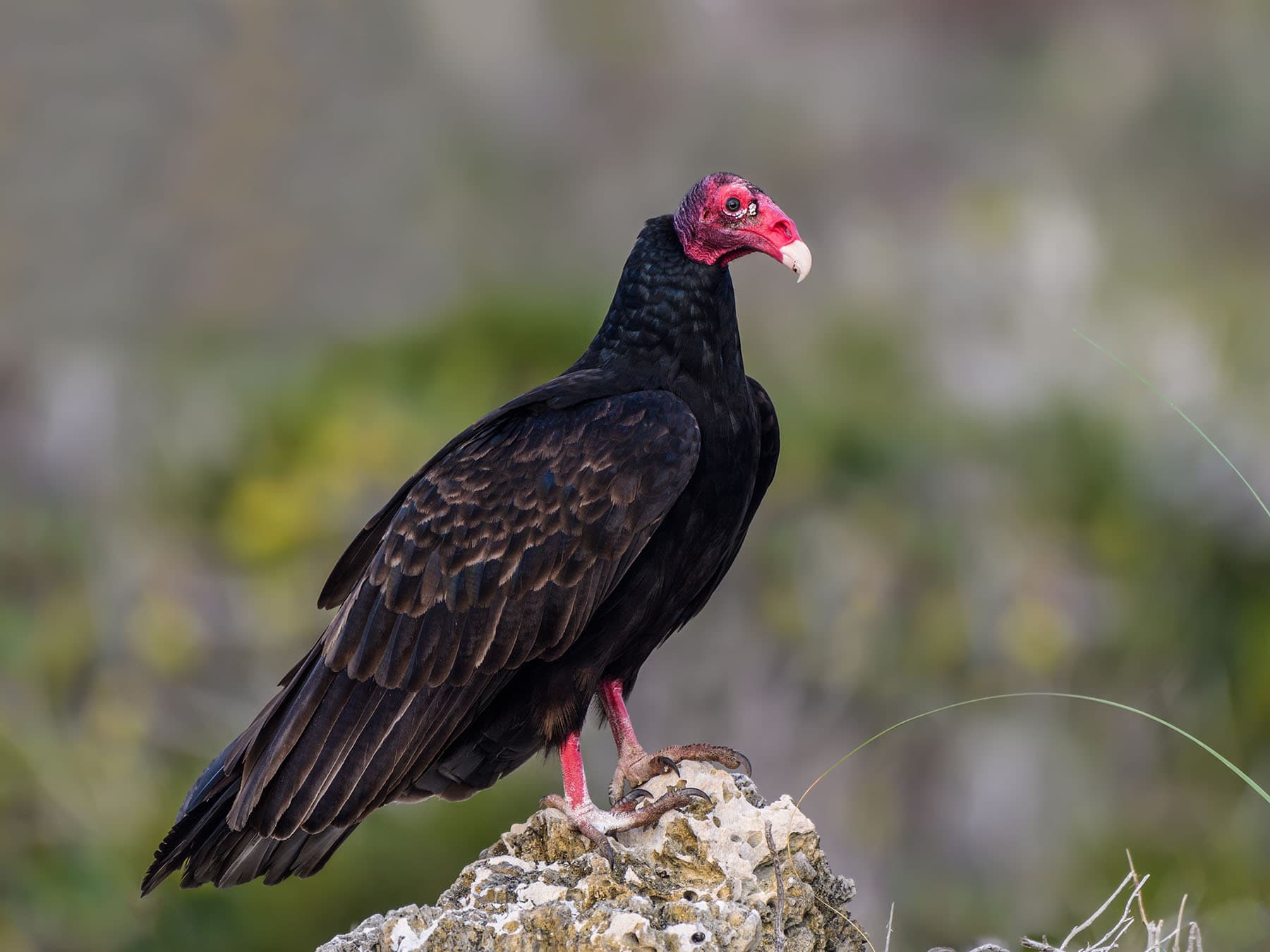
Quick facts
- Length
- 60–68 cm
- Wingspan
- 137–150 cm
- Weight
- 2000–2300 g
- Lifespan
- oldest recorded 25 years 6 months
- Family
- New World Vultures
- Global status (IUCN)
- Least Concern
- World population
- About 190 million (Partners in Flight, 2023)
- Population trend
- Common and increasing
- Also called
- American Black Vulture
- Scientific name
- Coragyps atratus
Questions
2Are Black Vultures dangerous?
Not to people: we found no record of attacks on people in the Birds of the World account or the Audubon guide. Now and then they kill small animals, and farmers report attacks on newborn livestock, though studies that watched births found far less harm than reported. See live animals and livestock.
Are Black Vultures rare?
No. With about 190 million birds, it is the most numerous vulture in the Americas, and it is still spreading north in the eastern US, so it can be new to an area. See where to see them.
Sources
43- 1Buckley, N. J., Kluever, B. M., Driver, R. and Rush, S. A. (2022). Black Vulture (Coragyps atratus), version 2.0. Birds of the World (P. G. Rodewald and B. K. Keeney, editors). Cornell Lab of Ornithology. doi:10.2173/bow.blkvul.02 (opens in a new tab)
- 2Cornell Lab of Ornithology. Black Vulture. All About Birds. Accessed 3 November 2026. Source (opens in a new tab)
- 3National Audubon Society. Black Vulture. Guide to North American Birds. Accessed 3 November 2026. Source (opens in a new tab)
- 4Graves, G. R. (2017). Sexual monomorphism in wing loading and wing aspect ratio in Black Vulture (Coragyps atratus) and Turkey Vulture (Cathartes aura). Proceedings of the Biological Society of Washington 130: 240-249. doi:10.2988/17-00018 (opens in a new tab)
- 5BirdLife International. Cinereous Vulture Aegypius monachus: species factsheet. BirdLife DataZone. Accessed 3 November 2026. Source (opens in a new tab)
- 6Parmalee, P. W. and Parmalee, B. G. (1967). Results of banding studies of the Black Vulture in eastern North America. Condor 69: 146-155. doi:10.2307/1366604 (opens in a new tab)
- 7Coleman, J. S. and Fraser, J. D. (1987). Food habits of Black and Turkey vultures in Pennsylvania and Maryland. Journal of Wildlife Management 51: 733-739. doi:10.2307/3801734 (opens in a new tab)
- 8Lisney, T. J. et al. (2013). Comparison of eye morphology and retinal topography in two species of New World vultures (Aves: Cathartidae). Anatomical Record 296: 1954-1970. doi:10.1002/ar.22815 (opens in a new tab)
- 9Avery, M. L. et al. (2011). Vulture flight behavior and implications for aircraft safety. Journal of Wildlife Management 75: 1581-1587. doi:10.1002/jwmg.205 (opens in a new tab)
- 10Buckley, N. J. (1997). Experimental tests of the information-center hypothesis with Black Vultures (Coragyps atratus) and Turkey Vultures (Cathartes aura). Behavioral Ecology and Sociobiology 41: 267-279. doi:10.1007/s002650050388 (opens in a new tab)
- 11Rabenold, P. P. (1987). Recruitment to food in Black Vultures: evidence for following from communal roosts. Animal Behaviour 35: 1775-1785. doi:10.1016/S0003-3472(87)80070-2 (opens in a new tab)
- 12Houston, D. C. (1988). Competition for food between Neotropical vultures in forest. Ibis 130: 402-417. doi:10.1111/j.1474-919X.1988.tb08815.x (opens in a new tab)
- 13McIlhenny, E. A. (1939). Feeding habits of Black Vulture. Auk 56: 472-474. doi:10.2307/4078809 (opens in a new tab)
- 14Lowney, M. S. (1999). Damage by Black and Turkey Vultures in Virginia, 1990-1996. Wildlife Society Bulletin 27: 715-719. Accessed 3 November 2026.
- 15Humphrey, J. S., Tillman, E. A. and Avery, M. L. (2004). Vulture-cattle interactions at a central Florida ranch. Proceedings of the 21st Vertebrate Pest Conference, University of California, Davis. Accessed 3 November 2026.
- 16Toledo, L. M. et al. (2013). The presence of Black Vultures at the calving sites and its effects on cows' and calves' behaviour immediately following parturition. Animal 7: 469-475. doi:10.1017/S1751731112001735 (opens in a new tab)
- 17Ballejo, F., Plaza, P. I. and Lambertucci, S. A. (2020). The conflict between scavenging birds and farmers: field observations do not support people's perceptions. Biological Conservation 248: 108627. doi:10.1016/j.biocon.2020.108627 (opens in a new tab)
- 18Jackson, J. A. (1983). Nesting phenology, nest site selection, and reproductive success of Black and Turkey vultures. Vulture Biology and Management (S. R. Wilbur and J. A. Jackson, editors), University of California Press. Accessed 3 November 2026.
- 19Decker, M. D., Parker, P. G., Minchella, D. J. and Rabenold, K. N. (1993). Monogamy in Black Vultures: genetic evidence from DNA fingerprinting. Behavioral Ecology 4: 29-35. doi:10.1093/beheco/4.1.29 (opens in a new tab)
- 20Parker, P. G., Waite, T. A. and Decker, M. D. (1995). Kinship and association in communally roosting Black Vultures. Animal Behaviour 49: 395-401. doi:10.1006/anbe.1995.0052 (opens in a new tab)
- 21Stewart, P. A. (1974). A nesting of Black Vultures. Auk 91: 595-600. doi:10.2307/4084478 (opens in a new tab)
- 22McHargue, L. A. (1981). Black Vulture nesting, behavior, and growth. Auk 98: 182-185. doi:10.1093/auk/98.1.182 (opens in a new tab)
- 23Stewart, P. A. (1983). The biology and communal behaviour of American Black Vultures. Vulture News 9-10: 14-36. Accessed 3 November 2026.
- 24Rabenold, P. P. (1986). Family associations in communally roosting Black Vultures. Auk 103: 32-41. doi:10.1093/auk/103.1.32 (opens in a new tab)
- 25Rabenold, P. P. and Decker, M. D. (1990). Black Vultures in North Carolina: statewide population surveys and analysis of Chatham County population trends. Final report to the North Carolina Wildlife Resources Commission. Accessed 3 November 2026.
- 26Rabenold, P. P. (1987). Roost attendance and aggression in Black Vultures. Auk 104: 647-653. doi:10.1093/auk/104.4.647 (opens in a new tab)
- 27Coleman, J. S. and Fraser, J. D. (1989). Habitat use and home ranges of Black and Turkey vultures. Journal of Wildlife Management 53: 782-792. doi:10.2307/3809213 (opens in a new tab)
- 28Larochelle, J., Delson, J. and Schmidt-Nielsen, K. (1982). Temperature regulation in the Black Vulture. Canadian Journal of Zoology 60: 491-494. doi:10.1139/z82-073 (opens in a new tab)
- 29USGS Bird Banding Laboratory. Longevity records of North American birds. USGS Eastern Ecological Science Center, Bird Banding Laboratory. Accessed 3 November 2026. Source (opens in a new tab)
- 30BirdLife International (2025). American Black Vulture Coragyps atratus: species factsheet. BirdLife DataZone (IUCN Red List assessment 2025). Accessed 3 November 2026. Source (opens in a new tab)
- 31Partners in Flight (2023). Avian Conservation Assessment Database and Population Estimates Database. Bird Conservancy of the Rockies. Accessed 3 November 2026. Source (opens in a new tab)
- 32Hostetler, J. A. et al. (2026). The North American Breeding Bird Survey, Analysis Results 1966-2025. U.S. Geological Survey data release. doi:10.5066/P1OSNSFC (opens in a new tab)
- 33Zimmerman, G. S. et al. (2019). Allowable take of Black Vultures in the eastern United States. Journal of Wildlife Management 83: 272-282. doi:10.1002/jwmg.21608 (opens in a new tab)
- 34Kiff, L. F., Peakall, D. B., Morrison, M. L. and Wilbur, S. R. (1983). Eggshell thickness and DDE residue levels in vulture eggs. Vulture Biology and Management (S. R. Wilbur and J. A. Jackson, editors), University of California Press. Accessed 3 November 2026.
- 35United States Congress. 16 U.S. Code 707: Violations and penalties; forfeitures (Migratory Bird Treaty Act). U.S. Code, via Legal Information Institute, Cornell Law School. Accessed 3 November 2026. Source (opens in a new tab)
- 36U.S. Fish and Wildlife Service (2026). Migratory Bird Permit Memorandum MBPM-7-02: Black Vulture Livestock Protection Permitting Framework. U.S. Fish and Wildlife Service, Migratory Bird Program, 6 February 2026. Accessed 3 November 2026. Source (opens in a new tab)
- 37Kluever, B. M. et al. (2020). Black Vulture conflict and management in the United States: damage trends, management overview, and research needs. Human-Wildlife Interactions 14: 376-389. doi:10.26077/9875-d38f (opens in a new tab)
- 38Cornell Lab of Ornithology. Turkey Vulture. All About Birds. Accessed 3 November 2026. Source (opens in a new tab)
- 39Cornell Lab of Ornithology. Common Raven. All About Birds. Accessed 3 November 2026. Source (opens in a new tab)
- 40Cornell Lab of Ornithology. American Crow. All About Birds. Accessed 3 November 2026. Source (opens in a new tab)
- 41Johnson, J. A., Brown, J. W., Fuchs, J. and Mindell, D. P. (2016). Multi-locus phylogenetic inference among New World Vultures (Aves: Cathartidae). Molecular Phylogenetics and Evolution 105: 193-199. doi:10.1016/j.ympev.2016.08.025 (opens in a new tab)
- 42Clapp, R. B., Klimkiewicz, M. K. and Kennard, J. H. (1982). Longevity records of North American birds: Gaviidae through Alcidae. Journal of Field Ornithology 53: 81-208. Accessed 3 November 2026.
- 43AviList Core Team (2025). AviList: The Global Avian Checklist, v2025b. doi:10.2173/avilist.v2025b (opens in a new tab)

Checked by
Nathan Cope, founder and editor
Nathan founded Birdfact and leads its writers and contributors in the UK, the US and Canada. He has watched and studied birds for more than ten years, and checks every article and species guide before it’s published.