


Egyptian Vulture
White Scavenger Vulture, Pharaoh's Chicken · Neophron percnopterus
By the Birdfact teamChecked by Nathan Cope
On this page14 sections
How to recognise it
What do Egyptian Vultures look like?
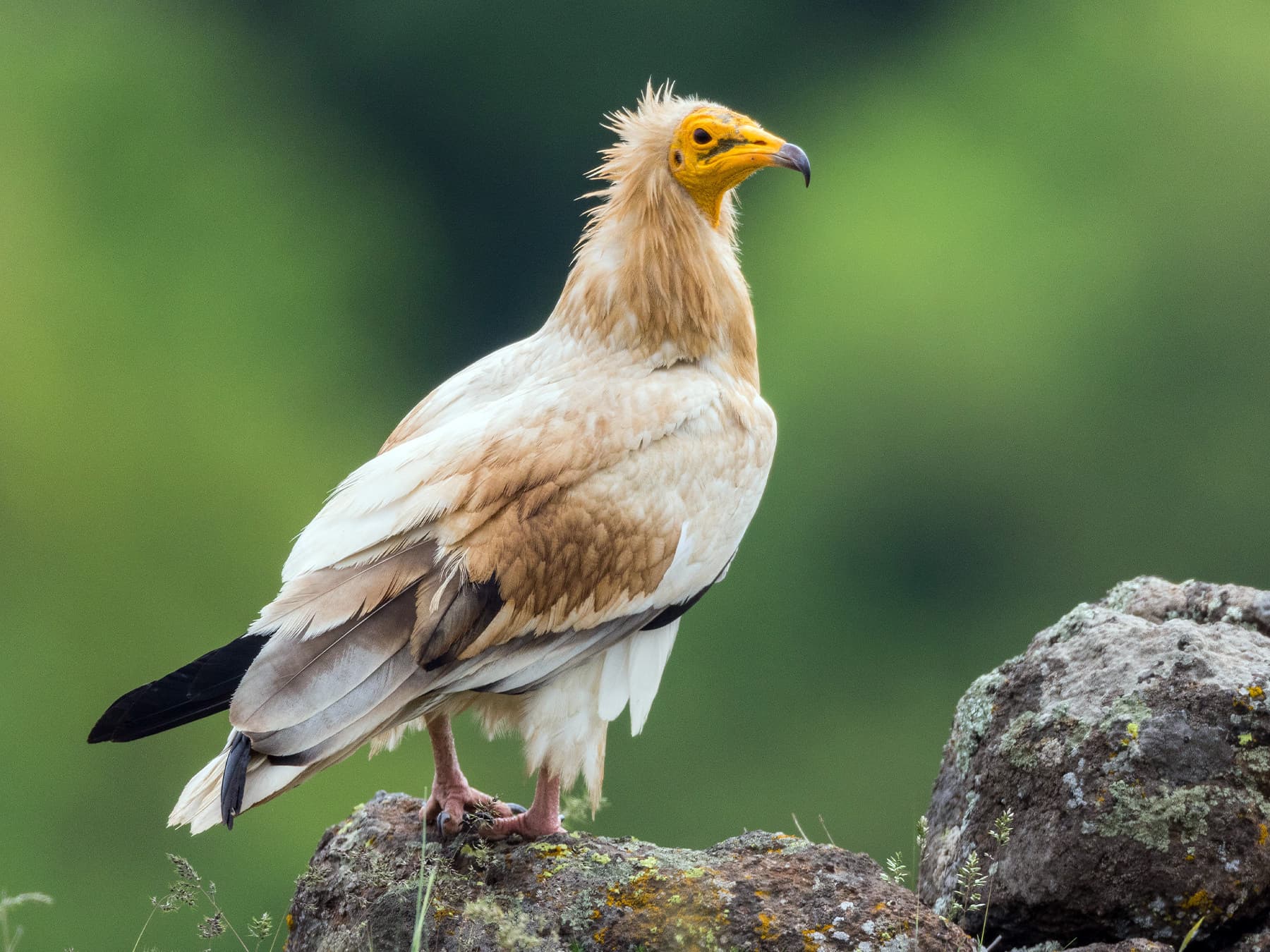
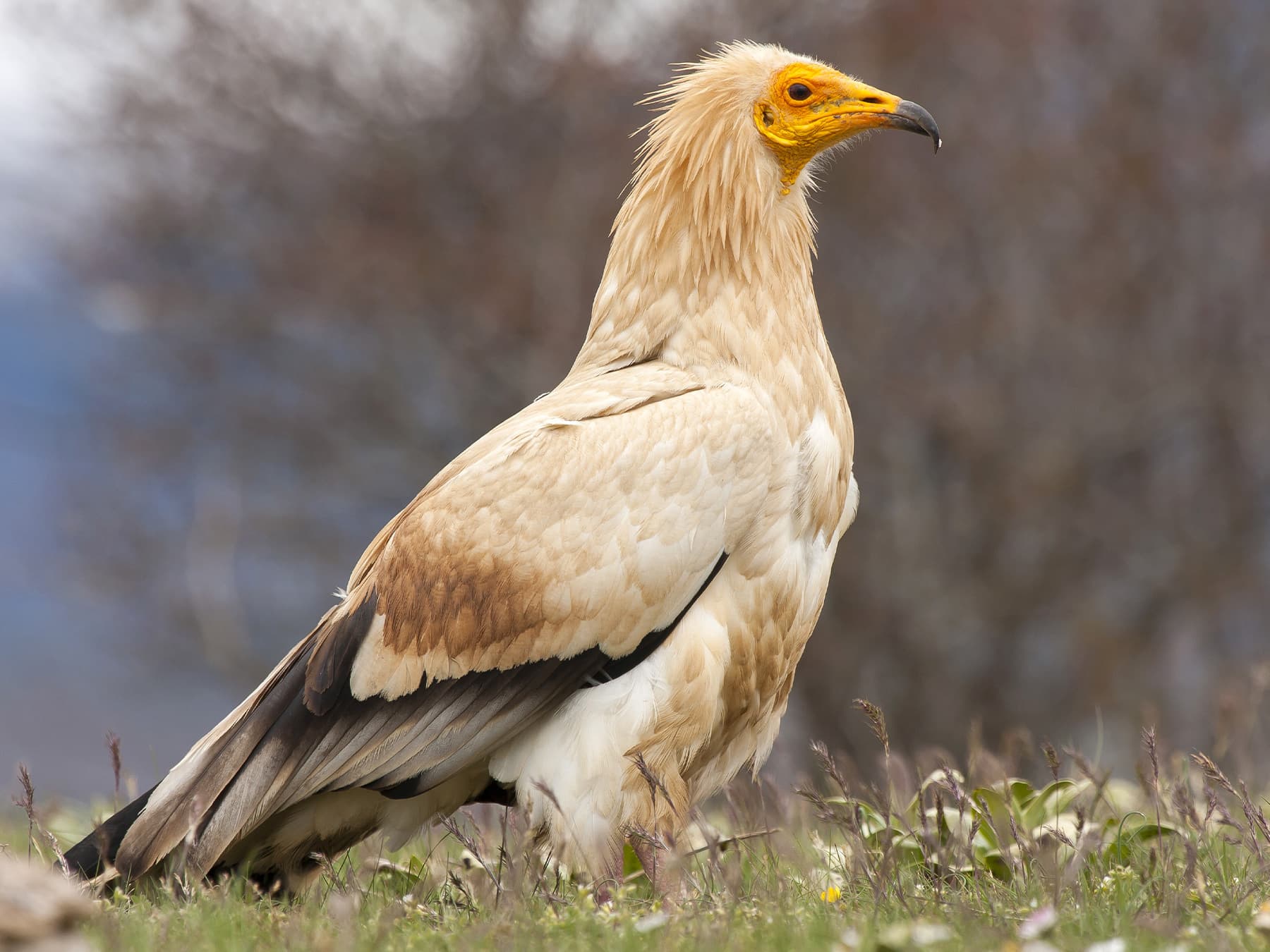
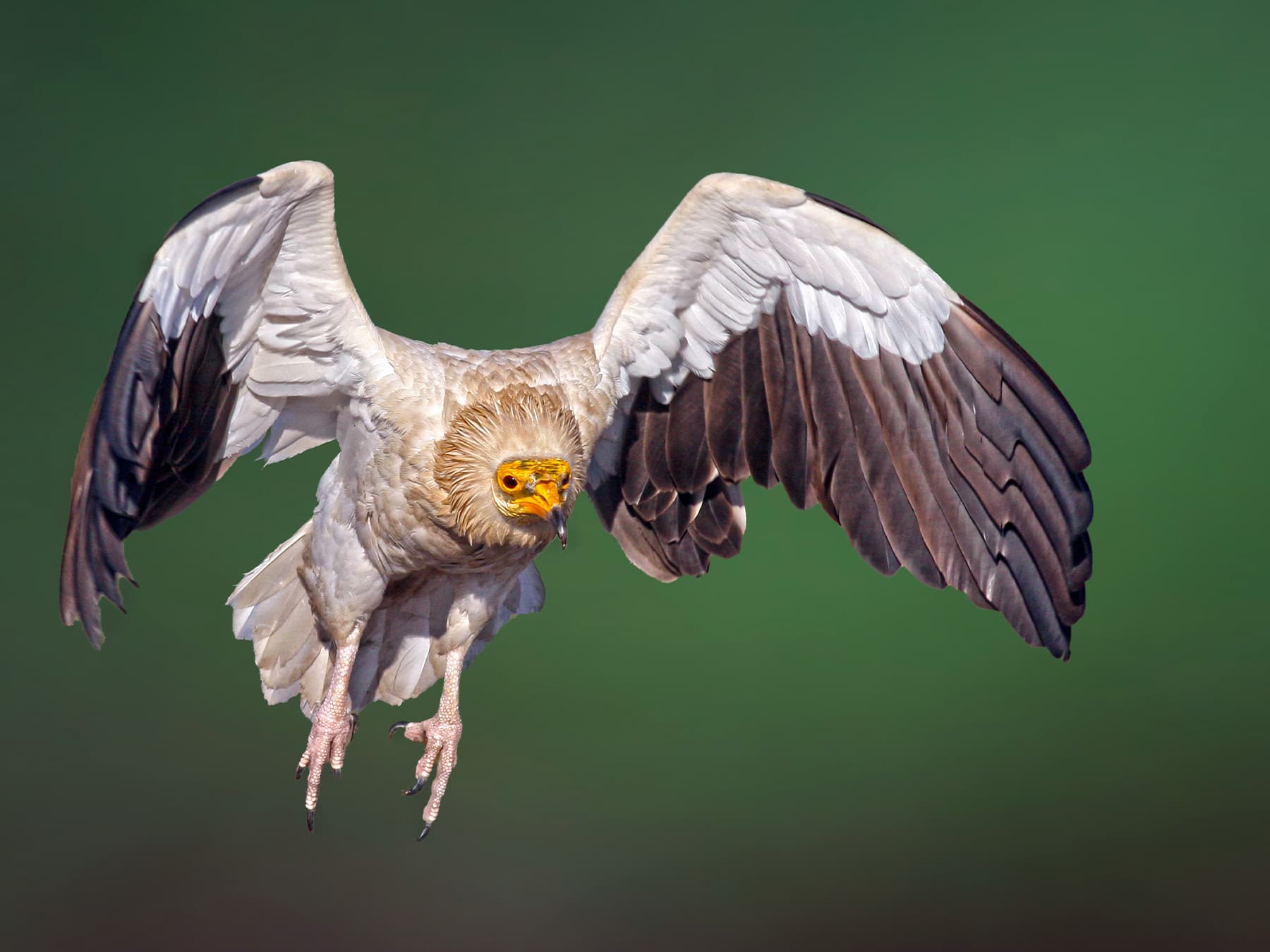
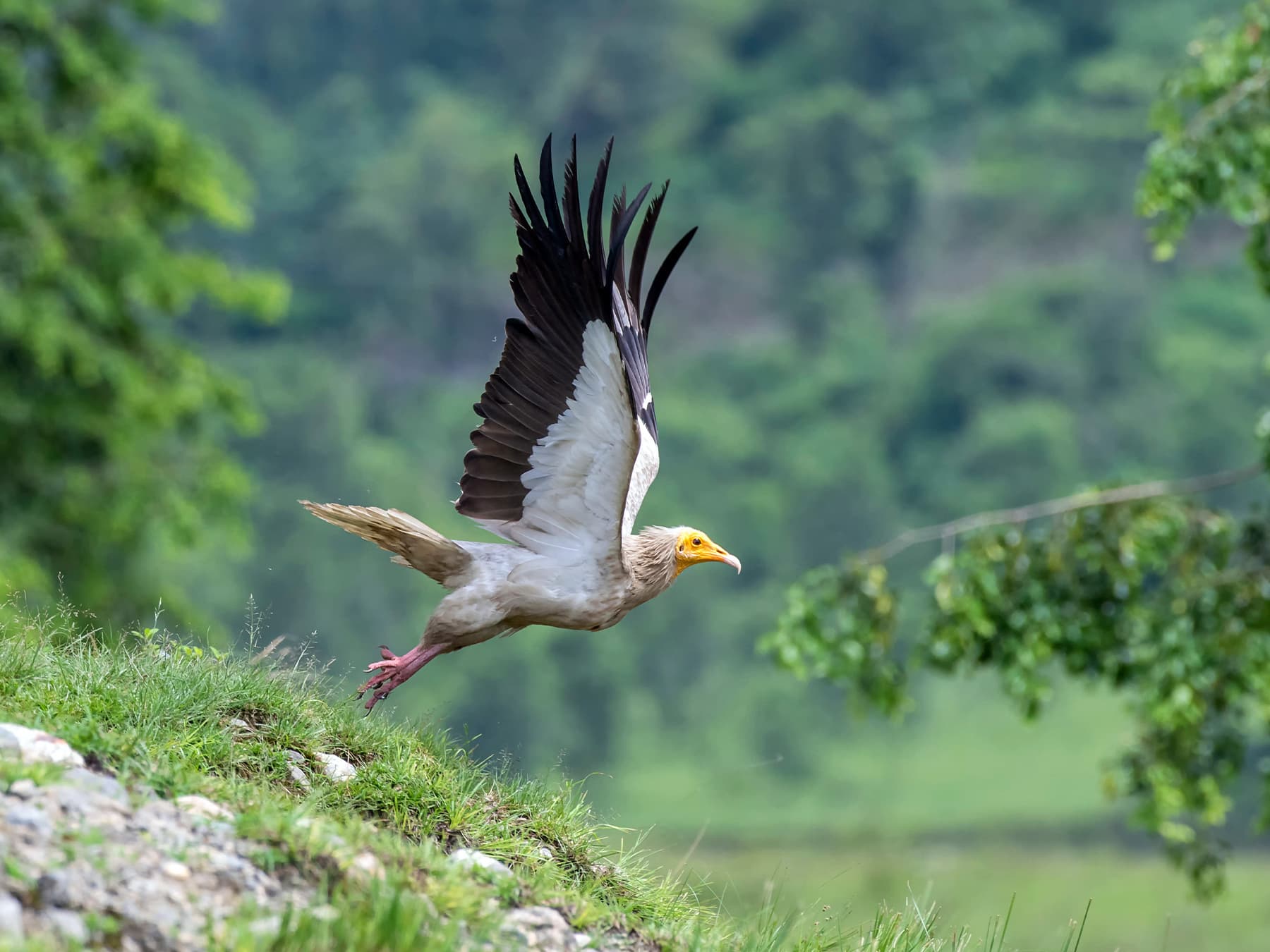
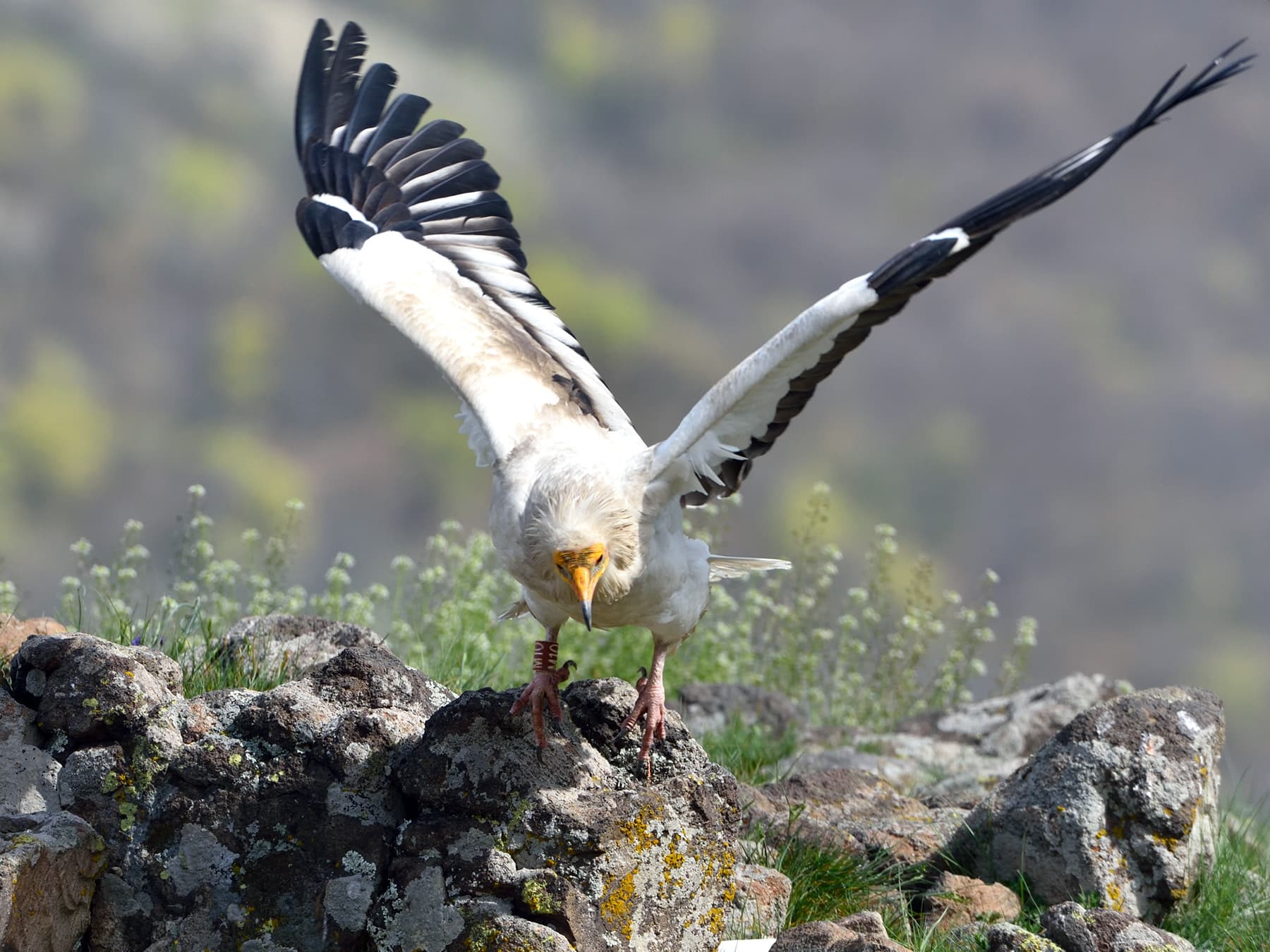
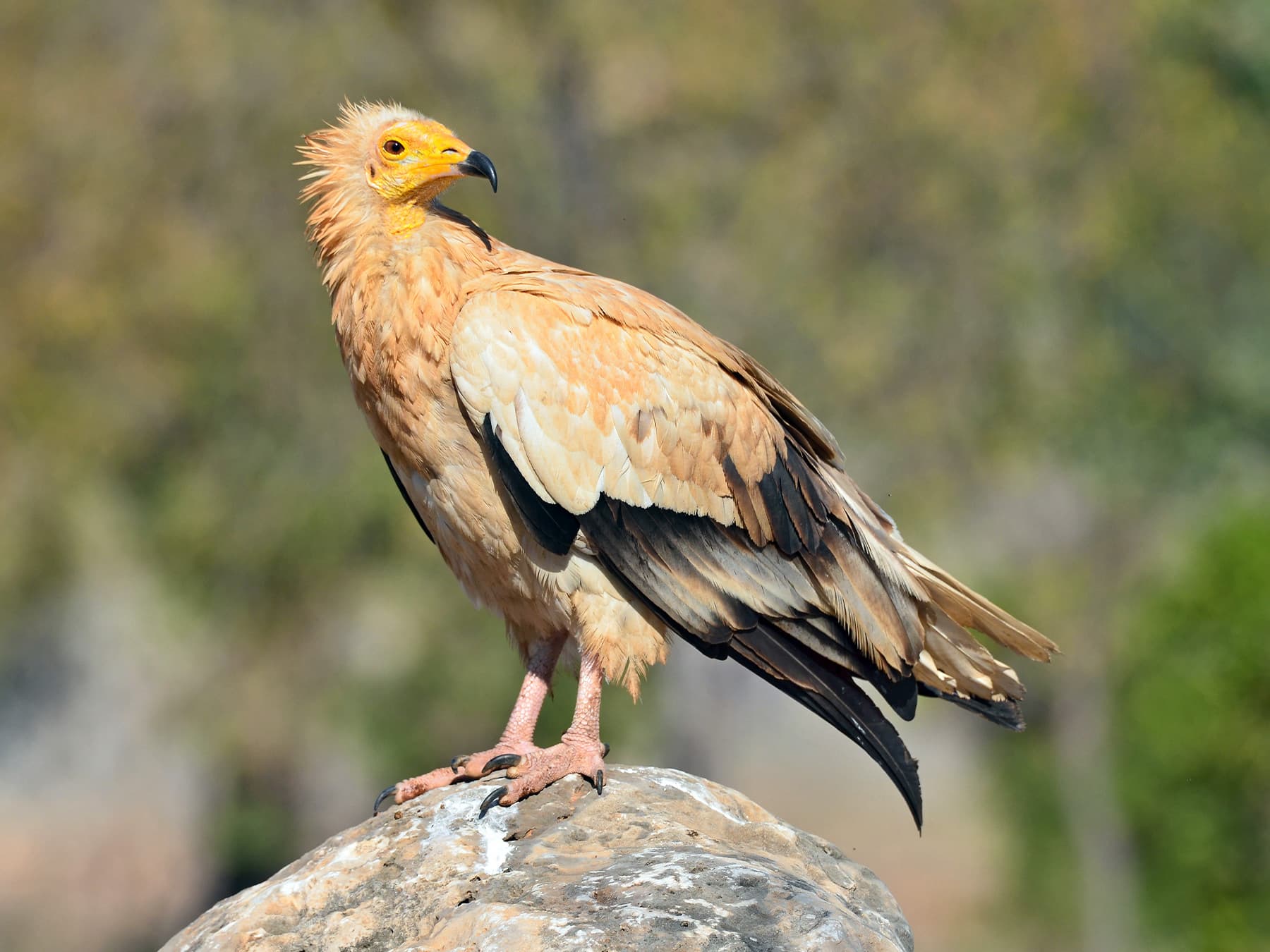
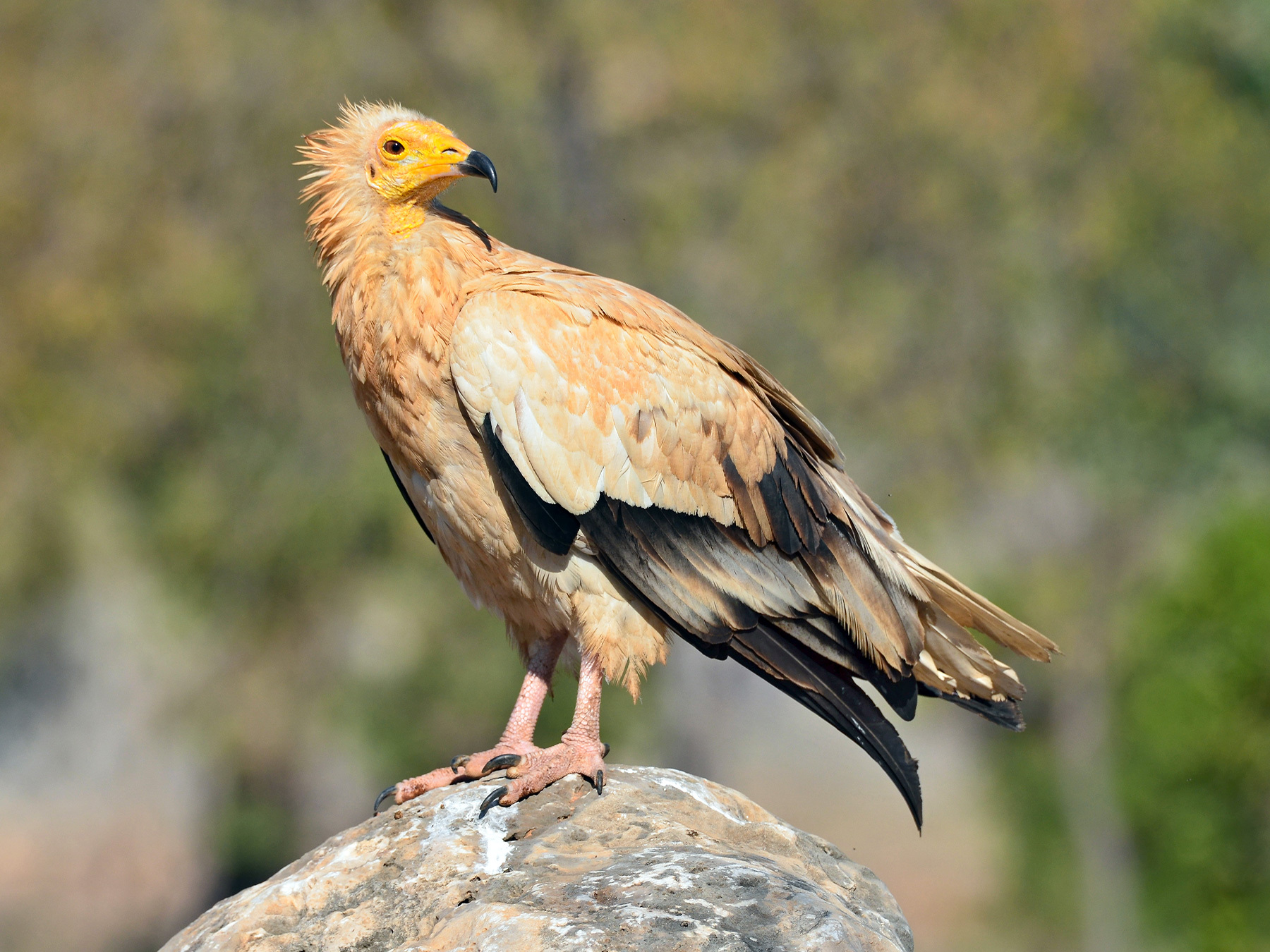
Sharing the coloration of European storks, adult Egyptian vultures have contrasting black and white plumage, a vast wingspan, and a wedge-shaped tail. They are mainly white, but their flight feathers are black, particularly noticeable when seen in flight from below, with the entire trailing edge of the wings is black and the front half white.
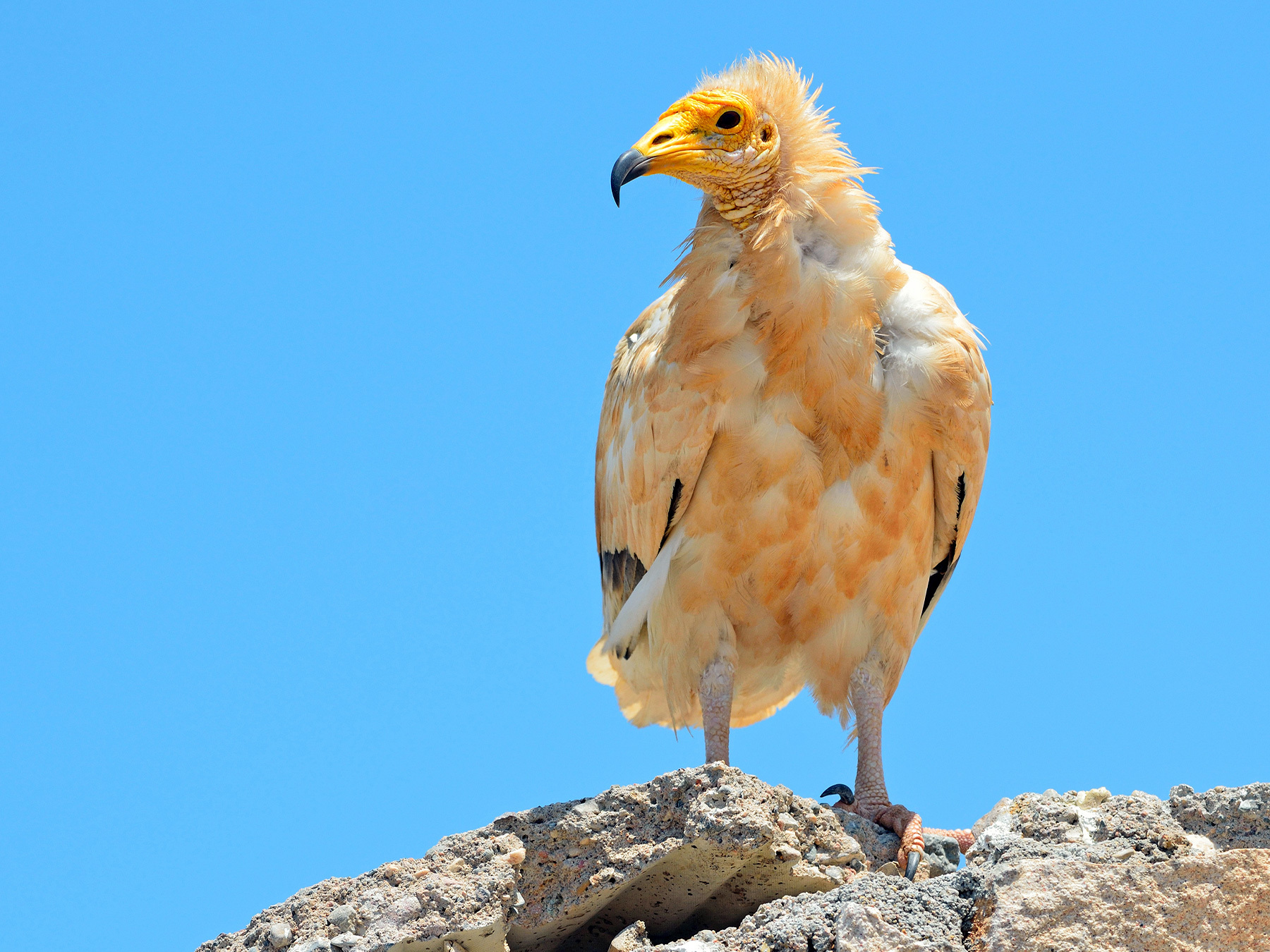
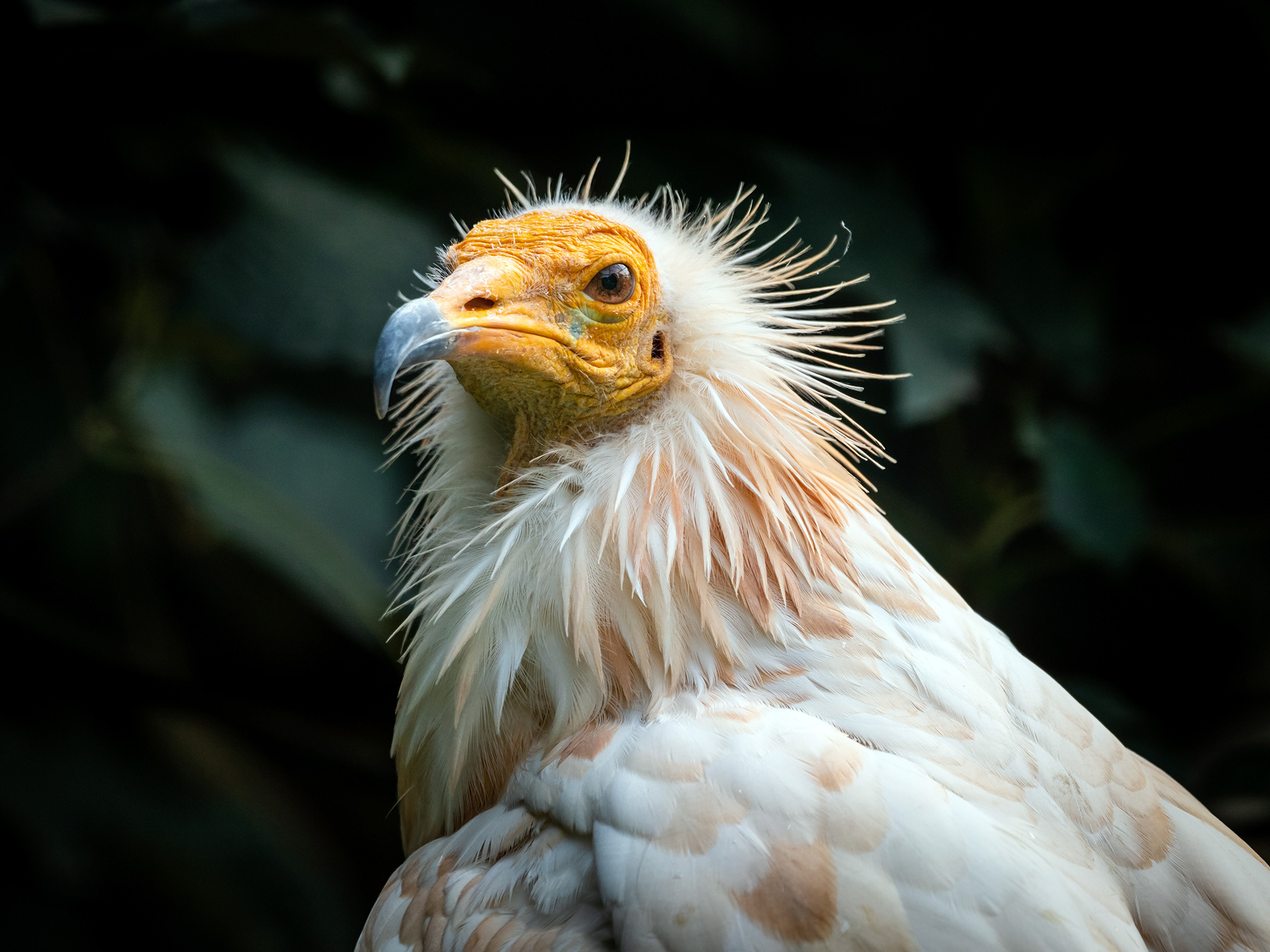
In captivity, Egyptian vultures have pure white bodies, although, in the wild, they are mottled with rusty brown streaks on their lower belly, stained from the iron-rich sandy soils of their natural environments.
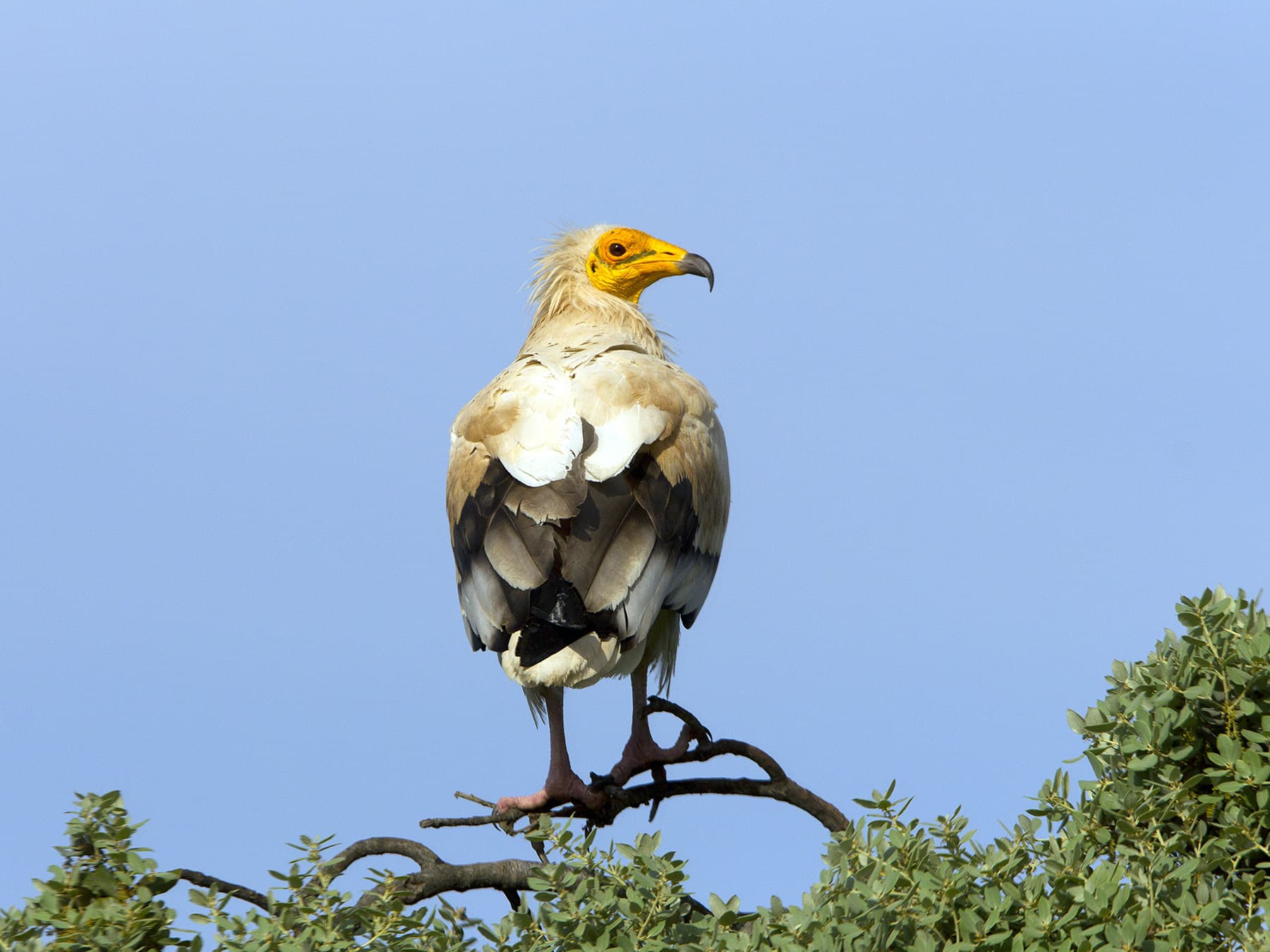
Distinctive facial features include a feathery frill around the crown and neck and bare yellow skin around the eyes and throat. The bill is yellow, tipped with black, but may be entirely yellow in some geographical areas, particularly the populations in India and Nepal. Eyes are black, and legs and feet are pink.
Male and female Egyptian vultures are alike in plumage and can’t accurately be told apart by their size (females are around 10 to 15 percent heavier although roughly the same height). The facial skin of breeding males is a deeper orange than the bright yellow of females and non-breeding males.
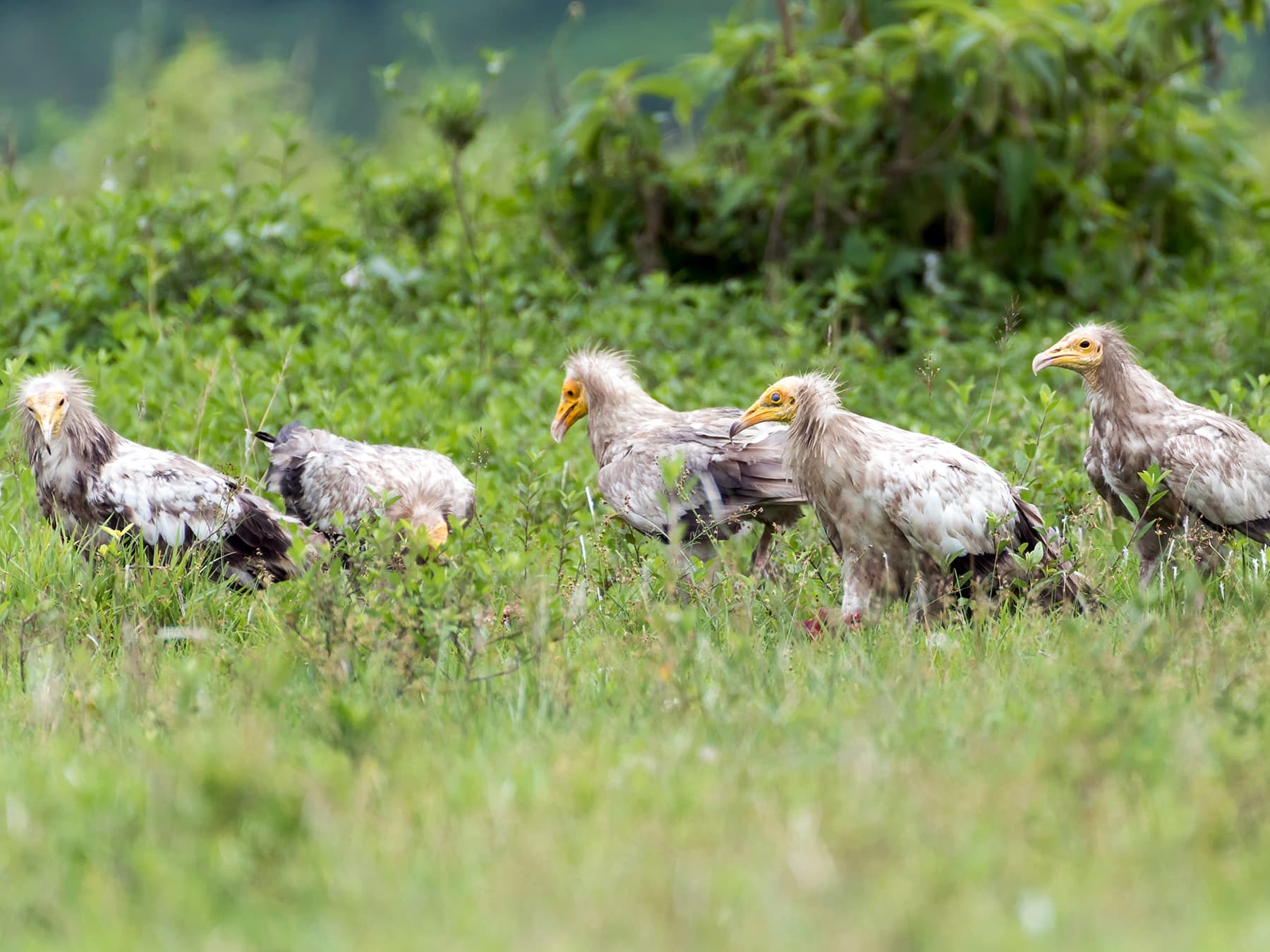
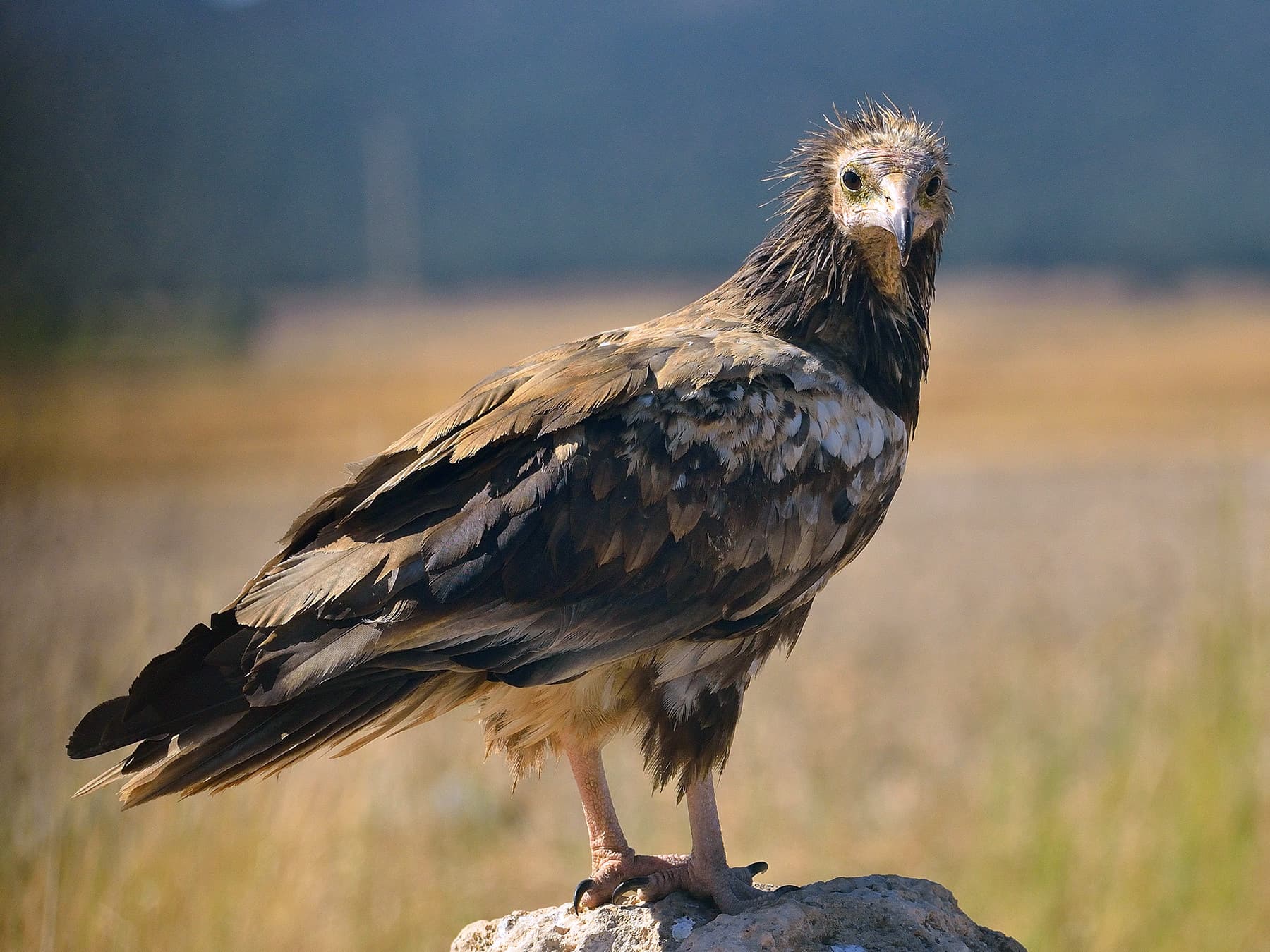
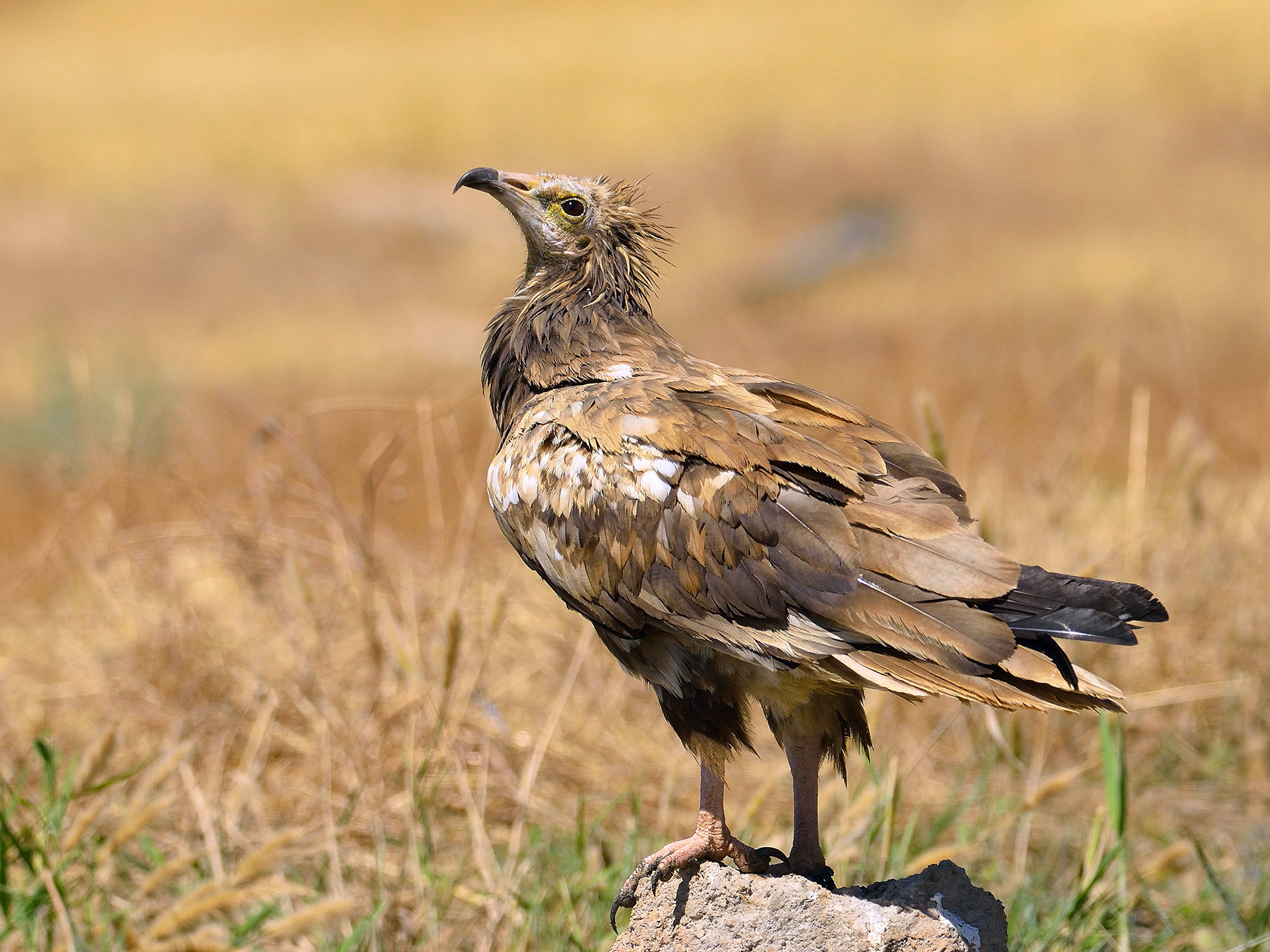
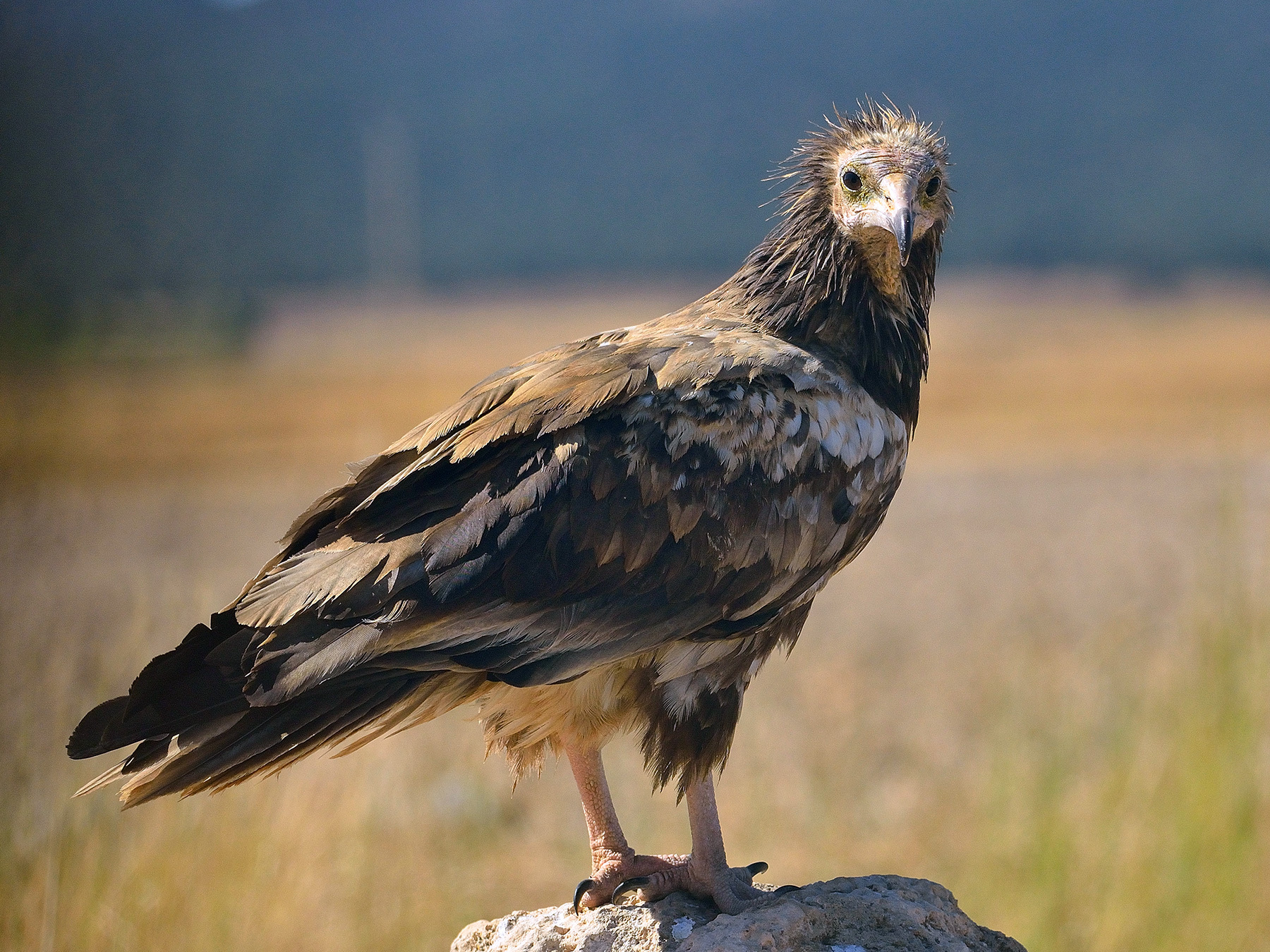
Juvenile Egyptian vultures are black or chocolate brown in color and do not resemble adults at all in coloring, although they share the same body shape and stature. The plumage of young birds is marked with irregular white, gray, and brown patches, and their faces and legs are usually gray. Young birds do not acquire their full adult coloring until they turn five.
How big are Egyptian Vultures?
Egyptian vultures boast an impressive wingspan, up to 2.7 times their body length. However, among vultures, they are relatively small, only roughly half the size of the giant cinereous vulture.
Females are sometimes marginally larger in length than males, and usually between 10 and 15 percent heavier.
- Length: 54 cm to 70 cm (2.1 in to 2.8 in)
- Wingspan: 146 cm to 175 cm (57.5 in to 68.9 in)
- Weight: 1600 g to 2400 g (3.5 lb to 5.5 oz)
Its size
Adults- Length
- 55–65 cm
- Wingspan
- 155–170 cm
- Weight
- 1600–2400 g
Its song and calls
What sound does an Egyptian Vulture make?
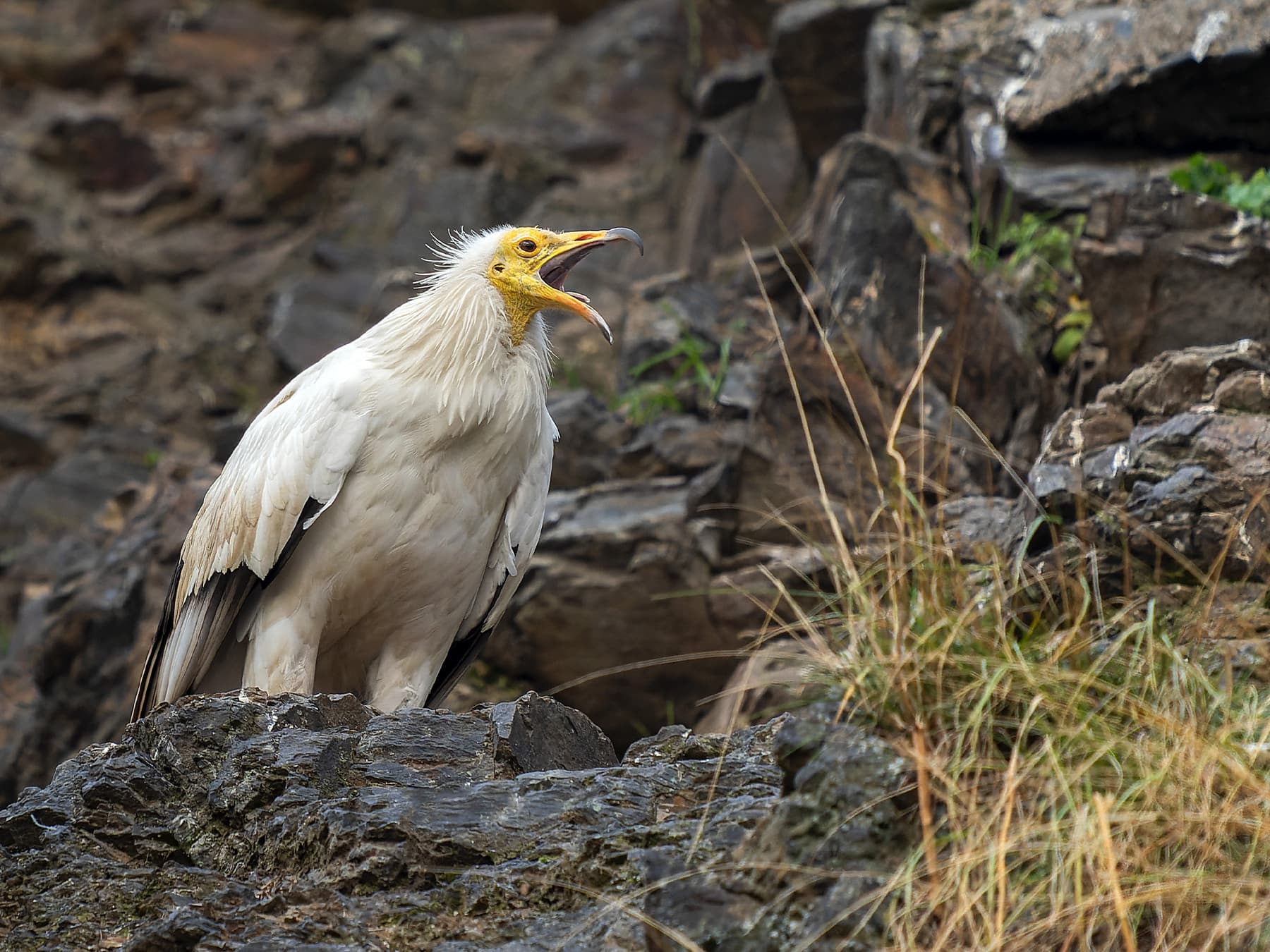
Egyptian vultures are not a particularly vocal species and rarely call. Whistles and screeches are occasionally heard around feeding sites, while hissing and grunting sounds may be heard when nesting.
- Call0:00 / 0:03
Recorded in Occitanie, France · July 2017
When and where to see it
The Egyptian Vulture is not recorded regularly in the UK, Ireland, the United States or Canada.
United Kingdom: recorded in 1 of the 6 years; Ireland: recorded in 2 of the 6 years. Too few years to count as a regular visitor.
Worldwide: recorded regularly in 43 countries
Countries where it was recorded in at least 3 of the 6 years 2019–2024. Linked countries have their own bird list.
Asia (22)
- Armenia
- Azerbaijan
- Georgia
- India
- Iran
- Iraq
- Israel
- Jordan
- Kazakhstan
- Kuwait
- Kyrgyzstan
- Lebanon
- Nepal
- Oman
- Pakistan
- Palestinian Territories
- Saudi Arabia
- Tajikistan
- Turkey
- United Arab Emirates
- Uzbekistan
- Yemen
Data: EOD – eBird Observation Dataset (Cornell Lab of Ornithology), accessed via GBIF.org, CC BY 4.0. Records from 2019–2024, aggregated and filtered by Birdfact. How these lists are made
What is the habitat of an Egyptian Vulture?
Open arid landscapes offer the necessary scavenging sites for Egyptian vultures to scour from above for feeding opportunities. Rocky ledges and cliffs are required for nesting.
In search of food, they have become increasingly common on the fringes of suburban areas, relying on human waste and livestock. Pasturelands and mountainous terrain may also be suitable; however, Egyptian vultures cover extensive distances by air in search of a meal.
What is the range of an Egyptian Vulture?
Egyptian vultures have a wide distribution range, breeding across the Iberian Peninsula, southern Europe, and North Africa, through Ukraine and Turkey into Central Asia, and east, as far as northwest India.
To the south, Egyptian vultures are present and year-round residents across Saharan Africa into the Arabian peninsula, and throughout most of India. Isolated permanent populations are also found in southwestern Africa, in Namibia and Angola, and in the Canary Islands.
Where do Egyptian Vultures live?
Around 25 percent of the world’s Egyptian vultures live in Europe, with Spain home to around 40 percent of the continent’s total population. Across the Arabian peninsula, declines have been recorded, but Oman supports a stable or increasing number.
Africa has the largest share of the global population, with an estimated 7,500 pairs, or 20,000 individuals, many of which are concentrated in Ethiopia.
To the east, the Asian populations of Egyptian vultures are found mainly in India and Nepal, where it is estimated that there are more than 2,000 individuals.
How rare are Egyptian Vultures?
The global population of mature individuals is estimated to be between 12,400 and 36,000 individuals, with significant population declines noted in recent decades. Sightings are relatively rare, even within the traditional strongholds of their population concentrations, including Ethiopia, Algeria, Chad, and Cameroon.
Where can you see Egyptian Vultures in Europe?
Between 3,000 and 4,500 breeding pairs of Egyptian vultures are present in Europe, around 1,300 of which live in Spain. Southern Europe, including Greece and the Balkan states, have resident, declining populations.
However, the picture is not all bleak, as the Spanish population is stable, and in France, an increase in number has been recorded in recent years. In 2021, an Egyptian vulture was spotted in the Scilly Isles, off the southwestern coast of England: it was the first sighting of the species in the UK since 1868.
Migration
Do Egyptian Vultures migrate?
Not all Egyptian vultures migrate, although a large number do maintain separate breeding and wintering territories in different parts of the world. Populations living in northern regions are most likely to be migratory, including the entire European population, those in North Africa, and those that breed across Central Asia.
In the Indian Subcontinent, Arabian Peninsula, and across Saharan Africa southwards, Egyptian vultures are resident in the same territories all year round, although some local post-breeding wandering may occur.
How far do Egyptian Vultures migrate?
Migrating Egyptian vultures cover epic distances of 3,500 km to 5,500 km (2,200 mi to 3,400 mi) between their summer breeding grounds and their winter territories on the southern edge of the Sahara.
A usual route from Europe takes migratory Egyptian vultures via Spain across the Strait of Gibraltar into North Africa, so as to spend the least possible time traveling over water.
How long does migration take for an Egyptian Vulture?
Egyptian vultures cover up to 500 km (310 mi) in a single day, and the time taken to reach their wintering grounds depends on their routes and their starting points.
One tracked individual was observed to reach his destination in as little as 14 days, from Greece to Chad, while other migrations, for example between Uzbekistan and Yemen, took almost two months to complete.
Tips for seeing it
- Look for their distinctive white plumage and black wing tips in flight
- Scan open areas and near refuse sites where they often forage
- Observe their unique egg-breaking behaviour if near ostrich habitats
- In Europe, watch for them in southern Spain and Greece during the summer months
What it eats
What do Egyptian Vultures eat?
Opportunistic scavengers, Egyptian vultures will eat whatever they come across, in order to survive.
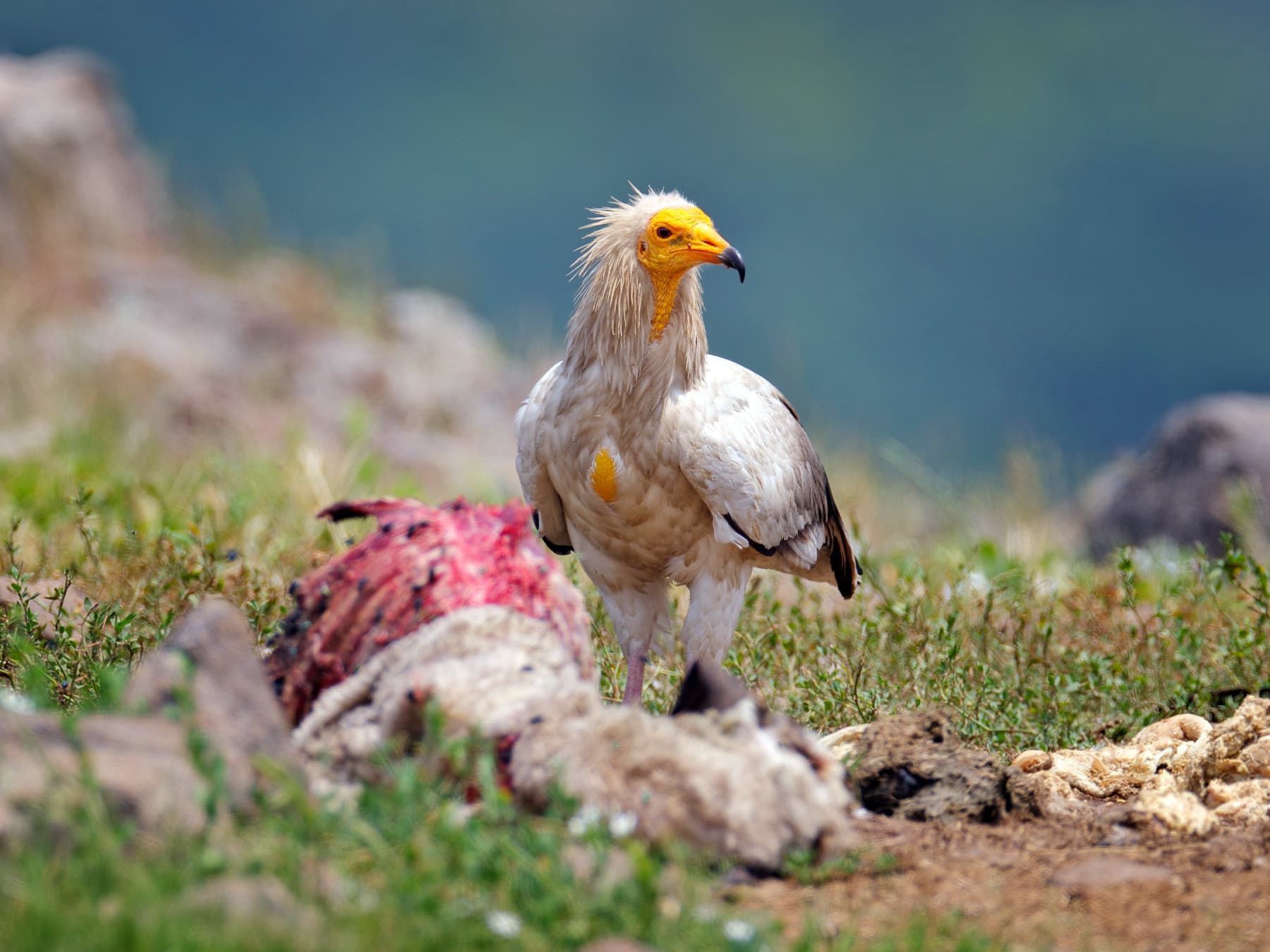
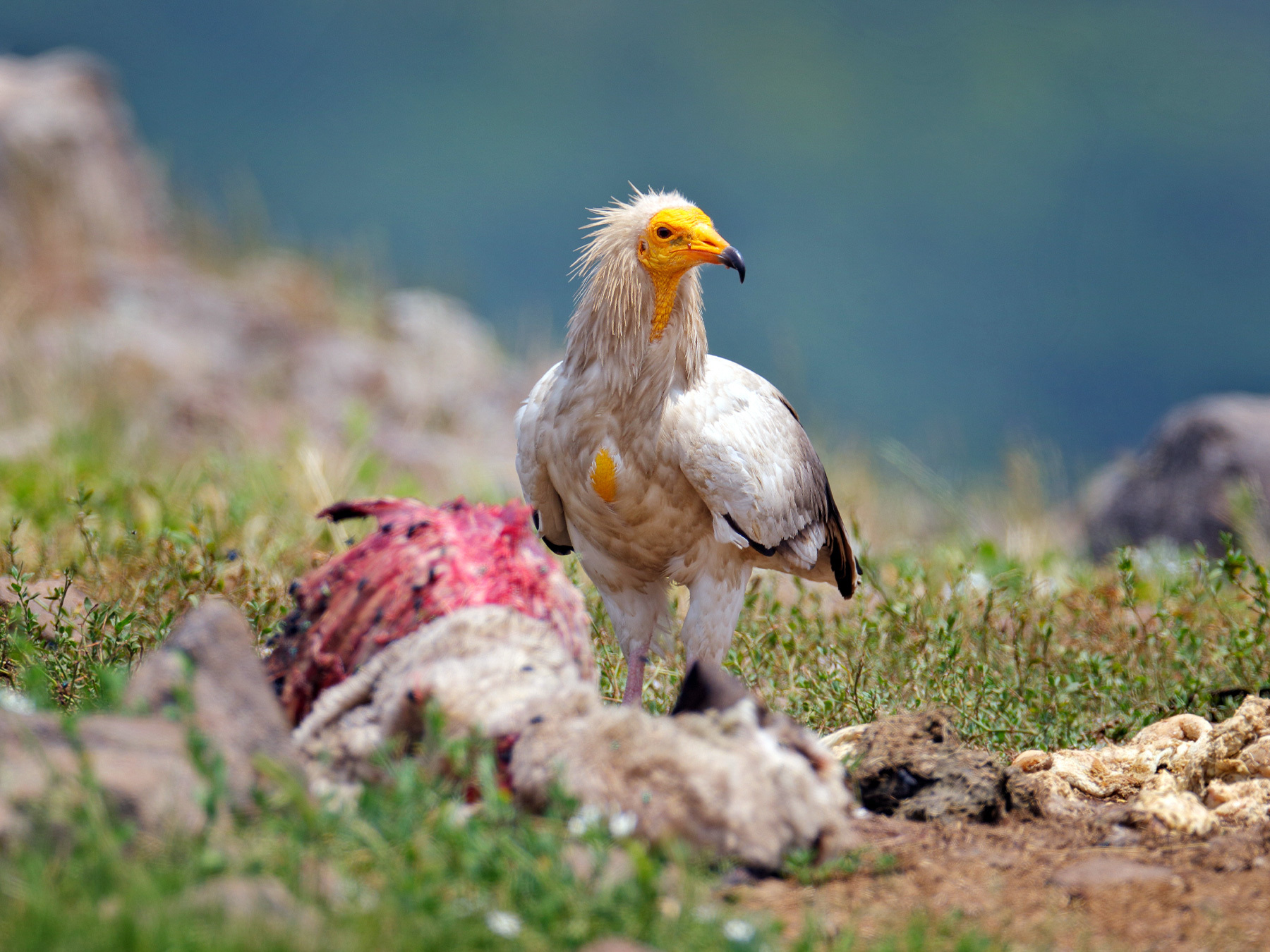
Their diet is mainly carrion-based, including carcasses of livestock, birds, dogs, and other small mammals. Food sources are spotted from soaring flights, where vultures scan the ground below and can identify a potential feeding site from up to 1 km away.
Occasionally live animals will also be eaten, particularly weak or dying mammals, such as injured rabbits, chicks, or fish. Organic matter is also occasionally eaten, including rotting fruit or human waste.
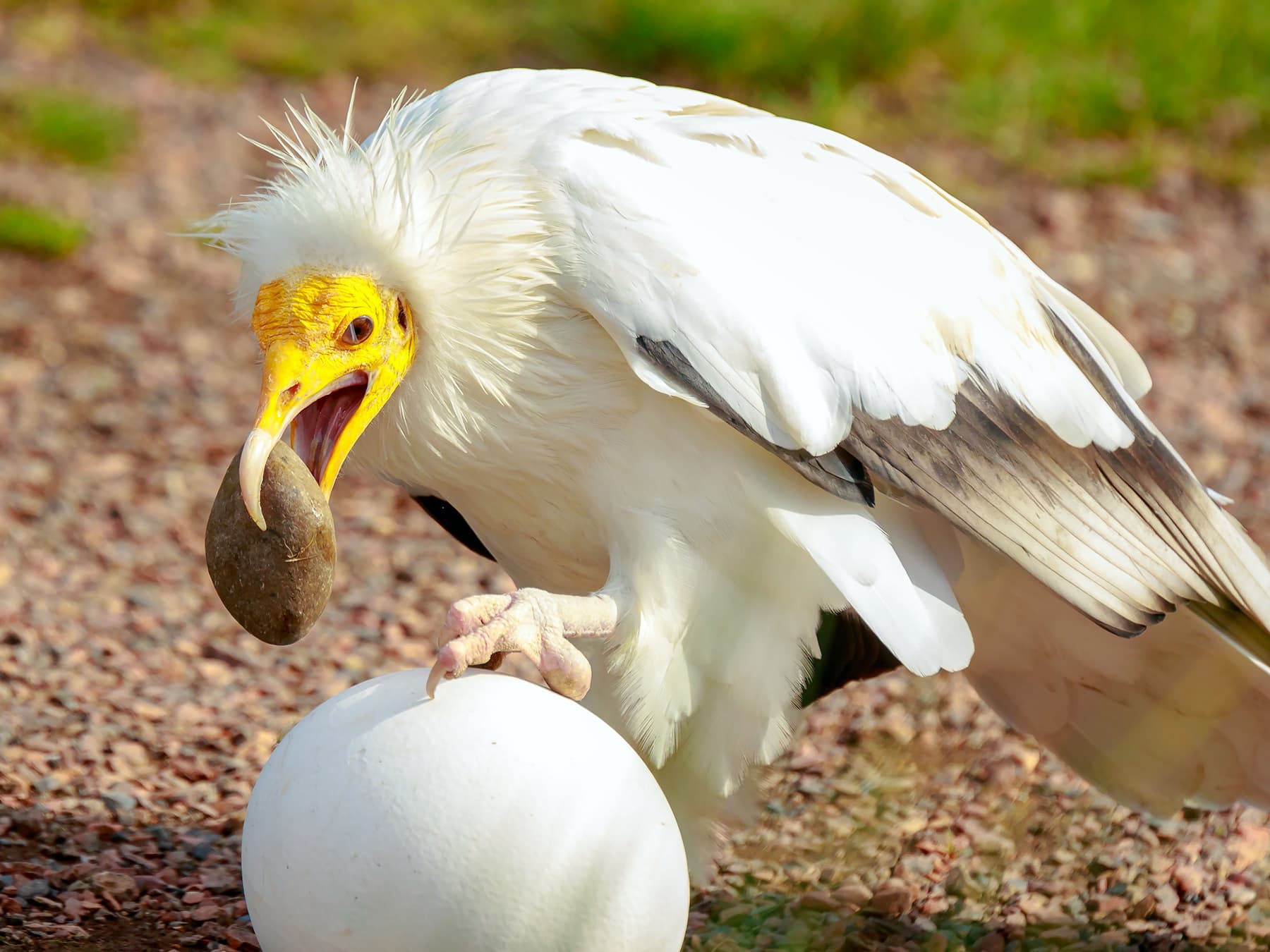
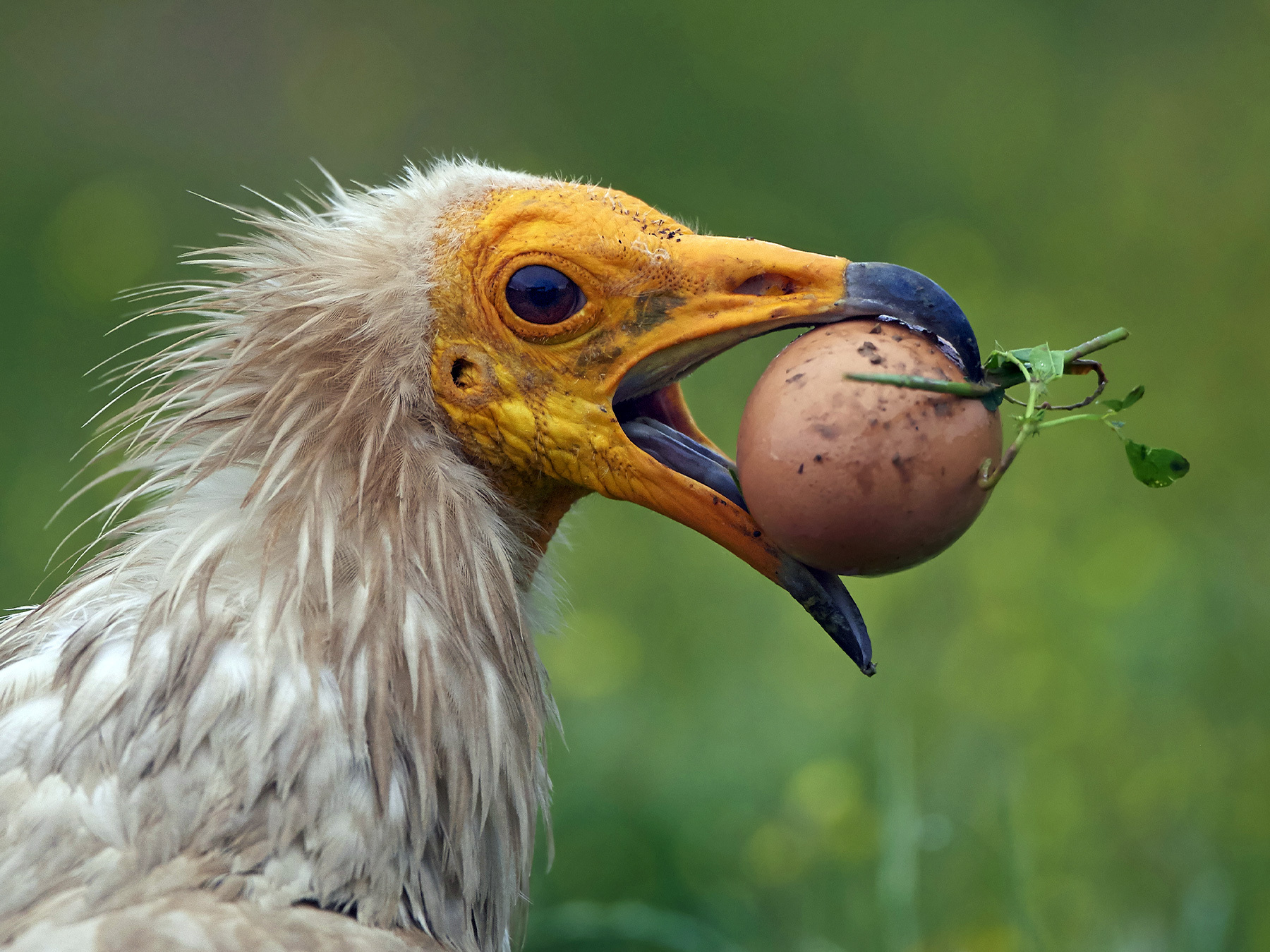
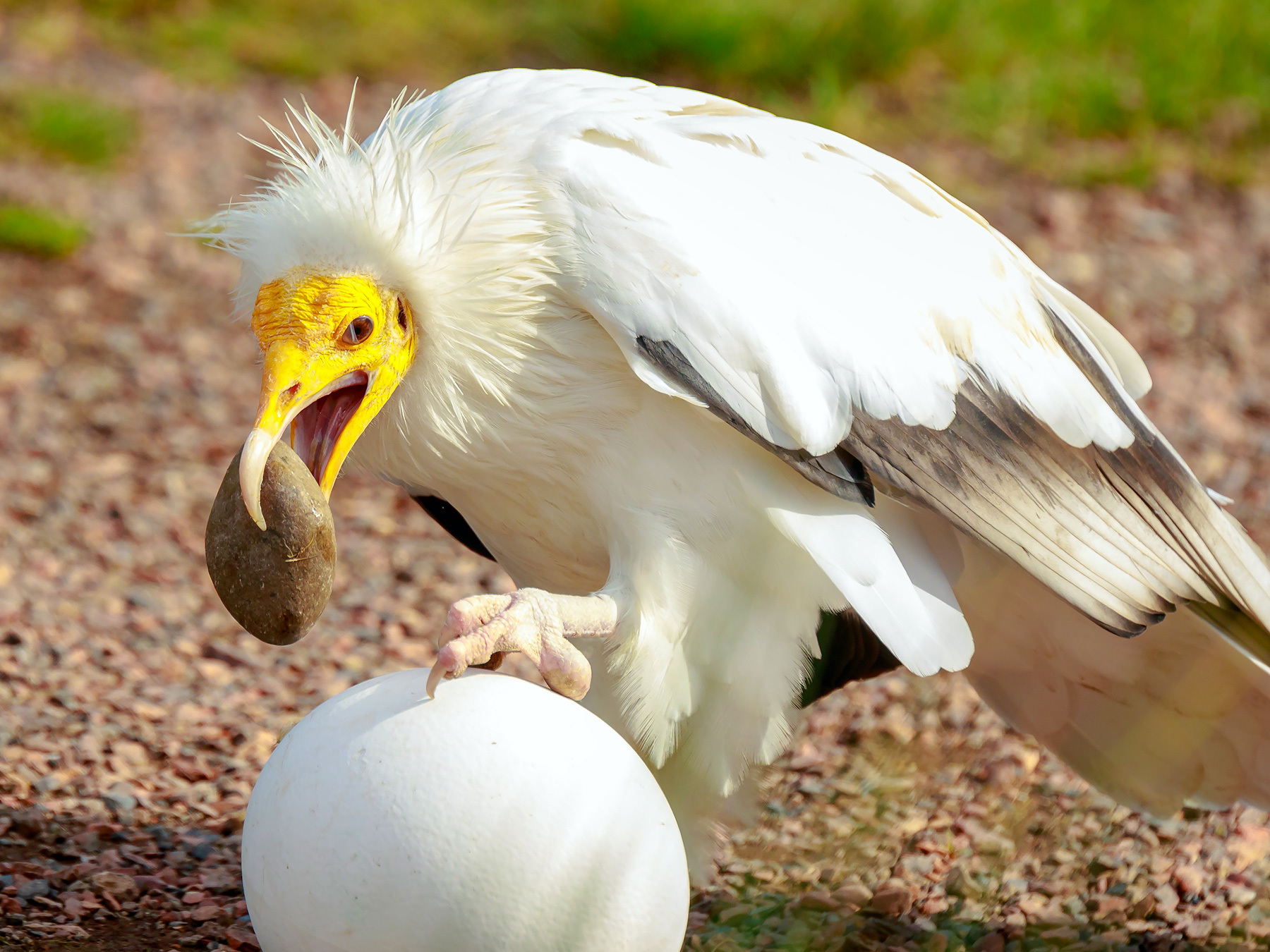
Egyptian vultures will also feast on the eggs of other birds, particularly ostriches, and have been observed to use stones as tools to crack them open.
What do Egyptian Vulture chicks eat?
Initially, Egyptian vulture chicks are fed on crop milk, regurgitated into their bills by their parents. Adults return to the nest with scraps of carrion from a carcass, carried in their crop as their talons only have a weak grip. They then bring this food up from their crop and feed it to their young.
Nesting and breeding
Where do Egyptian Vultures nest?
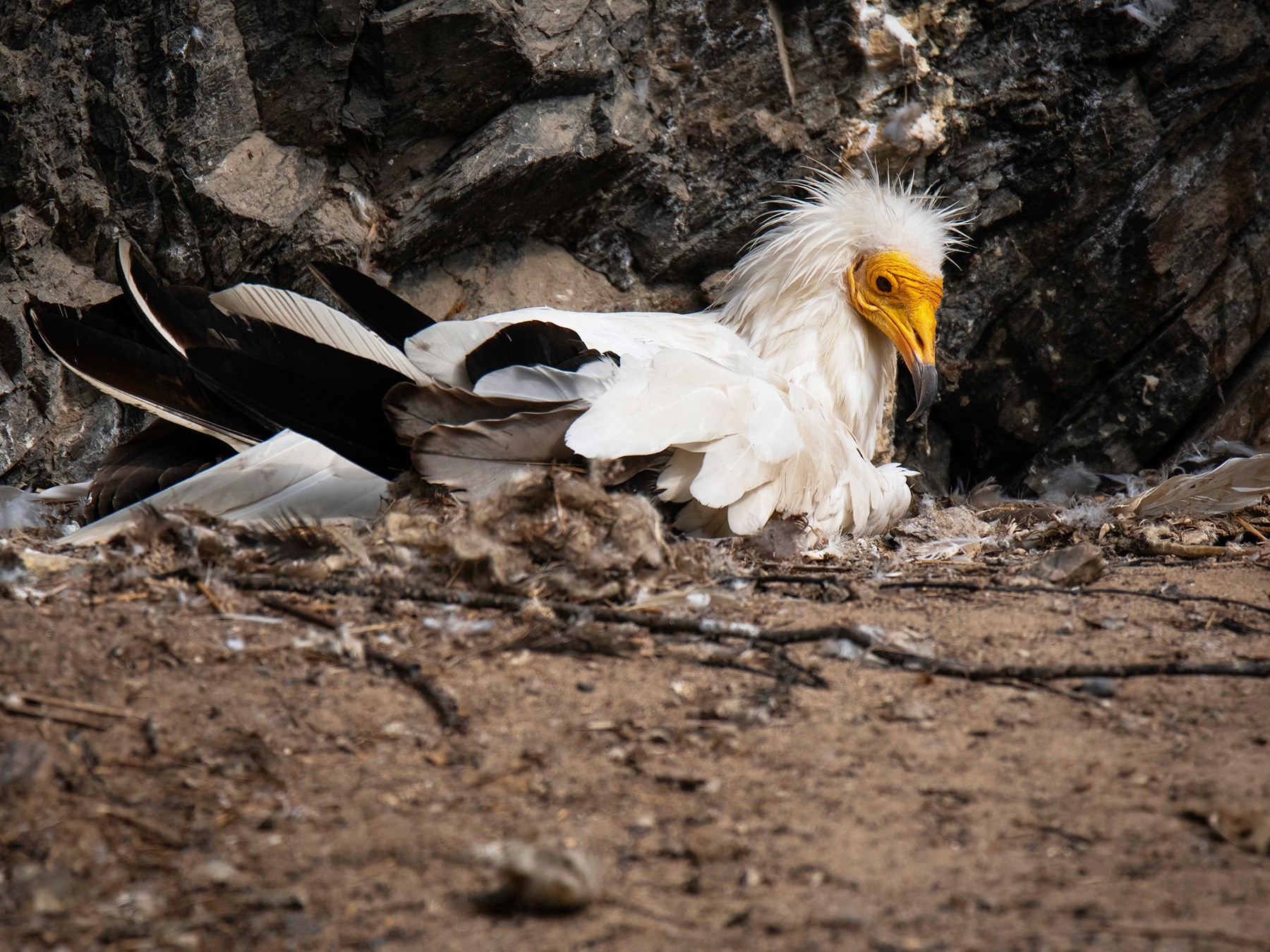
Typical nest sites are chosen on ledges on cliffs, crags, and rocky outcrops, as well as in the forks between branches of large trees, on buildings or electricity pylons, and occasionally directly on the ground.
Nests are bulky, untidy platforms made from twigs, lined with wool, hair, and rags. Males and females work together to build the nests, and they will frequently reuse nests in future breeding seasons.
When do Egyptian Vultures nest?
The breeding season for Egyptian vultures is usually between January and March, with pairs raising one brood together in a typical year. These dates may vary according to geographical location, with earlier breeding recorded in Nigeria and later laying dates, from April to May in Mediterranean regions.
Incubation is shared between males and females and lasts for around 42 days. Shared parental care continues after the young hatch, with both feeding young in the nest for between 70 and 90 days until they fledge and continuing to support their young for a further month outside the nest.
What do Egyptian Vulture eggs look like?
Egyptian vultures usually lay two eggs, although between one and three is not unusual. Eggs are whitish, heavily marked with brick-red scrawls and blotches, and measure around 63 mm by 48 mm (2.5 in by 1.9 in).
Do Egyptian Vultures mate for life?
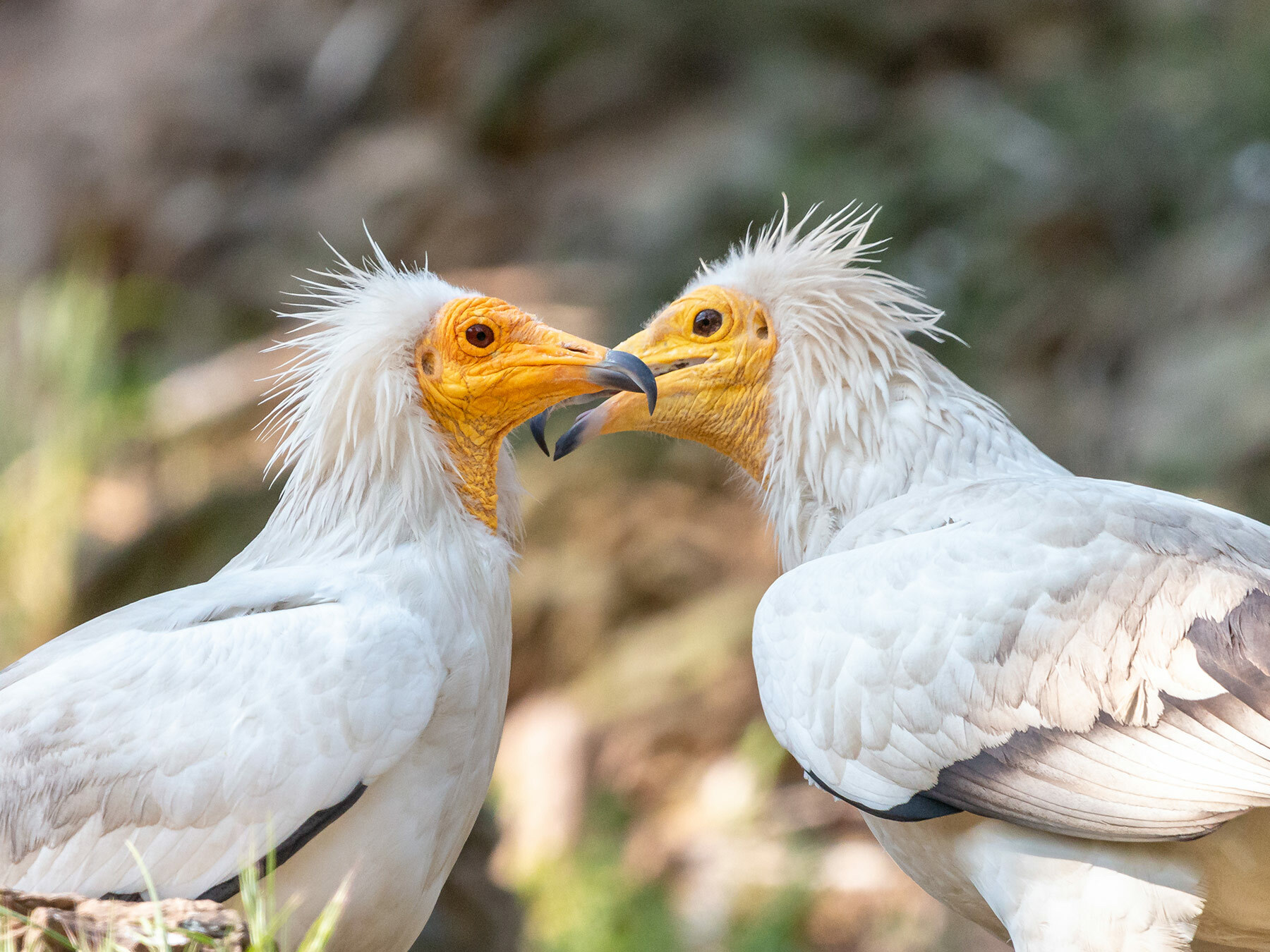
Egyptian vultures are believed to mate for life, forming strongly bonded pairs from around eight years of age. Pairs migrate together after breeding is complete and usually return to their nesting grounds together if both mates have survived the winter.
Behaviour
Are Egyptian Vultures aggressive?
Due to their size, Egyptian vultures have a reputation as being relatively unaggressive when compared to other larger vultures.
At feeding sites, Egyptian vultures are among the furthest down the pecking order and wait until more dominant, powerful species have taken their turn. They are more likely to be on the receiving end of aggressive confrontations than being the aggressors themselves.
Where do Egyptian Vultures sleep at night?
Egyptian vultures are active in the daytime, relying on sight rather than smell to find food. They roost overnight, usually in solitary pairs but occasionally as part of a much larger group.
Roosting spots on old, dead trees or high up on cliff ledges are preferred, offering a clear view of the surrounding terrain.
Lifespan and predators
How long do Egyptian Vultures live?
In the wild, Egyptian vultures are known to survive for around 21 years, but face threats from poaching, starvation, pesticide poisoning, and accidental collisions with power cables. In captivity, protected from these factors, they can live for more than 37 years.
Egyptian vultures reach sexual maturity at the age of 5 but usually delay breeding for the first time until 8 or 9.
What are the predators of Egyptian Vultures?
Due to their size and imposing presence, adult Egyptian vultures are not known to have any natural predators. However, their young are occasionally vulnerable to predation by foxes, golden eagles, eagle owls, wolves, and jackals.
As well as natural threats, further risks to the survival of Egyptian vultures are present in the form of lead poisoning from ammunition, poisoning from the ingestion of pesticides, and collisions with artificial structures such as power cables, particularly in mountainous regions of Europe.
Are Egyptian Vultures protected?
Across Europe, Egyptian vultures are protected under a number of conservation acts, and safeguarded by monitoring programs and designated habitat areas across their range, aimed at preventing nest disturbance and poaching.
International measures in place to protect the species include CITES Appendix II, the EU Birds Directive Annex I, and the Bern Convention Appendix II.
Are Egyptian Vultures endangered?
Egyptian vultures are designated as an endangered species by the IUCN Red List.
In Europe, dramatic declines in population of around 50 percent in the last 40 years, of which the most serious decrease in numbers – up to 80 percent – was recorded in the Balkan states.
In Africa, similar declines in Egyptian vulture numbers have been witnessed, including South Africa, Lesotho, and Eswatini, where the species is now extinct, and Namibia, where breeding no longer occurs.
The Indian populations are also in a state of critical decline, linked directly to the drug diclofenac that was widely used in veterinary practice to treat the livestock that forms much of the diet of Egyptian vultures and is fatally toxic to raptors.
Conservation
The Egyptian Vulture is listed as Endangered due to rapid population declines. Major threats include poisoning, electrocution by power lines, and habitat loss.
Conservation efforts focus on reducing poisoning incidents, protecting nesting sites, and raising awareness about their ecological importance.
More photos
10 photos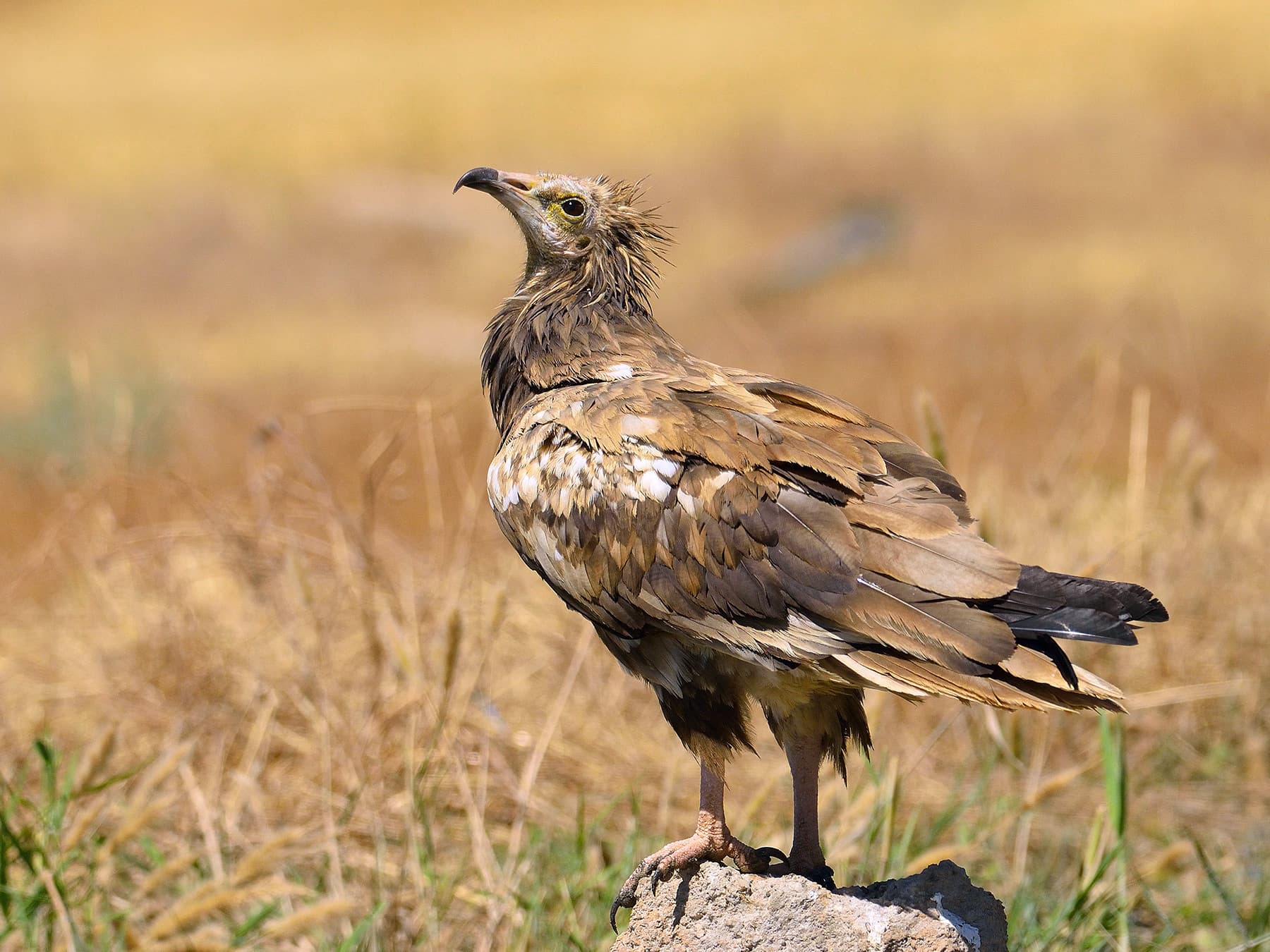 Juvenile Egyptian Vulture
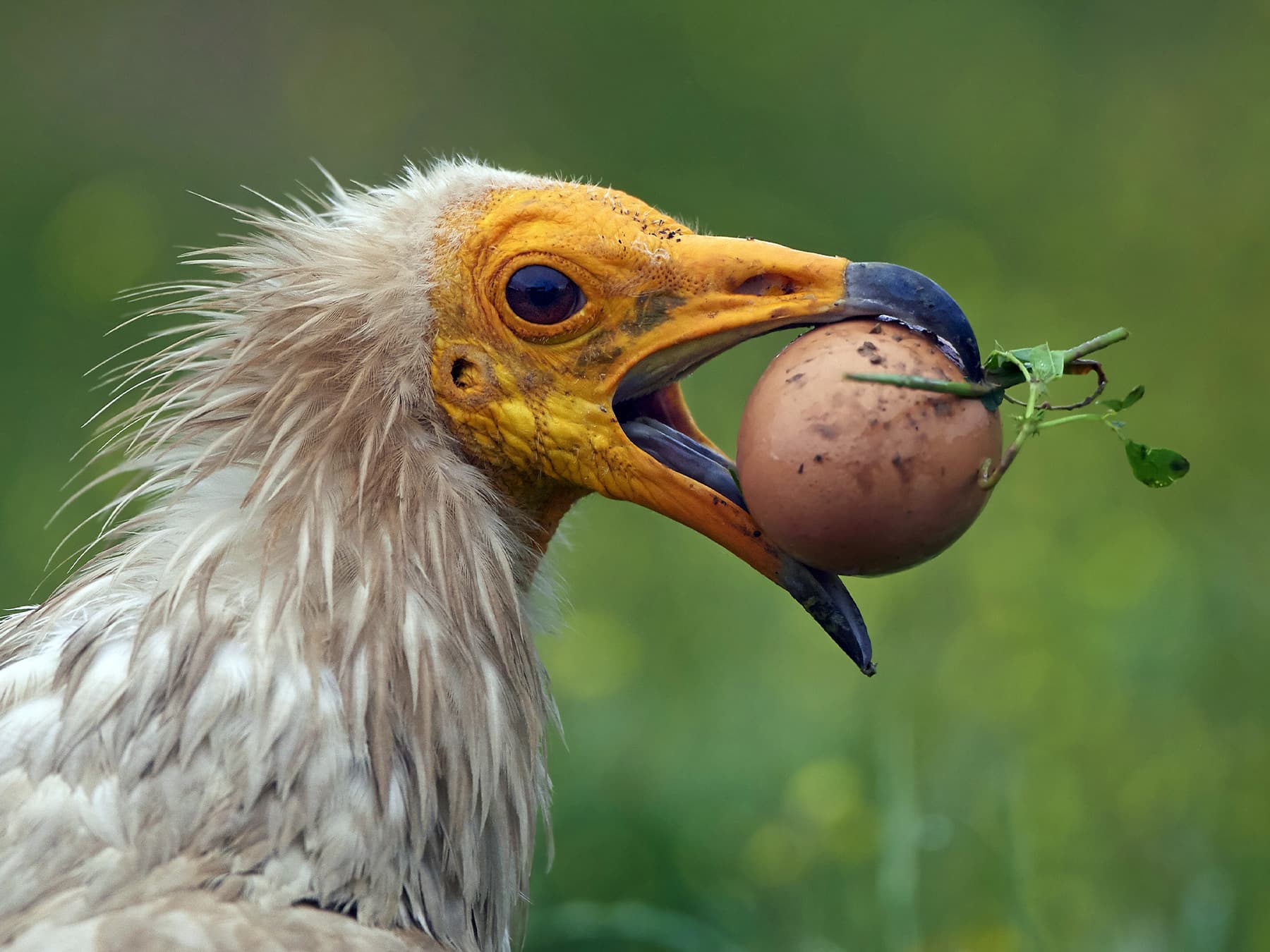 Egyptian Vulture carrying an egg in its beak
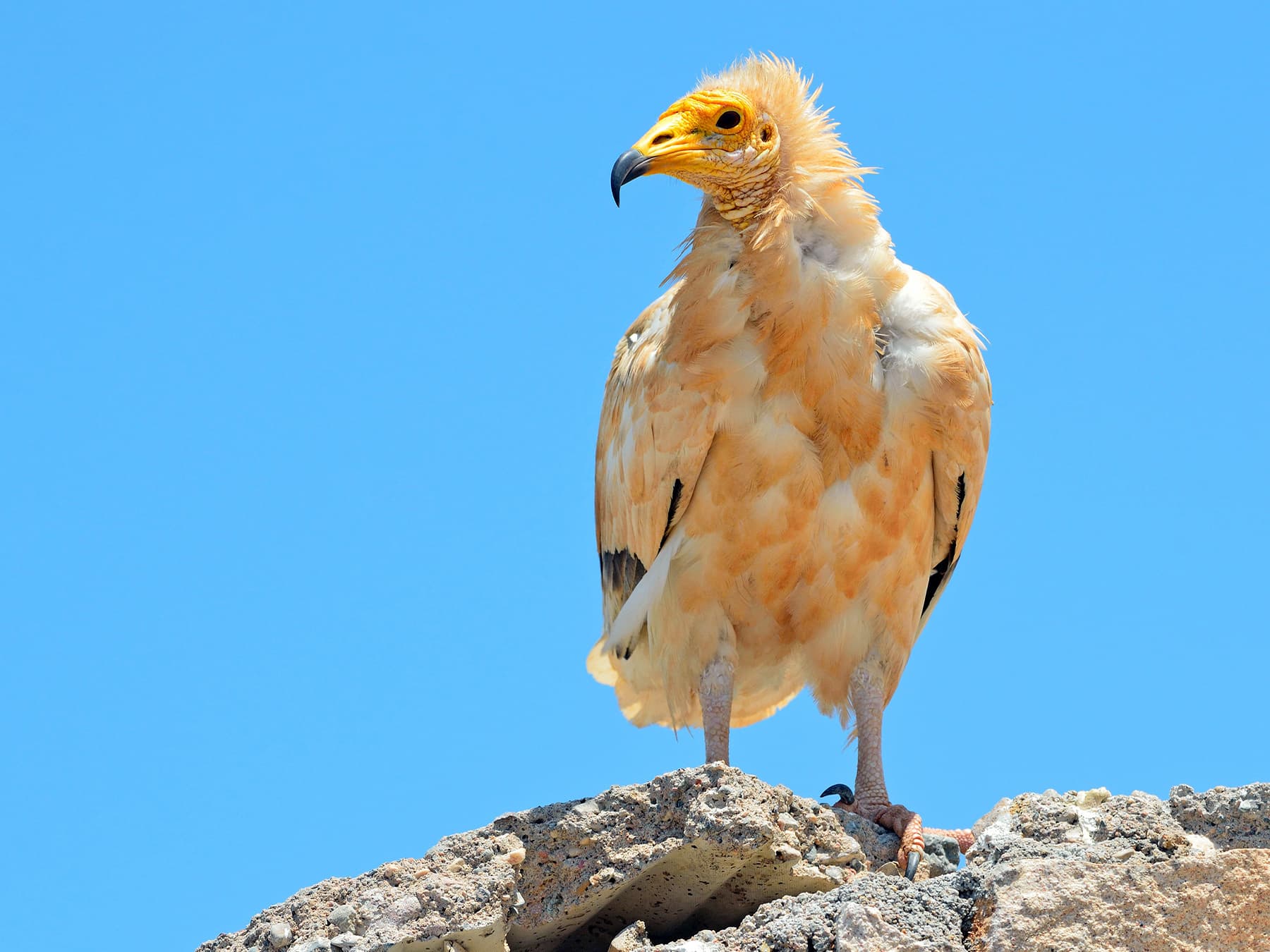 Egyptian Vulture standing on top of rocks
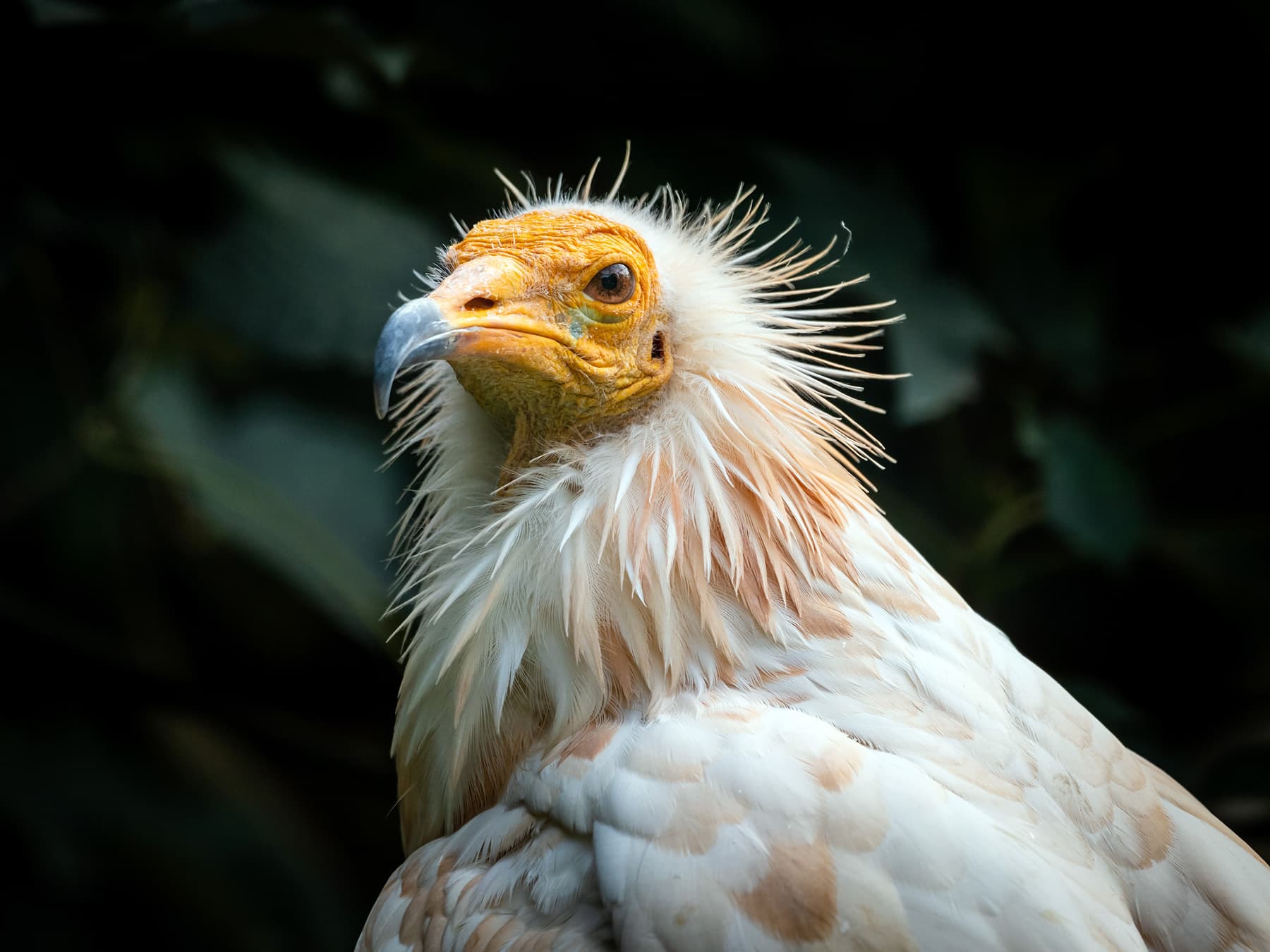 Portrait of an Egyptian Vulture
 Egyptian Vulture
 Juvenile Egyptian Vulture
 Egyptian Vulture breaking an egg using a stone
 Egyptian Vulture feeding on a carcass
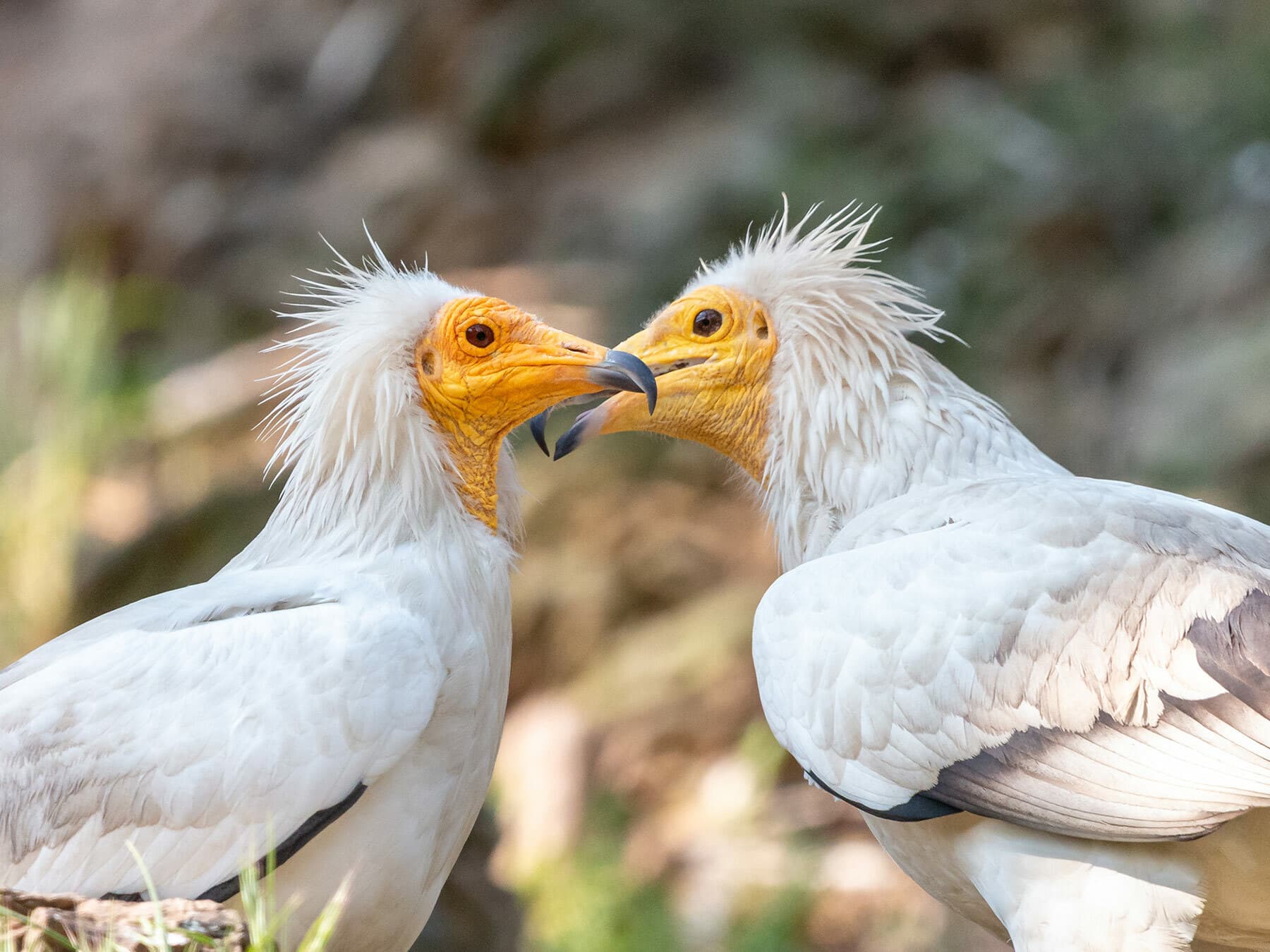 A pair of Egyptian Vultures
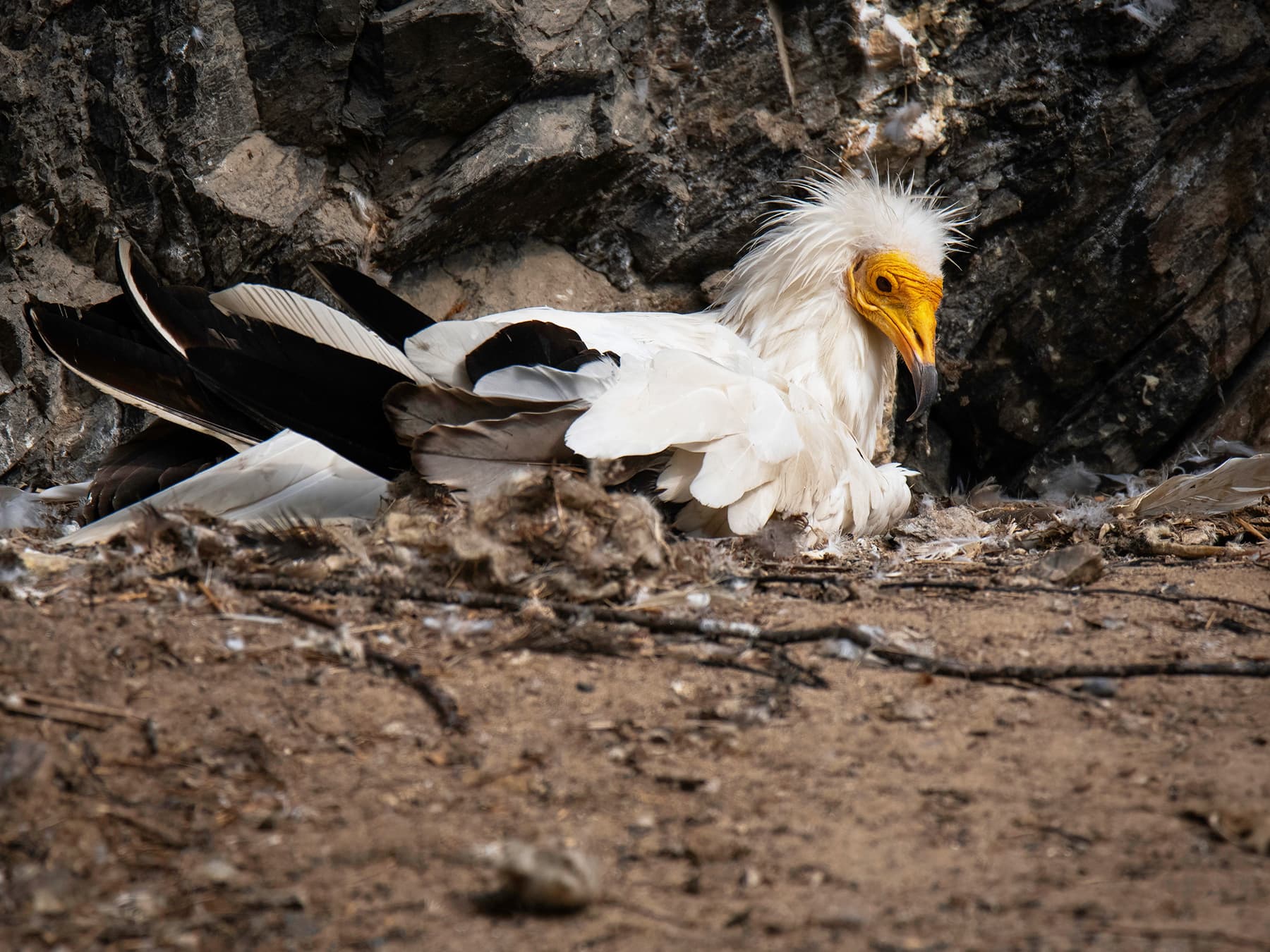 Egyptian Vulture sitting on the nest
Egyptian Vulture guides
1 guidesQuick facts
- Length
- 55–65 cm
- Wingspan
- 155–170 cm
- Weight
- 1600–2400 g
- Lifespan
- 20–30 years
- Family
- Hawks & Eagles
- Migration
- Partial migrant
- Global status (IUCN)
- Endangered
- World population
- 12,400 - 36,000 mature individuals
- Population trend
- Decreasing
- Also called
- White Scavenger Vulture, Pharaoh's Chicken
- Scientific name
- Neophron percnopterus
Questions
3How many Egyptian Vultures are there in the world?
Egyptian vulture numbers have suffered significant declines in the last 40 years, and there are now thought to be only 12,400 to 36,000 mature, breeding individuals left in the world, which is roughly equivalent to a total population of between 18,600 and 54,000 individuals.
What do Egyptian Vultures symbolize?
In ancient Egyptian culture, Egyptian vultures are associated with purification, protection, and maternity.
Their practice of feeding on carcasses is seen as a valuable process to sanitize the local environment from infections and decay, and in turn, protect their young from death. In turn, they also have associations with removing negativity from your life and signaling transformation and rebirth.
What is the Egyptian Vulture in the Bible?
Vultures are referenced in the Bible in the context of not being suitable for eating, due to their own feeding habits of feasting on the flesh of dead or decaying animal carcasses.
Vultures can also be interpreted as an omen relating to the Day of Judgment when vultures will gather around those who reject God’s word.
Sources
3- 1BirdLife International. 2021. Neophron percnopterus. The IUCN Red List of Threatened Species 2021: e.T22695180A205187871. Source (opens in a new tab)
- 2BirdLife International. 2021. Neophron percnopterus. The IUCN Red List of Threatened Species 2021: e.T22695180A205187871. Source (opens in a new tab)
- 3BirdLife International. 2021. Neophron percnopterus. The IUCN Red List of Threatened Species 2021: e.T22695180A205187871. Source (opens in a new tab)

Checked by
Nathan Cope, founder and editor
Nathan founded Birdfact and leads its writers and contributors in the UK, the US and Canada. He has watched and studied birds for more than ten years, and checks every article and species guide before it’s published.