


Woodhouse's Scrub-Jay
Aphelocoma woodhouseii
By the Birdfact teamChecked by Nathan Cope
On this page13 sections
How to recognise it
This page is about Woodhouse's Scrub-Jay, the inland scrub-jay, found from the Great Basin to southern Mexico. Until July 2016 it and the coastal California Scrub-Jay were treated as one species, the Western Scrub-Jay.
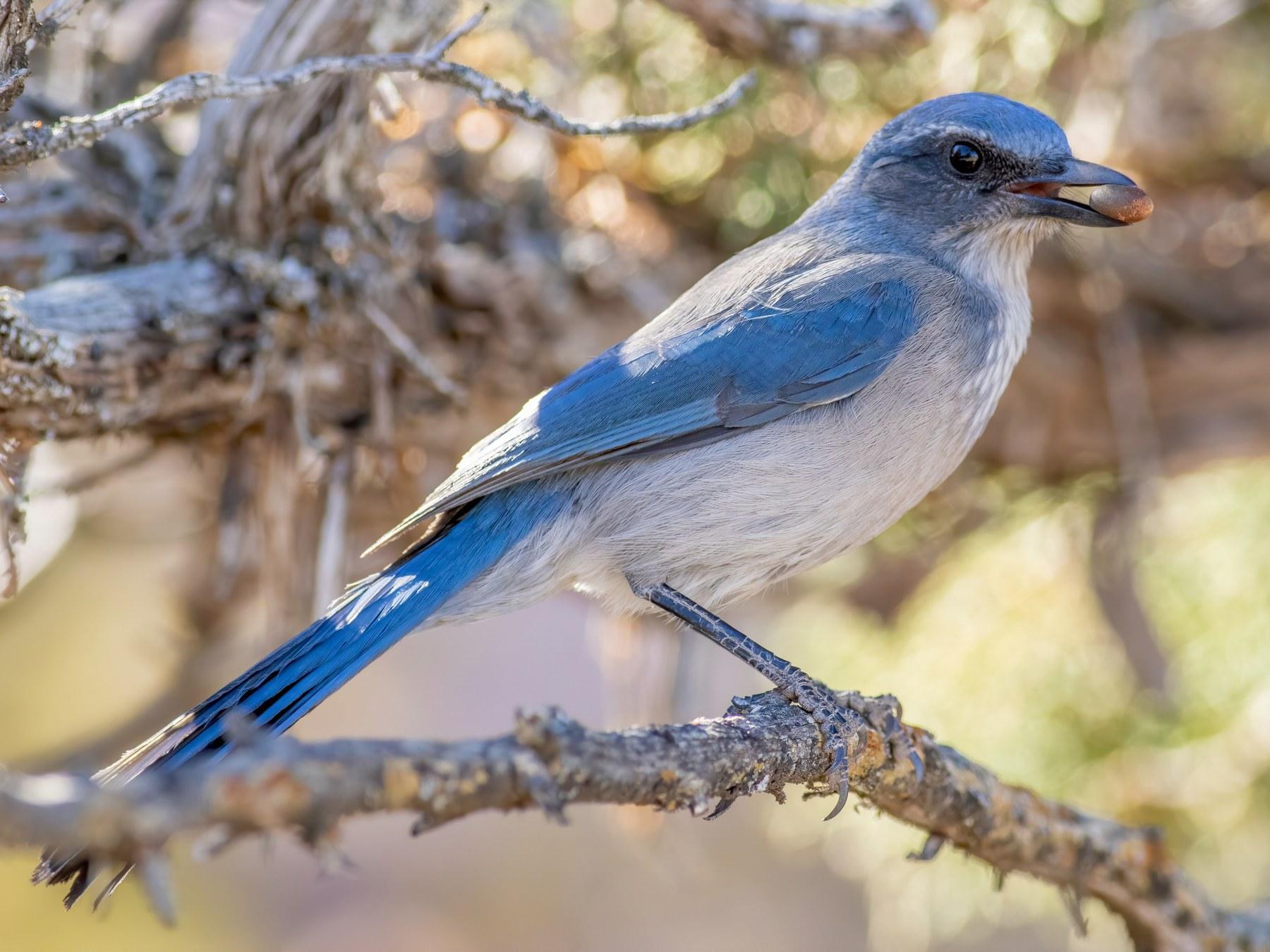
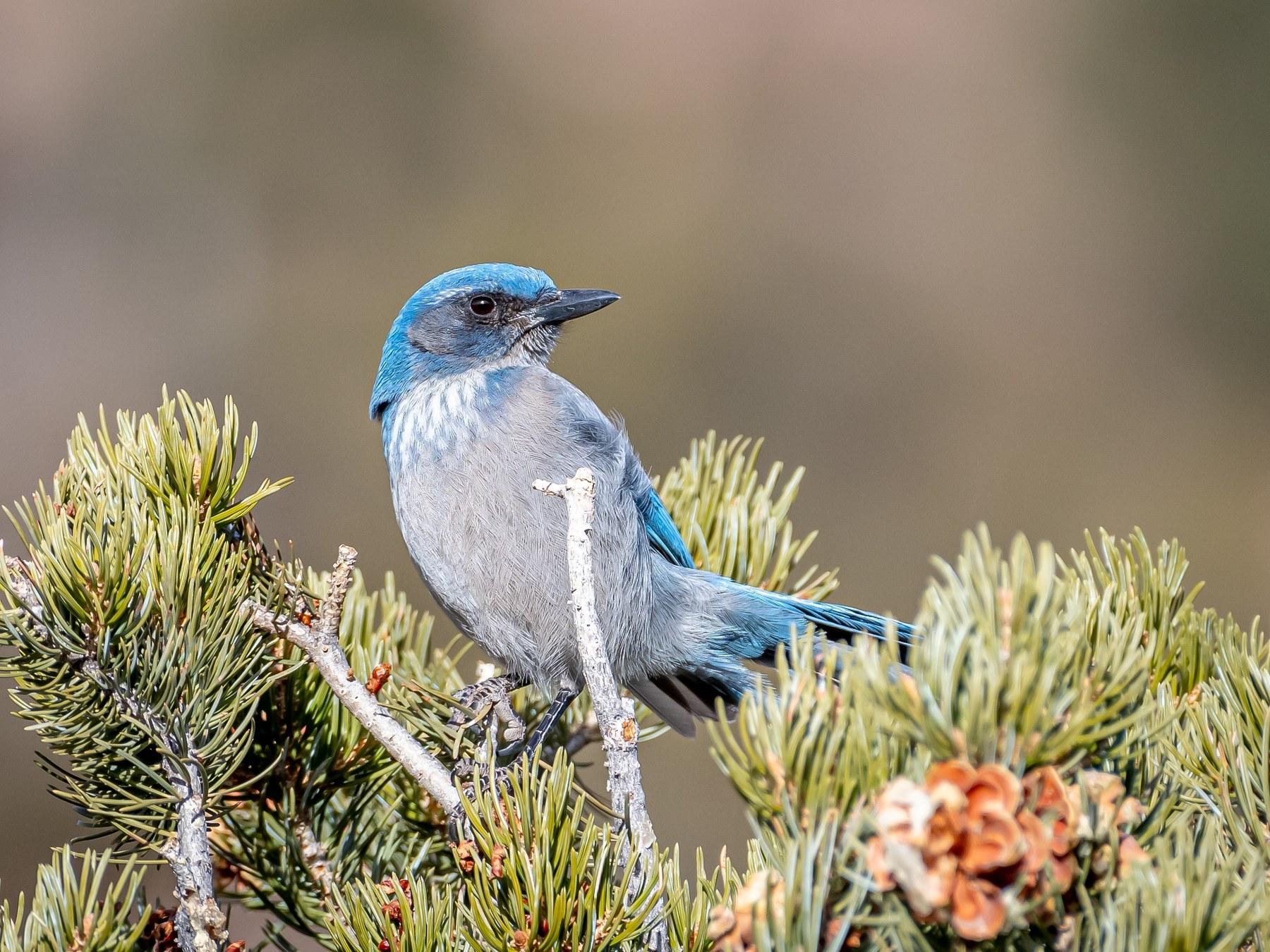
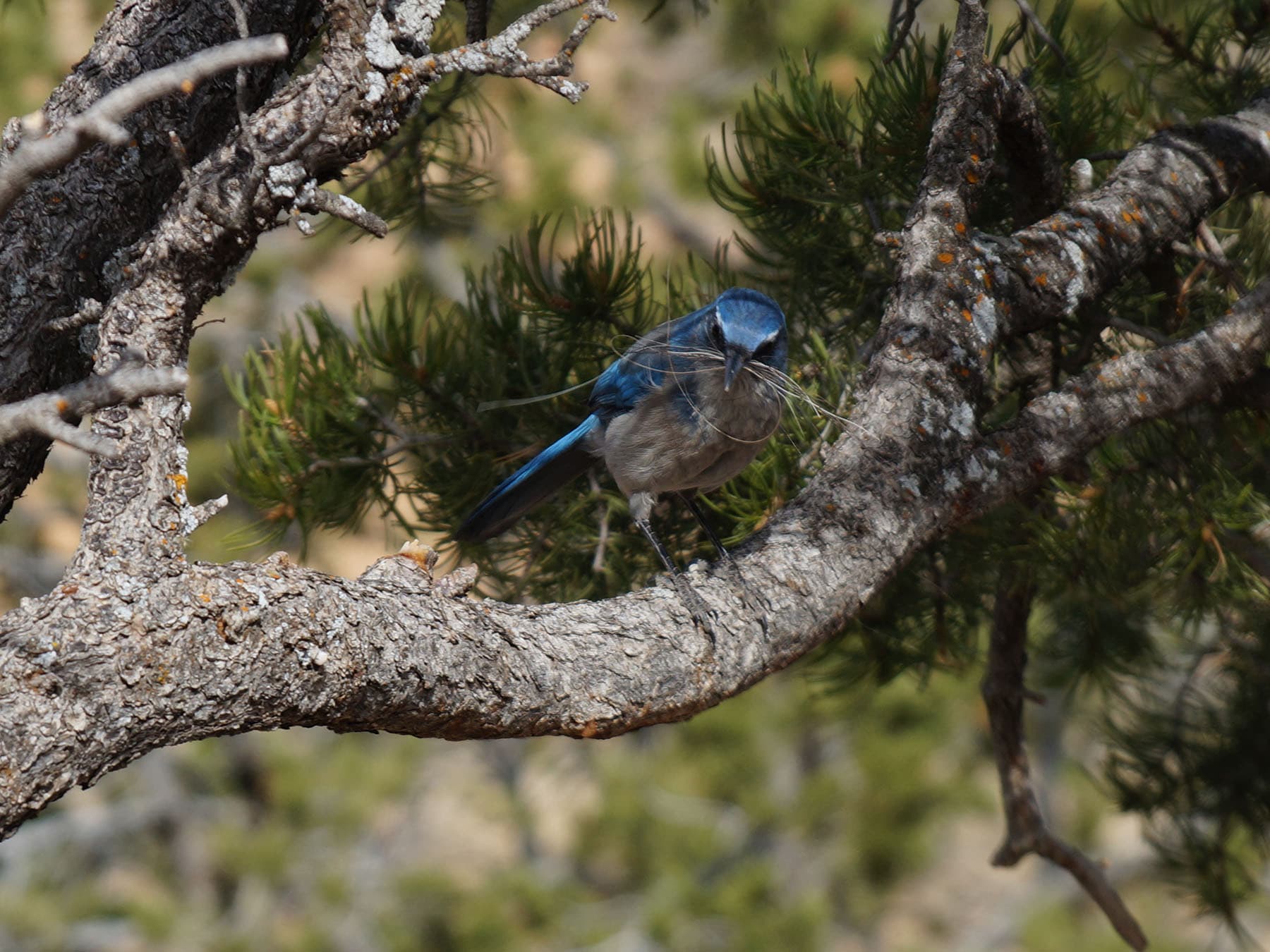
It is a lanky, crestless jay with a long, loose-looking tail, bigger and bulkier than a Western Bluebird and smaller than a crow. The head, wings and tail are medium blue, and the back between them is a dull gray-brown. The cheeks are dusky gray, with a very thin, faint white eyebrow above. The throat is whitish with blue-gray streaks, and a hint of blue at the sides of the breast may form a faint band; the rest of the underparts are pale gray, with a pale blue wash under the tail. The bill is long, straight and sharp-tipped, and the bill, legs and feet are black.
Out birding, look for a blue-and-gray jay sitting up on a treetop, wire or post in dry pinyon-juniper or oak country, often hunched.
Size and weight
Woodhouse's Scrub-Jays measure about 11-12 in (28-30 cm) long, with a wingspan of 15-17 in (38-43 cm), and weigh 2.5-3.5 oz (70-100 g): between a robin and a crow in size, with much of the length in the tail. Those printed figures date from before the split. Weighed specimens are few: six Arizona males in museum collections averaged 2.7 oz (76.9 g).1
Male and female
Males and females look the same, and there is no reliable plumage difference. Within a population, males average about 3-10% larger in most measurements and roughly 10% heavier, and females may look slightly duller or paler.1
Juvenile and first-year plumage
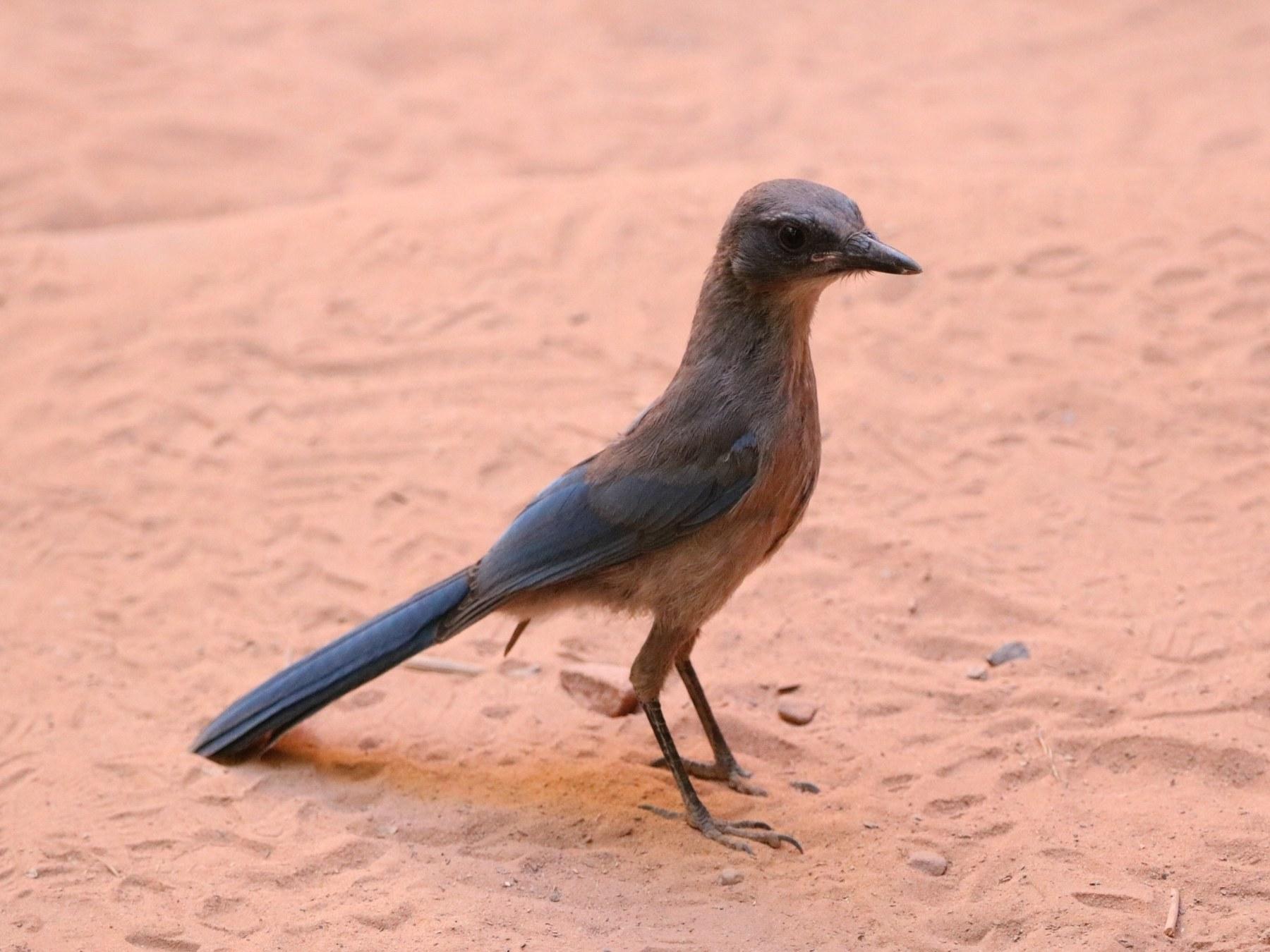
Young birds, seen mainly from May to July, are browner than adults. The head and back are dull brown, at most tinged with blue, and the white eyebrow is missing or reduced to a thin, dull line. The throat is plain dull white without streaks, and grayish-brown chest sides often join in a band across the breast.
Young birds often show pink inside the mouth, which turns black over their first 6-10 months. First-year birds look like adults but keep their browner juvenile outer wing feathers, which contrast with the new blue inner ones. Adults molt all their feathers once a year.
Regional plumage differences
Birds vary across the range. Great Basin birds are the dullest and grayest, with the clearest white eyebrow, and southern Mexican birds are the richest blue; the undertail changes from blue in the north to white in the south, and Mexican birds get larger southward. Edwards Plateau birds in Texas have deeper blue plumage, a slimmer necklace, browner underparts, white undertail feathers and a heavier, blunter bill. The southern Mexican birds of the Sumichrast's group look quite different again: bright blue above and white below, with velvety black cheeks and a heavy hooked bill.
Identification: other jays
Its closest lookalike is the California Scrub-Jay. Compared with it, Woodhouse's is a duller blue above and grayer below, with a paler, less distinct breast band and almost no necklace, and its bill is thinner, straighter and less hooked. Its calls help too: they are typically two-syllabled and higher, where the California bird's are harsher, lower and usually one-syllabled. The long, shallow, pointed bill is thought to suit pulling seeds from pinyon cones, while the California Scrub-Jay's heavier, hooked bill suits acorns.1
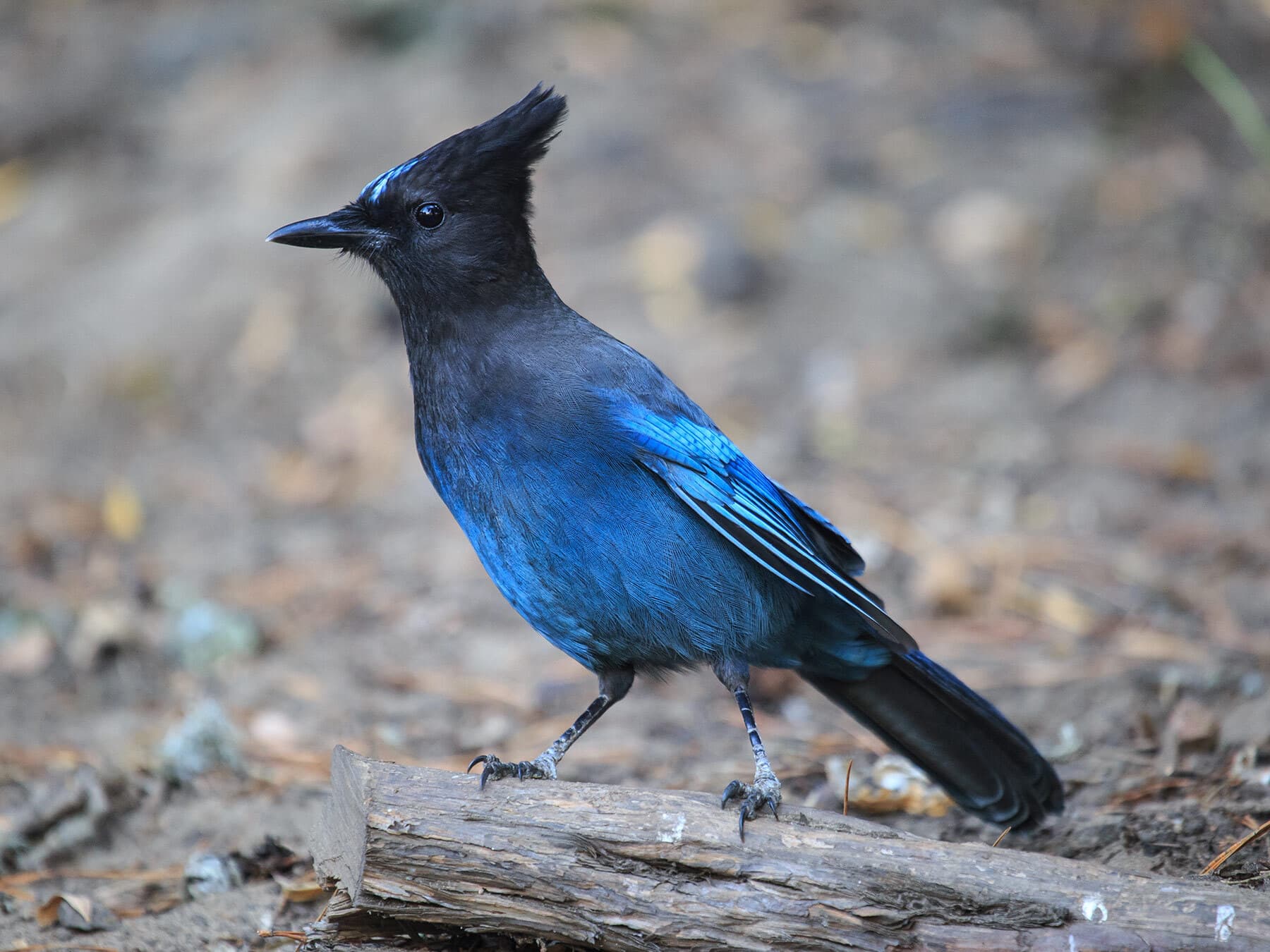
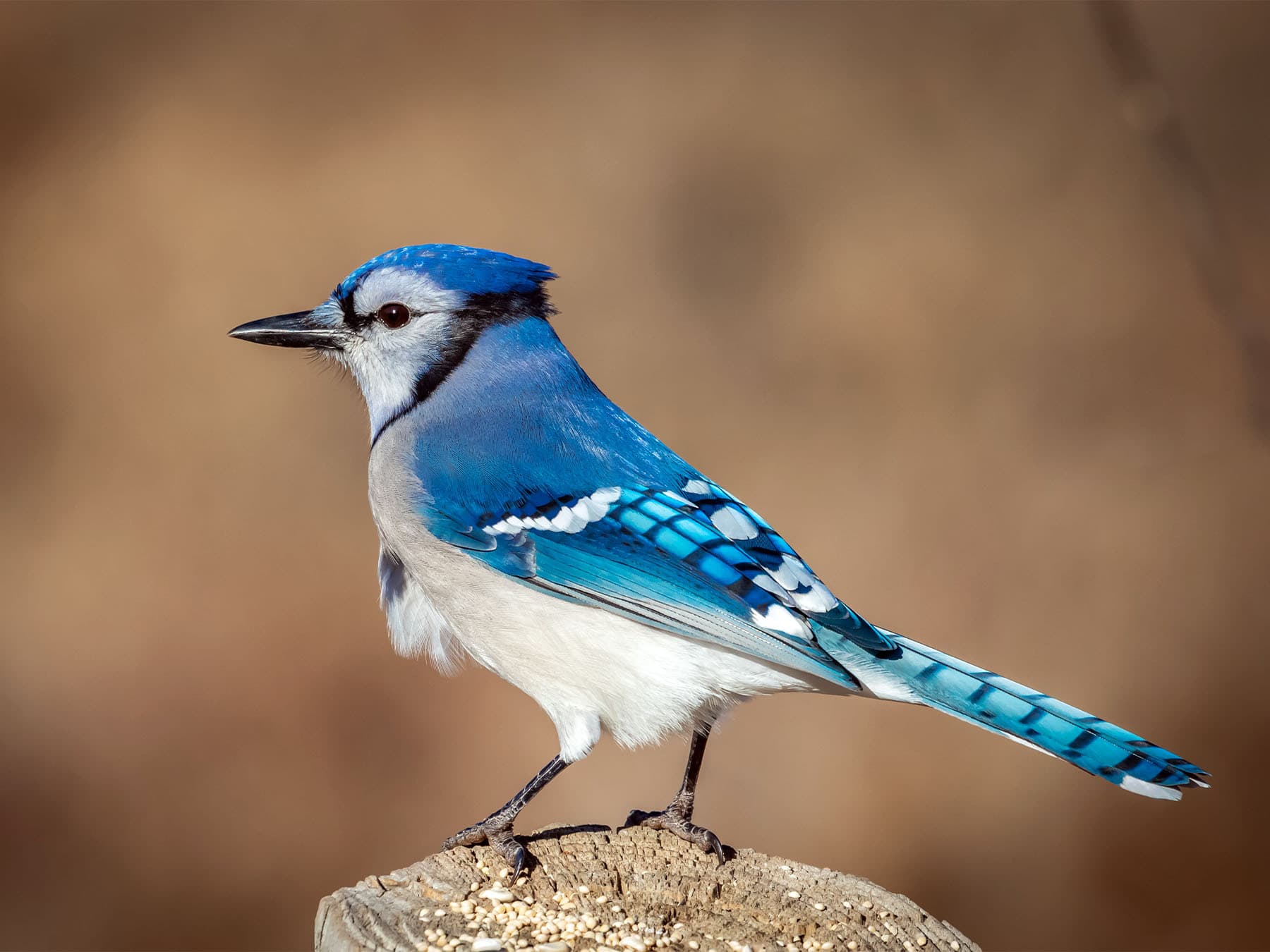
The other jays of its range are easier. A Steller's Jay has a tall dark crest and a blackish head and upper breast, and a Blue Jay has a crest, a black necklace, and black-barred wings and tail with bold white tips and a white wing-bar. A Pinyon Jay is dull blue all over apart from a whitish-streaked throat, with a shorter tail; it is usually in flocks and often walks rather than hops. A Mexican Jay has a blue-gray back rather than a brown one, no white eyebrow or necklace, and plainer gray underparts. Woodhouse's usually lives in drier, more open and lower places than the Mexican, Pinyon and Steller's Jays, though their ranges overlap.
Identification: the 2016 split and hybrids
The American Ornithologists' Union split the Western Scrub-Jay in its 57th Check-list supplement, published on 6 July 2016, citing differences in ecology, appearance, genetics and voice. The two still interbreed, but only in a narrow zone, where hybrids appear to be selected against. They meet mainly in western Nevada and east-central California.
A 2014 genetic study found western Nevada the only place where the two lineages meet to any great degree.2 Along its transect from northeastern California into west-central Nevada, the change from one species to the other spread over about 81 miles (131 km) in mitochondrial DNA and about 206 miles (331 km) in nuclear DNA.2 In its museum specimens, 68 along the transect and 50 in the core of the zone, plumage tracked a bird's genetic mix but bill and body size did not.2 A later genomic study of 16 birds from the same zone did link bill and wing length to genetic makeup.3
Not sure it’s a Woodhouse's Scrub-Jay? Check your photo: Birdfact names the bird and shows the look-alike side by side.
Its size
Adults- Length
- 28–30 cm
- Wingspan
- 38–43 cm
- Weight
- 70–100 g
Its song and calls
Woodhouse's Scrub-Jays are vocal, and most of what you hear are calls. Pairs give territorial and contact calls all year, often from exposed perches such as wires and shrub tops. One field guide writes the call as a loud, throaty jayy? or jree?, and the flight call as a long series of check notes.4
The main calls described are these. The weep call is short, sharp, high and loud: it is given in chases and territorial flights, singly from a perch, and when a flying predator appears suddenly and the jays dive for cover. The scold is a loud, raspy note given in short bouts when mobbing a predator close by. Only females give a rattle of loud, rapid clicks, and only males a short series of chuk notes. The wingbeats can be heard on take-off, louder in territorial encounters.
The song is something few people hear: a soft, unstructured run of melodious notes lasting up to 5 minutes, given mostly in courtship when the pair sit close together, usually started by the male, and occasionally by a lone bird.
Much of this comes from other scrub-jays. The call list rests mainly on a study of California Scrub-Jays in southern California, with measurements of Texas and Rocky Mountain birds from a Texas thesis, and no experiments have tested what the calls mean. Texas and Rocky Mountain birds differ significantly in some features of their calls.1
- Harsh calls0:00 / 0:22
Recorded in Arizona, United States · July 2013
- Calls0:00 / 0:11
Recorded in Colorado, United States · August 2024
Heard one and not sure? Let the bird song identifier listen.
When and where to see it
Woodhouse's Scrub-Jays live all year across the interior West. To the north the range reaches southeastern Oregon, southern Idaho and southern Wyoming, and to the east western and southern Colorado and the far western tip of the Oklahoma panhandle. From there it runs south through Nevada, Utah, eastern California, Arizona and New Mexico to western and central Texas, and on through the Mexican highlands to Oaxaca and Guerrero.
The majority of populations live in the pinyon-juniper woodlands of the Great Basin, but numbers are another matter. Breeding Bird Survey counts for 2011-2015 suggest the bird is most abundant in parts of central Arizona and northern New Mexico, and scarcer in northern Nevada, northern Utah and western Texas.1 Southwestern Wyoming is the northeastern edge of the core range: breeding was confirmed or suspected in only 3 of the state's 28 latitude-longitude blocks, all in the southwest, according to the 2016 state account.5
It lives mostly at lower elevations, up to about 7,900 ft (2,400 m) in the north; 19th- and 20th-century accounts report it to 12,100 ft (3,700 m) in southern and central Mexico.1
Habitat
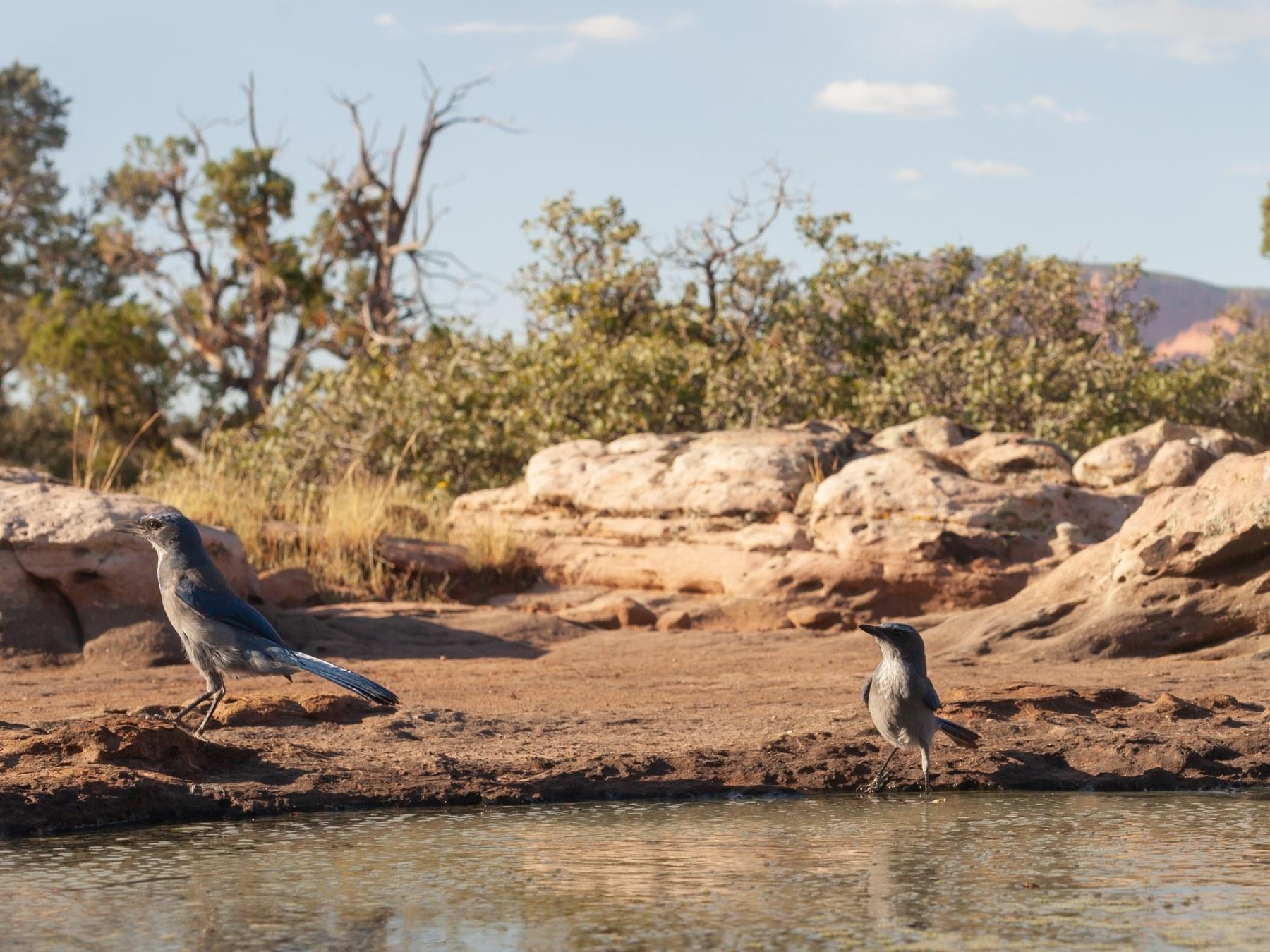
Look for it in pinyon-juniper and oak woodland and scrub, and in gardens, orchards and streamside woods. In Texas, New Mexico, Arizona and northern Mexico it lives mostly in oak or oak-pinyon-juniper woodland, and in southern Mexico mainly in open or cut-over oak and pine forest, also in tropical deciduous forest. At the edges of its range it manages without nut trees: in pure juniper in southern Wyoming, Oregon and Idaho, in desert streamside woods in the southern Chihuahuan Desert, and in thorn scrub in Oaxaca.
It comes into the suburbs of some western cities and lives along the edges of disturbed land in Nevada, but it is shyer and less tied to towns than the California Scrub-Jay. In central Texas, a study found the Edwards Plateau birds strongly tied to medium amounts of juniper nearby, and at lower density where there was more mixed oak-juniper woodland or more urban land.6
Do they migrate?
No. Woodhouse's Scrub-Jays are not migratory: pairs stay on their territory all year. Some birds wander in winter, moving down into desert edges in New Mexico and Arizona, including the lower Colorado River valley.1 More are said to disperse in dry years with poor acorn crops.4
In northern Texas, scrub-jays have spread out in irruption winters (1957-58, 1972-73, 1978-79, 1989-90 and 1994-95), at the same time as Pinyon Jays, Steller's Jays and Clark's Nutcrackers, presumably when food was short.1 Almost all long-distance wanderers prove to be young birds in their first year. Rare wanderers have reached southern Manitoba, central Kansas, Illinois and west-central Indiana.1
Range changes in Texas
The range in Texas has shifted since 1950. The Edwards Plateau birds spread east through the oak scrub of the plateau in the 1950s, reaching Austin's western suburbs by the 1970s. Separately, scrub-jays spread north from about 1950 into canyons of the Caprock Escarpment in the Panhandle, a small population whose subspecies is unknown.1
Spotting tips
Scan the tops of junipers, pinyons and power lines, where scrub-jays often sit as lookouts, and listen for their loud calls. Then look for the long tail and the blue head above a gray-brown back.
What it eats
Woodhouse's Scrub-Jays eat whatever the season offers. In spring and summer they live mainly on insects and other small creatures, and on fruit such as juniper berries; in fall and winter they turn to the seeds of nut trees, above all pinyon pines and oaks. They also take grass seeds, lizards, small rodents, and the eggs and nestlings of other birds, sometimes finding nests by following the parents. They forage at every level but mostly low down or on the ground, hopping as they go.
Where pinyons grow, their nuts are a main fall and winter food. A scrub-jay cannot open the closed green cones, so it takes the seeds once the cones open, from a perch or hovering below them. It also attacks Clark's Nutcrackers and Pinyon Jays that have opened green cones, and about 12% of such attacks made the startled bird drop its cone.1
The only diet sample for this species is small: 14 birds collected from November to January in Arizona oak grassland had eaten about 37% animal food, mostly beetles, and 54% plant food, with acorns making up 34%.1 An older field-guide account, written before the split, says moth caterpillars make up a large share of the food brought to nestlings.4
Food storing: caching nuts and seeds
Woodhouse's Scrub-Jays store food to eat later. Each item goes in its own hiding place, mostly nuts and seeds but also insects: the bird pushes it into the soil with its bill and often covers the spot with a leaf or a small stone.
The scale can be large. One bird may cache up to 6,000 pinyon seeds in a single fall.1 It carries at most 5 seeds (1.5 g) at a time, mostly less than 164 ft (50 m) and up to about 1,640 ft (500 m). Scrub-jays are said to be important dispersers of several pines, but how many trees grow from their caches has never been measured.1
How they find their caches again comes from laboratory work. In tests, scrub-jays found their caches better than chance up to 250 days later, though their spatial memory was weaker than that of Pinyon Jays and Clark's Nutcrackers.1 In a 1989 aviary experiment, scrub-jays used the sun as a compass to find their caches and largely ignored nearby landmarks; the paper does not say which population the birds came from.7 Other laboratory studies found they use landmarks too.1 When the handbook account was last revised, in 2017, no one had studied in detail how wild birds store and recover their food.
Feeders and yards
Where they live near people, Woodhouse's Scrub-Jays come to feeders for sunflower seeds and peanuts, and they carry off and cache peanuts too.
Nesting and breeding
Pairs nest low in shrubs and small trees, often well hidden. Both partners build, and one often stands guard on an exposed perch while the other gathers material. The nest is an open cup: an outer basket of interlaced twigs around an inner cup of fine twigs and weed stalks, lined with rootlets and hair, and about 4 in (10 cm) across outside. Building takes about 12 days.
Of 10 Arizona nests in one sample, 5 were in juniper, 2 in pinyon, 2 in scrub live oak and 1 in silktassel, at a median height of about 6 ft (1.8 m).1 Other reports place nests in mountain mahogany in Nevada, serviceberry in Colorado, sagebrush in Utah and, once, a cholla in Arizona. In Arizona, nest building has been reported from 12 April to late July.1
In most populations pairs raise their young on their own. Only in the mountains of northern Oaxaca, Mexico, have groups been found in which extra adults, probably grown offspring, help defend the nest and feed the fledged young, though they rarely feed nestlings.1
Eggs and incubation
A clutch is 3-6 eggs, most often 4-5. The slightly glossy eggs are light bluish-green to pale sage green, with brown spots, dots or blotches; 50 eggs averaged about 1.1 x 0.8 in (27.8 x 20.4 mm).1 Only the female incubates.
Almost nothing of this bird's breeding has been measured: we found no figures for its laying dates, incubation or nestling periods, broods per year or age at first breeding. Its incubation period is presumed to be like the California Scrub-Jay's, which was 17-18 days in one California study and 18-19 days in another.1
Nestlings and fledglings
The chicks hatch naked, with their eyes closed. The female probably broods them alone, and both parents remove their droppings. We found no measured nestling period for Woodhouse's Scrub-Jay: field guides give 17-19 days or 18-22 days, without naming a study of this species.1, 8, 4
The account giving 18-22 days, written before the split, also says the young are fed for at least a month after they leave the nest, and that pairs typically raise one brood a year, occasionally two.4 We found no report of cowbird or other brood parasitism.
Nest predators
Known or probable nest predators include raccoons, long-tailed weasels, skunks, squirrels and snakes, and birds such as other scrub-jays, Steller's Jays, Black-billed Magpies and American Crows. A pair may abandon a nest that is closely approached or disturbed, but only when the nest's security is at stake.1
Behaviour
Woodhouse's Scrub-Jays are assertive, vocal and inquisitive, and they like a lookout: treetops, wires and posts. On the ground they hop rather than walk. Their flight is a few quick wingbeats and a short glide, and can look underpowered; one study measured an average speed of 17.6 mph (28.4 km/h).1
Social behavior: pairs and territories
Pairs stay close together all year and share the defense of their territory, and mates feed each other in courtship, most often in the breeding season. The mating system has not been studied, but the birds are presumed to be socially monogamous like the California Scrub-Jay.
They are less social than other Aphelocoma jays apart from the Island Scrub-Jay. Besides the territorial pairs there are non-breeding floaters, which may flock: in an Arizona winter, flocks of 5-15 birds, probably mostly yearlings, used land outside the breeding territories.1 At feeders and other food, they usually dominate Steller's and Blue Jays but give way to the Mexican Jay.
Social behavior: mobbing
From a perch, Woodhouse's Scrub-Jays mob people, snakes, coyotes, owls, crows, squirrels, house cats and bobcats, scolding in short raspy bouts.1
Behavior: bill shape and lice
Bill shape may matter for preening. A study of scrub-jays from before the split found that pointed-billed birds from pinyon country carried more lice than hooked-billed birds from oak country, possibly because a pointed bill preens less well. Fewer of the pointed-billed birds were infested at all, and the comparison rests on 4 infested pointed-billed birds and 17 hooked-billed ones.9 The handbook account ties the pointed-billed birds to Woodhouse's and links their lower infestation to lower humidity.1
Lifespan and predators
Little is known about how long Woodhouse's Scrub-Jays live. The only one on the US banding longevity table was at least 3 years 2 months old: banded in Colorado on 17 May 2023, already in at least its third calendar year, it was seen alive there by its color marker on 27 August 2024.10 That is a minimum age from a single bird, not a typical or maximum lifespan.
We found no survival study and no sourced lifespan figure for this species. The older scrub-jay banding records, up to 15 years 9 months, were filed under the combined Western Scrub-Jay code and come from California.10
Predators
Fledglings and adults are taken by bobcats, house cats, Cooper's and Sharp-shinned Hawks and Great Horned Owls, and rarely by Northern Goshawks.
Conservation
The IUCN Red List still assesses the old, broad Western Scrub-jay as one species, rated Least Concern, and has no separate assessment for Woodhouse's.11, 12 Partners in Flight estimates about 880,000 breeding-age birds for around 2010, about 690,000 of them in the United States and the rest in Mexico. It gives the species a Continental Concern Score of 11 out of 20, and it is not on the Partners in Flight Watch List.13
Population trend
Numbers look broadly stable, though the survey picture is blurred. The North American Breeding Bird Survey does not analyze this species on its own: its combined California and Woodhouse's figure for the US is -0.10% a year since 1967 (95% interval -0.55 to +0.27), with no clear trend.14 Partners in Flight's estimate for Woodhouse's alone is about -0.4% a year from 1970 to 2021 (90% interval -1.0 to +0.3), not statistically significant.13
States within the range differ. The combined survey index fell by about 1.3% a year in New Mexico (1968-2025; 95% interval -2.75 to -0.19) and rose by about 1.9% a year in Utah (0.17 to 3.90), while Arizona, Colorado and Texas show no clear long-term trend. Over 2015-2025 the state figures lean downward in Arizona, Colorado, Texas and Utah and upward in New Mexico, but none of those intervals excludes zero.14
Conservation: grazing, noise and exotic plants
The handbook account, last revised in 2017, says populations do not appear to need conservation attention: the threats to them are not thought to be severe, their effects are probably spread thin, and no management had targeted it.1 A few studies show what can affect it locally. In New Mexico pinyon-juniper woodland it was about twice as abundant at a site where cattle had been kept out for 20 years as at nearby lightly grazed sites, in one study.1
In a northwestern New Mexico gas field, scrub-jays were recorded taking pinyon seeds only at quiet sites, not near noisy compressors, and pinyon seedlings were four times more common at quiet sites; the authors say the jays' absence potentially explains the difference.15, 16 A 2019 resurvey of the same plots found seedling numbers had not recovered where the noise had stopped, possibly partly because seed-dispersing animals were slow to return.16
A Utah occupancy study (five years, 61 species) estimated that Woodhouse's Scrub-Jays were less likely to occupy sites with any increase in uncharacteristic exotic vegetation. It was one of 26-31 species with that result, and the authors named it with three other sagebrush or pinyon-juniper specialists.17 In Wyoming, at the edge of its range, it is a protected bird and a state Species of Greatest Conservation Need (Tier II), ranked S1 in the 2016 state account.5
Legal status
In the United States, Woodhouse's Scrub-Jay is protected under the Migratory Bird Treaty Act. It has been listed by name in 50 CFR 10.13 since a rule that took effect on 18 May 2020, and a 2026 proposal to revise the list keeps it.18, 19, 20 The only federal depredation order for jays names California Scrub-Jays and Steller's Jays in parts of Washington and Oregon, not this species.21
In Canada, where it is only a rare visitor, the crow and jay family is outside the Migratory Birds Convention Act, though other federal, provincial or territorial laws may apply. It is not on Mexico's NOM-059 list of species at risk (2019 annex).22, 23
Similar birds
Often mistaken for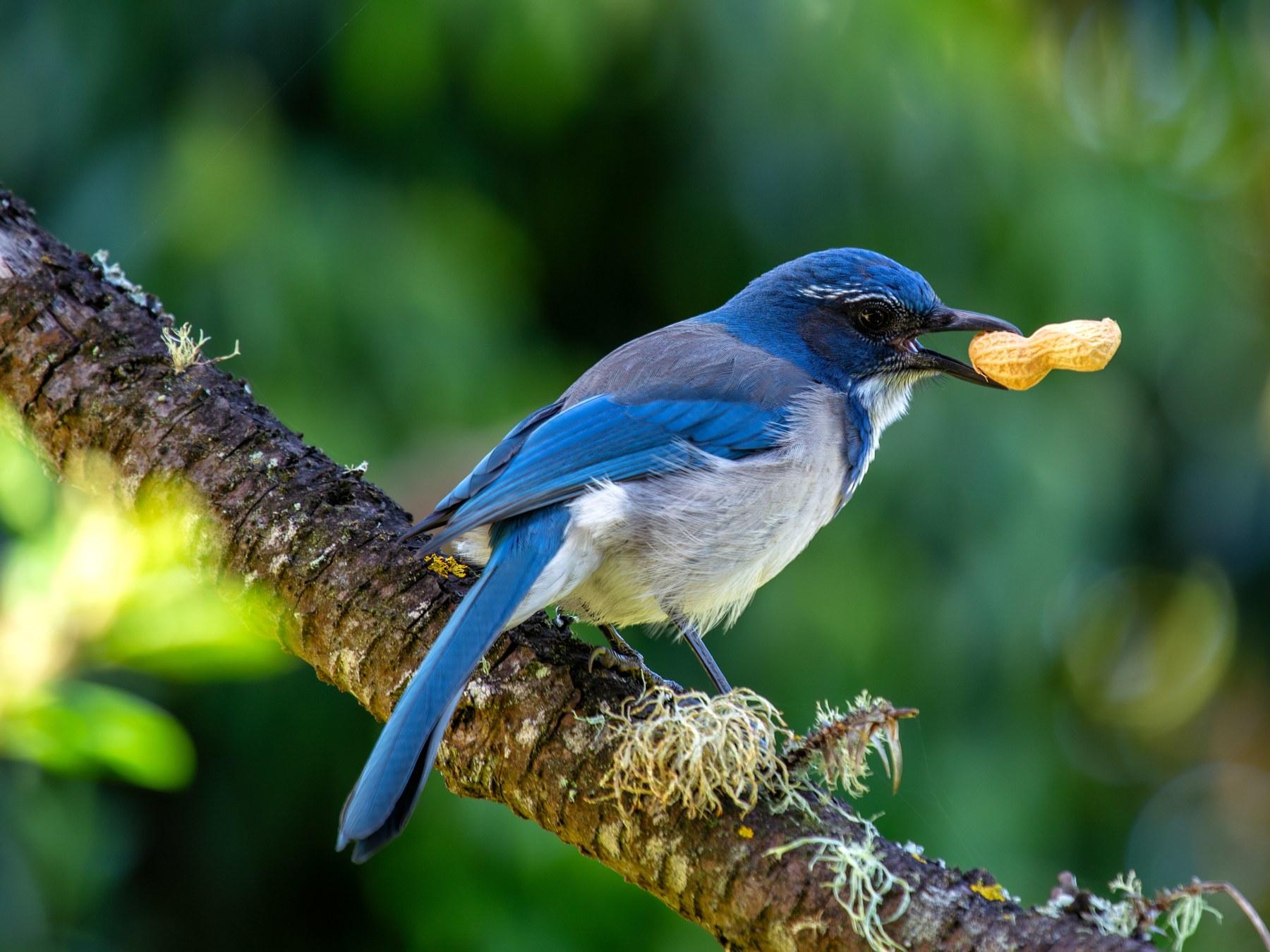
Quick facts
- Length
- 28–30 cm
- Wingspan
- 38–43 cm
- Weight
- 70–100 g
- Lifespan
- oldest recorded 3 years 2 months
- Family
- Crows & Jays
- Migration
- Resident
- Global status (IUCN)
- Least Concern
- World population
- About 880,000 breeding-age birds (Partners in Flight, around 2010)
- Population trend
- Stable: no significant long-term change on Partners in Flight's estimate (about -0.4% a year, 1970-2021); the Breeding Bird Survey's combined scrub-jay index fell in New Mexico and rose in Utah (1968-2025)
- Scientific name
- Aphelocoma woodhouseii
Questions
3Is Woodhouse's Scrub-Jay the same as the Western Scrub-Jay?
Partly. Western Scrub-Jay was the name of the combined species until July 2016, when it was split into Woodhouse's Scrub-Jay of the interior West and Mexico and the California Scrub-Jay of the Pacific Coast. Books and websites from before 2016 use the old name for both. See how to tell them apart.
Why is it called Woodhouse's Scrub-Jay?
It is named for Samuel W. Woodhouse, a doctor and naturalist who went on expeditions to the Southwest from 1849 to 1852. Spencer F. Baird described it in 1858 as Cyanocitta woodhouseii, from a type locality later fixed as Fort Thorn, in Doña Ana County, New Mexico. The genus name Aphelocoma refers to the missing crest: it comes from Greek words for 'smooth, plain' and 'hair'.
Is there more than one kind of Woodhouse's Scrub-Jay?
Yes. There are seven subspecies in two groups: the Woodhouse's group, from the Great Basin and the Rockies south through northern and central Mexico, and the Sumichrast's group of southern Mexico. The southern birds may be a separate species: the 2016 Check-list supplement says so with a 'may', and a 2022 genomic study found them distinct under any common species concept, but they have not been split.24, 25 The same 2022 study reported new genomic evidence that the Edwards Plateau birds of Texas could be treated as a species too.25
Sources
37- 1Curry, R. L. et al. (2020). Woodhouse's Scrub-Jay (Aphelocoma woodhouseii), version 1.0. Birds of the World (P. G. Rodewald, editor). Cornell Lab of Ornithology. doi:10.2173/bow.wooscj2.01 (opens in a new tab)
- 2Gowen, F. C. et al. (2014). Speciation in Western Scrub-Jays, Haldane's rule, and genetic clines in secondary contact. BMC Evolutionary Biology 14: 135. doi:10.1186/1471-2148-14-135 (opens in a new tab)
- 3Vinciguerra, N. T., Tsai, W. L. E., Faircloth, B. C. and McCormack, J. E. (2019). Comparison of ultraconserved elements (UCEs) to microsatellite markers for the study of avian hybrid zones: a test in Aphelocoma jays. BMC Research Notes 12: 456. doi:10.1186/s13104-019-4481-z (opens in a new tab)
- 4National Audubon Society and Kaufman, K.. Woodhouse's Scrub-Jay. Audubon Guide to North American Birds. Accessed 22 November 2026. Source (opens in a new tab)
- 5Hubbard, K. A., Orabona, A. C., Keinath, D. A. and Wyoming Game and Fish Department (2016). Wyoming Species Account: Woodhouse's Scrub-Jay. Wyoming Game and Fish Department, State Species Abstract. Accessed 22 November 2026. Source (opens in a new tab)
- 6Reidy, J. L. and Thompson, F. R. (2022). Density and habitat associations of the Woodhouse's Scrub-Jay in central Texas. The Southwestern Naturalist 66: 5-12. doi:10.1894/0038-4909-66.1.5 (opens in a new tab)
- 7Wiltschko, W. and Balda, R. P. (1989). Sun compass orientation in seed-caching scrub jays (Aphelocoma coerulescens). Journal of Comparative Physiology A 164: 717-721. doi:10.1007/bf00616744 (opens in a new tab)
- 8Cornell Lab of Ornithology. Woodhouse's Scrub-Jay. All About Birds. Accessed 22 November 2026. Source (opens in a new tab)
- 9Moyer, B. R., Peterson, A. T. and Clayton, D. H. (2002). Influence of bill shape on ectoparasite load in Western Scrub-Jays. The Condor 104: 675-678. doi:10.1093/condor/104.3.675 (opens in a new tab)
- 10USGS Bird Banding Laboratory. Longevity records of North American birds (current through December 2025). USGS Patuxent. Accessed 22 November 2026. Source (opens in a new tab)
- 11BirdLife International (2025). Aphelocoma californica. The IUCN Red List of Threatened Species 2025 (via GBIF's IUCN Red List checklist, version 2026-1). IUCN Red List. doi:10.2305/IUCN.UK.2025-2.RLTS.T103727785A139835822.en (opens in a new tab)
- 12AviList Core Team (2025). AviList: The Global Avian Checklist, v2025b. doi:10.2173/avilist.v2025b (opens in a new tab)
- 13Partners in Flight (2023). Avian Conservation Assessment Database, global sheet (2023). Partners in Flight. Accessed 22 November 2026. Source (opens in a new tab)
- 14Hostetler, J. A. et al. (2026). The North American Breeding Bird Survey, Analysis Results 1966 - 2025. U.S. Geological Survey data release. doi:10.5066/P1OSNSFC (opens in a new tab)
- 15Francis, C. D., Kleist, N. J., Ortega, C. P. and Cruz, A. (2012). Noise pollution alters ecological services: enhanced pollination and disrupted seed dispersal. Proceedings of the Royal Society B 279: 2727-2735. doi:10.1098/rspb.2012.0230 (opens in a new tab)
- 16Phillips, J. N., Termondt, S. E. and Francis, C. D. (2021). Long-term noise pollution affects seedling recruitment and community composition, with negative effects persisting after removal. Proceedings of the Royal Society B 288. doi:10.1098/rspb.2020.2906 (opens in a new tab)
- 17Hayes-Puttfarcken, A. L. and Stuber, E. F. (2026). Quantifying avian resilience to habitat change to support conservation decision-making. Ecological Applications 36. doi:10.1002/eap.70257 (opens in a new tab)
- 18U.S. Fish and Wildlife Service (2026). 50 CFR 10.13, List of Birds Protected by the Migratory Bird Treaty Act. eCFR (up to date as of 19 Nov 2026). Accessed 22 November 2026. Source (opens in a new tab)
- 19U.S. Fish and Wildlife Service (2020). General Provisions; Revised List of Migratory Birds (final rule, 85 FR 21282). Federal Register. Accessed 22 November 2026. Source (opens in a new tab)
- 20U.S. Fish and Wildlife Service (2026). General Provisions; Revised List of Birds Protected by the Migratory Bird Treaty Act (proposed rule, 91 FR 62411). Federal Register. Accessed 22 November 2026. Source (opens in a new tab)
- 21U.S. Fish and Wildlife Service (2026). 50 CFR Part 21 (Migratory bird permits), including 21.100 and 21.156. eCFR (17 Nov 2026). Accessed 22 November 2026. Source (opens in a new tab)
- 22Environment and Climate Change Canada. Birds protected in Canada. canada.ca (Wayback capture 4 Oct 2026). Accessed 22 November 2026. Source (opens in a new tab)
- 23SEMARNAT (2019). Modificacion del Anexo Normativo III de la NOM-059-SEMARNAT-2010. Diario Oficial de la Federacion, 14 Nov 2019. Accessed 22 November 2026. Source (opens in a new tab)
- 24Chesser, R. T. et al. (2016). Fifty-seventh Supplement to the American Ornithologists' Union Check-list of North American Birds. The Auk 133: 544-560. doi:10.1642/AUK-16-77.1 (opens in a new tab)
- 25DeRaad, D. A. et al. (2022). Combining species delimitation, species trees, and tests for gene flow clarifies complex speciation in scrub-jays. Systematic Biology 71: 1453-1470. doi:10.1093/sysbio/syac034 (opens in a new tab)
- 26Peterson, A. T. (1992). Philopatry and genetic differentiation in the Aphelocoma jays (Corvidae). Biological Journal of the Linnean Society 47: 249-260. doi:10.1111/j.1095-8312.1992.tb00669.x (opens in a new tab)
- 27DeRaad, D. A., Maley, J. M., Tsai, W. L. E. and McCormack, J. E. (2019). Phenotypic clines across an unstudied hybrid zone in Woodhouse's Scrub-Jay (Aphelocoma woodhouseii). The Auk 136. doi:10.1093/auk/uky018 (opens in a new tab)
- 28Woolfenden, G. E. and Fitzpatrick, J. W. (2020). Florida Scrub-Jay (Aphelocoma coerulescens), version 1.0. Birds of the World. Cornell Lab of Ornithology. Accessed 22 November 2026. Source (opens in a new tab)
- 29Curry, R. L. et al. (2024). California Scrub-Jay (Aphelocoma californica), version 1.1. Birds of the World. Cornell Lab of Ornithology. Accessed 22 November 2026. Source (opens in a new tab)
- 30Walker, L. E. et al. (2020). Steller's Jay (Cyanocitta stelleri), version 1.0. Birds of the World. Cornell Lab of Ornithology. Accessed 22 November 2026. Source (opens in a new tab)
- 31Smith, K. G., Tarvin, K. A. and Woolfenden, G. E. (2020). Blue Jay (Cyanocitta cristata), version 1.0. Birds of the World. Cornell Lab of Ornithology. Accessed 22 November 2026. Source (opens in a new tab)
- 32Johnson, K. and Balda, R. P. (2020). Pinyon Jay (Gymnorhinus cyanocephalus), version 2.0. Birds of the World. Cornell Lab of Ornithology. Accessed 22 November 2026. Source (opens in a new tab)
- 33McCormack, J. E. and Brown, J. L. (2020). Mexican Jay (Aphelocoma wollweberi), version 1.0. Birds of the World. Cornell Lab of Ornithology. Accessed 22 November 2026. Source (opens in a new tab)
- 34National Wildlife Federation. Woodhouse Scrub-jay. Wildlife Guide. Accessed 22 November 2026. Source (opens in a new tab)
- 35Cornell Lab of Ornithology. Woodhouse's Scrub-Jay. NestWatch. Accessed 22 November 2026. Source (opens in a new tab)
- 36Pajarito Environmental Education Center. Woodhouse's Scrub-Jay. PEEC nature guide (Los Alamos, New Mexico). Accessed 22 November 2026. Source (opens in a new tab)
- 37Tobias, J. A. et al. (2022). AVONET: morphological, ecological and geographical data for all birds. Ecology Letters 25: 581-597. doi:10.1111/ele.13898 (opens in a new tab)

Checked by
Nathan Cope, founder and editor
Nathan founded Birdfact and leads its writers and contributors in the UK, the US and Canada. He has watched and studied birds for more than ten years, and checks every article and species guide before it’s published.