


Western Bluebird
Sialia mexicana
By the Birdfact teamChecked by Nathan Cope
On this page14 sections
How to recognise it
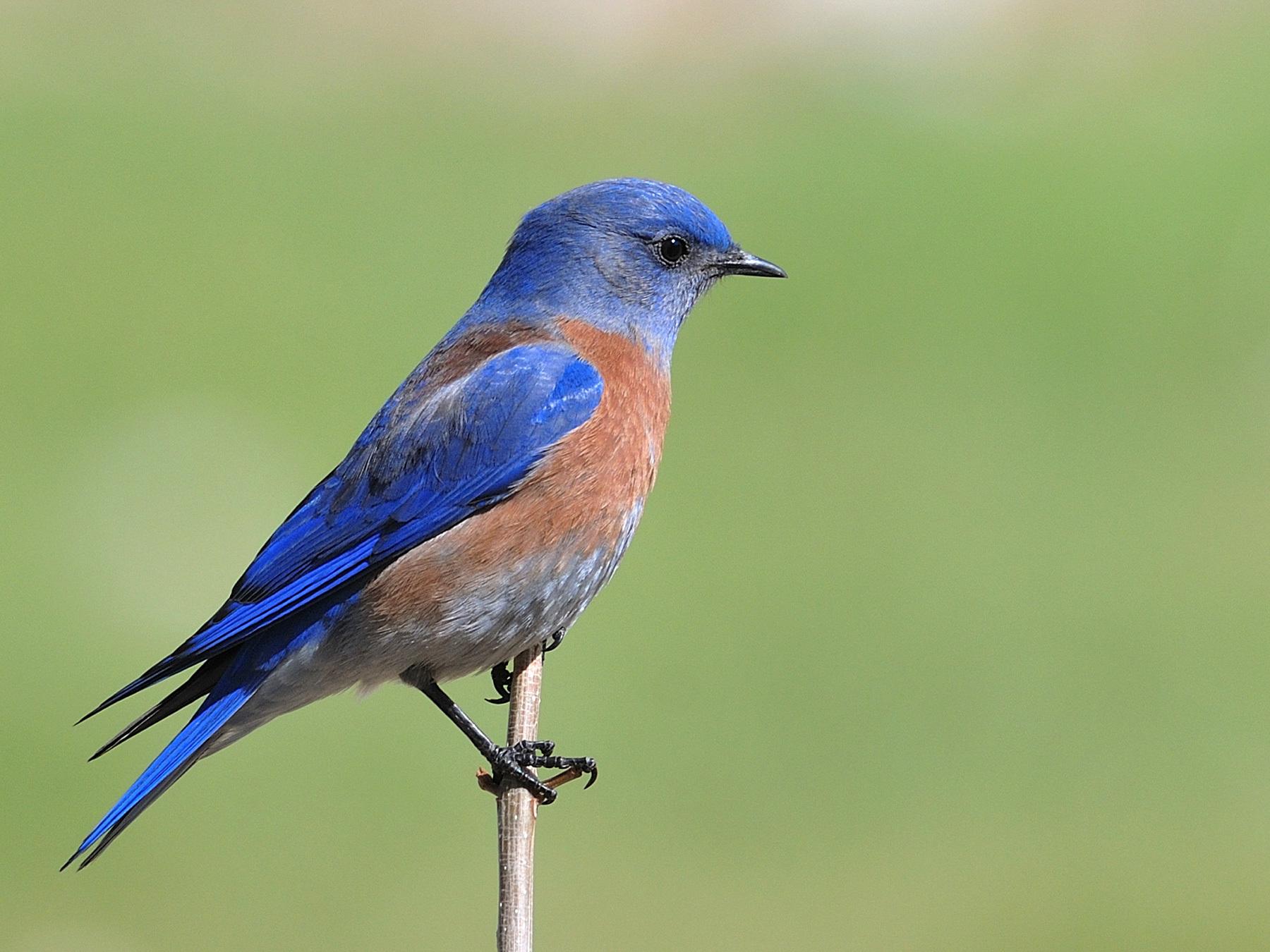
This small thrush is at home in open western woodland. The male's blue throat is the mark that sets him apart from an Eastern Bluebird. Look for one sitting low on a fence or branch, then dropping to the ground after an insect.
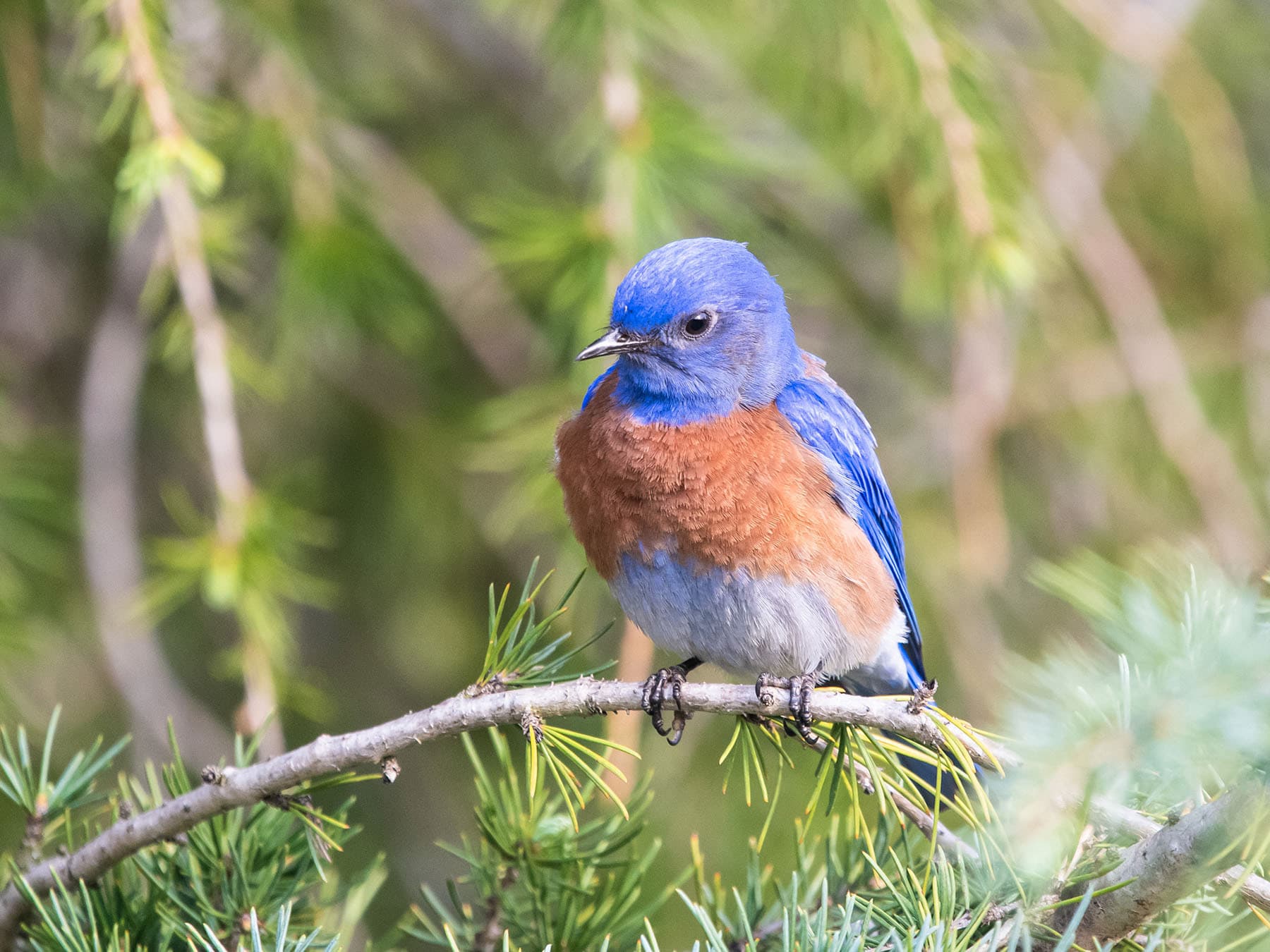
The adult male is deep blue on the head, including the chin and throat, and on the back, wings and tail. The breast and sides are chestnut, sometimes split across by blue, and the rest of the underparts are grayish, turning blue-gray on the belly and under the tail. Many males also show chestnut on the shoulders or across the upper back. The patch varies from a smudge or a narrow band to the whole back, and it differs between birds and between regions. The bill, legs and feet are black.
Adults look much the same all year. They molt once, completely, from July to September after breeding, and look brighter in spring only because the feather tips wear away. The blue and the rust are built differently inside the feather: in blue rump barbs the melanin granules sit in a layer at the base and the outer keratin has none, while rusty breast barbs have it the other way around.1
Size
The Western Bluebird is 6.3-7.5 in (16-19 cm) long, with a wingspan of 11.4-13.4 in (29-34 cm), and weighs 0.8-1.1 oz (24-31 g). That makes it bigger than a sparrow but smaller than an American Robin.
Males and females are close in size. In a four-year sample of live breeding adults in northern Arizona, weighed while they were feeding chicks, 50 males averaged 0.91 oz (25.8 g) and 76 females 0.96 oz (27.1 g), though the males had slightly longer wings and tails.1
Male and female
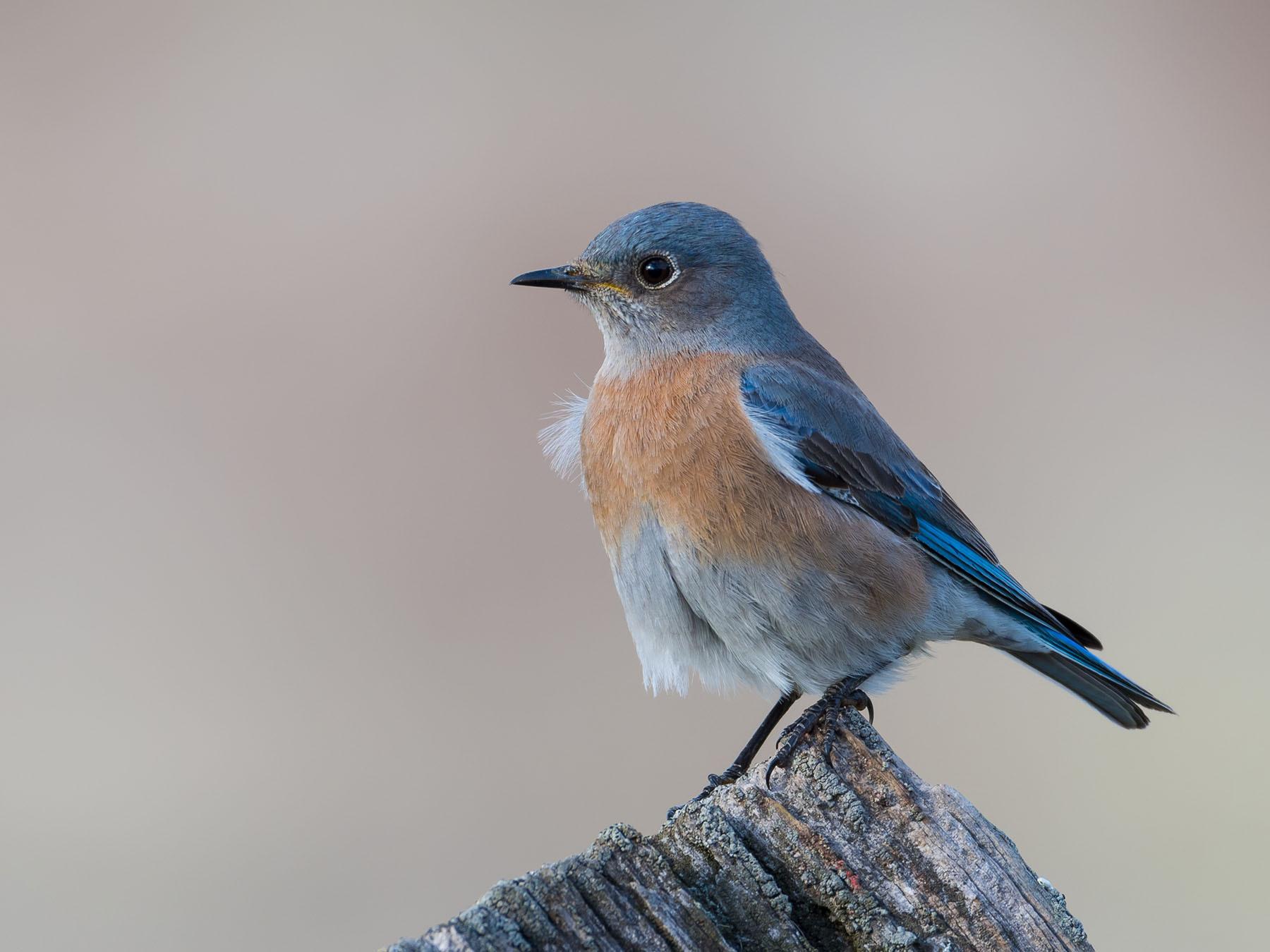
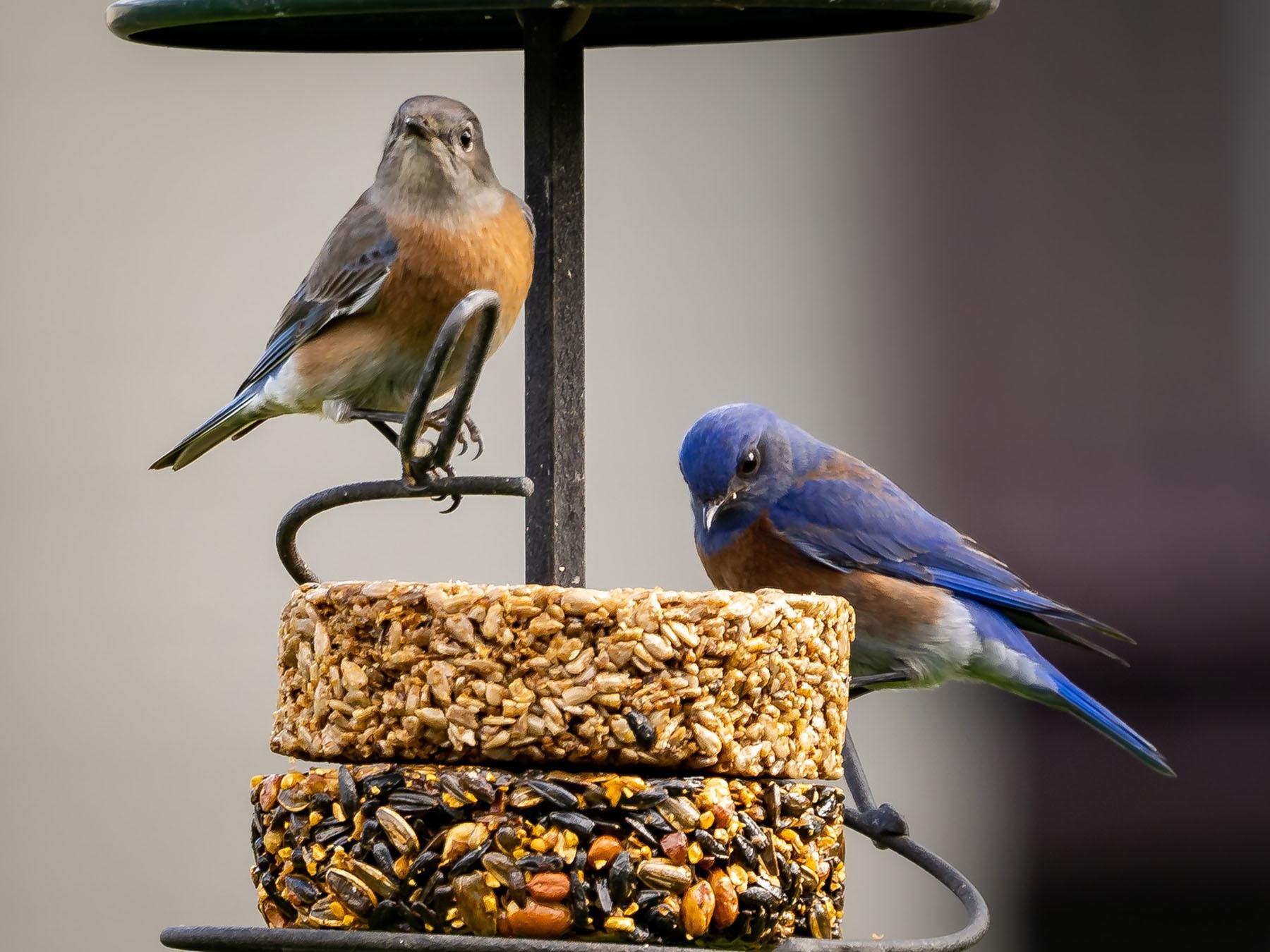
The female is much duller than the male. She has a gray head and throat and a gray-brown back, with blue only in the wings, the tail and usually the rump. Her breast is a dull orange-brown, her belly grayish, and the outer tail feathers have a white edge. Her gray throat separates her from a female Eastern Bluebird, whose throat is pale cinnamon to rusty orange.
In one studied population, males with brighter blue heads tended to be older and to raise heavier chicks, while a bigger rusty breast patch went with better body condition but not with age.2
Juvenile and first-year plumage
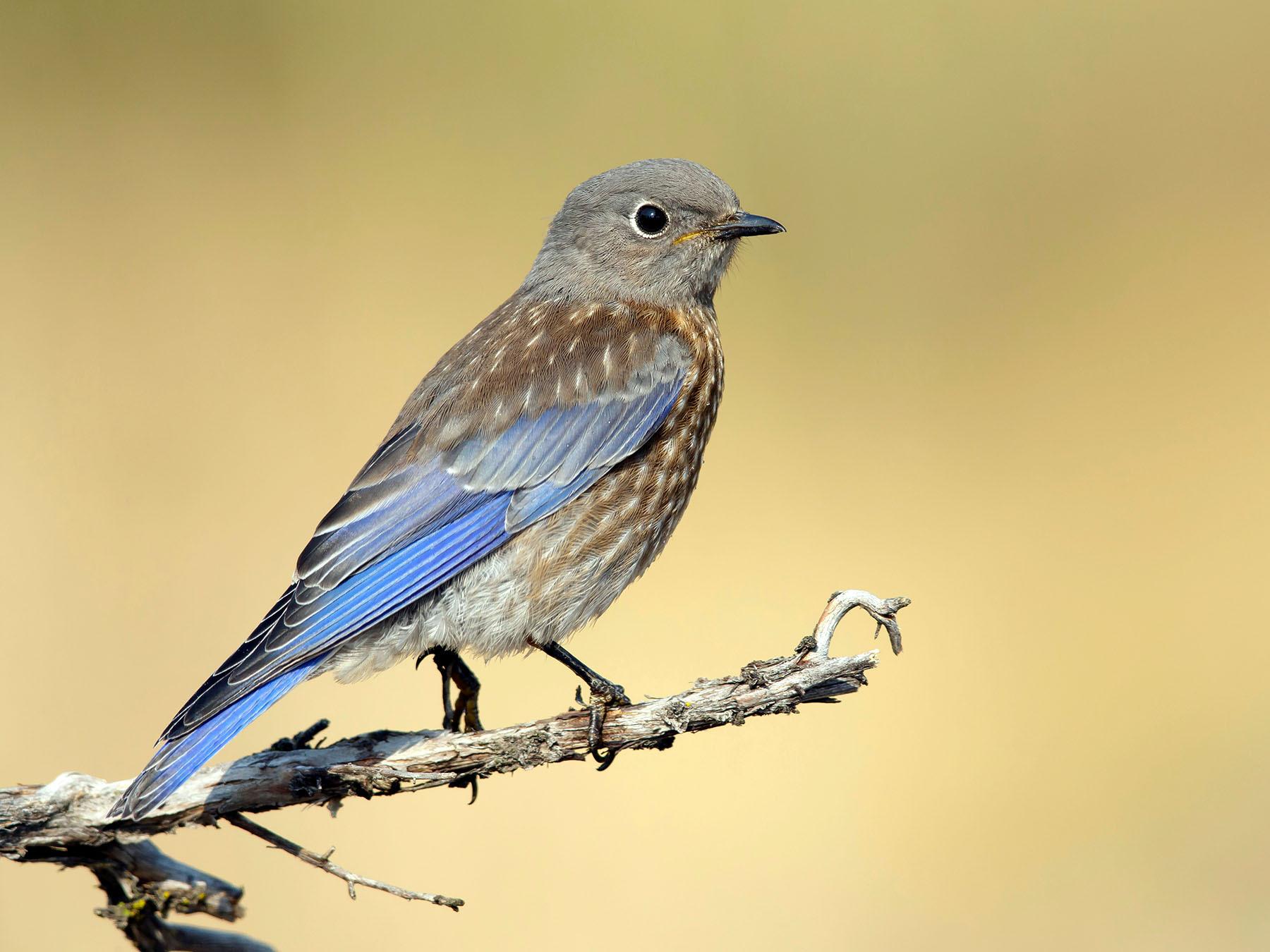
Juveniles are gray-brown above with white streaks and spots, and their light rusty to brown breast is heavily streaked or mottled with white. They already have blue in the wings and tail, and a distinct white eye-ring. Young females show duller blue and more white streaking than young males.
First-year birds look like adults but slightly duller. In the hand, a contrast between old and new feathers in the wing coverts is a reliable way to age them.
The sexes can be told apart even in the nest: at about 12 days old, males show stronger blue in their wing and tail feathers, and by 13-14 days the difference is easier to judge.1
Identification: Eastern, Mountain and Lazuli lookalikes
The Eastern Bluebird is the closest match. Its male is a paler, brighter blue above, with a reddish-brown throat whose color reaches toward the sides of the neck, a whitish belly, and only rarely any chestnut on the back. The female Eastern has a pale cinnamon to rusty-orange throat running onto the lower sides of the neck, and pale cinnamon flanks that contrast with a whitish belly. The female Western has a grayish throat and is dull rufous below, with a grayish belly.
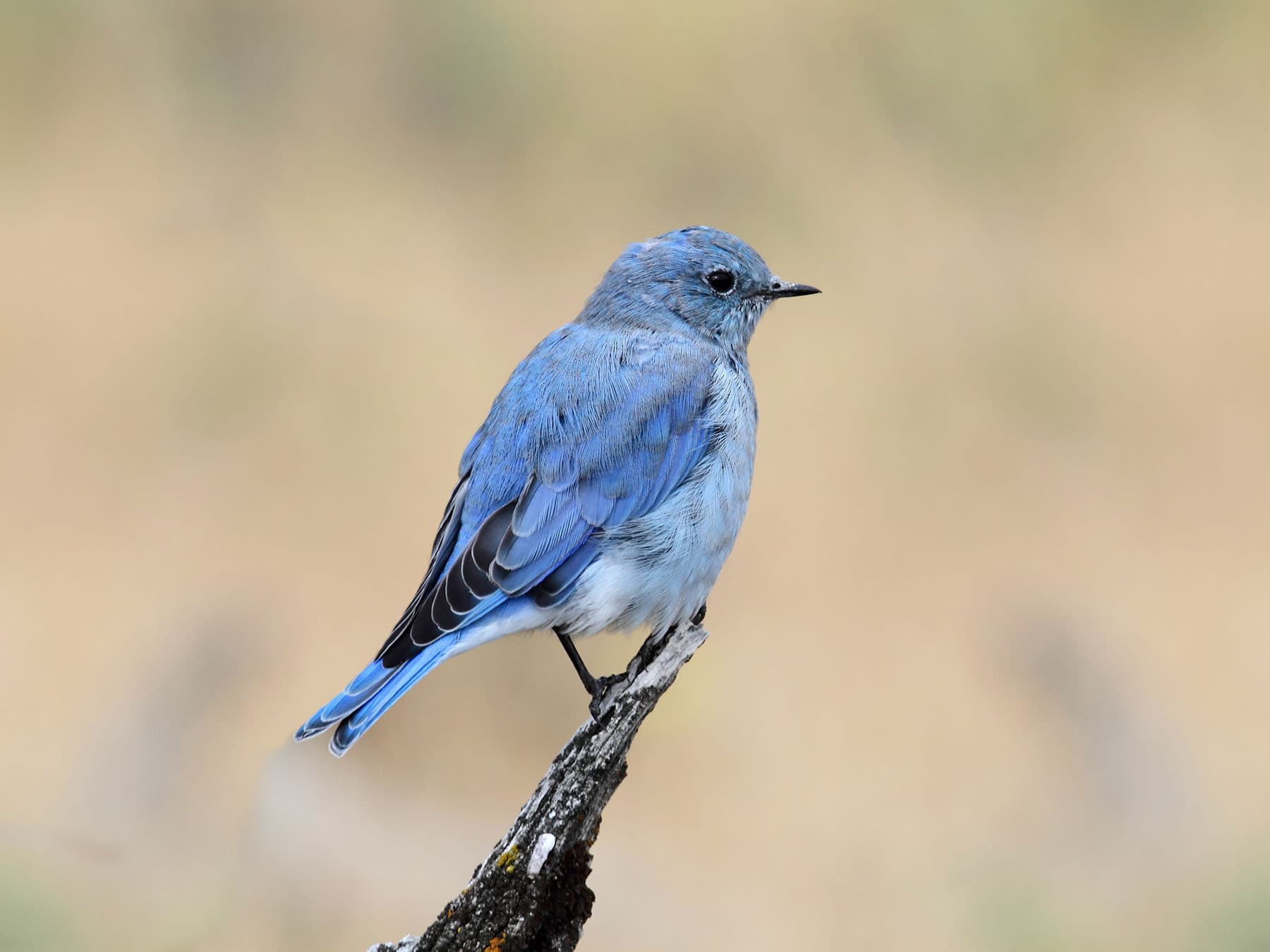
A male Mountain Bluebird is paler blue overall with no chestnut below. It is also shaped differently, with longer wings whose tips project farther, and a longer, thinner bill, and it stands more upright. Females are the hard ones, because a female Mountain can show a faint rufous or orange-buff wash on the breast. Check the upperparts: the female Mountain is more evenly colored on the head, nape and back, without the Western female's grayish head and brownish back.
A male Lazuli Bunting shares the blue upperparts and chestnut breast, but it is smaller, 5.1-5.9 in (13-15 cm), with a short, conical finch bill, two white wing bars and a white belly. For bluebirds against jays, see bluebird vs blue jay.
Not sure it’s a Western Bluebird? Check your photo: Birdfact names the bird and shows the look-alike side by side.
Its size
Adults- Length
- 16–19 cm
- Wingspan
- 29–34 cm
- Weight
- 24–31 g
Its song and calls
The call you will hear most is a soft few or kew, also written phew. Both sexes give it, often repeated and often in flight.
Other calls include a soft chuck and, in California in the breeding season, a harsh che-check. A chattering cut-cut-cut is often given when a person comes into a pair's territory. Males give a pa-wee while pairs are forming. An alarmed or aggressive bird also snaps its bill with a clicking sound.
Song
The song can be as simple as a few call notes strung together, written as a brief, quiet cheer, cheer-lee, churr; the dawn song is longer and more varied. Males sing most in the dawn chorus during the breeding season, and no female has been reported singing.
In Montana in the 1930s, males began the dawn chorus in full darkness early in the season, usually after only the Tree Swallows. As the days lengthened they started earlier, up to 2.5 hours before sunrise, and sang for 30 to 60 minutes; predawn song stopped soon after the second brood hatched.1
Its voice has had little study. Before a 2016 playback study, Birds of the World's account, last revised in 2008, called every report of its calls and songs anecdotal. In that study, young males responded more strongly to the songs of older males than to those of young males. This suggests males can tell a rival's age class by its song, and the authors say more research is needed to learn how.3
- Song0:00 / 0:29
Recorded in California, United States · June 2016
- Calls0:00 / 0:07
Recorded in California, United States · May 2022
- Calls0:00 / 0:08
Recorded in California, United States · January 2025
Heard one and not sure? Let the bird song identifier listen.
When and where to see it
These are birds of the West. In some southern and lowland areas they can be seen all year; farther north and higher up, many move south or downhill for the winter.
The breeding range runs from southern British Columbia and the southwest corner of Alberta to northern Baja California and the highlands of central Mexico, but the species is largely absent from the Great Basin. In Canada it breeds in the dry montane forest zone of southern British Columbia, with a few in southwestern Alberta. It occurs from sea level to about 3,900 ft (1,200 m) in British Columbia, while in the Southwest it breeds as high as 8,900 ft (2,700 m) in New Mexico and 9,500 ft (2,900 m) in south-central Colorado.
In winter many stay within the breeding range at lower elevations, from southern British Columbia and western Oregon through California. Others spread into California's Central Valley and southern coast, the lower Colorado River, most of Arizona, southern New Mexico, westernmost Texas (irregularly to central Texas) and northern Mexico. Winter temperature appears to set the limit of the winter range, at around 19°F (-7°C).1 Farther east it is casual in Oklahoma, with sight reports from North Dakota and Kansas.
In the US it breeds in parts of Washington and Oregon, most of California, northern and western Idaho, northwestern Montana and western Nevada. East of the Great Basin it breeds in extreme southern Wyoming, central and western Colorado, eastern and southern Utah, Arizona, New Mexico and the Guadalupe and Davis Mountains of west Texas.
Habitat
Look for it in open woodland with scattered trees, dead snags and low perches: ponderosa pine forest especially, oak woodland in California, streamside woods, farmland and orchards, and burned, moderately logged or edge areas. Unlike the other bluebirds, it does not favor large open meadows.
In winter it moves into piñon-juniper, mesquite, oak and streamside woodland, coastal chaparral and desert wherever winter food is plentiful, and less often into conifer forest.
It also lives close to people: in interior southern British Columbia, 53% of 546 nests were in rural and suburban areas and 33% in open pine and fir forest.1
Migration and winter movements
It is a short- to medium-distance partial migrant, described as the least migratory of the three bluebirds. Over much of the range it moves up and down mountains rather than north and south. It is resident in some southern areas and migratory in the north, and its winter range shifts from year to year with the supply of food.
Spring arrivals run from February to April, depending on place: from mid-February at Corvallis, Oregon, though usually in March there, and from mid-March in interior British Columbia. In fall, birds leave the northern mountains from mid-September, reaching the Arizona lowlands by late October and Sonora by November. Migrants travel by day in loose flocks. In Colorado, Utah and Arizona, wintering birds often visit the higher breeding grounds on mild days and in early spring, dropping back when the cold returns.
Geolocators fitted to 44 breeding adults at Los Alamos, New Mexico, in 2015, with data back from 10, showed no long-distance migration. The authors' most parsimonious reading is that these birds are resident or move less than the tags can detect, about 120 miles (200 km).4 Two birds recovered in late fall, about 50 miles (80 km) southeast and about 2,000 ft (600 m) lower, suggest that at least some make short moves downhill.4
Tips for seeing it
What it eats
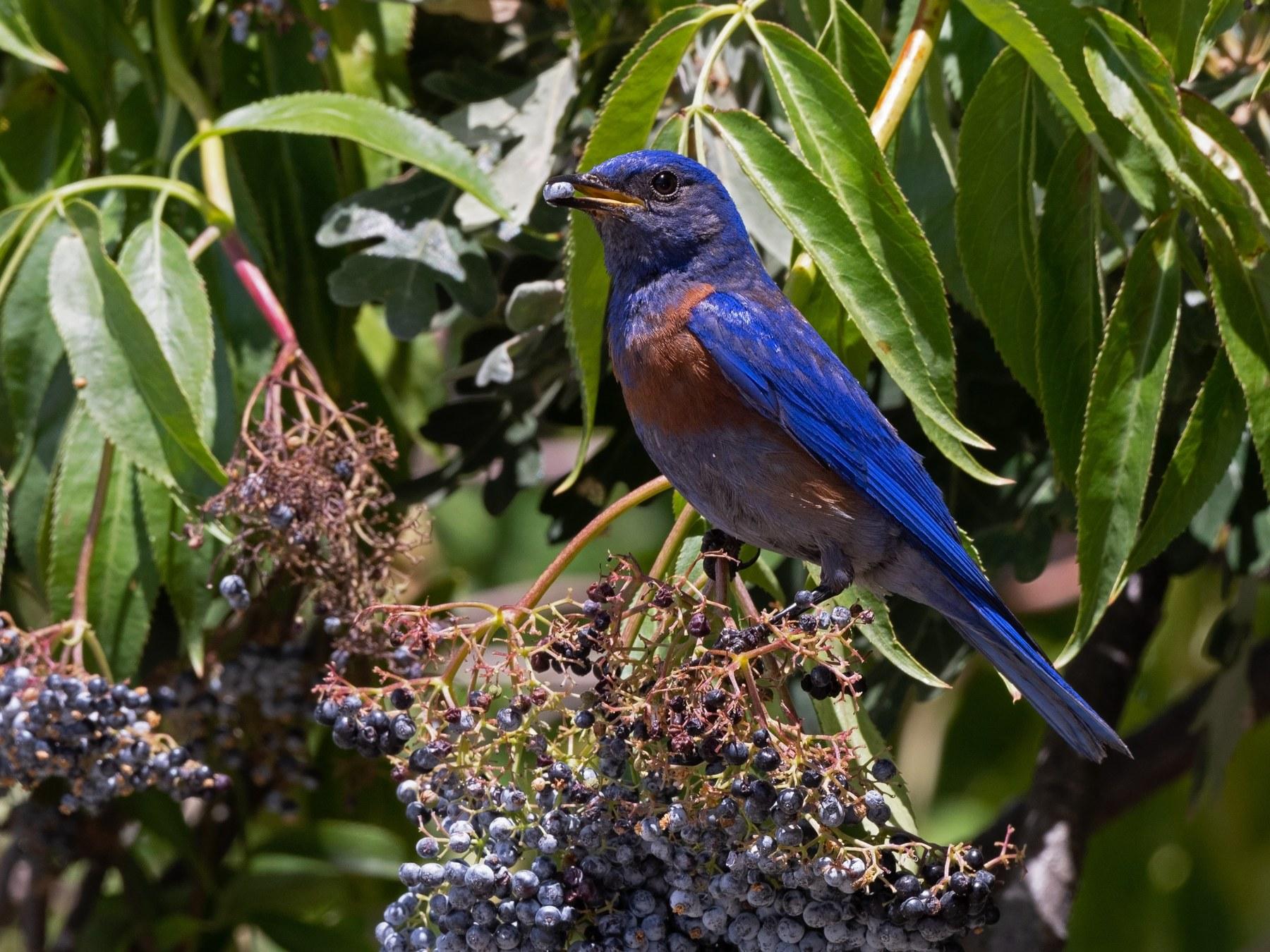
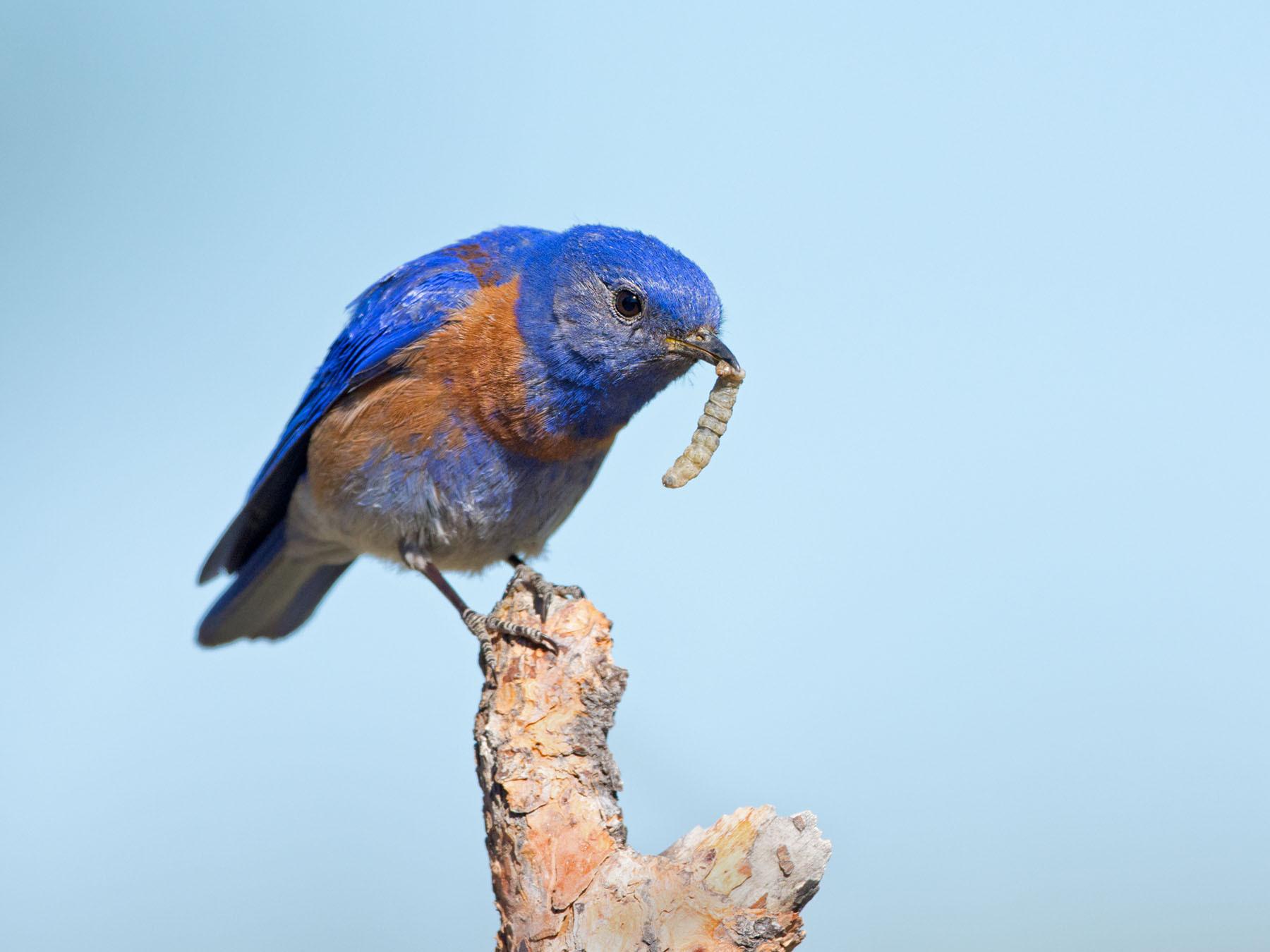
In the breeding season Western Bluebirds eat mainly insects, and in winter mostly small fruits, with some seeds and insects. Prey includes grasshoppers, beetles, caterpillars, bugs, ants, wasps and bees, flies and spiders, along with snails, sow bugs and earthworms. Fruits include juniper and mistletoe berries, elderberries, grapes, blackberries and raspberries, serviceberries, chokecherries, sumac and poison oak.
Most hunting is done from a low perch: the bird watches the ground, then drops down to take an insect in its bill. It also catches insects in the air, picks them from leaves and trunks, hops along the ground after prey, and sometimes hovers 3-10 ft (1-3 m) up before dropping onto prey.
In a Washington study of 22 adults and nestlings, chicks were fed mostly grasshoppers and crickets, 54% of items and 76% of the biomass, along with beetles, while adults ate mainly beetles; no plant food turned up in the breeding season.1
Vertebrates are almost never taken. The one capture on record is a first-year male in California that killed a 2-in (5-cm) western fence lizard by beating it against a fence post.1
Mistletoe and winter food
Mistletoe berries are eaten throughout the range and matter most in winter. On the lower Colorado River, 68% of 108 winter foraging attempts watched were for mistletoe berries, and in parts of Arizona and California the size of the winter population may depend partly on how much mistletoe there is.1
In a resident population in central coastal California, family groups defend mistletoe-laden trees as winter territories. When researchers removed half the mistletoe from territories, only 8% of sons stayed with their parents for the winter, against 50% on untouched territories.5
Feeding them in your yard
Mealworms can bring Western Bluebirds to a feeder; we found no other feeder food recommended for this species. A partly wooded yard with nest boxes can also draw them in (see nest boxes).6
Nesting and breeding
Western Bluebirds need a ready-made hole to nest in, since they cannot dig one. They use natural cavities and old woodpecker holes in living trees and dead snags, such as pine, oak, aspen, sycamore and cottonwood, and they readily take to nest boxes. Now and then they nest in buildings or in old swallow nests.
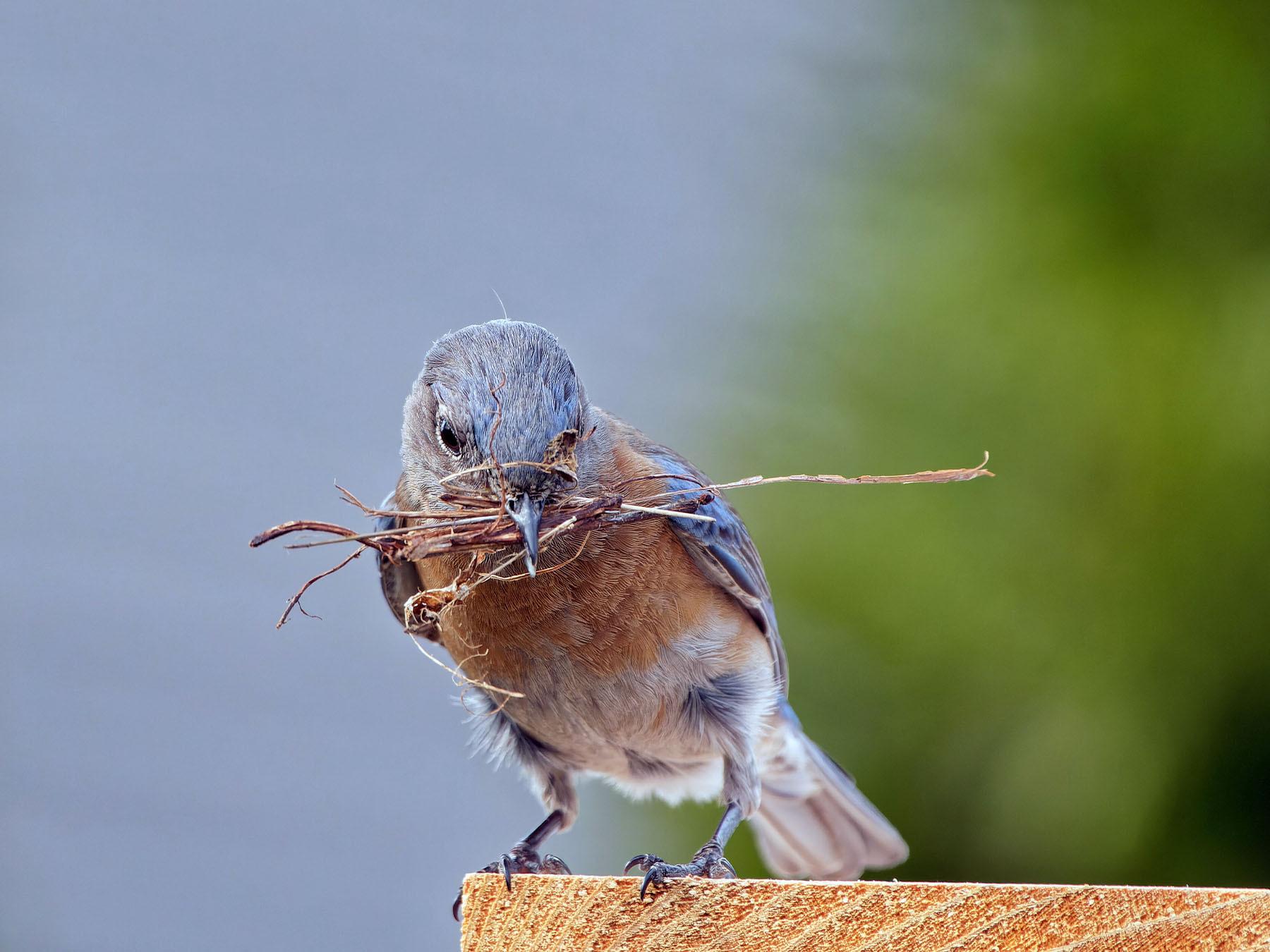
The female builds the nest, a loose cup of dry grass, conifer needles and other plant material lined with finer grass, hair or feathers, often with the male nearby. A first nest can take about two weeks and later ones under a week: 12.7 days against 3.6 in Arizona.1
Laying starts as early as March 8 in central California, though usually from mid- to late March there, and peaks from late April to early May. In Oregon it typically begins in mid-April.
Dead trees matter. In northern Arizona 70% of 33 nests were in snags, and the birds preferred snags under about 20 years old, while 58% of the ponderosa pine snags there fell within 30 years.1 In managed ponderosa pine in Washington, the holes they used had mostly been dug by Hairy Woodpeckers, White-headed Woodpeckers and Northern Flickers. There, 76% of 38 second nests were in the same cavity as the first, although 38% of those first attempts had failed, which the author takes to suggest that suitable cavities are in short supply.7
Eggs and young
The usual clutch is 5 eggs. Most clutches hold 4-6, up to 8 have been recorded, and first clutches are larger than second ones. The eggs are pale blue and unmarked, occasionally white, and about 0.83 x 0.63 in (21 x 16 mm).
Only the female incubates, for about two weeks: 13.7 days on average in northern Arizona (12-17 days, 125 nests), and 12 to 18 days in Oregon, where most eggs hatched on day 13 or 14. The chicks hatch within about a day of each other and leave the nest at about three weeks: 21.8 days on average in northern Arizona (18-25 days, 109 nests), and mostly on days 20-22 in Oregon.1
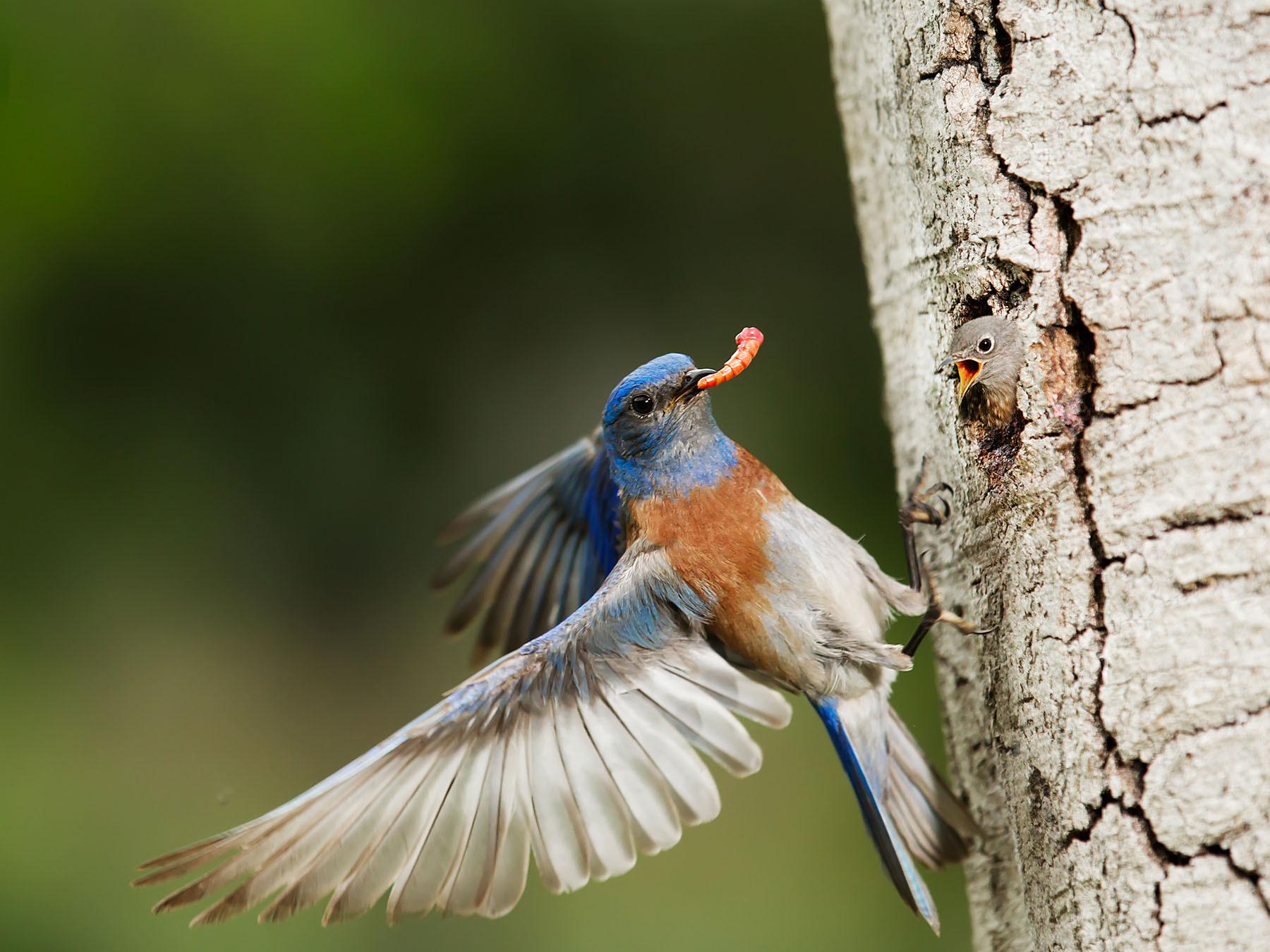
Both parents feed the chicks, and the male takes over the first brood if the female starts another nest. Fledglings stay close for a week or more and are independent within about two weeks, though they may beg from their parents for a month or more if no second clutch follows. Both sexes can breed at 10-11 months old, in their first spring.
Pairs usually raise one or two broods a season, and three are known in Oregon. In central California most pairs raise one, while in Oregon, over 8 years, 29% of females fledged two broods and 4% fledged three.1
Helpers at the nest
Some pairs have helpers, often adult males and frequently the pair's own sons, or young from an earlier brood. Helping is uncommon. In central coastal California, 3-16% of pairs have adult male helpers.8 There, over 11 years, an average of 7.4% of pairs had helpers, from none to 16% in a year.1
Elsewhere the figures are about 10% of nests with nestlings in one Oregon study, 2-14% of pairs in another, and 4% of females with nestlings in northern Arizona, and helping has been reported in some populations but not in others.1
In California, nests with adult helpers fledged 12% more young.1 The California researchers judge failed breeding and limits on breeding the most likely reasons most helpers help.8 In an Oregon population, a pedigree spanning seven generations found heritable variation in the tendency to help rather than breed.9
Nest boxes
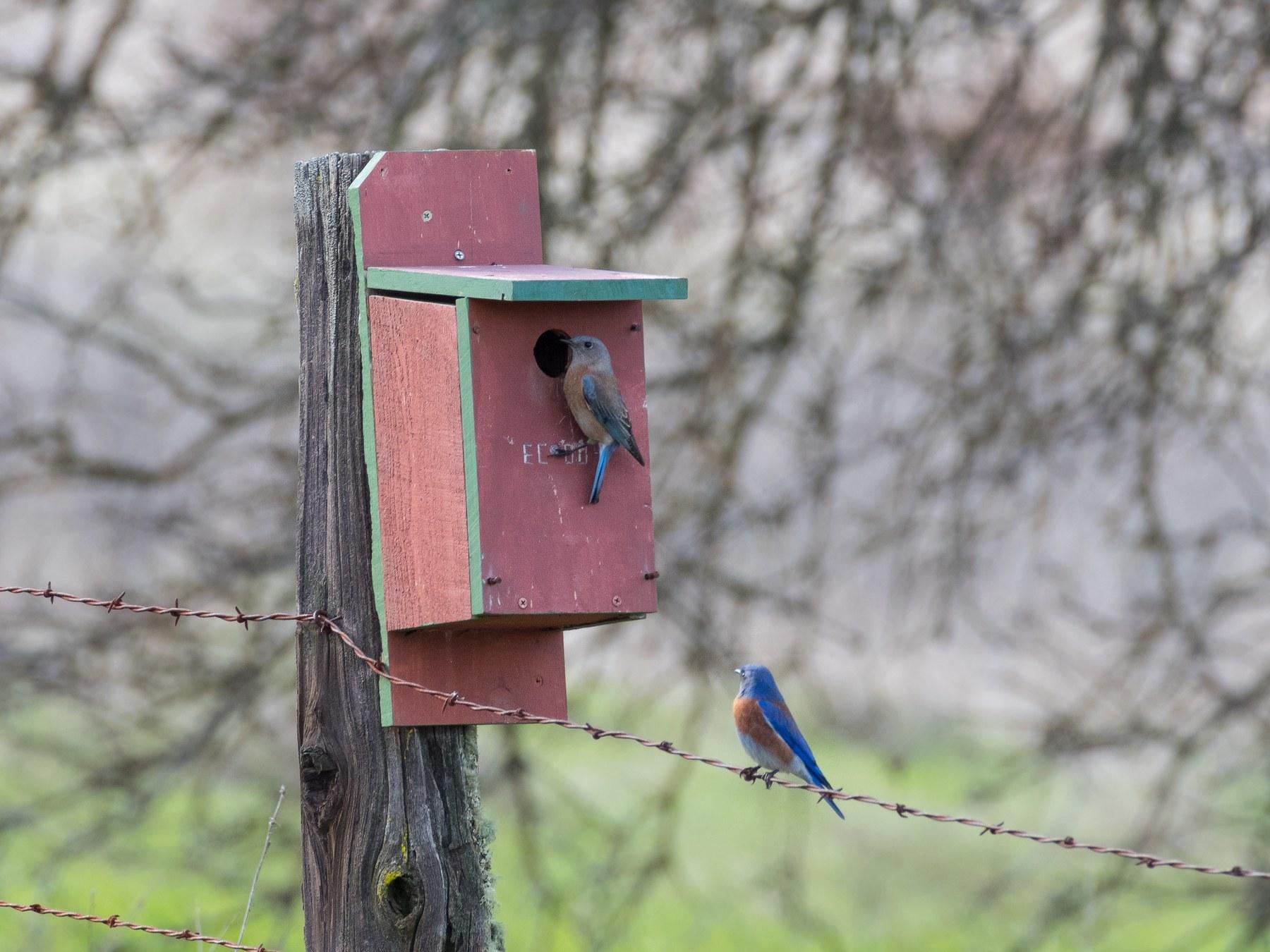
A box for Western Bluebirds should have a 1 1/2-inch (38 mm) entrance hole, a floor about 5 1/2 x 5 1/2 inches (14 x 14 cm) and a depth of about 9 inches (23 cm).10 Mount it 4-6 ft (1.2-1.8 m) up on a pole or a live tree, with boxes about 215 ft (66 m) apart, facing east toward an open area; some midday shade helps, and a box in full sun should face south.10 Clean out the old nest after each brood so the pair can nest again.10
Put boxes up well before the breeding season, with a guard to keep predators from the eggs and young.6 Where House Sparrows are a problem, a second entrance hole of the same size can help bluebirds defend the box.10
Boxes have helped bring the species back in parts of its range. In Oregon's Willamette Valley, 5 of 130 boxes were used in 1977 and 108 of 200 in 1996, and in northern Arizona breeding pairs rose 300-400% after boxes went into logged forest.1 A box program at Joint Base Lewis-McChord, Washington, has held more than 200 breeding pairs.11 Boxes are not a full answer, though: where a recovery depends on box trails, numbers stay stable only while the boxes are looked after.
Do they return to the same nest box?
Many adults do. In an Oregon study, adult breeding-site fidelity was nearly 100%, and in northern Arizona 62% of males and 46% of females returned over three years.1
At Los Alamos, New Mexico, most recaptured birds used the same box year after year. Young males are the ones that settle near home: 70 of 87 returning fledglings there (80%) were male.12
Behaviour
Western Bluebirds are usually seen in pairs in the breeding season and in flocks the rest of the year. Winter flocks are often small but can reach about 100, and may include American Robins, Yellow-rumped Warblers and Mountain Bluebirds; where junipers carry heavy berry crops they may gather by the hundreds. Outside the breeding season, birds may roost together in cavities for warmth, or inside clumps of mistletoe.
Pairs are socially monogamous and often last. In a 12-year California study, only 7 of 117 pairs changed mates when both birds returned to breed the next year.1
They are not always faithful, though. In central coastal California, DNA tests found 19% of 207 chicks were fathered by a male other than the one raising them, in 45% of 51 broods.8 In Montana the figures were 13% of 230 chicks, in 27% of 51 nests.1
In central coastal California, year-round residents commonly spend the winter in family groups that defend territories much like their breeding ones: the breeding pair, one or two of that year's sons and one or more unrelated females. More daughters than sons leave home.13
Aggressive behavior and rivals
Males fighting over territory may grab each other's legs and tumble to the ground, where one pins the other on its back and strikes with its bill.
Western Bluebirds compete for nest holes with many birds, including Mountain Bluebirds, Violet-green and Tree Swallows, House Wrens, nuthatches, chickadees, some woodpeckers, House Sparrows and European Starlings. In northern Arizona, Violet-green Swallows working in groups won 61% of 59 early-season contests with bluebirds.1
Aggression has shaped where they live. A 2007 study found that over the previous 30 years Western Bluebirds had spread across the northwestern US and displaced the less aggressive Mountain Bluebird, with the most aggressive males dispersing to the front. Once the Mountain Bluebirds were gone, aggression fell over the generations.14
Lifespan and predators
The oldest Western Bluebird on the US Bird Banding Laboratory's longevity list was a male at least 8 years 8 months old. He was banded in California in April 2001, already old enough to have hatched by 1999, and found injured and dead in California in February 2008.15 He is the only bird on the current list, so this is a minimum age on record, not a known maximum for the species.
Year-to-year survival is known from single sites. In a seven-year study in Oregon's Willamette Valley, adult males survived from one year to the next at 63% and females at 48%, and juveniles at 23-27%; the oldest bird found there was a six-year-old male. In a banded resident population in California, birds lived up to 8 years.1 Cold, wet spells kill nestlings.
Predators
Eggs and nestlings are taken by chipmunks, squirrels, weasels, snakes such as gopher snakes, raccoons and domestic cats. Cats and hawks, including Cooper's Hawks, take fledglings and adults. Parents answer a predator near the nest with chatter calls, bill-snapping and repeated low flights over it.
How many nests succeed depends on the place. Studies recorded 71-75% of nests succeeding in Arizona, California and British Columbia, but 31% of 26 in Washington, and snakes caused 35% of failed nests in one California population.1
Conservation
The Western Bluebird is listed as Least Concern on the IUCN Red List.16 Partners in Flight estimates about 7.1 million birds worldwide, 5.7 million of them in the US and Canada, with a reference year of about 2010.17 The State of Canada's Birds puts about 140,000 in Canada, 2% of the total.18
Over the long run, US numbers show no clear trend. The North American Breeding Bird Survey finds no significant change: +0.16% a year in the lower 48 states from 1967 to 2025 (95% credible interval -0.56 to +0.71), and +0.18% a year survey-wide. Over 2015-2025 the US trend was -0.85% a year, also not significant (-2.37 to +0.81); by state and province, the survey shows significant long-term increases in California (+0.74% a year) and British Columbia (+2.96%, on 13 routes).19
In Canada, the State of Canada's Birds reports a large increase of over 400% since 1970, with medium confidence because survey coverage is limited. Numbers rose from the mid-1980s to about 2007, then fell from the early 2010s back to early-2000s levels.18
An analysis based on eBird data points the other way. A 2026 genome paper, citing eBird models, says the species may still be declining over most of the area where it breeds, with a median change in modeled abundance of 21.8% from 2007 to 2022.20
Washington names it a Species of Greatest Conservation Need for the western part of the state, where numbers are low.11
Population history and recovery
West of the Cascades it was once reported as common, but it declined there from the 1950s to the 1980s. By 1994 only one breeding pair was left in Multnomah County, Oregon, where it had been a common resident, and breeders had also gone from the Sacramento Valley, where it was once common. The species disappeared from Montana valleys after land-use changes in the 1930s.1 How nest boxes have helped it return is under nest boxes.
Likely threats are the loss of nest sites and open feeding habitat: logging that removes snags, fire suppression that lets forests close in, grazing and development. In settled parts of the Northwest, House Sparrows and European Starlings competing for holes may have added to declines, though one comparison of bird counts from before and after the starling invasion found no significant declines.1
Open forest suits it. In northern Arizona, moderate logging raised breeding density from 8 pairs per 100 acres (40 ha) to 31 on a thinned plot and 35 on an open plot.1 In northwestern Arizona, nests in restoration-treated forest succeeded more often than in untreated forest (a probability of 0.75 against 0.39 from 1999 to 2001, in a study of 97 nests from 1998 to 2001) and produced 1.6 times as many fledglings. But up to 4.3 times as many nests held blowfly larvae, and the effect on the young after they leave the nest is unknown.21
Legal status
In the US the Western Bluebird is protected under the Migratory Bird Treaty Act and is listed by name on the federal list of protected migratory birds.22, 23 It is not a game bird, and it is not on the federal list of endangered and threatened wildlife.24, 25 The US Fish and Wildlife Service's ECOS profile gives it the status Species of Concern, under the category Not Listed.26
In Canada it is covered as a thrush by the Migratory Birds Convention Act, 1994. The 2022 regulations forbid capturing, killing, injuring or harassing migratory birds, or taking or disturbing their eggs, without a permit. Its nests are protected while they hold a live bird or a viable egg.27, 28 In Mexico we did not find it on the national list of species at risk (NOM-059-SEMARNAT-2010) or its 2025 draft revision.29
Similar birds
Often mistaken for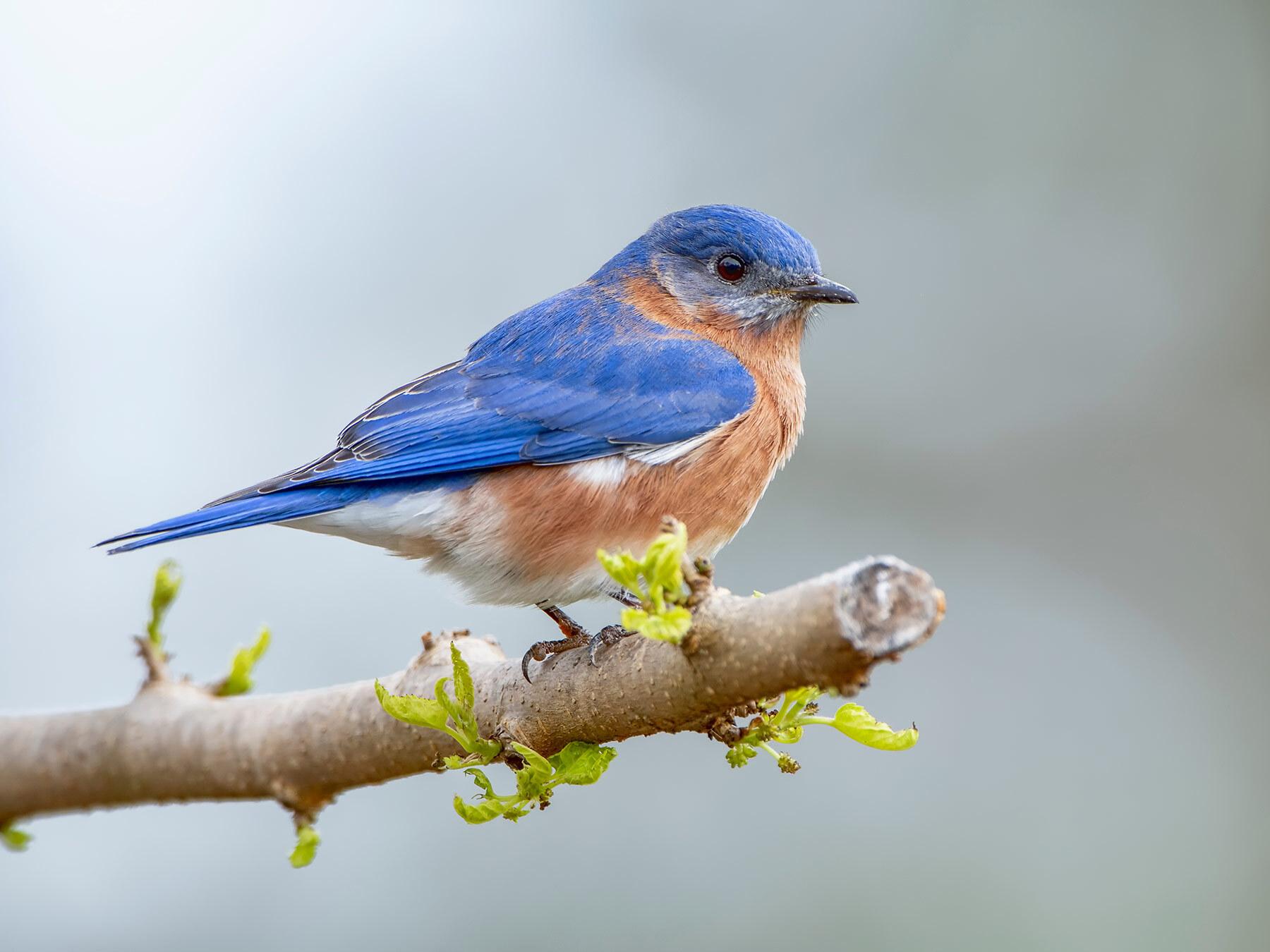
Western Bluebird guides
1 guidesQuick facts
- Length
- 16–19 cm
- Wingspan
- 29–34 cm
- Weight
- 24–31 g
- Lifespan
- oldest recorded 8 years 8 months
- Family
- Thrushes
- Migration
- Partial migrant
- Global status (IUCN)
- Least Concern
- World population
- About 7.1 million birds worldwide (Partners in Flight estimate, reference year about 2010)
- Population trend
- No significant long-term change in the Breeding Bird Survey since 1967, and no significant change over the last decade
- Scientific name
- Sialia mexicana
Questions
1What is the Western Bluebird's scientific name?
Sialia mexicana. Swainson described it in 1832 from the "tableland of Mexico", and mexicana refers to Mexico, where the type specimen came from. Sialia is the bluebird genus, shared with the Eastern and Mountain Bluebirds; DNA studies suggest those two are closer kin to each other than either is to the Western.
Sources
38- 1Guinan, J. A., Gowaty, P. A. and Eltzroth, E. K. (2020). Western Bluebird (Sialia mexicana), version 1.0. Birds of the World (A. F. Poole, Editor). Cornell Lab of Ornithology, Ithaca, NY, USA. doi:10.2173/bow.wesblu.01 (opens in a new tab)
- 2Budden, A. E. and Dickinson, J. L. (2009). Signals of quality and age: the information content of multiple plumage ornaments in male western bluebirds Sialia mexicana. Journal of Avian Biology 40(1): 18-27. doi:10.1111/j.1600-048x.2008.04344.x (opens in a new tab)
- 3Akçay, Ç., Arnold, J. A., Hambury, K. L. and Dickinson, J. L. (2016). Age-based discrimination of rival males in western bluebirds. Animal Cognition 19(5): 999-1006. doi:10.1007/s10071-016-1004-3 (opens in a new tab)
- 4Gadek, C. R. and Hathcock, C. D. (2022). Light-Level Geolocation of the LANL Population of Western Bluebirds. Los Alamos National Laboratory report LA-UR-22-20314. Accessed 20 November 2026. Source (opens in a new tab)
- 5Dickinson, J. L. and McGowan, A. (2005). Winter resource wealth drives delayed dispersal and family-group living in western bluebirds. Proceedings of the Royal Society B. doi:10.1098/rspb.2005.3269 (opens in a new tab)
- 6Cornell Lab of Ornithology. Western Bluebird: Overview, Identification and Life History. All About Birds. Accessed 20 November 2026. Source (opens in a new tab)
- 7Kozma, J. M. (2014). Characteristics of sites of Western Bluebird nests in managed ponderosa pine forests of Washington. Western Birds 45(4). doi:10.21199/wb45.4.5 (opens in a new tab)
- 8Dickinson, J. L. and Akre, J. J. (1998). Extrapair paternity, inclusive fitness, and within-group benefits of helping in western bluebirds. Molecular Ecology 7(1): 95-105. doi:10.1046/j.1365-294x.1998.00320.x (opens in a new tab)
- 9Charmantier, A., Keyser, A. J. and Promislow, D. E. L. (2007). First evidence for heritable variation in cooperative breeding behaviour. Proceedings of the Royal Society B. doi:10.1098/rspb.2007.0012 (opens in a new tab)
- 10Cornell Lab of Ornithology. Western Bluebird nest box page. NestWatch (Right Bird, Right House). Accessed 20 November 2026. Source (opens in a new tab)
- 11Washington Department of Fish and Wildlife. Western bluebird (Sialia mexicana). WDFW species and habitats. Accessed 20 November 2026. Source (opens in a new tab)
- 12Abeyta, E. J., Bartlow, A. W., Hathcock, C. D. and Fair, J. M. (2021). Individual Nest Site Preferences Do Not Explain Upslope Population Shifts of a Secondary Cavity-Nesting Species. Animals 11(8): 2457. doi:10.3390/ani11082457 (opens in a new tab)
- 13Kraaijeveld, K. and Dickinson, J. L. (2001). Family-based winter territoriality in western bluebirds, Sialia mexicana: the structure and dynamics of winter groups. Animal Behaviour 61(1): 109-117. doi:10.1006/anbe.2000.1591 (opens in a new tab)
- 14Duckworth, R. A. and Badyaev, A. V. (2007). Coupling of dispersal and aggression facilitates the rapid range expansion of a passerine bird. Proceedings of the National Academy of Sciences 104(38). doi:10.1073/pnas.0706174104 (opens in a new tab)
- 15USGS Bird Banding Laboratory. Longevity records: Western Bluebird (AOU 7670). USGS Bander Portal. Accessed 20 November 2026. Source (opens in a new tab)
- 16BirdLife International (via IUCN Red List on GBIF) (2021). Sialia mexicana. The IUCN Red List of Threatened Species 2021. GBIF IUCN checklist (IUCN 2026-1). Accessed 20 November 2026. Source (opens in a new tab)
- 17Partners in Flight (2023). Avian Conservation Assessment Database (ACAD), global. Partners in Flight / Bird Conservancy of the Rockies. Accessed 20 November 2026. Source (opens in a new tab)
- 18Environment and Climate Change Canada and Birds Canada (2024). The State of Canada's Birds: Western Bluebird. NatureCounts, Birds Canada. Accessed 20 November 2026. Source (opens in a new tab)
- 19Hostetler, J. A. et al. (2026). The North American Breeding Bird Survey, Analysis Results 1966 - 2025. U.S. Geological Survey. Accessed 20 November 2026. Source (opens in a new tab)
- 20Esperanza, C. W., Gee, H. K., Duckworth, R. A. and Schreier, A. D. (2026). The First Highly Contiguous Genome Assembly for the Western Bluebird (Sialia mexicana). Genome Biology and Evolution, evag219. doi:10.1093/gbe/evag219 (opens in a new tab)
- 21Germaine, H. L. and Germaine, S. S. (2002). Forest Restoration Treatment Effects on the Nesting Success of Western Bluebirds (Sialia mexicana). Restoration Ecology 10(2): 362-367. doi:10.1046/j.1526-100x.2002.00129.x (opens in a new tab)
- 22United States Congress. 16 U.S.C. 703, Migratory Bird Treaty Act. U.S. Code (GovInfo, 2023 edition). Accessed 20 November 2026. Source (opens in a new tab)
- 23U.S. Fish and Wildlife Service. 50 CFR 10.13 List of Migratory Birds. eCFR (as of 2026-11-18). Accessed 20 November 2026. Source (opens in a new tab)
- 24U.S. Fish and Wildlife Service. 50 CFR Part 20 Migratory Bird Hunting. eCFR (as of 2026-11-18). Accessed 20 November 2026. Source (opens in a new tab)
- 25U.S. Fish and Wildlife Service. 50 CFR 17.11 Endangered and threatened wildlife. eCFR (as of 2026-11-18). Accessed 20 November 2026. Source (opens in a new tab)
- 26U.S. Fish and Wildlife Service. ECOS species profile 3633: Western bluebird. Environmental Conservation Online System. Accessed 20 November 2026. Source (opens in a new tab)
- 27Government of Canada. Migratory Birds Convention Act, 1994. Justice Laws (current to 2026-10-19). Accessed 20 November 2026. Source (opens in a new tab)
- 28Government of Canada. Migratory Birds Regulations, 2022 (SOR/2022-105). Justice Laws (current to 2026-10-19). Accessed 20 November 2026. Source (opens in a new tab)
- 29SEMARNAT. NOM-059-SEMARNAT-2010 and PROY-NOM-059-SEMARNAT-2025 (draft). Diario Oficial de la Federacion. Accessed 20 November 2026. Source (opens in a new tab)
- 30National Audubon Society (text adapted from Kaufman, Lives of North American Birds, 1996). Western Bluebird. Audubon Guide to North American Birds. Accessed 20 November 2026. Source (opens in a new tab)
- 31Sullivan, J. (1995). Sialia mexicana. Fire Effects Information System, USDA Forest Service. Accessed 20 November 2026. Source (opens in a new tab)
- 32Gowaty, P. A. and Plissner, J. H. (2020). Eastern Bluebird (Sialia sialis), identification section. Birds of the World (A. F. Poole, Editor). Cornell Lab of Ornithology, Ithaca, NY, USA. doi:10.2173/bow.easblu.01 (opens in a new tab)
- 33Johnson, L. S. and Dawson, R. D. (2020). Mountain Bluebird (Sialia currucoides), identification section. Birds of the World (A. F. Poole, Editor). Cornell Lab of Ornithology, Ithaca, NY, USA. doi:10.2173/bow.moublu.01 (opens in a new tab)
- 34Greene, E., Muehter, V. R. and Davison, W. (2020). Lazuli Bunting (Passerina amoena), identification section. Birds of the World (A. F. Poole, Editor). Cornell Lab of Ornithology, Ithaca, NY, USA. doi:10.2173/bow.lazbun.01 (opens in a new tab)
- 35B.C. Conservation Data Centre (Westereng, L. K., report 2000; Hammerson, G., global text 2010) (2000). Conservation Status Report and Species Summary: Sialia mexicana. B.C. Ministry of Environment. Accessed 20 November 2026. Source (opens in a new tab)
- 36AviList Core Team (2026). AviList: The Global Avian Checklist, v2025b. AviList. Accessed 20 November 2026. Source (opens in a new tab)
- 37Guinan, J. A., Gowaty, P. A. and Eltzroth, E. K. (2020). Western Bluebird: names list (Birds of the World / HBW Alive taxon 58230). Birds of the World. Accessed 20 November 2026. Source (opens in a new tab)
- 38Jobling, J. A.. Key to Scientific Names: 'mexicana' and 'Sialia'. Birds of the World. Accessed 20 November 2026. Source (opens in a new tab)

Checked by
Nathan Cope, founder and editor
Nathan founded Birdfact and leads its writers and contributors in the UK, the US and Canada. He has watched and studied birds for more than ten years, and checks every article and species guide before it’s published.