


Steller's Jay
Cyanocitta stelleri
By the Birdfact teamChecked by Nathan Cope
On this page14 sections
How to recognise it
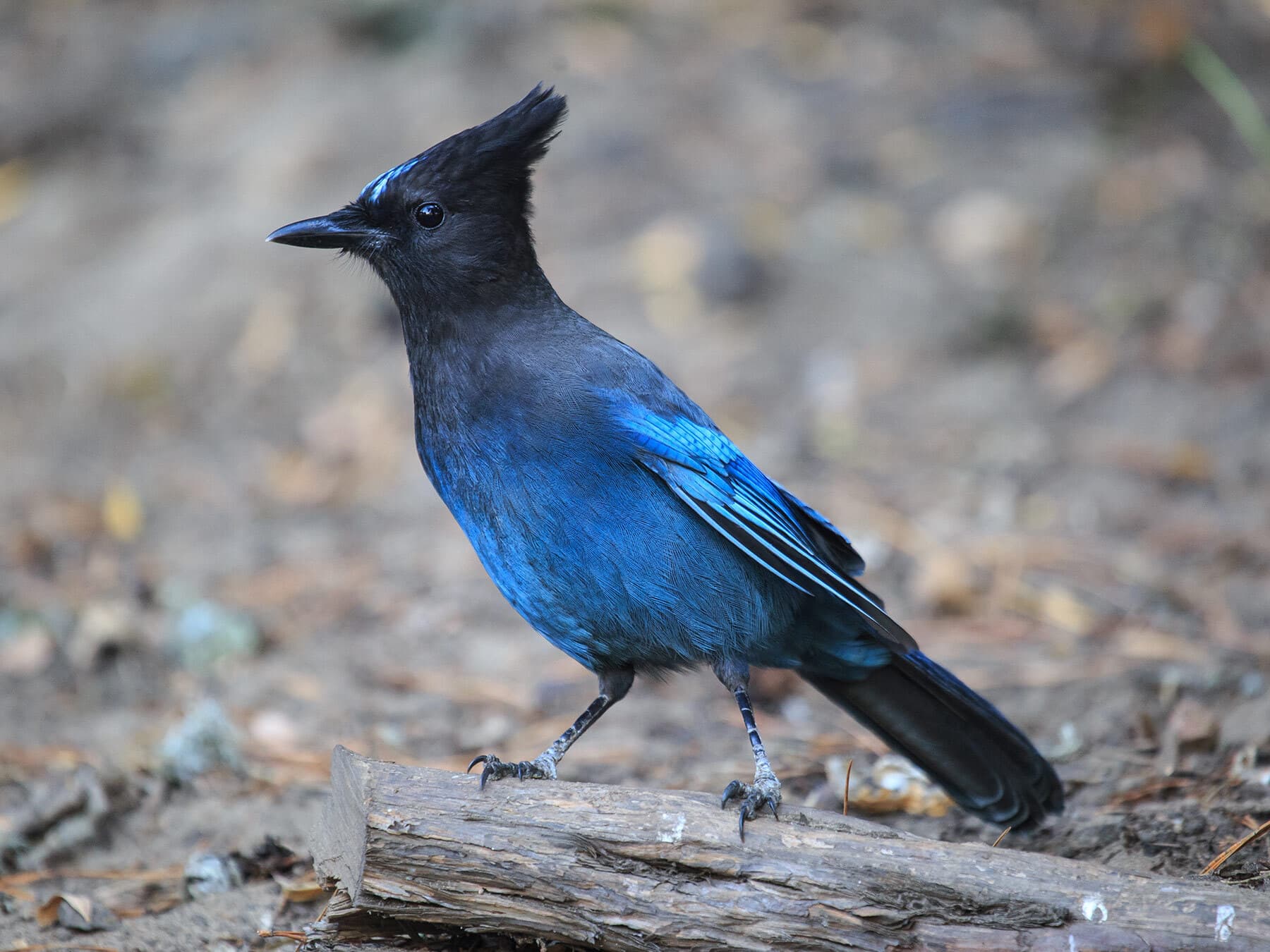
A Steller's Jay is a big, crested jay of western forests, with a black head, crest and breast and deep blue wings, tail and belly. The tall black crest, head and upper breast give way to a blue belly, wings and tail, and in most birds the back is blackish or gray. Fine black bars cross the wings and tail, and there is no white in the wings or tail, so at a distance the bird looks very dark, with no white underparts.1, 2
The crest is the giveaway. It is tall and pointed and often stands almost upright above a big head, a chunky body and a strong, slightly hooked black bill. The wings are rounded and the tail long and full.
Size and shape
Steller's Jays are 12 to 13.5 inches (30-34 cm) long2, with a wingspan of about 17 to 19 inches (44-48 cm)3, and weigh 3.5 to 4.9 ounces (100-140 g).1 That puts them between an American Robin and an American Crow in size, and larger and heavier than a Blue Jay, which is 9 to 12 inches (25-30 cm) long and weighs 2.5 to 3.5 ounces (70-100 g).
Size varies across the range. Jays generally get bigger the farther north they live, and Alaska birds are much larger than those of southern British Columbia. Birds from western Canada averaged 4.5 oz (128 g), Arizona birds 3.7 oz (106 g).1
Plumage across the range
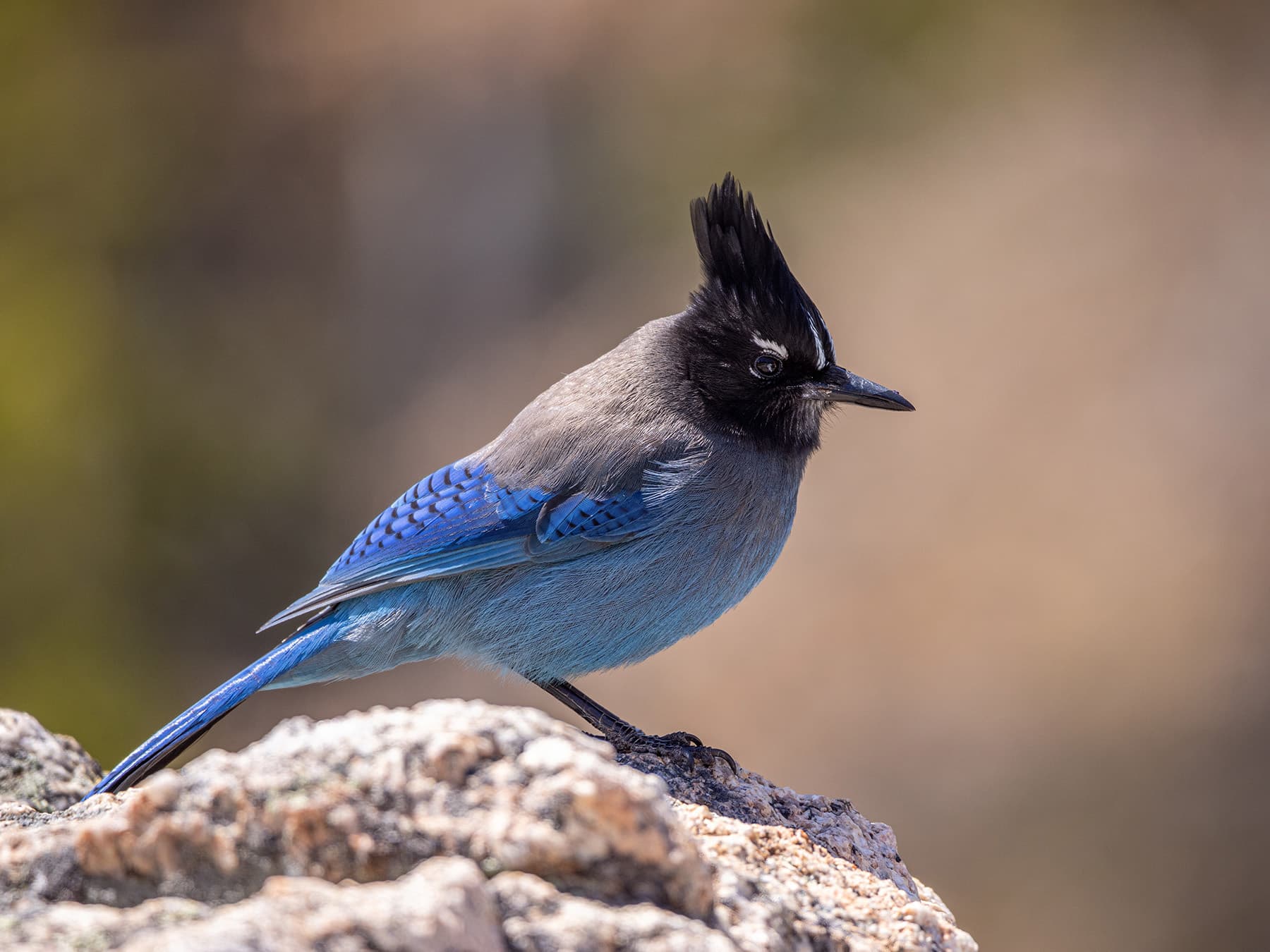
Where you see a Steller's Jay changes how it looks. Pacific coast birds, from Alaska to central California, and birds of the Cascades and Sierra Nevada have small blue streaks on the forehead and little or no white around the eye. Rocky Mountain and Southwest birds have white streaks on the forehead, a white mark above the eye and often one below it, and a grayer back that contrasts with the black head.
Farther south, from Jalisco in Mexico to Nicaragua, most birds have shorter blue crests and bluer heads and bodies; one black-crested form in central Mexico is surrounded by blue-crested ones. The largest North American birds, and among the darkest, live only on Haida Gwaii (the Queen Charlotte Islands) in British Columbia. AviList recognizes 13 subspecies4; older treatments split the species into 16 or 17.
Males, females and young
Males and females look alike. A female may have fainter, narrower black bars on the wings and tail, and males are generally a little larger, but the sizes overlap, so a single bird usually cannot be sexed by eye.1 Calls help: only females give the rattle and only males the creak (see the calls below). There is more in our guide to telling male and female Steller's Jays apart.
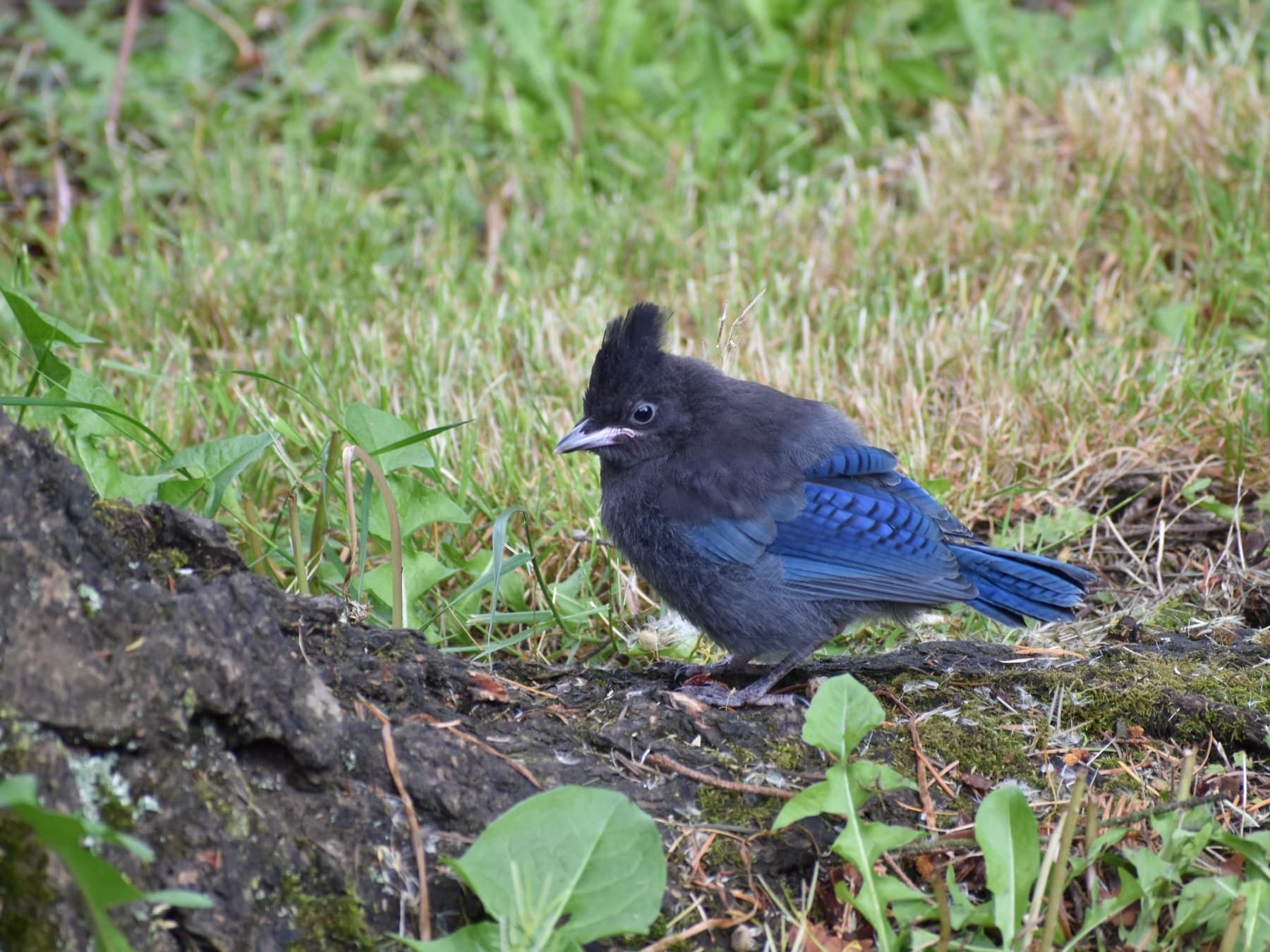
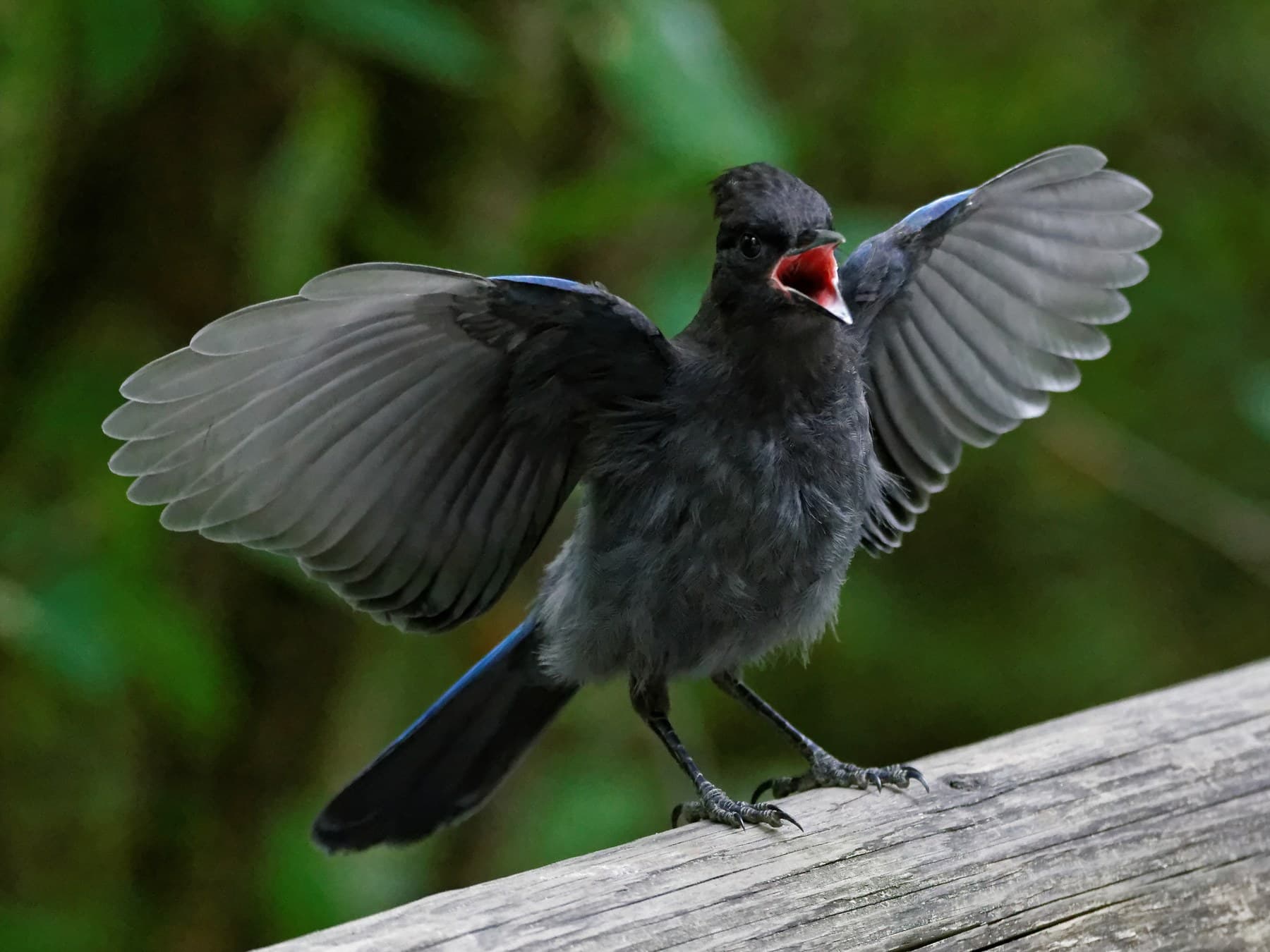
Juveniles, seen mainly from June to August, look like sooty versions of their parents: a sooty gray head and body, a shorter crest, no colored streaks on the forehead and no blue on the underparts. The bill starts pale and soon darkens. Adults replace all their feathers once a year, mainly from July to September; young birds have a partial molt at the same time of year, keeping some of their juvenile wing and tail feathers until the next year.
Identification: similar birds
Blue Jay. The only other crested jay in the United States and Canada. It is smaller, with a white face and underparts, a black necklace, and white wing bars and tail corners. A Steller's Jay is dark all over, with a black head and no white in the wings or tail.1 Where the two ranges meet, as in Colorado and British Columbia, they sometimes interbreed, and the hybrids look intermediate.1, 5
California and Woodhouse's Scrub-Jays. No crest at all. A California Scrub-Jay has a white throat edged with a streaky necklace and a gray back between its blue head and wings; a Woodhouse's Scrub-Jay is slimmer, with a dull blue head and pale gray underparts. Scrub-jays usually live lower down, in oak woods and scrub, though the two overlap.
Pinyon Jay. Stocky and short-tailed, dull blue all over with no crest and no black head, and almost always in flocks.
Not sure it’s a Steller's Jay? Check your photo: Birdfact names the bird and shows the look-alike side by side.
Its size
Adults- Length
- 30–34 cm
- Wingspan
- 44–48 cm
- Weight
- 100–140 g
Its song and calls
Steller's Jays are noisy, and a call is often the first sign of one. One of its commonest calls is a loud, harsh shook-shook-shook (or shack-shack-shack), repeated up to five times. Both sexes give it all year, in flight and perched, in squabbles and as an alarm at hawks. The female's version is slightly higher and more metallic than the male's.6
A harsh, nasal wah is another alarm call, and the one groups give when they mob a predator. Some calls belong to one sex: only females give a mechanical, clicking rattle, and only males give a soft, whistled creak that often ends in a pop. Both seem to matter in courtship.
The song is easy to miss. It is quiet: a long, rambling string of pops, gurgles, soft whistles and harsh notes, sung mostly by males, often in courtship, and sometimes for minutes on end from dense cover.

Hawk calls and mimicry
One of its calls, a slow, falling whistle, sounds much like a Red-tailed Hawk's scream, and it is often given by a hidden jay with no hawk nearby. Steller's Jays also imitate Northern Goshawks: when goshawk calls were played near goshawk nests, jays answered with goshawk-like calls after 33% of the playbacks.7
They are reported to copy other sounds too, from chickens, cats, dogs and squirrels to White-breasted Nuthatches, Northern Flickers and machines such as squeaky doors and sprinklers.
- Calls0:00 / 0:12
Recorded in Ed R, United States · January 2021
- Hawk-like screams (mimicry)0:00 / 0:14
Recorded in Ed R, United States · December 2021
Heard one and not sure? Let the bird song identifier listen.
When and where to see it
Steller's Jays live from southern coastal Alaska and British Columbia south through the western United States and the mountains of Mexico and Central America to Nicaragua. In the United States they live along the Pacific coast south to central California and in the mountains of the West, east to the Rockies of Montana, Wyoming, Colorado and New Mexico and, rarely, the Davis and Guadalupe Mountains of west Texas. They are absent from deserts, sagebrush and California's Central Valley.
Look for them in conifer and mixed forests, from damp coastal forest of hemlock, spruce and cedar to pine and Douglas-fir in the mountains, and in pine-oak woods in the Southwest. On the Pacific coast they live from sea level to the tree line; inland they live mostly at about 3,300-11,500 ft (1,000-3,500 m), and in Arizona they breed mostly above about 6,900 ft (2,100 m). They are most common where forest is broken into patches, often along edges, and they are familiar birds of campgrounds, picnic areas, parks and wooded suburbs.
In British Columbia the Steller's Jay was voted the most popular bird by the people of the province, and it became the province's official bird on 17 December 1987.8
Do they migrate?
Not in the usual sense. Most Steller's Jays stay on their home ground all year, but birds that breed high in the mountains typically move lower in winter. In British Columbia these moves usually begin in August and peak in September and October (from one observer's unpublished records).
In some years, perhaps when seed crops fail, large flocks, mostly of young birds, move into lowlands and places they do not normally live. In the 1992 invasion of Victoria, British Columbia, flocks of 8 to 250 jays arrived from 19 August to 27 September, wintered on acorns and feeders, and had mostly left by late April; of 89 birds aged, 75% were in their first year.9
Banded birds show how far some travel: one banded near Boulder, Colorado, was found 215 miles (346 km) to the south 75 days later, and another turned up 400 miles (640 km) away in New Mexico.1 Strays have reached southern Saskatchewan, South Dakota, Kansas and central Texas, and, as accidentals, Chicago and southeastern Quebec.
Tips for seeing it
What it eats
Steller's Jays eat almost anything: acorns, pine seeds and other nuts and seeds, berries and fruit, insects and spiders, and sometimes eggs, nestlings, small animals and food people leave out. Overall about two-thirds of the diet is plant food and one-third animal.2 Nuts and seeds matter most in fall and winter; insects, including wild bees, wasps and beetles, matter most in summer.
In a classic study of 93 birds collected in California, 72% of the food was plant material, mostly acorns, and 28% animal, including wasps and bees (11%) and beetles (8%).10
They feed in trees and on the ground, flicking leaf litter aside with the bill, catching insects in the air and picking them off leaves. To open a nut, a jay holds it under its feet and hammers it with its bill.
Food stores and caching
In fall Steller's Jays store food for winter. A jay can hold several acorns or pine seeds in its throat and bill on one trip, and it buries them mostly one to a spot, in soil or a bark crevice. Pine seeds may be carried up to 2 miles (3 km) before they are buried.11 It finds its own caches by memory, and it raids the caches of other birds and chipmunks by watching where they hide food.12 It also steals from the stores of Clark's Nutcrackers, Canada Jays and Acorn Woodpeckers.
Unrecovered caches matter to the forest: the jays carry pinyon pine seeds away from the parent tree and bury them, and some they never dig up germinate.11

Eggs and nestlings as food
Steller's Jays commonly take the eggs and nestlings of small birds. Studies suggest they come across nests while foraging for other food rather than seeking them out, though after a find they search the area more closely13, and they may take them most while feeding their own young.14 Birds of the World notes that near forest edges and campgrounds they may take the eggs of rarer birds such as the Marbled Murrelet.
Attacks on adult birds are seldom recorded. During heavy snow, jays have been seen catching a Pygmy Nuthatch and juncos in the air with their feet, then plucking and partly eating them.15
People often ask whether they eat hummingbirds. We found no record of it in Birds of the World's account, Audubon's guide, the 1972 report of jays killing small birds, or in a web search (November 2026).
Feeders and yards
Steller's Jays come readily to feeders in and near their forests. Put out peanuts, black oil or hulled sunflower seed, suet, cracked corn or mealworms, on a platform, a large hopper or tube feeder, the ground, or a suet cage.16 Given a choice, jays preferred sunflower seed, feeders no other jay was using, and feeders farther from cover.17 A jay taking seed after seed may be carrying it off to hide.
People change what jays eat. On Washington's Olympic Peninsula, jays within about half a mile (1 km) of settlements and campgrounds ate human food, while jays nesting more than 3 miles (5 km) away did not.18 Where Steller's and Blue Jays share feeders, the Steller's Jay usually wins. Birds of the World notes that they may eat garden produce and orchard and nut crops, and that netting protects them.


Nesting and breeding
In coastal California courtship begins in March or April: the male sidles up to the female with his tail spread and wings tilted, often singing, and he feeds her. Nest building starts in late March and peaks in April, and eggs are found from late April in California to early June in the Rockies.
The nest usually sits against the trunk on a level branch, often near the top of a tree, most often a conifer. Most nests are 10-16 ft (3-5 m) up, though some are almost on the ground and some as high as 100 ft (30 m), and near houses a pair may nest close to a window or path, or in a barn. Both birds gather material, often together, and the female does most of the building: a bulky cup of sticks, dry leaves, moss and plant fibers set in mud, lined with rootlets, pine needles and hair, 10-17 in (25-43 cm) across outside.10 Only Steller's and Blue Jays among New World jays build mud into their nests. No source we read records Steller's Jays using nest boxes.
The female lays 2 to 6 eggs, usually about 4, pale bluish green with small brown, purplish-brown or olive spots. She does most or all of the incubating, about 16 days, and the male feeds her.1, 2 Near the nest a pair keeps quiet and out of sight, but it turns loud and bold if the nest is threatened.
The young leave the nest at about 16 days old, by Birds of the World's account; Audubon's guide says about three weeks.1, 2 Both parents keep feeding them for about a month after they leave, and the family may stay together into fall or winter. Pairs raise one brood a year, and may nest again if the first attempt fails.
Pairs, nest success and young
Pairs stay together on their home ground all year, and over many years, in coastal California; bonds rarely change, and either bird pairs again if its mate dies. The pair is socially monogamous, but in a DNA study 12 of 79 young (15%) had been fathered by a male other than their mother's mate.19
Where they nest matters. In western Washington, 64% of pairs in forest fledged young, 2.9 on average, but only 11% of nests in nearby suburbs succeeded.20 Most probably first breed at 2-3 years old. In coastal California young birds leave home from mid-September to early October and settle within 6-9 miles (10-15 km) of where they hatched.1
Behaviour
Steller's Jays are bold, noisy and very social. Mates are rarely apart, neighbors meet and display often, and outside the nesting season they travel in small groups. Pairs are not strictly territorial: a pair dominates every other jay close to its nest, and its dominance fades with distance, so who gives way depends on where two jays meet. Near Berkeley, California, one pair's zone of dominance was about 400 ft (120 m) across.21
Watch the crest. It lies low when a jay is resting, feeding or courting, rises higher as the bird gets more aggressive or alarmed, and stands fully up in fights and when mobbing a predator. Groups mob hawks, ravens and squirrels with loud wah calls; once five or six jays dove at a perched Cooper's Hawk and knocked it to the ground.22
On the ground they hop, and they climb a tree by hopping up through its branches. They fly with slow, deliberate beats of their broad, rounded wings, and irrupting flocks in British Columbia were reluctant to cross open water. Where they meet scrub-jays in coastal California, each defends the area around its nest against the other, and the scrub-jay usually wins.

Lifespan and predators
The oldest Steller's Jay on the US Bird Banding Laboratory's list was at least 16 years 1 month old: a male banded in Alaska in 1972 and found dead there in 1987.23 Banding in the northwestern United States suggests about 67% of adults survive from one year to the next.1
Cooper's Hawks and Northern Goshawks take many: in north-central New Mexico, Steller's Jays made up 12% of identified Cooper's Hawk prey remains.1 Cats also kill them, and gopher snakes take young. Disease can hit hard: in fall 1992, at least 9 of 27 adult jays brought to one veterinary hospital in central Vancouver Island died of aspergillosis, a fungal lung infection.24
Conservation
The Steller's Jay is common and listed as Least Concern. Partners in Flight estimates about 3 million birds and gives it a Continental Concern Score of 11 out of 20 (2023), not a species of concern.25
Numbers are slowly falling. The North American Breeding Bird Survey shows a decline of 0.58% a year from 1968 to 2025, about 28% overall. Numbers have held steady in the Pacific Northwest rainforest, California and Washington, but fallen more in the interior West, including New Mexico, Utah, Arizona and Colorado.26 Farther south, a 1998 survey reported El Salvador's populations threatened with extirpation by habitat loss.27
Is it rare? Not in its range: it is a common bird of western conifer forests and a familiar one at campgrounds, picnic areas and feeders. In western Washington, numbers and nesting success were lower in suburbs than in forest.20
Similar birds
Often mistaken for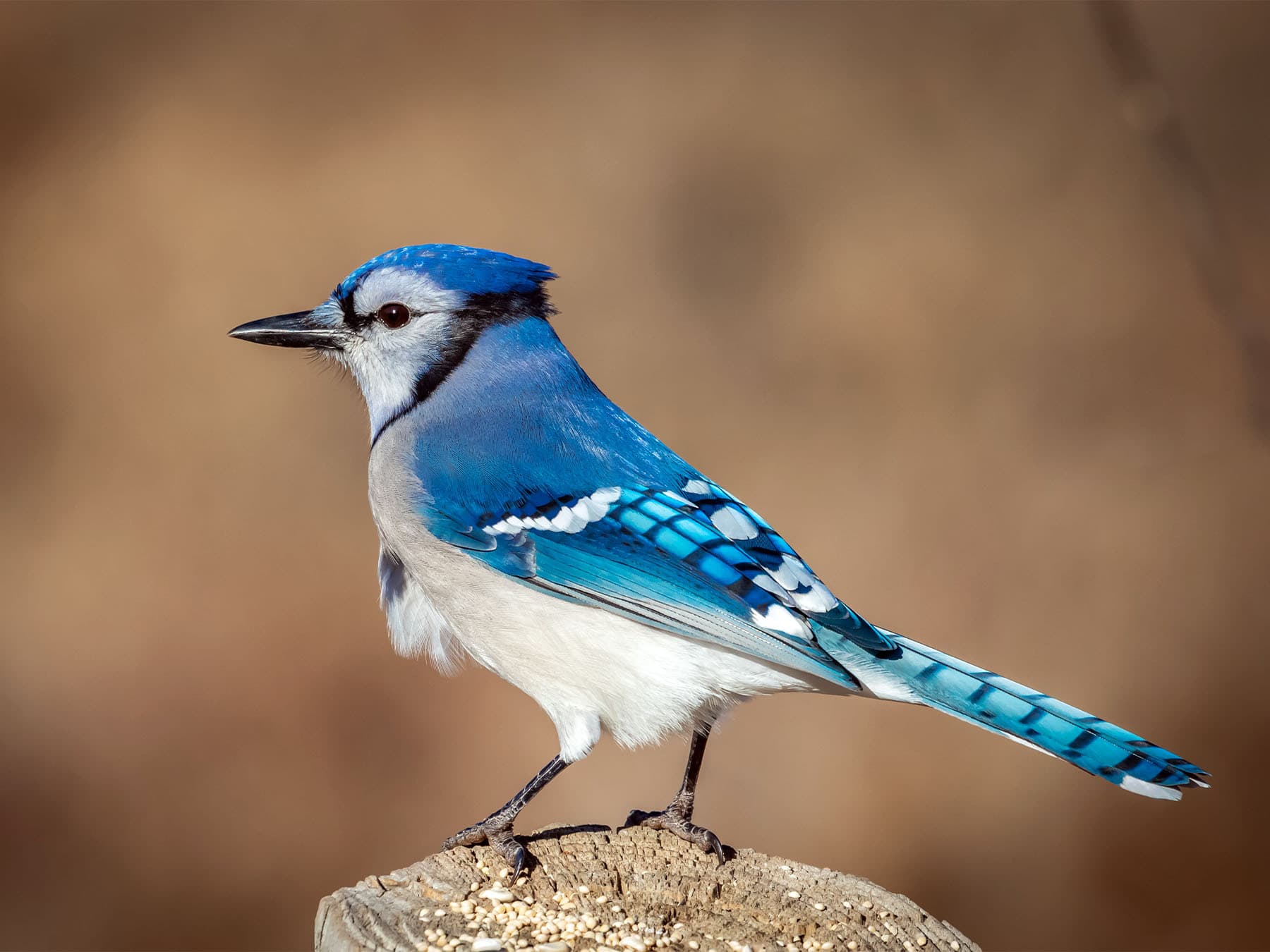
Steller's Jay guides
1 guidesQuick facts
- Length
- 30–34 cm
- Wingspan
- 44–48 cm
- Weight
- 100–140 g
- Lifespan
- oldest recorded at least 16 years 1 month
- Family
- Crows & Jays
- Global status (IUCN)
- Least Concern
- World population
- About 3 million (Partners in Flight, 2023)
- Population trend
- Common, but slowly declining
- Scientific name
- Cyanocitta stelleri
Questions
3Is the Steller's Jay being renamed?
Probably, in time. On 1 November 2023 the American Ornithological Society committed to changing the English names of birds in its area that are named after people, which includes Steller's Jay. Its 2024 pilot of six species did not include this jay, and no new name had been announced when we checked in November 2026.28 The scientific name, Cyanocitta stelleri, stays the same.
Why is it called Steller's Jay?
It is named after Georg Wilhelm Steller, naturalist on Vitus Bering's expedition, who saw it on Kayak Island, Alaska, in July 1741; the bird looked so like the Blue Jay Mark Catesby had painted in 1731 that Steller was sure the expedition had reached America. His specimen was lost, and J. F. Gmelin named the bird Corvus stelleri, "Steller's Crow", in 1788. It is Steller's, not "stellar".
Are Steller's Jays related to Blue Jays?
Yes: they are the only two species in the genus Cyanocitta, and both belong to the crow family. A 1997 genetic study put their split at about 5 million years ago.29 Their nearest relatives are the Pinyon Jay and the Aphelocoma jays, including the scrub-jays.
Sources
39- 1Walker, L. E. et al. (2020). Steller's Jay (Cyanocitta stelleri), version 1.0. Birds of the World (P. G. Rodewald, editor). Cornell Lab of Ornithology. doi:10.2173/bow.stejay.01 (opens in a new tab)
- 2National Audubon Society. Steller's Jay. Guide to North American Birds. Accessed 2 November 2026. Source (opens in a new tab)
- 3National Park Service. Steller's Jay. Bryce Canyon National Park. Accessed 2 November 2026. Source (opens in a new tab)
- 4AviList Core Team (2025). AviList: The Global Avian Checklist, v2025b. data/reference/avilist.csv. doi:10.2173/avilist.v2025b (opens in a new tab)
- 5Williams, O. and Wheat, P. (1971). Hybrid jays in Colorado. Wilson Bulletin 83: 343-346. Accessed 2 November 2026.
- 6Hope, S. (1980). Call form in relation to function in the Steller's Jay. American Naturalist 116: 788-820. doi:10.1086/283670 (opens in a new tab)
- 7Kennedy, P. L. and Stahlecker, D. W. (1993). Responsiveness of nesting Northern Goshawks to taped broadcasts of 3 conspecific calls. Journal of Wildlife Management 57: 249-257. doi:10.2307/3809421 (opens in a new tab)
- 8Government of British Columbia. Symbols of B.C.. Government of British Columbia. Accessed 2 November 2026. Source (opens in a new tab)
- 9Stewart, A. C. and Shepard, M. G. (1994). Steller's Jay invasion of southern Vancouver Island, British Columbia. North American Bird Bander 19: 90-95. Accessed 2 November 2026.
- 10Bent, A. C. (1946). Life histories of North American jays, crows, and titmice. United States National Museum Bulletin 191. Accessed 2 November 2026.
- 11Vander Wall, S. B. and Balda, R. P. (1981). Ecology and evolution of food-storage behavior in conifer-seed-caching corvids. Zeitschrift für Tierpsychologie 56: 217-242. doi:10.1111/j.1439-0310.1981.tb01298.x (opens in a new tab)
- 12Thayer, T. C. and Vander Wall, S. B. (2005). Interactions between Steller's Jays and yellow pine chipmunks over scatter-hoarded sugar pine seeds. Journal of Animal Ecology 74: 365-374. doi:10.1111/j.1365-2656.2005.00932.x (opens in a new tab)
- 13Vigallon, S. M. and Marzluff, J. M. (2005). Is nest predation by Steller's Jays (Cyanocitta stelleri) incidental or the result of a specialized search strategy?. Auk 122: 36-49. doi:10.1093/auk/122.1.36 (opens in a new tab)
- 14Sieving, K. E. and Willson, M. F. (1999). A temporal shift in Steller's Jay predation on bird eggs. Canadian Journal of Zoology 77: 1829-1834. doi:10.1139/z99-150 (opens in a new tab)
- 15Carothers, S. W., Sharber, N. J. and Balda, R. P. (1972). Steller's Jays prey on Gray-headed Juncos and a Pygmy Nuthatch during periods of heavy snow. Wilson Bulletin 84: 204-205. Accessed 2 November 2026.
- 16Project FeederWatch. Common Feeder Birds: Steller's Jay. Cornell Lab of Ornithology and Birds Canada. Accessed 2 November 2026. Source (opens in a new tab)
- 17Bekoff, M., Allen, C. and Grant, M. C. (1999). Feeding decisions by Steller's Jays (Cyanocitta stelleri): the utility of a logistic regression model for analyses of where, what, and with whom to eat. Ethology 105: 393-406. doi:10.1046/j.1439-0310.1999.00438.x (opens in a new tab)
- 18Marzluff, J. M. and Neatherlin, E. (2006). Corvid response to human settlements and campgrounds: causes, consequences, and challenges for conservation. Biological Conservation 130: 301-314. doi:10.1016/j.biocon.2005.12.026 (opens in a new tab)
- 19Overeem, K. R., Gabriel, P. O., Zirpoli, J. A. and Black, J. M. (2014). Steller sex: infidelity and sexual selection in a social corvid (Cyanocitta stelleri). PLoS ONE 9(8): e105257. doi:10.1371/journal.pone.0105257 (opens in a new tab)
- 20Vigallon, S. M. and Marzluff, J. M. (2005). Abundance, nest sites, and nesting success of Steller's Jays along a gradient of urbanization in western Washington. Northwest Science 79: 22-27. Accessed 2 November 2026.
- 21Brown, J. L. (1963). Aggressiveness, dominance and social organization in the Steller Jay. Condor 65: 460-484. doi:10.2307/1365507 (opens in a new tab)
- 22Ficken, M. S. (1989). Are mobbing calls of Steller's Jays a "confusion chorus"?. Journal of Field Ornithology 60: 52-55. Accessed 2 November 2026.
- 23USGS Bird Banding Laboratory. Longevity records of North American birds. USGS Eastern Ecological Science Center, Bird Banding Laboratory. Accessed 2 November 2026. Source (opens in a new tab)
- 24Machin, K. (1993). Aspergillosis outbreak in Steller's jays (Cyanocitta stelleri) from central Vancouver. Canadian Veterinary Journal 34: 247-248. Accessed 2 November 2026.
- 25Partners in Flight (2023). Avian Conservation Assessment Database and Population Estimates Database. Bird Conservancy of the Rockies. Accessed 2 November 2026. Source (opens in a new tab)
- 26Hostetler, J. A. et al. (2026). The North American Breeding Bird Survey, Analysis Results 1966-2025. U.S. Geological Survey data release. doi:10.5066/P1OSNSFC (opens in a new tab)
- 27Komar, O. (1998). Avian diversity in El Salvador. Wilson Bulletin 110: 511-533. Accessed 2 November 2026.
- 28American Ornithological Society. English Bird Names Project. American Ornithological Society. Accessed 2 November 2026. Source (opens in a new tab)
- 29Klicka, J. and Zink, R. M. (1997). The importance of recent ice ages in speciation: a failed paradigm. Science 277: 1666-1669. doi:10.1126/science.277.5332.1666 (opens in a new tab)
- 30Cornell Lab of Ornithology. Steller's Jay. All About Birds. Accessed 2 November 2026. Source (opens in a new tab)
- 31National Audubon Society. Blue Jay. Guide to North American Birds. Accessed 2 November 2026. Source (opens in a new tab)
- 32National Audubon Society. California Scrub-Jay. Guide to North American Birds. Accessed 2 November 2026. Source (opens in a new tab)
- 33National Audubon Society. Woodhouse's Scrub-Jay. Guide to North American Birds. Accessed 2 November 2026. Source (opens in a new tab)
- 34National Audubon Society. Pinyon Jay. Guide to North American Birds. Accessed 2 November 2026. Source (opens in a new tab)
- 35Brown, J. L. (1964). The integration of agonistic behavior in the Steller's Jay Cyanocitta stelleri (Gmelin). University of California Publications in Zoology 60: 223-328. Accessed 2 November 2026.
- 36Goodwin, D. (1976). Crows of the World. Comstock Publishing Associates, Ithaca, New York. Accessed 2 November 2026.
- 37Mann, N. J. (1983). Comparative physiology of the Scrub Jay (Aphelocoma coerulescens) and the Steller's Jay (Cyanocitta stelleri). Comparative Biochemistry and Physiology 76: 305-318. Accessed 2 November 2026.
- 38Shawkey, M. D. and Hill, G. E. (2006). Significance of a basal melanin layer to production of non-iridescent structural plumage color: evidence from an amelanotic Steller's Jay (Cyanocitta stelleri). Journal of Experimental Biology 209: 1245-1250. doi:10.1242/jeb.02115 (opens in a new tab)
- 39Gabriel, P. O. and Black, J. M. (2012). Reproduction in Steller's Jays (Cyanocitta stelleri): individual characteristics and behavioral strategies. Auk 129: 377-386. Accessed 2 November 2026.

Checked by
Nathan Cope, founder and editor
Nathan founded Birdfact and leads its writers and contributors in the UK, the US and Canada. He has watched and studied birds for more than ten years, and checks every article and species guide before it’s published.