


California Scrub-Jay
Western Scrub-Jay · Aphelocoma californica
By the Birdfact teamChecked by Nathan Cope
See it in 3D
2 plumages
An adult California Scrub-Jay is 11–12 in (28–30 cm) long, bill to tail.
Adult
© 2026 NC Digital Limited (Birdfact). All rights reserved. This 3D model may be viewed on this page and shared by link only. Downloading, extracting, copying or reusing it, or using it to train machine-learning models, is not permitted without our written permission. Using our models
On this page15 sections
How to recognise it
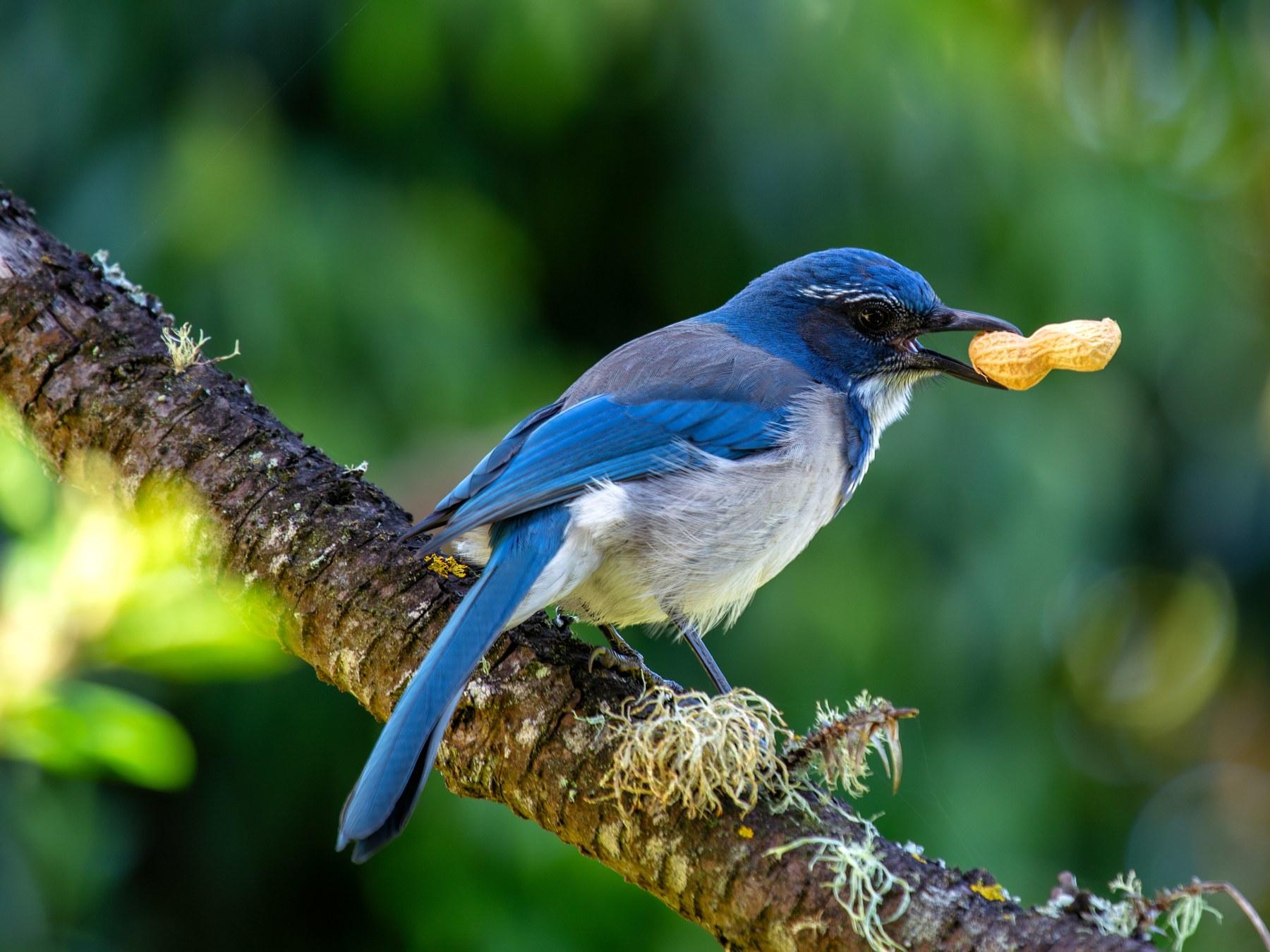
The California Scrub-Jay is the crestless blue jay of backyards, parks and oak woods along the Pacific Coast, from Washington to the tip of Baja California. Until 2016 it was lumped with the birds of the interior West as the Western Scrub-Jay, so many people still know it by that name. It is a long-tailed, lanky jay that hops boldly about on the ground, perches out in the open on wires and fence posts, and makes a lot of noise.1
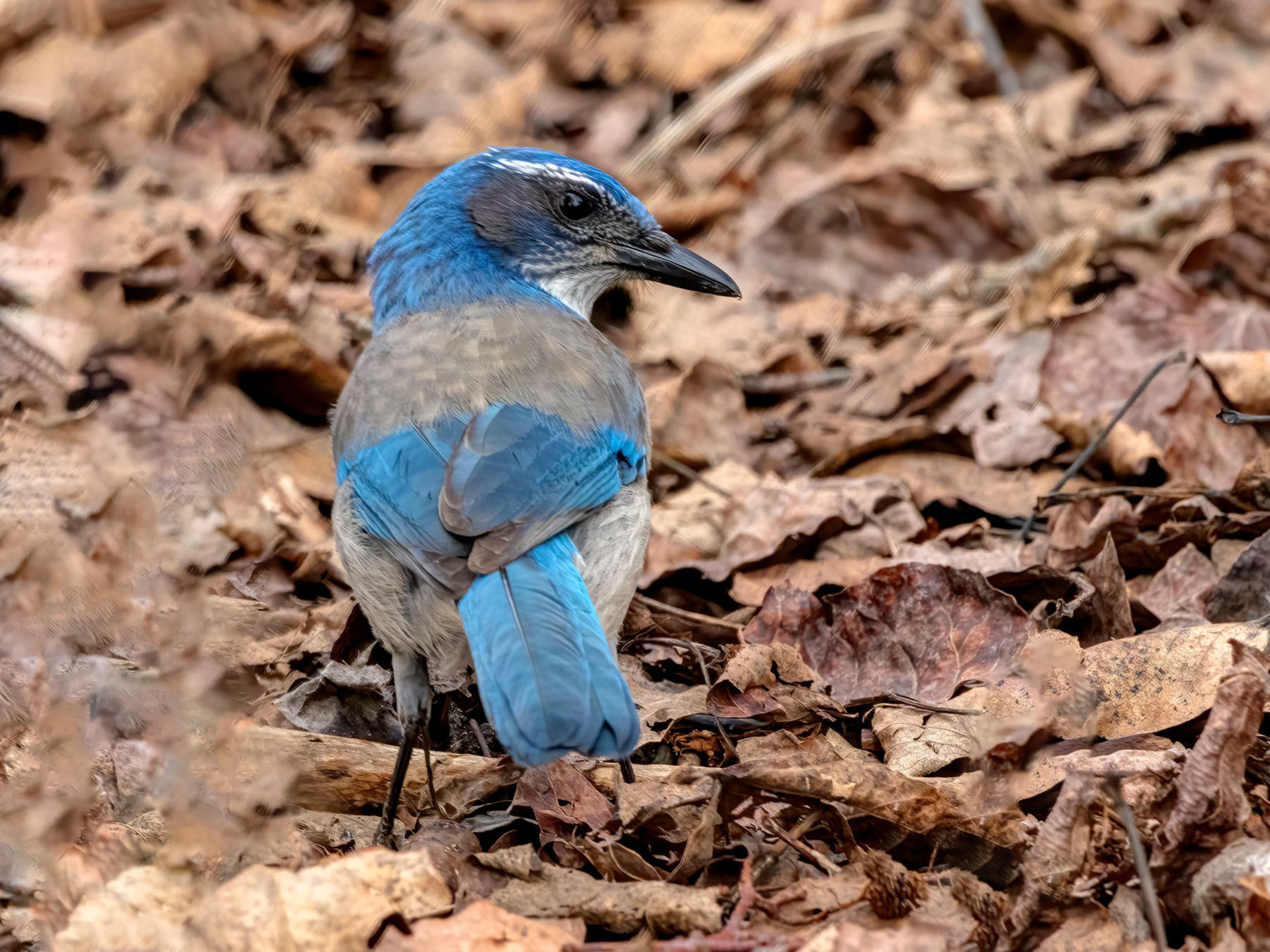
Look for a blue head, wings and long tail with a dull gray-brown patch on the back between them. A thin white eyebrow, made of fine white streaks, runs over a sooty cheek. The throat is whitish and finely streaked, framed by a band of blue that runs down each side of the breast like a broken necklace, and the belly is pale gray. The bill is black, stout and hooked at the tip, and the legs are black. In poor light the blue can look almost dark.

Size
The California Scrub-Jay is about 11-12 in (28-30 cm) long and weighs 2.5-3.5 oz (70-100 g), between a robin and a crow in size. Much of that length is tail. Males average a little larger than females.
Male, female and juvenile
Males and females look alike. Juveniles, seen from late spring into summer, are quite different: the head is a dusky gray-brown with little or no blue, there is little or no white eyebrow, and the throat is plain whitish with no blue necklace, so a young bird looks gray with blue wings and tail. Inside the mouth young birds have pink patches that fade over their first months.
From about five weeks after leaving the nest, young birds molt their body feathers and soon look like adults, but they keep their juvenile wing and tail feathers through their first year. Adults molt once a year, in summer, and have no separate breeding plumage.

Identification: other scrub-jays, Steller's and Blue jays
Woodhouse's Scrub-Jay, the other half of the old Western Scrub-Jay, lives in the interior West, mostly in pinyon and juniper. It is duller blue, with grayer underparts, a fainter breast band and a thinner, more pointed bill. California birds are brighter and more contrasting, with a bolder blue band, and their calls are typically harsher and lower. The split rested on differences in ecology, appearance, genetics and calls; the two meet and interbreed only in a narrow zone along the east side of the Sierra Nevada and in western Nevada.2, 3
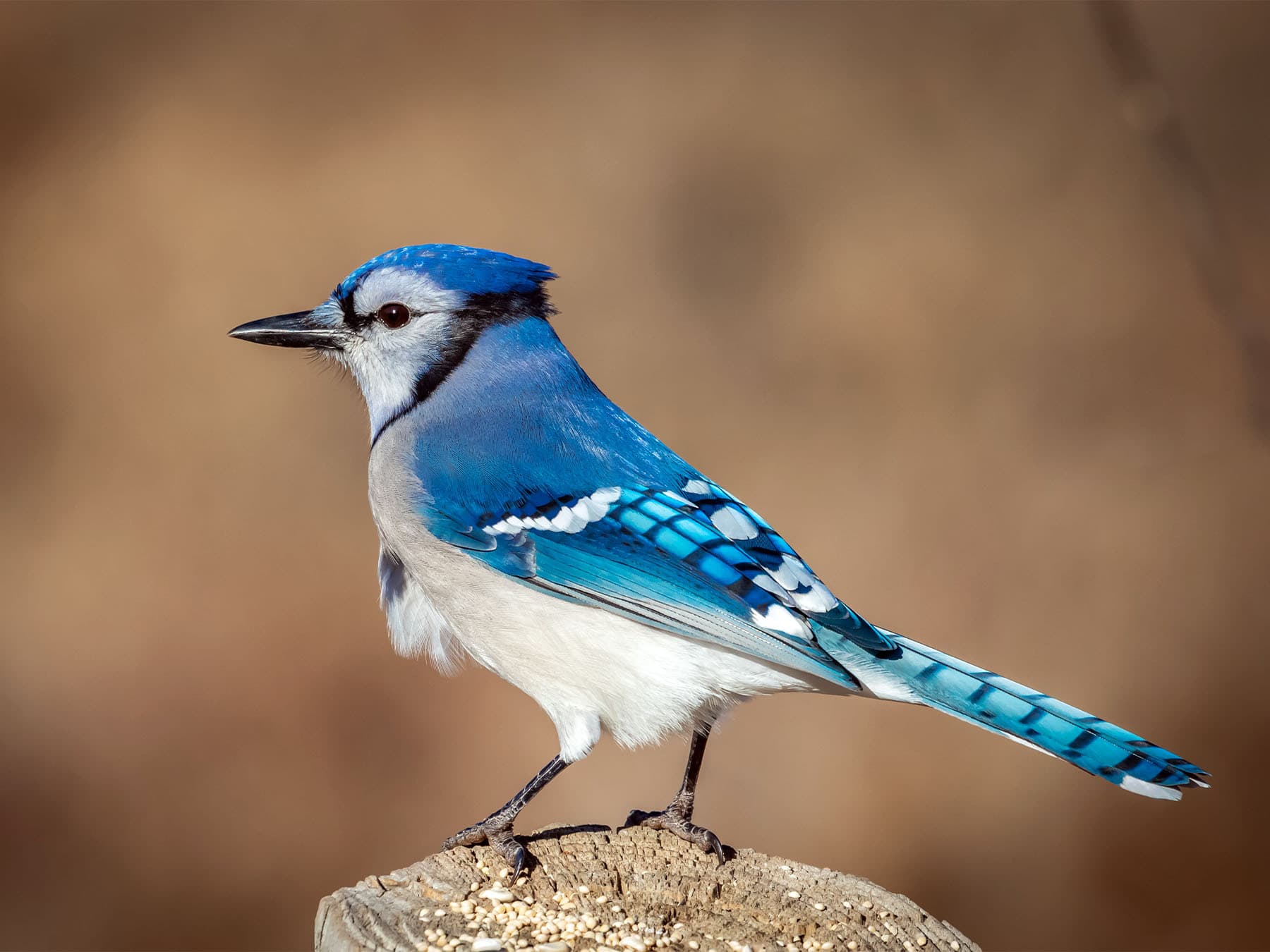
The Steller's Jay has a crest and is dark all over, with no white throat, and usually lives in conifer forest, higher up. The Blue Jay also has a crest, plus a black necklace and white spots in its wings and tail; it is mainly a bird of the East. Western Bluebirds are smaller. The Island Scrub-Jay, found only on Santa Cruz Island off southern California, is larger and deeper blue; the Florida Scrub-Jay lives only in Florida.
Not sure it’s a California Scrub-Jay? Check your photo: Birdfact names the bird and shows the look-alike side by side.
Its size
Adults- Length
- 28–30 cm
- Wingspan
- 39 cm
- Weight
- 70–100 g
Its song and calls
California Scrub-Jays are loud and talkative, and their calls are one of the commonest sounds of West Coast oak woods and suburbs. One of the commonest sounds is the scold, a harsh, raspy note given in short bursts when a jay mobs a cat, owl or snake. The weep call is short, sharp and high-pitched: neighbors trade it as they chase along their territory borders, and a jay gives it as it dives for cover from a hawk.
Some calls belong to one sex. Only females give the rattle, a long run of rapid clicks, and only males give the chuk, a series of short loud notes. Both are given while the bird bobs with its bill pointed up, usually in a dispute with neighbors. The calls of each type grade into one another, and rivals often answer each other with the same call.1
The true song is something few people notice: a soft, rambling warble that can last up to 5 minutes, given by a pair perched close together during courtship.
How scrub-jays learn their calls is not well known, but a captive California Scrub-Jay picked up two calls of the Florida Scrub-Jays it was housed with.1

- Calls0:00 / 0:09
Recorded in California, United States · June 2016
- Calls0:00 / 0:19
Recorded in California, United States · October 2022
Heard one and not sure? Let the bird song identifier listen.
When and where to see it
The California Scrub-Jay lives all year from the southern Puget Sound area of Washington, through western Oregon and most of California, to the southern tip of Baja California, with a few in extreme west-central Nevada. It is commonest in coastal and central California. Look for it in oak woodland and chaparral, in gardens, orchards and parks, and along streams. It usually keeps to drier, more open and lower ground than the Steller's Jay, though their ranges overlap.
It does well around people and can be more numerous in neighborhoods, golf courses and city parks than in wild habitat. In one study along an urban gradient, scrub-jays were found in every kind of habitat from a business district to a natural area, and were densest on a golf course.1
The range has grown north. Scrub-jays spread into southwestern Washington from the 1970s and were breeding as far north as Olympia by 2005, perhaps helped by the spread of suburbs; they have also spread in Oregon since 1980, and records in British Columbia are increasing.1

Do scrub-jays migrate?
No. California Scrub-Jays stay on their territories all year. Some wander a short way, or move lower, in winter, and in years when the acorn crop fails some leave their territories for the winter and come back in spring; now and then larger irruptions happen, at the same time as other jays.
Tips for seeing it
What it eats
Scrub-jays eat almost anything. In spring and summer they eat mainly insects and other small animals, along with fruit; in fall and winter they live largely on acorns and other nuts and seeds.
A 1910 study of 326 stomachs from farming areas of California found 27% animal and 73% plant food: acorns made up 38%, fruit (mostly cultivated cherries and prunes, and elderberries) 22%, and grain 12%. Acorns were more than 60% of the diet from October to February.1 A long study at Hastings Reservation in Monterey County found acorns were the jays' most important food there, and that in May almost four-fifths of their foraging was spent hunting caterpillars in oak leaves.1
They also take lizards, small snakes, mice and salamanders, and they eat the eggs and nestlings of other birds: they follow parent birds to find nests and sometimes catch small birds in flight. In the 1910 study, 18% of stomachs from the nesting season held remains of eggs or young birds; at Hastings, eggs and nestlings were only a small part of the diet.1 At video-monitored nests of the endangered Least Bell's Vireo in San Diego County, scrub-jays caused two-thirds of the few predation events filmed.4
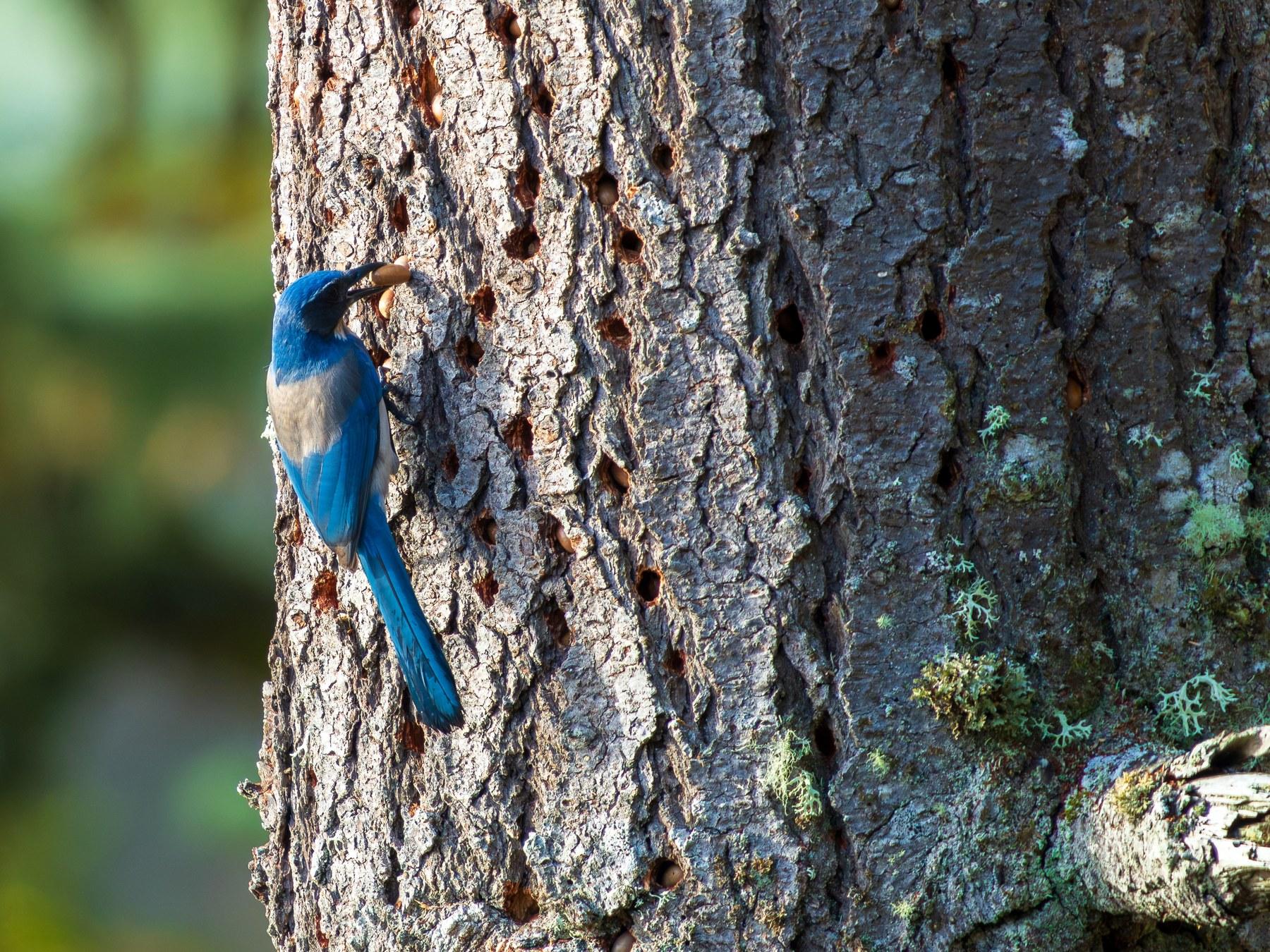
To open an acorn, a scrub-jay holds it with its feet and hammers it with its bill until it cracks; walnuts are wedged in a fork first. Jays also stand on the backs of mule deer and black-tailed deer to pick off ticks, and the deer stand still with their ears raised to let them.

Food storing: caching acorns
In fall, scrub-jays hide food to eat later. Each acorn or seed goes in its own spot, usually pushed into the ground with the bill and covered with a leaf or small stone, though jays also tuck food into tree crevices, under large rocks and on top of telephone poles. At Hastings each territorial jay was estimated to cache 5,000-7,000 acorns in a year with a good crop, and in March 43% of the birds' foraging went into digging them up again.5 A year when the acorn crop fails is hard on them: more die, fewer breed, and some leave their territories.5
Forgotten acorns can grow into oaks. A 1936 note from the foothills of the southern Sierra Nevada described scrub-jays carrying blue-oak acorns from a canyon bottom up the slopes to bury them, each bird climbing with an acorn and coming back empty.6 A later study called California Scrub-Jays high-quality acorn dispersers: they gathered at big valley oak crops when acorns were scarce elsewhere, but not when blue oaks had a good year, while Acorn Woodpeckers, which eat rather than plant acorns, came regardless.7 How many new oaks come from jay caches has never been measured.1 Scrub-jays also steal: they raid the acorns Acorn Woodpeckers store in their granary trees, and some steal acorns they have watched other jays hide.
Feeding scrub-jays in your yard
Scrub-jays come readily to feeders, especially for peanuts and sunflower seeds, and in suburbs some live largely on them; birds that are fed often grow tame enough to take peanuts from a person's hand. They also take hulled sunflower, cracked corn, suet, mealworms, fruit and millet, from platform feeders, large hoppers and suet cages or scattered on the ground.8 Much of what they take is carried off and cached. Dense shrubs or small trees may tempt a pair to nest nearby.


Nesting and breeding
California Scrub-Jays live in pairs that hold the same territory all year and stay together from year to year; mates often pass food to each other, most of all in the breeding season. Pairs generally stay together for life: at Hastings there were 12 splits in 182 breeding-pair years, several of them in the winter after an acorn failure, and others when an experienced bird left an inexperienced mate or moved to a better territory.5 Unlike the Florida Scrub-Jay and the Mexican Jay, they breed without helpers: each pair raises its young alone.
Building starts in late winter. Pairs often make a platform or two that they never use before building the real nest, a bulky cup with an outer basket of twigs lined with rootlets, plant fibers and hair. Both birds build, one keeping watch from a perch while the other works. Nests are usually low, about 5-15 ft up, and well hidden in an oak, a shrub or a tangle of vines, and they are not reused.


Eggs and young
In California most first eggs are laid from late March to early April. The clutch is usually 3-5 eggs, green or grayish and spotted with olive or brown. Only the female incubates, for about 17-19 days, and the male brings her food.1
The young leave the nest at about 20 days old but cannot fly well for about another month. Their parents go on feeding them for at least a month after they leave the nest; they are fed mainly caterpillars, and older nestlings get pieces of stored acorns. Pairs raise one brood a year, but pairs that lose a nest try again, up to three times.
In the Hastings study 84 of 208 nests fledged young, and about 30% of eggs became fledglings; predators took about 31% of eggs and 29% of nestlings, counting every loss of a whole brood as predation.5 Known or suspected nest predators include raccoons, weasels, skunks, squirrels, snakes, magpies, crows and other jays. In a small experiment, scrub-jays rejected cowbird eggs placed in their nests.1
Behaviour
A breeding pair defends its territory all year, and in central California territories are small, about 5-8 acres (2.2-3.2 hectares).5 The birds advertise them from high perches and with slow, swooping flights while calling, and at the border neighbors bob, raise their bills and call at each other. Males do more of the defending and more sentinel duty.
Young birds without a territory, called floaters, roam over several territories in loose flocks and wait for a breeder to die so they can take its place; when one does, up to 20 floaters may chase and fight over the vacancy. Some birds breed in their first year, others float for several years. In a year when the acorn crop fails, even breeders may leave their territories for the winter; about half come back in spring.1
Scrub-jays move mainly by hopping, and their flight is a few quick wingbeats and a glide, slow and swooping. They usually dominate Steller's Jays, and many smaller birds mob them; mockingbirds, flickers and towhees have been seen mobbing a jay that was trying to kill fledglings.

Behavior: memory, planning and cache theft
Scrub-jays have become a model species in research on animal memory. The experiments used captive birds and were published before the 2016 split, under older names; the papers read do not say where the birds came from. In one, jays cached wax-moth larvae, their favorite, alongside peanuts; allowed back soon, they searched first for the larvae, but after a longer wait, when the larvae had gone bad, they quickly learned to skip them. The researchers called this episodic-like memory: remembering what they hid, where and when.9
Jays also protect their caches. Birds that had stolen from other jays moved their own caches to new spots if another jay had watched them hide food, while birds with no experience of stealing did not.10 Later experiments found that they remember which jay watched them11, and that they store food in a place where they have learned they will be hungry the next morning, which the authors suggest is planning for the future.12
Wild scrub-jays react strongly to a dead jay. In backyard experiments in Davis, California, a dead scrub-jay on the ground set off alarm calls that drew other jays, which called too, in a loud gathering much like their response to a model owl; afterward they fed less in that spot for at least a day. The researchers called these gatherings funerals, though the lead author said the name is not meant to suggest any emotional or ritual element.13
Lifespan and predators
Adult scrub-jays that hold a territory survive well. At Hastings Reservation about 83% of breeding males and 79% of breeding females lived from one year to the next.5 Survival of established breeders did not fall with age, but young birds fare worse: in the same study only about a third of females lived to their second year.1
The oldest scrub-jay on the federal banding list, very probably this species, reached an age of at least 15 years 9 months: banded as a young bird in California in June 1932, it was found sick in California in March 1948. The list still files it under the old Western Scrub-Jay; it was banded and found in California, where the scrub-jays are very probably this species.14 The banding lab's list of past record-holders also includes an old Western Scrub-Jay, at least 11 years 11 months old, that a bander caught and released in California in 1993.14
Predators and disease
Bobcats, house cats, Cooper's and Sharp-shinned hawks and Great Horned Owls take adults and young birds, and Golden Eagles, Red-tailed Hawks and Prairie Falcons do so rarely. When a hawk appears, a scrub-jay gives a loud weep call and dives into thick cover; cats, owls, snakes and people are mobbed from a perch.
Scrub-jays are very susceptible to West Nile virus. In California from 2004 to 2007, 59% of 3,336 dead scrub-jays tested carried the virus, and 10 of 12 birds infected in an experiment died; but 28% of live birds trapped had antibodies, so many survive infection.15
Conservation
The California Scrub-Jay is common, with about 1.6 million birds, roughly 1.3 million of them in the United States.16 BirdLife International assesses the old, wider Western Scrub-Jay as Least Concern; the California Scrub-Jay has no assessment of its own.17
The North American Breeding Bird Survey still counts California and Woodhouse's scrub-jays together. Its state results show no long-term change in California since 1968 and significant increases in Oregon (about 1.1% a year) and Washington (about 4.7% a year), where the range has spread.18 In California the survey's index fell by about a sixth between 2004 and 2006, the years West Nile virus spread through the state, and reached its lowest point in 2023, though the last ten years show no significant change.18, 1 Partners in Flight's figures from the survey for this species alone show a significant decline of about 15% over the 14 years to 2021, against a non-significant rise of about 11% since 1970.16
Scrub-jays cope well with people and do well in suburbs, and the threats they face are not acute. Because they depend heavily on acorns, the loss of oaks, for example to sudden oak death, could harm them, and conserving oak woodland would benefit them.1
Legal status
In the United States the California Scrub-Jay is protected under the Migratory Bird Treaty Act, which makes it illegal to take, kill or possess the birds, their nests or eggs except as federal regulations allow.19, 20 One such regulation, a depredation order dating from 1974, lets nut growers in three Washington counties and nine Oregon counties take California Scrub-Jays and Steller's Jays without a federal permit between August 1 and December 1, when the birds are causing or about to cause serious damage to nut crops on land the growers own or occupy; state laws and permits still apply, and growers must report what they take each year. Outside that order, taking scrub-jays because of damage needs a federal depredation permit.21, 22
In Canada, where the species is only a rare visitor, the Migratory Birds Convention Act does not cover the crow and jay family; other laws may apply.23
Similar birds
Often mistaken for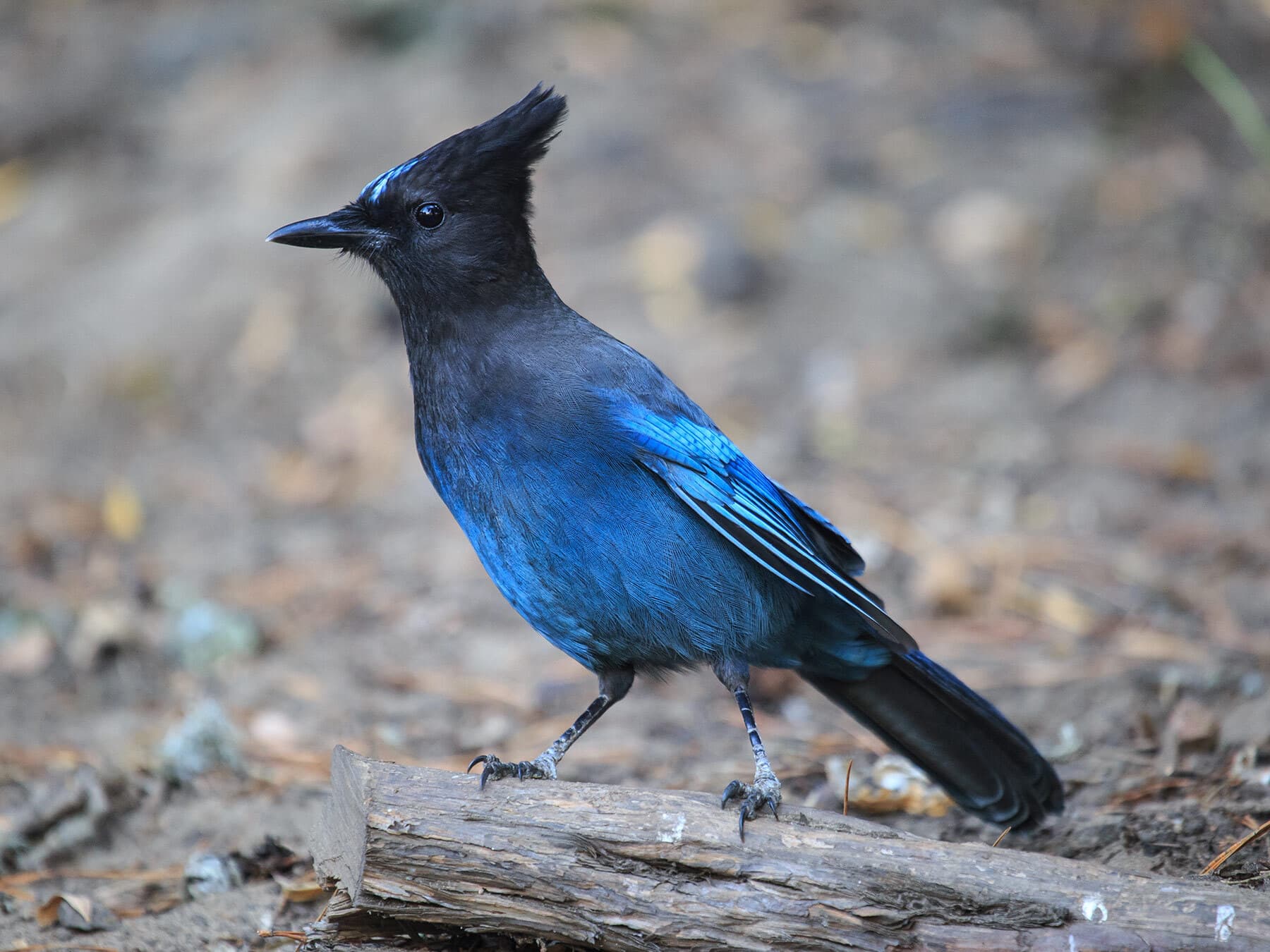
More photos
2 photos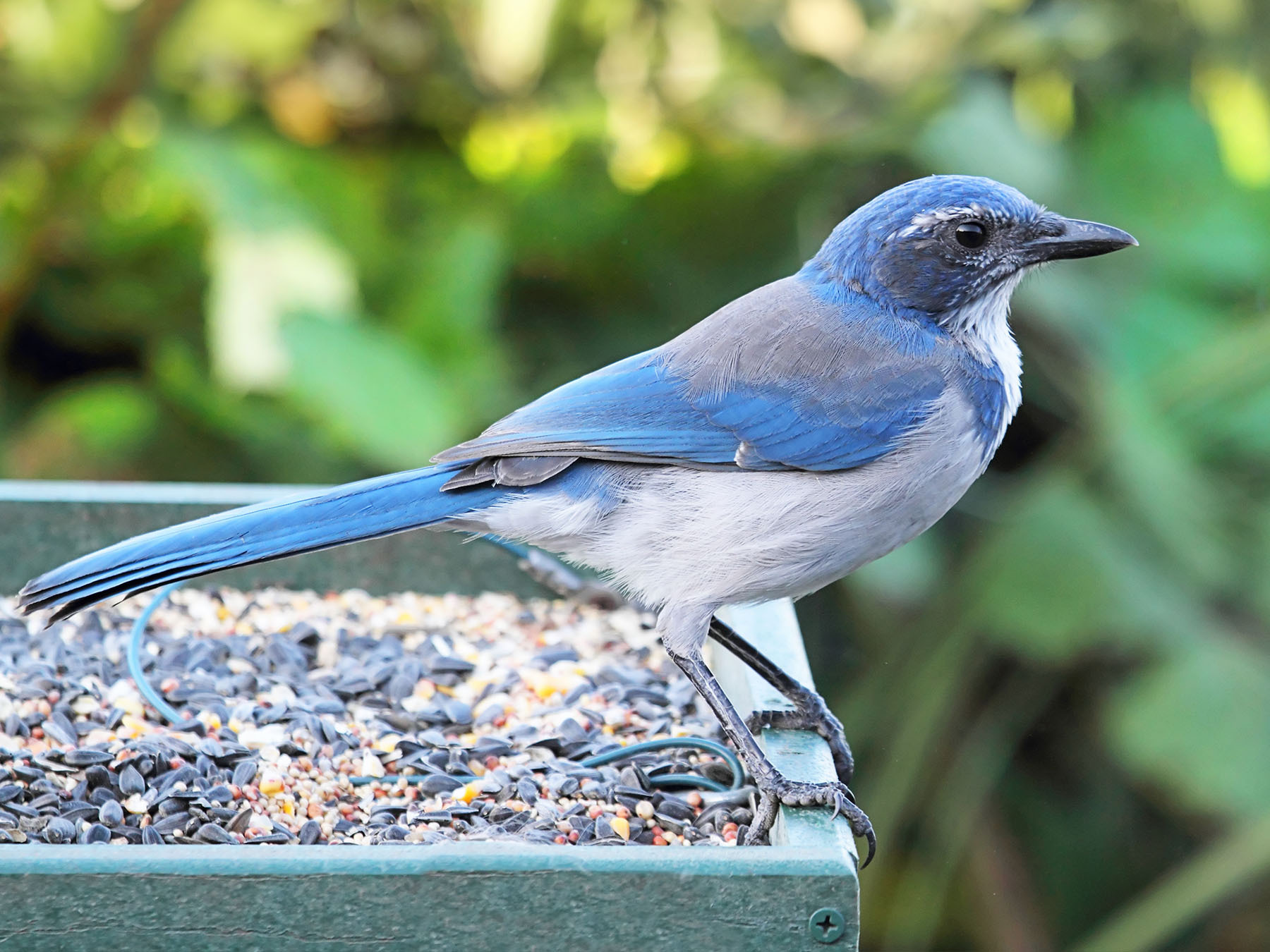
Quick facts
- Length
- 28–30 cm
- Wingspan
- 39 cm
- Weight
- 70–100 g
- Lifespan
- oldest recorded 15 years 9 months
- Family
- Crows & Jays
- Migration
- Resident
- Global status (IUCN)
- Least Concern
- World population
- 1,600,000 (Partners in Flight, about 2010)
- Population trend
- Common; steady in California over the long term, rising in Oregon and Washington, with a dip since the mid-2000s
- Also called
- Western Scrub-Jay
- Scientific name
- Aphelocoma californica
Questions
3Is the California Scrub-Jay the same as the Western Scrub-Jay?
Partly. The Western Scrub-Jay was split into two species in 2016: the California Scrub-Jay of the Pacific Coast and Woodhouse's Scrub-Jay of the interior West. A scrub-jay seen in Washington, western Oregon, coastal and central California or Baja California is a California Scrub-Jay; one in Utah, Colorado, Arizona or New Mexico is a Woodhouse's.
Are scrub-jays and Blue Jays the same?
No. They are different species in different genera: scrub-jays are Aphelocoma, Blue Jays and Steller's Jays are Cyanocitta, though the two groups are close relatives. A scrub-jay has no crest and no white in its wings.
Are scrub-jays rare?
No. The California Scrub-Jay is common across its range and often abundant in suburbs; see Population and conservation status.
Sources
32- 1Curry, R. L. et al. (2024). California Scrub-Jay (Aphelocoma californica), version 1.1. Birds of the World (P. G. Rodewald and S. M. Billerman, editors). Cornell Lab of Ornithology. doi:10.2173/bow.cowscj1.01.1 (opens in a new tab)
- 2Chesser, R. T. et al. (2016). Fifty-seventh supplement to the American Ornithologists' Union Check-list of North American Birds. The Auk 133(3): 544-560. doi:10.1642/AUK-16-77.1 (opens in a new tab)
- 3Gowen, F. C. et al. (2014). Speciation in Western Scrub-Jays, Haldane's rule, and genetic clines in secondary contact. BMC Evolutionary Biology 14: 135. doi:10.1186/1471-2148-14-135 (opens in a new tab)
- 4Peterson, B. L., Kus, B. E. and Deutschman, D. H. (2004). Determining nest predators of the Least Bell's Vireo through point counts, tracking stations, and video photography. Journal of Field Ornithology 75(1): 89-95. doi:10.1648/0273-8570-75.1.89 (opens in a new tab)
- 5Carmen, W. J. (2004). Noncooperative breeding in the California Scrub-Jay. Studies in Avian Biology 28 (Cooper Ornithological Society). ISBN 0-943610-59-1.
- 6Grinnell, J. (1936). Up-hill planters. The Condor 38(2): 80-82. doi:10.2307/1363554 (opens in a new tab)
- 7Pesendorfer, M. B. and Koenig, W. D. (2017). Competing for seed dispersal: evidence for the role of avian seed hoarders in mediating apparent predation among oaks. Functional Ecology 31(3): 622-631. doi:10.1111/1365-2435.12770 (opens in a new tab)
- 8Project FeederWatch (Cornell Lab of Ornithology and Birds Canada). Common Feeder Birds: California Scrub-jay. Project FeederWatch. Accessed 10 November 2026. Source (opens in a new tab)
- 9Clayton, N. S. and Dickinson, A. (1998). Episodic-like memory during cache recovery by scrub jays. Nature 395(6699): 272-274. doi:10.1038/26216 (opens in a new tab)
- 10Emery, N. J. and Clayton, N. S. (2001). Effects of experience and social context on prospective caching strategies by scrub jays. Nature 414(6862): 443-446. doi:10.1038/35106560 (opens in a new tab)
- 11Dally, J. M., Emery, N. J. and Clayton, N. S. (2006). Food-caching western scrub-jays keep track of who was watching when. Science 312(5780): 1662-1665. doi:10.1126/science.1126539 (opens in a new tab)
- 12Raby, C. R., Alexis, D. M., Dickinson, A. and Clayton, N. S. (2007). Planning for the future by western scrub-jays. Nature 445(7130): 919-921. doi:10.1038/nature05575 (opens in a new tab)
- 13Iglesias, T. L., McElreath, R. and Patricelli, G. L. (2012). Western scrub-jay funerals: cacophonous aggregations in response to dead conspecifics. Animal Behaviour 84(5): 1103-1111. doi:10.1016/j.anbehav.2012.08.007 (opens in a new tab)
- 14USGS Bird Banding Laboratory. Longevity records of North American birds (release 2025): Western Scrub Jay, Aphelocoma californica. USGS Eastern Ecological Science Center. Accessed 10 November 2026. Source (opens in a new tab)
- 15Wheeler, S. S. et al. (2009). Differential impact of West Nile virus on California birds. The Condor 111(1): 1-20. doi:10.1525/cond.2009.080013 (opens in a new tab)
- 16Partners in Flight (2023). Avian Conservation Assessment Database, 2023 (global). Bird Conservancy of the Rockies. Accessed 10 November 2026. Source (opens in a new tab)
- 17BirdLife International (2025). Aphelocoma californica. The IUCN Red List of Threatened Species 2025: e.T103727785A139835822. IUCN Red List (via GBIF's copy of the Red List checklist, version 2026-1). doi:10.2305/IUCN.UK.2025-2.RLTS.T103727785A139835822.en (opens in a new tab)
- 18Hostetler, J. A. et al. (2026). The North American Breeding Bird Survey, Analysis Results 1966 - 2025. U.S. Geological Survey. doi:10.5066/P1OSNSFC (opens in a new tab)
- 19United States Congress (1918). Migratory Bird Treaty Act, 16 U.S.C. 703. United States Code (govinfo, 2023 edition). Accessed 10 November 2026. Source (opens in a new tab)
- 20U.S. Fish and Wildlife Service (2023). 50 CFR 10.13, List of Birds Protected by the Migratory Bird Treaty Act. Electronic Code of Federal Regulations. Accessed 10 November 2026. Source (opens in a new tab)
- 21U.S. Fish and Wildlife Service (2022). 50 CFR 21.156, Depredation order for depredating California scrub jays and Steller's jays in Washington and Oregon. Electronic Code of Federal Regulations. Accessed 10 November 2026. Source (opens in a new tab)
- 22U.S. Fish and Wildlife Service (2022). 50 CFR 21.100, Depredation permits. Electronic Code of Federal Regulations. Accessed 10 November 2026. Source (opens in a new tab)
- 23Environment and Climate Change Canada. Birds protected in Canada under the Migratory Birds Convention Act, 1994. Government of Canada (Wayback copy of 4 Oct 2026). Accessed 10 November 2026. Source (opens in a new tab)
- 24Cornell Lab of Ornithology. California Scrub-Jay: overview, identification and life history. All About Birds. Accessed 10 November 2026. Source (opens in a new tab)
- 25National Audubon Society. California Scrub-Jay. Guide to North American Birds (text adapted from Kaufman 1996). Accessed 10 November 2026. Source (opens in a new tab)
- 26National Audubon Society. Woodhouse's Scrub-Jay. Guide to North American Birds (text adapted from Kaufman 1996). Accessed 10 November 2026. Source (opens in a new tab)
- 27National Audubon Society. Steller's Jay. Guide to North American Birds (text adapted from Kaufman 1996). Accessed 10 November 2026. Source (opens in a new tab)
- 28National Audubon Society. Blue Jay. Guide to North American Birds (text adapted from Kaufman 1996). Accessed 10 November 2026. Source (opens in a new tab)
- 29National Audubon Society. Island Scrub-Jay. Guide to North American Birds (text adapted from Kaufman 1996). Accessed 10 November 2026. Source (opens in a new tab)
- 30National Audubon Society. Florida Scrub-Jay. Guide to North American Birds (text adapted from Kaufman 1996). Accessed 10 November 2026. Source (opens in a new tab)
- 31AviList Core Team (2025). AviList: The Global Avian Checklist, v2025b. AviList. doi:10.2173/avilist.v2025b (opens in a new tab)
- 32U.S. Fish and Wildlife Service (2019). Migratory Bird Permits; Regulations Concerning a Depredation Order (final rule). Federal Register 84 FR 45921 (3 Sep 2019), FR Doc. 2019-18954. Accessed 10 November 2026. Source (opens in a new tab)

Checked by
Nathan Cope, founder and editor
Nathan founded Birdfact and leads its writers and contributors in the UK, the US and Canada. He has watched and studied birds for more than ten years, and checks every article and species guide before it’s published.