
Tricolored Heron
Louisiana Heron · Egretta tricolor
By the Birdfact teamChecked by Nathan Cope
On this page13 sections
How to recognise it
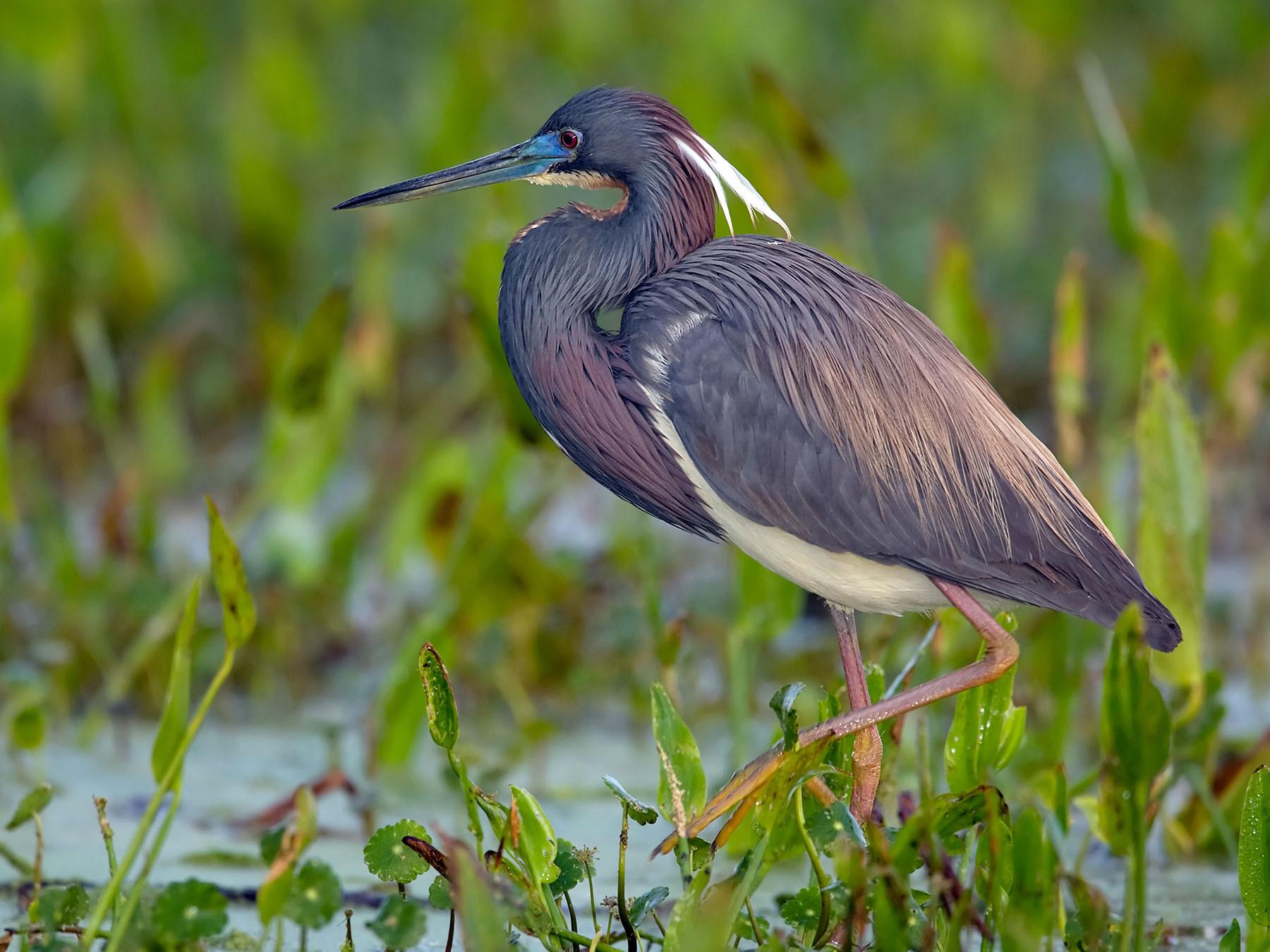
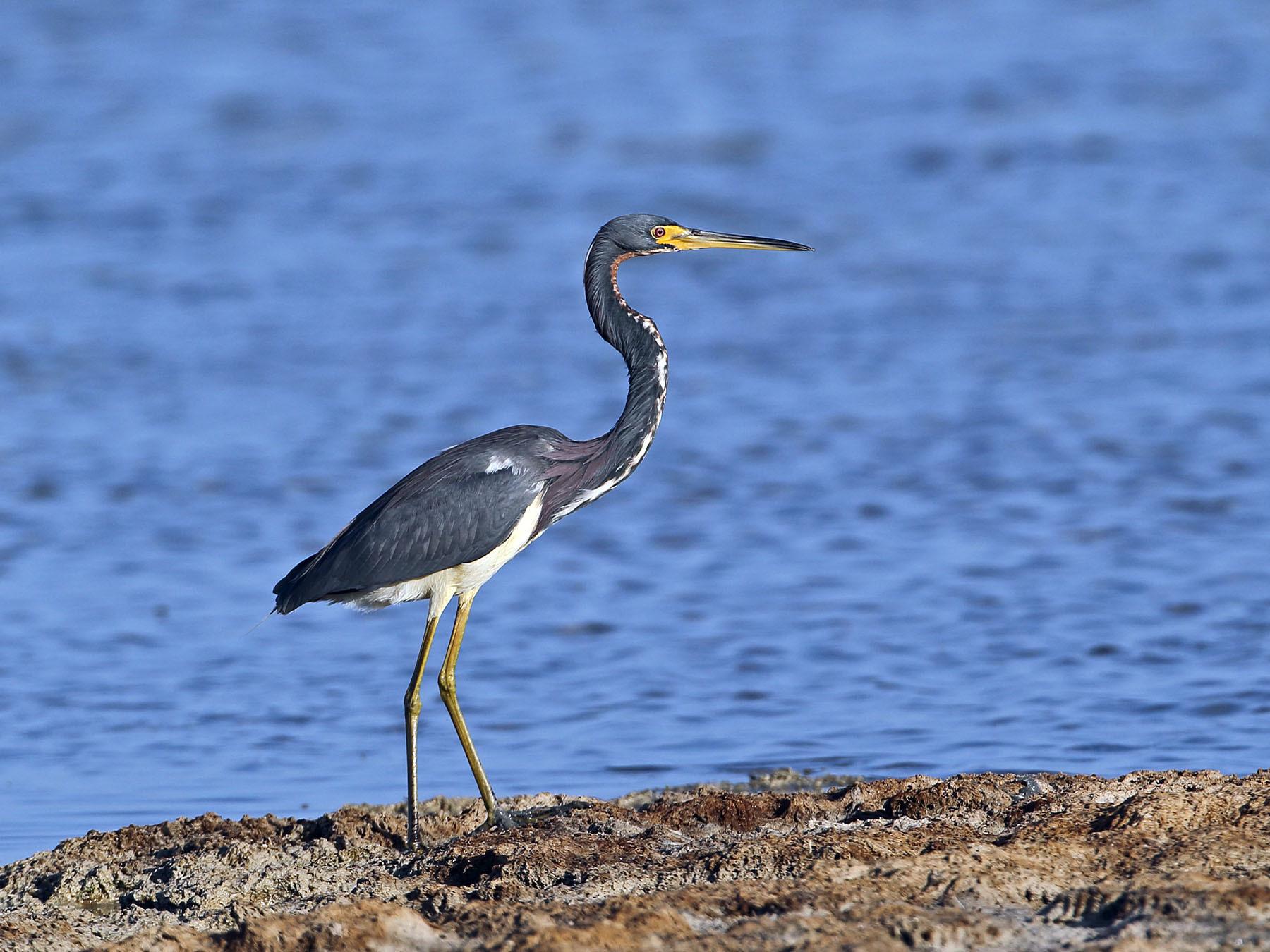
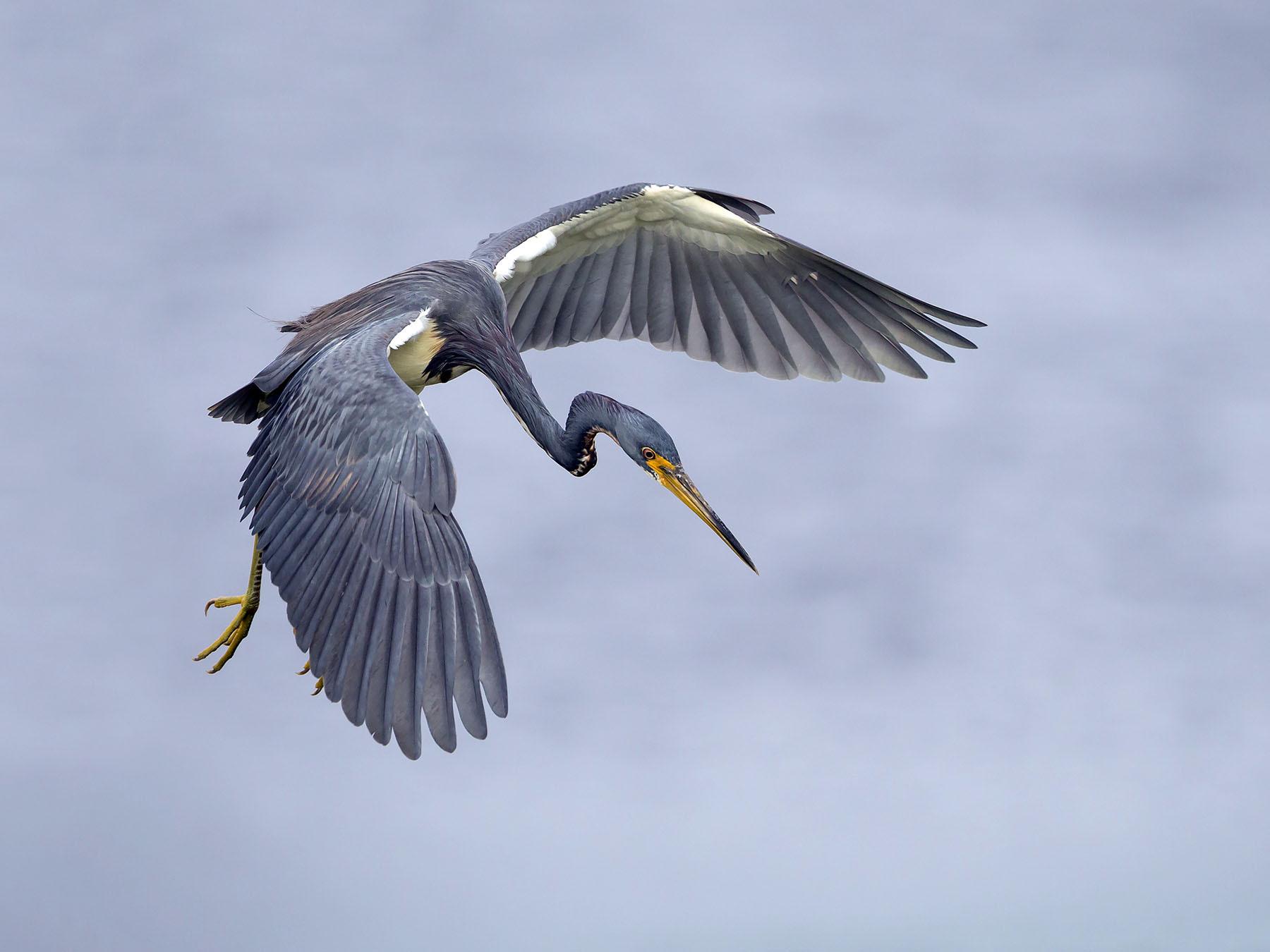
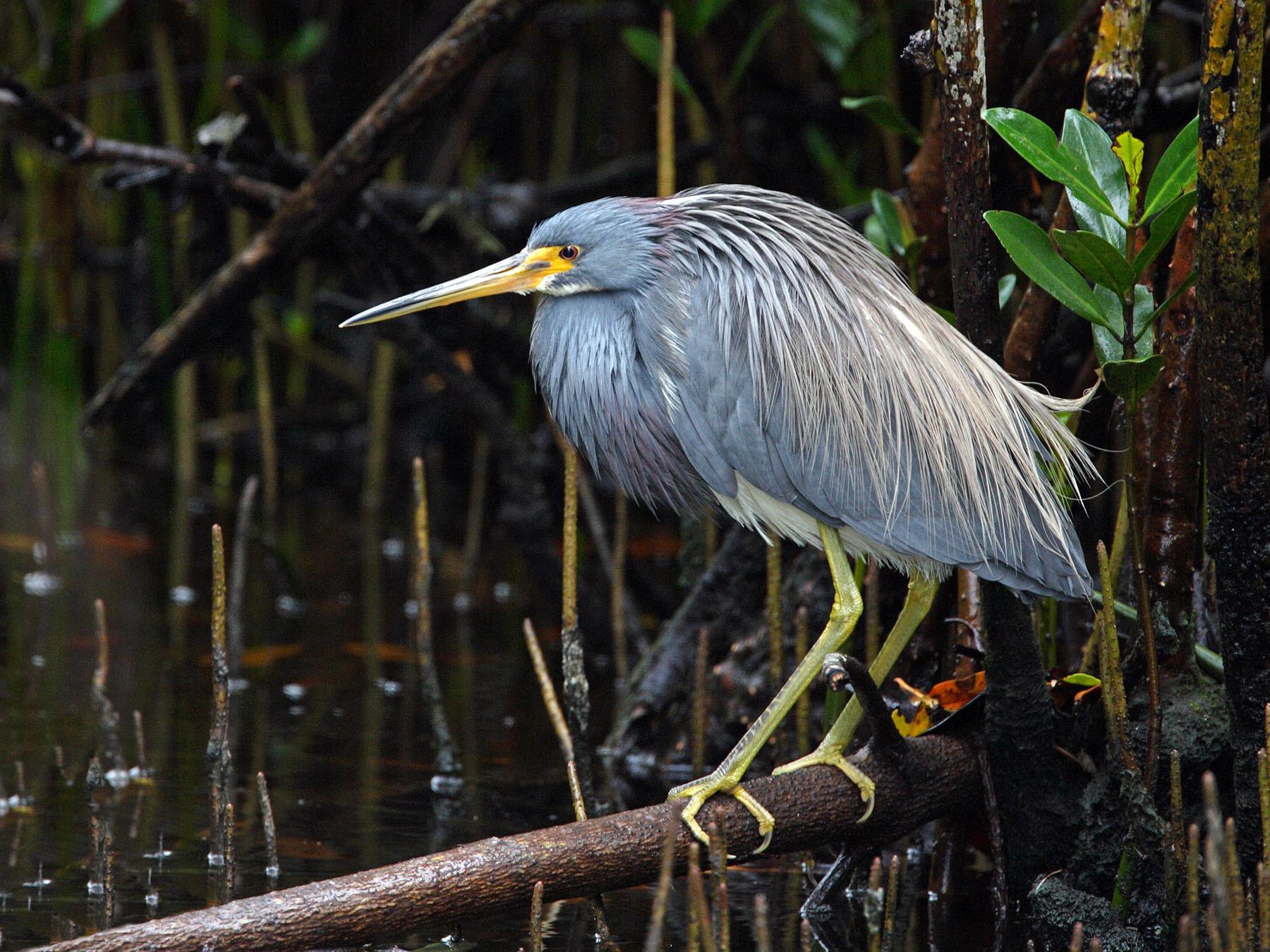
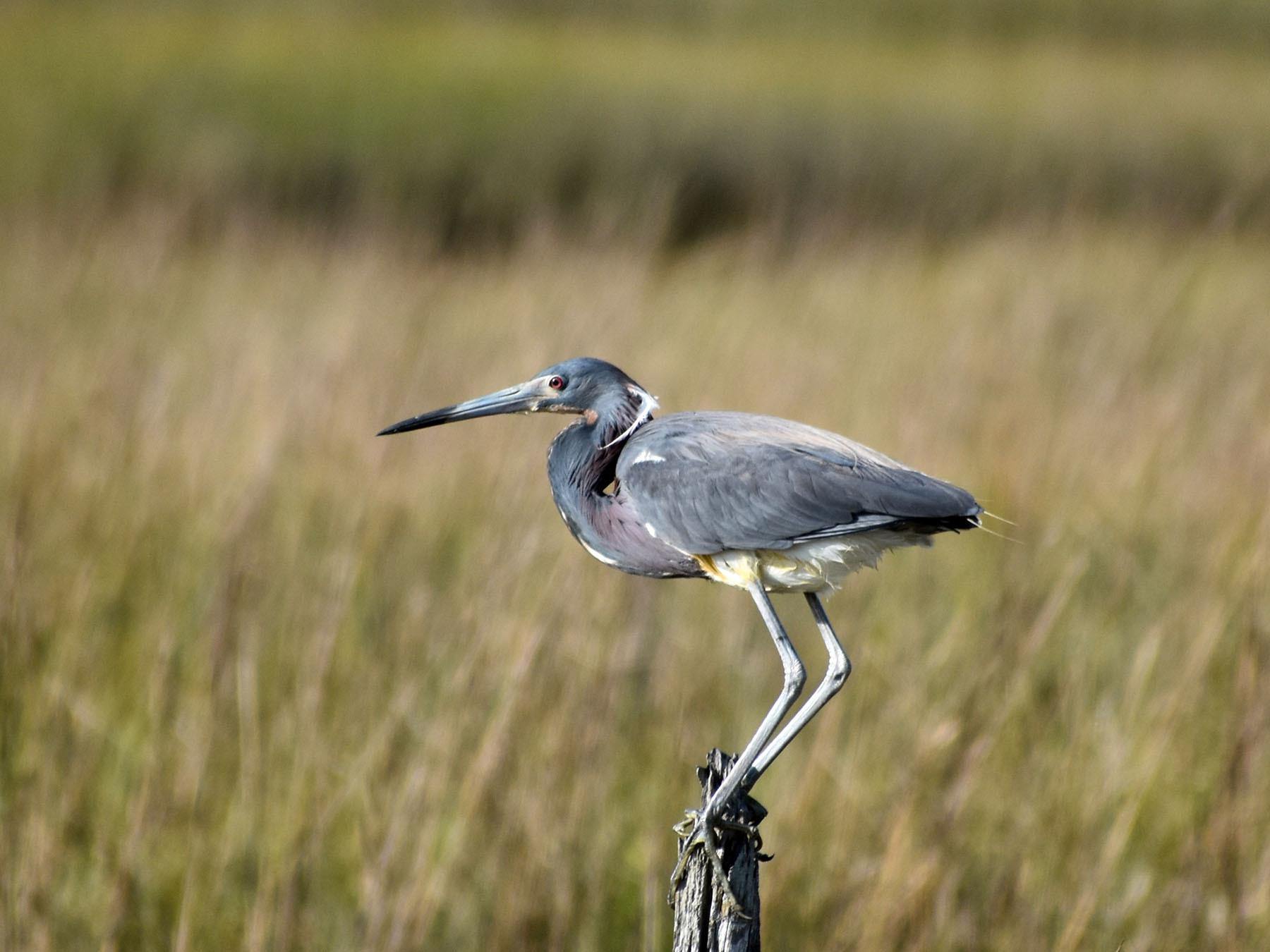
A slim, delicately built heron with a long, thin neck and bill. Adults are dark slate blue-gray on the head, neck, back and wings, with purplish-maroon feathers on the back. The breast and belly are white, and a white stripe runs down the front of the neck, with a thin rusty line down its middle.
The white belly is the mark to look for: it shows in every plumage and at every age, and no other small heron in North America pairs white underparts and foreneck with a slaty back and neck. In flight the white belly, rump and underwings stand out against the dark upperparts.
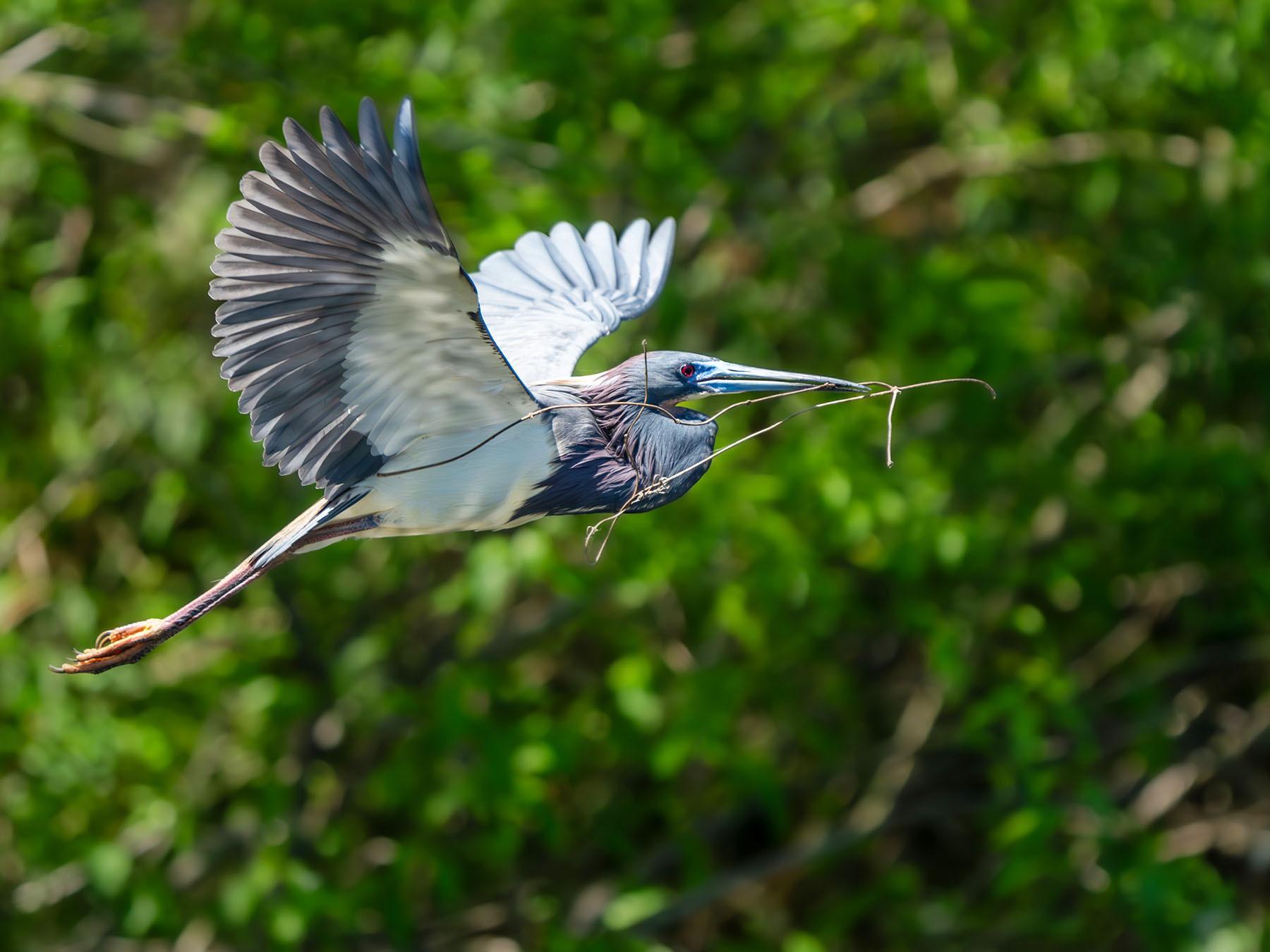
For most of the year the bill and the bare skin in front of the eye are mottled yellow to brownish yellow, and the legs grayish yellow. In the breeding season adults grow short white plumes at the back of the head, mauve to violet plumes on the neck and breast, and buff back plumes that reach the tail or beyond. For a short time in early spring, during courtship, the bill turns turquoise-cobalt with a black tip, the face cobalt blue and the legs pink, orange or fleshy maroon.
There is no separate breeding molt. The plumes grow slowly within the same plumage, from October to January, and reach full length by February to May.1 Birds from northeastern Venezuela, Trinidad and the Guianas south to northeastern Brazil and southern Peru belong to a southern race, tricolor, which is smaller and grayer above, with a chestnut chin and foreneck.
Size and weight
It is about 24–28 in (60–70 cm) long, with a wingspan of about 37 in (95 cm)1; Audubon's guide gives a shorter 23–26 in (58–66 cm).2 That puts it between a Snowy Egret and a Great Blue Heron in size. The bill alone is 3.5–4.3 in (9–11 cm) long.
Males are somewhat larger than females. North American males average about 14.6 oz (415 g), from 35 birds weighed; we found no reliable North American average for females.1
Male, female and young
Males and females look alike in every plumage, though the males' breeding plumes may average longer.
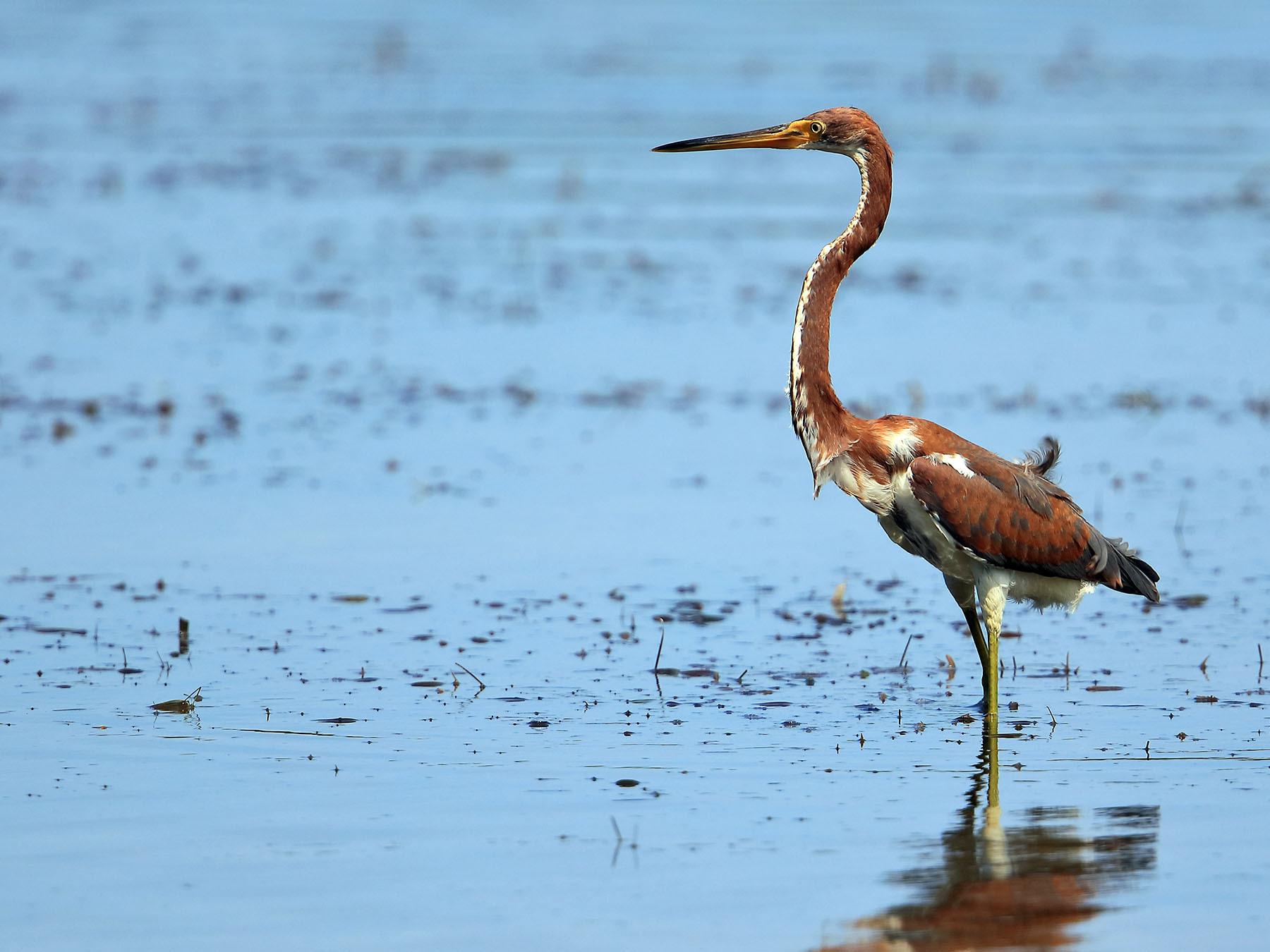
Juveniles, this year's young, look quite different. The head and neck are chestnut to bright bay, with a narrow white line down the foreneck, and the back is olive washed with chestnut, with rufous tips to the wing coverts. The belly and rump are white, as in adults. The bill is mostly yellow with a dark outer third, and the legs are greenish yellow.
In North America this plumage is worn mainly from July to October. Through the first winter young birds slowly molt into an adult-like look, but keep rufous-tipped wing coverts that bleach brownish by spring. Full adult plumage is thought to come in the second or third year of life, and most birds look like adults from their second fall.1
Identification: similar herons
Against a Little Blue Heron, the belly settles it. An adult Little Blue is wholly dark, slate-blue with a purplish head and neck, and its bill is bluish at the base with a black tip. Its young are white, and a molting young Little Blue looks patchy rather than blue above with a white belly. The Tricolored is also slightly taller, slimmer and more elegant.
A dark Reddish Egret is larger and taller and feeds in a more animated, erratic way. A breeding adult has a shaggy rusty-red head and neck, a pink bill with a black tip and slaty blue-gray legs.
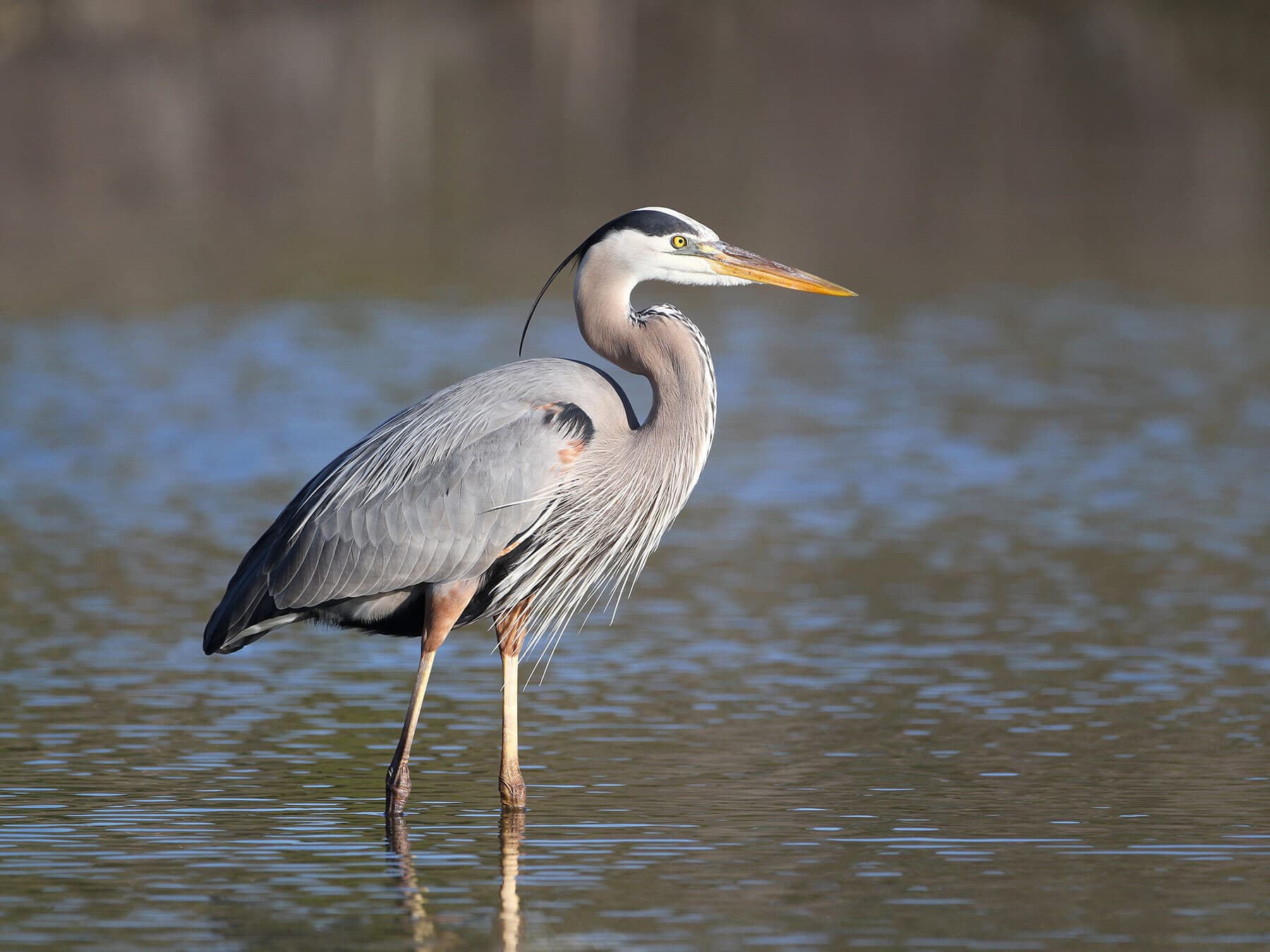
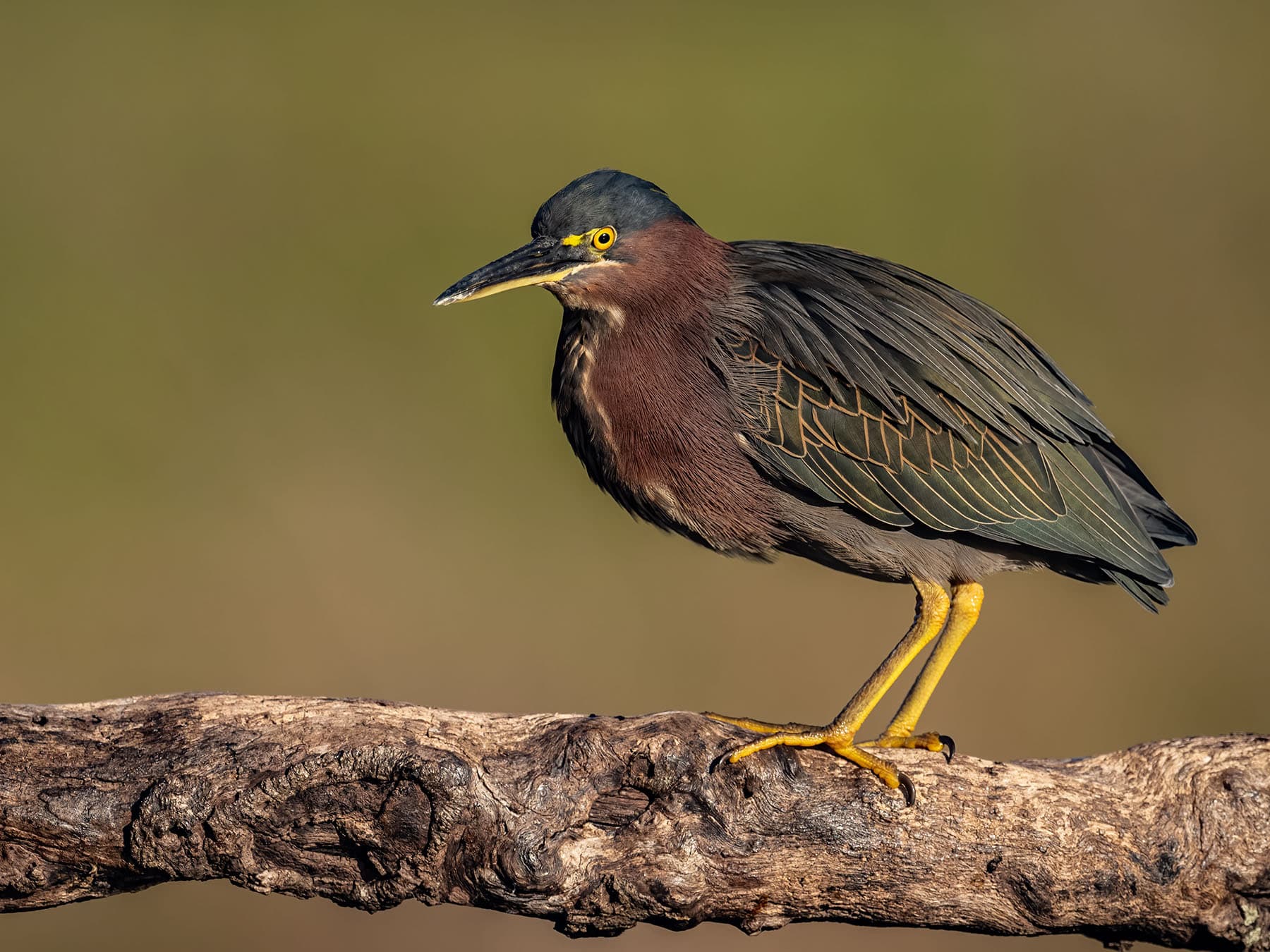
A Great Blue Heron is far bigger, 38–54 in (97–137 cm) long; adults have a mostly white head, and the bill is yellowish. It hunts slowly and methodically rather than dashing about. A Green Heron is smaller, 16–18 in (41–46 cm), and stocky, with a short neck and legs, a greenish-black cap, a rufous neck, gray underparts and orange legs. Its young are streaked brown below, where a young Tricolored is white below.
Not sure it’s a Tricolored Heron? Check your photo: Birdfact names the bird and shows the look-alike side by side.
Its size
Adults- Length
- 60–70 cm
- Wingspan
- 95 cm
- Weight
- 415 g
Its song and calls
It has no song in the songbird sense, and its calls are few and harsh, though it is often described as noisy. Calls include a harsh aaah, given in disputes, when startled and when people come near the nest, and a short, guttural aahrr when flushed. These two are the only calls noted outside the breeding season.
At the colony there is more. A parent flying in to the nest with food calls scaah. Males give a resonant unh after their snap-stretch display and a series of 5–12 cuhl-cuhl calls in each circle flight, and mates trade cuhl-cuhl calls when they greet at the nest. Chicks beg with weak peeping and, from about 5 days old, a harsh note.
Its voice is little studied. Birds of the World's account, written in 2013, says no good recordings were available then, and almost all descriptions of its calls come from courtship and nest behavior.1
Heard one and not sure? Let the bird song identifier listen.
When and where to see it
November
In season
The year across North America
Choose a place on the map to see its year, or find yours.
Most recorded in November
Up to 1.3% of a place’s bird records that monthHere in other months
How this map is made
Each county, state or province is shaded by the Tricolored Heron’s share of all the bird records there that month: the darker, the larger the share. A place with only a trace of records in a month is left unshaded. Shades compare places on this map with each other, not one bird with another. Records: GBIF eBird Observation Dataset, 2019–2024. Map: Natural Earth; place centres © OpenStreetMap contributors.
How often the Tricolored Heron turns up in the United States and Canada through the year, from birdwatchers' records.
United States
Resident · all year · most records in January
Canada
Passage migrant · regularly Apr–Jun · most records in June
Show as a table
| Month | United States | Canada |
|---|---|---|
| January | 0.19% (regular) | – |
| February | 0.18% (regular) | – |
| March | 0.13% (regular) | – |
| April | 0.12% (regular) | <0.001% (regular) |
| May | 0.053% (regular) | <0.001% (regular) |
| June | 0.075% (regular) | 0.004% (regular) |
| July | 0.097% (regular) | 0.002% |
| August | 0.12% (regular) | <0.001% |
| September | 0.11% (regular) | <0.001% |
| October | 0.12% (regular) | <0.001% |
| November | 0.16% (regular) | – |
| December | 0.18% (regular) | – |
Worldwide: recorded regularly in 43 countries
Countries where it was recorded in at least 3 of the 6 years 2019–2024. Linked countries have their own bird list.
North America (34)
- Anguilla
- Antigua & Barbuda
- Aruba
- Bahamas
- Barbados
- Belize
- Bermuda
- Canada
- Caribbean Netherlands
- Cayman Islands
- Costa Rica
- Cuba
- Curaçao
- Dominican Republic
- El Salvador
- Grenada
- Guadeloupe
- Guatemala
- Haiti
- Honduras
- Jamaica
- Martinique
- Mexico
- Nicaragua
- Panama
- Puerto Rico
- Sint Maarten
- St Lucia
- St Martin
- St Vincent & the Grenadines
- Trinidad & Tobago
- Turks & Caicos Islands
- United States
- US Virgin Islands
Data: EOD – eBird Observation Dataset (Cornell Lab of Ornithology), accessed via GBIF.org, CC BY 4.0. Records from 2019–2024, aggregated and filtered by Birdfact. How these lists are made
It lives from the coasts of the southeastern United States through Mexico, Central America and the West Indies to northern South America, south to Peru and northeastern Brazil. In the US it breeds mainly along the Atlantic and Gulf coasts. It is a common breeder on the coastal plain of the Carolinas and Georgia, nests throughout Florida, inland as well as on the coast, and keeps to the coastal plain from Alabama to Texas.
Look for it mostly on the coast, in estuaries, salt marshes, mangrove swamps, lagoons, river deltas and mudflats. It also uses fresh water: marshes, lake edges, cypress swamps, canals and ditches. It feeds almost entirely in wetlands, mostly brackish or salt, and nests on islands or raised ground with shrubs or small trees, ringed by open water or flooded marsh.
Farther north, Birds of the World's account, written in 2013, has it breeding more regularly in Virginia, Maryland, around Delaware Bay, in New Jersey and on Long Island, and only irregularly north to southern Maine, mostly in the 1970s and 1980s. Now and then it breeds far inland. It summers regularly in central Kansas, especially at Cheyenne Bottoms, where breeding has been tried since 1974 with mixed success, and a pair nested in Oklahoma in 1998.
Its breeding range spread north along the East Coast between the 1940s and 1970s, perhaps because building the Intracoastal Waterway created nesting habitat. The first nests were found in Virginia in 1941, New Jersey in 1951, New York in 1955, Maryland in 1958, and Connecticut and Massachusetts in 1976.1 In Texas, the state's breeding bird atlas calls it the most numerous heron apart from the non-native Cattle Egret.3
Do they migrate?
Some do. Most birds that breed on the Atlantic coast north of South Carolina migrate, while farther south birds are present all year, though numbers drop in some areas in winter. In winter it stays locally on the Atlantic coast from southern New Jersey, in warm winters only, and more commonly from South Carolina south. It is found all year on the Louisiana and Texas Gulf coast, a very few winter in southern California, and others winter along both coasts of Mexico and Central America to Panama.
Spring arrivals reach northern Florida in early to mid-March, Maryland in mid- to late April and Massachusetts in late April to early May, and most have left Maryland by late September or early October.1
Satellite tags show how mixed the habit is. Of 24 herons tagged at coastal Alabama colonies in 2020–2022, six stayed near the colonies and 18 moved away. Those that left wintered mainly in coastal salt marshes and estuaries from Alabama to Texas, and some crossed the Gulf of Mexico to winter in Central America.4
After breeding, birds wander in many directions, especially north, and sometimes far. July and August sightings come from inland states as far as Colorado, New Mexico and Arizona, and there are records from the southern parts of every Canadian province except British Columbia and Prince Edward Island. Sources differ on how marked this is, though: Birds of the World also calls its post-breeding dispersal much less pronounced than in other herons, and Audubon says its northward wandering is less marked than in some southern herons.1, 2
Birds banded in the southeastern US have been found in Cuba, the Greater and Lesser Antilles, Honduras, Nicaragua, Panama, Colombia and Venezuela. In one band-recovery study, the farthest bird was found about 1,450 miles (2,328 km) from where it was banded.1
Tips for seeing it
What it eats
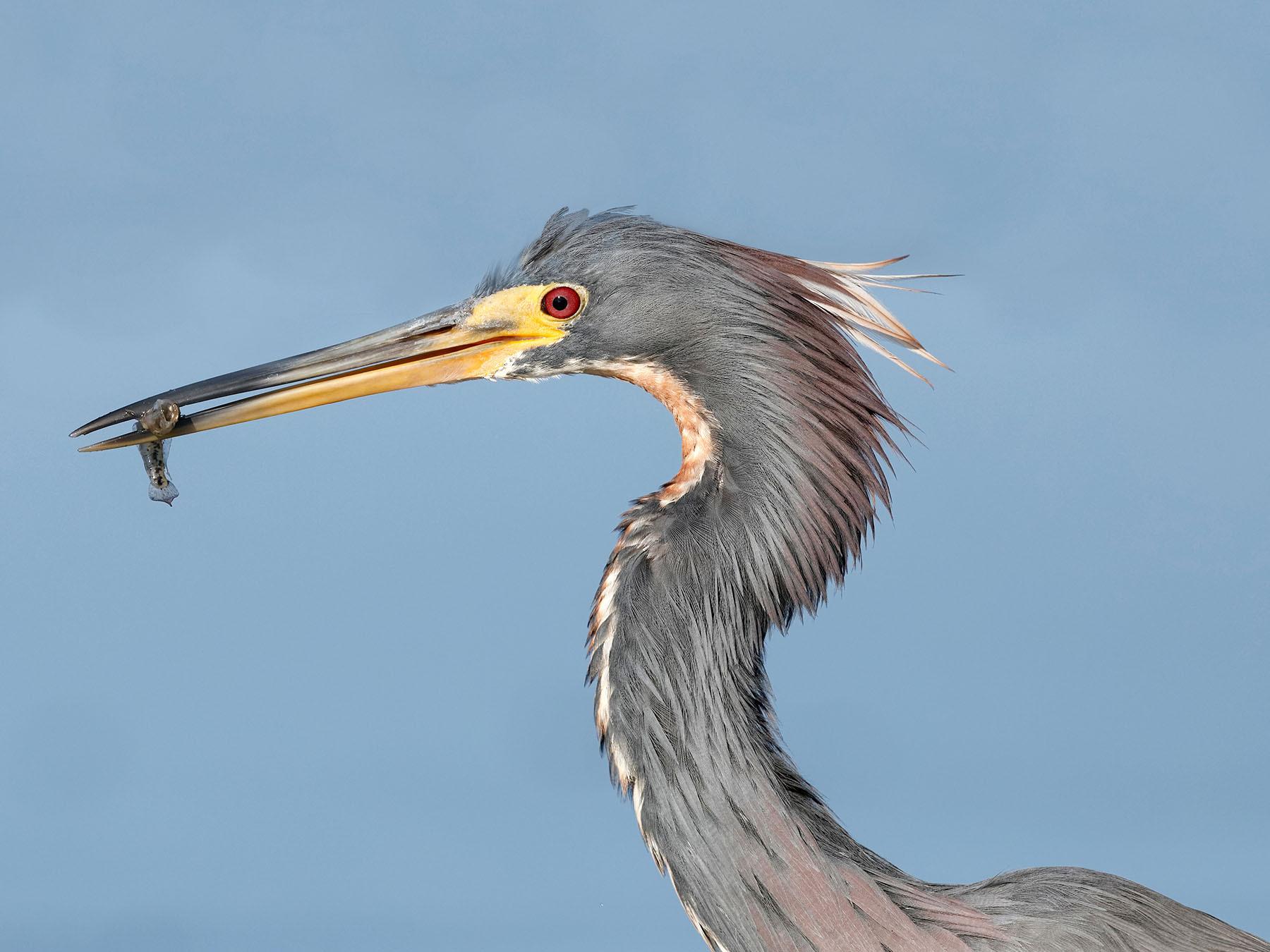
Almost entirely small fish. Fish make up more than 90% of the diet almost everywhere, and it probably takes insects, crustaceans and frogs only when they are very plentiful. The commonest prey are topminnows and killifishes, which often make up more than half the diet, and live-bearers such as mosquitofish and mollies.
The fish are small. In Tampa Bay 43% were 0.7–1.2 in (18–30 mm) long and only 8% were over 3 in (75 mm), and at Lake Okeechobee the median fish fed to chicks was 0.9 in (23 mm). Compared with the Snowy Egret and Little Blue Heron, it takes larger fish than the egret and smaller ones than the Little Blue, and fish make up a much larger share of its diet than of theirs.1
In the Everglades, chicks were fed mostly small marsh fish. A 2009 study at one colony found that Tricolored Herons and Snowy Egrets, analyzed together, chose larger fish, 0.8–1.6 in (2–4 cm) long,5 and a 2012–2014 study found most of both species' prey weight came from marsh fish over 0.75 in (1.9 cm).6
Older reports differ. Two early-20th-century accounts found insects made up a large part of the diet: in freshwater northern Florida, one stomach held over 200 grasshoppers, and 50 young birds held 2,876 grasshoppers but no fish.1
Feeding methods
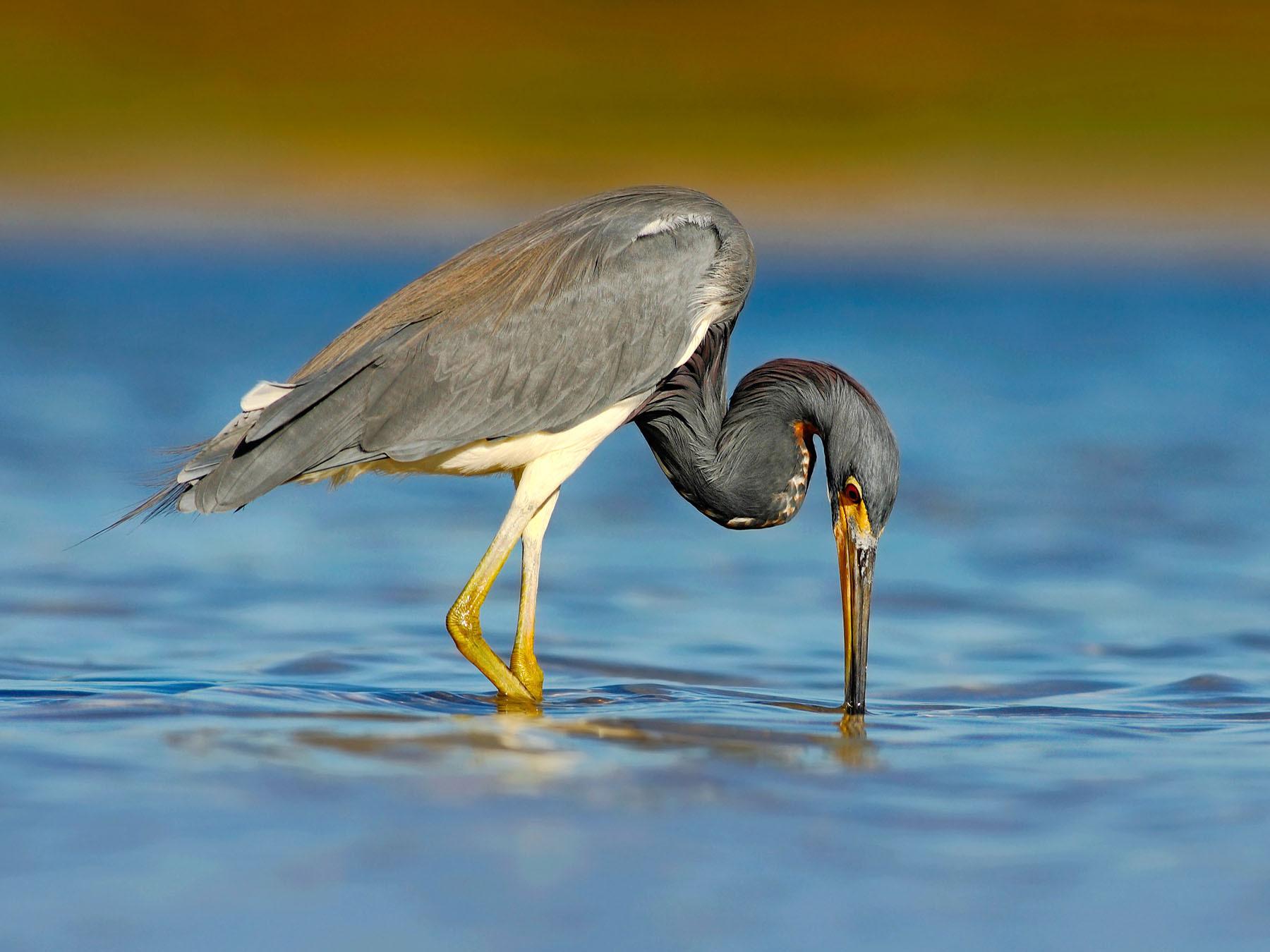
It is an active, varied hunter. It may stand and wait or walk slowly, but it also runs after fish, crouching so low that its belly nearly touches the water before a quick, low, slanting stab, and chases with flapping wings or tight pirouettes. It wades a little deeper than the Snowy Egret or Little Blue Heron, the water often reaching its belly feathers.
It sometimes spreads its wings forward over its head to shade the water, which is called canopy feeding, and may rake the bottom with a foot to flush prey, especially in cold weather. Now and then it strikes from a hover or grabs leaping fish in the air, and it sometimes follows Double-crested Cormorants or Pied-billed Grebes to catch the fish they disturb. It feeds only by day.
On coastal flats, one study found it spent 37% of its foraging time walking slowly and 36% disturbing and chasing prey,1 and another found that walking slowly brought a higher strike success than chasing.7
It usually feeds alone or at the edge of mixed groups of waders. In southern Florida 75% of foraging birds fed alone and fewer than 3% in mixed flocks of more than 30, yet in another study 70% of those flying over feeding areas were drawn to white wading-bird decoys.1
Nesting birds in the Everglades flew on average 3.5 miles (5.6 km) from the colony to feed, at about 9.5 mph (15.3 km/h), over 265 flights.1 At one Everglades colony, Rodgers River Bay, breeding birds fed within a mean radius of 3.4–8 miles (5.4–12.8 km) in 1987–1989, depending on the year, and up to 17 miles (27 km) away.1, 8 In the 1989 drought there, Tricolored Herons nested successfully when Snowy Egrets did not.8
Nesting and breeding
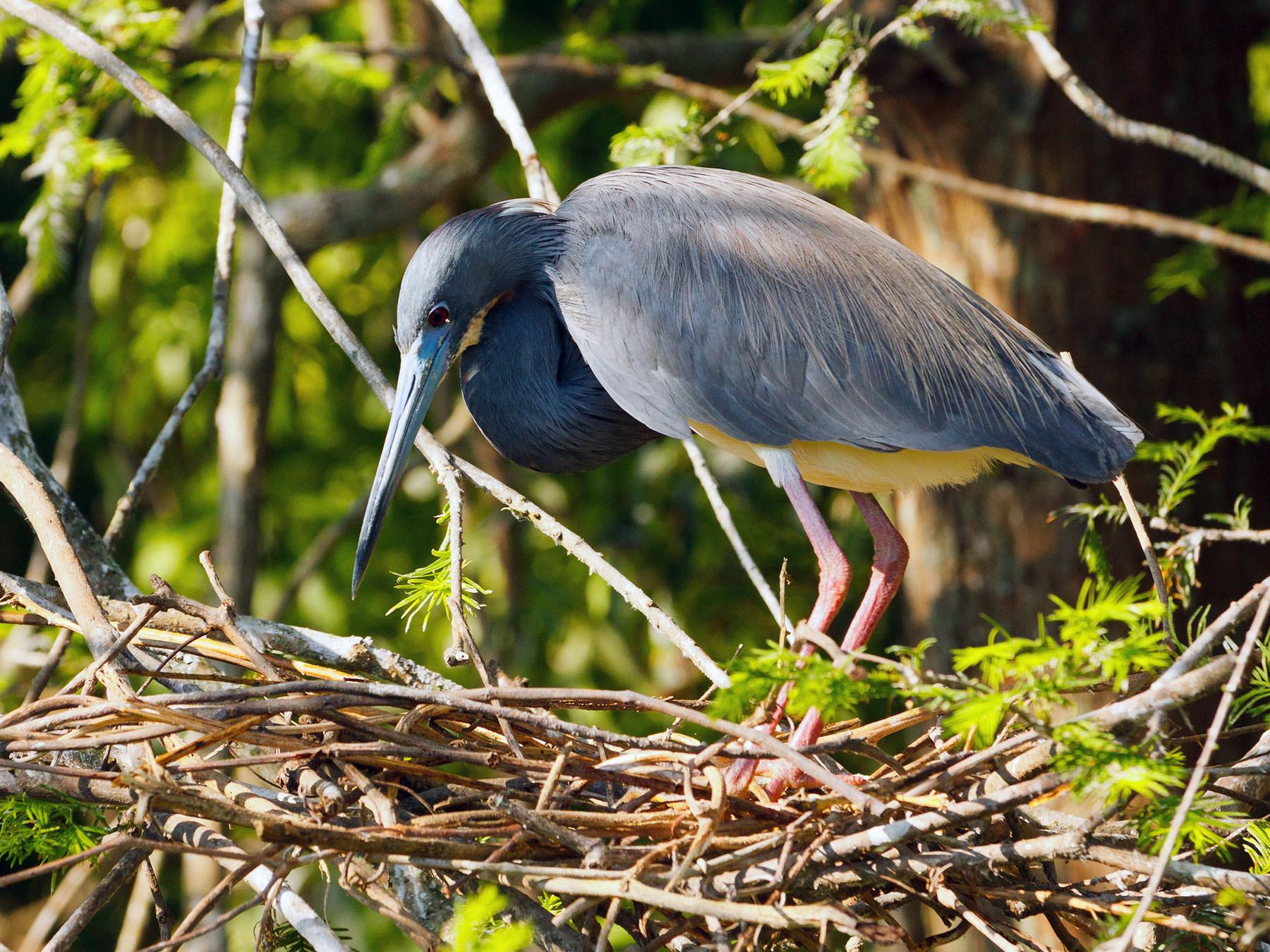
It nests in colonies, usually mixed with other herons, egrets and ibises, and often at the edge, in denser vegetation. It may also nest in small colonies of its own kind, of 2–100 nests, or occasionally alone. Nests sit in dense, shaded shrubs and small trees from 6 in to 13 ft (0.15–4 m) above the ground or water, often black mangrove in coastal Florida. On salt-marsh islands it may nest on flattened mats of needle rush.
The male starts a loose platform of large twigs before he has a mate, then usually brings twigs while the female works them in. The finished nest is under 12 in (30 cm) across with a slight hollow, sometimes topped with fine twigs and cordgrass.
Laying starts earliest in southern Florida, sometimes in February but more often in early to mid-March, and later farther north: early April in Texas and South Carolina, late April in Maryland and early May in Virginia. It can go on into June, and rarely August in Florida.1 In Louisiana colonies in 2011 it nested earlier than most other waterbirds, along with Brown Pelicans and Great Egrets.9 In a 1973 Florida mangrove colony, nests were built higher and farther from the shore as the season went on.10
Eggs and incubation
A clutch is 3–5 eggs, most often 3–4 in North America, and smaller, 2–4, in Central America and Mexico. The eggs are pale greenish blue and about 1.7 by 1.3 in (44 by 32 mm). They are laid about two days apart, and incubation usually begins with the second egg, so the chicks hatch over about three days.
Both parents incubate, in stints of 1 to more than 14 hours, most often 2–6 hours. Incubation lasts about three weeks: Florida studies found averages of 22–24 days, depending on how it was measured.1 Audubon's guide gives 21–25 days.2 In the Everglades, clutches were larger in fresh water than in brackish or salt water, and at one Florida colony early clutches were larger than late ones.1
Chicks and young
Chicks start climbing out of the nest at about 11 days old, and from about two to three weeks they perch near it, coming back to be fed. Both parents feed them by regurgitation, 4–5 times a day, for up to 7–8 weeks. The older chicks get most of the food, and the parents do not appear to step in for the youngest.
First flights come at 25–30 days, and the young become independent of their parents' feeding at about 50–56 days. Radio-tagged chicks in the Everglades became independent at 59 days on average, across 32 chicks.1
Pairs raise one brood a year and lay again if a nest fails; second broods after a success are probably uncommon. A successful nest usually fledges one or two young. Young birds are thought to breed first in their second spring, at about 21–23 months old, though there are no data to confirm it.
Behaviour
Away from the colony it is usually seen alone, wading or dashing after fish. It is generally less social in feeding, flocking and nesting than other herons, and at Lake Okeechobee it was the least likely of the wading birds to nest in clusters within mixed colonies.
It flies steadily with direct wingbeats, its head drawn in and legs trailing, and seldom in flocks. Coming in to a colony or roost, it drops with a rocking, falling-leaf descent.
At the colony, males display with twig-shaking, a snap-stretch display that shows off the magenta eye, black bill tip, blue face and white throat, and circle flights with deep, audible 'whomp' wingbeats. A male may hold a territory for up to 11 days while he pairs. Pairs stay together for at least one nesting attempt, and no banding study shows how long they last.
Older writers called it quarrelsome, but at a mixed heron roost at San Blas, Mexico, it was no more aggressive than its numbers predicted and lost about 70% of its encounters.1 In Panama, dark herons such as this one gave more alarm calls in mixed flocks than white ones, and Common Black Hawks attacked Tricolored Herons more than other species, perhaps because their contrasting plumage makes them easy to spot.1
A 1980 physiology study measured its feathers reflecting only 13–15% of light, against 80–82% for white herons.11 Its shaded nest sites may help it avoid overheating, though white Snowy Egrets also nest in shade.1
Lifespan and predators
The oldest on record was at least 17 years 8 months old. It was banded as a nestling in Virginia on 6 June 1958 and recovered in the Bahamas on 12 February 1976.12
Most live far shorter lives. From recoveries of birds banded as nestlings in Texas in 1926–1976, about 79% died in their first year and about 32% each year after that. Life expectancy was about 1.2 years at fledging and 2.7 years for birds that reached their second year, though these are rough estimates, because band recoveries are biased.1 Beyond these figures, we found no study that has measured adult survival.
Predators and other dangers
Fish Crows and American Crows take eggs, above all in coastal colonies, and may cause more egg loss than anything else. Raccoons may take eggs and young, but only when the water around a colony recedes.
In a south Florida study of radio-tagged young, 32% of chicks died between hatching and independence. Predation caused 57% of those deaths, malnutrition 29% and disease 9%, and Bald Eagles and Turkey Vultures were the commonest predators. Death rates were nearly three times as high once the chicks moved about the colony as before.1, 13
In the Everglades, wading birds were never found nesting without alligators nearby, and small day-herons, this one among them, gathered more at sites with alligator and bird decoys. The authors suggest alligators protect nests from predators,14 though alligators also take fallen chicks.1
A parasitic worm caught from killifish, Eustrongylides ignotus, can kill nestlings within a day. About 10% of wild nestlings in southern Florida were infected.1 In 1976, on Delaware's Pea Patch Island, the worm caused large-scale deaths of nestling herons and egrets, worst among Snowy Egrets and less severe among Tricolored Herons.15
Conservation
It is rated Least Concern on the 2025 IUCN Red List (BirdLife International).16 Partners in Flight puts the global population at about 190,000 breeding-age birds, on a 2010 base. That figure is scaled up from its US and Canada estimate of 58,000, which rests on Breeding Bird Survey counts. It is not on Partners in Flight's Watch List.17
Across the US, the North American Breeding Bird Survey shows no clear long-term trend. It estimates a change of −0.76% a year from 1966 to 2025, from 218 survey routes, but the 95% credible interval, −1.79 to +0.16, includes zero. The last ten years, 2015–2025, show no clear change either.18
Florida is different. There the survey shows a clear long-term decline of 1.7% a year (95% credible interval −2.83 to −0.75), and Florida's index in 2025 was about 64% below 1966. Louisiana and Texas show no clear trend.18
Counts at nesting colonies found large falls during the 20th century. Florida's statewide surveys found breeding numbers fell from about 35,000 birds in 1976–78 to fewer than 16,000 in 1986–89.19 In the southern Everglades, breeding birds fell from 10,000–15,000 in the 1930s to about 2,000 in the 1980s, and in Louisiana 11,450 pairs in the late 1980s were 84% fewer than in 1977.1 Texas colonial waterbird censuses counted 6,113–16,860 pairs between 1973 and 2000, with a highly significant decline of 3.0% a year, though the state's atlas adds that the decline may partly reflect regional rainfall cycles.3
Until the Cattle Egret arrived in the 1950s, it was likely the most numerous heron in North America. A comprehensive US survey in 1976 found at least 96,807 breeding pairs, about 193,600 adults, and probably undercounted, because this dark heron is hard to spot in aerial surveys; 72% were in Louisiana. The 1976 figure is a count at nesting colonies, while Partners in Flight's is scaled up from Breeding Bird Survey counts, so the gap between the two is not a measure of how far numbers have fallen. Birds of the World's 2013 text judged it probably in decline, perhaps fast, across its North American breeding range, with the causes unknown, and knew of no comprehensive survey since 1976.1
It is hard to count, and Christmas Bird Counts, when properly analyzed, are one of the few dependable sources of population data on small dark herons. A 1997 study of 30 years of Florida Christmas Bird Counts found it declining, though less than the Snowy Egret.20
NatureServe ranks it globally secure and secure in the US, while several states at the edge of its range, such as Delaware, Maryland, Connecticut, Maine and Kansas, rank it imperiled or critically imperiled. These are rarity ranks, not legal status.21
Conservation: wetlands and disturbance
A fall in estuarine productivity may be its most serious conservation problem, and declines in the Everglades may reflect coastal degradation through reduced freshwater flow. Sea-level rise, more frequent hurricanes and coastal development all threaten the estuaries it depends on. Food supply, and indirectly the amount of habitat, appears to control how many birds try to breed in the US; in an Everglades drought, adults abandoned nests when feeding trips stretched beyond 16 miles (25 km).1 Wetland development, pollutants, changes to water flow and oil spills are also listed as threats in Florida.22
Contaminant levels have generally been low. It does not appear to have suffered more than 4% eggshell thinning from DDT,1 and chicks in a Cuban colony carried low levels of pollutants.23
People on foot or in boats can flush nesting birds. In Florida studies, nesting birds flew off when people on foot came within about 100 ft (30 m) and canoes within 40 ft (12 m). The recommended setbacks were 290 ft (88 m) around colonies and roosts, and 430–540 ft (132–165 m) from personal watercraft, outboards and airboats for feeding and resting birds.1
It was probably of little commercial value to the plume trade around 1900, but disturbance at colonies it shared with plume-bearing species must have harmed it, at least locally.1, 3
Legal status
In the US it is protected under the Migratory Bird Treaty Act. It is on the federal list of protected migratory birds, and taking or killing the birds, their nests or eggs is unlawful except as allowed by regulation.24, 25 It is not listed under the Endangered Species Act.26
Florida lists it as State-designated Threatened. There, taking, possessing or selling the birds, their nests or eggs is prohibited except as authorized by Commission rule or permit. The rule includes guidelines, in effect since December 2018, for four threatened wading birds: this heron, the Little Blue Heron, the Reddish Egret and the Roseate Spoonbill.27 We have not read other states' lists.
In Canada, which it reaches only as a wanderer, herons are covered by the Migratory Birds Convention Act, 1994.28
Similar birds
Often mistaken for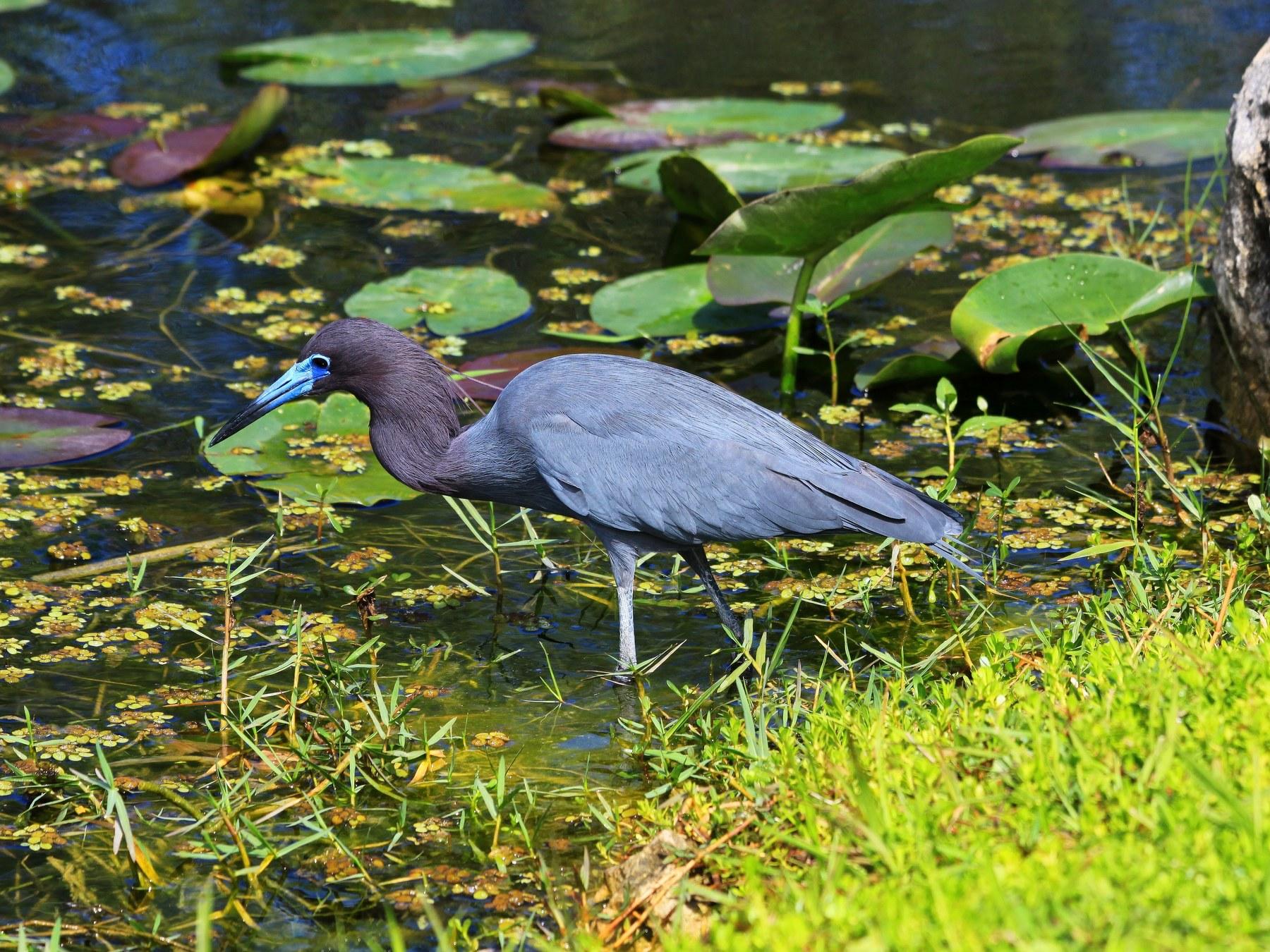
Quick facts
- Length
- 60–70 cm
- Wingspan
- 95 cm
- Weight
- 415 g
- Lifespan
- oldest recorded 17 years 8 months
- Family
- Herons & Egrets
- Migration
- Partial migrant
- Global status (IUCN)
- Least Concern
- World population
- About 190,000 breeding-age birds worldwide (Partners in Flight, 2010 base)
- Population trend
- No clear long-term trend across the US: the Breeding Bird Survey estimates a slight fall of about 0.8% a year since 1966, not statistically significant, and no clear change in the last ten years; Florida shows a clear decline, and state and colony counts from the 1930s–2000s found large falls in Florida, Louisiana and Texas
- Also called
- Louisiana Heron
- Scientific name
- Egretta tricolor
Questions
2Is the Louisiana Heron the same bird?
Yes. Louisiana Heron is its former name, used in older papers and on Audubon's plate 217. It was also once often placed in a genus of its own, so older papers may call it Hydranassa tricolor. As for the newer name, Florida's wildlife agency says it is named for its distinct coloring: a dark slate-blue head and back, a purple chest and white below.
Is it rare or endangered?
Not worldwide: it is rated Least Concern and is not listed under the US Endangered Species Act. In the US it nests widely along the southeastern coasts, but Florida lists it as State-designated Threatened, and colony counts there and in Louisiana and Texas fell in the late 20th century. See conservation for the numbers.
Sources
37- 1Frederick, P. C. (2020). Tricolored Heron (Egretta tricolor), version 1.0. Birds of the World (A. F. Poole, editor). Cornell Lab of Ornithology. doi:10.2173/bow.triher.01 (opens in a new tab)
- 2National Audubon Society. Tricolored Heron. Audubon Guide to North American Birds. Accessed 28 November 2026. Source (opens in a new tab)
- 3Telfair, R. C., II (2007). Tricolored Heron (Texas Breeding Bird Atlas species account). Texas Breeding Bird Atlas, Texas A&M AgriLife. Accessed 28 November 2026. Source (opens in a new tab)
- 4Zhang, K., Wisely, S. M., Gulick, C. K. and Powell, A. N. (2026). Contrasting haemosporidian infections in two ecologically distinct wading birds from breeding colonies in the southeastern United States. International Journal for Parasitology: Parasites and Wildlife 29: 101200. doi:10.1016/j.ijppaw.2026.101200 (opens in a new tab)
- 5Boyle, R. A., Dorn, N. J. and Cook, M. I. (2012). Nestling diet of three sympatrically nesting wading bird species in the Florida Everglades. Waterbirds 35: 154-159. doi:10.1675/063.035.0116 (opens in a new tab)
- 6Klassen, J. A., Gawlik, D. E. and Frederick, P. C. (2016). Linking wading bird prey selection to number of nests. The Journal of Wildlife Management 80: 1450-1460. doi:10.1002/jwmg.21141 (opens in a new tab)
- 7Kent, D. M. (1987). Effects of varying behavior and habitat on the striking efficiency of egrets. Colonial Waterbirds 10: 115. doi:10.2307/1521241 (opens in a new tab)
- 8Strong, A. M., Bancroft, G. T. and Jewell, S. D. (1997). Hydrological constraints on Tricolored Heron and Snowy Egret resource use. The Condor 99: 894. doi:10.2307/1370140 (opens in a new tab)
- 9Burger, J. (2018). Productivity of waterbirds in potentially impacted areas of Louisiana in 2011 following the Deepwater Horizon oil spill. Environmental Monitoring and Assessment 190. doi:10.1007/s10661-017-6428-y (opens in a new tab)
- 10Maxwell, G. R. and Kale, H. W. (1977). Breeding biology of five species of herons in coastal Florida. The Auk 94: 689-700. doi:10.2307/4085265 (opens in a new tab)
- 11Ellis, H. I. (1980). Metabolism and solar radiation in dark and white herons in hot climates. Physiological Zoology 53: 358-372. doi:10.1086/physzool.53.4.30157874 (opens in a new tab)
- 12USGS Bird Banding Laboratory (2026). Longevity records of North American birds: Tricolored Heron (AOU 1990). USGS Patuxent Wildlife Research Center, Bird Banding Laboratory. Accessed 28 November 2026. Source (opens in a new tab)
- 13Frederick, P. C., Spalding, M. G. and Powell, G. V. N. (1993). Evaluating methods to measure nestling survival in Tricolored Herons. The Journal of Wildlife Management 57: 34. doi:10.2307/3808997 (opens in a new tab)
- 14Burtner, B. F. and Frederick, P. C. (2017). Attraction of nesting wading birds to alligators (Alligator mississippiensis). Testing the 'nest protector' hypothesis. Wetlands 37: 697-704. doi:10.1007/s13157-017-0900-x (opens in a new tab)
- 15Wiese, J. H., Davidson, W. R. and Nettles, V. F. (1977). Large scale mortality of nestling ardeids caused by nematode infection. Journal of Wildlife Diseases 13: 376-382. doi:10.7589/0090-3558-13.4.376 (opens in a new tab)
- 16BirdLife International (2025). Egretta tricolor. The IUCN Red List of Threatened Species 2025. IUCN Red List, via the GBIF IUCN Red List checklist dataset. Accessed 28 November 2026. Source (opens in a new tab)
- 17Partners in Flight (2024). Avian Conservation Assessment Database, global, version 2024.05.23. Bird Conservancy of the Rockies. Accessed 28 November 2026. Source (opens in a new tab)
- 18USGS (2026). The North American Breeding Bird Survey, analysis results 1966-2025. USGS. Accessed 28 November 2026. Source (opens in a new tab)
- 19Anderson, B. H.. Tricolored Heron (Florida's Breeding Bird Atlas account). Florida Fish and Wildlife Conservation Commission. Accessed 28 November 2026. Source (opens in a new tab)
- 20McCrimmon, D. A., Fryska, S. T., Ogden, J. C. and Butcher, G. S. (1997). Nonlinear population dynamics of six species of Florida Ciconiiformes assessed by Christmas Bird Counts. Ecological Applications 7: 581-592. doi:10.1890/1051-0761(1997)007[0581:NPDOSS]2.0.CO;2 (opens in a new tab)
- 21NatureServe. Egretta tricolor (Tricolored Heron). NatureServe Explorer (public API record). Accessed 28 November 2026. Source (opens in a new tab)
- 22Florida Fish and Wildlife Conservation Commission. Tricolored heron (Egretta tricolor). FWC species profiles. Accessed 28 November 2026. Source (opens in a new tab)
- 23Rodríguez, A. et al. (2013). Assessment of trace elements and stable isotopes of three ardeid species at Birama Swamp, Cuba. Archives of Environmental Contamination and Toxicology 65: 24-32. doi:10.1007/s00244-013-9887-3 (opens in a new tab)
- 24US Fish and Wildlife Service. 50 CFR 10.13: List of Migratory Birds. Electronic Code of Federal Regulations (title 50 issue of 17 Nov 2026). Accessed 28 November 2026. Source (opens in a new tab)
- 25US Congress. 16 U.S.C. 703: Migratory Bird Treaty Act, taking, killing or possessing migratory birds unlawful. United States Code (Cornell LII text). Accessed 28 November 2026. Source (opens in a new tab)
- 26US Fish and Wildlife Service. ECOS species search: Egretta tricolor, Hydranassa, 'tricolor'. ECOS Environmental Conservation Online System. Accessed 28 November 2026. Source (opens in a new tab)
- 27Florida Fish and Wildlife Conservation Commission. Rule 68A-27.003, F.A.C.: Florida Endangered and Threatened Species List; Prohibitions. Florida Administrative Code (Cornell LII copy). Accessed 28 November 2026. Source (opens in a new tab)
- 28Government of Canada. Migratory Birds Convention Act, 1994 (S.C. 1994, c. 22), Schedule. Justice Laws Website. Accessed 28 November 2026. Source (opens in a new tab)
- 29Cornell Lab of Ornithology. Tricolored Heron: overview, identification and life history. All About Birds. Accessed 28 November 2026. Source (opens in a new tab)
- 30AviList Core Team (2025). AviList: The Global Avian Checklist, v2025b. AviList. doi:10.2173/avilist.v2025b (opens in a new tab)
- 31National Audubon Society. Louisiana Heron (Plate 217), John James Audubon's Birds of America. Audubon. Accessed 28 November 2026. Source (opens in a new tab)
- 32Kent, D. M. (1986). Behavior, habitat use, and food of three egrets in a marine habitat. Colonial Waterbirds 9: 25. doi:10.2307/1521140 (opens in a new tab)
- 33Meeks, W. A., Naugle, D. E., Johnson, R. R. and Higgins, K. F. (1996). Interbreeding of a Tricolored Heron and a Snowy Egret in South Dakota. The Auk 113: 955-957. doi:10.2307/4088880 (opens in a new tab)
- 34Rodgers, J. A., Jr. and Smith, H. T. (2020). Little Blue Heron (Egretta caerulea), version 1.0. Birds of the World (A. F. Poole, editor). Cornell Lab of Ornithology. doi:10.2173/bow.libher.01 (opens in a new tab)
- 35Koczur, L. M. et al. (2020). Reddish Egret (Egretta rufescens), version 1.0. Birds of the World (P. G. Rodewald, editor). Cornell Lab of Ornithology. doi:10.2173/bow.redegr.01 (opens in a new tab)
- 36Vennesland, R. G. and Butler, R. W. (2020). Great Blue Heron (Ardea herodias), version 1.0. Birds of the World (A. F. Poole, editor). Cornell Lab of Ornithology. doi:10.2173/bow.grbher3.01 (opens in a new tab)
- 37Davis, W. E., Jr. and Kushlan, J. A. (2020). Green Heron (Butorides virescens), version 1.0. Birds of the World (A. F. Poole and F. B. Gill, editors). Cornell Lab of Ornithology. doi:10.2173/bow.grnher.01 (opens in a new tab)

Checked by
Nathan Cope, founder and editor
Nathan founded Birdfact and leads its writers and contributors in the UK, the US and Canada. He has watched and studied birds for more than ten years, and checks every article and species guide before it’s published.