


Green Heron
Little Green Heron, Green-backed Heron · Butorides virescens
By the Birdfact teamChecked by Nathan Cope
On this page14 sections
How to recognise it
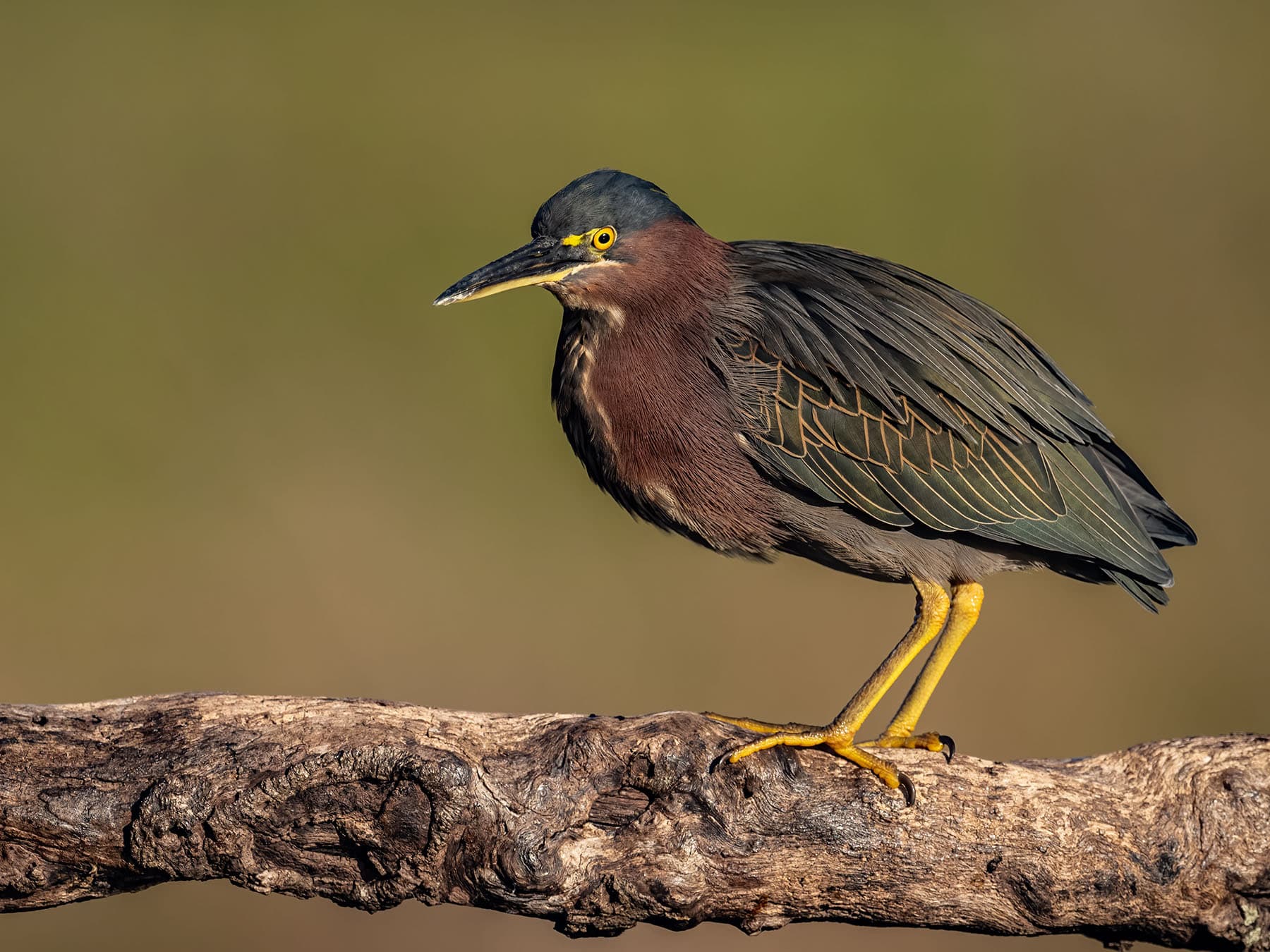
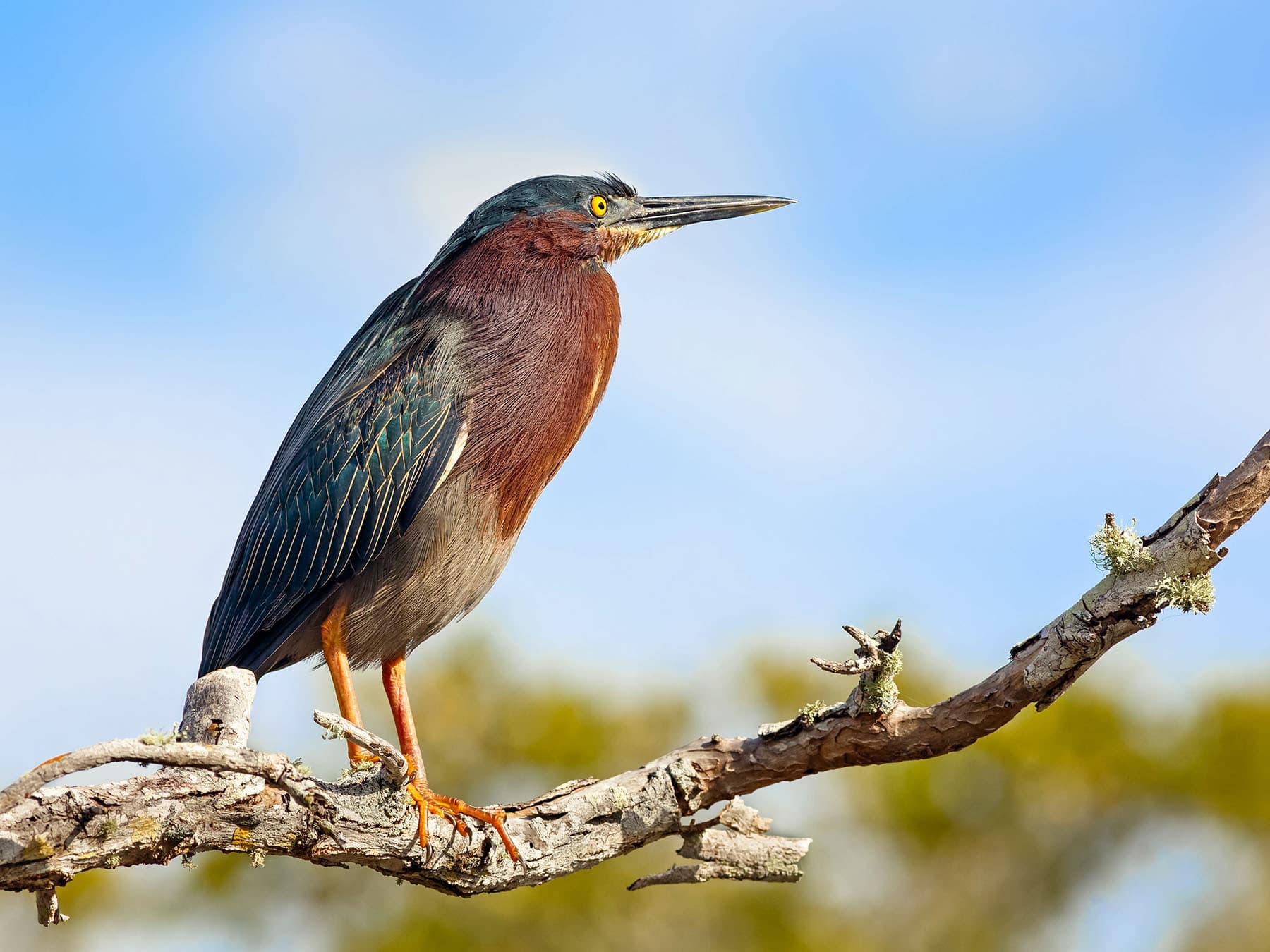
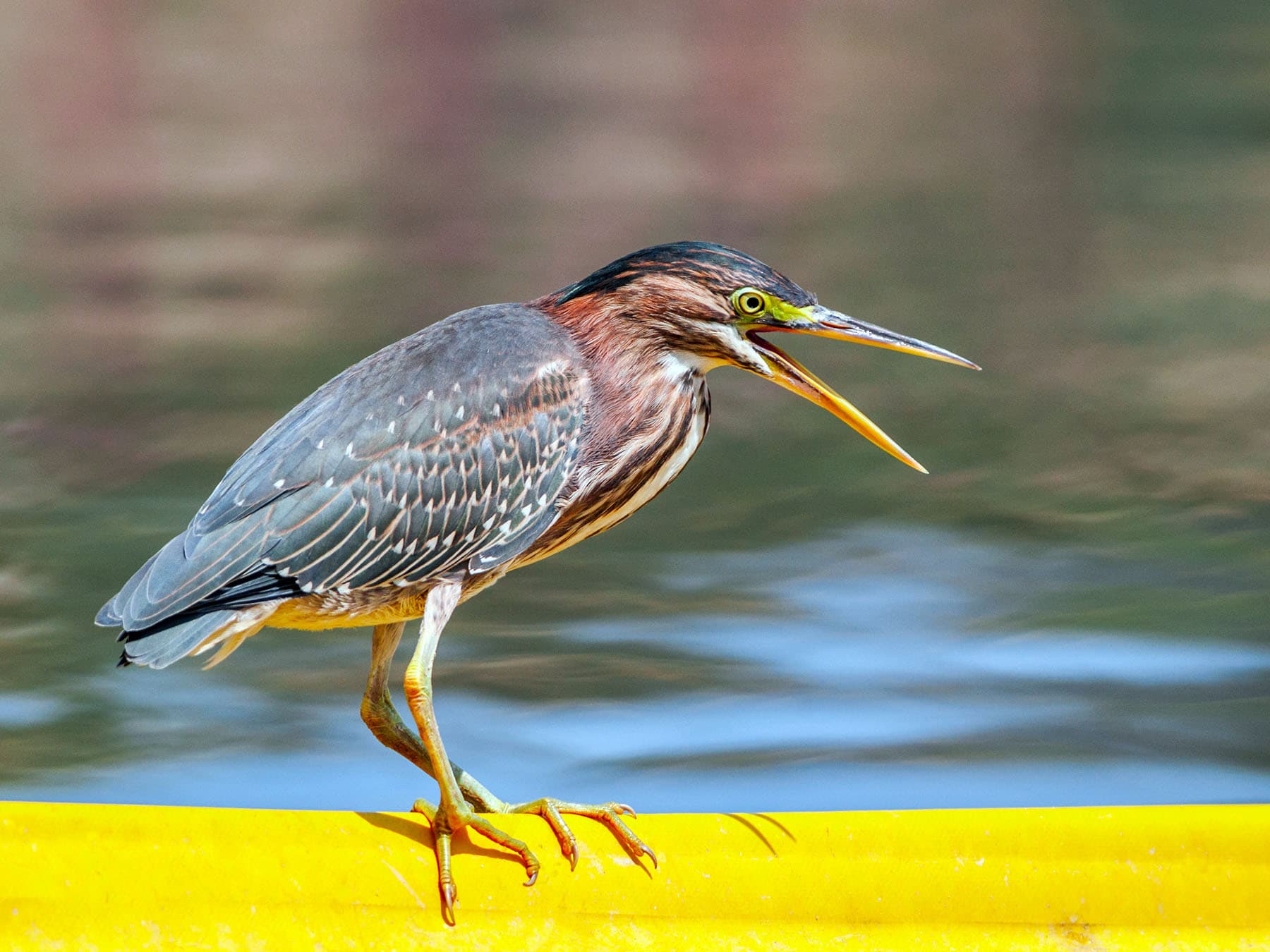
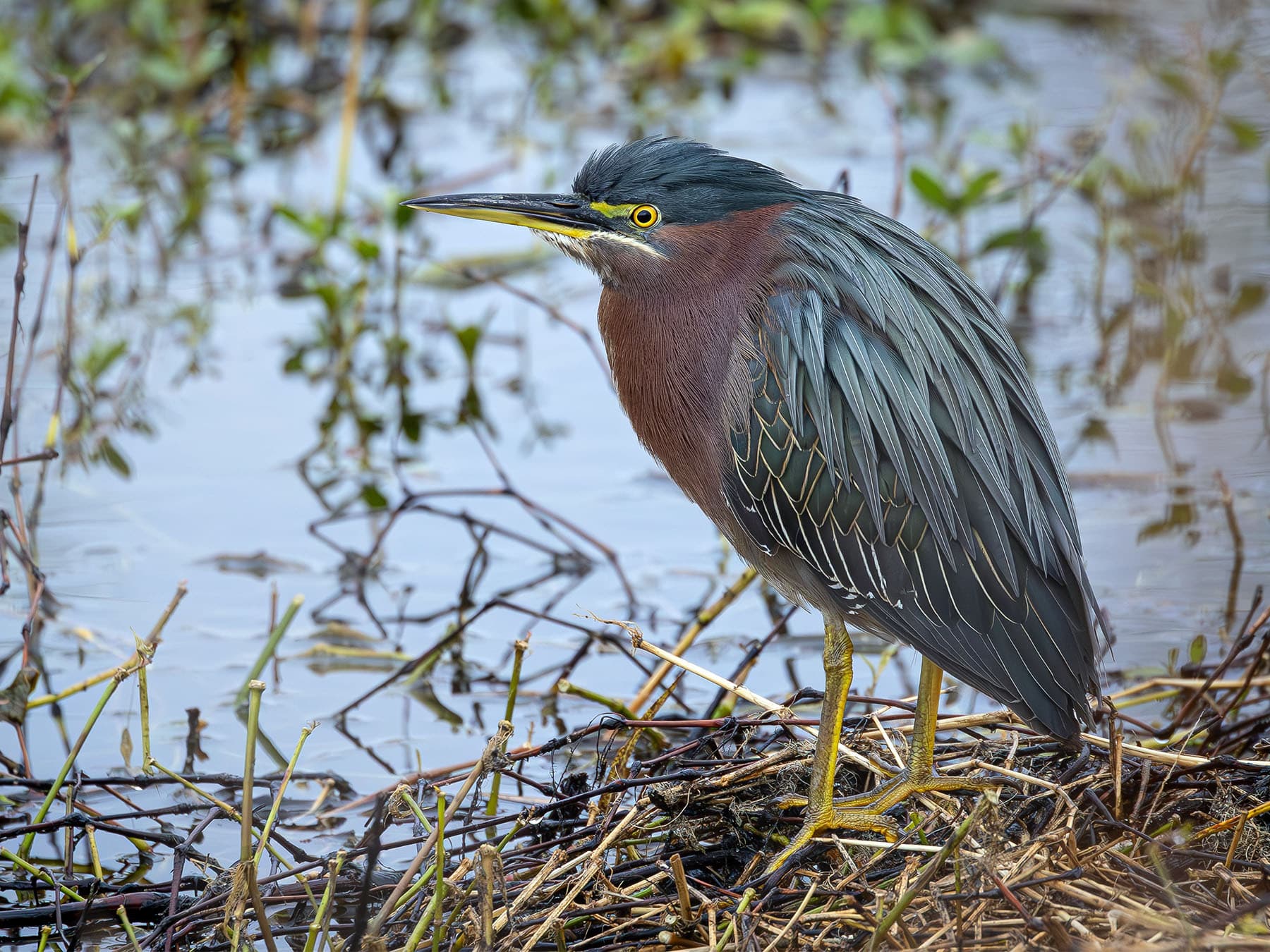
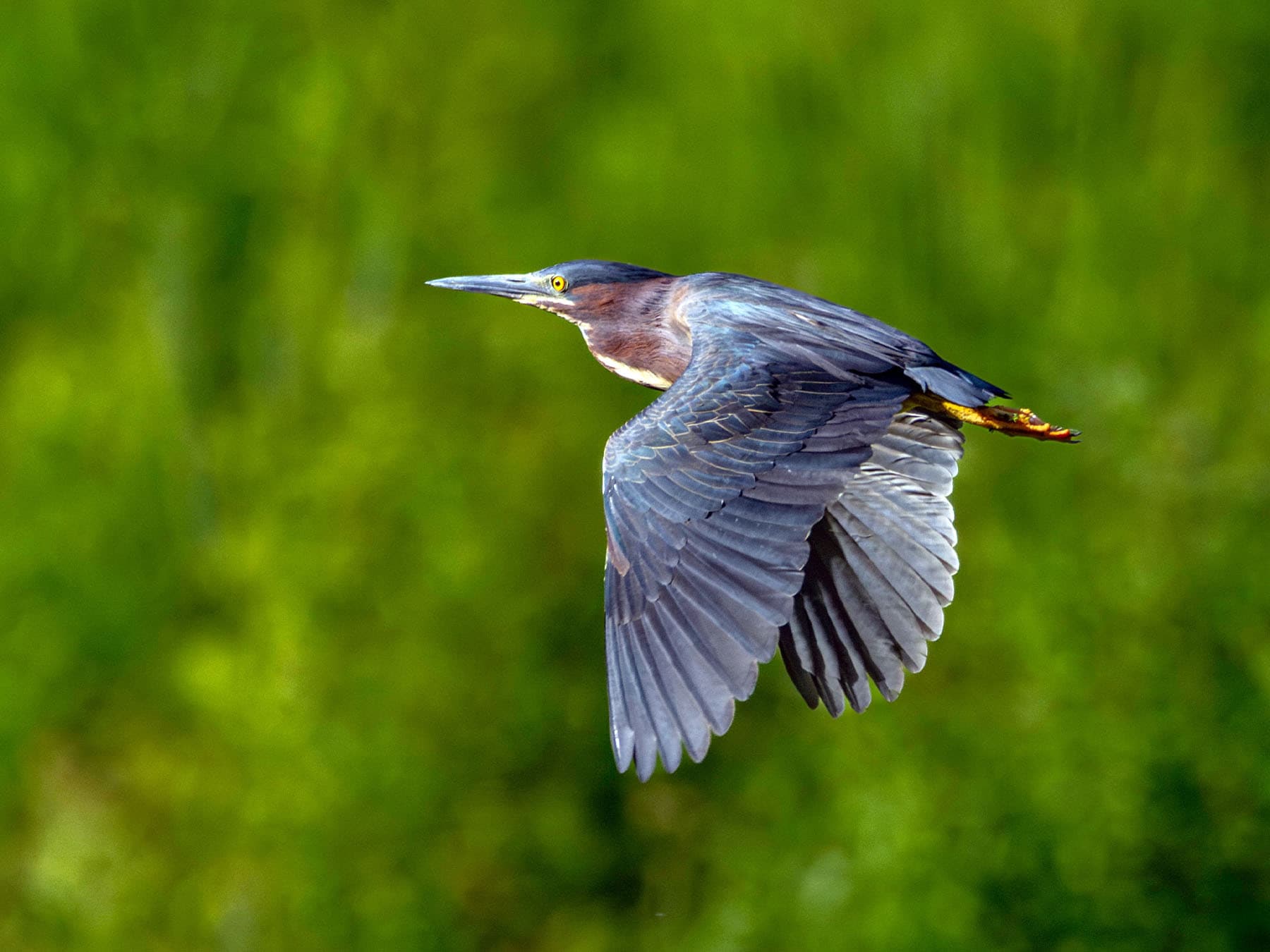
The Green Heron is a small, stocky heron that spends much of its time hunched and motionless at the edge of a pond or creek, often half hidden in the leaves. From a distance it looks all dark. Up close, an adult has a glossy greenish-black cap, a deep chestnut neck and breast with a white stripe down the throat, a dark back and wings glossed green or blue-gray, short yellow to orange legs and a heavy, dagger-like bill.1
When it is nervous it raises its cap into a shaggy crest and flicks its tail. The green is an iridescent sheen that shows in good light; otherwise the back often looks dull bluish or simply dark.
Size and shape
Green Herons are 16 to 18 inches (41-46 cm) long, about the size of an American Crow. A Black-crowned Night Heron is much bigger. In one late-summer study in Louisiana, 16 adults averaged 8.5 ounces (241 g).2
For a heron, its neck and legs are short. It often keeps the neck drawn into its body, so it looks hunched, but it shoots the head and neck out to strike at prey and often briefly unfolds the neck in flight.
There are four subspecies. Birds of western North America are larger and paler than eastern ones, and those of southern Baja California have a very dark neck.
Males, females and young
Adult males and females look much alike. Males tend to be brighter and females duller and lighter, and females are usually smaller, though in some regions they average larger, so a lone bird is hard to sex. In the breeding season the bill turns glossy black, the bare skin in front of the eye blue-black and the legs bright orange.
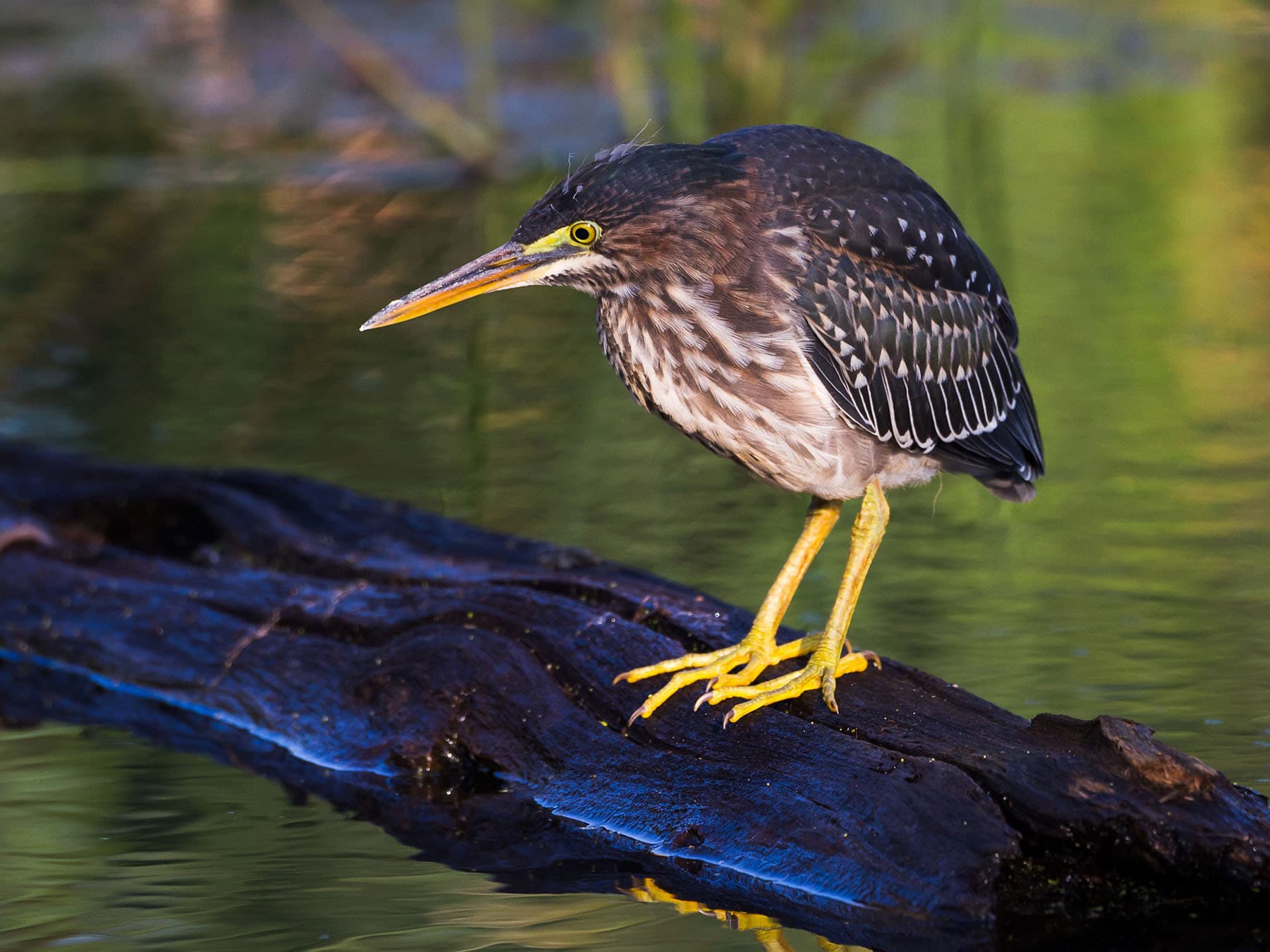
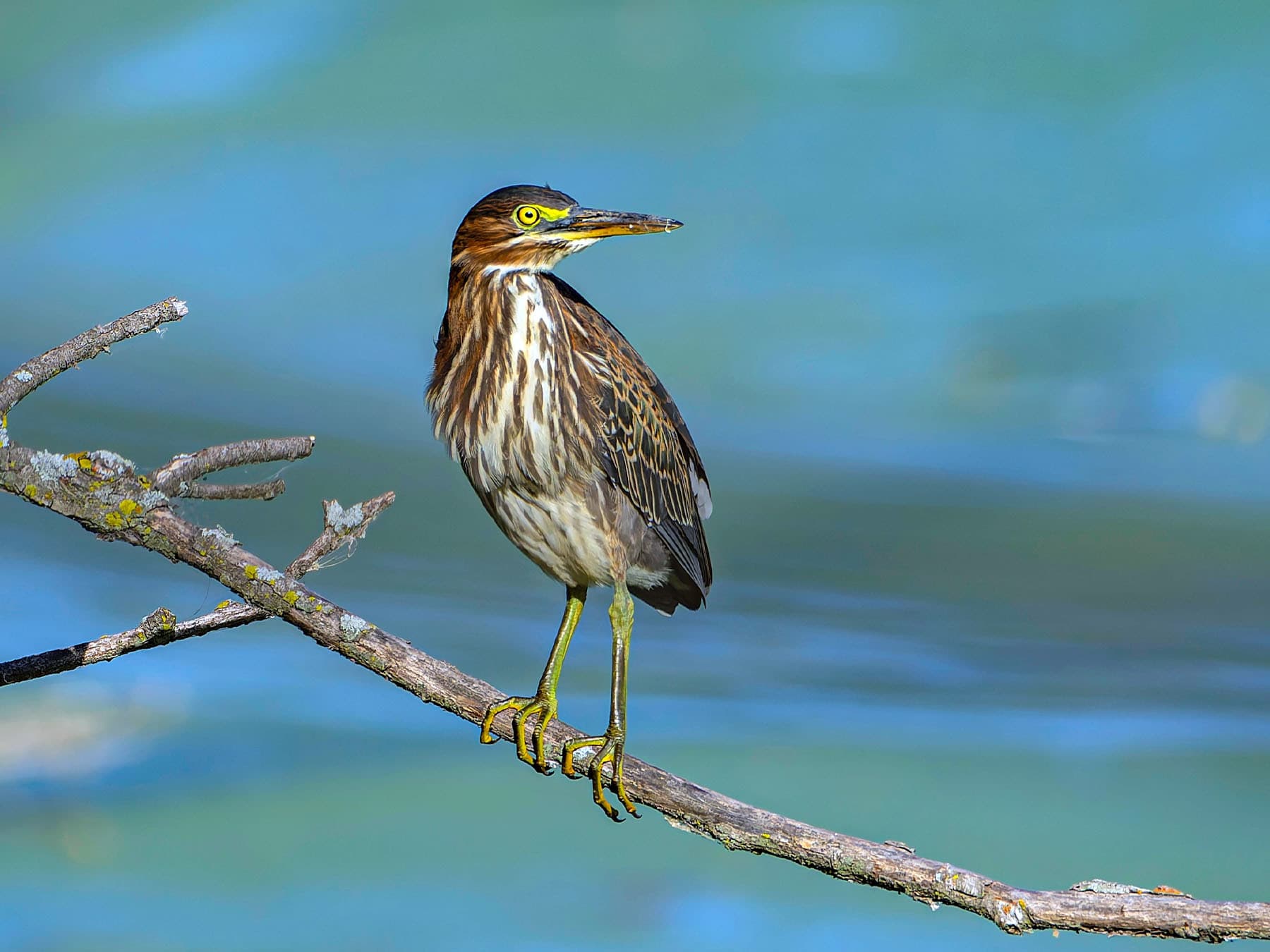
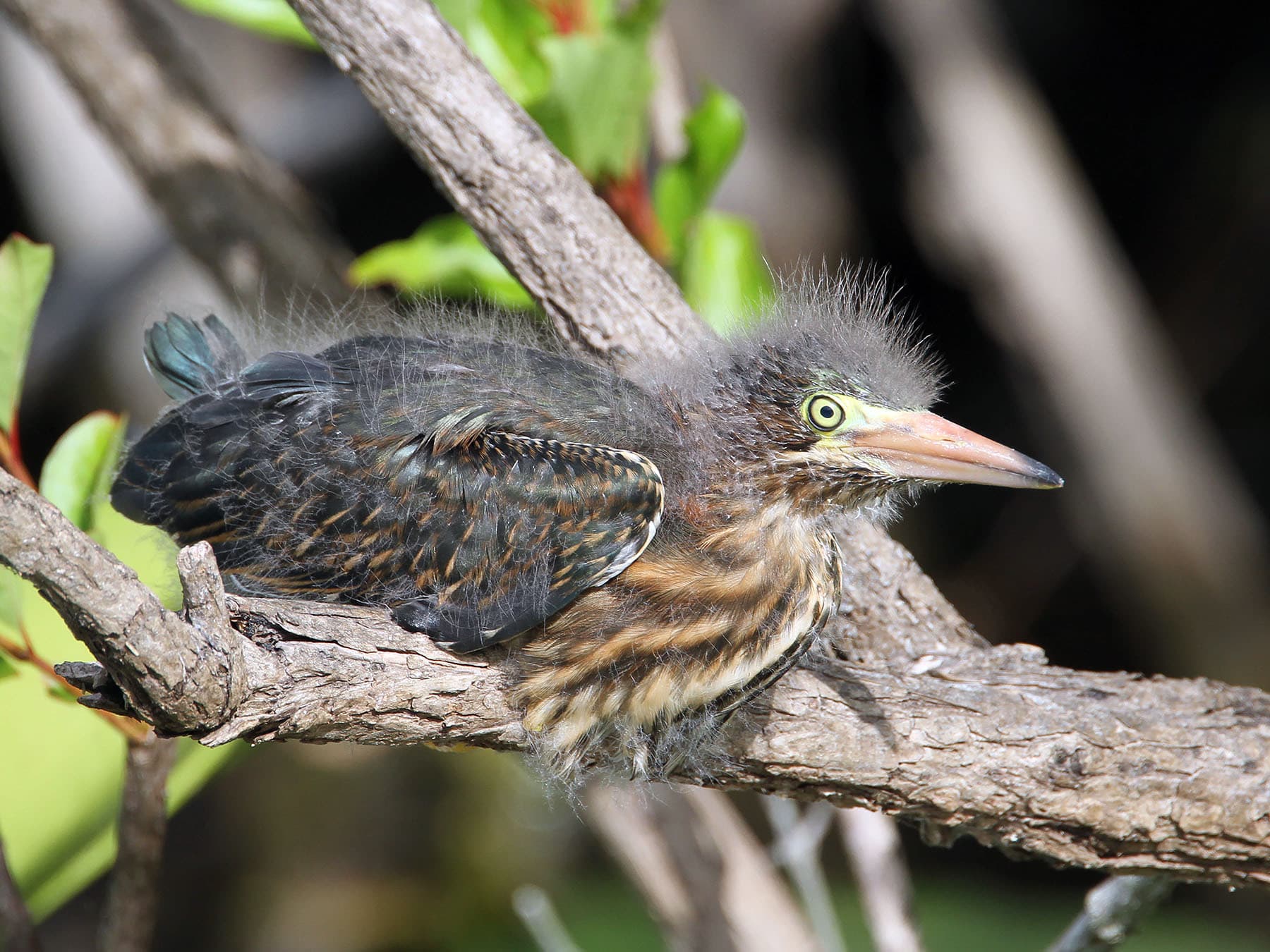
Young birds look quite different. A juvenile is browner than an adult, with a dark cap, a neck and underparts streaked brown on buffy white, pale buff spots and edges on the wing feathers, and yellow legs. Over the first winter most replace their body feathers: still striped on the neck, but with a darker crown and a clean white throat and underparts. By their first summer they look like dull adults, and by their second year like adults.
More: juvenile Green Herons, from hatching to their first spring.
Identification: similar birds
Black-crowned Night Heron. Young night herons are brown and spotted too, but they are much bigger, 23 to 26 inches (58-66 cm), and heavier-bodied, brown with white spots at first. A young Green Heron is much smaller, with a dark cap.
Yellow-crowned Night Heron. Much bigger, 21 to 28 inches (53-71 cm), and gray with a black-and-white face. Its young are grayish brown with small pale spots, a thick all-black bill and long legs.
Least Bittern. Smaller, 11 to 14 inches (28-36 cm), and mostly buff with a dark cap. The big buff patches on the inner wing, easy to see perched or flying, are the mark a young Green Heron lacks.
American Bittern. Much bigger, 23 to 34 inches (58-86 cm), and warm brown with strong stripes down the front; adults have a black neck mark. It hides in tall marsh plants.
Little Blue Heron. Adults are bigger, 22 to 29 inches (56-74 cm), and evenly dark slate blue with a purplish head and neck and a blue bill tipped black, not the Green Heron's chestnut neck and dark cap.
Not sure it’s a Green Heron? Check your photo: Birdfact names the bird and shows the look-alike side by side.
Its size
Adults- Length
- 41–46 cm
Its song and calls
The call you will hear most is a loud, harsh skeow, slurring downward, given in flight and as an alarm. A Green Heron flushed along a creek often flies off with a scolding call and a squirt of white droppings, which gave it old folk names such as fly-up-the-creek and chalk-line.1
In the breeding season the male's advertising call, its song, is a show-ch or ow-ch, given from an exposed perch or an old nest. He also gives a low skow from a treetop with his bill tilted up. Disturbed at the nest, adults give ku-ku-ku and kuk-kuk calls and harsh, threatening raaahs. Chicks beg with a rapid tik-tik-tik from their first day, loudest when a parent arrives. Green Herons call all year, though cold, wind and rain cut down courtship calling.
- Call0:00 / 0:01
Recorded in Maryland, United States · May 2025
- Nestlings begging0:00 / 0:20
Recorded in Virginia, United States · July 2021
Heard one and not sure? Let the bird song identifier listen.
When and where to see it
Green Herons breed across the eastern US and southeastern Canada, west through the Great Plains to Texas, New Mexico and Arizona; along the Pacific coast from British Columbia to Baja California; and south through Mexico and Central America to Panama and the Caribbean. They avoid the drier West and high mountains, and during the 20th century they spread along rivers and reservoirs in the middle of the continent.
They are most common around small, sheltered fresh waters lined with trees, shrubs or tall marsh plants: wooded ponds, creeks and streams, swamps, marsh edges, ditches, canals, reservoirs and lake shores, as well as mangroves, salt-marsh creeks and even park and garden ponds.3 Larger herons stand in the open; a Green Heron keeps to the edges and the cover, though it will feed in the open on mudflats and pond edges when food is there. Scan the banks and the low branches over the water. Solitary for most of the year and often secretive, it is easy to walk past.
Do they migrate?
Most North American birds do. In winter Green Herons leave the US except the southern tier: the Gulf Coast and Florida, and the Pacific coast, where some winter as far north as Washington. The rest winter around the Gulf of Mexico, in the Caribbean, Mexico and Central America and south to northern South America. Birds in Florida and the southern states appear to stay all year, as do many on the Pacific coast.
They move north in late winter and early spring, usually at night and often in flocks, reaching Ohio by mid to late March and New York and Vermont from mid-April. Before heading south many wander: young banded in summer in Maryland and Virginia were found in October anywhere from Wisconsin to Nicaragua and Puerto Rico. Fall migration runs from late August to early November.1
Tips for seeing it
What it eats
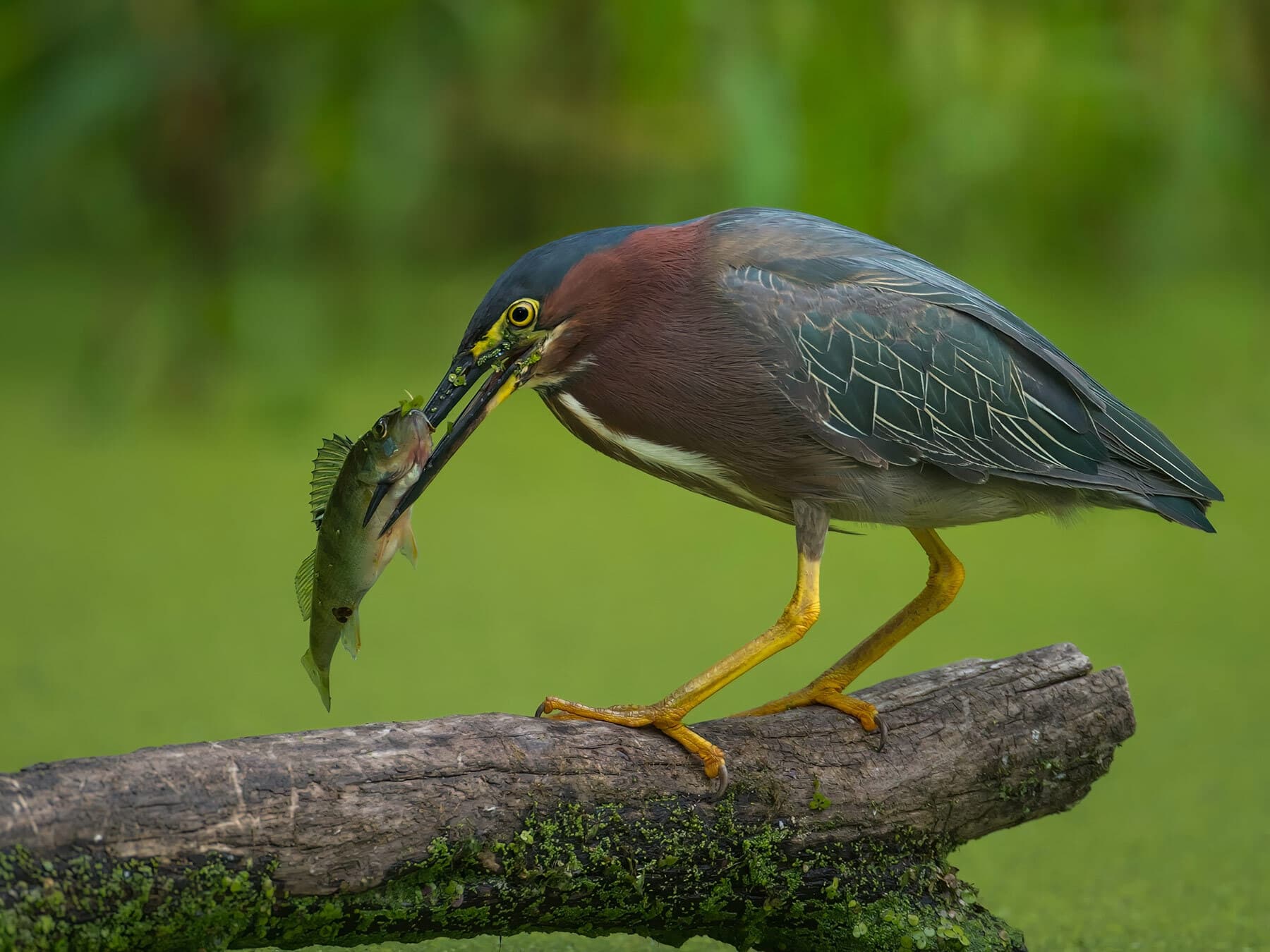
The heavy bill can manage prey as big as a frog, but not a big fish that struggles. Mostly, though, Green Herons eat small fish: minnows, topminnows, sunfish, shad and, in town ponds, goldfish. They also take crayfish, insects such as dragonflies and grasshoppers, frogs and tadpoles, spiders, worms and snails, and now and then snakes, lizards and rodents. In 27 stomachs from Louisiana in late summer, fish made up 93% of the diet by weight.2
The usual method is patience. A Green Heron stands crouched and still at the water's edge, head drawn in, staring into water under about 4 inches (10 cm) deep, or perches on a branch or rock to reach deeper water. Then it lunges with a darting stroke of the head and neck. Now and then it dives head first from a perch and goes right under. It feeds by day and at dawn and dusk, and sometimes at night, though at one New Jersey roost most birds came in after sunset and left about 30 minutes before sunrise.1
Feeding with bait
The Green Heron is one of the few birds known to use tools. Some birds drop bait on the water to bring fish within reach: bread crusts, mayflies and other insects, feathers or twigs.1, 4 One bird fishing with bread drove off American Coots.5
Detailed studies of the habit come from Striated Herons, the Green Heron's close relative, in southern Japan. Live bait worked best, young birds baited poorly, and birds were twice seen breaking off bits of stick to make bait.6, 7 In one study, three territorial birds baited most where they fished in open water with few perches, and least from high branches, where dropped bait rarely landed where they meant.7
Nesting and breeding
Pairs are thought to stay together for one season only. The male calls from perches and flies display flights around the territory, including a flap flight with exaggerated wingbeats; on a perch he snaps his bill shut with a click, and stretches his neck straight up and back with his back plumes fanned while swaying.
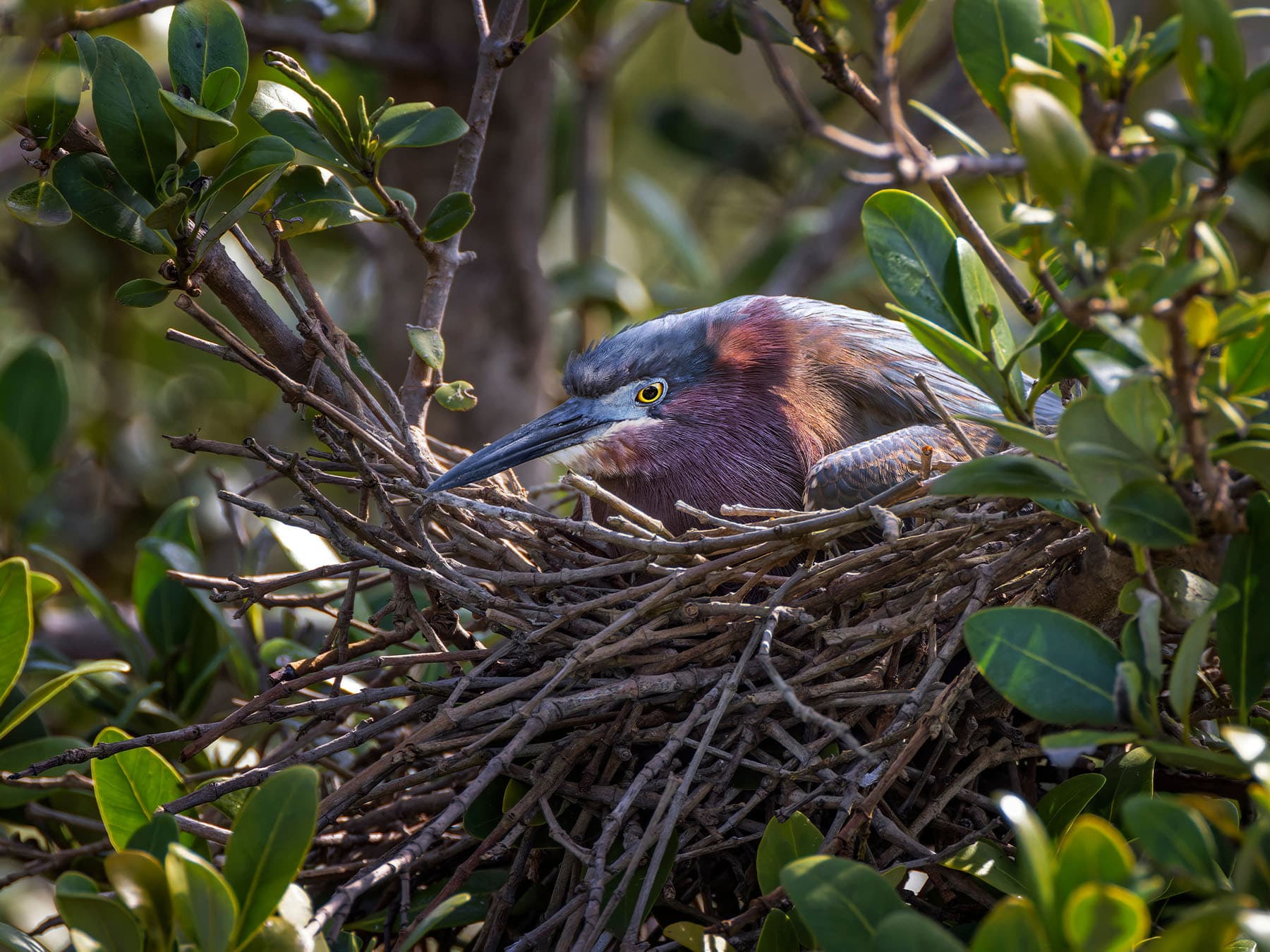
The nest is usually in a tree or shrub on or over water, in a fork with overhanging branches for cover, from ground level to about 33 feet (10 m) up. Some nest up to half a mile (0.8 km) from water, and some in dry woods or orchards if feeding sites are near. Pairs nest alone or in loose groups and small colonies, sometimes beside other herons and egrets. In a Missouri study, birds nested alone along streams, where they could defend a feeding territory, and in loose groups in open wetlands; they were more likely to move after a failed nest and to reuse one that succeeded.8
The male starts the nest, then brings sticks, often breaking them off, while the female does most of the building: a platform of thin sticks 8 to 12 inches (20-30 cm) across with a shallow dip and no lining, sometimes so thin you can see the eggs from below. In some places old nests are repaired and reused, including old Black-crowned Night Heron and Snowy Egret nests.1
Eggs and young
Laying starts from late March in Florida and early April on the Gulf Coast, and from late April in New York and New England. The clutch is usually 3 to 5 pale green to bluish eggs, about 1.5 by 1.1 inches (38 x 29 mm). Both parents incubate, usually starting with the second egg, for 19 to 21 days counted from the last egg.1, 3
Chicks hatch with their eyes open and a crest of grayish down. Both parents brood them, shade them from strong sun and feed them by regurgitation. The young clamber out of the nest at 16 to 17 days, fly at 21 to 23 days and follow their parents to feeding grounds by about 25 days. In the mid-1990s their age at independence had only been estimated, at about 30 to 35 days.
In the north pairs probably raise one brood; farther south they generally raise two, and pairs may try again after a failure. In Missouri, 79% of 62 nests raised young, and losses were mostly to predators, wind and storms.8
Behaviour
Green Herons defend good feeding spots against other Green Herons. They fly with slow, steady beats of rounded wings, looking rather like a tailless crow, usually with the neck drawn in and the legs trailing.
Chicks left alone in the nest from 9 to 11 days old, when their parents start leaving them by day, freeze when approached in what is called the bittern stance: neck stretched up, feathers sleeked and bill pointing up. Green Herons can swim, too: a half-grown bird put in water swam about 66 feet (20 m), sitting upright, and fledged young go into the water after prey.1
Lifespan and predators
Typical lifespan was little studied when the main handbook account was written (1994). The oldest on the North American banding records was at least 11 years 1 month old: banded as an adult in Texas in August 2013, so it had hatched by 2012 at the latest, it was seen alive there, by its color marker, in July 2023.9
Most of what is known about predators concerns eggs and chicks. Snakes, Common Grackles and Fish Crows take eggs, and raccoons probably take young; snakes caused a quarter of known nest failures in one study.8 Little had been recorded about what kills adults by the mid-1990s.
Conservation
Green Herons are still common and widespread, with about 1.2 million breeding adults in a Partners in Flight estimate for around 2010.10 But they are declining. On the North American Breeding Bird Survey their numbers fell by about half between 1966 and 2025, about 1.2% a year.11 Partners in Flight lists the Green Heron as a Common Bird in Steep Decline: too numerous and widespread for its Watch List, but in long-term decline.
No study has tied the survey decline to a single cause. The loss and draining of wetlands, small ones included, takes away the places it needs, and in a 1980s Missouri study, more recreational use of river channels meant fewer Green Herons there and less time spent feeding. Reservoirs and managed wetlands have given it new places to feed and nest.1 In the US it is protected under the Migratory Bird Treaty Act.12
Similar birds
Often mistaken for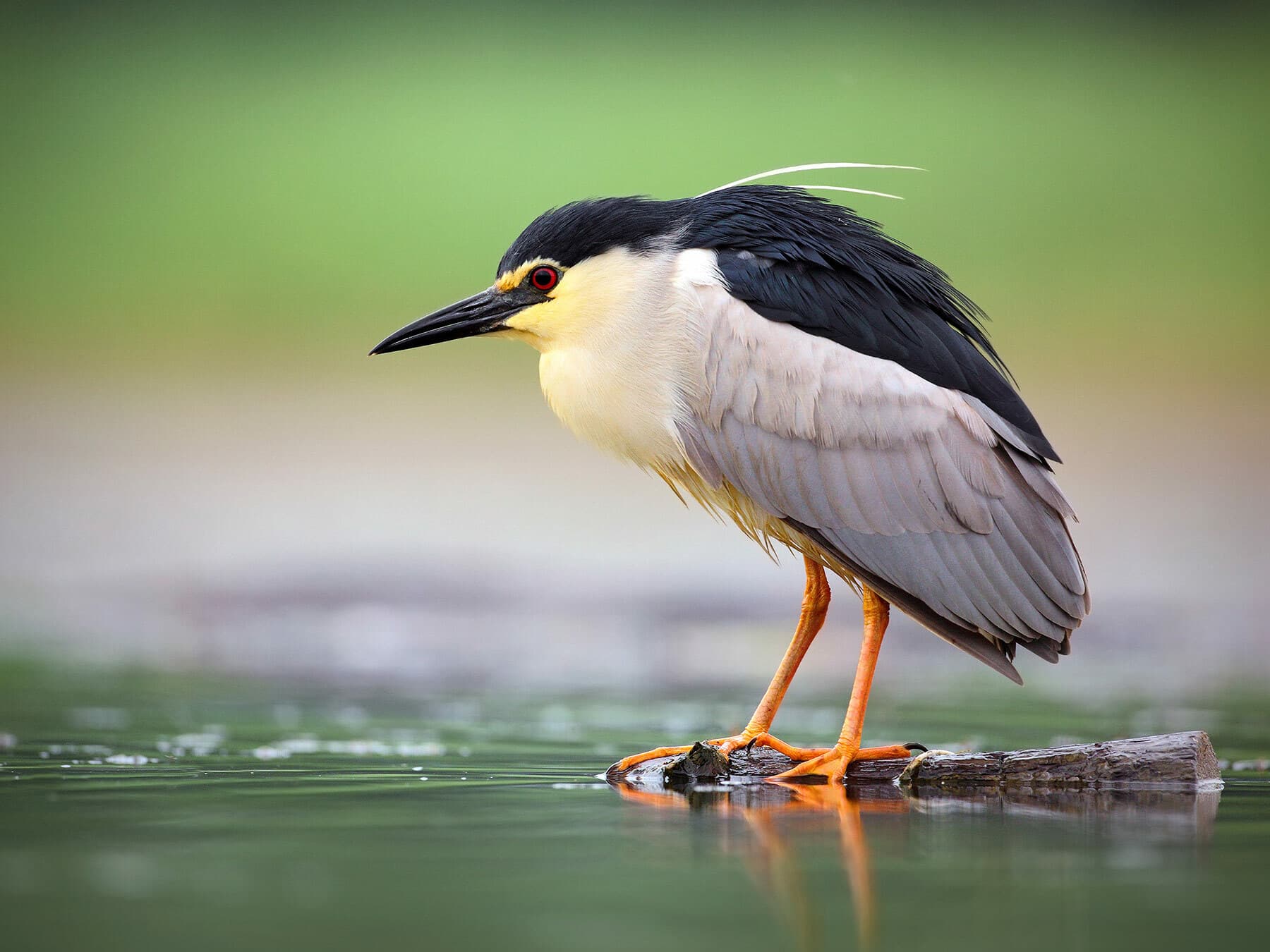


Green Heron guides
1 guidesQuick facts
- Length
- 41–46 cm
- Lifespan
- oldest recorded 11 years 1 month
- Family
- Herons & Egrets
- Migration
- Partial migrant
- World population
- About 1.2 million breeding adults (Partners in Flight, about 2010)
- Population trend
- Still common and widespread, but listed by Partners in Flight as a Common Bird in Steep Decline
- Also called
- Little Green Heron, Green-backed Heron
- Scientific name
- Butorides virescens
Questions
6Is it rare to see a Green Heron?
No: they are common and widespread, but easy to miss. They keep still, stay in cover and look dark, so scan the edges of ponds and creeks and listen for the harsh skeow as one flushes. See where and when to see them.
Do Green Herons mate for life?
Probably not. Pairs are thought to stay together for one season only, though no study of marked birds had tested this by the mid-1990s. See nesting.
Are Green Herons nocturnal?
Partly. They feed by day and at dawn and dusk, and sometimes at night, and usually travel by night on spring migration.
Is the Green Heron the same as the Green-backed or Striated Heron?
Not on the North American checklist. From the 1970s until 1993 the American bird was lumped with the Striated Heron, the Old World and South American form, as one species, the "Green-backed Heron". The American Ornithologists' Union split them again in 1993.13 The chestnut neck separates an adult Green Heron from the Striated Heron. It is also sometimes called the Little Green Heron.
Will a Green Heron take fish from my pond?
It may. Green Herons visit ornamental ponds and take goldfish. A length of drain pipe laid in the pond gives the fish somewhere to hide.14
Has a Green Heron been seen in Britain?
Yes, rarely. After nesting, Green Herons wander, and stragglers have reached England.
Sources
22- 1Davis, W. E., Jr. and Kushlan, J. A. (2020). Green Heron (Butorides virescens), version 1.0. Birds of the World (A. F. Poole and F. B. Gill, editors). Cornell Lab of Ornithology. doi:10.2173/bow.grnher.01 (opens in a new tab)
- 2Niethammer, K. R. and Kaiser, M. S. (1983). Late summer food habits of three heron species in northeastern Louisiana. Colonial Waterbirds 6: 148-153. Accessed 1 November 2026.
- 3National Audubon Society. Green Heron. Guide to North American Birds. Accessed 1 November 2026. Source (opens in a new tab)
- 4Norris, D. (1975). Green Heron (Butorides virescens) uses feather lure for fishing. American Birds 29: 652-654. Accessed 1 November 2026.
- 5Lovell, H. B. (1958). Baiting of fish by a Green Heron. Wilson Bulletin 70: 280-281. Accessed 1 November 2026.
- 6Higuchi, H. (1986). Bait-fishing by the Green-backed Heron Ardeola striata in Japan. Ibis 128: 285-290. doi:10.1111/j.1474-919x.1986.tb02677.x (opens in a new tab)
- 7Higuchi, H. (1988). Individual differences in bait-fishing by the Green-backed Heron Ardeola striata associated with territory quality. Ibis 130: 39-44. doi:10.1111/j.1474-919x.1988.tb00953.x (opens in a new tab)
- 8Kaiser, M. S. and Reid, F. A. (1987). A comparison of Green-backed Heron nesting in two freshwater ecosystems. Colonial Waterbirds 10: 78-83. Accessed 1 November 2026.
- 9USGS Bird Banding Laboratory. Longevity records of North American birds. USGS Eastern Ecological Science Center, Bird Banding Laboratory. Accessed 1 November 2026. Source (opens in a new tab)
- 10Partners in Flight (2023). Avian Conservation Assessment Database and Population Estimates Database. Bird Conservancy of the Rockies. Accessed 1 November 2026. Source (opens in a new tab)
- 11Hostetler, J. A. et al. (2026). The North American Breeding Bird Survey, Analysis Results 1966-2025. U.S. Geological Survey data release. doi:10.5066/P1OSNSFC (opens in a new tab)
- 12U.S. Fish and Wildlife Service (2026). 50 CFR 10.13: List of Birds Protected by the Migratory Bird Treaty Act. Electronic Code of Federal Regulations. Accessed 1 November 2026. Source (opens in a new tab)
- 13American Ornithologists' Union (1993). Thirty-ninth supplement to the American Ornithologists' Union Check-list of North American Birds. The Auk 110: 675-682. Accessed 1 November 2026.
- 14Cornell Lab of Ornithology. Green Heron. All About Birds. Accessed 1 November 2026. Source (opens in a new tab)
- 15National Audubon Society. Black-crowned Night Heron. Guide to North American Birds. Accessed 1 November 2026. Source (opens in a new tab)
- 16National Audubon Society. Least Bittern. Guide to North American Birds. Accessed 1 November 2026. Source (opens in a new tab)
- 17National Audubon Society. Yellow-crowned Night Heron. Guide to North American Birds. Accessed 1 November 2026. Source (opens in a new tab)
- 18National Audubon Society. American Bittern. Guide to North American Birds. Accessed 1 November 2026. Source (opens in a new tab)
- 19National Audubon Society. Little Blue Heron. Guide to North American Birds. Accessed 1 November 2026. Source (opens in a new tab)
- 20Dickerman, R. W. and Gavino T., G. (1969). Studies of a nesting colony of Green Herons at San Blas, Nayarit, Mexico. Living Bird 8: 95-111. Accessed 1 November 2026.
- 21Meyerriecks, A. J. (1960). Comparative breeding behavior of four species of North American herons. Publications of the Nuttall Ornithological Club 2. Accessed 1 November 2026.
- 22Edman, J. D., Day, J. F. and Walker, E. D. (1984). Field confirmation of laboratory observations on the differential antimosquito behavior of herons. The Condor 86: 91-92. Accessed 1 November 2026.

Checked by
Nathan Cope, founder and editor
Nathan founded Birdfact and leads its writers and contributors in the UK, the US and Canada. He has watched and studied birds for more than ten years, and checks every article and species guide before it’s published.