



Yellow-crowned Night Heron
Nyctanassa violacea
By the Birdfact teamChecked by Nathan Cope
On this page14 sections
How to recognise it
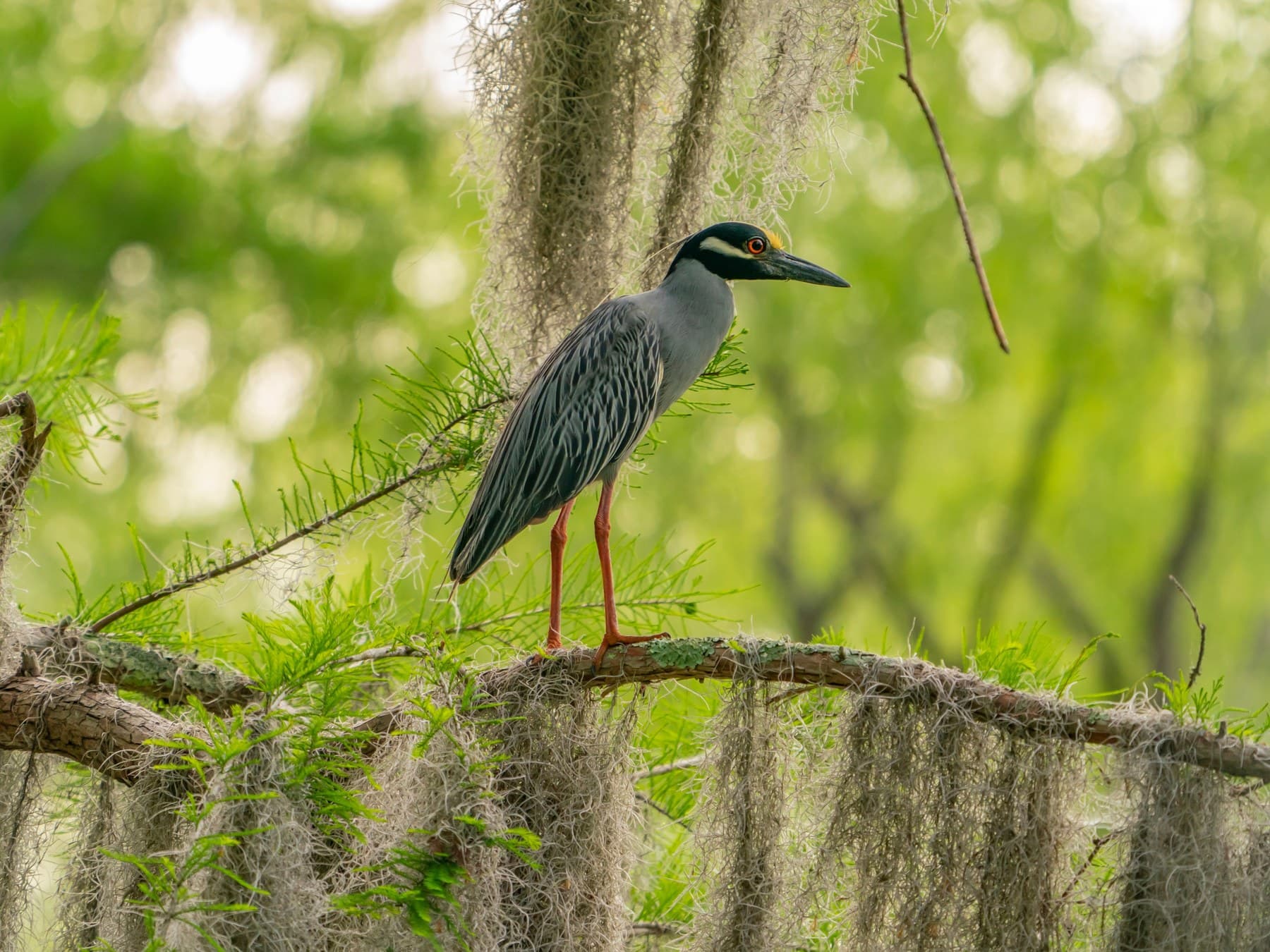
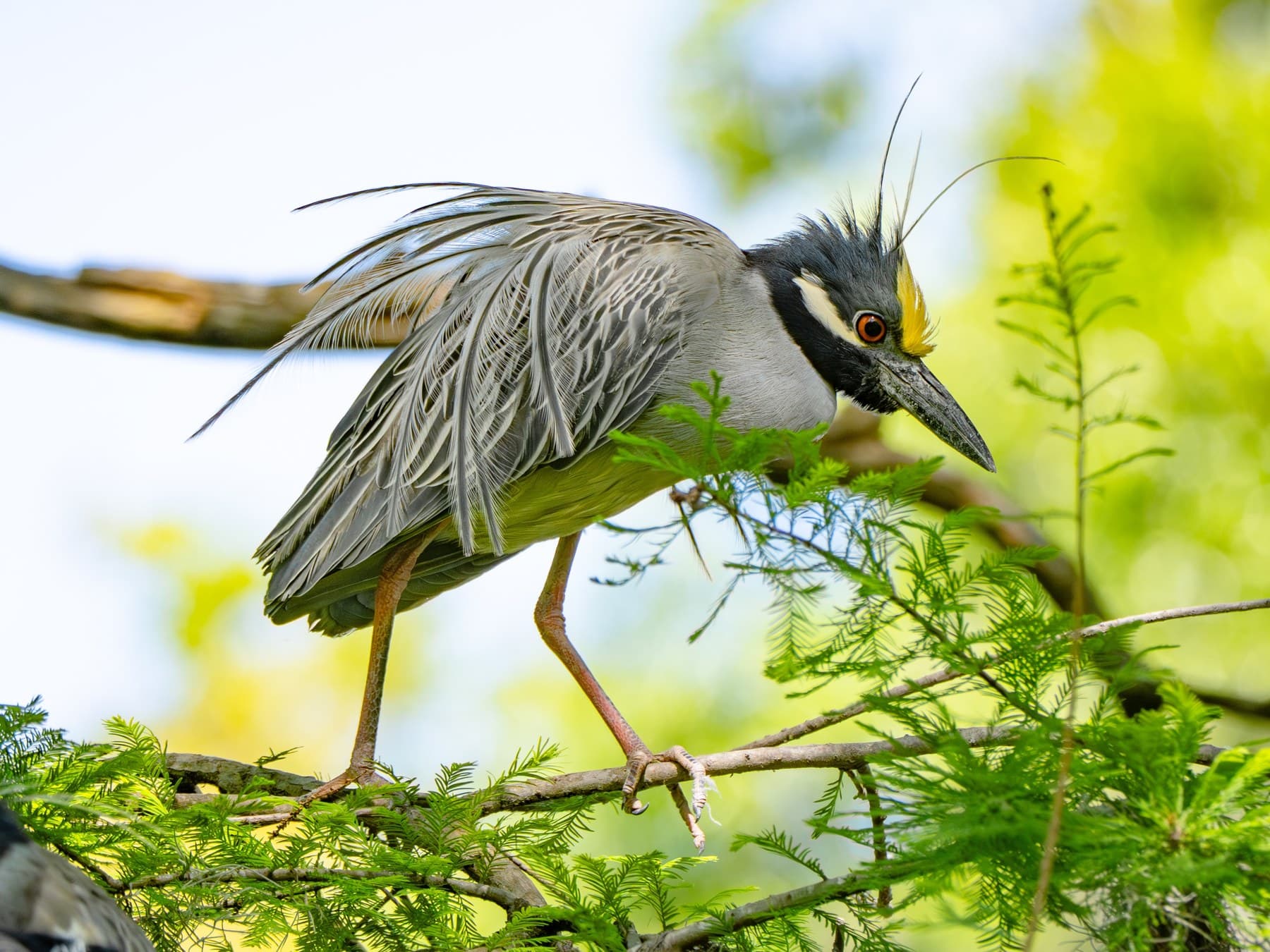
The Yellow-crowned Night Heron is a stocky, compact heron with a big, blocky head, a thick neck and a heavy, all-dark bill. Adults are gray with a bold face: a glossy black head with a large white cheek patch and a white crown, washed pale yellow at the front, and long white plumes trailing from the back of the head. The yellow is often hard to see.1
Look for one standing still or stalking slowly at the edge of a tidal creek, marsh or swamp, hunched forward with its neck drawn in, or perched quietly on a branch or stump over the water. Despite the name, it feeds by day as well as at night.
Size
A medium-sized heron, 21.6 to 27.6 inches (55-70 cm) long: larger than a Cattle Egret, and smaller and stockier than a Great Egret. They weigh about 1.4 to 1.8 pounds (650-800 g).1 Some weigh more.2 Females are slightly smaller than males. Birds get smaller from north to south: those of the southeastern US are the largest, and those on the Galapagos the smallest.
Male, female and juvenile
Males and females look the same in every plumage. Males are a little bigger and may grow longer plumes, so a pair can't be reliably told apart. Adults' long back plumes often reach well past the tail. In spring courtship the legs turn from yellowish to pink or coral red, deepest in males. Adults have scarlet to orange-red eyes.
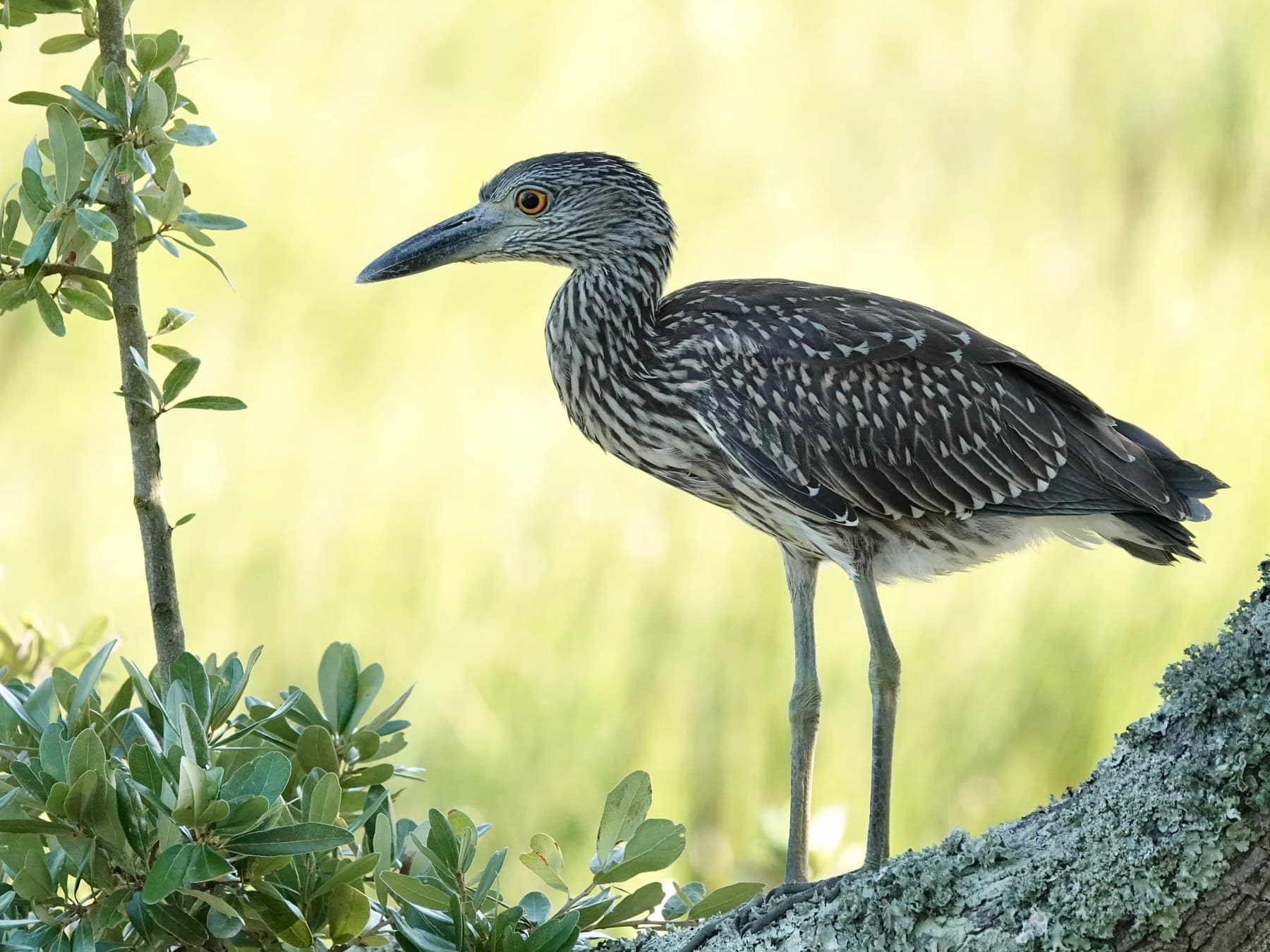
Juveniles look very different. They are brown above with fine pale spots on the back and wings, white below with brown streaks, and have a stout, mostly dark bill and long, yellowish-green legs. Fresh juvenile plumage is seen mainly from June to October, and the brown, spotted look lasts through the first year. After that comes a dull, adult-like stage for one or two years, with a muted head pattern and a brownish wash, and full adult plumage takes three to four years.
Identification: similar birds
Black-crowned Night Heron. The adult has a black cap and back and gray wings, so it lacks the Yellow-crowned's black-and-white face on an all-gray body. Young birds are much harder. A young Yellow-crowned stands more upright, with a heavier bill, longer legs, finer pale spots above and finer streaks below. In flight its feet reach well past the tail, and its wingbeats are slower. The two have even hybridized in the wild.1, 2
More: Yellow-crowned vs Black-crowned Night Heron, adults, young birds and flight compared.
American Bittern. Warm brown with bold stripes down the front and a black neck mark (brown on young birds); it keeps hidden in tall marsh plants.
Green Heron. Smaller, 16 to 22 inches (41-56 cm), with a chestnut neck and a dark back glossed green or blue; young birds have a striped neck.3
Not sure it’s a Yellow-crowned Night Heron? Check your photo: Birdfact names the bird and shows the look-alike side by side.
Its size
Adults- Length
- 55–70 cm
- Weight
- 650–800 g
Its song and calls
It has no song as such. The call you will hear most is a loud quawk, higher pitched than a Black-crowned Night Heron's. It is given when a bird is disturbed, often a few seconds after it takes off, by day and night and at any time of year, and it carries 650 to 1,000 feet (200-300 m).1
Around the nest pairs have other calls: a whoop the male gives at the end of his courtship display, a soft huh, a quiet yup-yup greeting between partners in courtship and when they swap at the nest, and threat squawks at intruders. Courtship calls and displays peak in the four hours after sunrise and before sunset. Chicks beg with a soft, nasal chu-chu-chu, likened to marbles rattling, that grows louder and deeper as they grow.
- Calls0:00 / 0:15
Recorded in Puerto Rico · April 2026
Heard one and not sure? Let the bird song identifier listen.
When and where to see it
Yellow-crowned Night Herons live only in the Americas. In the US they breed through the Southeast, north along the Atlantic coast to Connecticut, occasionally Massachusetts, and up the Mississippi valley, locally, to southern Wisconsin and eastern Minnesota. Farther south they breed through Mexico, Central America and the Caribbean to Brazil and northern Peru, and on the Galapagos. They are mainly coastal, where the crabs are, but breed inland on crayfish along rivers and swamps.
Look along the edges of coastal marshes, mangroves, barrier islands, tidal creeks and calm beaches, and inland in wooded swamps, bayous and streams. They also feed in drainage ditches, on wet lawns and golf courses, and are seldom in open marshes away from cover. They are often active at dusk and dawn, flying between roosts and feeding areas.
They are also birds of town. Unlike the Black-crowned Night Heron, this species often nests in wooded neighborhoods with open, park-like ground under the trees. In a 1991 study of Virginia's colonies, those in residential areas held over 80% of the known population, and pairs favor branches over roofs, driveways and roads, which can bring conflicts with residents.1
Do they migrate?
Northern birds do. Island birds stay all year, and other southern populations are thought to. In the US they winter mainly in south Florida, with small numbers along the coast north to southern North Carolina and on the Gulf Coast, so they are much less common in winter across most of their US range.1, 2 Most winter birds north of Daytona Beach, Florida, are young of the year, except around Wilmington, North Carolina, and Hilton Head, South Carolina; on Atlantic Coast Christmas Bird Counts from 1970 to 1990, over 97% of adults were south of Daytona Beach.1
Spring migrants reach the southern US in early to mid-March and farther north from late March to mid-April. Most birds have started south from their breeding areas by September. Atlantic birds appear to move down the coast and on to the West Indies, and Mississippi valley birds across or around the Gulf of Mexico, though no marked birds have confirmed the routes. Young birds wander north and west in late summer and fall, adults mainly in spring, so strays turn up far outside the range.
The range has moved over time. Yellow-crowned Night Herons spread north between about 1925 and 1960, most in 1945 to 1955, with new state and provincial breeding records from New Jersey and Massachusetts in the 1920s to Connecticut, Ontario, Minnesota and Indiana in the 1950s. Much of that area had held them in the mid-1800s. The northern edge pulled back south after the 1950s, though new nesting areas kept appearing in the 1970s and 1980s.1
Tips for seeing it
What it eats
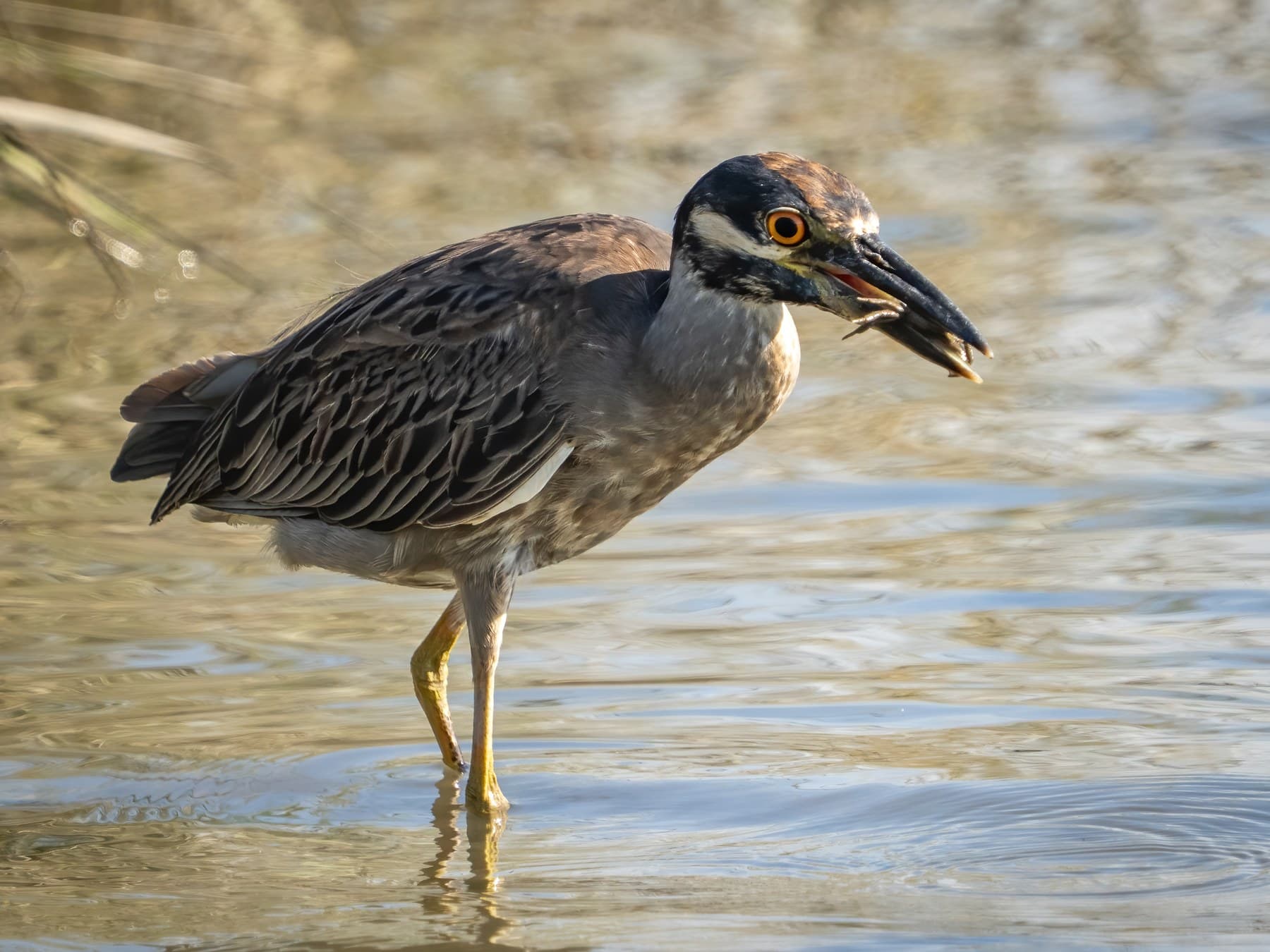
Crabs, above all. The Yellow-crowned Night Heron is a crustacean specialist: on the coast it takes fiddler, marsh, mud, blue and ghost crabs and more, and inland it eats mostly crayfish, with some fish and tadpoles. It also takes insects, worms, snails, snakes, lizards, young birds and small mammals. Stomachs of 105 birds from Louisiana, Alabama, Florida, Texas and Virginia held 79% crustaceans and 18% insects.4 Prey remains under New York and New Jersey nests were 97% crustaceans, and crab remains under 63 Virginia nests were 59% marsh crabs and 36% mud crabs. In 19 birds from northeastern Louisiana in late summer, crayfish made up 74% and fish 22%.1
On Bermuda, land crabs were the only or main prey in 97% of over 1,000 pellets.5 Bill size partly matches the crabs a population eats: birds that eat armored land crabs, mostly on islands, have wide, heavy bills.1
Feeding by day and night
It is a patient hunter. In a Florida study it was the most stationary forager of the North American herons compared, standing still for more than 80% of its foraging time; adults stand and wait almost 60% of the time, while young birds walk slowly far more, over 35% of the time against under 10% for adults.1 When prey is in range it lunges. Small prey is swallowed whole. A big crab is shaken by the legs or claws until they come off, and the bird eats the body first and the legs last. It may also stab a crab through the shell.
This night heron is not only nocturnal: it feeds by day and by night, and when nesting it is busiest at the start and end of the day. In coastal Virginia the tide predicted foraging better than the time of day, and most foraging fell from 3 hours before to 3 hours after low tide. It usually hunts within 10 feet (3 m) of the water's edge in salt marshes, often alone, keeping others about 16 feet (5 m) away, and it coughs up pellets of crab shell and beetle wing cases, about 1 to 2 inches (2.5-5 cm) long, often found under favorite roosts. It also feeds in plowed fields, at sewage works and on shrimp farms.1
Nesting and breeding
On the Atlantic coast, nesting starts when crabs come out in spring, which depends on the temperature. Across North America it begins between early March and early May, depending on latitude. Early egg dates run from March 24 in Florida to April 14 in Virginia and April 30 in New York.1
Pairs nest alone or in small, loose colonies of a few pairs: a mean of about 4 in coastal Virginia, where a quarter of pairs nested alone, sometimes alongside other herons.6 A few colonies are much larger; one in Louisiana was reported with 1,000 pairs in 1933. In woods there is usually one pair to a tree, and in Alabama nests averaged about 80 feet (24 m) apart, whereas Black-crowned Night Herons often nest under 10 feet (3 m) apart.1
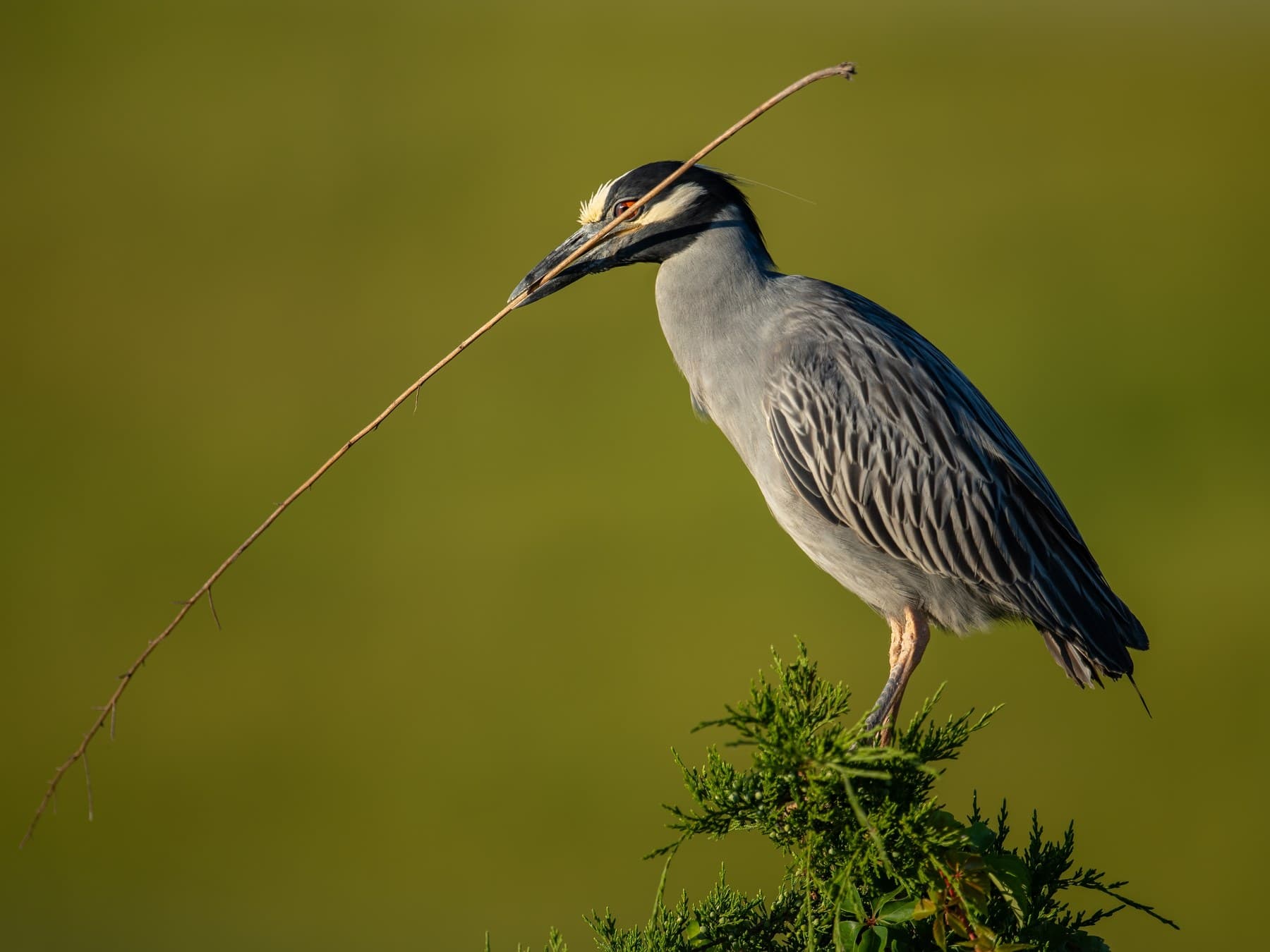
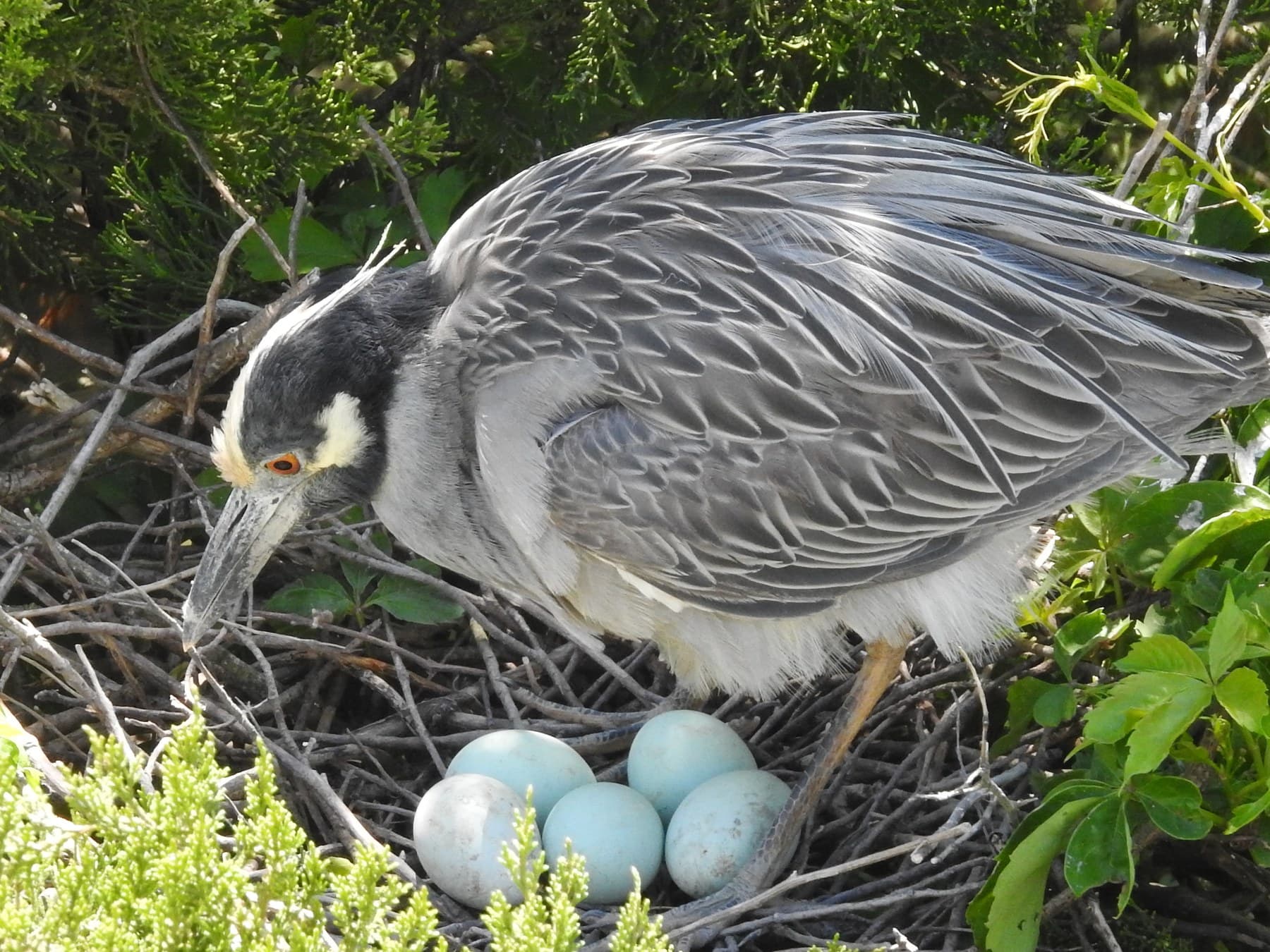
The nest sits high in a tree near or over water, usually about 30 to 60 feet (9-18 m) up, on an outer fork or the lowest horizontal limb, and lower in shrubs or mangroves on islands, even on cacti and rock ledges. Loblolly pines held 95% of 257 nests in coastal Virginia.6 The male picks the site and attracts a female, and several nests may be started before one is finished. He brings sticks and she builds at first, then both do. They snap twigs off trees, take them from old nests or steal them from neighbors, and build a platform of dead sticks with a shallow dip, sometimes lined with leaves, vines or Spanish moss, in about 10 days. Nests are reused and grow over the years, and one reached 4 feet (1.25 m) across. Pairs often return to the same fork, and over 80% of coastal Virginia pairs used old nests.1
Eggs and young
The female lays 2 to 6 pale bluish-green eggs, each about 2 by 1.5 inches (51 x 37 mm). Clutch size appears to rise with latitude: averages in three studies were 2.9 eggs in Florida, 3.5 in Virginia and 4.3 in New York. Both parents incubate, starting with the first egg. Incubation is not well measured: 24 to 25 days in the one clutch measured directly.1 One guide gives 21 to 25 days.2
Both parents brood the chicks almost nonstop for 2 weeks, then shade them, and feed them by bringing up food into the nest, taking turns in 2- to 5-hour shifts by day and night. Older chicks may peck, trample or push younger ones out. In a Virginia study the young left the nest at about 37 days on average. They make their first short flights in week 6 and fly properly from weeks 7 to 11, and come back to the nest to be fed and to roost for about 20 more days. They take 2 to 3 weeks to learn to catch crabs.
Pairs raise one brood a year in North America. They lay again after losing a whole clutch (in Virginia, 75% of lost first clutches were replaced), and the late broods that result led early writers to think the species raised two. Most first breed at about 2 years old.1
Behaviour
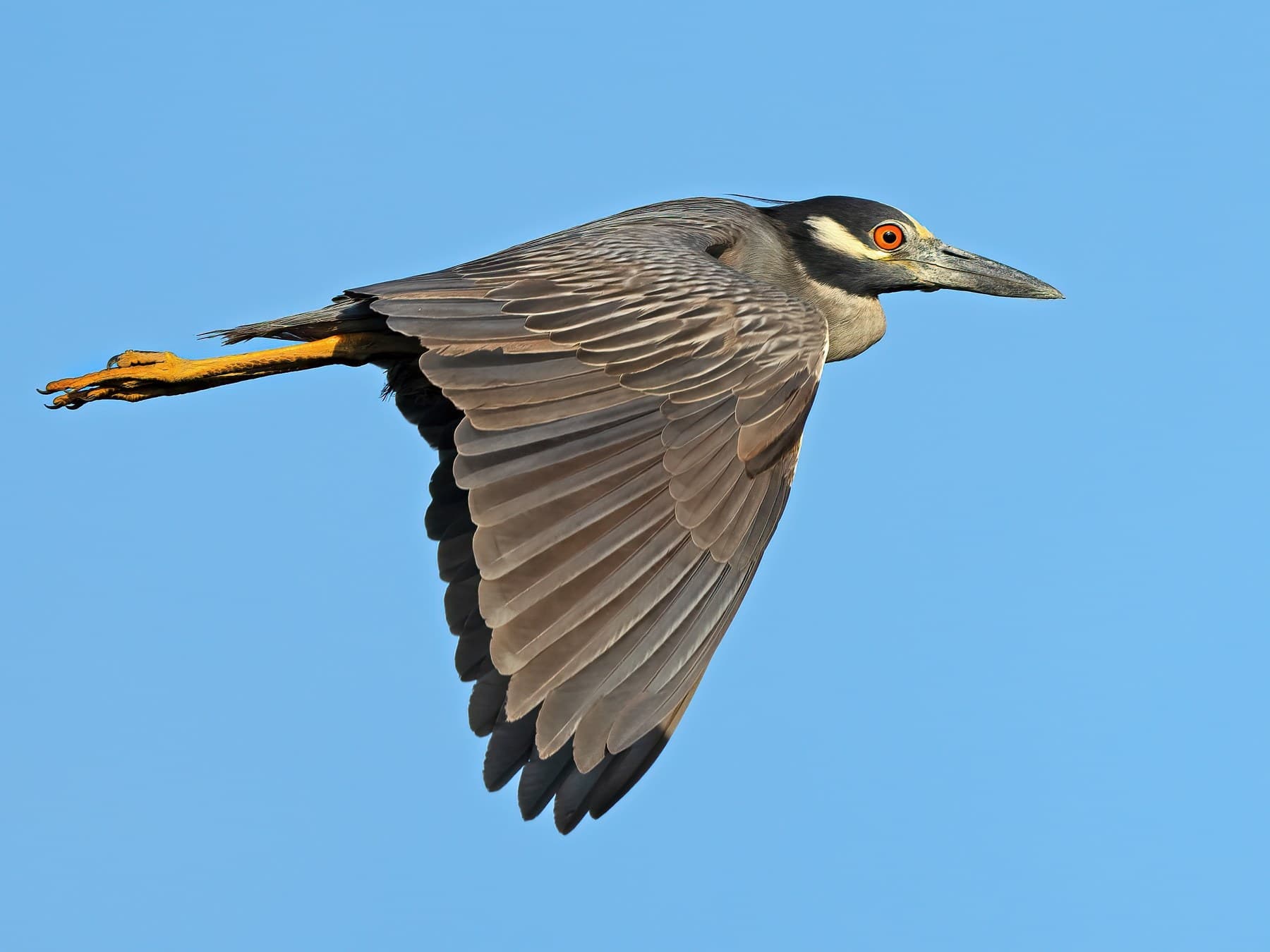
It flies with slow, deliberate wingbeats, its neck drawn in and its feet trailing well past the tail, and can look a little raptor-like. It forages alone but often roosts in small groups after the breeding season, sometimes with Black-crowned Night Herons, and it is generally less shy of people than many other wading birds.1
In courtship the male gives a stretch display: he raises his neck, then bends it back with the plumes fanned behind his head and his wings part-open, and ends with a whoop. Pairs are presumed to stay together for one season. Some arrive at the colony already paired, so pairs may form on migration or last more than a year, but no long-term study of marked birds has settled it.
Lifespan and predators
Little is known about how long they live. The oldest bird on the North American banding records was at least 6 years 3 months old: it was banded as a nestling in Mexico in 1974 and recovered there in 1980.7 There are no good data on typical lifespan or survival.
Predators take mainly eggs and chicks. In Virginia, Fish Crows took 76% of the eggs that were lost and mammals 19%; raccoons, opossums, cats and dogs take young, and storms can blow nests down. Red-tailed Hawks and Great Horned Owls occasionally kill adults or young. In Virginia pairs raised 1.7 young per nest with eggs, and in 1992 at least one young left 64% of nests.1
Conservation
The Yellow-crowned Night Heron is listed as Least Concern. Partners in Flight estimates about 400,000 breeding birds and gives it a concern score of 12 out of 20.8 It is hard to count: a dark bird nesting under tree cover in small, scattered colonies is easy to miss, and ground surveys in Virginia raised the known population there by over 500% in 3 years.1 The North American Breeding Bird Survey found no statistically significant change from 1966 to 2019, though the trend leans downward.9
At the northern edge of the range it is scarce in places. Pennsylvania lists it as endangered (threatened from 1990, endangered since 1999), and the state never had more than 8 to 12 nests a year in the 1990s; Illinois lists it as endangered too.10, 11 Like other migratory birds it is protected under the Migratory Bird Treaty Act. Losing the wetlands where it feeds lowers how many birds an area can support. Eggs collected in the 1970s had among the lowest organochlorine pesticide levels of 16 wading-bird species tested, and showed no eggshell thinning.1
Bermuda once had its own night heron, apparently a land-crab specialist known from fossils, which presumably died out after people arrived.12 Between 1976 and 1978, 46 Yellow-crowned chicks were moved there from Tampa Bay, Florida, and by 1982 they had founded an apparently self-sustaining population.5
Similar birds
Often mistaken for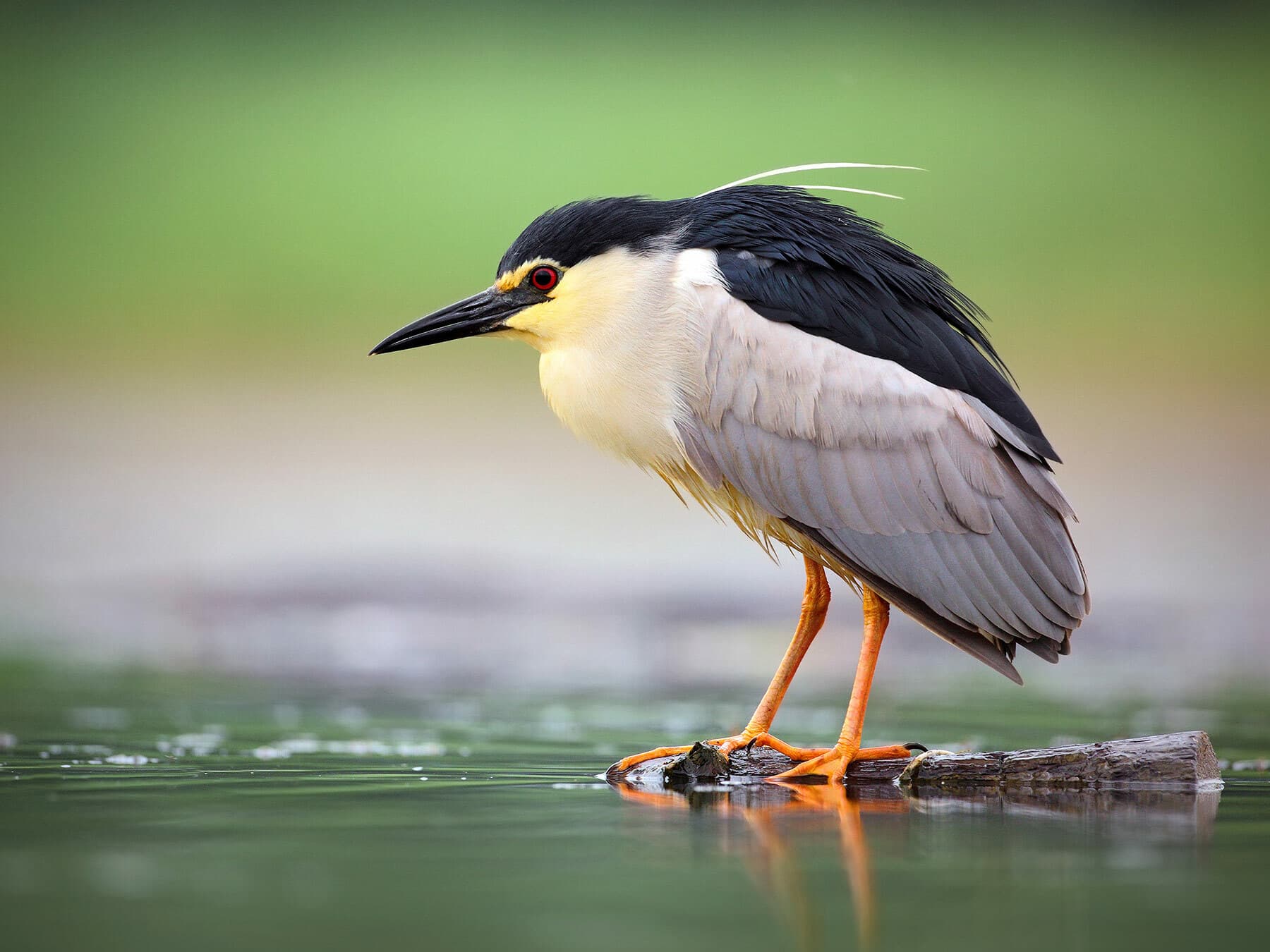

Yellow-crowned Night Heron guides
1 guidesQuick facts
- Length
- 55–70 cm
- Weight
- 650–800 g
- Lifespan
- oldest recorded 6 years 3 months
- Family
- Herons & Egrets
- World population
- About 400,000 breeding birds (Partners in Flight)
- Population trend
- Common in parts of the Southeast; hard to count; endangered in Pennsylvania and Illinois
- Scientific name
- Nyctanassa violacea
Questions
4Are night herons nocturnal?
Not only. Yellow-crowned Night Herons feed by day and by night, and in coastal Virginia the tide mattered more to their feeding than the time of day. See Feeding by day and night.
Why is there a night heron in my yard?
They often nest in wooded neighborhoods and sometimes feed on wet lawns, ditches and golf courses, especially near water with crabs or crayfish. Young birds also wander widely in late summer and fall.
Do they mate for life?
Probably not. Pairs are presumed to stay together for one season, though some arrive at the colony already paired and no study of marked birds has settled it. See Behavior.
Is it the official bird of Houston?
Yes. Houston Audubon named it the official Bird of Houston after a contest held during the city's first Bird Week, in 2019.13
Sources
17- 1Watts, B. D. (2020). Yellow-crowned Night Heron (Nyctanassa violacea), version 1.0. Birds of the World (A. F. Poole, editor). Cornell Lab of Ornithology. doi:10.2173/bow.ycnher.01 (opens in a new tab)
- 2National Audubon Society. Yellow-crowned Night Heron. Guide to North American Birds. Accessed 31 October 2026. Source (opens in a new tab)
- 3National Audubon Society. Green Heron. Guide to North American Birds. Accessed 31 October 2026. Source (opens in a new tab)
- 4Riegner, M. F. (1982). The diet of Yellow-crowned Night-Herons in the eastern and southern United States. Colonial Waterbirds 5: 173-176. Accessed 31 October 2026.
- 5Wingate, D. B. (1982). Successful reintroduction of the Yellow-crowned Night-Heron as a nesting resident in Bermuda. Colonial Waterbirds 5: 104-115. Accessed 31 October 2026.
- 6Watts, B. D. (1989). Nest-site characteristics of Yellow-crowned Night-Herons in Virginia. The Condor 91: 979-983. Accessed 31 October 2026.
- 7USGS Bird Banding Laboratory. Longevity records of North American birds. USGS Eastern Ecological Science Center, Bird Banding Laboratory. Accessed 31 October 2026. Source (opens in a new tab)
- 8Partners in Flight (2023). Avian Conservation Assessment Database, global scores. Partners in Flight Databases (Bird Conservancy of the Rockies). Accessed 31 October 2026. Source (opens in a new tab)
- 9Cornell Lab of Ornithology. Yellow-crowned Night Heron. All About Birds. Accessed 31 October 2026. Source (opens in a new tab)
- 10Pennsylvania Game Commission. Yellow-crowned Night-Heron. Pennsylvania Game Commission. Accessed 31 October 2026. Source (opens in a new tab)
- 11Illinois Department of Natural Resources. Yellow-crowned Night-Heron. Wild About Birds, Illinois DNR. Accessed 31 October 2026. Source (opens in a new tab)
- 12Olson, S. L. and Wingate, D. B. (2006). A new species of night-heron (Ardeidae: Nyctanassa) from Quaternary deposits on Bermuda. Proceedings of the Biological Society of Washington 119. Accessed 31 October 2026.
- 13Houston Audubon (2020). Houston, we have an announcement. Houston Audubon blog. Accessed 31 October 2026. Source (opens in a new tab)
- 14Eliezer Nieves-Rodriguez (2026). Yellow-crowned Night Heron calls, Boquerón, Puerto Rico, April 1, 2026. iNaturalist sound 1833848. Accessed 31 October 2026. Source (opens in a new tab)
- 15National Audubon Society. Black-crowned Night Heron. Guide to North American Birds. Accessed 31 October 2026. Source (opens in a new tab)
- 16National Audubon Society. American Bittern. Guide to North American Birds. Accessed 31 October 2026. Source (opens in a new tab)
- 17Houston Audubon. Yellow-crowned Night Heron. Bird Gallery, Houston Audubon. Accessed 31 October 2026. Source (opens in a new tab)

Checked by
Nathan Cope, founder and editor
Nathan founded Birdfact and leads its writers and contributors in the UK, the US and Canada. He has watched and studied birds for more than ten years, and checks every article and species guide before it’s published.