Published 31 Oct 2026
Yellow-crowned vs Black-crowned Night Heron: How to Tell Them Apart
By the Birdfact teamChecked by Nathan Cope
Adults differ at a glance; young birds need a closer look at their spots, bills and legs, and flying birds at their feet. Two photo cards, a table, both calls, food, range and nesting, compared.
On this page9 sections
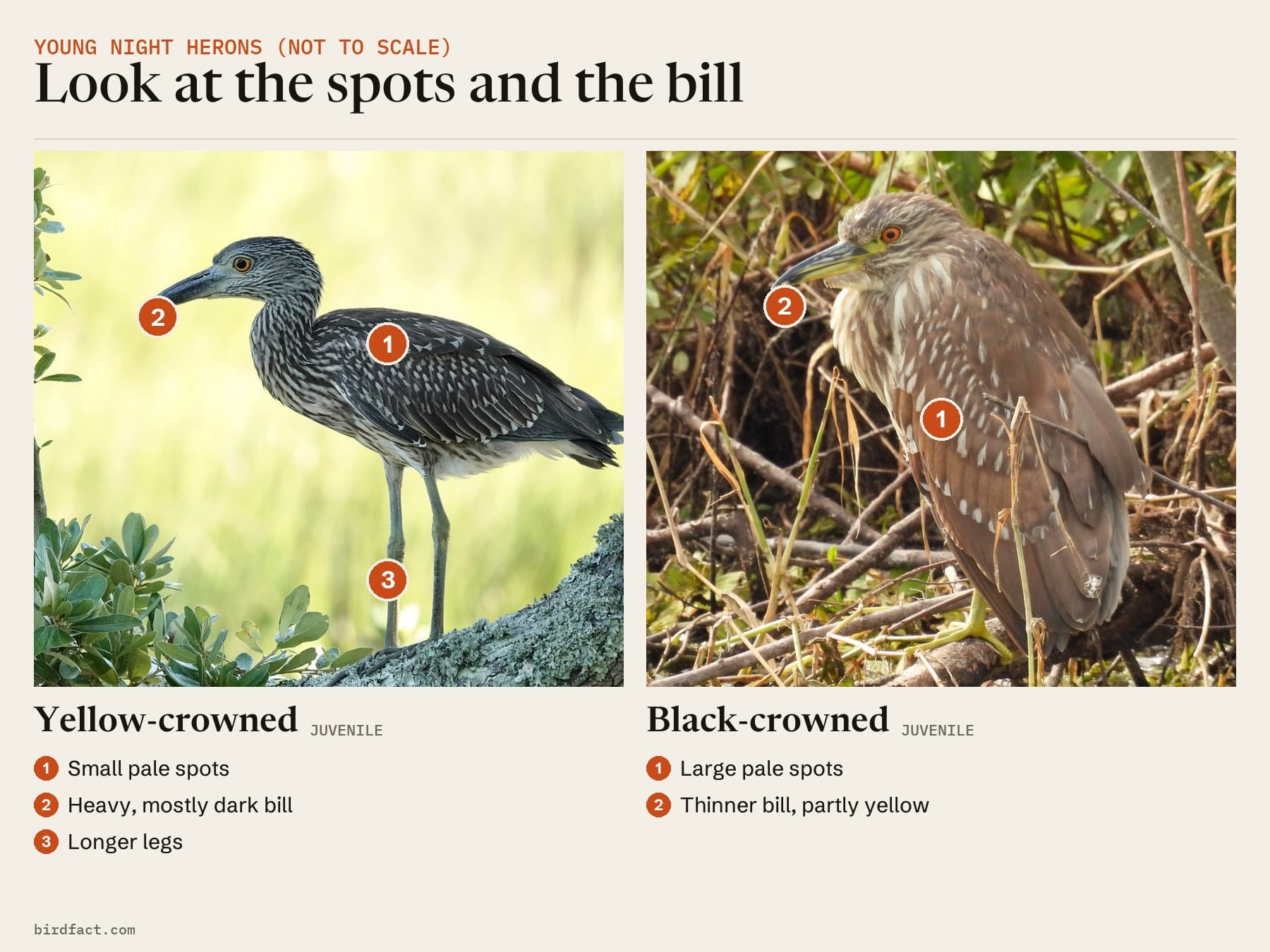
Adults are easy: a Yellow-crowned Night Heron is gray all over with a black-and-white face, while a Black-crowned Night Heron has a black cap and back, gray wings and a white face and underparts. Young birds are the hard part. Both are brown and spotted, so look first at the spots: small on a young Yellow-crowned, large on a young Black-crowned. The bill helps too, mostly dark and heavy on the Yellow-crowned, thinner and partly yellow on the Black-crowned, but it is often muddy. In flight, look at the feet.
At a glance
| Yellow-crowned Night Heron | Black-crowned Night Heron | |
|---|---|---|
| Adult head | Black, with a big white cheek patch and a white to pale yellow crown | Black cap; white face |
| Adult body | Gray all over, with a scaled back | Black back; gray wings; white to pale gray below |
| Young: spots | Small pale spots; grayer brown | Large pale spots |
| Young: bill | Heavier, mostly dark | Longer, thinner, partly yellow |
| Legs | Longer; stands more upright | Relatively short |
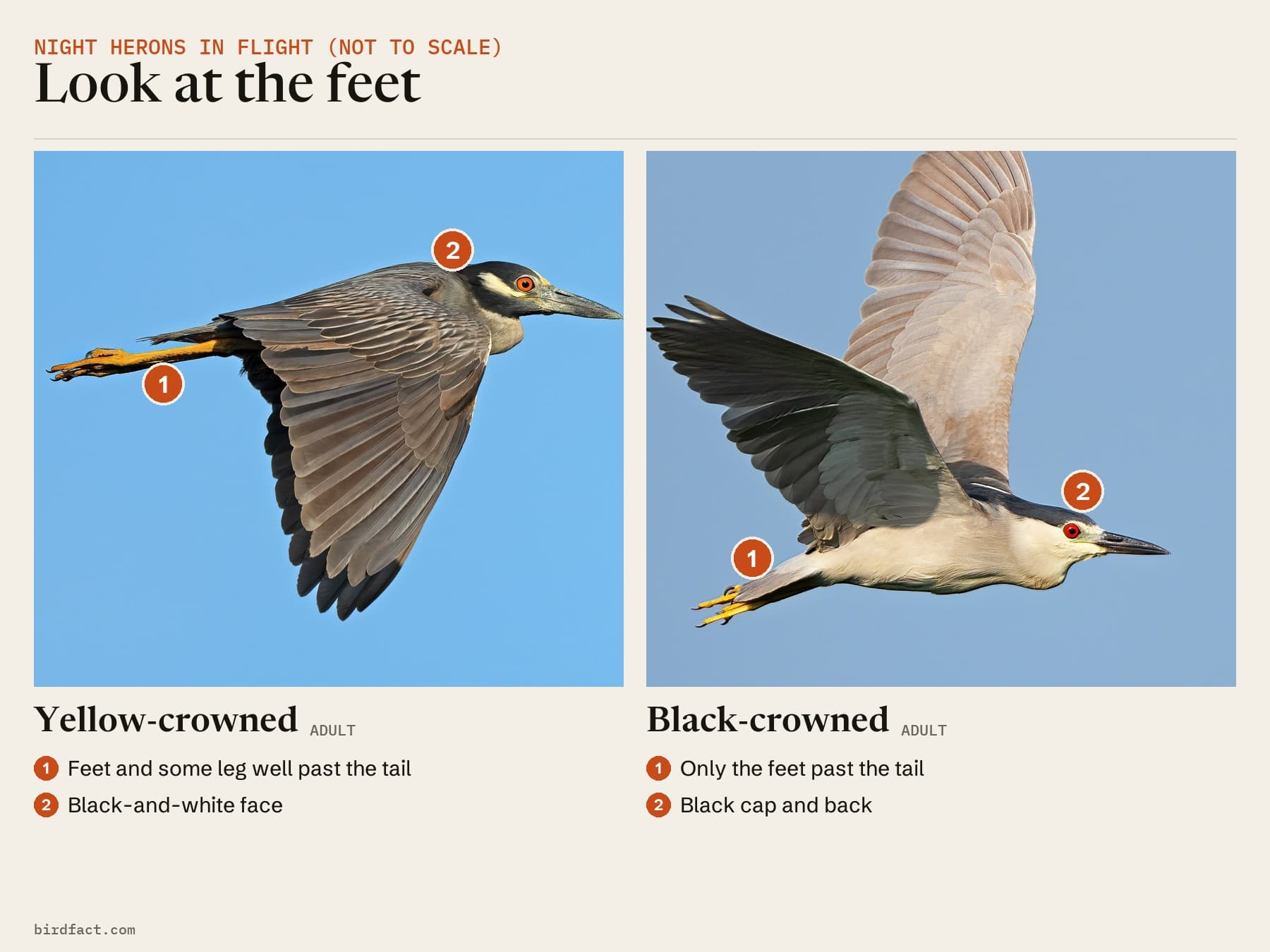
| In flight | Feet and some leg well past the tail | Only the feet past the tail |
| Length | 21.6-27.6 in (55-70 cm) | 23-26 in (58-66 cm) |
| Main food | Crabs and crayfish | Mainly fish, and almost anything else |
| Range | The Americas only | Breeds on every continent but Antarctica and Australia |
Adults
An adult Yellow-crowned Night Heron is gray all over, underparts included, with a glossy black head, a large white cheek patch and a white crown, washed pale yellow at the front. The back has a scaled pattern of black-centered feathers with pale gray edges. Its eyes are scarlet to orange-red, and long white plumes trail from the back of its head.
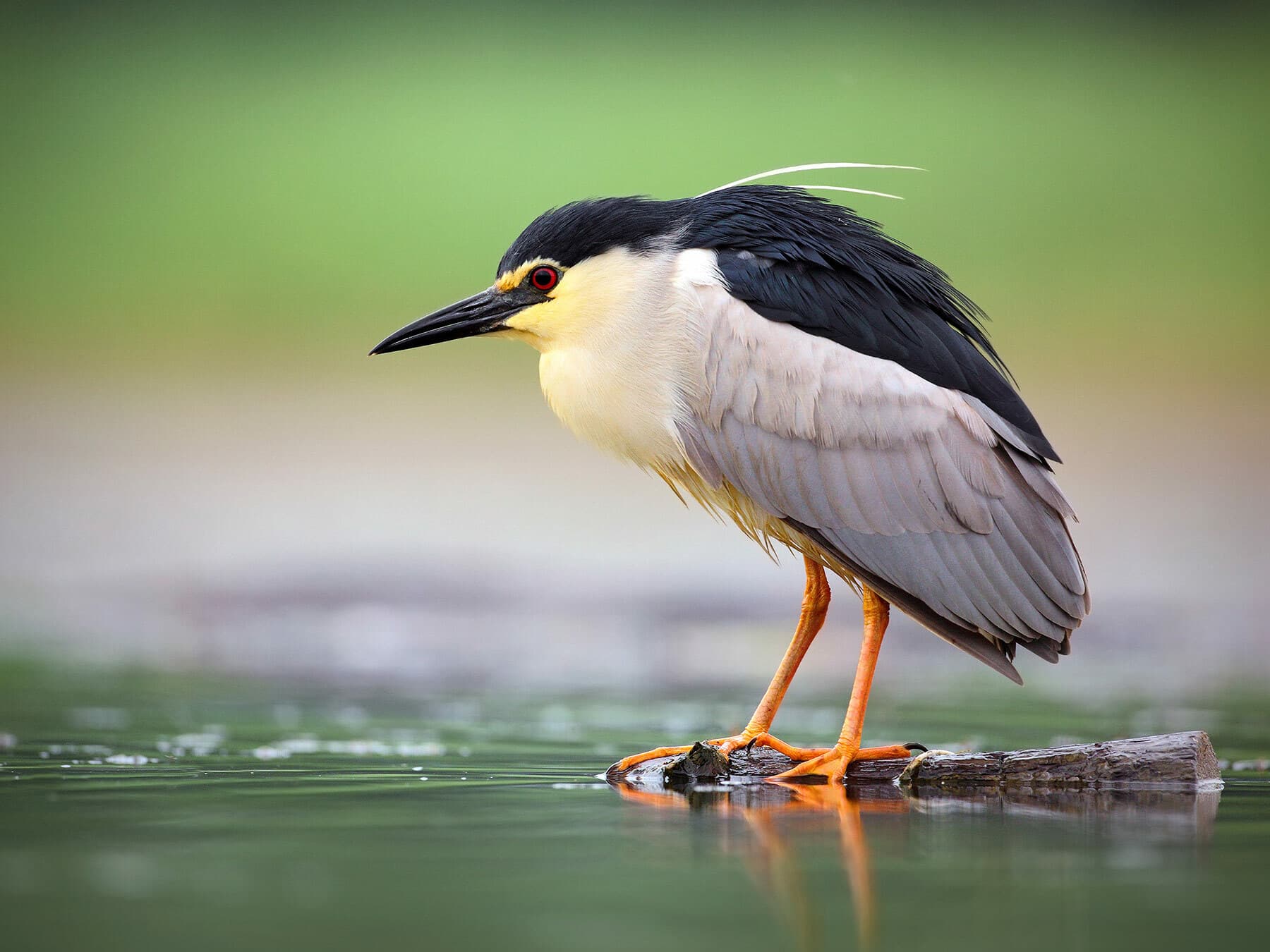
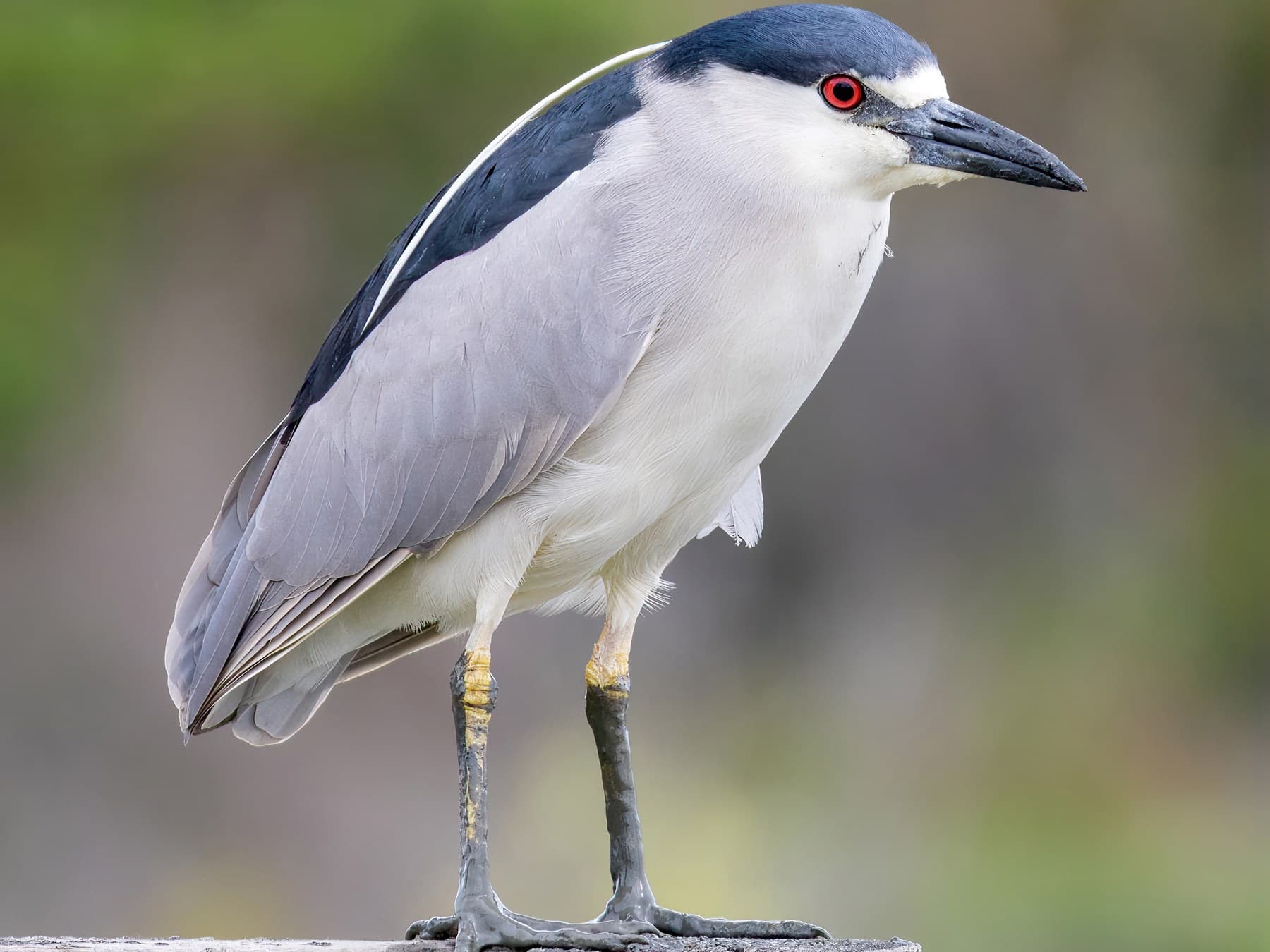
An adult Black-crowned Night Heron has a black cap, upper back and shoulders, gray wings, rump and tail, a white face and neck, and white to pale gray underparts, with red eyes and a stout black bill. Its white head plumes grow in the breeding season.
The two are about the same size: Yellow-crowned 21.6 to 27.6 inches (55-70 cm) long, Black-crowned 23 to 26 inches (58-66 cm). Both are shorter and stockier than most herons.1

Young birds
Juveniles of both species are brown above with pale spots and streaked below, and they are often confused. Four things help:
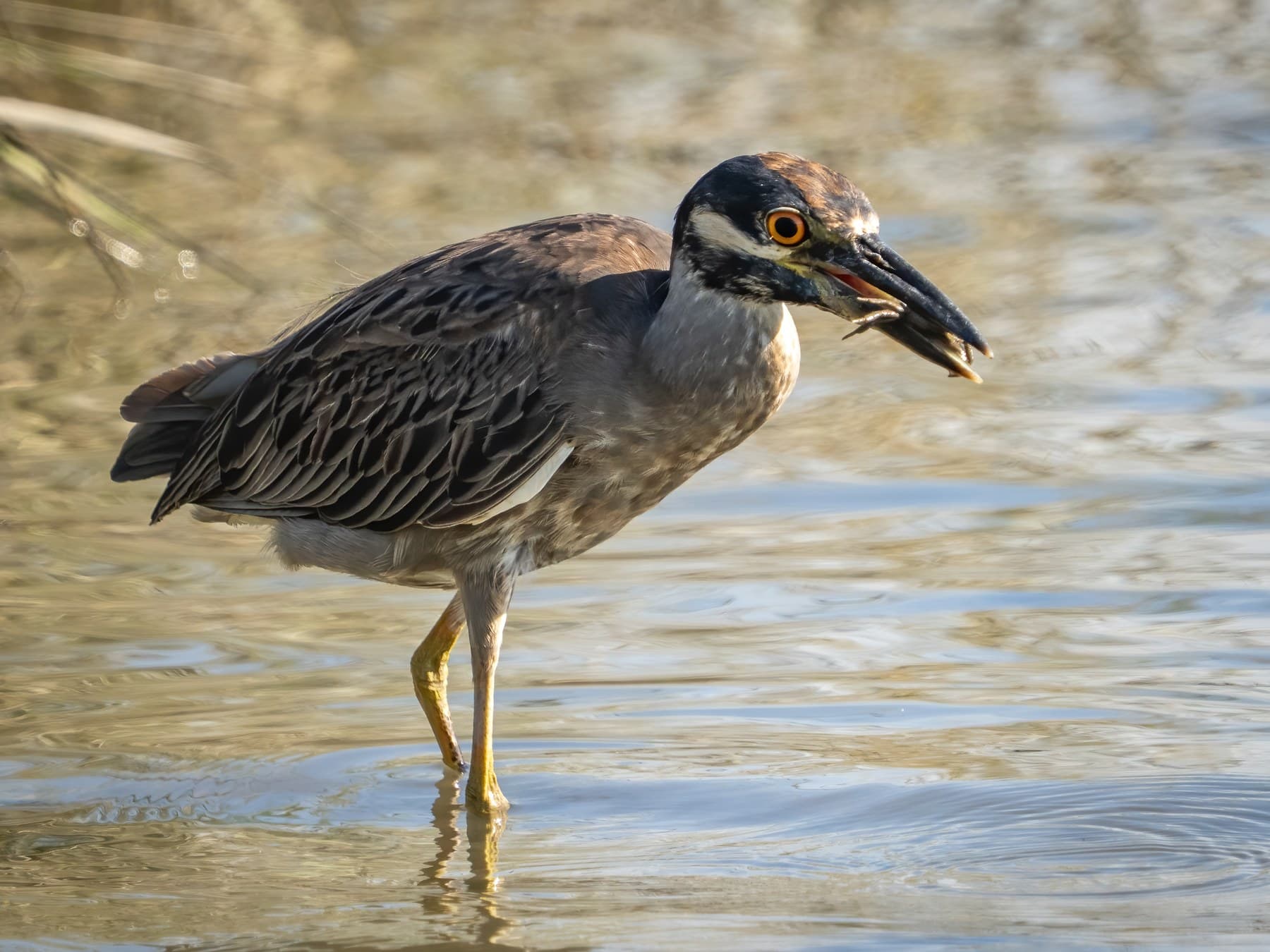
- The spots. A young Black-crowned has large pale spots on the back, shoulders and wing coverts. A young Yellow-crowned has smaller spots, especially on the wing coverts, and its brown has a grayer cast.2 Its pale feather edges run into the small spots, giving a more mottled look.1
- The bill. A young Yellow-crowned has a heavier, mostly dark bill; a young Black-crowned has a longer, thinner bill that is partly yellow. Don't rely on the bill alone: young birds' bills are often caked in mud.1
- The legs and stance. A young Yellow-crowned has longer legs and stands more upright; the Black-crowned has a relatively short neck and legs.
- The streaks. The Yellow-crowned is more finely streaked below.
Both take three to four years to reach full adult plumage. In between, second-year Black-crowned look like dusky, darker adults, and second-year Yellow-crowned like dull, brownish adults with a muted head pattern.
In flight
Look at the feet. A flying Yellow-crowned Night Heron trails its feet and part of its legs well beyond the tail, and its wingbeats are slower. A Black-crowned shows only a short foot projection.3 This works on young birds too.
Calls
Both give a loud quawk. The Black-crowned's is guttural, often heard at night as birds fly over or when a colony is disturbed. The Yellow-crowned's is higher pitched, and it often calls a few seconds after taking off.
Food and feeding
The Yellow-crowned is a crustacean specialist: crabs on the coast, crayfish inland. The Black-crowned is an opportunist whose diet is mainly fish and other water animals, but it takes almost anything, from insects and frogs to small mammals and refuse.
Timing differs too. The Black-crowned feeds mainly from evening to early morning, and by day when food demand is high, as in the breeding season. The Yellow-crowned feeds by day and by night.
Where to see each
No heron is more widespread than the Black-crowned, which breeds on all continents but Antarctica and Australia. The Yellow-crowned lives only in the Americas. In the lower 48 states, Black-crowned Night Herons live all year on both coasts and breed widely across the country, while the Yellow-crowned is found all year only in Florida and parts of the Southeast and breeds farther north in summer.1, 3 The Black-crowned uses almost any wetland, fresh, brackish or salt, including weedy pond margins, rice fields and canals; the Yellow-crowned keeps more to crab-rich coasts and crayfish streams.
They nest differently. Black-crowned Night Herons nest in tighter colonies, often under 10 feet (3 m) between nests, and tend to avoid nesting close to houses. Yellow-crowned Night Herons often nest alone or in loose groups, and many choose wooded neighborhoods.3
Questions
Which is more common?
The Black-crowned. Partners in Flight estimates about 3,000,000 Black-crowned Night Herons against about 400,000 Yellow-crowned.4
Can they hybridize?
Yes: the two have hybridized in the wild, even though they belong to different genera and are less closely related than once thought.3
What else looks like a young night heron?
An American Bittern. It has a long, dark mark down the side of the neck and lacks the large pale spots.
Sources
- Lund, N. (2016). Birdist Rule #115: Learn to Identify and Differentiate Night Herons. Audubon Magazine (National Audubon Society). Accessed 31 October 2026. Source
- Hothem, R. L., Brussee, B. E., Davis, W. E., Jr., Martínez-Vilalta, A., Motis, A., Kirwan, G. M. (2020). Black-crowned Night Heron (Nycticorax nycticorax), version 1.0. Birds of the World (S. M. Billerman, editor). Cornell Lab of Ornithology. doi:10.2173/bow.bcnher.01
- Watts, B. D. (2020). Yellow-crowned Night Heron (Nyctanassa violacea), version 1.0. Birds of the World (A. F. Poole, editor). Cornell Lab of Ornithology. doi:10.2173/bow.ycnher.01
- Partners in Flight (2023). Avian Conservation Assessment Database, global scores. Partners in Flight Databases (Bird Conservancy of the Rockies). Accessed 31 October 2026. Source
- National Audubon Society. Yellow-crowned Night Heron. Guide to North American Birds. Accessed 31 October 2026. Source
- National Audubon Society. Black-crowned Night Heron. Guide to North American Birds. Accessed 31 October 2026. Source
- Eliezer Nieves-Rodriguez (2026). Yellow-crowned Night Heron calls, Boquerón, Puerto Rico, April 1, 2026. iNaturalist sound 1833848. Accessed 31 October 2026. Source
- Joost van Bruggen (2018). Black-crowned Night Heron flight calls, near Isla Mayor, Sevilla, Spain. xeno-canto XC431999. Accessed 31 October 2026. Source