


Little Blue Heron
Egretta caerulea
By the Birdfact teamChecked by Nathan Cope
On this page13 sections
How to recognise it
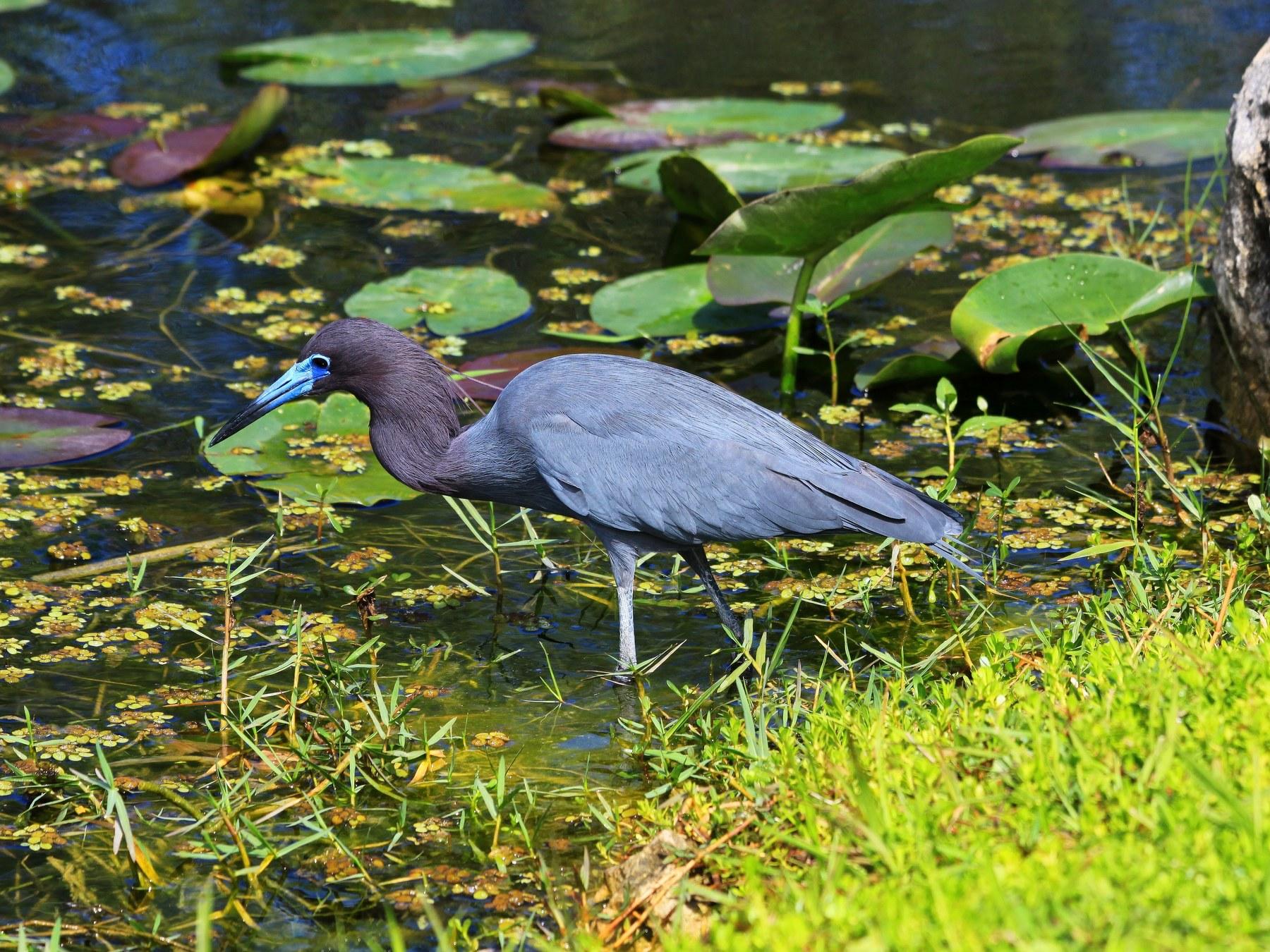
An adult is a small, dark heron: slate-blue on the body and wings, with a purplish-maroon head and neck. The bill is two-toned, bluish or gray at the base with a black tip.
Early in the breeding season the bill base and the bare skin around the eye turn a vivid cobalt to turquoise blue, and the legs darken to black. These colors fade within about a week or ten days of pairing. Breeding adults also grow long, narrow plumes on the crown, breast and back, some reaching 4–6 in (10–16 cm) past the tail, but never the lacy plumes of the white egrets.
Outside the breeding season the bill is dark gray with an almost black outer third, the skin in front of the eye is dull green, the eye pale yellow and the legs pearl-gray to grayish green.
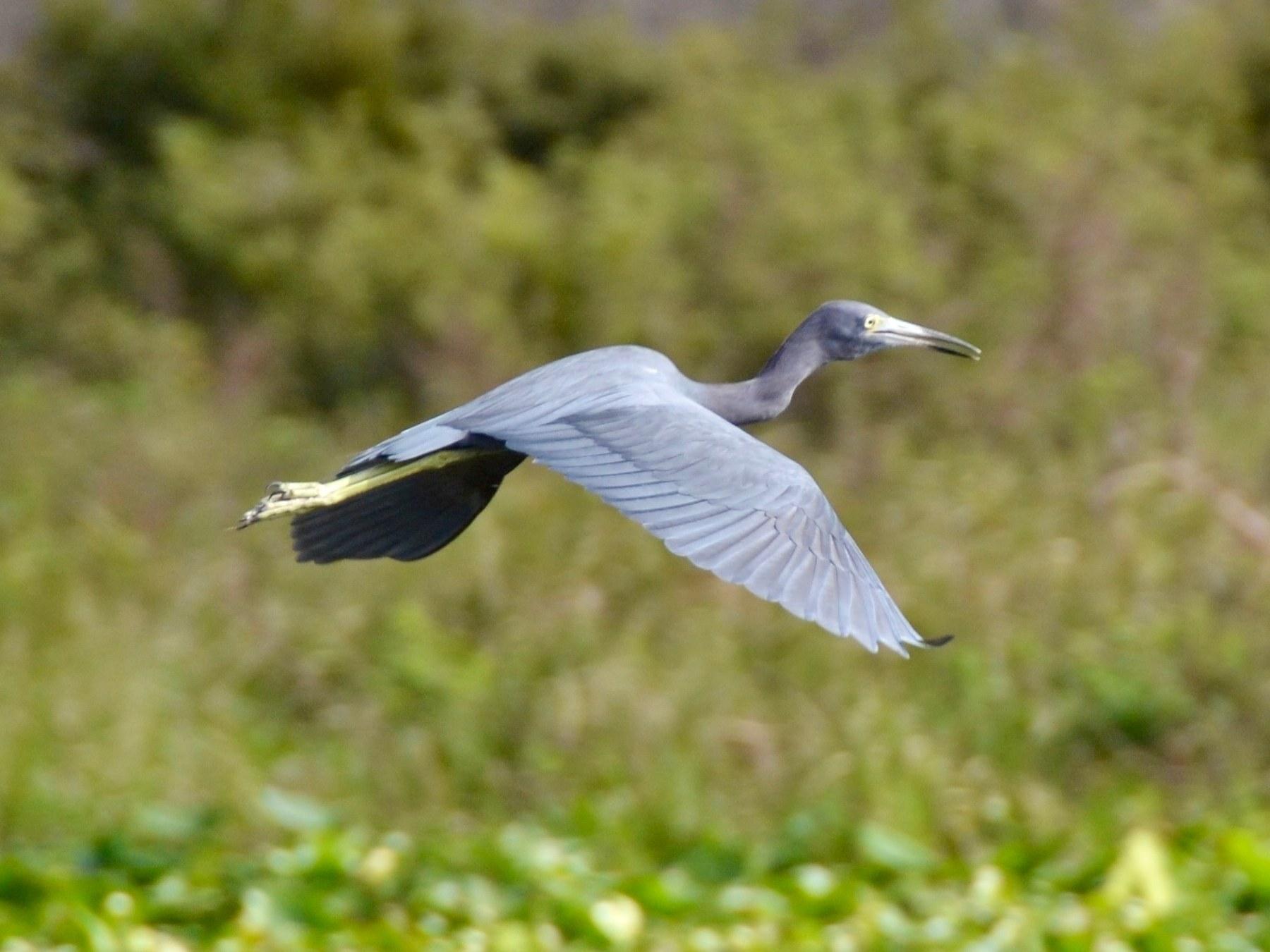
In flight it pulls its neck in and holds its legs straight out behind, and it flies directly, without hurry. Over longer flights in a North Carolina study it traveled at about 24 mph (39 km/h).1
Size and weight
It is 22–29 in (56–74 cm) long, with a wingspan of 39–41 in (100–105 cm). That makes it about the size of a Snowy Egret and far smaller than a Great Blue Heron.
Weights in the handbooks rest on few birds. The six weighed one by one in Birds of the World's table ran from 10.4 to 14.5 oz (296–412 g), and a larger set averaged 12.8 oz (364 g) for 11 males and 11.1 oz (315 g) for 8 females.1
Male, female and young
Males and females look alike in every plumage. On average males are heavier, and their breeding plumes appear to average longer.
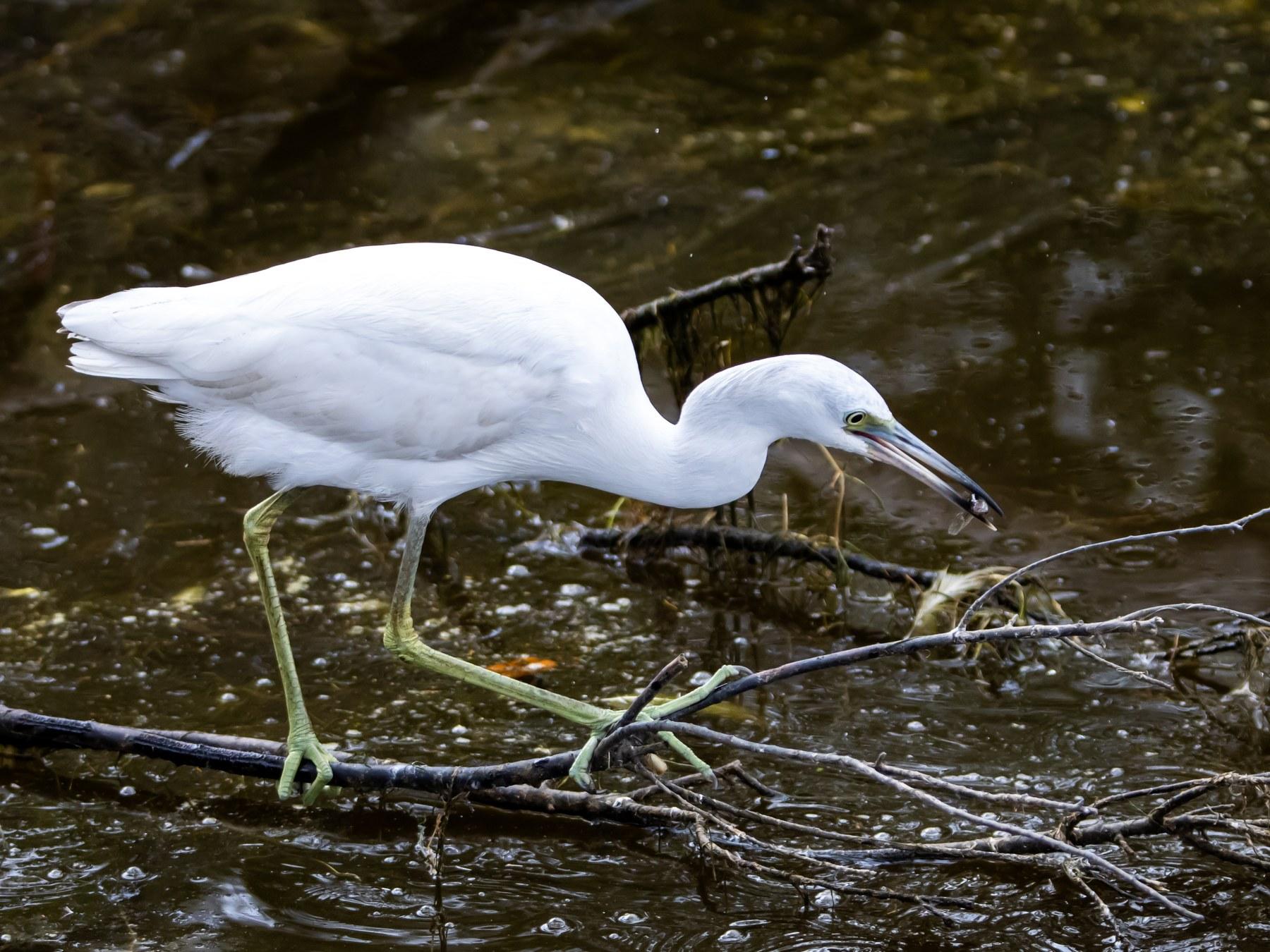
Young birds look nothing like their parents. In their first summer and fall they are all white, apart from dusky gray tips to the outer three flight feathers that are often hidden when the bird stands. The bill is grayish with a dark tip, the skin in front of the eye gray to blue-gray, and the legs dull greenish to grayish yellow, with no bright yellow feet. In North America this white plumage is worn mainly from June to October. It is the normal young plumage, not a separate white form.
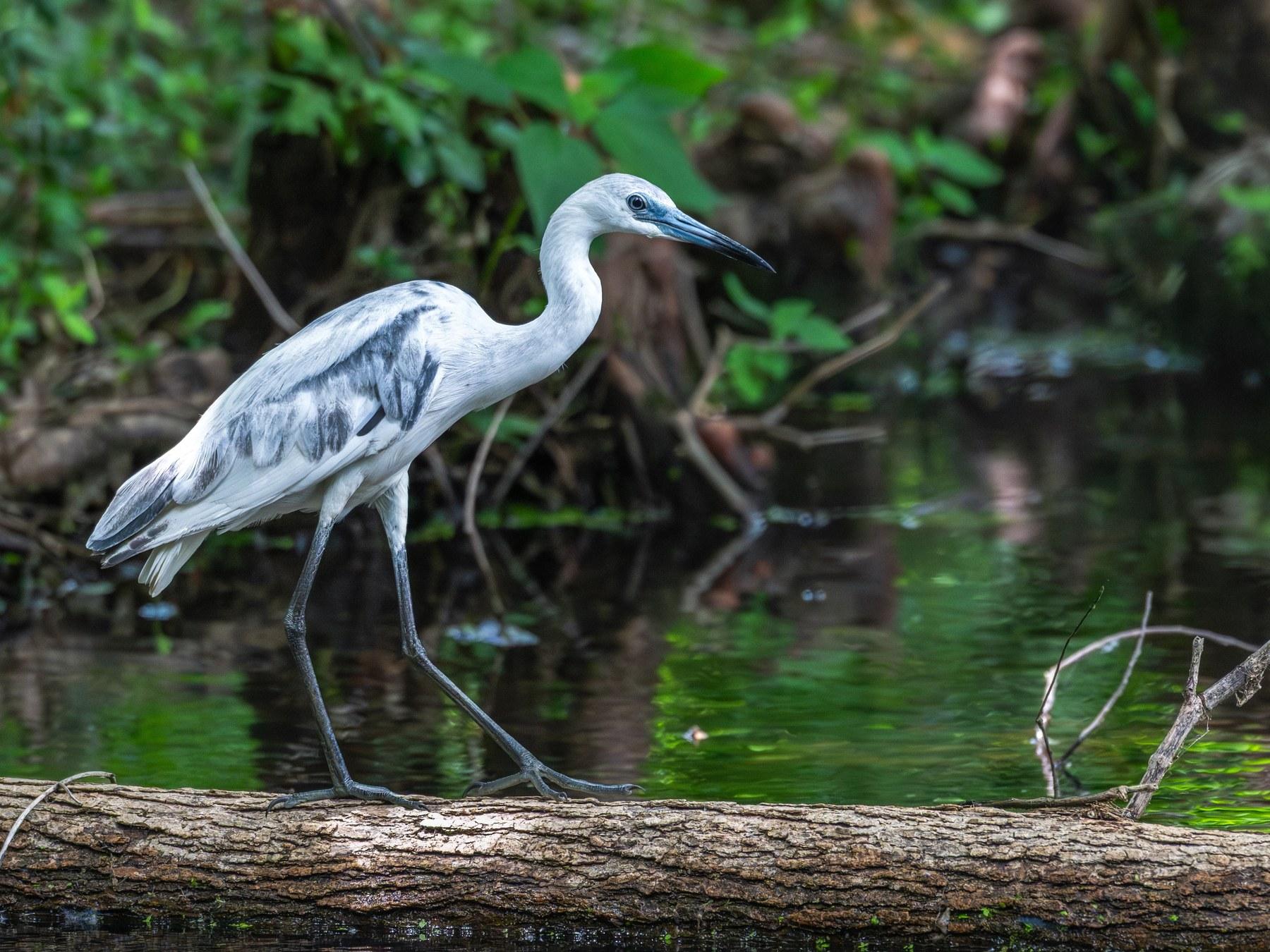
The white lasts until about the middle of the first year. Slate feathers start to come in from the fall, first on the crown and back, and through the first spring and summer the bird turns blotchy white and blue. These are known as calico, pied or piebald herons. The white wing and tail feathers are kept until the next complete molt.
In their second year most look like dull, sooty adults, with a more purple head and some white on the chin and throat, and a few already match older adults. Full adult plumage usually comes at the second or third complete molt.
The Heron Specialist Group knows of no other heron that starts white and ends dark.2
Identification: similar herons
The main confusion for a young bird is the Snowy Egret. Both are white, but the Snowy has yellow skin in front of the eye, a slender black bill that is paler at the base below in young birds, and yellow feet, which are duller greenish yellow in young birds. A young Little Blue has a gray face, a thicker gray bill with a dark tip, dull greenish legs with no yellow feet, and often dusky wingtips. It also feeds more slowly and deliberately.
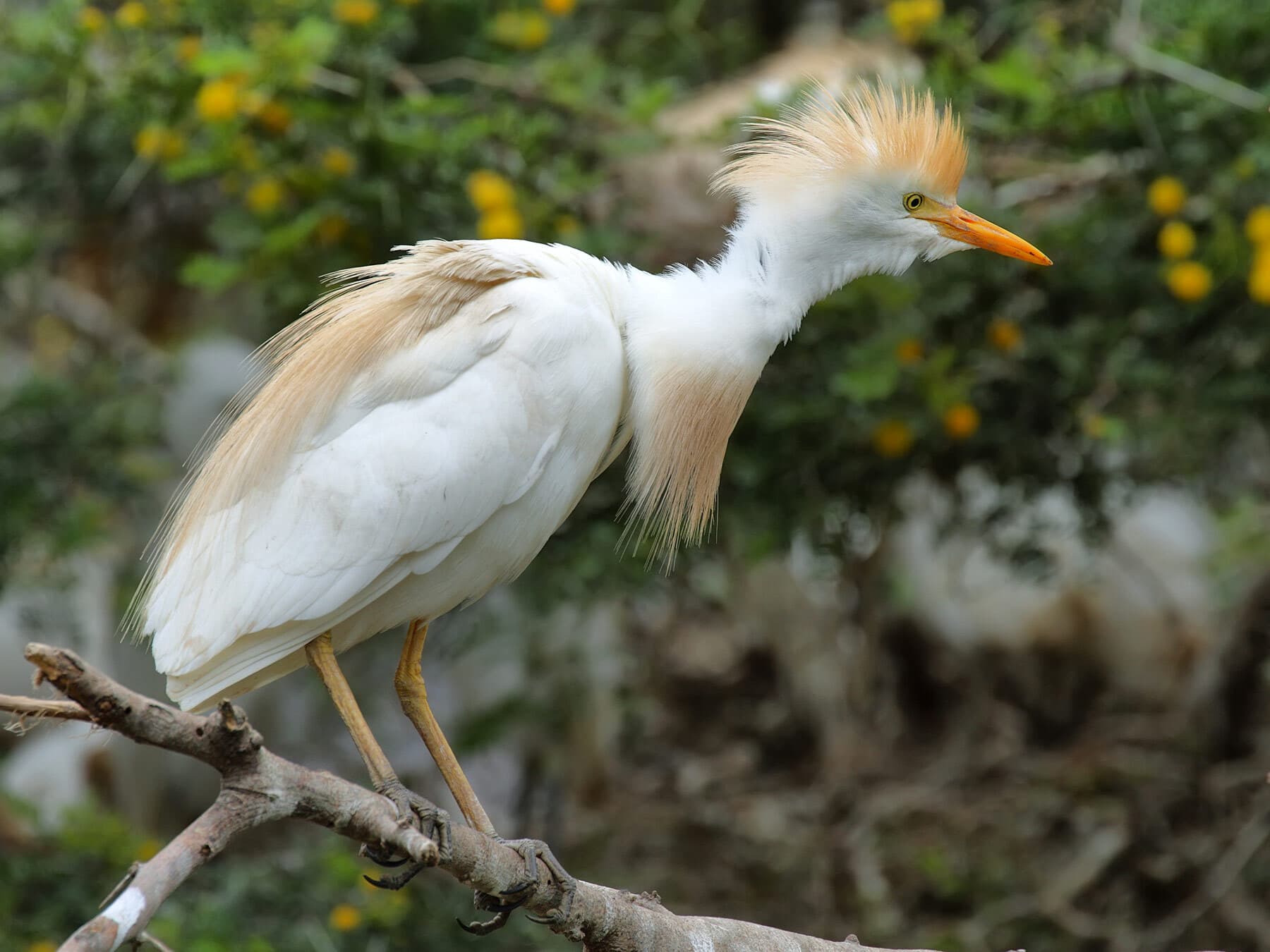
A young Cattle Egret is white too, but short-legged, thick-necked and hunched, with black legs and a black bill that pales to yellowish on its upper mandible.
Among dark herons, a Tricolored Heron has a white breast and belly in every plumage and is a little taller and slimmer; a molting young Little Blue looks pied rather than blue with a white belly. An adult dark Reddish Egret is larger, with a shaggy rusty head and neck and a pink-based bill, and it feeds in an active, erratic way, dashing about and spreading its wings.
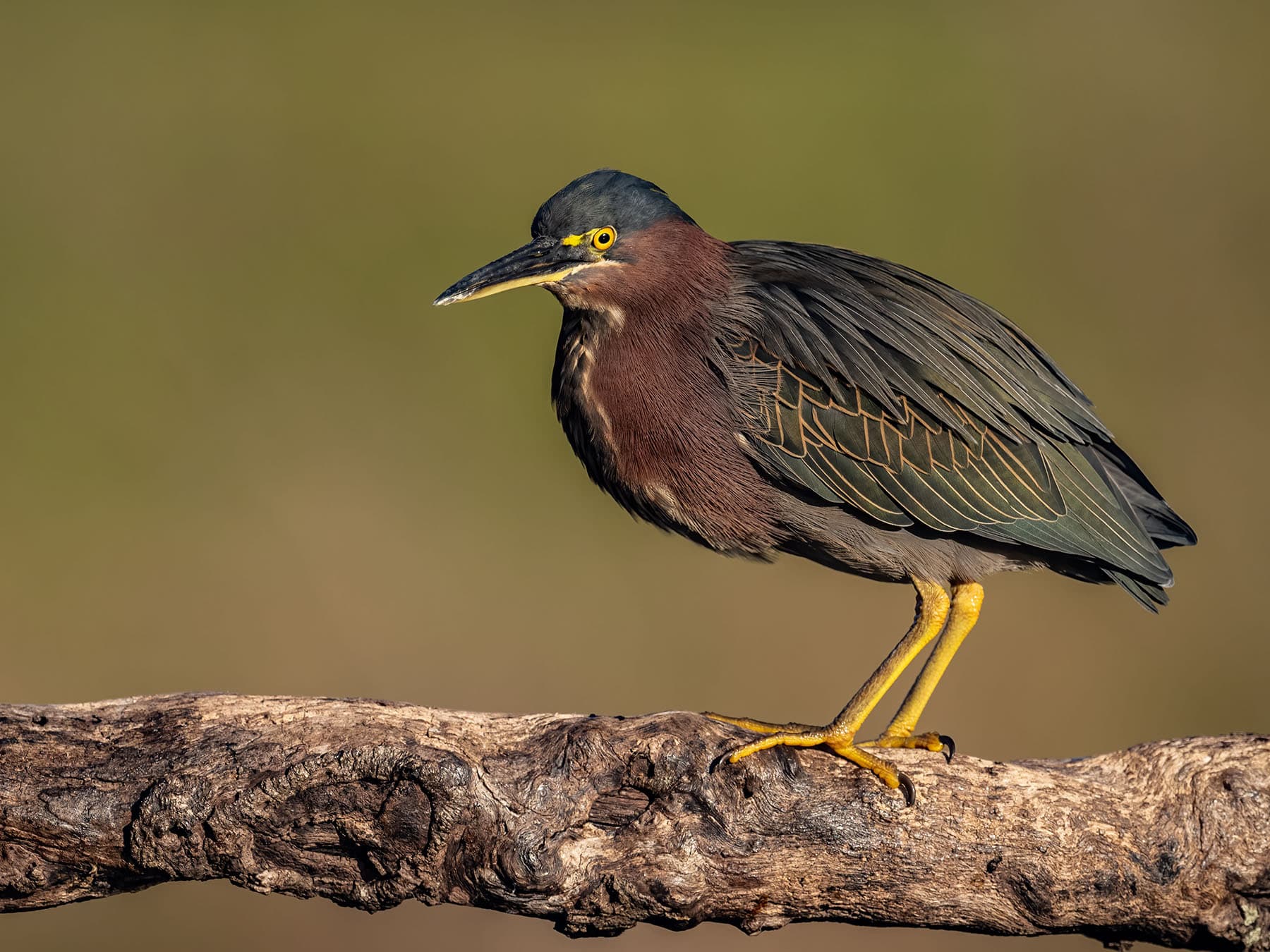
A Great Blue Heron is far bigger, 38–54 in (97–137 cm) long, with a mostly white head and a yellowish bill. A Green Heron is much smaller, 16–18 in (41–46 cm), and stocky, with a rufous neck, orange legs and a glossy greenish-black cap.
Not sure it’s a Little Blue Heron? Check your photo: Birdfact names the bird and shows the look-alike side by side.
Its size
Adults- Length
- 56–74 cm
- Wingspan
- 100–105 cm
- Weight
- 296–412 g
Its song and calls
It has no song in the songbird sense and is generally quiet. Its main call is a loud, nasal squawk, written scaah or sken, given in alarm and in disputes, and it is the only call heard outside the breeding season.
At the nest there is more. Both members of a pair give a greeting call, eh-oo-ah-eh-eh. A male's stretch display comes with a soft unh that often cannot be heard more than about 16 ft (5 m) away, and a mildly alarmed bird grunts like a pig frog. Chicks beg with a hee-hee-hee. It also makes sounds with its bill: a loud snap in the male's stretch display and in threat displays, and a soft rattle when mates nibble at each other.
In studies at a Tampa Bay colony, first-year males gave fewer, longer and harsher display calls than older males.1
The recording on this page was made at an evening roost in Virginia where young white birds were seen.
- Calls at an evening roost0:00 / 0:18
Recorded in Virginia, United States · August 2021
Heard one and not sure? Let the bird song identifier listen.
When and where to see it
It lives from the United States through Mexico, Central America and the West Indies to southern Brazil and Uruguay. In the US it breeds mainly in the Southeast, along the Gulf coast and up the Atlantic coast. Inland it nests north to Oklahoma, Kansas, Arkansas, Missouri, southern Illinois, Kentucky and Tennessee. On the Atlantic coast it reaches southern Maine, but it nests only rarely and locally north of New Jersey.
Look for it in fresh, brackish and salt water alike: marshes, swamps, streams, rivers, ponds, lakes, lagoons, tidal flats and mangroves, and also canals, ditches, fish-rearing ponds and flooded fields. It often feeds in spots thick with plants.
State colony counts gathered from sources of 1979–1991 found the most nests in Louisiana, 11,520 in 56 colonies, and Florida, 8,498 in 243 colonies.1
Its range has grown at both ends. Its nesting range spread north in the 1980s and 1990s, with small numbers breeding in California, the Dakotas and Minnesota.1 Even before that, six nests found in 1976 were North Dakota's first breeding record.3 By 2012 it was breeding at the Patos Lagoon estuary in southern Brazil, about 530 miles (850 km) beyond its earlier southern limit, which the authors say may be a response to warming.4
Do they migrate?
Some do. Northern breeders move south to the Caribbean and Central and South America by October and November, while others stay all year, mainly from South Carolina, southern Texas and central California southward. In winter it is found along the Gulf coast and the Atlantic coast from southern New Jersey through Florida, Bermuda and the West Indies, and from southeastern California and Baja California along both coasts of Mexico to Panama.
In late summer, before they head south, adults and young scatter from the colonies in every direction, often several hundred miles to the north. Wanderers turn up in Oregon, Washington, Colorado, Wisconsin, Michigan, southern Ontario and Quebec, Labrador, Newfoundland and Nova Scotia, and strays have reached Hawaii. It is counted among the most dispersive herons in North America, with dispersal averaging more than 620 miles (1,000 km).2
The southward move begins in late September and October. In spring the first birds reach Arkansas from mid-March and Missouri and southern New Jersey from late March.
GPS tags show how mixed the habit is. In 2021–22, 30 adults were tagged at two Florida Gulf Coast wintering sites. At a site with no fresh water nearby, 10 of 15 were migrants. At a site with freshwater ponds, 4 of 15 were, and 8 stayed all year.5 The migrants nested 116–504 miles (187–811 km) from their wintering sites, in South Carolina, Georgia, Florida and western Cuba.5 Through the winter the tagged birds kept to small home ranges, and the 11 followed for more than one winter came back to overlapping areas.5
Tips for seeing it
What it eats
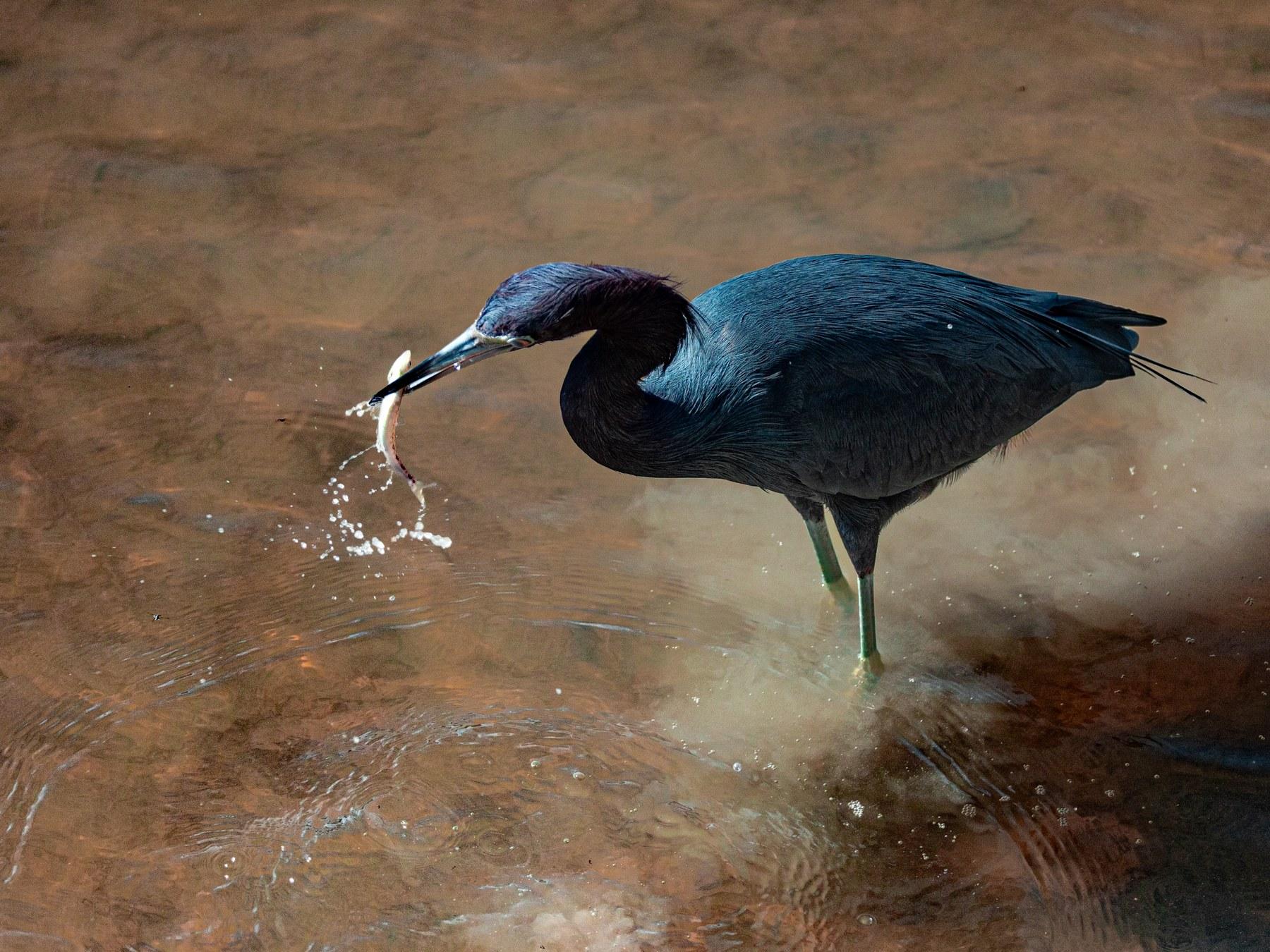
It eats whatever small animals it can catch in the shallows: mostly small fish, crustaceans such as crayfish, crabs and prawns, frogs and tadpoles, and insects, especially grasshoppers. Crayfish and grasshoppers turn up in most diet studies.
It hunts by stalking. It walks slowly, stops to peer into the water, then walks on, usually in shallow water; in a New Jersey study it mostly fed in water 2–6 in (5–15 cm) deep.1 Less often it hunts on the wing over water, rakes or stirs the bottom with a foot, or hovers. It feeds by day, usually alone or in small groups.
It sometimes feeds beside a White Ibis, making use of the ibis's movements. In one study it struck more often than when feeding alone, though not more successfully, and caught more prey at no extra cost.6
Foraging territories are often held. At one Brazilian site a single bird defended a feeding area of about 0.6 acre (2,560 square meters) beside the mangroves, where catch rates were higher, while the others defended no space.7
Farm fields matter too. In Florida's Everglades Agricultural Area, birds feeding in flooded rice and fallow fields met their daily energy needs in both study years, 2008 and 2009.8
Diet studies
In 120 food loads brought up by nestlings on Florida's west coast, invertebrates, mostly crustaceans, made up 51% of the weight, fish 35% and amphibians 15%. In a Delaware colony, fish were in 49% and frogs in 48% of 21 nestling food loads. In northeast Louisiana, 91% of 442 prey items from 17 stomachs were 1.4 in (35 mm) long or less. In Florida it takes many introduced freshwater fish, especially at fish-rearing ponds.1
Far to the south the menu changes. At a Brazilian estuary it had only recently colonized, Pink Shrimp made up 70% of the mass of 13 food samples from five nestlings.4
Nesting and breeding
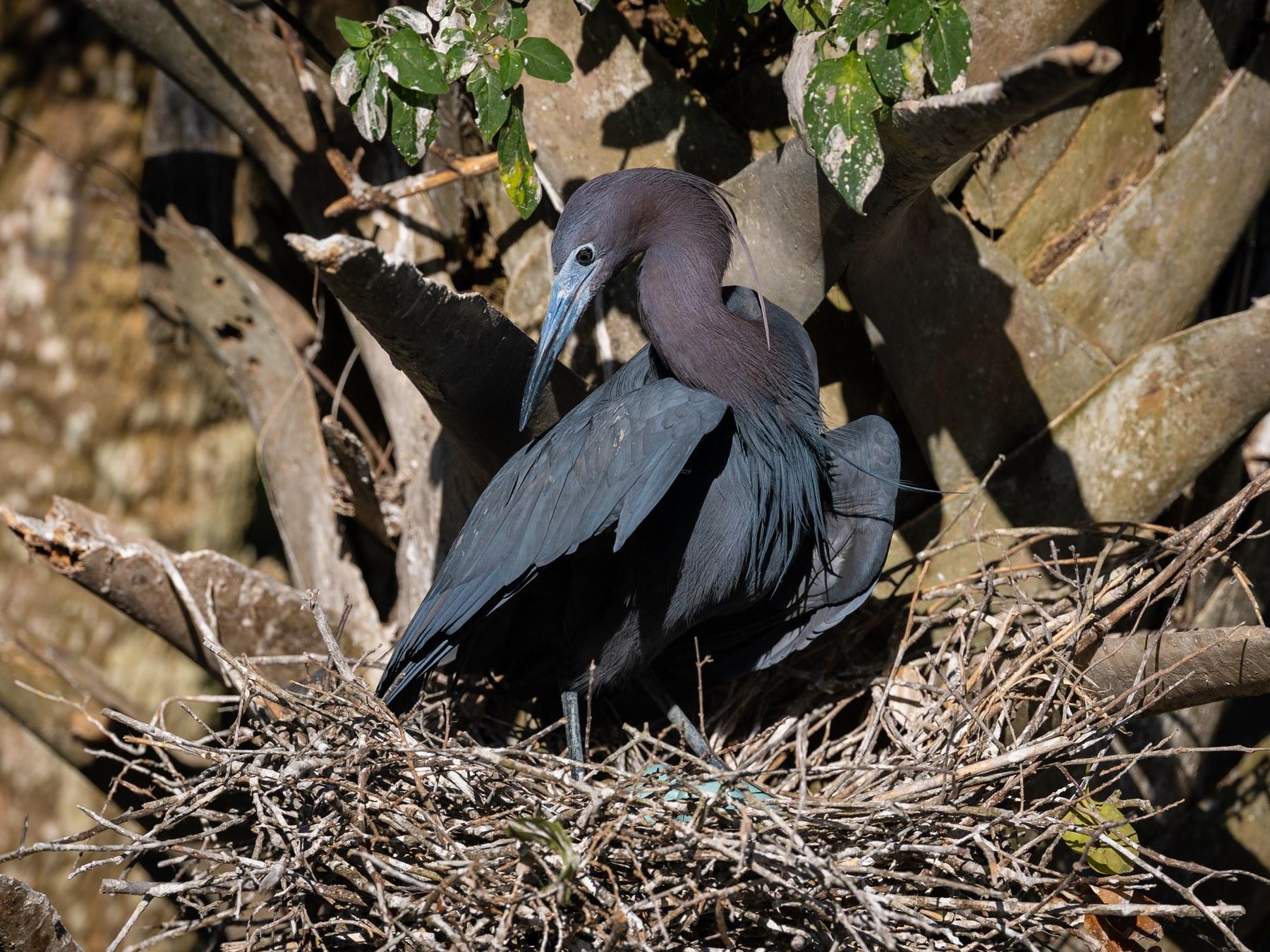
It nests in colonies, usually mixed with other herons, ibises, Brown Pelicans, cormorants and Anhingas, often around the edges of a large heronry. Nests are mostly in low shrubs, bushes and small trees under the canopy, standing in water or on islands, in cypress and hardwood swamps and mangroves. Buttonbush, willows, cattails, Phragmites and islands of dredged material are used too.
Nests are usually low: 7.9 ft (2.4 m) up on average in an Arkansas study and about 2.6 ft (0.8 m) in New Jersey. The male brings twigs and the female builds a stick platform about 12–18 in (30–45 cm) across, with a hollow lined with green material. Courtship and building take about three to five days.
Breeding tends to start later farther north, though single studies vary. Birds arrived at colonies in mid-March in Arkansas, at the end of March in interior Florida and in late April in New Jersey. In studies from different years, first eggs ranged from early March in coastal Louisiana to early May in New Jersey. At one coastal Florida island in 1973, 86% of clutches were finished between 7 and 22 April.1 In Brazil it nests from October to February.
Eggs and incubation
A clutch is usually 3 or 4 eggs, from 1 to 6 in most accounts, and one clutch of 7 has been reported. The eggs are pale bluish green, without gloss or markings, and about 1.8 by 1.3 in (45 by 33 mm).
Average clutches in published North American studies range from 2.3 to 4.4 eggs, a little larger farther north though sites vary a lot, and early nesters lay more.1 At Alafia Banks in Florida's Tampa Bay, clutches averaged 2.91 eggs, 92% of eggs hatched and 53% of nestlings lived to two weeks old: smaller clutches and fewer young than in most populations studied elsewhere.9
Eggs are laid about two days apart, and incubation usually starts with the second egg, so chicks hatch a day or two apart. Both parents incubate for about three weeks, usually given as 22–23 days, though some accounts give 20–23. They cover the eggs for 87–95% of the daylight hours and change over once or twice a day.1
Chicks and young
Chicks climb onto nearby branches at about two weeks, make short glides at about four weeks and fly properly at about five weeks. From about six weeks they leave the colony each morning to feed. Pairs raise one brood a year and can lay again if the first clutch fails early.
Sources differ on when feeding stops. Birds of the World says parents feed the young until they fledge at about five weeks, with no bond after that.1 In a 1975–77 study in Mississippi and Alabama, feeding went on until fledging at about 50 days, and the main cause of chick deaths was starvation of the last-hatched chicks, which lost out to older nestmates.10
Successful nests usually raise one to three young. In an urban colony in 2018, 16 successful nests fledged 2.4 young each, and all 26 nests 1.4 per attempt. Cattle Egrets destroying or taking over nests, and Black-crowned Night Herons taking eggs or chicks, were among the known causes of failure there.11
Behaviour
It is usually seen alone or in twos, wading slowly at the water's edge. Outside the breeding season it roosts in mixed groups of herons; at a roost in San Blas, Mexico, birds flew in from two hours before sunset to an hour after.1
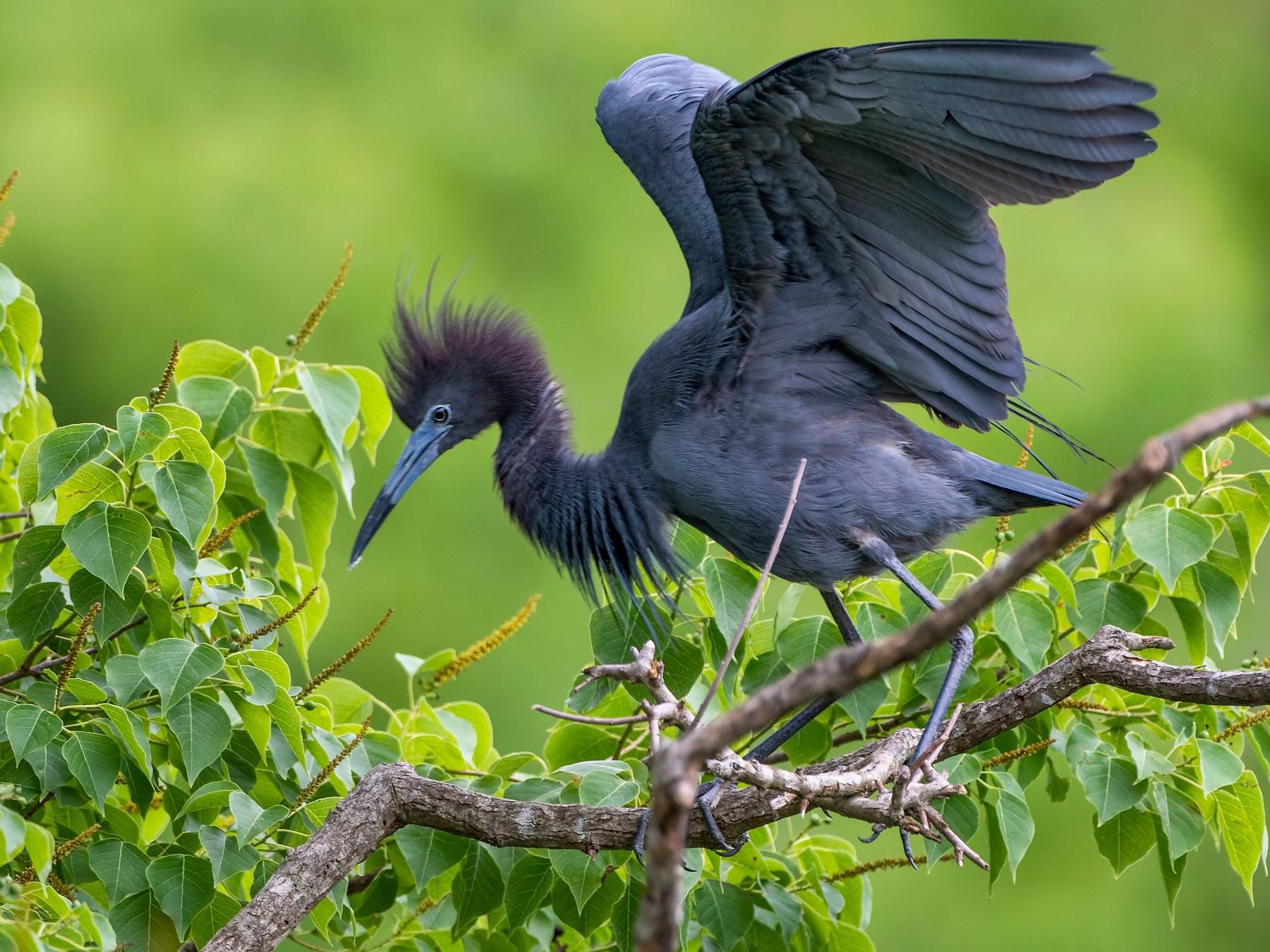
Each male picks a display site, which usually becomes the nest, and advertises from it. The display he uses, the stretch, is given only by males.12 Pairs stay together for the season, and it is not known whether the same birds pair again.
How faithful they are varies. A Florida study saw no mating outside the pair apart from three forced matings, while an Arkansas study counted 16 extra-pair matings in seven hours. In another colony, 64 extra-pair matings seen in 1976–78 were judged relatively infrequent, because males guarded their mates and females resisted.1, 13
Lifespan and predators
The oldest bird in North American banding records was at least 13 years 11 months old. Banded as a nestling in Virginia on 16 June 1957, it was found dead in Maryland in May 1971.14
We found no source that gives a typical lifespan, and no published survival rate for adults. For the young, the Heron Specialist Group gives survival of 73% from egg to two weeks old and about 50% to independence, though nesting success varies, and at Alafia Banks fewer young survived.2
Predators and other dangers
Raccoons, mink, rat snakes, crows, owls and other birds take eggs and chicks. Little is known about what kills adults, though Common Black Hawks and American Crocodiles were both seen taking adult herons in Panama; the study summary does not say which heron species.15
Losses at a colony can be heavy. In Texas, fewer than 40 crows destroyed a colony of 4,500 Little Blue Heron and Snowy Egret nests, in a report from 1940. Many nests also fail because they are flimsy; at one Florida colony, poor building and collapse caused 76% of failures.1
A parasitic worm, Eustrongylides, has caused high death rates among these and other wading birds in Delaware, southern Florida and Brazil. In southern Florida, 33 of 35 birds examined carried parasitic worms.1, 16
Conservation
It is rated Least Concern on the 2025 IUCN Red List (BirdLife International).17 Partners in Flight puts the global breeding population at about 1.1 million, on a 2010 base. That figure is scaled up from its US and Canada estimate of 270,000, which rests on Breeding Bird Survey counts.18
In the US it is declining. The North American Breeding Bird Survey estimates a fall of 1.1% a year from 1966 to 2025 (95% credible interval −1.8 to −0.5), and its index dropped from 2.20 birds per route in 1966 to 1.14 in 2025, about 48% lower.19 Most of the fall came after about 1990: 1966–1995 shows no clear change, 1995–2025 a decline of 2.0% a year, and the last ten years, 2015–2025, no clear change. The index was lowest in 2022.19
By state, the survey finds clear long-term declines in Florida, Alabama, South Carolina, Oklahoma and Missouri, and no clear trend in Texas, Louisiana, Georgia, Mississippi or North Carolina. No region shows a clear increase. Florida's index in 2025 was about 71% below 1966.19 Partners in Flight lists it as a Common Bird in Steep Decline.18
It is a hard bird to count. Dark birds nest under the canopy, and in Florida aerial surveys found only 57% of them.1 Older summaries were more upbeat. The Heron Specialist Group's undated page, citing sources from 2000, says the population “appears to be stable overall”,2 and a 30-year study of Florida Christmas Bird Counts published in 1997 found numbers “relatively stable”.20 At Kennedy Space Center on Florida's Atlantic coast, nest counts have fallen strongly since 1987.21
NatureServe ranks it globally secure and secure in the US, while several states, such as Illinois, Ohio, Connecticut and Maryland, rank it critically imperiled. These are rarity ranks, not legal status.22
Conservation: wetlands and disturbance
Changes to the natural rise and fall of water and the loss of wetland habitat are named as its greatest threats, though Florida's wildlife agency says the threats are not well understood. Food supply appears to limit its breeding success and numbers more than nest sites or predators do. Contaminant levels have been local and mostly low since the DDT era, though in south Louisiana chicks exposed to cadmium grew more slowly and those exposed to lead died more often.1
In Florida studies, feeding or resting birds flew off when people on foot came within 16–148 ft (5–45 m), 72 ft (22 m) on average over 20 approaches. Nesting birds flew off when a motorboat came within 52–89 ft (16–27 m). These studies led to recommended buffer zones of 330–660 ft (100–200 m).1 A Florida boat study proposed 590 ft (180 m) for feeding and resting wading birds in general.23
Its plumes were also sought by the hat trade of the early 1900s, but adults, lacking the lacy egret plumes, were mostly left alone, and its numbers were not hit as hard as the white egrets'.1
Legal status
In the US it is protected under the Migratory Bird Treaty Act. It is on the federal list of protected migratory birds, and taking or killing the birds, their nests or eggs is unlawful except as allowed by regulation.24, 25 It is not listed under the Endangered Species Act.26
Florida lists it as State-designated Threatened. There, taking, possessing or selling the birds, their nests or eggs is prohibited except by permit or Commission rule.27 We have not read the other states' lists.
In Canada, which it reaches as a wanderer, herons are covered all year by the Migratory Birds Convention Act, 1994, and the 2022 regulations ban killing, capturing or harassing them, or disturbing their nests and eggs, without a permit.28, 29
Similar birds
Often mistaken for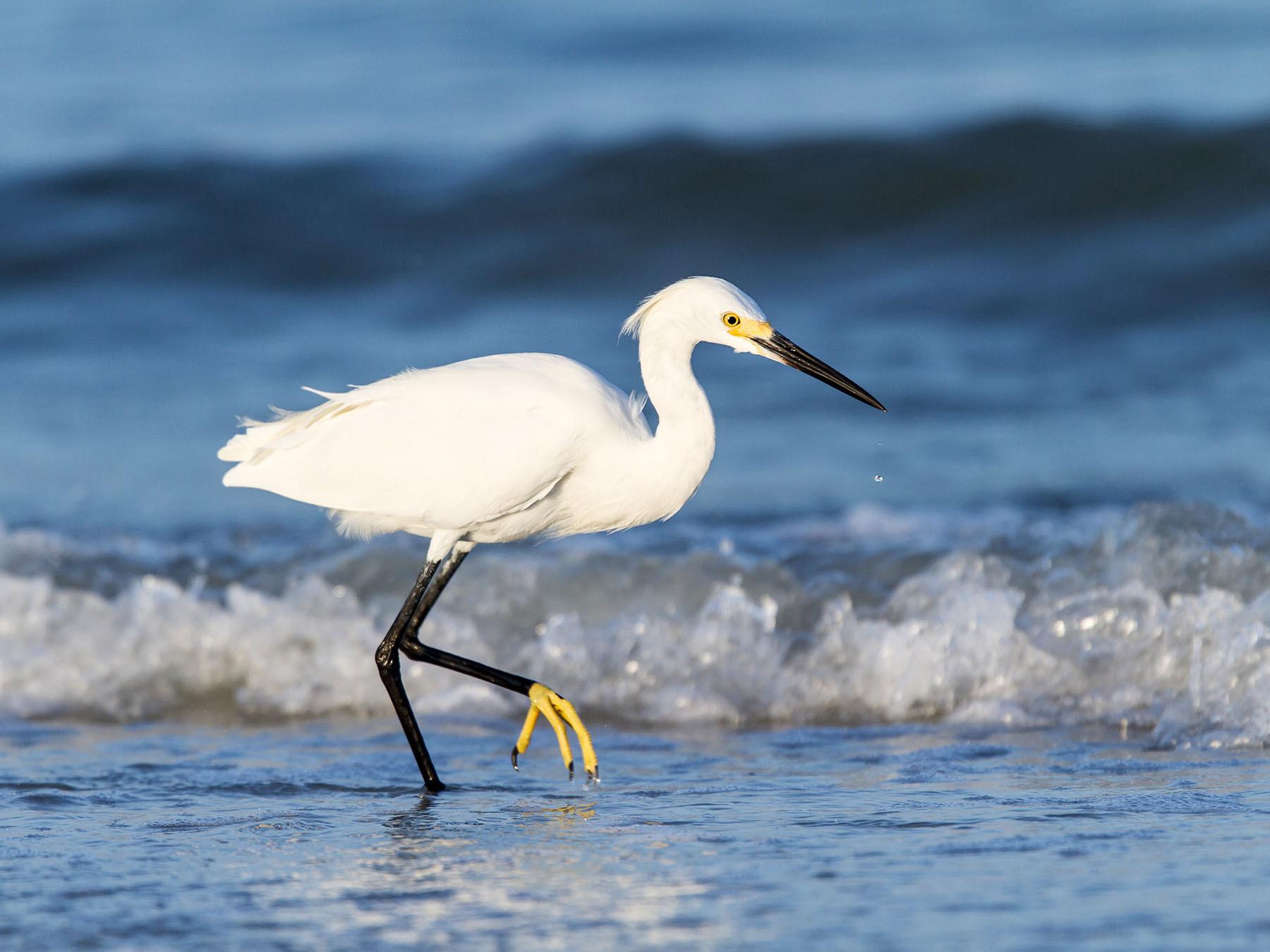

Quick facts
- Length
- 56–74 cm
- Wingspan
- 100–105 cm
- Weight
- 296–412 g
- Lifespan
- oldest recorded 13 years 11 months
- Family
- Herons & Egrets
- Migration
- Partial migrant
- Global status (IUCN)
- Least Concern
- World population
- About 1.1 million (global breeding population, Partners in Flight, 2010 base)
- Population trend
- Declining: the Breeding Bird Survey shows a clear fall of about 1.1% a year since 1966, about half the birds per route lost, most of it after about 1990; the last ten years show no clear change
- Scientific name
- Egretta caerulea
Questions
3Why are the young white?
Nobody is sure. The Heron Specialist Group says the advantage remains unclear, and the ideas studied are feeding beside Snowy Egrets, predators and heat. Studies of feeding with Snowy Egrets disagree. In Panama, blue adults caught fewer fish than white young because Snowy Egrets attacked the adults more often. In later controlled experiments the birds preferred ponds with decoys like their own kind. A study the next year found they tended to feed farther from Snowy Egrets than chance would predict, though the same review elsewhere reports that study as finding no difference in spacing.1
In Panama's mangroves, hawks attacked white young more often than blue adults, and more hawks came to white model herons than to blue ones. The author suggested predation could be a force keeping two color forms in herons.15 Heat may play a part too: the white feathers of young birds reflect about 80–82% of light, the adults' dark ones 13–15%.1
Is it rare?
Not in the Southeast, where it nests in colonies along the Gulf and Atlantic coasts, but on the Atlantic coast it is a rare and local breeder north of New Jersey. Breeding Bird Survey counts in the US have fallen by about half since 1966, though with no clear change in the last ten years. Florida lists it as State-designated Threatened. See conservation for the numbers.
Is it an egret?
It is in the same genus, Egretta, as the Snowy Egret, and is closely related to the Snowy Egret, though not its nearest relative. It was once placed in a genus of its own, Florida, so older papers call it Florida caerulea.
Sources
43- 1Rodgers, J. A., Jr. and Smith, H. T. (2020). Little Blue Heron (Egretta caerulea), version 1.0. Birds of the World (A. F. Poole, editor). Cornell Lab of Ornithology. doi:10.2173/bow.libher.01 (opens in a new tab)
- 2IUCN-SSC Heron Specialist Group. Little Blue Heron (Herons of the World). HeronConservation. Accessed 20 November 2026. Source (opens in a new tab)
- 3Bartos, A. J., Igl, L. D. and Sovada, M. A. (2010). Observations of Little Blue Herons nesting in North Dakota, and an instance of probable natural hybridization between a Little Blue Heron and a Cattle Egret. University of Nebraska-Lincoln repository (OpenAlex W3086866991). Accessed 20 November 2026. Source (opens in a new tab)
- 4Gianuca, D., Gianuca, A. T. and Vooren, C. M. (2012). Abundance, breeding and food of the Little Blue Heron Egretta caerulea (Aves, Ardeidae) in the Patos Lagoon estuary, a recently colonized area in southern Brazil. Iheringia Série Zoologia 102: 19-25. doi:10.1590/S0073-47212012000100003 (opens in a new tab)
- 5Sharp, A. R., Gawlik, D. E. and Petersen, M. L. (2026). Annual cycle movement patterns of Little Blue Herons Egretta caerulea wintering on the Florida Gulf Coast. Bird Conservation International 36: e13. doi:10.1017/S0959270925100348 (opens in a new tab)
- 6Kushlan, J. A. (1978). Commensalism in the Little Blue Heron. The Auk 95: 677-681. doi:10.1093/auk/95.4.677 (opens in a new tab)
- 7Moralez-Silva, E., Silva, F. J. L. and Monteiro-Filho, E. L. A. (2010). Unravelling feeding territoriality in the Little Blue Heron, Egretta caerulea, in Cananéia, Brazil. Brazilian Journal of Biology 70: 235-242. doi:10.1590/S1519-69842010005000020 (opens in a new tab)
- 8Sizemore, G. C. and Main, M. B. (2012). Quality of flooded rice and fallow fields as foraging habitat for Little Blue Herons and Great Egrets in the Everglades Agricultural Area, USA. Waterbirds 35: 381-393. doi:10.1675/063.035.0303 (opens in a new tab)
- 9Rodgers, J. A. (1980). Breeding ecology of the Little Blue Heron on the west coast of Florida. The Condor 82. doi:10.2307/1367470 (opens in a new tab)
- 10Werschkul, D. F. (1979). Nestling mortality and the adaptive significance of early locomotion in the Little Blue Heron. The Auk 96: 116-130. Accessed 20 November 2026. Source (opens in a new tab)
- 11Maccarone, A. D. and Harper, A. C. (2020). Breeding phenology and reproductive success of Little Blue Herons (Egretta caerulea) in an urban mixed-species colony. Transactions of the Kansas Academy of Science 123: 251-258. doi:10.1660/062.123.0125 (opens in a new tab)
- 12Rodgers, J. A. (1980). Little Blue Heron breeding behavior. The Auk 97: 371-384. Accessed 20 November 2026. Source (opens in a new tab)
- 13Werschkul, D. F. (1982). Nesting ecology of the Little Blue Heron: promiscuous behavior. The Condor 84. doi:10.2307/1367440 (opens in a new tab)
- 14USGS Bird Banding Laboratory (2026). Longevity records of North American birds: Little Blue Heron (AOU 2000). USGS Patuxent Wildlife Research Center, Bird Banding Laboratory. Accessed 20 November 2026. Source (opens in a new tab)
- 15Caldwell, G. S. (1986). Predation as a selective force on foraging herons: effects of plumage color and flocking. The Auk 103: 494-505. doi:10.1093/auk/103.3.494 (opens in a new tab)
- 16Sepúlveda, M. S., Spalding, M. G., Kinsella, J. M. and Forrester, D. J. (1996). Parasitic helminths of the little blue heron, Egretta caerulea in southern Florida. Comparative Parasitology 63: 136-140. Accessed 20 November 2026.
- 17BirdLife International (2025). Egretta caerulea. The IUCN Red List of Threatened Species 2025. IUCN Red List, via the GBIF IUCN Red List checklist dataset. Accessed 20 November 2026. Source (opens in a new tab)
- 18Partners in Flight (2024). Avian Conservation Assessment Database, global, version 2024.05.23. Bird Conservancy of the Rockies. Accessed 20 November 2026. Source (opens in a new tab)
- 19Hostetler, J. A. et al. (2026). The North American Breeding Bird Survey, analysis results 1966-2025. USGS. Accessed 20 November 2026. Source (opens in a new tab)
- 20McCrimmon, D. A., Fryska, S. T., Ogden, J. C. and Butcher, G. S. (1997). Nonlinear population dynamics of six species of Florida Ciconiiformes assessed by Christmas Bird Counts. Ecological Applications 7: 581-592. doi:10.1890/1051-0761(1997)007[0581:NPDOSS]2.0.CO;2 (opens in a new tab)
- 21Stolen, E. D. et al. (2026). Wading bird populations respond to fluctuating conditions in a sub-tropical estuary. Frontiers in Conservation Science 7. doi:10.3389/fcosc.2026.1774412 (opens in a new tab)
- 22NatureServe. Egretta caerulea (Little Blue Heron). NatureServe Explorer (public API record ELEMENT_GLOBAL.2.106018). Accessed 20 November 2026. Source (opens in a new tab)
- 23Rodgers, J. A. and Schwikert, S. T. (2002). Buffer-zone distances to protect foraging and loafing waterbirds from disturbance by personal watercraft and outboard-powered boats. Conservation Biology 16: 216-224. doi:10.1046/j.1523-1739.2002.00316.x (opens in a new tab)
- 24US Fish and Wildlife Service. 50 CFR 10.13: List of Migratory Birds. Electronic Code of Federal Regulations (current to 18 Nov 2026). Accessed 20 November 2026. Source (opens in a new tab)
- 25US Congress. 16 U.S.C. 703: Migratory Bird Treaty Act, taking, killing or possessing migratory birds unlawful. United States Code (Cornell LII text). Accessed 20 November 2026. Source (opens in a new tab)
- 26US Fish and Wildlife Service. Little Blue Heron (Egretta caerulea), species profile 9477. ECOS Environmental Conservation Online System. Accessed 20 November 2026. Source (opens in a new tab)
- 27Florida Fish and Wildlife Conservation Commission. Rule 68A-27.003, F.A.C.: Florida Endangered and Threatened Species List; Prohibitions. Florida Administrative Code (Cornell LII copy; flrules.org copy). Accessed 20 November 2026. Source (opens in a new tab)
- 28Government of Canada. Migratory Birds Convention Act, 1994 (S.C. 1994, c. 22), Schedule. Justice Laws Website. Accessed 20 November 2026. Source (opens in a new tab)
- 29Government of Canada. Migratory Birds Regulations, 2022 (SOR/2022-105). Justice Laws Website. Accessed 20 November 2026. Source (opens in a new tab)
- 30National Audubon Society. Little Blue Heron. Audubon Guide to North American Birds. Accessed 20 November 2026. Source (opens in a new tab)
- 31Cornell Lab of Ornithology. Little Blue Heron: overview and life history. All About Birds. Accessed 20 November 2026. Source (opens in a new tab)
- 32Florida Fish and Wildlife Conservation Commission. Little blue heron (Egretta caerulea). FWC species profiles. Accessed 20 November 2026. Source (opens in a new tab)
- 33AviList Core Team (2025). AviList: The Global Avian Checklist, v2025b. AviList. doi:10.2173/avilist.v2025b (opens in a new tab)
- 34Maxwell, G. R. and Kale, H. W. (1977). Breeding biology of five species of herons in coastal Florida. The Auk 94: 689-700. doi:10.2307/4085265 (opens in a new tab)
- 35Powell, G. V. N. (1987). Habitat use by wading birds in a subtropical estuary: implications of hydrography. The Auk 104: 740-749. doi:10.1093/auk/104.4.740 (opens in a new tab)
- 36Moralez-Silva, E. and Monteiro-Filho, E. L. A. (2008). Kleptoparasitism by Great Kiskadee on Little Blue Heron. Waterbirds 31: 666. doi:10.1675/1524-4695-31.4.666 (opens in a new tab)
- 37Parsons, K. C. and Master, T. L. (2020). Snowy Egret (Egretta thula), version 1.0. Birds of the World (A. F. Poole and F. B. Gill, editors). Cornell Lab of Ornithology. doi:10.2173/bow.snoegr.01 (opens in a new tab)
- 38Frederick, P. C. (2020). Tricolored Heron (Egretta tricolor), version 1.0. Birds of the World (A. F. Poole, editor). Cornell Lab of Ornithology. doi:10.2173/bow.triher.01 (opens in a new tab)
- 39Koczur, L. M. et al. (2020). Reddish Egret (Egretta rufescens), version 1.0. Birds of the World (P. G. Rodewald, editor). Cornell Lab of Ornithology. doi:10.2173/bow.redegr.01 (opens in a new tab)
- 40Vennesland, R. G. and Butler, R. W. (2020). Great Blue Heron (Ardea herodias), version 1.0. Birds of the World (A. F. Poole, editor). Cornell Lab of Ornithology. doi:10.2173/bow.grbher3.01 (opens in a new tab)
- 41Davis, W. E., Jr. and Kushlan, J. A. (2020). Green Heron (Butorides virescens), version 1.0. Birds of the World (A. F. Poole and F. B. Gill, editors). Cornell Lab of Ornithology. doi:10.2173/bow.grnher.01 (opens in a new tab)
- 42Telfair, R. C., II (2024). Western Cattle-Egret (Ardea ibis), version 1.1. Birds of the World (P. G. Rodewald, B. K. Keeney, S. M. Billerman and M. A. Bridwell, editors). Cornell Lab of Ornithology. doi:10.2173/bow.categr1.01.1 (opens in a new tab)
- 43Babineau, G. (iNaturalist guy23) (2021). Little Blue Heron calls, Chris Greene Lake, Albemarle County, Virginia, 10 August 2021. iNaturalist observation 335119080 (sound 1743715). Accessed 20 November 2026. Source (opens in a new tab)

Checked by
Nathan Cope, founder and editor
Nathan founded Birdfact and leads its writers and contributors in the UK, the US and Canada. He has watched and studied birds for more than ten years, and checks every article and species guide before it’s published.