Species Profile
Northern Yellow Warbler
Setophaga aestiva
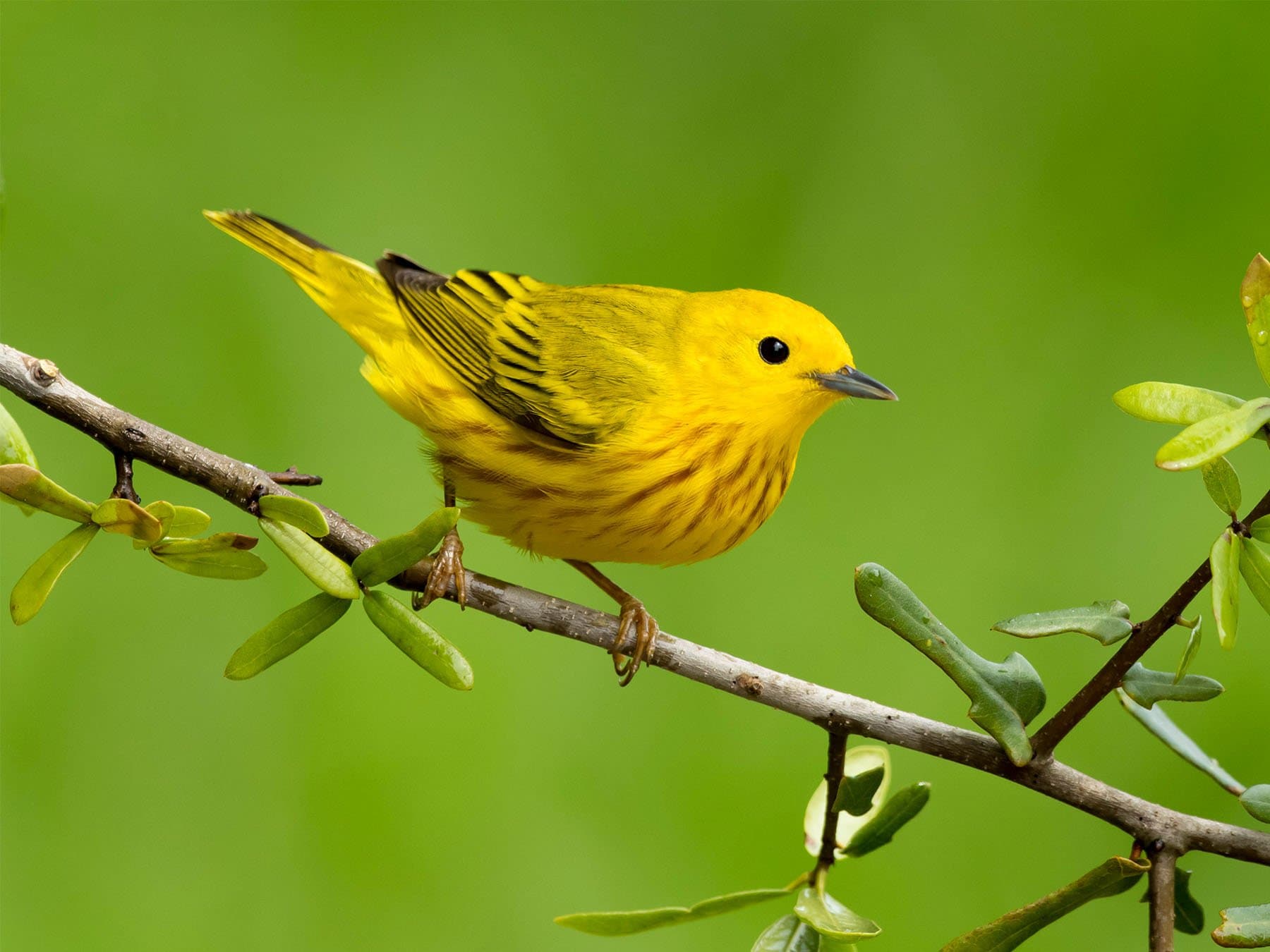
Northern Yellow Warbler perched on a branch with green leaves, showing bright yellow plumage with dark streaking on its breast.
Quick Facts
Conservation
LCLeast ConcernLifespan
3–5 years
Length
12–13 cm
Weight
9–11 g
Wingspan
16–20 cm
Migration
Long-distance Migrant
Egg-yolk yellow from crown to tail tip, the Northern Yellow Warbler is the brightest warbler across its vast North American range. Males carry reddish-chestnut streaks down the breast that double as a status badge — the bolder the streaking, the more dominant the bird. Uniquely among warblers, both sexes flash yellow patches in the tail, a field mark that clinches the identification in an instant.
Think you've spotted a Northern Yellow Warbler?
Upload a photo and we'll confirm it instantly
Confirm with a PhotoAppearance
Adult male Northern Yellow Warblers are a saturated, egg-yolk yellow across the entire head, underparts, and rump — the yellowest warbler wherever they occur. The back and wings are yellow-green, with blackish-olive flight feathers edged in yellow that can form an indistinct wing-band. The most distinctive feature of the male's underparts is a series of reddish-chestnut streaks running down the breast and flanks. Research has shown that the intensity of this streaking functions as a reliable badge of status, with bolder-streaked males proving more aggressive toward rivals in experimental studies using taxidermic mounts.
The face is entirely unmarked — no eye-stripe, no malar, no supercilium — which throws the large, beady black eye into sharp relief. The bill is short, straight, and dark, typical of a gleaning insectivore. The legs are olive-buff. Both sexes share the species' most distinctive field mark: yellow patches in the tail, a feature unique among North American warblers and visible both perched and in flight.
Females are noticeably duller than males. The back is yellow-green, the underparts are pale yellow, and reddish breast streaking is faint or absent on most individuals, though some show a trace. A faint pale eye-ring is sometimes visible. Immatures are the dullest of all, ranging from washed-out yellow to brownish or greyish, but always retaining those diagnostic yellow tail patches and the plain, unmarked face. Hatchlings emerge helpless, covered in light-grey down, weighing roughly 0.5 g at hatching.
The nominate subspecies aestiva of eastern North America shows the boldest chestnut breast streaking of the nine recognised subspecies. Populations follow Bergmann's and Gloger's Rules, with birds from cooler, more humid regions tending to be larger and more richly coloured than those from warmer, drier areas.
Identification & Characteristics
Male Colors
- Primary
- Yellow
- Secondary
- Olive
- Beak
- Black
- Legs
- Olive-brown
Female Colors
- Primary
- Yellow
- Secondary
- Greenish Yellow
- Beak
- Black
- Legs
- Olive-brown
Male Markings
Entirely yellow plumage with reddish-chestnut breast streaks (male); yellow patches in tail (both sexes, unique among warblers); plain, unmarked face with large dark eye
Tail: Short, with distinctive yellow patches visible in both sexes — unique among North American warblers
Female Markings
Duller yellow overall with yellow-green back; faint or absent breast streaking; yellow tail patches retained; plain unmarked face; occasional faint pale eye-ring
Tail: Short, with yellow patches as in male — diagnostic field mark retained at all ages
Attributes
Understanding Attributes
Rated 0–100 based on research and observation. A score of 50 is average across all bird species. These attributes are relative and don't necessarily indicate superiority.
Habitat & Distribution
During the breeding season, Northern Yellow Warblers show a strong preference for shrubby, disturbed, or regrowing vegetation close to water. Willow thickets along streams, rivers, and lakeshores are the classic habitat, but the species also uses dwarf birch stands at the tundra edge, aspen groves in the Rockies, alder and dogwood scrub in the East, and overgrown field margins, orchards, blueberry bogs, and power-line cuts wherever these occur near wetlands. In the western mountains, birds breed up to approximately 2,750 m (9,000 ft) elevation.
The breeding range is enormous — one of the widest of any North American warbler. It stretches from Alaska and northern Canada south through virtually the entire contiguous United States to central Mexico, covering most of the temperate continent. Particularly strong breeding populations occur across the northern tier of states: Montana, Idaho, North Dakota, Minnesota, Michigan, Maine, New York, and Ohio all support healthy numbers. The species is less common in parts of the south and southwest, and largely absent from the Gulf Coast and far Southwest during the breeding season.
In the US, spring migrants begin crossing the southern border in March, with birds reaching the northern states and Canada by May. Fall departure is early — sometimes as soon as late July once young are fledged — with most birds off their breeding grounds by September.
Wintering birds occupy a much wider range of habitats than breeding birds: mangrove forests, dry scrub, marshes, deciduous and tropical evergreen forests, gardens, town plazas, second growth, brushy pastures, and agricultural plantations across Central America, the Caribbean, and northern South America south to the Amazon basin, Bolivia, and Peru. Wintering birds are typically found in lowlands but occasionally reach 2,600 m (8,500 ft) elevation.
In Britain, the Northern Yellow Warbler is a rare transatlantic vagrant — classified as a "Mega" rarity by BirdGuides, meaning only a handful of records exist. The most recent UK record was a bird found at New Hythe, near Maidstone in Kent, on Christmas Eve 2024 — the first UK record since 2017, when a bird appeared at the Isle of Portland, Dorset. Two further records came from Shetland in autumn 2023. These birds are wind-assisted transatlantic vagrants, typically arriving in autumn or early winter after being swept east by Atlantic weather systems.
Where to See This Bird
Explore regional guides for locations where this bird has been recorded.
United States
Montana
Iowa
Idaho
Illinois
Nebraska
Nevada
Indiana
Louisiana
Massachusetts
Kansas
Kentucky
Maine
Maryland
Michigan
New Hampshire
New Jersey
New Mexico
Missouri
Alaska
Minnesota
Alabama
Arizona
Mississippi
North Dakota
Colorado
Connecticut
District of Columbia
California
Delaware
Oklahoma
New York
Ohio
Oregon
Utah
Rhode Island
Pennsylvania
South Dakota
Texas
Virginia
Vermont
Washington
West Virginia
Wyoming
Wisconsin
Canada
Alberta
British Columbia
Manitoba
New Brunswick
Newfoundland and Labrador
Nova Scotia
Northwest Territories
Ontario
Prince Edward Island
Quebec
Saskatchewan
Yukon Territory
Diet
Northern Yellow Warblers are almost entirely insectivorous throughout the year. Caterpillars are the single most important prey item, particularly during the breeding season when protein demand is highest. Gleaning insects from leaf surfaces, hovering to pick prey from undersides of leaves, and sallying after airborne invertebrates — the foraging repertoire is broad, covering midges, beetles, leafhoppers, wasps, mayflies, moths, mosquitoes, and spiders. Birds work the outer, slender branches of shrubs and small trees rather than probing bark or leaf litter, which distinguishes their foraging niche from heavier-billed species like nuthatches or creepers.
On their wintering grounds in Central America, Northern Yellow Warblers provide a measurable ecosystem service in coffee-growing regions. Studies have documented that both Northern and Mangrove Yellow Warblers significantly reduce infestations of the coffee berry borer (Hypothenemus hampei), one of the most economically damaging agricultural pests in the coffee industry. This makes the species a genuine ally for shade-grown coffee farmers across their wintering range.
There is no evidence of significant dietary shift between seasons beyond the opportunistic availability of prey. Insects remain the staple throughout, with the species showing no meaningful reliance on fruit or seeds even during migration — unlike some other warblers that supplement their diet with berries in autumn.
Behaviour
Northern Yellow Warblers are restless, energetic birds that rarely sit still for long. Foraging males work their way along slender outer branches of shrubs and small trees, flicking wings and tail as they go — a habit that regularly flashes those yellow tail patches. Singing males typically perch near the tops of bushes or small trees, making them conspicuous despite their small size.
Territorial behaviour begins as soon as males arrive on breeding grounds in late April or May. Disputes start with song: two males will sing at each other from opposite sides of a territory boundary, gradually escalating to quieter chip notes before chasing begins. Courtship involves a distinctive "circle flight," in which a male flies toward a female (or rival) in a horizontal, semicircular arc, sometimes combined with slow, exaggerated wingbeats to impress a prospective mate or intimidate a competitor.
On their wintering grounds in Central America and northern South America, individual birds are strikingly solitary and highly territorial, each defending a private feeding patch independently of any pair bond. This contrasts with many other migratory warblers that are more tolerant of conspecifics outside the breeding season.
The species has a well-documented and scientifically significant relationship with the Brown-headed Cowbird. When a cowbird lays an egg in a Yellow Warbler's nest, the warbler cannot eject the larger egg — its bill is too small. Instead, some females respond by building a new nest floor directly on top of the parasitised clutch, entombing both the cowbird egg and their own eggs, then laying a fresh clutch above. This behaviour can be repeated, producing nests with up to six tiers, each floor a record of a previous parasitism attempt. Approximately 25–39% of parasitised females bury the clutch; others desert the nest entirely and renest elsewhere.
Calls & Sounds
The Northern Yellow Warbler's primary song is one of the most recognisable sounds of a North American spring. It is a bright, musical series of 6–10 clear, sweet whistled notes, most commonly rendered as "sweet sweet sweet, I'm so sweet" or "sweet sweet sweet little-more sweet." The song typically features a quick stutter phrase before a final note that either rises or drops — a pattern that varies between individuals but is consistent enough to be learned quickly. Males sing vociferously from late April through early July, often from high, exposed perches at the tops of shrubs and small trees.
The call note is a soft or harder "chip" or "ship," given frequently by both sexes. Females often produce a chip call immediately after a male finishes singing, and both sexes chip incessantly when agitated near the nest. A "dzeet" flight call is used during nocturnal migration.
Most scientifically significant is the species' specialised "seet" alarm call, which functions as a referential alarm call directed specifically at Brown-headed Cowbirds. This is the only known bird species to use a referential alarm call to signal a brood parasite rather than a predator — a finding published in Communications Biology (2020). When a female hears the seet call, she returns to the nest and sits tightly, physically blocking the cowbird from laying. Males respond by increasing vigilance. The seet call is produced almost exclusively during the laying and incubation period, when parasitism risk is highest. Remarkably, Red-winged Blackbirds have been documented eavesdropping on these seet calls as their own early warning system against cowbird parasitism — one of the few documented cases of cross-species eavesdropping on a brood-parasite alarm call.
Flight
In flight, the Northern Yellow Warbler appears compact and rounded — a small, fast-moving burst of yellow that is hard to mistake for anything else. The wings are relatively short and broad for a long-distance migrant, producing a slightly undulating flight path typical of small passerines, with bursts of rapid wingbeats interspersed with brief wing-closes. The overall impression is of a bird that moves with purpose rather than drifting.
The yellow tail patches are particularly visible in flight, flashing as the bird fans its tail on landing or during short sallies after airborne insects. This feature is diagnostic: no other North American warbler shows yellow in the tail to this degree, and it is visible at distances where plumage detail is otherwise lost.
During migration, Northern Yellow Warblers are nocturnal fliers, using a "dzeet" flight call to maintain contact in the dark. Many individuals cross the Gulf of Mexico directly during autumn migration — a non-stop overwater flight of several hundred kilometres. That crossing demands significant fat reserves built up on pre-migratory staging grounds, a considerable feat for a bird weighing around 10 g.
Within their breeding territories, flight is typically short and direct — dashing between shrub tops, sallying after insects, or dropping into cover when alarmed. The circle flight of courtship sees a male arc toward a female or rival in a horizontal semicircle; with slow, exaggerated wingbeats, it is one of the more distinctive display flights of any North American warbler.
Nesting & Breeding
The breeding season runs from late April through July across most of the range, with males arriving on territory a few days before females and immediately beginning to sing. Pair bonds are typically monogamous and sometimes persist across multiple seasons. Courtship involves the distinctive circle flight — a male arcing toward a female in a horizontal semicircle — and slow, exaggerated wingbeats that function as both a courtship display and a threat to rival males.
The female alone builds the nest, typically completing it over approximately four days. She selects a vertical fork in a shrub or small tree — willow, hawthorn, raspberry, white cedar, dogwood, and honeysuckle are all favoured — usually within 3 m (10 ft) of the ground, though occasionally as high as 12 m (40 ft). The nest is a deep, sturdy cup constructed from grasses, bark strips, and plant fibres including nettles, with the exterior reinforced by spiderwebs and plant down. The inner lining is soft: deer hair, feathers, and the fluffy seed fibres of cottonwood, dandelion, willow, and cattail.
Clutch size ranges from 1–7 eggs, with 4–5 being typical. Eggs are greyish or greenish-white with dark spots, measuring approximately 16.6 × 12.7 mm. Incubation lasts 10–13 days and is performed solely by the female. Both parents feed the nestlings, which fledge after 9–12 days. Pairs may raise one or two broods per season.
Nest predation is a significant source of breeding failure. Known predators include garter snakes, red squirrels, jays, crows, raccoons, weasels, skunks, and domestic or feral cats. Brown-headed Cowbird parasitism is also frequent, particularly in fragmented landscapes — but the warbler's multi-tiered nest-burying response (see Behaviour) is one of the most elaborate anti-parasitism strategies documented in any songbird.
Lifespan
Northern Yellow Warblers typically live 3–5 years in the wild, with annual survival rates reflecting the considerable hazards of long-distance migration and overwintering in tropical habitats. The oldest individual on record was a female recaptured during banding operations in New York at a minimum age of 11 years — an exceptional lifespan for a bird weighing around 10 g.
Migration exacts the heaviest toll: exhaustion, collisions with tall lighted structures and glass buildings, and predation during stopovers all contribute to annual mortality. Nocturnal migrants are particularly vulnerable to TV towers and illuminated skyscrapers. Nest predation by garter snakes, red squirrels, raccoons, and corvids accounts for significant losses among eggs and nestlings on the breeding grounds, while adults face predation from hawks and domestic cats.
Compared to the closely related Prothonotary Warbler, which has a recorded maximum lifespan of around 9 years, the Northern Yellow Warbler's 11-year record is notably higher — though both species face similar migration-related mortality pressures. The species' scientific name aestiva is Latin for "of summer," a fitting epithet for a bird that spends only a few months of the year on its northern breeding grounds before heading south again.
Conservation
The Northern Yellow Warbler is listed as Least Concern on the IUCN Red List, and with a global population estimated at 97–197 million individuals (Partners in Flight/Audubon), it remains one of the most abundant warblers in North America. The US and Canada population alone is estimated at approximately 93 million birds. Note that these figures previously included the Mangrove Yellow Warbler before the 2025 taxonomic split, so revised estimates specific to S. aestiva are pending.
Despite its abundance, the species is in slow decline. North American Breeding Bird Survey data show a consistent decrease of approximately 0.4% per year between 1966 and 2019 — a cumulative loss of around 20% over that period. Partners in Flight rates the species 8 out of 20 on the Continental Concern Score, indicating low overall conservation concern, but the downward trend warrants monitoring.
The primary driver of decline is habitat loss, particularly the degradation of riparian willow stands through agricultural conversion, urban development, and livestock grazing. Cattle grazing along stream corridors can eliminate the dense willow thickets that are critical nesting habitat, and this remains one of the most tractable conservation problems to address. Brood parasitism by the Brown-headed Cowbird compounds breeding failure in fragmented landscapes where cowbirds have easy access to warbler nests.
Additional threats include collisions with tall lighted structures during nocturnal migration, pesticide use reducing insect prey availability, and climate change — the National Audubon Society's climate vulnerability assessment rates the species as moderately vulnerable at +3°C of warming.
Conservation efforts focus on protecting and restoring riparian habitats on both breeding and wintering grounds, and on managing cowbird populations in key breeding areas.
Population
Estimated: 97–197 million individuals (global estimate, Partners in Flight/Audubon); ~93 million in US and Canada
Trend: Declining
Slow but consistent decline of approximately 0.4% per year; cumulative decline of ~20% between 1966 and 2019 (North American Breeding Bird Survey)
Elevation
Breeds up to 2,750 m (9,000 ft); winters up to 2,600 m (8,500 ft)
Additional Details
- Family:
- Parulidae (New World Warblers)
- Predators:
- Garter snakes, red squirrels, jays, crows, raccoons, weasels, skunks, domestic and feral cats; brood parasite: Brown-headed Cowbird
- Uk status:
- Mega rarity (BirdGuides); fewer than 10 accepted records; most recent: New Hythe, Kent, December 2024
- Subspecies:
- 9 subspecies recognised within Setophaga aestiva; nominate aestiva (eastern North America) shows boldest chestnut breast streaking
Similar Species
The Northern Yellow Warbler's all-yellow plumage and yellow tail patches make it one of the easier warblers to identify, but a few species can cause confusion. The Wilson's Warbler is similarly yellow but has a distinctive black cap in males, a plain olive-green back, and no yellow in the tail — it is also a smaller, more compact bird. The Yellow-breasted Chat is much larger, with a heavy bill, white spectacles, and olive upperparts; it shares the yellow breast but is unmistakably bulkier.
Female and immature Yellow Warblers are sometimes confused with female Orange-crowned Warblers, which are similarly dull yellow-green but lack the yellow tail patches and have faint blurry streaking rather than the clean, plain face of the Yellow Warbler. The plain, unmarked face — no eye-stripe, no supercilium, no malar — combined with the yellow tail patches is the combination to look for on any age or sex of Northern Yellow Warbler.
In the UK, where the species is a mega-rarity, the most likely confusion species would be other yellow vagrant warblers. The Mangrove Yellow Warbler (S. petechia) is virtually identical to Northern Yellow Warbler in female and immature plumage; adult males are distinguished by the rufous head markings of the Mangrove species. Any Yellow Warbler-type bird found in Britain should be carefully documented and reported immediately.
Taxonomy And Subspecies
The Northern Yellow Warbler was formally described by Johann Friedrich Gmelin in 1789, with the type locality given as Quebec. For most of the 20th century, it was treated as part of a sprawling species complex — "Yellow Warbler" (Setophaga petechia) — encompassing around 35 subspecies spread across North America, Central America, the Caribbean, and the Galápagos Islands. In 2025, the eBird/Clements taxonomy committee officially split this complex into two species: the migratory Northern Yellow Warbler (Setophaga aestiva), which breeds across temperate North America and winters in the Neotropics, and the resident Mangrove Yellow Warbler (Setophaga petechia), which inhabits mangroves and coastal scrub from the Caribbean to the Galápagos year-round.
The key identification difference is straightforward: male Northern Yellow Warblers always have a fully yellow head with no rufous on the crown or face, while male Mangrove Yellow Warblers show varying amounts of rufous on the head — from a small cap to an entirely rufous head depending on the subspecies. This distinction is most relevant for birders encountering Yellow Warblers on Caribbean islands or in Central American mangroves, where both species may occur.
Nine subspecies of S. aestiva are currently recognised, differing primarily in the intensity of male breast streaking and overall brightness. The nominate aestiva of eastern North America shows the boldest chestnut streaking; western subspecies such as morcomi and sonorana tend to be slightly paler. Subspecies boundaries are often clinal and can be difficult to assign in the field.
Birdwatching Tips
The Northern Yellow Warbler is one of the easiest warblers to find in North America during the breeding season, and one of the most rewarding to watch. The key is habitat: head to willow-lined stream banks, marshy lake edges, or shrubby wetland margins from late April onwards. Males sing persistently from exposed perches at the tops of bushes, making them far easier to locate than most warblers that skulk in dense canopy.
The song — a bright, whistled "sweet sweet sweet, I'm so sweet" — is one of the most distinctive and easily learned warbler songs. Once you know it, you'll hear Yellow Warblers in habitats you previously walked past without noticing them. Listen for the characteristic quick stutter before the final rising or falling note.
In the field, the combination of all-yellow plumage, yellow tail patches (visible as the bird fans its tail), and plain unmarked face is diagnostic. No other warbler in North America is this uniformly yellow. Males with bold chestnut breast streaking are unmistakable; females and immatures are paler but always retain those yellow tail patches.
In the UK, any sighting of this species is a major event. The handful of records have come from Shetland in autumn and from southern England in late autumn and winter. If one is reported, it will attract large numbers of birders — the Kent bird in December 2024 drew hundreds of twitchers within days of its discovery. Check BirdGuides or BirdTrack for real-time alerts.
For North American birders, fall migration offers a different challenge: birds become quieter and more secretive from late July onwards. Look for them in the same riparian thickets, but listen for the soft "chip" call rather than the full song. The yellow tail patches remain the most reliable feature at any age or season.
Did You Know?
- The Northern Yellow Warbler is the only known bird species to use a referential alarm call specifically to signal a brood parasite. Its specialised "seet" call — produced only during the laying and incubation period — tells females to return to the nest and sit tight, physically blocking a Brown-headed Cowbird from laying. Red-winged Blackbirds have been documented eavesdropping on this call as their own cowbird early-warning system.
- The oldest recorded Northern Yellow Warbler was a female at least 11 years old when recaptured during banding operations in New York — an exceptional age for a 10-gram migratory songbird.
- A male's reddish-chestnut breast streaking is a reliable badge of dominance: experimental studies using taxidermic mounts showed that territorial males directed significantly higher aggression toward models with bolder streaking. The more streaked the male, the more aggressive he is toward rivals.
- On their wintering grounds in Central America, Northern Yellow Warblers provide a measurable pest-control service for coffee farmers: studies have shown the species significantly reduces infestations of the coffee berry borer (Hypothenemus hampei), one of the most economically damaging insects in the global coffee industry.
- Fall migration averages approximately 49 days, with many individuals crossing the Gulf of Mexico non-stop — a journey of several hundred kilometres fuelled entirely by fat reserves built up on pre-migratory staging grounds.
Records & Accolades
Most Distinctive Song
"Sweet sweet sweet, I'm so sweet"
One of the most recognisable and easily learned warbler songs in North America, sung vociferously from exposed perches throughout the breeding season.
Most Elaborate Anti-Parasitism Strategy
Up to 6-tiered nests recorded
When repeatedly parasitised by Brown-headed Cowbirds, females bury each parasitised clutch under a new nest floor, producing nests with up to six tiers — each floor entombing a previous cowbird egg.
Unique Alarm Call
Only bird known to use a referential alarm call for a brood parasite
The specialised 'seet' call warns of approaching cowbirds — not predators — triggering females to sit tight on the nest. Red-winged Blackbirds eavesdrop on this call as their own early warning system.
Longevity Record
11 years (female, New York)
The oldest recorded Northern Yellow Warbler was a female recaptured during banding in New York at a minimum age of 11 years — exceptional for a 10-gram migratory songbird.
Community Photos
Be the first to share a photo of the Northern Yellow Warbler
Upload a PhotoIdentify Any Bird Instantly
- Upload a photo from your phone or camera
- Get an instant AI identification
- Ask follow-up questions about the bird
Monthly Birds in Your Area
- Personalised for your location
- Seasonal tips and garden advice
- Updated every month with new species