Species Profile
Orange-crowned Warbler
Leiothlypis celata
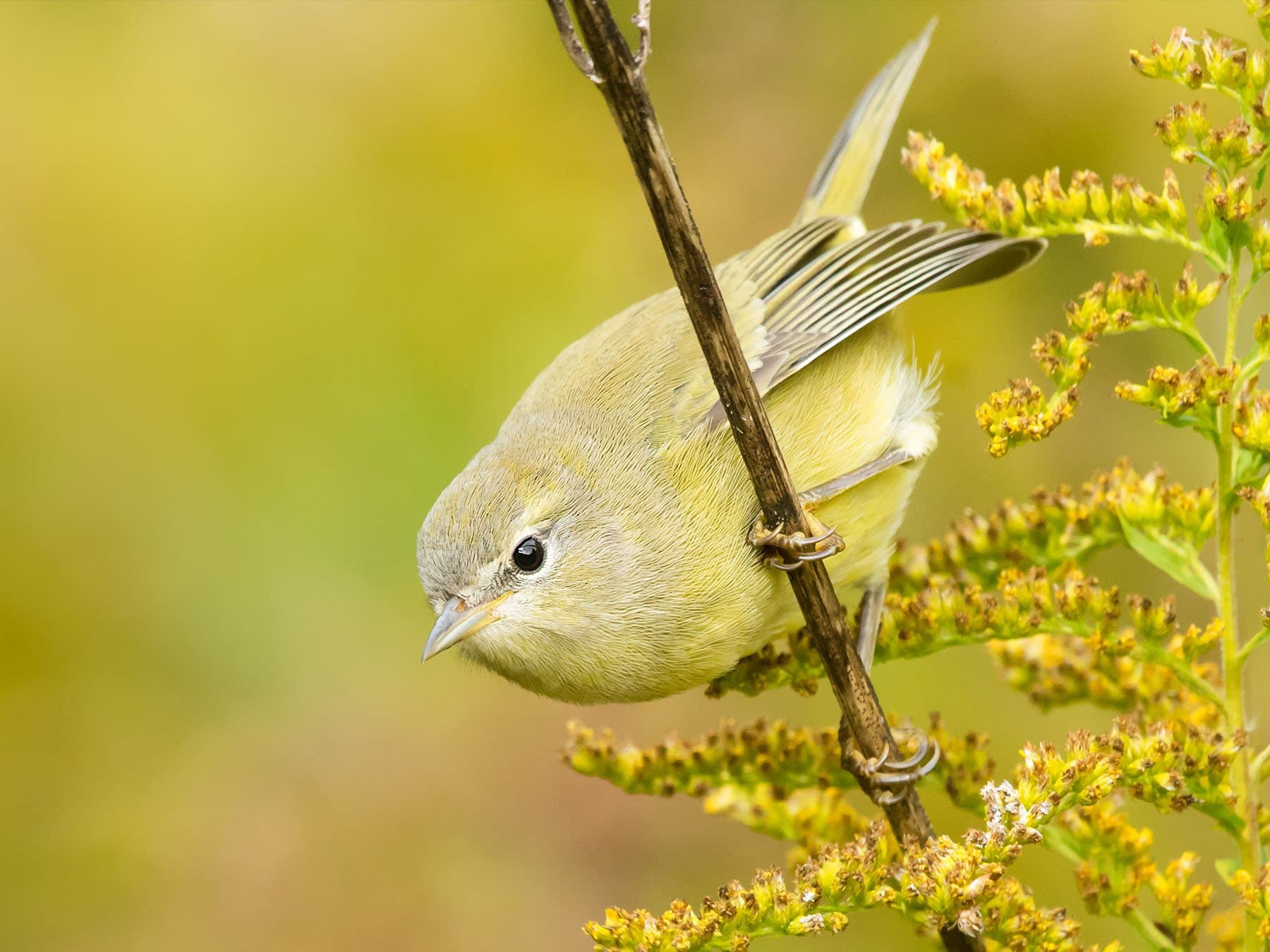
Orange-crowned Warbler with yellow-green plumage and dark eye, perched on a diagonal branch amidst yellow flowers.
Quick Facts
Conservation
LCLeast ConcernLifespan
3–8 years
Length
11–14 cm
Weight
9–10.8 g
Wingspan
18–19 cm
Migration
Partial migrant
Named for a feature almost never seen in the field, the Orange-crowned Warbler is a study in deliberate plainness — an olive-grey bird that hides its vivid crown patch so reliably that even experienced banders sometimes only discover it by blowing on the feathers. With around 82 million individuals spread across western North America, it is one of the continent's most abundant warblers, yet its drab appearance means it is routinely overlooked by all but the most attentive observers.
Think you've spotted a Orange-crowned Warbler?
Upload a photo and we'll confirm it instantly
Confirm with a PhotoAppearance
Plain olive-grey from crown to tail, with no wing bars, no bold face markings, and no bright contrasting patches — the Orange-crowned Warbler has made an art of looking like nothing in particular. Adults have olive-grey to olive-green upperparts across the back, rump, and tail, with the rump and uppertail coverts often appearing slightly brighter yellow-green. The underparts are a dull greenish-yellow with faint, blurry streaking on the breast and sides.
Two field marks cut through the drabness. First, the undertail coverts are distinctly brighter yellow than the belly — a reliable feature that separates this species from the superficially similar Tennessee Warbler. Second, the face shows a faint, broken eye-ring and a short, indistinct dusky line through the eye, giving the bird a slightly masked expression without any real drama. The bill is thin, sharply pointed, and narrowly wedge-shaped — a precision tool for gleaning invertebrates from foliage.
The orange crown patch that gives the species its name is almost always completely hidden beneath the olive-green feathers. It surfaces only when the bird raises its crown feathers during aggressive encounters or courtship. Even in hand, banders sometimes miss it entirely until they blow gently on the crown. The extent of the patch is a reliable indicator of sex and age: adult males consistently show patches 9 mm or larger, while females tend to have smaller, brownish-orange patches, and first-year birds of both sexes may show no crown colour at all.
The four subspecies differ noticeably in tone. The nominate L. c. celata (Alaska and Canada) is the dullest and greyest. L. c. lutescens (Pacific Coast) is the brightest yellow-green. L. c. orestera (Rocky Mountains and Great Basin) is intermediate. L. c. sordida (Channel Islands and coastal southern California) is the darkest, with a leaden tinge to the feather tips and slightly larger feet and bill. Juvenile birds are greyer and duller than adults, with a buffy wash below and buffy-yellow wing bars that disappear after the first preformative moult.
Identification & Characteristics
Male Colors
- Primary
- Olive-grey
- Secondary
- Greenish Yellow
- Beak
- Black
- Legs
- Pink
Female Colors
- Primary
- Olive-grey
- Secondary
- Greenish Yellow
- Beak
- Black
- Legs
- Pink
Male Markings
Bright yellow undertail coverts contrasting with duller greenish-yellow belly; faint blurry breast streaking; hidden orange crown patch (rarely visible); no wing bars
Tail: Olive-green tail with no white spots or patches; slightly rounded; adult rectrices broader and more rounded than first-year birds
Female Markings
Duller and greyer than males overall; orange crown patch absent or reduced to a small brownish-orange patch; slightly duller yellow-green underparts
Tail: As male but first-year females have narrower, more pointed rectrices
Attributes
Understanding Attributes
Rated 0–100 based on research and observation. A score of 50 is average across all bird species. These attributes are relative and don't necessarily indicate superiority.
Habitat & Distribution
Few warblers in North America occupy as wide a range of breeding habitats as the Orange-crowned Warbler. It breeds in open shrubby areas, brushy clearings, and deciduous undergrowth across at least eight distinct vegetation types. These include alder and willow stands in coastal Alaskan rainforest; fir-aspen woodlands up to 2,300 m in central Arizona; willow, alder, and maple thickets in Washington; open Oregon white oak woodlands; California laurel and coast live oak stands in central California; and torrey pine, chaparral, and coastal sage scrub on the Channel Islands. The common thread is not tree species or elevation — it is structure: dense shrub layers and low vegetation, consistently preferred over open or high-canopy habitats.
The breeding range spans from central and southern Alaska east across most of Canada — from British Columbia and the Yukon east to Manitoba and southern Ontario. It extends south through the western United States, including Washington, Oregon, California, Idaho, Montana, Wyoming, Colorado, Utah, Nevada, Arizona, and New Mexico. In British Columbia, the species reaches its highest abundance in the Coastal Douglas-fir biogeoclimatic zone below 250 m elevation, and also at 750–1,250 m in the interior. Three of the four subspecies occur in British Columbia alone, making it one of the most important provinces for the species.
In winter, birds spread across the southern United States — particularly common in Louisiana, Mississippi, Alabama, Florida, Georgia, and the Carolinas — throughout Mexico, and south to Guatemala and Belize. Some individuals reach Costa Rica. The Pacific Coast subspecies (lutescens) winters from California south to Guatemala; the nominate celata winters from the southeastern US to Guatemala; and the Channel Islands sordida moves only about 50 km to the nearby California coast. Vagrant records exist from the Bahamas, Cuba, Jamaica, Bermuda, and even Greenland.
For US birders, the species is common in the West year-round and a regular winter visitor across the Southeast. In Canada, it is an abundant breeder across the northern forests. It is uncommon but regular in the eastern US during fall migration, peaking in October, and rare but annual in the Northeast at that season.
Where to See This Bird
Explore regional guides for locations where this bird has been recorded.
United States
Georgia
Montana
Nevada
Louisiana
New Mexico
Mississippi
Alaska
Alabama
Arizona
North Dakota
California
Colorado
Florida
Utah
Oregon
South Carolina
Texas
Washington
Canada
Alberta
British Columbia
Manitoba
Northwest Territories
Saskatchewan
Yukon Territory
Diet
Invertebrates make up over 90% of the Orange-crowned Warbler's diet. Caterpillars are particularly important, especially during the breeding season when nestlings need high-protein food. Adults also take ants, beetles, flies, spiders, and a wide range of other insect larvae — anything roughly 2.5–15 mm in length that can be gleaned from foliage or bark. The thin, pointed bill is well suited to probing into crevices and extracting soft-bodied prey from leaf surfaces.
The remaining diet is more varied than most warblers manage. Berries, fruit, seeds, and plant galls supplement the insect intake, particularly in winter when invertebrate prey becomes scarce. Nectar is accessed through the bird's characteristic nectar-robbing technique: rather than entering a flower from the front, it pierces the base of the corolla with its bill and extracts the sugar directly, bypassing the flower's pollination mechanism entirely. Sap from sapsucker wells is another reliable energy source, and birds will return repeatedly to productive wells.
In winter, the dietary balance shifts noticeably towards plant material. Berries and fruit become more prominent, and the species' willingness to exploit backyard feeders — suet cakes, peanut butter mixes, and even hummingbird feeders — reflects a genuine flexibility that most warblers lack. The Channel Islands subspecies (sordida) consumes proportionally less fruit and nectar than mainland populations, likely reflecting differences in local food availability on the islands.
Nestlings are fed almost exclusively on insect larvae. Both parents provision the chicks, though the female also handles all brooding duties. The shift from a larval-heavy nestling diet to the more varied adult diet happens gradually as young birds develop their foraging skills after fledging.
Behaviour
Orange-crowned Warblers forage actively and low, working through dense shrubs and tangled undergrowth with quick, restless movements. They glean invertebrates from leaf surfaces and stems, often hovering briefly to snatch prey from the undersides of foliage. Unlike many warblers that forage high in the canopy, this species keeps close to the shrub layer — a preference that shapes both its habitat choices and its relative invisibility to casual observers.
Outside the breeding season, they are largely solitary, though they will join mixed-species foraging flocks during migration and in winter. Territorial males on the breeding grounds defend their patches vigorously, singing persistently and raising the orange crown patch as a visual threat signal during confrontations — one of the few moments when the bird's hidden colour becomes visible.
One of the more unusual foraging habits of this species is piercing the bases of flowers to access nectar rather than entering from the front — a technique known as nectar robbing (described further in the diet section). Sapsucker wells are another reliable resource: the birds feed on oozing sap alongside other small species and return repeatedly to productive sites. During winter, when insect prey is scarce, they will visit backyard feeders offering suet, peanut butter, and sugar water, and have even been recorded at hummingbird feeders.
The species is notably hardy for a warbler, wintering farther north than almost any other member of the family. Birds regularly appear on Christmas Bird Counts across the southern United States, and some individuals remain in coastal California and the Pacific Northwest through the coldest months.
Calls & Sounds
The Orange-crowned Warbler's song is a high-pitched, rapidly delivered trill of sweet, clear notes. It starts at a single pitch, accelerates and rises slightly through the middle, then becomes weaker and slower at the end — often dropping in pitch on the final notes. The effect is of a trill that builds momentum and then runs out of steam. It resembles a Chipping Sparrow's trill in quality but is distinguishable by that characteristic drop at the end. The Pacific Coast subspecies (lutescens) sings notably faster than the other subspecies, and the Channel Islands sordida has a more melodic, variable song than mainland populations.
What makes this species' vocalisation genuinely unusual among wood warblers is the degree of individual variation. Male Orange-crowned Warblers have songs so individually distinctive that individual birds can be identified by their song patterns alone. Neighbouring males in adjacent territories form what researchers call 'song neighbourhoods' — groups of 2–6 individuals who learn and mimic each other's songs, creating shared local dialects that can persist for years within a neighbourhood. This level of cultural transmission and individual vocal identity is rare in the warbler family.
Males sing to establish territories and attract mates in late winter and spring, then enter a silent phase during early courtship. They resume singing once the pair bond is established and the female begins nest construction. During territorial disputes, the crown feathers are raised to flash the orange patch alongside the vocal display.
The most frequent call is a sharp, hard stik or tik chip note — very distinctive and given freely at all seasons. It is harder and drier than the chip calls of most other warblers and is often the first clue to the bird's presence in dense cover. The flight call is a high, thin seet. Females produce a quieter trill, and both sexes call frequently near the nest.
Flight
Compact and rounded-winged, the Orange-crowned Warbler is built for threading through dense shrub layers rather than sustained open-air travel. The flight style is direct and slightly undulating over short distances, with quick wingbeats interspersed with brief closed-wing glides. It does not have the deeply bounding flight of some larger passerines, but the undulation is noticeable enough to help separate it from flycatchers and vireos in the field.
The overall impression from behind is of a plain olive-grey bird with no wing bars, no tail spots, and no bright patches to catch the eye. The slightly brighter yellow-green of the rump and uppertail coverts can be visible as the bird moves away, and the bright yellow undertail coverts flash briefly when the bird lands and fans its tail. These are the most useful flight features for identification.
The species migrates at night, like most wood warblers, and the thin, high seet flight call is the primary way to detect birds moving overhead in darkness. During the day, migrants move through shrubby habitats in a low, restless style — rarely flying far in the open, preferring to hop and flutter through cover. The nominate subspecies undertakes a substantial migration from Alaska and northern Canada to the southeastern US and Mexico, a journey of several thousand kilometres completed in stages over several weeks. Subspecies vary considerably in the distances they cover — from the nominate's transcontinental journey to the much shorter movements of western populations — as detailed in the subspecies section.
Nesting & Breeding
Males arrive on the breeding grounds before females and immediately begin singing to establish territories. Returning males typically reclaim the same territory defended in previous years — a fidelity that, combined with the song neighbourhood behaviour described in the vocalisation section, creates remarkably stable local social structures from one season to the next. The breeding season runs from late April through mid-August, with eggs laid March–May in the west and June in the east.
Courtship involves a distinctive display in which the male follows the female through the undergrowth, then droops his wings, spreads his tail, points his bill skyward, and gapes his beak — mimicking the solicitation posture of a receptive female to facilitate pair bonding. The full display is described in the courtship and display section. After a silent phase during early courtship, the male resumes singing once the pair bond is established and the female begins nest construction.
The female selects the nest site alone, fluttering through low vegetation until she settles on a location. Nests are typically placed on or near the ground — often on shady hillsides, steep road cuts, the bases of snowmelt drainages, or nestled in fern fronds — sheltered by overhanging vegetation. The female builds the nest over approximately four days. She lays a foundation of dead leaves and coarse plant material, then adds an outer layer of grasses, fine twigs, bark, and moss, lining the cup with finer grasses and animal hair from small mammals, sometimes including elk or horse hair. The finished cup measures roughly 10 cm across and 6 cm high.
The Channel Islands subspecies (sordida) is a notable exception to the ground-nesting rule, consistently placing nests off the ground in low shrubs and up to 6 m high in toyon, coast live oak, and ironwood trees. This adaptation is attributed to the reduced avian predator community on the islands.
Clutch size is 3–6 eggs, typically 4–5. Eggs are white to cream-coloured, finely speckled with reddish-brown or chestnut markings concentrated at the larger end, and average 16.2 mm long by 12.7 mm in diameter. Only the female incubates, for 11–13 days. Chicks hatch with eyes closed and sparse dark grey down.
Both parents feed the nestlings, but only the female broods them. Young fledge at 10–13 days and continue to be fed by both parents for at least several days after leaving the nest. Parental care continues for up to two months as the young develop full flight capability. Typically one brood per year, though pairs re-nest readily after predation failures.
Lifespan
Whether a bird lives three years or nine depends largely on how far it migrates — a difference the Orange-crowned Warbler illustrates with unusual clarity. The oldest known individual reached at least 8 years and 7–8 months when recaptured during banding operations in California in 2018. Annual survival rates vary considerably between populations: Alaska-breeding birds of the nominate subspecies survive at a rate of only about 45% per year, while the largely resident Channel Islands sordida subspecies achieves around 75% — a difference of 30 percentage points attributed almost entirely to the costs and hazards of long-distance migration.
This contrast makes the Orange-crowned Warbler an unusually clear case study in the survival costs of migration. The Alaska breeders face predation, weather events, collisions with structures, and the energetic demands of a journey spanning several thousand kilometres twice a year. The Channel Islands birds, moving only about 50 km to the California coast, avoid most of these risks and live correspondingly longer on average.
Mortality causes for migratory populations include collisions with buildings, communication towers, and wind turbines — a significant source of mortality for all nocturnally migrating passerines. Nest predation by small mammals, snakes, and corvids reduces breeding success but does not directly affect adult survival. Compared to other Parulidae, the Orange-crowned Warbler's maximum recorded lifespan of nearly 9 years is broadly typical for a small warbler of its size, similar to the Yellow Warbler and other closely related species.
Conservation
Eighty-two million individuals and still declining — the Orange-crowned Warbler's conservation story is more complicated than its Least Concern listing suggests. The species is listed as Least Concern on the IUCN Red List (2016), and with an estimated population of approximately 82 million individuals (Partners in Flight), it is not a species in immediate danger.
North American Breeding Bird Survey data show an overall decline of approximately 28% between 1966 and 2019 across the full range. In the United States, the decline has been steeper — around 54% over the same period. Canadian populations have been relatively stable since about 1970, though declines are noted in British Columbia's Northern Pacific Rainforest and Great Basin Bird Conservation Regions. The species rates 9 out of 20 on the Partners in Flight Conservation Concern Score, indicating low overall concern, but the US trajectory warrants monitoring.
Habitat loss and degradation are the primary threats. Loss of the shrub layer in coastal coniferous forests, oak woodlands, and southern interior riparian forests removes the dense low vegetation this species depends on. Livestock overgrazing degrades understory habitat in California oak woodlands and elsewhere. Some logging practices in coastal Alaska damage the shrub layer that supports breeding populations. Unlike many warblers, the Orange-crowned Warbler is unlikely to be significantly affected by tropical deforestation, since it winters primarily in shrubby habitats in the southern US and Mexico rather than in closed-canopy tropical forest.
Other mortality causes include collisions with buildings, airport towers, TV towers, and wind turbines. Nest predation by small mammals, snakes (including gopher snakes), and corvids is a significant source of breeding failure — on Santa Cruz Island, Island Scrub-Jays are a notable nest predator of the sordida subspecies. Climate change poses a longer-term threat to range and habitat suitability, though the species' broad habitat tolerance may buffer it against some projected changes.
Population
Estimated: 82,000,000
Trend: Decreasing
Overall declining. North American Breeding Bird Survey data show an approximately 28% decline between 1966 and 2019 across the full range, with steeper declines of around 54% in the United States. Canadian populations have been relatively stable since 1970, though declines are noted in British Columbia's Northern Pacific Rainforest and Great Basin Bird Conservation Regions.
Elevation
Sea level to 2,300 m
Additional Details
- Family:
- Parulidae (New World Warblers)
- Predators:
- Small mammals, gopher snakes, corvids (particularly Island Scrub-Jays on Santa Cruz Island); nest predation is a significant source of breeding failure
- Subspecies:
- Four recognised subspecies: L. c. celata, L. c. lutescens, L. c. orestera, L. c. sordida
Subspecies Variation
The four recognised subspecies of the Orange-crowned Warbler differ enough in plumage, song, and ecology that they are sometimes treated as a species complex. The nominate L. c. celata, breeding across the boreal forests of Alaska and Canada, is the dullest and greyest. It migrates primarily through the Mississippi Valley — northwestward from mid-April to late May in spring, southeastward in fall — and winters in the southeastern United States and Mexico, reaching Guatemala.
L. c. lutescens, the Pacific Coast subspecies, is the brightest of the four — a vivid yellow-green bird that breeds from Alaska south through coastal California. Its song is noticeably faster than that of other subspecies, and it winters from California south to Guatemala, migrating earlier in both spring and fall than the nominate. L. c. orestera, breeding in the Rocky Mountains and Great Basin, is intermediate in colour between celata and lutescens, and winters primarily in Mexico.
L. c. sordida, restricted to California's Channel Islands and locally along the southern California and northern Baja California coast, is the darkest subspecies — a deep olive-green bird with a leaden tinge to the feather tips. It is also the most ecologically divergent. Rather than undertaking a long migration, it moves only about 50 km to the mainland coast after breeding. It nests off the ground in trees and tall shrubs rather than on the ground — an adaptation to the reduced avian predator community on the islands — and its song is more melodic and variable than those of mainland populations.
The sordida subspecies was first described from specimens collected on Santa Catalina Island and remains one of the most distinctive island-adapted passerines on the California coast. Three of the four subspecies — celata, lutescens, and orestera — occur in British Columbia, making it one of the most important provinces for the species as a whole.
Courtship & Display
Courtship in the Orange-crowned Warbler is a quiet, understated affair — appropriate for a bird that hides its most vivid feature. After males establish territories through song in late winter and early spring, there is a conspicuous silent phase when females first arrive. The male stops singing and instead follows the female through the undergrowth in close pursuit, a behaviour that can last for several days before the pair bond solidifies.
The male's courtship display is distinctive and easy to overlook in dense cover. He droops his wings away from his body, spreads and fans his tail, points his bill skyward, and gapes his beak open — a posture that closely mimics the solicitation display of a receptive female. This apparent mimicry of the female's own behaviour is thought to reduce the female's wariness and facilitate bonding, though the precise function is not fully understood. During this display, the orange crown patch is raised and visible — one of the few reliable opportunities to see the feature that names the species.
Once the pair bond is established, the male resumes singing, and the female begins selecting the nest site. The female's role in site selection is active and deliberate: she flutters through low vegetation repeatedly, testing locations before committing. The male does not participate in nest construction but continues to sing from the territory and will aggressively chase rival males that approach the nest area. The pair is monogamous for the breeding season, and returning males typically re-establish the same territory in subsequent years, sometimes reuniting with the same female.
Birdwatching Tips
The Orange-crowned Warbler's plainness is both its challenge and its reward. The key identification features to fix in mind are: overall olive-grey to olive-green colouring with no wing bars; faint blurry streaking on the breast; and — crucially — undertail coverts that are distinctly brighter yellow than the belly. That last feature, visible when the bird pumps its tail or clings to a stem, is the most reliable separator from the similar Tennessee Warbler.
In the western United States and Canada, look for this species in brushy clearings, willow and alder thickets, shrubby forest edges, and riparian corridors from late April through August. In California, Oregon, and Washington, it is among the most frequently recorded breeding warblers in shrubby habitats. In the southeastern US — particularly Florida, Louisiana, and the Carolinas — it is a regular winter visitor from October through March, often found in weedy fields, overgrown gardens, and brushy woodland edges. It is one of the few warblers that will reliably visit suet feeders in winter, which makes it easier to observe at close range.
The chip call is a key identification tool: a sharp, hard stik or tik note, distinctly harder and drier than the chip calls of most other warblers. Learning this call is the fastest way to locate birds in dense cover. The song — a high-pitched trill that rises and accelerates in the middle before weakening and dropping at the end — is distinctive once learned, though it can be confused with a Chipping Sparrow's trill at first.
The orange crown patch is almost never visible in the field, so do not wait for it. If you are lucky enough to observe a territorial dispute or a male in full display, watch the crown carefully — the flash of orange is brief but unmistakable. In fall, first-year birds are the dullest individuals, with a buffy wash below and no crown colour at all; focus on structure and the undertail covert colour rather than any warm tones.
Did You Know?
- The species' scientific name, celata, is Latin for 'hidden' or 'concealed' — a direct reference to the orange crown patch that almost never shows in the field. Even experienced banders sometimes only discover it by blowing gently on the crown feathers while processing a bird in hand. The extent of the patch is used to help determine sex: males consistently have larger orange patches than females.
- Male Orange-crowned Warblers develop such individually distinctive songs that researchers can identify specific birds by voice alone — without ever seeing them. Song patterns are so stable that a male's unique signature can be tracked across multiple breeding seasons, and neighbouring males form local dialects that persist for years.
- Migration in this species appears to be triggered by food availability rather than day length. Orange-crowned Warblers leave the breeding grounds when cold or drought reduces insect prey — not in response to shortening days — making them among the latest fall migrants of any warbler species.
- Unlike most migratory warblers that retreat deep into the tropics for winter, this species regularly winters across the southern United States and will reliably visit backyard suet feeders — a flexibility that reflects its unusually broad dietary range.
- At Alaska's Creamer's Field Migration Station, the Orange-crowned Warbler ranks third all-time in banding capture totals, with approximately 13,000 individuals captured over the station's history. The oldest known individual was at least 8 years and 7–8 months old when recaptured during banding operations in California in 2018.
Records & Accolades
Song Neighbourhood Pioneer
2–6 males
Forms local 'song neighbourhoods' where neighbouring males learn and mimic each other's songs, creating shared dialects that persist for years — unusual cultural transmission for a warbler.
Island Survivor
75% annual survival
The Channel Islands subspecies (sordida) achieves a 75% annual survival rate — 30 percentage points higher than Alaska-breeding birds — thanks to its short 50 km migration.
Oldest on Record
8 years 7–8 months
The oldest known individual was recaptured during banding operations in California in 2018, making it one of the longest-lived small warblers on record.
Habitat Generalist
Sea level to 2,300 m
Breeds across a wider range of vegetation types than almost any other North American warbler, from coastal Alaskan rainforest to Channel Islands chaparral to Rocky Mountain fir-aspen woodland.
Community Photos
Be the first to share a photo of the Orange-crowned Warbler
Upload a PhotoIdentify Any Bird Instantly
- Upload a photo from your phone or camera
- Get an instant AI identification
- Ask follow-up questions about the bird
Monthly Birds in Your Area
- Personalised for your location
- Seasonal tips and garden advice
- Updated every month with new species