Species Profile
Tennessee Warbler
Leiothlypis peregrina
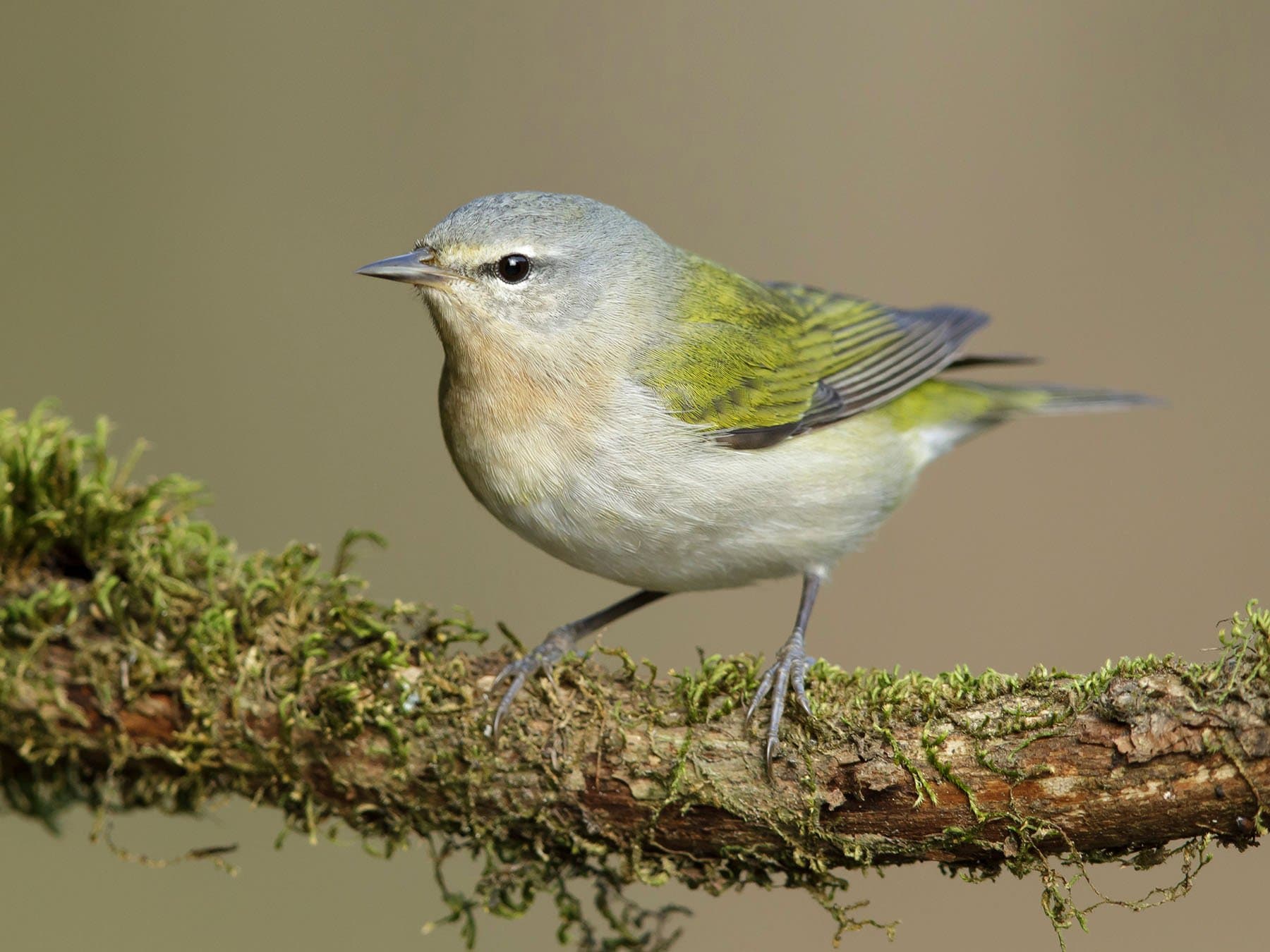
Tennessee Warbler perched on a mossy branch. Features a gray head, olive-green back, and pale underparts with a faint buff wash on the flanks.
Quick Facts
Conservation
LCLeast ConcernLifespan
1–4 years
Length
10–13 cm
Weight
8–13 g
Wingspan
19–20 cm
Migration
Long-distance Migrant
Named after a state where it has never bred, the Tennessee Warbler is a small but surprisingly loud boreal songbird whose fortunes are tied to one of North America's most dramatic ecological cycles — the spruce budworm. During peak outbreaks, breeding densities can reach 610 pairs per square kilometre; on its wintering grounds in Latin America, it earns a second reputation as a serial nectar thief, piercing flowers at the base to steal their nectar without pollinating them.
Think you've spotted a Tennessee Warbler?
Upload a photo and we'll confirm it instantly
Confirm with a PhotoAppearance
Compact and short-tailed, with a long primary projection that gives it an unusually pointed silhouette for a warbler, the Tennessee Warbler is easy to overlook until the white undertail coverts catch the eye. It measures 10–13 cm in length, weighs 8–13 g, and has a wingspan of 19–20 cm. The bill is thin and sharply pointed — around 8 mm long — well suited to gleaning insects from foliage and, on the wintering grounds, piercing flower bases for nectar. Males are marginally larger than females, particularly in wing length (averaging around 66 mm in adult males versus 63 mm in females).
Breeding males are crisp and well-defined. The crown and nape are slate-grey, contrasting sharply with a bright olive-green back, wings, and rump. The underparts are predominantly white with a subtle yellow tinge on the flanks. A bold white superciliary stripe (eyebrow) runs above the eye, and the flight feathers are brownish-black edged in olive. Crucially, there are no wingbars, tail spots, or eye-ring — the plain face is a key identification feature. The undertail coverts are white in all plumages and all seasons, which is the single most reliable mark for separating this species from the similar Orange-crowned Warbler, which has yellow undertail coverts.
Non-breeding males and fall adults resemble breeding females: the grey crown turns olive-green, the underparts take on a yellow hue, and the supraocular line becomes more prominent and yellowish. Juveniles and first-year birds closely resemble adult females but may show faint streaking on the underparts, which fades after the post-juvenile moult in autumn. The overall impression in non-breeding plumage is of a plain, dull olive-green bird with a pale eyebrow — understated but identifiable once the white undertail coverts are noted.
Identification & Characteristics
Male Colors
- Primary
- Olive
- Secondary
- White
- Beak
- Black
- Legs
- Pink
Female Colors
- Primary
- Yellow
- Secondary
- Olive
- Beak
- Black
- Legs
- Pink
Male Markings
Bold white superciliary stripe; white undertail coverts in all plumages (key ID feature); plain face with no wingbars, tail spots, or eye-ring; slate-grey crown contrasting with olive-green back in breeding males
Tail: Short tail; plain olive-green above, white below; no tail spots; white undertail coverts in all plumages
Female Markings
Olive-green head (not grey); yellowish underparts with buffy wash; pale yellow to buffy-white superciliary stripe; white undertail coverts (critical distinction from Orange-crowned Warbler)
Tail: As male; short plain tail with white undertail coverts — the most reliable field mark in all plumages
Attributes
Understanding Attributes
Rated 0–100 based on research and observation. A score of 50 is average across all bird species. These attributes are relative and don't necessarily indicate superiority.
Habitat & Distribution
Its breeding range spans the boreal forests of Canada. From British Columbia and southern Yukon in the west, it extends through the Northwest Territories, Manitoba, Ontario, Quebec, New Brunswick, and Nova Scotia to Newfoundland and Labrador in the east. The highest breeding densities are recorded in eastern Quebec and from northern Manitoba to northern British Columbia. In the United States, breeding is restricted to the northern fringe. In the northeast, this includes the Adirondack Mountains of New York, northern Vermont, New Hampshire, and Maine; in the Midwest, northeast Minnesota and the northern Upper Peninsula of Michigan.
Breeding habitat is boreal forest — typically younger or middle-aged coniferous or mixed woodland regenerating from disturbance, with open areas and dense shrubs. Specific habitats include openings in second-growth balsam-tamarack bogs, aspen and pine woods, edges of dense spruce forest, and boreal mixed-wood. The species shows a strong association with areas experiencing spruce budworm outbreaks, where food superabundance drives extraordinary breeding densities.
Wintering birds concentrate in southern Central America — especially Costa Rica, Panama, and Guatemala — the Caribbean, and northern South America, primarily northern Colombia and Venezuela. Shade-grown coffee plantations are particularly important wintering habitat, where Inga shade trees provide critical nectar during the dry season. During migration, the species is widespread and common across eastern North America, from the Mississippi Valley to the Atlantic coast. In the western United States it is a rare but regular autumn vagrant, especially along the Pacific Coast.
In Britain, the Tennessee Warbler is a rare vagrant with 11 accepted records as of 2024, all in September–October. Five records are from the Northern Isles (four from Fair Isle, one from Fetlar, Shetland), four from the Outer Hebrides (two from St Kilda, two from Barra), and one from Skokholm, Pembrokeshire. The first British record was at Fair Isle in September 1975; the most recent was also at Fair Isle in September 2024. The species is also a rare vagrant to Iceland and the Azores.
Where to See This Bird
Explore regional guides for locations where this bird has been recorded.
Georgia
Illinois
Indiana
Louisiana
Mississippi
Minnesota
Alabama
District of Columbia
Canada
Alberta
Manitoba
Northwest Territories
Ontario
Quebec
Saskatchewan
Diet
Insects and other invertebrates dominate the Tennessee Warbler's diet during the breeding season. The species gleans prey from the outer foliage of trees and shrubs. Prey items include caterpillars, beetles, spiders, bees, wasps, flies, ants, leafhoppers, scale insects, and aphids. The spruce budworm (Choristoneura fumiferana) is the key prey item on the breeding grounds: during outbreaks, caterpillars can account for up to 69% of the adult diet and more than 90% of food brought to nestlings. This tight link between predator and prey is one reason why Tennessee Warbler populations fluctuate so dramatically over multi-year cycles.
During migration, the diet expands to include energy-rich fruit and berries alongside insects. The species' small bill limits it to fruits that fit within it, making it more abundant in second-growth and open forests where small bird-dispersed fruits are plentiful.
On the wintering grounds in Central and South America, the diet shifts substantially. Arthropods remain important but are supplemented — especially during the dry season — by flower nectar. Tennessee Warblers are well-known nectar thieves: rather than probing flowers from the front (which would transfer pollen), they pierce the base of tube-shaped flowers with their sharp bills to drain the nectar directly. This bypasses the plant's pollination mechanism entirely, making it one of the more one-sided relationships in the avian world. This behaviour is especially prevalent around Inga, Erythrina, and Grevillea shade trees in coffee-growing regions.
Behaviour
From solitary territorial males singing from boreal treetops to wintering flocks of up to 200 birds moving through Latin American coffee plantations, the Tennessee Warbler shows a striking shift in social behaviour between seasons. On the breeding grounds, males forage predominantly in the treetops, while females tend to remain closer to the ground — a division of habitat that likely reduces competition between the sexes during the energetically demanding nesting period.
On the wintering grounds, the species becomes notably social. Foraging flocks often form mixed-species groups moving through shade-grown coffee plantations and second-growth woodland. Birds can be aggressive in defending productive nectar sources, giving sharp calls to repel competitors. This gregariousness contrasts with the territorial behaviour of breeding males, which sing persistently from exposed perches in the upper two-thirds of trees to defend their patch of boreal forest.
During courtship, males perform song flights up to 18 m (60 ft) above the ground — an impressive aerial display for a bird weighing barely 10 g. Pairs are seasonally monogamous, with no documented extra-pair copulation. Outside the breeding season, Tennessee Warblers associate freely with other warbler species during migration, often appearing in mixed flocks moving through forest edges and shrubby areas. In spring, birds tend to travel high in the canopy; in autumn, they descend more readily to lower saplings, brush, and weedy fields, making them easier to observe at eye level.
Calls & Sounds
A loud, ringing, staccato series of notes bursts from the treetops — the Tennessee Warbler's song is disproportionately powerful for a bird weighing barely 10 g, and one of the more carrying voices among North American warblers. The song is characteristically divided into two or three distinct parts, with the three-part form most common. A typical rendering runs: di-dit-di-dit / swit-swit-swit-swit / chip-chip-chip-chip-chip — the phrases accelerate and increase in both loudness and pitch toward the end, giving the song a swelling, emphatic quality. It has also been rendered phonetically as thucka-thucka-thucka-swit-swit-swit-swit-chew-chew-chew-chew. The quality is high and sibilant, almost hissing, with a sharp staccato character that carries well through dense boreal forest.
The two-part song variant is most similar to that of the Nashville Warbler, and the two species can be confused by ear in areas where their ranges overlap. Breeding males sing from exposed perches in the upper two-thirds of trees to defend territories, and continue singing persistently during spring migration — making the song a reliable detection tool even when the bird is concealed in foliage.
The call note is a sharp, high-pitched chip or tsip, typical of the New World warbler family. A distinct flight call is also given during nocturnal migration. Females do not sing but give similar chip calls. On the wintering grounds, birds defending nectar sources give sharp, aggressive calls in interactions with competitors — a reminder that this apparently mild-mannered warbler can be surprisingly combative when food is at stake.
Flight
In flight, the Tennessee Warbler appears compact and pointed — the long primary projection that gives it an elongated look at rest translates into a swift, direct flight style with rapid wingbeats. Like most warblers, it is agile enough to manoeuvre through dense foliage but tends to fly more directly and purposefully when moving between trees or during migration, lacking the fluttery, hesitant quality of some shorter-winged species.
The wing-to-tail length ratio exceeds 1.5, which is high for a warbler and reflects the species' long-distance migratory lifestyle — longer wings are more efficient for sustained flight over thousands of kilometres. During the Gulf of Mexico crossing in spring, birds make a non-stop overwater flight from the Yucatán Peninsula to the southern US coastline, a journey that demands considerable aerobic endurance.
In flight, the plain olive-green upperparts and white underparts are visible, with no wingbars or tail spots to catch the eye. The white undertail coverts flash briefly as the bird lands or fans its tail. Courtship song flights, in which males ascend up to 18 m above the canopy before descending, are the most dramatic aerial displays the species produces — brief, steep climbs followed by a gliding descent back to a singing perch.
Nesting & Breeding
The Tennessee Warbler's breeding biology remained almost entirely unknown until the first nest was discovered in Canada in 1901. For one of the more abundant warblers in North America, this is a striking gap — a reflection of just how remote and inaccessible its boreal forest habitat is. Many aspects of its nesting behaviour remain poorly studied today.
Breeding season runs from late May to mid-August. Males arrive on the breeding grounds in late May to early June and immediately begin singing to establish territories. In ideal habitat — particularly during spruce budworm outbreaks — nests are closely spaced in loose colonies, with pairs tolerating neighbours at unusually short distances.
The nest is built entirely by the female. It is a cup-shaped structure with two distinct layers: an outer shell of dead grass or weed stems, and an inner lining of fine grasses, occasionally supplemented with porcupine quills, moose hair, or moss. Nests are extremely well concealed near the ground, typically placed in a hummock of sphagnum moss, in the roots of a fallen tree, at the base of a small shrub, or in a slight depression in boggy ground.
Clutch size is typically 5–6 eggs, with a range of 4–7 — and occasionally up to 8 during spruce budworm outbreaks, when food is superabundant. Eggs are white, speckled with reddish-brown or purple-brown marks, and measure approximately 1.4–1.7 cm long by 1.1–1.3 cm wide.
Incubation is by the female only and lasts 11–12 days; males feed females during this period. Both parents feed the nestlings after hatching, and the young fledge after a further 11–12 days. The species is rarely parasitised by Brown-headed Cowbirds. Typically one brood per year, though pairs will attempt a replacement clutch after nest failure.
Lifespan
The Tennessee Warbler is a relatively short-lived songbird, as is typical for small Neotropical migrants. Most individuals live for one to four years in the wild, with annual survival rates subject to the considerable hazards of long-distance migration — including collisions with buildings and communication towers, predation by cats, and the energetic demands of crossing the Gulf of Mexico twice a year.
The oldest individual confirmed by banding records lived to at least 4 years and 7 months, according to Cornell Lab of Ornithology data. The Smithsonian's National Zoo cites a maximum recorded lifespan of 6 years, though the basis for this figure differs between sources. As with many small passerines, first-year birds face the highest mortality, and those that survive their first full migration cycle have a markedly better chance of reaching two or three years of age.
Compared to the closely related Nashville Warbler and other Leiothlypis warblers, lifespan data for the Tennessee Warbler are sparse — a consequence of its remote boreal breeding range, which makes long-term banding studies difficult to sustain. Predation on the breeding grounds by snakes, corvids, and small mammals is likely a significant mortality factor, as is Brown-headed Cowbird parasitism, though the latter is reported as rare for this species.
Conservation
The Tennessee Warbler is listed as Least Concern on the IUCN Red List (2021), and with an estimated global breeding population of approximately 110 million individuals (Partners in Flight / Cornell Lab of Ornithology), it is one of the more numerous Neotropical migrants. An earlier Partners in Flight estimate (Rosenberg et al. 2016) placed the figure at approximately 95 million breeding adults, giving some indication of the range of estimates. The species rates 10 out of 20 on the Continental Concern Score, indicating low conservation concern overall.
Population trends are difficult to assess precisely because of the species' remote northern breeding range and the dramatic multi-year fluctuations driven by spruce budworm cycles. North American Breeding Bird Survey data from 1966 to 2015 suggest numbers have remained broadly stable or declined slightly. Local populations can increase dramatically during budworm outbreaks — densities reaching 610 pairs per km² in mature forest — and decline sharply when outbreaks subside, making short-term trend data hard to interpret.
On the breeding grounds, key threats include habitat loss and degradation of boreal forest, and climate change, which may alter the range and frequency of spruce budworm outbreaks and shift the breeding range northward. On the wintering grounds, loss of shade-grown coffee plantations threatens critical dry-season habitat.
During migration, collisions with radio towers and reflective skyscrapers, predation by domestic and feral cats, and the energetic demands of crossing the Gulf of Mexico all take a toll. The Smithsonian Institution actively promotes Bird Friendly certified shade-grown coffee as a conservation measure benefiting this and other migratory species — making the Tennessee Warbler a compelling argument for choosing your morning coffee carefully.
Population
Estimated: Approximately 110 million individuals
Trend: Stable
Broadly stable or slightly declining; numbers fluctuate widely over multi-year cycles driven by spruce budworm outbreaks. North American Breeding Bird Survey data (1966–2015) suggest a slight long-term decline, but the remote boreal breeding range makes precise trend assessment difficult.
Elevation
Breeding: lowland boreal forest to moderate elevations. Wintering: lowland to mid-elevation tropical forest and coffee-growing regions, typically below 1,500 m.
Additional Details
- Genus:
- Leiothlypis
- Family:
- Parulidae (New World Warblers)
- Predators:
- Snakes, corvids, small mammals (nest predators); raptors; domestic and feral cats (especially during migration)
- Clutch size:
- 4–7 eggs (typically 5–6; up to 8 during spruce budworm outbreaks)
- Diet summary:
- Insects, spiders, and other invertebrates (breeding); fruit and berries (migration); insects and flower nectar (wintering)
- Fledging age:
- 11–12 days after hatching
- Broods per year:
- 1 (replacement clutch attempted after failure)
- Egg description:
- White, speckled with reddish-brown or purple-brown marks; 1.4–1.7 cm × 1.1–1.3 cm
- Incubation period:
- 11–12 days (female only)
Taxonomy And Naming
The Tennessee Warbler was first described by the Scottish-American ornithologist Alexander Wilson in 1811. His specimen was collected during migration on the banks of the Cumberland River in Tennessee — a state where the species has never been known to breed. The name has stuck despite being geographically misleading, though Smithsonian ornithologist Thomas Dietsch has proposed 'Coffee Warbler' as a more ecologically accurate alternative, reflecting the species' strong winter association with Latin American coffee plantations.
Taxonomically, the species has moved between genera several times. It was long placed in Vermivora alongside the Nashville and Orange-crowned Warblers, then transferred to Oreothlypis following molecular studies that reorganised the New World warblers (Parulidae). More recent phylogenetic work placed it in Leiothlypis. Its congeners include the Nashville Warbler (L. ruficapilla), Orange-crowned Warbler (L. celata), Virginia's Warbler (L. virginiae), Colima Warbler (L. crissalis), and Lucy's Warbler (L. luciae). The species epithet peregrina is Latin for 'wandering' or 'foreign' — an apt description for a bird that crosses continents twice a year and turns up as a vagrant on remote Scottish islands.
No subspecies are currently recognised. The species shows relatively little geographic variation across its broad breeding range, which stretches from British Columbia to Newfoundland.
Birdwatching Tips
Spring migration — mid-April to mid-May across the eastern United States — offers the best opportunity to see Tennessee Warblers in their sharpest breeding plumage. Males in full grey-and-olive dress are distinctive, but the key identification feature in any plumage and any season is the white undertail coverts. Check this first: if the undertail is yellow, you are looking at an Orange-crowned Warbler or a Nashville Warbler, not a Tennessee.
In the US and Canada, the species is a common migrant through the Mississippi Valley and across the eastern states. In spring, birds tend to forage high in the canopy around flowering trees — patience and a good pair of binoculars are essential. In autumn (late August to late October), birds descend more readily to lower shrubs and weedy edges, making them easier to observe. Northeast Minnesota and the northern Upper Peninsula of Michigan offer the best chances of encountering breeding birds in the US.
The song is a useful detection tool even when the bird is hidden in foliage — a loud, staccato three-part series that accelerates and swells in volume, described in full in the Vocalization section. Males sing persistently during spring migration as well as on the breeding grounds.
In Britain, all accepted records have come from September–October, with a strong bias towards the Northern Isles and Outer Hebrides. Fair Isle, Shetland, is the most productive location. After westerly Atlantic weather systems in late September or early October, checking coastal headlands and island bird observatories in Scotland gives the best chance of encountering this transatlantic vagrant.
Did You Know?
- Unlike most warblers, the Tennessee Warbler moults and migrates simultaneously — a highly unusual strategy. Most bird species separate these two energetically costly processes, but Tennessee Warblers regularly begin growing new feathers before leaving the breeding grounds and continue moulting throughout migration. This is exceptional among warblers.
- During spruce budworm outbreaks, breeding densities can reach 610 pairs per square kilometre in mature forest — and females respond to the food bonanza by laying up to 8 eggs instead of the typical 5–6. When the outbreak ends, local populations crash just as dramatically.
- As a nectar thief, the Tennessee Warbler targets Inga, Erythrina, and Grevillea shade trees in Latin American coffee-growing regions, piercing flower bases to drain nectar directly. These same trees are the backbone of shade-grown coffee plantations — meaning the warbler's winter survival and the Bird Friendly coffee certification movement are closely intertwined.
- Britain has recorded just 11 accepted Tennessee Warblers (as of 2024), all in September–October. Three of these occurred in a single autumn — 2023 — with two on the island of Barra in the Outer Hebrides and one on Fetlar, Shetland, making it the most productive year on record for this transatlantic vagrant.
- Smithsonian ornithologist Thomas Dietsch has proposed renaming this species the 'Coffee Warbler' — a nod to its strong winter association with Latin American coffee plantations and a far more ecologically accurate label than a state it has never bred in.
Records & Accolades
Loudest Song for Size
One of the loudest songs among North American warblers
The Tennessee Warbler's staccato three-part song is disproportionately powerful for a bird weighing barely 10 g, carrying clearly through dense boreal forest.
Budworm Boom
Up to 610 breeding pairs per km² during spruce budworm outbreaks
No other small songbird shows such dramatic population swings tied to a single prey species — densities can increase tenfold within a single outbreak cycle.
The Coffee Warbler
Strongly associated with shade-grown coffee plantations in winter
The Tennessee Warbler's dependence on Inga-shaded coffee farms in Central America has made it a flagship species for Bird Friendly coffee certification.
Community Photos
Be the first to share a photo of the Tennessee Warbler
Upload a PhotoIdentify Any Bird Instantly
- Upload a photo from your phone or camera
- Get an instant AI identification
- Ask follow-up questions about the bird
Monthly Birds in Your Area
- Personalised for your location
- Seasonal tips and garden advice
- Updated every month with new species