Species Profile
Nashville Warbler
Leiothlypis ruficapilla
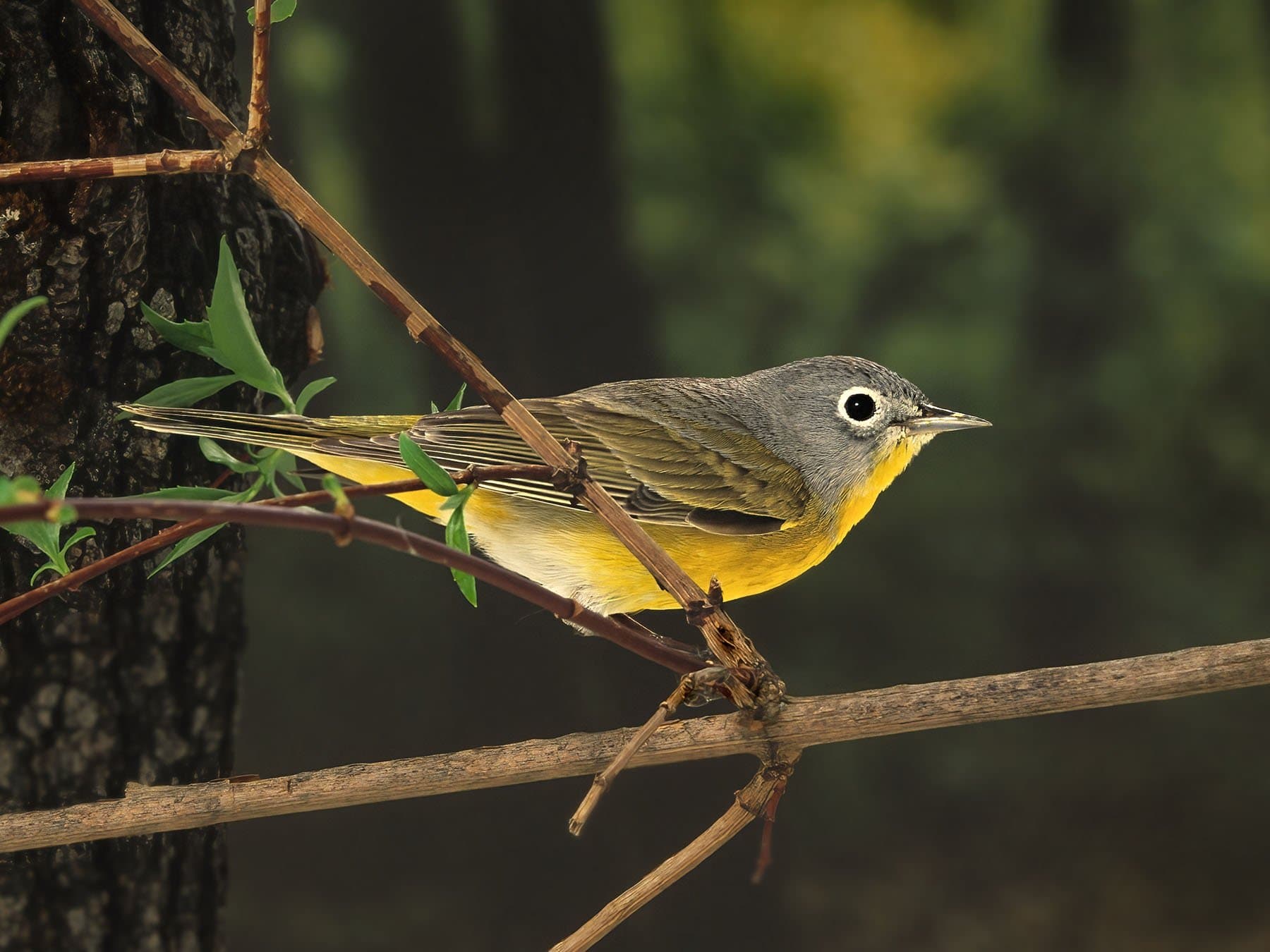
Nashville Warbler perched on a bare branch, showing its gray head, white eye-ring, yellow throat, and olive-green back.
Quick Facts
Conservation
LCLeast ConcernLifespan
3–7 years
Length
11–13 cm
Weight
5.7–14.2 g
Wingspan
17–20 cm
Migration
Long-distance Migrant
Named after a city where it has never bred, the Nashville Warbler is a compact songbird whose crisp white eye ring, blue-grey head, and bright yellow underparts make it one of the more straightforward warblers to identify. Alexander Wilson collected the first specimen on the banks of the Cumberland River in 1811 — catching it mid-migration, not nesting — and the name has stuck ever since.
Think you've spotted a Nashville Warbler?
Upload a photo and we'll confirm it instantly
Confirm with a PhotoAppearance
The Nashville Warbler is compact and round-headed, with a plump body, shortish tail, and a fine, sharply pointed bill. Its plumage is built around three bold contrasts: a blue-grey head, bright yellow underparts, and an olive-green back — all framed by a complete, crisp white eye ring that stands out at almost any distance. Crucially, the Nashville Warbler has no wing bars and no tail spots, which immediately rules out many superficially similar species.
Adult males carry the most vivid colouring. The throat, breast, and belly are bright yellow, interrupted by a distinctive white patch on the lower belly between the legs — a useful field mark when a bird is perched above you. The bill is dark brown to black, fine and straight. The legs and feet are dark. The back and wings are olive-green, contrasting sharply with the grey head in eastern birds.
Hidden beneath those grey head feathers is the feature that inspired the species' scientific name: a rusty-chestnut crown patch. Ruficapilla means 'red-haired cap' in Latin, but most birders never see it. The patch is normally concealed and only briefly flashed when a male is agitated or displaying. Even experienced observers can spend years watching Nashville Warblers without catching a glimpse of it.
Females and immatures are similar in pattern but noticeably duller. The head is a muted olive-grey rather than clean blue-grey, the crown patch is reduced or absent, and the underparts are paler yellow — the throat can appear almost whitish in some individuals. Juvenile birds of both sexes have a brownish-grey head, dull yellow underparts, and pinkish bill and feet that darken with age. Unlike many warblers, males do not undergo a dramatic colour change outside the breeding season, making the species relatively consistent year-round.
Identification & Characteristics
Male Colors
- Primary
- Yellow
- Secondary
- Olive
- Beak
- Dark Brown
- Legs
- Dark Brown
Female Colors
- Primary
- Yellow
- Secondary
- Olive
- Beak
- Dark Brown
- Legs
- Dark Brown
Male Markings
Bold complete white eye ring; bright yellow underparts with white lower belly patch; blue-grey head; olive-green back; no wing bars; concealed rusty-chestnut crown patch in males
Tail: Short, plain olive-green tail with no white spots or patches; western subspecies (ridgwayi) has a slightly longer tail that is frequently bobbed and wagged while foraging
Female Markings
Similar pattern to male but duller; olive-grey head rather than blue-grey; paler yellow underparts, throat may appear whitish; white eye ring retained; crown patch reduced or absent
Tail: Short, notched tail; no tail spots; tail bobbing less frequent than in western males
Attributes
Understanding Attributes
Rated 0–100 based on research and observation. A score of 50 is average across all bird species. These attributes are relative and don't necessarily indicate superiority.
Habitat & Distribution
The Nashville Warbler breeds across two completely separate populations in North America, hundreds of miles apart. The eastern population (L. r. ruficapilla) nests from the Maritime provinces of Canada — including Cape Breton Island and Côte-Nord in Quebec — westward through Ontario and into central Alberta and Saskatchewan, and south through the Great Lakes states (Michigan, Minnesota, Wisconsin) into New England and along the Appalachians as far as West Virginia. The western population (L. r. ridgwayi) breeds in the mountains of the Pacific Northwest and Great Basin, from southern British Columbia south through Washington, Oregon, Idaho, Nevada, and into northern California, with nests recorded up to 2,134 m elevation.
Despite its name, the Nashville Warbler has never bred in Tennessee. Alexander Wilson collected the type specimen near Nashville in 1811 while the bird was on migration, and the name has been attached ever since. The species passes through Tennessee and much of the central and eastern United States each spring and autumn as a widespread passage migrant.
In winter, both populations migrate to Mexico, with the bulk of birds in central and southern Mexico around San Luis Potosí and southward. Smaller numbers reach Guatemala, El Salvador, and occasionally as far as Panama. A small contingent winters in southernmost Texas and southern California. The species is a casual visitor to the Caribbean and a vagrant to Alaska, Colorado, and Florida.
For birders in the United States, the Nashville Warbler is an uncommon to common breeder across the northern tier of states and a widespread spring and autumn migrant through the interior and eastern states — one of the more reliably encountered warblers during May migration. Canadian birders in Ontario, Quebec, and the Maritime provinces can find breeding birds in boreal bogs and mixed forest from late April through July. The species does not occur in the UK, Ireland, Australia, or New Zealand.
Where to See This Bird
Explore regional guides for locations where this bird has been recorded.
Illinois
Iowa
Indiana
Maine
Michigan
Minnesota
New Hampshire
Texas
Vermont
Wisconsin
Canada
Manitoba
New Brunswick
Nova Scotia
Ontario
Quebec
Diet
Caterpillars are the Nashville Warbler's preferred prey, and the species times its breeding season closely to the peak emergence of lepidopteran larvae in its boreal and montane habitats. Documented prey items include beetles, flies, grasshoppers, leafhoppers, aphids, and — particularly in the boreal north — spruce budworms (Choristoneura fumiferana), the same defoliating moth larvae that drive population booms in several other warbler species. Nestlings are fed caterpillars, small beetles, flies, and other soft-bodied insects almost exclusively.
The primary foraging technique is gleaning: the bird moves deliberately through foliage, picking insects from the undersides of leaves, the tips of twigs, and from catkins. It will hover briefly to snatch prey from awkward positions and occasionally drops to the ground near the nest to take insects from the leaf litter. Males tend to forage higher in the canopy than females, which reduces competition between paired birds on the same territory.
In winter, the diet broadens slightly. Berries and nectar supplement the insect intake on the Mexican wintering grounds, and birds overwintering in the southern United States will occasionally visit suet feeders — an unusual behaviour for a warbler. During migration, Nashville Warblers are highly opportunistic, taking whatever arthropods are available in the wide variety of habitats they pass through.
Behaviour
Nashville Warblers are active, restless foragers that spend most of their time moving through the lower and middle levels of trees and shrubs. Males typically work higher in the canopy than females. Both sexes frequently flick the tail while foraging — a habit that is especially pronounced in the western subspecies (L. r. ridgwayi), which bobs and wags its tail almost constantly, a useful field identification trick that eastern birds rarely perform.
Outside the breeding season, Nashville Warblers readily join mixed-species foraging flocks, moving through woodland with chickadees, vireos, and other warblers. This social foraging increases efficiency and reduces individual predation risk. During migration, flocks can be surprisingly large, with dozens of individuals moving through a single patch of scrub in a morning.
On the breeding grounds, males are strongly territorial and sing persistently from exposed perches to advertise and defend their patch. Territory defence involves both song and direct pursuit of intruders. The male performs a slow, hovering display flight while singing during courtship — a behaviour that is easy to miss but striking when observed. Once a pair has mated, singing drops off sharply for several days, then resumes at a lower intensity.
Nashville Warblers are generally not aggressive towards other species outside their own territory. They respond positively to forest disturbance — fire, logging, windthrow — that creates the shrubby, early-successional conditions they prefer, and populations can increase noticeably in areas that have recently been cleared or burned.
Calls & Sounds
The Nashville Warbler's song is loud for a bird of its size, carrying well through open woodland and bog. The standard perch song of the eastern subspecies (L. r. ruficapilla) has a clear two-part structure: a series of four to six repeated syllables followed by a lower-pitched, faster trill roughly half the length of the first part. It is commonly transcribed as seewit-seewit-seewit-seewit ti-ti-ti-ti or see-bit see-bit see-bit see-bit ti-ti-ti-ti. The entire song lasts under three seconds. A popular mnemonic among Adirondack birders is pizza-pizza-pizza eat-eat-eat-eat, which captures both the two-part rhythm and the emphatic quality of the delivery well.
The two-part structure is itself a useful identification tool. The Tennessee Warbler's song has three distinct parts — matching the three syllables of 'Ten-nes-see' — while the Nashville's has only two, matching 'Nash-ville'. Once you know this trick, separating the two species by ear becomes straightforward even in dense cover.
The western subspecies (L. r. ridgwayi) sings a slightly lower-pitched, richer version of the same song and has a sharper call note than eastern birds. There is also some regional variation in song within populations. Males of both subspecies have two song types: the common perch song described above, and a less frequently heard flight song.
Males sing from open perches in the lower to middle understory (eastern birds) or from high, exposed perches — sometimes the tops of old burned snags (western birds). Singing is most intense during territory establishment and courtship; it drops off sharply for several days after mating occurs, then resumes at a lower rate through the incubation period. The call note is a high, sharp seet or chink. Females produce a chink call when receptive to mating.
Flight
In flight, the Nashville Warbler appears small, compact, and fast-moving, with rapid wingbeats typical of the wood-warblers. The wings are relatively short and rounded, producing a slightly undulating flight path over longer distances — a series of quick flaps followed by a brief pause with wings partly closed. This bounding, slightly erratic quality is characteristic of the family and helps distinguish small warblers from similarly sized but more direct-flying sparrows or vireos.
The Nashville Warbler's flight silhouette is unremarkable compared to some warblers: no bold wing patches, no white tail corners, and no elongated tail feathers. The bright yellow underparts can flash briefly as a bird crosses an open gap, and the white lower belly patch may be visible from directly below. The olive-green upperparts and grey head are visible when a bird banks or turns.
Migration occurs mostly at night. Both populations travel overland rather than making the trans-Gulf crossing used by many other Neotropical migrants — a strategy that keeps the birds over land for the entire journey but adds considerable distance. Daytime movement is also recorded, particularly in autumn when birds move through in loose, mixed-species flocks. In the West, Nashville Warblers use drier habitats such as desert flats and washes during autumn migration but avoid these areas in spring, suggesting the two seasons involve at least partially different routes.
Nesting & Breeding
The female Nashville Warbler selects the nest site and builds the nest alone, taking 7–9 days to complete construction. Nests are placed on or very near the ground, typically tucked into a depression in moss, grass, or ferns and concealed beneath scrubby bushes, saplings, or at the base of a tree — often near the edge of a clearing or wetland. The nest is a neat open cup of coarse grass, strips of bark, ferns, and moss, lined with fine grasses, pine needles, and animal hair. Finished nests measure approximately 9 cm across and 5 cm deep.
Clutch size is typically 4–5 eggs, occasionally ranging from 3 to 6. Eggs are white, usually speckled with reddish-brown spots concentrated at the larger end, and measure approximately 1.4–1.7 cm long by 1.1–1.3 cm wide. The female lays one egg per day, typically between 06:00 and 10:00. Incubation lasts 11–12 days and is performed primarily by the female, though the male regularly brings food to the incubating bird and may occasionally take a brief turn on the nest.
Hatchlings emerge helpless, with sparse dark brown down and closed eyes, weighing just 0.4–1.25 g. Both parents feed the nestlings, though the female contributes more. Young fledge 9–11 days after hatching — fast even by warbler standards. The female continues to feed fledglings until they become fully independent, typically by July. Nashville Warblers raise a single brood per season and rarely re-nest after failure. They show strong site fidelity, returning to the same breeding territory in subsequent years.
Nests are seldom parasitised by Brown-headed Cowbirds (Molothrus ater). The ground-level, well-concealed nest placement likely reduces cowbird detection, and this low parasitism rate may contribute to the species' stable population across most of its range.
Lifespan
Nashville Warblers typically live 3–7 years in the wild, with most individuals not surviving beyond their fifth year. Annual survival rates for small Neotropical migrants are generally low: the hazards of two long-distance migrations per year, combined with predation, window strikes, and weather events, mean that reaching old age requires considerable luck as well as fitness.
The maximum recorded lifespan for the species is 10 years and 2 months, documented when a bird was recaptured and re-released at a banding station in Ontario — a record that places the Nashville Warbler among the longer-lived small warblers in North America. For context, the closely related Prothonotary Warbler has a recorded maximum of around 8 years 11 months, making the Nashville's record modestly superior despite its smaller body size.
Mortality causes include predation at the nest (Blue Jays, grey squirrels, and red squirrels are the primary suspects), predation of adults by Accipiter hawks during migration, building and window collisions — which kill an estimated hundreds of millions of North American birds annually — and starvation during cold snaps on the wintering grounds. The species' low rate of Brown-headed Cowbird parasitism likely contributes positively to productivity and, by extension, to population stability across most of the range.
Conservation
The Nashville Warbler is listed as Least Concern on the IUCN Red List (assessed 2016), with a global population estimated at approximately 40 million mature individuals by Partners in Flight (2019) and BirdLife International. North American Breeding Bird Survey data from 1966 to 2015 show stable populations range-wide, and the species scores just 9 out of 20 on the Partners in Flight Continental Concern Score — indicating low conservation concern at the continental scale.
The picture is not uniformly positive at the regional level. NH Audubon records a strongly decreasing trend in New Hampshire specifically, and similar localised declines have been noted where early-successional shrubby habitats have matured into closed-canopy forest. The species' dependence on early-successional vegetation makes it unusually sensitive to the natural succession of its breeding habitat: as shrubby clearings grow into forest, suitable territory disappears. In Washington State, by contrast, the Breeding Bird Survey recorded a non-significant increase since 1966, possibly linked to clear-cut logging creating new shrubby habitat.
The primary long-term threat is habitat loss on the wintering grounds. Ongoing deforestation and agricultural development in central and southern Mexico — where the bulk of the population winters — represents a significant risk that is difficult to address through North American conservation measures alone. Additional threats include building and window collisions during migration, predation of ground nests by Blue Jays, grey squirrels, and red squirrels, and the gradual loss of riparian woodland in the western United States.
No species-specific conservation programmes are currently in place for the Nashville Warbler. The species benefits indirectly from broad boreal forest conservation initiatives in Canada and from forest management practices that maintain a mosaic of successional stages across the landscape.
Population
Estimated: Approximately 40 million mature individuals
Trend: Stable
Stable range-wide (North American Breeding Bird Survey 1966–2015); locally decreasing in parts of the northeastern US (e.g. New Hampshire) where early-successional habitat is maturing; non-significant increase in Washington State linked to clear-cut logging.
Elevation
Sea level to 2,134 m (breeding); most abundant at 1,000–1,650 m in western mountains
Additional Details
- Taxonomy:
- Family: Parulidae (New World Warblers). Genus: Leiothlypis (accepted by AOS 2019, following splits from Oreothlypis). Previous genera: Sylvia (Wilson 1811), Helminthophila, Vermivora. Two subspecies: L. r. ruficapilla (eastern) and L. r. ridgwayi (western; formerly 'Calaveras Warbler').
- Predators:
- Known and suspected nest predators include Blue Jays (Cyanocitta cristata), grey squirrels (Sciurus carolinensis), and red squirrels (Tamiasciurus hudsonicus). Adult birds are taken by Accipiter hawks, particularly Sharp-shinned Hawks (Accipiter striatus), during migration. Brown-headed Cowbird (Molothrus ater) nest parasitism occurs but is infrequent, likely because the well-concealed ground nest is difficult for cowbirds to locate.
Subspecies
The two recognised subspecies of Nashville Warbler are geographically separated by hundreds of miles and differ in appearance, behaviour, and song — differences substantial enough that the western form was treated as a full species for much of the 19th and early 20th centuries.
The nominate eastern subspecies (L. r. ruficapilla) breeds across Canada and the northeastern United States. It has a bright olive-green mantle that contrasts sharply with the blue-grey head, a greenish-yellow belly, and a relatively short tail that it holds still while foraging. The song is the classic two-part seewit-seewit-seewit ti-ti-ti-ti pattern. Eastern birds tend to forage in the lower to middle understory and favour boreal bog habitats dominated by black spruce, tamarack, and balsam fir.
The western subspecies (L. r. ridgwayi), sometimes still called the Calaveras Warbler, breeds in the mountains of the Pacific Northwest and Great Basin. It differs from the eastern form in several ways: the back is greyer-green and contrasts less with the head; the rump is brighter yellow; there is more white on the lower belly; and the tail is longer. Most usefully for field identification, western birds bob and wag their tails almost constantly while foraging — a behaviour that eastern birds rarely perform. The song is slightly lower-pitched and richer. Western birds also favour different breeding habitat: brushy black-oak groves, manzanita thickets, and shrubby zones within ponderosa pine and Douglas-fir forest, typically at 1,000–1,650 m elevation in the Cascades and Sierra Nevada.
Taxonomy And Naming
The Nashville Warbler has had a complicated taxonomic history, shuffled between four different genera over the past two centuries. Alexander Wilson described the species in 1811 as Sylvia ruficapilla. It was subsequently moved to Helminthophila, then to Vermivora — the genus it occupied for most of the 20th century and under which most older field guides list it. In 2010, a molecular phylogenetic study by Lovette and colleagues demonstrated that Vermivora as then constituted was not monophyletic, and the Nashville Warbler was moved to the newly erected genus Oreothlypis along with several close relatives. A further revision in 2019, accepted by the American Ornithological Society, split Oreothlypis and placed the Nashville Warbler in Leiothlypis — its current genus — alongside the Tennessee Warbler, Orange-crowned Warbler, and a handful of other species.
The species epithet ruficapilla has remained constant throughout all these genus changes, anchoring the bird's identity even as its family address shifted. It means 'red-haired cap' in Latin, a reference to the male's concealed rusty crown patch. The common name, as noted, derives from Wilson's collection locality — Nashville, Tennessee — where the bird was a migrant, not a resident. Two subspecies are currently recognised: the nominate eastern L. r. ruficapilla and the western L. r. ridgwayi, the latter named for the ornithologist Robert Ridgway, who first described it from a specimen collected in Nevada in 1868 and initially treated it as a distinct species under the name 'Calaveras Warbler.'
Birdwatching Tips
Spring migration — late April through mid-May — offers the best opportunity to see Nashville Warblers across a wide swath of North America. Males arrive on territory singing loudly and persistently, making them far easier to locate than the skulking females. Listen for the distinctive two-part song: a series of repeated syllables followed by a lower-pitched trill, often rendered as seewit-seewit-seewit-seewit ti-ti-ti-ti. Once you have the song locked in, you will start hearing Nashville Warblers in places you previously walked straight past.
The bold white eye ring is the single most reliable field mark at any distance — it stands out even in poor light and distinguishes the Nashville Warbler from most similar species. The complete absence of wing bars is equally important: if you can see wing bars, it is not a Nashville Warbler. The white patch on the lower belly, visible when a bird is perched above you, is a useful confirmatory mark.
In the eastern United States and Canada, look for breeding birds in spruce-tamarack bogs, regenerating clearcuts, and shrubby forest edges from late April onwards. In the West, try brushy black-oak and manzanita slopes in the Cascades and Sierra Nevada from May. During migration, Nashville Warblers turn up in almost any wooded or shrubby habitat — suburban gardens, riparian corridors, and desert washes in the West are all productive.
The Nashville Warbler is most easily confused with the Connecticut Warbler and the MacGillivray's Warbler, both of which also have grey heads and yellow underparts. The Connecticut Warbler has a complete grey hood extending over the throat (the Nashville's throat is yellow), while MacGillivray's has broken white eye arcs rather than a complete ring. The Tennessee Warbler has a similar grey-and-olive colour scheme but lacks the yellow underparts and has a supercilium rather than an eye ring.
Did You Know?
- The Nashville Warbler has never bred in Nashville. Alexander Wilson collected the first specimen on the banks of the Cumberland River in 1811 while the bird was simply passing through on migration — making it one of ornithology's more enduring geographical misnomers.
- The oldest recorded wild Nashville Warbler lived to at least 10 years and 2 months, documented when it was recaptured at a banding station in Ontario. For a bird weighing less than 15 grams that completes a round-trip migration of thousands of kilometres each year, that is extraordinary longevity.
- The species' scientific name ruficapilla means 'red-haired cap' in Latin — but most birders never see the rusty-chestnut crown patch it refers to. The patch is normally hidden beneath grey feathers and only briefly revealed when a male is agitated or displaying.
- Unlike many warblers that make a direct trans-Gulf crossing in spring, the Nashville Warbler travels overland around the Gulf of Mexico before spreading northeastward to its breeding grounds — a longer but apparently safer route that distinguishes it from many of its Parulidae relatives.
- The western subspecies (L. r. ridgwayi) was once considered a completely separate species, known as the 'Calaveras Warbler,' first described by Robert Ridgway in Nevada in 1868. The subspecies name ridgwayi honours him — meaning the bird carries his name even though he originally thought it was a different species entirely.
Records & Accolades
Misnomer of the Year
Never bred in Nashville
Named after Nashville, Tennessee, where Alexander Wilson collected the type specimen in 1811 — while the bird was on migration. It has never nested anywhere near Tennessee.
Longest-lived Individual
10 years, 2 months
The oldest recorded Nashville Warbler was recaptured at a banding station in Ontario, having survived over a decade of annual Neotropical migrations at a body weight under 15 grams.
Gulf Detour Champion
Travels around the Gulf of Mexico
Unlike many warblers that cross the Gulf of Mexico directly in spring, the Nashville Warbler takes the longer overland route around the Gulf before spreading northeast to its breeding grounds.
Community Photos
Be the first to share a photo of the Nashville Warbler
Upload a PhotoIdentify Any Bird Instantly
- Upload a photo from your phone or camera
- Get an instant AI identification
- Ask follow-up questions about the bird
Monthly Birds in Your Area
- Personalised for your location
- Seasonal tips and garden advice
- Updated every month with new species