


Lesser Goldfinch
Spinus psaltria
By the Birdfact teamChecked by Nathan Cope
On this page15 sections
How to recognise it
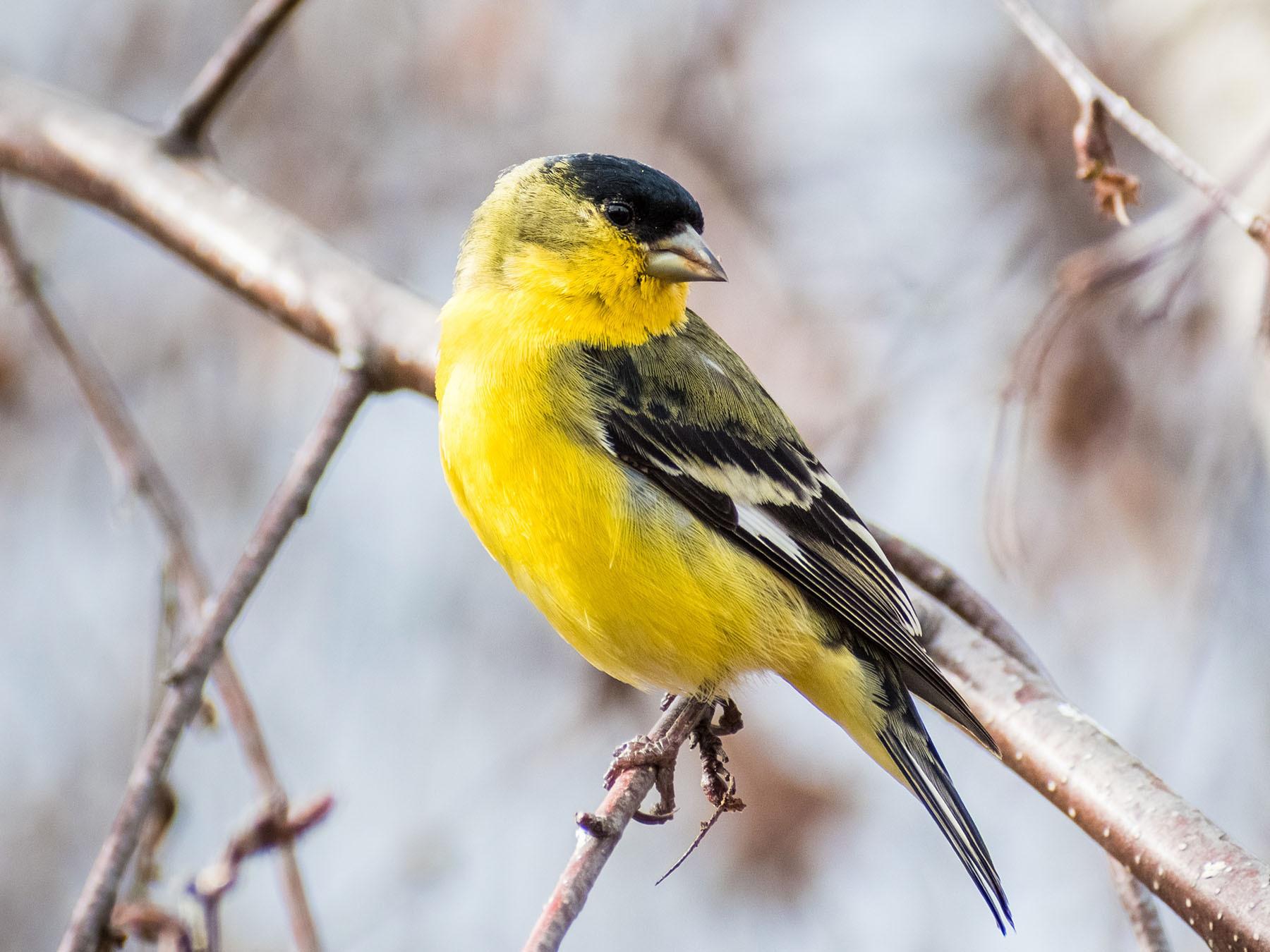
The Lesser Goldfinch is a small black-capped, yellow-bellied goldfinch of the West and Southwest, green-backed across the Far West and much of the interior and black-backed farther east, a regular visitor to gardens and feeders and a bird that has been spreading north. It is a close relative of the American Goldfinch and the smallest member of its genus in North America. An adult male has a glossy black cap on the forehead and crown, bright canary-yellow underparts, and black wings with a big white patch at the base of the flight feathers; his black tail has large white patches on the outer feathers that stop short of the tips. The back is olive green to glossy black, depending on where the bird lives. The bill is short, conical and sharply pointed, the wings are long and pointed and the tail is short and notched. Unlike the American Goldfinch, it keeps the same plumage all year.
Size and weight
A Lesser Goldfinch is 3.5–4.3 in (9–11 cm) long, weighs 0.3–0.4 oz (8–11.5 g) and has a wingspan of 5.9–7.9 in (15–20 cm). Females average a little smaller than males. In one museum sample of western birds (Oregon, California, Nevada, Baja California and western Sonora), the wing averaged 2.5 in (63.4 mm) in 85 males and 2.4 in (61.2 mm) in 20 females.1
Male, female and young birds
Males and females are easy to tell apart. The female has no black cap: she is olive green from the crown to the rump, sometimes with faint dusky streaks on the crown, and light olive yellow below, brightest on the chin, throat and undertail. Her wings and tail look like the male's but grayer, with two whitish wing bars, broad pale edges on the tertials and smaller white patches at the base of the flight feathers and on the tail. Some females, likely older ones, show a little black in the crown and brighter yellow underparts. Females look the same in color across the whole range.
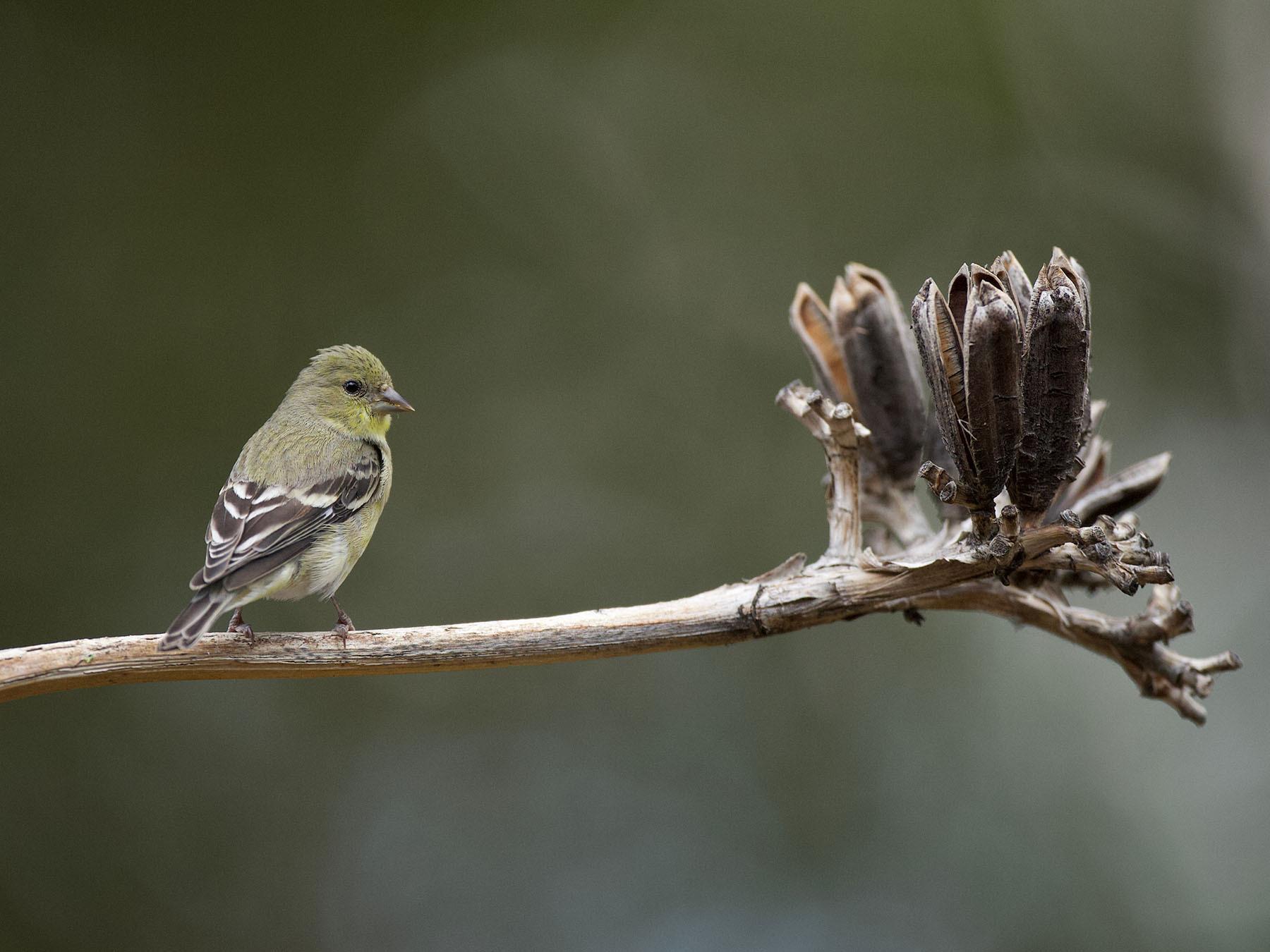
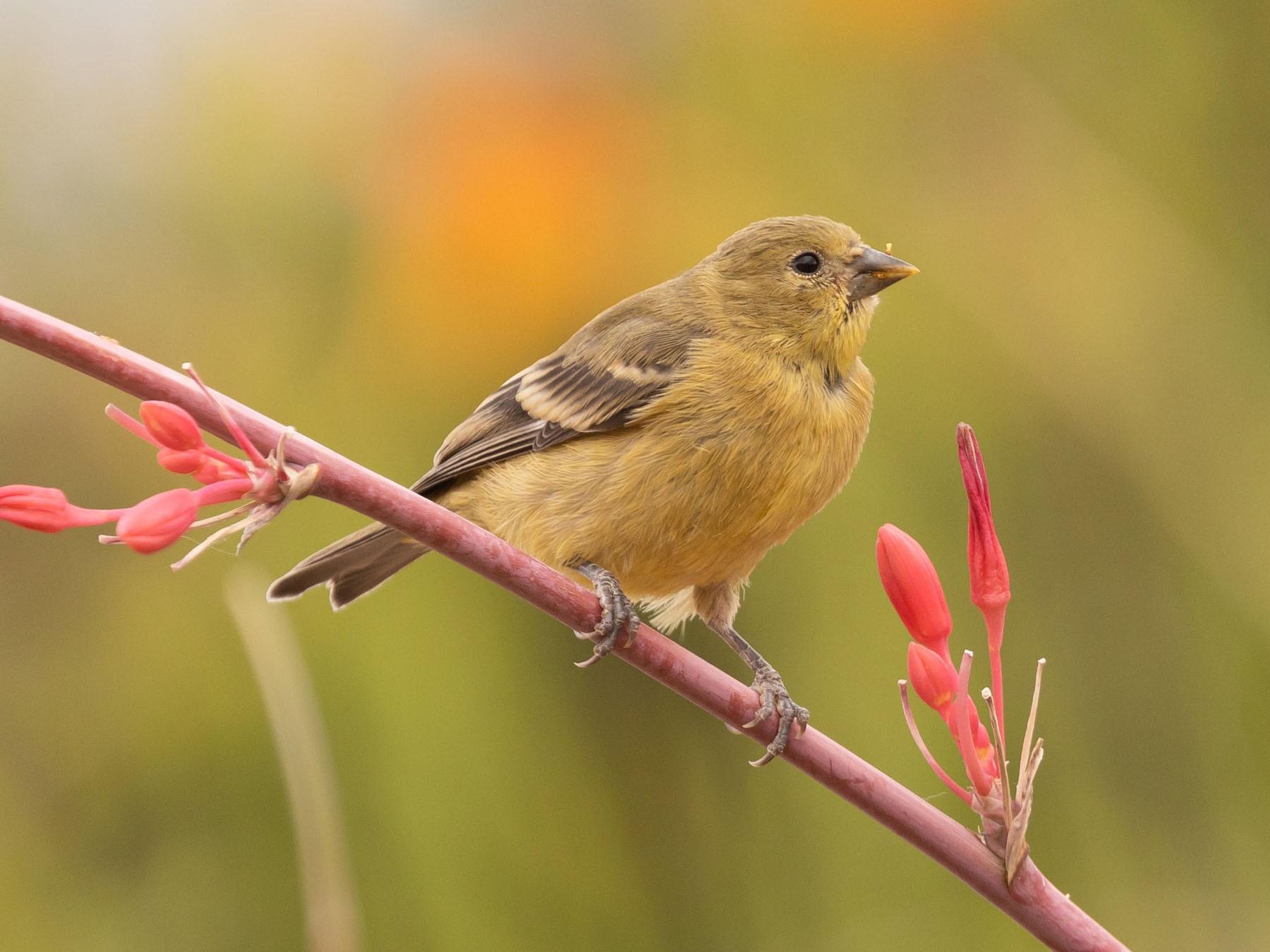
A young bird in juvenile plumage, worn mainly from June to October, looks like the adult female but is tinged buffy brown above and more buffy yellow below. Its wing bars are buffy rather than whitish, and the white patches on the flight feathers and tail are much smaller or missing. First-year males molt in fall and winter into the black forehead and bright yellow underparts that set them apart from females; a young black-backed male can look mottled for a while, with patches of green among the black.
Green-backed and black-backed males
Adult males come in two main patterns, and which one you see depends on where you are. Green-backed males are the rule in the West: nearly all males from Washington down through Oregon and California to Baja California have a black cap and a green back, and green-backed birds reach east to northern Utah and central Arizona. Farther east the amount of black on the back, neck and ear coverts grows. Males in Utah, western Colorado, eastern Arizona and western New Mexico are intermediate but mostly green-backed; both patterns breed in Colorado and New Mexico, with many birds in between; in southern Texas all males are black-backed, with black from the crown to the rump; and south of northern Mexico there are essentially no green-backed males. Along the far eastern fringe of the range, in Nebraska, Kansas and South Dakota, the two are about equally common.1
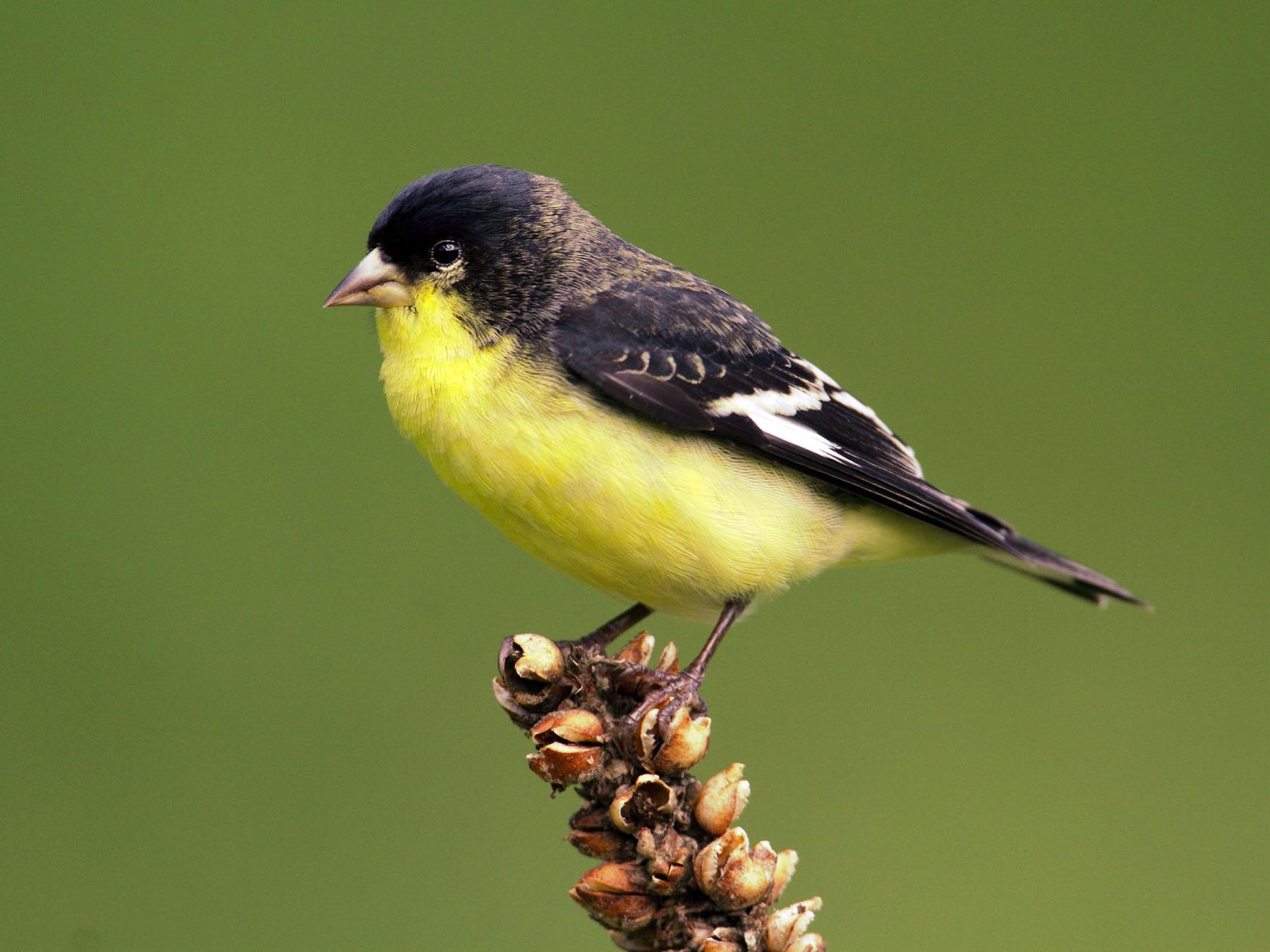
These are not clearly separate kinds of bird. A museum study of 963 skins found green-backed males predominating on the Pacific coast and black-backed males in the interior east of 106° W, with a gradual change between them and no difference in females, and it concluded that color does not justify subspecies; the difference may be a simple inherited polymorphism.2 AviList still lists five subspecies, two of them in the United States: hesperophilus in the West, whose males are largely green above, and psaltria from Colorado and western Oklahoma south, whose males range from black to green above.1, 3
Identifying it from similar birds
The Lesser Goldfinch is most easily confused with the American Goldfinch and Lawrence's Goldfinch, which overlap parts of its range. A female Lesser is easiest to mistake for a female American Goldfinch, but her undertail coverts are yellow where the American's are white (the yellow can be very pale), and her white patches at the primary bases and the black tips on every tail feather settle it. A female Lawrence's Goldfinch has yellow wing bars where a Lesser's are whitish.
Males are easier. A male American Goldfinch has a yellow back in summer and a brown one in winter, and a male Lawrence's Goldfinch has a gray to brownish-olive back, while a male Lesser's back is green to black in every season. The American Goldfinch also has a lighter rump and undertail in every plumage. The three also differ in their flight calls: the Lesser's harsh dit-dit-dit is less bell-like than a Lawrence's tink-tink-tink, and the American's call descends.
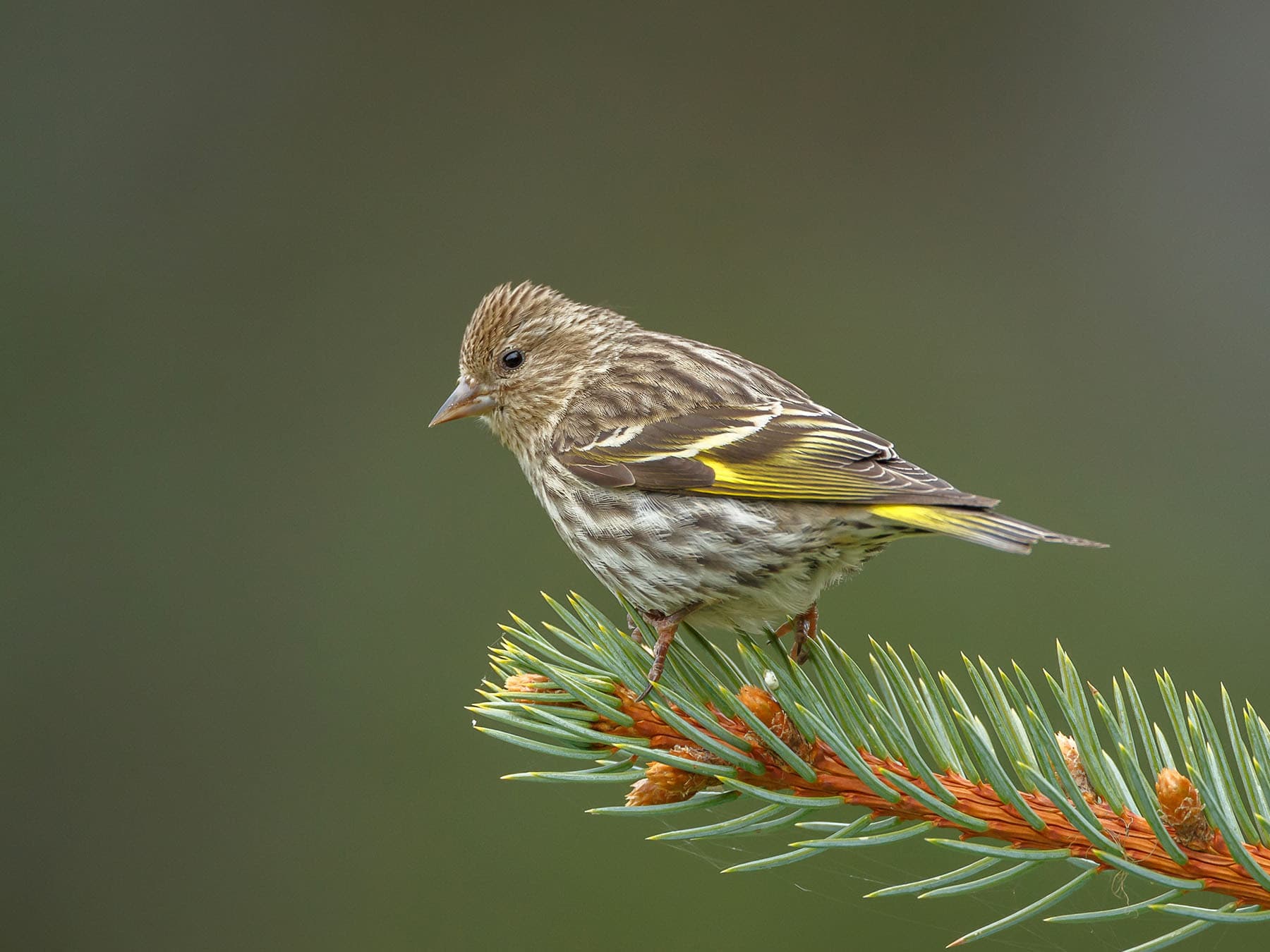
A Pine Siskin is brown and usually heavily streaked, unlike an adult Lesser Goldfinch, and its flight calls, which can sound a little like a Lesser's, are harsher and higher-pitched.
Not sure it’s a Lesser Goldfinch? Check your photo: Birdfact names the bird and shows the look-alike side by side.
Its size
Adults- Length
- 9–11 cm
- Wingspan
- 15–20 cm
- Weight
- 8–11.5 g
Its song and calls
The song is long, rambling and intricate: clear warbles and squeals broken up by grating notes, less musical than a Lawrence's Goldfinch's. Males sing often from the tallest tree in their territory, in circular flights over it that show off the white wing and tail patches, and in chases. Singing starts as the winter flocks break up and carries on through pair formation and nest building into incubation, peaking at courtship, nest building and egg laying and falling off once the female is sitting; groups have also been recorded singing together on the wintering grounds, and what that singing is for is not known. A 1987 thesis recorded 449 songs in southeastern Arizona, which averaged 5.78 seconds and ranged from 0.9 to 26.0 seconds.1
The song is also full of borrowed sounds. Lesser Goldfinches copy the calls of other birds, as Lawrence's Goldfinches do; American Goldfinches and Pine Siskins have not been reported to. Field workers who kept notes on about 25 Lesser and 30 Lawrence's Goldfinches from 1973 to 1980 heard both species work other birds' calls into their songs, though many stretches of Lesser Goldfinch song had no borrowed material at all, and the species copied changed with place: one in Kleberg County, Texas, copied the Eastern Phoebe, and one near Patagonia, Arizona, copied a Gila Woodpecker.4 At least 30 species have been copied in California, and in one breeding season at six sites in southeastern Arizona 39 bird species and a rock squirrel were copied, among the models Verdin, American Robin, Bewick's Wren, Black Phoebe, Pine Siskin, House Finch and Canyon Towhee; copied phrases made up more than half of an average song, and black-backed birds in Colorado were reported copying 25 species.1
In Pullman, Washington, one male singing on 4 April 2023 imitated ten species in 30 seconds, among them the American Kestrel, American Robin, Killdeer and Pine Siskin and a European Starling, a new model for the species; it was one bird on one day.5
The contact call, given by foraging flock members and in flight, is a harsh dit-dit-dit of one to five notes, lower and harsher than a Lawrence's Goldfinch's and without the descending sound of an American Goldfinch's. A male courting a female gives a falling tee-yer. An alarmed bird gives a dee-ree or bee-ee that rises in intensity, a chasing bird a rapid run of harsh chit notes, and a female asking her mate for food a loud, high pee-ee. Nestlings beg with a single note at hatching and two notes close to fledging, crouching and fluttering their wings.
The player on this page has a song recorded in Pima County, Arizona, in July 2013, whose observation's photos show a black-backed male, and calls recorded in Contra Costa County, California, in June 2024. On a sound plot the song clip is a dense, unbroken run of varied phrases lasting its full 22 seconds, and the calls clip is about 25 short, evenly spaced, falling notes.
- Song0:00 / 0:22
Recorded in Arizona, United States · July 2013
- Calls0:00 / 0:12
Recorded in California, United States · June 2024
Ty · iNaturalist · CC BY 4.0
Heard one and not sure? Let the bird song identifier listen.
When and where to see it
November
Here all year
The year across North America
Choose a place on the map to see its year, or find yours.
Most recorded in November
Up to 2.5% of a place’s bird records that monthHere in other months
How this map is made
Each county, state or province is shaded by the Lesser Goldfinch’s share of all the bird records there that month: the darker, the larger the share. A place with only a trace of records in a month is left unshaded. Shades compare places on this map with each other, not one bird with another. Records: GBIF eBird Observation Dataset, 2019–2024. Map: Natural Earth; place centres © OpenStreetMap contributors.
How often the Lesser Goldfinch turns up in the United States and Canada through the year, from birdwatchers' records.
United States
Resident · all year · most records in August
Canada
Winter visitor · regularly Nov–Aug · most records in January
Show as a table
| Month | United States | Canada |
|---|---|---|
| January | 0.37% (regular) | 0.003% (regular) |
| February | 0.44% (regular) | 0.001% (regular) |
| March | 0.45% (regular) | 0.002% (regular) |
| April | 0.37% (regular) | <0.001% (regular) |
| May | 0.28% (regular) | <0.001% (regular) |
| June | 0.37% (regular) | <0.001% (regular) |
| July | 0.47% (regular) | <0.001% (regular) |
| August | 0.54% (regular) | <0.001% (regular) |
| September | 0.45% (regular) | <0.001% |
| October | 0.38% (regular) | <0.001% |
| November | 0.36% (regular) | <0.001% (regular) |
| December | 0.38% (regular) | 0.002% (regular) |
Worldwide: recorded regularly in 14 countries
Countries where it was recorded in at least 3 of the 6 years 2019–2024. Linked countries have their own bird list.
North America (10)
- Belize
- Canada
- Costa Rica
- El Salvador
- Guatemala
- Honduras
- Mexico
- Nicaragua
- Panama
- United States
South America (4)
- Colombia
- Ecuador
- Peru
- Venezuela
Data: EOD – eBird Observation Dataset (Cornell Lab of Ornithology), accessed via GBIF.org, CC BY 4.0. Records from 2019–2024, aggregated and filtered by Birdfact. How these lists are made
Lesser Goldfinches range from the Pacific coast across to the edge of the Great Plains, mostly west of the Rockies, and south through Mexico and Central America to Panama and on through northern Venezuela and Colombia to Ecuador and northern Peru. In the United States they are year-round residents across California's coast and Central Valley, in southern New Mexico, in central and southern Arizona and in Texas west of Dallas, from the middle of the state south, as well as in scattered places along the Columbia River in Washington, the Snake River in Idaho and Oregon's Willamette Valley and the area around Bend, east of the Cascades. In other places they are mainly summer breeders: Colorado has them on both sides of the Rockies except in the northeast, and the Texas panhandle and parts of Nevada, Utah, Arizona and New Mexico hold breeding-only populations, with isolated resident groups in cities such as Las Vegas, Reno, Salt Lake City, Denver and Grand Junction.1
Look wherever weeds go to seed near water: streamside oak and cottonwood–willow woods, weedy fields and farm margins, shrubby hillsides, parks and suburban yards. It is a habitat generalist but depends on regular drinking water, so a creek, pond, birdbath or dripping faucet is a good place to wait, and in desert country its populations cluster around towns. In a study of street trees in Los Angeles, Lesser Goldfinches (61 observations) were among the most selective of the year-round tree-foraging birds, preferring American sweetgums and Chinese elms to other street trees.6
Spotting tips
Lesser Goldfinches feed in small flocks, often of four to six, working through weed patches and low plants and perching on stems beside the seed heads. Listen for the harsh dit-dit-dit as a flock takes off, and watch for a dipping, bounding flight in which a male's white wing patches flash. Mixed goldfinch flocks at feeders are the easy place to compare them with American Goldfinches and Pine Siskins, and in weedy fields look for bright yellow birds clinging to seeding thistle.
Range changes
The Lesser Goldfinch's biggest North American populations have long been in the Southwest, but with changes in climate and landscape it has been moving north. Its resident range in Washington, Idaho and Oregon has grown markedly in recent decades, and newly settled sites usually stay occupied.1
The early records show how recent this is. The American Ornithologists' Union's 1983 checklist, as one Idaho paper quotes it, called it a rare stray (casual or accidental) in the southwest of British Columbia, in eastern Oregon and in southern Wyoming; a 1972 book on Idaho's birds did not list it, and Idaho had eight records before 1988, all in the south. Then on 5 July 1988 a green-backed male was seen feeding five juveniles south of Pocatello, the first nesting reported for the state.7 Montana's first record was a male near Glasgow on 26 May 1996; by 2020 birds had been seen in the breeding season in 25 of its 56 counties, yet breeding was documented only three times before the first nest was found at Missoula in April 2021, 9.2 ft (2.8 m) up in a ponderosa pine, and whether that nest fledged young is uncertain.8 In eastern Washington the species had reached Pullman by the late 1990s,5 and the Breeding Bird Survey's few routes in Washington (five) and Idaho (seven) count more birds now than they did before 1990, though far too few to give a rate.9
In British Columbia, a records summary says the first record was a bird collected near Bowron Lake in 1931, followed by just three valid sightings before 2007, and that there are now over 100 records and two confirmed breeding records, the first near Osoyoos in July 2019, the first for Canada.10 Saskatchewan's first confirmed record was a black-backed male visiting a feeder at Yorkton on 30 April 2020.11
Project FeederWatch data show a northward expansion in occupancy of about 272 miles (437 km) from 2002 to 2022, and models built on eBird data show breeding-season numbers rising from 2012 to 2022 by 16.9% in Oregon, 66.3% in Idaho and 110.5% in Washington (modeled changes, not counts); sites were more likely to be colonized if they were warmer and wetter, had more urban development around them and lay near a major river, and once colonized they mostly stayed occupied, which points to a lasting spread, not wandering birds.12 The drivers include a warming climate, landscape change, spreading weedy plants such as thistle and urban growth; feeders are not thought to have played an important part.1
Does it migrate?
Mostly no. Most Lesser Goldfinches stay where they are all year: banding and recoveries suggest strong attachment to a site and little movement, and of 142 birds recaptured in the North American banding program from 1960 to 2024, 131 were within 0.6 mi (1 km) of where they were banded.1
The colder edges of the range have changed, though. Birds formerly withdrew south in winter from Utah, Colorado, New Mexico, northern Arizona and northern Texas, and at least some now stay, including farther north in the inland Northwest; as of 2023 the only winter-only range left in the United States is marginal, in Texas, New Mexico and Arizona. Where the bird is not resident it moves into its breeding areas in spring and away in fall, and in California some move to higher ground to breed and drop to the lowlands in winter. Some birds make a molt migration in August to October to the Mexican monsoon region, in Arizona, Sonora, Sinaloa and southern Baja California; not all do, and many may disperse in other directions.1
What it eats
The Lesser Goldfinch eats mostly seeds, and mostly the seeds of weedy plants in the sunflower family. It feeds on the ground under food plants in weed patches, fields, meadows and yards, or perches on a plant beside the seed heads, pries off the seed coat and shakes its head to loosen the husk. It also takes flowers, buds and fruits, and it clings to tall seed heads, bending the stem, and hangs upside down to feed. Flocks of four to six work through weed patches near water alongside other finches.
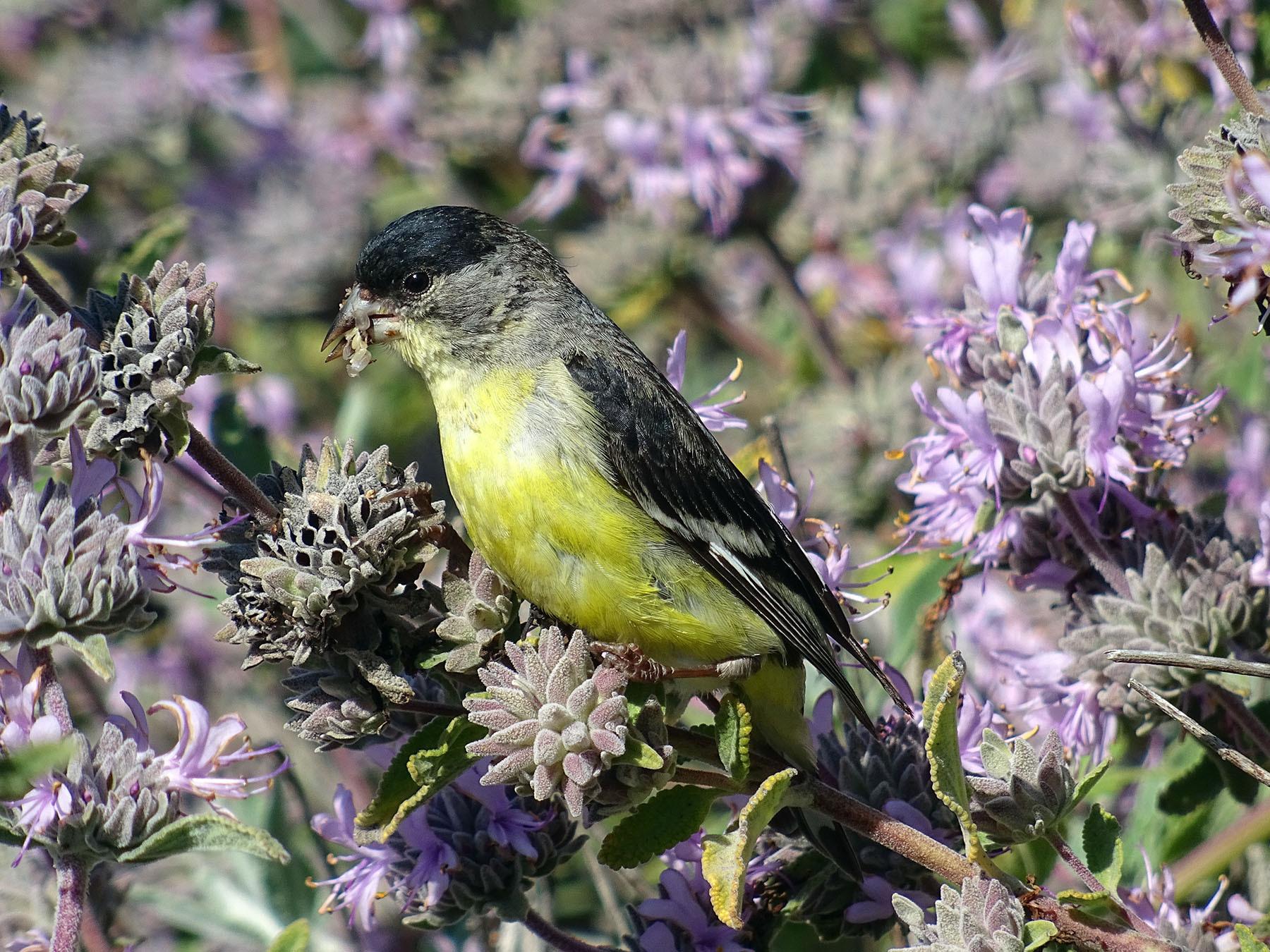
The best numbers come from a 1910 federal study of 476 stomachs collected through the year from the green-backed birds of California: 98.3% of the food was plant matter and 1.7% animal, almost all of it plant lice (aphids) taken from June to September.13 Weed seed made up over 96% of the year's food, and the seed of bur thistle, also called Napa thistle, was in 243 of the 476 stomachs; the author concluded that the bird should be protected.13
Other foods include tansy, lambsquarters, sow-thistle and yellow star-thistle seeds, sunflower seeds, berries of coffeeberry, blue elder and madrone, and the buds of cottonwoods, alders, willows and oaks. It takes insects only now and then; at one California strawberry farm, birds nesting there regularly fed on plant bugs.1 In Pullman, Washington, one observer's notes from four winters have the birds feeding heavily on the heads of tansy, which he thought a preferred food.5
Feeding in your garden
Lesser Goldfinches come to feeders, often alongside American Goldfinches and Pine Siskins. Offer black oil sunflower seed, hulled sunflower seed or nyjer in tube, hopper or platform feeders.14 In Pullman the birds mostly took millet, nyjer and shelled black sunflower seed at feeders in every season, in smaller numbers as spring came.5
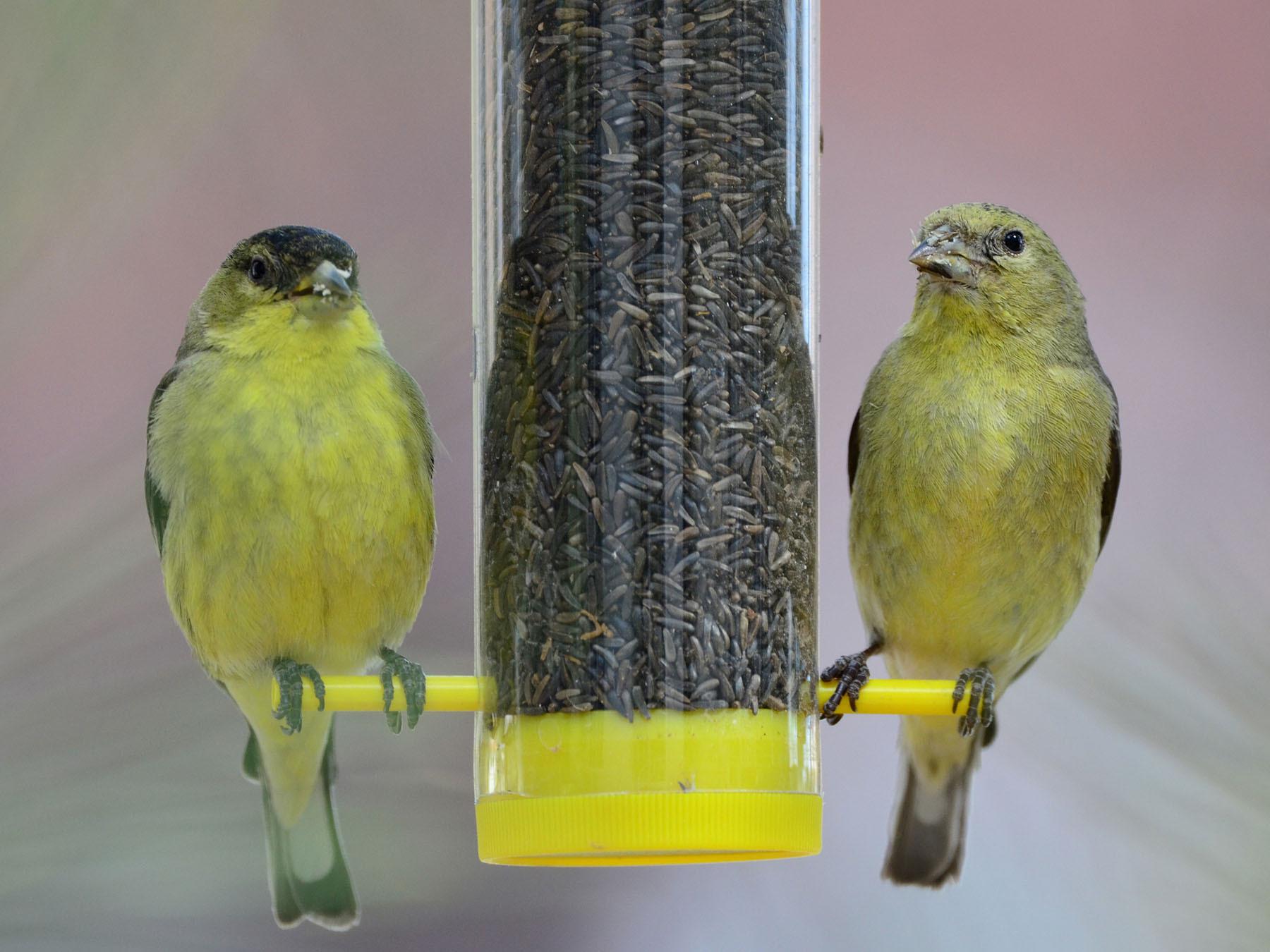
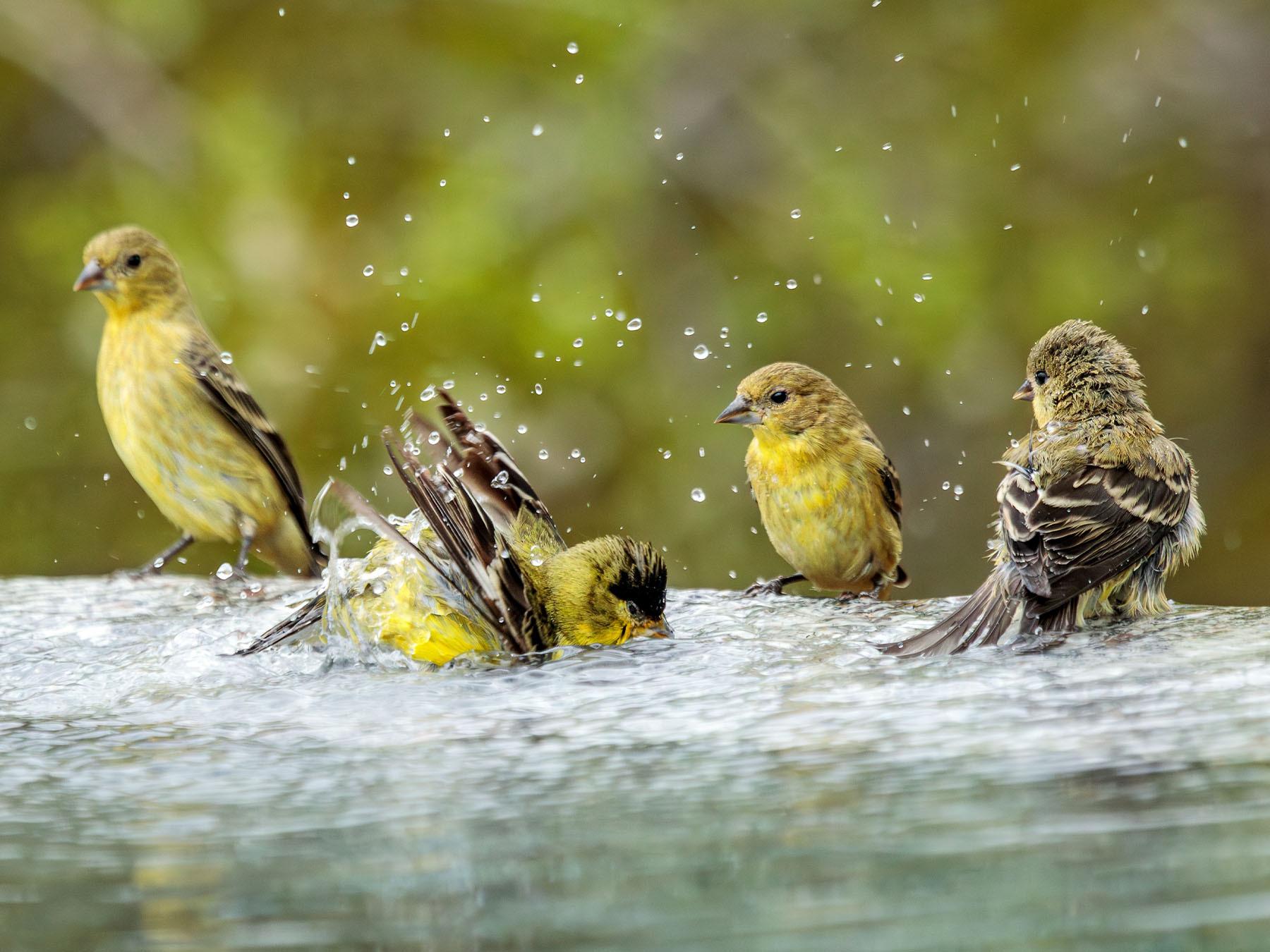
Water matters too. Lesser Goldfinches drink often and need a constant supply, perhaps because of their seed diet. Birdbaths, dripping faucets and stock tanks all draw them, and they often come to water in groups and through the day, not just in the early morning and late afternoon when they feed. In laboratory heat trials on desert songbirds, a Lesser Goldfinch lost water at up to about 9% of its body weight an hour.15, 1
Feeder hygiene
Clean and disinfect feeders and birdbaths at least monthly, more often when they are soiled, and take them down during an outbreak of sick birds. In the 2020–21 outbreak of Salmonella Typhimurium in wild songbirds, mostly Pine Siskins, salmonellosis was confirmed in 15 California birds, 2 of them Lesser Goldfinches, and 30 people in 12 states fell ill; the outbreak investigators gave this advice.16
Nesting and breeding
Breeding runs mainly from April to July along the West Coast and from June to September in the interior. In California the first eggs are laid from early April to early August, mostly between mid-May and mid-June, and in Colorado from early June to early August; eggs and young have also been found in central California as late as October and early November, a time when it may regularly breed.1 Pairs form out of the winter flocks quickly: at one southern California canyon pairs formed over just 10 to 14 days, with high-speed chases, billing and courtship feeding that began after two or three days.1
Nest sites
The female chooses the site, crouching in forks while the male stays close. She picks a spot in dense foliage, often a fork of three to five branches, usually 3.3–6.6 ft (1–2 m) from the tip of the branch, in a tree or shrub. Riverside cottonwoods and willows appear to be favorites, and many other trees are used, from oaks, sycamores and cypresses to fruit trees and eucalyptus. Heights vary a lot by place: in a Colorado study nests were 7–49 ft (2.2–15 m) up, averaging 20 ft (6.1 m), while 83 nests in NestWatch's open dataset average 9.1 ft (2.78 m), from 2.6 to 25 ft (0.8–7.6 m).1
The nest itself
The female builds the nest over 4 to 8 days, with the male nearby. It is an open, deep, tightly woven cup about 3.0 in (7.5 cm) across and 2.0 in (5 cm) high, with an inside diameter of 1.8 in (4.5 cm) and a depth of 1.2 in (3 cm). She uses oak leaves, catkins, strips of bark, grasses, yucca fiber, cocoons and lichen, lined with fine material such as fur, feathers and plant fibers. No reuse of an old nest has been recorded.1
Eggs and young
The eggs are pale blue-white to olive green and usually unspotted, though a few have small brown spots. A clutch is usually 4 in the western birds (3 to 5) and 4 or 5 in the interior (3 to 6). The female lays one egg a day and starts incubating after the second or third, so the eggs hatch over one to three days. She incubates alone for roughly 12 to 13 days (up to 15), sitting for stretches of more than three hours, and the male feeds her on the nest about once an hour, apparently with regurgitated, moistened seed.1
The nestlings spend 11 to 15 days in the nest, 13.3 on average in a Colorado study, and leave together. The female broods them, and for the first five days the male feeds her on the nest and she passes the food to the nestlings; after that both parents forage and feed the young by regurgitation, and the droppings are removed, often eaten by the female, for the first four or five days. The fledglings sit quietly near the nest for several days, and about a week after leaving they follow the adults to feeding areas. How long they stay dependent has hardly been studied; young American Goldfinches are fed for several weeks.1
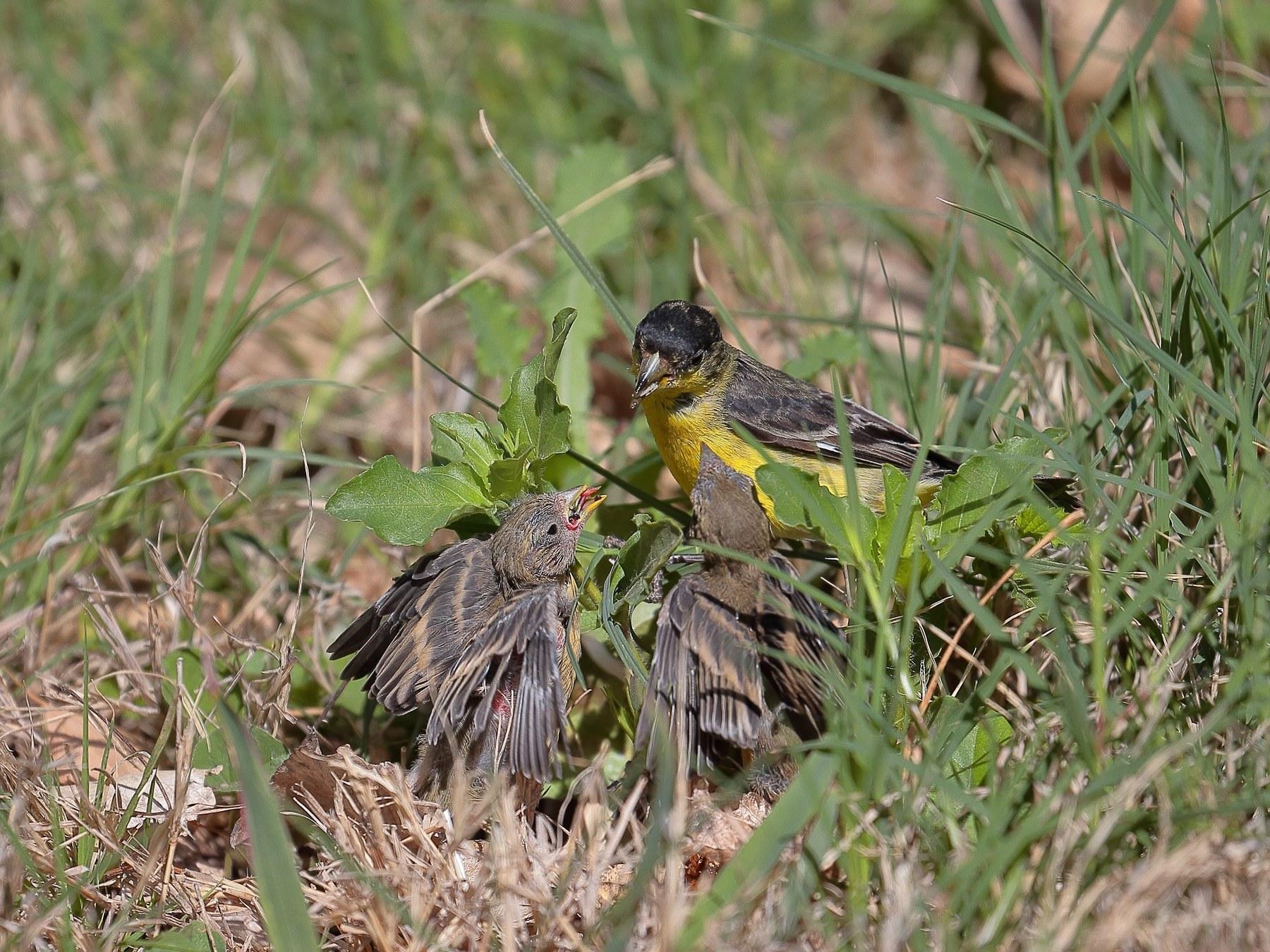
How many broods a pair raises is not settled: usually one, it seems, with a second nest recorded at the Grand Canyon after the first brood fledged and two Colorado females building a new nest while still feeding fledglings. It is not clear whether nestlings that turn up late in the season come from second broods or from replacement nests, and some research has suggested up to three broods in a season. In a Colorado study nest success was put at 62.3% overall (31 nests), and the 21 successful nests fledged an average of 2.93 young.1
Brown-headed Cowbirds rarely use the Lesser Goldfinch as a host: in a study from 1993 to 1999, only 2 of 432 parasitized nests of many host species were Lesser Goldfinch nests, perhaps because a seed diet does not suit a cowbird chick.1
Behaviour
Lesser Goldfinches are gregarious in every season. Flocks outside the breeding season can number in the hundreds, and at feeding and watering sites in California they mix with House Finches, Western Bluebirds, White-crowned Sparrows, Lark Sparrows, Pine Siskins and both of the other goldfinches. They hop rather than walk and bathe in groups, and at one California reserve groups roosted together in dense foliage from September to February. Despite its small size, the Lesser Goldfinch dominates Lawrence's Goldfinch, eating first at feeding stations and chasing it from early nest sites.
In the breeding season males defend a territory about 33–98 ft (10–30 m) across by song, flight display and sometimes fighting, and females defend the area around the nest; both ease off once incubation starts.1 Fights between males are fiercest while pairs form, and early in the breeding season females dominate males. Yet in one Colorado study nests were as close as 56 ft (17 m) and the birds foraged together with little sign of territorial behavior.1
Lifespan and predators
The oldest Lesser Goldfinch on the US Bird Banding Laboratory's current record was a male banded in Texas as an adult in July 2008 and caught and released alive there in July 2013, at least 7 years 1 month old; the Laboratory counts from an assumed June hatching, so the age is a minimum.17 A California male banded in 2009 and recaptured in 2015, at least 7 years old, is on the Laboratory's older table and is the bird other guides quote.17 Banding stations in the MAPS program estimated from 1992 to 2006 that about 40% of adults survive from one year to the next, lower than in other finches.1
Snakes, including rattlesnakes, gopher snakes and garter snakes, Cooper's and Sharp-shinned Hawks, American Kestrels, Northern Pygmy-Owls, Loggerhead Shrikes and California Scrub-Jays have all been recorded as predators, and Argentine ants made several nests with eggs fail in San Diego.1 A nesting bird flutters away low with its tail spread to lure a predator from the nest.
Conservation
The Lesser Goldfinch is a species of Least Concern.18 Breeding Bird Survey counts show it stable over the long term: +0.24% a year from 1967 to 2025 across 656 routes, with a 95% credible interval from –0.43 to +0.86, which spans zero (high credibility). Underneath that sits a fall to the mid-1990s (1967–1995, –1.16% a year, only just clear of zero) and a credible rise since (1995–2025, +1.58%, interval +0.88 to +2.30); the last ten years (2015–2025, +0.34, interval –1.42 to +2.21) show no clear change.9
Over the long term Arizona (+2.10% a year, high credibility) rose, as did Colorado (+2.18) and Utah (+3.39), both with medium credibility, while Texas (–1.35, high credibility) fell, though only just clear of zero; California and Oregon show no clear change. Arizona has fallen since 2010 (–3.38, interval –6.65 to –0.16) after a rise.9 Rising temperatures and drought are suggested as reasons for the Southwest's declines, and the northward spread may become a lasting shift in the range if they continue.1
Partners in Flight estimates about 15 million Lesser Goldfinches worldwide and about 5.7 million in the United States and Canada, from a calculation centered on 2010, and does not put it on its Watch List.19 It is not endangered or threatened in any part of its US range, and irrigation, weedy farm margins, ornamental trees and gardens have helped it.1
The bird is on the federal list of species protected by the Migratory Bird Treaty Act.20 It is unlawful to take or possess it, or its parts, nests or eggs, without a permit or as the regulations allow.21, 22 A bird raised in captivity counts too, so keeping one as a cage bird is not allowed without a federal permit.20, 23 None of the federal depredation orders in 50 CFR Part 21 names it.24 Canada's list of regularly occurring protected birds does not name it, but the Migratory Birds Convention Act names the finch family and covers listed-family species that occur there infrequently.25 Mexico's NOM-059 list of 2010 does not name it.26 In Mexico it is a cage bird: in six markets in Mérida, Yucatán, between June 2014 and January 2015, 305 of the 1,427 birds on sale were Lesser Goldfinches.27
Names and history
Thomas Say described the Lesser Goldfinch from birds taken at a camp on the Arkansas River, near present-day Colorado Springs and Pueblo, where the party noted a pretty little bird hopping about in low trees and bushes and singing sweetly, somewhat like the American Goldfinch. The description appeared in the account of Stephen Long's 1819–20 expedition to the Rocky Mountains, and checklists print the year as 1822 or 1823; the volume's title page says 1823.28, 3
Its original English name in the United States was Arkansas Goldfinch, after the river. The American Ornithologists' Union's 1895 list used it for the species, with Mexican Goldfinch as the name of the birds of the lower Rio Grande valley in Texas and south through Mexico, and its lists of 1910 and 1931 gave Arkansas Goldfinch to the interior birds and Green-backed Goldfinch to the western ones.29, 30, 31 Bent's life history of 1968 called the Arkansas name an unfortunate choice, since people tied it to the state, where the bird had not then been recorded; the fifth edition of the checklist, in 1957, replaced it with Lesser Goldfinch.32, 33
The scientific name Spinus psaltria joins Spinus, an old Greek word for a finch, to psaltria, which Birds of the World assumes refers to a female harpist, though it may instead refer to its singing, which Say remarked on. The genus has moved around: the checklists printed Spinus in 1895, 1931 and 1957 and Astragalinus in 1910, and the species was in Carduelis in the 1983 and 1998 editions, according to NatureServe, before returning to Spinus.1, 30, 34
Hybrids
Hybrids are very rare. Birds of the World counts one documented Lesser × American Goldfinch hybrid, photographed in Oregon; a British Columbia records summary adds a likely hybrid female photographed in Victoria on 1 December 2020. No hybrid with Lawrence's Goldfinch has been recorded, though the two overlap in nesting areas and have been seen contesting a nest while it is being built.1, 10
Similar birds
Often mistaken for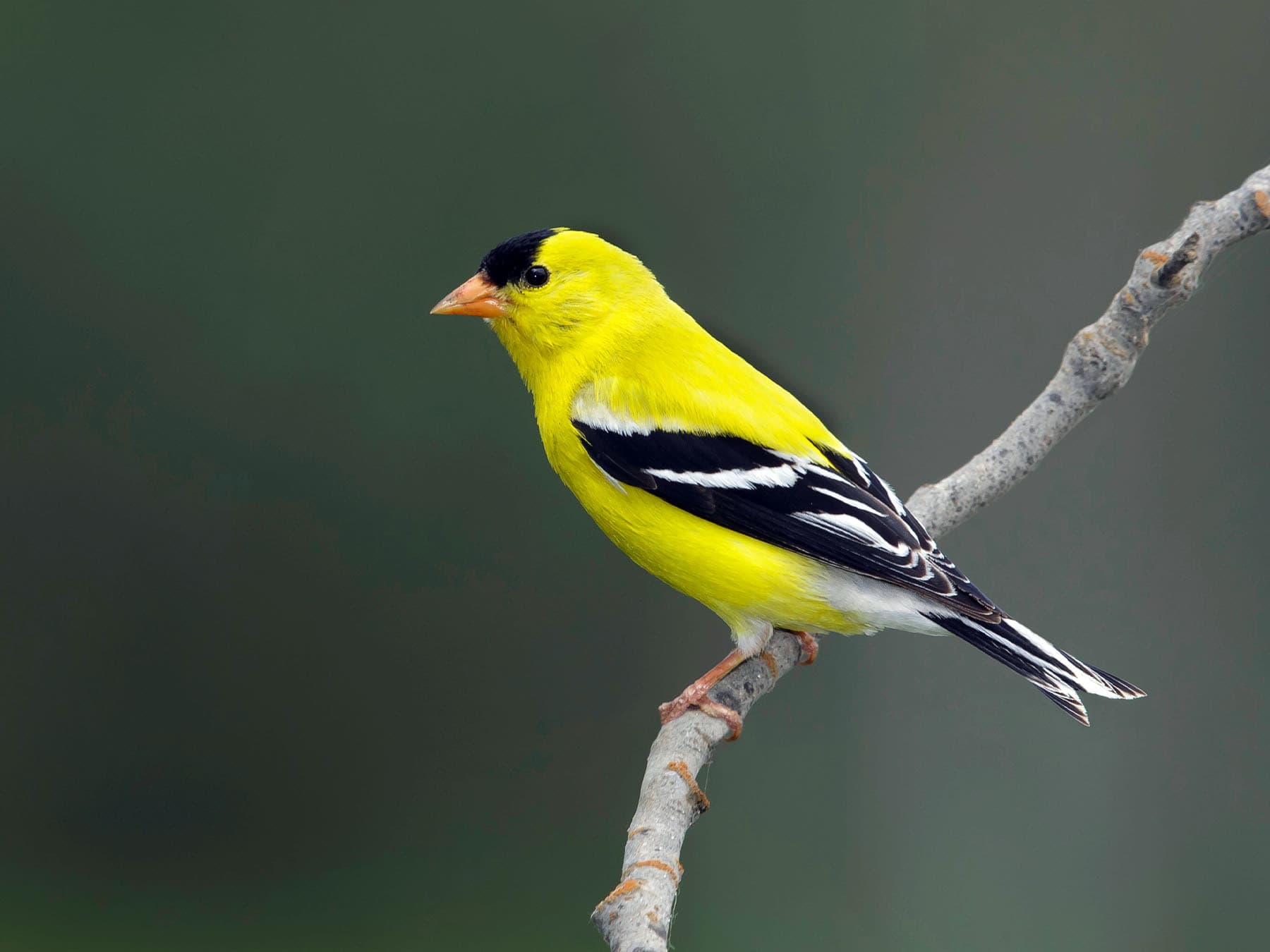
Quick facts
- Length
- 9–11 cm
- Wingspan
- 15–20 cm
- Weight
- 8–11.5 g
- Lifespan
- oldest recorded 7 years 1 month
- Family
- Finches
- Migration
- Partial migrant
- Global status (IUCN)
- Least Concern
- World population
- About 15 million (Partners in Flight)
- Population trend
- Stable in Breeding Bird Survey counts since 1967: a fall to the mid-1990s, a rise since, and no clear change in the last ten years
- Scientific name
- Spinus psaltria
Questions
3Are Lesser Goldfinches rare?
Not in the West, where they are most common in California and Texas. Farther north they are spreading: they now live year-round in parts of Washington, Idaho and Oregon, and are still scarce but turning up more often in Montana and British Columbia (see where and when to see them).
Do Lesser Goldfinches mate for life?
Nobody knows yet. They are described as monogamous, but no study has measured how long a pair stays together.
Why is it called a Lesser Goldfinch?
The name replaced Arkansas Goldfinch in 1957 (see the names section above). The sources we read do not say why "lesser" was chosen.
Sources
39- 1Maron, M. W. et al. (2025). Lesser Goldfinch (Spinus psaltria), version 2.0. Birds of the World (B. K. Keeney, editor). Cornell Lab of Ornithology. doi:10.2173/bow.lesgol.02 (opens in a new tab)
- 2Willoughby, E. J. (2007). Geographic variation in color, measurements, and molt of the Lesser Goldfinch in North America does not support subspecific designation. The Condor 109(2): 419-436. doi:10.1093/condor/109.2.419 (opens in a new tab)
- 3AviList Core Team (2025). AviList: the global avian checklist, v2025b. AviList (data/reference/avilist.csv). Accessed 17 November 2026. Source (opens in a new tab)
- 4Remsen, J. V., Jr., Garrett, K. and Erickson, R. A. (1982). Vocal copying in Lawrence's and Lesser goldfinches. Western Birds 13: 29-33. Accessed 17 November 2026.
- 5Maron, M. W. (2025). Behavioral observations of Lesser Goldfinches in Pullman, Washington. Western Birds 56(4): 302-303. doi:10.21199/WB56.4.6 (opens in a new tab)
- 6Wood, E. M. and Esaian, S. (2020). The importance of street trees to urban avifauna. Ecological Applications 30(7). doi:10.1002/eap.2149 (opens in a new tab)
- 7Stephens, D. A., Webb, C. and Trost, C. H. (1990). First report of nesting Lesser Goldfinch in Idaho. Western Birds 21: 33-34. Accessed 17 November 2026.
- 8Hendricks, P. and Mitchell, A. (2022). Breeding status and first nest record of the Lesser Goldfinch in Montana. Western Birds 53: 232-236. doi:10.21199/wb53.3.5 (opens in a new tab)
- 9Hostetler, J. A. et al. (2026). The North American Breeding Bird Survey, Analysis Results 1966-2025. U.S. Geological Survey data release. doi:10.5066/P1OSNSFC (opens in a new tab)
- 10Toochin, R.. Lesser Goldfinch / Spinus psaltria. BC Rare Bird Records (page revised 3 August 2026). Accessed 17 November 2026. Source (opens in a new tab)
- 11Holtkamp, R. (2021). First confirmed record of a Lesser Goldfinch in Saskatchewan. Blue Jay 78(4): 8-9. doi:10.29173/bluejay6307 (opens in a new tab)
- 12Maron, M. W., Greig, E. I. and Boersma, J. (2025). Climate and landscape modification facilitate range expansion in Spinus psaltria (Lesser Goldfinch) across the Pacific Northwest. Ornithology 142(3): ukaf013. doi:10.1093/ornithology/ukaf013 (opens in a new tab)
- 13Beal, F. E. L. (1910). Birds of California in relation to the fruit industry, part II (the green-backed goldfinch, Astragalinus psaltria hesperophilus). U.S. Department of Agriculture, Biological Survey Bulletin 34. Accessed 17 November 2026. Source (opens in a new tab)
- 14Project FeederWatch, Cornell Lab of Ornithology. Common Feeder Birds: Lesser Goldfinch. Project FeederWatch. Accessed 17 November 2026. Source (opens in a new tab)
- 15Smith, E. K. et al. (2017). Avian thermoregulation in the heat: resting metabolism, evaporative cooling and heat tolerance in Sonoran Desert songbirds. Journal of Experimental Biology 220: 3290-3300. doi:10.1242/jeb.161141 (opens in a new tab)
- 16Patel, K. et al. (2023). Human salmonellosis outbreak linked to Salmonella Typhimurium epidemic in wild songbirds, United States, 2020-2021. Emerging Infectious Diseases 29(11). doi:10.3201/eid2911.230332 (opens in a new tab)
- 17USGS Bird Banding Laboratory. Longevity records of North American birds: Lesser Goldfinch (AOU 5300). Bird Banding Laboratory, Bander Portal longevity tables. Accessed 17 November 2026. Source (opens in a new tab)
- 18BirdLife International (2018). Spinus psaltria (Say, 1823), The IUCN Red List of Threatened Species 2018. IUCN Red List. doi:10.2305/IUCN.UK.2018-2.RLTS.T22720410A132139491.en (opens in a new tab)
- 19Partners in Flight (2024). Avian Conservation Assessment Database, version 2024.05.23 (global). Partners in Flight. Accessed 17 November 2026. Source (opens in a new tab)
- 20US Fish and Wildlife Service (2026). 50 CFR 10.13, List of Birds Protected by the Migratory Bird Treaty Act; 50 CFR 10.12, Definitions. Electronic Code of Federal Regulations (version dated 2026-11-13). Accessed 17 November 2026. Source (opens in a new tab)
- 21US Fish and Wildlife Service (2026). 50 CFR 21.10, Migratory bird permits: general. Electronic Code of Federal Regulations (version dated 2026-11-13). Accessed 17 November 2026. Source (opens in a new tab)
- 22US Congress (2026). 16 U.S.C. 703, Taking, killing, or possessing migratory birds unlawful. United States Code (Cornell Legal Information Institute copy). Accessed 17 November 2026. Source (opens in a new tab)
- 23US Fish and Wildlife Service. What we do. National Wildlife Property Repository, fws.gov. Accessed 17 November 2026. Source (opens in a new tab)
- 24US Fish and Wildlife Service (2026). 50 CFR Part 21, Migratory bird permits (with the depredation orders of Subpart D). Electronic Code of Federal Regulations (version dated 2026-11-13). Accessed 17 November 2026. Source (opens in a new tab)
- 25Environment and Climate Change Canada. Birds protected in Canada under the Migratory Birds Convention Act, 1994. Canada.ca. Accessed 17 November 2026. Source (opens in a new tab)
- 26SEMARNAT (2010). NOM-059-SEMARNAT-2010, Protección ambiental: especies nativas de México de flora y fauna silvestres. Diario Oficial de la Federación, 30 December 2010. Accessed 17 November 2026. Source (opens in a new tab)
- 27González-Herrera, A., Chablé-Santos, J., Aguilar-Cordero, W. and Manríque-Saide, P. (2018). El comercio de aves silvestres en la ciudad de Mérida, Yucatán, México. Ecosistemas y Recursos Agropecuarios 5(14): 271-281. doi:10.19136/era.a5n14.1242 (opens in a new tab)
- 28James, E. (compiler) and Say, T. (1823). Account of an expedition from Pittsburgh to the Rocky Mountains, performed in the years 1819 and '20, volume 2. Philadelphia: H. C. Carey and I. Lea (title page dated 1823). Accessed 17 November 2026. Source (opens in a new tab)
- 29American Ornithologists' Union (1895). Check-list of North American birds, second edition. New York: American Ornithologists' Union. Accessed 17 November 2026. Source (opens in a new tab)
- 30American Ornithologists' Union (1910). Check-list of North American birds, third edition. New York: American Ornithologists' Union. Accessed 17 November 2026. Source (opens in a new tab)
- 31American Ornithologists' Union (1931). Check-list of North American birds, fourth edition. Lancaster, Pennsylvania: American Ornithologists' Union. Accessed 17 November 2026. Source (opens in a new tab)
- 32American Ornithologists' Union (1957). Check-list of North American birds, fifth edition. Baltimore: American Ornithologists' Union. Accessed 17 November 2026. Source (opens in a new tab)
- 33Bent, A. C. (1968). Life histories of North American cardinals, grosbeaks, buntings, towhees, finches, sparrows, and allies, part 1 (Lesser Goldfinch, by A. O. Gross; Green-backed Goldfinch, by J. M. Linsdale). U.S. National Museum Bulletin 237. Accessed 17 November 2026. Source (opens in a new tab)
- 34NatureServe. Spinus psaltria, Lesser Goldfinch. NatureServe Explorer. Accessed 17 November 2026. Source (opens in a new tab)
- 35NestWatch, Cornell Lab of Ornithology. Lesser Goldfinch. NestWatch focal species. Accessed 17 November 2026. Source (opens in a new tab)
- 36Cornell Lab of Ornithology. Lesser Goldfinch. All About Birds. Accessed 17 November 2026. Source (opens in a new tab)
- 37National Audubon Society. Lesser Goldfinch. Guide to North American Birds. Accessed 17 November 2026. Source (opens in a new tab)
- 38eBird. Lesser Goldfinch (Spinus psaltria). eBird species page, Cornell Lab of Ornithology. Accessed 17 November 2026. Source (opens in a new tab)
- 39National Audubon Society. Pine Siskin. Guide to North American Birds. Accessed 9 November 2026. Source (opens in a new tab)

Checked by
Nathan Cope, founder and editor
Nathan founded Birdfact and leads its writers and contributors in the UK, the US and Canada. He has watched and studied birds for more than ten years, and checks every article and species guide before it’s published.