
Harris's Hawk
Bay-winged Hawk · Parabuteo unicinctus
By the Birdfact teamChecked by Nathan Cope
See it in 3D
2 plumages
An adult Harris's Hawk is 18–23 in (46–59 cm) long, bill to tail.
Adult
© 2026 NC Digital Limited (Birdfact). All rights reserved. This 3D model may be viewed on this page and shared by link only. Downloading, extracting, copying or reusing it, or using it to train machine-learning models, is not permitted without our written permission. Using our models
On this page14 sections
How to recognise it
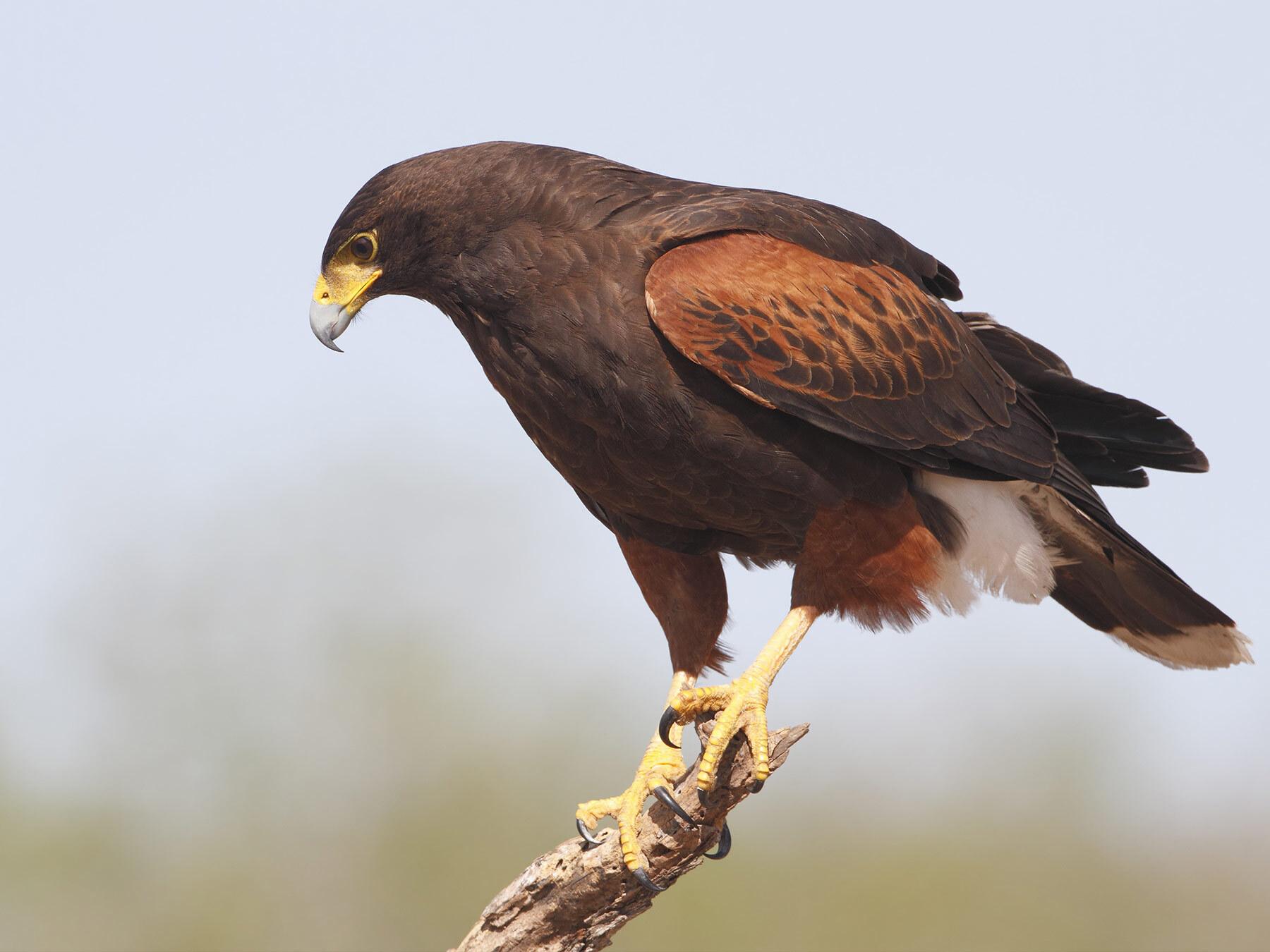
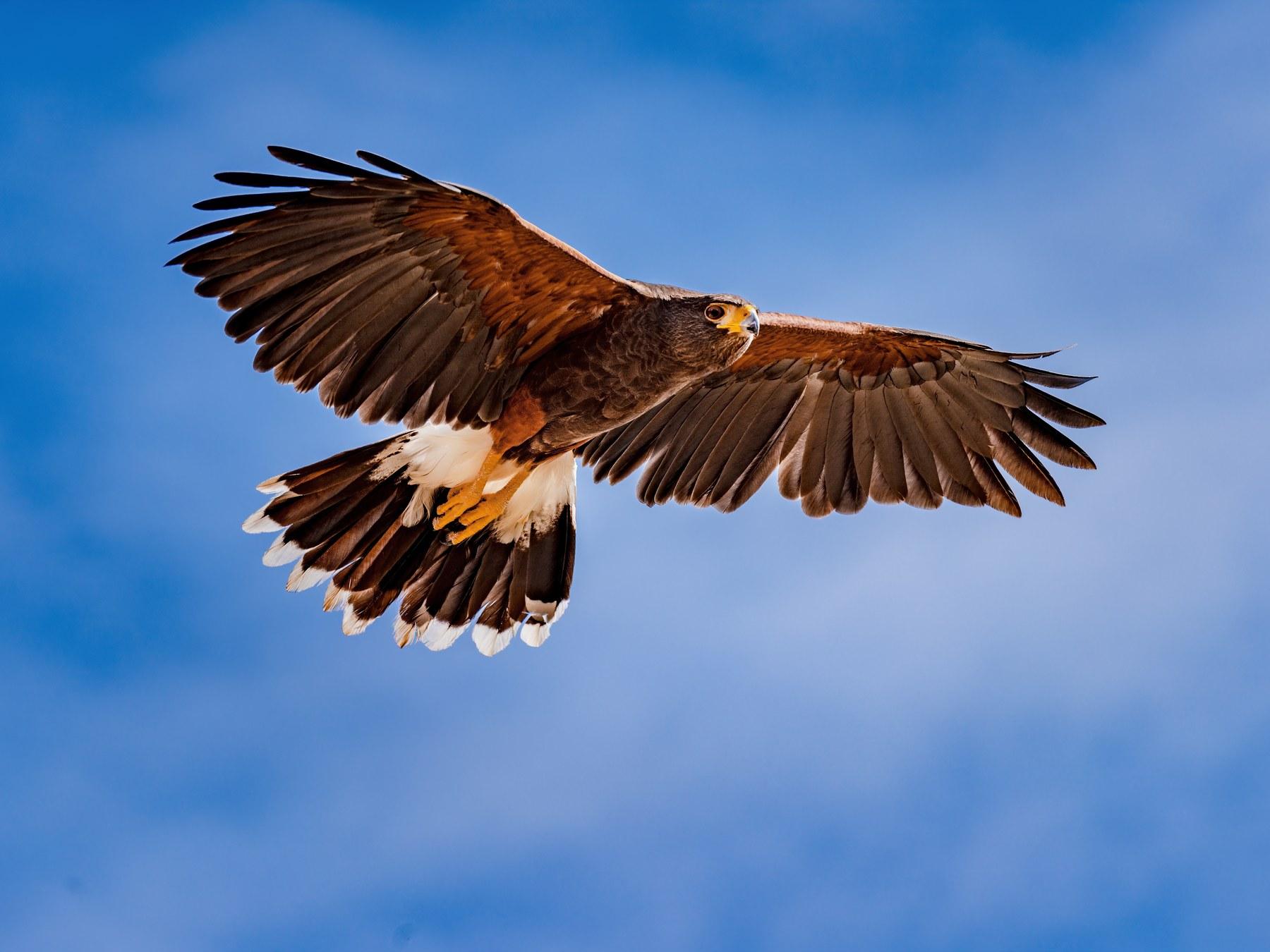
Look for a lanky, dark chocolate-brown hawk with rich chestnut shoulders and thighs. Its black tail is framed in white, at the base and in a band about 2 cm wide at the tip, and its long legs, the cere at the base of the bill and the bare skin of the face are bright yellow.
It is a medium-large hawk with a fairly long tail and broad, rounded wings. Bare skin in front of the eyes makes the pale blue, black-tipped bill look large and projecting. The chestnut also covers the wing linings and flanks, and the dark and white parts of the plumage meet in sharp lines. No colour morphs are known in North America: a reported all-blackish form was not borne out by specimens.
Two subspecies are recognised. Harrisi, the form shown on this page, lives from the arid south-western United States south to the Pacific slope of Colombia, Ecuador and Peru. Unicinctus, the Bay-winged Hawk, ranges from Venezuela and eastern Colombia south through Brazil to southern Chile and southern Argentina.
Plumage of the South American form
Adult Bay-winged Hawks are usually streaked or flecked with white on the throat and belly, with whitish primaries and less white in the tail. They are smaller in body than North American birds but longer-tailed for their size. They also take longer to mature, passing through four age-related plumages over three years, where North American birds have two, juvenile and adult.1
On these differences, and on differences in breeding and hunting, a 2023 paper by two authors proposes treating the Bay-winged Hawk as a separate species, while saying it is unclear whether the behaviour differences have any taxonomic value. The same paper says there are no valid records of the North American form in South America, whereas AviList extends it down the Pacific slope to Peru.1 The major world checklists still treat the two as one species, and this page follows them.
Size and weight
A Harris's Hawk is 46-59 cm long with a wingspan of 103-119 cm, larger than a Cooper's Hawk and smaller than a Golden Eagle. Females are much the bigger sex. They weigh 775-1,630 g against 515-880 g for males, and on average they are about 47% heavier.2
Within one population and age group, the weights of males and females overlap little if at all. Among birds banded in winter in Texas, males averaged about 300 g lighter than females in every age class.3 Mean adult weights were 1,063.7 g for 64 females and 703.8 g for 59 males in Arizona, 1,025.4 g (25 birds) and 699.0 g (32) in New Mexico, and 997.7 g (177) and 689.7 g (220) in Texas.2
Across North America, size, and tail length above all, increases from north-eastern Mexico, where birds are smallest, to north-western Arizona.
Male, female and juvenile
Males and females look alike in every plumage, so size is the only clue, and birds are usually sexed by weight. Even then, birds of middling weight can be hard to place.
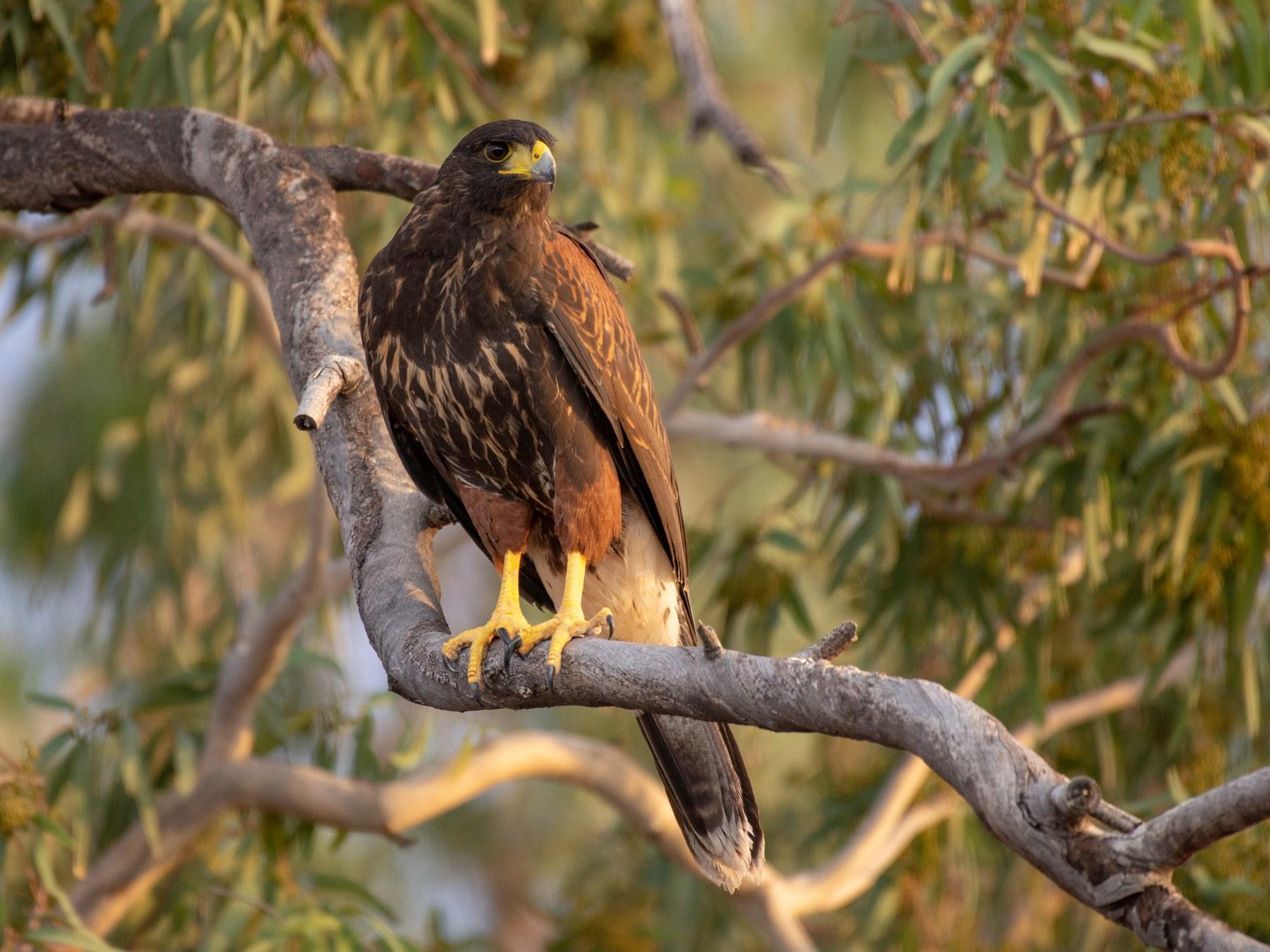
Juveniles, birds in their first plumage, are built like adults but streaked cream or buff on the breast and belly. Their chestnut thighs are barred with cream, the rufous patches are smaller and duller, and in flight the undersides of the primaries look whitish. The tail is finely barred but keeps its white base and tip. This plumage is worn mainly from June to December, and all year in some birds.
Adult plumage usually comes with the second or third basic plumage, the feathers of each year's main moult, and because those moults are often incomplete, most birds keep a few juvenile feathers, often flight feathers, into their second year. There is no separate breeding plumage. Adults replace their flight feathers in overlapping waves, so they often carry two to five generations of feathers at once.
Identification in flight
In the air it shows broad, rounded wings and a long tail, often fanned as it soars. Its usual travelling flight is a few flaps and a glide, in the style of an accipiter, usually 10-100 m up and following the lie of the land. From below, an adult shows chestnut wing linings and the white base and tip of its black tail; a juvenile shows whitish primaries.
Identification: lookalikes
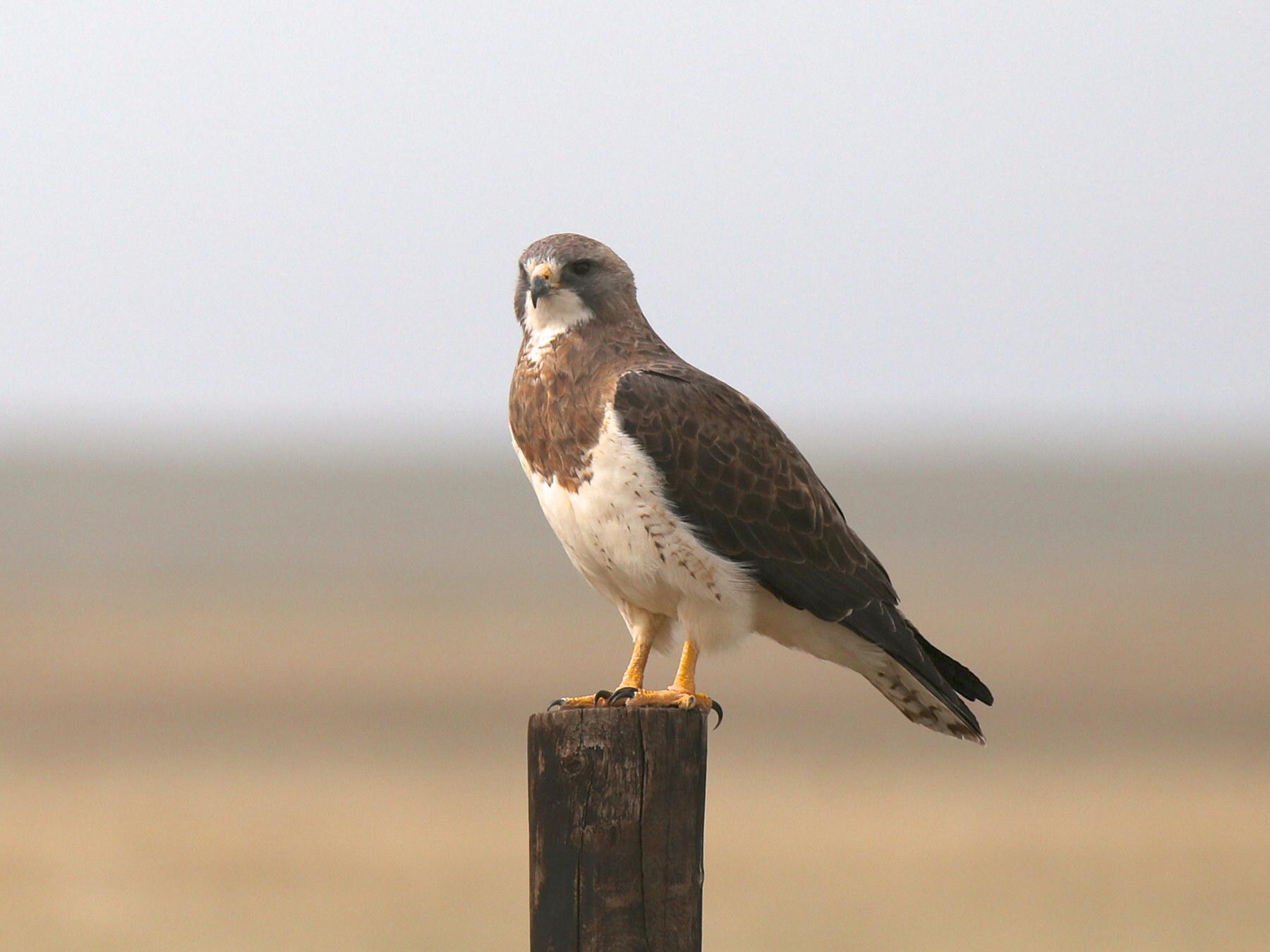
The closest lookalikes are dark buteos. A dark Swainson's Hawk has a grey-brown tail with many narrow dark bands, the widest near the tip, usually lacks chestnut on the shoulders and thighs, and soars on slimmer wings held in a shallow V. A dark Red-tailed Hawk is a stouter, broad-winged hawk, and most adults show a reddish tail with a narrow dark band near the tip.
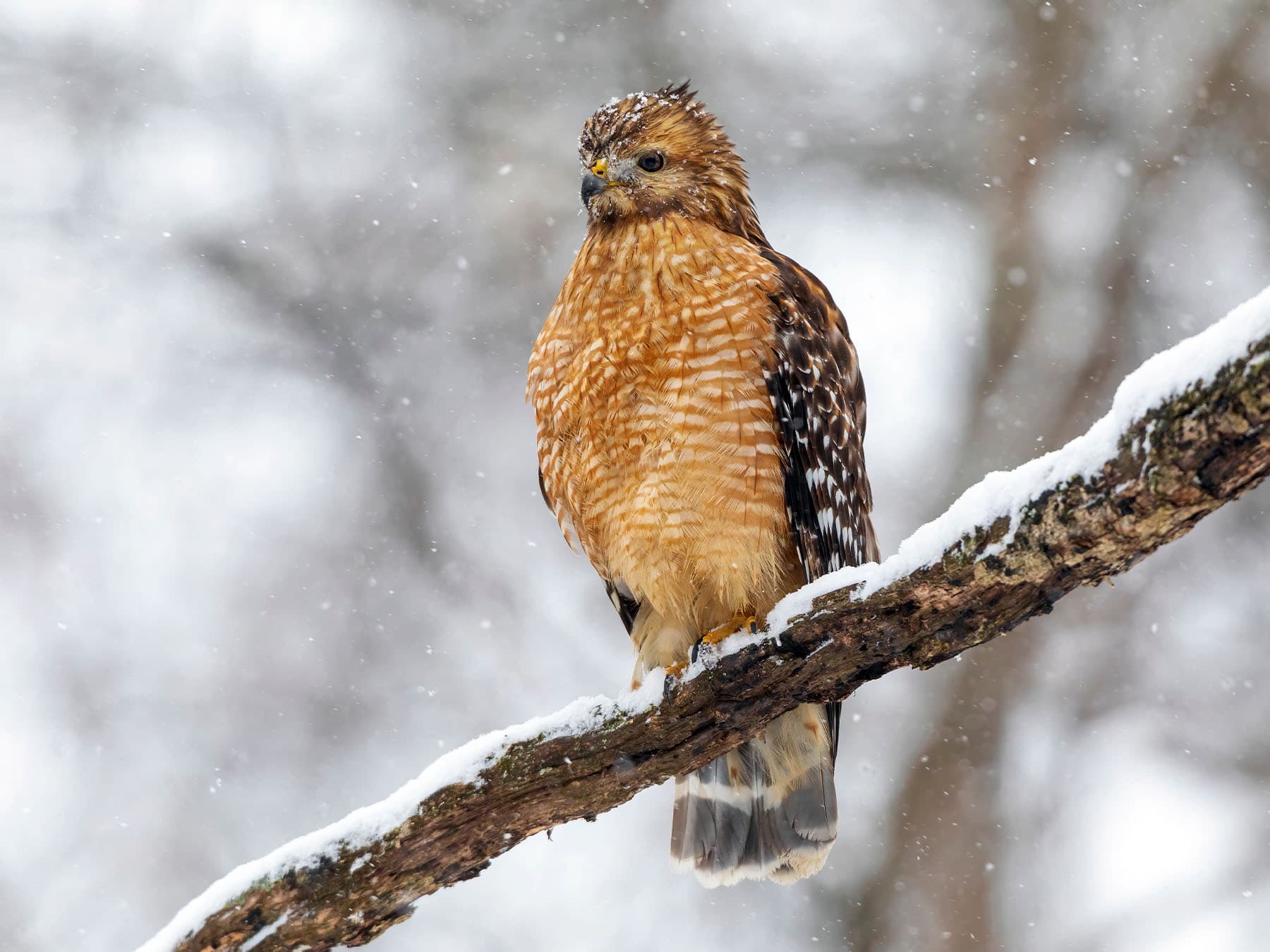
A Red-shouldered Hawk also has rusty shoulders, but its underparts are barred rusty to reddish and its tail has several wide dark bars with narrow white bars between them. A Common Black Hawk looks black at first glance, with one wide white band across the middle of the tail and a thin white tip. A Zone-tailed Hawk is slaty black with two or three pale tail bands and black wing linings against pale flight feathers, and it holds its long, narrow wings in a slight V like a Turkey Vulture.
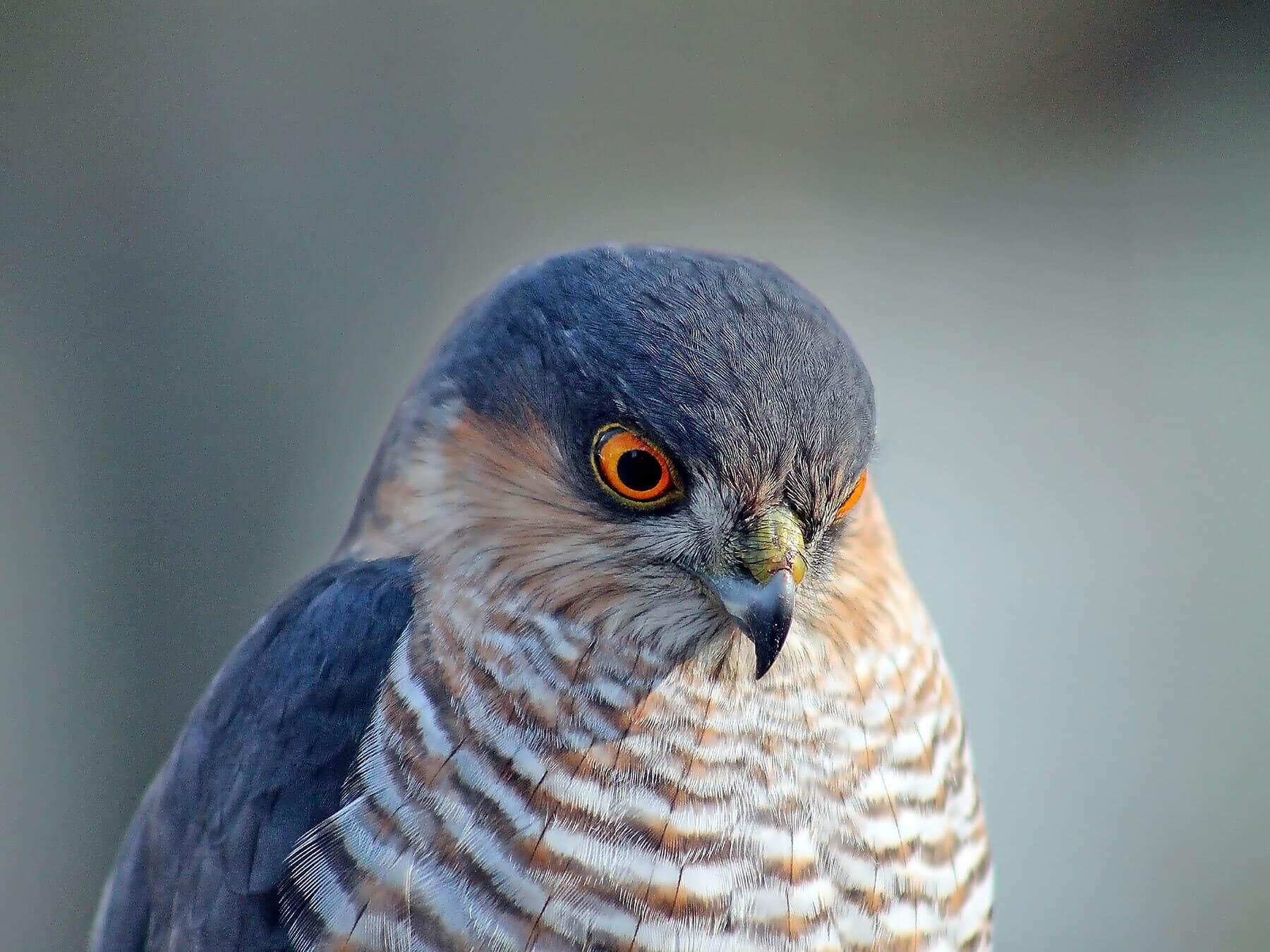
Farther south, a Great Black Hawk is nearly all black with long yellow legs and a broad white tail band or, in southern birds, a white basal half; when perched, its wingtips fall well short of the tail tip. A Savanna Hawk is rufous to cinnamon-brown on the head, neck and underparts, finely barred with black below. The White-rumped Hawk, the nearest relative in DNA studies and now placed in the same genus, is much smaller, 33-40 cm long, with a white rump and creamy white underwing coverts, and lives in humid mountain forest.
Not sure it’s a Harris's Hawk? Check your photo: Birdfact names the bird and shows the look-alike side by side.
Its size
Adults- Length
- 46–59 cm
- Wingspan
- 103–119 cm
- Weight
- 515–1630 g
Its song and calls
No song has been described. The call heard most often in the wild is a long, harsh scream that sounds angry and grates before it fades, given when people or other intruders come near a nest or a kill.
Adults give a chirp of 1-3 seconds, often in rhythmic strings of 5-10 notes, mostly when expecting a hand-over of prey and now and then while hunting in groups, and there is also a cackle of quick chirps. Chicks and first-year birds beg with a shrill, plaintive scream of about 2 seconds. Birds call most while nesting, from April to June in North America.
Its voice is poorly studied: when Birds of the World's account was written in 2011, only a few poor-quality recordings of its calls were available.2
- Calls0:00 / 0:18
Recorded in Arizona, United States · April 2025
- Juveniles calling0:00 / 1:04
Recorded in Buenos Aires Province, Argentina · July 2014
Heard one and not sure? Let the bird song identifier listen.
When and where to see it
November
Arriving
The year across North America
Choose a place on the map to see its year, or find yours.
Most recorded in November
Up to 0.27% of a place’s bird records that monthHere in other months
How this map is made
Each county, state or province is shaded by the Harris's Hawk’s share of all the bird records there that month: the darker, the larger the share. A place with only a trace of records in a month is left unshaded. Shades compare places on this map with each other, not one bird with another. Records: GBIF eBird Observation Dataset, 2019–2024. Map: Natural Earth; place centres © OpenStreetMap contributors.
How often the Harris's Hawk turns up in the United States through the year, from birdwatchers' records.
United States
Winter visitor · all year · most records in November
Show as a table
| Month | United States |
|---|---|
| January | 0.032% (regular) |
| February | 0.030% (regular) |
| March | 0.022% (regular) |
| April | 0.013% (regular) |
| May | 0.004% (regular) |
| June | 0.004% (regular) |
| July | 0.005% (regular) |
| August | 0.007% (regular) |
| September | 0.007% (regular) |
| October | 0.011% (regular) |
| November | 0.038% (regular) |
| December | 0.027% (regular) |
Worldwide: recorded regularly in 18 countries
Countries where it was recorded in at least 3 of the 6 years 2019–2024. Linked countries have their own bird list.
Europe (1)
North America (7)
- Costa Rica
- El Salvador
- Guatemala
- Honduras
- Mexico
- Nicaragua
- United States
Data: EOD – eBird Observation Dataset (Cornell Lab of Ornithology), accessed via GBIF.org, CC BY 4.0. Records from 2019–2024, aggregated and filtered by Birdfact. How these lists are made
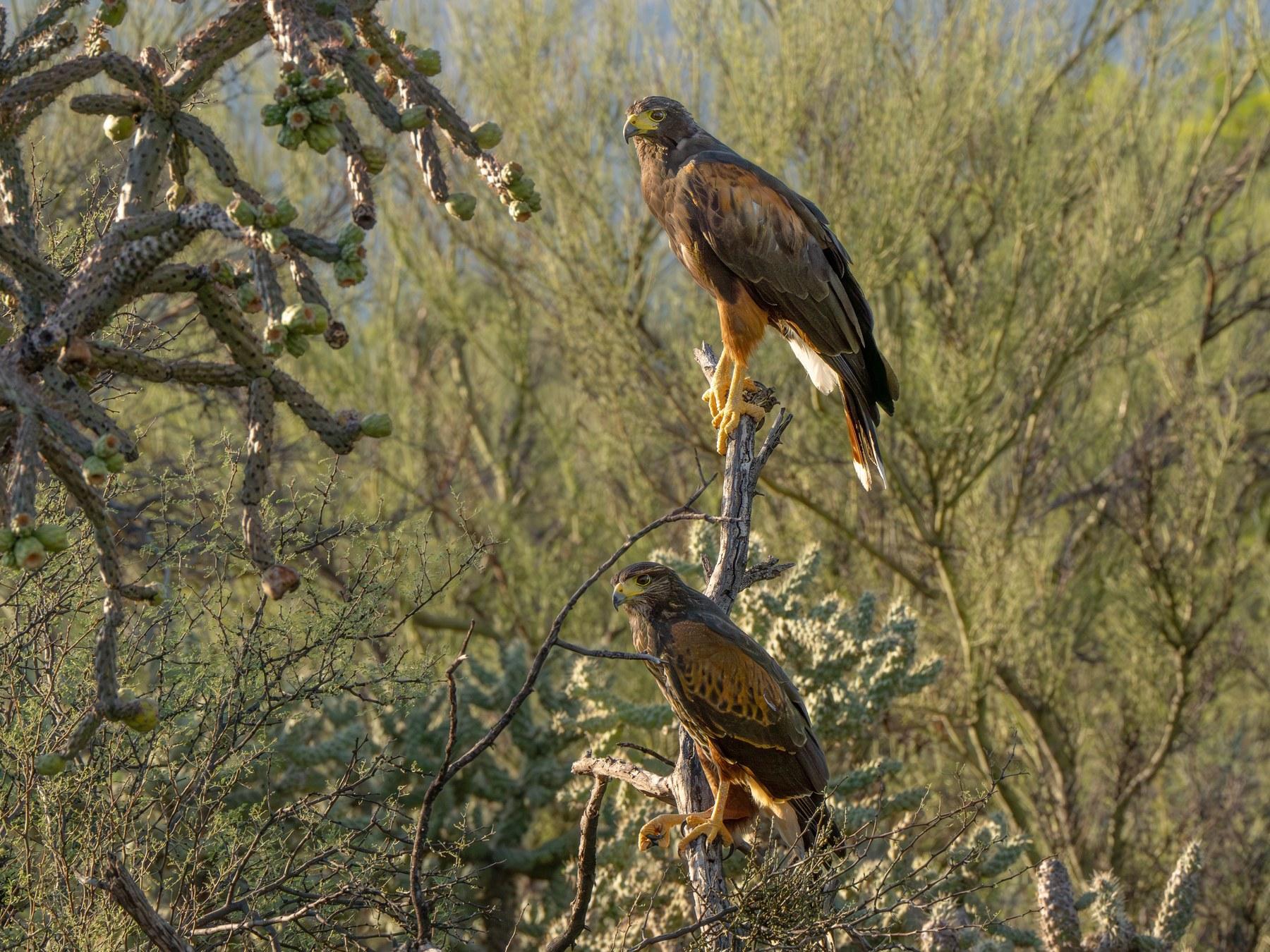
Harris's Hawks live from the south-western United States through Mexico and Central America to Chile and Argentina. In South America they are patchy in the west and live in open savannas in the east, north of 44°S. They need semi-open country with tall perches and places to nest: desert scrub, savanna, grassland and wetland with scattered trees, cacti or poles.
In the United States they breed in scattered populations, as described in 2011. In Arizona most live in the upland Sonoran Desert from Tucson to Wickenburg, among paloverde and saguaro. Others breed in south-eastern New Mexico and patchily in western and southern Texas, commonest in the south, among mesquite and oak scrub. It occurs only irregularly in California, at the edge of the range (see Conservation). In Sonora, Mexico, they use dry country from about sea level up to 600 m.
Urban habitat
Harris's Hawks also nest in cities. In Tucson, nesting groups rose from about 10 in 1975 to 46 in 1993 and 62 in 2003, and plentiful prey, such as pigeons and doves, and easy water appear to be among the reasons.2
Birds also live in Phoenix. In Mexico City the species has been a regular resident since the 1980s.4 Farther south, the Bay-winged form was absent from Buenos Aires in the 1980s but was a common breeder there in the 2010s, and it first appeared in Mar del Plata, Argentina, in 2018.5 It lives in cities in Chile too.
Does it migrate?
Harris's Hawks do not migrate: they are resident, and pairs and groups hold their territories all year. Young birds may roam far while looking for a territory of their own, and some Central and South American populations are suspected of moving north and south, though the sightings, of young or escaped falconry birds, may show nomadic wandering instead.2
Birds have turned up well outside the range in Kansas (where a few once nested), Ohio, Iowa, Utah and Nevada, and some wore falconers' jesses and were certainly escapes.
Distribution outside the Americas
In Britain the Harris's Hawk is known only as an escape from captivity. Birds of the World's account, written in 2011, knew of no records of wild Harris's Hawks in Europe, where captive birds are used in falconry.
The British Ornithologists' Union places it in Category E*: escapes from captivity that have bred in the wild, with breeding thought not to be self-sustaining. So it is not on the British List.6
Spotting tips
In Arizona, look in Sonoran Desert scrub between Tucson and Wickenburg, and in Tucson itself; in Texas, look in the south of the state. Scan tall perches such as saguaros, poles and dead trees, where a group may sit together before a hunt. Birds are most vocal from April to June, while nesting.
What it eats
Most of its prey are medium-sized mammals, above all rabbits and hares, along with birds and lizards. In the south-western US, common prey include cottontails, jackrabbits, ground squirrels, woodrats, kangaroo rats, quail, Cactus Wrens and mockingbirds. In any one area only a few kinds of prey are taken often, and snakes only rarely.
Rabbits lead in most North American studies. In an Arizona study published in 1975, desert cottontails were 41.9% of prey items, followed by ground squirrels at 14.4%, woodrats and birds other than quail at 12.5% each, lizards at 8.7% and quail at 5%. In New Mexico, desert cottontails supplied an estimated 87.1% of prey biomass, and cottontails and jackrabbits together about 90% in spring, summer and autumn.2 A comparison with Swainson's Hawks there found Harris's Hawks to be relative specialists on larger mammals and some birds.7
In South America, studies of the Bay-winged form at single sites find mostly mammals, then birds. Mammals were 64.7% of prey by frequency at Concepción airport in Chile in 2003-04.8 On the central Chilean coast in the autumn and winter of 2006-07, small mammals were 69.6% of prey and introduced rabbits gave 56.9% of the biomass.9 At one site in Córdoba, Argentina, a wild cavy made up 68% of 392 prey items, and toads and other amphibians turn up at Argentine sites.10, 11
It is not a garden feeder bird, and nothing we read recommends any food for it.
How it feeds
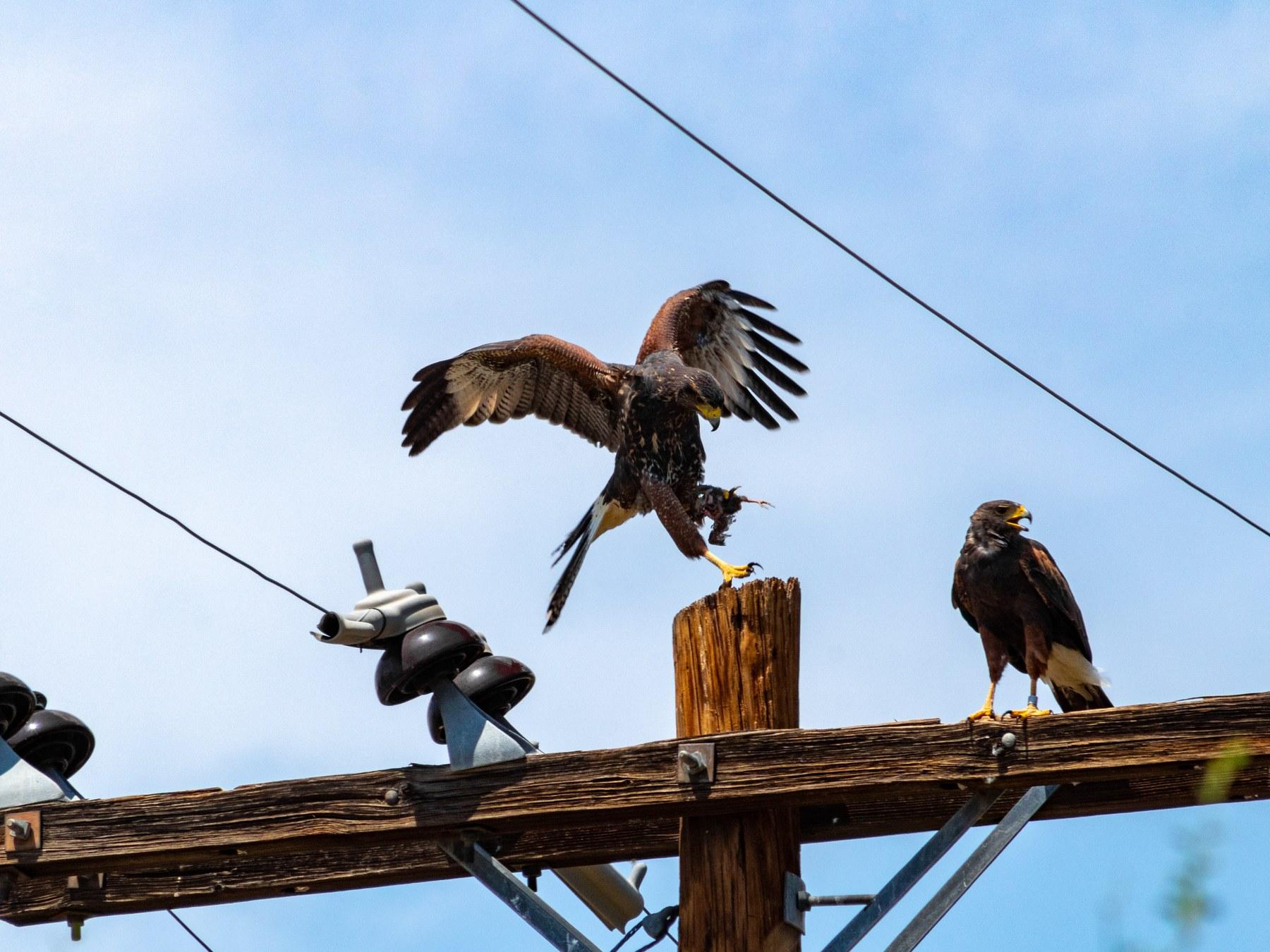
Most attacks start from a perch. A lone hawk often sits and waits, while a group flies from perch to perch, scanning for a few minutes at each. It also runs and hops after prey on the ground and will push into thick cover.
Kills are shared. In Arizona the feeding order followed the group's dominance order, and a dominant hawk took the carcass from the catcher in 6 of 9 cottontail captures watched. In the non-breeding season, a group can guard and feed on a large carcass for more than 36 hours. Hawks cache prey on old nests and large branches, and in Arizona they visit water daily to drink and bathe, especially when it is hotter than 37 °C.2
Some prey is unexpected. Two hawks were seen catching bats in Mexico City, which the authors describe as the first formal record of bat predation by the species, and one was filmed eating a Cooper's Hawk in Baja California in October 2025.4, 12
Nesting and breeding
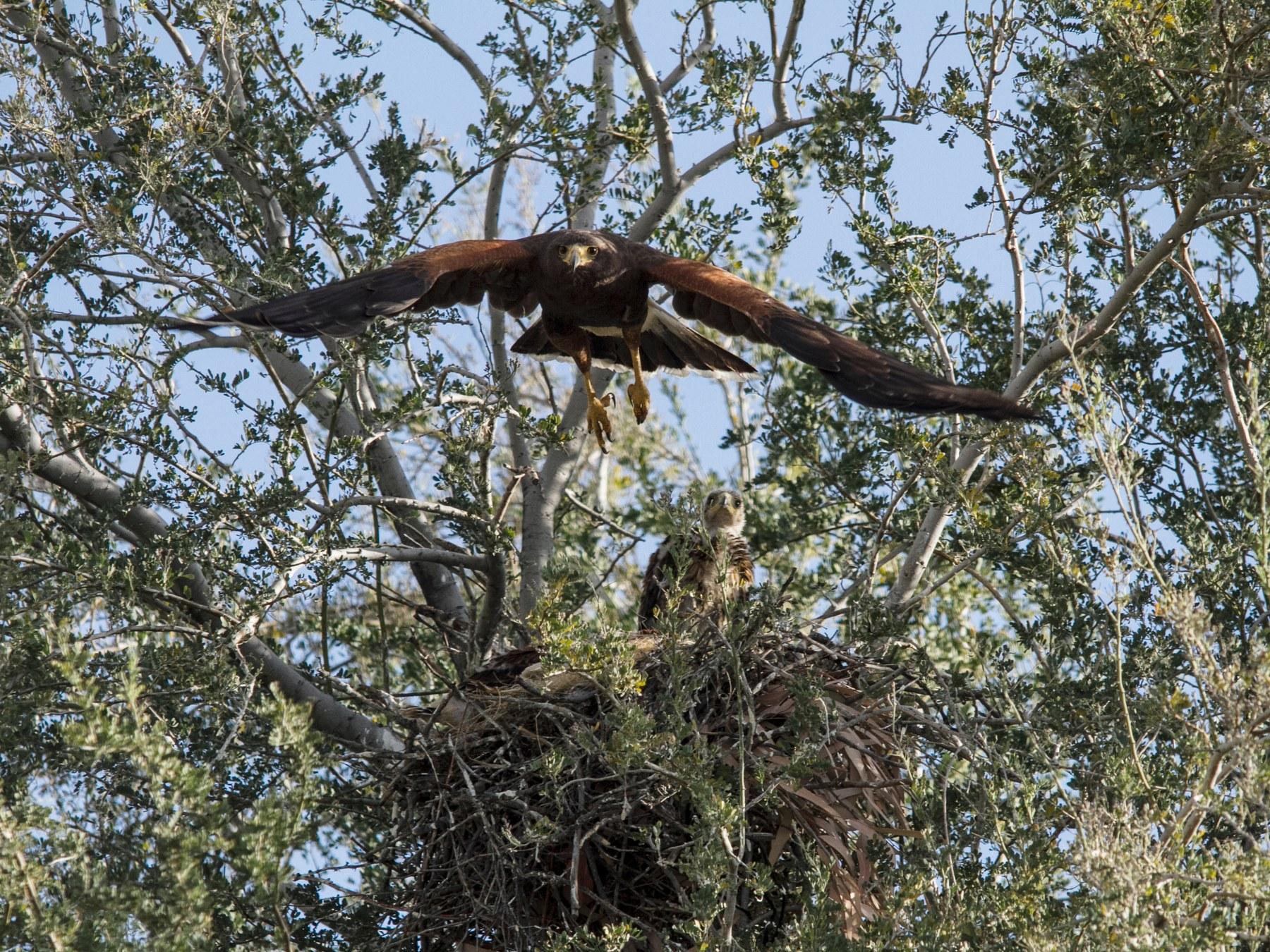
Harris's Hawks nest on almost any tall, sturdy support: saguaros, paloverde, mesquite and live oak in the US, and introduced pines, palms and eucalyptus in Tucson, as well as transmission towers, windmill platforms and cliffs. Nests average 5.9 m up in saguaros and 5.7 m in paloverdes in Arizona, but only 2.7 m in the small trees of New Mexico.2 Both sexes build a bulky nest of sticks lined with green leaves, grass and feathers, the female doing most, and a pair may keep up to four nests and use them again.
In the south-western US most first clutches are laid in March and April, or from January to March in good years in Arizona, and nesting has been recorded in every month. The clutch is 1-5 eggs, usually 3-4, plain or lightly spotted, very pale bluish fading to white, and about 53 x 42 mm. Incubation is reported as 31-36 days, usually 34-35. The breeding female alone develops a brood patch and does the bulk of the sitting.
Mean clutches range from 2.33 in Texas to 3.34 in New Mexico, and were 2.96 at 50 Arizona nests.13, 2
Raising the young
Food for the chicks comes mostly from the breeding male and the helpers, and is passed to the female, who feeds them. At about 40 days the chicks clamber about the branches, and they leave the nest at about 45-48 days: in New Mexico males fledged at 44.8 days on average (55 birds) and females at 47.9 (35).2 Young birds stay in the territory for at least two to three months.
In a New Mexico study, first-hatched chicks were mostly male, and nests where a male hatched first fledged more young.14 In south-eastern New Mexico in 1977-1990, nests fledged 0.73-1.89 young on average, rising and falling with cottontail numbers, and 50 Arizona nests in 1969-1973 produced 1.60 young each.2, 13
Pairs can raise second and even third broods. In one south-eastern New Mexico study, 29-70% of groups each year tried again in late summer or autumn.15 Second broods depend heavily on prey: in the same area none were attempted in 1988-1990. Second or third attempts made up 22% of 284 Arizona clutches.2
Group breeding and helpers
In North America many pairs breed with helpers, extra birds that hunt for the nest and help guard it. Breeding groups hold two to seven hawks, averaging 3.8 in Arizona and 2.7 in New Mexico, where pairs alone were the commonest unit (49% of 61).16, 17 In south Texas, 56% of 73 groups in 2014-2015 had three or more birds.18
Helpers are of two kinds: young birds that stay with their parents for up to three years, and unrelated birds, mostly adults. Of 108 helpers at 64 Arizona nests, 38% were of the second, mostly unrelated kind, while in New Mexico all 105 documented helpers were the breeders' own young, with one probable unrelated helper seen.2 Arizona groups have a straight-line pecking order, always with an adult female at the top; the breeding male usually comes next, though in 11% of 64 groups a second adult female ranked between them.19, 2
All helpers join group hunts. In Arizona, helpers rarely tended eggs or chicks directly but brought prey and helped drive off Great Horned Owls.19 In one hormone study, male helpers in adult plumage carried more prey from group kills to the chicks than any other member of the group.20 In New Mexico, helpers did not change clutch size, young per nest or young fledged per year, though groups reared slightly larger young and started second nests more often; preliminary data suggest birds in groups survive better than pairs.2
The mating system varies by place. In Arizona it has been described as sometimes polyandrous, with a female mating with more than one male, and groups often hold unrelated adults of the same sex. In New Mexico and Texas pairs are mainly monogamous, though polyandry probably occurs, and early work in Chile and Ecuador suggests mainly monogamous pairs. Two marked New Mexico pairs stayed together for at least four years.2
Most breeders are in adult plumage, but in Arizona some one-year-olds in juvenile-type plumage have nested, and six New Mexico females marked as nestlings were first seen breeding at 23-62 months. Young leave their family group at between a few months and three years old, females usually first; in New Mexico, recoveries of seven banded hawks suggest dispersal distances of 1-160 km.2
Behaviour
Harris's Hawks are very social, and in North America they are known for hunting in groups. Birds of the World calls their cooperative hunting the most sophisticated documented in birds.2 A hunt starts with the group gathering on a perch. Then birds may surprise prey from several directions at once, flush it from cover for others waiting nearby, or chase a hare in relays, the lead changing hands.
How often they do it varies by place and study. In Arizona, 48% of 61 prey-capture attempts in a study published in 1975 involved more than one hawk, and most of 204 attempts watched in a later study involved two to six. In New Mexico, all obvious hunting by group members from September to March was cooperative, and much less in the breeding season.2 There, in the non-breeding season, hawks hunted in parties of two to six, which the study found raised capture success and food per bird and let them kill prey larger than themselves.21
Success also varies. In one Arizona study, groups tended to do better than lone hawks, from 20% of 65 attempts alone to 50% of 8 by groups of five. An earlier Arizona study, though, found that success, 16%, did not change with group size from one to three birds. In New Mexico, winter hunting parties of five gave the most food per bird and were the commonest party size.2
Not every population hunts this way. A 2026 south Texas study (108 groups surveyed, 28 radio-tracked) reports that cooperative hunting was infrequent there, with no clear pattern by season or urbanisation, and suggests it is not the main driver of group living in that population.22 A 2013 review found reports of cooperative hunting only from North America, and none was seen in about 13 hours of watching over a year at one site in central Chile.1, 23 Whether cooperative hunting is a cause or a result of living in groups is unresolved.
Backstanding behaviour
Harris's Hawks sometimes stand on one another's backs, which people often call stacking. The behaviour is known as backstanding: one hawk lands on another's back and stands there quietly for a few seconds to several minutes, with no mating behaviour. In Arizona, 82% of 44 bouts between marked birds had a subordinate standing on a dominant, and it is seen less often in New Mexico. The main handbook account describes it among the ways group members perch close together, and an early Arizona study suggested some backstanding comes from one hawk wanting another's perch.2
Territory and daily behaviour
Territories are held all year. In Arizona, breeding groups rarely went more than 0.8 km from the nest except to reach water, and in autumn and winter neighbouring groups gathered in temporary groups averaging 5.9 hawks (4-11).16 In New Mexico, home ranges ran from 50 to 1,600 ha, and in a time budget there birds spent about 95% of the day perched.2
Small birds mob it, and it mobs Great Horned Owls in turn. In New Mexico, Swainson's Hawks were the aggressors in 14 of 15 encounters watched between the two species.2
In urban Buenos Aires province, two juveniles of the Bay-winged form were seen grasping pine cones and handling them; the authors say it may be the first report of such object handling for the species and may relate to learning to hunt.24
Lifespan and predators
The oldest Harris's Hawk on the USGS Bird Banding Laboratory's current longevity list was at least 20 years 5 months old: a female banded in Texas in January 2006, in her third year, and found dead on a road in Texas in November 2024.25 Older figures are superseded: Birds of the World's 2011 account gave 11 years for the oldest wild bird.
We found no typical lifespan in the sources we read. Preliminary yearly survival rates from radio-tracking 44 New Mexico hawks were 0.82 for breeding adults, 0.64 for adult helpers and 0.70 for young birds in groups. Captive ages are not wild records: the oldest captive bird reported was a female at least 37 years old, from unpublished data.2
Predators and other dangers
Electrocution on power poles is a common cause of death, and the risk grows when several hawks share a pole. In Tucson, 7 of 85 trapped birds had definite and 7 suspected shock injuries, and only one injured bird was a male.26 Some injured birds appear to survive with help from their group, and in 2011 utilities in Arizona, New Mexico and Texas were retrofitting poles.2
Other causes are documented but little studied. In Arizona, carcasses in livestock water tanks suggested drowning, and two flying young were hurt by cholla joints; birds have apparently been killed by vehicles in Arizona and Texas, and three adult males in New Mexico were killed and eaten by Great Horned Owls. In Arizona, nestlings have been taken by coyotes, Common Ravens and Great Horned Owls, and any mammal or snake able to climb to a nest probably takes eggs and small young.2
Conservation
The Harris's Hawk is listed as Least Concern on the IUCN Red List (2024).27 Partners in Flight estimates about 920,000 breeding-age birds worldwide, about 52,000 of them in the US (an estimate for about 2010); both figures are calculated from survey data, not counted, and Partners in Flight gives it a combined concern score of 11.28 We found no range-wide trend: Partners in Flight gives none, and we could not read the IUCN trend text.
In the US, which holds only the northern edge of the range, the North American Breeding Bird Survey shows a fall of 2.19% a year from 1967 to 2025 (95% credible interval -3.51 to -1.00). The fall is driven by Texas, at -2.33% a year, while Arizona and New Mexico show no clear change, and the trend over 2015-2025 cannot be told from no change.29
Conservation in the United States
The hawk once nested along the lower Colorado River, and its nesting birds at the Havasu and Imperial refuges were gone by about 1969. It was lost from Louisiana in the early 1900s, and in Texas, where mesquite habitat has been fragmented, numbers fell, probably because of widespread mesquite clearing. Urban growth also cut into its Arizona desert habitat up to the mid-1980s, and oil and gas development may threaten its rangeland in New Mexico.30, 2
California is the edge of the range. The hawk was regarded as gone as a breeder there by the mid-1950s, and virtually all Californian records from the mid-1960s were considered escaped falconry birds. A 1979-1989 reintroduction released nearly 200 birds (222 releases by another count), but the habitat was never restored and the releases stopped.2, 31 From April 1994, an apparently natural influx of nearly 50 birds into southern California and northern Baja California led to local breeding.31
People have harmed some birds. In Arizona in 1976-77, people took 7 young from nests and killed 5, and 4 of 44 radio-tagged New Mexico hawks were shot. The capture of wild birds for falconry, a permitted activity in Arizona when Birds of the World's account was written, has not been measured for its effects.2 Partners in Flight notes falconry capture in Arizona as a concern.28
Legal status
In the United States it is protected under the Migratory Bird Treaty Act and is on the federal list of protected birds (50 CFR 10.13). It is not listed under the Endangered Species Act.32, 33 Mexico lists it as subject to special protection (Pr) under NOM-059-SEMARNAT-2010 and its 2019 update.34 International trade is controlled under CITES Appendix II, through the listing of the order Falconiformes, and it is on Annex B of the EU wildlife trade rules.35
In England and Wales, releasing it or letting it escape into the wild is an offence under section 14 of the Wildlife and Countryside Act 1981, as an animal not ordinarily resident in Great Britain. Scotland's version of section 14 makes it an offence to release or let escape an animal outside its native range.36
Similar birds
Often mistaken for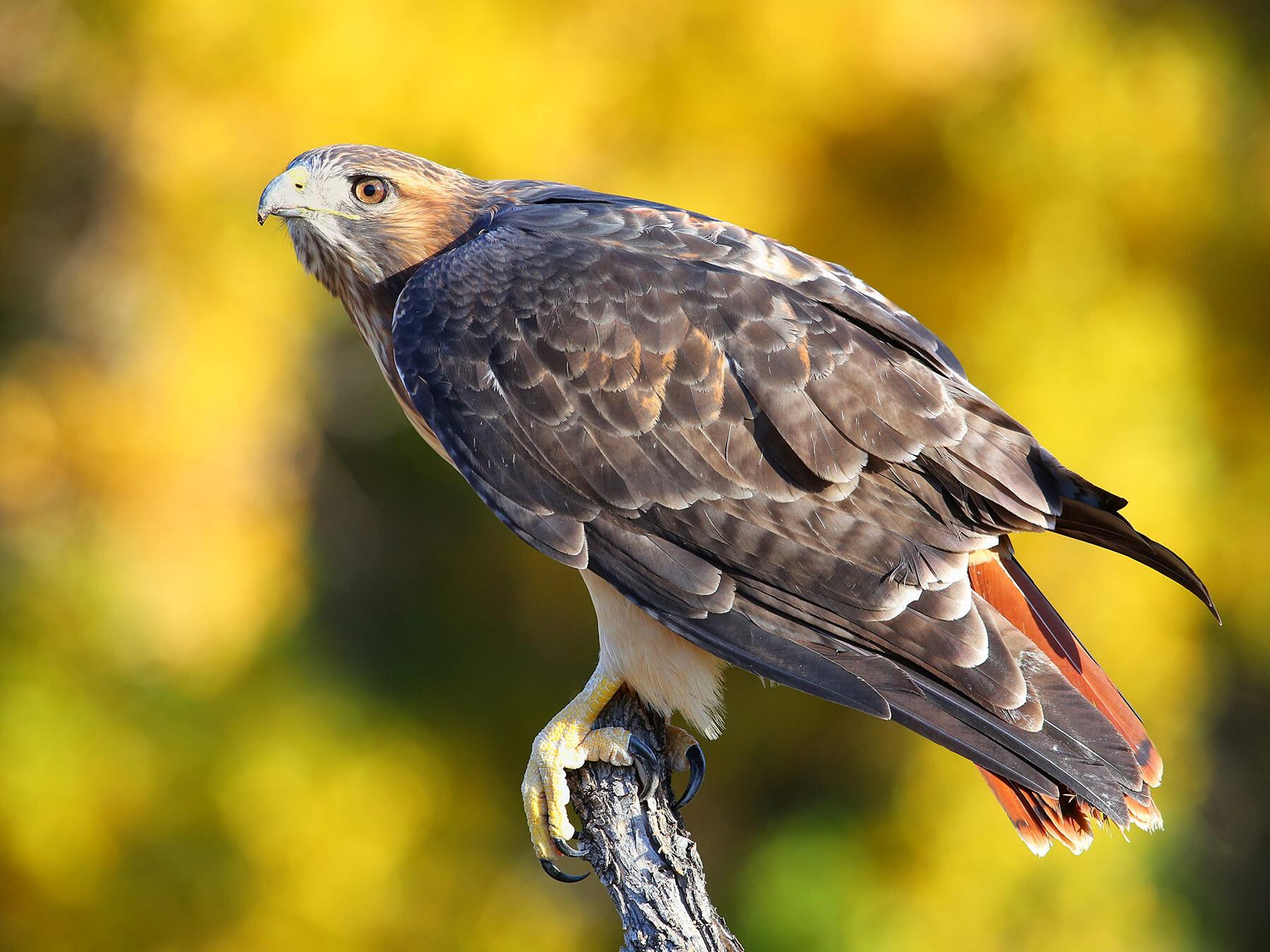
Quick facts
- Length
- 46–59 cm
- Wingspan
- 103–119 cm
- Weight
- 515–1630 g
- Lifespan
- oldest recorded 20 years 5 months
- Family
- Hawks & Eagles
- Migration
- Resident
- Global status (IUCN)
- Least Concern
- World population
- About 920,000 breeding-age birds worldwide (Partners in Flight estimate)
- Population trend
- No range-wide trend found; in the US, the Breeding Bird Survey shows a fall of about 2% a year since 1967, mostly in Texas
- Also called
- Bay-winged Hawk
- Scientific name
- Parabuteo unicinctus
Questions
2Why is it called Harris's Hawk?
John James Audubon named it Buteo harrisi, on a plate dated 1837, after his friend Edward Harris, a fellow ornithologist who had often helped him. His specimen was a female shot between Bayou Sara and Natchez, and he had no information on its habits.37
What is its scientific name?
Parabuteo unicinctus. It was first described in 1824 as Falco unicinctus, from near Boa Vista, Brazil, and it belongs to the hawk family, Accipitridae. It has also been called the Bay-winged Hawk, now the name of the South American form, and was formerly written Harris' Hawk. It has reportedly hybridised with the Red-tailed Hawk, in captivity and in the wild.
Sources
55- 1Clark, W. S. and Seipke, S. H. (2023). Taxonomic status of Bay-winged Hawk Parabuteo (unicinctus) unicinctus and Harris's Hawk P. (u.) harrisi, with documentation of delayed plumage maturation in Bay-winged Hawk. Bulletin of the British Ornithologists' Club 143: 142-152. doi:10.25226/bboc.v143i2.2023.a2 (opens in a new tab)
- 2Dwyer, J. F. and Bednarz, J. C. (2020). Harris's Hawk (Parabuteo unicinctus), version 1.0. Birds of the World (A. F. Poole, editor). Cornell Lab of Ornithology. doi:10.2173/bow.hrshaw.01 (opens in a new tab)
- 3Hamerstrom, F. N. and Hamerstrom, F. (1978). External sex characters of Harris' Hawks in winter. Raptor Research 12: 1-14. doi:10.5281/zenodo.16545706 (opens in a new tab)
- 4Ortega-Alvarez, R. and Calderon-Parra, R. (2014). Hunting the unexpected: Harris's Hawks (Parabuteo unicinctus) preying on bats in a Neotropical megacity. Revista Brasileira de Ornitologia 22: 297-299. doi:10.1007/bf03544264 (opens in a new tab)
- 5Leveau, L. M. (2021). The Harris Hawk (Parabuteo unicinctus) in Urban Areas of Argentina: Arrival in Mar Del Plata City and Green Area Use in Buenos Aires City. Animals 11: 1023. doi:10.3390/ani11041023 (opens in a new tab)
- 6British Ornithologists' Union (2025). The British List: Category E species list (updated 30 November 2025). BOU. Accessed 27 November 2026. Source (opens in a new tab)
- 7Bednarz, J. C. (1988). A Comparative Study of the Breeding Ecology of Harris' and Swainson's Hawks in Southeastern New Mexico. The Condor 90: 311-323. doi:10.2307/1368559 (opens in a new tab)
- 8Figueroa, R. A. R. and Gonzalez-Acuna, D. (2006). Prey of the Harris's Hawk (Parabuteo unicinctus) in a suburban area of southern Chile. Journal of Raptor Research 40: 164-168. doi:10.3356/0892-1016(2006)40[164:pothhp]2.0.co;2 (opens in a new tab)
- 9Santander, F. J., Alvarado, S. A., Ramirez, P. A. and Figueroa, R. A. (2011). Prey of Harris' Hawks (Parabuteo unicinctus) During Autumn and Winter in a Coastal Area of Central Chile. The Southwestern Naturalist 56: 417-422. doi:10.1894/n05-gds-03.1 (opens in a new tab)
- 10Salvador, S. A. (2012). Dieta del Gavilan Mixto (Parabuteo u. unicinctus) en Villa Maria, Cordoba, Argentina. Nuestras Aves 57: 21-23. doi:10.56178/na.vi57.353 (opens in a new tab)
- 11Gomez, R. O. and Lires, A. I. (2015). Dieta del Gavilan Mixto (Parabuteo unicinctus) en un humedal de la Ciudad de Buenos Aires. Nuestras Aves 60: 97-101. doi:10.56178/na.vi60.283 (opens in a new tab)
- 12Verdugo-Murillo, M. M., Flores-Camacho, L. E., De Leon-Giron, G. and Ruiz-Campos, G. (2026). Intraguild feeding of a Harris's Hawk (Parabuteo unicinctus) on a Cooper's Hawk (Astur cooperii) in Baja California, Mexico. The Southwestern Naturalist 70: 1-4. doi:10.1894/0038-4909-70.4.7 (opens in a new tab)
- 13Mader, W. J. (1978). A Comparative Nesting Study of Red-tailed Hawks and Harris' Hawks in Southern Arizona. The Auk 95: 327-337. doi:10.1093/auk/95.2.327 (opens in a new tab)
- 14Bednarz, J. C. and Hayden, T. J. (1991). Skewed Brood Sex Ratio and Sex-Biased Hatching Sequence in Harris's Hawks. The American Naturalist 137: 116-132. doi:10.1086/285149 (opens in a new tab)
- 15Bednarz, J. C. (1987). Successive Nesting and Autumnal Breeding in Harris' Hawks. The Auk 104: 85-96. doi:10.2307/4087237 (opens in a new tab)
- 16Mannan, R. W. (1991). The Role of Territoriality in the Social Organization of Harris' Hawks. The Auk 108: 661-672. doi:10.2307/4088106 (opens in a new tab)
- 17Bednarz, J. C. (1987). Pair and Group Reproductive Success, Polyandry, and Cooperative Breeding in Harris' Hawks. The Auk 104: 393-404. doi:10.2307/4087535 (opens in a new tab)
- 18Clark, W. S. (2017). Group Size of Harris's Hawks (Parabuteo unicinctus) in South Texas. The Wilson Journal of Ornithology 129: 364-368. doi:10.1676/16-030.1 (opens in a new tab)
- 19Mannan, R. W. (1991). Dominance Hierarchies and Helper Contributions in Harris' Hawks. The Auk 108: 649-660. doi:10.2307/4088105 (opens in a new tab)
- 20Vleck, C. M. and Goldsmith, A. R. (1991). Hormonal Correlates of Parental and Helping Behavior in Cooperatively Breeding Harris' Hawks (Parabuteo unicinctus). The Auk 108: 638-648. doi:10.2307/4088104 (opens in a new tab)
- 21Bednarz, J. C. (1988). Cooperative Hunting Harris' Hawks (Parabuteo unicinctus). Science 239: 1525-1527. doi:10.1126/science.239.4847.1525 (opens in a new tab)
- 22Poplin, B. et al. (2026). Complex habitat promotes adaptive sociality of Parabuteo unicinctus (Harris's Hawk) in south Texas. Ornithology. doi:10.1093/ornithology/ukag063 (opens in a new tab)
- 23Jimenez, J. E. and Jaksic, F. M. (1993). Observations on the comparative behavioral ecology of Harris' Hawk in central Chile. Journal of Raptor Research 27: 143-148. Accessed 27 November 2026.
- 24Lorenzi, J. E., Casale, A. I. and Borgnia, M. (2026). Manipulacion de objetos inanimados en juveniles de Gavilan Mixto (Parabuteo unicinctus) en ambientes urbanos de la provincia de Buenos Aires, Argentina. Nuestras Aves 71. doi:10.56178/na.v71i.1199 (opens in a new tab)
- 25USGS Bird Banding Laboratory. Longevity records: Harris's Hawk (AOU 3350), current table. Bander Portal. Accessed 27 November 2026. Source (opens in a new tab)
- 26Dwyer, J. F. (2006). Electric shock injuries in a Harris's Hawk population. Journal of Raptor Research 40: 193-199. doi:10.3356/0892-1016(2006)40[193:esiiah]2.0.co;2 (opens in a new tab)
- 27BirdLife International (2024). Parabuteo unicinctus. The IUCN Red List of Threatened Species 2024. IUCN Red List (via GBIF's IUCN checklist dataset). Accessed 27 November 2026. Source (opens in a new tab)
- 28Partners in Flight (2024). Avian Conservation Assessment Database, version 2024.05.23 (global). Accessed 27 November 2026. Source (opens in a new tab)
- 29Hostetler, J. A. et al. (2026). The North American Breeding Bird Survey, Analysis Results 1966 - 2025. doi:10.5066/P1OSNSFC (opens in a new tab)
- 30NatureServe. Parabuteo unicinctus (ELEMENT_GLOBAL.2.105646). NatureServe Explorer. Accessed 27 November 2026. Source (opens in a new tab)
- 31Patten, M. A. and Erickson, R. A. (2000). Population fluctuations of the Harris' Hawk (Parabuteo unicinctus) and its reappearance in California. Journal of Raptor Research 34: 187-195. doi:10.5281/zenodo.16182242 (opens in a new tab)
- 32US Fish and Wildlife Service (2026). 50 CFR 10.13 List of Birds Protected by the Migratory Bird Treaty Act. eCFR. Accessed 27 November 2026. Source (opens in a new tab)
- 33US Fish and Wildlife Service. ECOS species search: Parabuteo unicinctus. Environmental Conservation Online System. Accessed 27 November 2026. Source (opens in a new tab)
- 34SEMARNAT (2010). NOM-059-SEMARNAT-2010 (2010 list) and the 2019 modification of Annex III. Accessed 27 November 2026. Source (opens in a new tab)
- 35CITES Secretariat and UNEP-WCMC. Species+: Parabuteo unicinctus (taxon concept 3634). Species+. Accessed 27 November 2026. Source (opens in a new tab)
- 36UK Parliament (1981). Wildlife and Countryside Act 1981, section 14 and Schedules 1, 4 and 9 (England and Wales text). legislation.gov.uk. Accessed 27 November 2026. Source (opens in a new tab)
- 37Audubon, J. J. (1840). The Birds of America, octavo edition, vol. 1. Internet Archive (birdsofamericafr01audu), OCR text. Accessed 27 November 2026. Source (opens in a new tab)
- 38AviList Core Team (2025). AviList: The Global Avian Checklist, v2025b. Accessed 27 November 2026. Source (opens in a new tab)
- 39Cornell Lab of Ornithology. Harris's Hawk: Overview, Identification and Life History. All About Birds. Accessed 27 November 2026. Source (opens in a new tab)
- 40National Audubon Society. Harris's Hawk. Audubon Guide to North American Birds (text adapted from Kenn Kaufman, Lives of North American Birds, 1996). Accessed 27 November 2026. Source (opens in a new tab)
- 41Preston, C. R. and Beane, R. D. (2024). Red-tailed Hawk (Buteo jamaicensis), version 1.1. Birds of the World. Cornell Lab of Ornithology. Accessed 27 November 2026. Source (opens in a new tab)
- 42Bechard, M. J., Houston, C. S., Sarasola, J. H. and England, A. S. (2020). Swainson's Hawk (Buteo swainsoni), version 1.0. Birds of the World. Cornell Lab of Ornithology. Accessed 27 November 2026. Source (opens in a new tab)
- 43Dykstra, C. R., Hays, J. L. and Crocoll, S. T. (2020). Red-shouldered Hawk (Buteo lineatus), version 1.0. Birds of the World. Cornell Lab of Ornithology. Accessed 27 November 2026. Source (opens in a new tab)
- 44Johnson, L. S. and Schnell, J. H. (2024). Common Black Hawk (Buteogallus anthracinus), version 2.1. Birds of the World. Cornell Lab of Ornithology. Accessed 27 November 2026. Source (opens in a new tab)
- 45Johnson, R. R., Glinski, R. L. and Matteson, S. W. (2020). Zone-tailed Hawk (Buteo albonotatus), version 1.0. Birds of the World. Cornell Lab of Ornithology. Accessed 27 November 2026. Source (opens in a new tab)
- 46van Dort, J. (2020). Great Black Hawk (Buteogallus urubitinga), version 1.0. Birds of the World. Cornell Lab of Ornithology. Accessed 27 November 2026. Source (opens in a new tab)
- 47Bierregaard, R. O. and Kirwan, G. M. (2020). Savanna Hawk (Buteogallus meridionalis), version 1.0. Birds of the World. Cornell Lab of Ornithology. Accessed 27 November 2026. Source (opens in a new tab)
- 48Bierregaard, R. O., Boesman, P. F. D., de Juana, E. and Marks, J. S. (2020). White-rumped Hawk (Parabuteo leucorrhous), version 1.0. Birds of the World. Cornell Lab of Ornithology. Accessed 27 November 2026. Source (opens in a new tab)
- 49Bednarz, J. C. and Ligon, J. D. (1988). A Study of the Ecological Bases of Cooperative Breeding in the Harris' Hawk. Ecology 69: 1176-1187. doi:10.2307/1941272 (opens in a new tab)
- 50Vleck, C. M. and Dawson, J. (1991). Plasma Luteinizing Hormone, Steroid Hormones, Behavioral Role, and Nest Stage in Cooperatively Breeding Harris' Hawks (Parabuteo unicinctus). The Auk 108: 619-637. doi:10.2307/4088103 (opens in a new tab)
- 51Dwyer, J. F. and Mannan, R. W. (2009). Return Rates of Aluminum Versus Plastic Leg Bands from Electrocuted Harris's Hawks (Parabuteo unicinctus). Journal of Raptor Research 43: 152-154. doi:10.3356/jrr-08-44.1 (opens in a new tab)
- 52Boal, C. W. and Dwyer, J. F. (2018). Harris's Hawks: All in the Family. Urban Raptors (book chapter): 126-137. doi:10.5822/978-1-61091-841-1_9 (opens in a new tab)
- 53Clark, W. S. (2022). Atypical molt sequences among primaries of Harris's Hawks (Parabuteo unicinctus harrisi) in south Texas. The Wilson Journal of Ornithology 134: 699-702. doi:10.1676/22-00028 (opens in a new tab)
- 54Brighton, C. H. and Taylor, G. K. (2019). Hawks steer attacks using a guidance system tuned for close pursuit of erratically manoeuvring targets. Nature Communications 10. doi:10.1038/s41467-019-10454-z (opens in a new tab)
- 55Colbert-White, E. N., McCord, E. M., Sharpe, D. I. and Fragaszy, D. M. (2013). String-pulling behaviour in a Harris's Hawk Parabuteo unicinctus. Ibis 155: 611-615. doi:10.1111/ibi.12040 (opens in a new tab)

Checked by
Nathan Cope, founder and editor
Nathan founded Birdfact and leads its writers and contributors in the UK, the US and Canada. He has watched and studied birds for more than ten years, and checks every article and species guide before it’s published.