


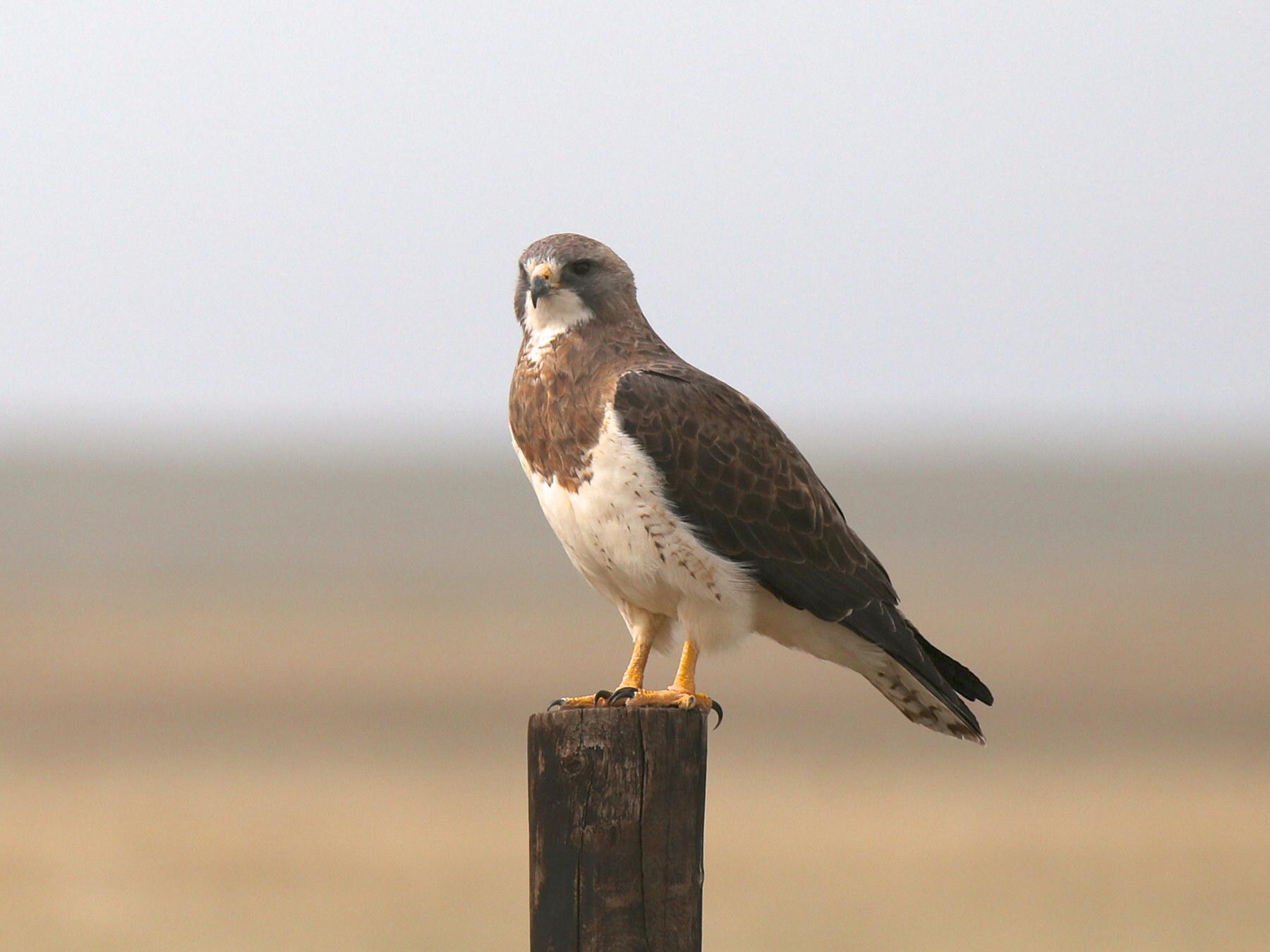
Swainson's Hawk
Buteo swainsoni
By the Birdfact teamChecked by Nathan Cope
On this page13 sections
How to recognise it
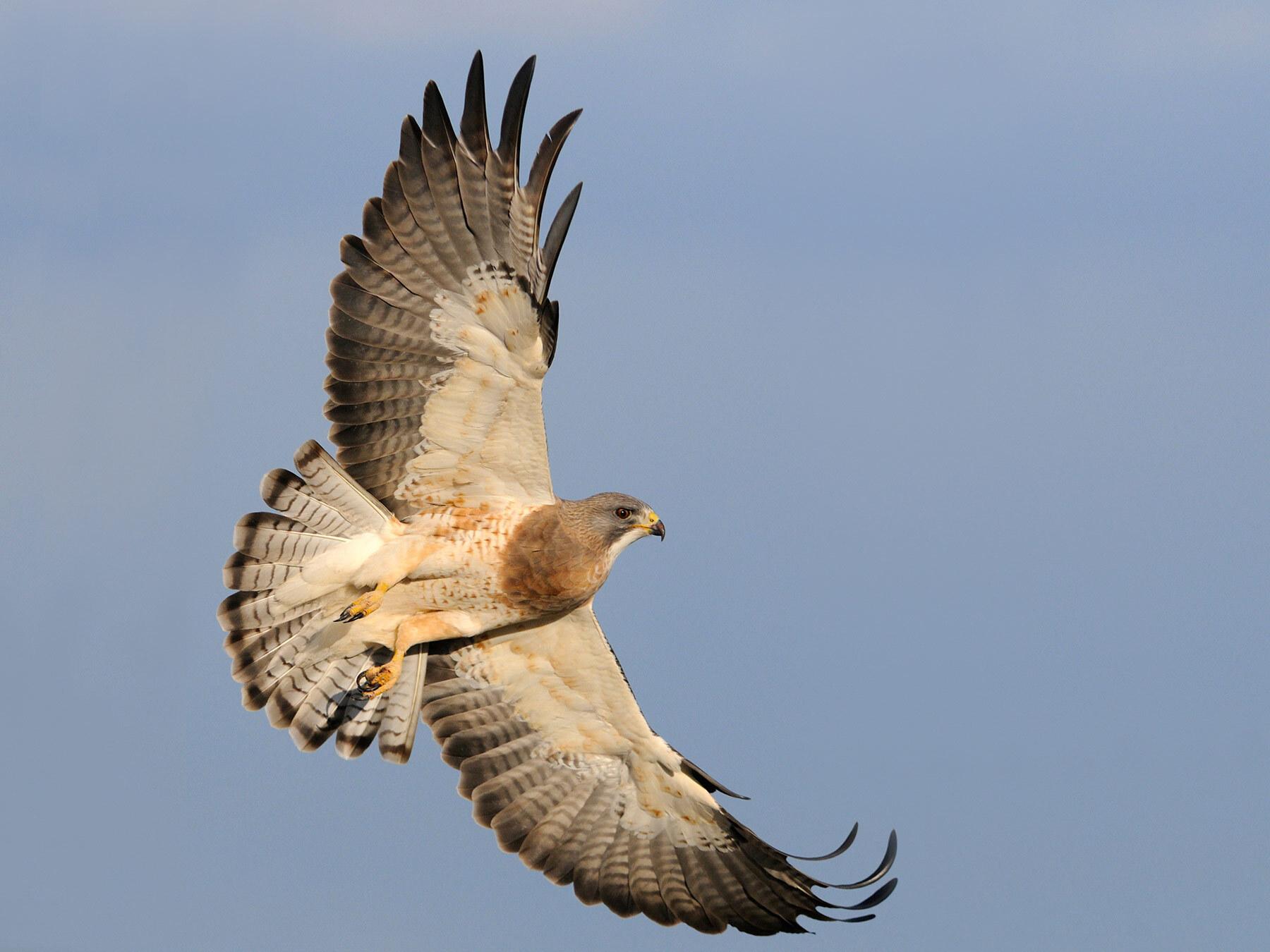
Look for a slender, long-winged hawk over open grassland and farmland in the West. A light adult, the form of nearly every bird that breeds east of the Rocky Mountains, has a white throat, a dark brown or rufous bib across the upper breast and a pale belly. From below, its pale wing linings contrast with dark flight feathers, and it soars with its long, pointed wings raised in a shallow V.
It belongs to the genus Buteo, like the Red-tailed Hawk, but it is slimmer than the other North American species, with narrower wings that reach or just pass the tail tip when it perches. Plumage runs from light through rufous to almost wholly dark brown, so shape and the underwing pattern matter as much as color.
Size and weight
A Swainson's Hawk is 18.9-22.0 in (48-56 cm) long, with a wingspan of about 46-51 in (117-130 cm), and breeding adults weigh 1.5-3.0 lb (693-1,367 g). That puts it between a crow and a goose in size, larger than a Cooper's Hawk and smaller than a Ferruginous Hawk. Females are larger and heavier than males.
Males measure 18.9-20.1 in (48-51 cm) long and females 20.1-22.0 in (51-56 cm). Among breeding adults weighed in Alberta, males averaged 28.5 oz (808 g) and ranged 24.4-33.0 oz (693-936 g), while females averaged 39.1 oz (1,109 g) and ranged 33.1-48.2 oz (937-1,367 g), so the two sexes did not overlap. In the hand, a sexing study separated the sexes mainly by body mass, wing chord and foot-pad length.1
Light, intermediate and dark plumages
Swainson's Hawks are usually sorted into light, intermediate (rufous) and dark morphs, but birds grade almost continuously from the palest to the darkest, so the labels are a convenience rather than sharp classes.
A light adult has a white chin and a whitish forehead above the white throat, a bib that may be rufous-brown or gray-brown, a whitish belly and plain gray-brown upperparts. Under the wing, white linings set off dark gray flight feathers, which form a broad dark trailing edge. The gray tail is crossed by many narrow bars, with a wider dark band near the end and a white tip.
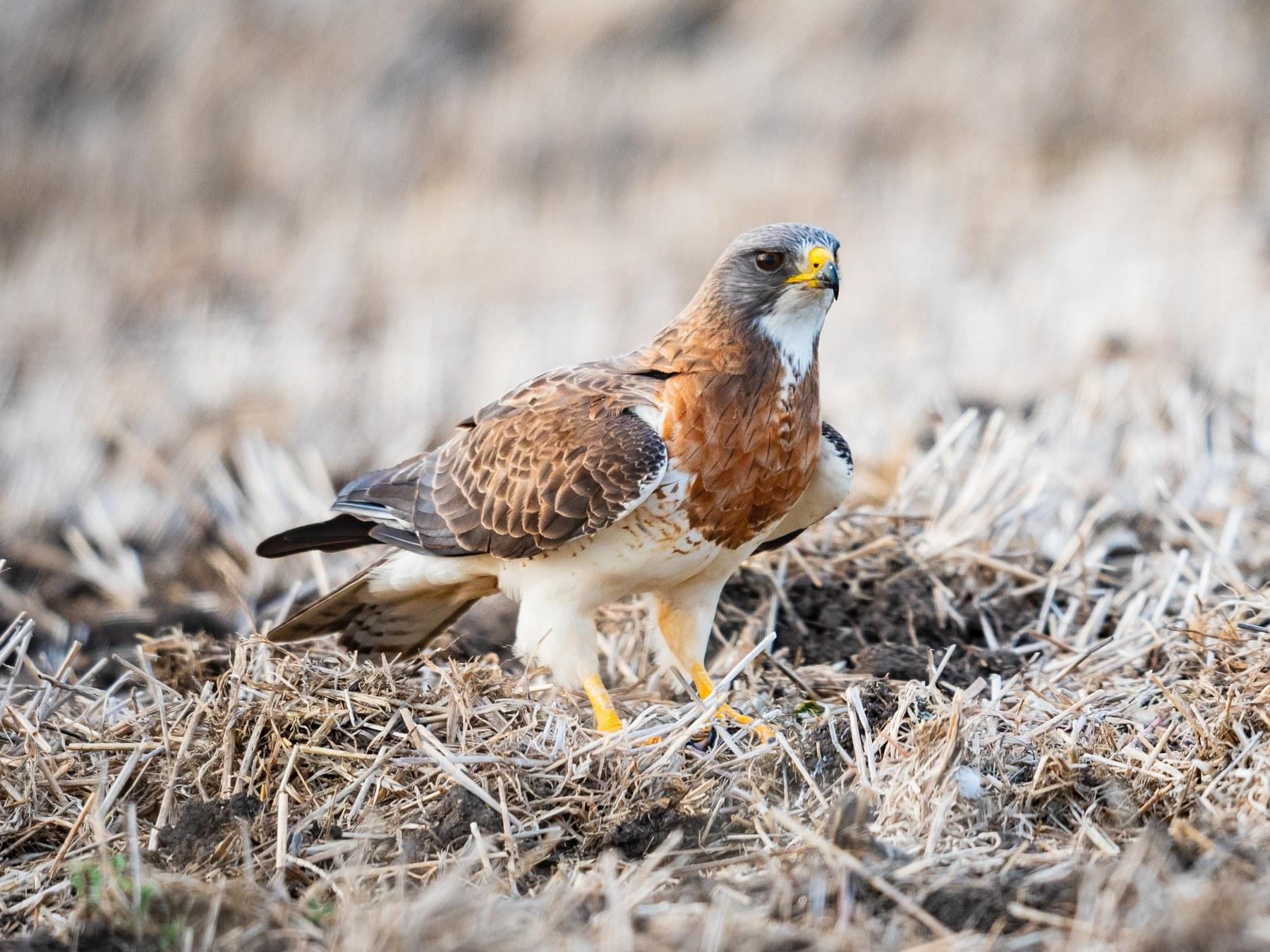
An intermediate adult keeps a dark gray or brown band across the upper breast, but below it the breast and belly are rufous, plain or barred, and the wing linings run from whitish to rufous. Birds that are rufous all over are exceptional, though they turn up more often in California's Central Valley.
Where each form occurs varies. Nearly all birds breeding east of the Rockies are light. In the West darker birds are commoner, though still a minority, upwards of 10% of birds by one estimate.2 In California there are far more: roughly 35% in the north of the state and, in the northeast, about 70% of females and 40% of males; among 15 breeding pairs there, 89% of light birds were males but only 33% of dark birds.1 In one breeding population studied for 32 years, 7% of birds were light, 57% intermediate and 36% dark, and the study found no difference between the morphs in survival or breeding success.3 Color appears to be inherited: in a test of 31 adults against their parents, every bird fitted a simple one-gene, two-version pattern, which the authors put forward as a hypothesis.4
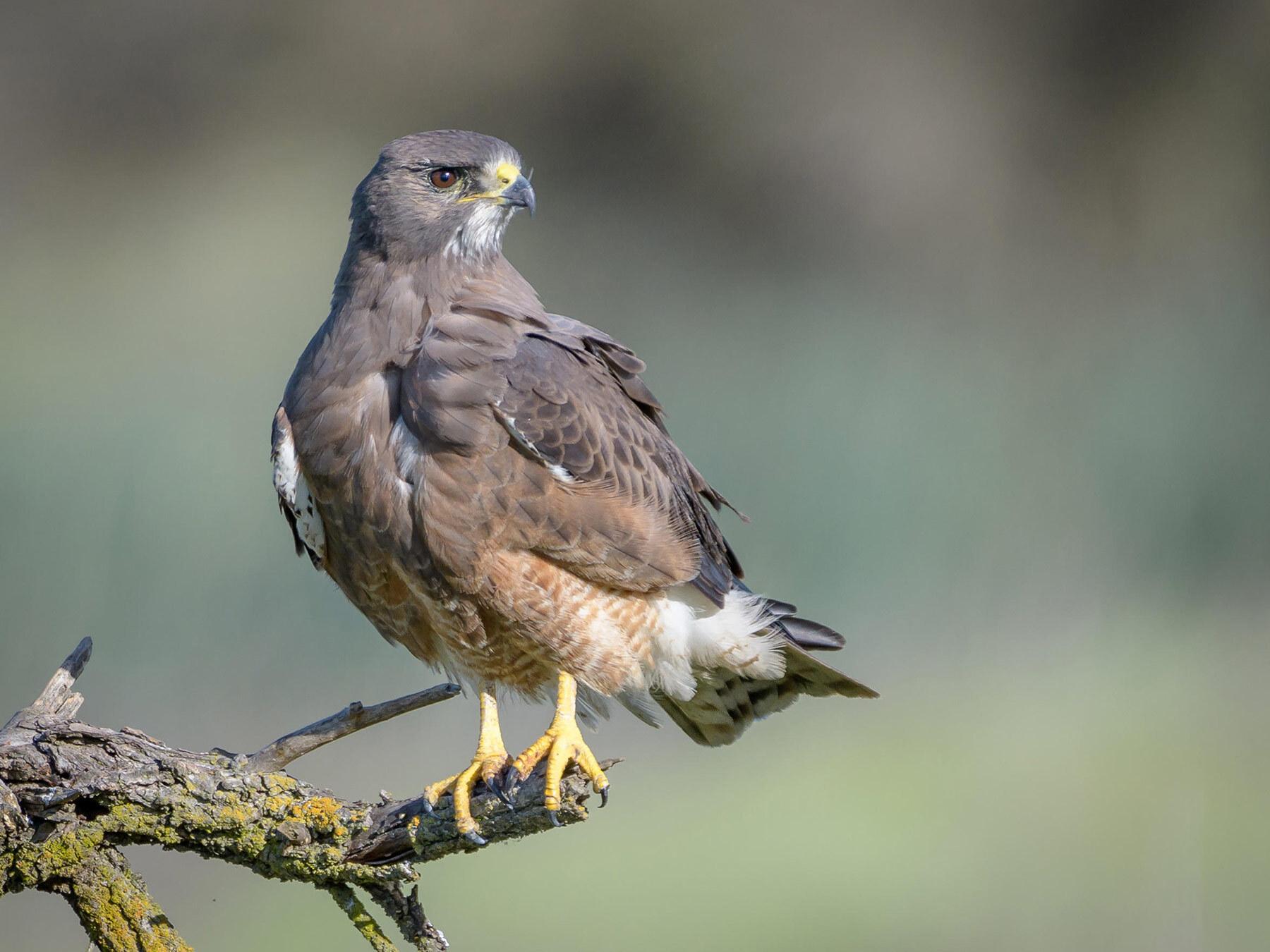
Dark plumage
A dark adult is blackish brown on the body, and its face shows little or no white. The wing linings vary from whitish mottled with rufous to blackish, often with a rufous tone, and the darkest birds lose the sharp light-and-dark contrast under the wing. The undertail coverts stay pale, barred with dark brown, and stand out against the dark belly.
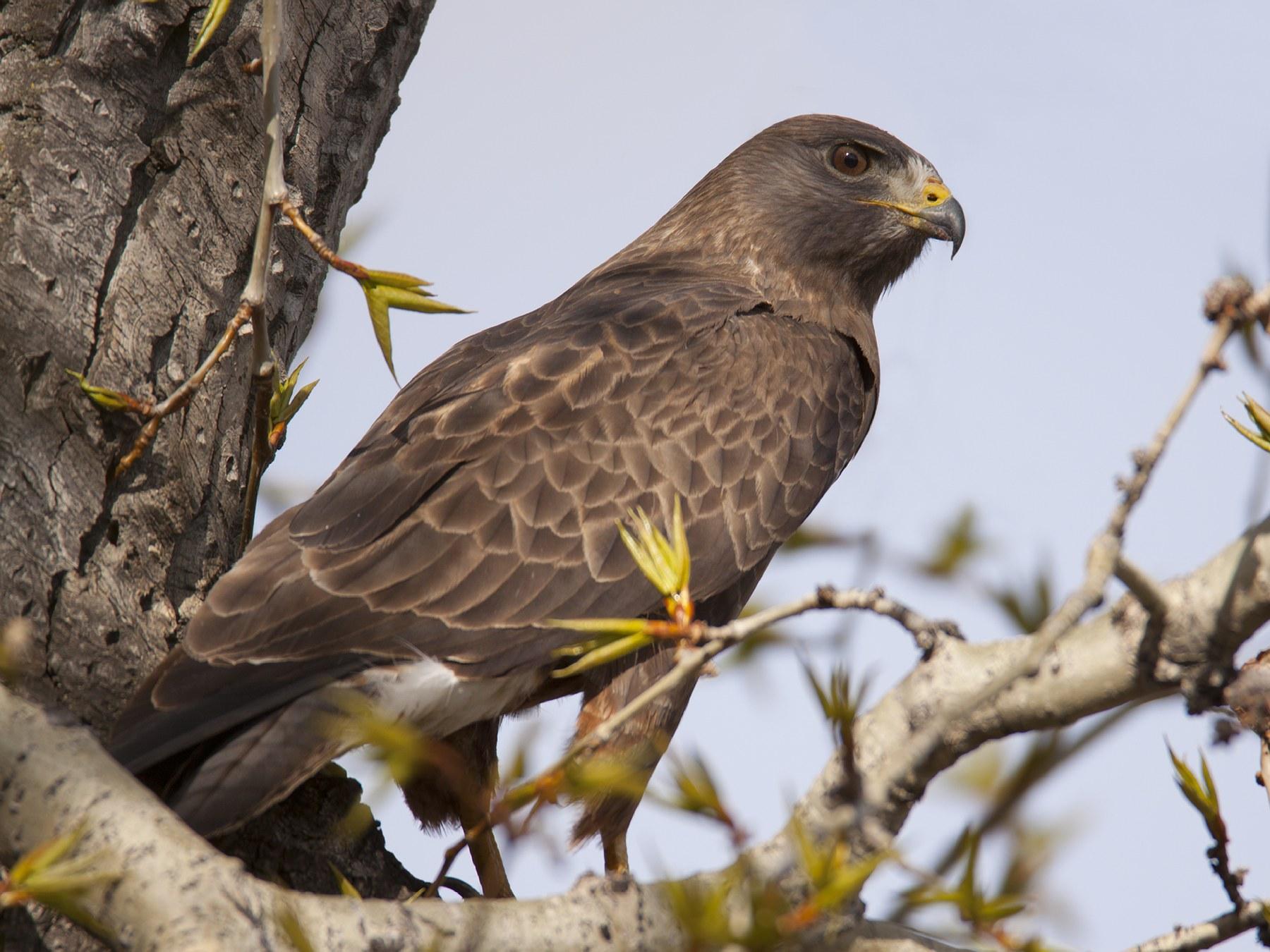
Male, female and juvenile
The sexes look much alike. Males tend to have grayer heads and rufous bibs, and females browner bibs, heavier markings below, more distinct tail bars and a wider dark band near the tail tip, but these are tendencies rather than a rule; size is the clearer difference.
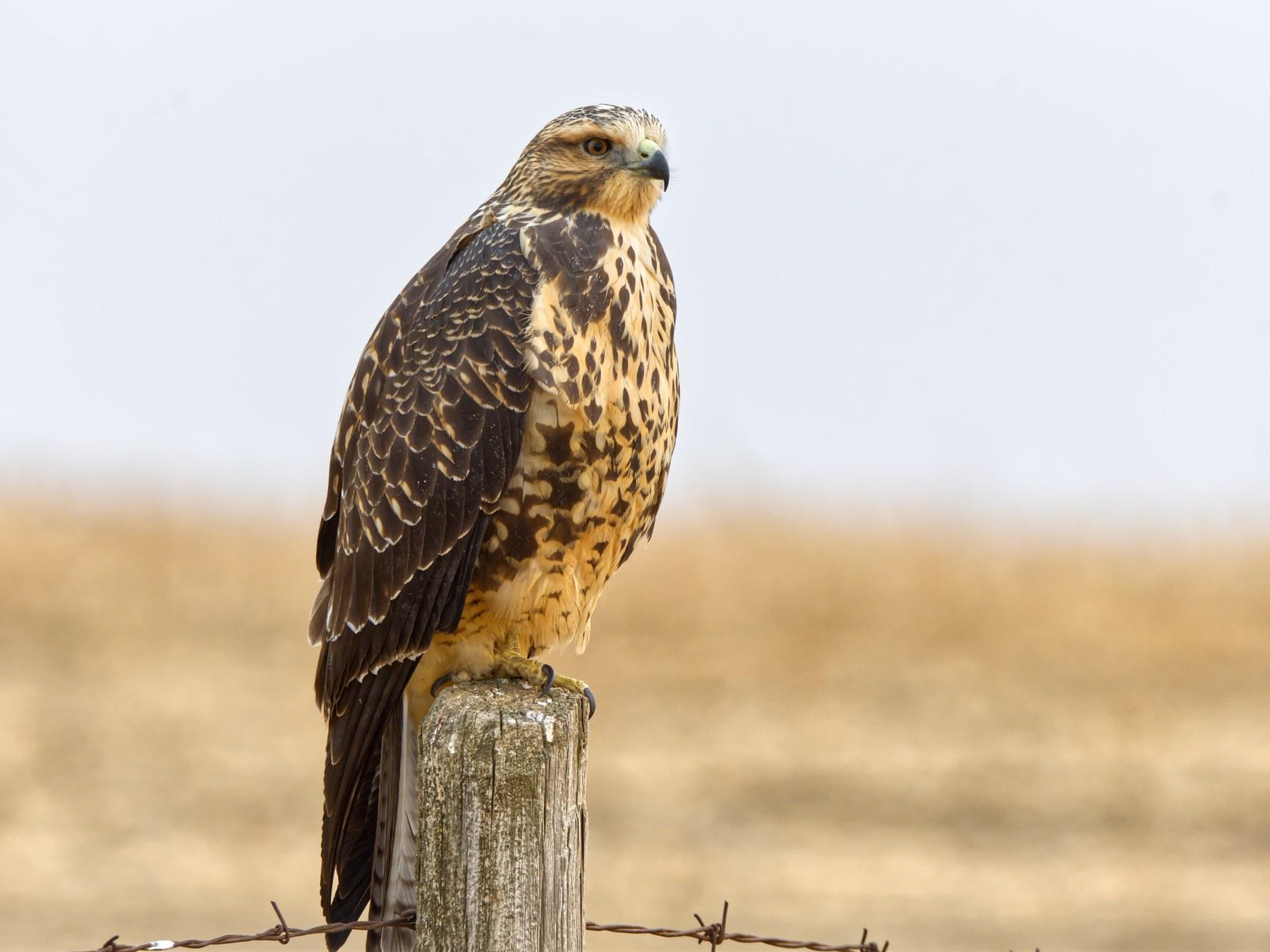
Juveniles, birds in their first plumage, have no solid bib. They are streaked dark below, with large, rounded spots that are heaviest on the sides of the breast, and light juveniles have a largely unmarked lower belly. A pale eyebrow and pale cheeks frame a dark mustache stripe, pale feather edges give the upperwing a scaly look, and the dark trailing edge and tail band are narrower and fainter than an adult's. The head often bleaches pale by spring. Dark juveniles are never solidly dark below in their first two years: they keep pale streaking and whitish undertail coverts.
Most birds reach adult plumage after their third molt and some after their second, and three age classes can often be told apart in the field; there is no separate breeding or winter plumage. The eye darkens with age, from gray or blue-gray in juveniles to yellowish later in the first year, pale brown in the second and dark brown to reddish brown in adults. Wing molt is slow: adults may begin during incubation, pause while feeding chicks, carry on during the southward migration and finish in South America. Some presumed one-year-olds are very pale, almost white, and up to 200 such birds were reported in late June and early July 1997 between Weyburn and Regina, Saskatchewan.5
Identification in flight
Overhead, look for long, tapered, pointed wings and, on a light bird, the two-toned underwing of pale linings and dark flight feathers. It soars with its wings raised in a shallow V, like a Turkey Vulture or a Zone-tailed Hawk. In a thermal it circles with wings and tail spread, then draws its wings back and glides down at a low angle, and when hunting it often hovers or hangs in the wind, especially in moderate to strong winds.
Close views add two more marks. Only three outer primaries are notched, where most North American buteos have four, and the legs are feathered only halfway down.
Identification: Red-tailed Hawk and other lookalikes
Against a Red-tailed Hawk, look at shape and the underwing. A Red-tailed is stouter, with broader wings; adults have a reddish tail, light birds show a dark bar along the leading edge of the underwing, and it has four notched outer primaries to the Swainson's three.
A Broad-winged Hawk is much smaller; adults have a black tail with one broad white band and a blackish trailing edge to the wing, and dark birds have dark linings against silvery flight feathers, the reverse of a light Swainson's pattern. A Ferruginous Hawk is bigger and bulkier, with a large head and legs feathered to the toes; pale adults have a whitish tail and almost white underparts, the dark legs making a rufous V. A Rough-legged Hawk also has legs feathered to the toes and hovers habitually; light birds have silvery-white flight feathers below with dark tips, where a light Swainson's has dark flight feathers against pale linings.
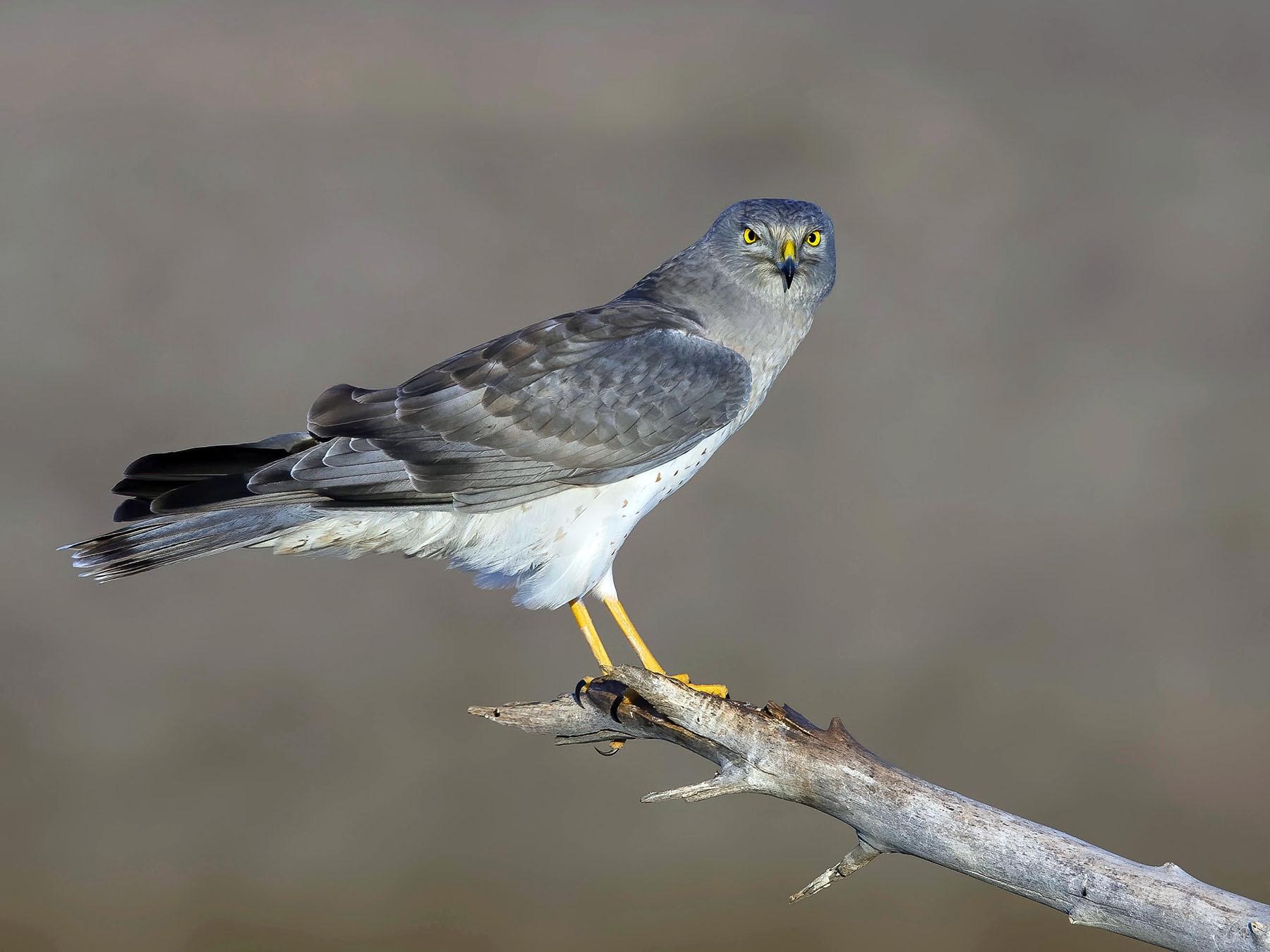
Dark birds bring in other species. A Turkey Vulture is bigger, with a small bare head, red in adults, and silvery flight feathers against blackish linings, and it rocks from side to side on raised wings; a dark Swainson's has a feathered head and a pale undertail. A Zone-tailed Hawk is slaty black all over, with black linings against pale, finely barred flight feathers and, in adults, two or three pale tail bands, and it tilts in flight like a Turkey Vulture. An adult White-tailed Hawk has a white tail with a broad black band near the tip and no breast band, and its wingtips reach past its short tail when perched. A Northern Harrier also flies with its wings in a shallow V, but it has a white rump in every plumage, an owl-like face and a long tail, and it flies low over open ground.
Not sure it’s a Swainson's Hawk? Check your photo: Birdfact names the bird and shows the look-alike side by side.
Its size
Adults- Length
- 48–56 cm
- Wingspan
- 117–130 cm
- Weight
- 693–1367 g
Its song and calls
The Swainson's Hawk has no song in the songbird sense, and we found no paper devoted to its calls. Its main call is a long, shrill, plaintive scream that fades at the end, written kreeeee or kree-e-e. Both sexes give it, in flight or from a perch, above all at intruders near the nest, and the female's version is shorter and lower than the male's.1
It has other calls too: a call in boundary disputes and a soft weeeee during mating. Chicks and young birds out of the nest beg whenever they see an adult carrying prey. Away from the nesting season it is mostly silent, though some birds call when flushed from their roosts in Argentina, and in summer it calls most from early to late morning.
- Call0:00 / 0:22
Recorded in Oregon, United States · July 2025
- Young bird begging0:00 / 0:04
Recorded in Arizona, United States · August 2019
- Calls in flight0:00 / 0:12
Recorded in Montana, United States · May 2017
Heard one and not sure? Let the bird song identifier listen.
When and where to see it
Swainson's Hawks breed across western North America, from the Canadian prairies (southern Alberta, Saskatchewan, southwestern Manitoba and interior British Columbia) south through the Great Plains and Great Basin to northern Mexico. The range reaches east to western Minnesota, northern Iowa and central Texas, and a separate population lives in California's Central Valley. They need open country: grassland, prairie, sparse shrubland and farmland, with scattered trees to nest in, and they have taken well to hay, alfalfa, pasture and grain fields. A few pairs nest in Central Valley towns such as Davis and Stockton.
The range has changed. They no longer breed in coastal southern California or the central Coast Ranges, and by 1980 they were essentially gone from the Mojave Desert. East of the breeding range they are very rare. Sightings at eastern hawk watches have increased since the 1970s, which may reflect more birdwatchers or a real change; a handful reach the Atlantic coast each fall.1 In Mexico, evidence from seven nests in the Yaqui Valley of southern Sonora in 2023-2025 moved the southern edge of the known breeding range more than 155 miles (250 km) farther south.6
How far does it migrate?
Nearly every Swainson's Hawk leaves North America each fall, and most spend the northern winter on the pampas of central Argentina and nearby Uruguay. From the Canadian prairies that is more than 6,200 miles (10,000 km) each way, and a round trip can pass 12,400 miles (20,000 km), one of the longest made by any North American raptor.7, 1
Satellite tags have measured the journey. In one analysis of 34 breeding hawks tagged across nine states and provinces, 27 tracked south averaged about 8,400 miles (13,504 km) over 51 days (46-58), leaving 28 September-10 October, and 19 tracked north averaged about 7,400 miles (11,952 km) over 60 days (43-75).8 A later analysis, of 46 adults tagged in 1995-98, found that hawks left between mid-August and mid-October and took 42-98 days to fly south and 51-82 to return; 36% left about three weeks early and made stopovers of 9-26 days on the way.9
The routes converge. Hawks set off on a broad front, meet on the Gulf coast of eastern Mexico, follow a narrow corridor through Central America, cross the Andes in Colombia and carry on east of the Andes to central Argentina. They travel by day in flocks that can reach 5,000-10,000 birds, soaring on thermals and seldom crossing water, and most pass through Central America in about two weeks each way, alongside Broad-winged Hawks and Turkey Vultures. Up to about 845,000 were counted passing Veracruz, Mexico, in the fall of 1996, though such counts should not be used as an index of the whole population.1
Not every population takes that road. Twenty hawks from California's Central Valley, tracked in 2011-2015, wintered anywhere from western Mexico to central South America, on routes the authors describe as markedly different from the rest of the species.10 A few birds winter in North America: about 30 a year in California's Sacramento-San Joaquin delta in the early 1990s, and a few in Florida.1
Before leaving, flocks of hundreds of young birds and adults gather in late August and early September to fatten on grasshoppers. Older accounts said the hawks then fast on the journey. A 2006 study weighed adults in southern Idaho before they left in September and other adults on arrival in Argentina. Males averaged 30.8 oz (872 g) at departure and 26.8 oz (759 g) on arrival, and females 39.9 oz (1,131 g) and 32.9 oz (933 g), a smaller drop than the fasting model predicted.8 The authors concluded that the fasting idea should be modified to allow for lower energy use on migration or feeding at stopovers.8
In Argentina, flocks mix birds from many breeding areas: banded and satellite-tagged hawks from California, Idaho, Colorado, Alberta and Saskatchewan shared the same areas.1 The flocks break up from mid-February and head north from late February to mid-March, and most birds are back in Alberta and Saskatchewan between late April and 10 May.
Spotting tips
In summer, scan open grassland and farmland in the West and on the Great Plains for a slim hawk soaring with its wings in a V, hanging in the wind or walking in a field, and check any field where a tractor is at work. In late summer, flocks gather to feed on grasshoppers before they leave.
What it eats
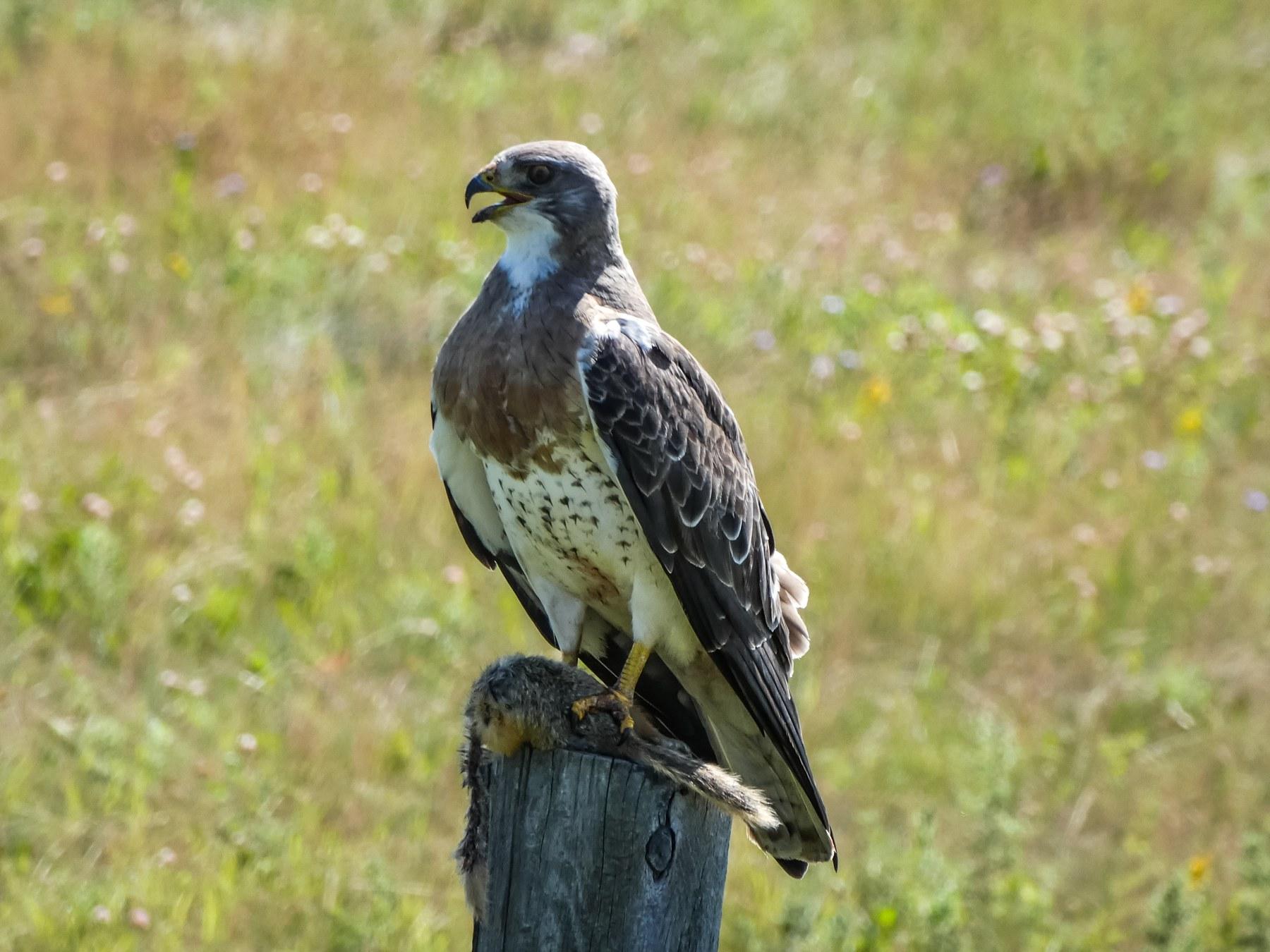
In the nesting season the Swainson's Hawk eats mostly small mammals, chiefly ground squirrels, pocket gophers, voles, mice and rabbits, with some reptiles and birds. For the rest of the year it lives almost entirely on insects, especially grasshoppers, crickets and dragonflies, a seasonal switch that is almost unique.
The mammals vary from place to place. In southern Alberta, Richardson's ground squirrels averaged 89% of prey items at nests, 97% of them young squirrels; rabbits made up more than half the prey in a Utah study, and Burrowing Owls were a major prey near Hanna, Alberta.1 At 12 nest cameras in northern California in 2013-2018, mammals made up 88.2% of 466 prey deliveries and 97.1% of the estimated biomass, with pocket gophers and voles together nearly half.11 In south-central North Dakota, northern pocket gophers were 44% of the animal remains found at nests.12
Insects can be as much as 90% of food items by number but far less by weight. Invertebrates were up to 94% of 3,428 items in the stomachs of non-breeding North American birds, a single hawk can eat an average of about 100 grasshoppers a day, and one Kansas bird held 98 crickets in its crop and 132 in its stomach.1 In Argentina it eats grasshoppers, beetles, caterpillars and dragonflies; one study in Buenos Aires province found over 90% dragonflies, and observers near Córdoba in 1997 saw it take no mammals, birds or reptiles.13, 1
It is not a feeder bird, and nothing we read recommends any food for it.
How it feeds: on foot, from perches and on the wing
The Swainson's Hawk hunts from perches, on the wing and on foot. It drops onto prey from a lookout, soars or hovers over open ground, and walks and runs easily, head low and wings often half raised, chasing grasshoppers and crickets. For pocket gophers it waits beside a fresh mound, then pounces stiff-legged on the mound and pulls the gopher out.
It also snatches flying insects with its feet and eats them in the air. In Argentina, a review gives 61% of 236 attempts to catch insects as aerial, mostly around midday, with the rest on the ground early and late in the day.14
Farm work brings it in. It has long followed farm machinery, from horse-drawn implements to tractors, to catch the rodents and insects they disturb, and it gathers at fields being harvested, plowed, irrigated or burned, and at flood-irrigated alfalfa, sometimes 100 or more at sprinkler systems in California's Central Valley.1 Plant cover matters: in a 1982 study, cultivated fields full of prey went unhunted until the harvest thinned the crop, and in California's Central Valley hawks used vineyards less often than their area would predict, and irrigated hay and dry-farmed grain more often.15, 16
Nesting and breeding
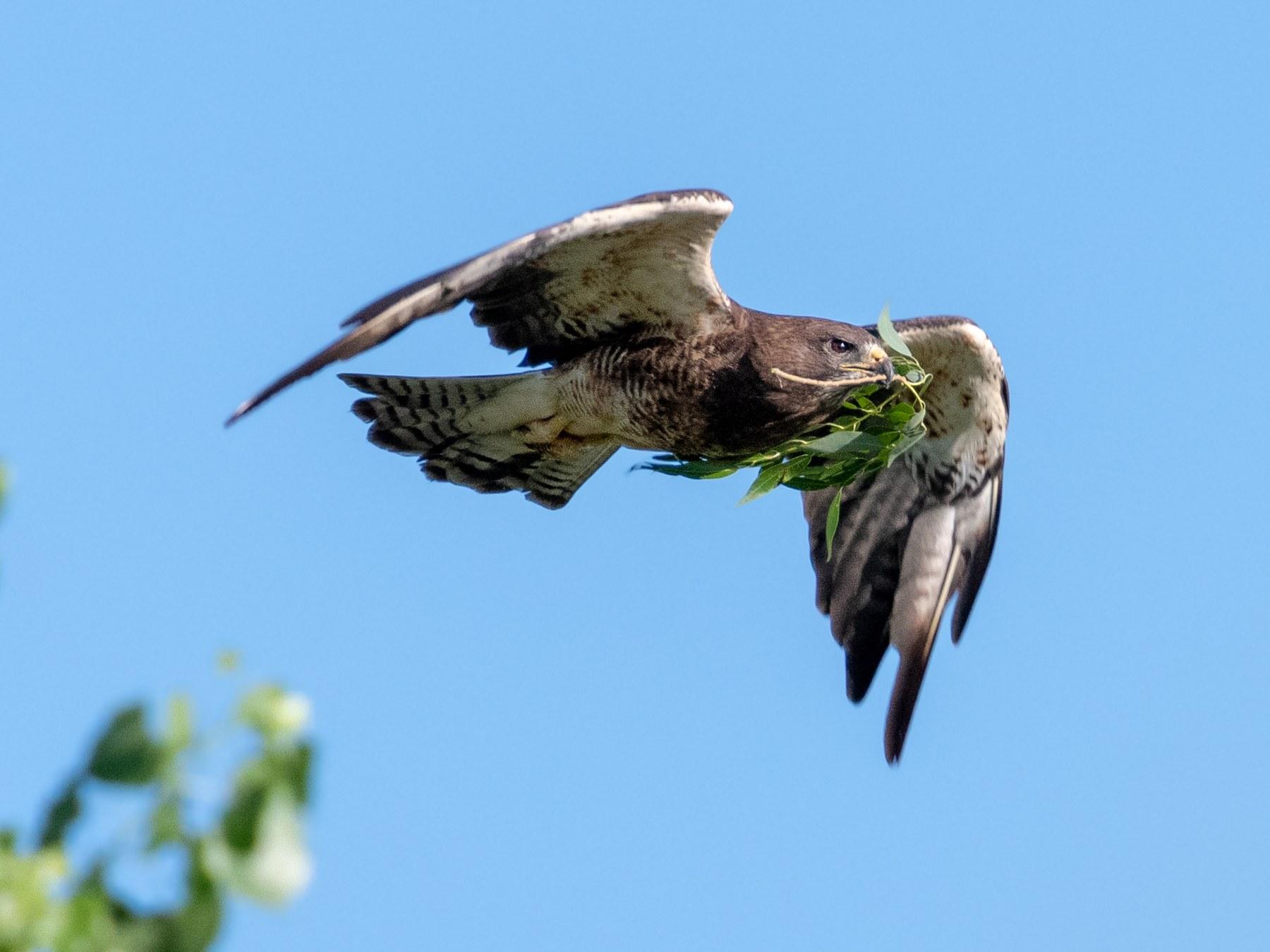
Swainson's Hawks nest in a lone tree or bush, a small clump or a row of streamside trees, often in farm shelterbelts or around homesteads and sometimes on power or telephone poles, usually 15-30 ft up. Both birds build, the male bringing most of the material: a rather flimsy platform of sticks lined with leafy twigs, grass and bark, about 2 ft (60 cm) across, and some nests are used again. In Cimarron County, Oklahoma, 71% of nests were in planted Siberian elms, and in southeastern Arizona mesquite and cottonwood made up over half of 167 nest trees.1, 17
Laying starts from early March to late April in Arizona, New Mexico, Oklahoma and Texas, from late April to late May farther north and west, and from late May to mid-June in British Columbia and Saskatchewan. The clutch is typically 1-4 eggs, usually 2 or 3, and clutches of five are rare. The eggs are about 2.2 in (57 mm) long and off-white, about a fifth of them plain and the rest lightly marked with reddish-brown or purplish blotches. The female does almost all the incubating, for 34-35 days from the first egg, while the male brings her food. Pairs raise one brood a year, and replacement clutches are rare.
Raising the young
The female does nearly all the brooding while the male brings most of the food, though she hunts more as the chicks grow. The young first fly at 38-46 days, 43 on average. They stay near the nest for 7-10 days and with their parents for about a month, then leave the territory, and adults and young migrate separately. Most birds do not breed until they are at least three years old.
The youngest chick, or the two youngest of three, often dies, and most nestling deaths are from starvation, sometimes after attacks by siblings. In a southeastern Washington study, the remains of partly eaten chicks lay in 10 of 16 nests in 1978, and in 15 of 26 in 1979; the killing of chicks by their siblings may be linked to food supply, but its cause is unknown.1
Nest success varies by place and year: 64% in North Dakota, with 1.5 young per occupied nest, 44-58% in southeastern Arizona, 44% at Janos, Chihuahua, in 2006, and 65.5% a year on average in northeastern California.12, 17, 18, 1 In the Dakotas in 2013-2014, nests nearer farm sites survived better, which the authors suggest makes the tree belts around farmsteads critical places to nest.19 Swainson's Hawks avoid open-topped nest platforms, which Ferruginous and Red-tailed Hawks use routinely, so where nest sites are scarce, planting trees is the preferred way to help.1
Behaviour
The Swainson's Hawk is the most sociable bird of prey in North America. Outside the nesting season it feeds, roosts and migrates in flocks, sometimes of thousands, and even nesting pairs, which keep apart, may hunt together near farm work.
In Argentina, communal roosts in groves of mostly eucalyptus averaged 658 birds (range 8-5,000, n=27) in one survey and 2,300 (25-7,000, n=6) in another, and one roost in La Pampa was estimated at 12,000 birds.1, 13 In summer, GPS-tagged adults in the Natomas Basin, California, mostly stayed within 5-6 miles (8-10 km) of the nest, with median seasonal home ranges of 34-66 sq mi (87-172 sq km), and their use of the land was most strongly tied to grassland and alfalfa.20
Pair bond and courtship behavior
Pairs are usually monogamous, and some stay together for many years. Color-banded pairs in central California stayed together for a mean of 5.0 years (2-10, n=9 pairs), and two pairs were still together after 9 and 10 years. In northeastern California, though, birds have been seen to change territories and mates between seasons, and in three cases females took a new mate within 1-3 days after their mate was removed in an experiment.1 Trios and probable polygyny are rare. In Butte Valley, California, in 2008-2010, only 3 of 56 nestlings (5%), in 2 of 27 broods, were fathered by a male outside the pair.21
In courtship the pair circles 260-490 ft (80-150 m) above the nest site, and the smaller bird, presumably the male, folds its wings and dives, then opens them and pulls out; the display varies, though tight circling and steep dives are typical. The pair defends only a small area around the nest. Returning pairs may evict Red-tailed Hawks or White-tailed Kites from old Swainson's nests, and nesting birds chase off many intruders, Red-tailed Hawks, Golden Eagles and Turkey Vultures among them.
Lifespan and predators
The oldest Swainson's Hawk on the USGS Bird Banding Laboratory's longevity list was at least 26 years old: banded as a nestling in California in July 1986, it was seen alive there, identified by its color marker, in July 2012.22 Other long-lived birds include a 24-year-old trapped at its northern California breeding site in 2004 and a Colorado-banded bird found in Argentina at 19 years 6 months, and by 2005 eight banded birds were known to have passed 17 years.5
We found no typical lifespan in the sources we read. Adult survival was 84.3% a year in Saskatchewan and Alberta in 1972-2003. Of 538 banded birds reported up to 1992, 51 had been hit by cars, 71 were found on highways, 13 had been electrocuted on power lines and 3 tangled in fences.1
Conservation
The Swainson's Hawk is listed as Least Concern on the IUCN Red List (2025).23 Partners in Flight estimates about 900,000 breeding-age birds worldwide, 820,000 of them in the US and Canada (95% bounds 720,000-960,000), in figures dated around 2010.24, 25 A separate estimate from Veracruz migration counts came to about 894,000.26 NatureServe ranks it G5, secure, and Partners in Flight scores it 11 out of 20 for conservation concern and leaves it off its watch list.27, 24
Numbers have grown over the long term. The North American Breeding Bird Survey shows an increase of 0.73% a year from 1967 to 2025 across the survey (95% credible interval 0.42 to 1.05), roughly half as many birds again, but the trend over 2015-2025 is flat (-0.03% a year, -0.96 to 0.92).28 In the US the long-term trend is +0.80% a year (0.47 to 1.13), while Canada's +0.52% a year has an interval that spans zero. Among states and provinces, California shows the steepest rise, +4.38% a year since 1968 (3.03 to 5.91), and over 2015-2025 Texas fell significantly (-3.84% a year) while Oregon rose significantly (+5.47% a year).28
On the Canadian prairies, young fledged per successful nest in Saskatchewan fell from 2.09 (1944-1987) to 1.60 (1988-1994), tracking declines in Richardson's ground squirrels.1 A western Canada study estimated the population growth rate for 1973-1996 at 0.996 (95% confidence interval 0.945-1.057), where 1.0 means no change.29 In a nine-year study of the hawks and Richardson's ground squirrels, Swainson's Hawk density rose only where grassland was mixed with fields, and fledging success did not track squirrel numbers.30
Conservation in California
California's hawks have their own history. An estimate from 1980 put the state's historical population as high as 17,136 pairs, and a 2010 review of the species says the population may have fallen by more than 90% during the 1900s.31, 32, 1 Numbers were estimated as low as 375 pairs in 1979, and the state listed the hawk as threatened in 1983.33, 34 A statewide survey put the 2018 population at 18,810 pairs (95% CI 11,353-37,228), with growth of about 13.9% a year since 2005.33 Earlier, California's Great (Central) Valley held an estimated 3,218 breeding pairs in 2005-2006 (95% CI 2,271-4,165).35
Habitat loss is the main threat named in California, where hawks do not readily forage in orchards and vineyards once their canopy develops.32 Elsewhere, the loss of farm shelterbelts removes nest trees, and the conversion of Argentine pasture to soybeans reduces winter habitat.1
Conservation on the wintering grounds
In the austral summers of 1995-96, insecticides sprayed on grasshoppers in Argentine alfalfa and sunflower fields killed thousands of wintering hawks.1 One study documented 19 incidents and an estimated 5,095 dead in 1995-96, with tests and interviews with farmers pointing to monocrotophos in 17 of them.36 Birds of the World's account gives nearly 6,000 deaths in 1995 and 1996 and an estimated 20,000 overall; the deaths came to light in 1995, when satellite tracking was first used to follow the migration.1
After monocrotophos was kept out of La Pampa, no further deaths were found there the next summer, and Argentina banned the chemical in 1999, though other highly toxic organophosphates replaced it.1, 14 It is unclear whether the lack of new cases reflects the rules, education or weather less suited to insect outbreaks.1 In November 2003, 113 hawks died at one communal roost in La Pampa after a hailstorm.14
Shooting is an older story. The same account attributes the sharp fall in numbers after settlement largely to persecution.1 Of 81 band returns from birds banded before the mid-1950s, 60 came from shot birds. For birds banded from 1955 on, the share was 19 of 362 recoveries (5.2%) in Canada and the US, while 44 of 96 recoveries (45.8%) from Central and South America were of shot birds.7
On Oregon's Columbia Plateau, wind turbines did not affect the nest success of Swainson's or Red-tailed Hawks, but fledglings of three Buteo species were more likely to die soon after leaving nests in areas with more turbines.37
Legal status
In the United States the Swainson's Hawk is protected under the Migratory Bird Treaty Act and is on the federal list of protected birds (50 CFR 10.13): taking, killing or possessing the bird, its nest or its eggs is unlawful without federal authorization.38, 39 It is not listed under the Endangered Species Act; the US Fish and Wildlife Service lists it as a Species of Concern, which is not a listing.40, 41 In California it has been listed as State Threatened since 17 April 1983 under the California Endangered Species Act, and the state's 2016 review recommended keeping that status.34, 32
In Canada the federal Migratory Birds Convention Act, 1994, does not cover the hawk family; the provinces and territories may protect it by their own laws, which we did not read, and we found no COSEWIC status. Mexico lists it as subject to special protection (Pr) under NOM-059-SEMARNAT-2010, and international trade is controlled under CITES Appendix II, through the order listing for Falconiformes (birds of prey).42, 43, 44
Similar birds
Often mistaken for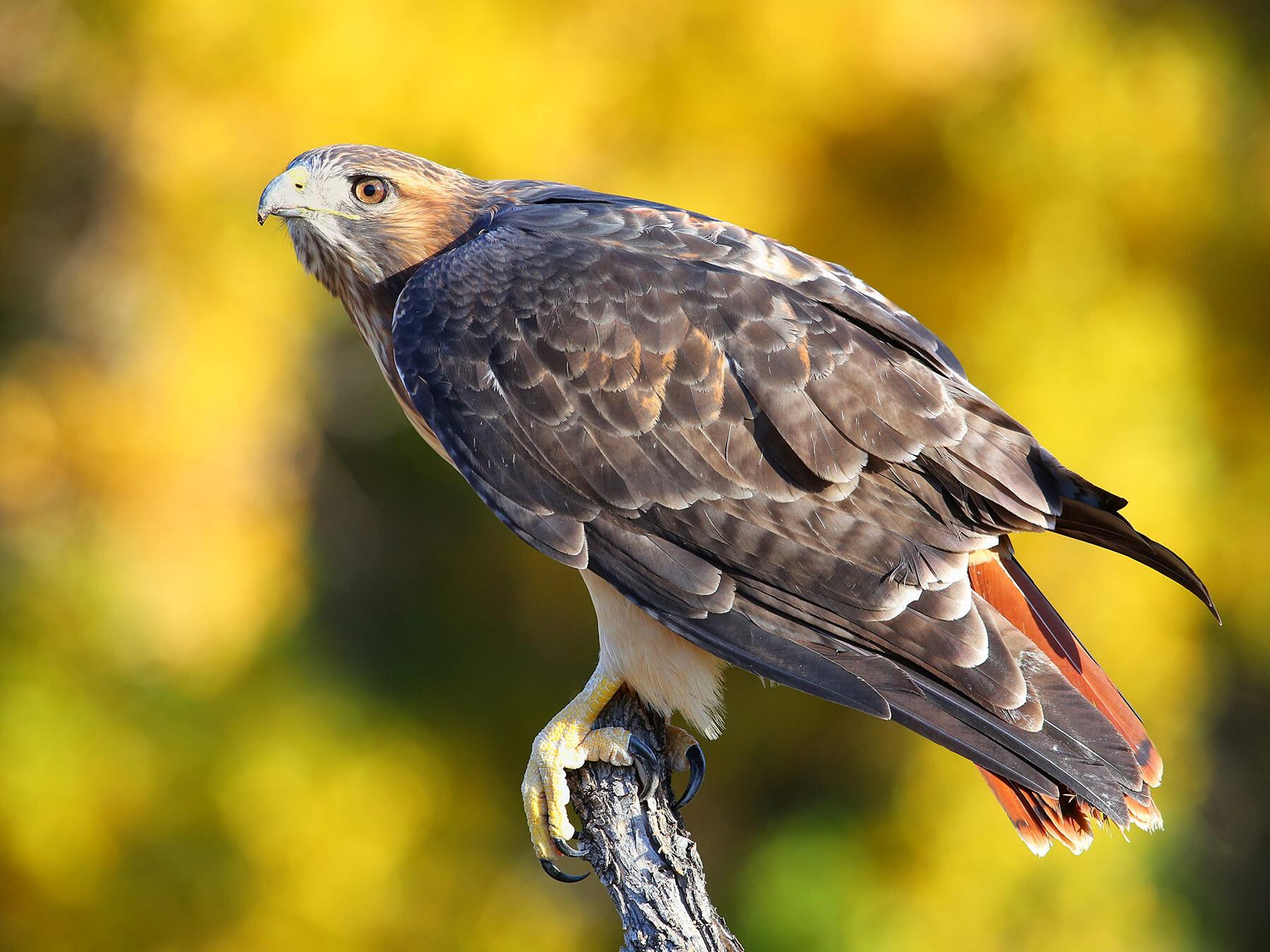
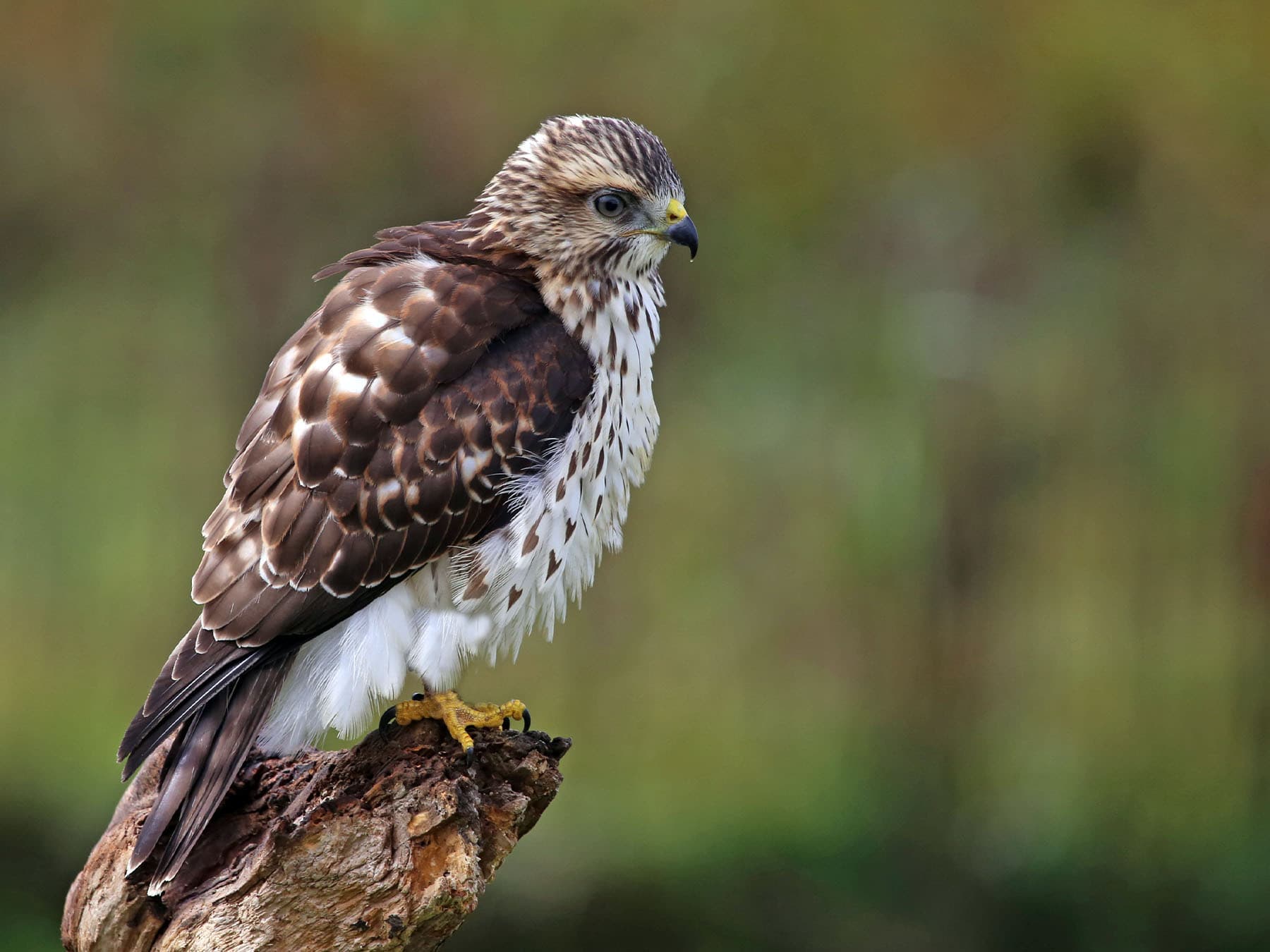
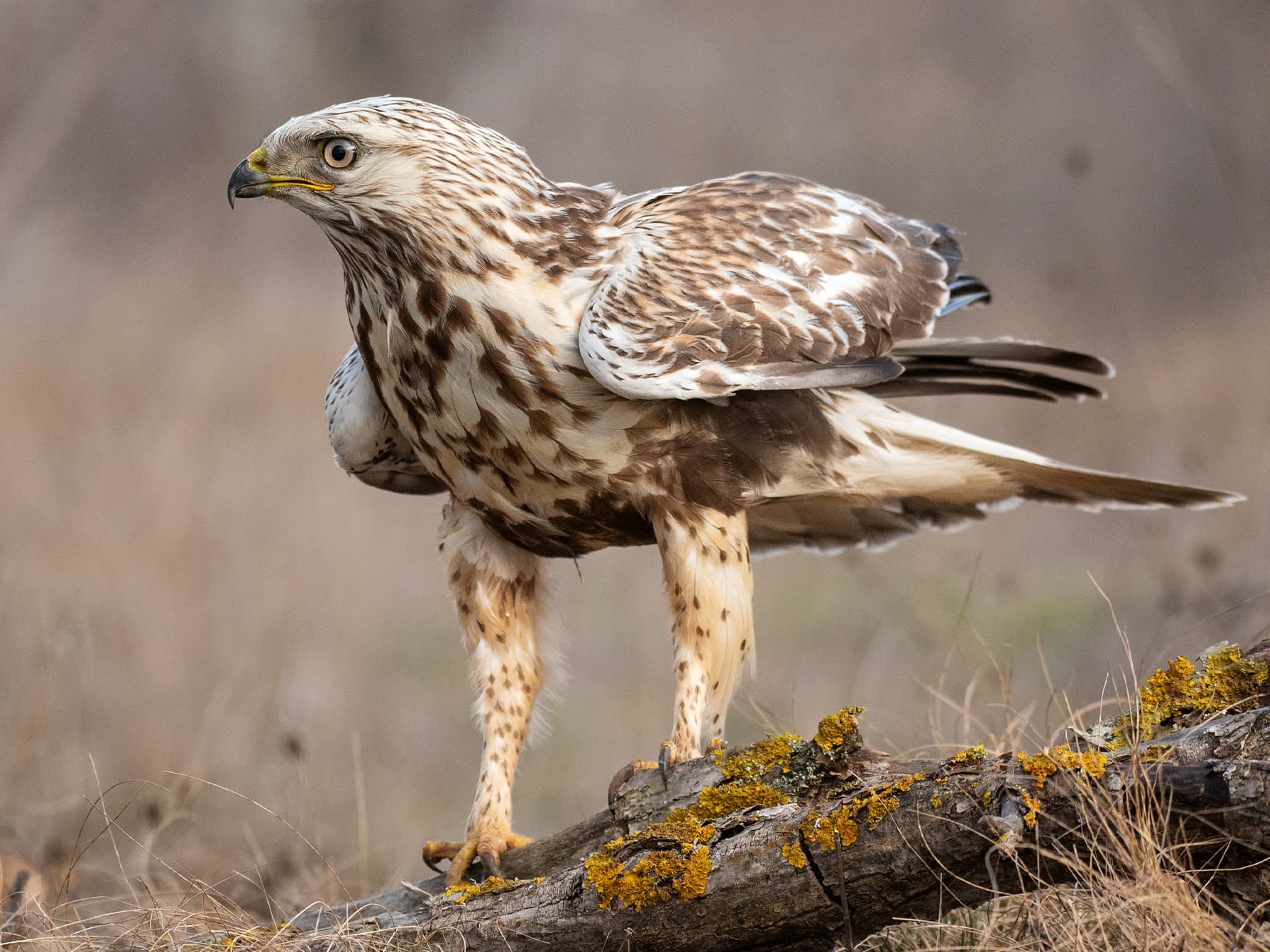
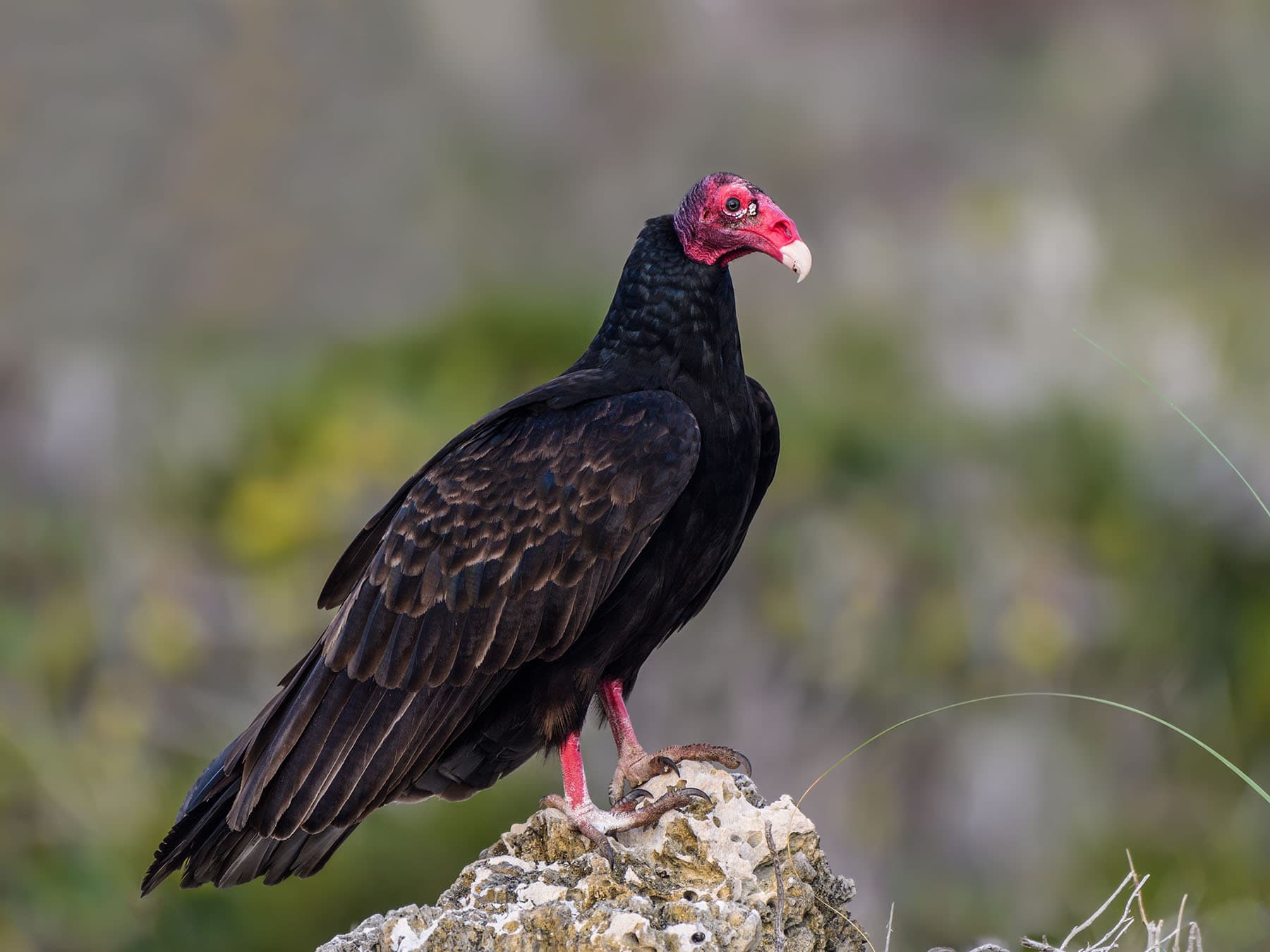
Quick facts
- Length
- 48–56 cm
- Wingspan
- 117–130 cm
- Weight
- 693–1367 g
- Lifespan
- oldest recorded 26 years
- Family
- Hawks & Eagles
- Migration
- Long-distance Migrant
- Global status (IUCN)
- Least Concern
- World population
- About 900,000 breeding-age birds (Partners in Flight, around 2010)
- Population trend
- Increasing: up about 0.7% a year since 1967 in the North American Breeding Bird Survey, about half as many again, but flat over 2015-2025
- Scientific name
- Buteo swainsoni
Questions
2Why is it called Swainson's Hawk?
It is named after William Swainson, who illustrated the first specimen. That bird was collected in 1827 at Fort Carlton near Saskatoon, Saskatchewan, on John Richardson's Franklin expedition, and was taken at first for a Common Buzzard; in 1838 Charles Lucien Bonaparte named the species Buteo swainsoni in honor of Swainson's earlier work.
What is the Swainson's Hawk's scientific name?
Buteo swainsoni. It is a hawk of the family Accipitridae, with no subspecies. Its closest living relatives are the Galápagos Hawk and the Hawaiian Hawk, and the Galápagos Hawk is estimated to have split from it about 126,000 years ago (95% CI 51,000-254,000); hybrids with Rough-legged and Red-tailed Hawks have been reported.1
Sources
56- 1Bechard, M. J., Houston, C. S., Sarasola, J. H. and England, A. S. (2020). Swainson's Hawk (Buteo swainsoni), version 1.0. Birds of the World (A. F. Poole, editor). Cornell Lab of Ornithology. doi:10.2173/bow.swahaw.01 (opens in a new tab)
- 2Cornell Lab of Ornithology. Swainson's Hawk: Overview, Identification and Life History. All About Birds. Accessed 20 November 2026. Source (opens in a new tab)
- 3Briggs, C. W., Collopy, M. W. and Woodbridge, B. (2011). Plumage polymorphism and fitness in Swainson's hawks. Journal of Evolutionary Biology 24(10): 2258-2268. doi:10.1111/j.1420-9101.2011.02356.x (opens in a new tab)
- 4Briggs, C. W., Woodbridge, B. and Collopy, M. W. (2010). Inheritance patterns of plumage morph in Swainson's Hawks. Journal of Raptor Research 44(3): 232-235. doi:10.3356/jrr-09-83.1 (opens in a new tab)
- 5Houston, C. S. (2005). Swainson's hawk longevity, colour banding and natal dispersal. Blue Jay 63(1). doi:10.29173/bluejay5854 (opens in a new tab)
- 6Leyva-Garcia, G. and Macias-Duarte, A. (2026). Outstanding migration and nesting records of Swainson's Hawks in southern Sonora, Mexico. Western Birds 57(3): 239-246. doi:10.21199/wb57.3.6 (opens in a new tab)
- 7Schmutz, J. K., Houston, C. S. and Holroyd, G. L. (1996). Southward migration of Swainson's Hawks: over 10,000 km in 54 days. Blue Jay 54(2). doi:10.29173/bluejay5253 (opens in a new tab)
- 8Bechard, M. J., Sarasola, J. H. and Woodbridge, B. (2006). A re-evaluation of evidence raises questions about the fasting migration hypothesis for Swainson's Hawk (Buteo swainsoni). El Hornero 21(2): 65-72. doi:10.56178/eh.v21i2.788 (opens in a new tab)
- 9Kochert, M. N. et al. (2011). Migration patterns, use of stopover areas, and austral summer movements of Swainson's Hawks. The Condor 113(1): 89-106. doi:10.1525/cond.2011.090243 (opens in a new tab)
- 10Airola, D. A. et al. (2019). Wintering areas and migration characteristics of Swainson's Hawks that breed in the Central Valley of California. Journal of Raptor Research 53(3): 237-252. doi:10.3356/jrr-18-49 (opens in a new tab)
- 11Briggs, C. W., Farner, C., Hunt, M. G. and Vennum, C. R. (2024). Daily diet and temporal variation of Swainson's Hawk prey deliveries. Journal of Raptor Research 58(4). doi:10.3356/jrr2368 (opens in a new tab)
- 12Gilmer, D. S. and Stewart, R. E. (1984). Swainson's Hawk nesting ecology in North Dakota. The Condor 86(1): 12. doi:10.2307/1367335 (opens in a new tab)
- 13Goldstein, M. I. et al. (2000). Abundance, behavior, and mortality of Buteo swainsoni near San Francisco, Cordoba, Argentina in 1997. El Hornero 15(2): 117-121. doi:10.56178/eh.v15i2.930 (opens in a new tab)
- 14Sarasola, J. H., Galmes, M. A. and Santillan, M. A. (2007). Ecologia y conservacion del Aguilucho Langostero (Buteo swainsoni) en Argentina. El Hornero 22(2): 173-184. doi:10.56178/eh.v22i2.765 (opens in a new tab)
- 15Bechard, M. J. (1982). Effect of vegetative cover on foraging site selection by Swainson's Hawk. The Condor 84(2): 153. doi:10.2307/1367658 (opens in a new tab)
- 16Swolgaard, C. A., Reeves, K. A. and Bell, D. A. (2008). Foraging by Swainson's Hawks in a vineyard-dominated landscape. Journal of Raptor Research 42(3): 188-196. doi:10.3356/jrr-07-15.1 (opens in a new tab)
- 17Nishida, C., Boal, C. W., DeStefano, S. and Hobbs, R. J. (2013). Nesting habitat and productivity of Swainson's Hawks in southeastern Arizona. Journal of Raptor Research 47(4): 377-384. doi:10.3356/jrr-12-16.2 (opens in a new tab)
- 18Cruz-Maldonado, N. N., Villareal Lozoya, C. J., Cruz Nieto, J. et al. (2026). Reproductive success and diet of the Swainson's Hawk (Buteo swainsoni) in the grasslands of Janos, Chihuahua, Mexico. Animals 16(1): 131. doi:10.3390/ani16010131 (opens in a new tab)
- 19Inselman, W. M. et al. (2015). Buteo nesting ecology: evaluating nesting of Swainson's Hawks in the northern Great Plains. PLoS ONE 10(9): e0137045. doi:10.1371/journal.pone.0137045 (opens in a new tab)
- 20Fleishman, E., Anderson, J., Dickson, B. G. et al. (2016). Space use by Swainson's Hawk (Buteo swainsoni) in the Natomas Basin, California. Collabra 2(1). doi:10.1525/collabra.35 (opens in a new tab)
- 21Briggs, C. W. and Collopy, M. W. (2012). Extra-pair paternity in Swainson's Hawks. Journal of Field Ornithology 83(1): 41-46. doi:10.1111/j.1557-9263.2011.00354.x (opens in a new tab)
- 22USGS Bird Banding Laboratory. Longevity records of North American birds (current table). USGS Eastern Ecological Science Center. Accessed 20 November 2026. Source (opens in a new tab)
- 23BirdLife International (2025). Buteo swainsoni. The IUCN Red List of Threatened Species 2025. doi:10.2305/IUCN.UK.2025-2.RLTS.T22695903A152330166.en (opens in a new tab)
- 24Partners in Flight (2024). Avian Conservation Assessment Database, version 2024.05.23. Accessed 20 November 2026. Source (opens in a new tab)
- 25Partners in Flight (2020). Population Estimates Database, version 3.1. Accessed 20 November 2026. Source (opens in a new tab)
- 26Ruelas Inzunza, E., Goodrich, L. J. and Hoffman, S. W. (2009). North American population estimates of waterbirds, vultures and hawks from migration counts in Veracruz, Mexico. Bird Conservation International 20(2): 124-133. doi:10.1017/s0959270909990293 (opens in a new tab)
- 27NatureServe. Buteo swainsoni (Swainson's Hawk). NatureServe Explorer. Accessed 20 November 2026. Source (opens in a new tab)
- 28Hostetler, J. A. et al. (2026). The North American Breeding Bird Survey, Analysis Results 1966-2025. U.S. Geological Survey data release. doi:10.5066/P1OSNSFC (opens in a new tab)
- 29Schmutz, J. K., McLoughlin, P. D. and Houston, C. S. (2006). Demography of Swainson's hawks breeding in western Canada. Journal of Wildlife Management 70(5): 1455-1460. doi:10.2193/0022-541x(2006)70[1455:doshbi]2.0.co;2 (opens in a new tab)
- 30Schmutz, J. K. and Hungle, D. J. (1989). Populations of ferruginous and Swainson's hawks increase in synchrony with ground squirrels. Canadian Journal of Zoology 67(10): 2596-2601. doi:10.1139/z89-366 (opens in a new tab)
- 31California Department of Fish and Wildlife. Swainson's Hawks in California. California Department of Fish and Wildlife. Accessed 20 November 2026. Source (opens in a new tab)
- 32California Department of Fish and Wildlife (2016). Status Review: Swainson's Hawk (Buteo swainsoni) in California. Five-year status report to the California Fish and Game Commission. Accessed 20 November 2026. Source (opens in a new tab)
- 33Furnas, B. J. et al. (2022). Rapid growth of the Swainson's Hawk population in California since 2005. Ornithological Applications 124(2). doi:10.1093/ornithapp/duac006 (opens in a new tab)
- 34California Department of Fish and Wildlife, California Natural Diversity Database (2026). State and Federally Listed Endangered and Threatened Animals of California (October 2026). Accessed 20 November 2026. Source (opens in a new tab)
- 35Battistone, C. L., Furnas, B. J., Anderson, R. L. et al. (2019). Population and distribution of Swainson's Hawks (Buteo swainsoni) in California's Great Valley: a framework for long-term monitoring. Journal of Raptor Research 53(3): 253. doi:10.3356/jrr-18-34 (opens in a new tab)
- 36Goldstein, M. I. et al. (1999). Monocrotophos-induced mass mortality of Swainson's hawks in Argentina, 1995-96. Ecotoxicology 8(3): 201-214. doi:10.1023/a:1026496331396 (opens in a new tab)
- 37Kolar, P. S. and Bechard, M. J. (2016). Wind energy, nest success, and post-fledging survival of Buteo hawks. Journal of Wildlife Management 80(7): 1242-1255. doi:10.1002/jwmg.21125 (opens in a new tab)
- 38U.S. Fish and Wildlife Service (2026). 50 CFR 10.13: List of Migratory Birds. Accessed 20 November 2026. Source (opens in a new tab)
- 39United States Congress (2023). 16 U.S.C. 703: Taking, killing, or possessing migratory birds unlawful. Accessed 20 November 2026. Source (opens in a new tab)
- 40U.S. Fish and Wildlife Service (2026). 50 CFR 17.11 and 17.12: Lists of endangered and threatened wildlife and plants. Accessed 20 November 2026. Source (opens in a new tab)
- 41U.S. Fish and Wildlife Service. Swainson's hawk (Buteo swainsoni): species profile. ECOS Environmental Conservation Online System. Accessed 20 November 2026. Source (opens in a new tab)
- 42Environment and Climate Change Canada. Birds protected in Canada under the Migratory Birds Convention Act, 1994. Government of Canada. Accessed 20 November 2026. Source (opens in a new tab)
- 43SEMARNAT (2019). NOM-059-SEMARNAT-2010 (list of species at risk) and the 14 Nov 2019 modification of its Annex III. Diario Oficial de la Federacion. Accessed 20 November 2026. Source (opens in a new tab)
- 44UNEP-WCMC. Buteo swainsoni Bonaparte, 1838. Species+. Accessed 20 November 2026. Source (opens in a new tab)
- 45AviList Core Team (2025). AviList: The Global Avian Checklist, v2025b. doi:10.2173/avilist.v2025b (opens in a new tab)
- 46National Audubon Society. Swainson's Hawk. Audubon Guide to North American Birds (text adapted from Kenn Kaufman, Lives of North American Birds, 1996). Accessed 20 November 2026. Source (opens in a new tab)
- 47Schmutz, J. K., Houston, C. S. and Barry, S. J. (2001). Prey and reproduction in a metapopulation decline among Swainson's Hawks, Buteo swainsoni. Canadian Field-Naturalist 115(2): 257-273. doi:10.5962/p.363787 (opens in a new tab)
- 48Briggs, C. W., Collopy, M. W. and Woodbridge, B. (2012). Correlates and fitness consequences of natal dispersal in Swainson's Hawks. The Condor 114(4): 764-770. doi:10.1525/cond.2012.120034 (opens in a new tab)
- 49Preston, C. R. and Beane, R. D. (2024). Red-tailed Hawk (Buteo jamaicensis), version 1.1. Birds of the World. Cornell Lab of Ornithology. Accessed 20 November 2026. Source (opens in a new tab)
- 50Goodrich, L. J., Crocoll, S. T. and Senner, S. E. (2020). Broad-winged Hawk (Buteo platypterus), version 1.0. Birds of the World. Cornell Lab of Ornithology. Accessed 20 November 2026. Source (opens in a new tab)
- 51Ng, J. W. et al. (2020). Ferruginous Hawk (Buteo regalis), version 1.0. Birds of the World. Cornell Lab of Ornithology. Accessed 20 November 2026. Source (opens in a new tab)
- 52Bechard, M. J. et al. (2020). Rough-legged Buzzard (Buteo lagopus), version 1.0. Birds of the World. Cornell Lab of Ornithology. Accessed 20 November 2026. Source (opens in a new tab)
- 53Kirk, D. A. et al. (2024). Turkey Vulture (Cathartes aura), version 2.0. Birds of the World. Cornell Lab of Ornithology. Accessed 20 November 2026. Source (opens in a new tab)
- 54Johnson, R. R., Glinski, R. L. and Matteson, S. W. (2020). Zone-tailed Hawk (Buteo albonotatus), version 1.0. Birds of the World. Cornell Lab of Ornithology. Accessed 20 November 2026. Source (opens in a new tab)
- 55Farquhar, C. C. (2020). White-tailed Hawk (Geranoaetus albicaudatus), version 1.0. Birds of the World. Cornell Lab of Ornithology. Accessed 20 November 2026. Source (opens in a new tab)
- 56Smith, K. G., Wittenberg, S. R., Macwhirter, R. B. and Bildstein, K. L. (2020). Northern Harrier (Circus hudsonius), version 1.0. Birds of the World. Cornell Lab of Ornithology. Accessed 20 November 2026. Source (opens in a new tab)

Checked by
Nathan Cope, founder and editor
Nathan founded Birdfact and leads its writers and contributors in the UK, the US and Canada. He has watched and studied birds for more than ten years, and checks every article and species guide before it’s published.