


Burrowing Owl
Ground Owl, Prairie Dog Owl · Athene cunicularia
By the Birdfact teamChecked by Nathan Cope
On this page14 sections
How to recognise it
What do Burrowing Owls look like?
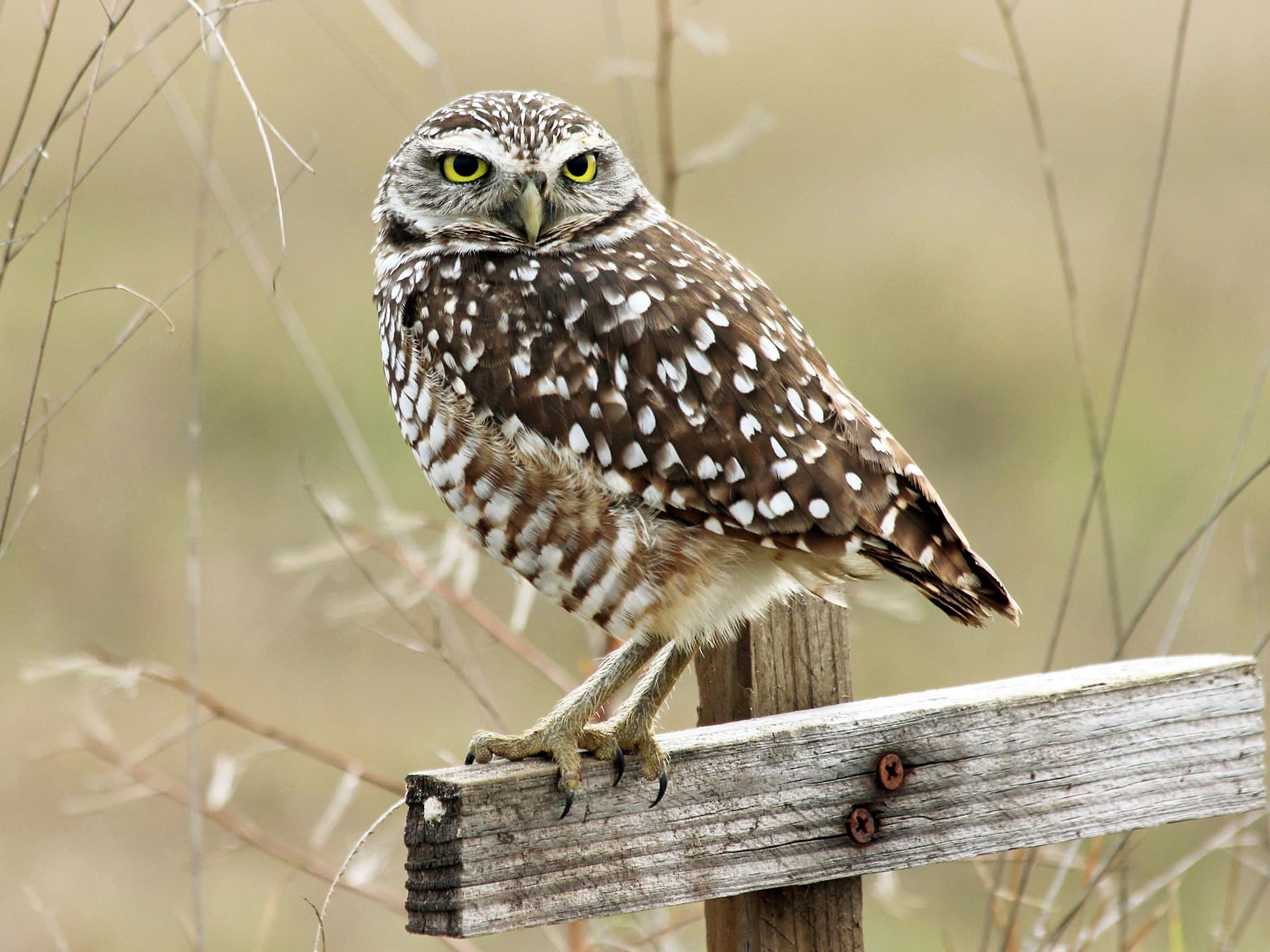
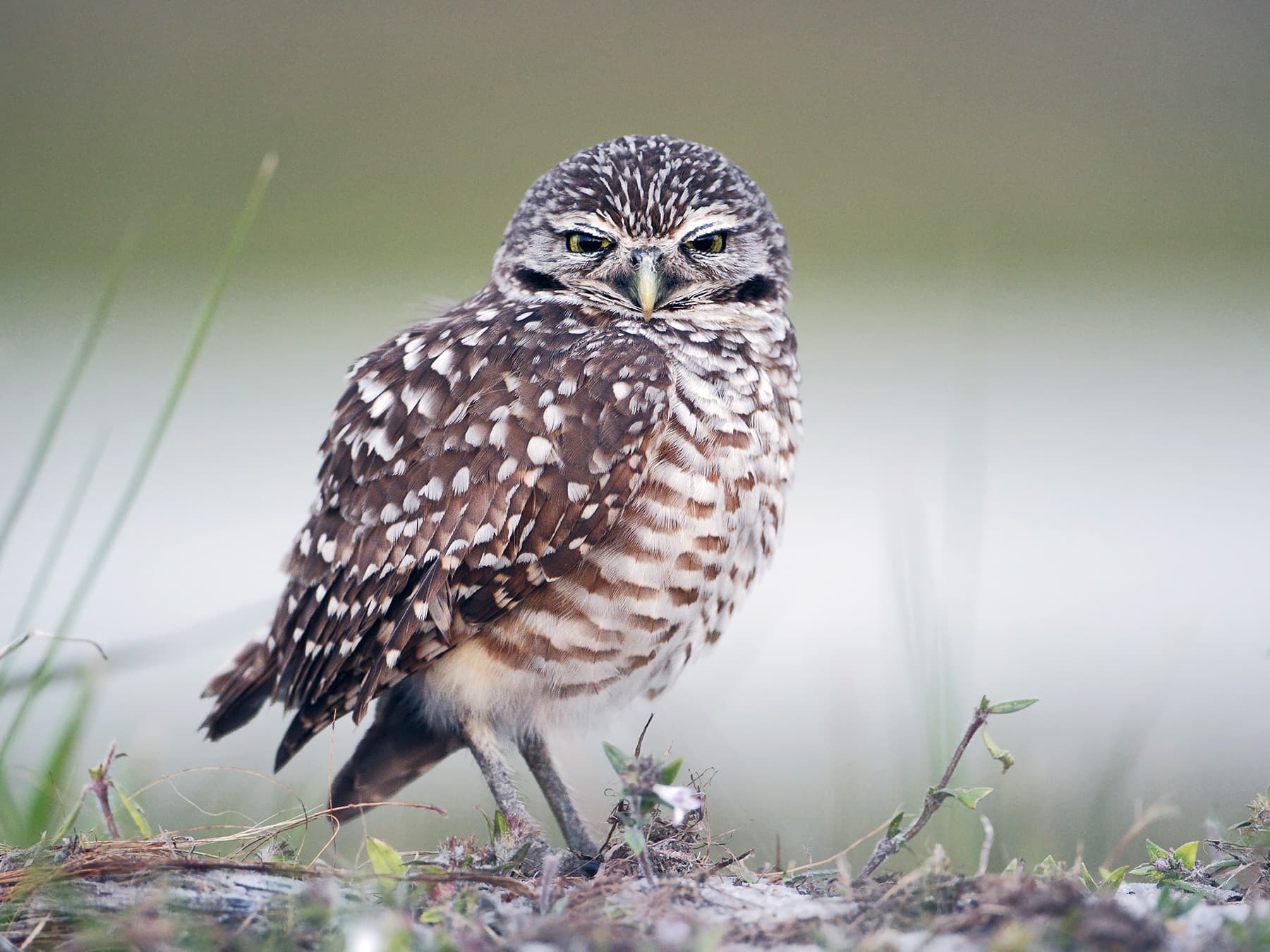
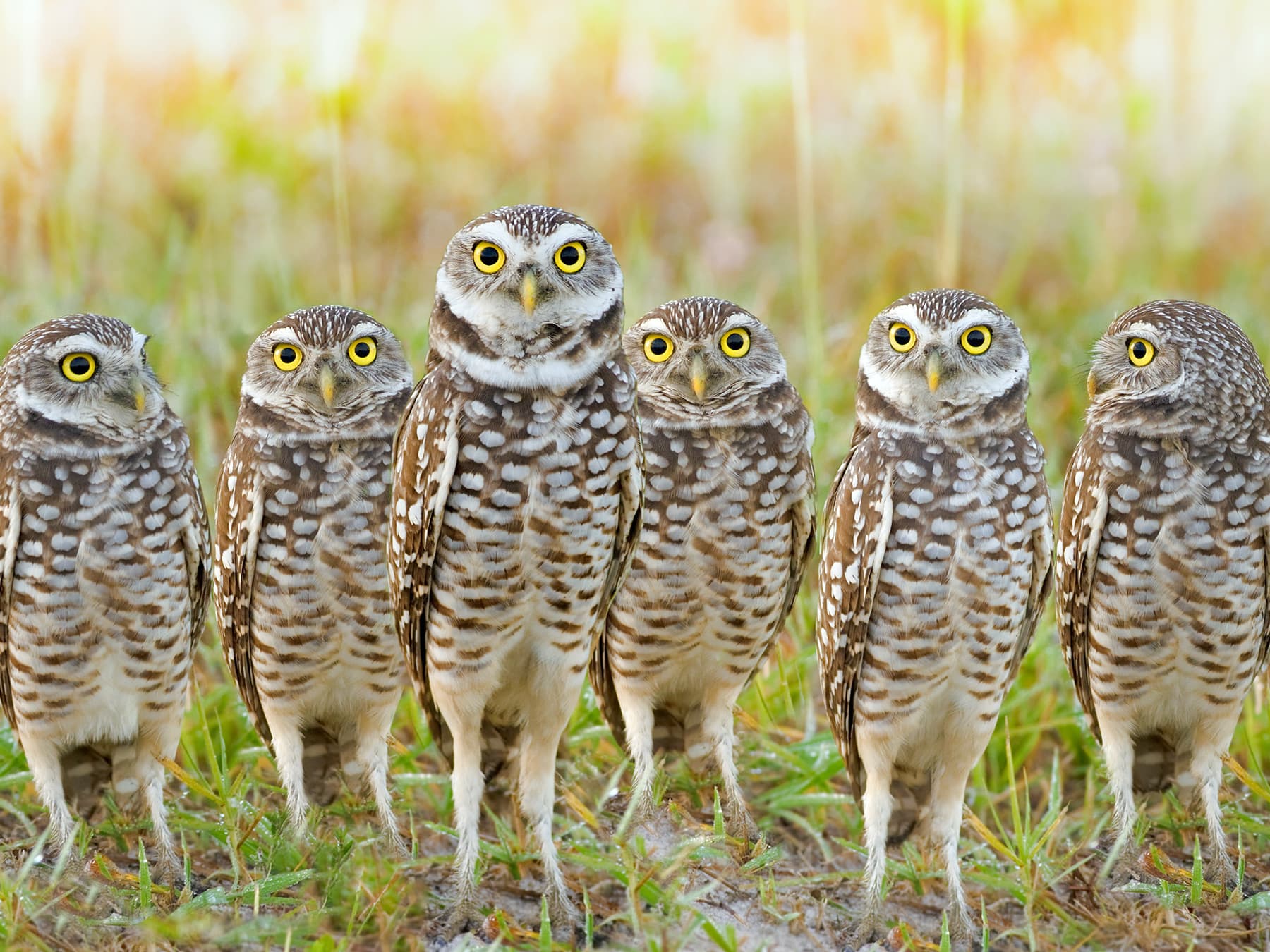
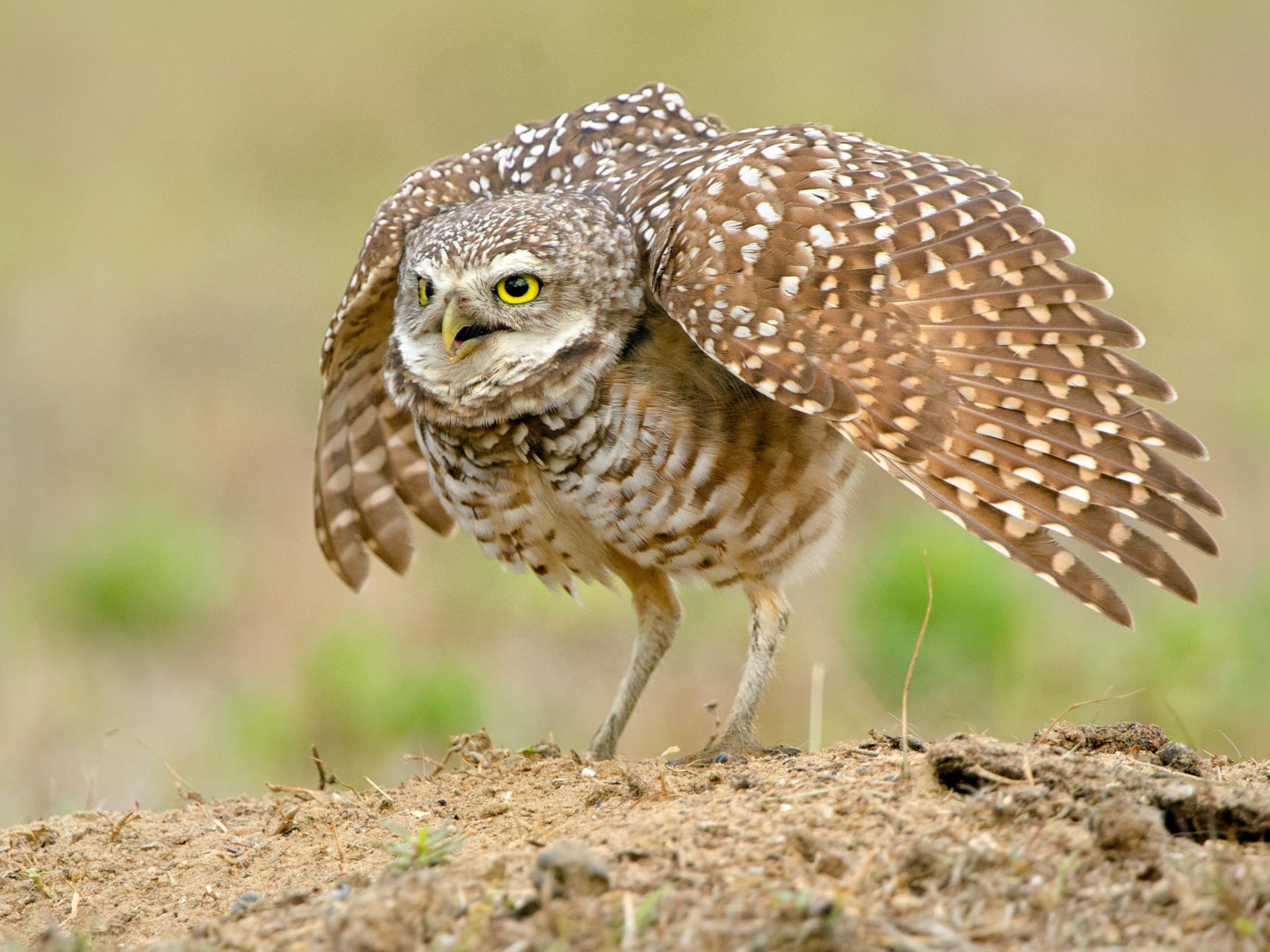
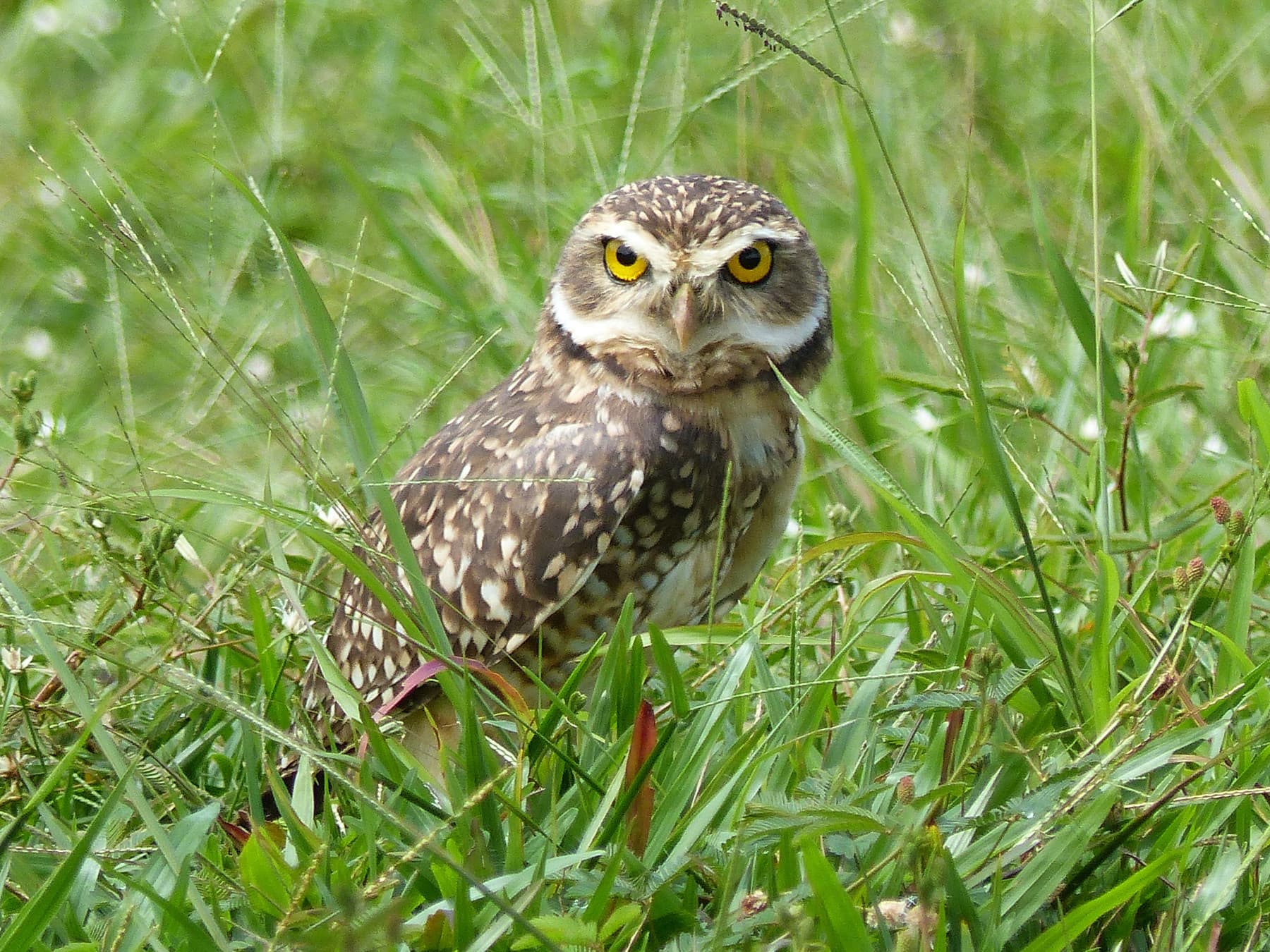
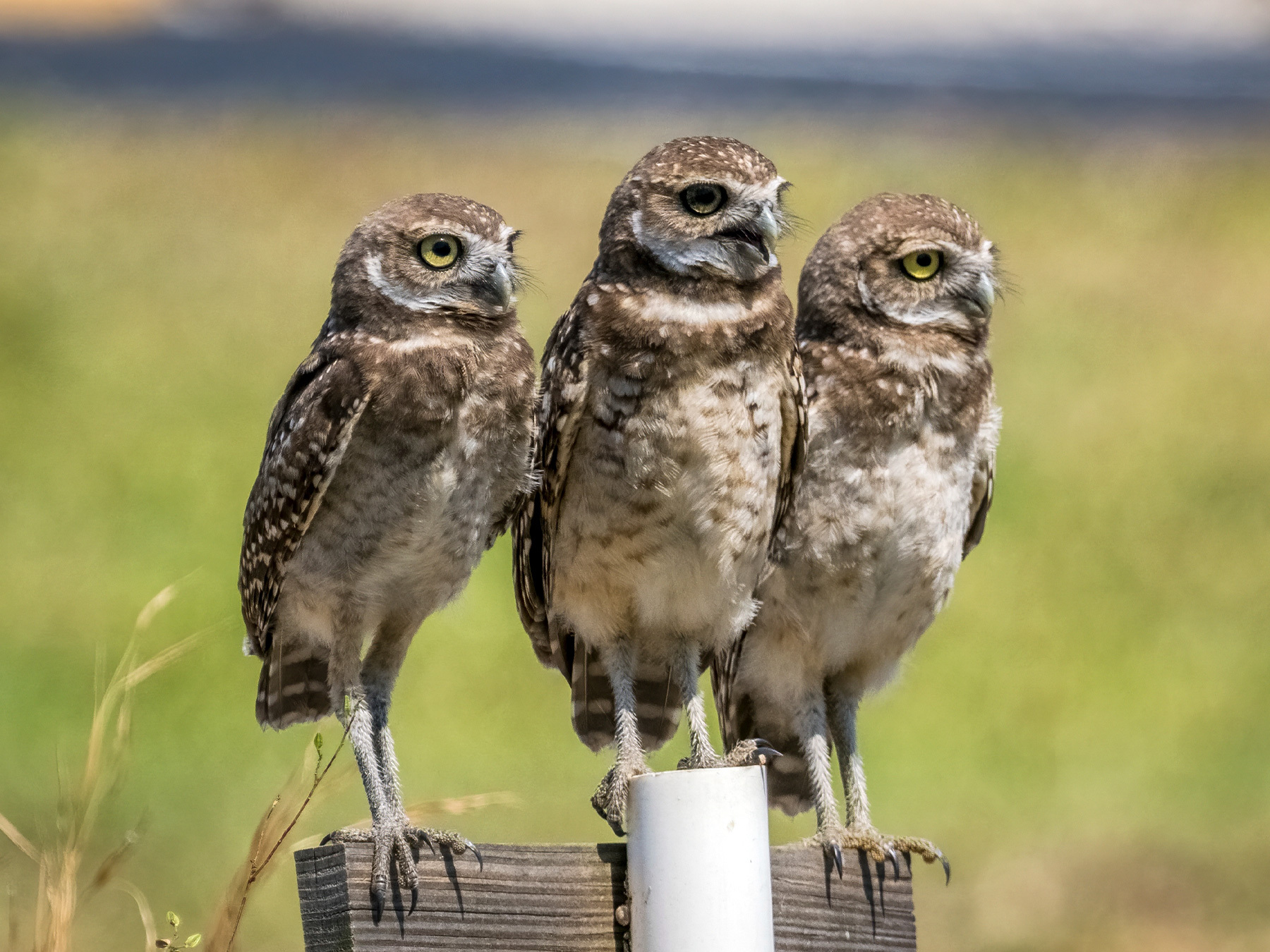
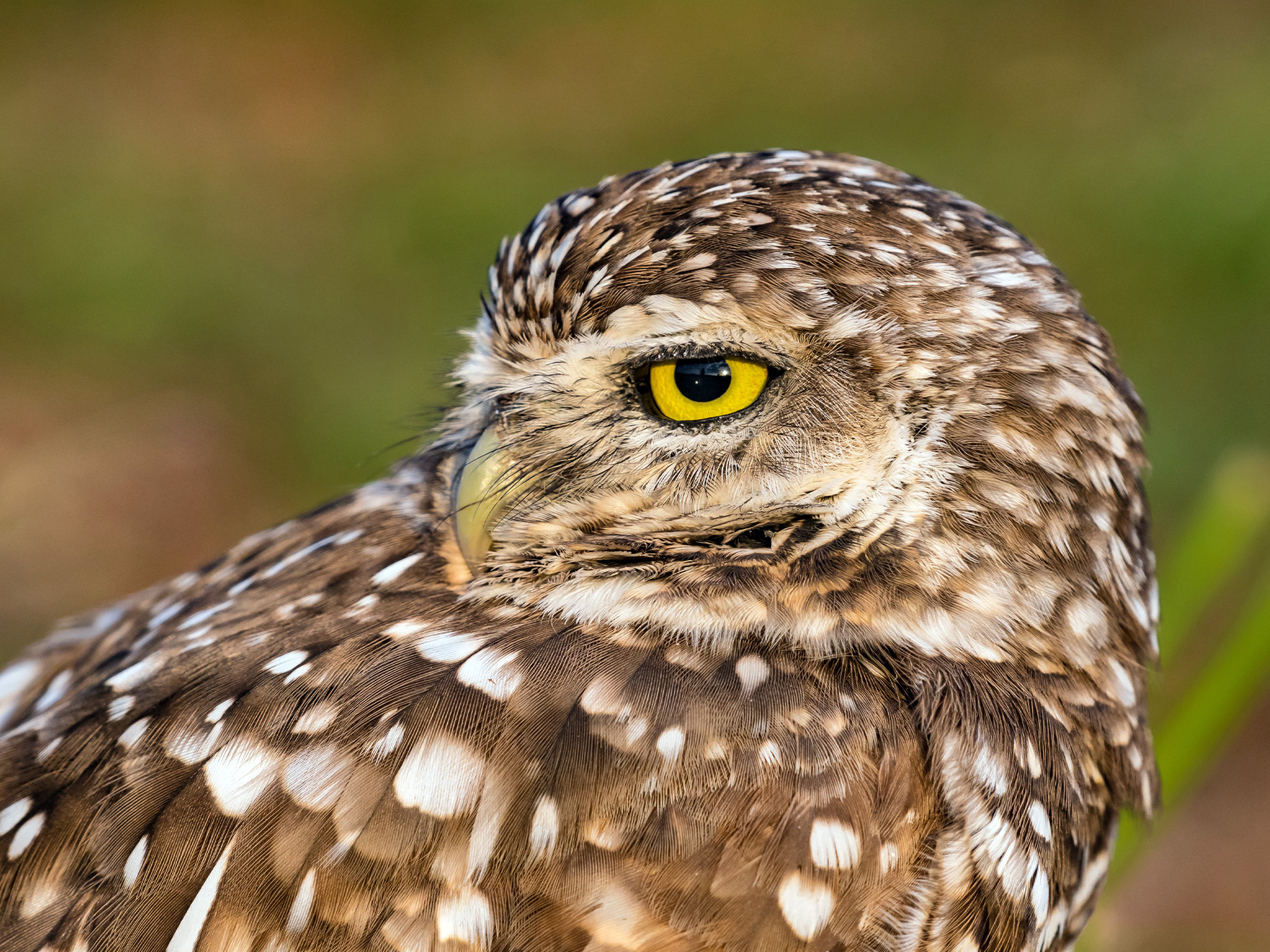
Burrowing owls are small owls with unusually long legs. Their upperparts are brown and heavily spotted with white, including the crown, nape, back, and wings. The tail is short and barred with brown and white. The throat is white, with a buff-colored breast, which is marked with dark spots.
Facial features include prominent white eyebrows and large bright yellow eyes. Burrowing owls have rounded heads and no ear tufts.
Burrowing owl populations living further to the east, in Florida for example, are generally a darker brown than those in the east.
Female and male burrowing owls are alike, and there is no obvious difference in size between the sexes. Females tend to be slightly darker than males during the breeding season, due to spending more time inside the burrows than males, which become lighter from standing guard outside nest burrows in direct sunlight. However, this criteria alone cannot be reliably used to distinguish between the sexes.
Juvenile burrowing owls have the same overall coloring as mature birds, although, in young burrowing owls, the breast and belly are a solid pale buff rather than spotted.
How big are Burrowing Owls?
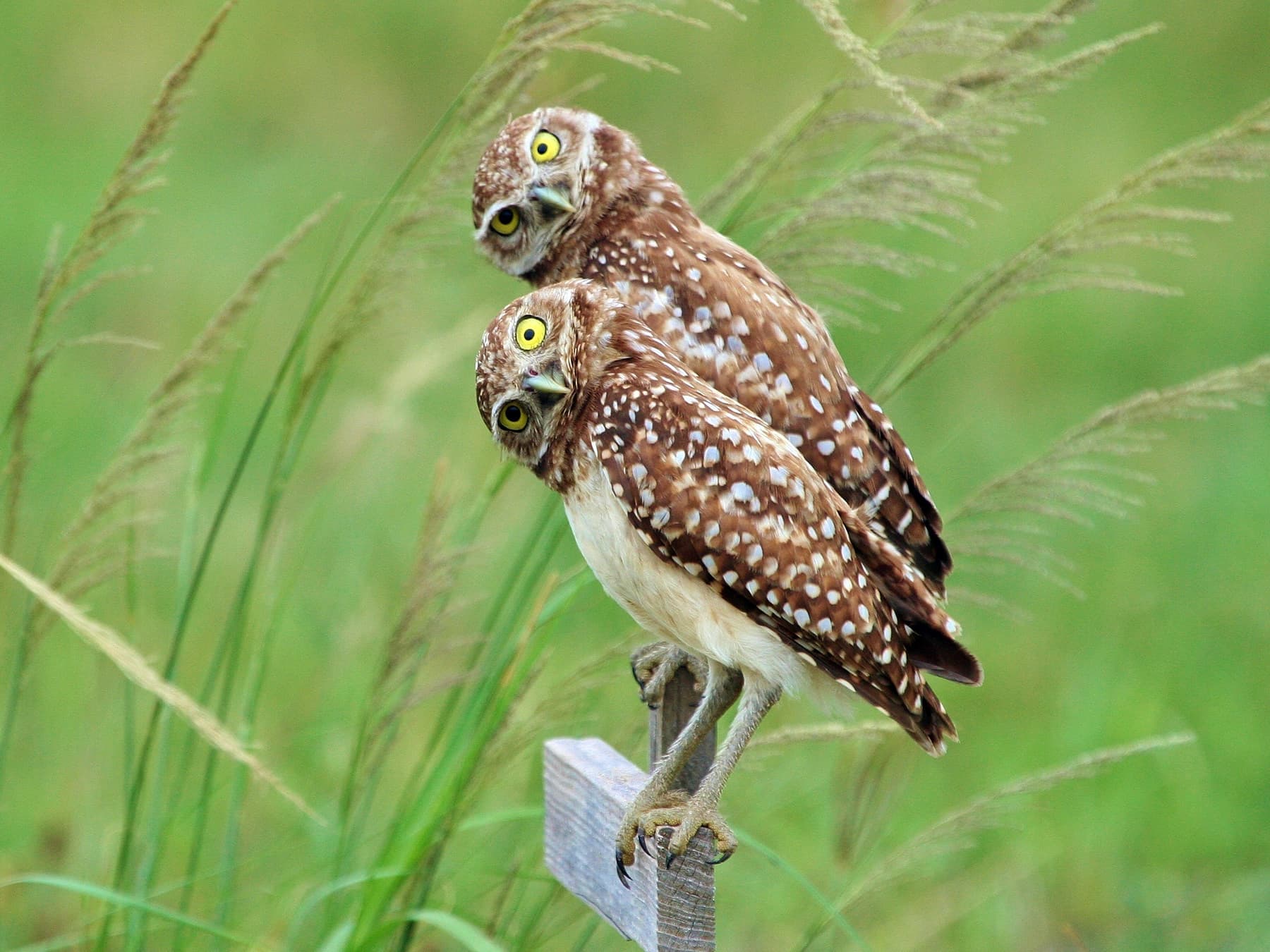
A relatively small species, burrowing owls are comparable in size to a European starling and an American robin. Unusually for owls, there is normally no noticeable difference in size between males and females of this species.
- Length: 19 cm to 28 cm (7 in to 11 in)
- Wingspan: 50.8 cm to 61 cm (20 in to 24 in)
- Weight: 140 g to 240 g (5 oz to 8 oz)
Its size
Adults- Length
- 19–25 cm
- Wingspan
- 51–61 cm
- Weight
- 120–250 g
Its song and calls
What sound does a Burrowing Owl make?
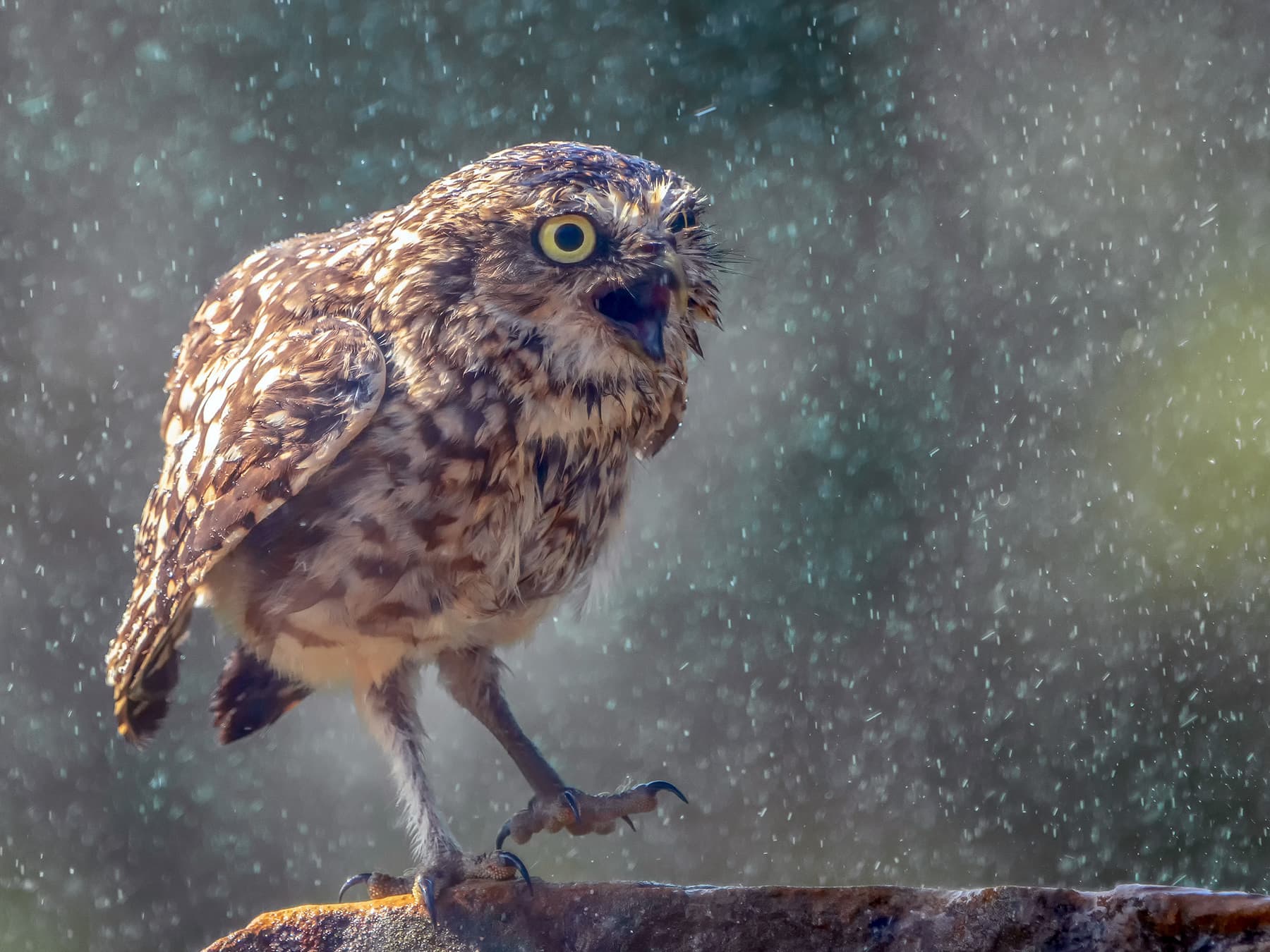
A soft ‘coo-cooooo’ call is given by the male early in the breeding season and is also heard in the nest defense. Both sexes make a louder, lively chattering cry when mobbing predators or any other threat is sensed nearby.
- Call0:00 / 2:26
Recorded in Chubut Province, Argentina · October 2023
When and where to see it
OctoberLeaving
Most recorded in October
- 1. Nevadaunder 0.1%
- 2. South Dakotaunder 0.1%
- 3. Californiaunder 0.1%
- 4. Arizonaunder 0.1%
- 5. Oklahomaunder 0.1%
Each dot is a county, state or province: the bigger and darker, the larger the bird’s share of that place’s bird records that month. Grey dots: no regular records. The ringed point is the centre of the bird’s records this month; the arrow shows how it moved since last month, and the dashed loop its path through the year. “Arrivals” colours places where it becomes regular this month (orange) or is in its last regular month (grey). GBIF eBird Observation Dataset, 2019–2024. Map data: Natural Earth, US Census Bureau; place centres © OpenStreetMap contributors.
In your area
See when the Burrowing Owl is recorded in your county, state or province.
How often the Burrowing Owl turns up in the United States and Canada through the year, from birdwatchers' records.
United States
Resident · all year · most records in January
Canada
Scarce · most records in July
Show as a table
| Month | United States | Canada |
|---|---|---|
| January | 0.025% (regular) | <0.001% |
| February | 0.021% (regular) | – |
| March | 0.015% (regular) | – |
| April | 0.013% (regular) | – |
| May | 0.011% (regular) | <0.001% |
| June | 0.017% (regular) | <0.001% |
| July | 0.017% (regular) | 0.002% |
| August | 0.014% (regular) | 0.002% |
| September | 0.011% (regular) | <0.001% |
| October | 0.011% (regular) | <0.001% |
| November | 0.018% (regular) | – |
| December | 0.019% (regular) | <0.001% |
Worldwide: recorded regularly in 22 countries
Countries where it was recorded in at least 3 of the 6 years 2019–2024. Linked countries have their own bird list.
Data: EOD – eBird Observation Dataset (Cornell Lab of Ornithology), accessed via GBIF.org, CC BY 4.0. Records from 2019–2024, aggregated and filtered by Birdfact. How these lists are made
What is the habitat of a Burrowing Owl?
Preferred habitats of burrowing owls include grasslands, agricultural areas, deserts, and any open, dry expanses of land with low-level vegetation cover. Underground burrows, such as those excavated by prairie dogs are used for nesting and roosting. Treeless prairies are also a popular choice.
What is the range of a Burrowing Owl?
Burrowing owls breed across western North America, from the extreme southern regions of Canada southwards through the western United States, Mexico, and into Central America, reaching Guatemala and El Salvador. To the east, isolated populations are present in Florida and parts of the Caribbean, including the Bahamas, Cuba, Haiti, and the Dominican Republic.
In South America, burrowing owls are present in the northeast of the continent, and also widespread across the entire southern half, from the Amazon basin to the tip of Patagonia.
The northernmost populations, in Canada and across the northern regions of the United States are migratory, arriving in spring to breed and heading south as fall approaches.
Where do Burrowing Owls live?
Widely distributed across North, Central, and South America, burrowing owls are resident for at least part of the year in Canada and the northern US, and across much of the rest of their range they are present all year round.
Established populations exist in the following countries: Canada, the United States, the Bahamas, Cuba, the Dominican Republic, Haiti, the Netherlands Antilles, Mexico, Guatemala, El Salvador, Venezuela, Guyana, Brazil, Colombia, Ecuador, Peru, Bolivia, Chile, Argentina, Paraguay and Uruguay.
How rare are Burrowing Owls?
Although not widely considered to be a ‘rare’ species, the global population of burrowing owls is in decline throughout their range, due to habitat loss and lack of available nest sites. An estimated 10,000 individuals are thought to live in the US, distributed across the western and southwestern states, so despite being widespread, they are not particularly numerous.
Where can you see Burrowing Owls in the US?
Cape Coral in Florida and the Imperial Valley in California both have notable populations of burrowing owls and sightings are more frequently reported there than anywhere else in the United States. Another good location to try is across the prairies of Colorado.
Where can you see Burrowing Owls in Canada?
Canada’s burrowing owl population is focused in Manitoba, Saskatchewan, and Alberta. Every now and then sightings are reported in British Columbia. Fewer than 800 pairs breed in Canada, mostly concentrated in the region between Regina, Saskatchewan to Brooks in southeast Alberta.
Migration
Do Burrowing Owls migrate?
Burrowing owls living in the furthest north regions of North America, from southern Canada as far south as northern California, Arizona, New Mexico and Texas are breeding visitors, wintering further south in these states as well as in Louisiana, Florida and Mexico. Burrowing owls that breed in Florida are sedentary and remain in the state all year round.
South American populations are largely nonmigratory, while in Mexico, resident populations of burrowing owls in the central regions of the country are joined by winter visitors along both coasts and into Central America.
Are Burrowing Owls native to the US?
Burrowing owls are most northern populations migratory and southern populations resident all year round. Breeding occurs from the Canadian border regions southwards across the US and into Mexico, as well as in Florida, where around 2,800 individuals live in Cape Coral – one of the world’s largest populations of the species.
Tips for seeing it
- Look for them in open, treeless areas, especially near ground squirrel or prairie dog colonies.
- Scan for their distinctive upright posture at burrow entrances.
- Listen for their 'coo-cooo' call, especially at dawn and dusk.
- In the US, visit protected grasslands or golf courses in western states for better chances of spotting them.
What it eats
What do Burrowing Owls eat?
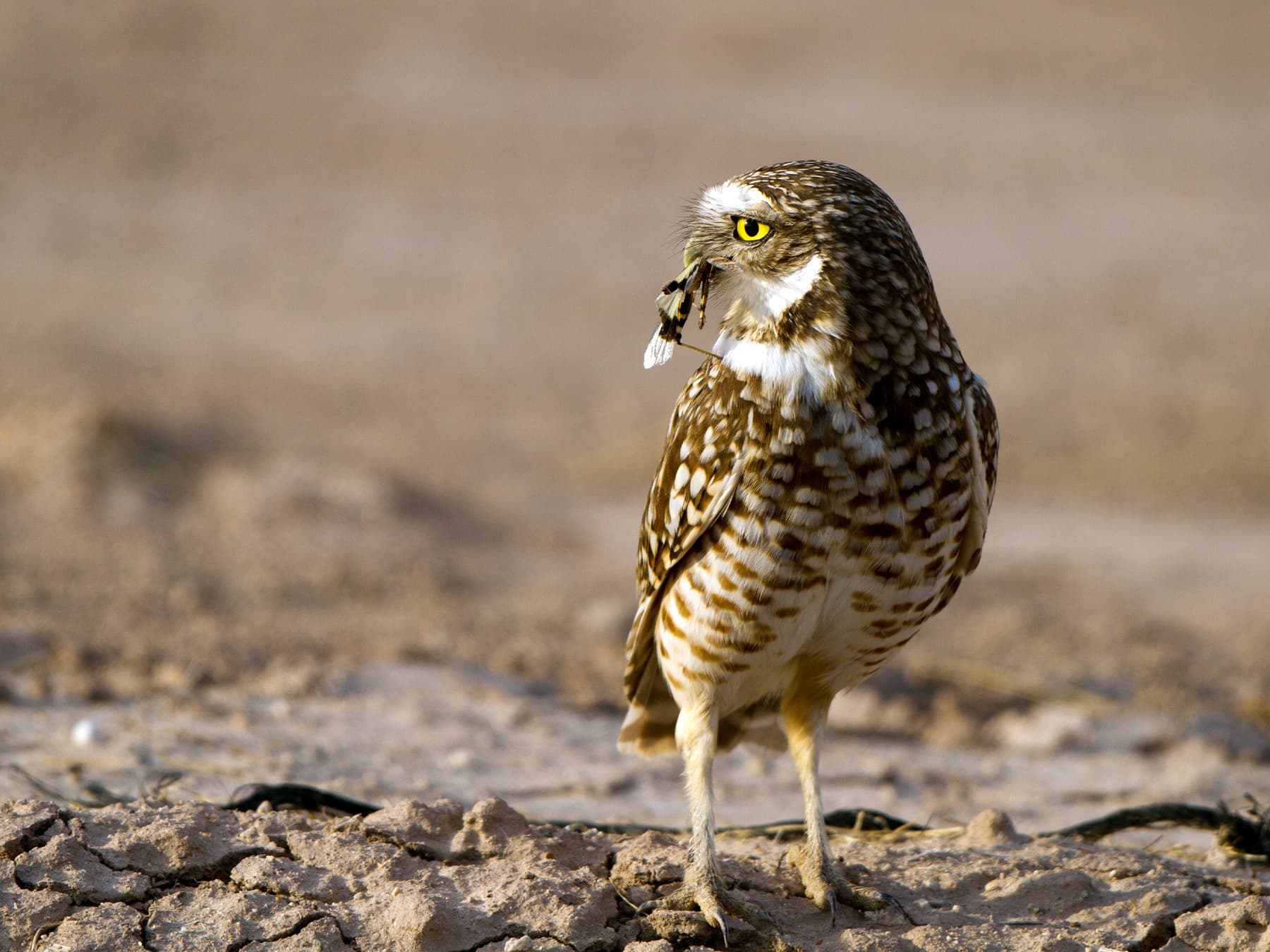
The diet of burrowing owls is mainly insect-based (particularly moths, beetles, grasshoppers, and crickets) although small mammals (most commonly voles, shrews, and mice) are also important. Other small prey may include birds, bats, frogs, snakes, earthworms, and caterpillars. Small mammals seem to be preferred over insects in areas where there is an abundance.
What do Burrowing Owl chicks eat?
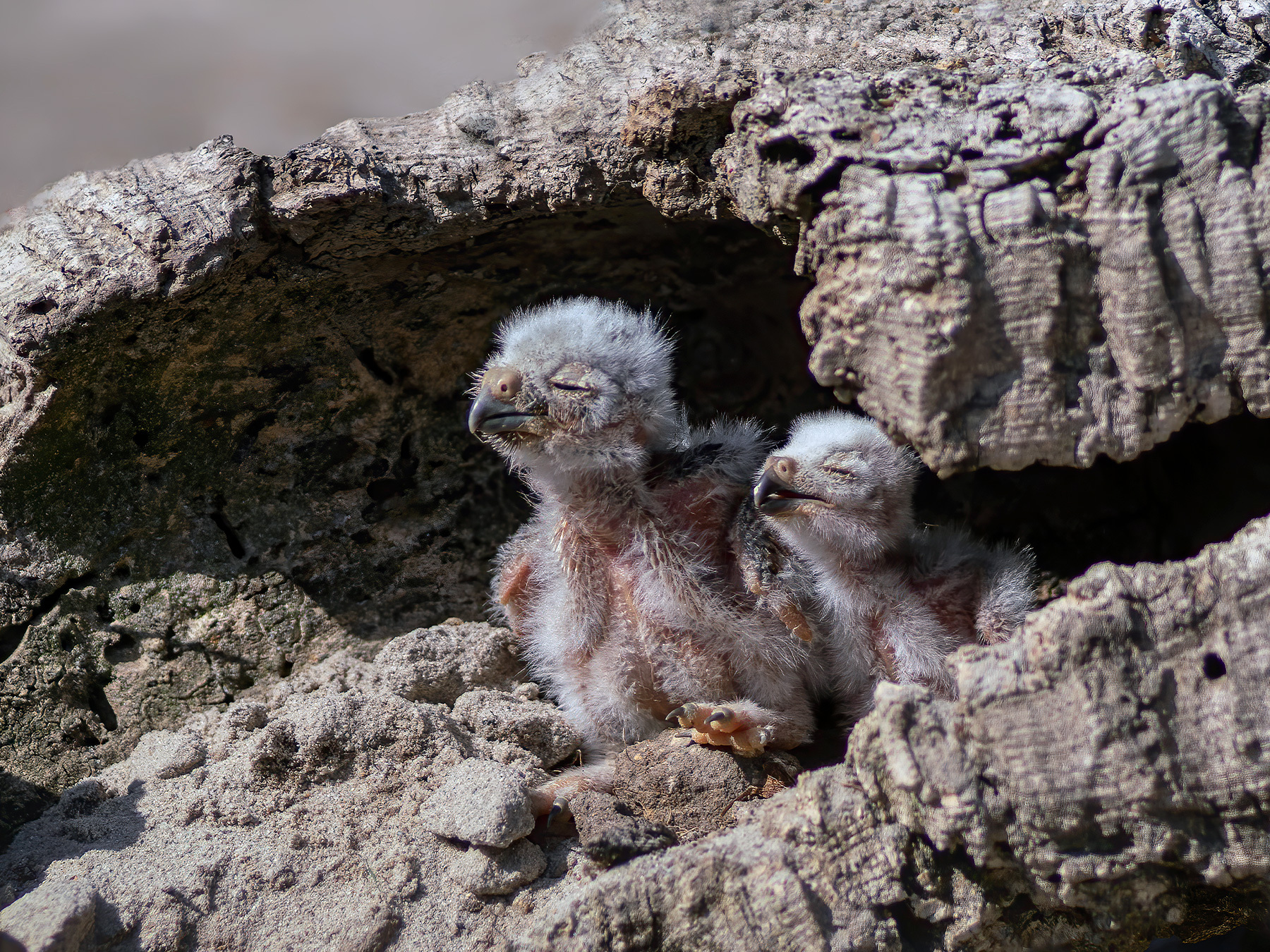
Young burrowing owls are fed on a combination of insects and mammals, which are brought to the nest by the male and ripped into manageable pieces by the female. Grasshoppers, voles, and small mice are among the most common prey in the nestling’s early days.
Nesting and breeding
Where do Burrowing Owls nest?
Burrowing owls hunt for suitable nest sites at dusk, visiting grasslands and open pastures, and checking out prairie dog colonies for tunnels that are no longer in use.
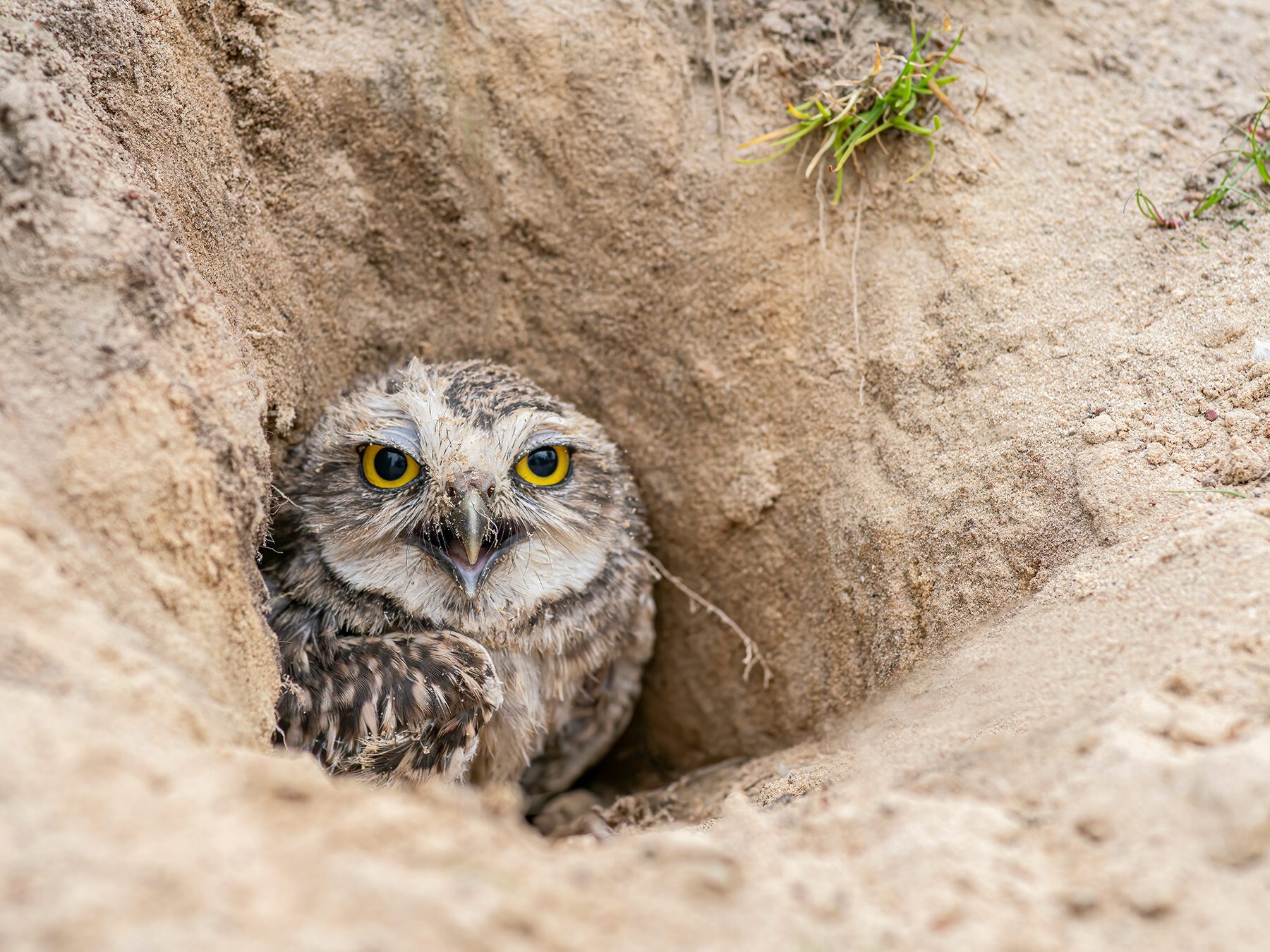
Favored nesting locations used by burrowing owls are the abandoned underground burrows of other animals, including badgers, prairie dogs, armadillos, ground squirrels, and large rodents. If there are no suitable sites available, they will excavate their own tunnels and underground chambers in the soil, digging with their bill and moving soil out of the way with their feet. These tunnels can reach up to 3 m (10 ft) in length.
Nests are often lined with livestock dung, which is believed to have the aim of masking the owl’s scent from potential predators.
When do Burrowing Owls nest?
Pairs form as early as February when males arrive on breeding grounds and begin advertising for a mate. Eggs are laid between March and May. The female incubates, remaining in the burrow with the eggs for between 28 and 30 days, and is brought food to the nest by her mate.
What do Burrowing Owl eggs look like?
Burrowing owls’ eggs are smooth and white, measuring around 32 mm by 27 mm (1.3 in by 1.1 in). Clutches contain between 2 and 12 eggs, with 5 or 6 eggs being the most common number. Eggs may become stained with deep brown from the nest lining.
Do Burrowing Owls mate for life?
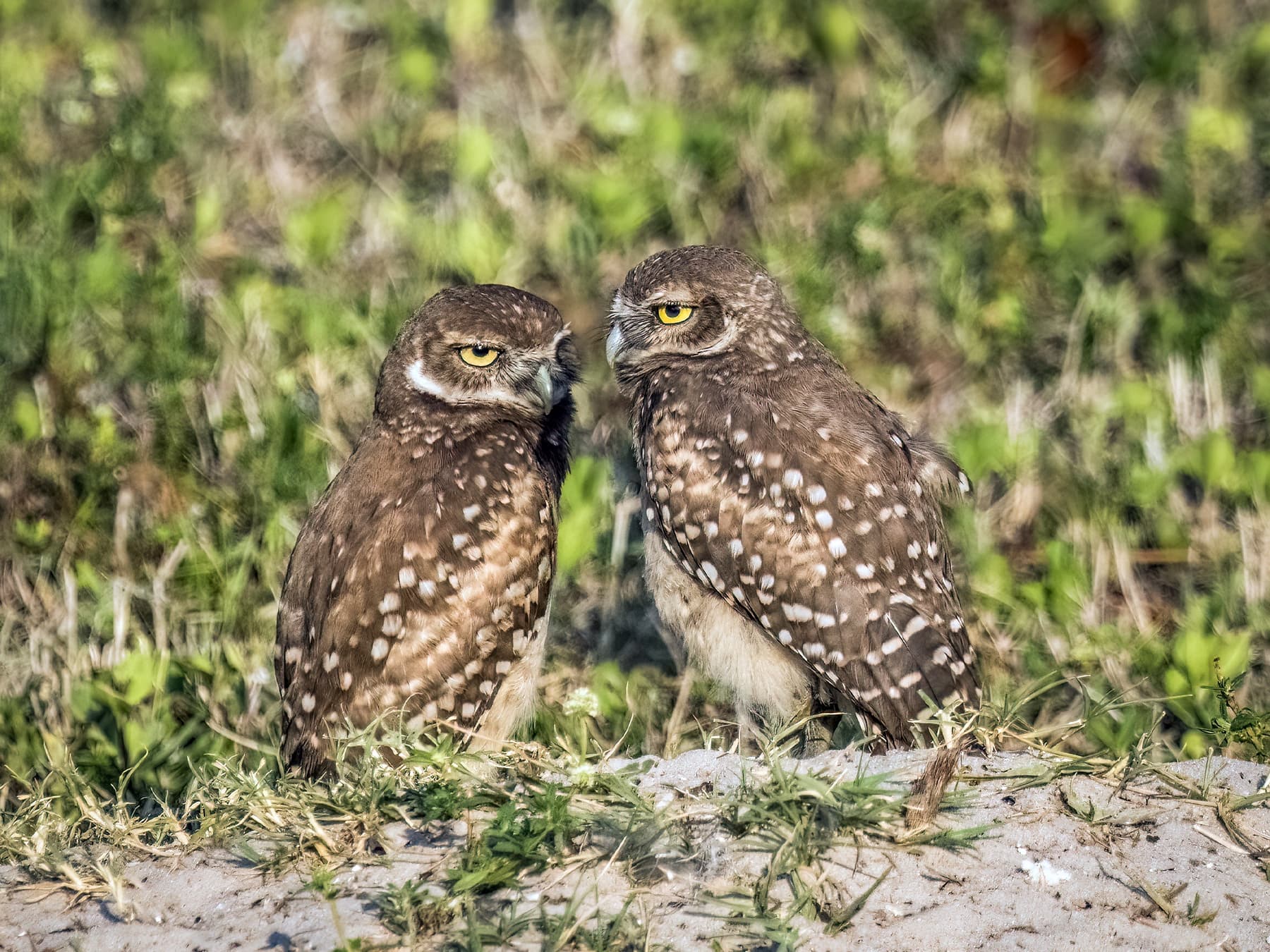
In western populations of burrowing owls, monogamous pair bonds form on breeding grounds but are not usually permanent and pairs disperse once they have finished raising their young. In most cases, a new mate is found in subsequent years, although it is not entirely unheard of for pairs to reunite.
In Florida burrowing owl populations, more than 90 percent of pairs do mate for life, remaining together until one mate dies.
Behaviour
Are Burrowing Owls aggressive?
Nest defense tactics can quickly become physical if intruders persist. If swiping and chasing are not enough to deter a predator, then more confrontational behavior will follow, including aggressive attacks using their sharp talons to displace any threats.
Where do Burrowing Owls sleep at night?
Burrowing owls are nocturnal and hunt at night, and catch up on sleep during the day. Unlike many other owls, they are usually easier to spot when asleep than when awake during the breeding season, dozing while standing guard outside their burrow in plain sight. In winter, they wander more, roosting in burrows or behind hummocks during the day.
Lifespan and predators
How long do Burrowing Owls live?
Burrowing owls are able to breed for the first time at around 10 months of age and raise a single brood each year. Life expectancy is on average 6 years in the wild, with the oldest-documented individual reaching 8 years.
What are the predators of Burrowing Owls?
As a ground-dwelling species, burrowing owls are perhaps the most vulnerable of all owl species to predation. Badgers are a leading predator, accounting for up to 90 percent of all destroyed burrowing nests in certain regions. Domestic cats, skunks, weasels, and dogs are also known to prey on their eggs and young.
Avian predators attack adults and juvenile burrowing owls, with raptors including Swainson's and ferruginous hawks, merlins, prairie and peregrine falcons, red-tailed hawks, and cooper’s hawks, and great horned owls.
Are Burrowing Owls protected?
The Migratory Bird Treaty Act in the US provides legislation that safeguards burrowing owls, their nests, and their young.
In Canada, burrowing owls are federally protected as an endangered species, as well as being included in the Migratory Birds Convention Act, which makes it an offense to kill, injure, trade, or capture one or to disturb their nest sites, eggs, and young.
In Mexico, it is listed as a species with Special Protection.
Are Burrowing Owls endangered?
Although globally listed as a species of least concern, burrowing owls have declined significantly in population, with falling numbers believed to be linked to habitat loss caused by increased cultivation of grasslands.
Since 1995, the species has been classified as Endangered in Canada, while in Mexico, burrowing owls were assessed as a species with Special Protection in 2008.
In certain parts of the US, there are similar concerns about the long-term survival of burrowing owls, where it is listed as Endangered in Minnesota, Threatened in Colorado, and has status as a species of conservation concern in Washington, Oregon, California, Montana, Wyoming, Utah, and Oklahoma.
Conservation
While listed as Least Concern globally, Burrowing Owl populations are declining in many areas due to habitat loss and fragmentation.
Conservation efforts focus on protecting grasslands, maintaining suitable burrowing habitats, and implementing artificial burrow programs in some regions.
Similar birds
Often mistaken for
More photos
6 photos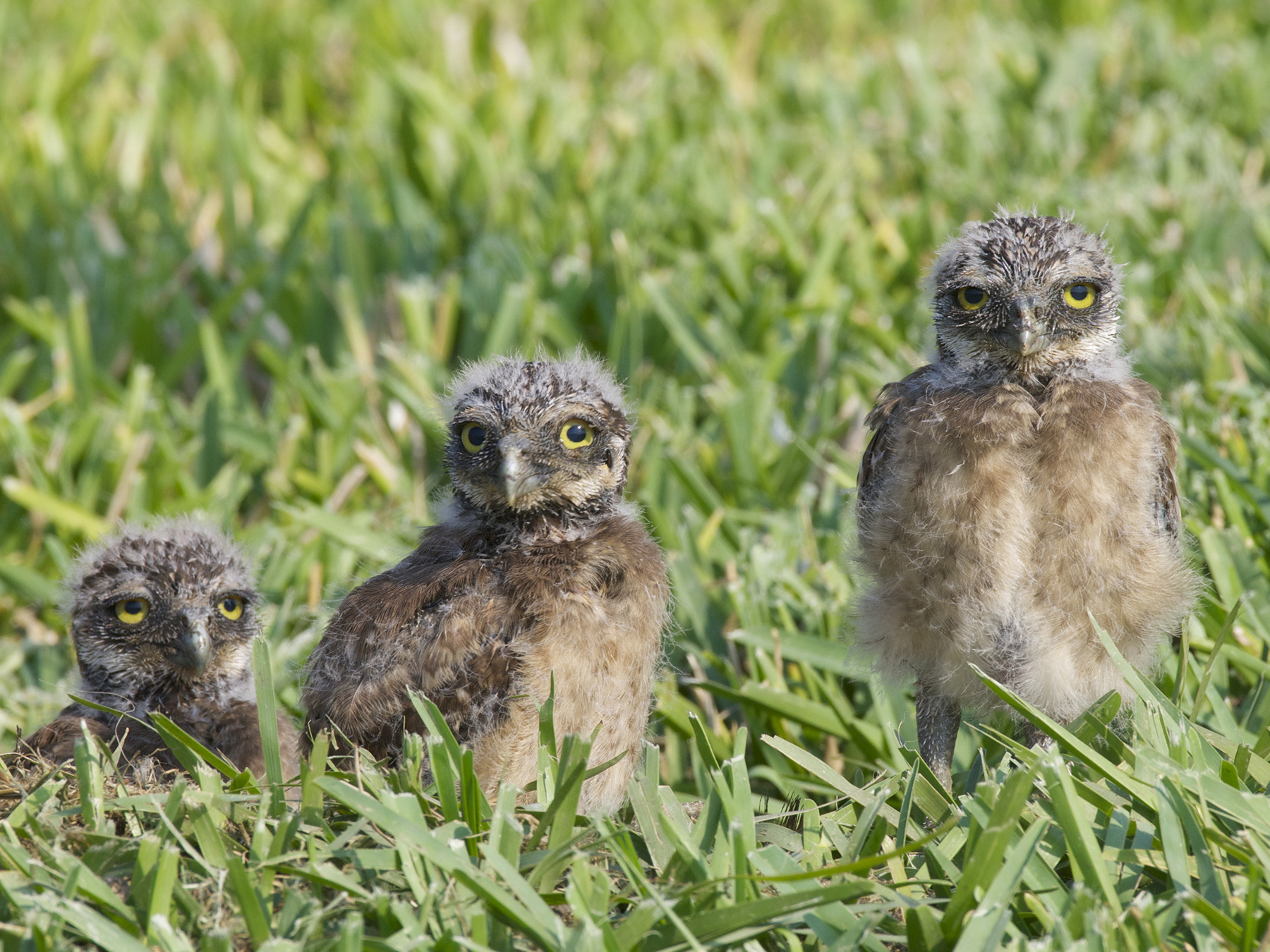
Quick facts
- Length
- 19–25 cm
- Wingspan
- 51–61 cm
- Weight
- 120–250 g
- Lifespan
- 6 years · oldest recorded 11 years
- Family
- Owls
- Migration
- Partial migrant
- Global status (IUCN)
- Least Concern
- World population
- 18,000,000 mature individuals
- Population trend
- Decreasing
- Also called
- Ground Owl, Prairie Dog Owl
- Scientific name
- Athene cunicularia
Questions
6How do I attract Burrowing Owls to my yard?
Burrowing owls live in open grassland plains, desert landscapes, and sparse or low vegetation. Backyards are not their typical or preferred habitats and it would be very unusual for such a setting to be chosen as a nesting spot.
However, tales of airfields, golf courses, and urban parks used as nest sites are regularly reported. So if your backyard has a vast available space, is within their range, and meets their preferred habitat requirements, it might be possible, although fairly unlikely, to attract a pair of burrowing owls.
What do Burrowing Owls do all day?
Unlike more secretive tree-dwelling owls, burrowing owls are frequently spotted in broad daylight standing outside the burrow or mound and sleeping for brief periods.
Can Burrowing Owls fly?
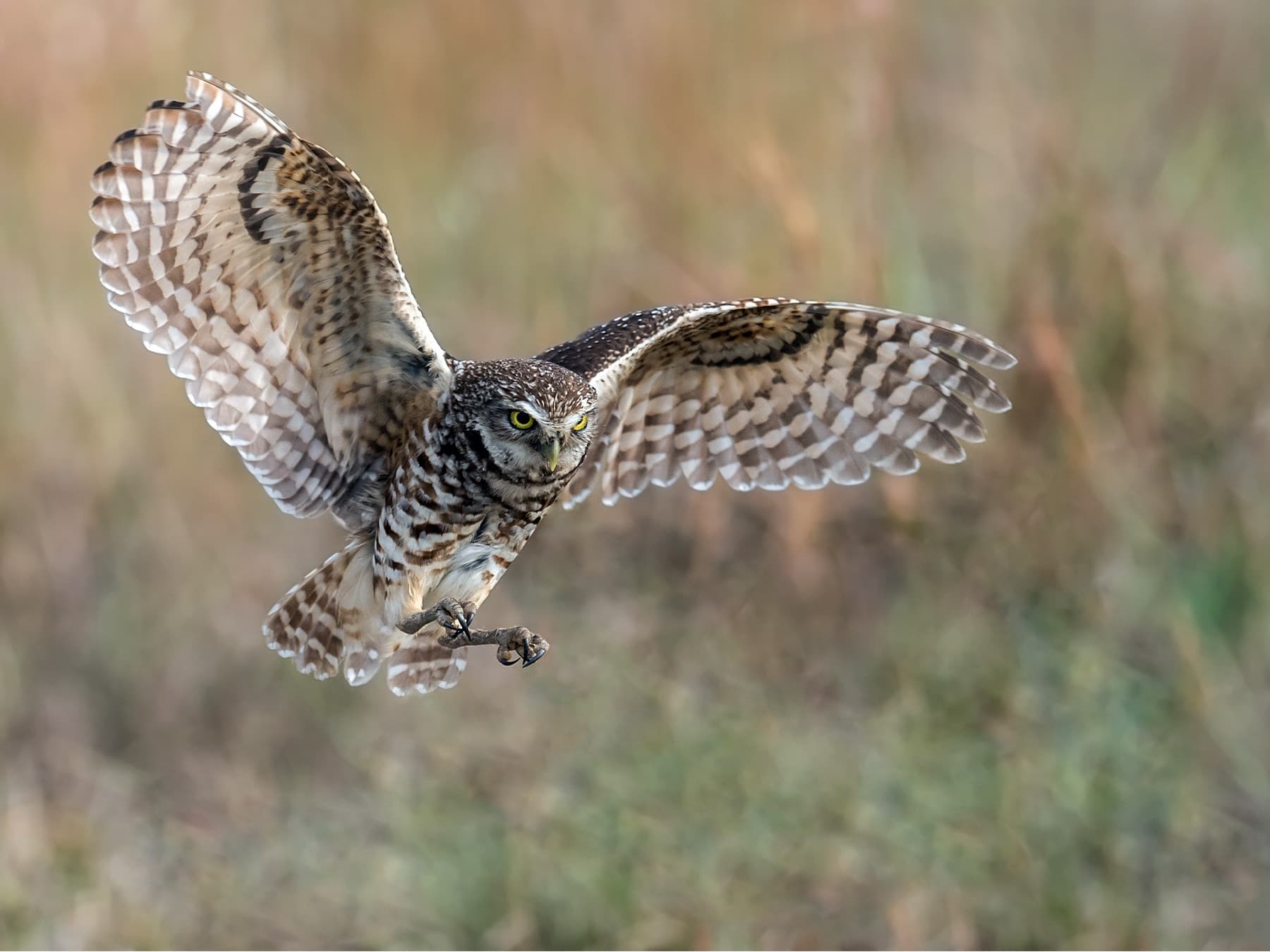
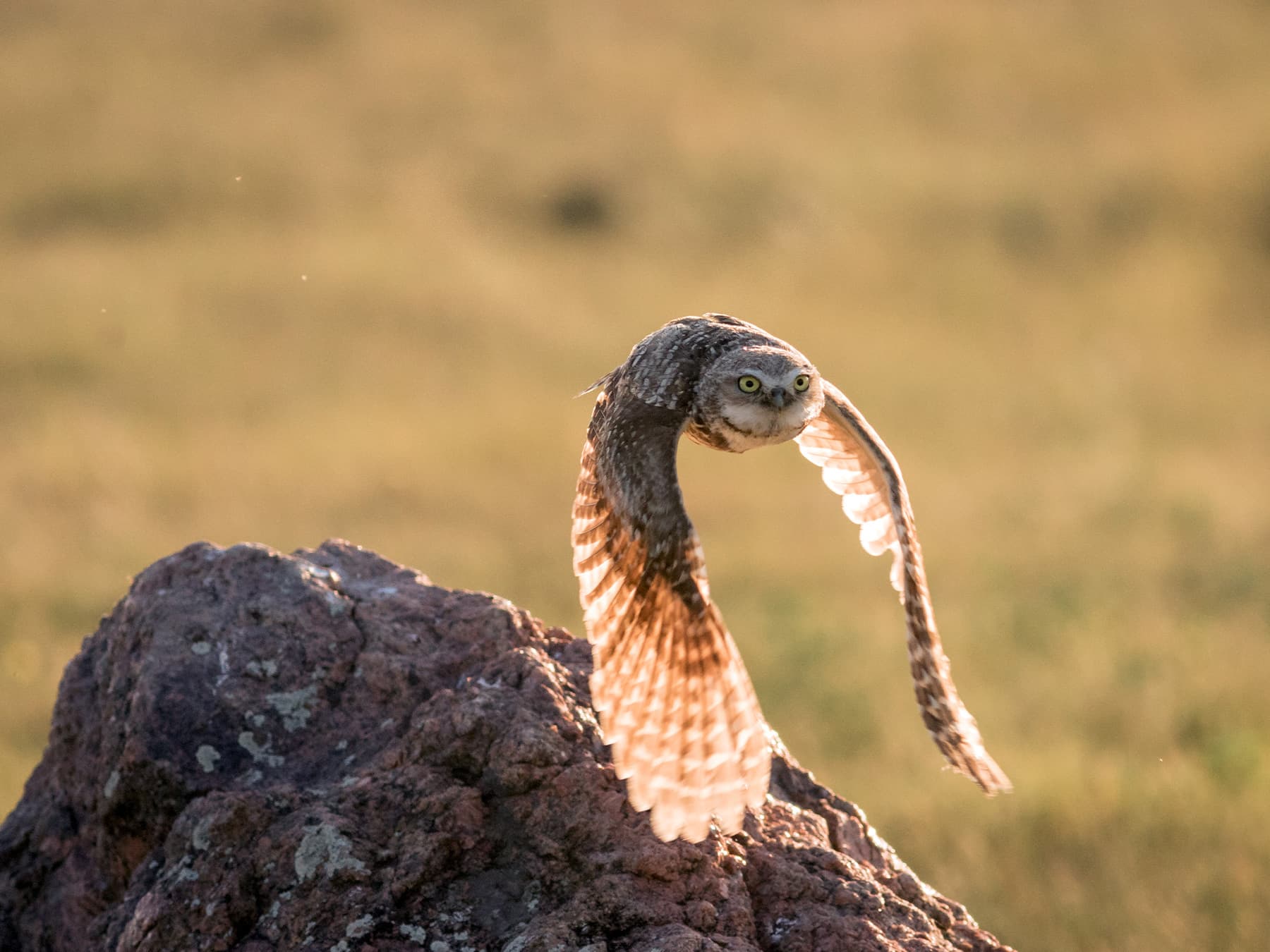
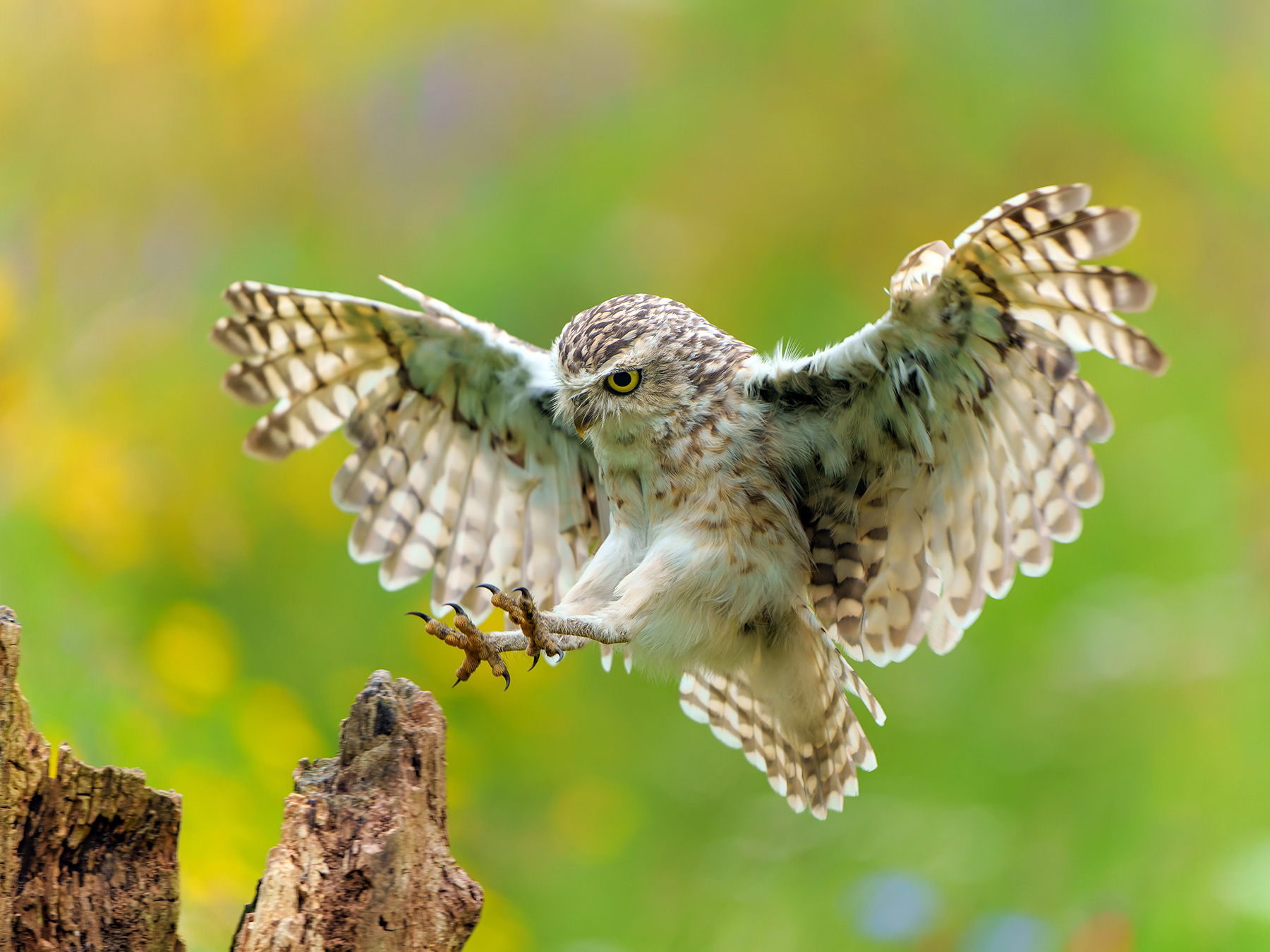
Burrowing owls do fly, but remain relatively low to the ground, and hover in pursuit of prey usually no more than 10 m (33 ft) above ground. Flights to and from nest burrows are close to the ground, usually at heights of only around 1m (3.3 ft)
Are Burrowing Owls nocturnal?
Burrowing owls are a nocturnal species but are most active at dawn and dusk. Most hunting takes place between these times, with insects mainly caught as it’s beginning to get light, and mammals successfully hunted in darkness.
During the day, resting burrowing owls can be seen standing guard at the entrance to their burrow, unlike the concealed daytime roosting spots of most other owl species.
What time are Burrowing Owls most active?
Both nocturnal and crepuscular, burrowing owls are at their most active at dawn and dusk, although they continue hunting throughout the night and may occasionally be seen in pursuit of prey during the day.
Are Burrowing Owls only in Florida?
An isolated population of burrowing owls are resident in Florida and the Bahamas. This subspecies is known as Athene cunicularia floridana.
Burrowing owls have a wider range in western North America, extending from Canada, throughout the western US into Mexico, as well as in parts of the Caribbean. Burrowing owls are also permanent residents across South America from the Amazon basin as far south as Patagonia.
Sources
4- 1BirdLife International. 2016. Athene cunicularia. The IUCN Red List of Threatened Species 2016: e.T22689353A93227732. Source (opens in a new tab)
- 2BirdLife International. 2016. Athene cunicularia. The IUCN Red List of Threatened Species 2016: e.T22689353A93227732. Source (opens in a new tab)
- 3Partners in Flight (2022) Source (opens in a new tab)
- 4Longevity Records Of North American Birds. Version 2023.1 Source (opens in a new tab)

Checked by
Nathan Cope, founder and editor
Nathan founded Birdfact and leads its writers and contributors in the UK, the US and Canada. He has watched and studied birds for more than ten years, and checks every article and species guide before it’s published.