


Short-eared Owl
Grass Owl · Asio flammeus
By the Birdfact teamChecked by Nathan Cope
On this page14 sections
How to recognise it
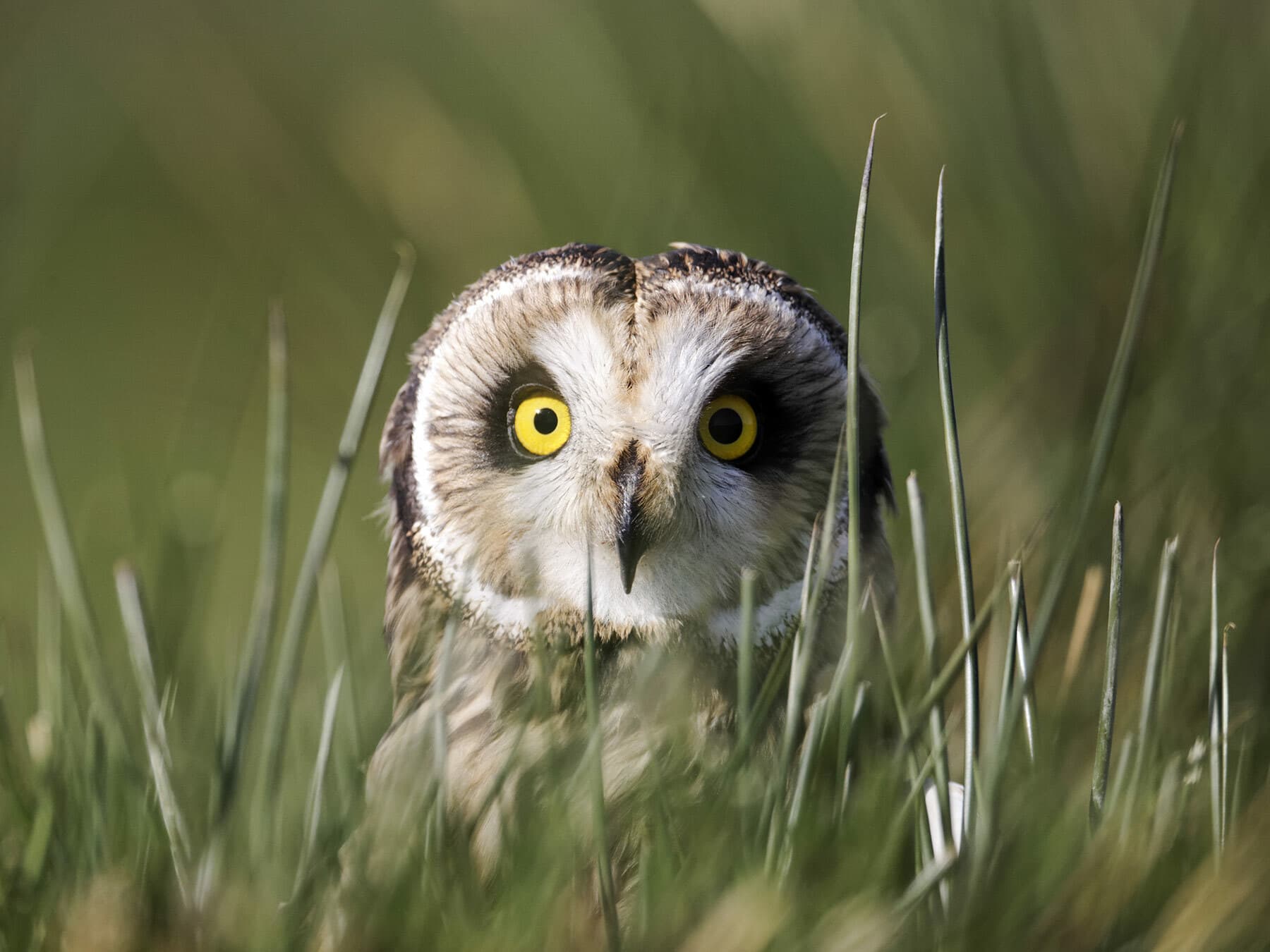
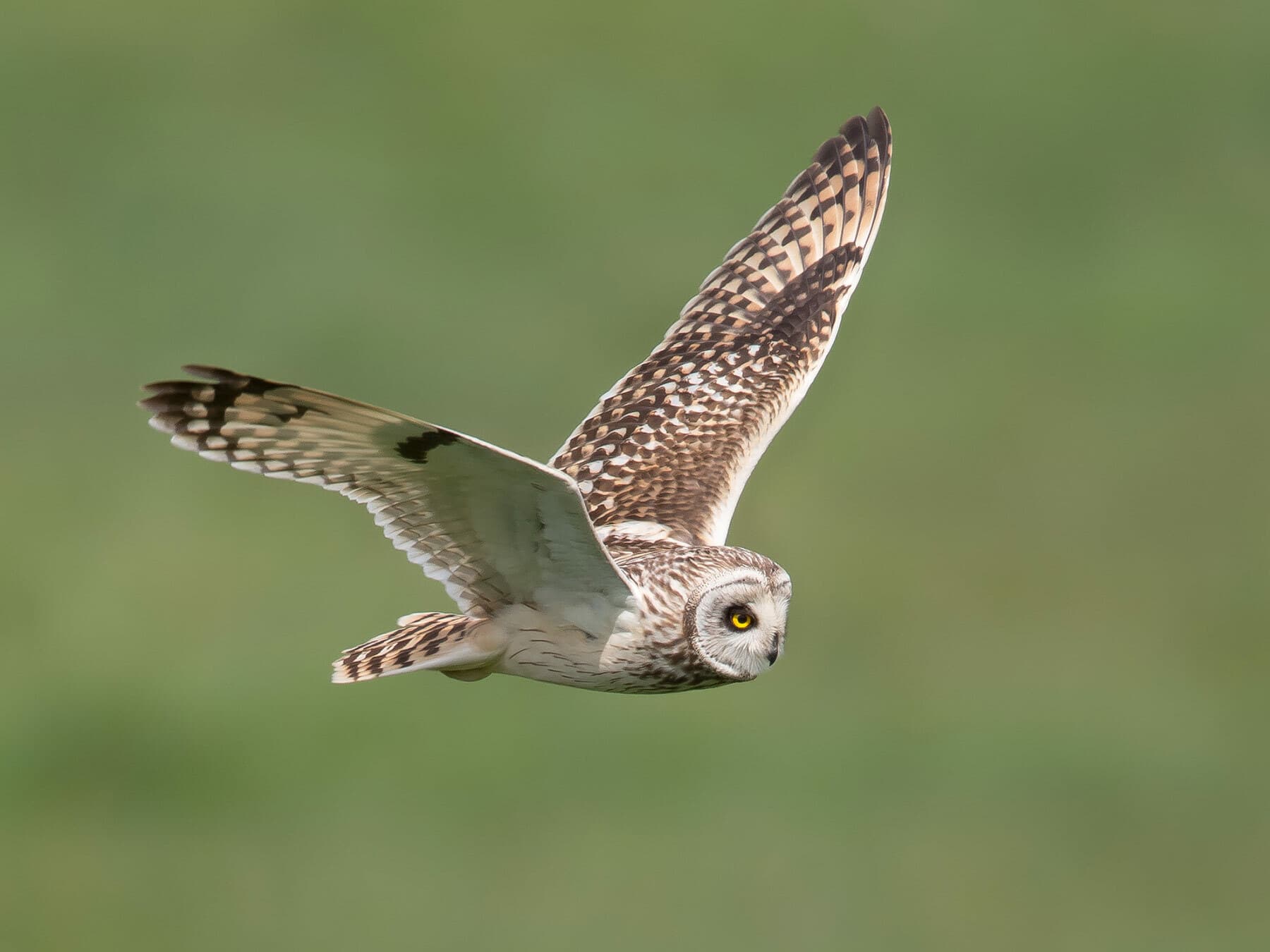
The Short-eared Owl is a medium-sized owl with a rounded head and small ear tufts. Its plumage is mottled brown and buff, with streaking on the breast. The wings are broad and rounded, with distinctive black wrist marks visible in flight.
Both sexes are similar in appearance, with females slightly larger. The bill is short and thin, black in colour and hooked. Its feet are black with a yellow sole.
Juveniles resemble adults but may have a darker facial disk and more uniform wing colouration.
Its size
Adults- Length
- 34–43 cm
- Wingspan
- 85–110 cm
- Weight
- 206–475 g
Its song and calls
In flight the short-eared will often issue a loud ‘boo – boo – boo’ hoot, alternatively, they have a short almost bark type call of ‘ke-ow’ or ‘waowk’.
- Song0:00 / 0:56
Recorded in Volyn Oblast, Ukraine · June 2025
- Call0:00 / 0:05
Recorded in Bretagne, France · December 2022
When and where to see it
OctoberArriving
Most recorded in October
- 1. Orkney Islands0.33%
- 2. East Riding of Yorkshire0.33%
- 3. Pembrokeshire0.17%
- 4. Wexford0.15%
- 5. Antrim0.13%
Each dot is a county, state or province: the bigger and darker, the larger the bird’s share of that place’s bird records that month. Grey dots: no regular records. The ringed point is the centre of the bird’s records this month; the arrow shows how it moved since last month, and the dashed loop its path through the year. “Arrivals” colours places where it becomes regular this month (orange) or is in its last regular month (grey). GBIF eBird Observation Dataset, 2019–2024. Map data: Natural Earth, US Census Bureau; place centres © OpenStreetMap contributors.
In your area
See when the Short-eared Owl is recorded in your county, state or province.
How often the Short-eared Owl turns up in the UK, Ireland, the United States and Canada through the year, from birdwatchers' records.
United Kingdom
Resident · all year · most records in October
Ireland
Passage migrant · regularly Sep–May · most records in November
United States
Winter visitor · regularly Oct–Jul · most records in January
Canada
Winter visitor · regularly Oct–Jul · most records in January
Show as a table
| Month | United Kingdom | Ireland | United States | Canada |
|---|---|---|---|---|
| January | 0.058% (regular) | 0.027% (regular) | 0.046% (regular) | 0.077% (regular) |
| February | 0.041% (regular) | 0.017% (regular) | 0.032% (regular) | 0.055% (regular) |
| March | 0.033% (regular) | 0.020% (regular) | 0.018% (regular) | 0.025% (regular) |
| April | 0.032% (regular) | 0.013% | 0.007% (regular) | 0.014% (regular) |
| May | 0.037% (regular) | 0.008% (regular) | 0.004% (regular) | 0.003% |
| June | 0.030% (regular) | 0.004% | 0.007% (regular) | 0.007% (regular) |
| July | 0.019% (regular) | <0.001% | 0.004% (regular) | 0.007% (regular) |
| August | 0.019% (regular) | 0.003% | 0.002% | 0.003% |
| September | 0.025% (regular) | 0.005% (regular) | 0.002% | 0.002% |
| October | 0.060% (regular) | 0.034% (regular) | 0.007% (regular) | 0.014% (regular) |
| November | 0.054% (regular) | 0.077% (regular) | 0.025% (regular) | 0.046% (regular) |
| December | 0.043% (regular) | 0.019% | 0.040% (regular) | 0.055% (regular) |
Recorded regularly in
Worldwide: recorded regularly in 75 countries
Countries where it was recorded in at least 3 of the 6 years 2019–2024. Linked countries have their own bird list.
Europe (34)
Asia (21)
North America (7)
Data: EOD – eBird Observation Dataset (Cornell Lab of Ornithology), accessed via GBIF.org, CC BY 4.0. Records from 2019–2024, aggregated and filtered by Birdfact. How these lists are made
Short-eared owls prefer open countryside and hunt across farmland, moors and coastal marshes. They are highly terrestrial. The UK’s resident population is predominantly concentrated in the north of England and Scotland although during the winter months visiting migrants can be found throughout our shores, more commonly in wetlands and coastal marsh areas.
Signs and Spotting tips
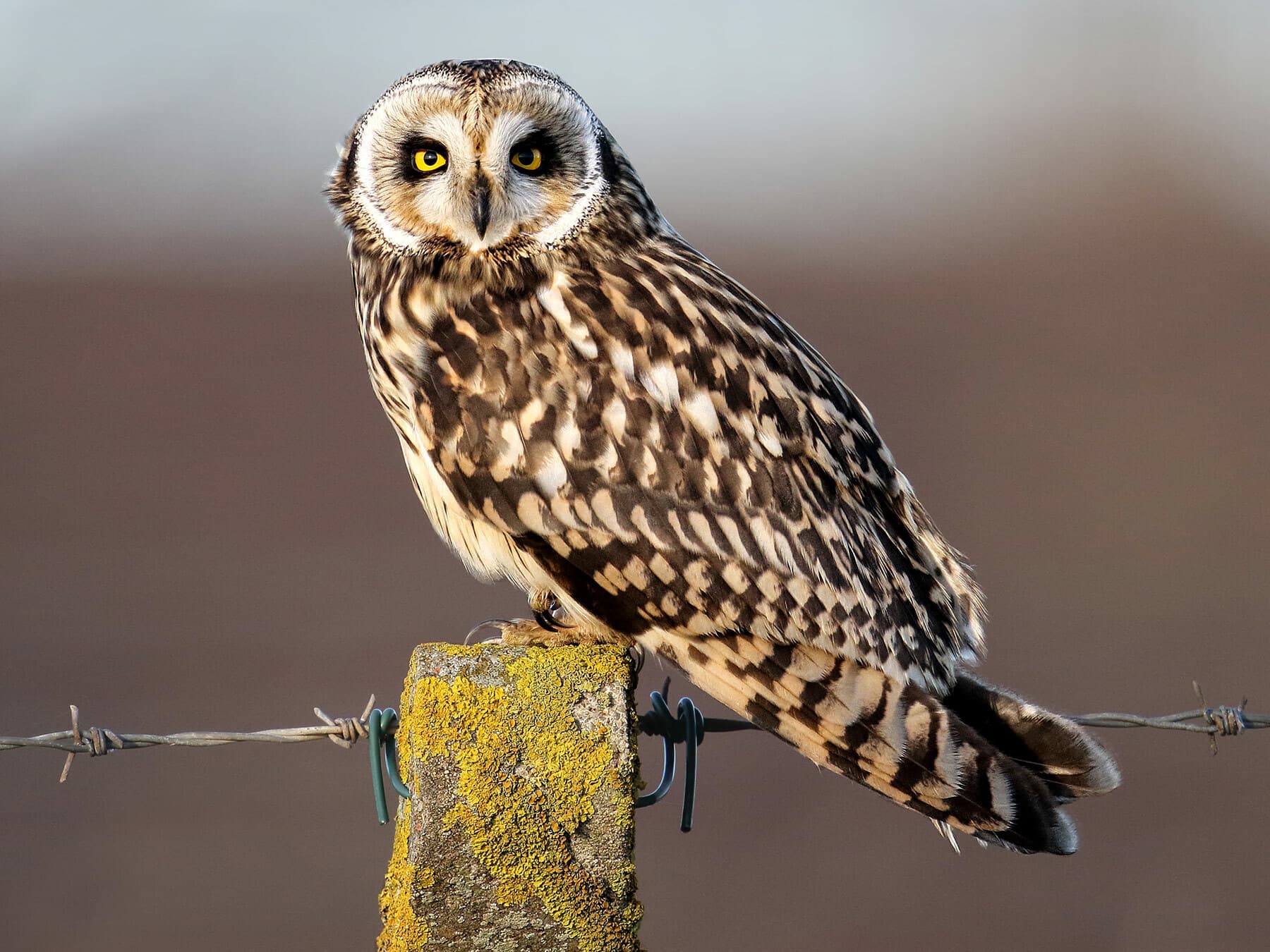
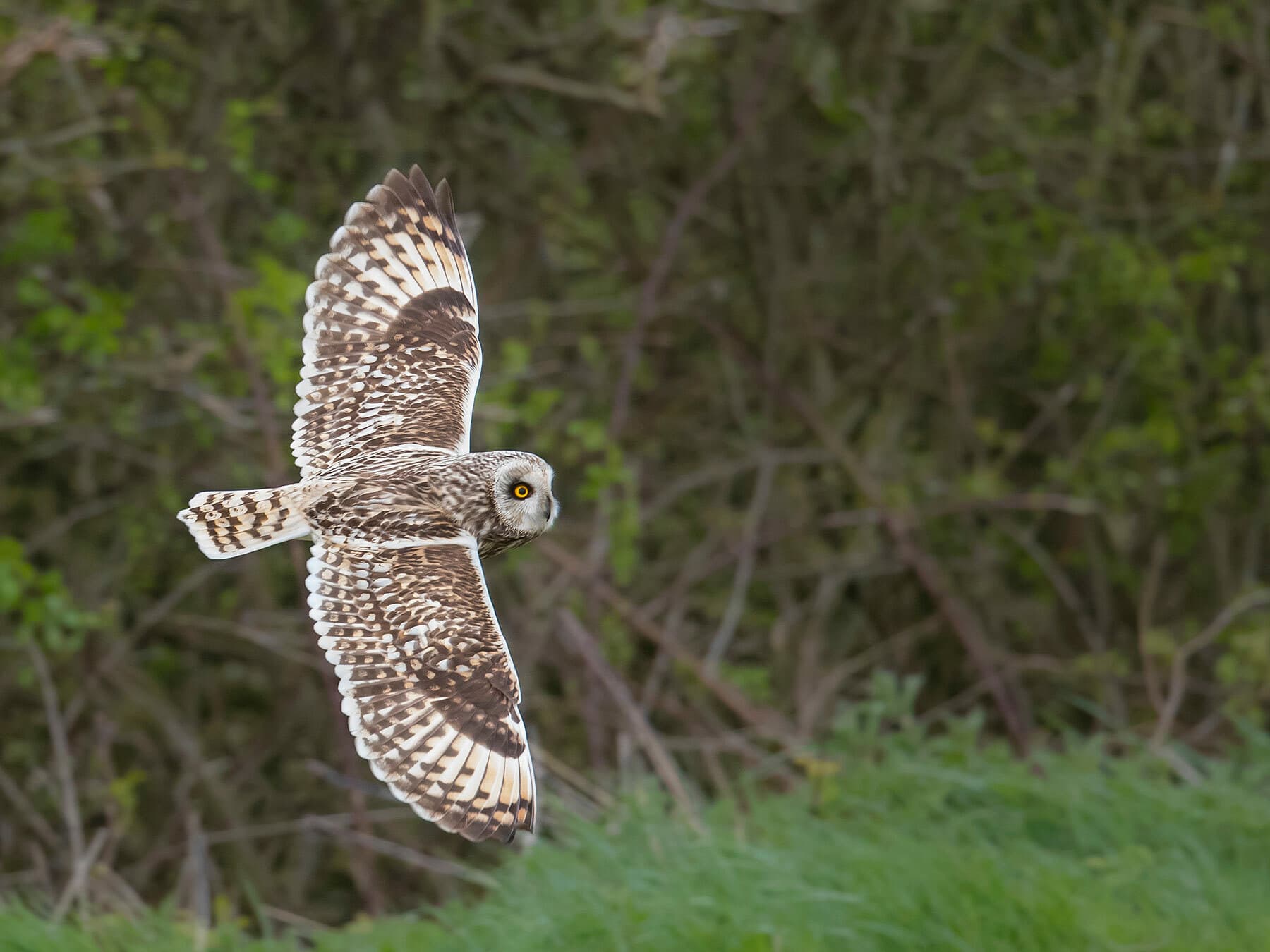
Probably the owl which most closely resembles the short-eared and may easily be confused with it is the long-eared owl. Generally, however, the long-eared has darker plumage and a red/orange eye with a dark facial disc and pale coloured eyebrows, angled downwards in an obvious V shape. As previously stated the short-eared is often seen during daylight hours, particularly at and after dawn and before dusk where it can be viewed flying at a low height searching for its prey. Its stiff wings beat a slow rhythm and it tends to glide as it banks and circles across its hunting grounds. More easily sighted in winter in wetland and marsh regions when numbers of birds are greater.
What it eats
As with all other owls, the short-eared is a carnivore preferring as its staple diet the vole but it will also take other small rodents and occasionally birds.
Nesting and breeding
The short-eared constructs a nest on the ground lined with grass or feathers in a scrape in which it lays between 4 to 8 plain creamy white coloured eggs. Up to two broods may be produced between April to July.
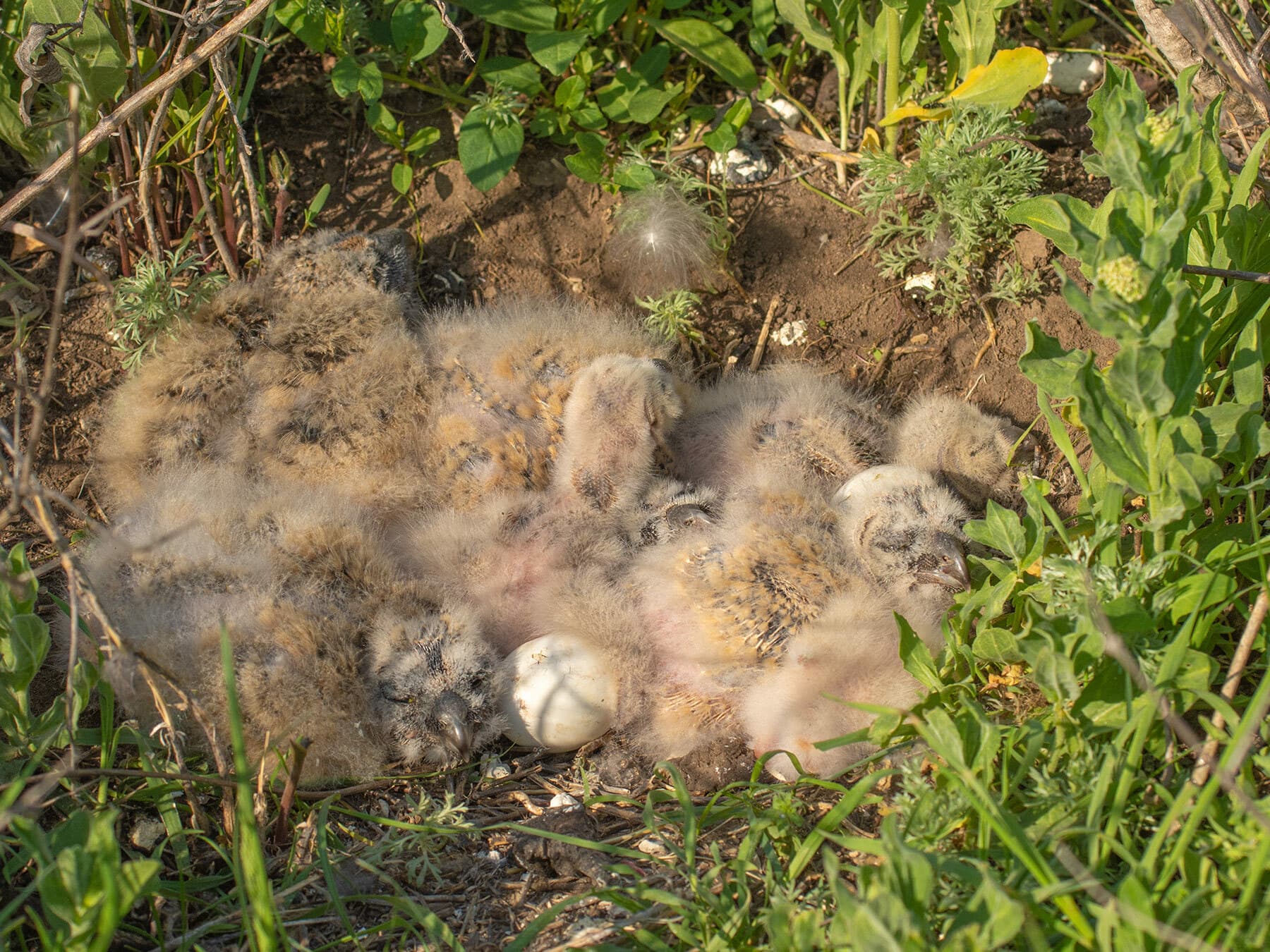
Behaviour
Short-eared Owls are known for their low, wavering flight over open areas while hunting. They are more diurnal than most owls, often active during daylight hours, especially at dawn and dusk.
These owls are generally solitary but may form loose communal roosts in winter.
Lifespan and predators
Whilst some authorities give an estimated lifespan for the short-eared within Europe as between 10 to 15 years others quote a much shorter period with 7 years often given for North American populations.
Conservation
While listed as Least Concern globally, Short-eared Owl populations are declining in many areas due to habitat loss and degradation.
Conservation efforts focus on preserving grasslands and managing agricultural practices to maintain suitable hunting and nesting grounds.
What does a Short-eared Owl look like?
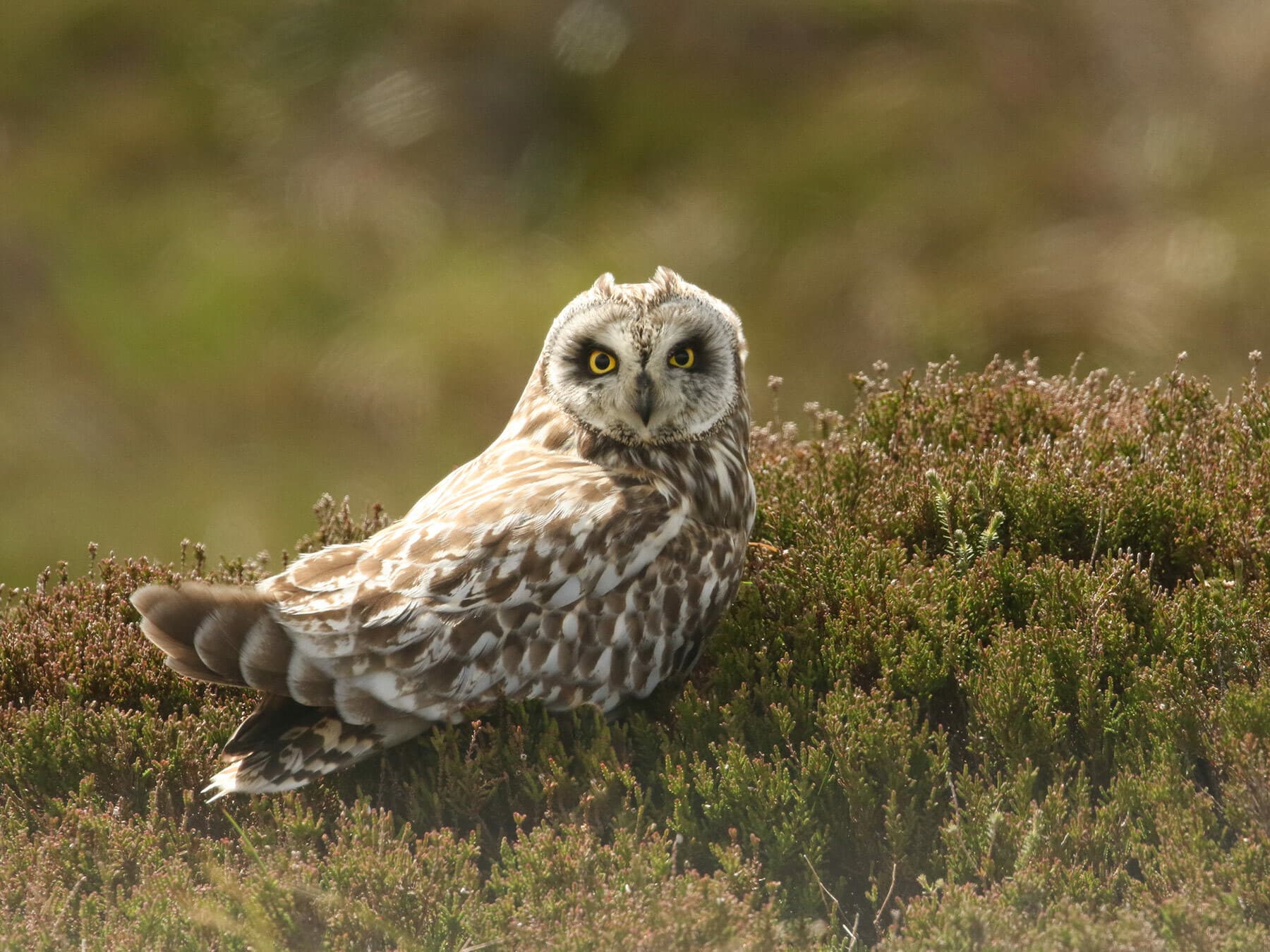
The adult short-eared owl has a round head and short neck. I has prominent, large piercing yellow eyes circled by a black ring with pale buff or whitish rounded ‘disc’ shaped patches surrounding the upper part of the face and forehead. There are small tufts of feathers on the top of the bird’s head with the appearance of ears from where this owl gets its name, they are often difficult to spot and usually lay flat on top of the head. The underside of the bird is a creamy white colour streaked with thin dark lines and a white belly area. The broad underwing is mainly buff or white with blackish wing tips and a narrow dark brown angled bar across the covert feathers towards the end of the wing.
The upperside of the owl is a buff and brown marbled pattern with orange/buff areas across the outer wing and a dark brownish ‘wrist’ patch with similarly coloured wingtips. There is a row of pale-coloured spots running down the back on both sides of the bird above the wings and a short square orange/buff tail with dark stripes running parallel to its outstretched wings. The feathers at the trailing edge of the wings are tipped white. The bill is short and thin, black in colour and hooked. Its feet are black with a yellow sole.
Similar birds
Often mistaken for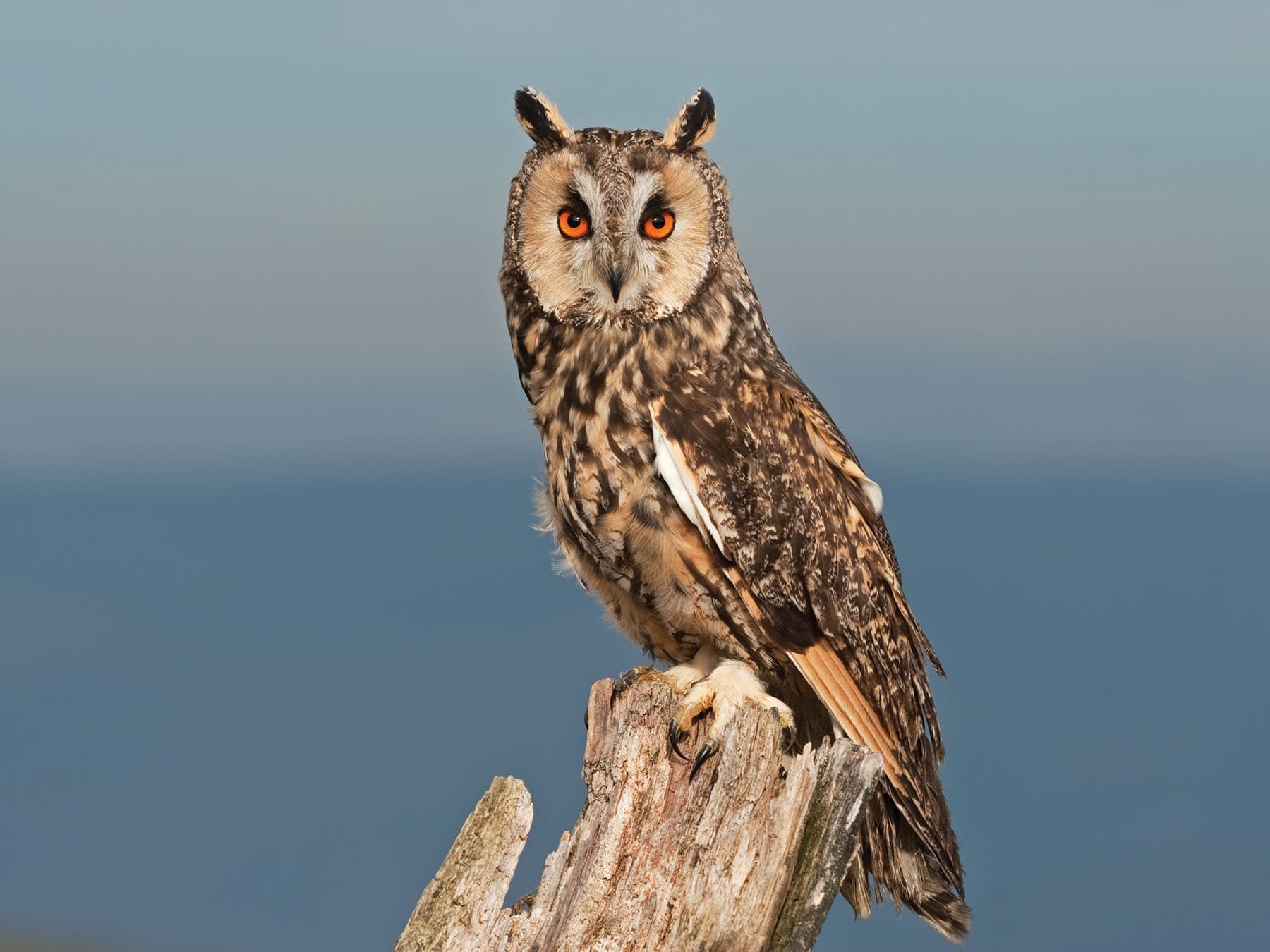
Short-eared Owl guides
5 guidesQuick facts
- Length
- 34–43 cm
- Wingspan
- 85–110 cm
- Weight
- 206–475 g
- Lifespan
- 7–15 years · oldest recorded 21.8 years
- Family
- Owls
- Migration
- Partial migrant
- Global status (IUCN)
- Least Concern
- World population
- 1,210,000 - 2,030,000 mature individuals
- Population trend
- Decreasing
- Also called
- Grass Owl
- Scientific name
- Asio flammeus
Sources
4- 1BirdLife International. 2021. Asio flammeus. The IUCN Red List of Threatened Species 2021: e.T22689531A202226582. Source (opens in a new tab)
- 2BirdLife International. 2021. Asio flammeus. The IUCN Red List of Threatened Species 2021: e.T22689531A202226582. Source (opens in a new tab)
- 3BirdLife International. 2021. Asio flammeus. The IUCN Red List of Threatened Species 2021: e.T22689531A202226582. Source (opens in a new tab)
- 4Fransson et al., EURING list of longevity records for European birds (2010) Source (opens in a new tab)

Checked by
Nathan Cope, founder and editor
Nathan founded Birdfact and leads its writers and contributors in the UK, the US and Canada. He has watched and studied birds for more than ten years, and checks every article and species guide before it’s published.