


Tawny Owl
Brown Owl · Strix aluco
By the Birdfact teamChecked by Nathan Cope
On this page20 sections
- How to recognise it
- Its size
- Its song and calls
- When and where to see it
- What it eats
- Nesting and breeding
- Behaviour
- Lifespan and predators
- Conservation
- What does a Tawny Owl look like?
- The seven subspecies of Tawny Owl
- How big is a Tawny Owl?
- How much does a Tawny Owl weigh?
- What is the scientific name for a Tawny Owl?
- Are Tawny Owls aggressive?
- Are Tawny Owls endangered?
- Do Tawny Owls mate for life?
- Tawny Owl guides
- Quick facts
- Sources
How to recognise it
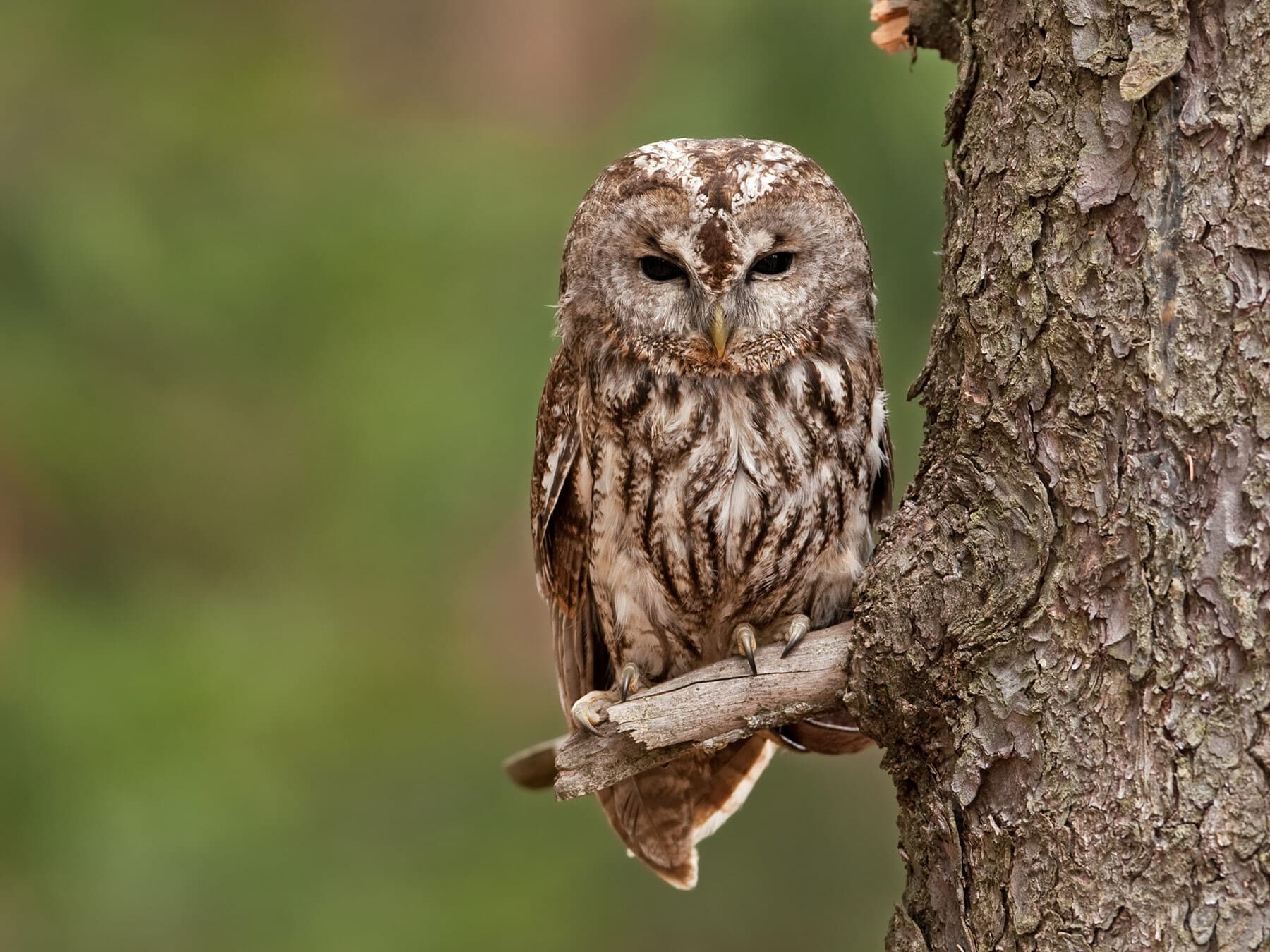
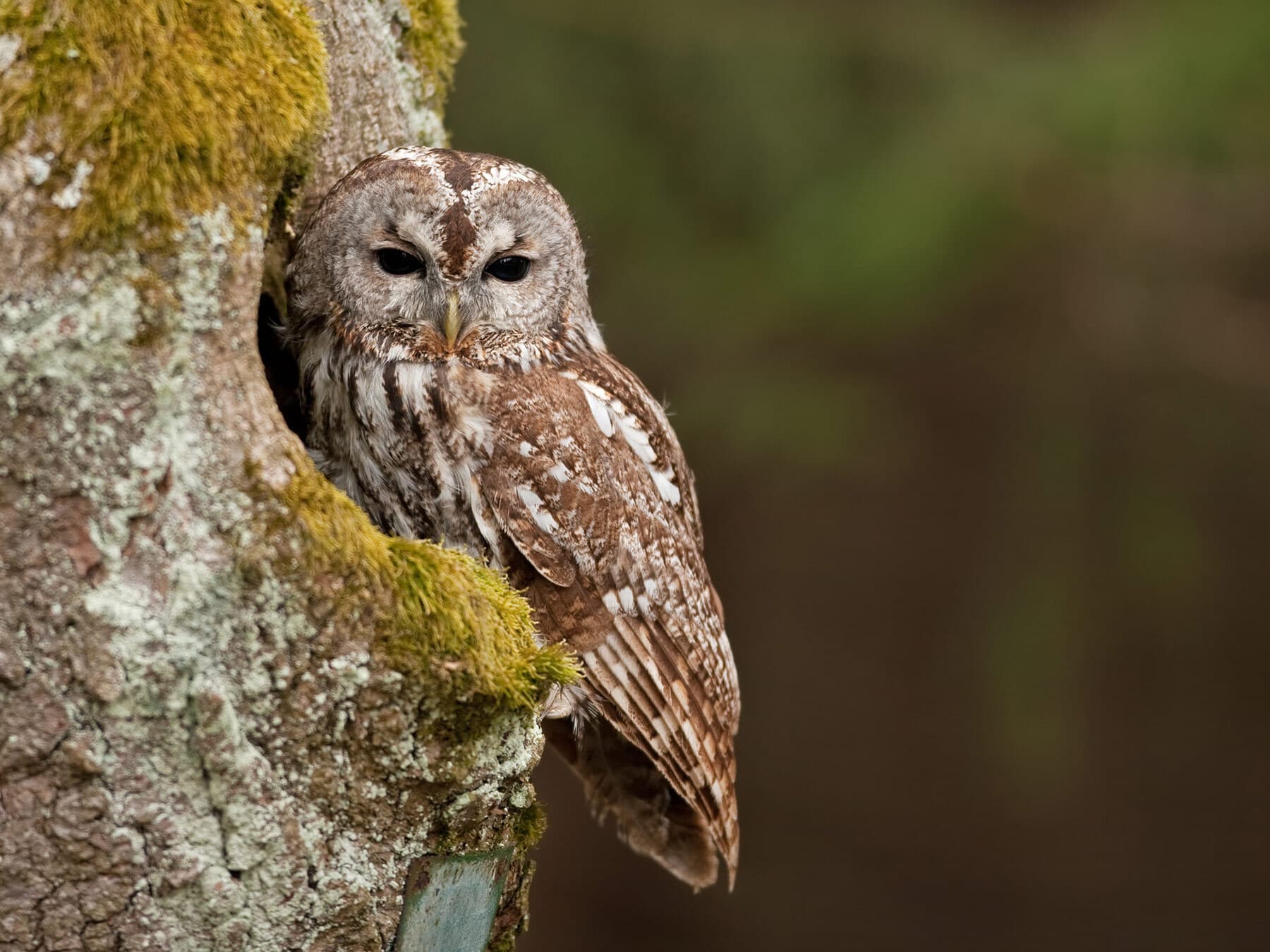
The Tawny Owl is a medium-sized owl with a robust build. Its plumage is mottled brown and grey, providing excellent camouflage against tree bark. The bird has a large, rounded head with dark eyes and no ear tufts. The facial disc is pale, almost off white.
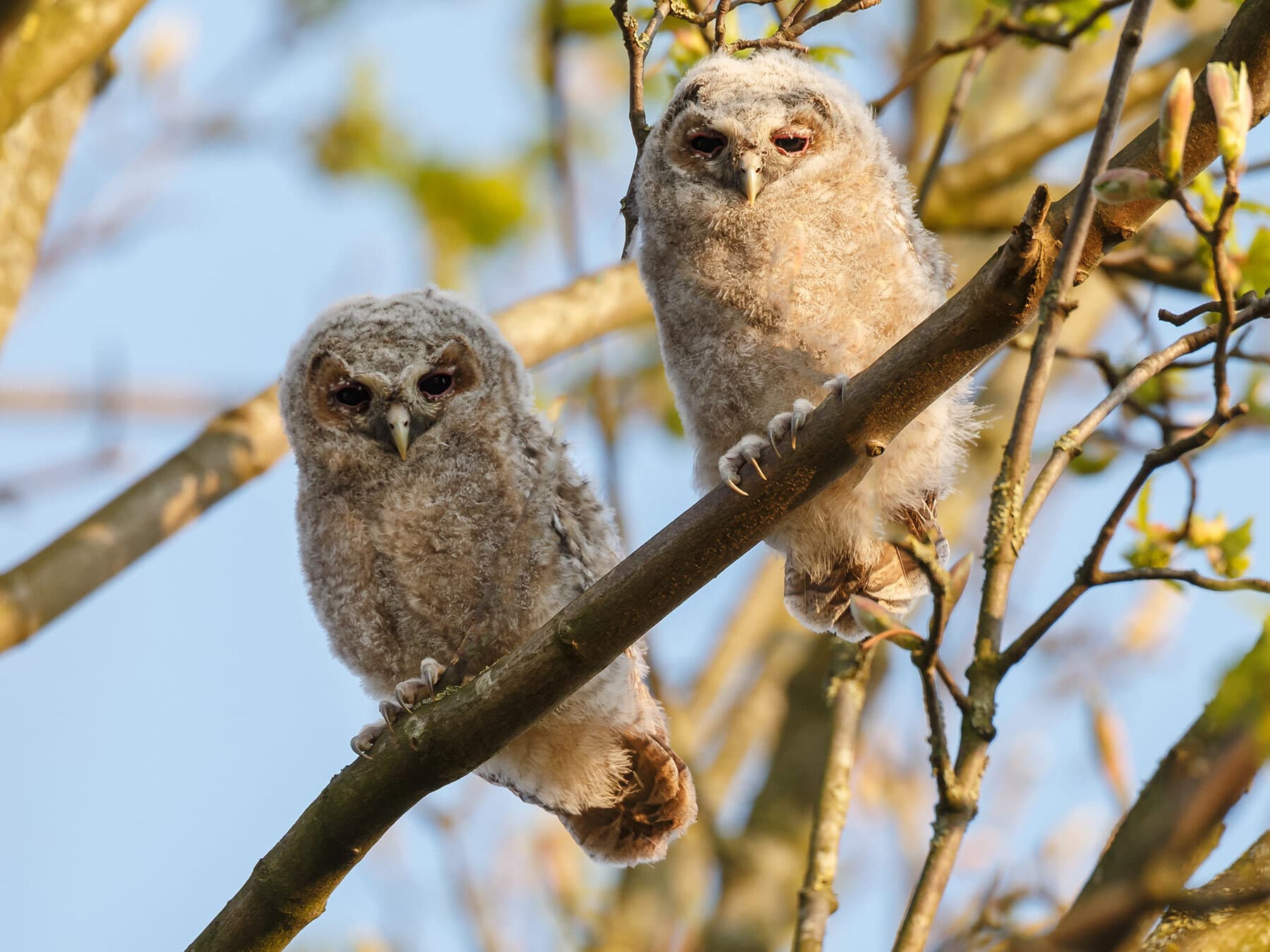
Females are generally larger and heavier than males, but plumage is similar between the sexes. Juveniles resemble adults but have a more fluffy appearance and may show slightly paler markings.
Two colour morphs exist, grey or brown.
Its size
Adults- Length
- 37–43 cm
- Wingspan
- 94–104 cm
- Weight
- 330–590 g
Its song and calls
The vocalisations of male and female tawny owls differ with the female issuing a medium to high pitched almost screech like, ‘kew – wick, kew – wick’ sound whereas the male sings with a low pitched, haunting whistle or hoot, frequently repeated as in ‘hooo – hooo – hooo’.
This has often been interpreted as a ‘ta-wit ta-woo’ sound where in fact the female’s ‘kew – wick’ sound is made first (‘ta-wit’) followed by the male’s response of ‘hooo’ (erroneously described as being ‘ta-woo’).
This archetypal owl noise is often used in films to create a spooky atmosphere at night and it has come to epitomise the genre even though the tawny owl may not be a resident in many of the portrayed locations.
- Song0:00 / 0:10
Recorded in Bauska Municipality, Latvia · March 2025
- Call0:00 / 0:12
Recorded in Lincolnshire, England · October 2021
When and where to see it
OctoberHere all year
Most recorded in October
- 1. Shropshire0.69%
- 2. Cumbria0.52%
- 3. Ceredigion0.45%
- 4. Blaenau Gwent0.40%
- 5. Midlothian0.39%
Each dot is a county, state or province: the bigger and darker, the larger the bird’s share of that place’s bird records that month. Grey dots: no regular records. The ringed point is the centre of the bird’s records this month; the arrow shows how it moved since last month, and the dashed loop its path through the year. “Arrivals” colours places where it becomes regular this month (orange) or is in its last regular month (grey). GBIF eBird Observation Dataset, 2019–2024. Map data: Natural Earth, US Census Bureau; place centres © OpenStreetMap contributors.
In your area
See when the Tawny Owl is recorded in your county, state or province.
How often the Tawny Owl turns up in the UK through the year, from birdwatchers' records.
United Kingdom
Resident · all year · most records in September
Show as a table
| Month | United Kingdom |
|---|---|
| January | 0.12% (regular) |
| February | 0.12% (regular) |
| March | 0.10% (regular) |
| April | 0.079% (regular) |
| May | 0.11% (regular) |
| June | 0.095% (regular) |
| July | 0.084% (regular) |
| August | 0.11% (regular) |
| September | 0.13% (regular) |
| October | 0.12% (regular) |
| November | 0.13% (regular) |
| December | 0.11% (regular) |
Recorded regularly in
Worldwide: recorded regularly in 50 countries
Countries where it was recorded in at least 3 of the 6 years 2019–2024. Linked countries have their own bird list.
Europe (39)
- Albania
- Andorra
- Austria
- Belarus
- Belgium
- Bosnia & Herzegovina
- Bulgaria
- Croatia
- Czechia
- Denmark
- Estonia
- Finland
- France
- Germany
- Gibraltar
- Greece
- Hungary
- Italy
- Kosovo
- Latvia
- Lithuania
- Luxembourg
- Moldova
- Montenegro
- Netherlands
- North Macedonia
- Norway
- Poland
- Portugal
- Romania
- Russia
- Serbia
- Slovakia
- Slovenia
- Spain
- Sweden
- Switzerland
- Ukraine
- United Kingdom
Asia (11)
- Armenia
- Azerbaijan
- Georgia
- India
- Iran
- Israel
- Kyrgyzstan
- Lebanon
- Tajikistan
- Turkey
- Uzbekistan
Data: EOD – eBird Observation Dataset (Cornell Lab of Ornithology), accessed via GBIF.org, CC BY 4.0. Records from 2019–2024, aggregated and filtered by Birdfact. How these lists are made
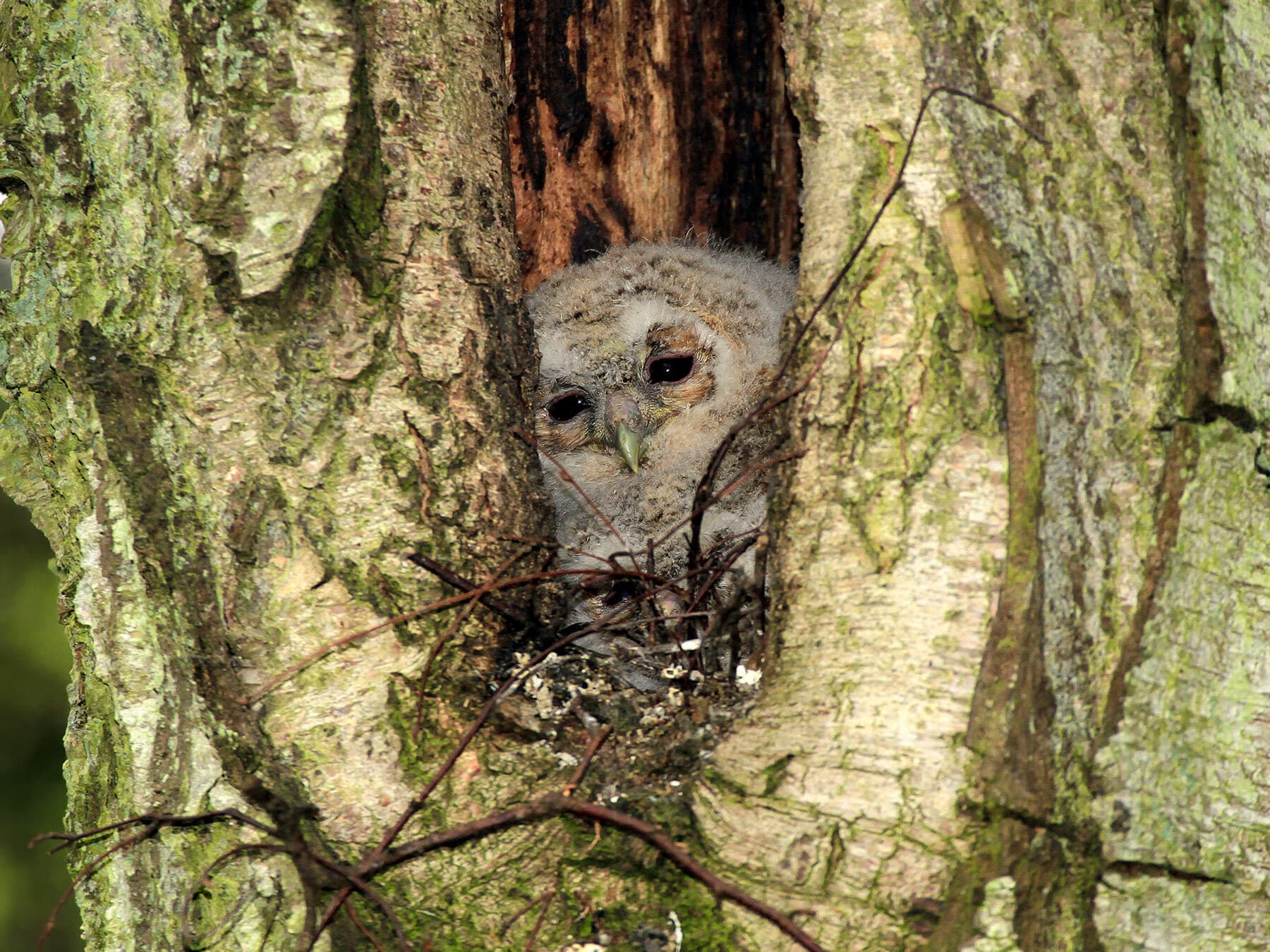
Tawny owls often nest in abandoned nests of other large bird species or tree cavities within open mixed forests or broadleaf woodlands. Nesting boxes and nooks in buildings or chimneys are also utilised and within certain geographical areas (e.g. Scotland) they will even nest upon the ground.
What is the habitat of a Tawny Owl?
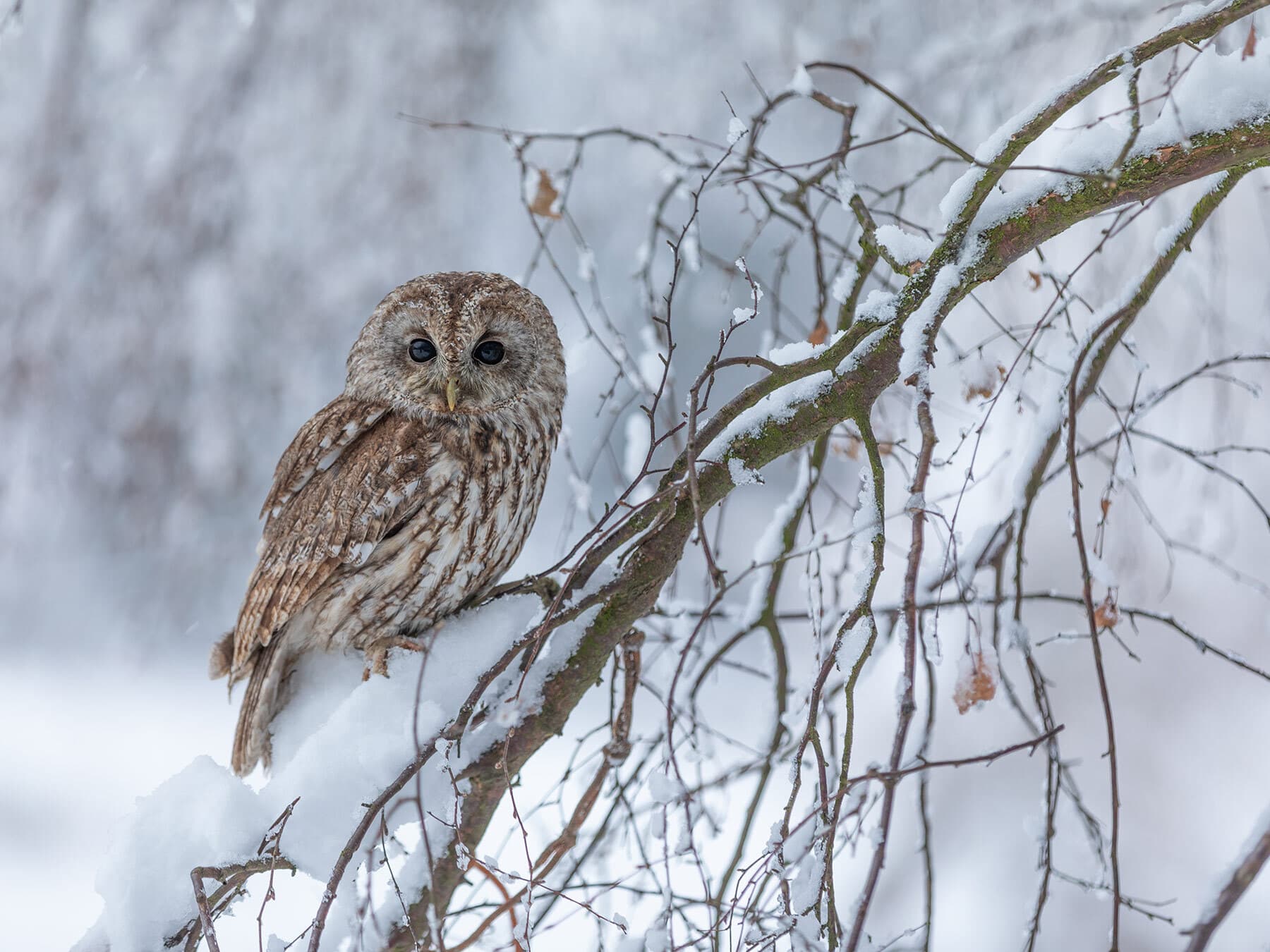
Tawny owls are, in the main, lowland birds who prefer open woodland and forest habitats of mainly broadleaf (deciduous) trees or mixed copses, although they will occasionally choose coniferous woods when left with no alternative. Whilst they will avoid treeless plains and landscapes they will populate urban parks, gardens, scrubland and farmland provided there are trees (particularly mature tress) within the immediate area.
Tawny owls are particularly territorial in nature and will usually defend an area of between 30 to 50 acres in size which they consider to be theirs alone. To understand the size of an owl’s territory we could compare it to that of a normal size soccer pitch (to include the immediate touchline area) which is calculated as being 2 acres. Thus, a pair of adult tawny owls will occupy a territory the size of between 15 to 25 soccer pitches which they will rarely, if ever leave.
Where can I see Tawny Owls?
Certainly within Europe the tawny owl is a common resident although not always easy to spot. Not only does their plumage offer excellent camouflage within their usual surroundings, they are also night hunters and during the day seldom move from their nest or roosting spot and are in fact exceptionally sedentary, using the minimal amount of physical activity.
Remember that tawny owls can be very aggressive, particularly in the breeding season and will often attack unsuspecting creatures, including humans, that they consider may be a danger to themselves or their offspring, so take care and avoid the immediate vicinity of nests.
Within the United Kingdom the tawny owl is the most common species of owl, although it is not found in Ireland. Careful observation around typical tawny owl habitats, particularly during dusk or dawn, can often result in a rewarding glimpse of a hunting tawny, especially when combined with prior knowledge obtained from hearing the unmistakable hooting sounds of an adult male.
Whilst walking through woods a telling sign of the presence of a tawny owl can also be the discovery of pellets at the base of a tree or underneath a branch. Many birds expel pellets by regurgitation, which are made up of undigestible feathers, fur, bones and other matter they may have consumed during a previous meal. Owl pellets are predominantly grey in colour and can often be found immediately below a nest or favourite perch.
Owl sanctuaries are also not uncommon within the western world, often caring for sick or injured birds and offer the chance to observe these beautiful creatures at close hand.
Do Tawny Owls migrate?
Tawny owls do not migrate. They are monogamous and remain within their own territory throughout their lives. Juvenile tawny owls are chased away from the parental territory during their first autumn and must find their own territory and mate which is seldom any great distance from the area in which they originated. The high death rate of first year juveniles is often attributed to starvation following their parental expulsion and inability to find food and/or territory.
Tips for seeing it
- Listen for their distinctive 'kee-wick' and 'hoo-hoo-ooo' calls at night
- Look for them perched in dense foliage during the day
- Search for pellets beneath regular roosting sites
- In the UK, check mature woodlands and parks, especially near water
What it eats
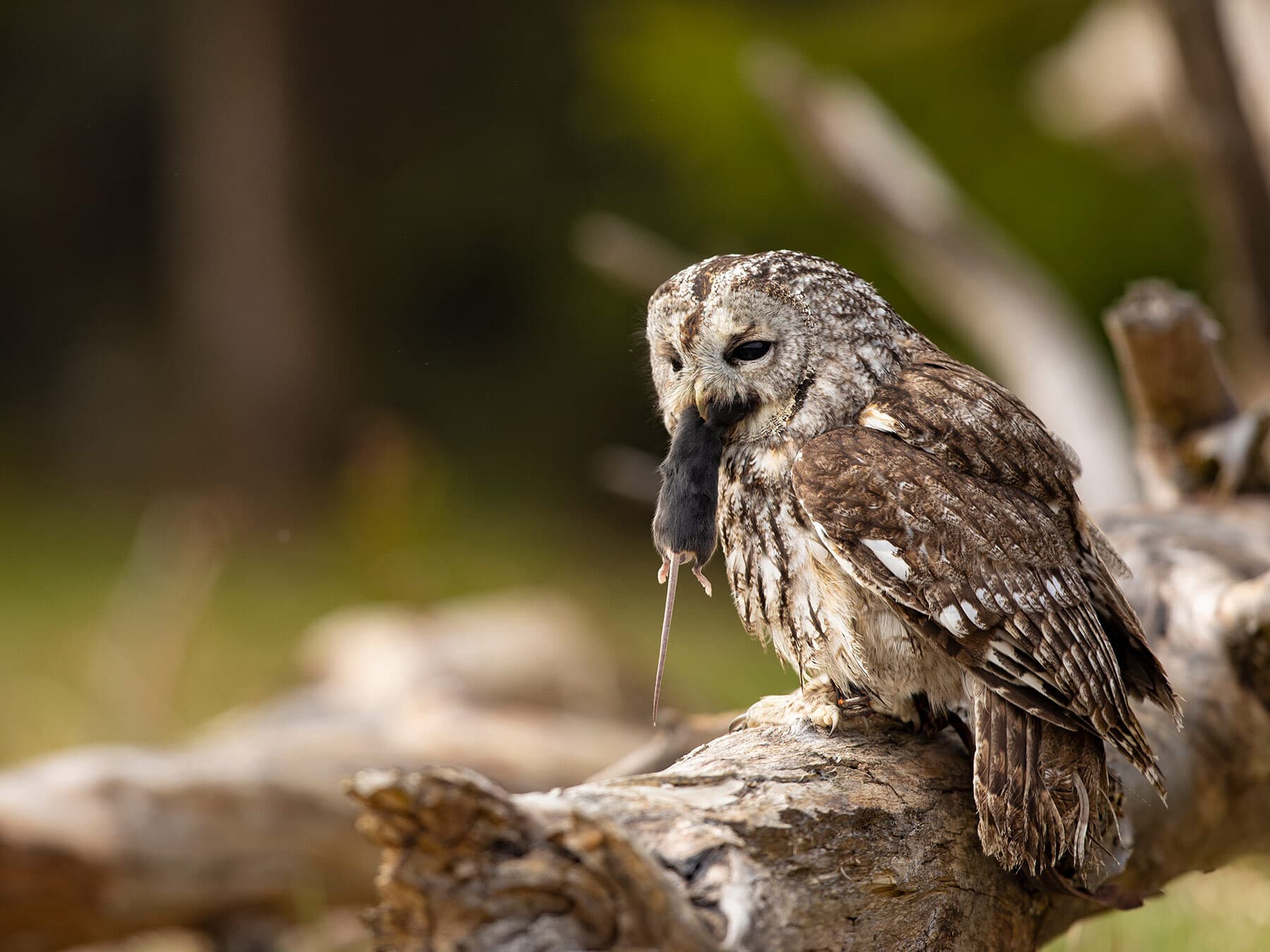
Tawny owls are superb night hunters and will glide silently over their territory hunting for prey or stand motionless on a favourite perch watching and more importantly listening for the telltale movement of their next meal.
They are almost totally carnivorous choosing a diet of small birds and mammals, reptiles and amphibians, insects, snails, beetles and worms.
Within the United Kingdom, where they are arguably the most common owl, their diet consists in the main of what is available to them within their territory during a particular season, predominantly voles, mice and shrews, as opposed to what their individual preference may be.
For more information on the feeding habits of Tawny Owls, check out this guide.
Nesting and breeding
The tawny owl will normally lay one brood annually between the months of February to July. The preferred laying period is dependent upon geographical location and climate. Eggs are laid at intervals of a couple of days which ensures that they hatch asynchronously meaning there are intervals between each egg hatching. Although observations have recorded the number of eggs laid in each clutch ranging from between 2 to 9, the number most commonly produced varies from 3 to 5.
The female parent alone incubates the eggs for up to 30 days during which time she is fed by the male. Upon hatching chicks are altricial meaning they are underdeveloped and reliant upon their parents for food and protection.
Fledging occurs 35 to 39 days later although chicks will often leave the nest earlier than this and roost on nearby branches where they will continue to be fed by their parents. Juvenile owls are generally fully independent by the time they attain three months of age. There is often an extremely high mortality rate during the tawny owl’s first twelve months of life.
What do Tawny Owl eggs look like?
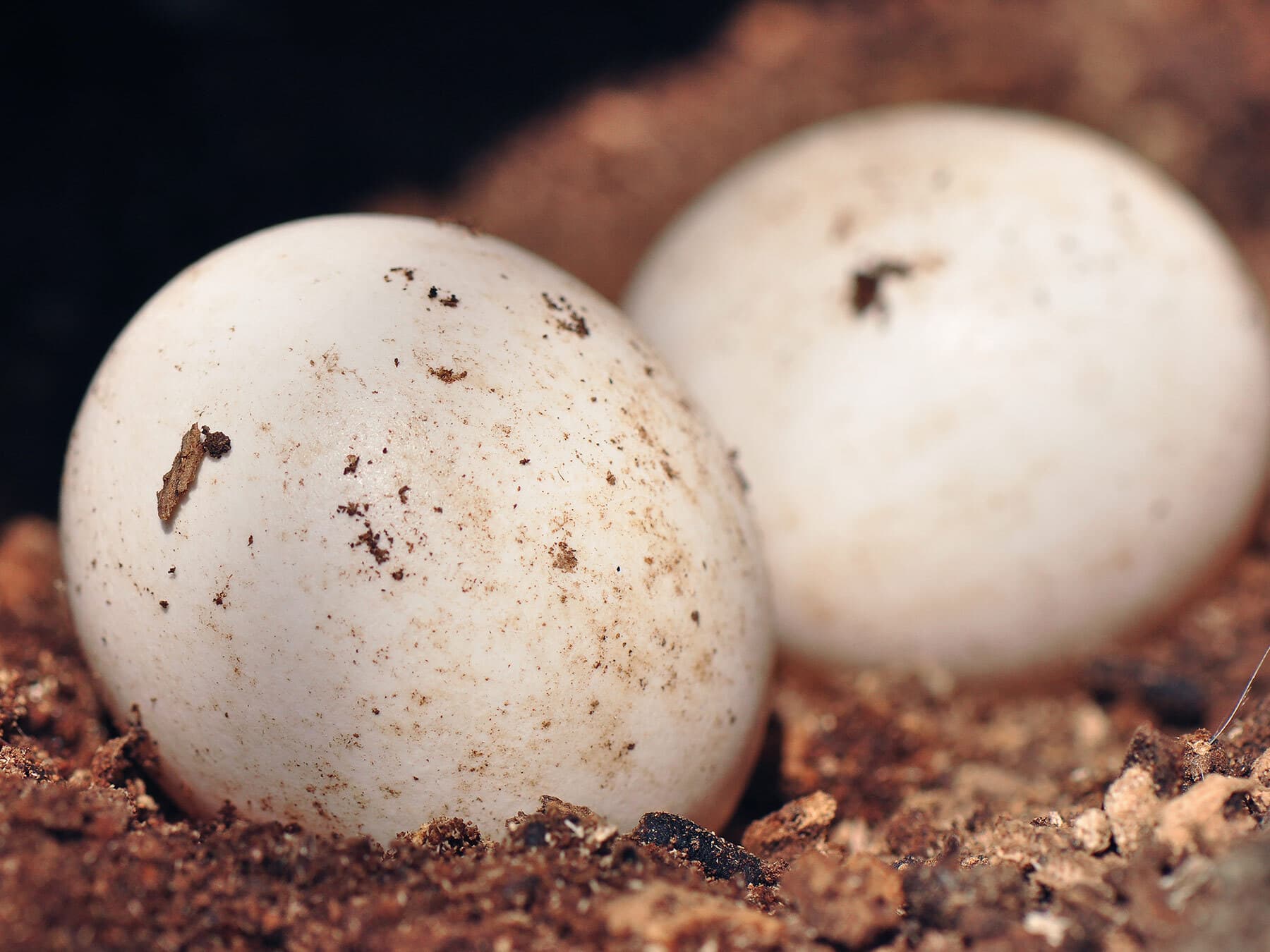
Tawny owl eggs are a plain gloss white in colour and much smaller than even the smallest chicken egg, averaging some 48 mm x 39 mm in size (1.9 in x 1.5 in) and weighing in at around 39 g or 1.4 oz.
Behaviour
Tawny Owls are strictly nocturnal, roosting during the day in dense foliage or tree cavities. They are highly territorial, with pairs defending their territory year-round. These owls hunt from perches, swooping down silently to catch prey on the ground or in mid-air.
Remember that Tawny Owls can be very aggressive, particularly during the breeding season. They will often attack unsuspecting creatures, including humans, that they consider a danger to themselves or their offspring, so take care and avoid the immediate vicinity of nests.
Lifespan and predators
Life expectancy for the tawny owl is generally accepted as being 5 years. Predation will often result in high chick mortality rates and juveniles who leave the nest area to establish their own territories can often starve to death if no vacant territories can be found.
There have been instances where tawny owls have survived much longer than the accepted average with a ringed individual achieving 18 years and a specimen in captivity living over 25 years.
Conservation
While the Tawny Owl is listed as Least Concern globally, it faces localised threats from habitat loss and fragmentation.
In the UK, conservation efforts focus on maintaining mature woodlands and providing nest boxes to supplement natural cavities.
What does a Tawny Owl look like?
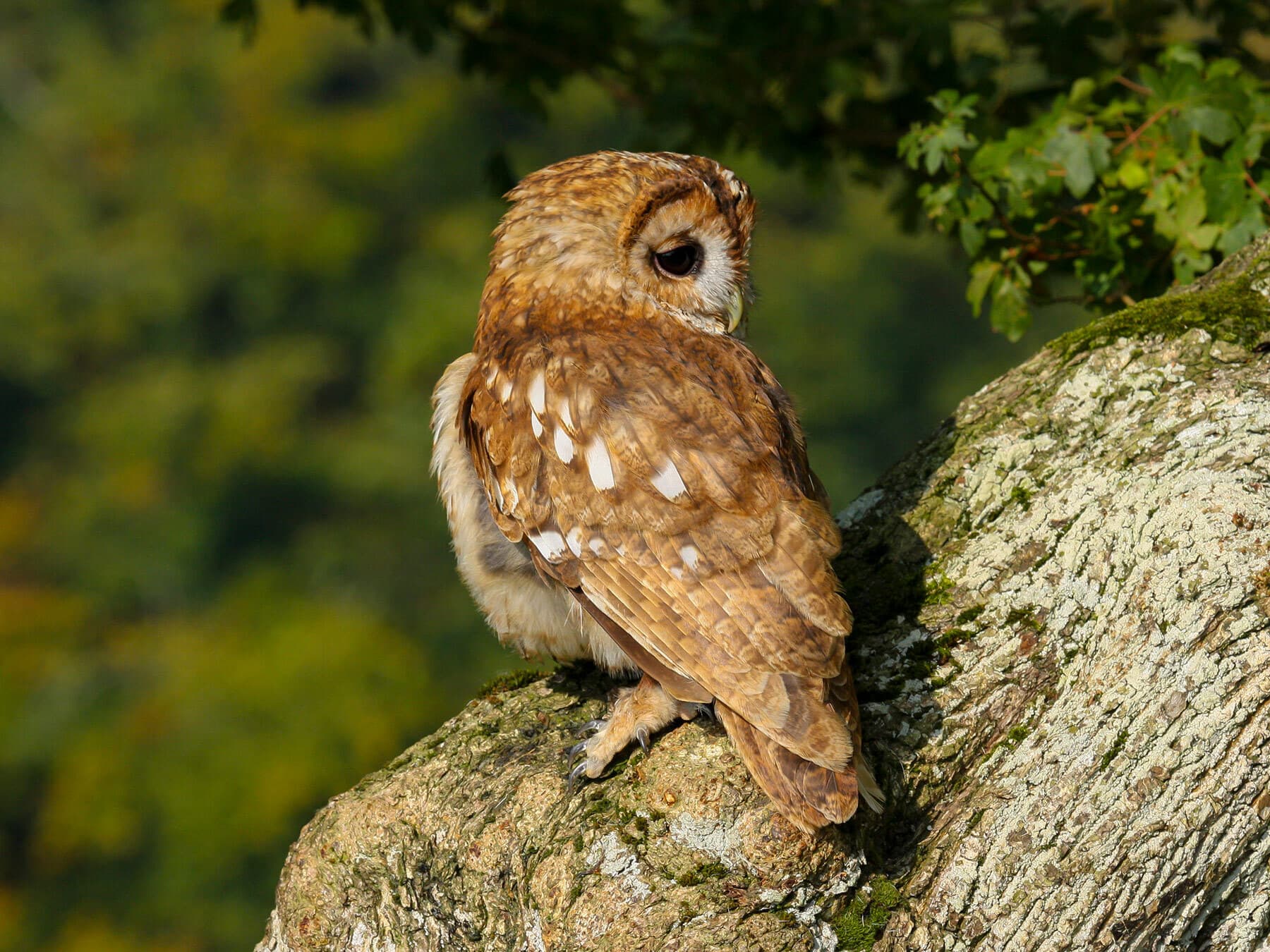
The tawny owl is a stocky, medium sized owl with a large round head and large forward facing dark coloured eyes. Whilst the adult female is larger than the adult male both sexes are similar with regards to their plumage. There is however an anomaly with the tawny owl in that its plumage is polymorphic, meaning that the bird can appear in one of two dominant colour morphs, either grey or brown.
Tawny owls have either brown or grey mottled upperparts with dark streaks and paler underparts with very dark thin vertical streaks with occasional cross barring. Where the bird is predominantly brown then the rest of the plumage has a brown hue and where the morph is of a grey colour then the remaining base colour is grey.
Whatever the colour morph, in ornithological circles it is described as being cryptic. This means that the plumage colour and patternation is such as to camouflage the individual bird to such an extent so as to make it almost invisible when in its natural environment.
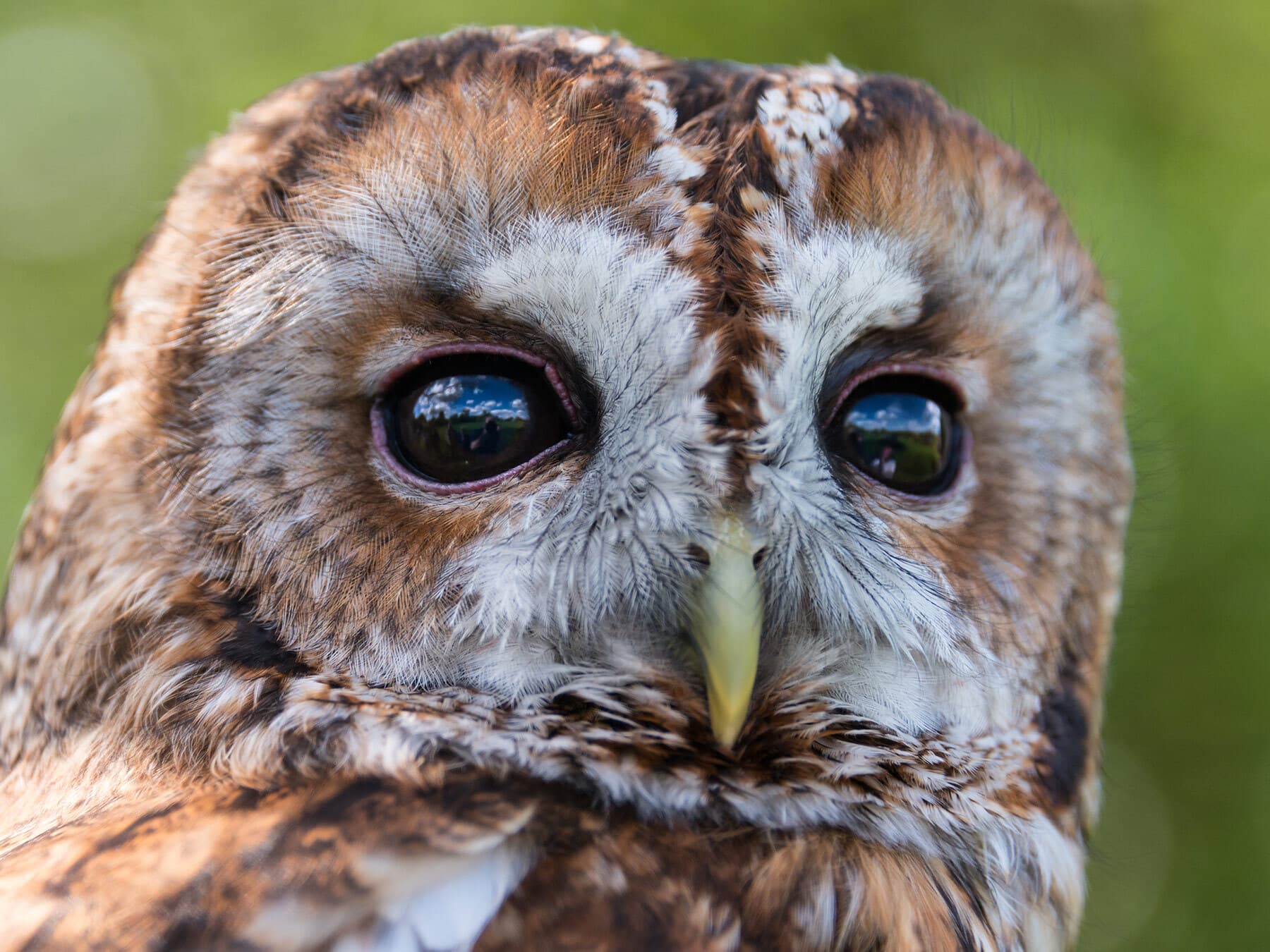
The facial disc is pale, almost off white (sometimes tinged either buff or light grey) with highlighted darker concentric circles and the crown of the head has a very dark central band running from the top of the bill to the back of the head. The remainder of the head mirrors the colouration of the bird’s upper parts.
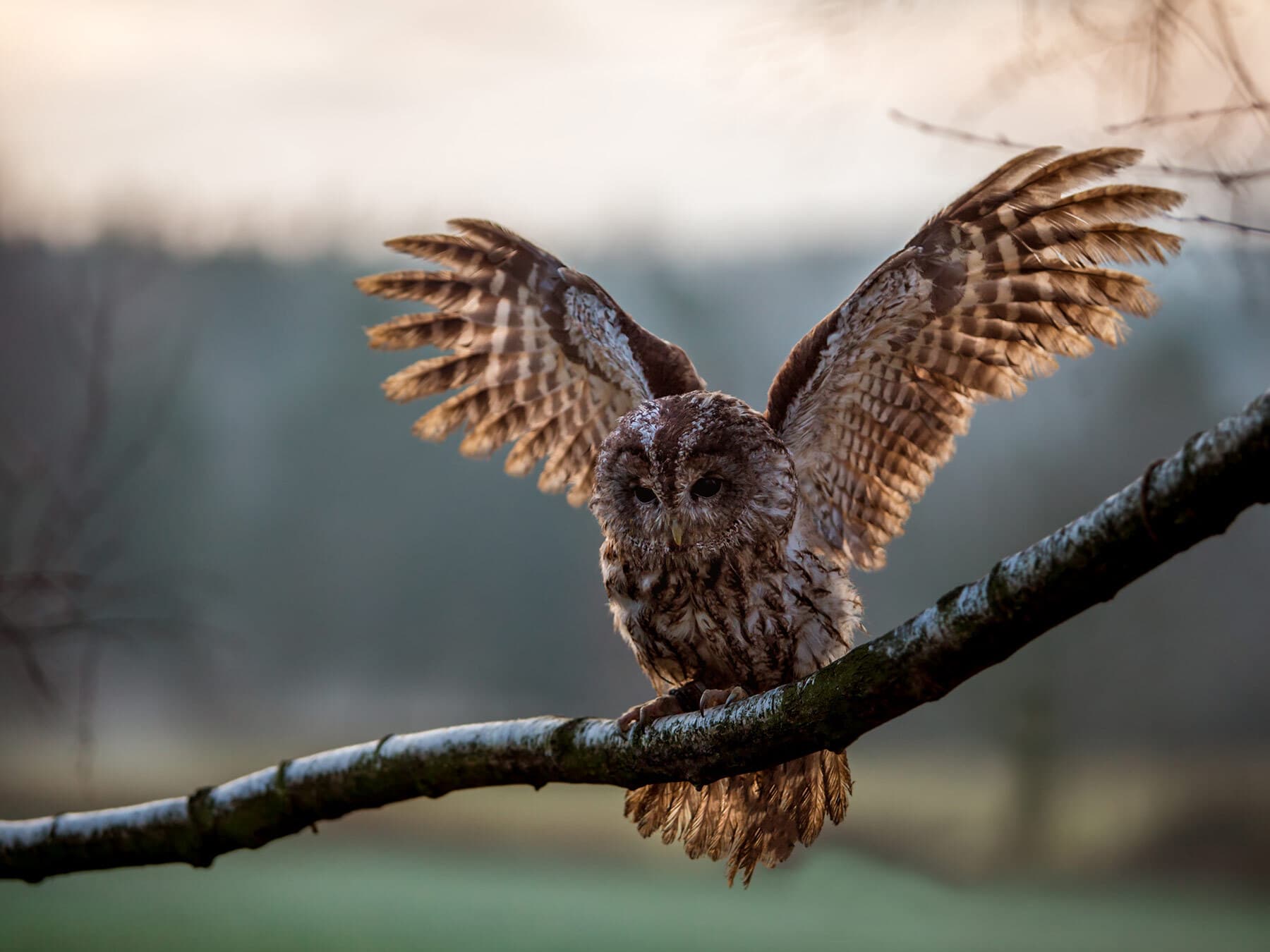
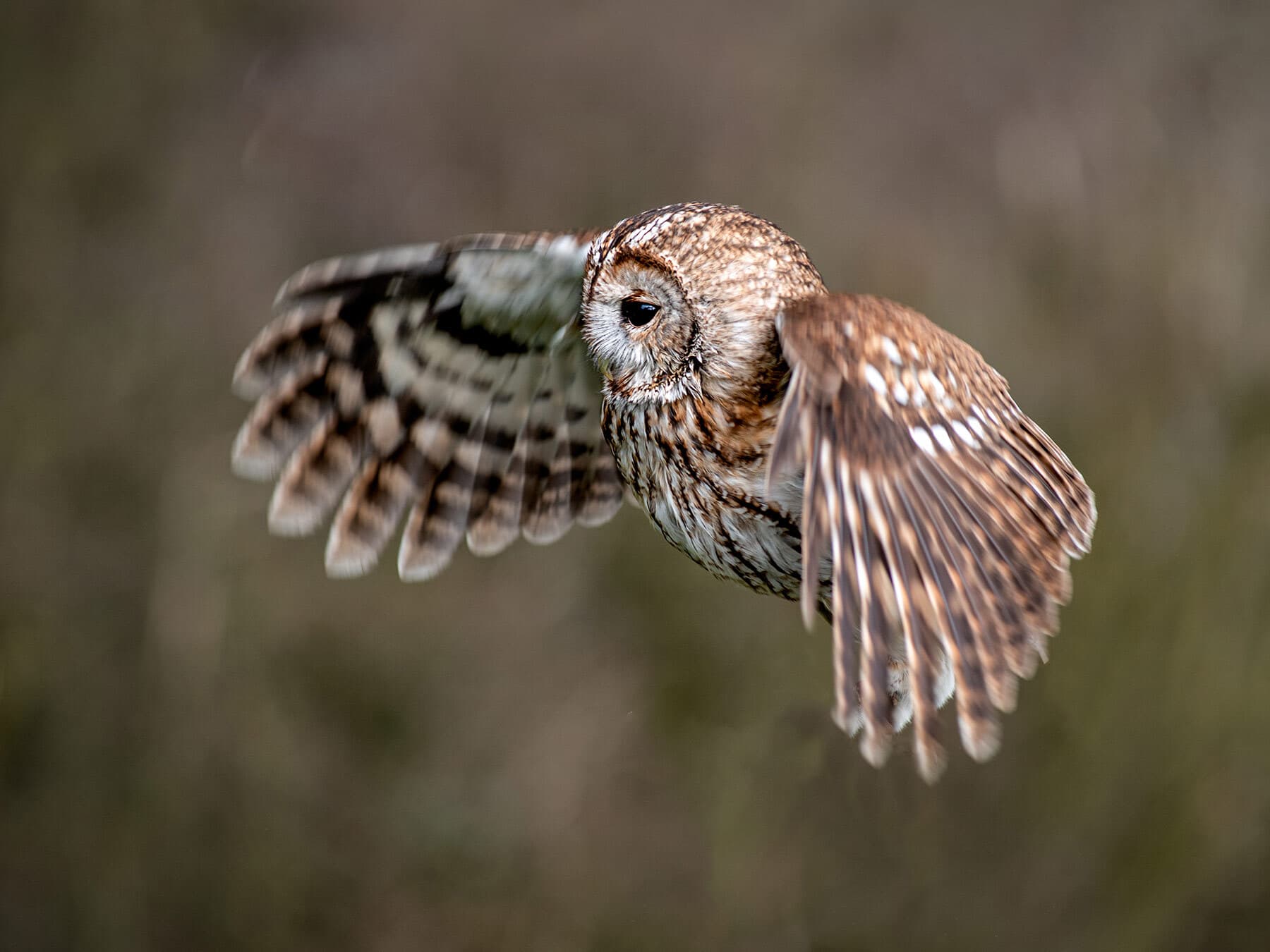
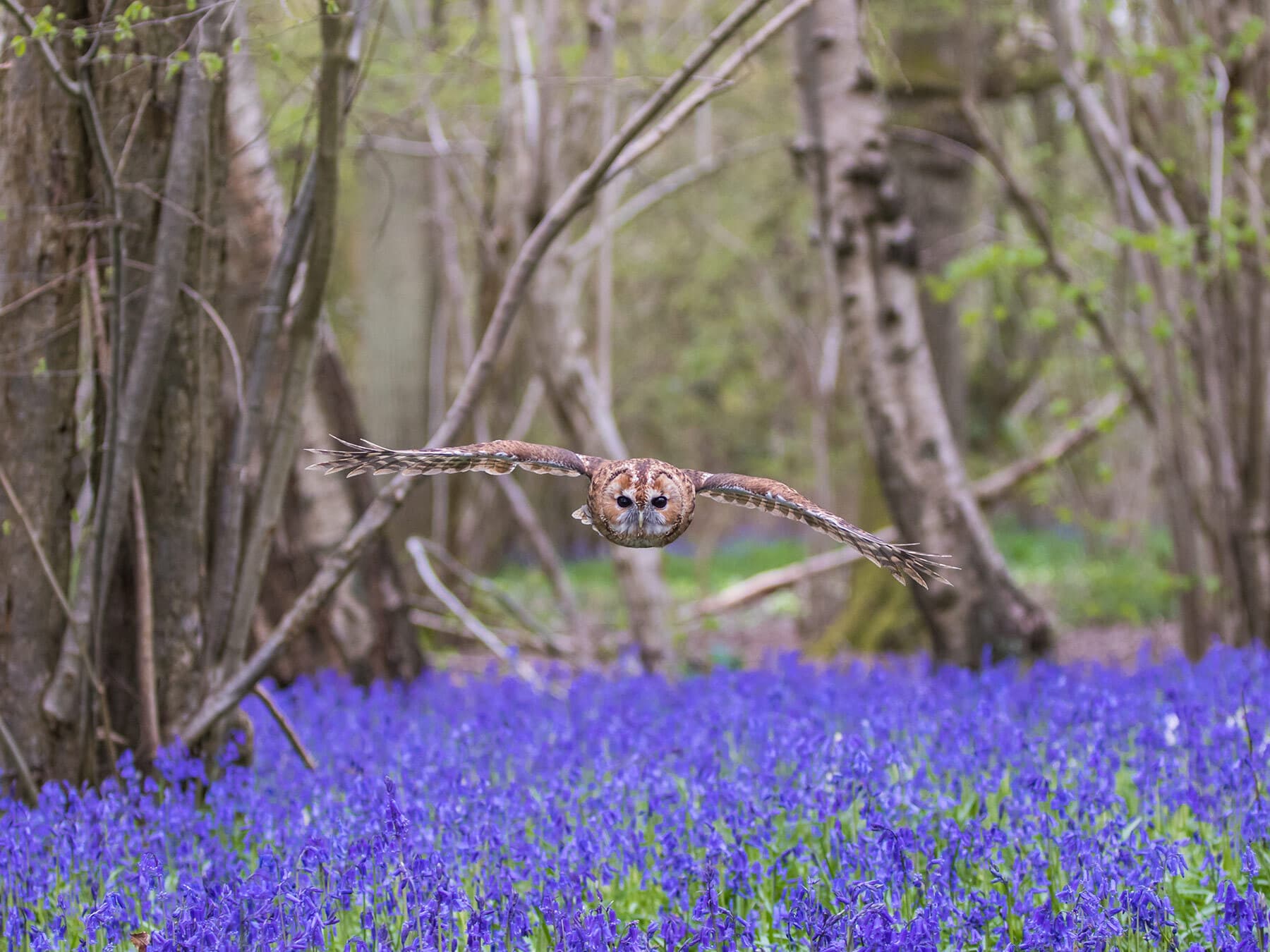
The wings are rounded with the upperwing coverts tipped white. The outer primary flight feathers are fringed and this, coupled with the soft upper surface of the remainder of the wing, allows the bird to be almost silent in flight. Underwing area is pale with base colour barring and the legs are feathered.
Talons are grey or blackish and the bill is hooked and a pale olive yellow. The forward facing eyes appear almost black and cannot be moved within their sockets which is the reason that the tawny owl is able to turn its head through a 270° arc and is able to see behind it.
Tawny owl chicks are altricial and covered in a soft white down.
The seven subspecies of Tawny Owl
The seven subspecies of tawny owl are differentiated from the nominate predominantly by minor variations in size and plumage and on the geographical area of their habitats which range from the Indian sub-continent to Western Europe and Britain, the Caucasus to the Persian Gulf and the Urals to Tajikistan. This article concentrates mainly on the nominate, Strix aluco.
How big is a Tawny Owl?
With a body length of between 37 – 39 cm (14.5 – 15.5 in) the adult tawny owl is shorter in length than the Common Wood Pigeon. For an owl of its size its wing span is relatively short at 94 – 104 cm (37 – 41 in) which allows for quick and easy flight through woodland areas, its preferred habitat.
How much does a Tawny Owl weigh?
The adult male has an average weight of around 440 g or 15.5 oz which equates roughly to just under half the weight of a standard bag of shop bought sugar. The adult female is heavier than its mate averaging 553 g or 19.5 oz.
What is the scientific name for a Tawny Owl?
The tawny owl is classified as belonging to the family known as Strigadae which consists of 225 species of owls. The genus of the tawny owl, which is best defined as being the name of a specimen between family and species, is Strix of which there are 19 individual species.
The word strix is derived from the ancient Greek word meaning owl. The scientific name for the tawny owl is Strix aluco with the word aluco denoting the owl’s species.
This latter word comes from the Italian ‘alocho’ meaning tawny owl which originated from the Latin word ‘uluccus’ meaning screech owl.
Are Tawny Owls aggressive?
Tawny owls can be incredibly aggressive, particularly during the breeding season when they have young in their nest. They will often attack unsuspecting animals and even humans whom they may consider a threat, by swopping down from above and using their sharp talons as extremely effective weapons.
Scientists engaged in the ringing of tawny owl chicks have been known to wear crash helmets and visors as protection against attack. Tawny owls are also very territorial and will defend their territory against outsiders and other ’trespassing’ birds.
Are Tawny Owls endangered?
Within the United Kingdom Conservation Status criteria, tawny owls are classified as Amber, whereas under the International Union for Conservation of Nature (IUCN) they are listed as being of Least Concern. In other words they are not considered, at this time, as being endangered.
Do Tawny Owls mate for life?
Once mature and of breeding age, from approximately twelve months old, tawny owls begin looking for a mate and once found they generally pair for life and are therefore classed as monogamous.
Tawny Owl guides
6 guidesQuick facts
- Length
- 37–43 cm
- Wingspan
- 94–104 cm
- Weight
- 330–590 g
- Lifespan
- 5 years · oldest recorded 22.4 years
- Family
- Owls
- Migration
- Resident
- Global status (IUCN)
- Least Concern
- World population
- 1,400,000 - 2,400,000 mature individuals
- Population trend
- Stable
- Also called
- Brown Owl
- Scientific name
- Strix aluco
Sources
4- 1BirdLife International. 2016. Strix aluco. The IUCN Red List of Threatened Species 2016: e.T22725469A86871093. Source (opens in a new tab)
- 2BirdLife International. 2016. Strix aluco. The IUCN Red List of Threatened Species 2016: e.T22725469A86871093. Source (opens in a new tab)
- 3BirdLife International. 2016. Strix aluco. The IUCN Red List of Threatened Species 2016: e.T22725469A86871093. Source (opens in a new tab)
- 4Fransson et al., EURING list of longevity records for European birds (2010) Source (opens in a new tab)

Checked by
Nathan Cope, founder and editor
Nathan founded Birdfact and leads its writers and contributors in the UK, the US and Canada. He has watched and studied birds for more than ten years, and checks every article and species guide before it’s published.