


Northern Saw-whet Owl
Saw-whet Owl, Acadian Owl · Aegolius acadicus
By the Birdfact teamChecked by Nathan Cope
On this page13 sections
How to recognise it
What do Northern Saw-whet Owls look like?
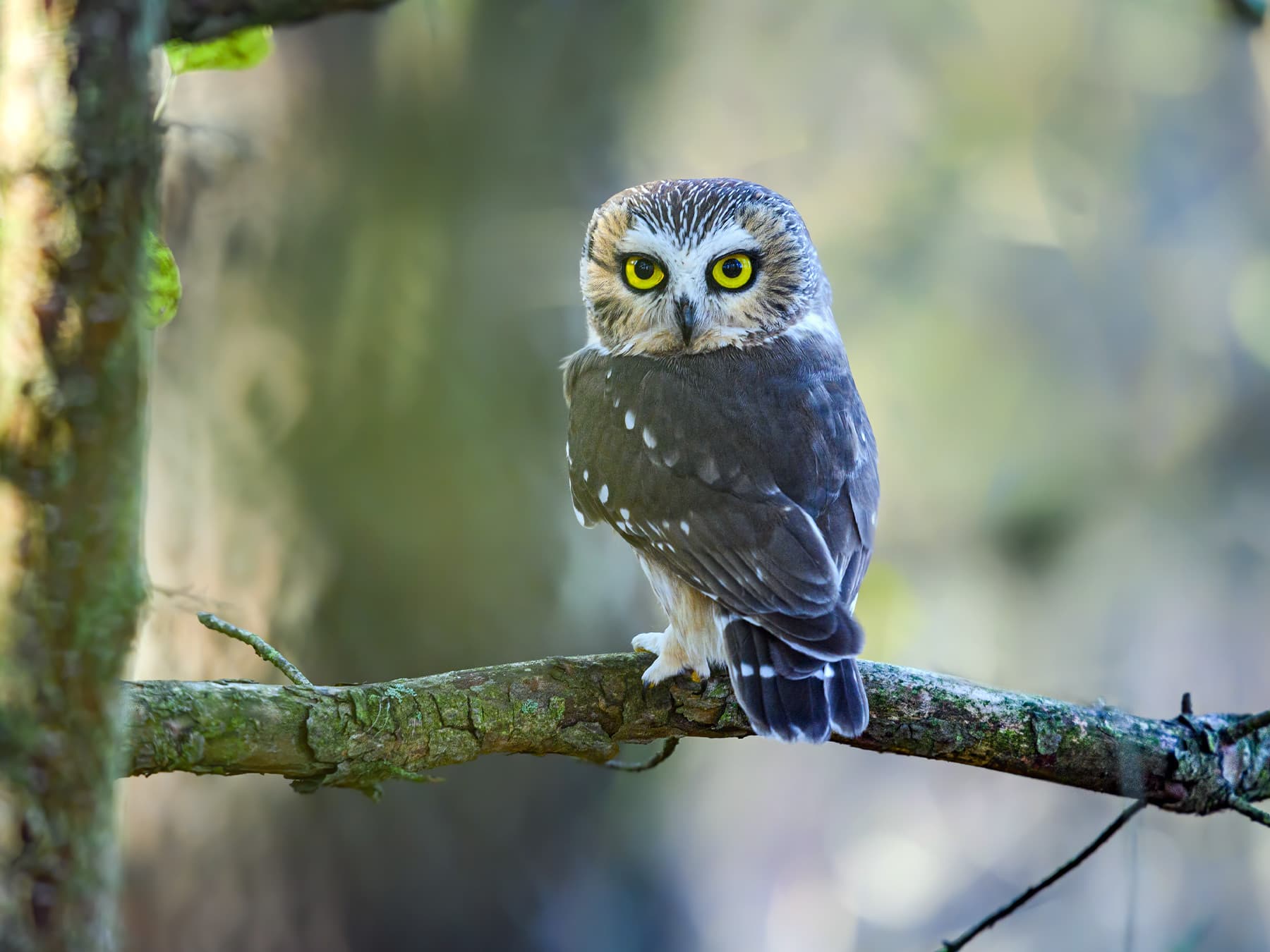
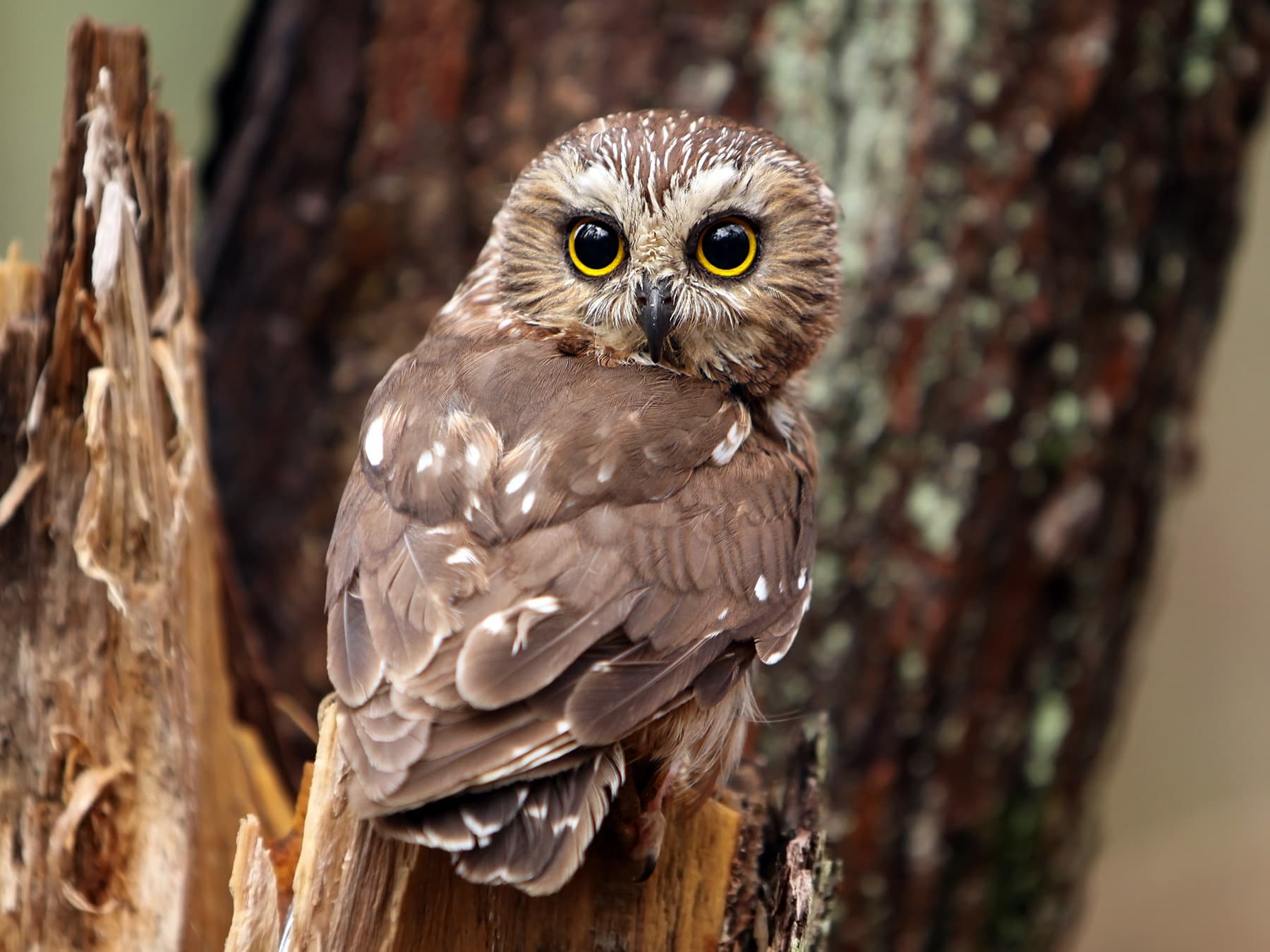
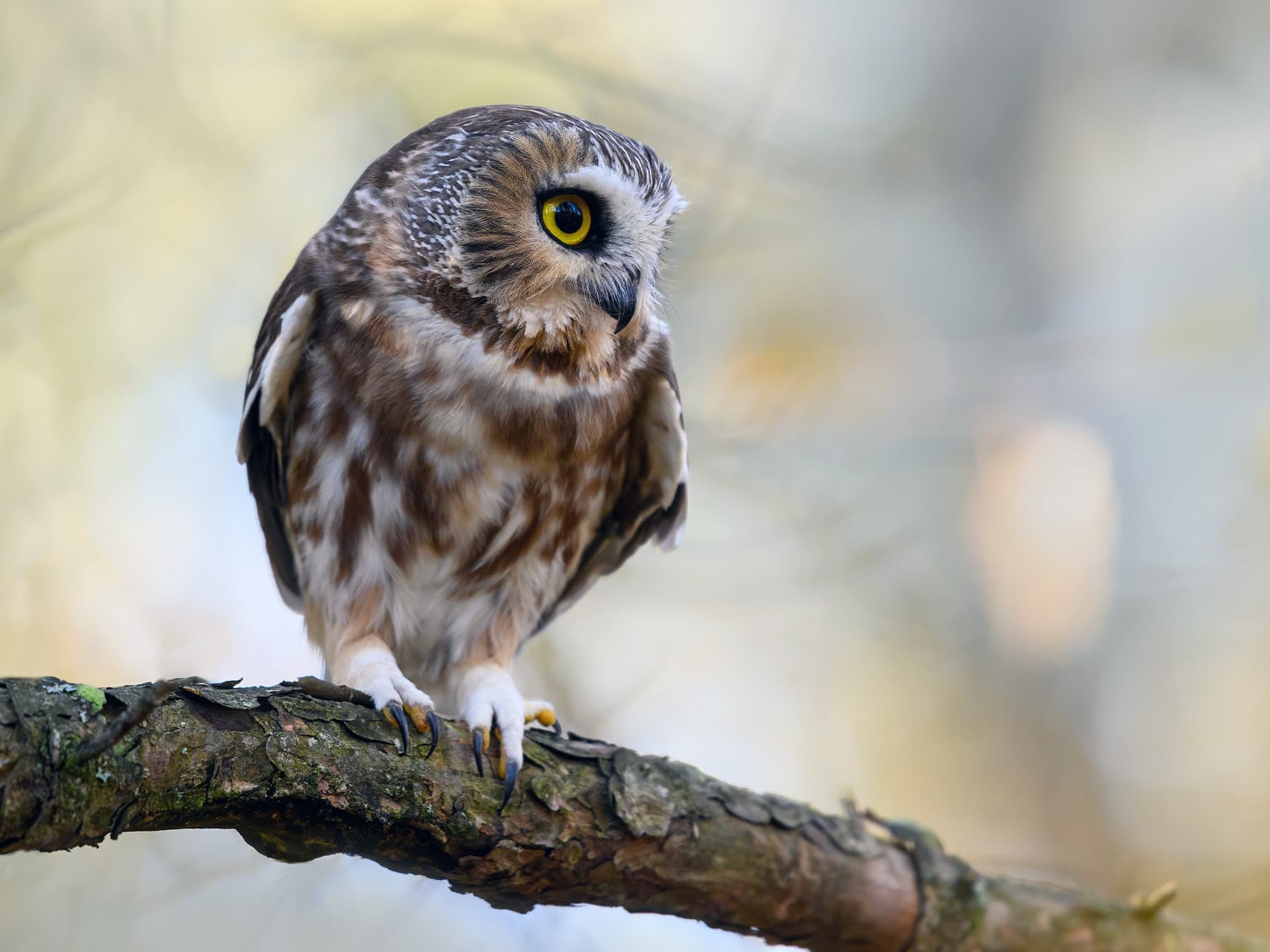
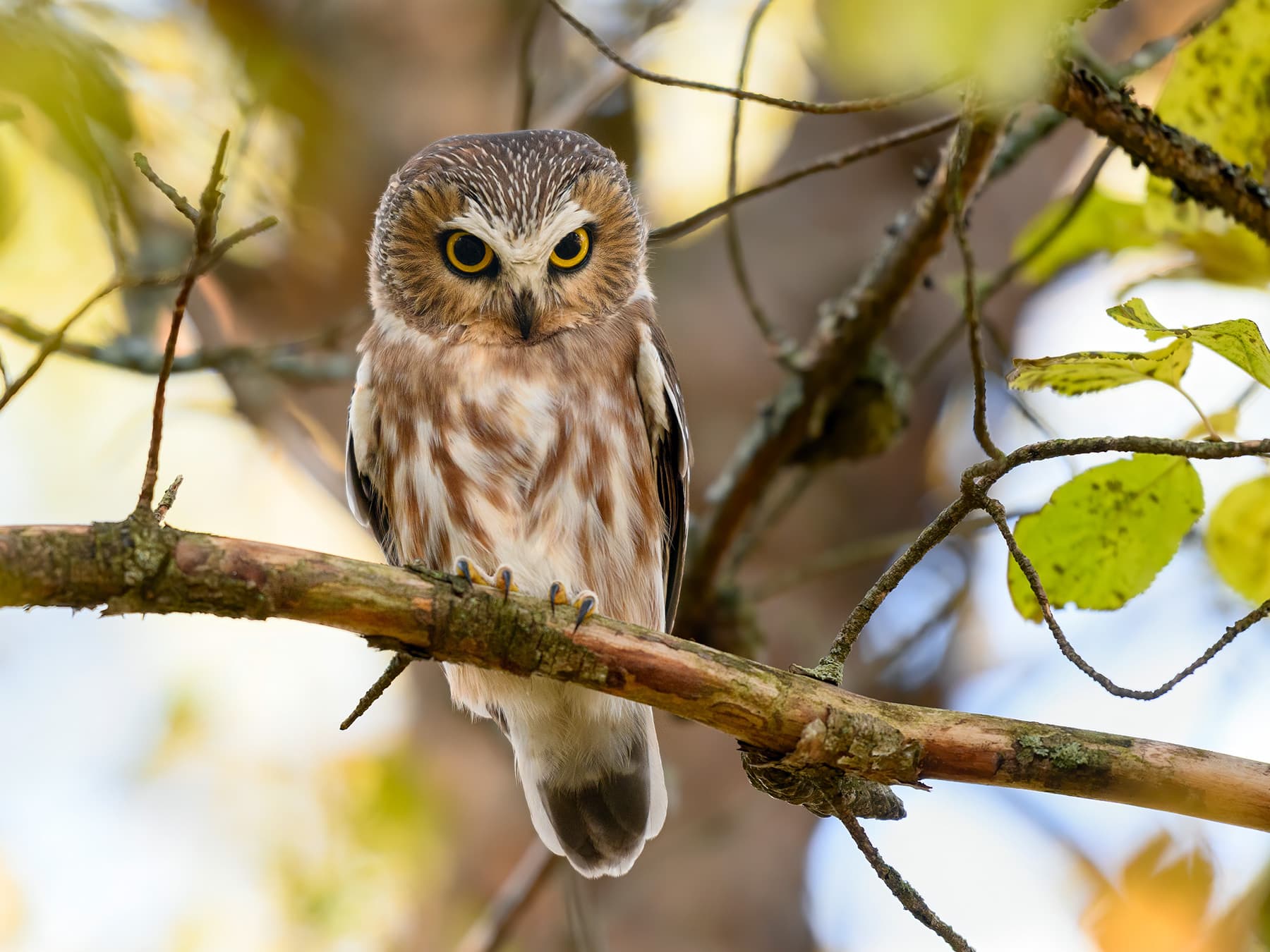
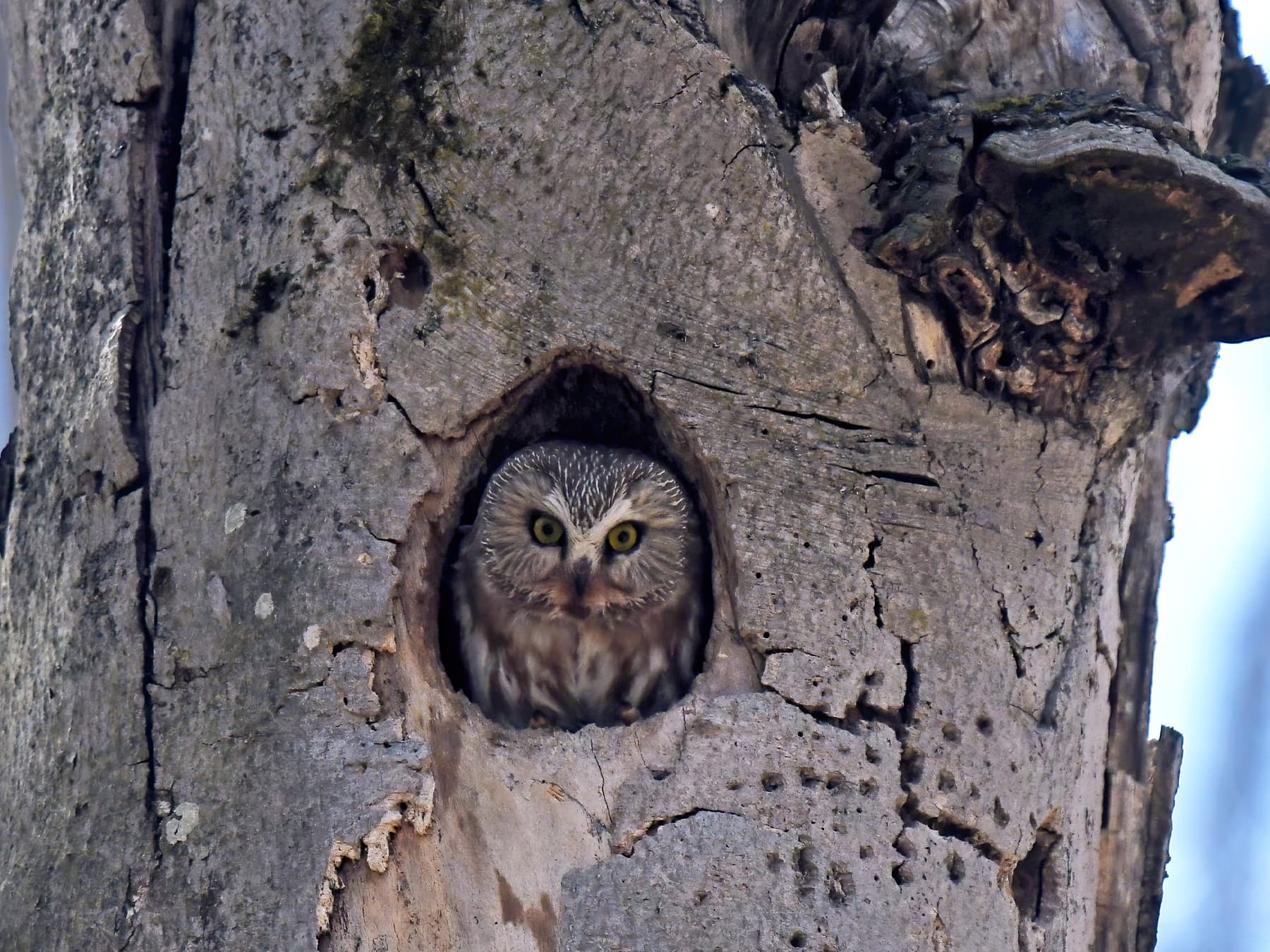
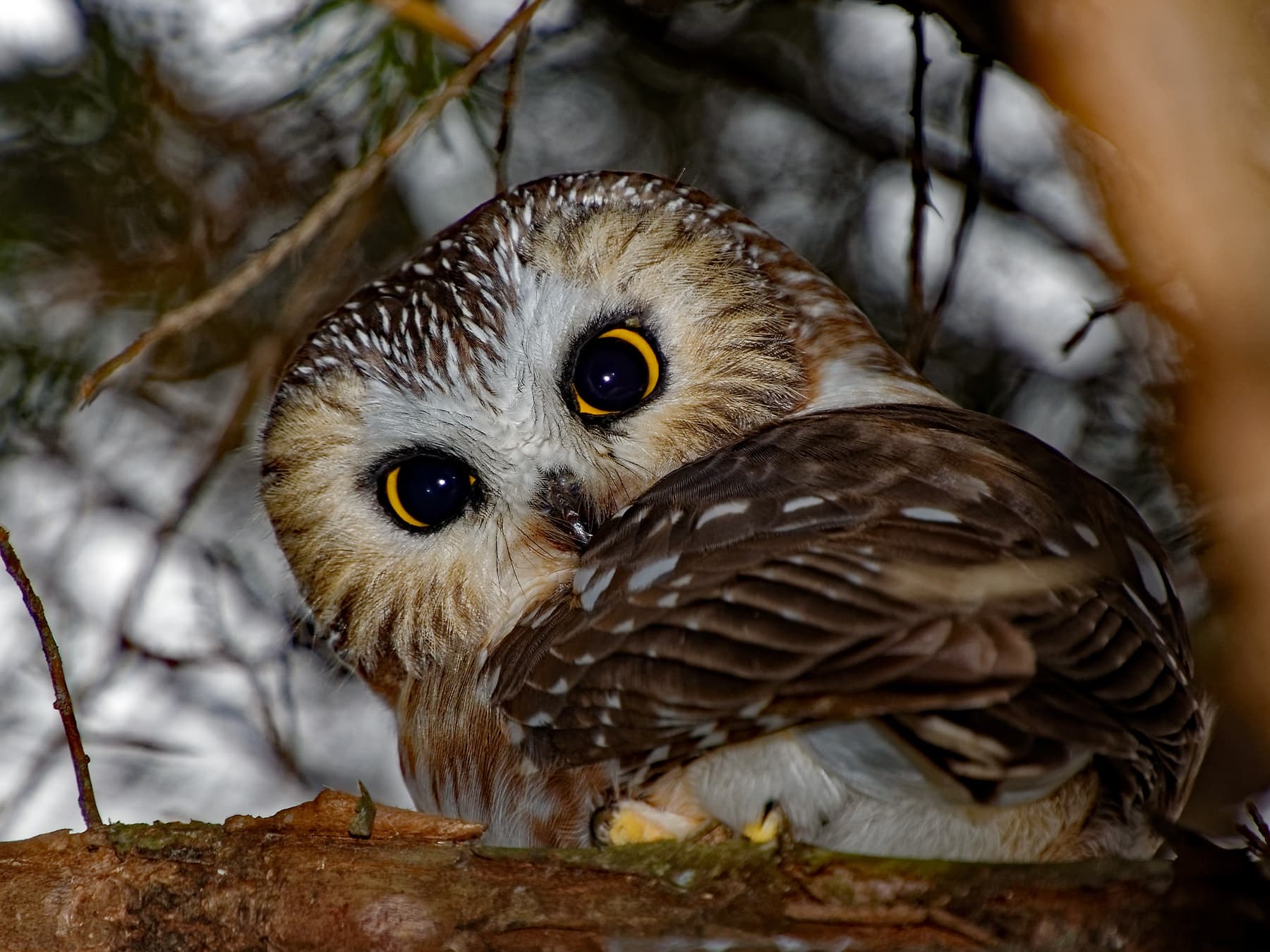
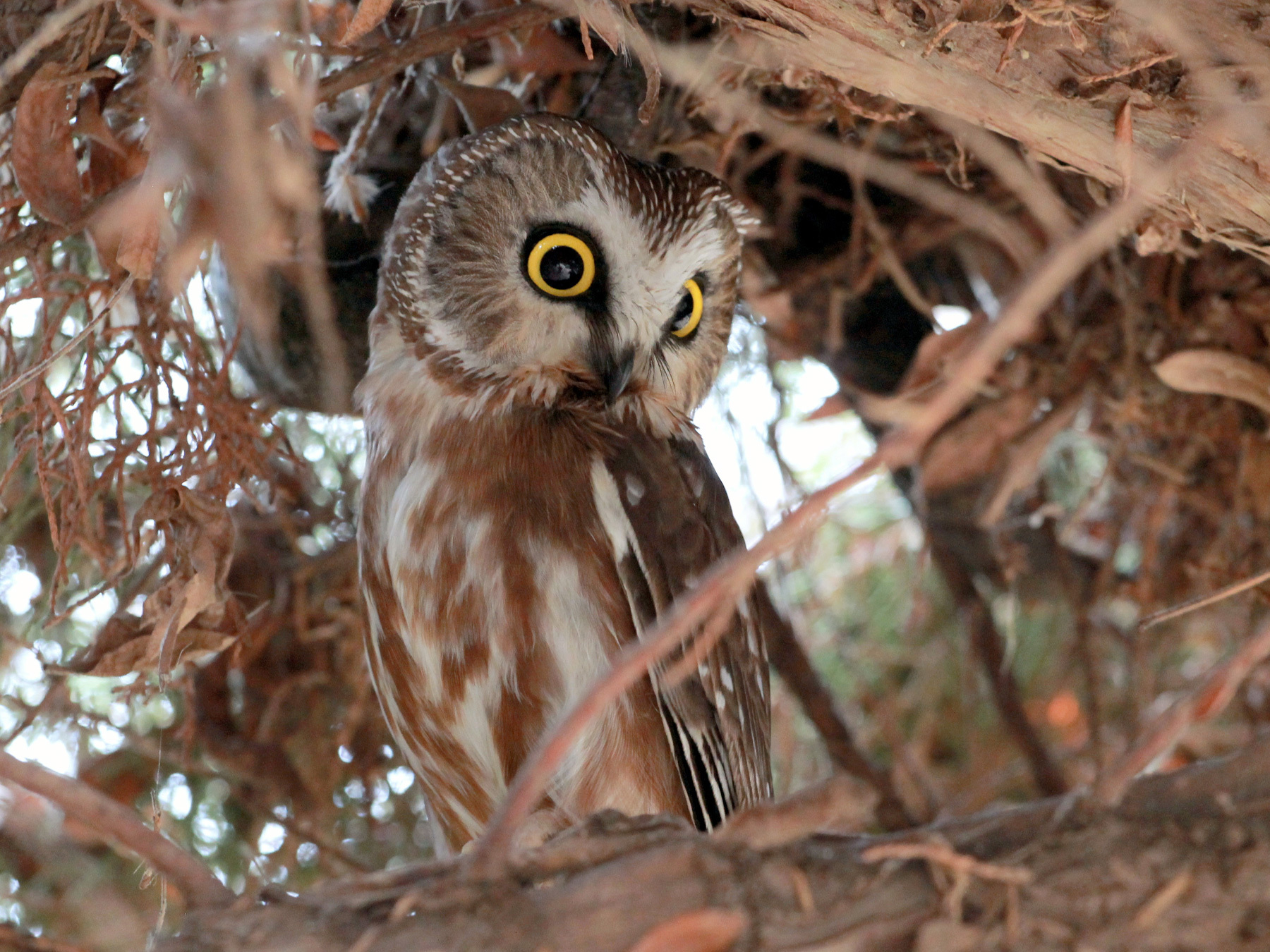
Northern saw-whet owls have round brown heads, streaked with white. The facial disk is white between the eyes, forming a Y-shape, and streaked with reddish-brown and white stripes. The forehead is brown, speckled with white, and the back, wings, and tail are reddish-brown, dotted with white markings.
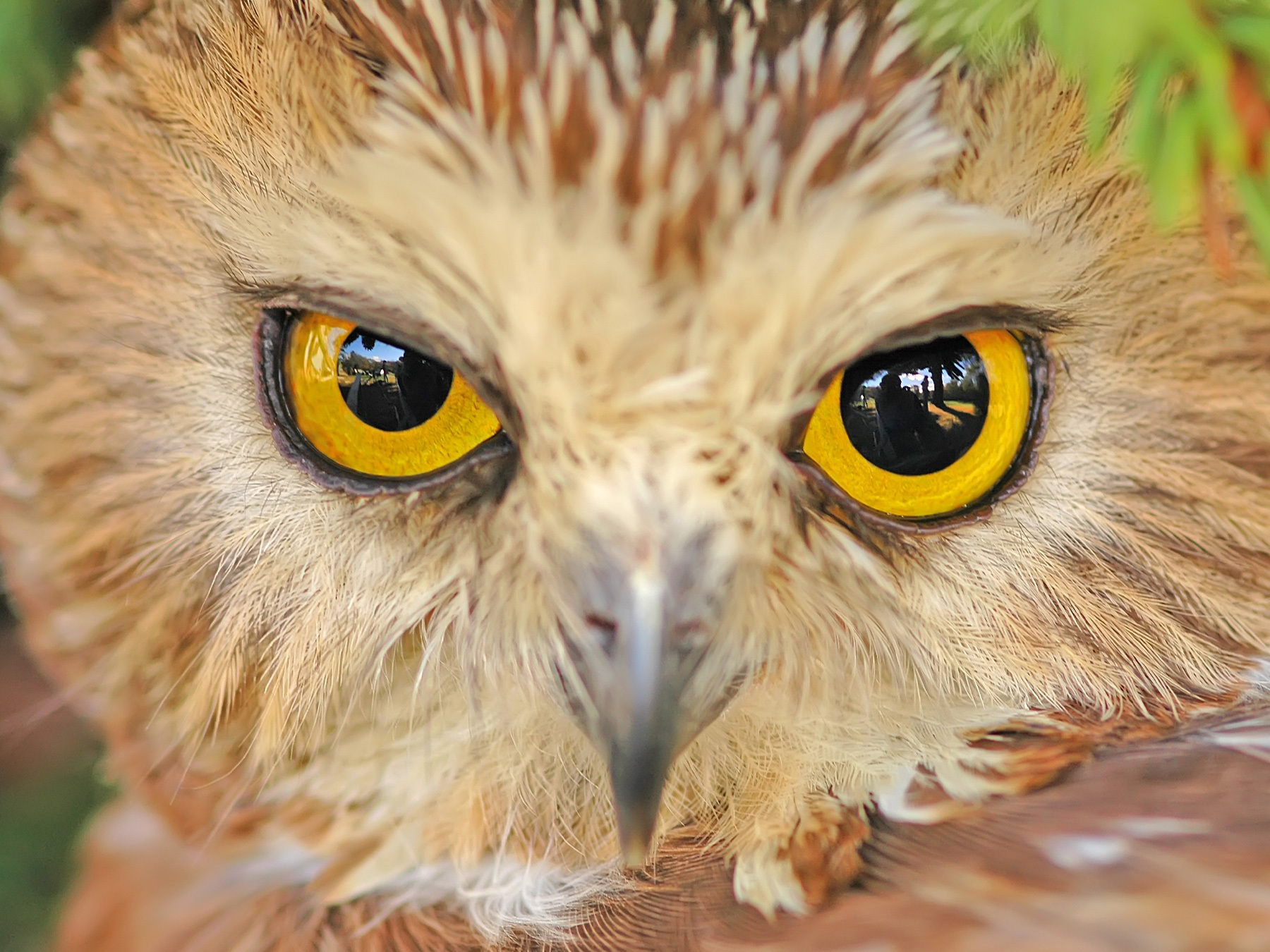
Their underparts are pale white, heavily patterned with rufous streaks, and the legs are covered in dense white feathers to the toes. Eyes are yellow, and the short hooked bill is black..
Female northern saw-whet owls are alike in coloring to males but can be easily told apart due to the considerable size difference between much larger females and much smaller males.
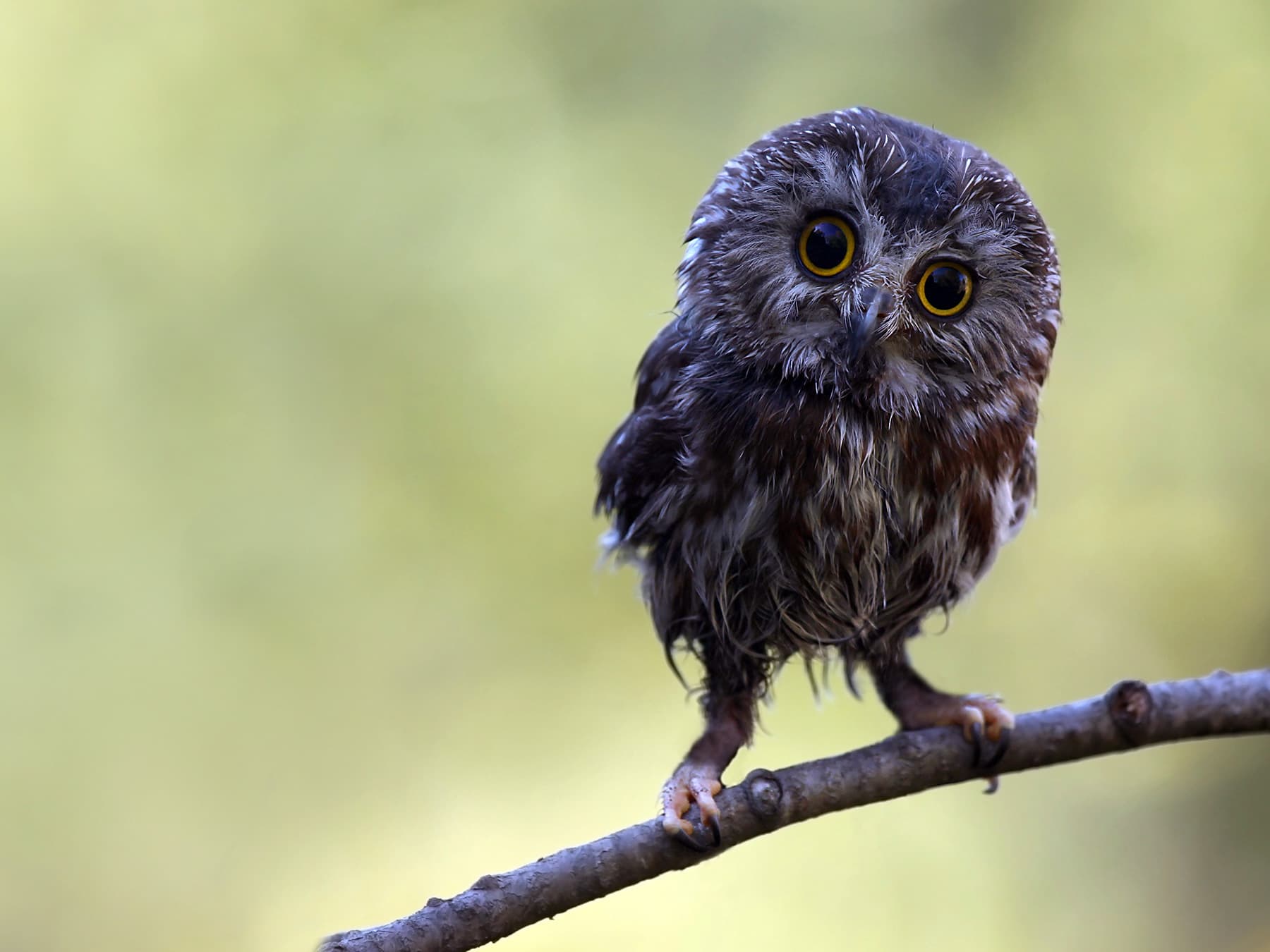
Juvenile northern saw-whet owls have darker brown upperparts and their breast and belly are rust-colored and unmarked. Their faces are plain brown with white patches above and between the eyes and narrow white mustache stripes.
How big are Northern Saw-whet Owls?
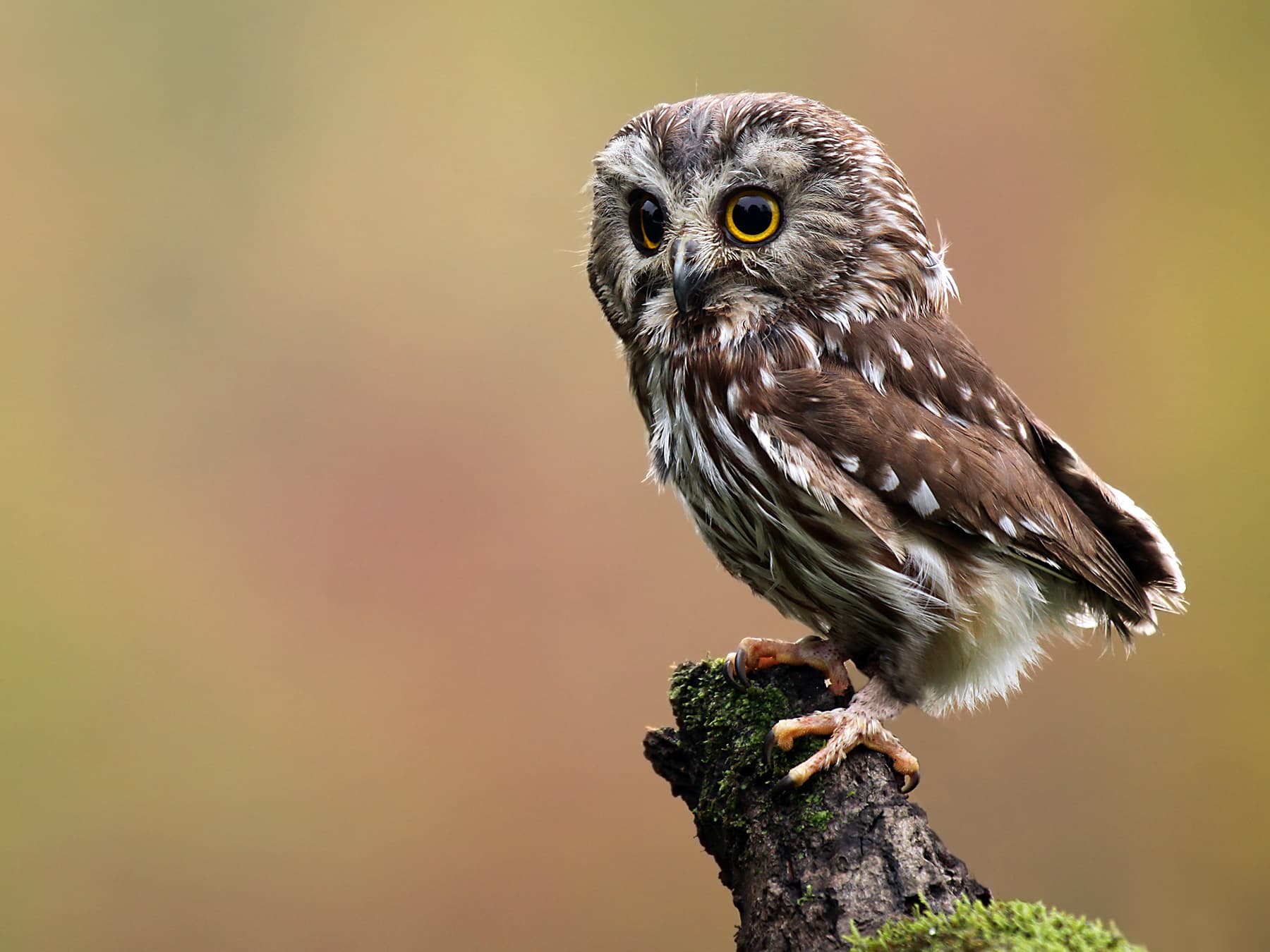
One of North America’s smallest owls, the northern saw-whet owl is smaller than the similar boreal owl but marginally bigger than the tiny northern pygmy owl. Despite males and females being identical in plumage, size offers a clear indication of a northern saw-whet owl’s sex, with females around 25 percent larger than males.
- Length: 17 cm to 22 cm (6.7 in to 8.7 in)
- Wingspan: 42 cm to 56.3 cm (16.5 in to 22.2 in)
- Weight: 54 g to 151 g (1.9 oz to 5.3 oz)
Its size
Adults- Length
- 17–21 cm
- Wingspan
- 42–56 cm
- Weight
- 65–125 g
Its song and calls
What sound does a Northern Saw-whet Owl make?
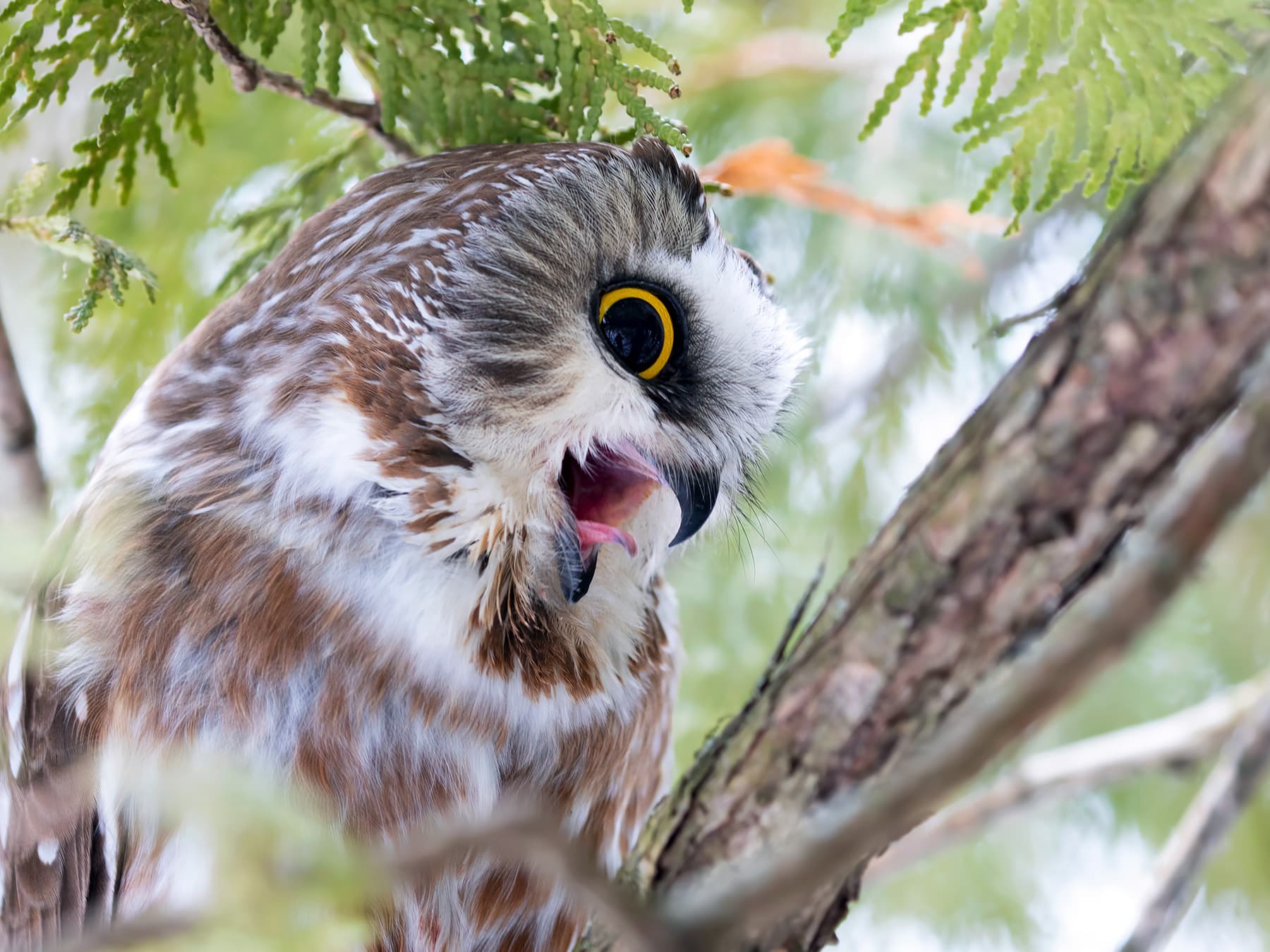
A single-note ‘too-too-too’ whistle can be heard by northern saw-whet owls stating a claim to a territory or as a warning to intruders and is a common sound across woodlands on spring evenings. Whines, barks, and high-pitched ‘tssst’ calls are also heard. Bill snapping is also heard as an alarm call when threatened.
- Song0:00 / 0:13
Recorded in Arizona, United States · March 2022
When and where to see it
OctoberArriving
Most recorded in October
- 1. Wyomingunder 0.1%
- 2. Albertaunder 0.1%
- 3. Saskatchewanunder 0.1%
- 4. Idahounder 0.1%
- 5. Prince Edward Islandunder 0.1%
Each dot is a county, state or province: the bigger and darker, the larger the bird’s share of that place’s bird records that month. Grey dots: no regular records. The ringed point is the centre of the bird’s records this month; the arrow shows how it moved since last month, and the dashed loop its path through the year. “Arrivals” colours places where it becomes regular this month (orange) or is in its last regular month (grey). GBIF eBird Observation Dataset, 2019–2024. Map data: Natural Earth, US Census Bureau; place centres © OpenStreetMap contributors.
In your area
See when the Northern Saw-whet Owl is recorded in your county, state or province.
How often the Northern Saw-whet Owl turns up in the United States and Canada through the year, from birdwatchers' records.
United States
Winter visitor · all year · most records in January
Canada
Winter visitor · regularly Sep–Jun · most records in January
Show as a table
| Month | United States | Canada |
|---|---|---|
| January | 0.014% (regular) | 0.063% (regular) |
| February | 0.013% (regular) | 0.055% (regular) |
| March | 0.010% (regular) | 0.053% (regular) |
| April | 0.004% (regular) | 0.020% (regular) |
| May | 0.003% (regular) | 0.006% (regular) |
| June | 0.003% (regular) | 0.005% (regular) |
| July | 0.002% (regular) | 0.002% |
| August | 0.001% (regular) | 0.002% |
| September | 0.003% (regular) | 0.016% (regular) |
| October | 0.010% (regular) | 0.037% (regular) |
| November | 0.012% (regular) | 0.032% (regular) |
| December | 0.014% (regular) | 0.045% (regular) |
Worldwide: recorded regularly in 3 countries
Countries where it was recorded in at least 3 of the 6 years 2019–2024. Linked countries have their own bird list.
North America (3)
Data: EOD – eBird Observation Dataset (Cornell Lab of Ornithology), accessed via GBIF.org, CC BY 4.0. Records from 2019–2024, aggregated and filtered by Birdfact. How these lists are made
What is the habitat of a Northern Saw-whet Owl?
Northern saw-whet owls inhabit dense coniferous forests and mixed species woodlands and are also found in wooded swamps and forested peatlands with spruce-tamarack bogs. Mixed woodlands are popular, with conifers offering ideal sheltered roosting spots and deciduous trees providing perches for foraging and cavities for nesting.
What is the range of a Northern Saw-whet Owl?
Northern saw-whet owls breed in dense forests and woodlands of western and northeastern North America, from southern Alaska, across the southernmost regions of Canada. The mountains of Tennessee and North Carolina represent the southern limit of that range.
In winter, populations breeding in the northernmost regions migrate southward across much of the northern and central United States but remain absent from the extreme southeast and most of Texas.
Permanent year-round populations are present along the east and west coasts of Canada and the United States, reaching as far south as central Mexico.
Where do Northern Saw-whet Owls live?
The highest number of northern saw-whet owls are found in regions with dense coniferous forests. In spring and fall, significant numbers are frequently reported in the Great Lakes area. The states with the highest recorded concentrations include Minnesota, Wisconsin, Michigan, New York, and Pennsylvania.
How rare are Northern Saw-whet Owls?
Population estimates are difficult for northern saw-whet owls because their migration patterns are irregular and concentrations shift naturally depending on the availability of prey. The overall population is thought to be between 100,000 and 2 million individuals.
Northern saw-whet owls are relatively secretive and hard to spot because of their tiny size, nocturnal behavior, and chosen habitats in dense forests. Despite being widespread and common across forests of North America, sightings are highly prized, and the giveaway ‘too-too-too’ call is probably the best indicator that northern saw-whet owls are nearby.
Where can you see Northern Saw-whet Owls in the US?
Being a highly nocturnal species with a preference for dense, undisturbed forest habitats, sightings of northern saw-whet owls are never guaranteed and are notoriously challenging.
Sites that offer ideal habitats and a number of regular reports include Acadia National Park in Maine, which has a sizable breeding population, with sightings increasing during the migration period. Minnesota’s forests offer northern saw-whet owls suitable year-round habitats, and sightings are frequently recorded at Voyageurs National Park, Isle Royale National Park, and the Superior National Forest, Little Suamico at Stevens Point in Wisconsin is another known spot with increased chances of a sighting.
Where can you see Northern Saw-whet Owls in Canada?
Throughout much of southern Canada, northern saw-whet owls are year-round residents, breeding from the southern corner of Alaska southwards across to New Brunswick and Nova Scotia in the east. One location that regularly reports sightings is the protected forest landscape of Macphail Woods on Prince Edward Island.
A subspecies of the northern saw-whet owl, Aegolius acadicus brooksi, is only found on British Columbia’s Haida Gwaii archipelago, and has distinctive golden coloring on its face and breast, rather than white.
Migration
Do Northern Saw-whet Owls migrate?
In eastern and western regions of North America, populations of northern saw-whet owls are sedentary, remaining in the same territories all year round.
Towards the interior of the continent, and at the northern limit of their range across central-southern Canada, movement south begins once breeding is complete. Relatively short-distance migrations take place from higher elevations to lower-lying, milder landscapes in the central US.
Are Northern Saw-whet Owls native to the US?
Northern saw-whet owls are widespread across the United States both as resident birds and in parts of the central south as winter visitors only. Only the states furthest to the southeast and south do not have an established presence of the species.
Tips for seeing it
- Listen for their distinctive 'too-too-too' call at night, especially during spring
- Search dense coniferous forests, particularly near water sources
- Look for small, round whitewash marks on tree trunks as signs of roosting sites
- Use playback calls cautiously to attract them, but limit use to avoid disturbance
- In the US and Canada, join organized owl banding programs for close-up views
What it eats
What do Northern Saw-whet Owls eat?
Deer mice and white-footed mice are the chief prey of northern saw-whet owls, with house mice, harvest mice, and montane voles are also important. Other mammals occasionally hunted include bats, pocket gophers, squirrels, and chipmunks. Northern saw-whet owls also feed on birds as well as large beetles and grasshoppers.
What do Northern Saw-whet Owl chicks eat?
Male northern saw-whet owls bring prey items to the nest, which are then ripped up into smaller chunks by the female and fed to the young. Deer mice and small voles are among the initial prey offered to nestlings, and as they grow, they are able to manage larger-sized items.
Nesting and breeding
Where do Northern Saw-whet Owls nest?
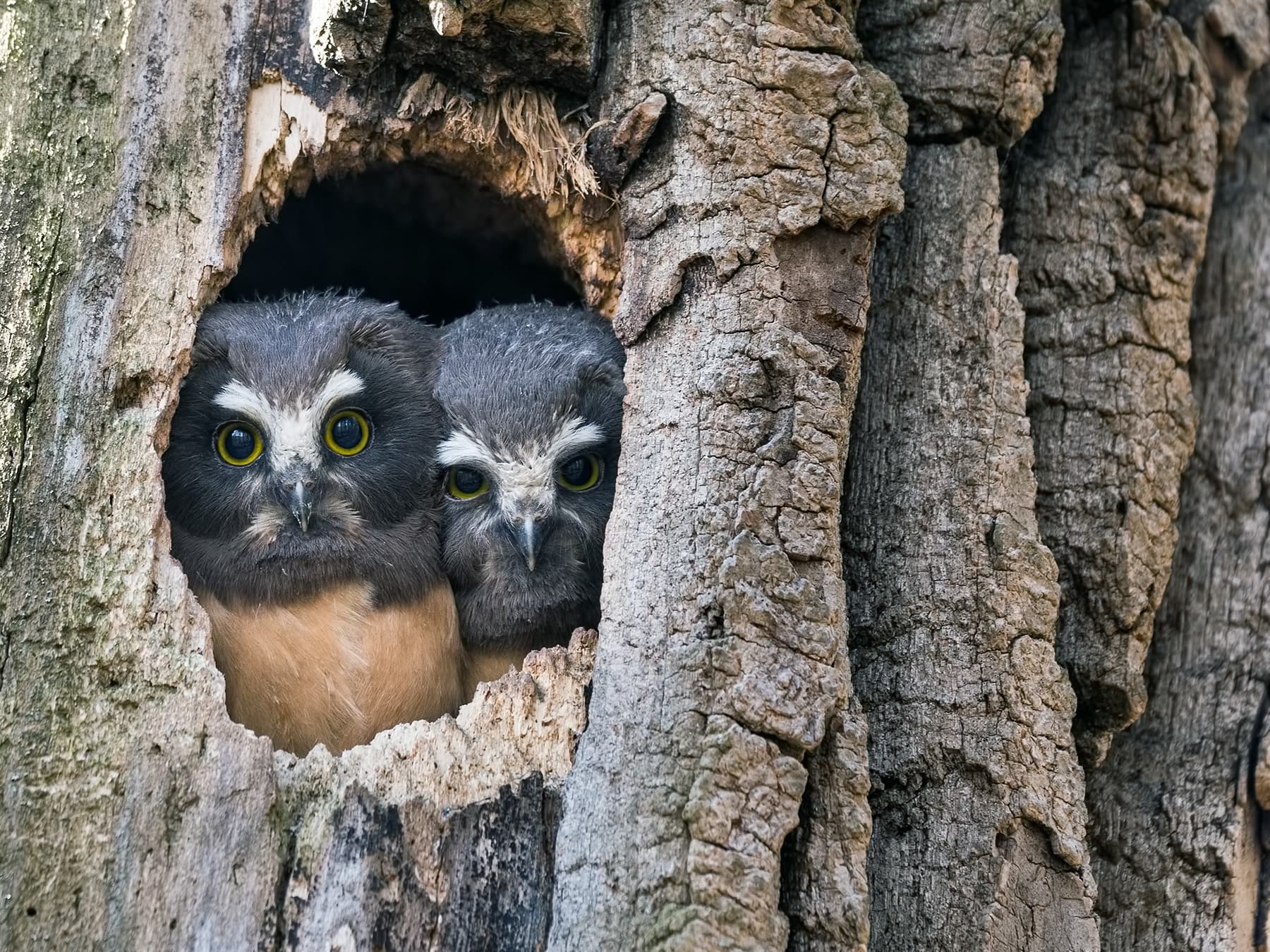
Northern saw-whet owls are secondary cavity nesters and make use of nest chambers that have been drilled out and previously used by other species, including pileated woodpeckers and northern flickers. Nest boxes may also be used if available.
When do Northern Saw-whet Owls nest?
Ahead of the breeding season, males begin calling to advertise for mates from late January onwards. The earliest eggs are laid in Canadian breeding grounds in late February, with Californian populations being the latest to lay, with clutches there complete in May or June.
Incubation takes between 27 and 29 days, with the female brooding the eggs alone and food brought to the nest by her mate, barely leaving the eggs unattended. A single brood is raised in a typical year, although if an initial clutch fails, a replacement brood may be attempted.
What do Northern Saw-whet Owl eggs look like?
Northern saw-whet owls lay between 4 and 7 smooth white eggs in a typical clutch. Eggs measure 30 mm by 25 mm (1.2 in by 1 in).
Do Northern Saw-whet Owls mate for life?
No evidence exists of northern saw-whet owls’ pair bonds lasting for longer than one season, and in some cases, particularly in years with abundant prey and nest sites, females may leave their original mate to raise young after hatching to raise a second brood with a different mate.
Behaviour
Are Northern Saw-whet Owls aggressive?
Aggressive interactions when competing for nest cavities are common, with northern saw-whet owls not always coming out on top. They are generally a docile species but may become aggravated if their nest site is disturbed.
Where do Northern Saw-whet Owls sleep at night?
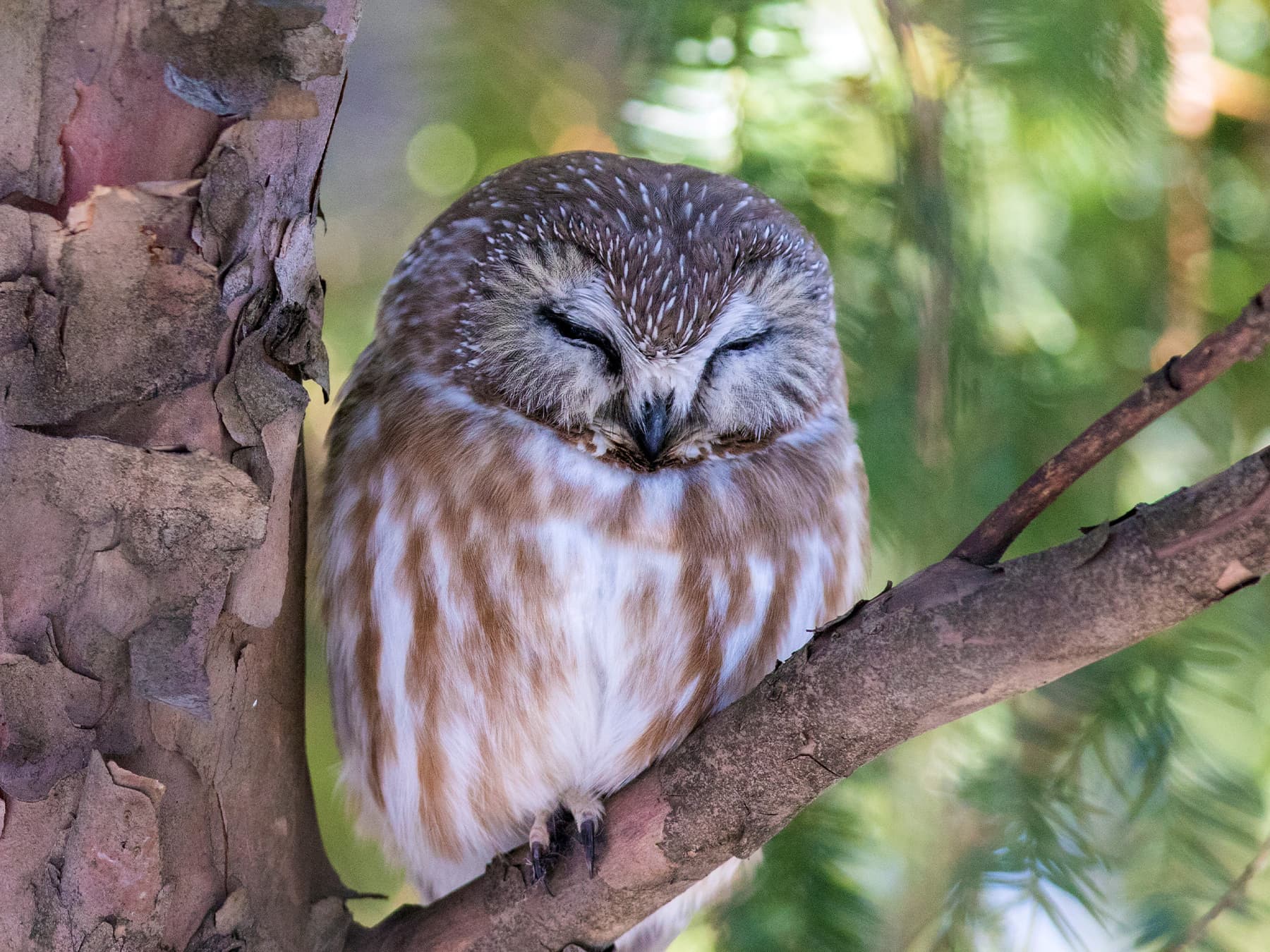
Northern saw-whet owls are nocturnal, hunting at night and roosting in dense vegetation during the day. Roosting spots are chosen in tall trees, around 3.5 m (11.4 ft) above the ground, and around 70 cm (28 in) from the trunk, with conifers seeming to be preferred trees for daytime roosting.
Lifespan and predators
How long do Northern Saw-whet Owls live?
An average lifespan for northern saw-whet owls is around 7 years, although individuals that have survived for much longer have been identified through banding programmes, including one that reached 10 years and 4 months.
In captivity, northern saw-whet owls have lived for up to 16 years. Breeding is thought to occur for the first time at one year old.
What are the predators of Northern Saw-whet Owls?
Being predators themselves does not make northern saw-whet owls immune from being preyed on themselves, and they are regularly targeted by larger raptors, including great horned owls, eastern screech owls, spotted owls, Cooper’s hawks, peregrine falcons, and broad-winged hawks. Nest predators include red squirrels.
Are Northern Saw-whet Owls protected?
Canada’s Migratory Birds Convention Act and the United States Migratory Bird Treaty Act both prohibit the capture, trade, and harm of northern saw-whet owls and their eggs and young.
Are Northern Saw-whet Owls endangered?
Across their entire range, northern saw-whet owls are rated as a species of least concern, although in some regions, including parts of North Carolina, there are more immediate concerns over their future due to habitat loss and declining local populations.
Conservation
While the Northern Saw-whet Owl is currently listed as Least Concern, habitat loss due to deforestation and urban expansion poses a threat.
Conservation efforts focus on maintaining mature forest habitats and providing artificial nest boxes to support breeding populations in areas where natural cavities are scarce.
More photos
3 photos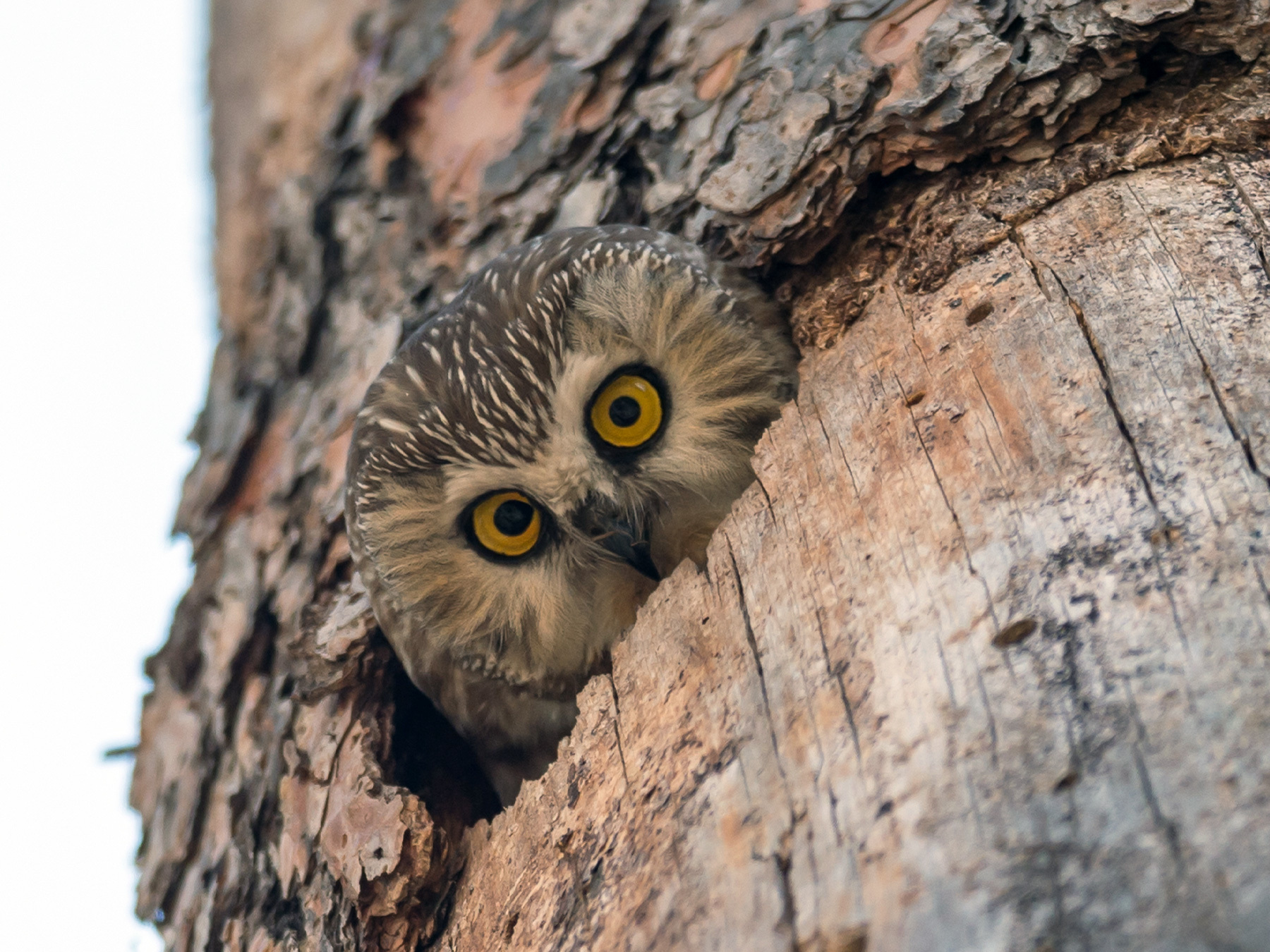
Quick facts
- Length
- 17–21 cm
- Wingspan
- 42–56 cm
- Weight
- 65–125 g
- Lifespan
- 7 years · oldest recorded 17 years
- Family
- Owls
- Migration
- Partial migrant
- Global status (IUCN)
- Least Concern
- World population
- 2,000,000 mature individuals
- Population trend
- Decreasing
- Also called
- Saw-whet Owl, Acadian Owl
- Scientific name
- Aegolius acadicus
Questions
2What does the Northern Saw-whet Owl symbolize?
Due to their elusive nature, northern saw-whet owls are sometimes seen as a symbol of mystery and magic. They are also associated with wisdom, intuition, and the ability to see through mistruths and deception.
Where does the Northern Saw-whet Owl’s name come from?
The Northern saw-whet owl's name comes from its "skiew" alarm call, which is said to sound like the whetting - or sharpening - of a saw blade.
Sources
4- 1BirdLife International. 2016. Aegolius acadicus. The IUCN Red List of Threatened Species 2016: e.T22689366A93228694. Source (opens in a new tab)
- 2Breeding Bird Survey and/or Christmas Bird Count: Butcher and Niven (2007)
- 3Partners in Flight (2022) Source (opens in a new tab)
- 4Reynolds and Lee, Phylogenetic analysis of avian energetics: passerines and non-passerines do not differ (1996)

Checked by
Nathan Cope, founder and editor
Nathan founded Birdfact and leads its writers and contributors in the UK, the US and Canada. He has watched and studied birds for more than ten years, and checks every article and species guide before it’s published.