


Common Merganser
Goosander · Mergus merganser
By the Birdfact teamChecked by Nathan Cope
On this page14 sections
How to recognise it
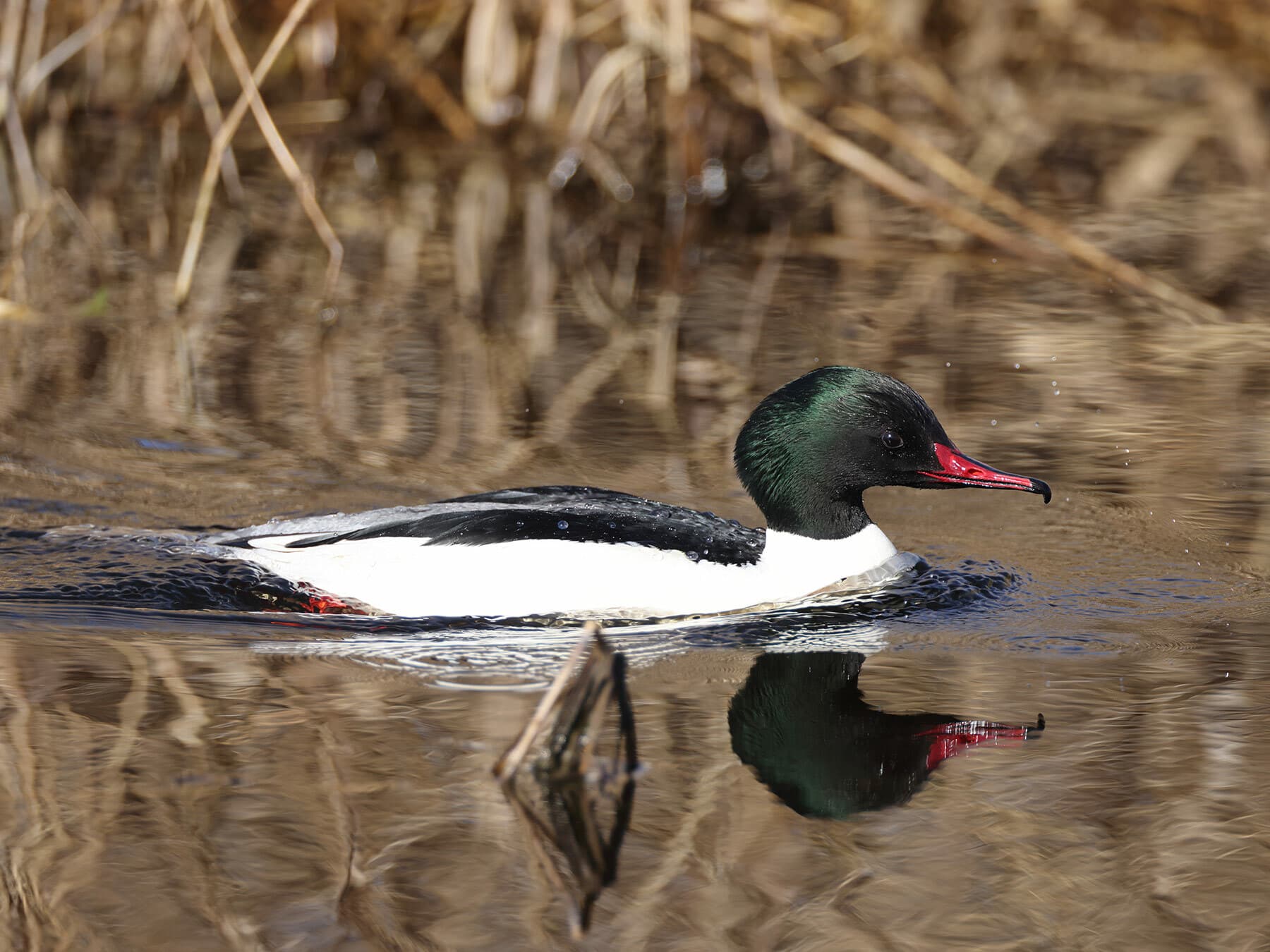
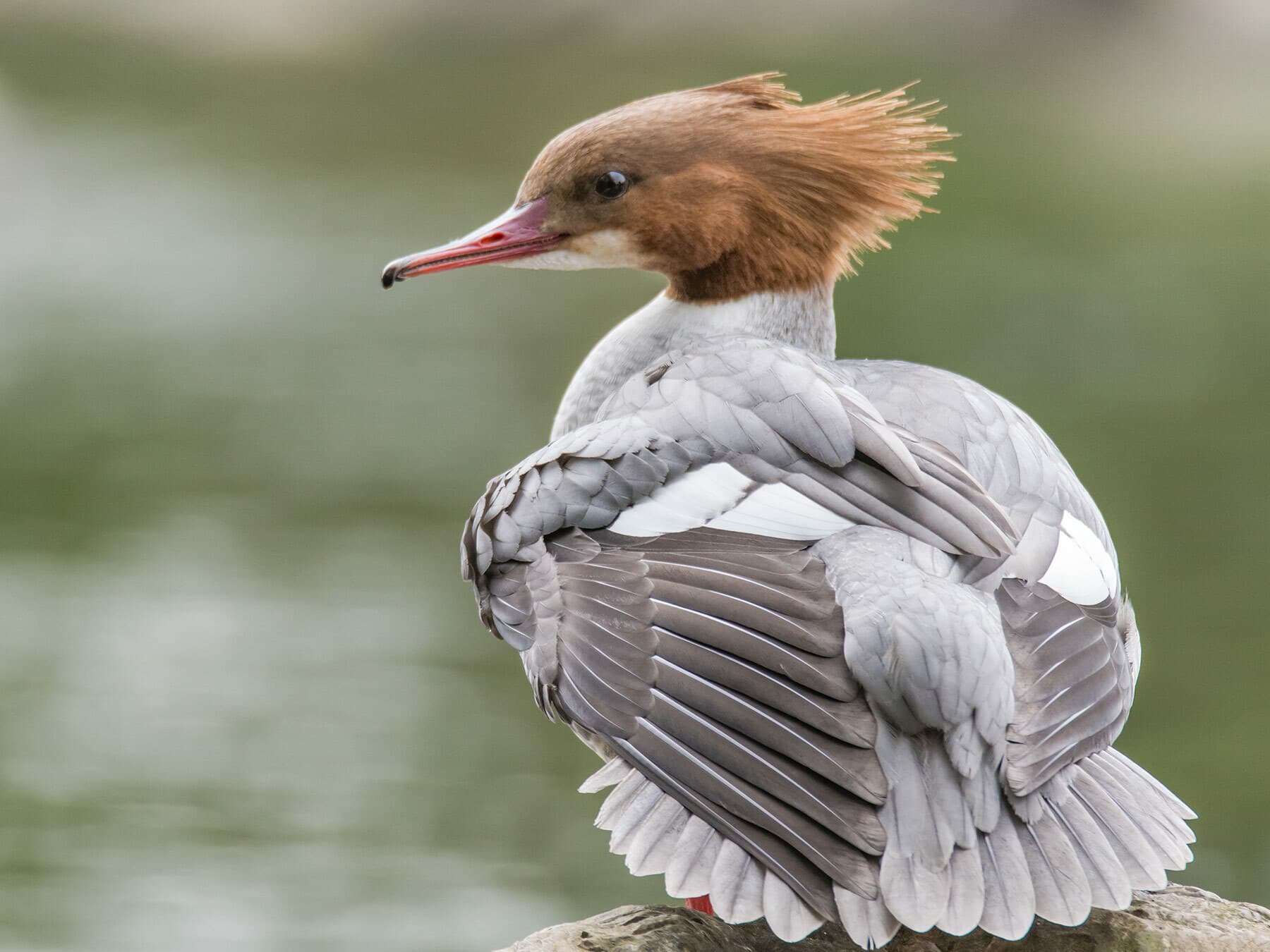
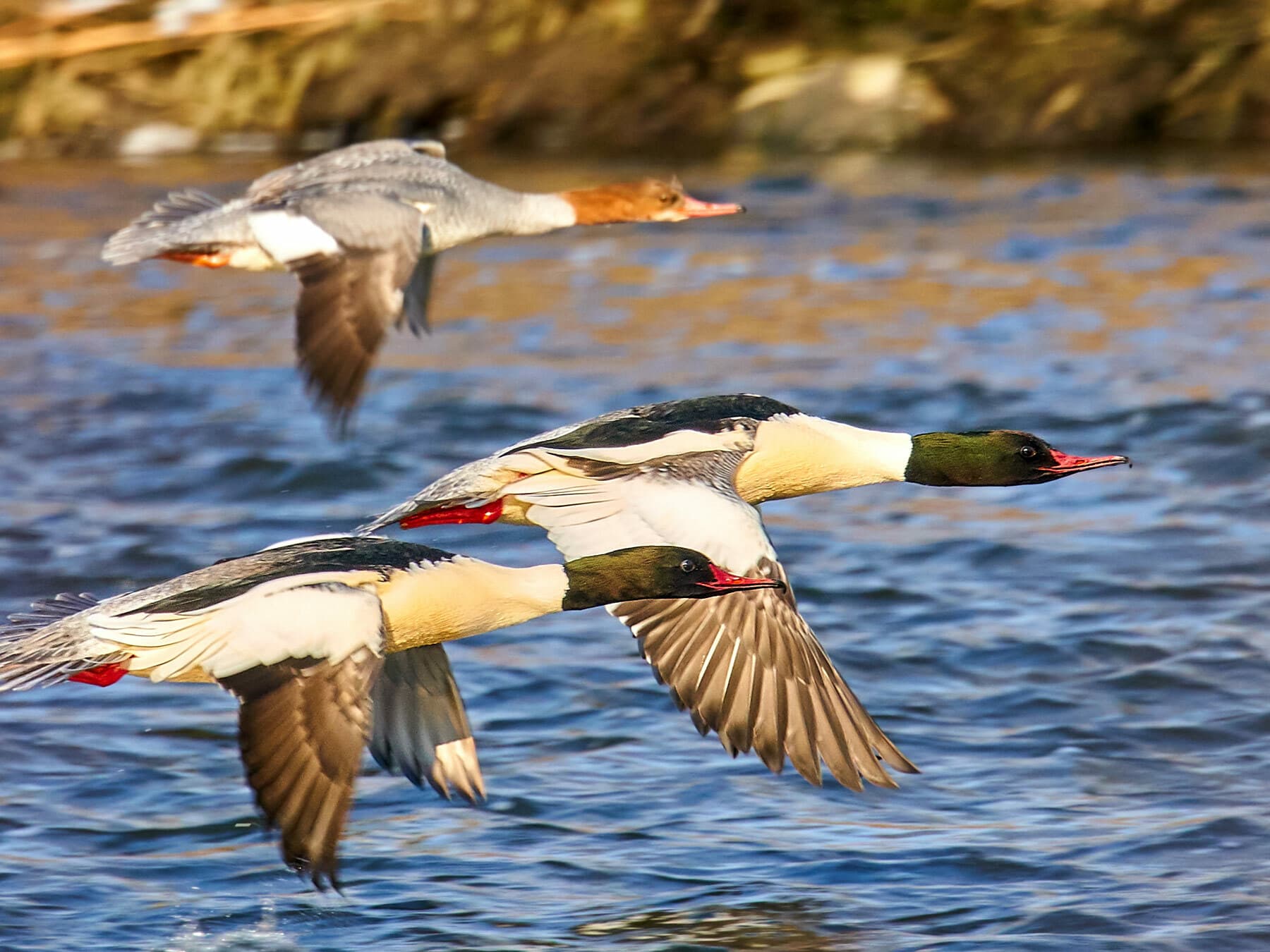
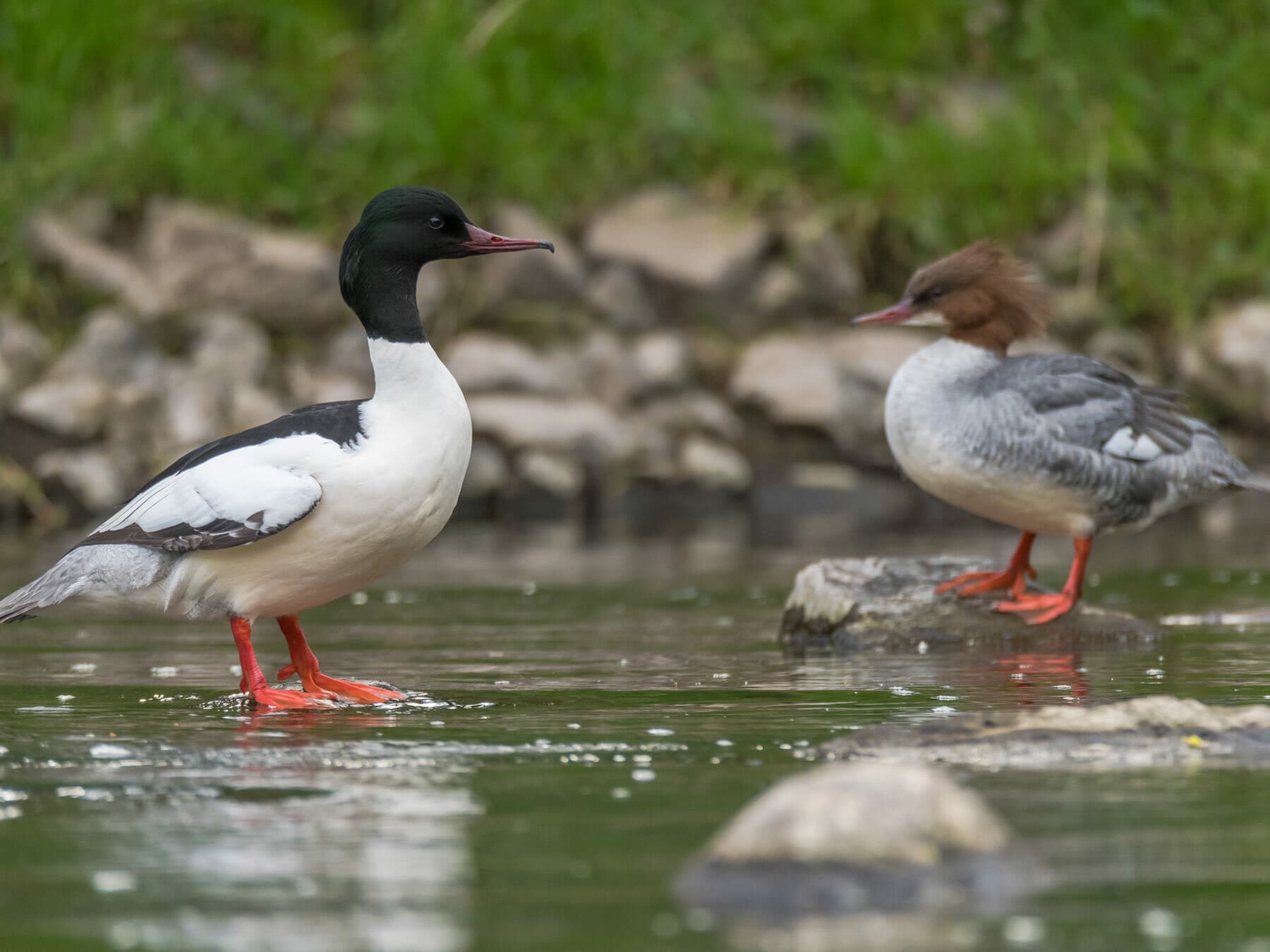
The Common Merganser is a large, streamlined duck with a distinctive long, narrow bill. Males have a dark green head, white body, and black back, while females display a grey body with a rusty cinnamon head and white chin.
Both sexes have a bright red, serrated bill and orange legs. Juveniles resemble females but with a shorter crest and duller overall colouration.
Its size
Adults- Length
- 58–68 cm
- Wingspan
- 78–94 cm
- Weight
- 1000–2100 g
Its song and calls
Common mergansers are generally silent unless courting or alarmed. The female will often hiss when protecting her young or issue a high pitched ‘cru – cru – cru’ sound when calling her young to her. The general alarm call is a low to medium pitched ‘guk – guk’.
- Song0:00 / 0:55
Recorded in Bern, Switzerland · December 2019
When and where to see it
OctoberArriving
Most recorded in October
- 1. Glasgow1.6%
- 2. West Lothian1.5%
- 3. Moray1.3%
- 4. Clackmannanshire1.3%
- 5. Blaenau Gwent1.3%
Each dot is a county, state or province: the bigger and darker, the larger the bird’s share of that place’s bird records that month. Grey dots: no regular records. The ringed point is the centre of the bird’s records this month; the arrow shows how it moved since last month, and the dashed loop its path through the year. “Arrivals” colours places where it becomes regular this month (orange) or is in its last regular month (grey). GBIF eBird Observation Dataset, 2019–2024. Map data: Natural Earth, US Census Bureau; place centres © OpenStreetMap contributors.
In your area
See when the Common Merganser is recorded in your county, state or province.
How often the Common Merganser turns up in the UK, Ireland, the United States and Canada through the year, from birdwatchers' records.
United Kingdom
Winter visitor · all year · most records in January
Ireland
Winter visitor · regularly Oct–May · most records in December
United States
Winter visitor · all year · most records in March
Canada
Winter visitor · all year · most records in November
Show as a table
| Month | United Kingdom | Ireland | United States | Canada |
|---|---|---|---|---|
| January | 0.38% (regular) | 0.056% (regular) | 0.46% (regular) | 1.2% (regular) |
| February | 0.32% (regular) | 0.037% (regular) | 0.46% (regular) | 1.1% (regular) |
| March | 0.24% (regular) | 0.016% (regular) | 0.49% (regular) | 1.3% (regular) |
| April | 0.13% (regular) | 0.020% (regular) | 0.22% (regular) | 0.86% (regular) |
| May | 0.084% (regular) | 0.012% (regular) | 0.094% (regular) | 0.32% (regular) |
| June | 0.077% (regular) | 0.004% | 0.087% (regular) | 0.21% (regular) |
| July | 0.077% (regular) | 0.004% | 0.074% (regular) | 0.21% (regular) |
| August | 0.100% (regular) | <0.001% | 0.083% (regular) | 0.26% (regular) |
| September | 0.12% (regular) | 0.004% | 0.096% (regular) | 0.38% (regular) |
| October | 0.14% (regular) | 0.013% (regular) | 0.12% (regular) | 0.61% (regular) |
| November | 0.27% (regular) | 0.017% (regular) | 0.26% (regular) | 1.3% (regular) |
| December | 0.35% (regular) | 0.085% (regular) | 0.34% (regular) | 1.3% (regular) |
Recorded regularly in
Worldwide: recorded regularly in 60 countries
Countries where it was recorded in at least 3 of the 6 years 2019–2024. Linked countries have their own bird list.
Europe (40)
- Åland Islands
- Albania
- Austria
- Belarus
- Belgium
- Bosnia & Herzegovina
- Bulgaria
- Croatia
- Czechia
- Denmark
- Estonia
- Faroe Islands
- Finland
- France
- Germany
- Greece
- Hungary
- Iceland
- Ireland
- Isle of Man
- Italy
- Latvia
- Liechtenstein
- Lithuania
- Luxembourg
- Moldova
- Netherlands
- North Macedonia
- Norway
- Poland
- Romania
- Russia
- Serbia
- Slovakia
- Slovenia
- Spain
- Sweden
- Switzerland
- Ukraine
- United Kingdom
Asia (16)
North America (4)
Data: EOD – eBird Observation Dataset (Cornell Lab of Ornithology), accessed via GBIF.org, CC BY 4.0. Records from 2019–2024, aggregated and filtered by Birdfact. How these lists are made
The three sub-species are located as follows:
- Common merganser (North American)
- Mergus merganser americanus (monotypic)
The north American variant breeds from Alaska eastwards to Newfoundland, south to northern California and in a south westerly direction into New Mexico and northern Pennsylvania. When northern rivers and lake freeze over during the winter the birds migrate south to south western USA and northern Mexico.
- Common merganser (Eurasian)
- Mergus merganser merganser (polytypic)
The Eurasian variant occupies the largest of the world’s biographic ecozones known as the Palearctic. This particular zoogeographical region includes Eurasia, together with north Africa and the temperate areas of the Arabian Peninsula. Within its borders it encompasses the Mediterranean Basin, west, central and eastern Asia, the Sahara and Arabian deserts and the Euro-Siberian region. Breeding occurs from Iceland westwards to the far east of Russia on the pacific coast, south and central Europe, northern regions of Japan and north east China. Birds migrate south to over winter on the Atlantic coasts and also from central Europe eastwards to Iran, Korea, Japan and China.
- Mergus merganser orientalis (polytypic)
Breeding in central Asia from Afghanistan through Tibet to the Himalayas and western China, this sub-species of the common merganser may over winter in the north west Indian sub-continent and from the foothills of the Himalayas across to south east Asia.
Signs and Spotting tips
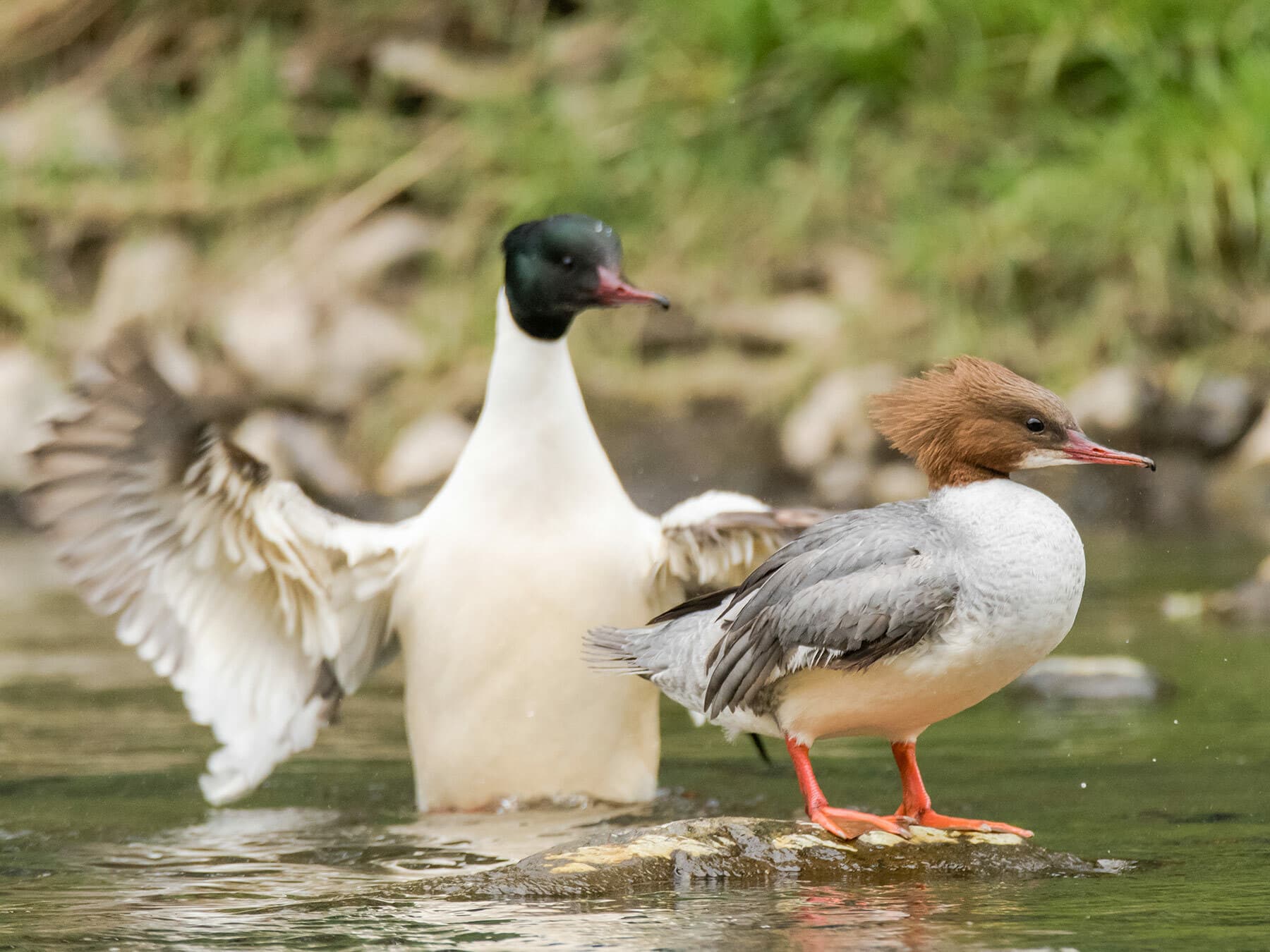
Common mergansers prefer the fresh water surroundings of rivers, lakes and large pools but during winter will often occupy salt water estuaries and occasionally inland seas. They are superb fish catchers and their long slim bodies can often be seen gliding through the water with their head submerged hunting for food. The distinctive white throat patch on the female is an excellent aid to identification.
What it eats
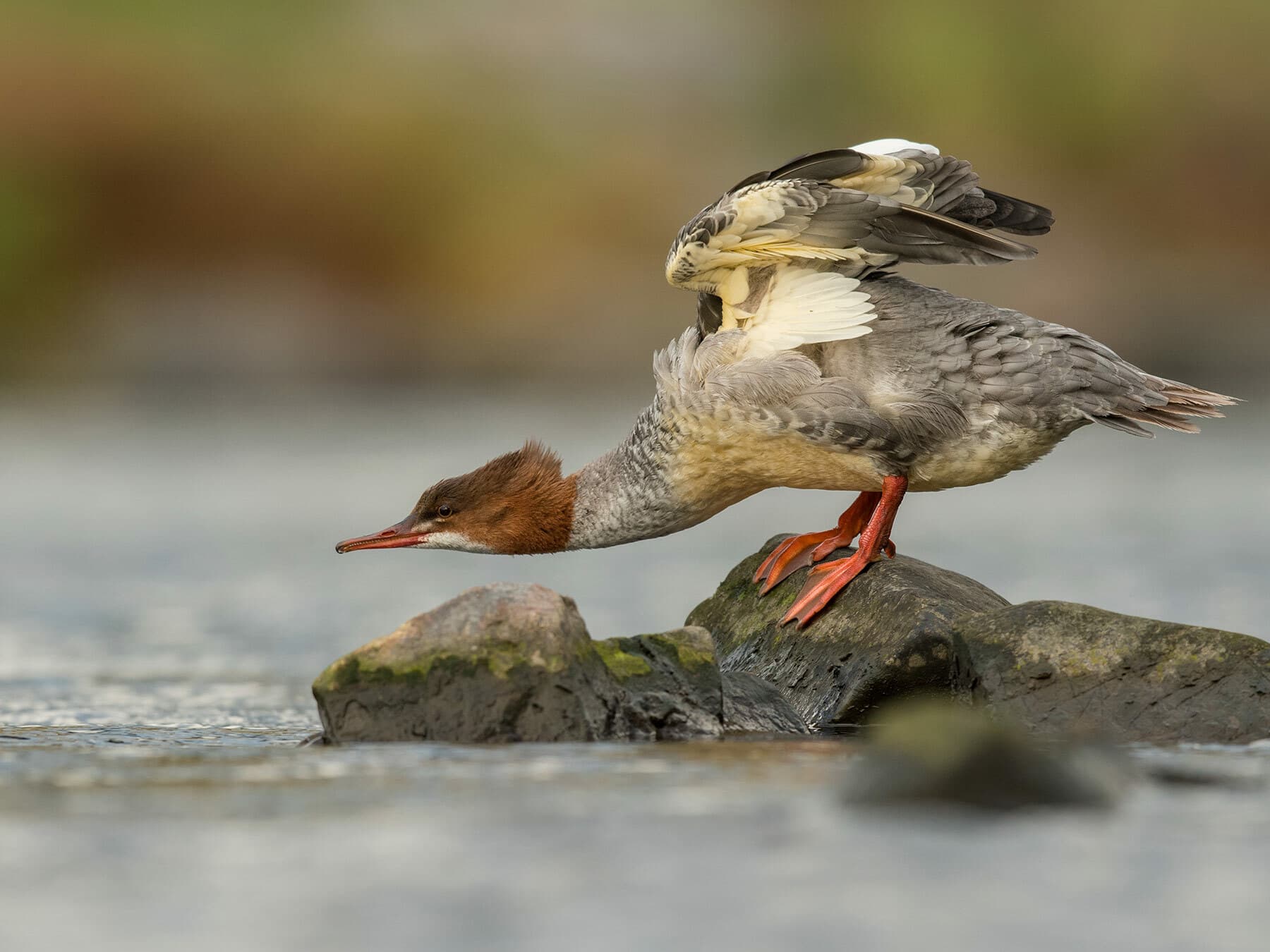
Whilst usually seen diving from the surface in order to catch fish, its main source of nourishment, the merganser will also take, crustaceans, frogs, worms, insects and even small birds and plant matter. In the past they have been targeted by commercial fish farms following their penchant for trout and salmon although more commonly they will feed on the more abundant species of fish available within their immediate habitat.
Nesting and breeding
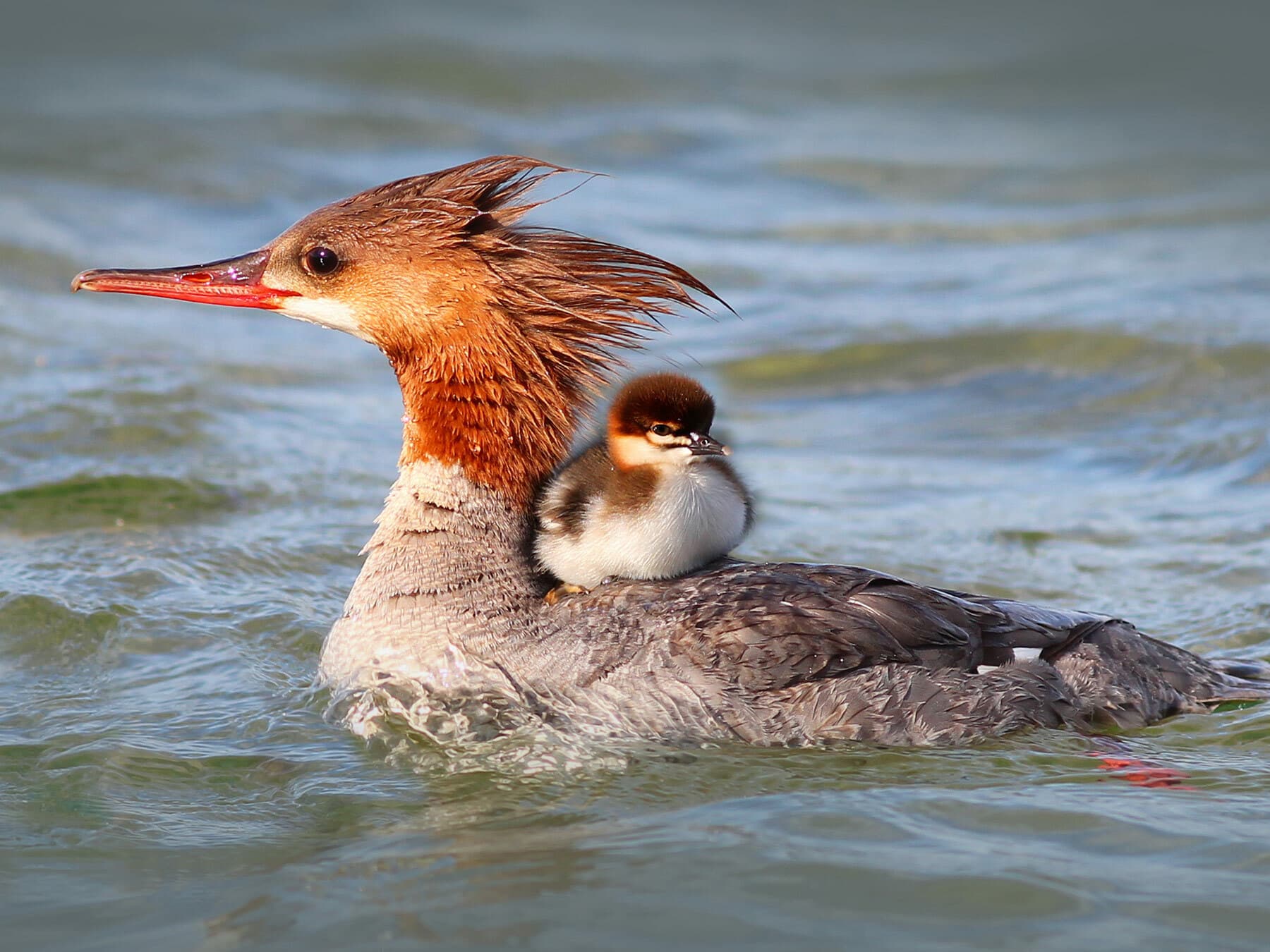
The female alone chooses a nesting site and constructs a bowl shaped nest which is lined with her own downy breast feathers. The nest is often located in the hole or crevice of a tree close to water. Breeding females may visit and utilise then same nest year upon year. A single clutch of between 8 – 11 creamy white coloured eggs is laid annually with the north American variant laying between June to July and less frequently from May and the two Eurasian sub species producing eggs from April through to late July. Incubation by the female only, averages thirty two days and the chicks are lured from the nest by the mother to the water, approximately forty eight hours after hatching. Young are able to fly from the age of two months and may be abandoned and left to fend for themselves by the parent as early as one week after hatching although more commonly at around a month old.
Behaviour
Common Mergansers are excellent divers, using their powerful legs to propel themselves underwater in pursuit of fish. They often form small flocks during winter and engage in cooperative fishing behaviour.
These birds are generally quiet but become more vocal during courtship displays.
Lifespan and predators
The life expectancy for the common merganser averages eight years.
Conservation
While the Common Merganser is currently listed as Least Concern, it faces threats from habitat loss and degradation of freshwater ecosystems.
Conservation efforts focus on protecting water quality and maintaining healthy fish populations in their breeding and wintering areas.
What does a Common Merganser look like?
The adult female is a large diving duck with a rufous brown head. It has a long rufous coloured, downward pointing crest on its crown and a well defined white throat with a brown collar on the neck below. The lower neck is white as is the belly and the flanks. Overall the remainder of the bird is a blue grey to slate grey across the breast, wings, back and tail. The legs and bill are red. The bill is long, narrow and hooked with serrated edges enabling the bird to hold on to its preferred prey of fish. During the summer months the adult male is similar to the female, although the crest is normally shorter, but this appearance changes in the autumn to reveal a winter plumage of a green black head with a round crest and bright white neck and underparts which may be tinged with a pinkish hue. Secondary flight feathers are also white whilst the back and tail are a light grey. The upper wing area, apart from the secondaries is black resulting in a large white wing patch in the centre of the wing which is prominent in flight. The bill and legs are as the female and both sexes have dark brown eyes. Juvenile mergansers are similar to the adult female with a lighter colour to the head and a shorter crest.
Similar birds
Often mistaken for
Common Merganser guides
1 guidesQuick facts
- Length
- 58–68 cm
- Wingspan
- 78–94 cm
- Weight
- 1000–2100 g
- Lifespan
- 8 years · oldest recorded 14.8 years
- Family
- Ducks, Geese & Swans
- Migration
- Partial migrant
- Global status (IUCN)
- Least Concern
- World population
- 1,700,000 - 2,400,000 mature individuals
- Population trend
- Stable
- Also called
- Goosander
- Scientific name
- Mergus merganser
Sources
3- 1BirdLife International. 2018. Mergus merganser. The IUCN Red List of Threatened Species 2018: e.T22680492A132054083. Source (opens in a new tab)
- 2Wetlands International (2015)
- 3Fransson et al., EURING list of longevity records for European birds (2010) Source (opens in a new tab)

Checked by
Nathan Cope, founder and editor
Nathan founded Birdfact and leads its writers and contributors in the UK, the US and Canada. He has watched and studied birds for more than ten years, and checks every article and species guide before it’s published.