


Red-breasted Merganser
Sawbill, Fish Duck, Sheldrakes · Mergus serrator
By the Birdfact teamChecked by Nathan Cope
On this page15 sections
How to recognise it
What do Red-breasted Mergansers look like?
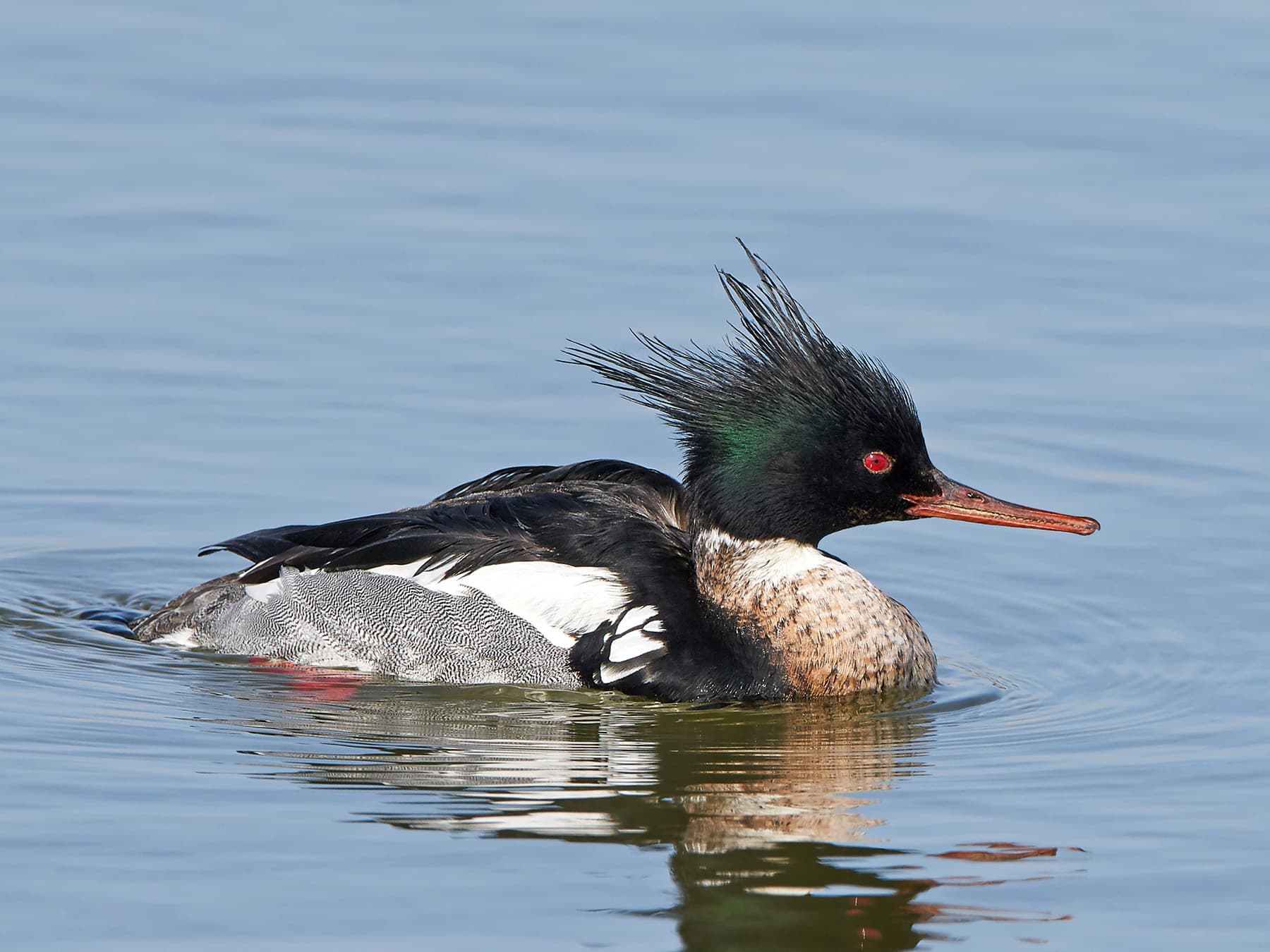
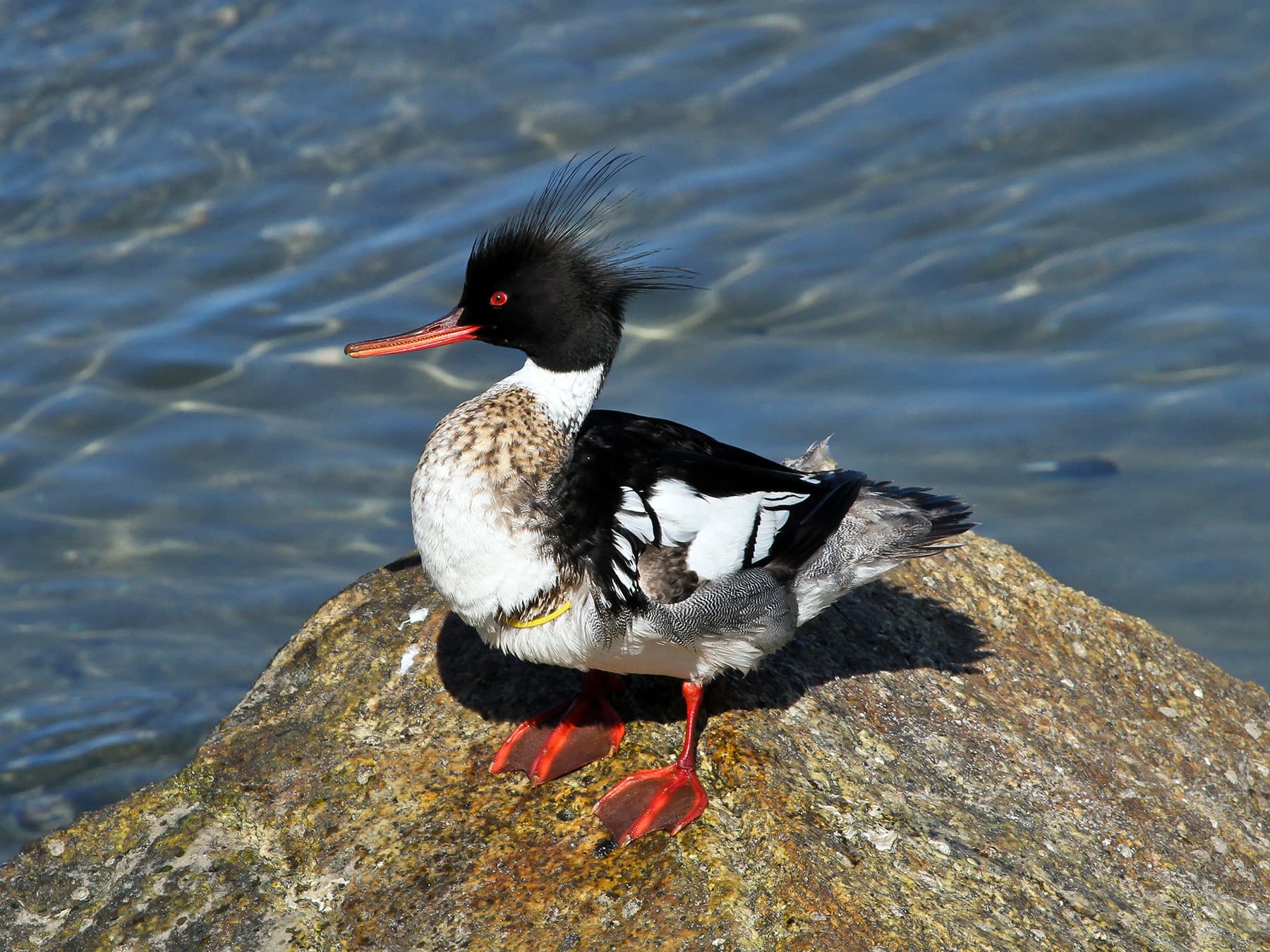
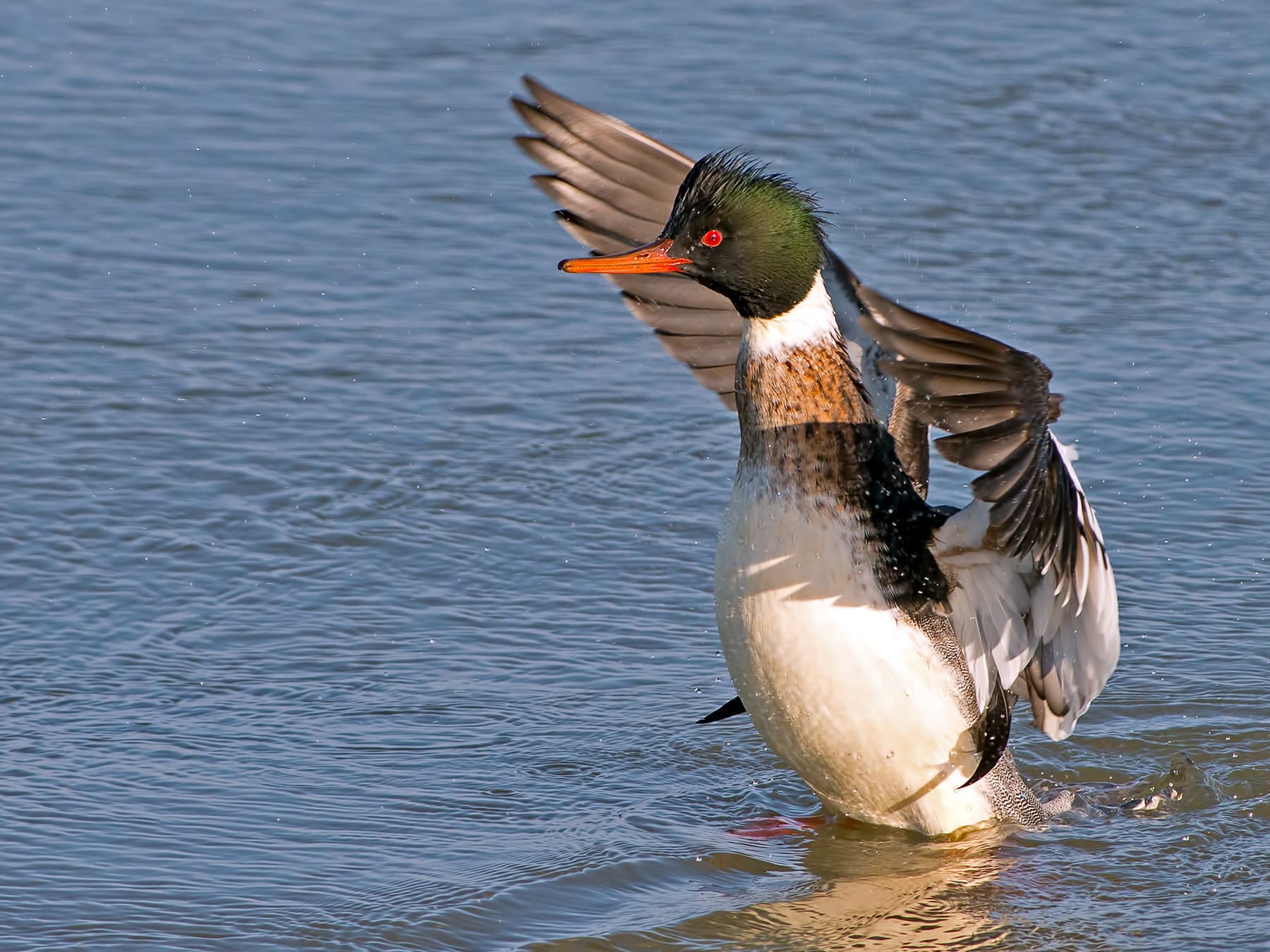
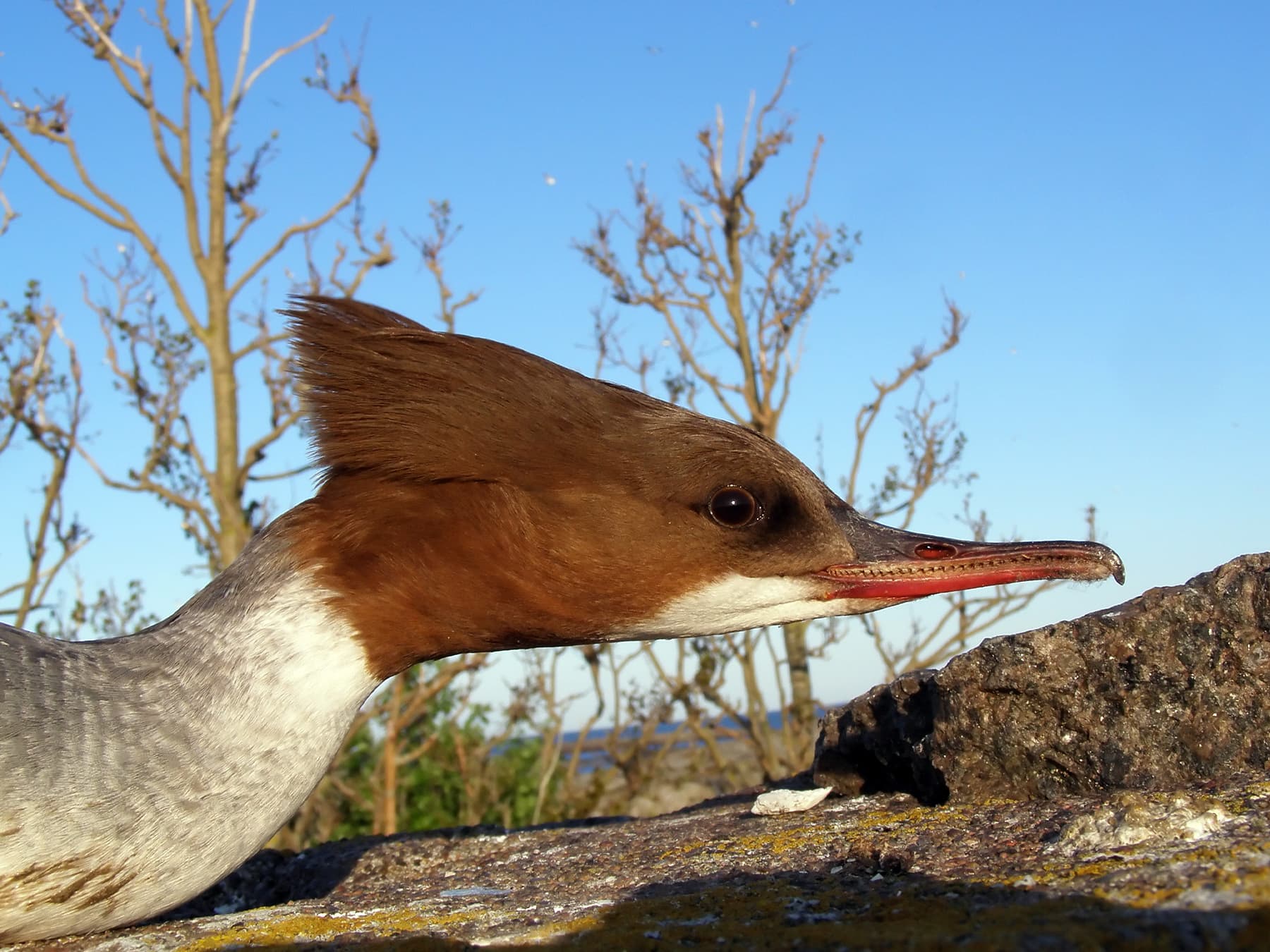
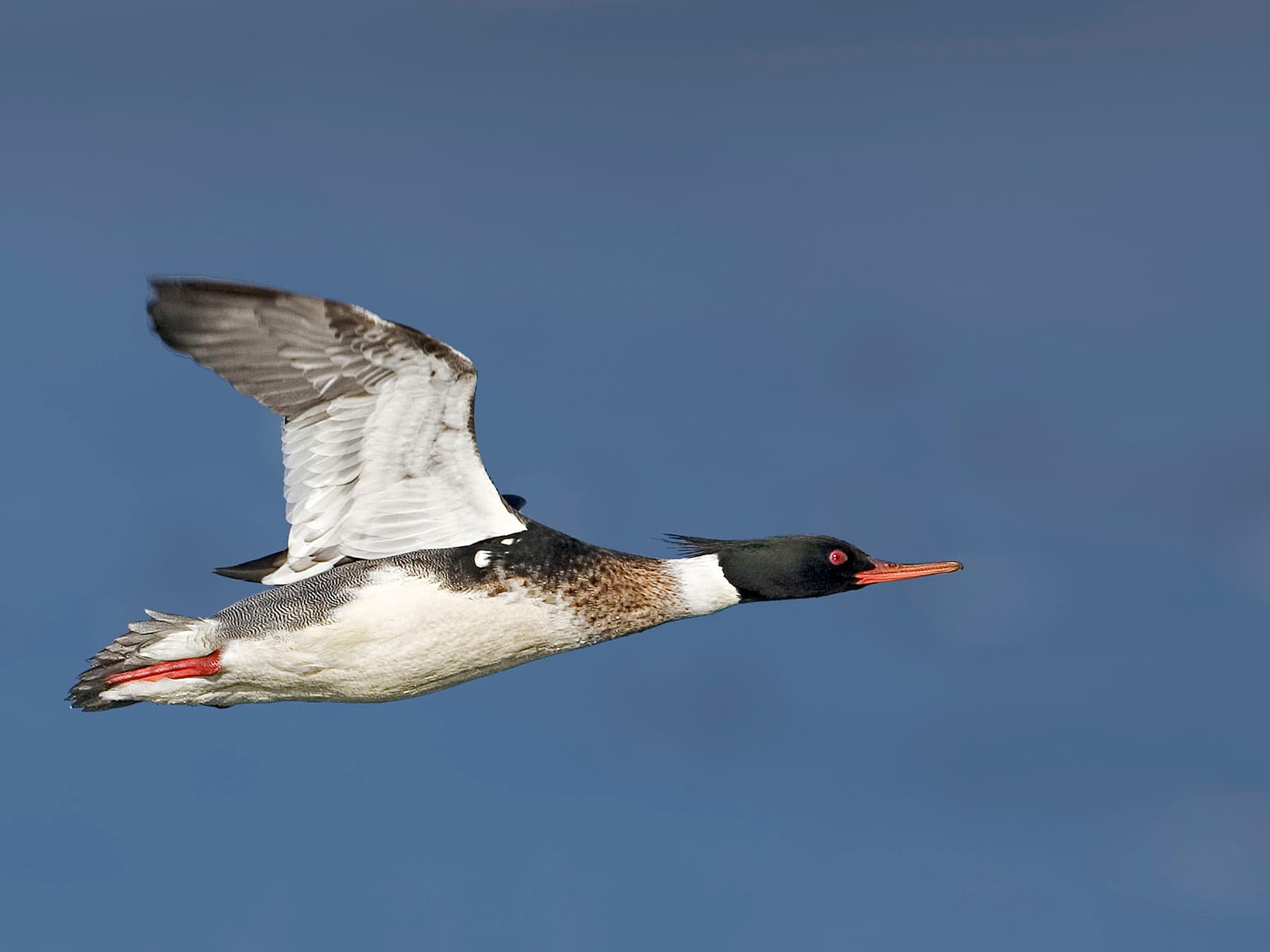
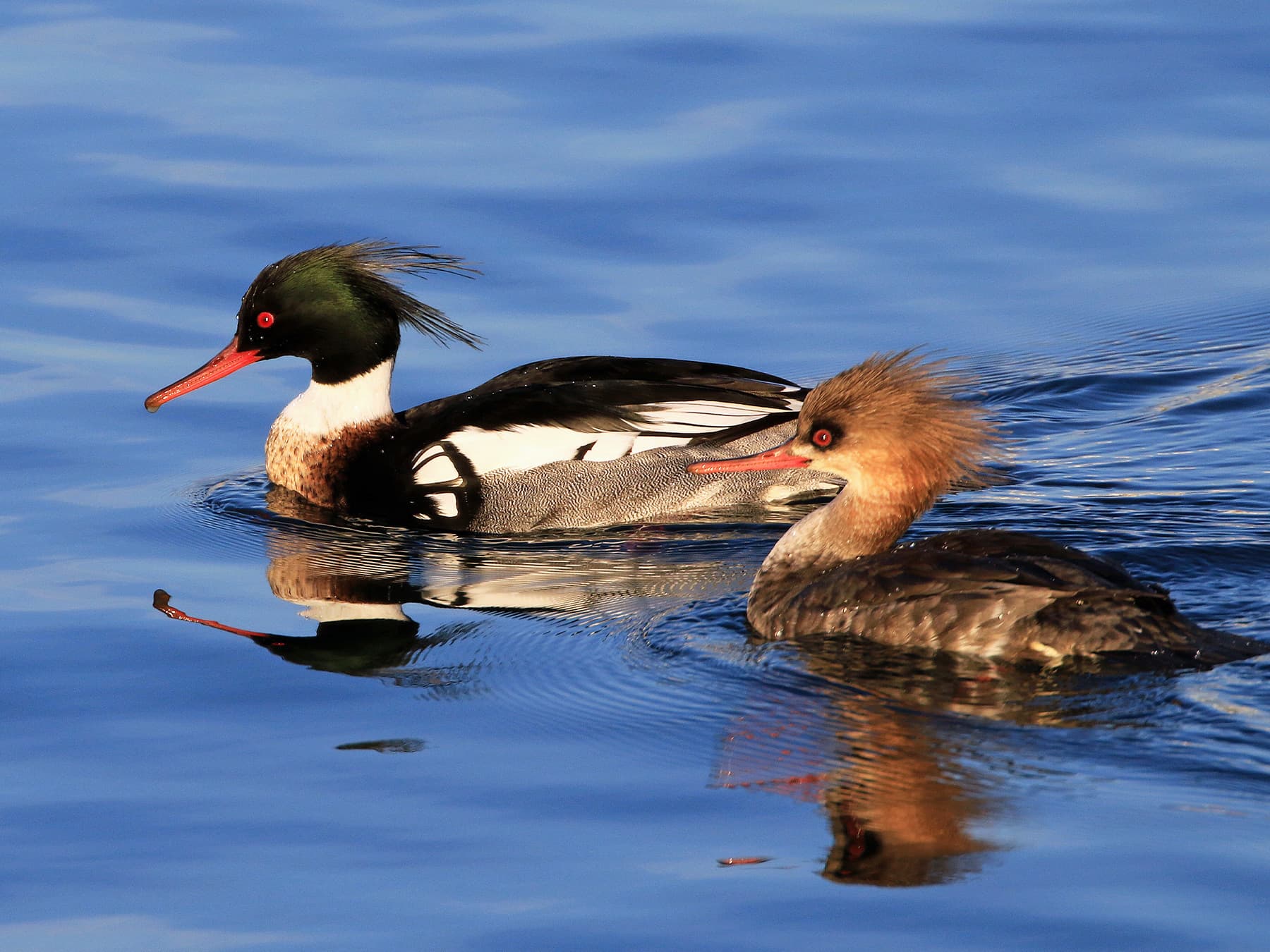
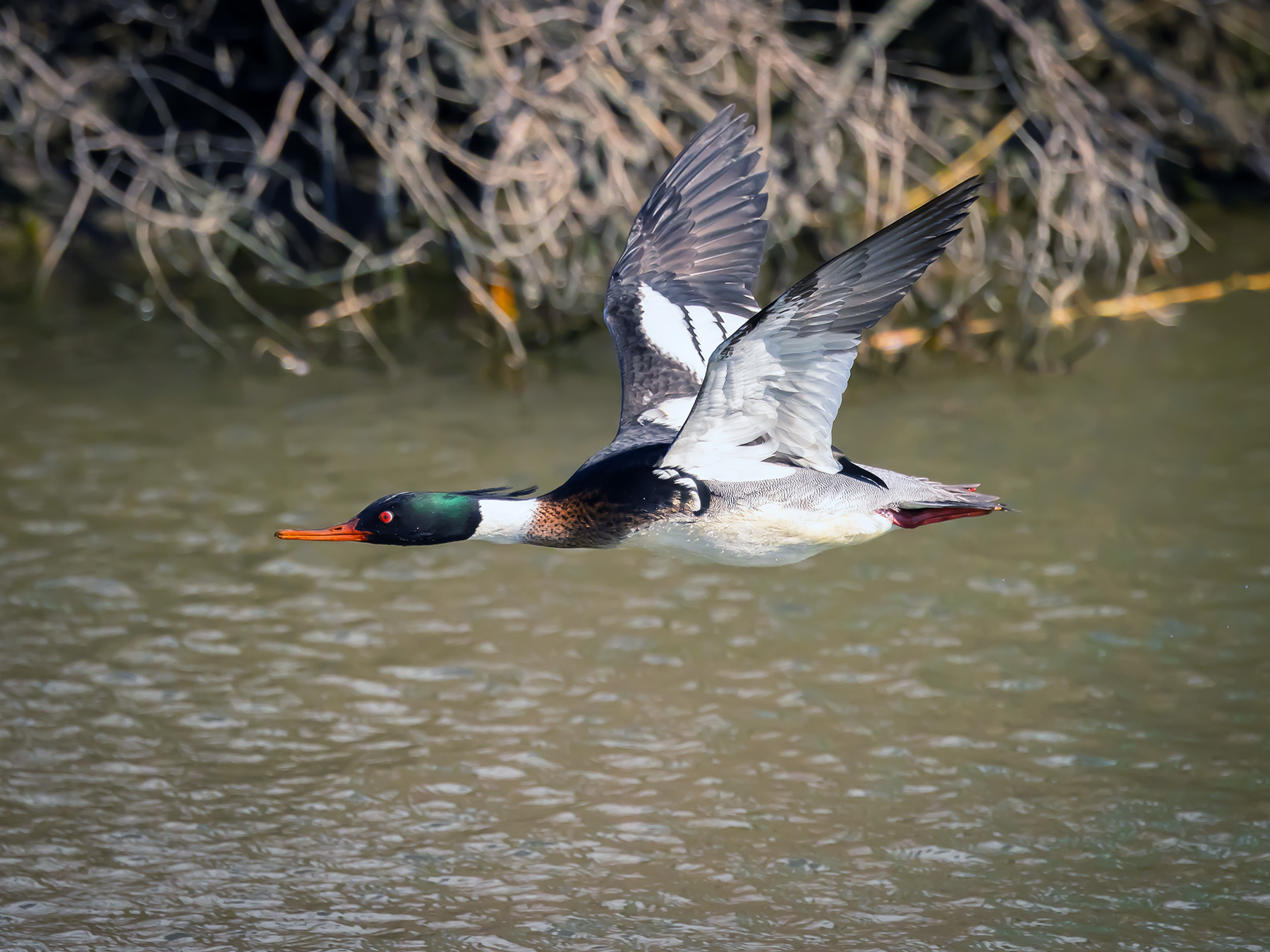
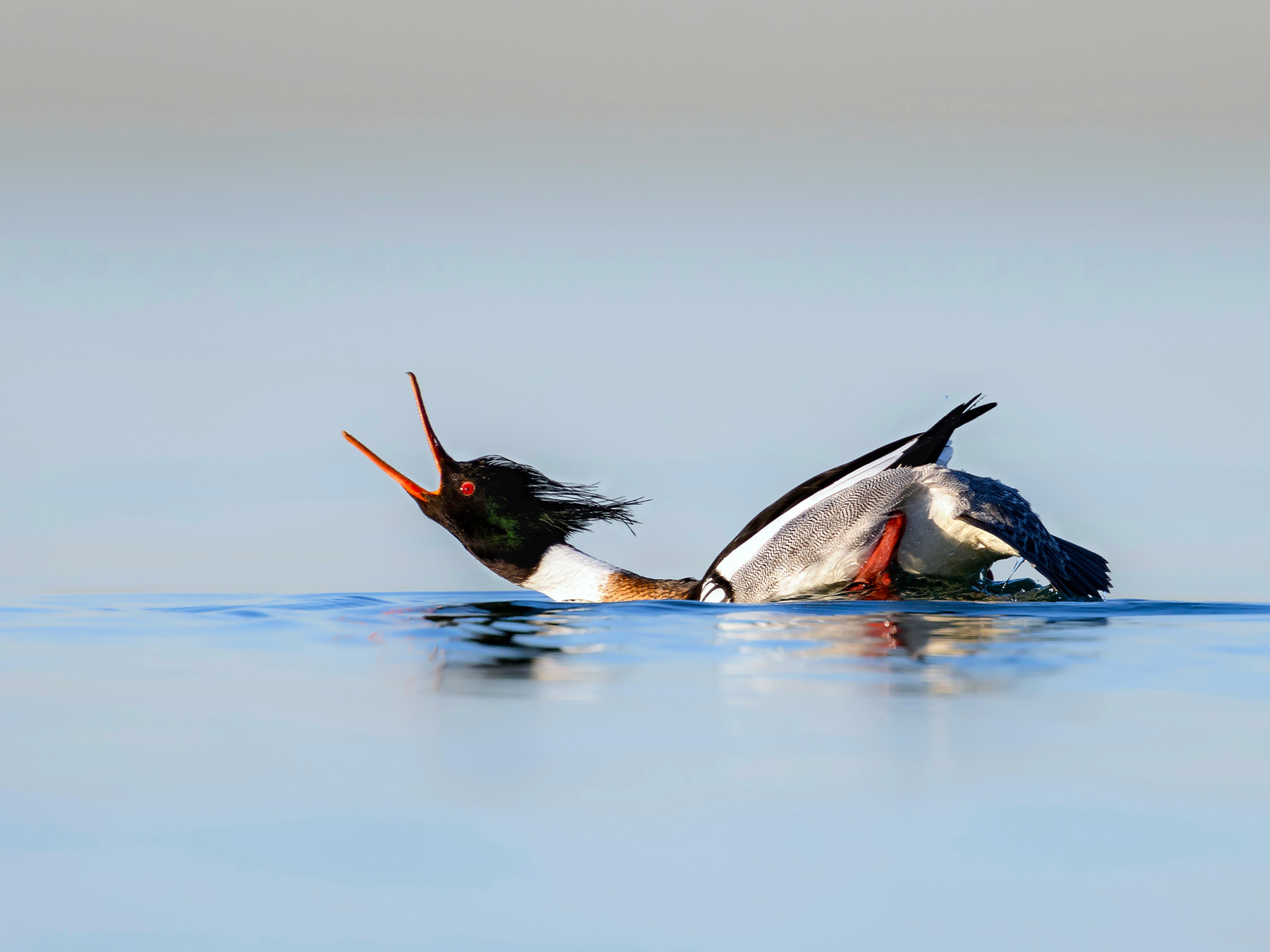
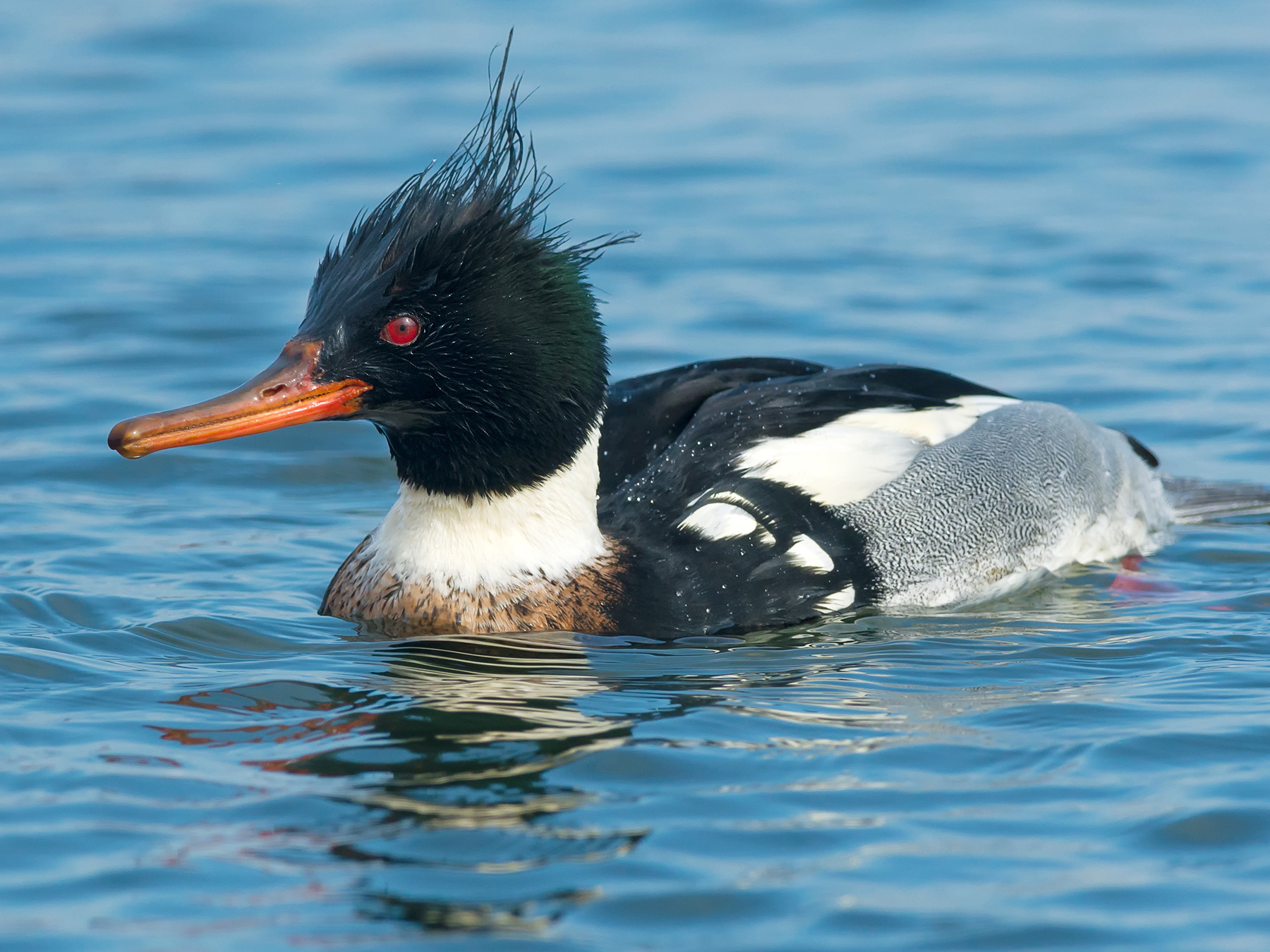
Red-breasted Mergansers are distinctive wildfowl with narrow, serrated bills and spiky crests. Breeding males are attractively patterned with a bright red bill and eyes, a dark green head, complete with an untidy crest, and a white collar. Their flanks appear gray, bordered above by a bold white horizontal streak on the wing and then a pure black back. The shoulder is black, with contrasting white spots, and the lower neck and breast are reddish brown.
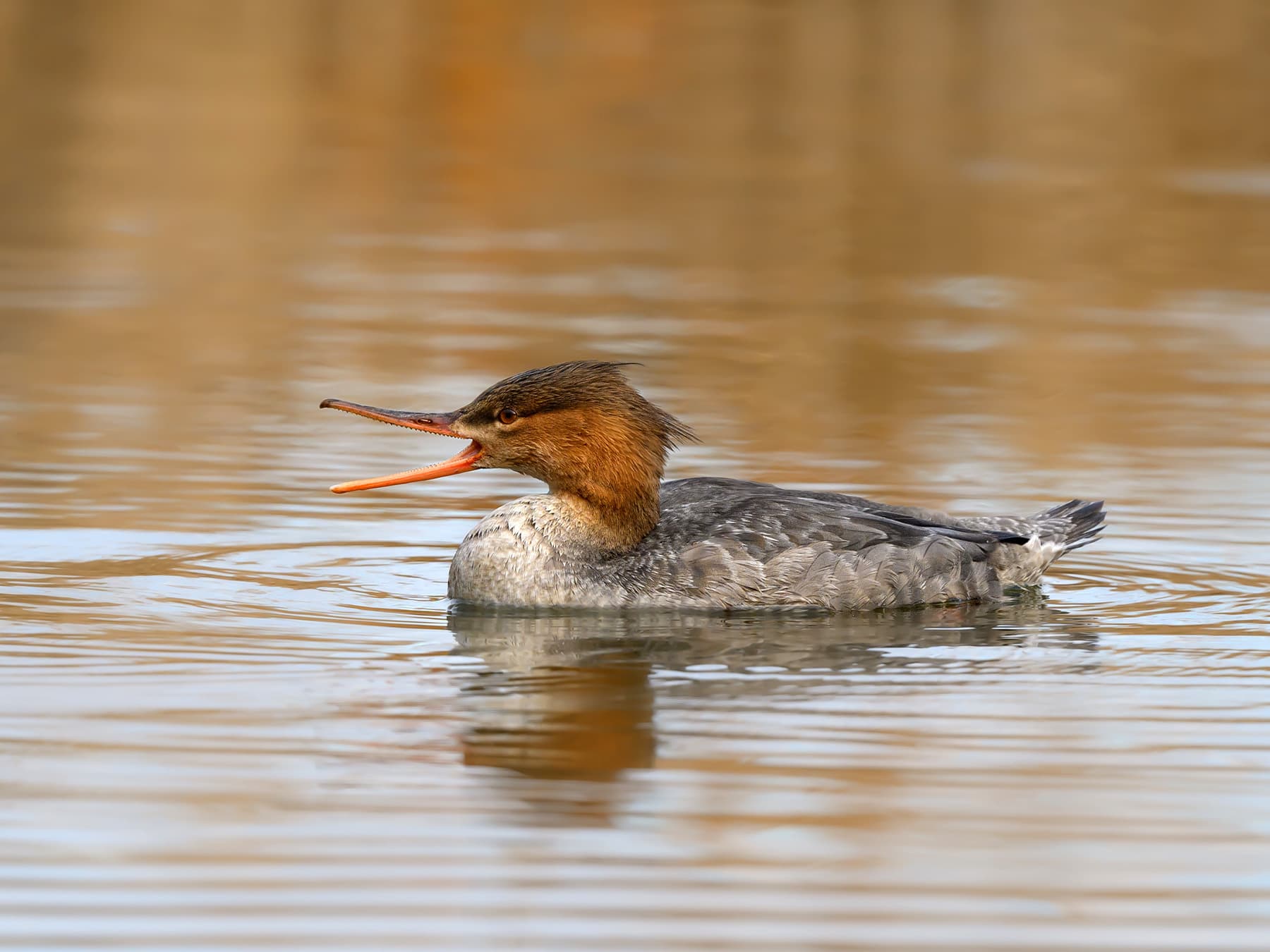
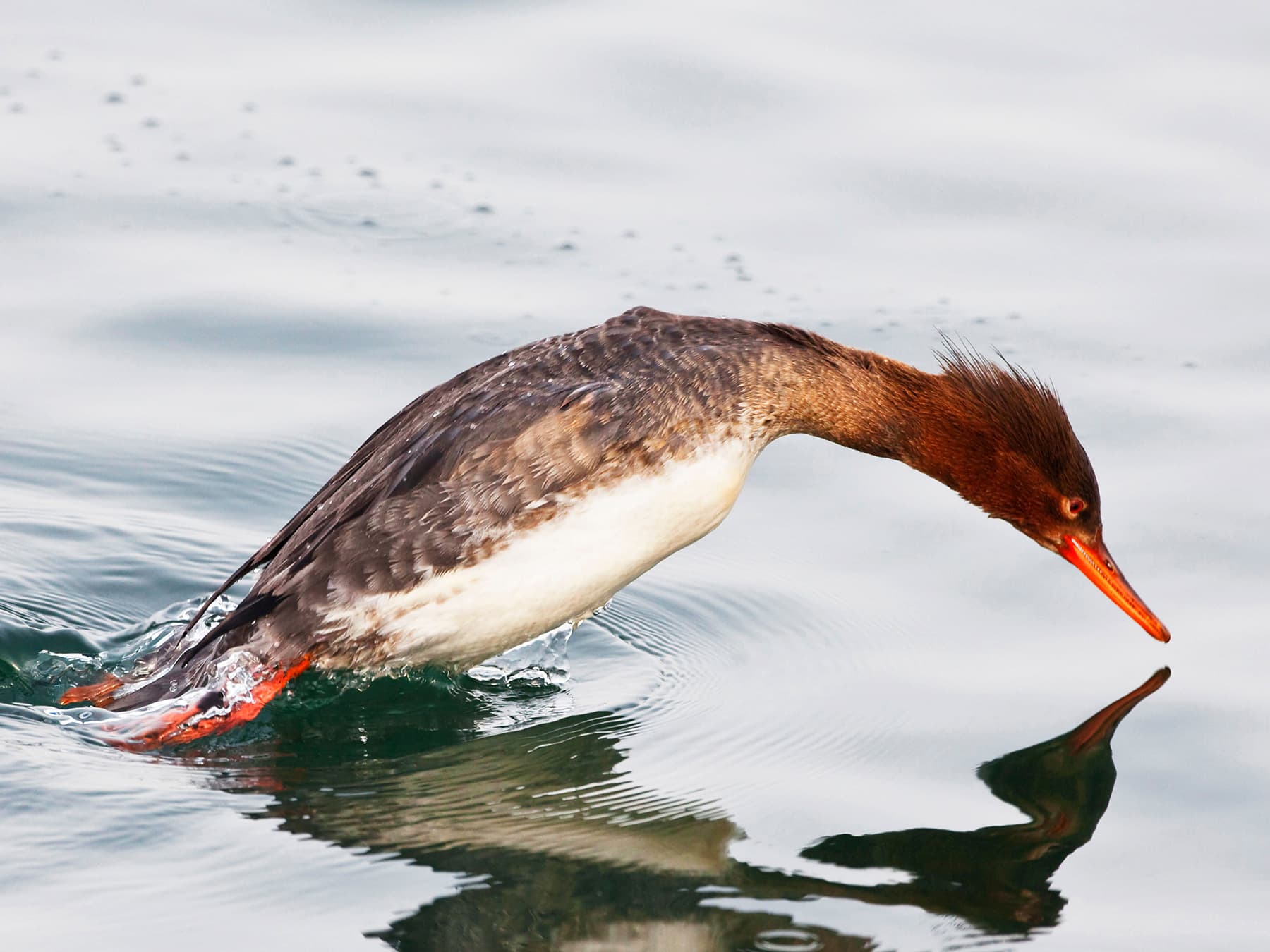
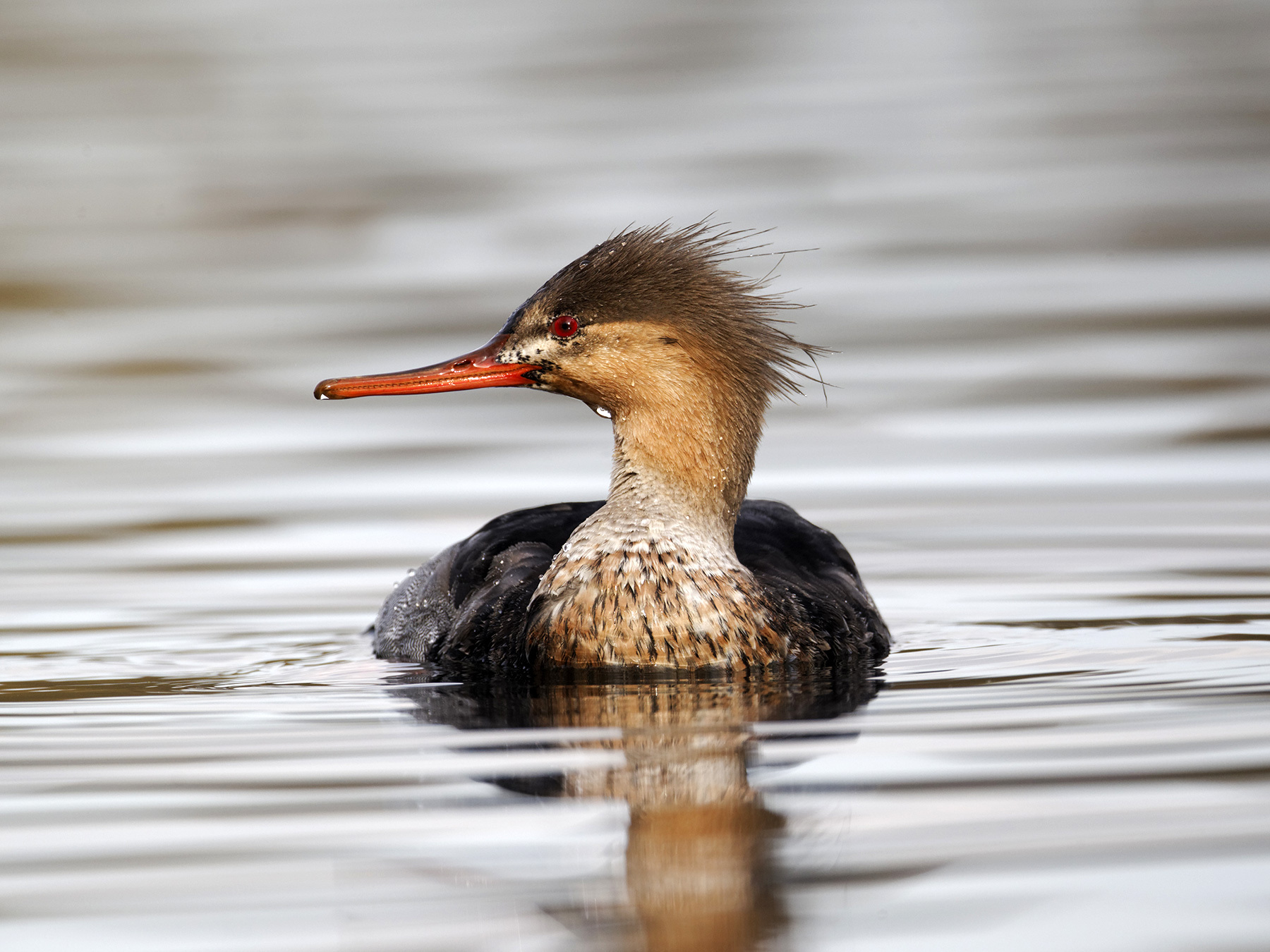
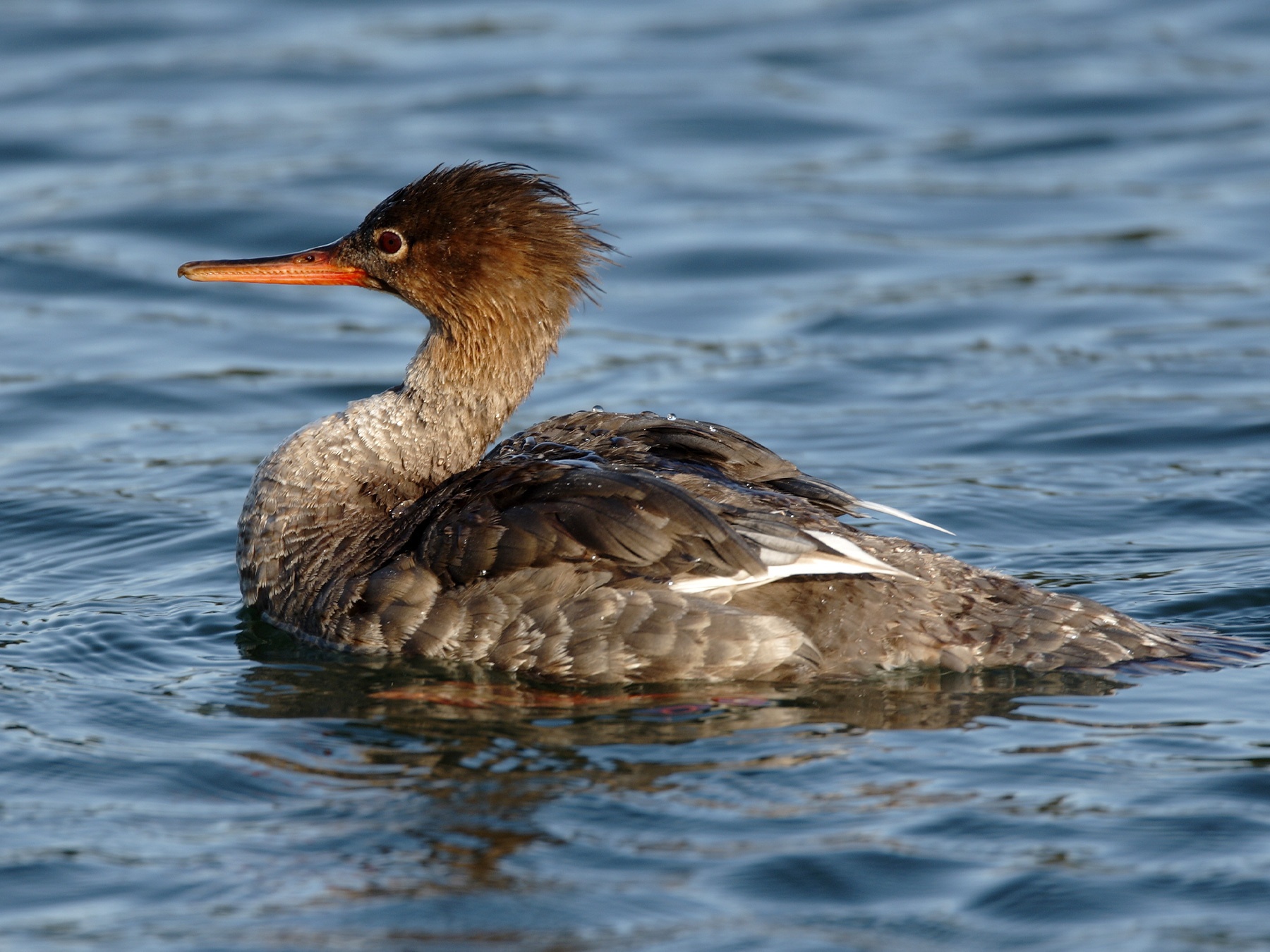
Females have gray-brown upperparts with distinctive brick-red heads and coral-red bills. The throat, breast, and underparts are a paler whitish shade. Immature males and females resemble adult females, as do non-breeding males, although they are larger and have darker crowns.
This species is most easily confused with the Common Merganser/ Goosander and the female Hooded Merganser.
How big are Red-breasted Mergansers?
Red-breasted Mergansers are long and lean ducks, slightly smaller than Mallards.
Length
They have a total length of 20 to 25 inches or 51 to 64 centimeters. Males are larger than females.
Weight
Males generally weigh 33½ to 47 ounces or 950 to 1350 grams, while females weigh 32 to 39 ounces or 900 to 1100 grams.
Wingspan
They have a fairly short wingspan of 27½ to 34 inches or 70 to 86 centimeters.
Its size
Adults- Length
- 52–58 cm
- Wingspan
- 70–86 cm
- Weight
- 800–1350 g
Its song and calls
What sound does a Red-breasted Merganser make?
Red-breasted Mergansers are quiet for most of the year. Both sexes are more vocal during courtship displays when males produce a ‘meow’ call and females make a croaking call. They also make a grunting alarm call if threatened.
- Song and calls0:00 / 0:17
Recorded in Normandy, France · March 2026
- Call0:00 / 0:10
Recorded in Kalmar län, Sweden · April 2024
When and where to see it
OctoberArriving
Most recorded in October
- 1. Argyll and Bute1.4%
- 2. Moray1.3%
- 3. East Lothian1.0%
- 4. Highland1.0%
- 5. Falkirk0.97%
Each dot is a county, state or province: the bigger and darker, the larger the bird’s share of that place’s bird records that month. Grey dots: no regular records. The ringed point is the centre of the bird’s records this month; the arrow shows how it moved since last month, and the dashed loop its path through the year. “Arrivals” colours places where it becomes regular this month (orange) or is in its last regular month (grey). GBIF eBird Observation Dataset, 2019–2024. Map data: Natural Earth, US Census Bureau; place centres © OpenStreetMap contributors.
In your area
See when the Red-breasted Merganser is recorded in your county, state or province.
How often the Red-breasted Merganser turns up in the UK, Ireland, the United States and Canada through the year, from birdwatchers' records.
United Kingdom
Resident · all year · most records in January
Ireland
Winter visitor · all year · most records in January
United States
Winter visitor · regularly Oct–Jun · most records in January
Canada
Winter visitor · regularly Sep–Jun · most records in November
Show as a table
| Month | United Kingdom | Ireland | United States | Canada |
|---|---|---|---|---|
| January | 0.20% (regular) | 0.60% (regular) | 0.37% (regular) | 0.83% (regular) |
| February | 0.17% (regular) | 0.58% (regular) | 0.32% (regular) | 0.68% (regular) |
| March | 0.12% (regular) | 0.45% (regular) | 0.32% (regular) | 0.54% (regular) |
| April | 0.074% (regular) | 0.20% (regular) | 0.19% (regular) | 0.40% (regular) |
| May | 0.070% (regular) | 0.080% (regular) | 0.056% (regular) | 0.23% (regular) |
| June | 0.072% (regular) | 0.041% (regular) | 0.030% (regular) | 0.064% (regular) |
| July | 0.045% (regular) | 0.037% (regular) | 0.009% | 0.041% |
| August | 0.033% (regular) | 0.042% (regular) | 0.007% | 0.036% |
| September | 0.064% (regular) | 0.13% (regular) | 0.010% | 0.079% (regular) |
| October | 0.13% (regular) | 0.29% (regular) | 0.050% (regular) | 0.34% (regular) |
| November | 0.18% (regular) | 0.52% (regular) | 0.25% (regular) | 0.85% (regular) |
| December | 0.19% (regular) | 0.51% (regular) | 0.32% (regular) | 0.84% (regular) |
Recorded regularly in
Worldwide: recorded regularly in 62 countries
Countries where it was recorded in at least 3 of the 6 years 2019–2024. Linked countries have their own bird list.
Europe (38)
Asia (13)
- Azerbaijan
- China
- Cyprus
- Georgia
- Iran
- Israel
- Japan
- Kazakhstan
- Kyrgyzstan
- Mongolia
- South Korea
- Taiwan
- Turkey
North America (11)
- Bahamas
- Belize
- Bermuda
- Canada
- Cayman Islands
- Cuba
- Greenland
- Honduras
- Mexico
- St Pierre & Miquelon
- United States
Data: EOD – eBird Observation Dataset (Cornell Lab of Ornithology), accessed via GBIF.org, CC BY 4.0. Records from 2019–2024, aggregated and filtered by Birdfact. How these lists are made
What is the habitat of a Red-breasted Merganser?
Red-breasted Mergansers generally live in shallow marine and estuarine environments in the winter but many switch to freshwater bodies like lakes and larger rivers near the coast and further inland in the breeding season.
What is the range of a Red-breasted Merganser?
Red-breasted Mergansers are extremely widespread in the Northern Hemisphere, breeding from Iceland and the United Kingdom in the west to the Bering Sea off Russia. In the New World, they occur from the west coast of Alaska to the east coast of Canada. They range south to Mexico, the Mediterranean, and Southeast Asia in the winter.
Where do Red-breasted Mergansers live?
Red-breasted Mergansers spend most of their time in shallow brackish, saltwater, and freshwater environments. They are excellent swimmers, with large webbed feet set well back toward their tails. Away from the water, these birds are awkward on land and rarely walk. However, they are powerful in flight, reaching impressive speeds of over 80 miles per hour (130 km/h)! They are probably the fastest ducks and one of the world’s fastest birds.
How rare are Red-breasted Mergansers?
Their world population is estimated at about 500,000 to 600,000 individuals, of which about a third live in Europe. This species can be common in suitable habitats, although they disappear from most areas for part of the year on migration.
Where can you see Red-breasted Mergansers in the US?
Red-breasted Mergansers are a widespread breeding visitor in Alaska, especially in coastal areas. They are mostly winter visitors to the East and West Coasts of the Lower 48, although they do breed and overwinter around the Great Lakes and the far Northeast. They are rare inland, although small numbers overwinter and migrate across the interior.
Where can you see Red-breasted Mergansers in Canada?
Look out for these migratory wildfowl along the entire west coast and around the Gulf of St. Lawrence and Newfoundland in the winter. They are also widespread breeding birds in Canada’s interior, although absent from much of British Columbia, Alberta, and Saskatchewan.
Where can you see Red-breasted Mergansers in the UK?
British birdwatchers can spot Red-breasted Mergansers practically anywhere off the UK coast in the winter. They are much rarer in the summer when about 1650 pairs nest on Scotland’s lochs and isolated locations in western England, Wales, and Northern Ireland.
Migration
Do Red-breasted Mergansers migrate?
Red-breasted Mergansers are migratory across their range. They usually migrate in pairs or small flocks, although larger flocks up to about 500-strong have been observed in North America.
Why do Red-breasted Mergansers migrate?
Shallow water bodies in the boreal zone provide ideal nesting conditions in the spring and summer but become inhospitable in the cold winter months. Coastal areas in the temperate south provide a more comfortable environment and better fishing opportunities for vulnerable first-year birds. Warmer overwintering grounds also allow adults to improve their condition ahead of the next breeding season.
Where do Red-breasted Merganser migrate to?
Red-breasted Mergansers migrate to their northern breeding grounds for the spring and summer. These areas are located primarily in Alaska, Canada, Northern Europe, Greenland, Iceland, and Russia, although they also breed further south in the Northeast and Midwest of the United States and in parts of Western and Central Europe and Central Asia.
In the fall/autumn, they return to coastal areas at temperate latitudes on both coasts of North America, from Alaska to Mexico in the west and from the Gulf Coast to the Northeast on the Atlantic coast. In the Old World, these birds overwinter in scattered areas from the United Kingdom to the Mediterranean and from the Middle East to Southeast Asia.
Tips for seeing it
- Look for them on coastal waters, especially during winter
- Observe their distinctive diving behaviour and rapid wing beats in flight
- Listen for their harsh, grating calls during the breeding season
- In the UK, scan estuaries and sea lochs during autumn and winter months
What it eats
What do Red-breasted Mergansers eat?
Red-breasted Mergansers are mostly carnivorous, hunting small fish in the four to six-inch (10 - 15 cm) range. They also eat other small marine or aquatic animals like frogs, worms, crustaceans, and insects.
These birds swim with their heads lowered below the surface, watching for fish or other prey. Once sighted, they may dive down, kicking with their webbed feet and snapping at their prey with their toothy bill. They can dive to about 30 feet (9 m) but usually hunt closer to the surface.
What do Red-breasted Merganser chicks eat?
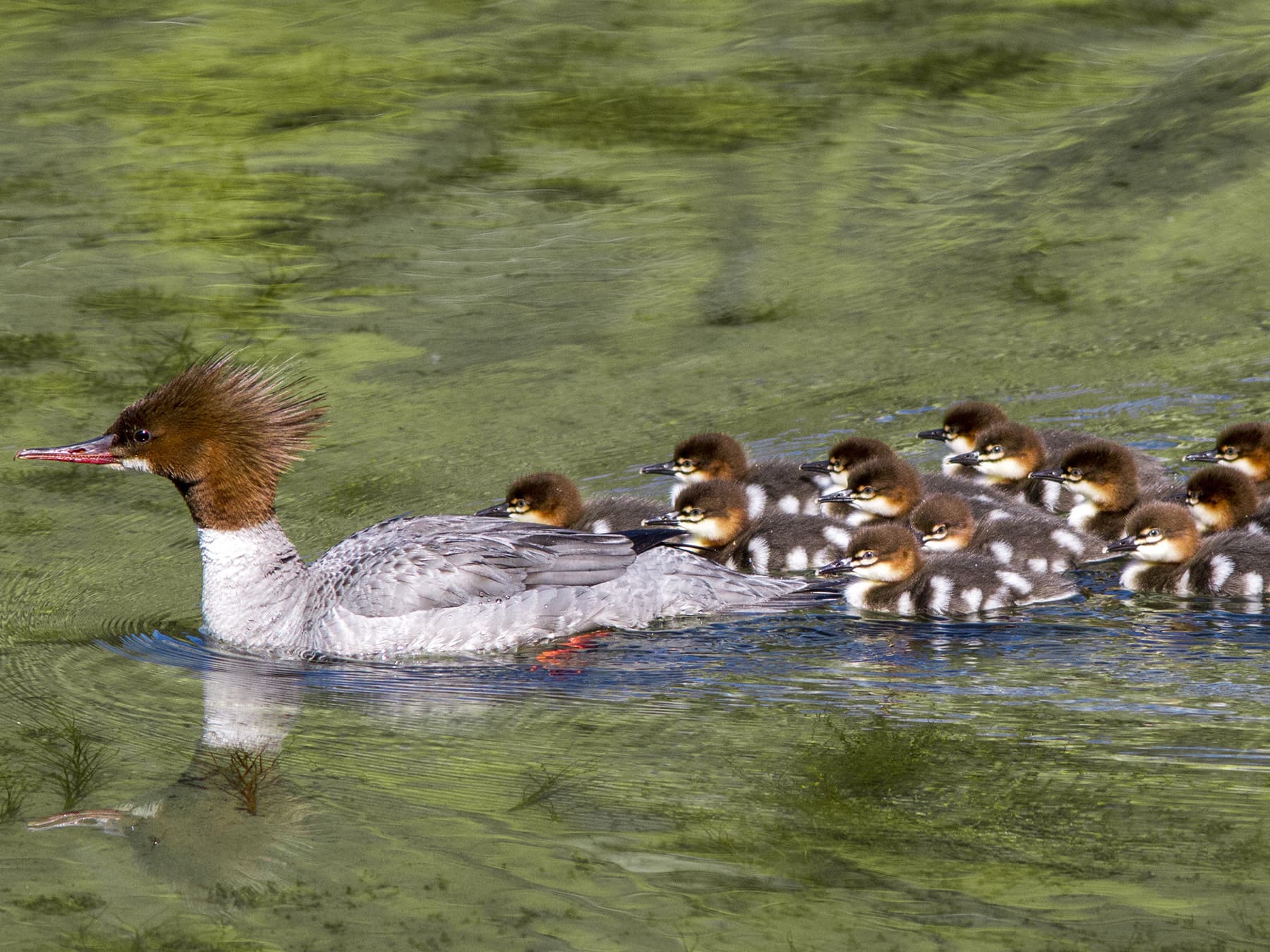
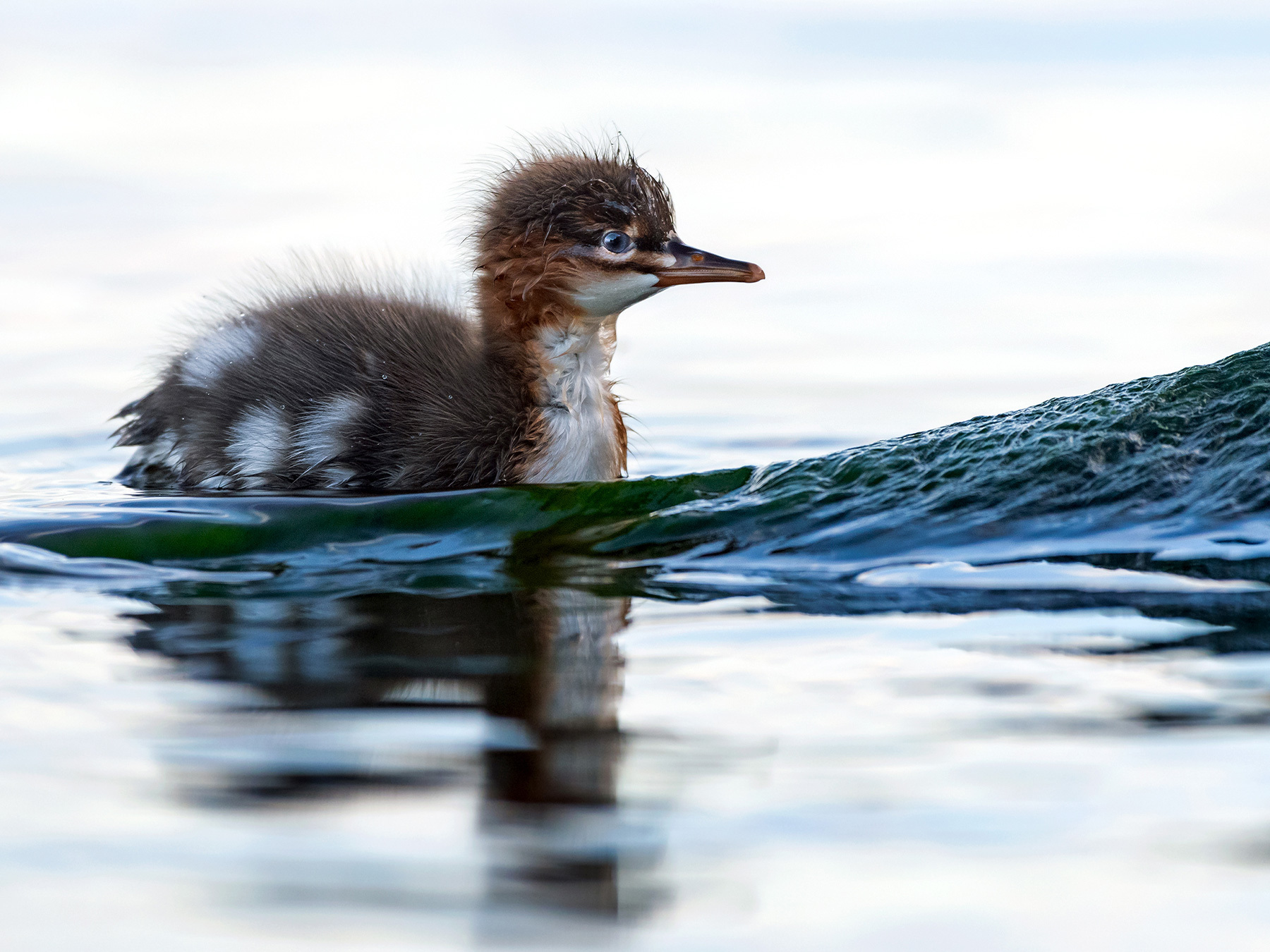
Red-breasted Merganser ducklings eat small fish, insects, and seeds. They leave the nest soon after hatching and begin to hunt for themselves as soon as they move to the water.
Nesting and breeding
Where do Red-breasted Mergansers nest?
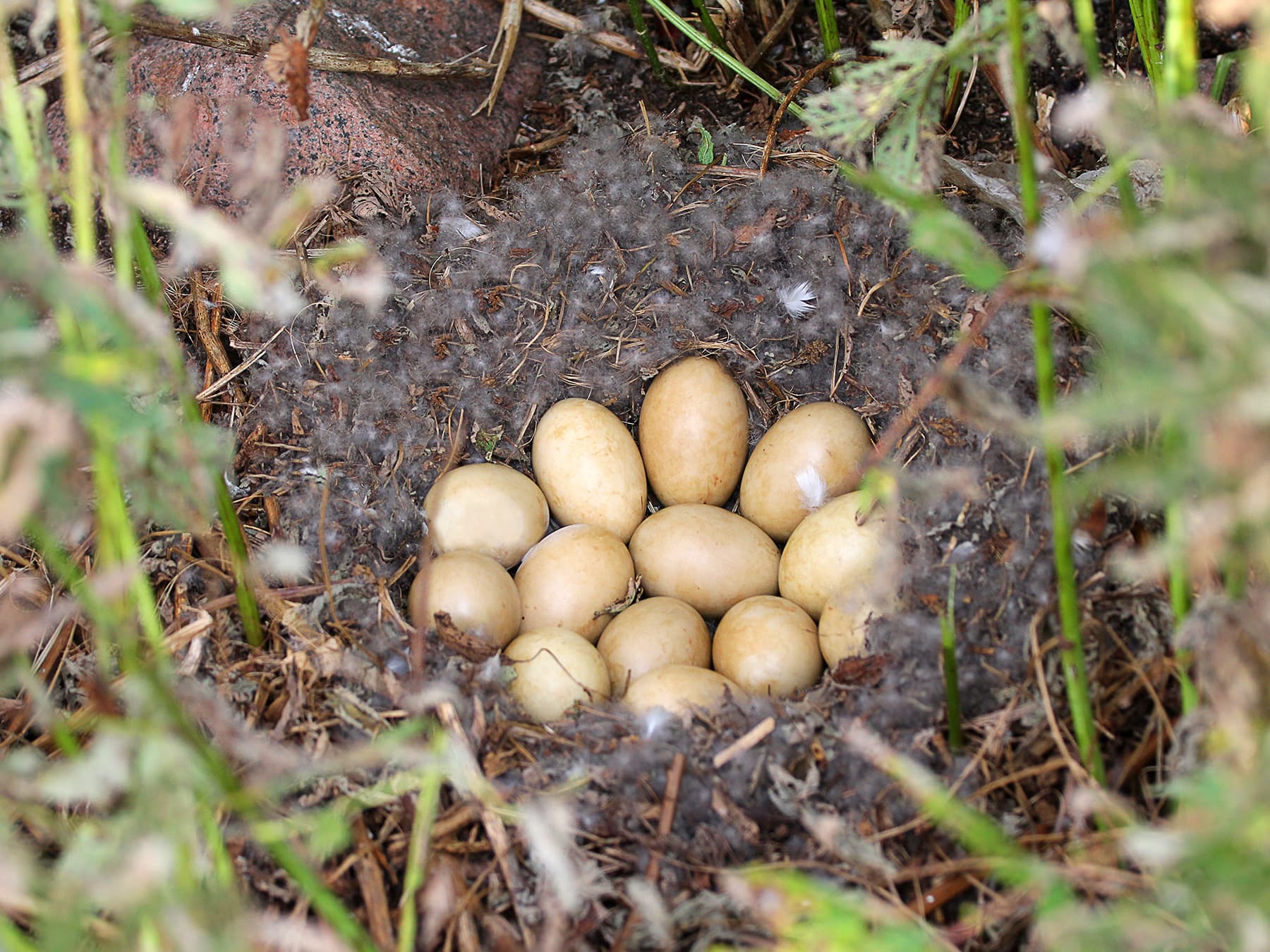
Red-breasted Mergansers nest on the ground within about 100 feet (30 m) of the water and often much closer. The female selects a well-hidden site under cover or among dense vegetation. She usually constructs a shallow scrape and gradually lines it with soft plant material and her own down feathers.
When do Red-breasted Mergansers nest?
The warm months of spring and summer provide ideal nesting conditions for Red-breasted Mergansers. Females lay their eggs from mid-May to early July, depending on latitude. They incubate the eggs alone for about a month, and the hatchlings leave the nest within a day of hatching.
What do Red-breasted Merganser eggs look like?
Red-breasted Mergansers lay a single clutch of anything from 5 to 25 pale brown or grayish eggs each year. Each egg measures approximately 63 millimeters long and 45 millimeters wide.
Do Red-breasted Mergansers mate for life?
Red-breasted Mergansers do not mate for life. Pairs usually form in early spring and break up once the eggs have been laid.
Behaviour
Are Red-breasted Mergansers aggressive?
Red-breasted Mergansers are gregarious and non-territorial throughout the year. They are not particularly aggressive, although males may use aggression to deter competitors when pairing or to defend their immediate personal space. They will also defend the space around their nest, although they may nest within about a foot of each other in dense colonies.
Lifespan and predators
How long do Red-breasted Mergansers live?
Ringing/banding records suggest that Red-breasted Mergansers can live a maximum of about 12 years.
What are the predators of Red-breasted Mergansers?
Gyrfalcons, Great-horned Owls, and Red Foxes are known predators of adult Red-breasted Mergansers. Their eggs and young are vulnerable to a greater variety of predators, including Herring Gulls, Great Black-backed Gulls, and Parasitic Jaegers/ Arctic Skuas.
Are Red-breasted Mergansers protected?
Red-breasted Mergansers are protected in the United Kingdom, The United States, and Canada.
Are Red-breasted Mergansers endangered?
These widespread diving ducks are not endangered. They are a ‘Least Concern’ species with an extensive global range and a stable population.
Conservation
While currently listed as Least Concern, Red-breasted Mergansers face threats from oil spills, habitat degradation, and climate change.
Conservation efforts focus on protecting coastal wetlands and regulating pollutants in their aquatic habitats.
Similar birds
Often mistaken for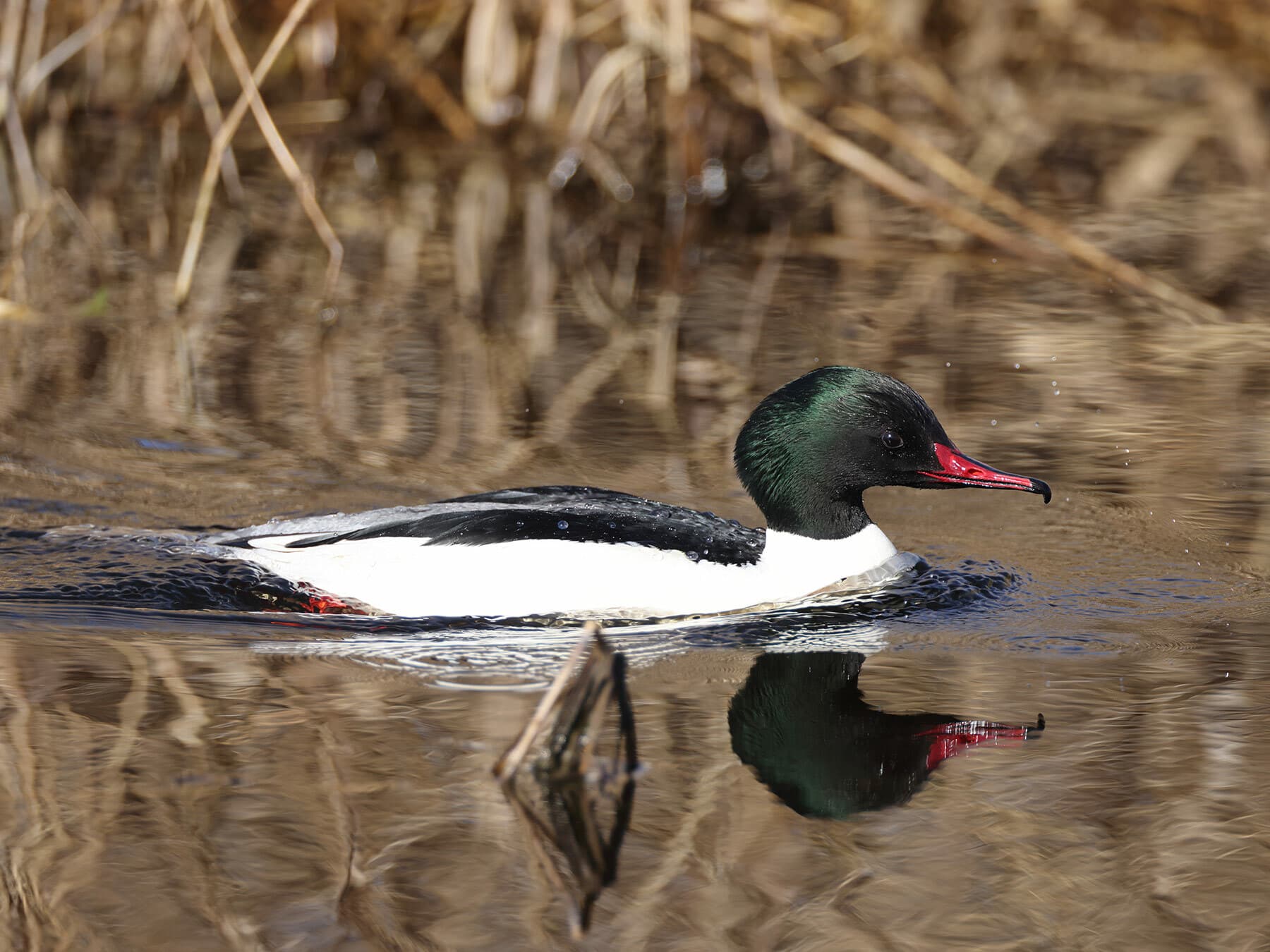
More photos
7 photos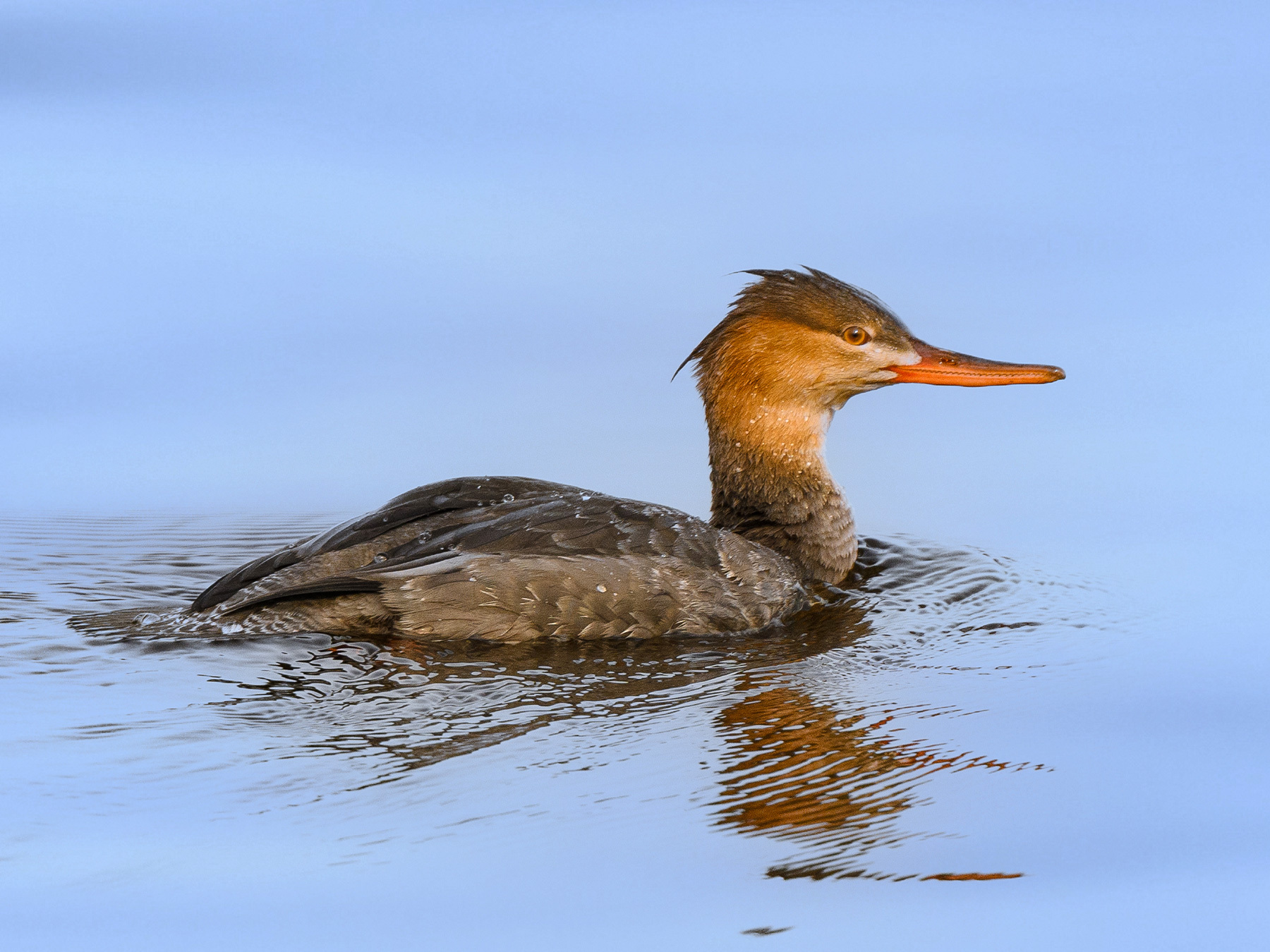
Red-breasted Merganser guides
1 guidesQuick facts
- Length
- 52–58 cm
- Wingspan
- 70–86 cm
- Weight
- 800–1350 g
- Lifespan
- 9–12 years · oldest recorded 21 years
- Family
- Ducks, Geese & Swans
- Migration
- Long-distance Migrant
- Global status (IUCN)
- Least Concern
- World population
- 495,000 - 605,000 individuals
- Population trend
- Stable
- Also called
- Sawbill, Fish Duck, Sheldrakes
- Scientific name
- Mergus serrator
Questions
3What is the difference between Red-breasted and Common Merganser?
Red-breasted Mergansers and Common Mergansers (also known as the Goosander in the United Kingdom) are similar species that occur over much of the Northern Hemisphere.
You’re most likely to see the Red-breasted Merganser in saltwater or estuarine environments, where their long, scruffy crest and straight bill are useful clues to look for. The Common Merganser (Mergus merganser) is a much larger species that usually inhabits freshwater habitats. These birds also have hooked bills, and males have rounded crests.
Is the Red-breasted Merganser a duck?
Red-breasted Mergansers are ducks, despite their unusually thin bills. These attractive wildfowl are from the Anatidae family, the same group that contains all ducks, geese, and swans.
What’s another name for a Red-breasted Merganser?
Red-breasted Mergansers are sometimes called sawbills, fish ducks, or sheldrakes.
Sources
4- 1BirdLife International. 2018. Mergus serrator. The IUCN Red List of Threatened Species 2018: e.T22680485A132053220. Source (opens in a new tab)
- 2Wetlands International (2016)
- 3Wetlands International (2016)
- 4Fransson et al., EURING list of longevity records for European birds (2010) Source (opens in a new tab)

Checked by
Nathan Cope, founder and editor
Nathan founded Birdfact and leads its writers and contributors in the UK, the US and Canada. He has watched and studied birds for more than ten years, and checks every article and species guide before it’s published.