Published 12 Oct 2026
Mourning Dove Sounds: Song, Calls and Wing Whistle
By the Birdfact teamChecked by Nathan Cope
A Mourning Dove's song is a low, mournful coo: a long opening note that slides up and down, then two or three level coos, three to four seconds in all, mostly from unmated males in spring. Listen to recordings, see the song drawn as a spectrogram, and learn the nest call, the whistle of the wings, and how to tell the coo from an owl.
On this page15 sections
- What does a Mourning Dove sound like?
- Why do Mourning Doves coo?
- How a dove coos
- When they coo
- Counting doves by ear
- The nest call
- Other calls
- Baby Mourning Dove sounds
- The wing whistle
- What bird sounds like an owl?
- Telling it from a Collared-Dove
- Why is it called a Mourning Dove?
- Low songs and noise
- About the recordings
- Sources
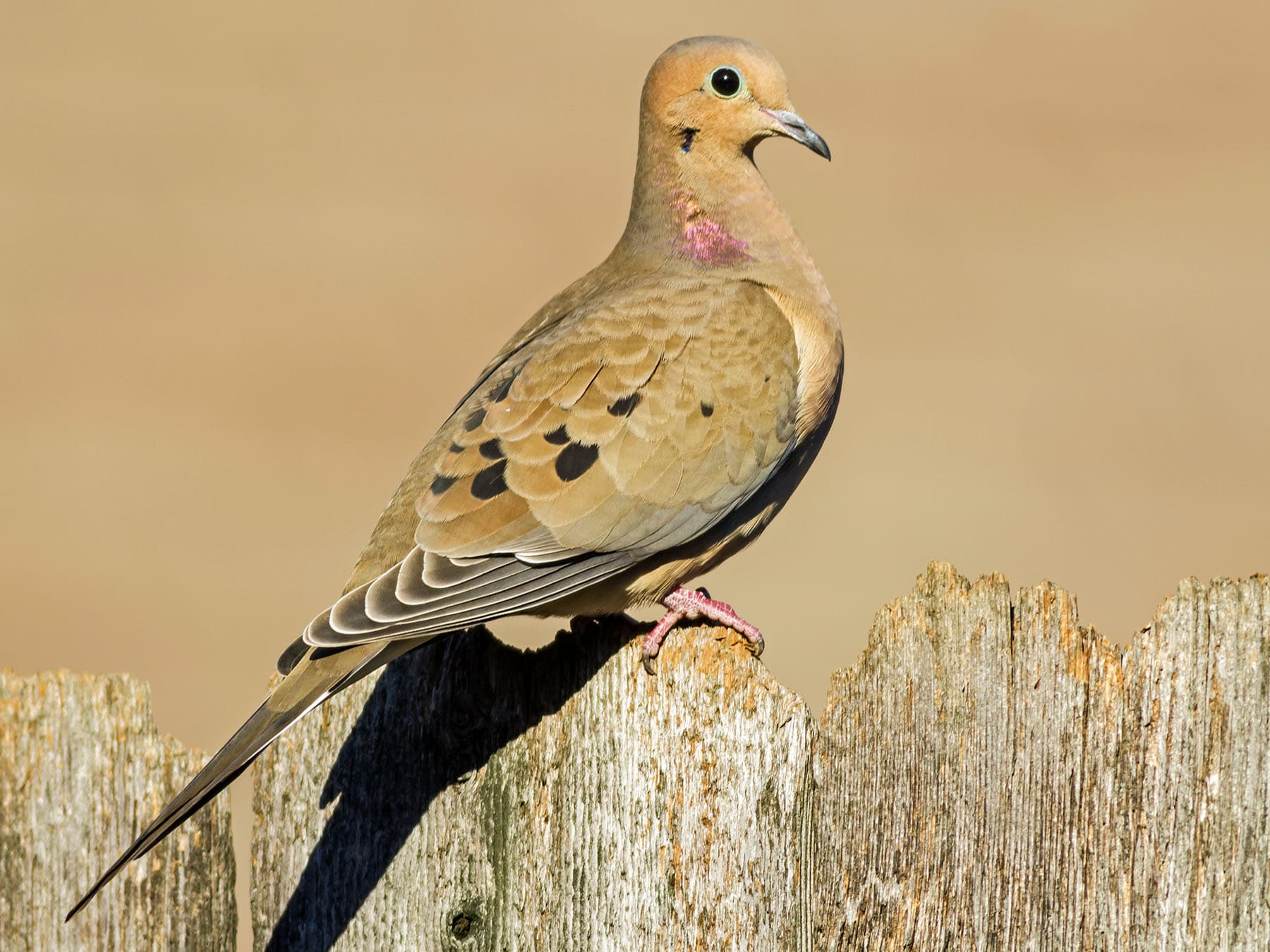
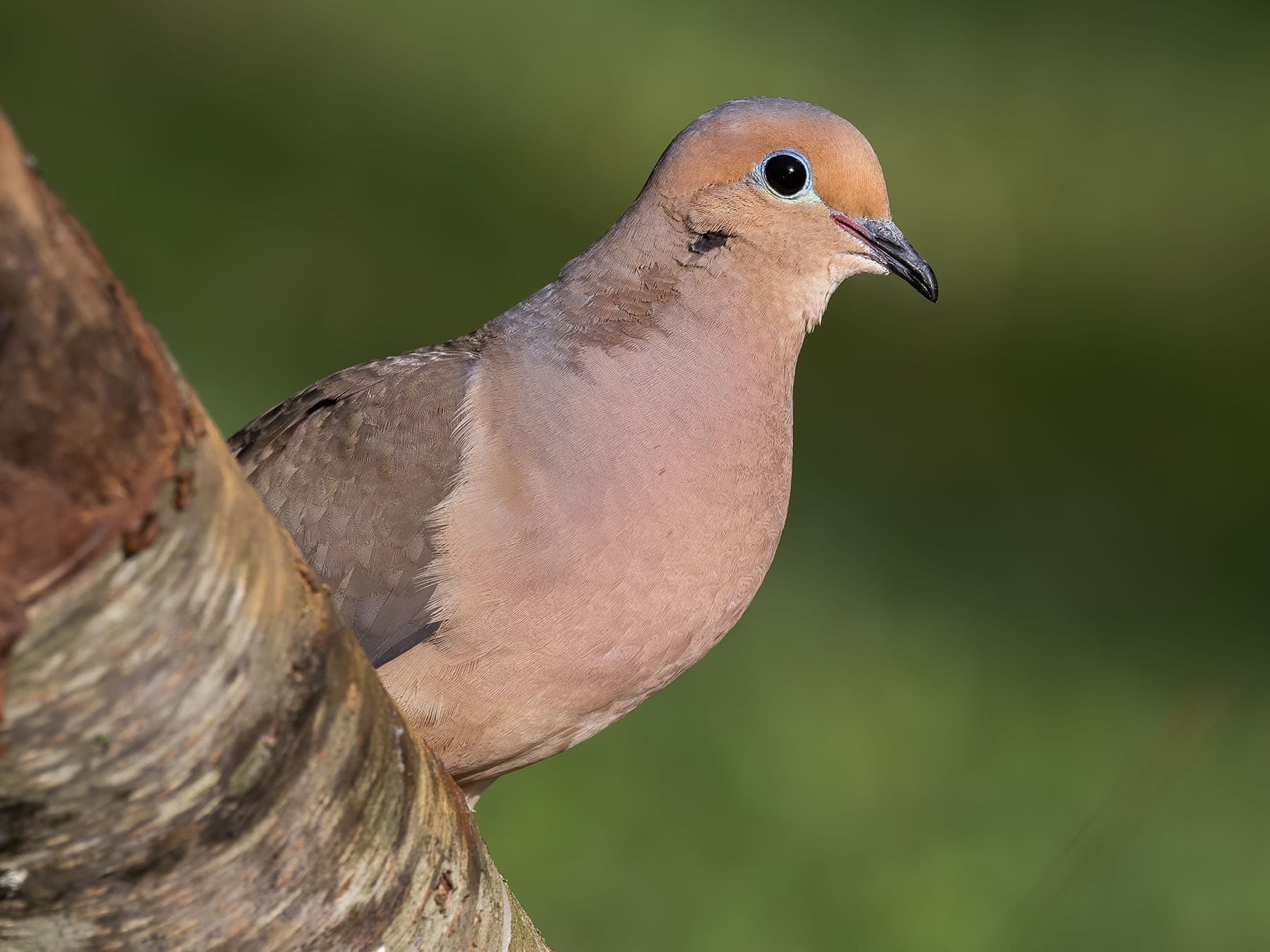
What a Mourning Dove sounds like, with recordings from California, Manitoba and Minnesota drawn as spectrograms: the song and its four parts, why and when Mourning Doves coo, the nest call and the quieter calls, the whistle of their wings, and how to tell the coo from an owl or a Eurasian Collared-Dove. For the bird itself, see Mourning Dove identification and facts.
What does a Mourning Dove sound like?
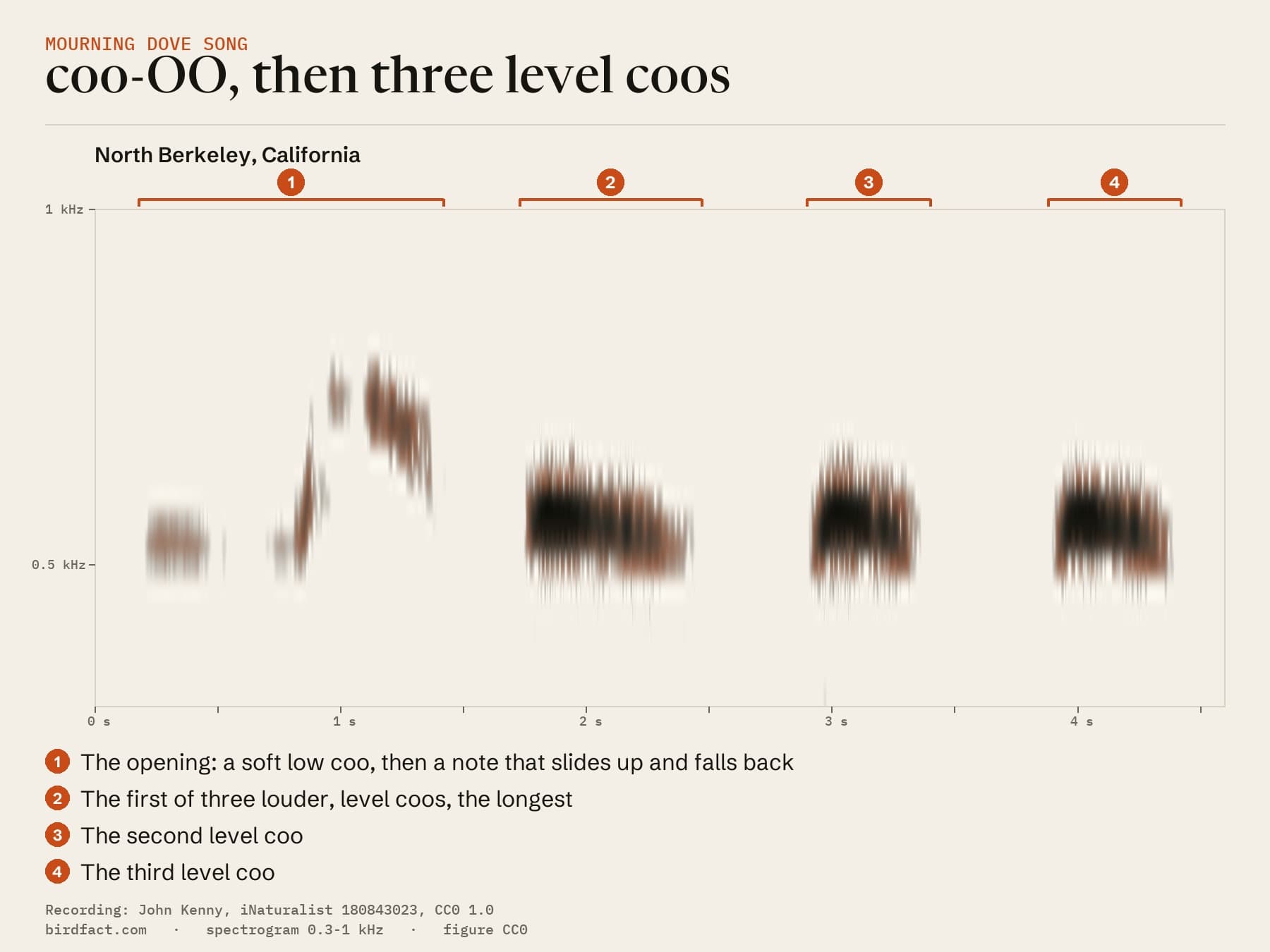
A low, soft, mournful coo: a long opening note that slides up and falls back, then two or three louder coos on one pitch, written "coo-oo, OO, OO, OO".1 This is the song, known as the perch coo. Each song is given on its own, with a pause before the next, not repeated in a quick run the way a Ring Dove's is (an observation of captive birds).2
A song lasts about three and a half seconds. Ten songs of wild California doves, measured for a 1983 study, averaged 3.46 seconds (3.25 to 3.67); the opening note alone took about 1.12 seconds, and the pitch stayed low, between about 438 and 723 Hz.3 The bird-song writer A. A. Saunders timed songs at 3 to 4.5 seconds and found them easy to copy with a low whistle, though some birds went lower than he could whistle. He usually heard a bird repeat one song unchanged, but once recorded five different songs from a single dove.4
Why do Mourning Doves coo?
Mostly to find a mate. Unmated males ready to breed sing the perch coo again and again, often from somewhere easy to see, such as a wire, a pole or a treetop.1 In a South Carolina study of marked birds, unmated males cooed at 6.2 times the rate of mated males, were 2.3 times as likely to coo in any 3-minute period, and kept cooing longer each morning. They also cooed more when other doves were cooing.5 So much of the cooing you hear in spring comes from males still looking for a mate.
A paired male coos far less, but the song has other uses. A male gives a similar coo after charging at another bird, and uses it to call his fledged young out to be fed away from the nest. Birds of the World describes a courtship bow-coo, in which the male bows until his head nearly touches the ground, then rises and gives a loud coo.1 Craig, who watched captive doves, including a pair in his room in 1902, noticed that a male always stands still to coo, even stopping in the middle of a chase.2
How a dove coos
A Mourning Dove coos with its neck swollen and its head held up.3 In Ring Doves, filmed with X-rays as they cooed, the bird keeps its bill and nostrils shut and breathes out into its upper gullet, mouth and nasal cavities; the inflated gullet helps filter out the higher overtones made in the syrinx, the bird's voice box.6 We found no study of how a Mourning Dove does it.
When they coo
Mostly in spring and early summer, and mostly early in the morning. Across much of the range cooing peaks from mid-May to mid-June; in a Missouri study of penned birds it began in early April, peaked in May and June and had nearly stopped by August and September.1 Farther south it starts earlier. In north-central Florida, cooing counted every week in 1979 and 1980 was highest in February and March and very low from October to December.7 In Maryland and Virginia in 1951, calling fell away after July 3 and apparently stopped by September 11.8
In a day, cooing may begin about half an hour before sunrise and taper off by an hour and a half after it, then pick up again in the afternoon at about a quarter of the morning rate. Unmated males coo steadily for about two hours from half an hour before sunrise; mated males far less, most just before sunrise.1 Craig, watching captive birds, found they sang relatively more in the evening than other doves.2 We found no study that reports Mourning Doves cooing at night; owls are the night callers.
Counting doves by ear
For almost half a century, the coo was how the United States tracked Mourning Dove numbers. From 1966 to 2013 the Call-count Survey counted doves along roadside routes, more than 1,000 of them by 2013: observers made 20 stops, 1 mile apart, and counted the doves heard calling in 3 minutes at each, starting half an hour before sunrise, once a year between May 20 and June 5, never in rain or in wind over 12 mph.9 The survey was dropped after 2013, when the harvest strategy switched to estimates of total numbers from banding and harvest data.10
The nest call
A paired male has a second coo, the nest call: shorter and quieter than the song, three separate notes, low, high, low.2 In captive birds it lasted about 1.12 seconds.3 He gives it crouched at a possible nest site, wings twitching, lowering his head with each call, his tail raised and, on the first note, spread just enough to flash its white tips.2, 3 He uses it to call his mate to the site and while they build; it gets rarer once the nest is established, though he may use it to call her for a change-over on the eggs.1 Craig counted one captive male giving it 45 times in 4 to 5 minutes before the female came.2 For the nest itself, see Mourning Dove nesting.
Other calls
- A soft greeting "ork", about a quarter of a second, given by a male when his mate rejoins him and by both sexes after mating, then unusually for a dove with the bill wide open.1, 3
- An alarm call, "roo-oo", by either sex.1 In the 1983 study, captive females chased off the nest gave it, about 0.78 seconds long.3
- Birds of the World also lists a soft "ohr ohr" from the incubating female, which may bring her mate to take a turn on the eggs;1 the published recordings of this call are of the closely related Grayson's Dove.3
Females coo too, now and then: a faint perch coo.1 Craig found the female's coo so thin, weak and staccato beside the male's that he burst out laughing, and in his pair the female's coo set off the male's courtship.2
Baby Mourning Dove sounds
Nestlings beg with weak peeps from about 5 days old, louder as they grow, and stop when they become independent of their parents at about 25 days old.1 Craig described the begging as more musical than other young pigeons', a musical, hissing note sliding up the scale, easily copied by whistling "sssst".2
From about the 5th day of feeding, the parents, especially the male, perch-coo to the nestlings just before feeding them. By 9 to 12 days the young know their father's voice, which helps him find them after they leave the nest.1 More on the young: baby Mourning Doves.
The wing whistle
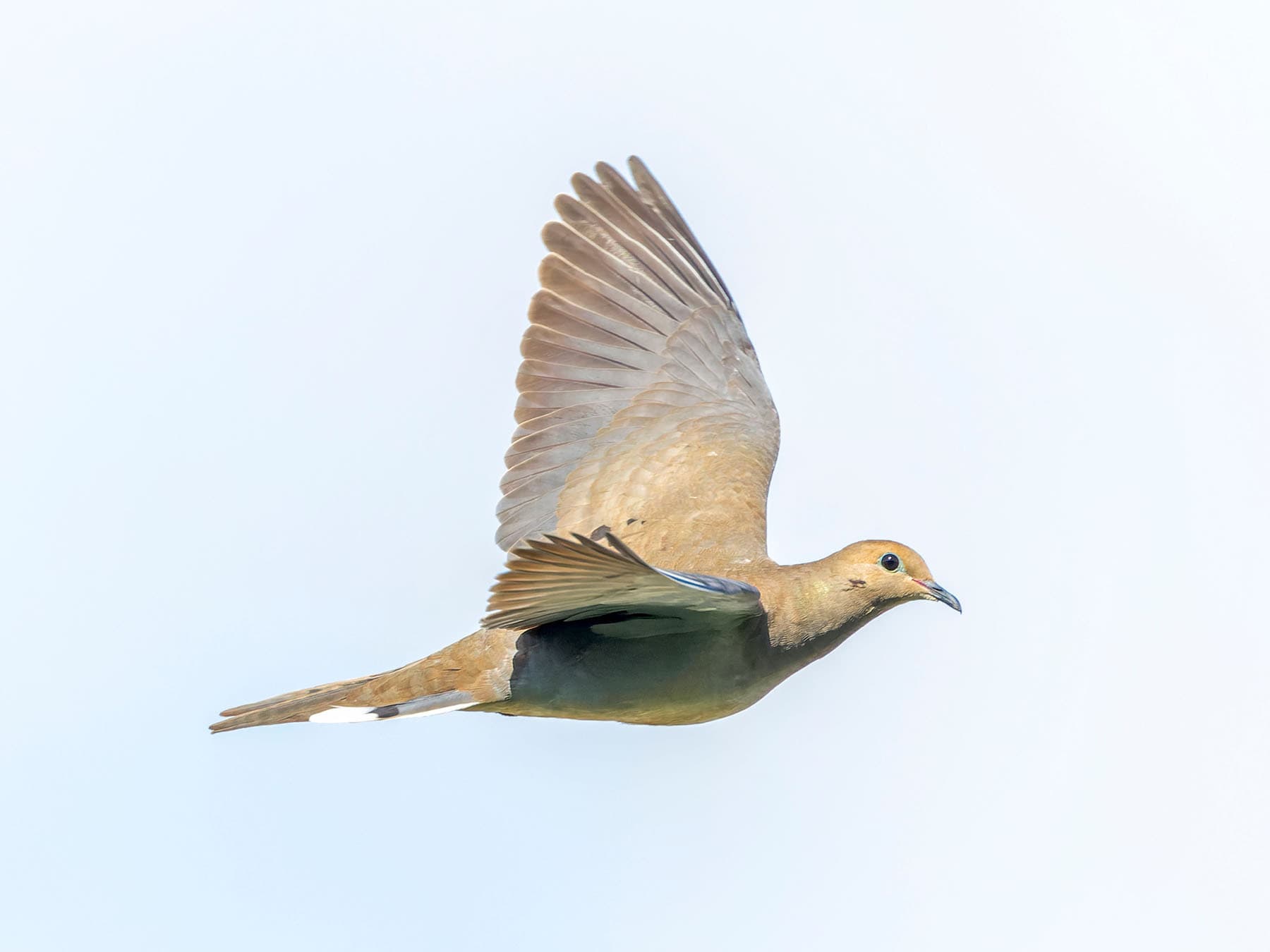
Not every Mourning Dove sound is a voice. Their wings whistle in flight, loudest at take-off and landing, and a displaying male claps his wings as he sets off on his display flight.1 Alexander Wilson wrote of the whistle in 1812: it always went with the dove's flight, and it told the bird from the Passenger Pigeon.11
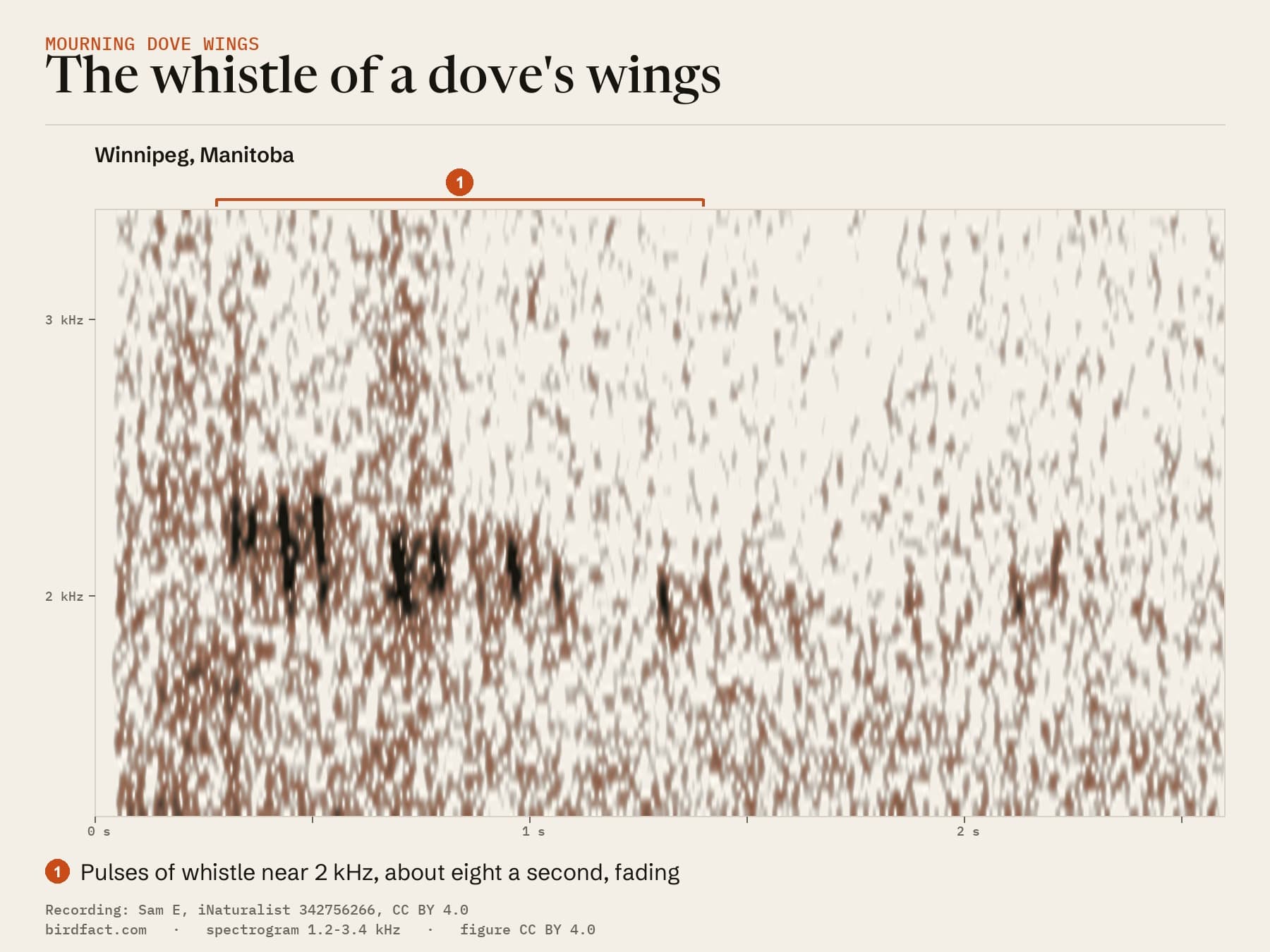
What the whistle is for is not settled. Birds of the World suggests it may have some alarm value at take-off.1 In playback trials, Mourning Doves, Northern Cardinals and House Sparrows all startled and stayed more watchful, and were slower to go back to feeding, after the whistle of a startled dove's take-off than after a relaxed take-off. Whether doves make the alarmed whistle on purpose has not been tested.12 How a Mourning Dove's wings make the sound has not been studied either. In the Australian Crested Pigeon, a specially modified eighth primary feather makes a note on every downstroke, and a fleeing bird beats its wings faster, so the tempo itself signals danger.13
What bird sounds like an owl?
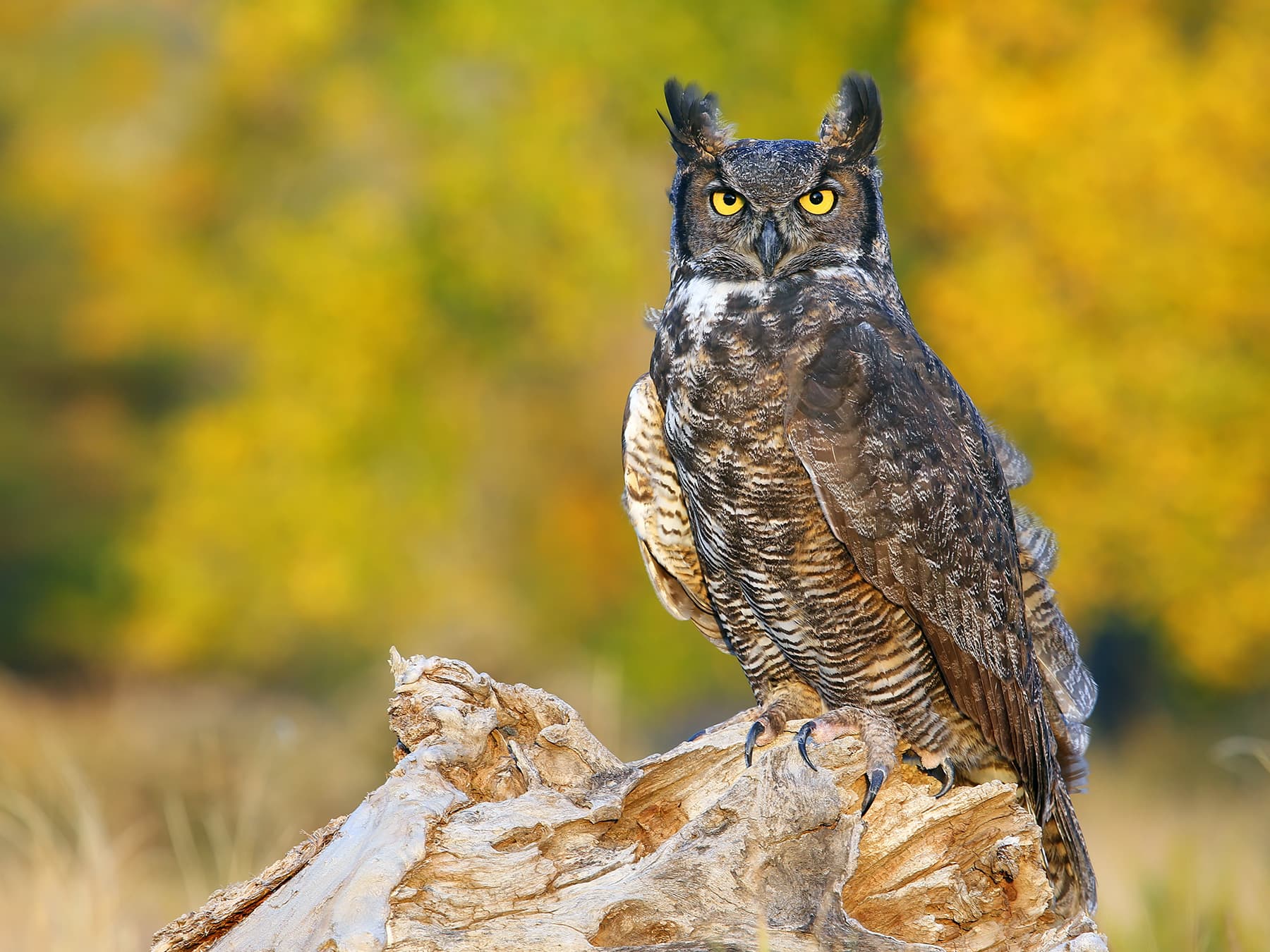
Very often, a Mourning Dove. Audubon magazine points out that the dove's coo often sounds more like the stereotypical hoot than real owls do,14 and the Tennessee Wildlife Resources Agency says the song is often mistaken for an owl.15
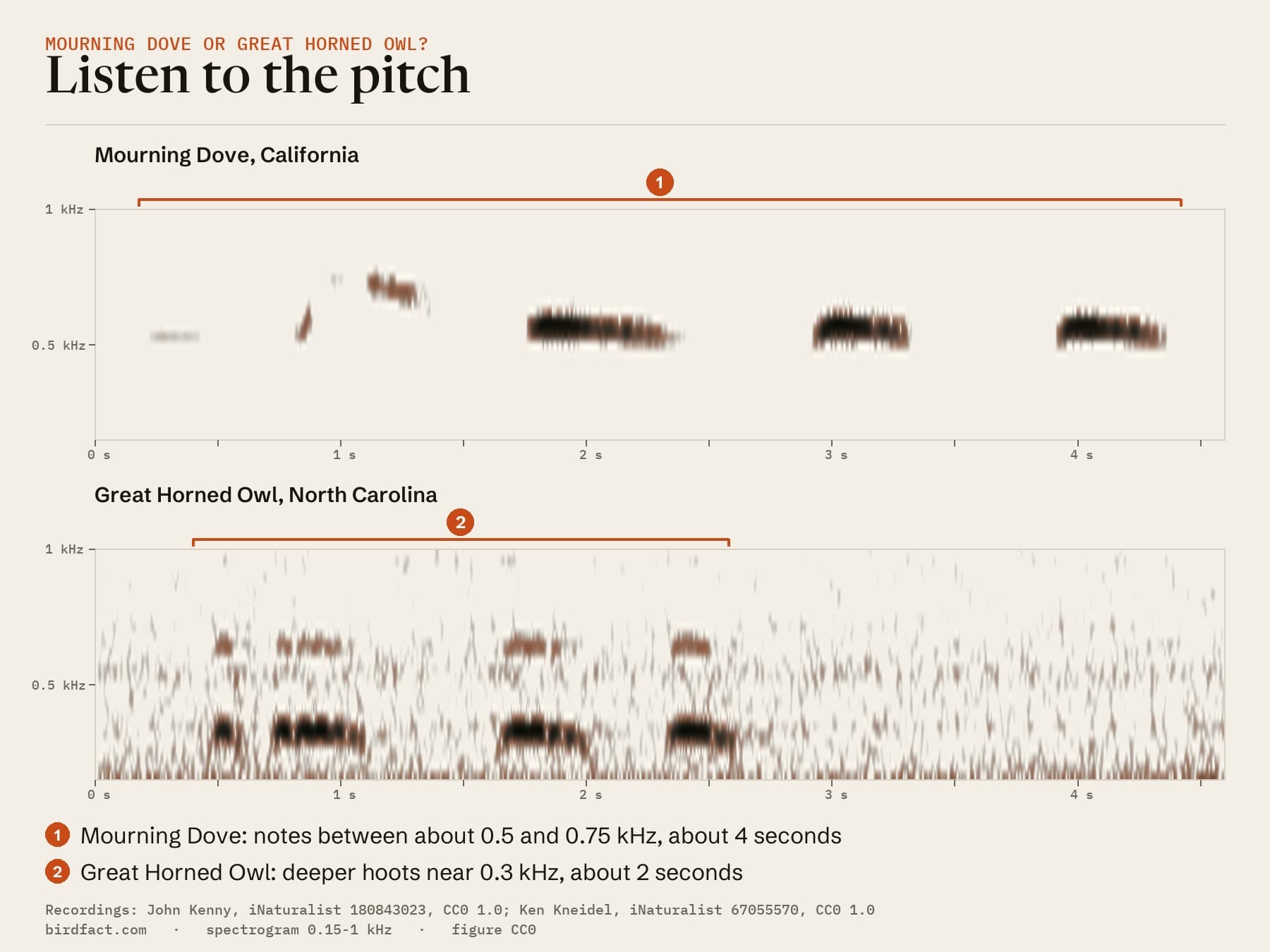
Check the time, the place and the pitch. Owls are largely nocturnal, so a hoot in broad daylight is a red flag, and owls rarely hang around windows or gather in groups.14 The Great Horned Owl, the classic deep hooter, gives a series of low, far-carrying hoots, the second and third shorter, often on midwinter nights.16 On a spectrogram the difference is pitch: in the recordings below, the owl's hoots are strongest near 300 Hz and the dove's coos sit between about 530 and 740 Hz, and the owl's four hoots take about 2 seconds against the dove's 4.
Other common owls sound different again. The Barred Owl gives a loud, barking series, and pairs call back and forth;17 the Eastern Screech-Owl gives a tremulous, descending wail and soft trills.18
Telling it from a Collared-Dove
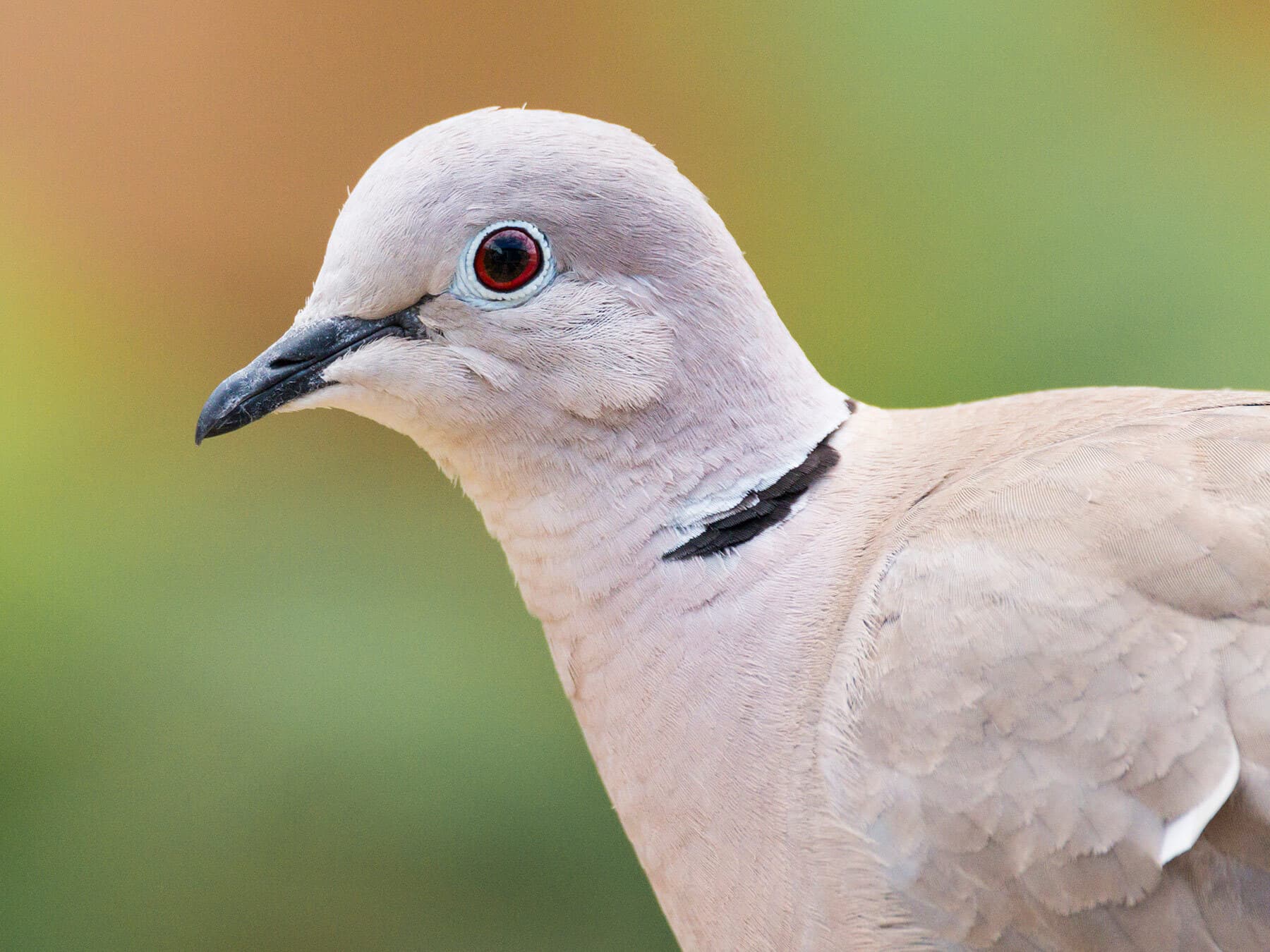
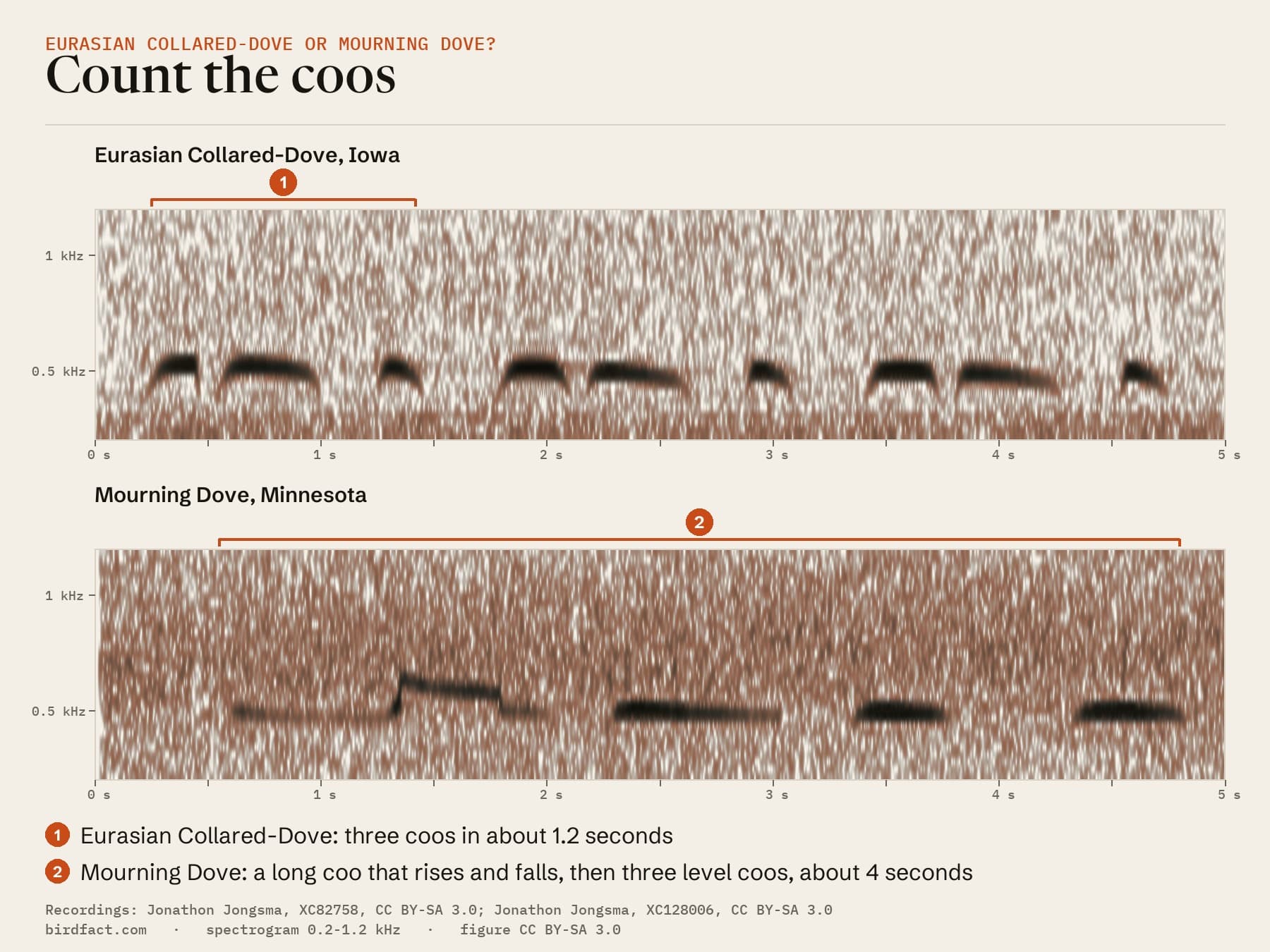
Count and time the coos. The Eurasian Collared-Dove's song is a three-note phrase, short, long, short, about 1.2 seconds long, repeated over and over.19 The Mourning Dove's song is a long opening note and three level coos, about 4 seconds in the Minnesota recording below. The one Mourning Dove sound closer to the Collared-Dove's is the nest call, three notes in about a second. More on the Collared-Dove's sounds: Collared Dove call and song.
Why is it called a Mourning Dove?
For its song. Winsor M. Tyler, in Bent's 1932 life history, wrote that the dove takes its name from its low, moaning coo,4 and Craig that its plaintive perch coo gave it the name.2 Earlier writers heard the same thing. Alexander Wilson's account of the bird, which he knew as the Carolina Pigeon or Turtle Dove, finds no woodland singer so mournful, its four notes ending in three long, deep moanings, and then calls it "the voice of love".11 Audubon wrote of its soft and melancholy cooing.20 Wilson was half right: the song is about love, but mostly an unmated male's call for a mate.1
Low songs and noise
Low songs are easily drowned out by machinery. Around natural-gas wells in northwestern New Mexico, where compressors run day and night in pinyon-juniper woodland, birds with low-pitched songs avoided the noisy sites while birds with higher songs stayed, in both nesting and abundance data. The Mourning Dove, with its low song, was one of the species that avoided noise most strongly.21
About the recordings
The song was recorded by John Kenny in North Berkeley, California, and identified by him and two other iNaturalist users. The wing whistle was recorded by Sam E at FortWhyte Alive, Winnipeg, on a windy day, and identified by the recordist and one other user. The Great Horned Owl is by Ken Kneidel in Charlotte, North Carolina, and the Minnesota song and the Iowa Collared-Dove (xeno-canto XC82758) by Jonathon Jongsma. We found no openly licensed recording of a nest call or of young birds begging that we could be sure of, so those are described here, not played. Birdfact drew the spectrograms from these files; each figure credits its recordings.
Sources
- Otis, D. L., Schulz, J. H., Miller, D., Mirarchi, R. E., Baskett, T. S. (2020). Mourning Dove (Zenaida macroura), version 1.0. Birds of the World (A. F. Poole, editor). Cornell Lab of Ornithology. doi:10.2173/bow.moudov.01
- Craig, W. (1911). The expressions of emotion in the pigeons. II. The Mourning Dove (Zenaidura macroura Linn.). The Auk 28(4): 398-407. doi:10.2307/4071159
- Baptista, L. F., Boarman, W. I., Kandianidis, P. (1983). Behavior and taxonomic status of Grayson's Dove. The Auk 100(4): 907-919. doi:10.1093/auk/100.4.907
- Bent, A. C. (1932). Life histories of North American gallinaceous birds. U.S. National Museum Bulletin 162, Smithsonian Institution. Accessed 12 October 2026. Source
- Sayre, M. W., Atkinson, R. D., Baskett, T. S., Haas, G. H. (1978). Reappraising factors affecting mourning dove perch cooing. Journal of Wildlife Management 42(4): 884-889. doi:10.2307/3800778
- Riede, T., Beckers, G. J. L., Blevins, W., Suthers, R. A. (2004). Inflation of the esophagus and vocal tract filtering in ring doves. Journal of Experimental Biology 207(23): 4025-4036. doi:10.1242/jeb.01256
- Marion, W. R., Schnoes, M. S. (1982). Seasonality of mourning dove nesting in Florida. Proceedings of the Annual Conference of the Southeastern Association of Fish and Wildlife Agencies 36: 543-551. Accessed 12 October 2026. Source
- Duvall, A. J., Robbins, C. S. (1952). Investigations of methods of determining abundance of breeding mourning doves in certain eastern states. In: Investigations of methods of appraising the abundance of mourning doves, pp. 15-34. U.S. Fish and Wildlife Service (USGS record 5210444). Accessed 12 October 2026. Source
- Seamans, M. E., Rau, R. D., Sanders, T. A. (2013). Mourning dove population status, 2013. U.S. Fish and Wildlife Service, Division of Migratory Bird Management. Accessed 12 October 2026. Source
- Seamans, M. E. (2021). Mourning dove population status, 2021. U.S. Fish and Wildlife Service, Division of Migratory Bird Management. Accessed 12 October 2026. Source
- Wilson, A. (1812). American Ornithology, vol. 5: Carolina Pigeon, or Turtle Dove. Bradford and Inskeep, Philadelphia. Accessed 12 October 2026. Source
- Coleman, S. W. (2008). Mourning dove (Zenaida macroura) wing-whistles may contain threat-related information for con- and hetero-specifics. Naturwissenschaften 95(10): 981-986. doi:10.1007/s00114-008-0404-x
- Murray, T. G., Zeil, J., Magrath, R. D. (2017). Sounds of modified flight feathers reliably signal danger in a pigeon. Current Biology 27(22): 3520-3525. doi:10.1016/j.cub.2017.09.068
- Del-Colle, A. (2018). No, That's Not an Owl Outside Your Window. Audubon magazine, National Audubon Society. Accessed 12 October 2026. Source
- Tennessee Wildlife Resources Agency. Mourning Dove. TWRA. Accessed 12 October 2026. Source
- National Audubon Society. Great Horned Owl. Guide to North American Birds (text adapted from Kaufman 1996). Accessed 12 October 2026. Source
- National Audubon Society. Barred Owl. Guide to North American Birds (text adapted from Kaufman 1996). Accessed 12 October 2026. Source
- National Audubon Society. Eastern Screech-Owl. Guide to North American Birds (text adapted from Kaufman 1996). Accessed 12 October 2026. Source
- Slabbekoorn, H., de Kort, S. R., ten Cate, C. (1999). Comparative analysis of perch-coo vocalizations in Streptopelia doves. The Auk 116(3): 737-748. doi:10.2307/4089334
- Audubon, J. J. (1831). Ornithological Biography, vol. 1: The Carolina Turtle Dove. Adam Black, Edinburgh. Accessed 12 October 2026. Source
- Francis, C. D., Ortega, C. P., Cruz, A. (2011). Noise pollution filters bird communities based on vocal frequency. PLOS ONE 6(11): e27052. doi:10.1371/journal.pone.0027052