Facts · Updated 12 Oct 2026
Baby Mourning Doves: Stages, Feeding and Fledglings (with Pictures)
By the Birdfact teamChecked by Nathan Cope
Baby Mourning Doves hatch blind and thinly covered in down after 14 days of incubation, are fed crop milk and then seeds by both parents, and leave the nest at about two weeks old. The male keeps feeding the fledglings for about 12 more days; at about a month old they join flocks of young doves.
On this page15 sections
- Hatching
- What a newly hatched dove looks like
- Baby Mourning Dove stages, day by day
- How fast baby doves grow
- What do baby Mourning Doves eat?
- Who feeds the chicks
- How long do baby Mourning Doves stay in the nest?
- Fledglings
- I found a baby Mourning Dove on the ground: what should I do?
- What do juvenile Mourning Doves look like?
- Why you rarely see baby doves
- Squabs, nestlings and fledglings
- Two eggs, many nests
- Survival
- Sources
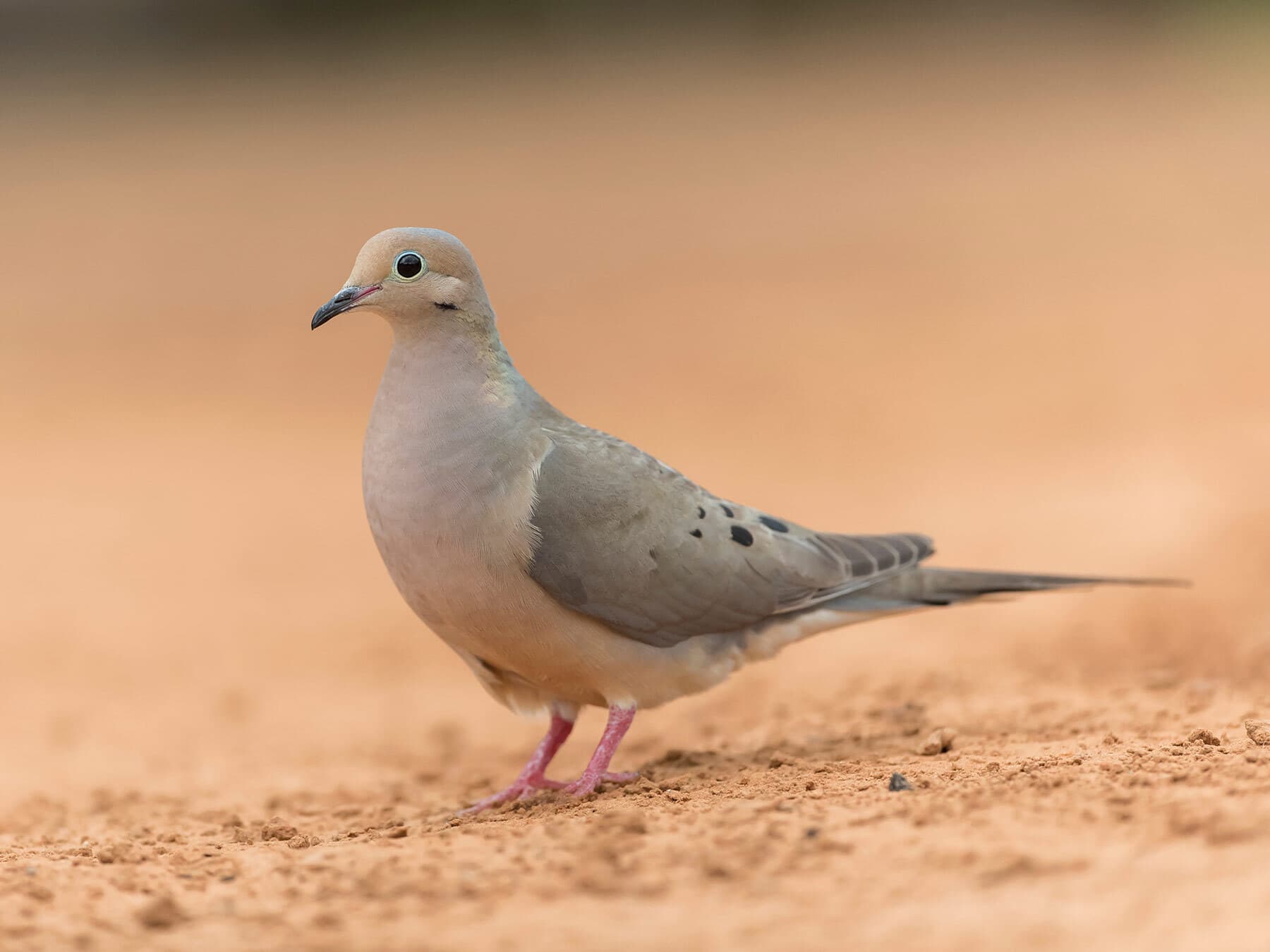
A guide to young Mourning Doves from the egg to the day they fend for themselves: what they look like at each stage, what they eat, how long they stay in the nest, and what to do if you find one on the ground. For the adults, see Mourning Dove identification and facts; for nests and eggs, Mourning Dove nesting.
Hatching
Mourning Doves lay two white eggs, and both parents incubate them for 14 days. The chick breaks the shell from the wide end, chipping all the way round in 15 to 20 hours, and the two eggs hatch 12 to 48 hours apart. A parent, usually the female, then carries each half of the shell away and drops it out of sight of the nest.1
What a newly hatched dove looks like
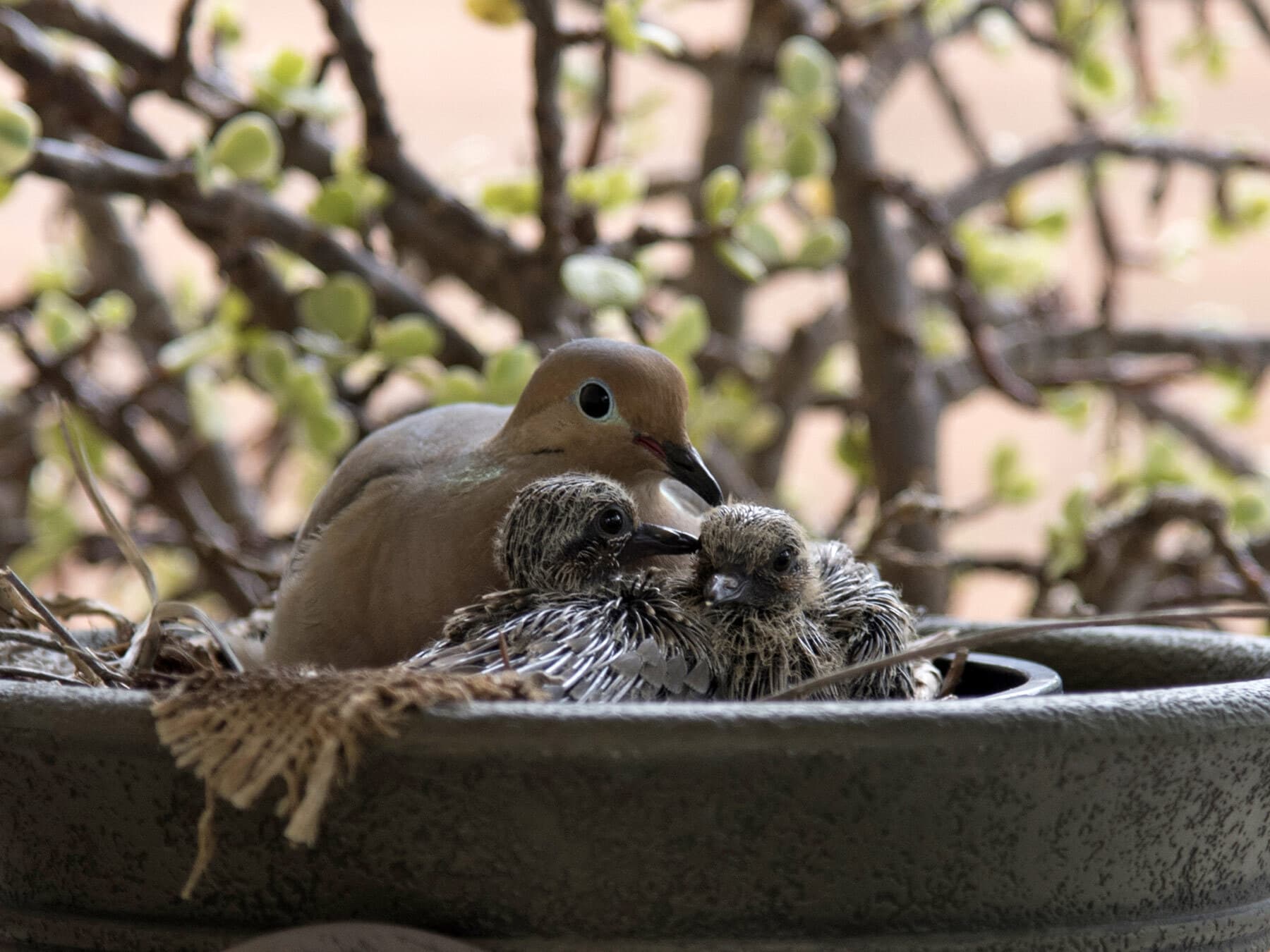
A hatchling is helpless. Its eyes are closed, it has only sparse, cream-colored down, and it can barely hold its head up or keep itself warm. Both halves of its dark gray bill carry a small white egg tooth, used to break out of the shell. It weighs about 0.2 ounce (5 g) and is about 2.5 inches (65 mm) long.
Baby Mourning Dove stages, day by day
Mourning Dove chicks grow fast. Birds of the World describes their development like this:
- Days 2 to 3. Eyes still closed; feather sheaths start to grow on the wings.
- Days 4 to 5. Eyes partly open.
- Days 6 to 7. Eyes fully open; feather tips break out of their sheaths. Chicks can crawl and, if threatened, raise their wings over their backs.
- Days 8 to 9. The breast is well feathered and crown feathers are coming. An older nestling may leave the nest if alarmed.
- Days 10 to 11. Belly feathers open; nestlings readily leave the nest when alarmed. They weigh 1.6 to 2.1 ounces (45-60 g).
- Days 12 to 15. The feather coat is complete, and the young can keep themselves warm at about 15 days.
Over those two weeks a chick grows from about 2.5 to 6 or 7 inches (65 to 150-180 mm) long. First-hatched and single chicks grow fastest. The new plumage is darker and more mottled than an adult's, which may help hide the young on the ground after they leave the nest.
How fast baby doves grow
In a study in Iowa, H. E. McClure weighed 20 young raised by captive parents as they grew. They grew from 0.2 ounce (5 g) on day 1 to 2.1 ounces (60 g) at 10 days and 2.5 ounces (72 g) at 14 days, when wild young leave the nest, and passed 3.5 ounces (100 g) at 25 to 30 days old:2
| Age (days) | Weight |
|---|---|
| 1 | 5.0 g (0.18 oz) |
| 2 | 9.2 g (0.32 oz) |
| 3 | 14.4 g (0.51 oz) |
| 4 | 20.9 g (0.74 oz) |
| 5 | 27.4 g (0.97 oz) |
| 6 | 35.0 g (1.2 oz) |
| 7 | 42.0 g (1.5 oz) |
| 8 | 49.1 g (1.7 oz) |
| 9 | 55.0 g (1.9 oz) |
| 10 | 60.0 g (2.1 oz) |
| 11 | 63.4 g (2.2 oz) |
| 12 | 67.0 g (2.4 oz) |
| 13 | 70.0 g (2.5 oz) |
| 14 | 72.2 g (2.5 oz) |
| 30 | 103.3 g (3.6 oz) |
What do baby Mourning Doves eat?
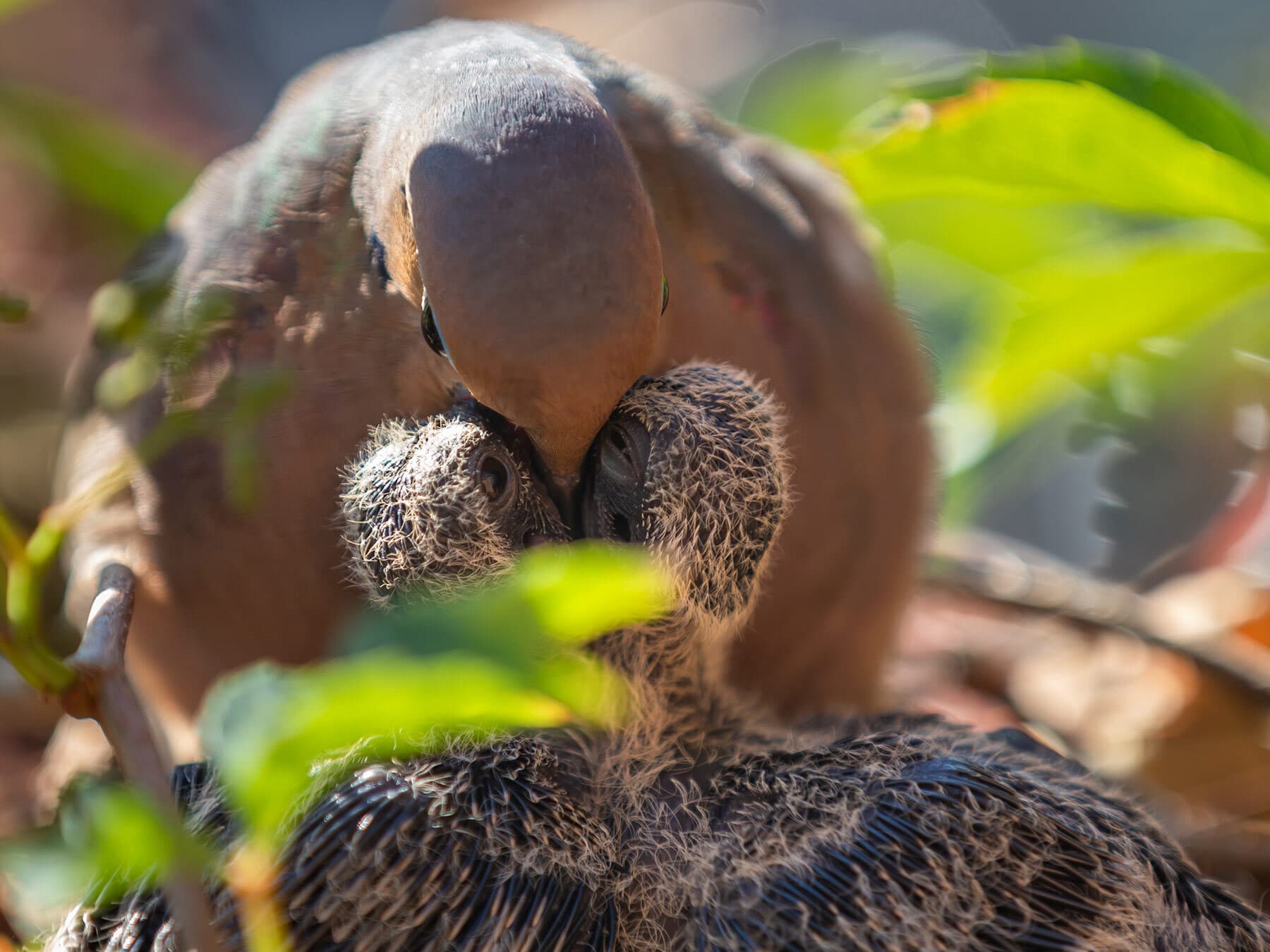
Crop milk first. Like all pigeons and doves, both parents feed their newly hatched young crop milk, a cheesy mass of cells shed from the lining of the crop. Studies reviewed in two papers describe it as the only food of chicks 1 to 4 days old3 and the main food to about day 5, with chicks taking mostly seed from about day 6;4 in Iowa, H. E. McClure found a little seed, about 0.3 grams, in chicks' crops even on their first day. By the time the young leave the nest their food is essentially the adults' diet of seeds.
Crop milk is rich. Measured in pigeons and doves generally, it is 65 to 81% water, 13 to 19% protein and 7 to 13% fat;5 its make-up in Mourning Doves themselves has not been measured. The female's production wanes 4 to 6 days before the male's, freeing her to lay the next clutch.
Feeding is by regurgitation. The chicks push their bills into the corners of the parent's mouth, often both at once, and a feed can last several minutes. From about the fifth day of feeding the parents, especially the male, coo to the chicks just before feeding them; the young learn their father's voice, which helps him find them after they leave the nest.
The seeds are the parents' own foods. In 157 crops of young doves in Iowa, hemp seed was the most important by weight, then wheat, corn and foxtail grasses, and the chicks were also given small snails, about 9 to a crop on average, a likely source of calcium.
Who feeds the chicks
Both parents. Both make crop milk and both feed the chicks. The parents brood them constantly for the first 4 or 5 days, the male from mid-morning to late afternoon and the female the rest of the day and night; night brooding ends at 9 or 10 days. The female does more of the feeding from day 4 to about day 15, but from day 12 the job shifts toward the male. Once the young have left the nest, the male feeds them almost alone while the female starts the next clutch.
How long do baby Mourning Doves stay in the nest?
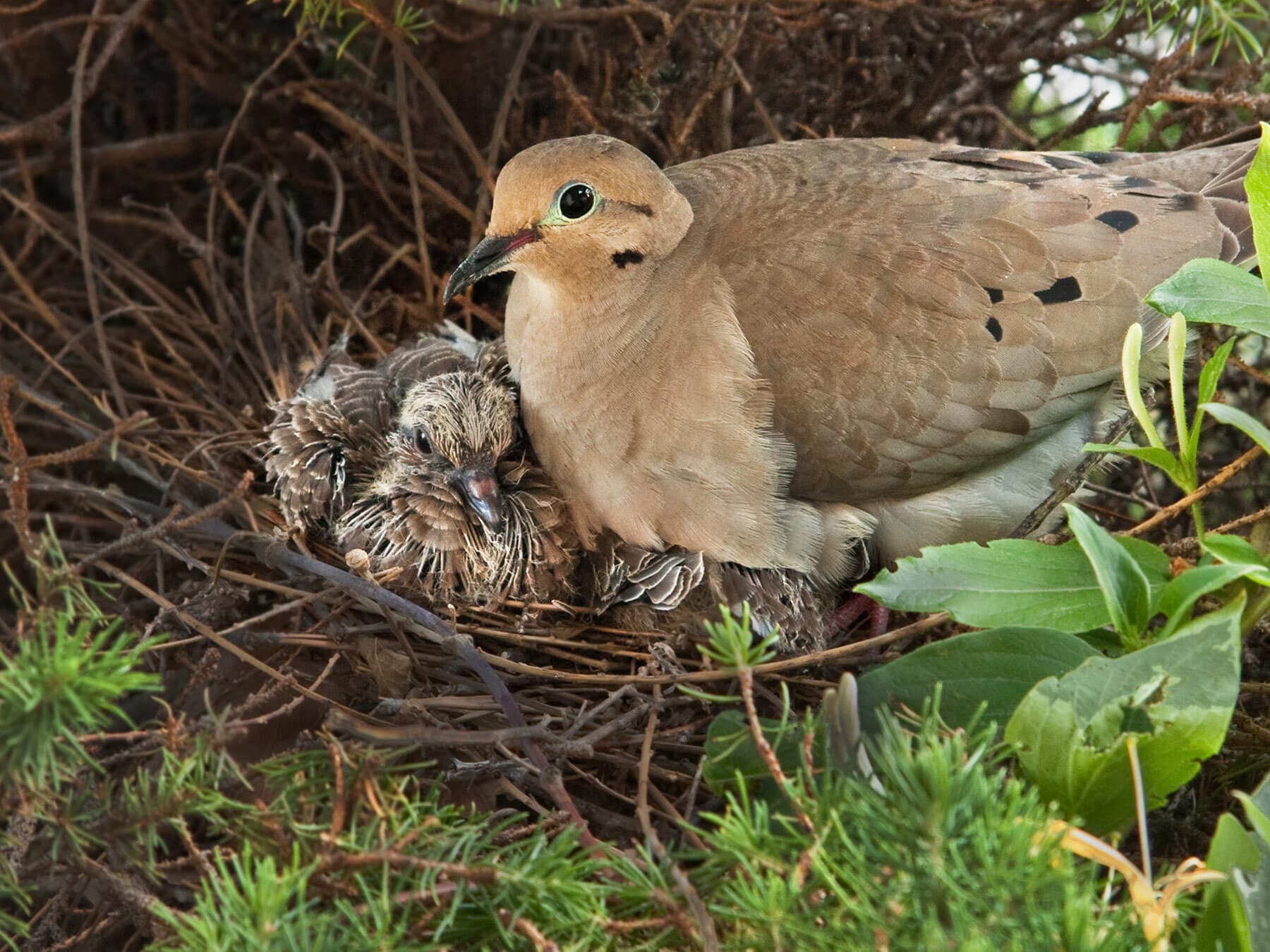
About two weeks. Young Mourning Doves normally leave the nest at 13 to 15 days old,1 or as early as 9 or 10 days if something frightens them. On an Oklahoma campus a century ago, Margaret Morse Nice timed 16 young leaving at 12 to 15 days, 13.4 on average.6 They leave fully feathered except for fine feathers under the wings and a short tail, weighing about 2.8 ounces (80 g), around 60 to 65% of an adult's weight, and they may come back to roost on the nest with a parent for a night or two.
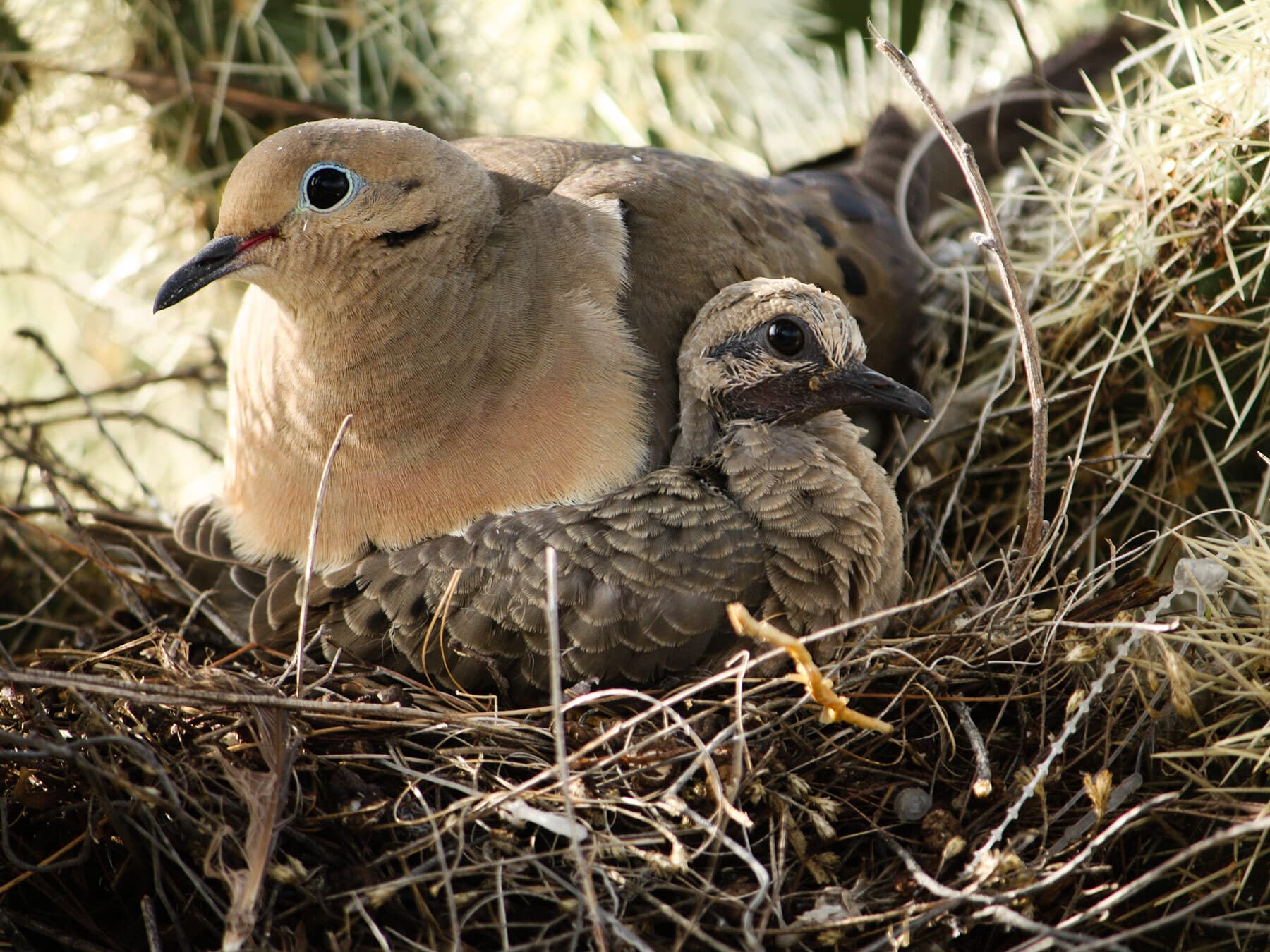
Fledglings
A young dove that has just left the nest is a fledgling. It cannot fly well yet and stays in the same tree or on the ground close by. In studies in Alabama, fledglings loafed in spots with dense overhead cover within about 150 feet (45 m) of the nest tree until 27 days old, and before 21 days rarely moved more than 230 feet (70 m) unless disturbed.1 Siblings stay together, roosting in nearby trees at night.
In a radio-tracking study there, young doves left the nest at about 15 days, were fed by a parent, mainly the male, until about 27 days old, began picking up food for themselves at 17 days, and could manage alone at 18 to 21 days if there was food close to the nest tree.7 Birds of the World describes the male's feeds getting shorter until the young are about 30 days old. At 27 to 30 days old they join flocks of young doves, up to about a mile (1,500 m) from where they hatched. Audubon's guide puts it simply: the young wait nearby to be fed for a week or two after leaving the nest.8
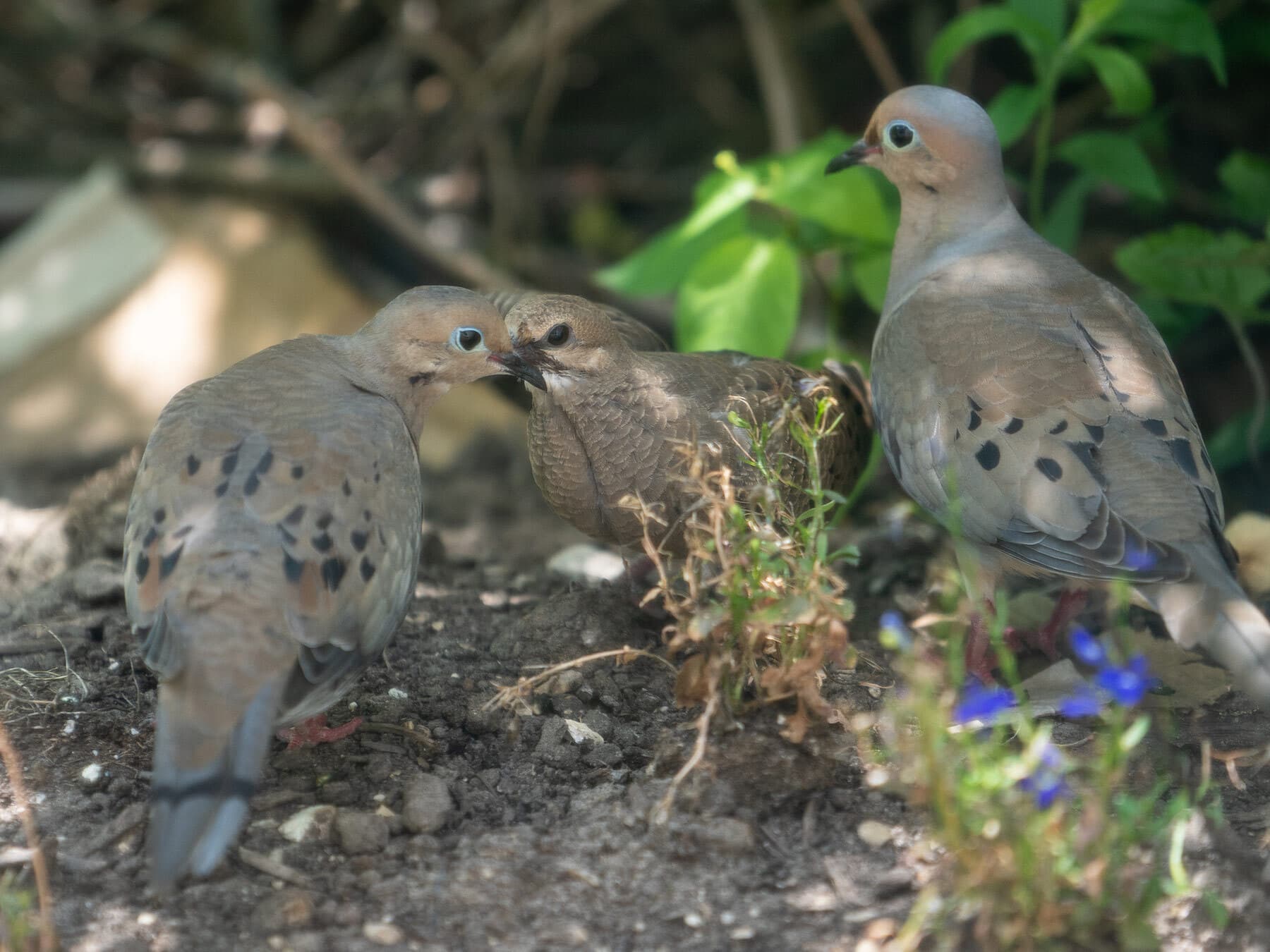
I found a baby Mourning Dove on the ground: what should I do?
First look at it. A fledgling is fully feathered and alert; a nestling still shows bare skin. NestWatch's advice: a fledgling out of the nest should be left alone, because its parents are probably nearby; fledglings hop about on the ground and in shrubs and are fed for a few weeks before they are independent.9
If the bird is injured, call a licensed wildlife rehabilitator or a wildlife vet, and meanwhile watch from a distance: parents will not come back while you are close. Do not try to feed it or force water on it: young birds need the right food several times an hour, and the wrong diet can cause deformities, disease or death.9 In the US, the Migratory Bird Treaty Act also bars keeping a Mourning Dove without a federal permit.10
What do juvenile Mourning Doves look like?
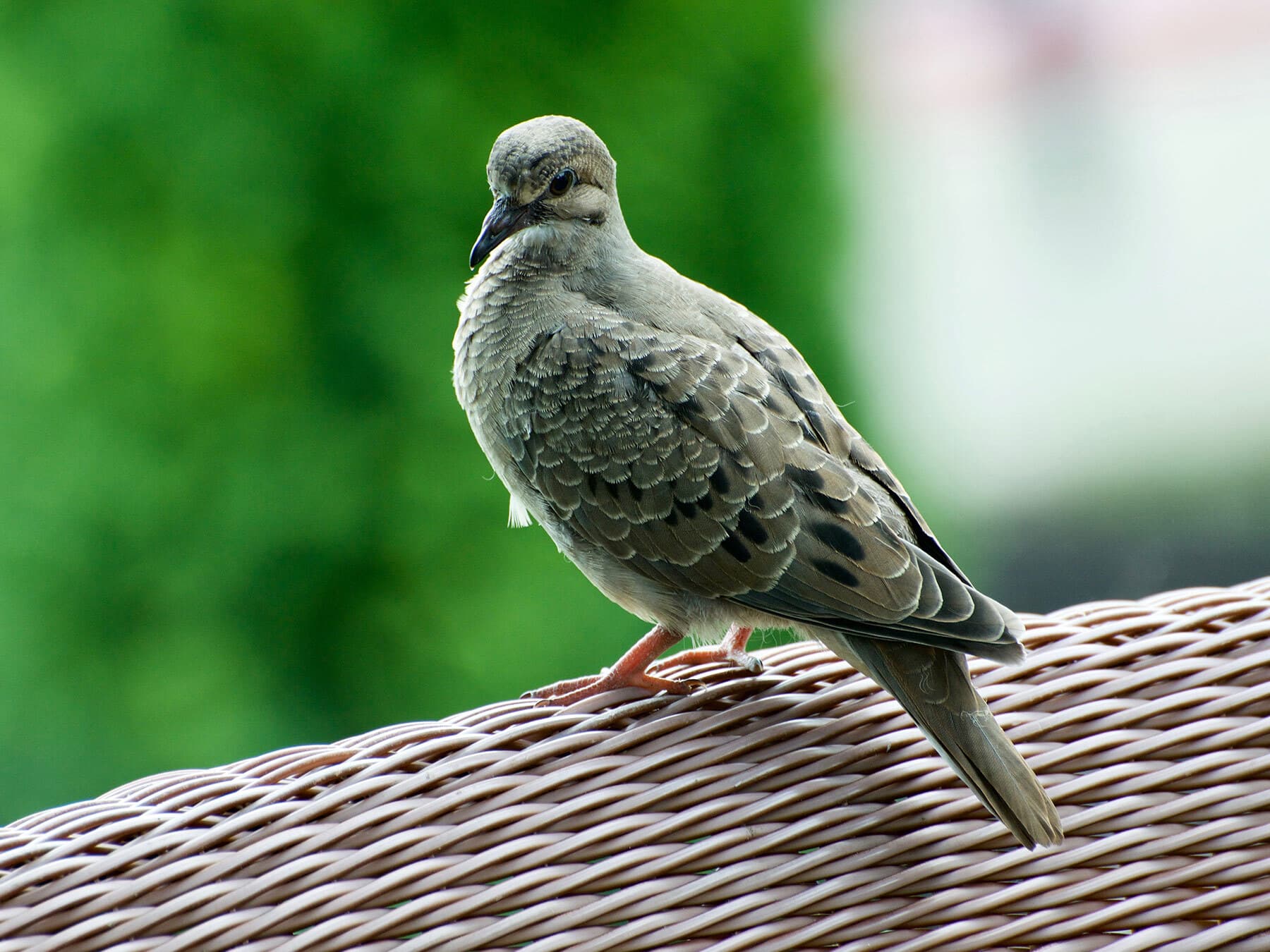
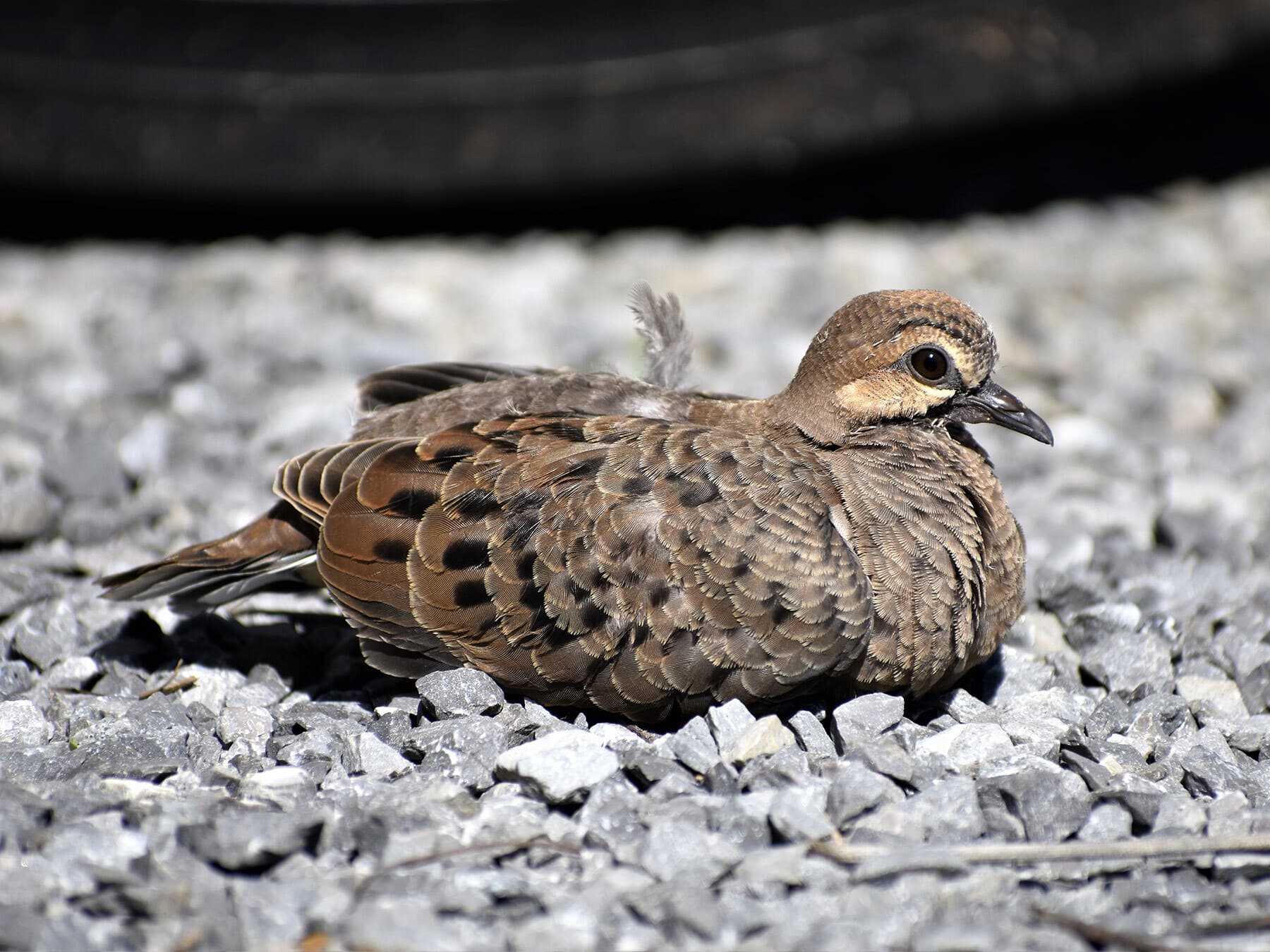
Like small, scaly adults. Young males and females look alike: grayish brown, paler and buffier below, with pale buff or whitish edges to the feathers of the breast, back and wing coverts, white marks on the face, and no black spot below the eye. They are sometimes mistaken for an Inca Dove or a Common Ground Dove.
The juvenile plumage does not last. At about 30 to 40 days old young doves begin a molt that takes 100 to 120 days on average, sometimes paused for migration, after which they look like adults. In the hand, banders can still pick out a young bird by buff tips on the primary coverts until those feathers are replaced.
Why you rarely see baby doves
Nests are often hidden in thick foliage, chicks grow out of the downy stage in about a week, and they leave at two weeks already looking much like small adults. Their mottled plumage may help them blend into the ground and branches where they wait to be fed.
Squabs, nestlings and fledglings
Chicks of pigeons and doves in the nest are often called squabs, and Birds of the World uses the word for Mourning Dove nestlings too. Out of the nest they are fledglings, then juveniles.
Two eggs, many nests
A clutch is normally two eggs, but pairs nest again and again. About 30 days pass from starting one successful clutch to starting the next, and a new clutch may even be laid while the last young are still being fed. Pairs make 2 to 7 nesting attempts a year, more in the South, and one marked pair in Texas made six in a season.1
Many attempts fail, mostly to weather and predators: studies have found that roughly 30 to 87% of nests succeed, depending on the place and year. Across the US, a pair raises about 3.6 young a year on average, 83% of them between May and August.
Survival
Few young doves live long. In the US Fish and Wildlife Service's population model, only about 28 to 31% of young doves banded in July and August live another year, against 40 to 49% of adults.11 In an Alabama study, predators caused 30% of the known deaths of nestlings and fledglings and weather 33%.1 Trichomonosis, caused by a parasite, can also pass from adults to their young at feeding time.12
Sources
- Otis, D. L., Schulz, J. H., Miller, D., Mirarchi, R. E., Baskett, T. S. (2020). Mourning Dove (Zenaida macroura), version 1.0. Birds of the World (A. F. Poole, editor). Cornell Lab of Ornithology. doi:10.2173/bow.moudov.01
- McClure, H. E. (1943). Ecology and management of the mourning dove, Zenaidura macroura (Linn.), in Cass County, Iowa. Iowa Agricultural Experiment Station Research Bulletin 310: 355-415. Accessed October 12, 2026. Source
- Blockstein, D. E. (1989). Crop milk and clutch size in Mourning Doves. Wilson Bulletin 101(1): 11-25. Accessed October 12, 2026. Source
- Westmoreland, D., Best, L. B. (1987). What limits Mourning Doves to a clutch of two eggs? The Condor 89(3): 486-493. doi:10.2307/1368638
- Westmoreland, D., Best, L. B., Blockstein, D. E. (1986). Multiple brooding as a reproductive strategy: time-conserving adaptations in Mourning Doves. The Auk 103(1): 196-203. doi:10.1093/auk/103.1.196
- Nice, M. M. (1922). A study of the nesting of Mourning Doves. The Auk 39(4): 457-474. doi:10.2307/4073568
- Hitchcock, R. R., Mirarchi, R. E. (1984). Duration of dependence of wild fledgling Mourning Doves upon parental care. Journal of Wildlife Management 48(1): 99-108. doi:10.2307/3808457
- National Audubon Society. Mourning Dove. Guide to North American Birds (text adapted from Kaufman 1996). Accessed October 12, 2026. Source
- NestWatch (Cornell Lab of Ornithology). What should I do if I see a young bird out of the nest? NestWatch FAQ. Accessed October 12, 2026. Source
- United States Congress (1918). Migratory Bird Treaty Act, 16 U.S.C. 703. United States Code, Title 16, section 703 (Legal Information Institute). Accessed October 12, 2026. Source
- Seamans, M. E. (2026). Mourning Dove Population Status, 2026. U.S. Fish and Wildlife Service, Division of Migratory Bird Management, Laurel, Maryland. Accessed October 12, 2026. Source
- Pennsylvania Game Commission. Trichomoniasis. Pennsylvania Game Commission, Wildlife Diseases. Accessed October 12, 2026. Source
- Cornell Lab of Ornithology. Mourning Dove. All About Birds. Accessed October 12, 2026. Source
- NestWatch (Cornell Lab of Ornithology). Mourning Dove. NestWatch focal species. Accessed October 12, 2026. Source