Facts · Updated 12 Oct 2026
Do Mourning Doves Migrate? Where They Go in Winter
By the Birdfact teamChecked by Nathan Cope
Some do. Mourning Doves are partial migrants: northern breeders fly south for the winter, mid-latitude birds partly, and southern birds mostly stay. Fall migration runs from August to December, by day and in flocks, to the southern US, Mexico and Central America.
On this page13 sections
- Do Mourning Doves migrate?
- Where they stay all year
- When do Mourning Doves migrate?
- Where do Mourning Doves go in winter?
- How far they travel
- Flocks and day flights
- Do Mourning Doves migrate at night?
- Flight speed
- Crossing water
- What triggers migration
- Returning to the same place
- Migration and hunting seasons
- Sources
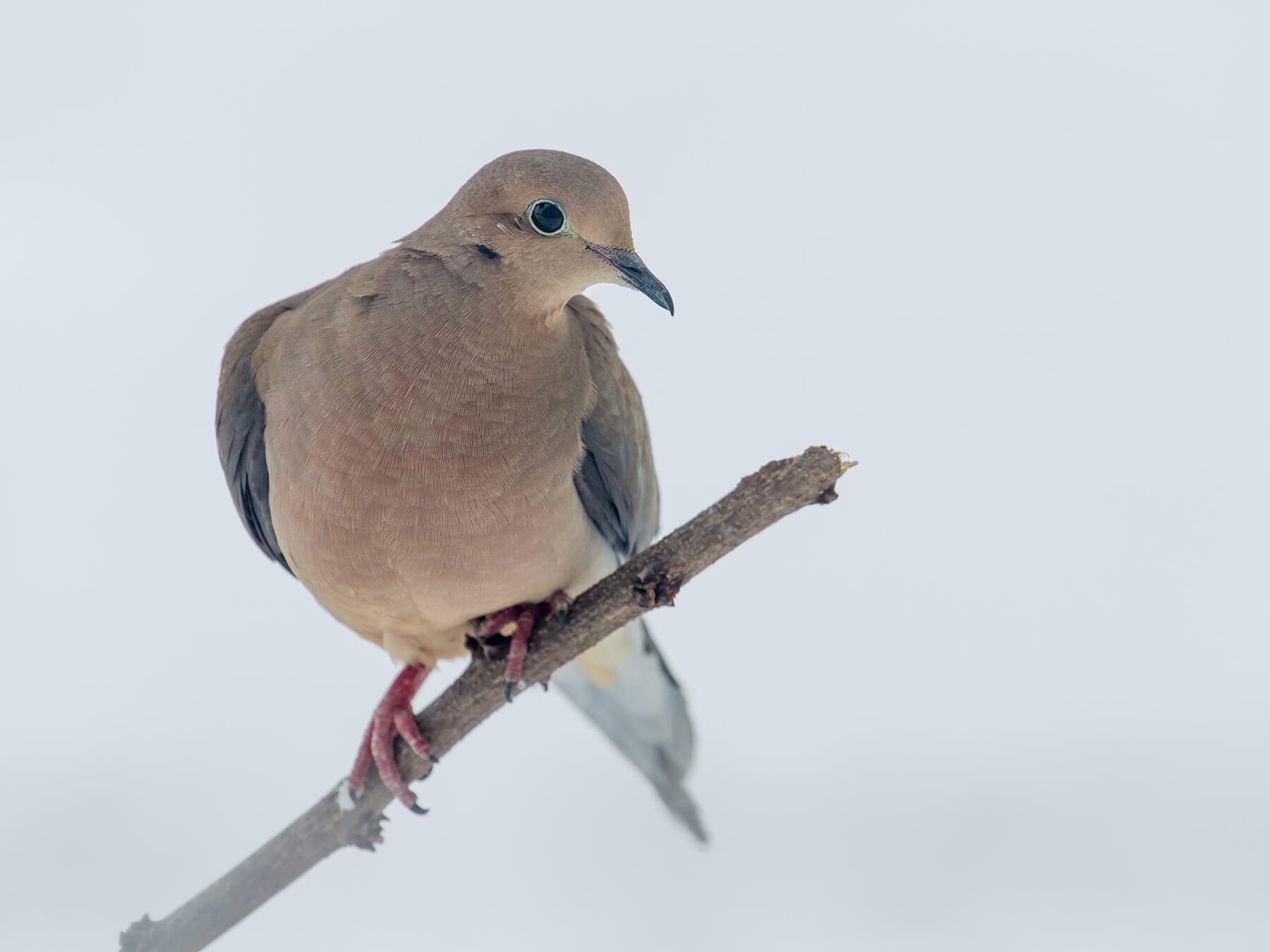
Which Mourning Doves migrate and which stay put, when they move, where they go, how far and how fast. For the bird itself, see Mourning Dove identification and facts.
Do Mourning Doves migrate?
Some do and some don't. Mourning Doves are partial migrants. On the northern edge of the breeding range almost all of them migrate; at middle latitudes, where winters are milder, some go and some stay; in the South they are mostly resident. Migrating and resident doves live side by side in many places, north-central Missouri for one.1
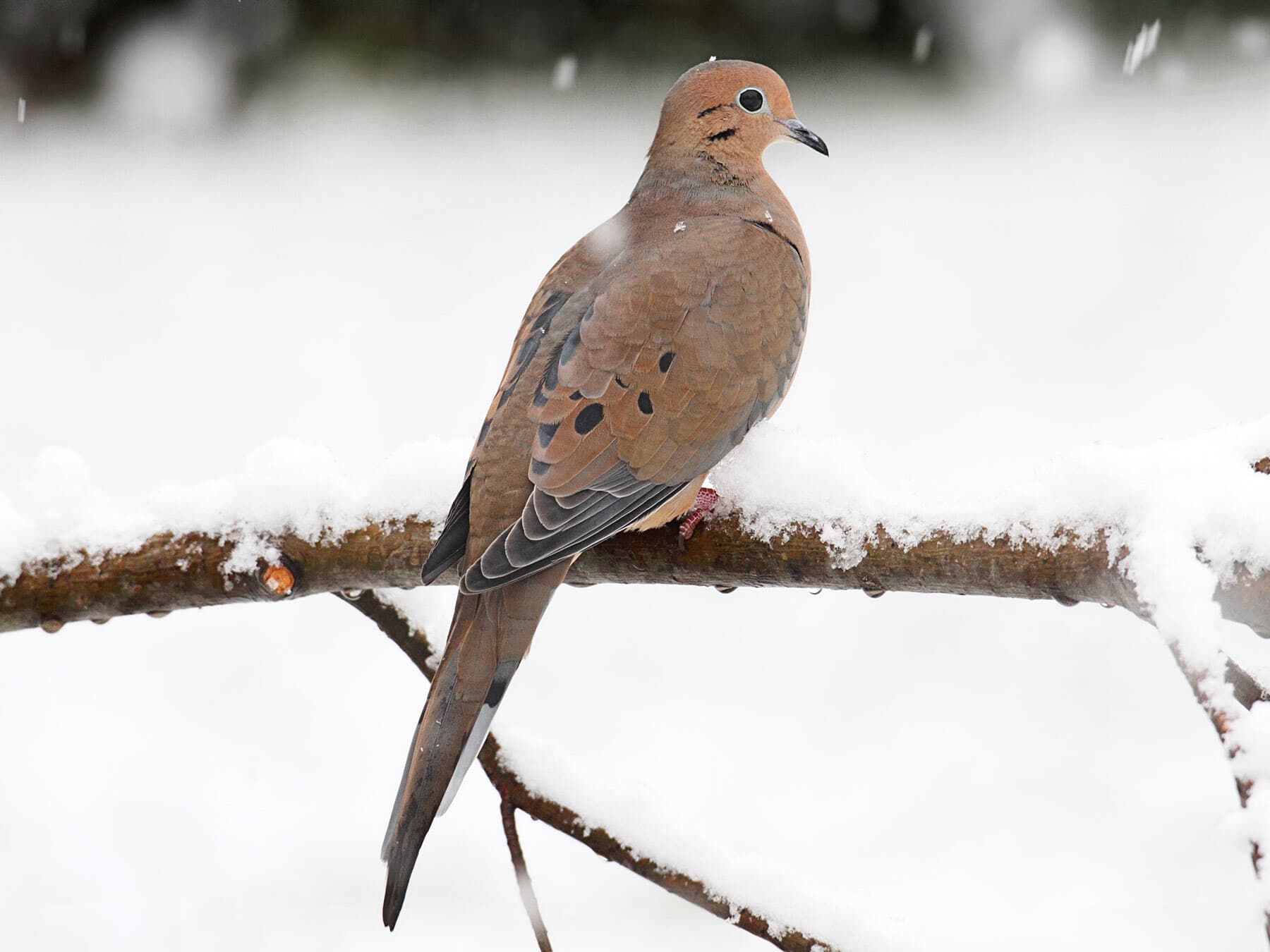
In winter Mourning Doves are found through most of their breeding range except central Canada and the north-central United States, and south through Mexico and along the Pacific side of Central America to Costa Rica and western Panama. Most winter south of about 40 degrees north, but some stay as far north as southern Canada wherever there is food.
Where they stay all year
In our records, Mourning Doves are present all year in most of the US and in southern Ontario, Quebec and the Maritimes, but are summer birds in Montana, Wyoming, Colorado and the Dakotas and in Alberta, Saskatchewan and Manitoba, which most of them leave for the winter. In Guatemala, El Salvador and Nicaragua they are winter visitors from the north.
When do Mourning Doves migrate?
Fall migration is long and spread out. In late summer, young birds gather in growing flocks looking for food and water, and they tend to set off first, followed by the adults. In Iowa, young doves began leaving in July and adults not until September.2 Some young doves from Ohio and Pennsylvania reach the Gulf Coast states by early September, but most doves of both ages finish their migration in October and November. Doves banded in the north turn up in Mexico from October on, more as the winter goes on. Birds of the World concludes that somewhere in the lower 48, some Mourning Doves are migrating at any time from August to December.
Spring migration is less well described. Doves are leaving Mexico by mid-April, the movement north progresses slowly through April, and in most of the US it is probably over by mid- to late May. Early studies found counts of cooing doves peaking in late April and early May, which they took as a sign that spring migration was largely done.
Where do Mourning Doves go in winter?
Most of what is known comes from hunters reporting bands from doves they shot.1 Those reports show three largely separate populations, which wildlife agencies manage as the Eastern, Central and Western Management Units:3
- East. New England doves migrate down the Atlantic coast; doves from the mid-Atlantic go south and southwest; and those from the Eastern unit's Midwestern states, such as Ohio, Indiana, Illinois and Wisconsin, winter mainly in the Gulf Coast states.
- Central. Doves from the northern Plains and upper Midwest, such as the Dakotas, Minnesota and Iowa, spread most widely: south into eastern Texas, Mexico and Central America, and southeast into the Gulf states.
- West. Doves from the northern Pacific coast go south and southeast, and those from the interior mostly south; few are recovered south of the western highlands of Mexico.
How far they travel
Anything from a few hundred miles to several thousand. Doves breeding in the north-central US make the longest journeys, while lower-latitude birds move only hundreds of miles, if at all. Banding records give a sense of it: a young dove banded in Colorado in 1958 was shot in Guatemala in 1977, 19 years later, and doves banded in Louisiana and Minnesota have been recovered in Mexico.4
Young birds tend to go farther. Of doves banded in South Dakota and shot in the first hunting season after banding, 17.9% of young birds but only 7.7% of adults were recovered in Mexico.5 In Massachusetts, most young doves migrated south in their first year, while many adults spent the winter in southern New England.6
Flocks and day flights
Migration is mostly by day, in flocks.7 In Sonora, Mexico, in late August and September, thousands of doves have been seen in flocks of 5 to 50, flying just over the tops of the mesquite and paloverde. They usually fly low, but some cross mountain passes at about 9,800 feet (3,000 m).
Do Mourning Doves migrate at night?
Mostly not. There are scattered signs of night migration, such as doves killed at television towers at night, but most direct evidence is of daytime migration, with flocks moving unhurriedly and stopping often to feed and rest.1
Flight speed
Fast over a short distance, slow over a long one. A figure of 55 mph was reported for one dove that flew beside a car near Ridgetown, Ontario, in June 1951,8 and radar has measured 40 mph (65 km/h).1 Migration is far more leisurely. Two young doves from Iowa shot in Oklahoma, about 400 miles away, had averaged at least 15 miles a day,2 and Alabama banders reported in 1940 that migrating doves travel no more than 20 miles a day.9 Approximate calculations from banding, in Birds of the World, suggest under about 110 miles (180 km) a day.
Crossing water
Their main routes avoid large bodies of water, but a few have been seen crossing the Gulf of Mexico in spring and fall, and some fly between Florida, Cuba and the Greater Antilles; a few bands have been recovered in Cuba.
What triggers migration
Day length, local weather and food are thought to trigger it. Adults carry the most fat in fall, just before migration.
Returning to the same place
Many doves come back to the same area. In a 20-year banding study on Cape Cod, more than half the doves that survived the winter came back to the banding area each summer, and in Minnesota 80% of returning doves nested within 200 feet (60 m) of their site the year before. For young doves the evidence is mixed: a Missouri study suggested they settle where they first nest rather than where they hatched, while a Minnesota study found signs that many returned to their natal area.10 More: Mourning Dove nesting.
Migration and hunting seasons
Because Mourning Doves cross state and national borders, they are managed under the Migratory Bird Treaty Act and the treaties with Canada and Mexico. Federal frameworks set the outer limits for each management unit and states choose their seasons within them, between September 1 and mid- to late January.3 In Canada, Mourning Doves can be hunted only in parts of Ontario, Quebec and British Columbia.11
Sources
- Otis, D. L., Schulz, J. H., Miller, D., Mirarchi, R. E., Baskett, T. S. (2020). Mourning Dove (Zenaida macroura), version 1.0. Birds of the World (A. F. Poole, editor). Cornell Lab of Ornithology. doi:10.2173/bow.moudov.01
- McClure, H. E. (1943). Ecology and management of the mourning dove, Zenaidura macroura (Linn.), in Cass County, Iowa. Iowa Agricultural Experiment Station Research Bulletin 310: 355-415. Accessed October 12, 2026. Source
- Seamans, M. E. (2026). Mourning Dove Population Status, 2026. U.S. Fish and Wildlife Service, Division of Migratory Bird Management, Laurel, Maryland. Accessed October 12, 2026. Source
- USGS Bird Banding Laboratory. Longevity records of North American birds. USGS Patuxent Wildlife Research Center, Bird Banding Laboratory. Accessed October 12, 2026. Source
- Rice, L. A. (1971). Population dynamics of the Mourning Dove in South Dakota. MS thesis, South Dakota State University. Accessed October 12, 2026. Source
- Heusmann, H. W. (1979). Current status and mortality rates of Massachusetts Mourning Doves. Bird-Banding 50(3): 256-262. doi:10.2307/4512461
- National Audubon Society. Mourning Dove. Guide to North American Birds (text adapted from Kaufman 1996). Accessed October 12, 2026. Source
- Bastin, E. W. (1952). Flight-speed of the Mourning Dove. Wilson Bulletin 64(1): 47. Accessed October 12, 2026. Source
- U.S. Department of the Interior, Bureau of Biological Survey (1940). Mourning doves don't travel far or fast, migration studies show. Press release for 26 May 1940 (U.S. Fish and Wildlife Service historic news releases). Accessed October 12, 2026. Source
- Thomforde, L. L. (1972). Migration and mortality of banded mourning doves. Journal of the Minnesota Academy of Science 38(2): 72-76. Accessed October 12, 2026.
- Government of Canada (2022). Migratory Birds Regulations, 2022 (SOR/2022-105). Justice Laws Website (current to 21 September 2026). Accessed October 12, 2026. Source
- Cornell Lab of Ornithology. Mourning Dove. All About Birds. Accessed October 12, 2026. Source