Facts · Updated 12 Oct 2026
Male vs Female Mourning Doves: How to Tell Them Apart (and Juveniles)
By the Birdfact teamChecked by Nathan Cope
A male Mourning Dove has a bluish-gray crown and a rosy breast; a female's crown is olive-brown and her breast tan. But even biologists with the bird in the hand get about 1 in 20 wrong, and at a feeder it is harder, so learn the behavior that gives each sex away, how to recognize a juvenile, and when the difference is hardest to see.
On this page10 sections
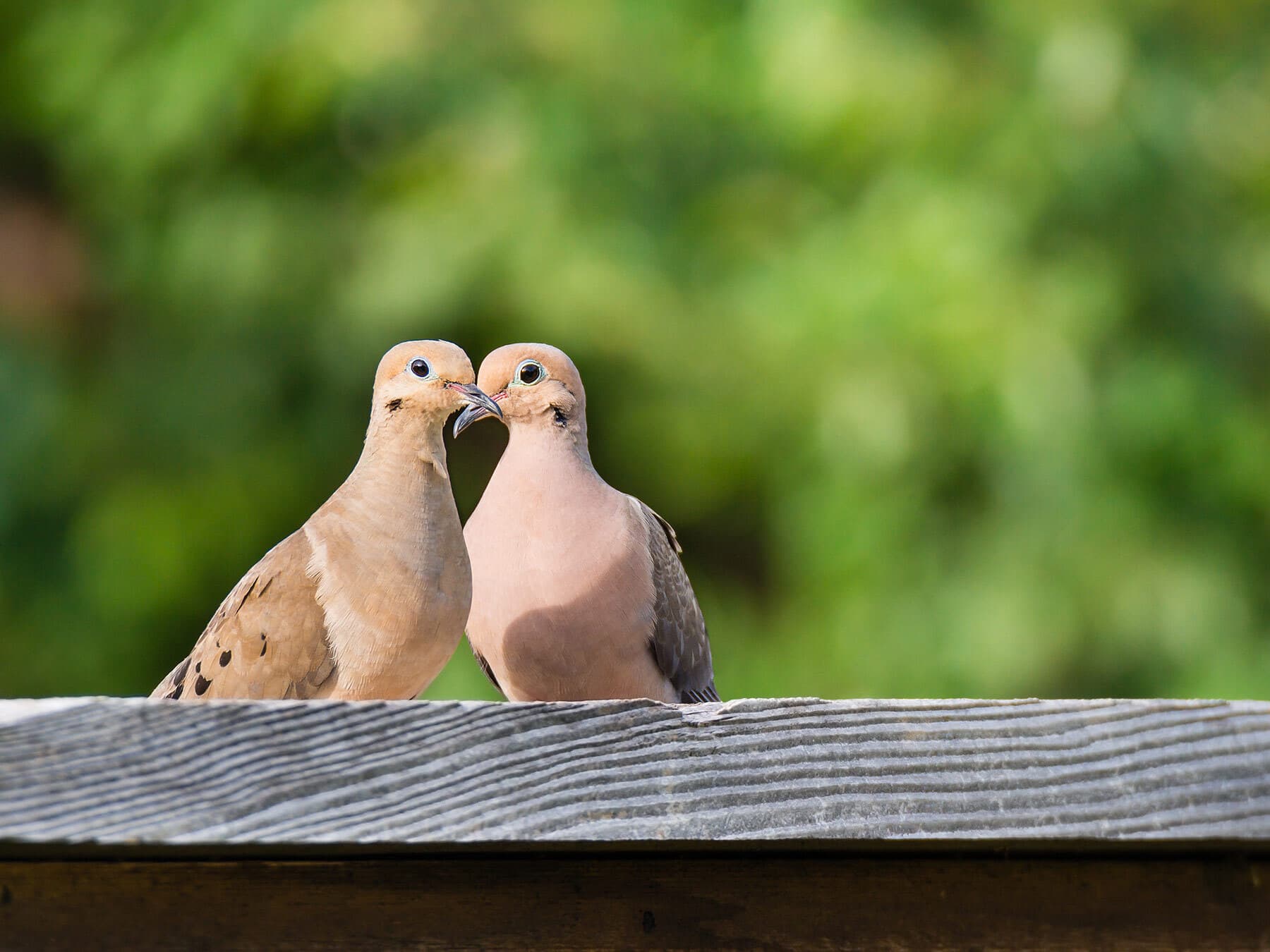
How to tell a male Mourning Dove from a female, and a young bird from an adult: the plumage marks to look for, how often even experts get it wrong, and the behavior that gives each sex away. For the bird itself, see Mourning Dove identification and facts.
How can you tell a male from a female Mourning Dove?
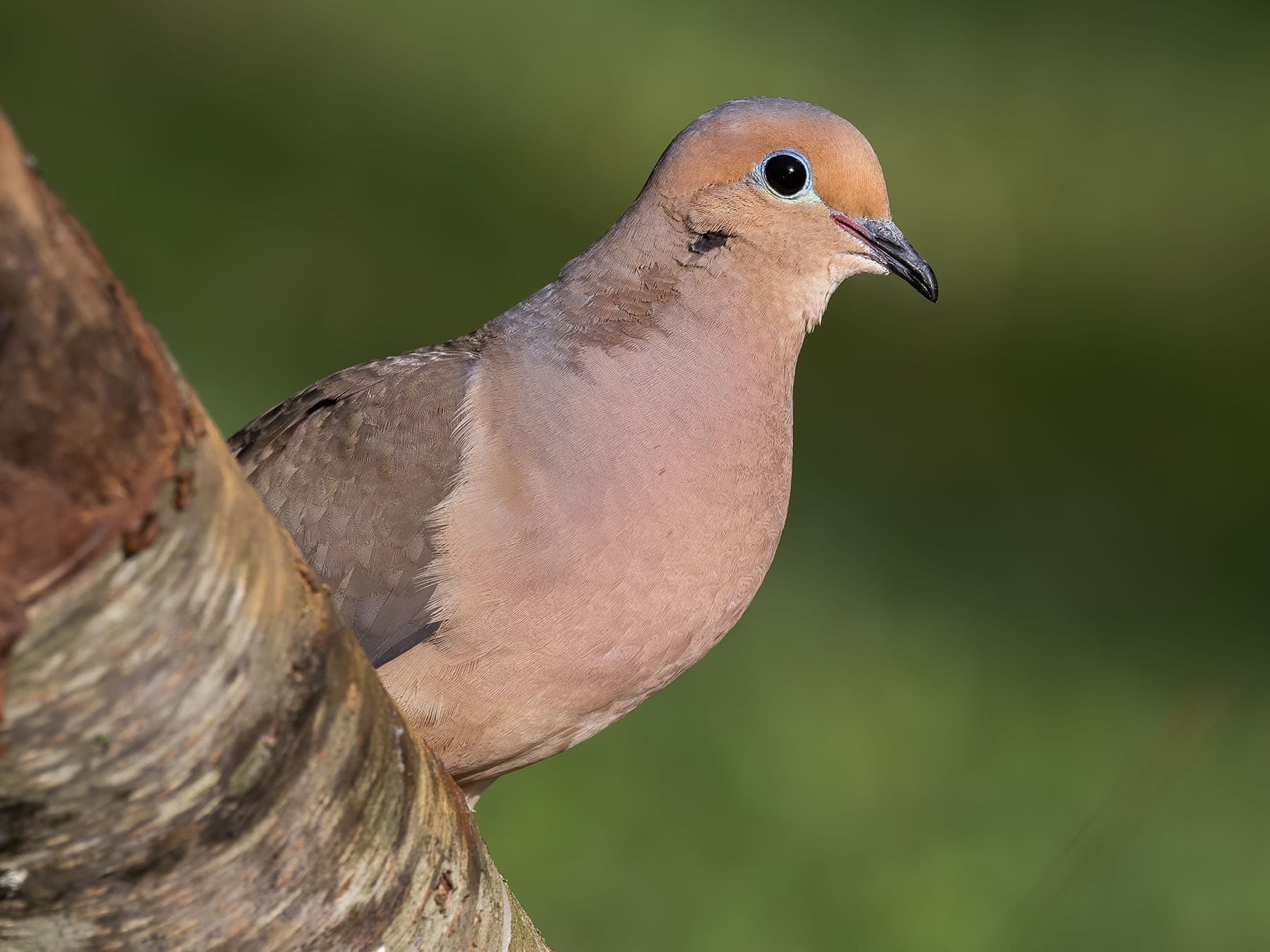
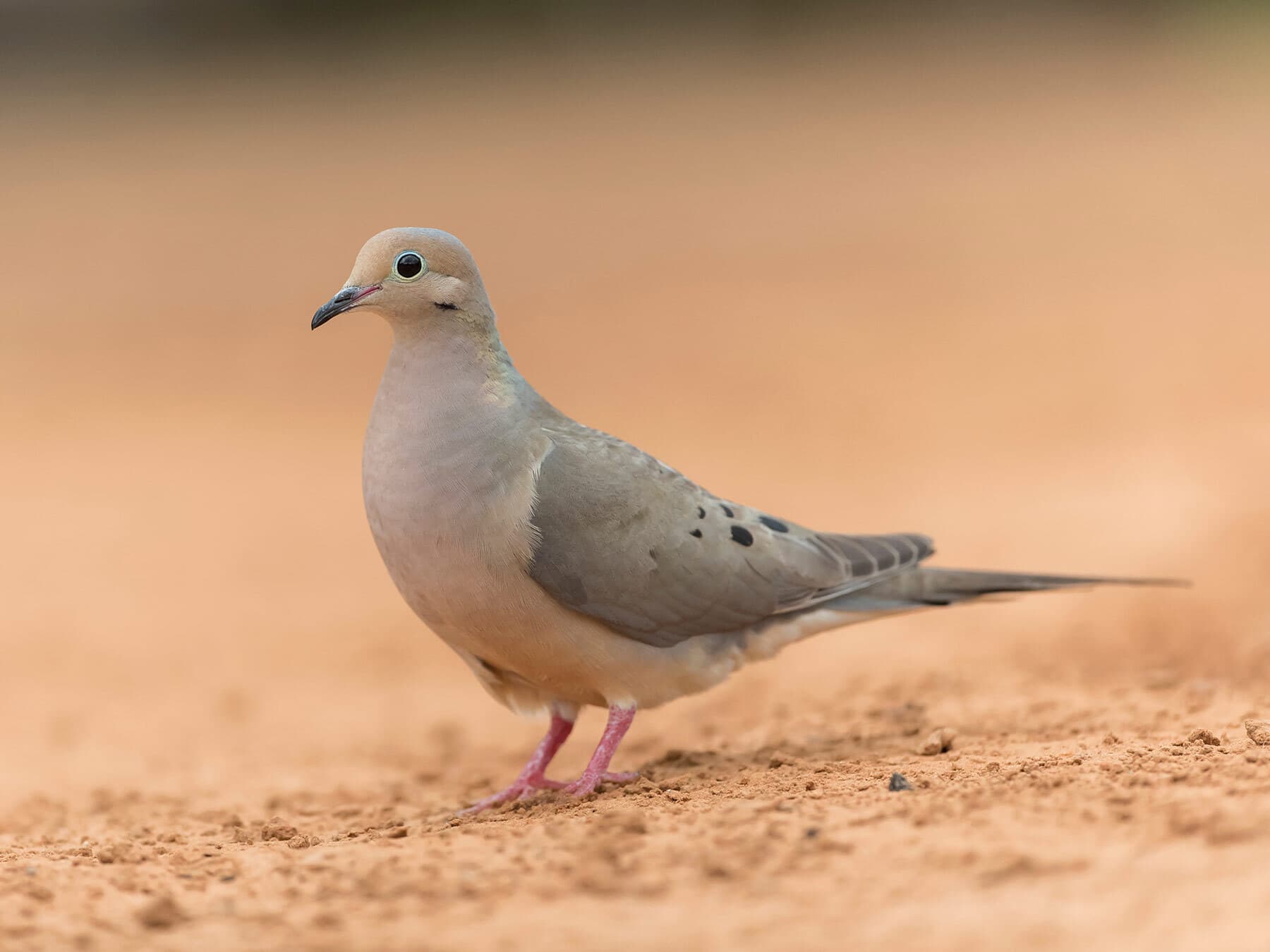
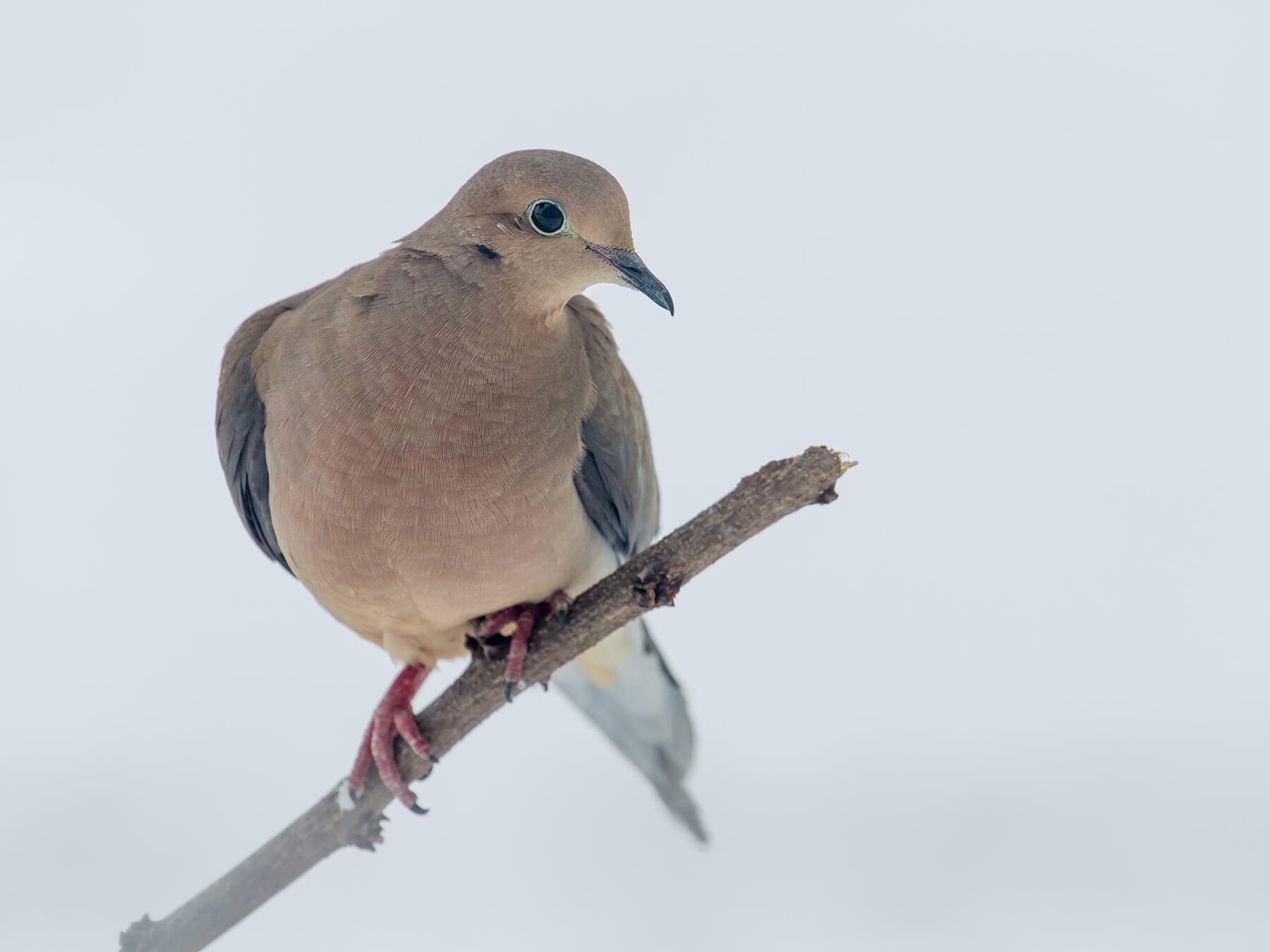
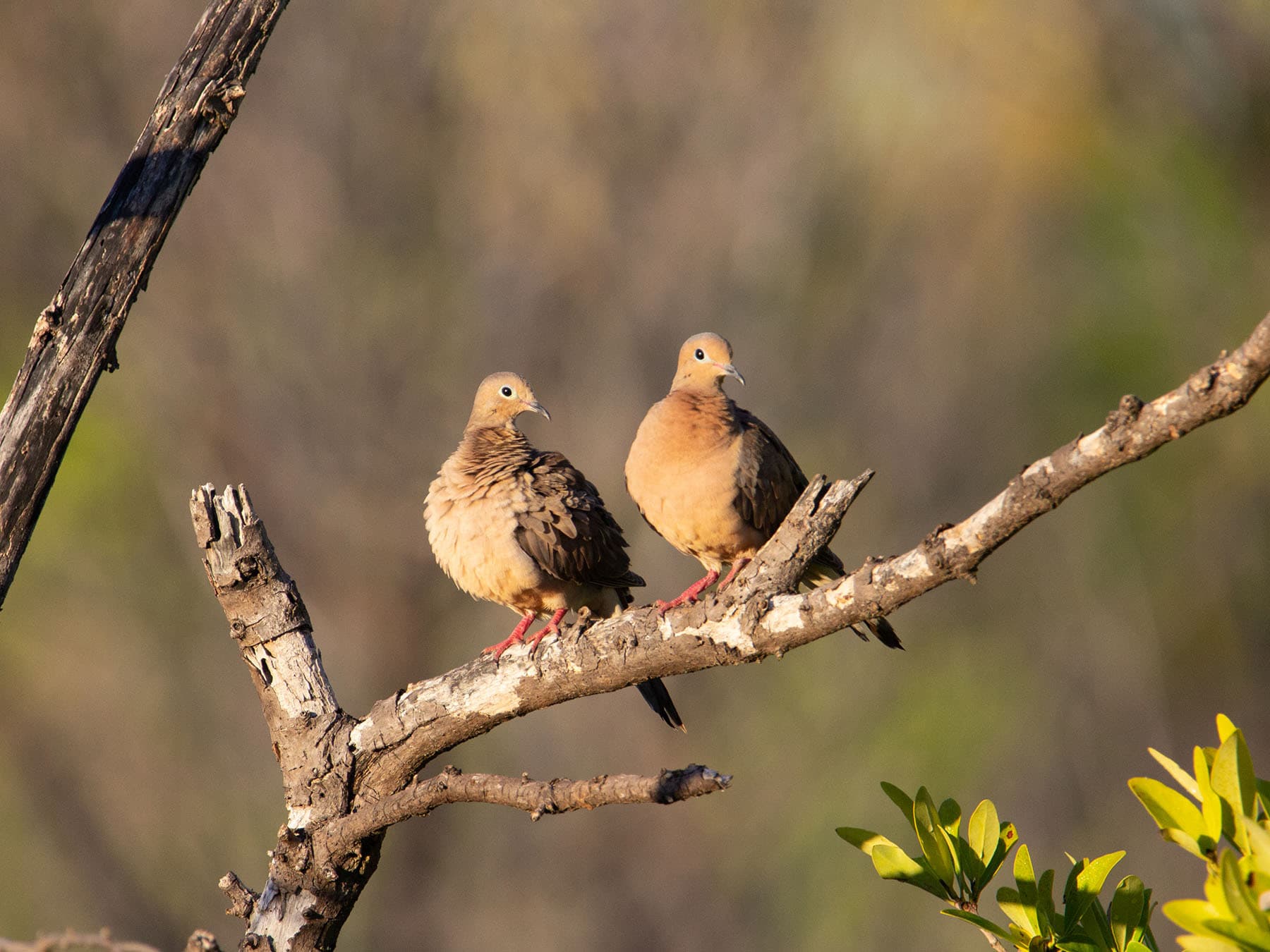
Look at the head and breast in good light. A male has a bluish-gray crown and nape and a rosy-pink face, throat and breast, with pink iridescence on the side of the neck. A female's crown and nape are olive-gray, her face olive-brown and her breast tan, and the gloss on her neck is usually greenish, only occasionally pink.1 In Ohio, Petrides described the male's crown as a pronounced bluish gray and the female's as brown like the sides of her head, and he sexed 51 adult-plumaged birds this way without a mistake when they were checked by dissection.2
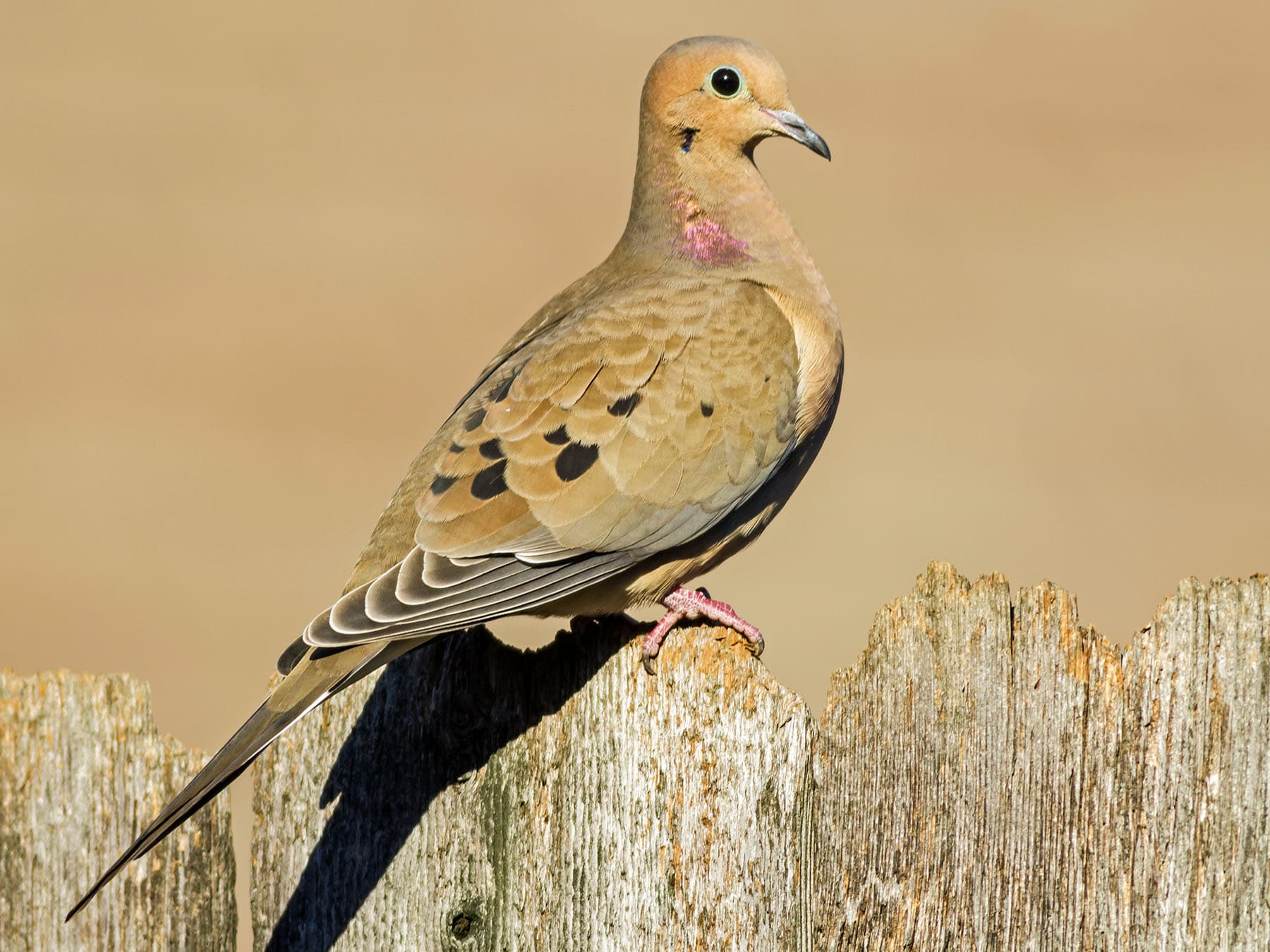
The iridescent neck patch helps too. In summer both sexes show one, but a male's is longer, often 40 mm (about 1.5 inches) or more, while a female's is seldom over 20 mm (0.8 inch) and usually fainter, according to J. H. Jenkins, who measured birds in the hand and advised comparing breast colors in natural light. The newsletter that reported this advised against trying to sex doves in the field.3
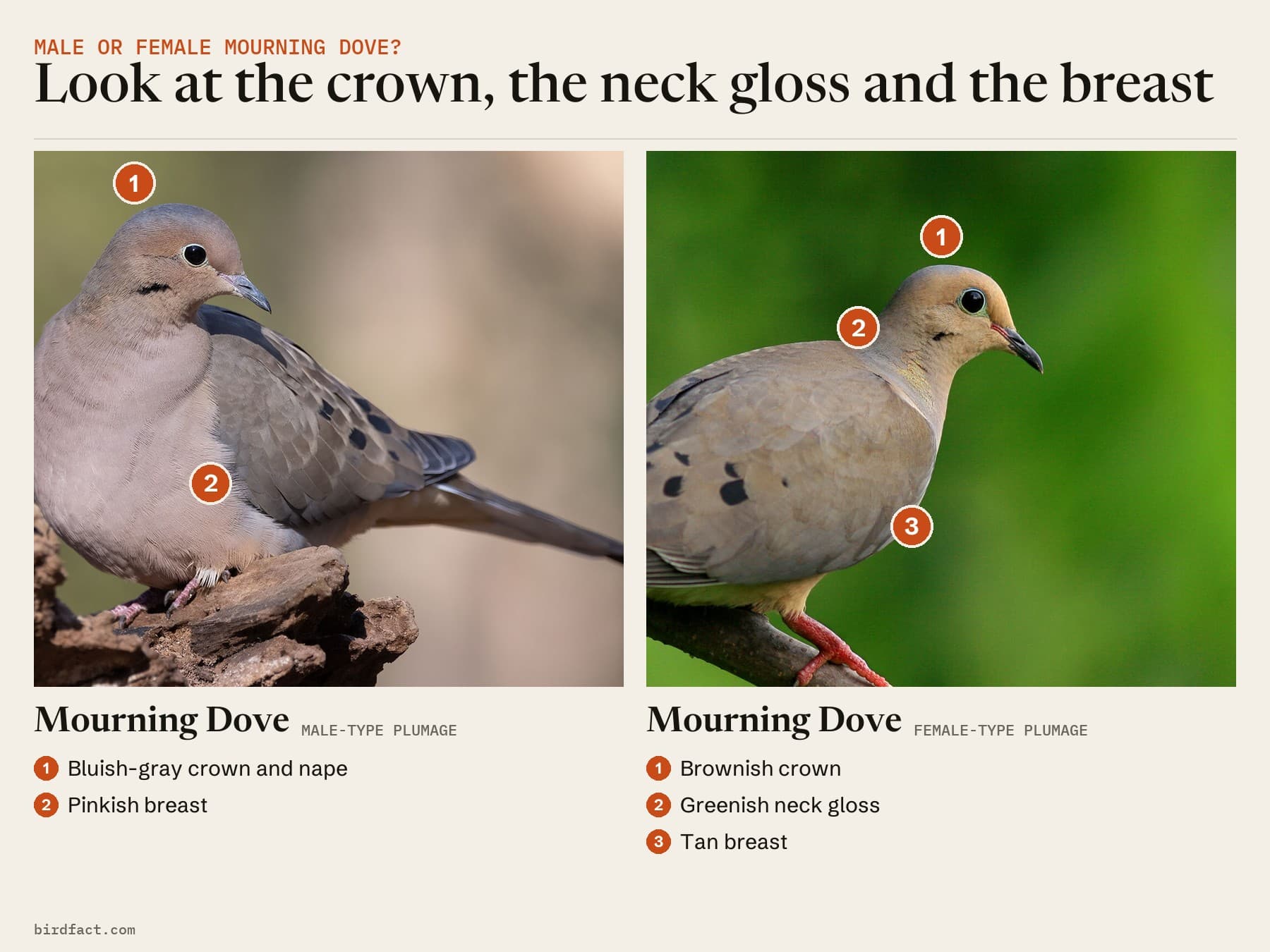
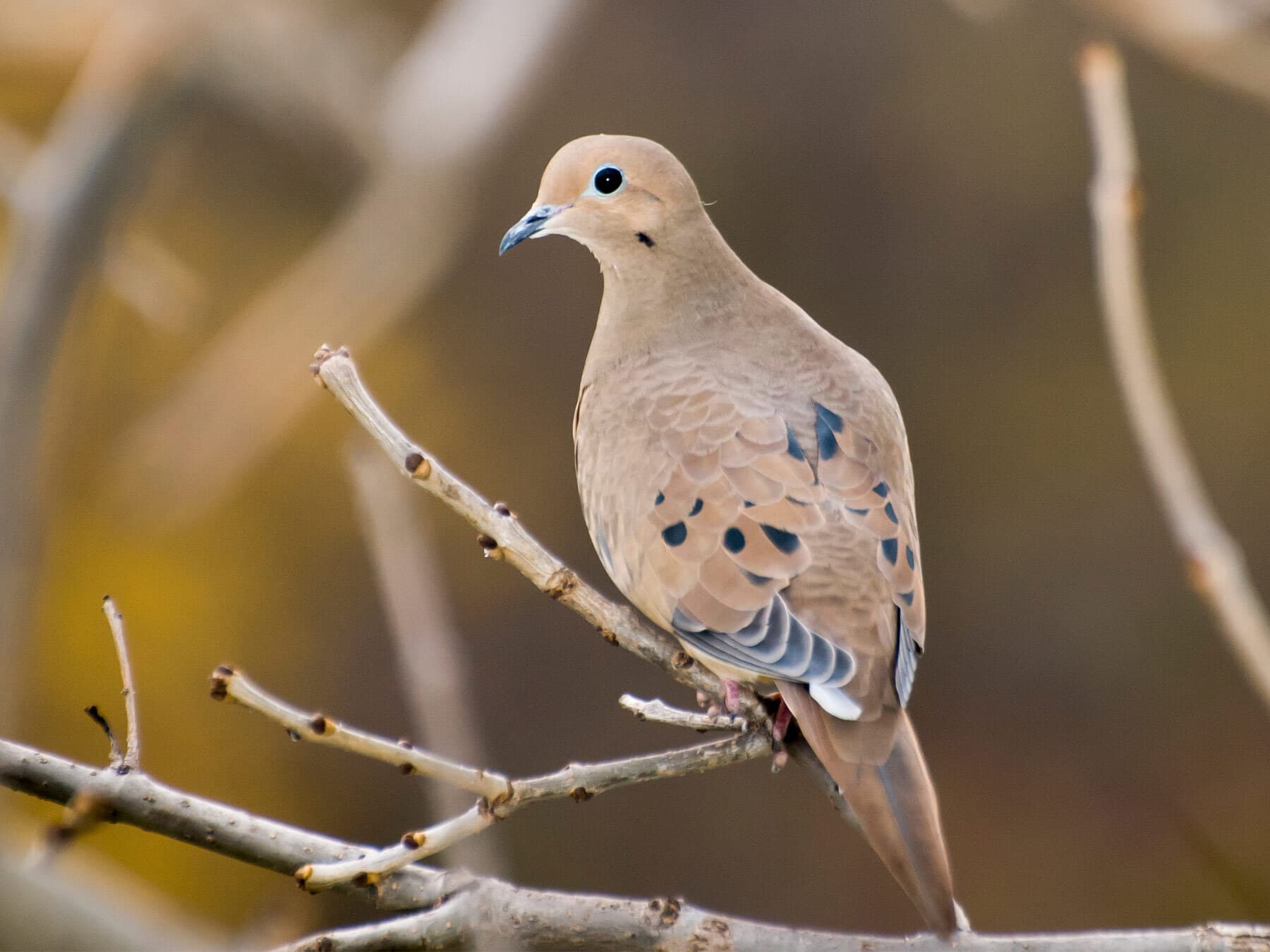
A few smaller clues: the bare skin around the eye is turquoise blue in adult males and turquoise green in adult females, especially in the breeding season; males often show white on the outer three tail feathers and females on one or two, though that does not hold everywhere; and males are a little heavier, 5-11% on average.1
Season changes the look
Males are hardest to pick out in fall and early winter. In Alabama, the body moult from August to December gave males olive tips on the crown, hindneck and chest, a drab winter plumage; the tips wore off by late winter and spring to show the brighter breeding colors. Females get olive tips too, but not enough to change their look.4 A Mourning Dove has no separate breeding plumage: it grows one set of feathers a year.1
How often plumage gets it wrong
More often than you might think. In Louisiana, biologists sexed doves by the head, nape and breast and then checked the gonads. Of 236 live birds sexed this way and later shot, 9 were wrong (3.8%), and 8 of the 98 called males were in fact females. Of 1,820 birds shot by hunters, 91 (5.0%) were wrong. Head and nape alone, or breast alone, did worse than both together. Young males were misjudged 7.2% of the time against 1.4% for adult males, and adult females 6.8% (young females only 3.7%). The authors did not know why; some females have bluish crowns and pinkish breasts, only less marked than a male's, and they suggested older females may show this more often.5 These were trained biologists with the bird in the hand, and the youngest birds were left out, so a backyard watcher will do worse.
Birds of the World warns that some doves are intermediate and hard to sex, perhaps first-year males or very old females. In young birds still early in their first moult, some males can be told by plumage, but a female-looking bird cannot be confirmed as a female.1 A careful look at a pair side by side is safer than judging a single bird.
Telling them apart by behavior
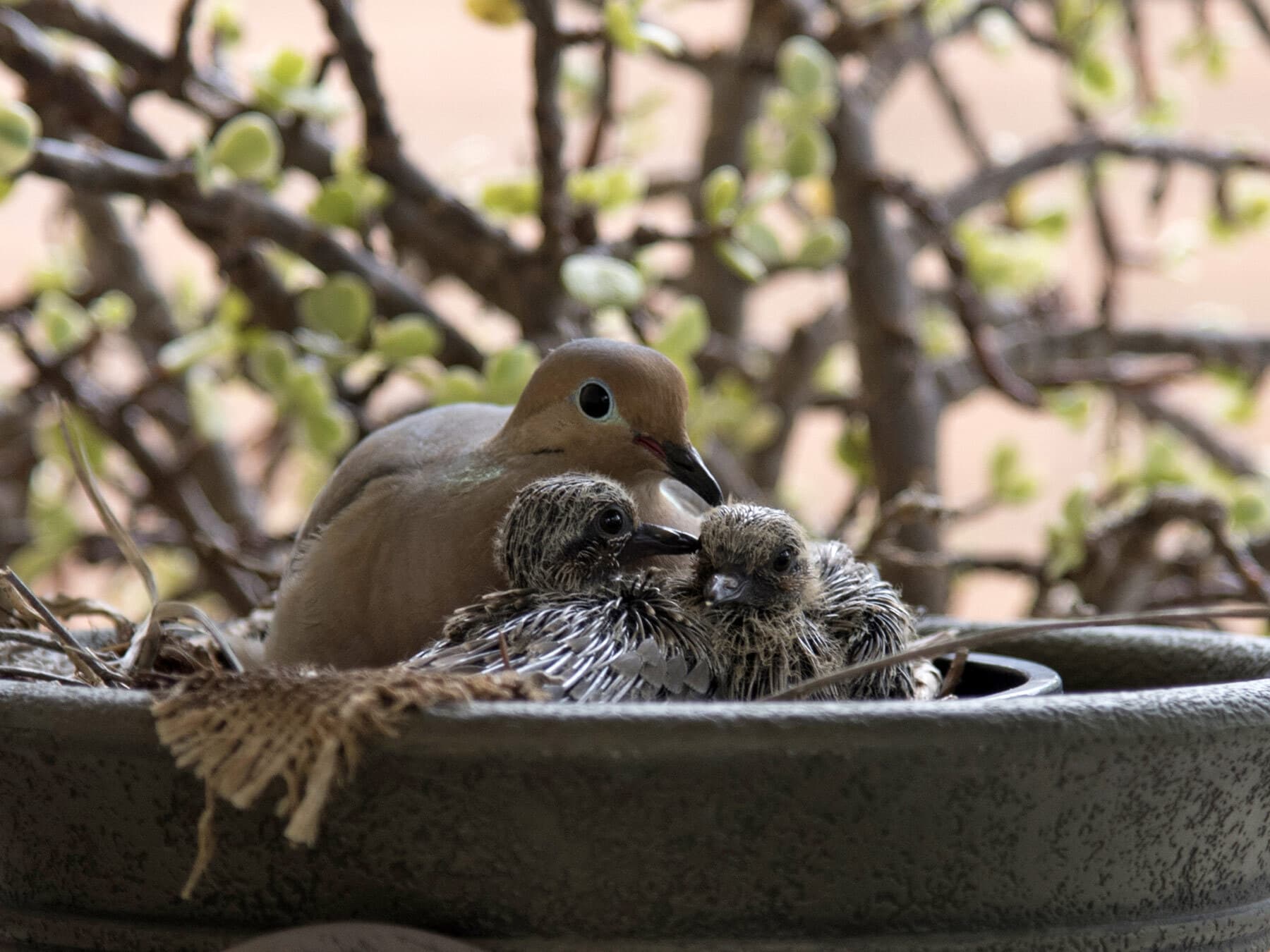
In the breeding season, behavior can settle it. Near Tucson, researchers told the sexes apart by what they did: males coo, give display flights, carry nest material and sit on the nest by day, and females sit at night.6
- The song. The loud perch coo comes from males, mostly unmated ones. Females coo only now and then, faintly.1 More in Mourning Dove sounds.
- The display flight. A male climbs from his cooing perch with loud wing claps, then glides down in a long spiral.1
- Courtship. The male charges and bows; the female decides.1
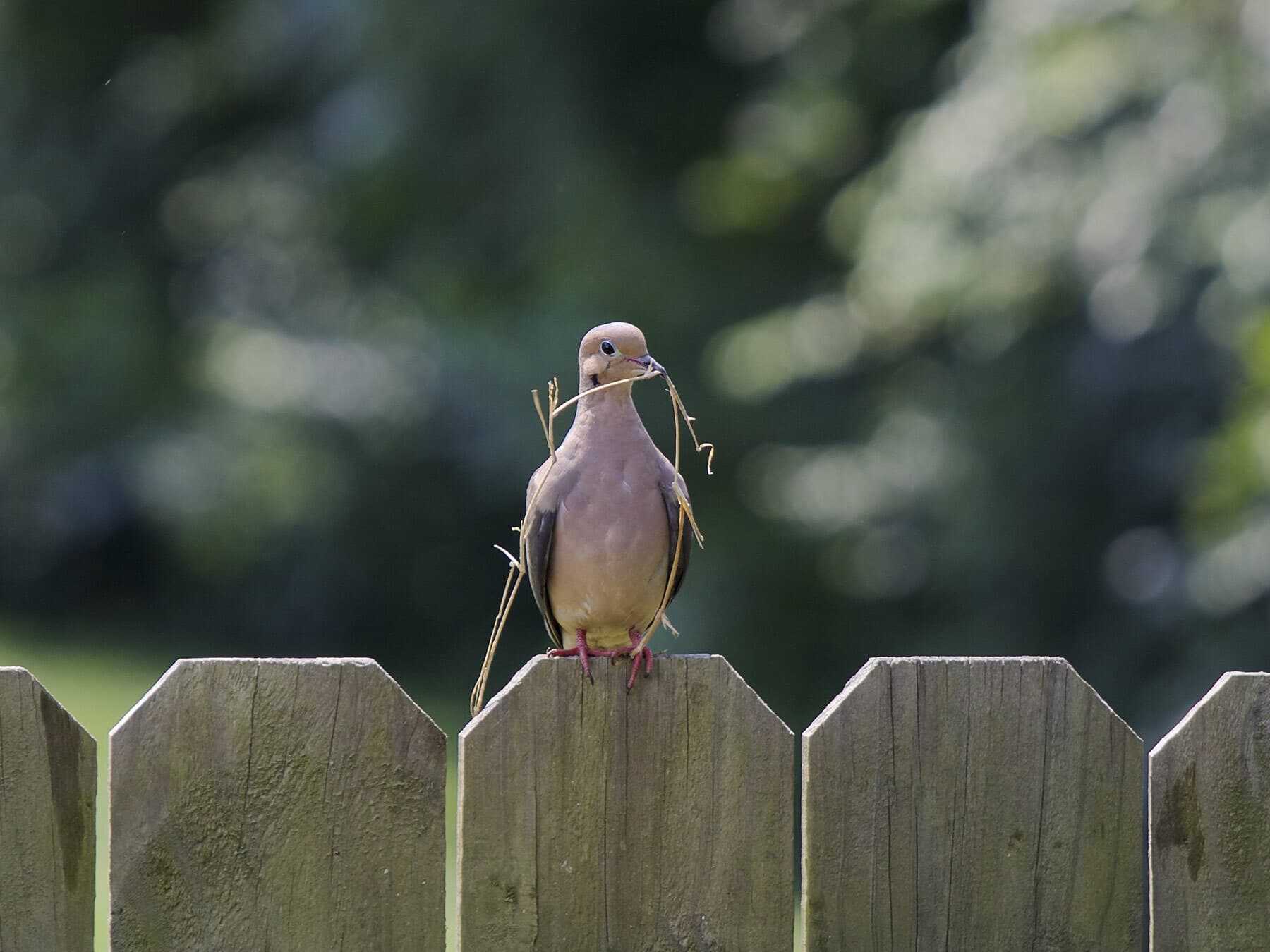
- Nest building. The male gathers the twigs and hands them to the female, standing on her back; she sits on the nest and arranges them around her.1
- Incubation shifts. The male generally sits from mid-morning to late afternoon and the female the rest of the day and night;1 in Iowa the male sat from about 8 a.m. to 5 p.m.7
- Driving. In the breeding season a paired male follows his mate closely wherever she walks or flies, pecking at her whenever she stops.1
Do female Mourning Doves coo?
Are male Mourning Doves bigger?
A little, on average. Eastern males average about 130 g (4.6 ounces) and females 123 g (4.3 ounces); western males 116 g (4.1 ounces) and females 108 g (3.8 ounces).1 All About Birds gives 96-170 g for males and 86-156 g for females.9 The ranges overlap so much that size is no use for a single bird. Alexander Wilson thought the female an inch shorter,10 but a captive bird kept as the hen because it was smaller turned out to be a cock when it was seen cooing.11
Juvenile Mourning Doves
A young Mourning Dove looks like a darker, scalier adult. Juveniles, mostly seen from May to August, look the same in both sexes: grayish brown, paler and buffier below, with pale buff or whitish tips to the feathers of the neck, chest, back and wing coverts, and no black spot below the ear.1 USGS Patuxent describes the dark brown mottled head, neck and breast and the scaly neck and upperwings, and notes that juveniles are easily confused with the smaller Common Ground Dove and Inca Dove.12
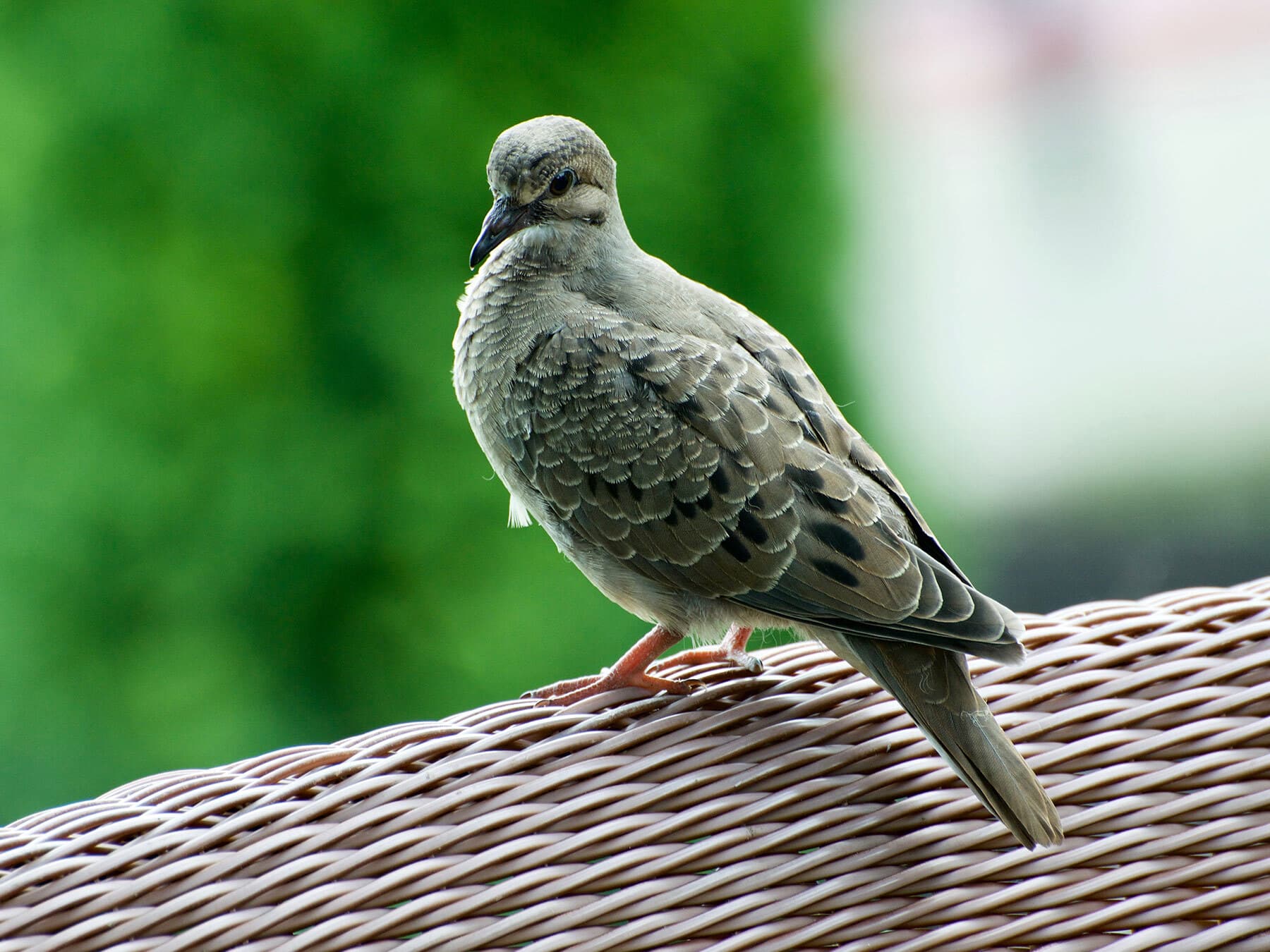
Young birds start replacing this plumage at about 30-40 days old, and the moult takes 100-120 days on average, so by late fall most look like adults.1 In the hand, wildlife biologists can still age many of them by the wing: white or buff tips on the primary coverts, and later a buff fringe on the tips of the outer two primaries, mark a young bird; experienced biologists aged 100 known-age wings from the East and Midwest almost without error, though the method is less reliable in the Southwest, where feathers wear more.13 A few even breed in the summer they hatch: near Tucson, young birds were involved in at least 10 nestings in 1963.6 Birds of the World puts the share that become sexually mature that first season at about 5-10% of females and 15-20% of males, if the days are still long enough, but most start breeding at a year old.1 For nestlings and fledglings, see baby Mourning Doves.
More males than females
Studies find more males than females, and the gap grows with age: 169 males to 137 females at hatching in one study (not a significant difference), 113-142 males per 100 females among young birds, and anywhere from 100 to 433 per 100 among adults, varying by month, season and place. None of these figures corrects for the sexes being seen, shot or trapped at different rates.1
Pairs and partners
Telling the sexes apart is easiest in a pair. For how pairs form, who does what at the nest and whether they stay together, see do Mourning Doves mate for life?
Sources
- Otis, D. L., Schulz, J. H., Miller, D., Mirarchi, R. E., Baskett, T. S. (2020). Mourning Dove (Zenaida macroura), version 1.0. Birds of the World (A. F. Poole, editor). Cornell Lab of Ornithology. doi:10.2173/bow.moudov.01
- Petrides, G. A. (1950). Notes on determination of sex and age in the woodcock and mourning dove. The Auk 67(3): 357-360. Accessed 12 October 2026. Source
- Sullivan, J. D., Mirarchi, R. E. (1999). Molt of after-hatching-year mourning doves. Journal of Wildlife Management 63(1): 223. doi:10.2307/3802504
- Menasco, K. A., Perry, H. R. Jr. (1978). Errors from determining sex of mourning doves by plumage characteristics. Proceedings of the Annual Conference of the Southeastern Association of Fish and Wildlife Agencies 32: 224-227. Accessed 12 October 2026. Source
- Irby, H. D., Blankenship, L. H. (1966). Breeding behavior of immature mourning doves. Journal of Wildlife Management 30(3): 598-604. doi:10.2307/3798754
- McClure, H. E. (1943). Ecology and management of the mourning dove, Zenaidura macroura (Linn.), in Cass County, Iowa. Iowa Agricultural Experiment Station Research Bulletin 310: 355-415. Accessed 12 October 2026. Source
- Craig, W. (1911). The expressions of emotion in the pigeons. II. The Mourning Dove (Zenaidura macroura Linn.). The Auk 28(4): 398-407. doi:10.2307/4071159
- Cornell Lab of Ornithology. Mourning Dove. All About Birds. Accessed 12 October 2026. Source
- Wilson, A. (1812). American Ornithology, vol. 5: Carolina Pigeon, or Turtle Dove. Bradford and Inskeep, Philadelphia. Accessed 12 October 2026. Source
- Gifford, E. W. (1909). The mourning dove in captivity. The Condor 11(3): 84-85. Accessed 12 October 2026. Source
- USGS Patuxent Wildlife Research Center. Mourning Dove identification tips. Patuxent Bird Identification InfoCenter. Accessed 12 October 2026. Source
- Wight, H. M., Blankenship, L. H., Tomlinson, R. E. (1967). Aging mourning doves by outer primary wear. Journal of Wildlife Management 31(4): 832-835. doi:10.2307/3797993