Facts · Updated 12 Oct 2026
Mourning Dove Nesting: Nests, Eggs and How Often They Breed
By the Birdfact teamChecked by Nathan Cope
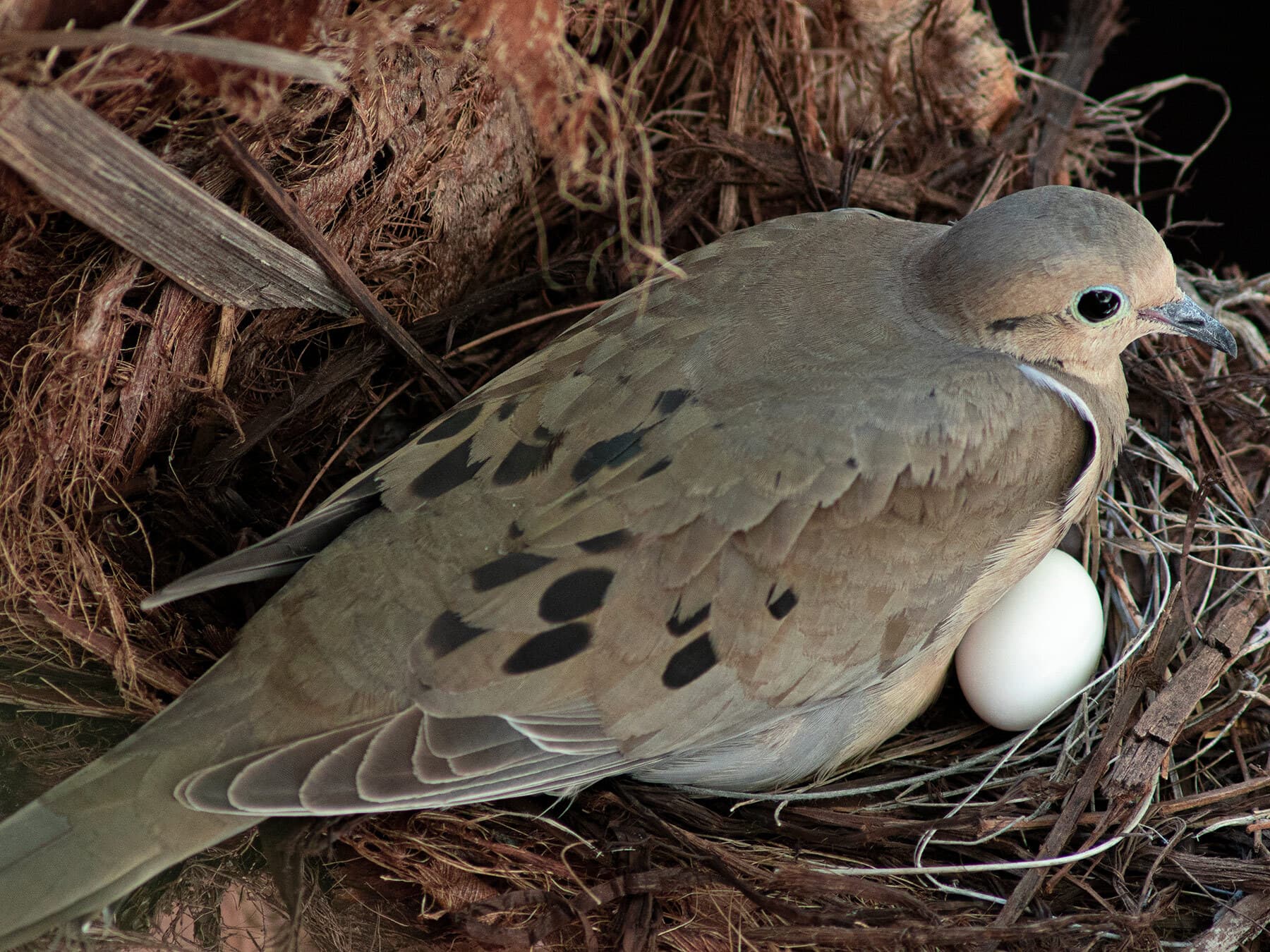
Mourning Doves nest from late winter to fall in trees, shrubs, gutters, flower pots and on the ground, on a flimsy platform the female builds from twigs the male hands her. The clutch is always two white eggs, incubated by both parents for 14 days, and pairs make 2 to 7 nesting attempts a year.
On this page13 sections
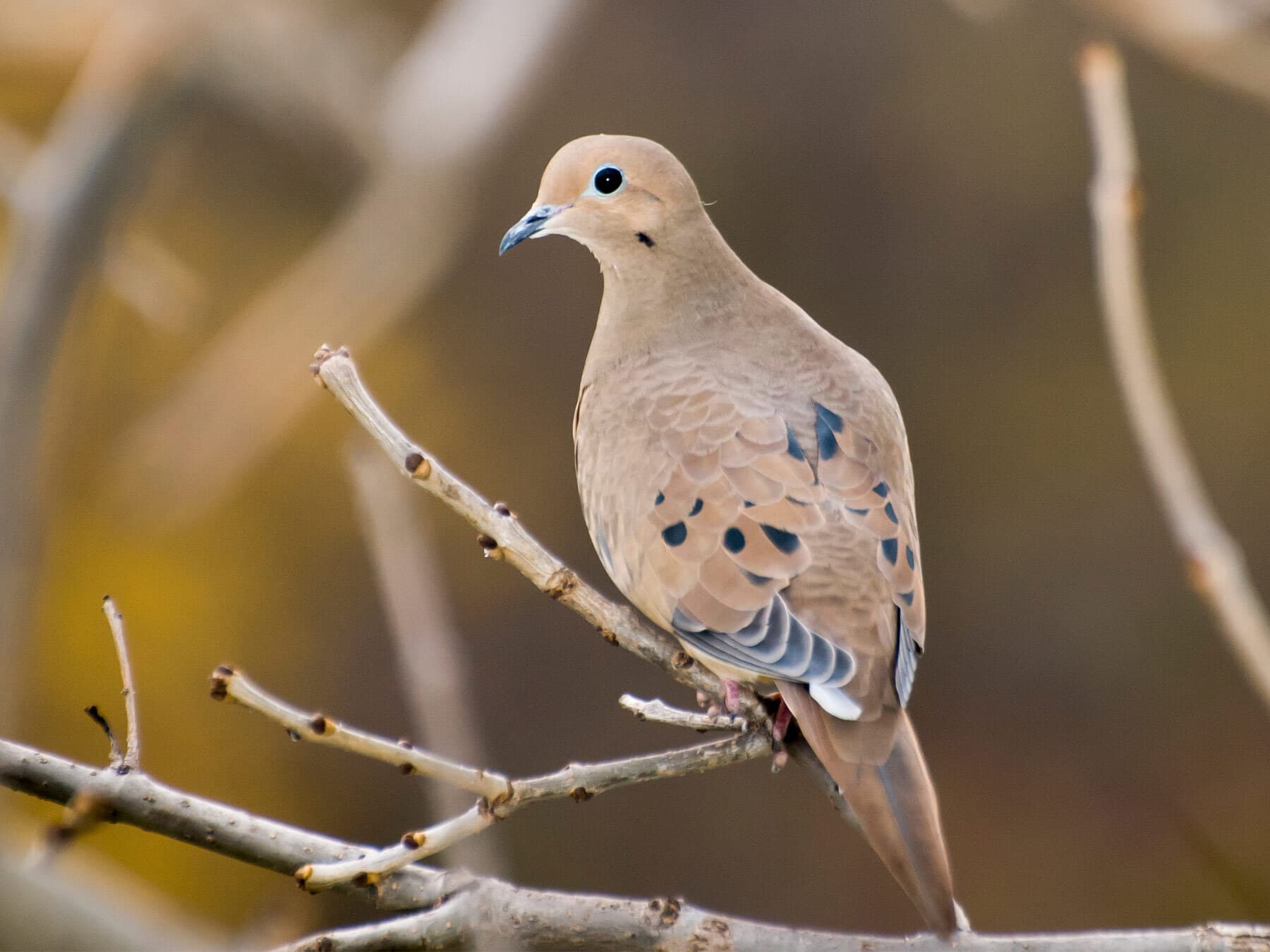
Where and when Mourning Doves nest, how they build, what their eggs look like, how often they nest in a year, and whether they come back to the same place. For the chicks, see baby Mourning Doves; for the bird itself, Mourning Dove identification and facts.
When do Mourning Doves nest?
For much of the year. In the South, nesting usually starts in late February or early March, and nests have been found in every month; farther north it starts a month or two later. The season is longest in the Southeast, where 80% of nests are started between April 1 and August 26, and shortest in the West (May 13 to August 10) and the north-central states (May 23 to August 25).1 Across the US, 83% of young doves leave the nest between May and August.
Where they nest
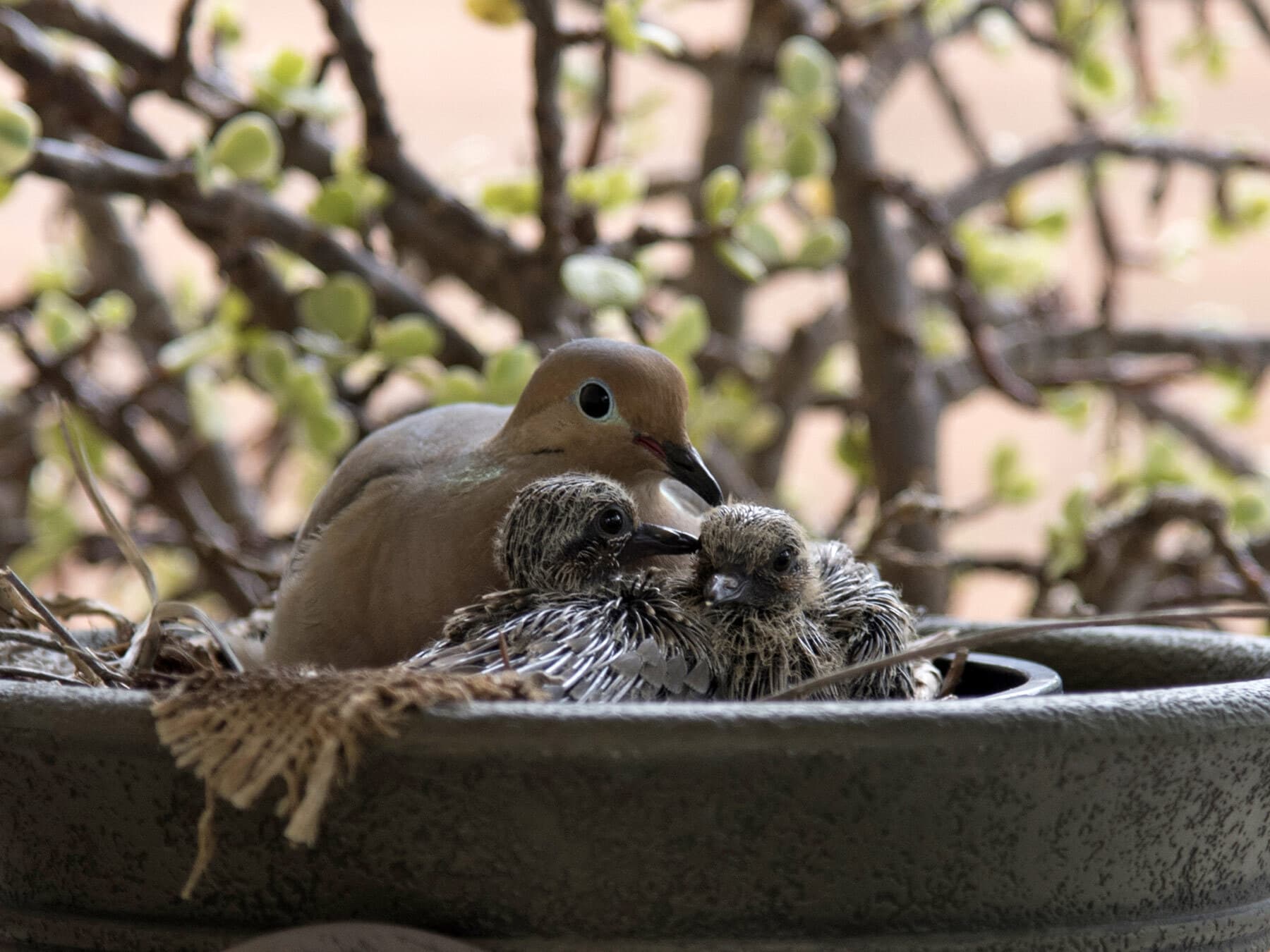
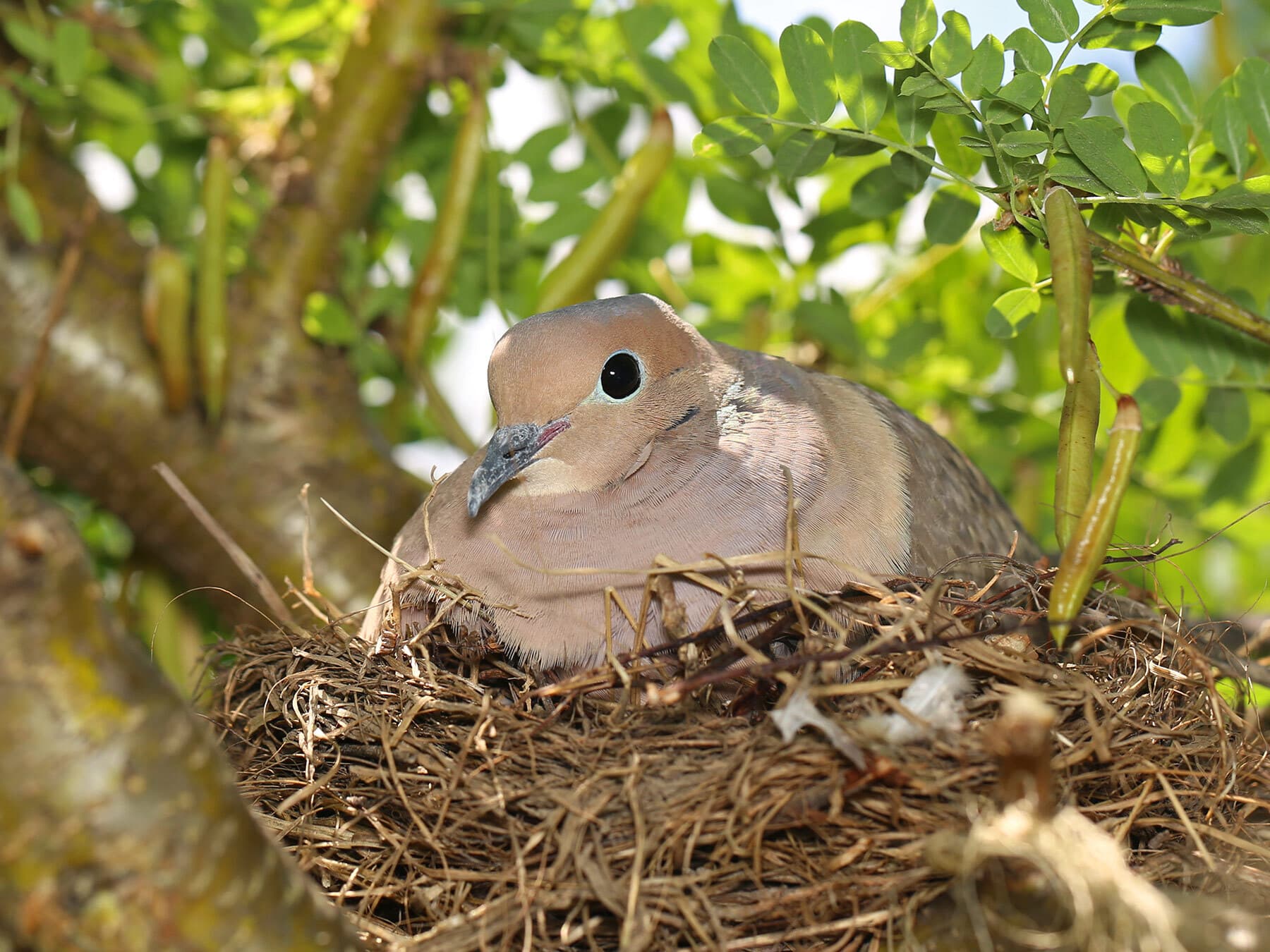
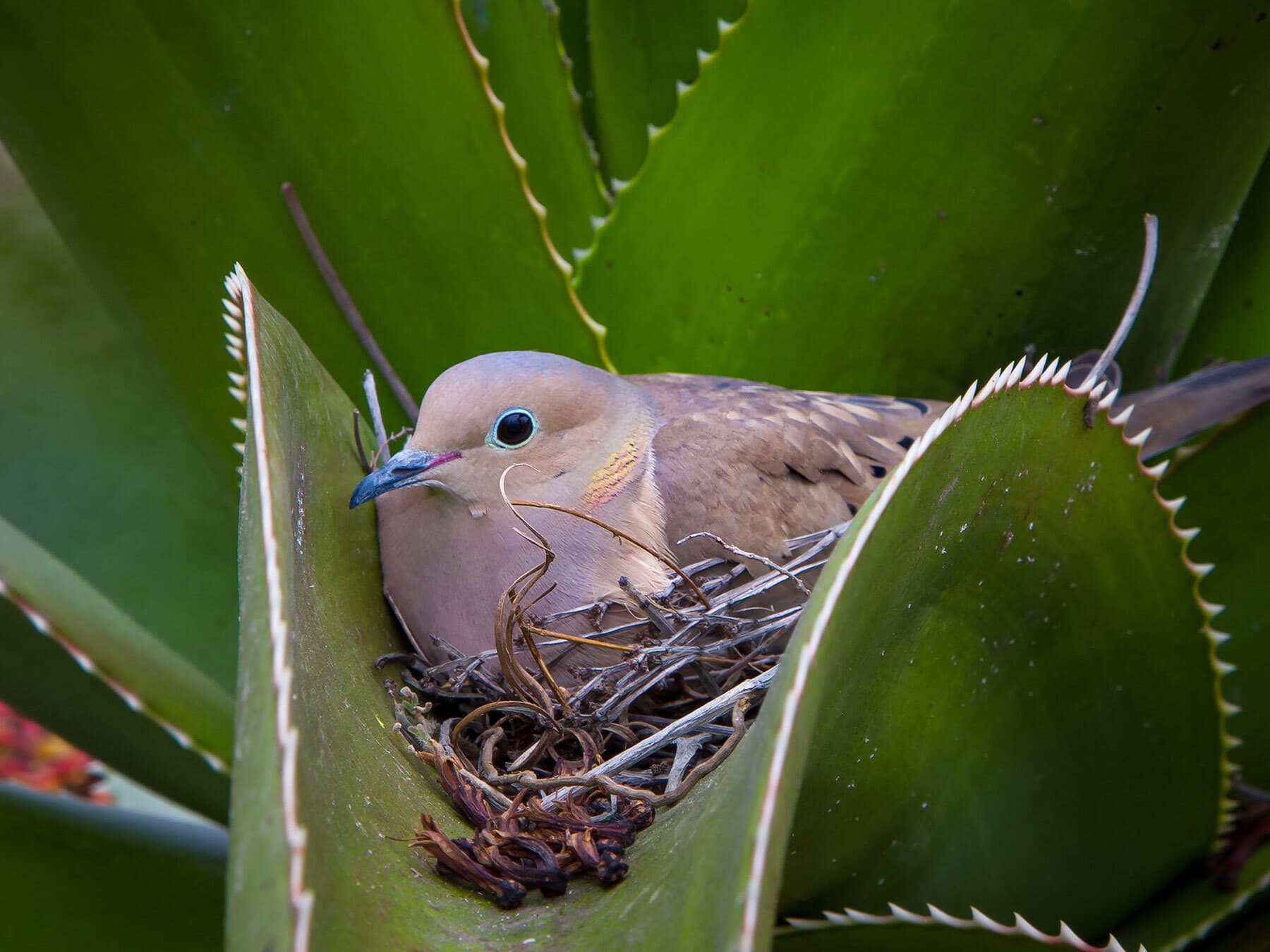
Almost anywhere with a flat base and a little cover. Most nests are in trees or shrubs at the edge of woodland or open country, but Mourning Doves nest readily on the ground where trees are scarce, and quite commonly in the West.2 They also use vines, ledges on buildings, gutters, eaves, hanging flower pots and odd places such as a rain spout or a mop hung on a wall.
Audubon's guide puts most nests below 40 feet and only rarely 100 feet or more,3 though Birds of the World records nests from the ground up to 260 feet (80 m), and on an Oklahoma campus in 1920-21 most were 12 to 20 feet up.4 Early in the season doves favor conifers, and switch to broadleaved trees once the leaves are out. In the East they use conifers and orchard trees; on the Plains, shelterbelts, mesquite and the ground; in the West, cottonwoods, mesquite, saltcedar, orchards, grapevines, palms and the ground. In one North Carolina study nests were found in 55 kinds of trees and shrubs, two-thirds of them conifers.
How they build the nest
The male picks out possible sites and calls the female to them with his three-note nest call. Once they settle on one, he gathers twigs, pine needles and grass stems and hands each piece to her while standing on her back, and she arranges them around her body. He may make 30 to 40 trips in a bout, mostly in the early morning. Building takes 7 to 10 hours of work spread over 2 to 4 days.1
The result is famously flimsy: an unlined platform about 8 inches (20 cm) across, with little insulation for the young.

Reusing old nests
Pairs often reuse their own old nests or those of other doves, and build on top of old nests of American Robins, Common Grackles and Blue Jays, which saves time. Studies reviewed in 1986 found nests reused in as many as 35 to 40% of nesting attempts,5 and on the Oklahoma campus 15% of nests sat on top of other birds' old ones. NestWatch also notes that doves sometimes take over old nests, their own or other birds'.6 A pair may even lay its next clutch in the same nest while the last young are still being fed nearby.
Do Mourning Doves return to the same nest every year?
Many come back to the same area, and often to nearly the same spot. In a 20-year banding study on Cape Cod, more than half the doves that survived the winter returned to the banding area each summer. In Minnesota, 80% of returning doves nested within 200 feet (60 m) of the site they used the year before, and birds found nesting two years later had moved on average only 300 feet (91 m).1 Young birds are less predictable. In Missouri only 13 of 411 doves banded young were caught again where they were banded, which suggested they settle where they first nest rather than where they hatched; a Minnesota study, though, found signs that many survivors homed to their natal area.7
Eggs
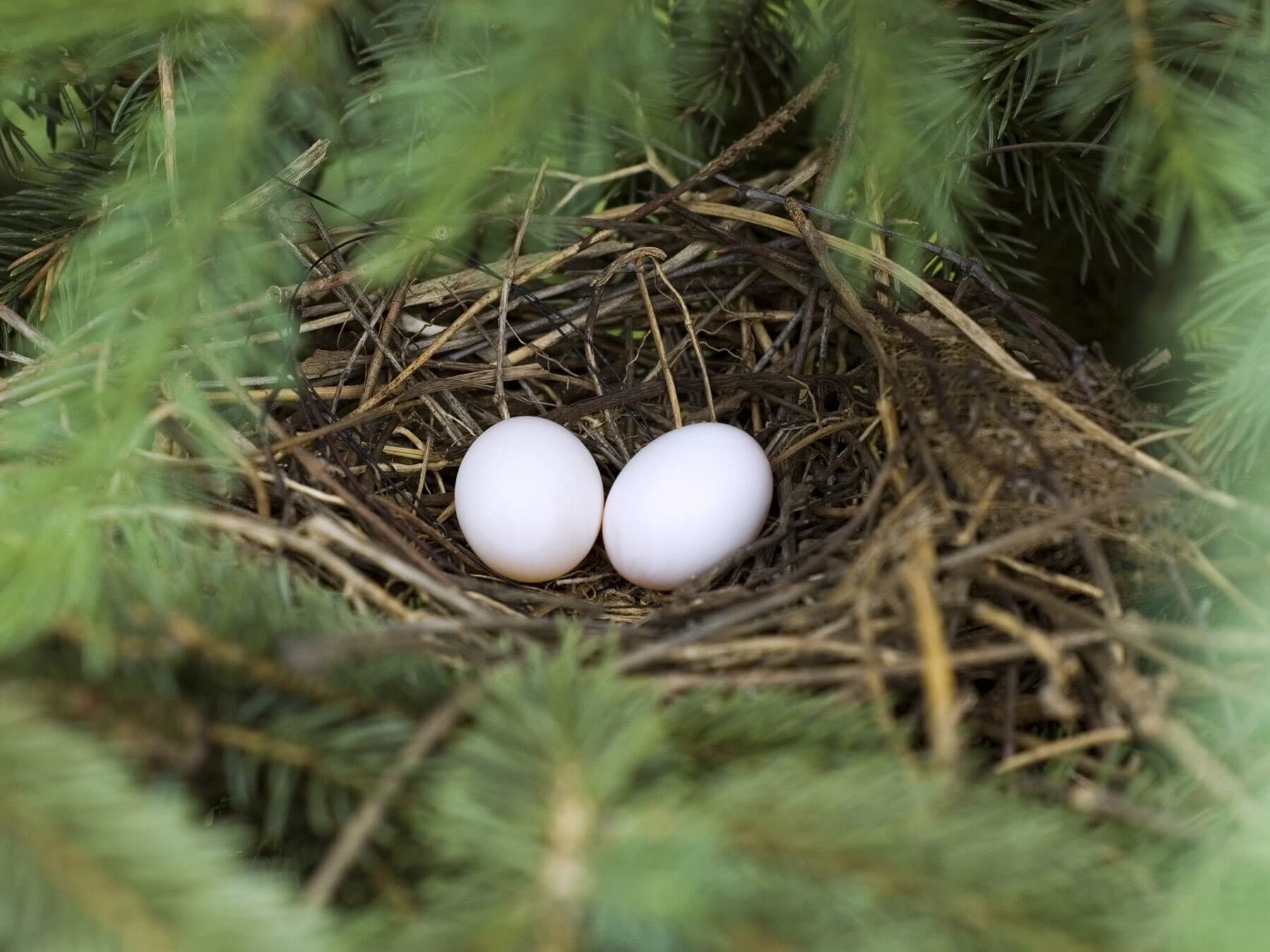
Mourning Dove eggs are pure white and unmarked, about 1.0 to 1.2 inches by 0.8 to 0.9 inches (2.6-3.0 by 2.1-2.3 cm), and weigh about a quarter of an ounce (6-7 g), 5 to 6% of the female's weight. The first egg is usually laid within 2 days of finishing the nest, often in the early morning, and the second the next day or the day after.
The clutch is normally two. In North Dakota, 1,169 of 1,203 nests (97.2%) held two eggs; the 28 with three or four eggs were probably laid by more than one female.8 A nest with a single egg has usually lost the other.
Why only two eggs
Crop milk may be part of the answer. In North Dakota, David Blockstein gave pairs a third chick while their young still depended on crop milk: all the chicks in those nests were lighter at 9 to 10 days (48 g against 61 g in broods of two), and 7 of them (17%) were runts of about 35 g. He concluded that crop-milk production is apparently an important reason doves lay no more than two eggs.8 In Iowa, parents could incubate three eggs and brood three chicks, but enlarged broods grew more slowly, left the nest 1.3 days later and weighed 26% less; they did fledge an estimated 30% more young, though the authors note that poor survival after fledging may cancel the gain.9 Instead of laying more eggs, doves nest more often.
Incubation
Both parents incubate, for 14 days; in an Iowa study, 13.8 days for two-egg clutches.9 The eggs are covered almost constantly: the male usually sits from mid-morning to late afternoon and the female the rest of the day and night. In Iowa, H. E. McClure found the male on the eggs from about 8 a.m. to 5 p.m. and the female from about 5 p.m. to 8 a.m.10 Exact times vary by two or three hours. Neither parent has a bare brood patch. In desert heat, a sitting dove draws heat out of the eggs and sheds it by panting.
If you flush a dove from its nest it may flutter on the ground as if injured, to lead you away. This distraction display gets stronger as nesting goes on and is most intense once there are chicks. Try not to flush a sitting dove: in one study, nests whose parents were flushed every 3 days survived less well than undisturbed ones, especially while there were eggs,11 though another found no difference in predation between nests visited daily and weekly.
How many times a year do Mourning Doves nest?
Several. Birds of the World gives 2 to 7 nesting attempts a year, more in the South, with about 30 days from starting one successful clutch to starting the next. One marked pair in Texas made six attempts in a season. Many attempts fail, though: in Iowa in 1938-40, pairs made on average 4.6 to 5.4 nesting attempts a year but raised only 1.8 to 3 successful broods.10 NestWatch notes that a pair may nest two or three times one after another.12 A 1986 review in The Auk calls the Mourning Dove the champion of multiple brooding among North American birds.5
They manage it by saving time at every step: small nests, reused nests, small eggs, fast-growing chicks, early fledging, and laying the next clutch while the last young are still being fed. Together these make a dove's nesting cycle about 22% shorter than expected for a bird its size. If a nest is lost, a female can lay again in 5 or 6 days if the eggs were taken just after laying, but may take 2 or 3 weeks if the nest is destroyed early in brooding.
Nest success
On average, fewer than half of nests succeed. Nest success has ranged from 30 to 41% in California and 37 to 58% in Iowa to 52 to 87% in Illinois, with an average of 48% across studies.1 More nests fail during incubation than after hatching. Weather is a big cause: nests and chicks are often lost in high winds and heavy rain. Predators are the other: in Iowa, Blue Jays, fox squirrels and house cats took the most eggs and chicks, and rat snakes are the main snake predator of nests.
Nest cones
Mourning Doves do not use nest boxes. NestWatch suggests offering a nest cone instead, which may also draw doves away from spots such as potted plants: a cone of wire mesh wired into a horizontal fork of a live tree, in shade with branches overhead, 6 to 10 feet up, about one per 2.5 acres. Doves don't need one, but it gives their flimsy nest a solid base.12 Put it up well before spring.
Moving a nest and the law
Leave a nest with eggs or young alone. Mourning Doves are protected under the Migratory Bird Treaty Act, which makes it unlawful to take or possess a migratory bird, or its nest or eggs, except as federal regulations allow.13 A nesting attempt lasts about a month, 14 days of incubation and about two weeks in the nest, but pairs may reuse a nest straight away. If a nest must go, ask your state wildlife agency or the US Fish and Wildlife Service first.
Sources
- Otis, D. L., Schulz, J. H., Miller, D., Mirarchi, R. E., Baskett, T. S. (2020). Mourning Dove (Zenaida macroura), version 1.0. Birds of the World (A. F. Poole, editor). Cornell Lab of Ornithology. doi:10.2173/bow.moudov.01
- Cornell Lab of Ornithology. Mourning Dove. All About Birds. Accessed October 12, 2026. Source
- National Audubon Society. Mourning Dove. Guide to North American Birds (text adapted from Kaufman 1996). Accessed October 12, 2026. Source
- Nice, M. M. (1922). A study of the nesting of Mourning Doves. The Auk 39(4): 457-474. doi:10.2307/4073568
- Westmoreland, D., Best, L. B., Blockstein, D. E. (1986). Multiple brooding as a reproductive strategy: time-conserving adaptations in Mourning Doves. The Auk 103(1): 196-203. doi:10.1093/auk/103.1.196
- NestWatch (Cornell Lab of Ornithology). Mourning Dove. NestWatch focal species. Accessed October 12, 2026. Source
- Thomforde, L. L. (1972). Migration and mortality of banded mourning doves. Journal of the Minnesota Academy of Science 38(2): 72-76. Accessed October 12, 2026.
- Blockstein, D. E. (1989). Crop milk and clutch size in Mourning Doves. Wilson Bulletin 101(1): 11-25. Accessed October 12, 2026. Source
- Westmoreland, D., Best, L. B. (1987). What limits Mourning Doves to a clutch of two eggs? The Condor 89(3): 486-493. doi:10.2307/1368638
- McClure, H. E. (1943). Ecology and management of the mourning dove, Zenaidura macroura (Linn.), in Cass County, Iowa. Iowa Agricultural Experiment Station Research Bulletin 310: 355-415. Accessed October 12, 2026. Source
- Westmoreland, D., Best, L. B. (1985). The effect of disturbance on Mourning Dove nesting success. The Auk 102(4): 774-780. doi:10.1093/auk/102.4.774
- NestWatch (Cornell Lab of Ornithology). Right Bird, Right House: Mourning Dove. NestWatch, All About Birdhouses. Accessed October 12, 2026. Source
- United States Congress (1918). Migratory Bird Treaty Act, 16 U.S.C. 703. United States Code, Title 16, section 703 (Legal Information Institute). Accessed October 12, 2026. Source
- U.S. Fish and Wildlife Service (2026). 50 CFR 10.13: List of Migratory Birds. Electronic Code of Federal Regulations (up to date as of 8 October 2026). Accessed October 12, 2026. Source