


Eurasian Collared Dove
Collared Dove · Streptopelia decaocto
By the Birdfact teamChecked by Nathan Cope
See it in 3D
3D model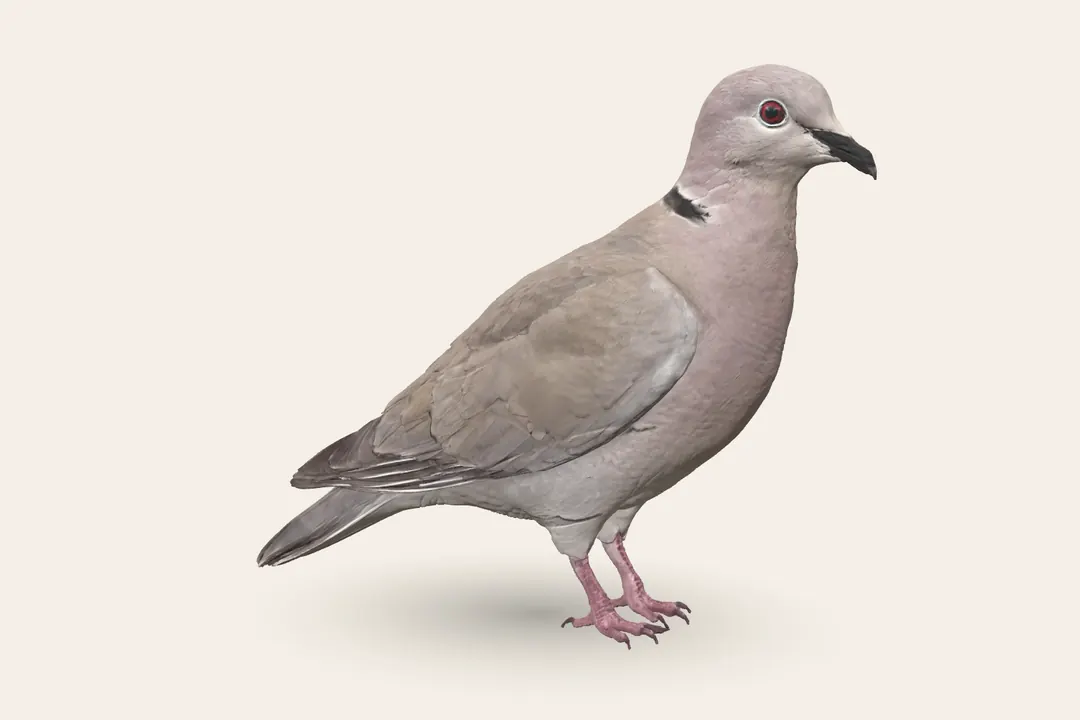 3D model
A Eurasian Collared Dove is 30–32 cm (12–12.5 in) long, bill to tail.
3D model · Adult · Length 30–32 cm (12–12.5 in) · How we make our birds · Report a problem
© 2026 NC Digital Limited (Birdfact). All rights reserved. This 3D model may be viewed on this page and shared by link only. Downloading, extracting, copying or reusing it, or using it to train machine-learning models, is not permitted without our written permission. Using our models
On this page16 sections
How to recognise it
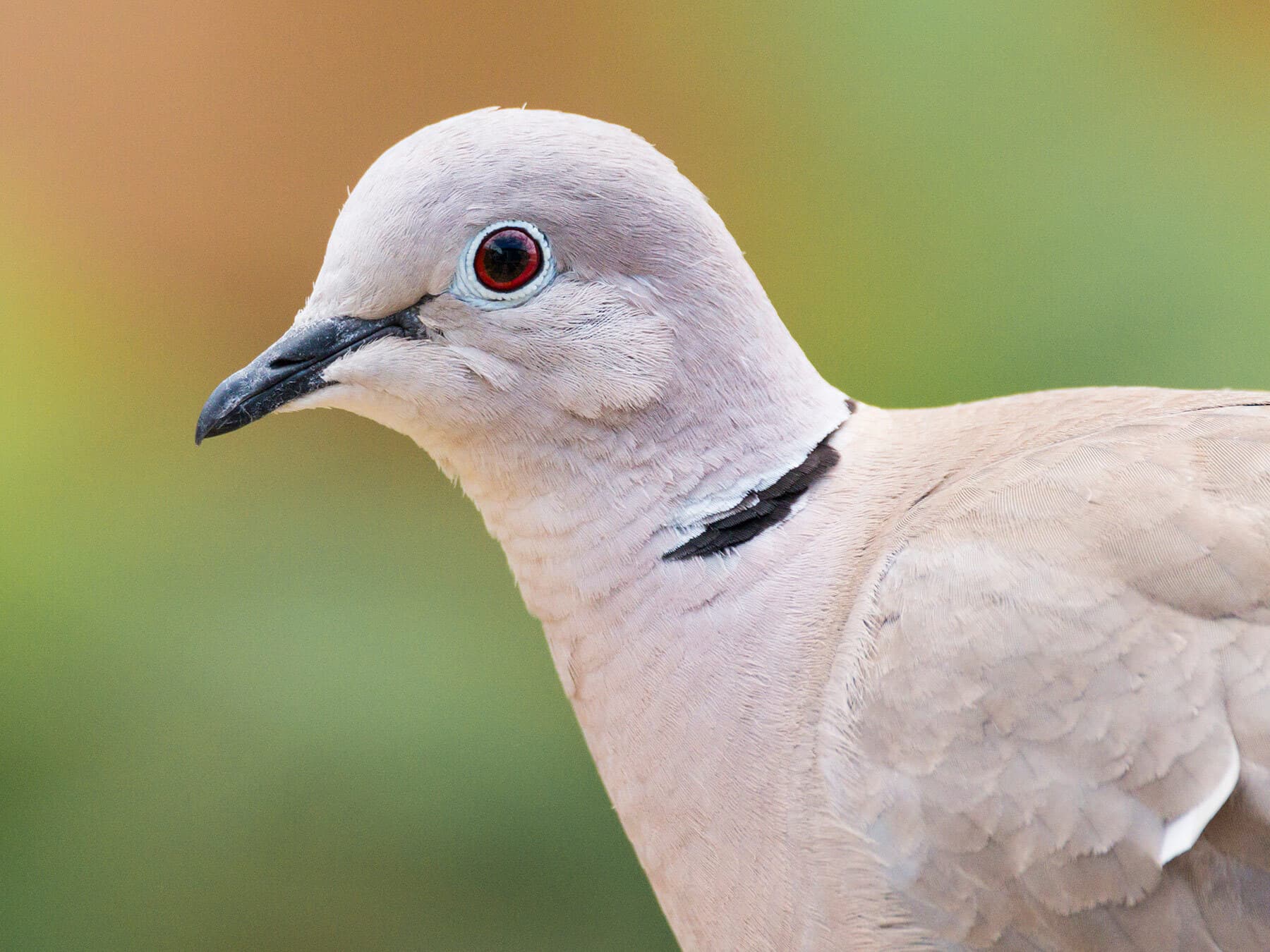
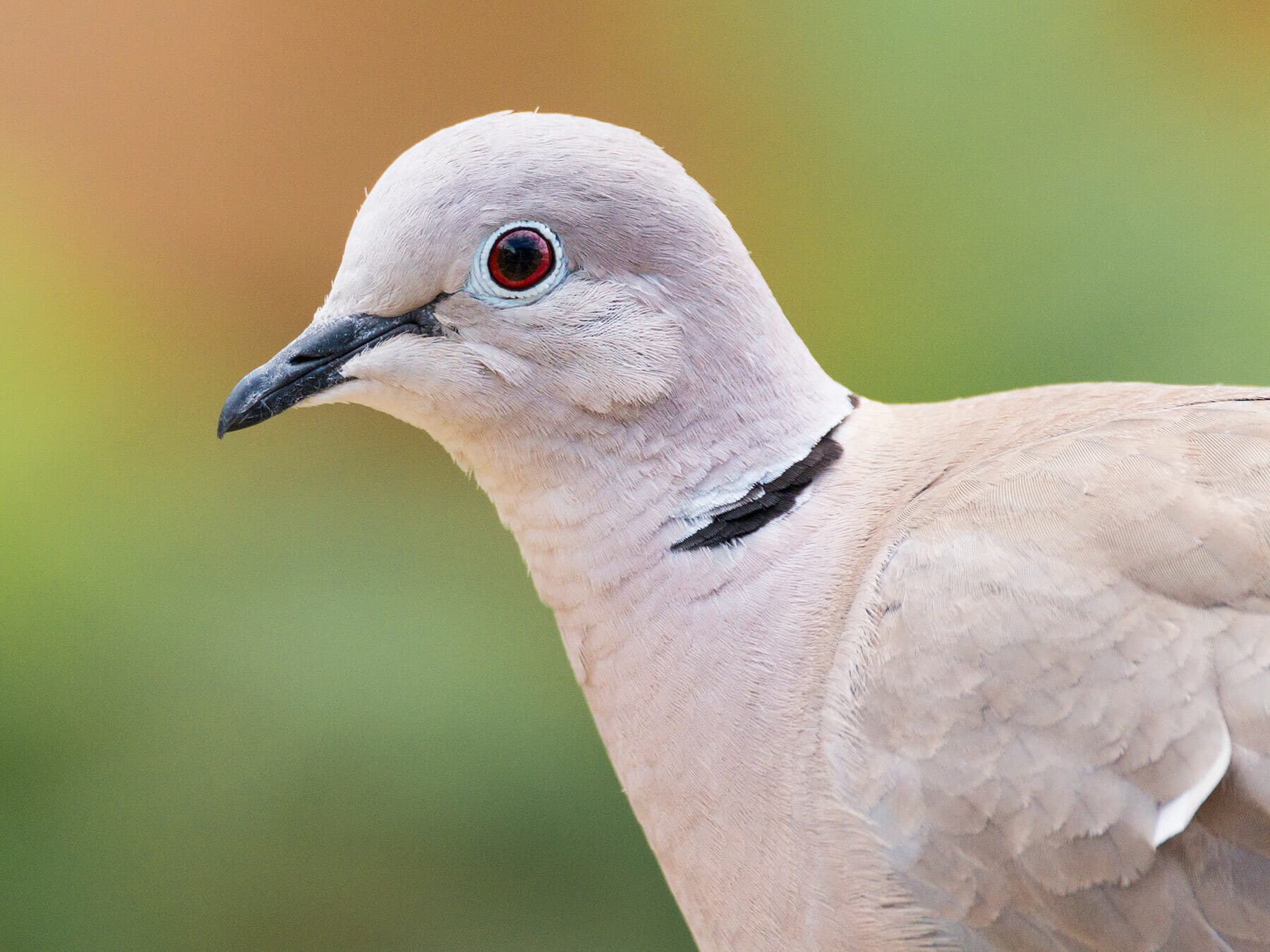
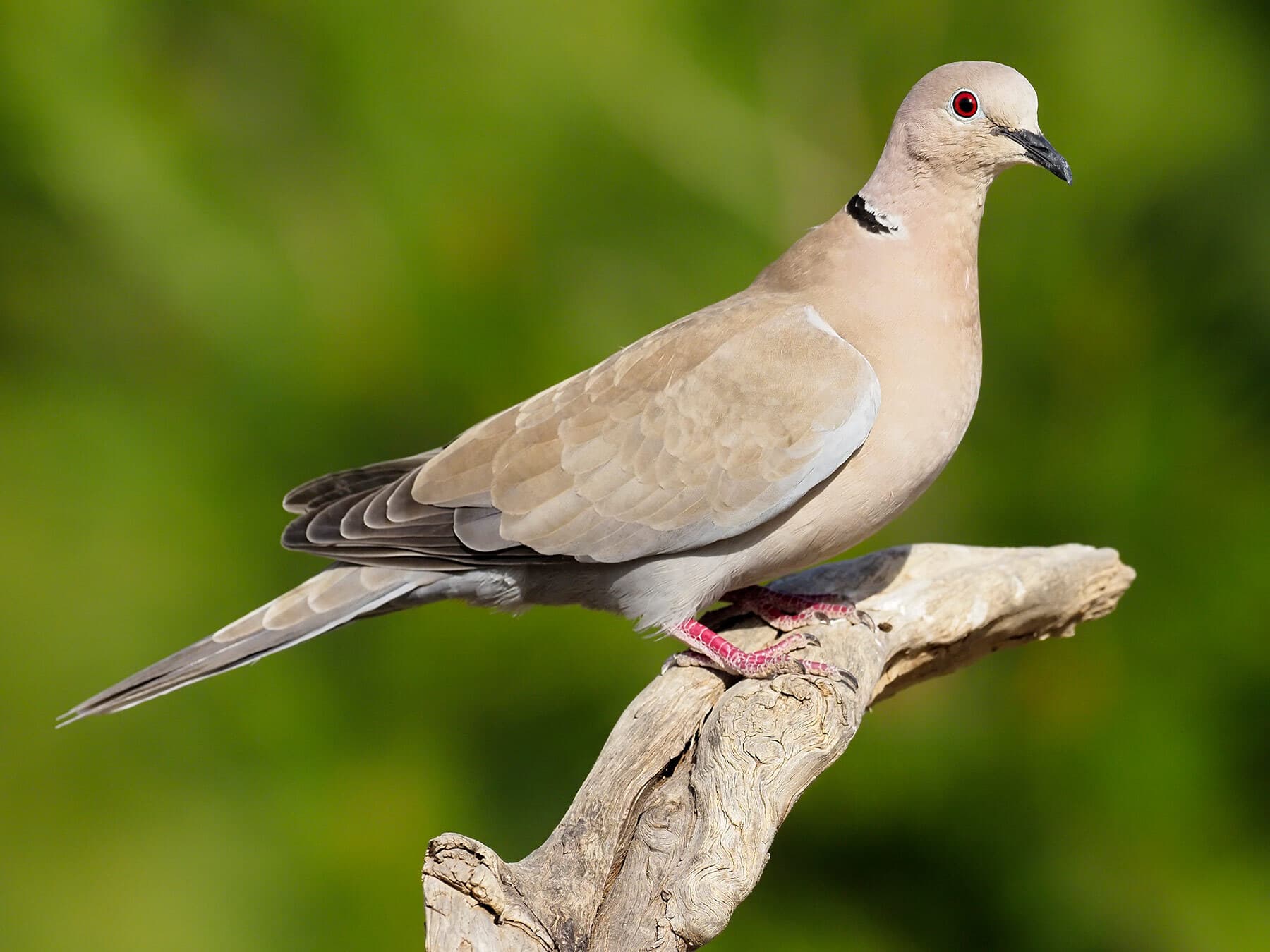
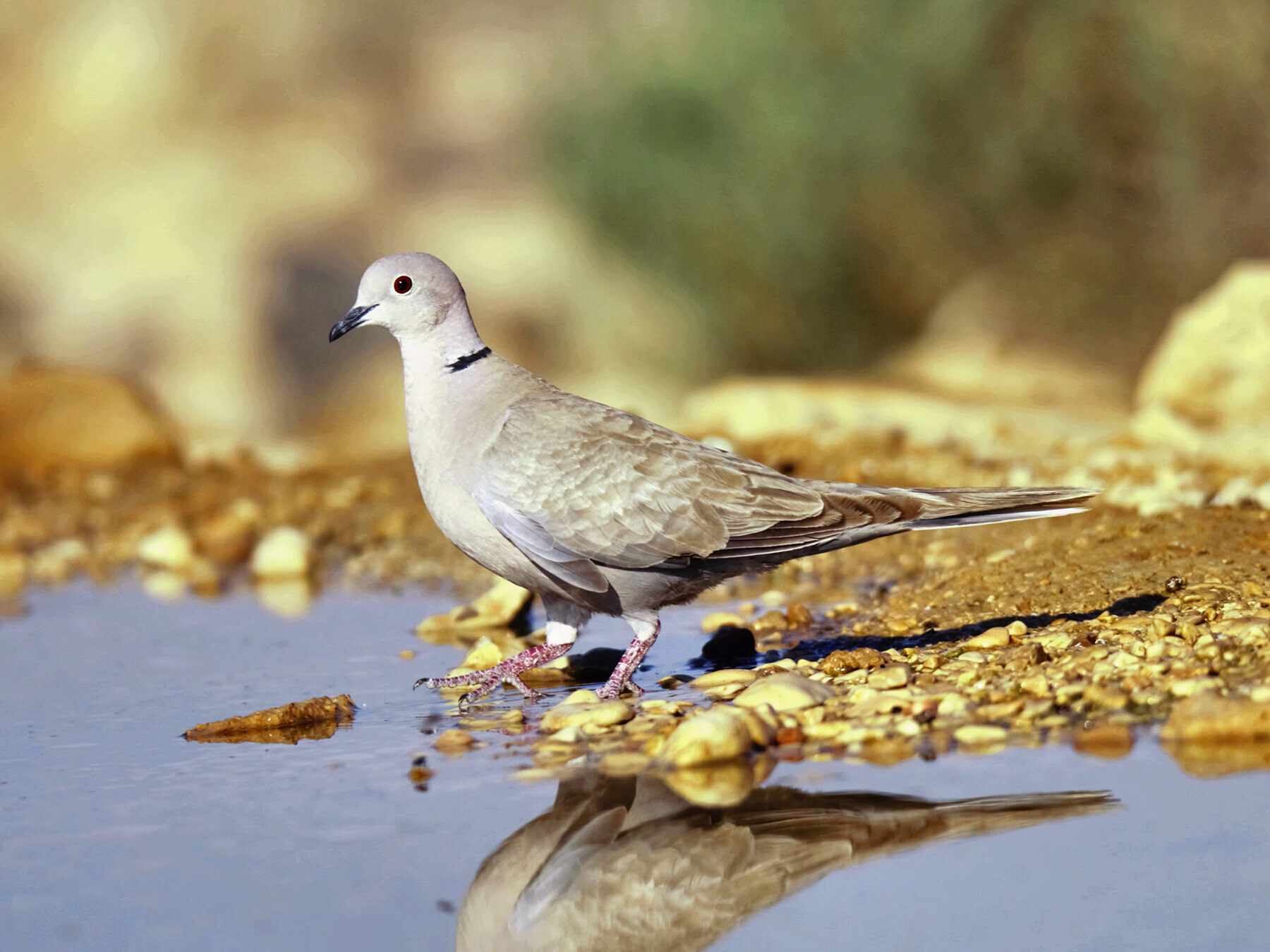
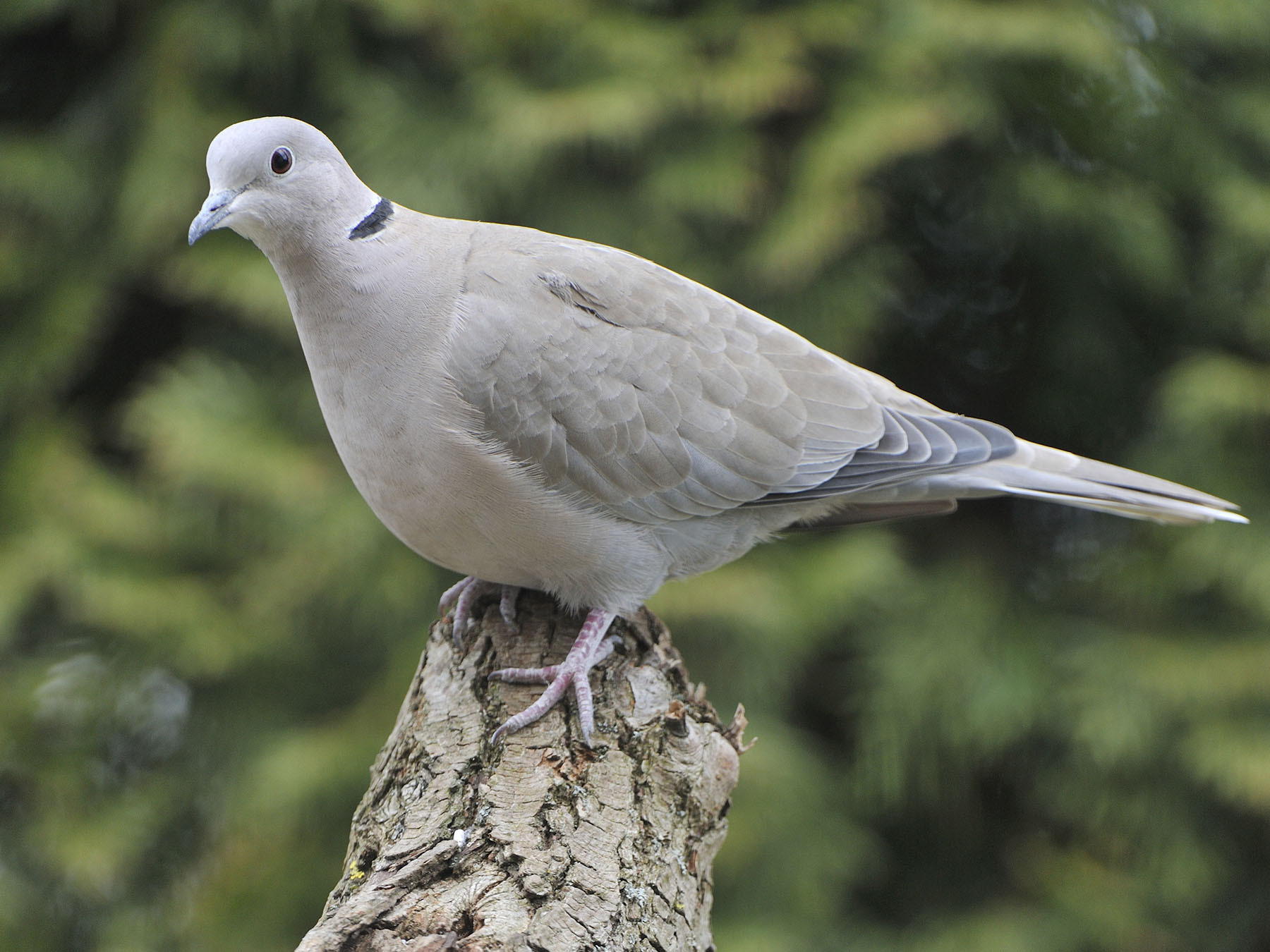
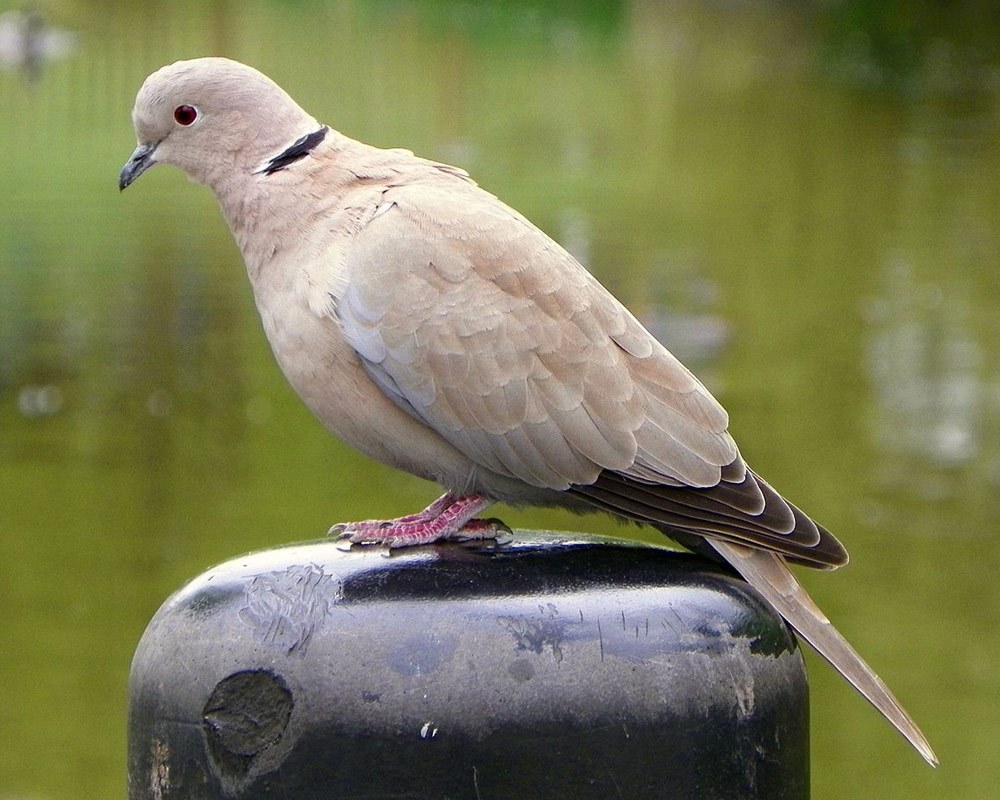
A pale, medium-sized dove, 30 to 32 cm (about 12 in) long and around 200 g (7 oz): smaller than a Woodpigeon.1 It is a soft sandy grey-buff, pinkish on the head and breast in good light, with a narrow black half-collar on the back of the neck, edged with white.2
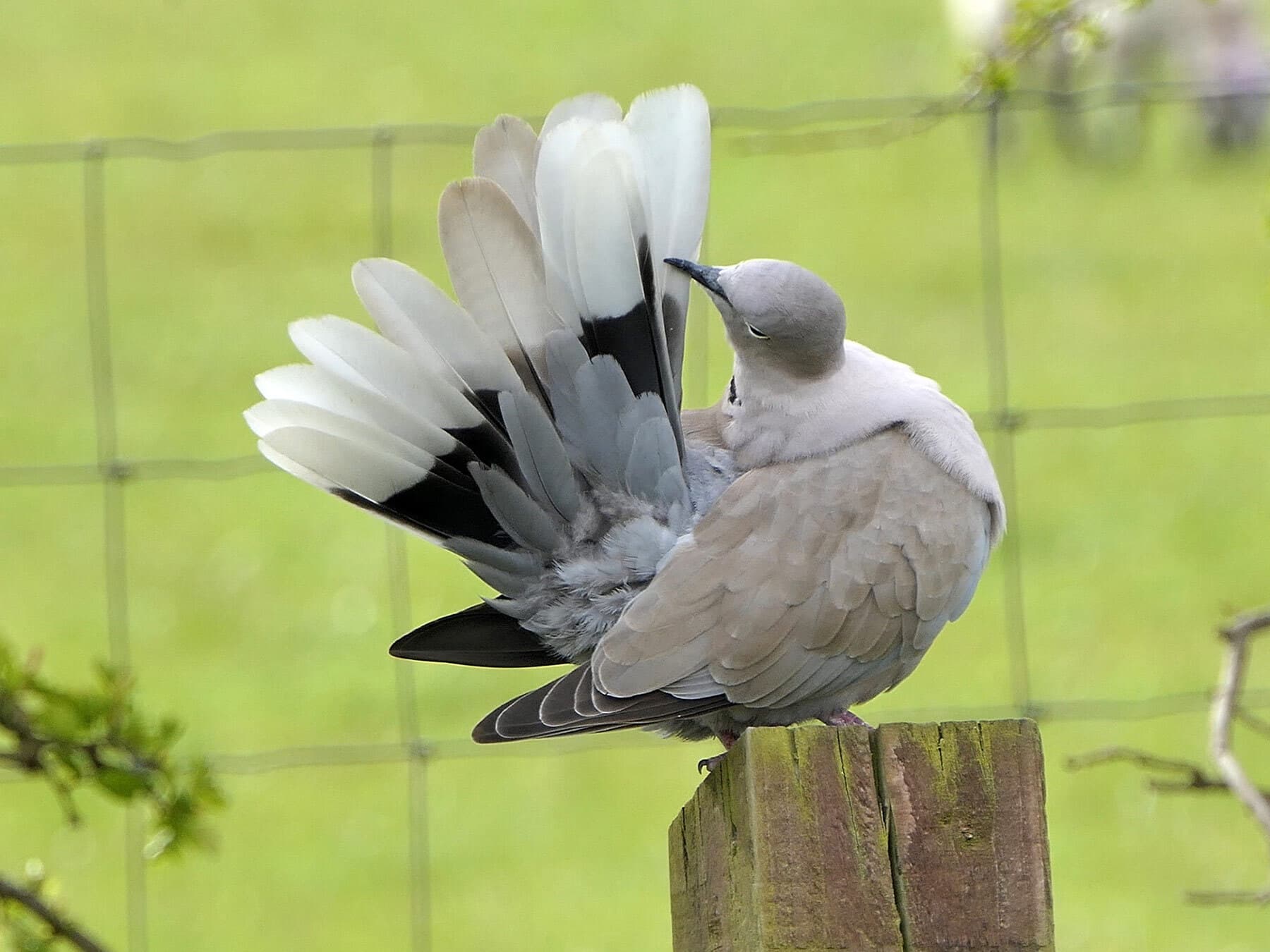
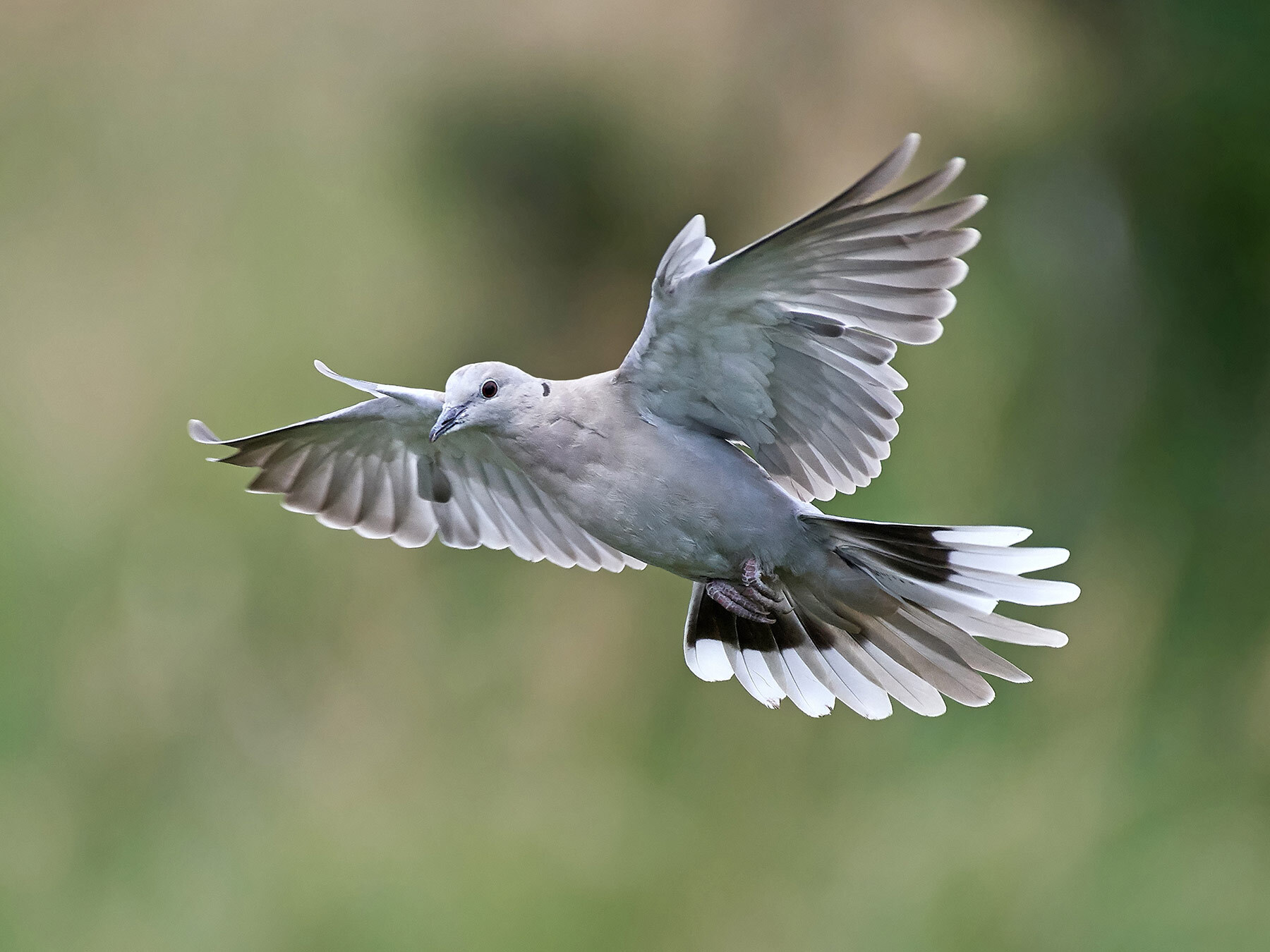
Close up, the eye is deep red inside a thin greyish-white ring, the bill is black and the legs are dark red. The wingtips are dark, and in flight the outer wing looks darker than the grey middle of the wing. From below, the long, square-ended tail is black at the base and broadly white at the tip, which shows best as a bird lands or in the male's display flight.
Adults weighed by BTO ringers average 205 g (about 7 oz).3 The RSPB gives a wingspan of about 51 cm (20 in).1
Male, female and young
Males and females look alike. Females tend to be a little duller and less pink, with greyish rather than white edges to the collar, but the difference overlaps and is hard to see. Males are a little heavier on average: 208 g against 202 g in BTO's samples.3
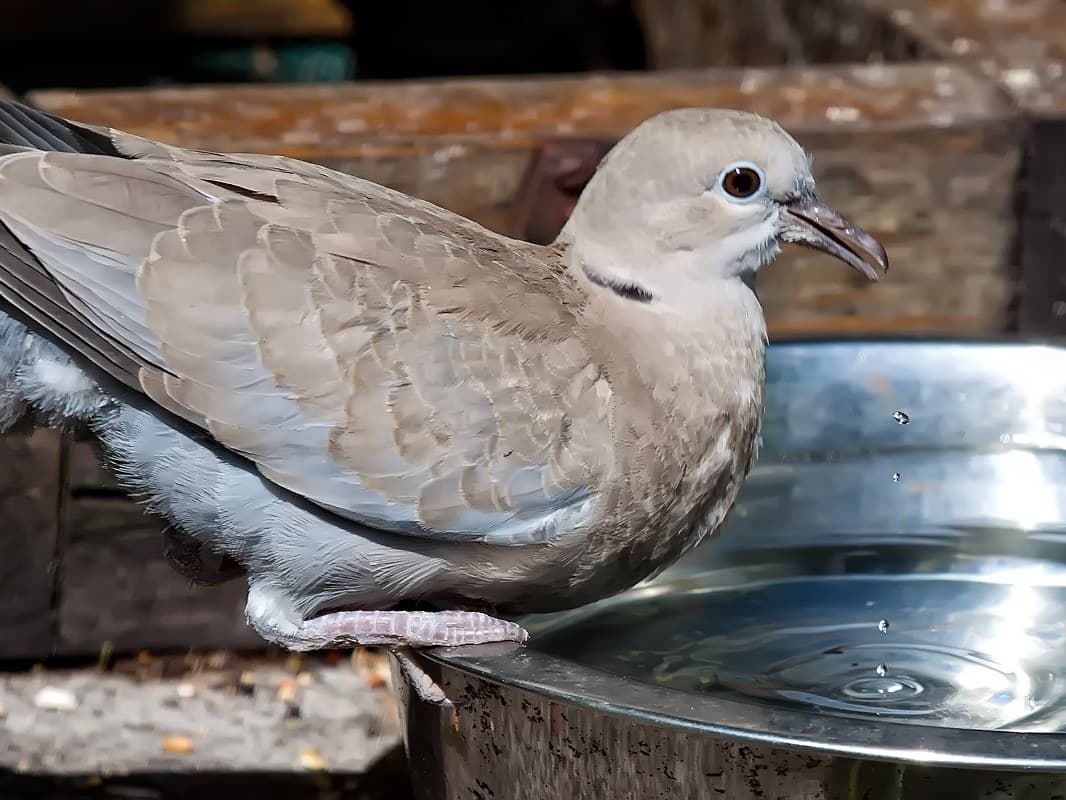
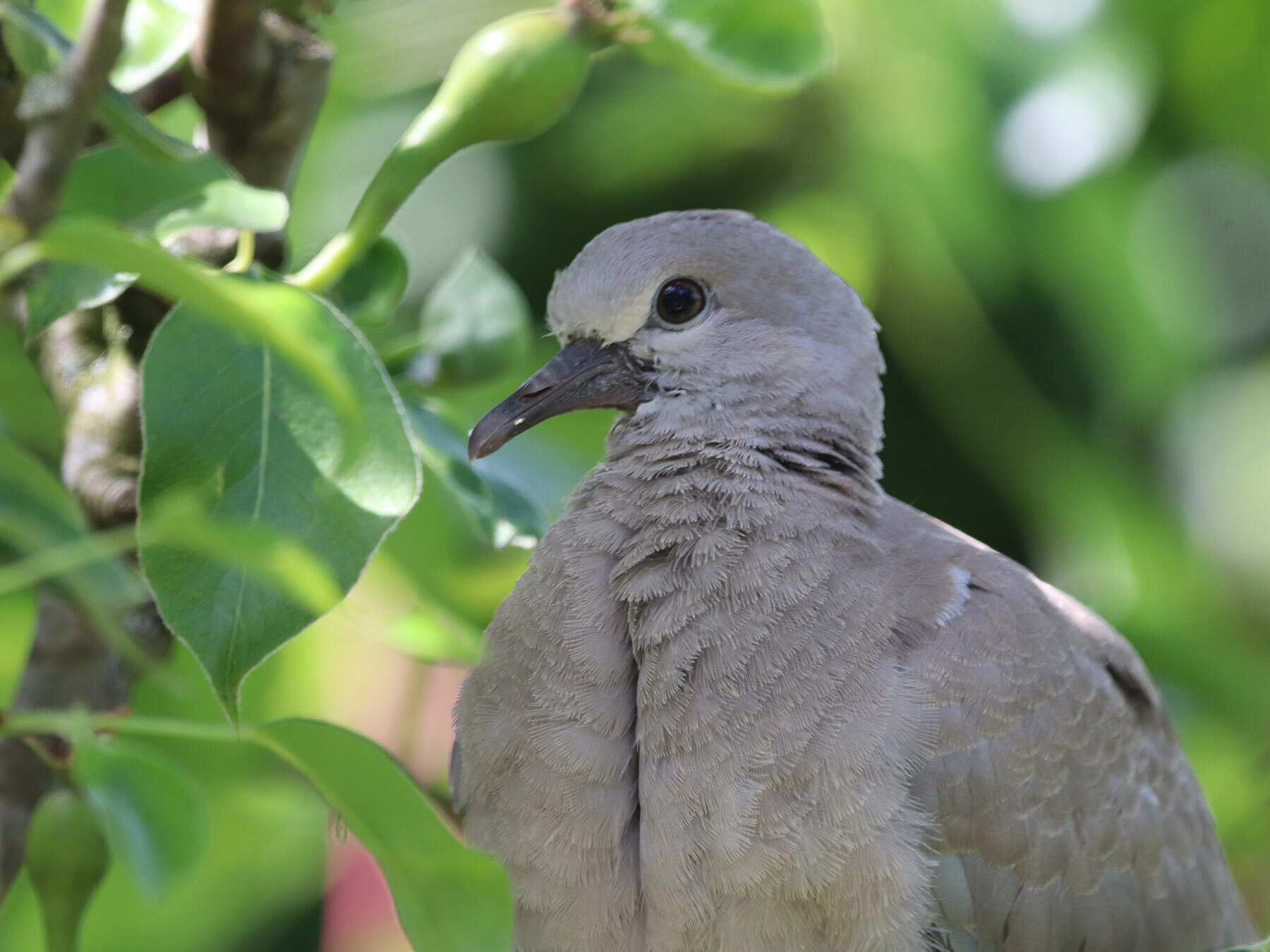
Young birds have pale reddish to buff edges to their feathers, which gives them a scaly look, and a brown eye. They have no complete black collar until they are about three months old.
Identification: similar birds
Pigeons and doves are one family, and the two names mark no scientific difference.4 Among them, the Collared Dove is the pale one with a thin black half-collar.
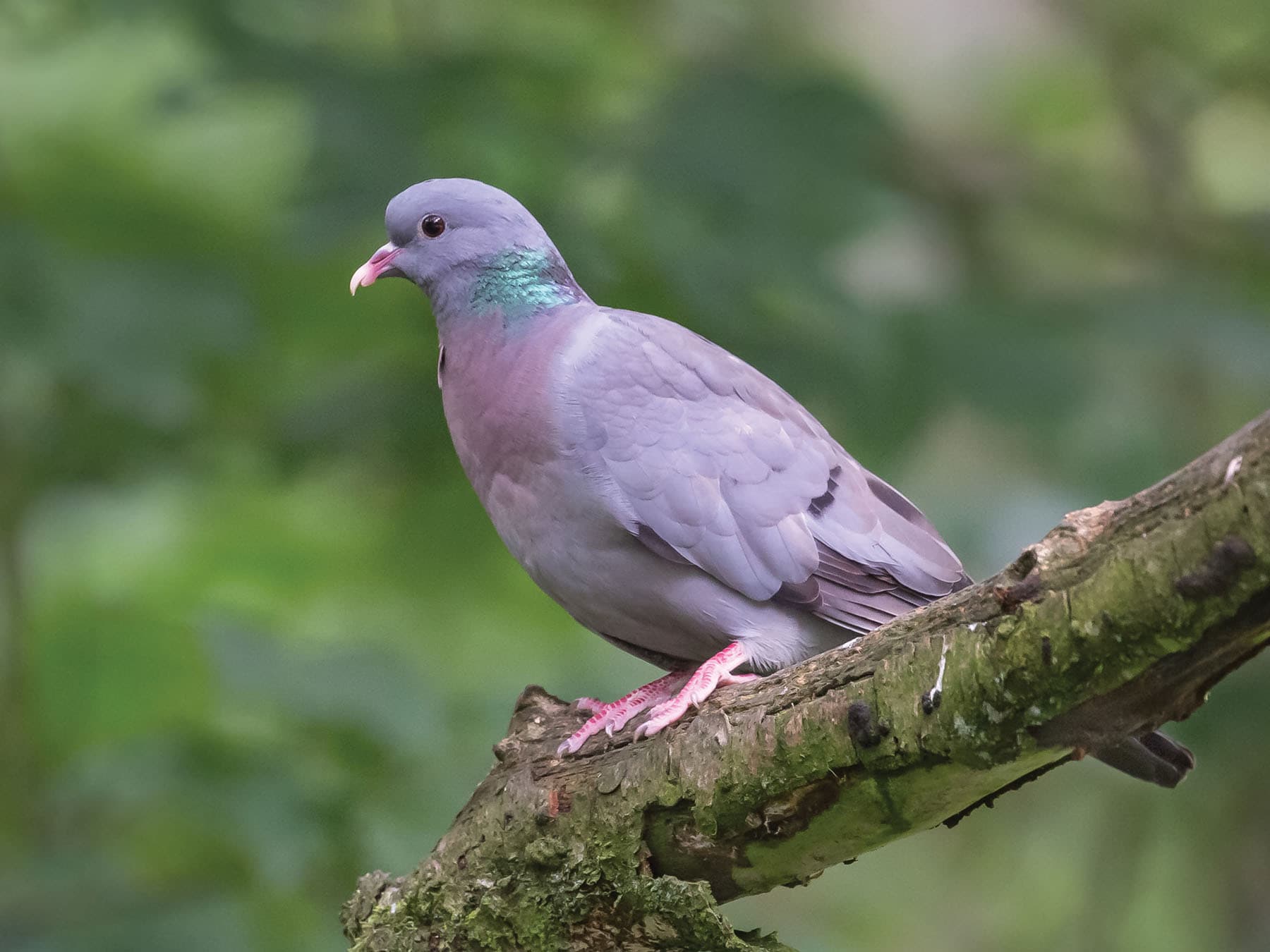
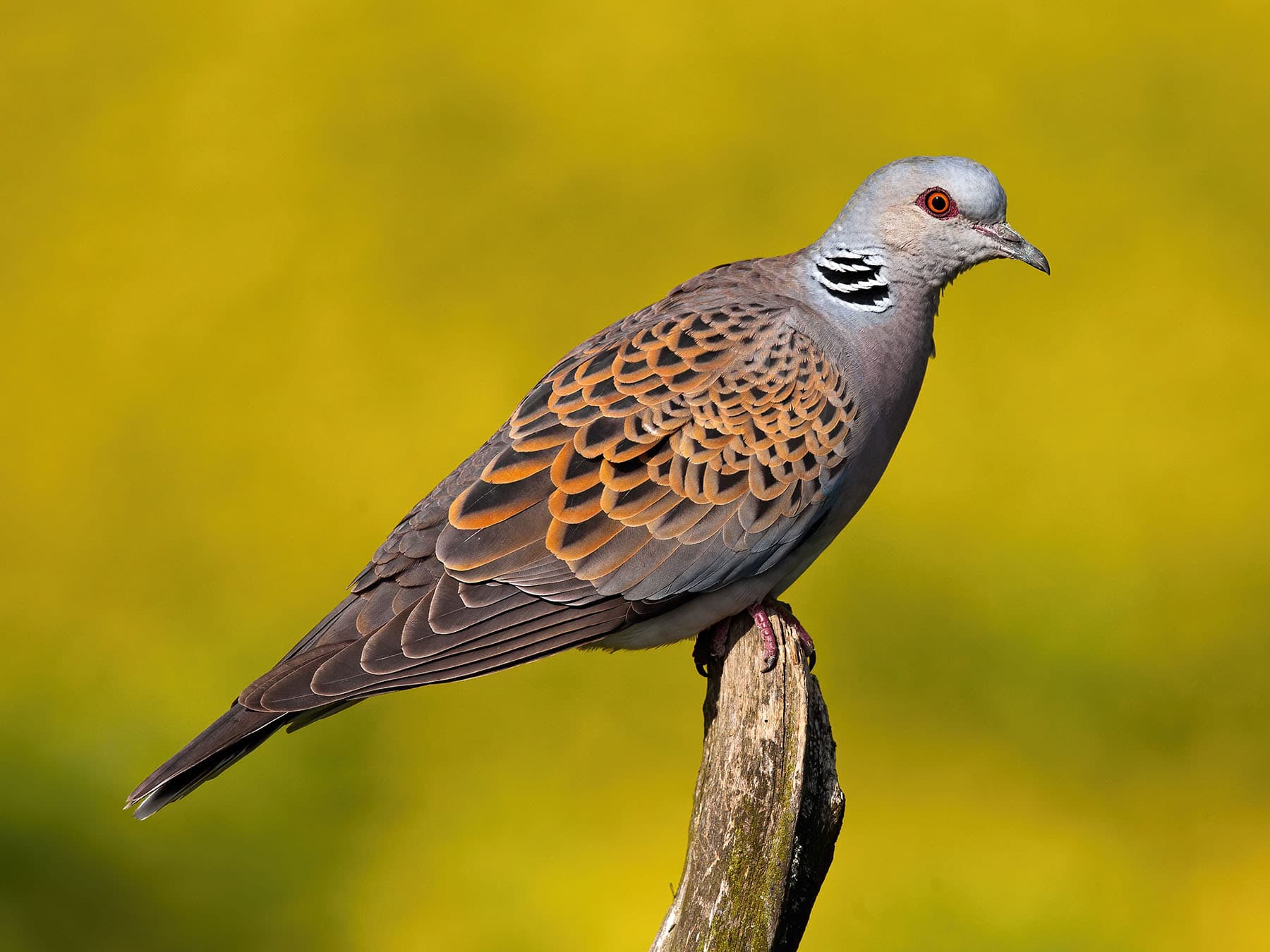
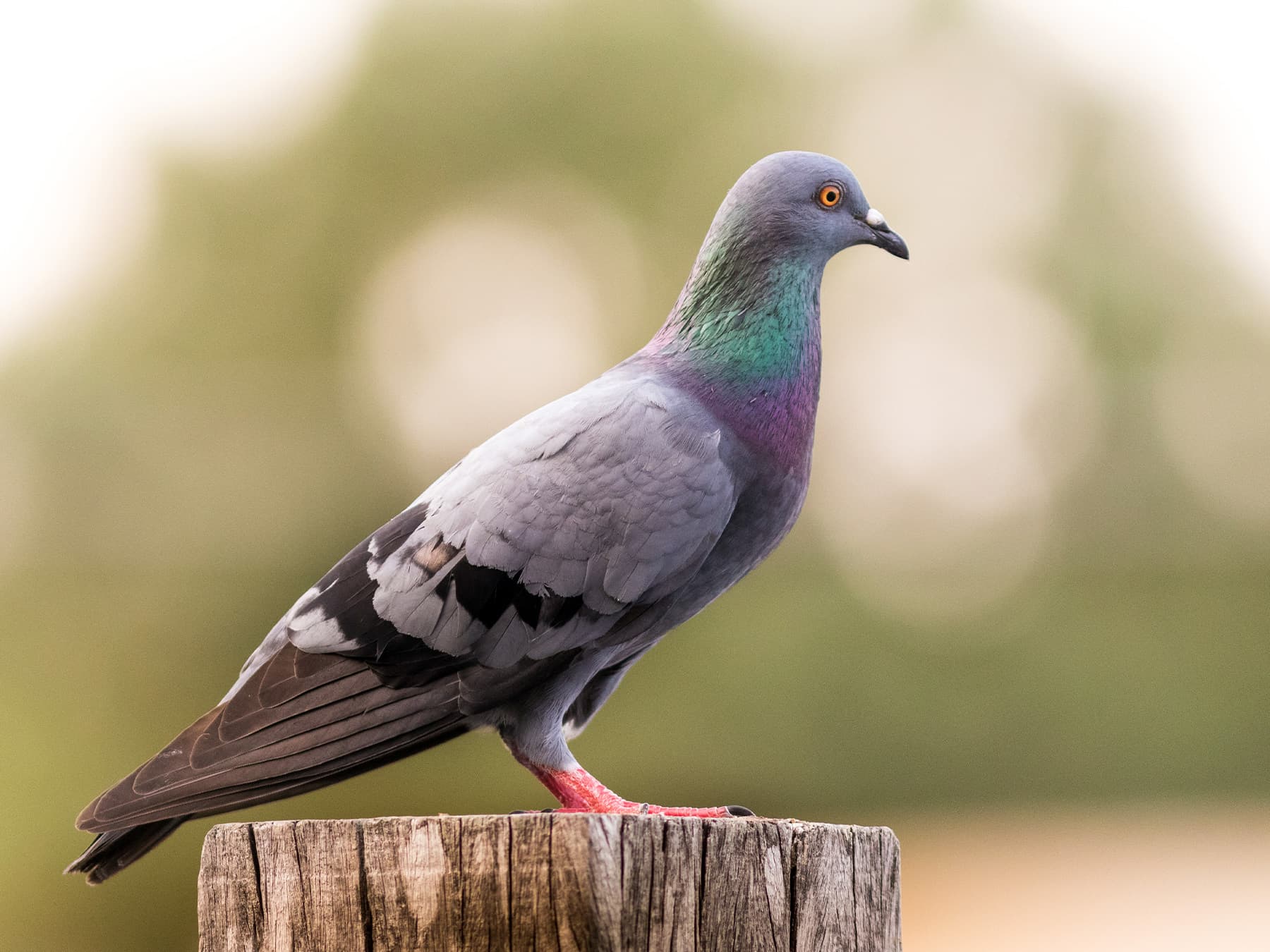
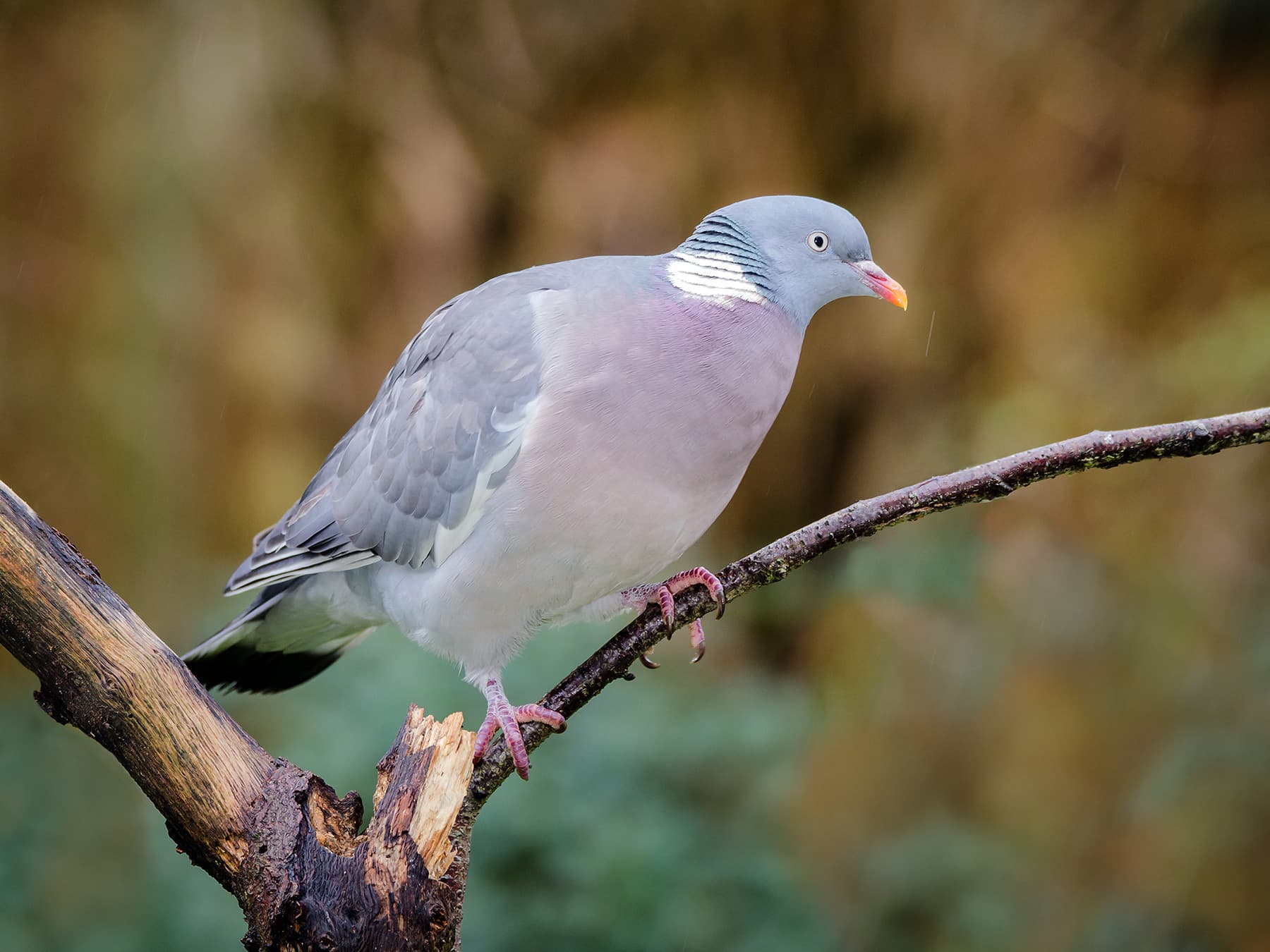
A Woodpigeon is bigger and greyer, with a pink breast, a white neck patch and white bands across the wings. A feral pigeon, the same species as the wild Rock Dove, is chunkier and shorter-tailed, typically grey with bold black wing bars and a shiny neck patch instead of a collar. The Stock Dove is grey with a pink breast and a shiny neck patch. The Turtle Dove, a summer visitor, is smaller and darker, with a mottled chestnut-and-black back and a black-and-white patch on the neck.5
In North America it lives alongside the Mourning Dove, which is smaller and slimmer, with a pointed tail and no black collar.6 See Eurasian Collared-Dove vs Mourning Dove for all the differences. Escaped domestic Barbary Doves (Ringed Turtle-Doves) look very like Collared Doves, but they are white under the base of the tail where a Collared Dove is grey, and show less contrast on the wings in flight. Hybrids between the two have been reported in the wild.2
Its size
Adults- Length
- 30–32 cm
- Wingspan
- 51 cm
- Weight
- 172–236 g
Its song and calls
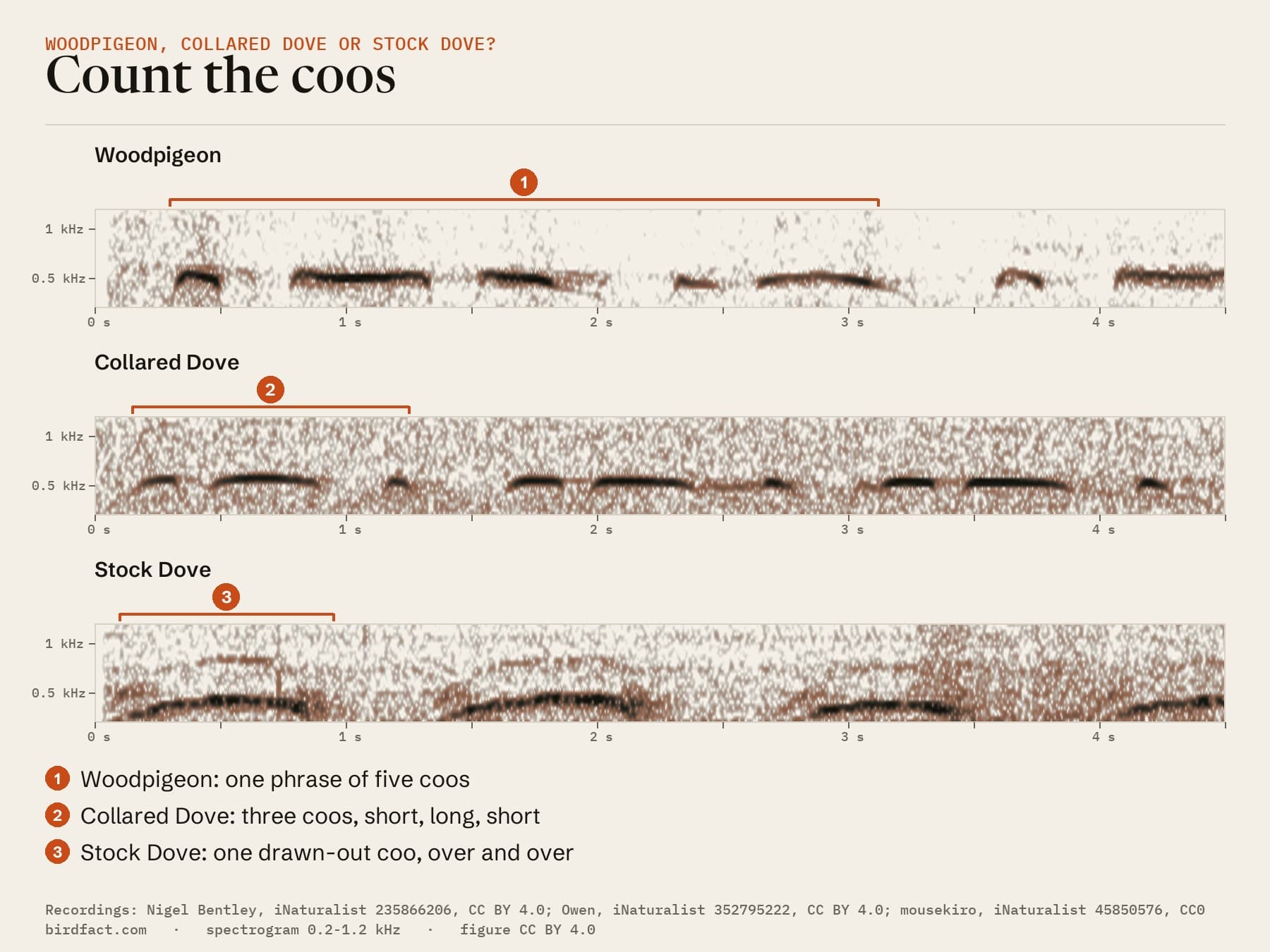
The song is the soft, three-note coo heard from roofs, wires and TV aerials, with the stress on the middle note: Birds of the World writes it "hoo-HOOOO-hoo". A male usually repeats it 3 to 12 times from a high perch, and it is thought to hold his territory and attract a mate. It can be heard in any month, most of all at the height of the breeding season, when males sometimes coo in the middle of the night.
Each phrase lasts a second or so. The Woodpigeon's song, easily mixed up with it, is a deep, slightly muffled phrase of five notes; the Collared Dove's is three less muffled notes, just over a second long, with the second higher.7 See the Woodpigeon's call for the two side by side.
When excited or alarmed, and especially just before landing, both sexes give a nasal "hwaah". At the nest a pair call to each other with a lower, slower version of the coo. See the Collared Dove's call and song for more recordings, spectrograms and what the research has found.
- Song0:00 / 0:14
Recorded in East Sussex, United Kingdom · July 2021
- Calls0:00 / 0:08
Recorded in Pays de la Loire, France · June 2026
When and where to see it
OctoberHere all year
Most recorded in October
- 1. Derry1.6%
- 2. Down1.6%
- 3. Neath Port Talbot1.5%
- 4. Longford1.5%
- 5. Cornwall1.4%
Each dot is a county, state or province: the bigger and darker, the larger the bird’s share of that place’s bird records that month. Grey dots: no regular records. The ringed point is the centre of the bird’s records this month; the arrow shows how it moved since last month, and the dashed loop its path through the year. “Arrivals” colours places where it becomes regular this month (orange) or is in its last regular month (grey). GBIF eBird Observation Dataset, 2019–2024. Map data: Natural Earth, US Census Bureau; place centres © OpenStreetMap contributors.
In your area
See when the Eurasian Collared Dove is recorded in your county, state or province.
How often the Eurasian Collared Dove turns up in the UK, Ireland, the United States and Canada through the year, from birdwatchers' records.
United Kingdom
Resident · all year · most records in July
Ireland
Resident · all year · most records in May
United States
Resident · all year · most records in August
Canada
Resident · all year · most records in February
Show as a table
| Month | United Kingdom | Ireland | United States | Canada |
|---|---|---|---|---|
| January | 0.99% (regular) | 0.60% (regular) | 0.45% (regular) | 0.22% (regular) |
| February | 0.96% (regular) | 0.58% (regular) | 0.47% (regular) | 0.22% (regular) |
| March | 0.93% (regular) | 0.58% (regular) | 0.47% (regular) | 0.19% (regular) |
| April | 0.93% (regular) | 0.80% (regular) | 0.41% (regular) | 0.14% (regular) |
| May | 0.99% (regular) | 0.83% (regular) | 0.32% (regular) | 0.11% (regular) |
| June | 1.0% (regular) | 0.81% (regular) | 0.38% (regular) | 0.13% (regular) |
| July | 1.1% (regular) | 0.71% (regular) | 0.45% (regular) | 0.17% (regular) |
| August | 1.1% (regular) | 0.60% (regular) | 0.49% (regular) | 0.18% (regular) |
| September | 0.89% (regular) | 0.54% (regular) | 0.41% (regular) | 0.13% (regular) |
| October | 0.71% (regular) | 0.47% (regular) | 0.33% (regular) | 0.12% (regular) |
| November | 0.70% (regular) | 0.40% (regular) | 0.34% (regular) | 0.16% (regular) |
| December | 0.88% (regular) | 0.48% (regular) | 0.41% (regular) | 0.21% (regular) |
Recorded regularly in
Worldwide: recorded regularly in 128 countries
Countries where it was recorded in at least 3 of the 6 years 2019–2024. Linked countries have their own bird list.
Europe (51)
- Åland Islands
- Albania
- Andorra
- Austria
- Belarus
- Belgium
- Bosnia & Herzegovina
- Bulgaria
- Croatia
- Czechia
- Denmark
- Estonia
- Faroe Islands
- Finland
- France
- Germany
- Gibraltar
- Greece
- Guernsey
- Hungary
- Iceland
- Ireland
- Isle of Man
- Italy
- Jersey
- Kosovo
- Latvia
- Liechtenstein
- Lithuania
- Luxembourg
- Malta
- Moldova
- Monaco
- Montenegro
- Netherlands
- North Macedonia
- Norway
- Poland
- Portugal
- Romania
- Russia
- San Marino
- Serbia
- Slovakia
- Slovenia
- Spain
- Sweden
- Switzerland
- Ukraine
- United Kingdom
- Vatican City
Africa (7)
- Algeria
- Cape Verde
- Egypt
- Mauritania
- Morocco
- Tunisia
- Western Sahara
Asia (34)
North America (36)
- Anguilla
- Antigua & Barbuda
- Bahamas
- Barbados
- Belize
- British Virgin Islands
- Canada
- Caribbean Netherlands
- Cayman Islands
- Costa Rica
- Cuba
- Dominica
- Dominican Republic
- El Salvador
- Grenada
- Guadeloupe
- Guatemala
- Haiti
- Honduras
- Jamaica
- Martinique
- Mexico
- Montserrat
- Nicaragua
- Panama
- Puerto Rico
- Sint Maarten
- St Barthélemy
- St Kitts & Nevis
- St Lucia
- St Martin
- St Vincent & the Grenadines
- Trinidad & Tobago
- Turks & Caicos Islands
- United States
- US Virgin Islands
Data: EOD – eBird Observation Dataset (Cornell Lab of Ornithology), accessed via GBIF.org, CC BY 4.0. Records from 2019–2024, aggregated and filtered by Birdfact. How these lists are made
Almost anywhere people live, all year round. In the 2007-11 Bird Atlas Collared Doves were found in 84% of the UK's 10-km squares in the breeding season, missing only from high ground such as the Scottish Highlands and from remote bogs, and they are most numerous in eastern England. They are commonest in towns and villages.3 Look in gardens, parks and farmyards, wherever there is seed or grain to eat and trees, buildings or wires to perch on; they avoid forest and the most built-up city centres.2
Spotting tips
Look for a pale dove on a roof, chimney pot or wire, listen for the three-note coo, and watch for the white-tipped tail as one lands.
How the range spread
The Collared Dove is a newcomer. Its original home was probably India and nearby parts of Asia, and until the early 20th century it lived in Europe only in the Balkans and Turkey. From 1912 it began to spread north from the former Yugoslavia, then from the 1930s it swept north-west across Europe, colonising around 2.5 million km² (about 965,000 sq miles) in some 40 years: Hungary in 1932, Germany in 1946, the Netherlands in 1947, France in 1950. Why is not known. Farming and towns created the open country it likes, and the sudden start and the steady direction have led the authors of Birds of the World to suggest that a genetic change may have set it off.2
In Britain the first birds were recorded in Norfolk in 1955, when just four were known.3 They reached Ireland in 1959.2 By 1964 there were nearly 19,000 at about 500 sites in Britain and Ireland8, and BTO puts the population, conservatively, at 15,000 to 25,000 pairs by 1970.3
North American range
Collared Doves are a recent arrival in North America too. Most are thought to trace back to the Bahamas, where in December 1974 a breeder in Nassau lost some birds in a burglary and then released the rest, no more than 50 in all.9 From there they probably reached Florida, where they were first identified in 1986, and spread mainly north-west in long jumps: South Dakota, about 2,900 km (1,800 miles) from Florida, had its first in 1996, the same year as New Jersey, about 1,800 km (1,100 miles) away. Other releases helped. They now live across most of the United States and southern Canada, though they are still scarce in the north-east, and number about 8.7 million in the two countries.2
Scientists studying its spread in North America describe it as an invasive species.10 So far there is no evidence that it has harmed native doves2, and in Florida in winter four other dove species were more numerous where Collared Doves were more numerous.11 See how to tell it from a Mourning Dove.
Do they migrate?
No. In Britain and Ireland Collared Doves are resident, with no regular migration. Young birds wander, mostly less than 300 km (186 miles) from where they hatched, and a few much further. The longest move on record within Britain and Ireland is 923 km (574 miles), from North Ronaldsay in Orkney to Margate in Kent.12 Ringing shows that some cross the sea: there have been 54 reports of foreign-ringed birds in Britain and Ireland, 33 of them from Belgium, and 12 of birds ringed in Britain and Ireland found abroad.
What it eats
Mostly seeds and grain, such as wheat, barley, oats and maize, and the seeds of weeds, with buds, shoots and some berries. Now and then they take small insects, aphids or tiny snails. They feed mostly on the ground, walking with bobbing heads, and gather where grain is spilled, around farmyards, grain stores and animal feed: a British study found their numbers near grain mills rose and fell with how much grain was within reach.2
Feeding them in your garden
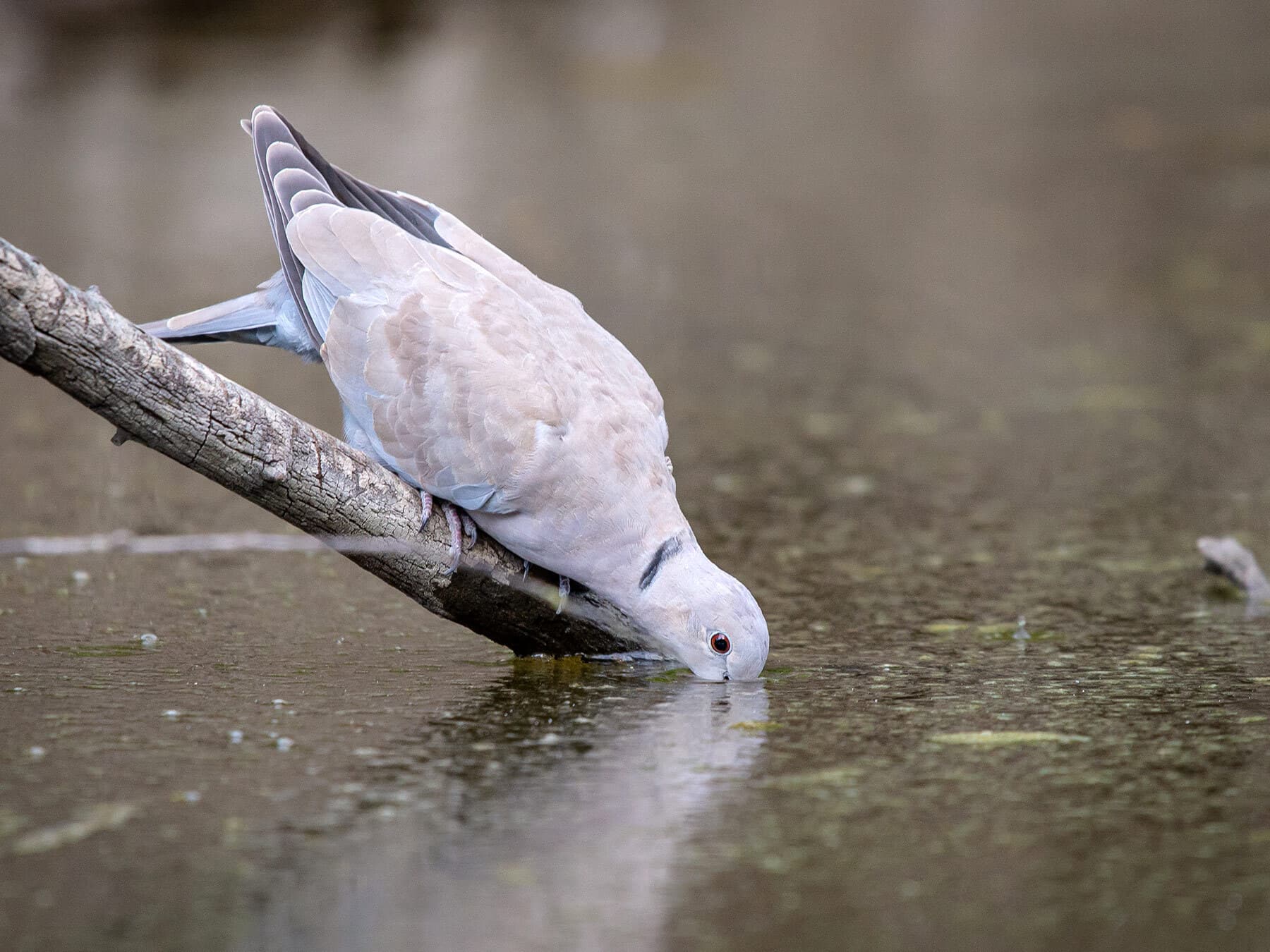
BTO notes that Collared Doves make use of seed put out in gardens.3 Trichomonosis has been found in Collared Doves.2 If you feed birds in the UK, follow the RSPB's current advice to slow the spread of diseases such as this: from 1 May to 31 October pause seeds and peanuts, putting out only small amounts of mealworms, fat balls or suet; use hanging feeders rather than flat surfaces such as bird tables, trays and window feeders; clean feeders every week; and put out fresh water every day.13
In North America, All About Birds notes that they come readily to millet and other seed scattered on the ground or on platform feeders.6 Project FeederWatch also lists cracked corn, sunflower seed and oats for them.14
Nesting and breeding
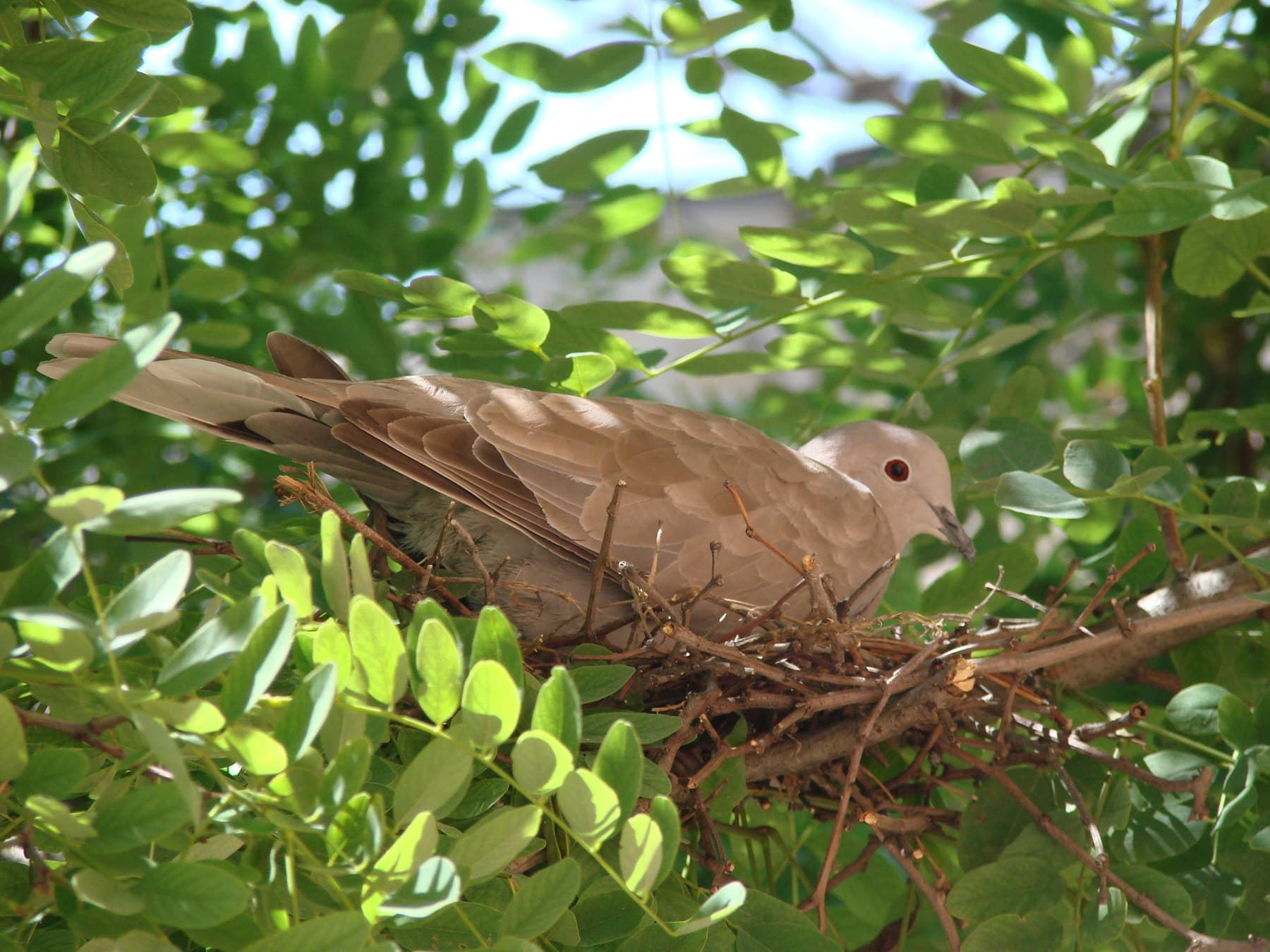
Collared Doves have a long season. In Britain they breed mainly from March to October2, and BTO notes they can nest in any month when the weather is mild.3 The male shows the female possible sites, calling at each, and brings her twigs, stems and grass; she builds a flimsy platform, usually in a tree or tall hedge near houses, sometimes on a building.
There are almost always 2 white eggs. Both parents incubate them for 16 to 17 days, the female through the night and the male for about eight hours from early morning, and the chicks leave the nest at 17 to 19 days. The parents feed them at first on "crop milk", a cheesy food made in the crop, then on seeds as well.
A pair often lays again while still feeding the last brood. BTO gives 1 to 2 broods a year as typical, but in an Oxfordshire study pairs averaged 3.8 clutches a year, and some raised up to five broods in a season.2
Behaviour
A male proclaims his territory from a high perch, then launches into his display flight: he climbs steeply, clapping his wings, and glides down, often in a spiral, with his tail spread, usually calling "hwaah".2 A 2008 study found the display uses close to the bird's maximum muscle power yet very little energy overall, which may make it a hard-to-fake sign of fitness.15
Near the nest pairs can be aggressive. They chase off other Collared Doves and crows and fight with blows of the wing, and a nesting bird may even strike a person with its wing. Outside the breeding season they gather at good feeding places in flocks, sometimes several hundred strong, and roost together, more so in cold weather; some fly into towns to roost in street and garden trees. On the ground they walk with a bobbing head, and after landing they flick the tail up, then slowly lower it.
Lifespan and predators
A Collared Dove that survives to breed typically lives about 3 years, and nearly two in three adults (64%) survive from one year to the next.3
Some live much longer. The oldest on the BTO's ringing list was ringed at Margate Beach, Kent, in January 1969 and found there, injured, in April 1984, 15 years 3 months later.16 The European longevity list's oldest is a Dutch bird with an estimated age of 22 years 2 months.17 North America's record is 9 years 3 months: a bird banded in South Carolina in 2002 and caught by a cat in 2011.18
Predators and other dangers
In Europe most eggs that fail are lost to predators, chiefly crows and their relatives; in a Manchester study only 29% of eggs led to fledged young. Predators recorded in Britain include a bird of prey, foxes, stoats and domestic cats, and cats appear to be a common predator of adults. Disease matters too: trichomonosis has been reported in Collared Doves in Britain.2
Conservation
The Collared Dove is on the UK Green List and of Least Concern worldwide. There are about 810,000 pairs in the UK (2016).
After its spectacular spread, it is now declining. The Breeding Bird Survey puts the UK fall at 45% from a peak in 2005, 30% of it in the decade to 2024, and a fall of 9% between 2024 and 2025. England's numbers fell 34% between 1995 and 2024, while Northern Ireland's nearly doubled (up 96% between 1997 and 2024).19
The cause is not settled. The survey's 2025 report, and the introduction to BTO's species account, say the decline is likely to be linked to the spread of trichomonosis. Another passage of the same account says the 2006 outbreak is not thought to be the main cause of the downturn. It suggests the earlier slowing of the increase may be due to rising numbers of grey squirrels, which have been linked to nests failing at the egg stage, or to the birds nearing the limit of their niche.3
Legal status
Like all wild birds, Collared Doves and their nests while in use or being built are protected by law in Great Britain20 and Northern Ireland.21 Unlike the Woodpigeon and the feral pigeon, the Collared Dove is not among the species on the 2026 general licences that let authorised people kill or take certain birds to prevent serious damage, in England22, Wales23, Scotland24 or Northern Ireland.25
In the United States, as a non-native bird, it is not protected by the Migratory Bird Treaty Act26, and it is hunted in several states.
Similar birds
Often mistaken for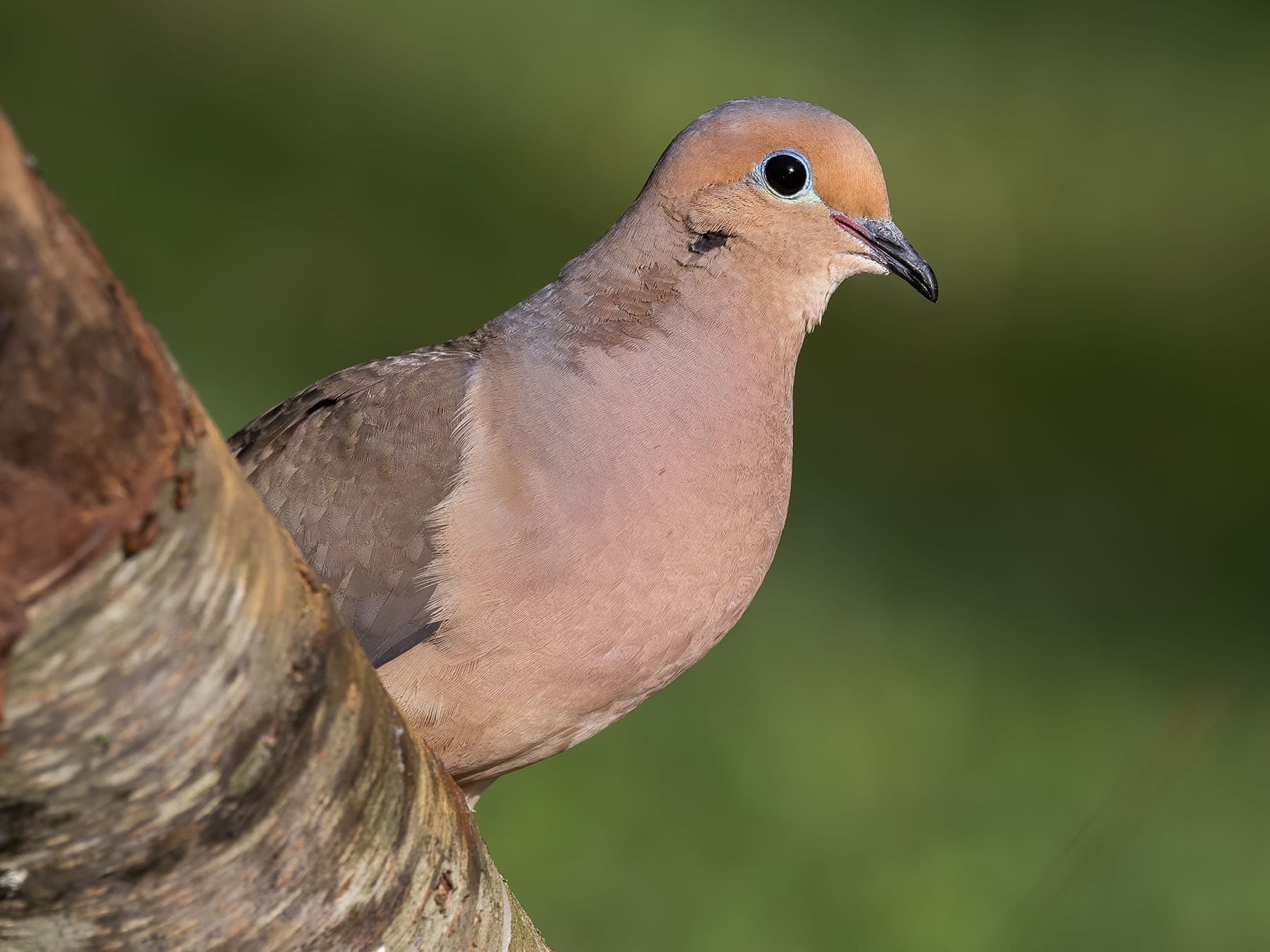
More photos
6 photos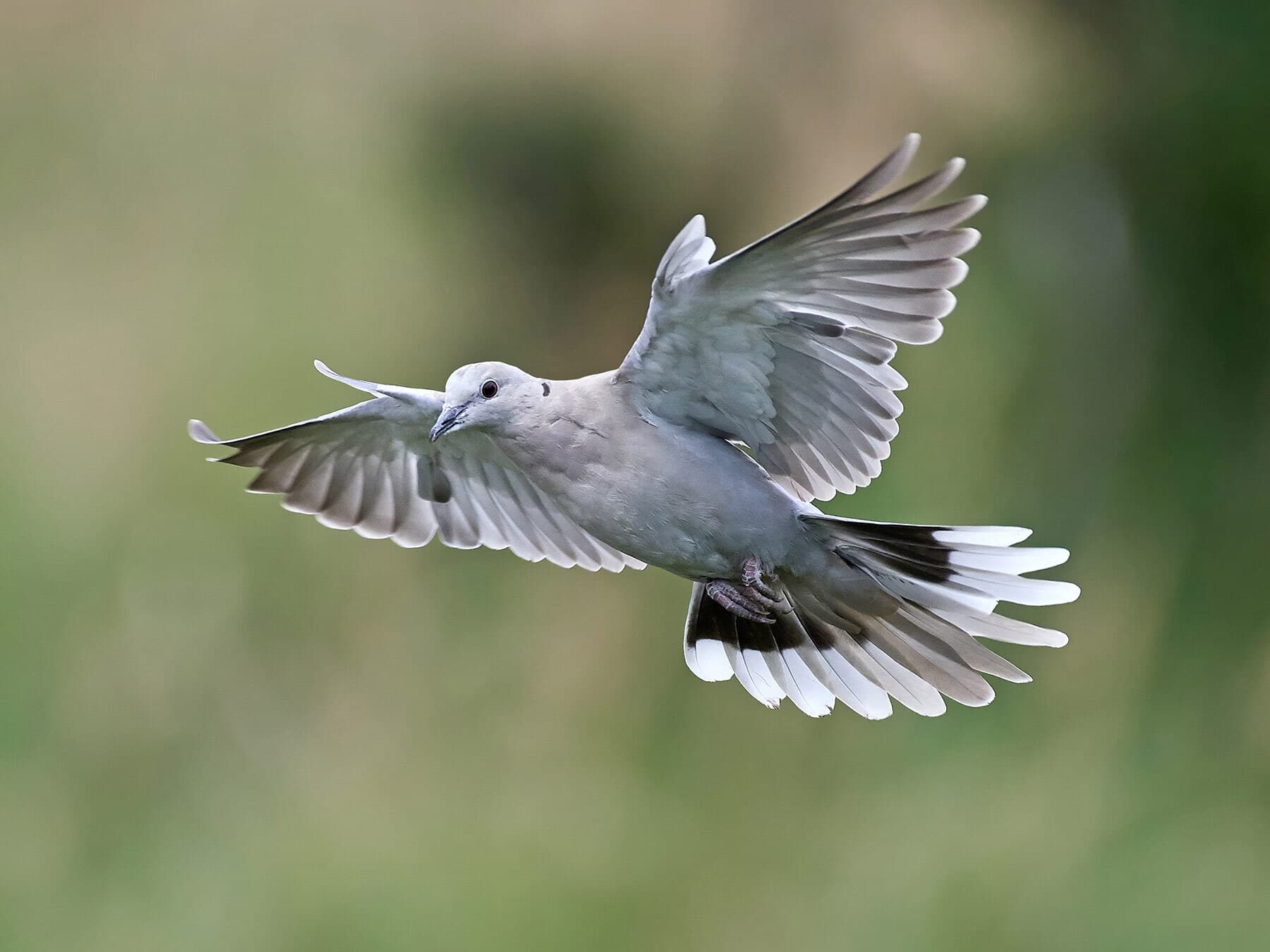 A Collared Dove in flight, showing the black-and-white underside of its fanned tail
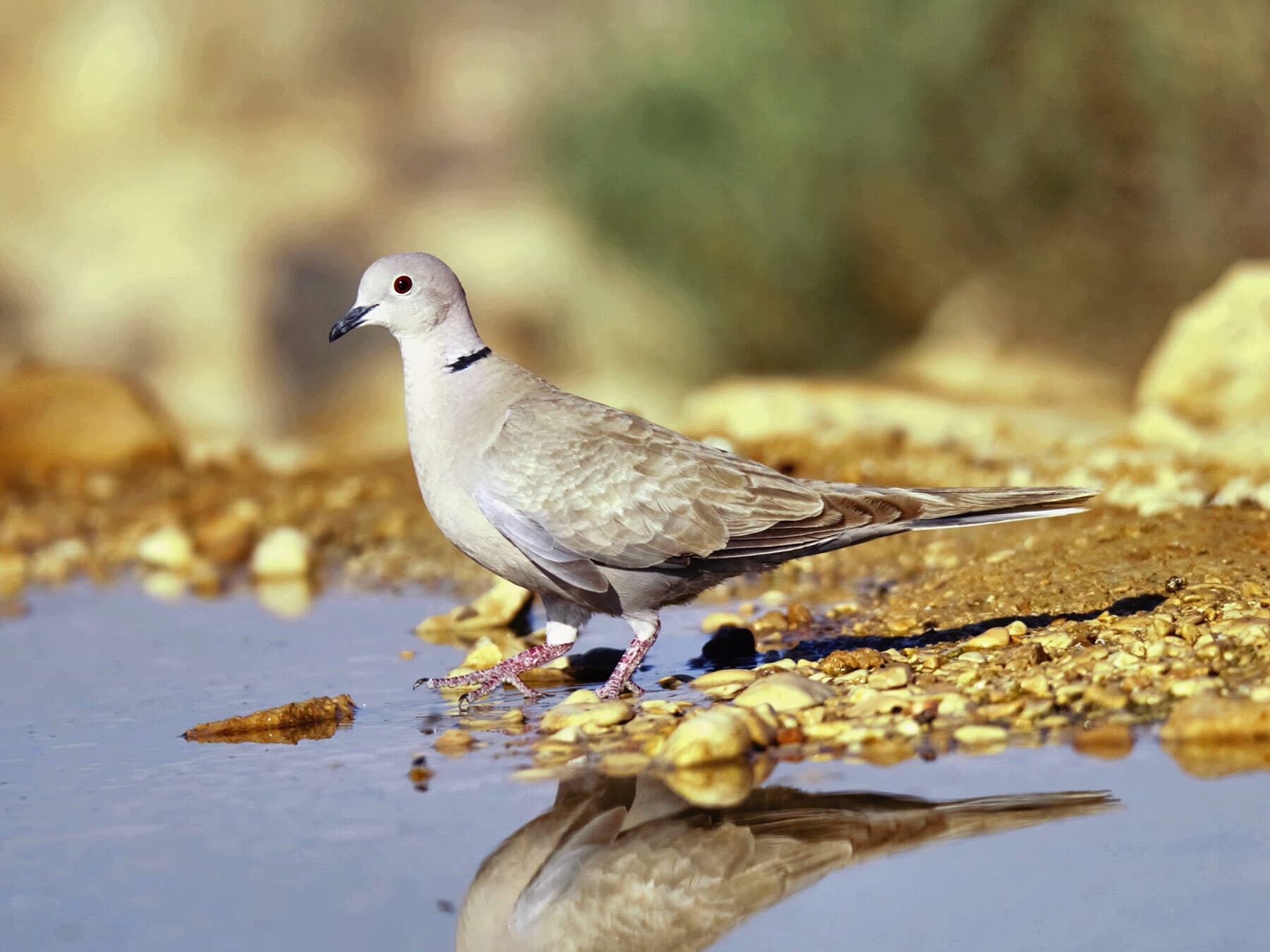 A Collared Dove walking at the edge of a puddle
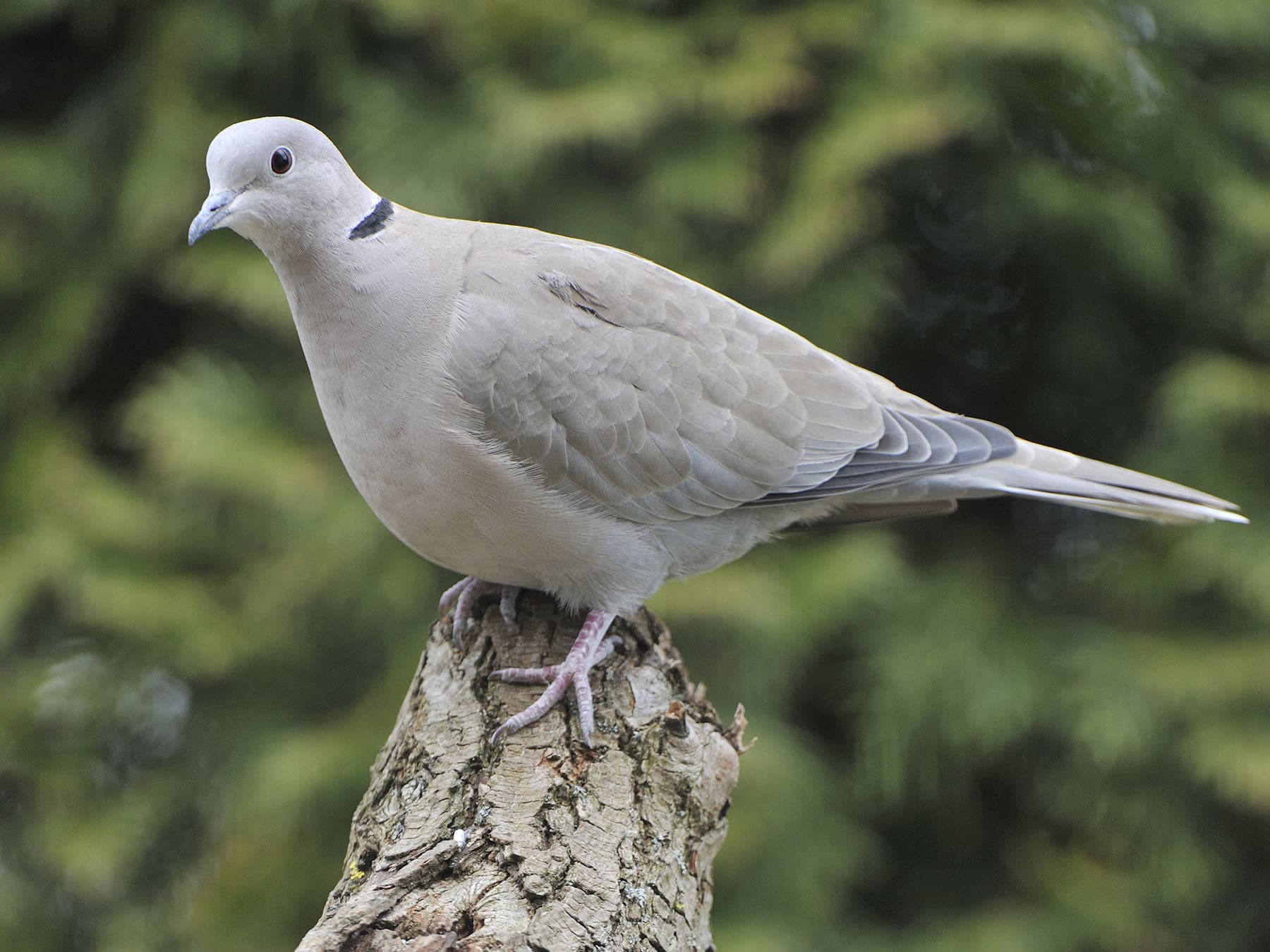 A Collared Dove perched on a tree stump
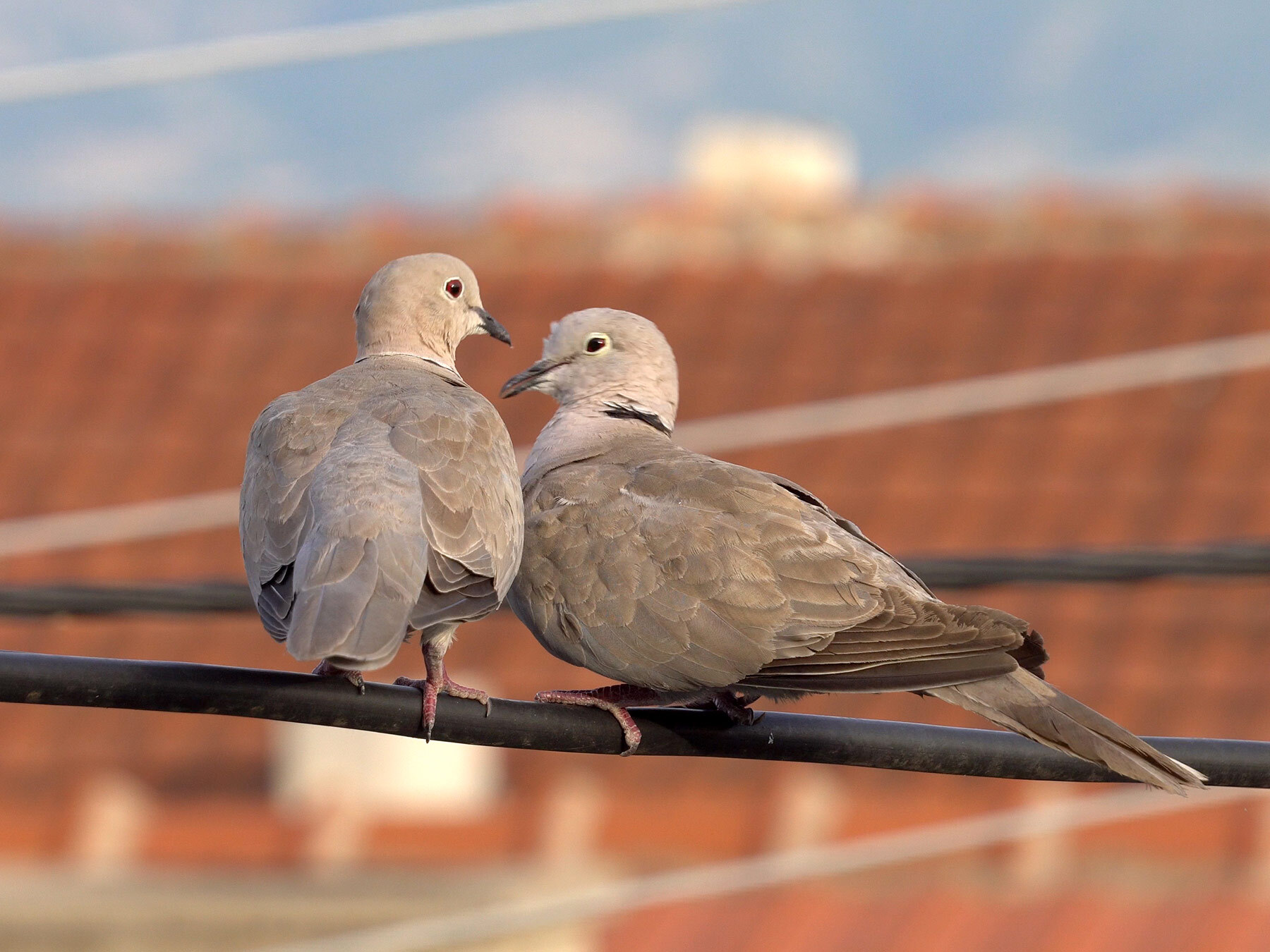
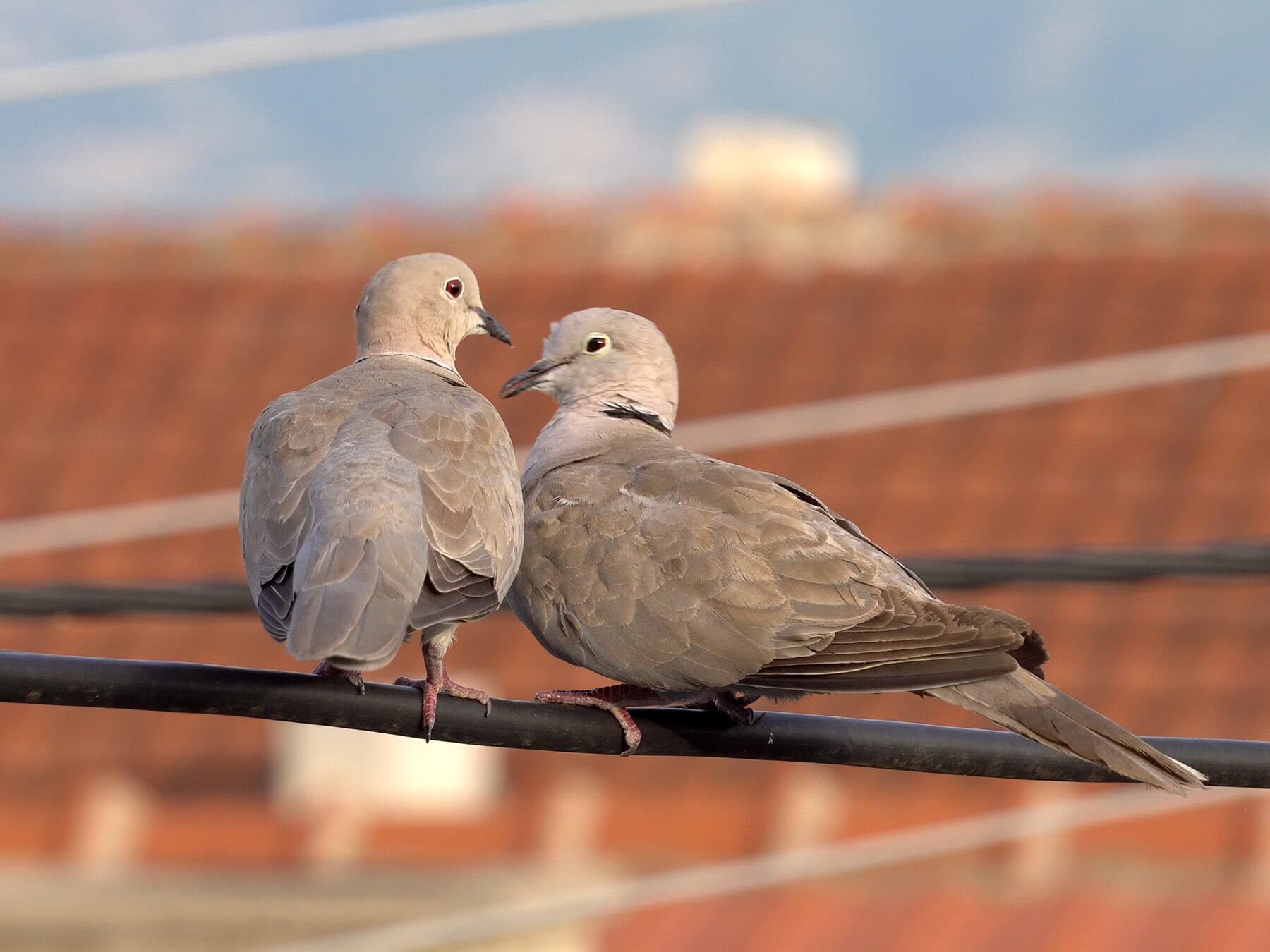 Two Collared Doves side by side on a wire, with rooftops behind
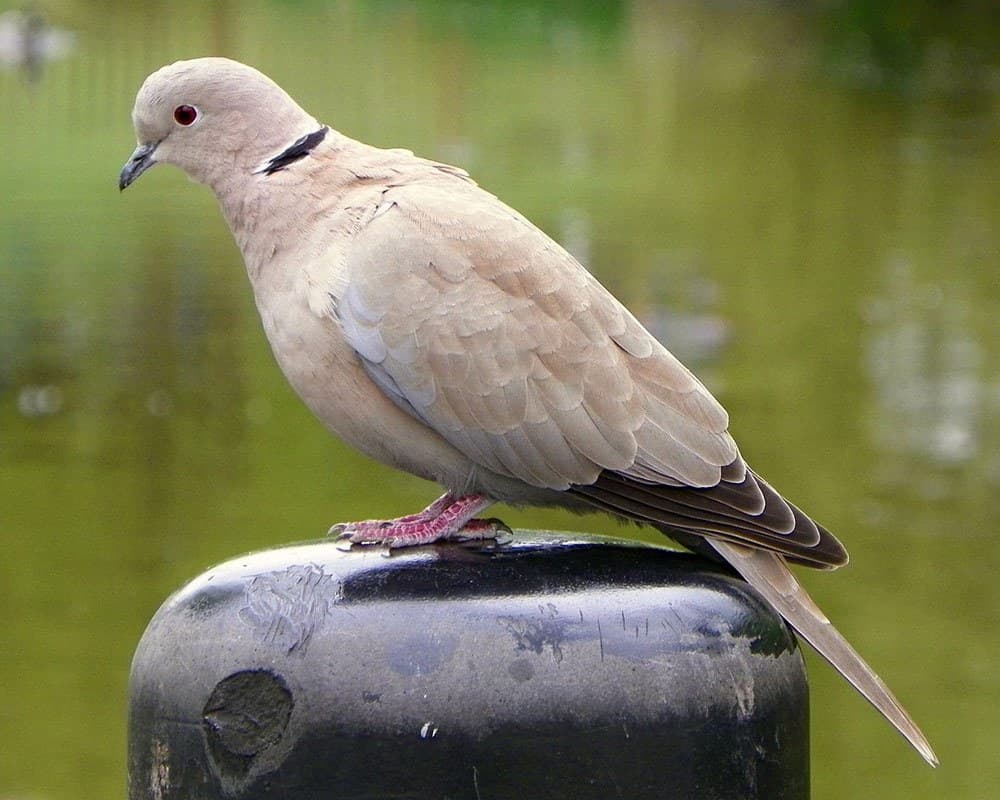 A Collared Dove on a post, showing its red legs
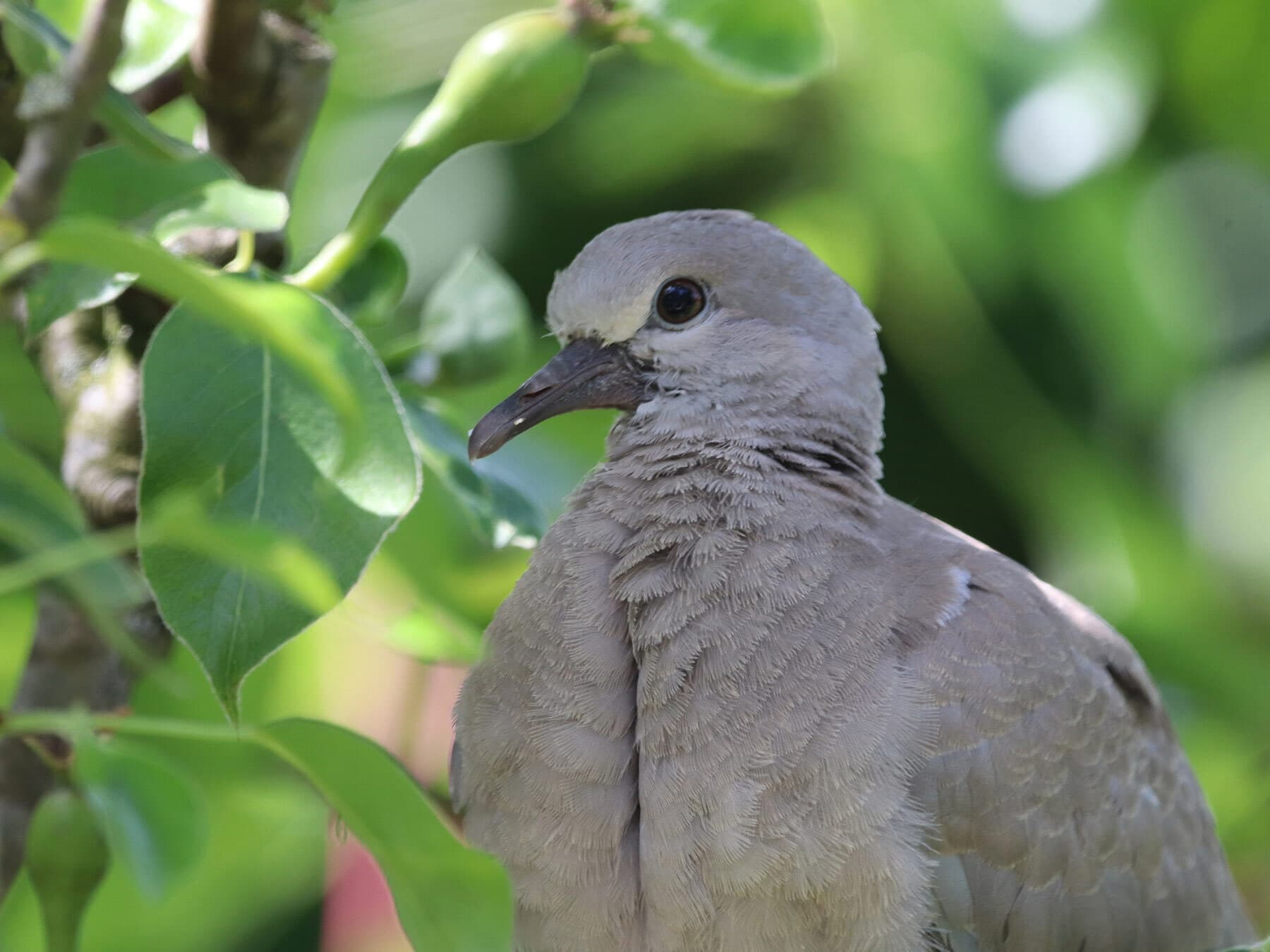 A young Collared Dove close up: brown eye, scaly feather edges and no complete collar yet
Eurasian Collared Dove guides
6 guides- Collared Dove Call and Song: What a Collared Dove Sounds Like
- Eurasian Collared-Dove vs Mourning Dove: How to Tell Them Apart
- Woodpigeon Call and Song: What a Woodpigeon Sounds Like
- Mourning Dove Sounds: Song, Calls and Wing Whistle
- Do Mourning Doves Mate for Life? Pair Bonds, Courtship and Mating
- 23 Common Garden Birds in the UK (Full Guide with Pictures)
Quick facts
- Length
- 30–32 cm
- Wingspan
- 51 cm
- Weight
- 172–236 g
- Lifespan
- 3 years · oldest recorded 22.2 years · UK record 15 years 3 months
- Family
- Pigeons & Doves
- Migration
- Resident
- Global status (IUCN)
- Least Concern
- Population trend
- Colonised Britain from 1955; UK numbers peaked in 2005 and have since fallen by about 45% (BBS). About 810,000 pairs in 2016
- Also called
- Collared Dove
- Scientific name
- Streptopelia decaocto
Questions
4Is a Collared Dove a pigeon?
Yes, in the sense that pigeons and doves are one family; smaller, more delicate kinds tend to be called doves. See similar birds.
Do Collared Doves mate for life?
Pairs are monogamous and stay together through the breeding season, and Birds of the World says the bond is reported to last through the winter and may continue from year to year. No source we read shows pairs staying together for life.
Are Collared Doves rare?
No. There are about 810,000 pairs in the UK and they live in most of the country, though UK numbers have fallen by almost half since 2005. See conservation status.
Why is it called decaocto?
Decaocto means eighteen (Latin deca-, ten, and octo, eight), and the name is meant to echo the three-note song. An account from 1795 records that the Greeks named the bird after its call, and Greek folk tales tell of a woman turned into a dove who forever cries "eighteen".27
Sources
27- 1RSPB. Collared Dove. RSPB Birds A-Z. Accessed 9 October 2026. Source (opens in a new tab)
- 2Romagosa, C. M. and Mlodinow, S. G. (2022). Eurasian Collared-Dove (Streptopelia decaocto), version 1.1. Birds of the World (P. Pyle, P. G. Rodewald and S. M. Billerman, editors). Cornell Lab of Ornithology. doi:10.2173/bow.eucdov.01.1 (opens in a new tab)
- 3BTO. Collared Dove (Streptopelia decaocto). BTO BirdFacts. Accessed 9 October 2026. Source (opens in a new tab)
- 4RSPB (2025). Doves vs Pigeons. What's the difference?. RSPB, Identifying birds. Accessed 8 October 2026. Source (opens in a new tab)
- 5RSPB. Turtle Dove. RSPB Birds A-Z. Accessed 9 October 2026. Source (opens in a new tab)
- 6Cornell Lab of Ornithology. Eurasian Collared-Dove. All About Birds. Accessed 9 October 2026. Source (opens in a new tab)
- 7Duncan, J.. What can I hear - Woodpigeon or Collared Dove?. Sussex Wildlife Trust. Accessed 8 October 2026. Source (opens in a new tab)
- 8Hengeveld, R. (1993). What to do about the North American invasion by the Collared Dove?. Journal of Field Ornithology 64(4): 477-489. Accessed 9 October 2026. Source (opens in a new tab)
- 9Romagosa, C. M. and McEneaney, T. (1999). Eurasian Collared-Dove in North America and the Caribbean. North American Birds 53(4): 348-353. Accessed 9 October 2026. Source (opens in a new tab)
- 10Fujisaki, I., Pearlstine, E. V. and Mazzotti, F. J. (2010). The rapid spread of invasive Eurasian Collared Doves Streptopelia decaocto in the continental USA follows human-altered habitats. Ibis 152(3): 622-632. doi:10.1111/j.1474-919x.2010.01038.x (opens in a new tab)
- 11Bonter, D. N., Zuckerberg, B. and Dickinson, J. L. (2010). Invasive birds in a novel landscape: habitat associations and effects on established species. Ecography 33(3): 494-502. doi:10.1111/j.1600-0587.2009.06017.x (opens in a new tab)
- 12Robinson, R. A., Leech, D. I. and Clark, J. A. (2025). Summary of all recoveries for Collared Dove (Streptopelia decaocto). The Online Demography Report: bird ringing and nest recording in Britain & Ireland in 2024 (BTO). Accessed 9 October 2026. Source (opens in a new tab)
- 13RSPB (2026). Our latest guidance on feeding garden birds. RSPB news. Accessed 8 October 2026. Source (opens in a new tab)
- 14Project FeederWatch (Cornell Lab of Ornithology and Birds Canada). Common Feeder Birds: Eurasian Collared-Dove. Project FeederWatch. Accessed 9 October 2026. Source (opens in a new tab)
- 15Usherwood, J. R. (2008). Collared doves Streptopelia decaocto display with high, near-maximal muscle powers, but at low energetic cost. Journal of Avian Biology 39(1): 19-23. doi:10.1111/j.0908-8857.2008.04347.x (opens in a new tab)
- 16Robinson, R. A., Leech, D. I. and Clark, J. A. (2025). Longevity records for Britain & Ireland in 2024. The Online Demography Report: bird ringing and nest recording in Britain & Ireland in 2024 (BTO). Accessed 9 October 2026. Source (opens in a new tab)
- 17Fransson, T., Kolehmainen, T., Moss, D. and Robinson, R. (2023). EURING list of longevity records for European birds (1 September 2023). EURING. Accessed 9 October 2026. Source (opens in a new tab)
- 18USGS Bird Banding Laboratory. Longevity records of North American birds. USGS Patuxent Wildlife Research Center, Bird Banding Laboratory. Accessed 9 October 2026. Source (opens in a new tab)
- 19Heywood, J. J. N., Massimino, D., Baker, L., Balmer, D. E. et al. (2026). The Breeding Bird Survey 2025. BTO Research Report 802. British Trust for Ornithology, Thetford. Accessed 9 October 2026. Source (opens in a new tab)
- 20UK Parliament (1981). Wildlife and Countryside Act 1981, section 1. Accessed 7 October 2026. Source (opens in a new tab)
- 21UK Government (1985). The Wildlife (Northern Ireland) Order 1985, Article 4. Accessed 8 October 2026. Source (opens in a new tab)
- 22Natural England (2026). GL42: general licence to kill or take certain species of wild birds to prevent serious damage. Accessed 9 October 2026. Source (opens in a new tab)
- 23Natural Resources Wales (2026). General Licence 001 (WCA/GEN/001/2026): prevent serious damage or spread of disease. Accessed 9 October 2026. Source (opens in a new tab)
- 24NatureScot (2026). General licence for birds GL02/2026: prevention of serious damage to livestock, foodstuffs for livestock, crops, vegetables and fruit. Accessed 9 October 2026. Source (opens in a new tab)
- 25Department of Agriculture, Environment and Rural Affairs (2026). General licence TPG/2/2026 (Wildlife (Northern Ireland) Order 1985). Accessed 9 October 2026. Source (opens in a new tab)
- 26U.S. Fish and Wildlife Service (2020). List of Bird Species To Which the Migratory Bird Treaty Act Does Not Apply. Federal Register 85(74): 21262-21264. Accessed 9 October 2026. Source (opens in a new tab)
- 27Jobling, J. A.. The Key to Scientific Names: decaocto; Streptopelia. Birds of the World, Cornell Lab of Ornithology. Accessed 9 October 2026. Source (opens in a new tab)

Checked by
Nathan Cope, founder and editor
Nathan founded Birdfact and leads its writers and contributors in the UK, the US and Canada. He has watched and studied birds for more than ten years, and checks every article and species guide before it’s published.