Published 9 Oct 2026
Collared Dove Call and Song: What a Collared Dove Sounds Like
By the Birdfact teamChecked by Nathan Cope
A Collared Dove's song is a soft three-note coo, the middle note the longest, repeated over and over from roofs and wires. Listen to recordings, see the coo drawn as a spectrogram, and learn why Collared Doves coo, the loud call they give as they land, and how to tell them from a Woodpigeon or a Mourning Dove.
On this page14 sections
- What does a Collared Dove sound like?
- Why do Collared Doves coo?
- When they coo
- Males and females
- How a dove coos
- Learning the coo
- The excitement call
- Collared Dove or Woodpigeon?
- Mistaken for a Cuckoo
- Eurasian Collared-Dove or Mourning Dove?
- Barbary Doves and the lost trill
- The name decaocto
- About the recordings
- Sources
What a Collared Dove sounds like, with recordings from Britain, France and North America drawn as spectrograms: the three-note coo, why and when Collared Doves coo, the loud call they give as they land, and how to tell them from a Woodpigeon, a Cuckoo or, in North America, a Mourning Dove. For the bird itself, see Collared Dove identification and facts.
What does a Collared Dove sound like?
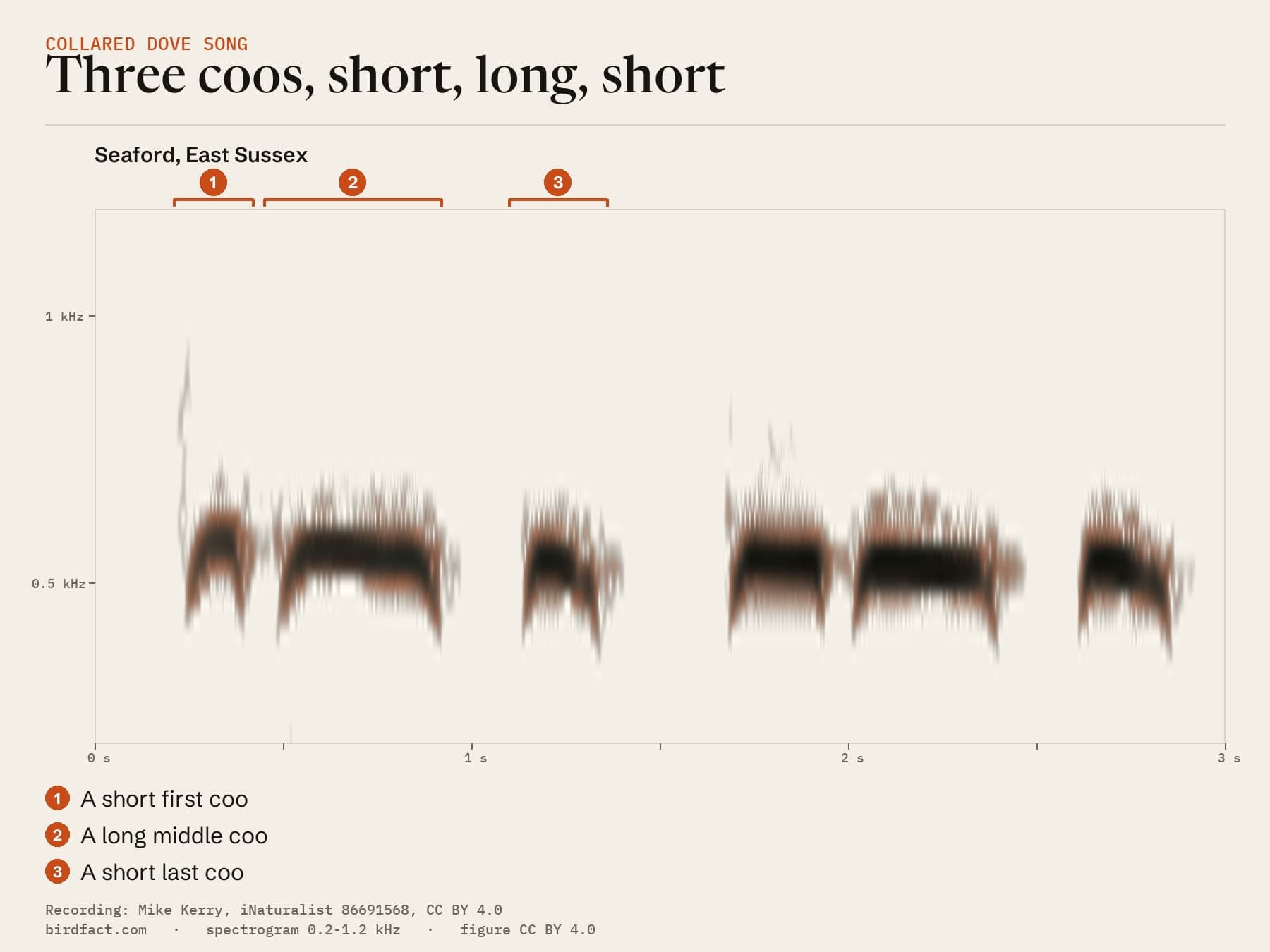
A soft, three-note coo, with the middle note the longest and stressed: Birds of the World writes it "hoo-HOOOO-hoo";1 All About Birds "koo-KOO-kook".2 A male repeats the phrase over and over, usually 3 to 12 times in a run, from a high perch such as a roof, a wire, a TV aerial or a treetop.
Each phrase is short. In a study of five males, mostly recorded in aviaries and zoos, a coo lasted about 1.2 seconds, its three notes about 0.25, 0.4 and 0.2 seconds long, with a pause of about 0.4 seconds before the next; the pitch is low, peaking around 550 Hz.3
Why do Collared Doves coo?
The coo is the Collared Dove's song. Researchers compare it to a songbird's advertising song: males use it in contests with other males and to attract females.3 A male coos from a high perch in his territory and often follows it with a display flight, climbing steeply with claps of his wings, then gliding down.
Playback experiments on territorial males show how other doves read the message. The rhythm mattered: a coo with its last note, or even its long middle note, cut out worked as well as a normal one, but without its first note it did not raise their territorial activity.4 Males also reacted most to coos whose pitch stepped by 75 to 108 Hz.5 Lighter males dropped the last note more often, and any male was more likely to drop it late in a long run of coos.6
When they coo
Collared Doves coo in every month, but most of all at the height of the breeding season, when a male may start before sunrise and sometimes coos in the middle of the night. Most cooing is in the morning and the evening.1
Males and females
Both sexes coo, but females coo less, in fewer and shorter runs, and their coos are higher-pitched, with more overtones, and tend to be less regular in form. Even the voice box differs: the female's syrinx is a smaller copy of the male's.7
Young birds start early. Birds of the World records the coo from a wild juvenile 11 weeks old.1 In captive birds followed through their second to eighteenth months, young males and females cooed alike at first except in pitch; the males' coos then grew gradually more striking, much as a songbird's song does, while the females' stayed like a youngster's, the two sexes parting at about a year old.8
How a dove coos
A dove coos with its bill shut, and a Collared Dove's throat swells as it does.1 Work on Ring Doves showed that a cooing dove keeps its bill and nostrils closed and sends air into its gullet and crop. When six caged Collared Dove males were recorded breathing a mix of helium and oxygen, the pitch of their plain notes barely changed, so the coo is not whistled: it is most likely made by membranes vibrating in the syrinx, the bird's voice box.9
Learning the coo
The coo seems to be largely inborn. In classic experiments, doves raised by another species, and Ring Doves deafened young, still developed seemingly normal coos of their own kind. Ten Cate, a co-author of most of the Collared Dove studies on this page, now cautions that those experiments used few birds and no detailed analysis, so subtle learning may have gone unnoticed.10
The excitement call
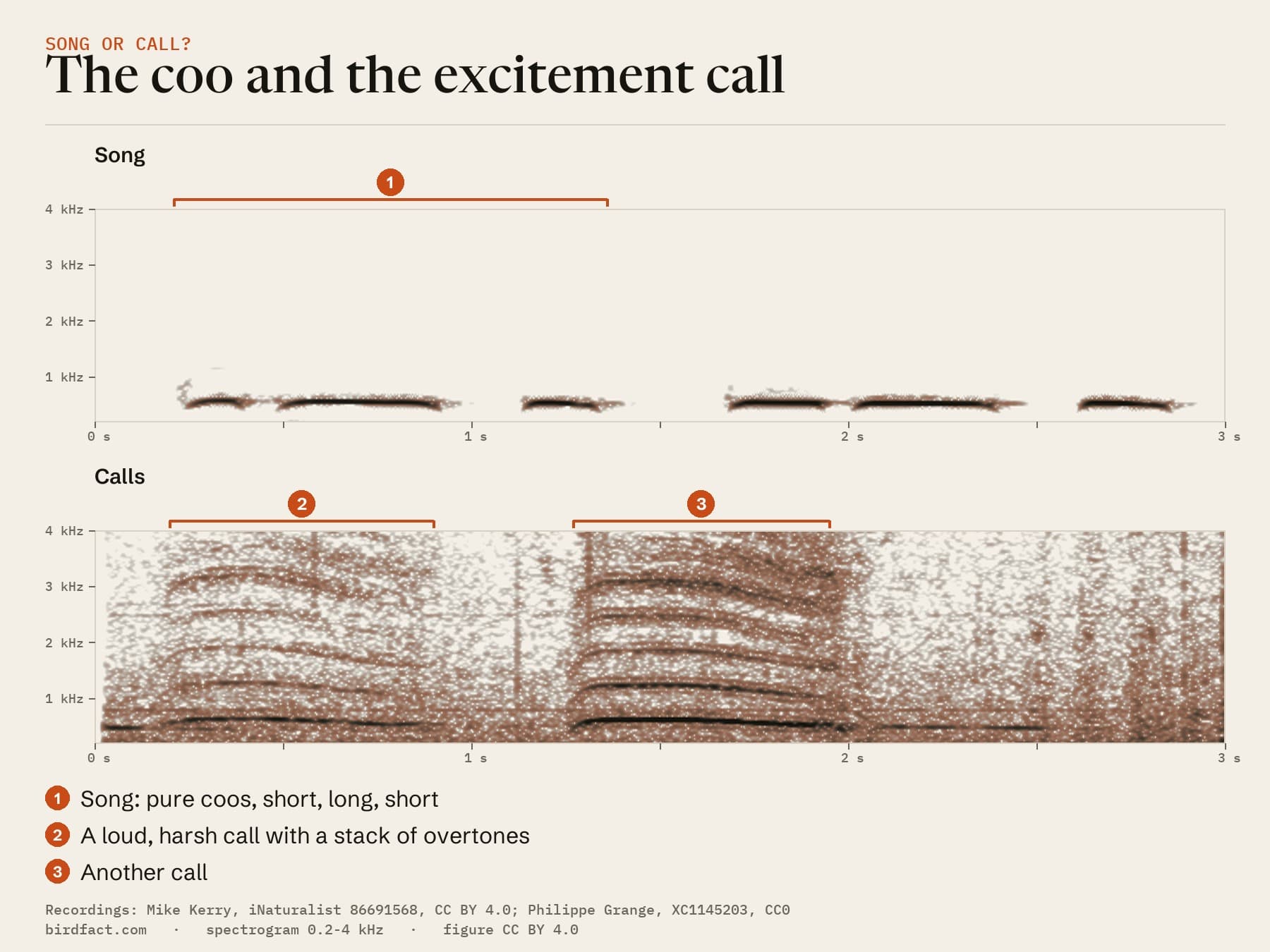
Collared Doves have other calls too: a lower, slower version of the coo at the nest, never given in a series, which both sexes use while choosing a site and to call the mate to take over the eggs; a soft, nasal "gu" when another Collared Dove intrudes; and the shrill, feeble "weeep" of begging young.1
Collared Dove or Woodpigeon?
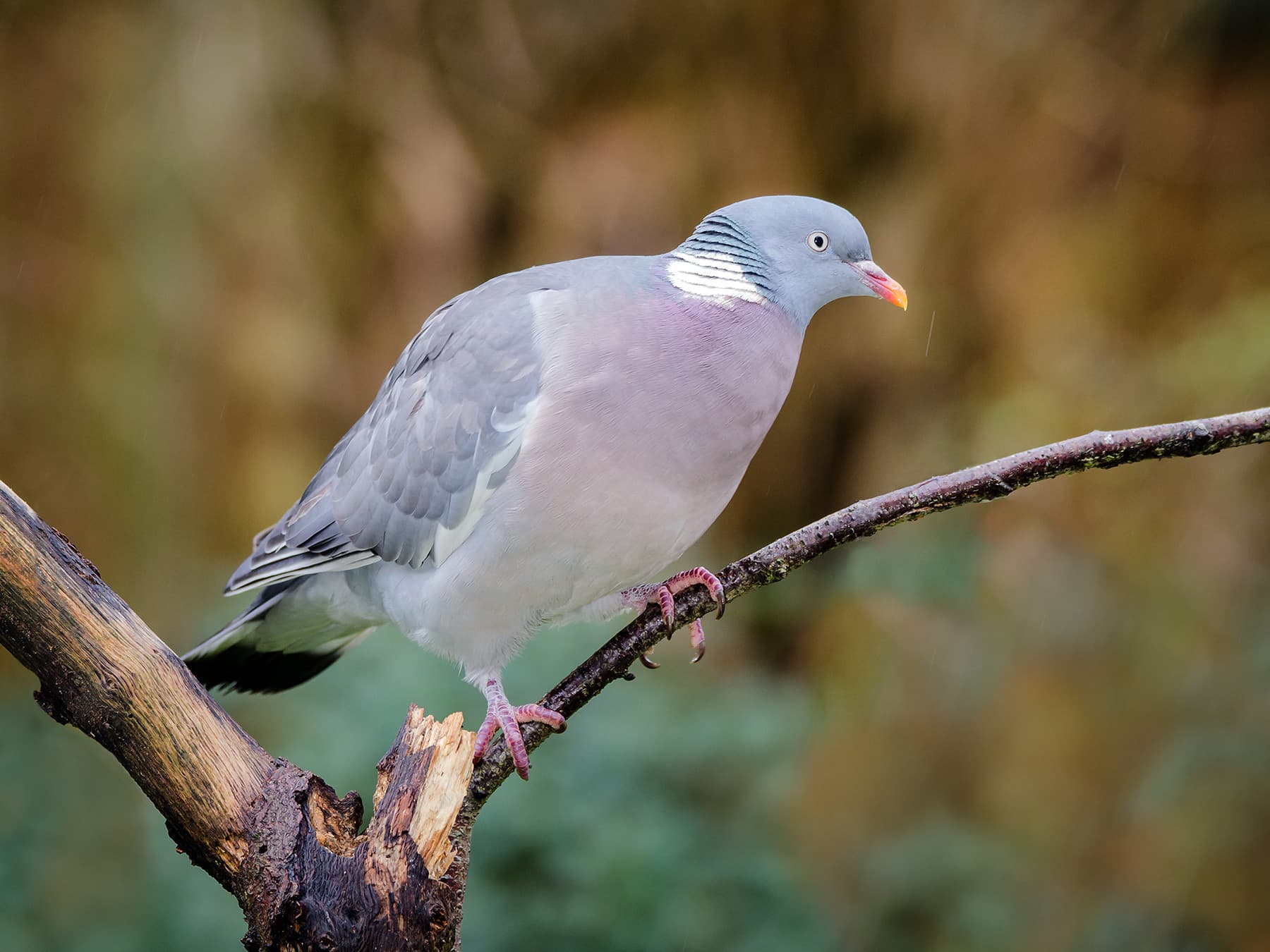
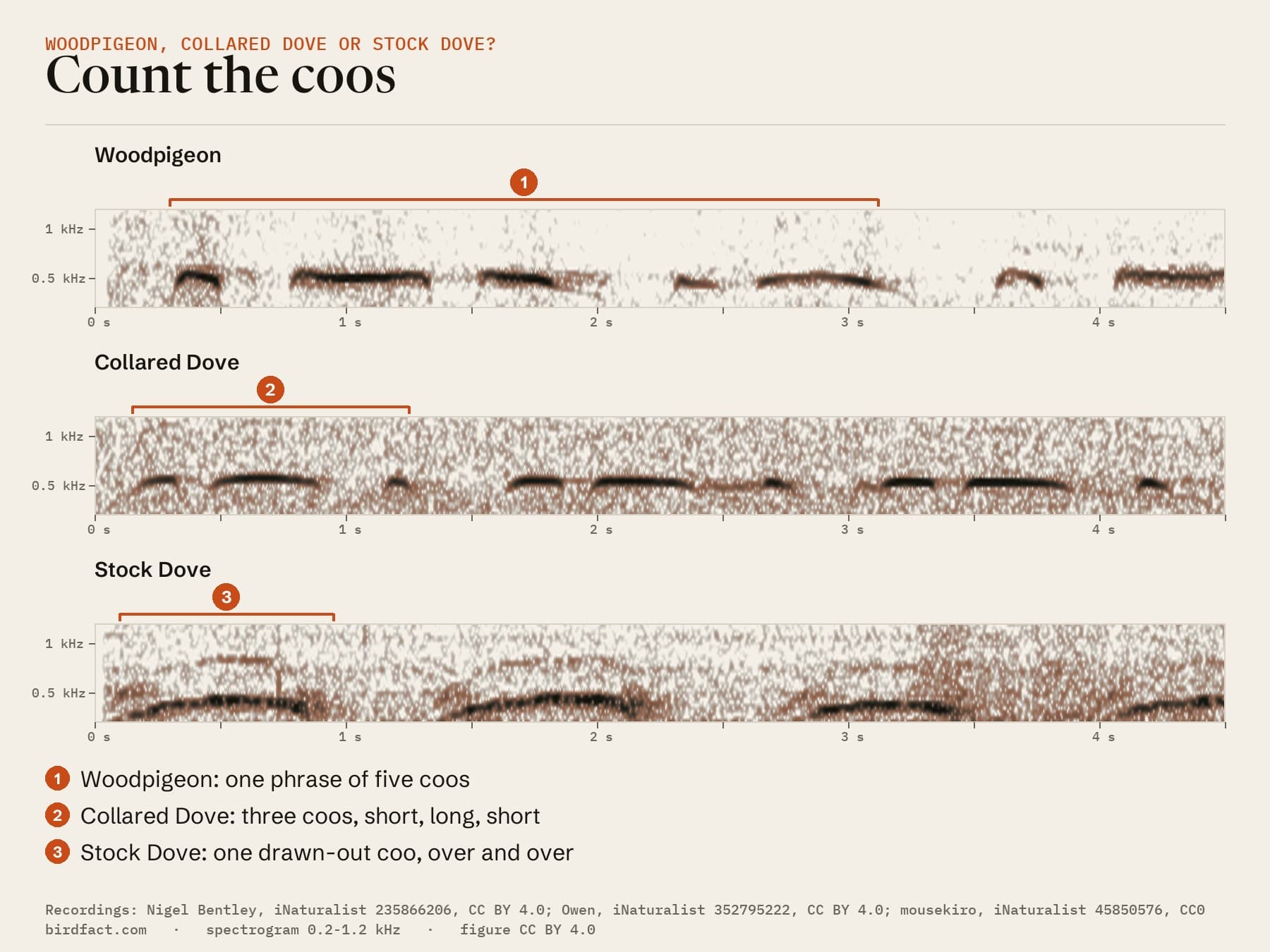
Count the notes. The two sound very similar,12 but the Collared Dove's phrase has three coos, just over a second long, far less muffled, with the second higher; the Woodpigeon's is a deep, slightly muffled phrase of five, usually repeated three or four times. Collared Doves coo more often from rooftops and telegraph poles, Woodpigeons from a treetop.11 See the Woodpigeon's call for both birds and the Stock Dove side by side.
Mistaken for a Cuckoo
Eurasian Collared-Dove or Mourning Dove?
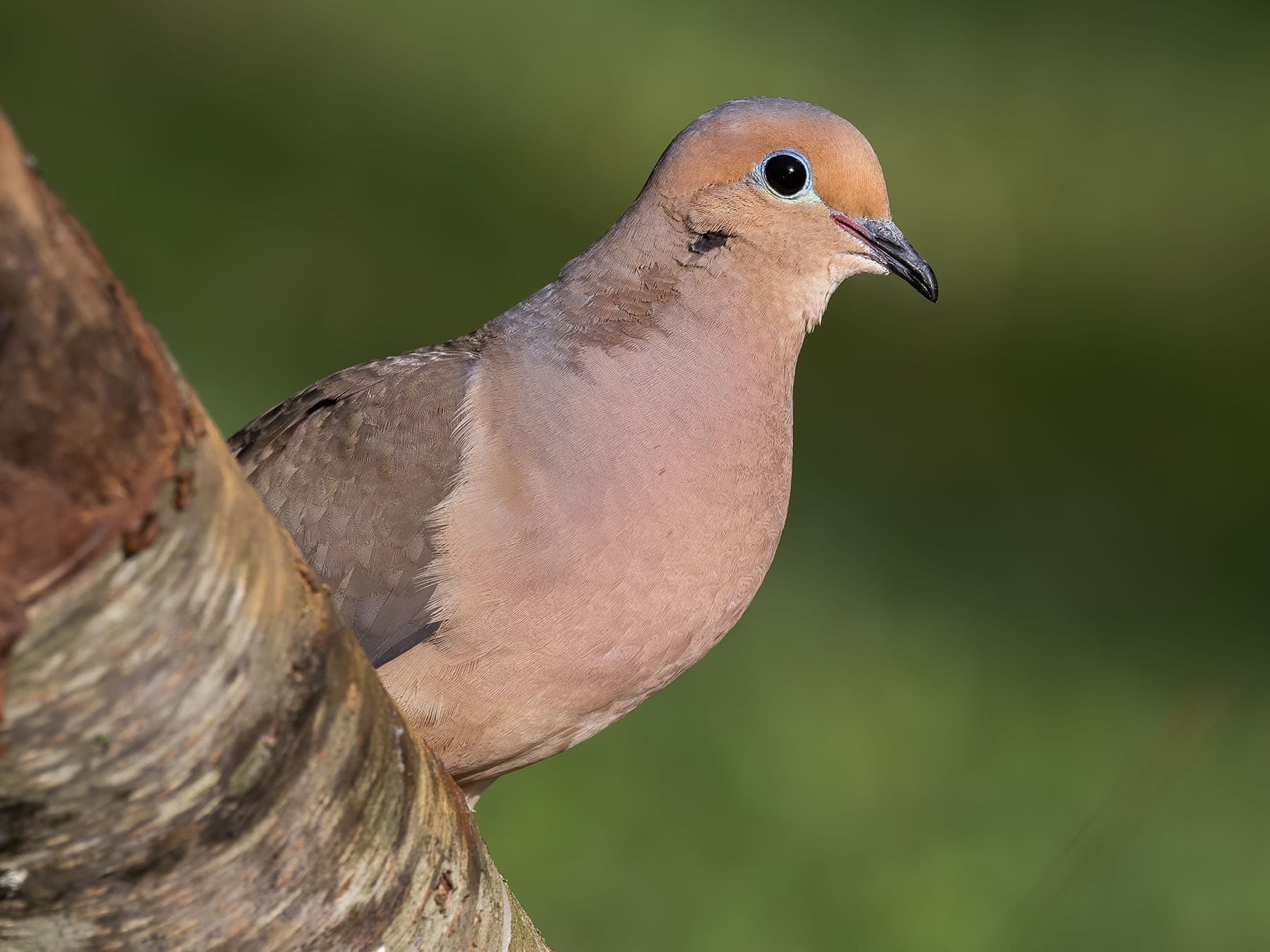
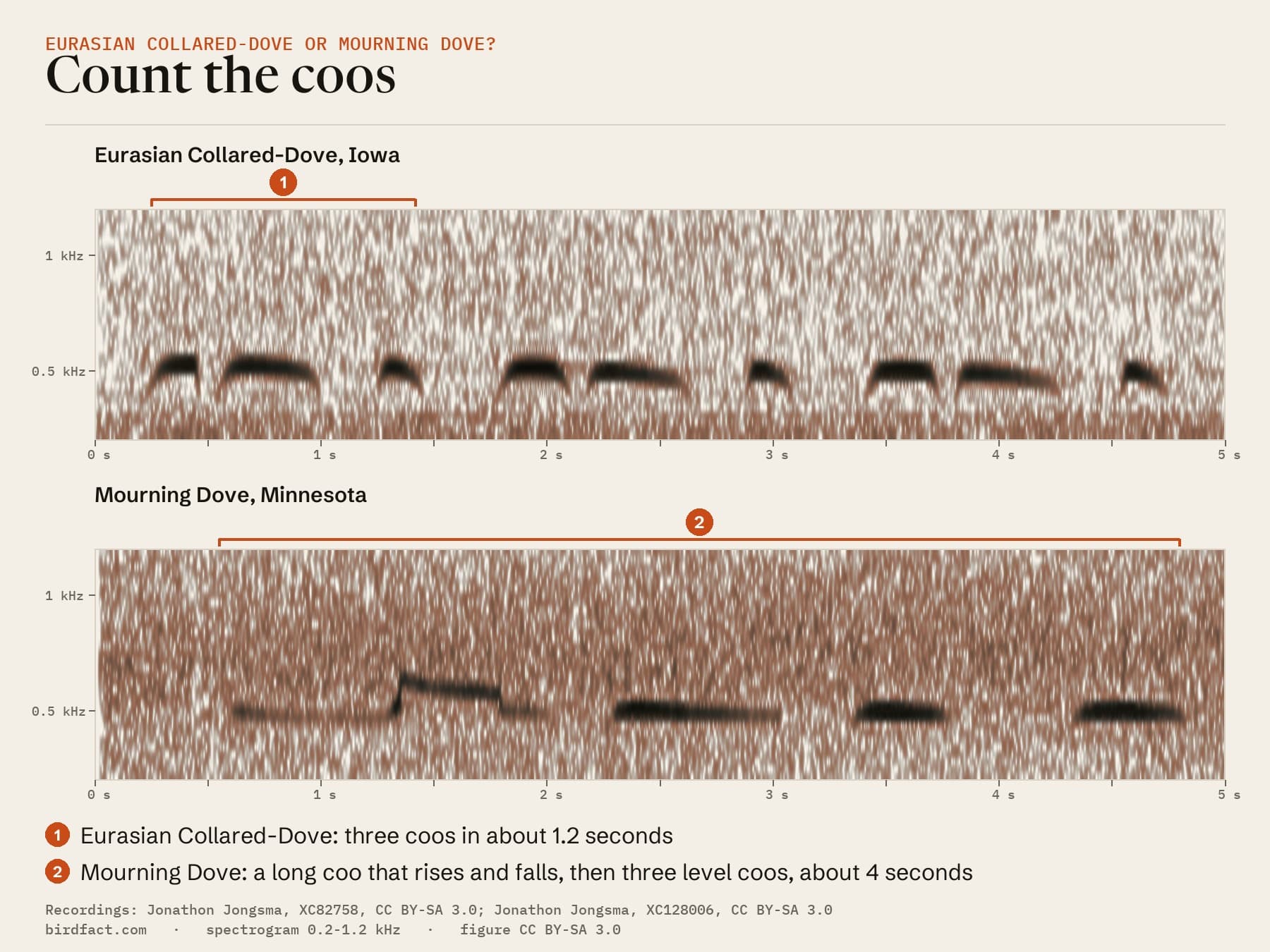
In North America, where it is called the Eurasian Collared-Dove, it shares towns and farmland with the Mourning Dove. Again, count and time the coos. The Collared Dove sings the same three-note phrase as in Britain: in the Iowa recording in the figure below each phrase lasts about 1.2 seconds, like the Sussex bird's. The Mourning Dove's song is a two-part coo followed by two or three louder coos, "coo-oo, OO, OO, OO",14 and in our Minnesota recording it lasts about 4 seconds. All About Birds calls the Collared Dove's call shorter, more impatient and more frequent than the Mourning Dove's.15
One Mourning Dove sound comes closer: its nest call, a short three-note coo, low, high, low, about a second long, given by a paired male at the nest site.14
Barbary Doves and the lost trill
The domestic Barbary Dove (Ringed Turtle-Dove) and its wild ancestor the African Collared Dove sound different: their coo has two notes, the second long and trilled (about 1.1 seconds of a 1.6-second coo in Barbary Doves).3 The Collared Dove seems to have lost the trill most of its relatives share, yet males still react more strongly to coos with an African Collared Dove's trill spliced in.16
The name decaocto
The scientific name, Streptopelia decaocto, is said to echo the song. Decaocto means eighteen, and an account from 1795 records that the Greeks named the bird after its call.17
About the recordings
The British song was recorded by Mike Kerry in a garden in Seaford, East Sussex, and identified by him and two other iNaturalist users. No openly licensed British recording of the excitement call could be found, so the calls are from Philippe Grange in the Vendée, France. The North American recordings are by Jonathon Jongsma in Iowa and Minnesota. Birdfact drew the spectrograms from these files and, for the three-dove figure, from British recordings by Nigel Bentley, Owen and mousekiro; each figure credits its recordings.
Sources
- Romagosa, C. M., Mlodinow, S. G. (2022). Eurasian Collared-Dove (Streptopelia decaocto), version 1.1. Birds of the World (P. Pyle, P. G. Rodewald and S. M. Billerman, editors). Cornell Lab of Ornithology. doi:10.2173/bow.eucdov.01.1
- Cornell Lab of Ornithology. Eurasian Collared-Dove: Sounds. All About Birds. Accessed 9 October 2026. Source
- Slabbekoorn, H., de Kort, S. R., ten Cate, C. (1999). Comparative analysis of perch-coo vocalizations in Streptopelia doves. The Auk 116(3): 737-748. doi:10.2307/4089334
- Slabbekoorn, H., ten Cate, C. (1999). Collared Dove responses to playback: slaves to the rhythm. Ethology 105(5): 377-391. doi:10.1046/j.1439-0310.1999.00420.x
- Slabbekoorn, H., ten Cate, C. (1998). Perceptual tuning to frequency characteristics of territorial signals in collared doves. Animal Behaviour 56(4): 847-857. doi:10.1006/anbe.1998.0887
- Ballintijn, M. R., ten Cate, C. (1999). Variation in number of elements in the perch-coo vocalization of the Collared Dove (Streptopelia decaocto) and what it may tell about the sender. Behaviour 136(7): 847-864. doi:10.1163/156853999501603
- Ballintijn, M. R., ten Cate, C. (1997). Sex differences in the vocalizations and syrinx of the Collared Dove (Streptopelia decaocto). The Auk 114(1): 22-39. doi:10.2307/4089062
- Ballintijn, M. R., ten Cate, C. (1997). Vocal development and its differentiation in a non-songbird: the Collared Dove (Streptopelia decaocto). Behaviour 134(7-8): 595-621. doi:10.1163/156853997X00548
- Ballintijn, M. R., ten Cate, C. (1998). Sound production in the Collared Dove: a test of the 'whistle' hypothesis. Journal of Experimental Biology 201(10): 1637-1649. doi:10.1242/jeb.201.10.1637
- ten Cate, C. (2021). Re-evaluating vocal production learning in non-oscine birds. Philosophical Transactions of the Royal Society B 376(1836): 20200249. doi:10.1098/rstb.2020.0249
- Duncan, J. What can I hear - Woodpigeon or Collared Dove? Sussex Wildlife Trust. Accessed 8 October 2026. Source
- BTO. Bird Song Basics: Collared Dove and Woodpigeon. BTO, Bird ID videos. Accessed 8 October 2026. Source
- BTO. Identifying Cuckoos. BTO, Bird ID videos. Accessed 9 October 2026. Source
- Otis, D. L., Schulz, J. H., Miller, D., Mirarchi, R. E., Baskett, T. S. (2020). Mourning Dove (Zenaida macroura), version 1.0. Birds of the World (A. F. Poole, editor). Cornell Lab of Ornithology. doi:10.2173/bow.moudov.01
- Cornell Lab of Ornithology. Eurasian Collared-Dove. All About Birds. Accessed 9 October 2026. Source
- Secondi, J. (2003). To trill or not to trill? Territorial response to a heterospecific vocal trait in male collared doves, Streptopelia decaocto. Behavioral Ecology 14(5): 694-701. doi:10.1093/beheco/arg058
- Jobling, J. A. The Key to Scientific Names: decaocto; Streptopelia. Birds of the World, Cornell Lab of Ornithology. Accessed 9 October 2026. Source