Published 8 Oct 2026
Woodpigeon Call and Song: What a Woodpigeon Sounds Like
By the Birdfact teamChecked by Nathan Cope
A Woodpigeon's song is a deep phrase of four or five coos, the second usually stressed, repeated several times. Listen to recordings made in Britain, see the coo drawn as a spectrogram, and learn to tell it from a Collared Dove's three coos and a Stock Dove's slow, drawn-out ones.
On this page10 sections
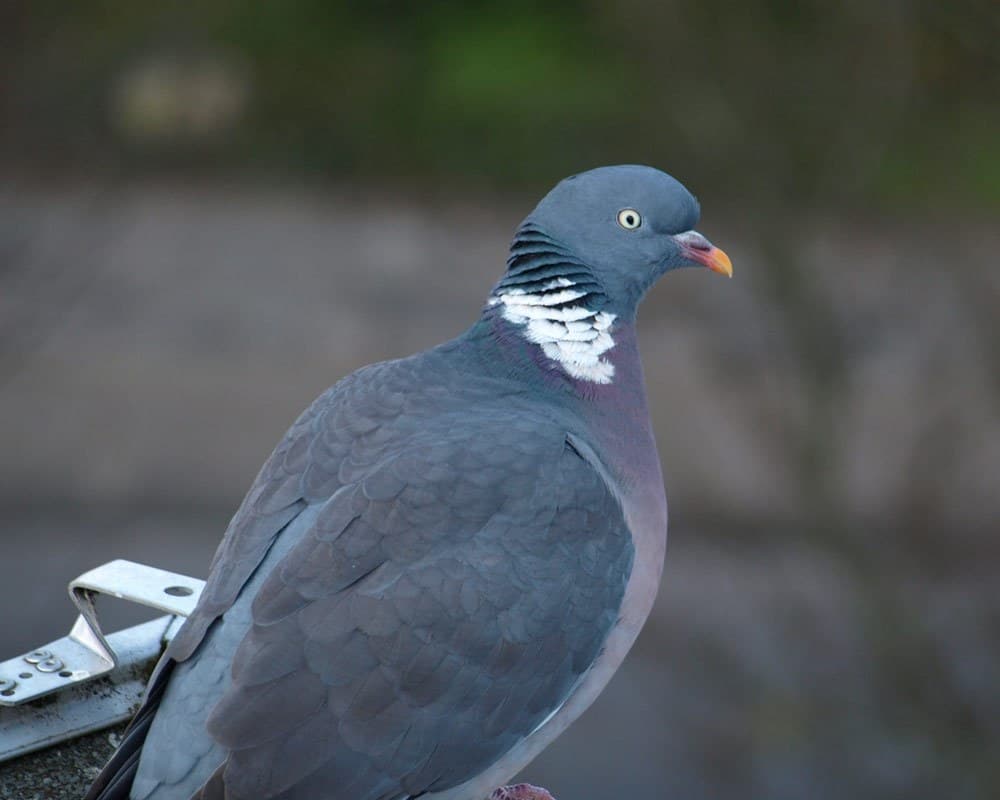
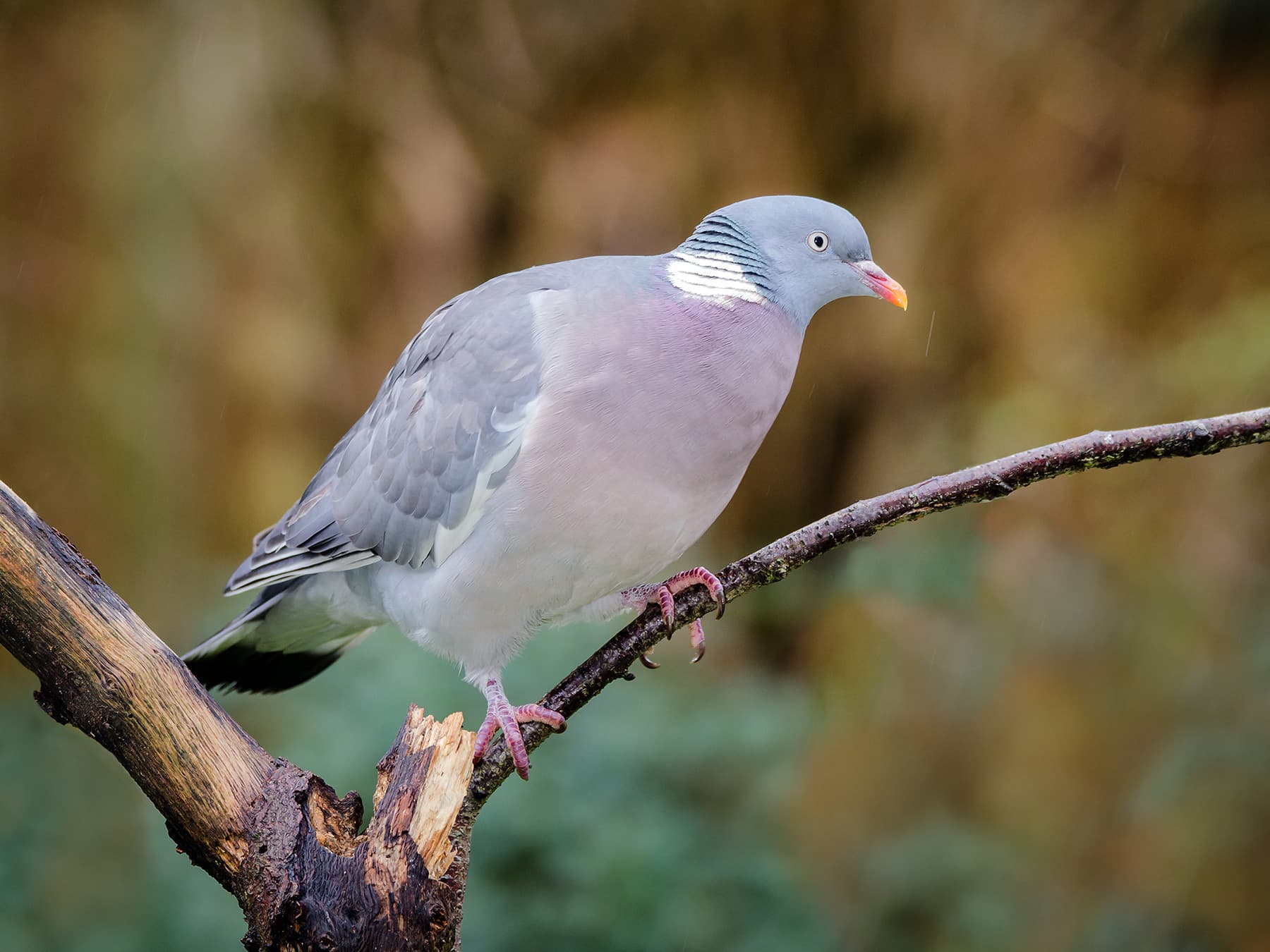
What a Woodpigeon sounds like, with recordings made in Britain and drawn as spectrograms: the coo, why and when Woodpigeons call, how to tell them from a Collared Dove or a Stock Dove, and the sounds made by their wings. For the bird itself, see Woodpigeon identification and facts.
What does a Woodpigeon sound like?
A deep cooing: a phrase of four or five coos, the second usually stressed, repeated with only short pauses so that it can sound like one continuous run; a run of phrases usually ends with a single short note.1 The Sussex Wildlife Trust describes it as deep, resonant and slightly muffled, a five-note phrase usually repeated three or four times.2
In the recording below, made in Polegate, East Sussex, a Woodpigeon sings three phrases in about 10 seconds from the ridge of a thatched roof.
One phrase, five coos
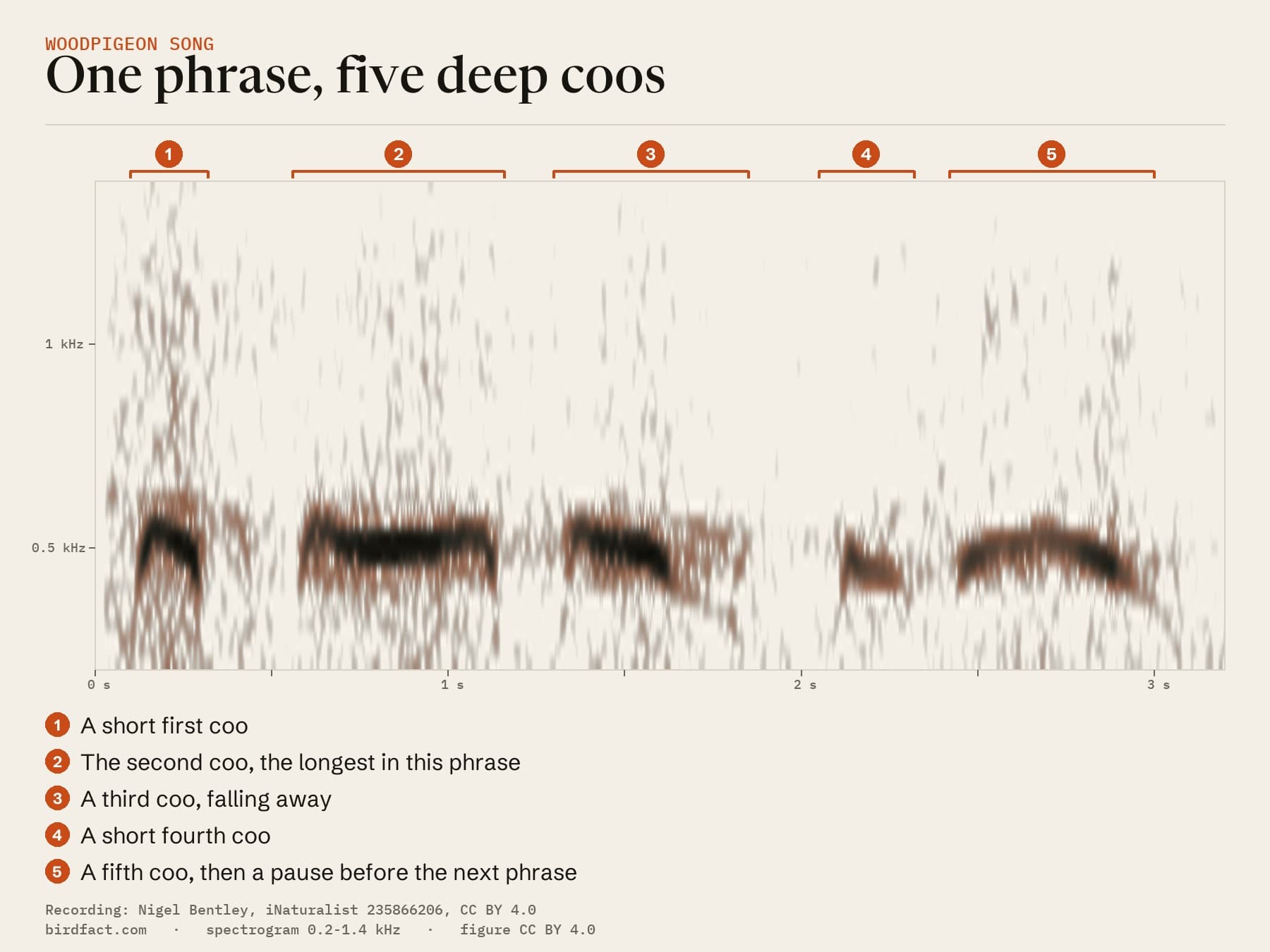
The figure below draws the first phrase of that recording as a spectrogram, pitch against time. It has five coos, all around half a kilohertz, and lasts about 2.8 seconds; in this phrase the second coo is the longest. Then comes a short pause and the next phrase. All About Birds gives a single song as about 2 seconds, often sung several times in quick succession for 10 to 15 seconds;3 this one is a little longer.
How the coo is made
With its bill shut. A singing Woodpigeon puffs out its throat but keeps its bill closed.3 Pitch and pace vary a little from bird to bird.
Why do Woodpigeons coo?
It is an advertising call: that is what Birds of the World calls the cooing phrase.1 In central London in the 1950s, Stanley Cramp found that males proclaimed their territories partly by song, though mostly just by being there: on most mornings a male flew in from the roost, sang two or three times on arrival and then went to feed. Once the eggs were laid, the full song stopped, though a sitting bird might still coo a little.4
When they call
Woodpigeons are particularly vocal in spring, and they are usually one of the first birds singing after dawn.2 In Cramp's London study, song was heard from December to September, most of all from March to June, and almost never in October and November, when the birds had mostly left central London to feed.4
Telling it from a Collared Dove or Stock Dove
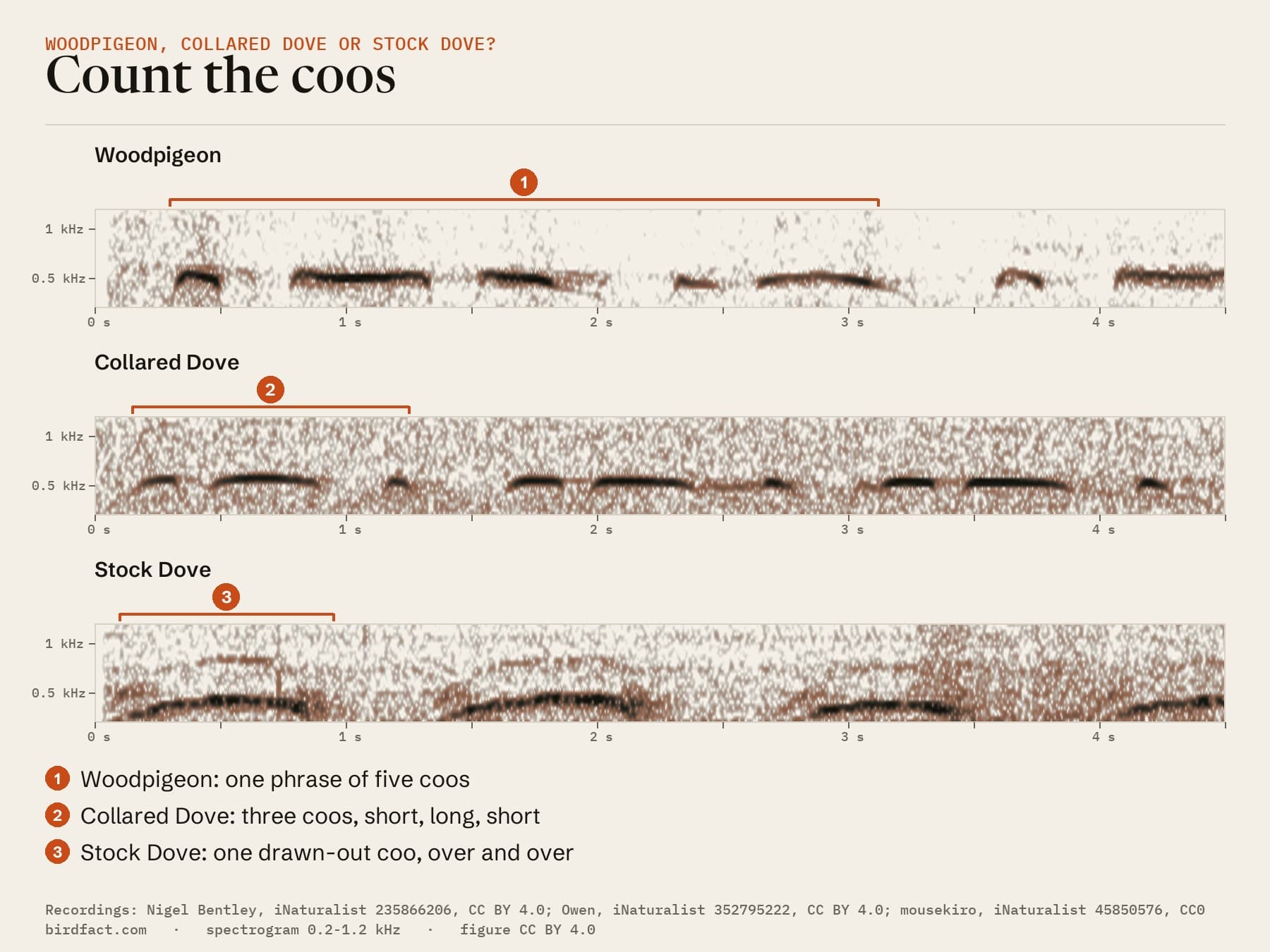
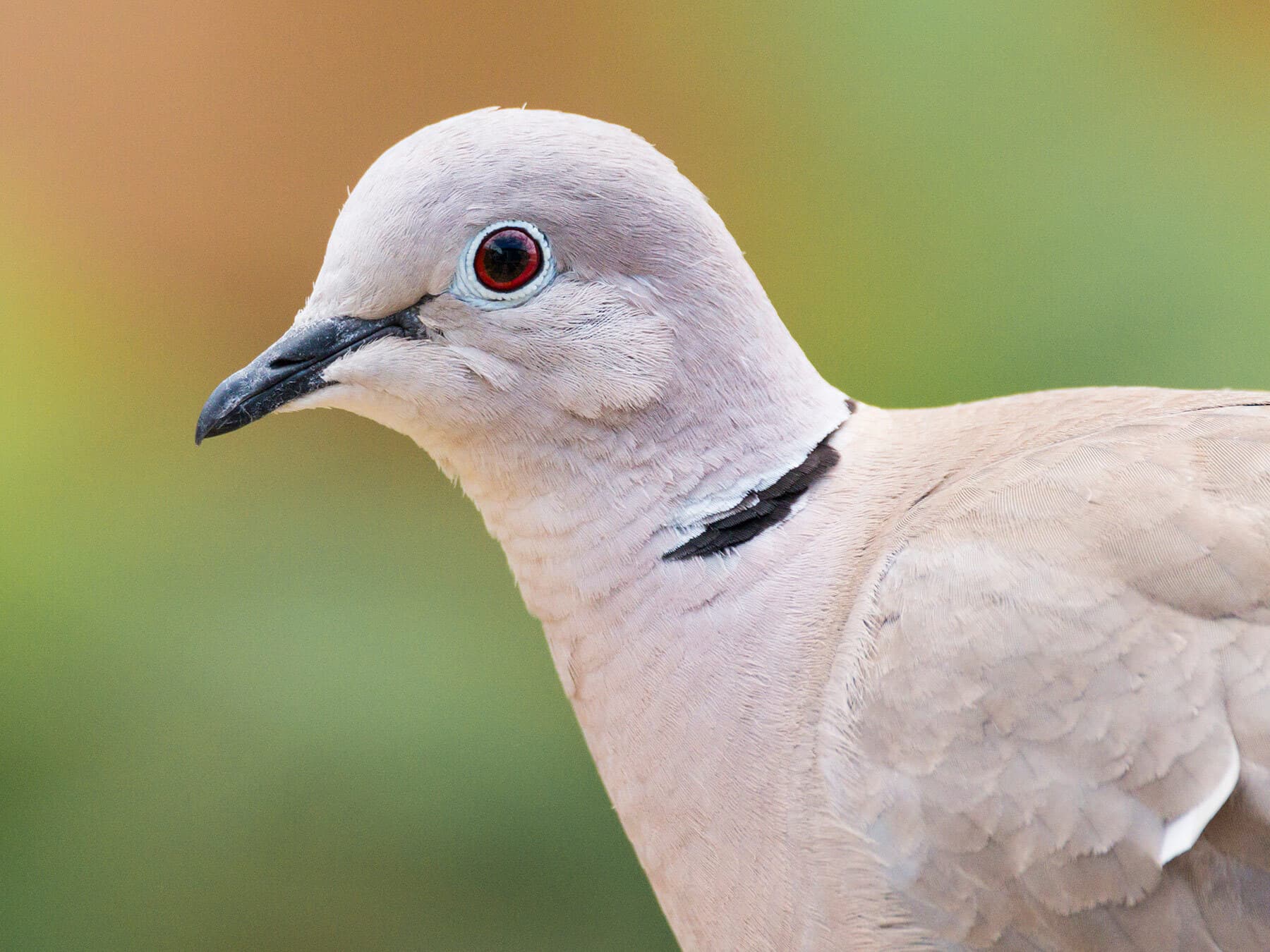
Count the coos. The BTO warns that the Woodpigeon and the Collared Dove sound very similar.5 A Collared Dove sings just three coos, the second stressed, in a phrase of about 1.5 seconds, usually repeated 3 to 12 times.6 It is less muffled than a Woodpigeon, and more often heard from rooftops and telegraph poles; Woodpigeons often sing from a treetop.2 Collared Doves only reached the UK in 1955.
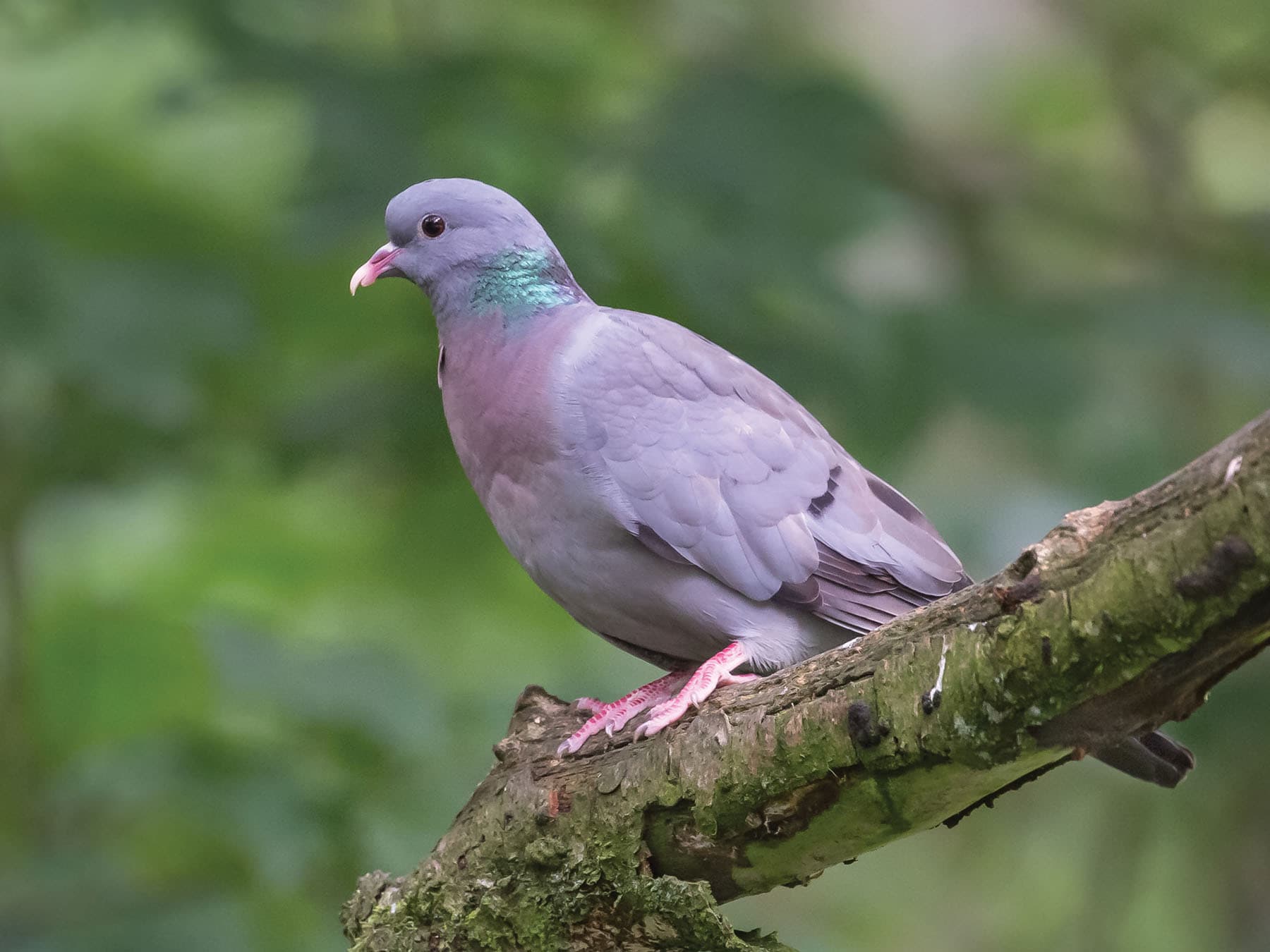
The Stock Dove is not very vocal. Its advertising call is a series of drawn-out, two-part coos; the series starts faint and stops abruptly.7 In the Stanmore recording below its coos are lower than a Woodpigeon's and come one at a time, about every 1.3 seconds.
Other calls
Besides the song, a Woodpigeon gives a gruffer call of two very low, growling notes with a short gap, repeated at longer intervals.3 In Cramp's 1950s study, courting males cooed softly as they bowed to a female, and a male showing his mate a nest site gave a deep double "coo, coo" with downward pecking motions.4 See Woodpigeon courtship.
Why do Woodpigeons clap their wings?
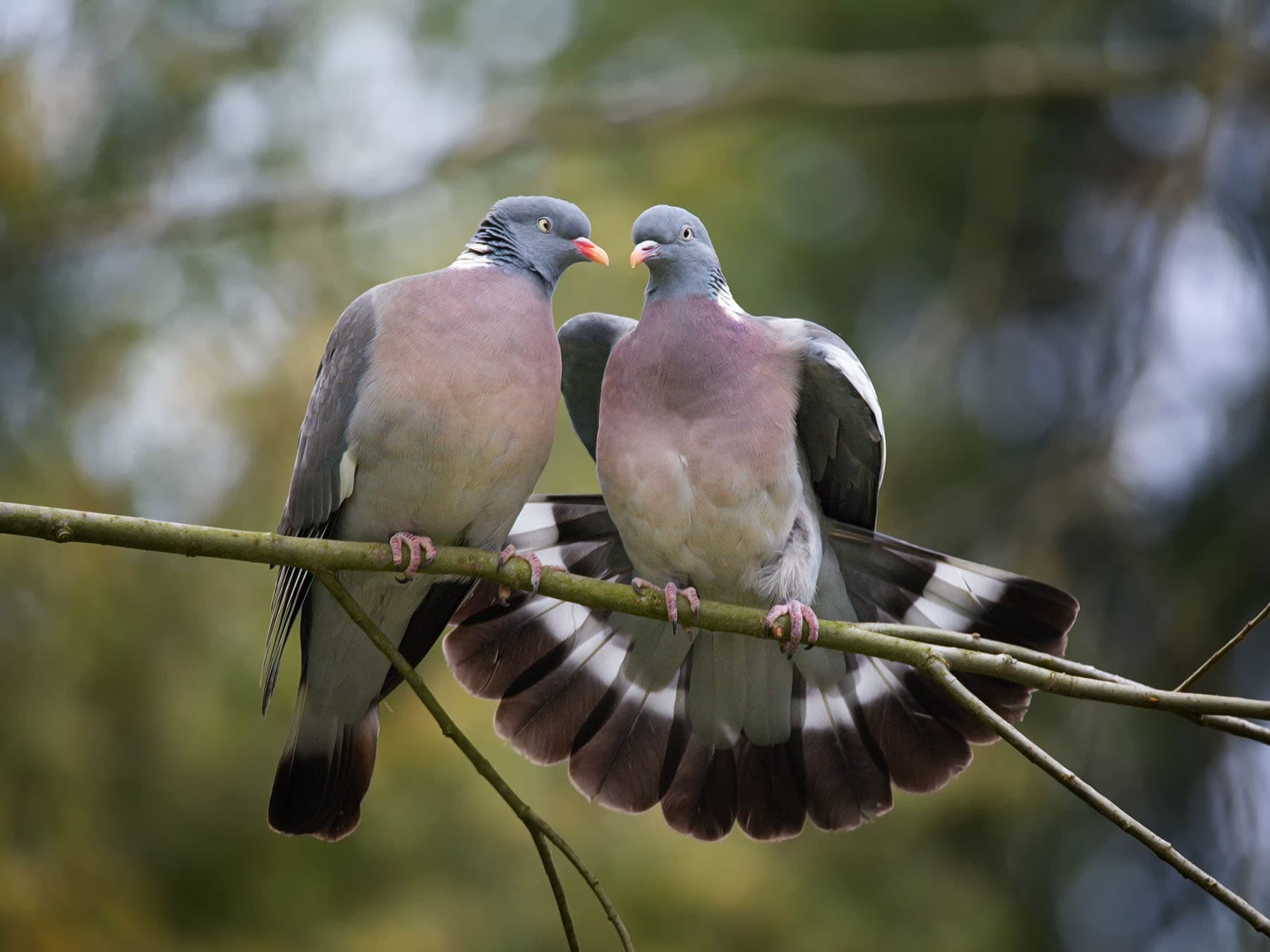
As part of the display flight, which announces a territory: the bird climbs, may clap its wings, then glides down on stiff wings.1 The clap is not always heard: in central London, Cramp heard one on fewer than 5% of display flights, which were most frequent in February and March.4
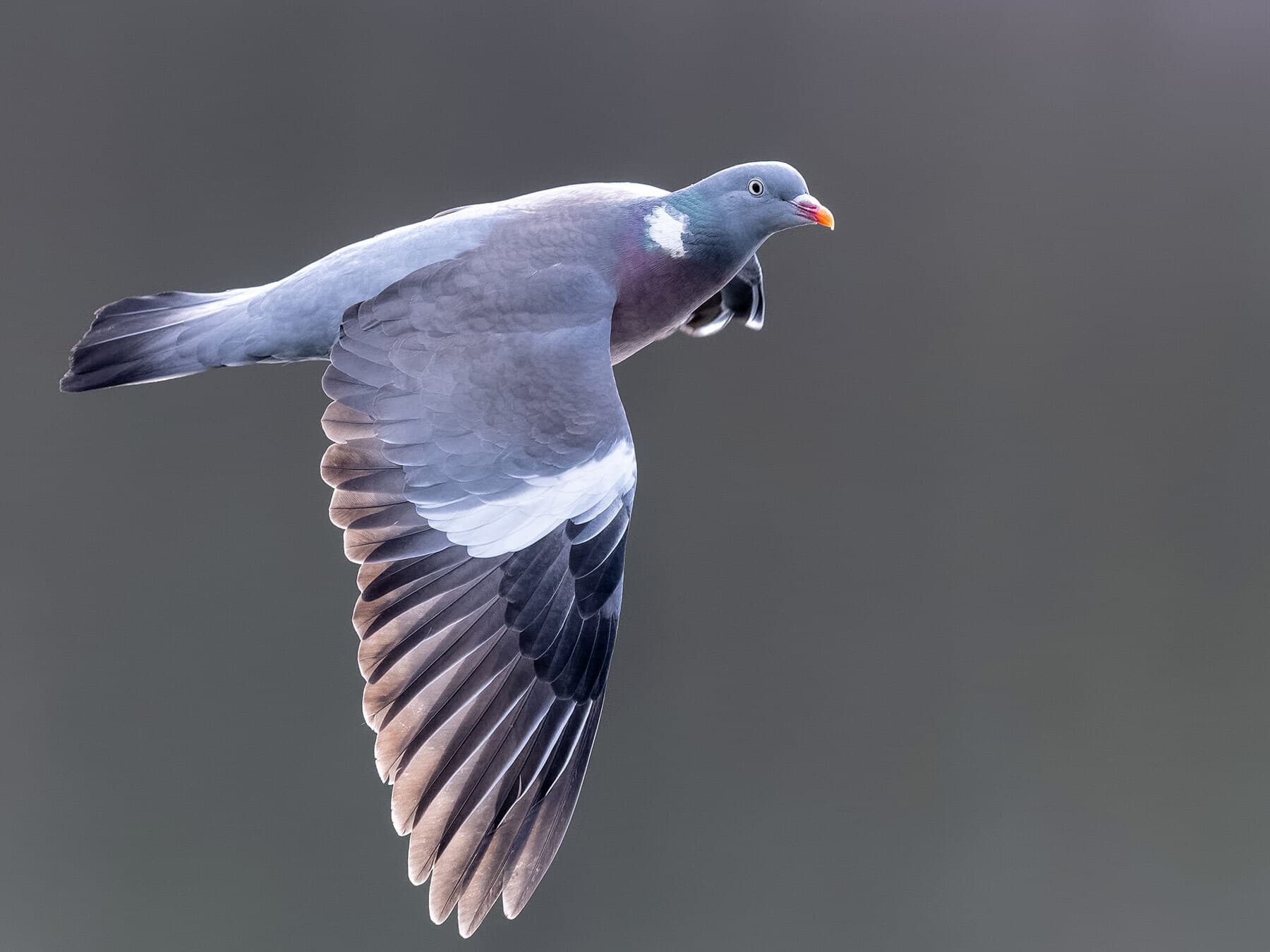
A different sound is the loud clatter of wings when a Woodpigeon takes off,8 often in alarm. And listen as one flies past: an adult's wings make a whistling sound, a young bird's do not.3
About these recordings
All four recordings were made in Britain and shared on iNaturalist under Creative Commons terms (the Stock Dove recording is dedicated to the public domain); each was checked on a spectrogram before use. For both Woodpigeon recordings the recordist photographed a Woodpigeon on the thatched roof ridge; the Collared Dove and Stock Dove were identified from their recordings by iNaturalist users, and their spectrograms match the published descriptions of their calls. The two figures were drawn by Birdfact from these recordings.
Sources
- Baptista, L. F., Trail, P. W., Horblit, H. M., Boesman, P. F. D., Garcia, E., Perlman, Y. (2025). Common Wood-Pigeon (Columba palumbus), version 1.1. Birds of the World (J. del Hoyo, A. Elliott, J. Sargatal, D. A. Christie, E. de Juana and M. G. Smith, editors). Cornell Lab of Ornithology. doi:10.2173/bow.cowpig1.01.1
- Duncan, J. What can I hear - Woodpigeon or Collared Dove? Sussex Wildlife Trust. Accessed 8 October 2026. Source
- Cornell Lab of Ornithology. Common Wood-Pigeon: Sounds. All About Birds. Accessed 8 October 2026. Source
- Cramp, S. (1958). Territorial and other behaviour of the Woodpigeon. Bird Study 5(2): 55-66. doi:10.1080/00063655809475903
- BTO. Bird Song Basics: Collared Dove and Woodpigeon. BTO, Bird ID videos. Accessed 8 October 2026. Source
- Romagosa, C. M., Mlodinow, S. G. (2022). Eurasian Collared-Dove (Streptopelia decaocto), version 1.1. Birds of the World (P. Pyle, P. G. Rodewald and S. M. Billerman, editors). Cornell Lab of Ornithology. doi:10.2173/bow.eucdov.01.1
- Baptista, L. F., Trail, P. W., Horblit, H. M., Boesman, P. F. D., Garcia, E. (2020). Stock Dove (Columba oenas), version 1.0. Birds of the World (J. del Hoyo, A. Elliott, J. Sargatal, D. A. Christie and E. de Juana, editors). Cornell Lab of Ornithology. doi:10.2173/bow.stodov1.01
- RSPB. Woodpigeon. RSPB Birds A-Z. Accessed 8 October 2026. Source