


Woodpigeon
Common Wood Pigeon, Wood Pigeon, Ring Dove · Columba palumbus
By the Birdfact teamChecked by Nathan Cope
See it in 3D
3D model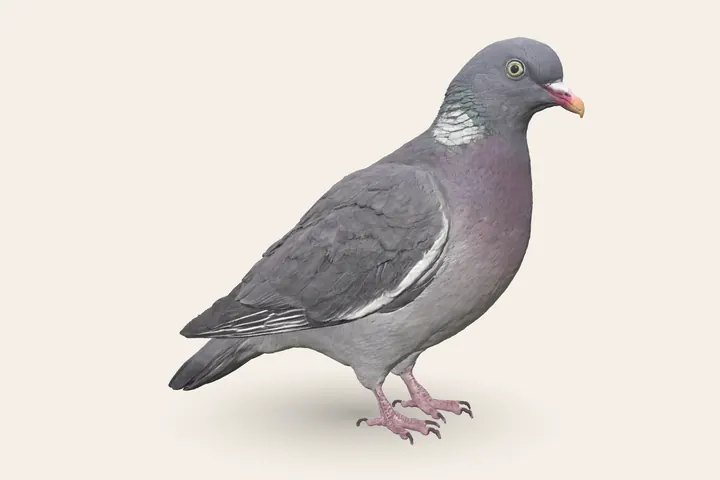 3D model
A Woodpigeon is 40–42 cm (15.5–16.5 in) long, bill to tail.
3D model · Adult · Length 40–42 cm (15.5–16.5 in) · How we make our birds · Report a problem
© 2026 NC Digital Limited (Birdfact). All rights reserved. This 3D model may be viewed on this page and shared by link only. Downloading, extracting, copying or reusing it, or using it to train machine-learning models, is not permitted without our written permission. Using our models
On this page16 sections
How to recognise it
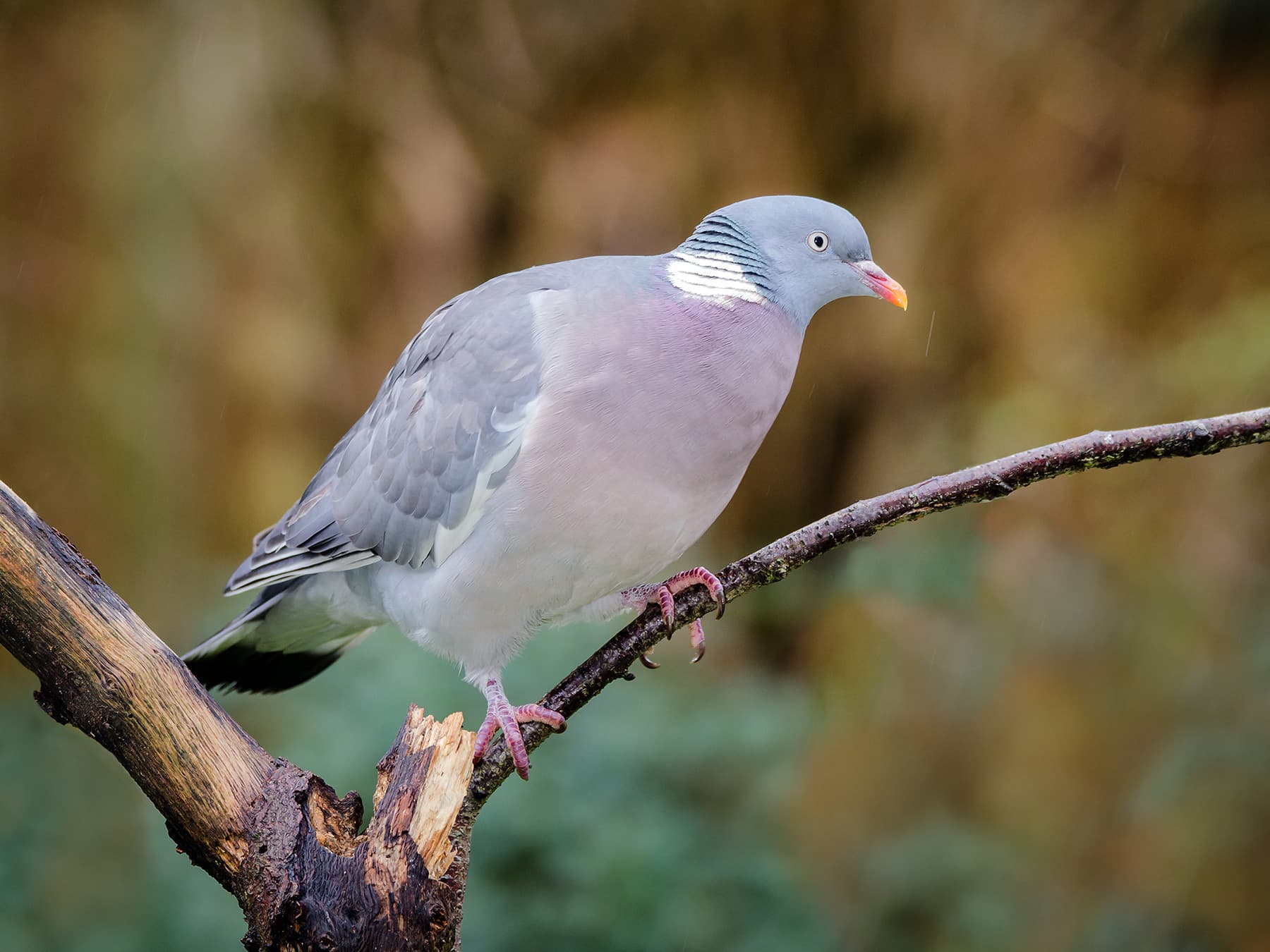
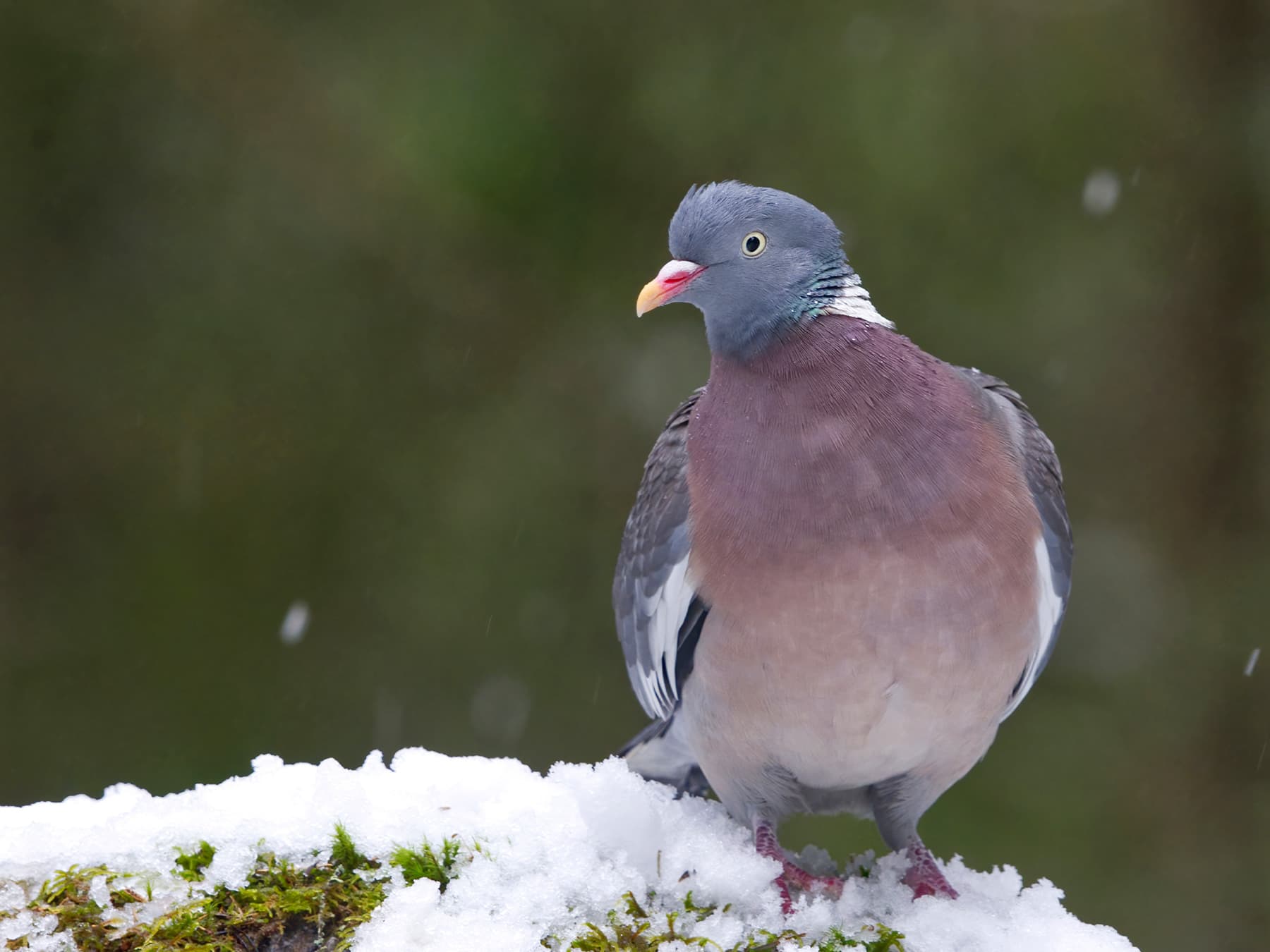
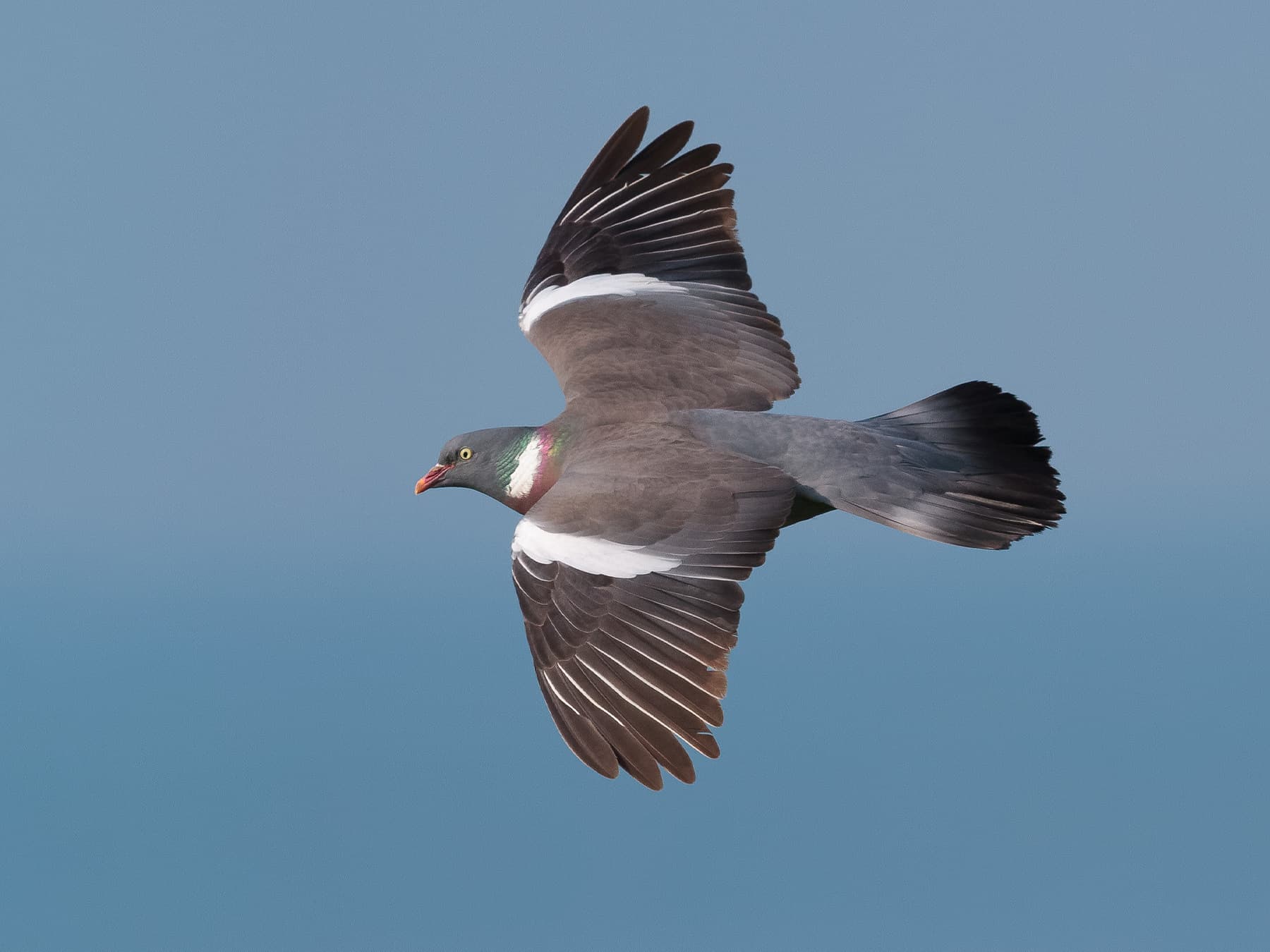
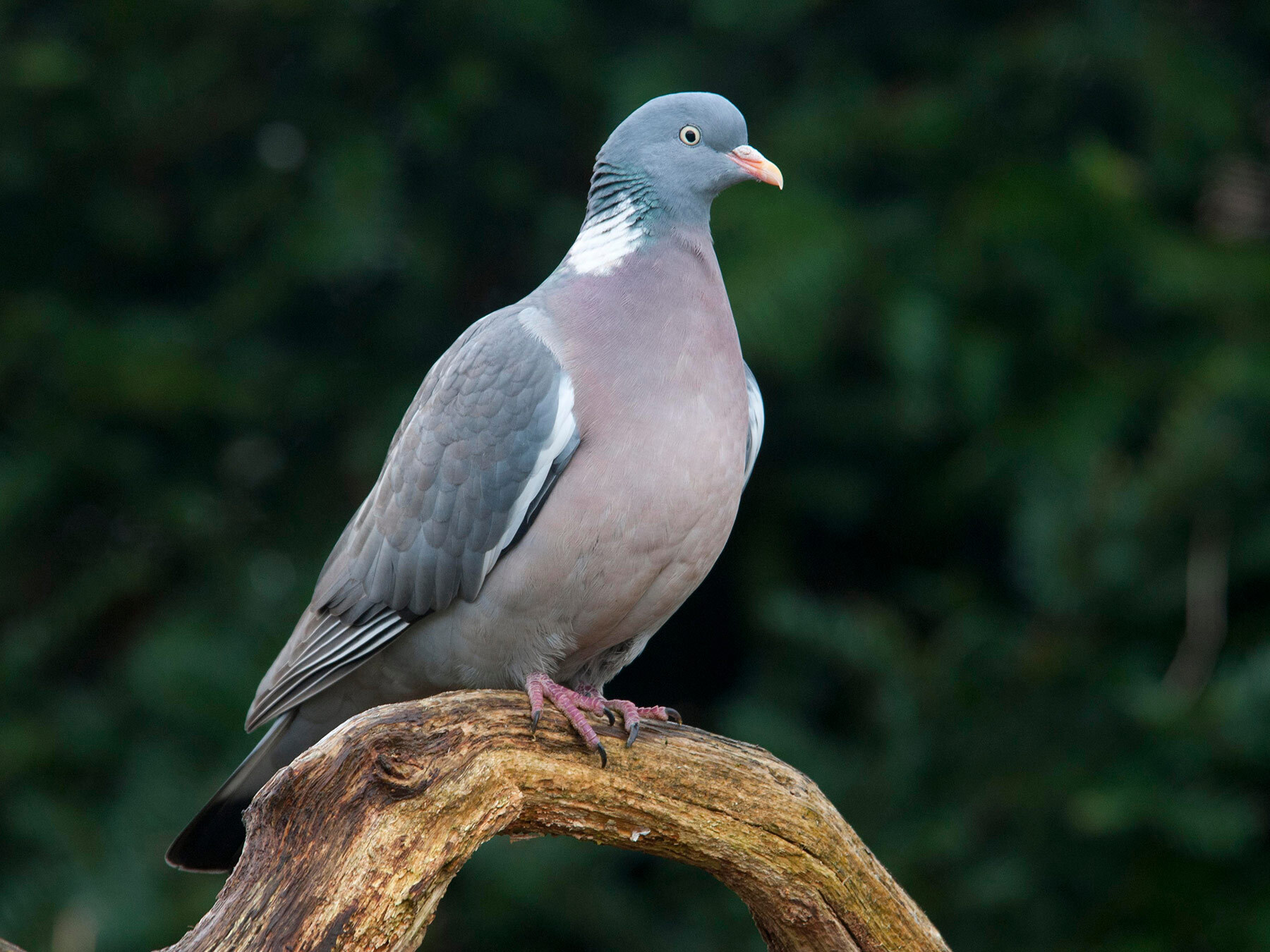
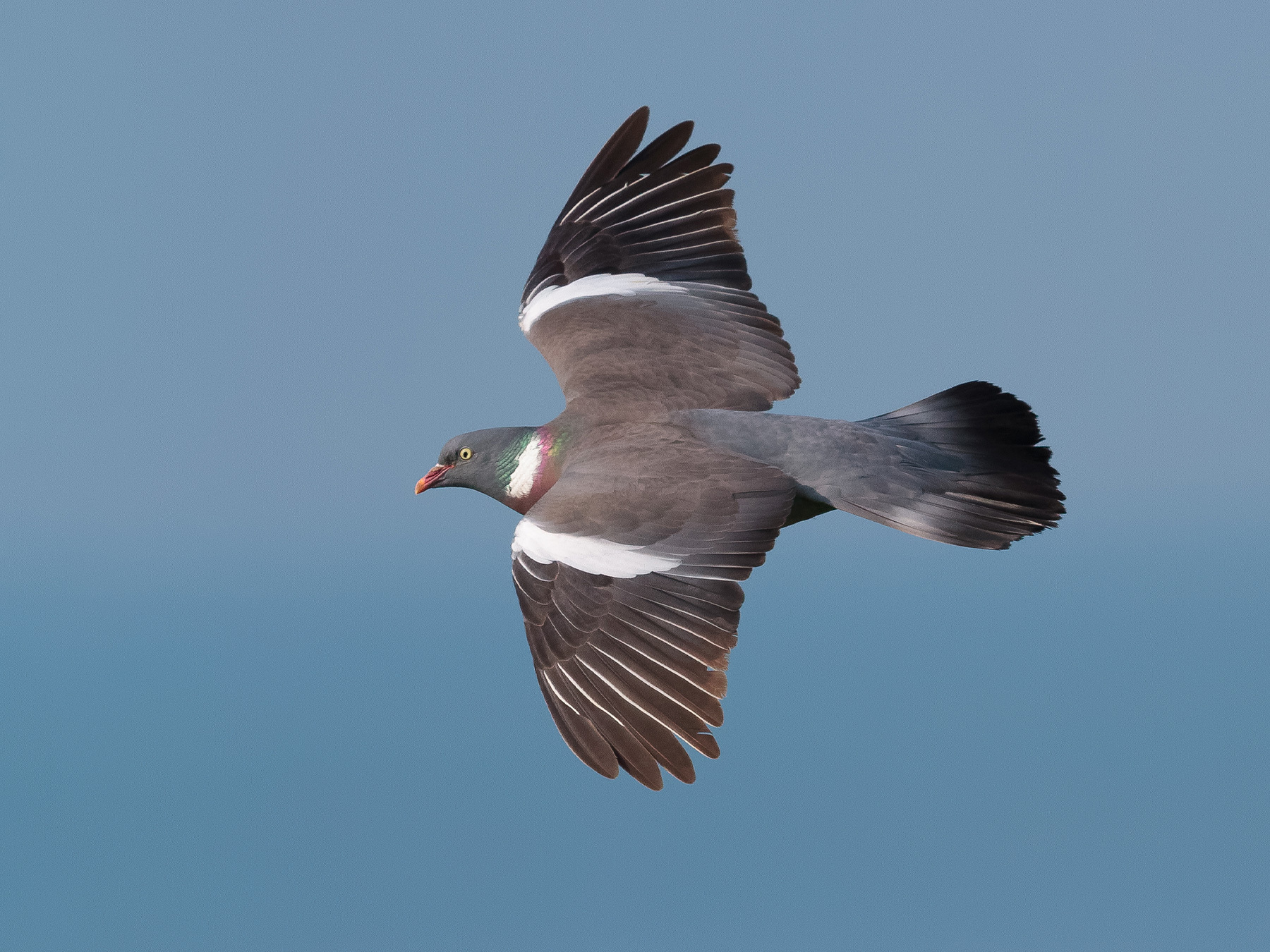
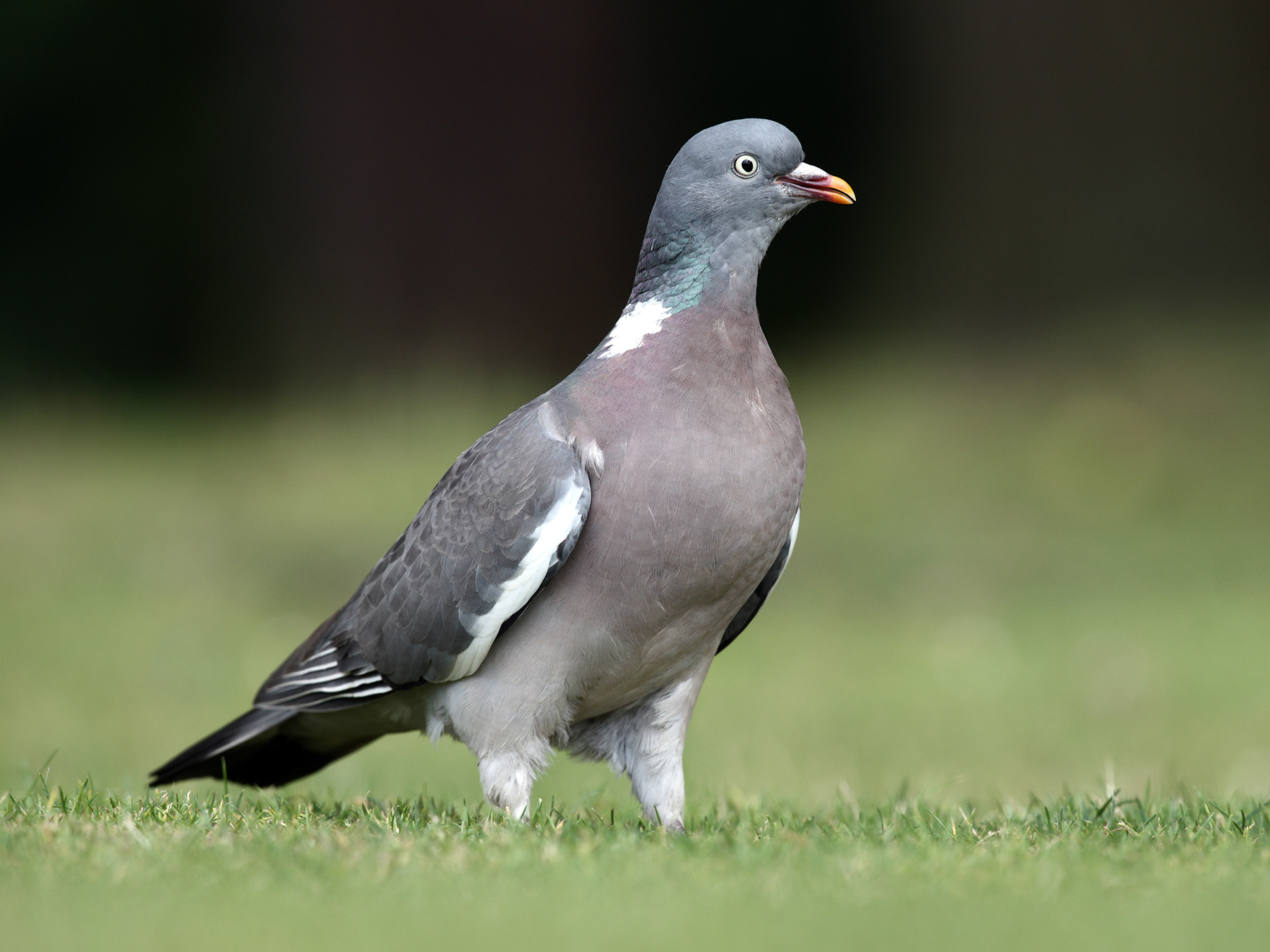
A big, plump pigeon, 40 to 42 cm long and around 480 to 550 g, and the largest pigeon in the UK. It is grey above with a pinkish breast, and an adult has a white patch on each side of the neck. In flight, look for the broad white band across each wing.1
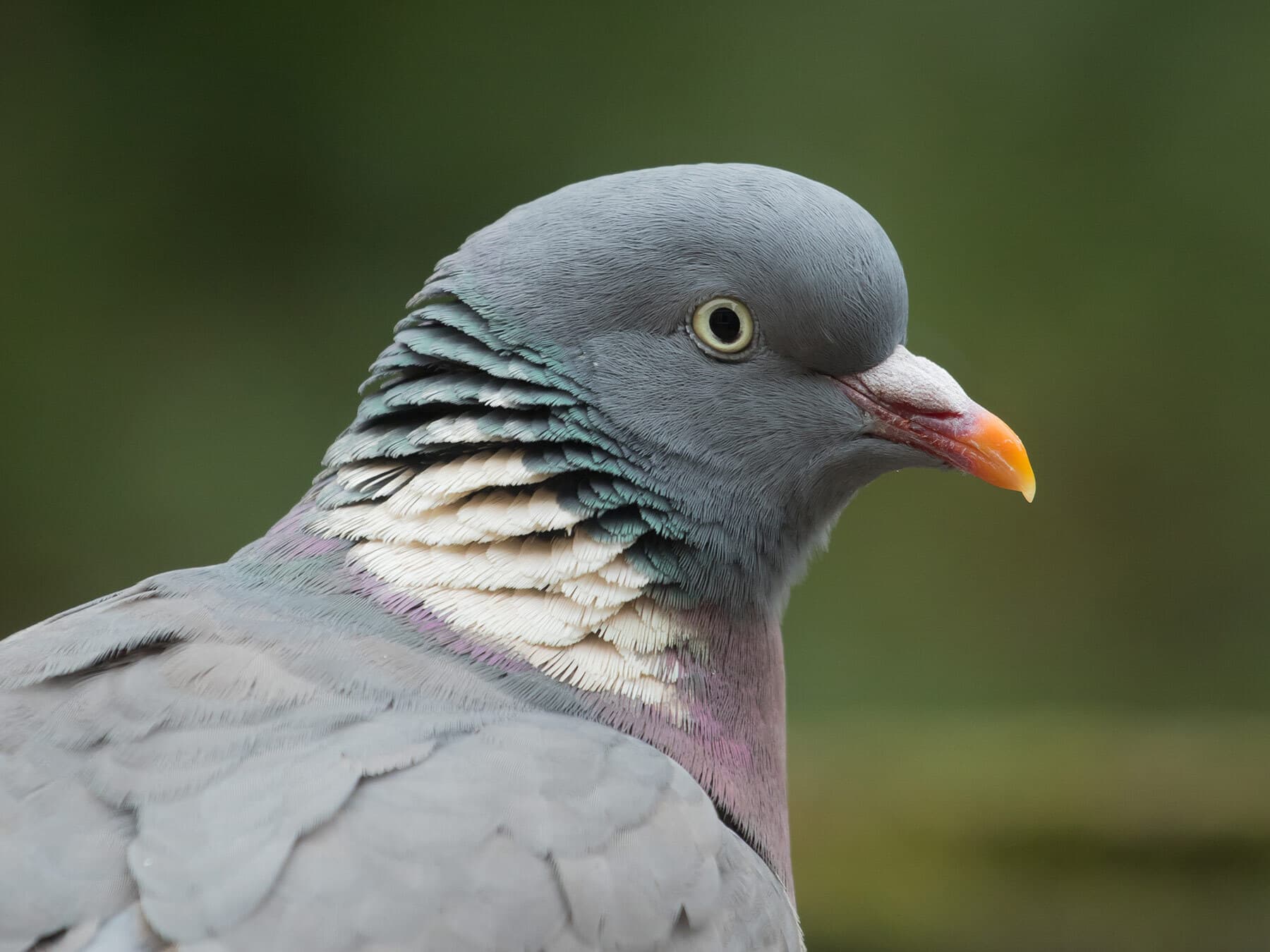
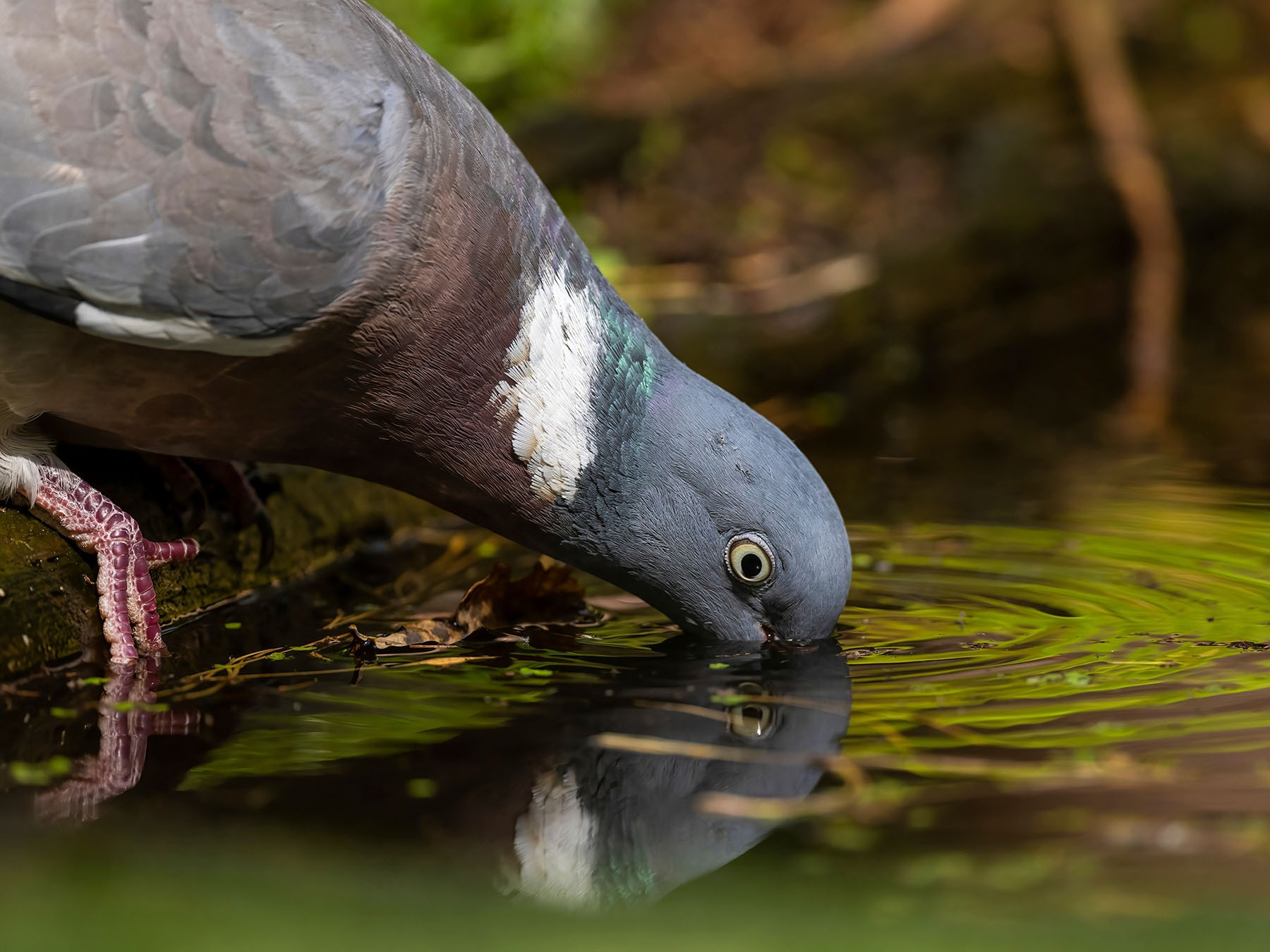
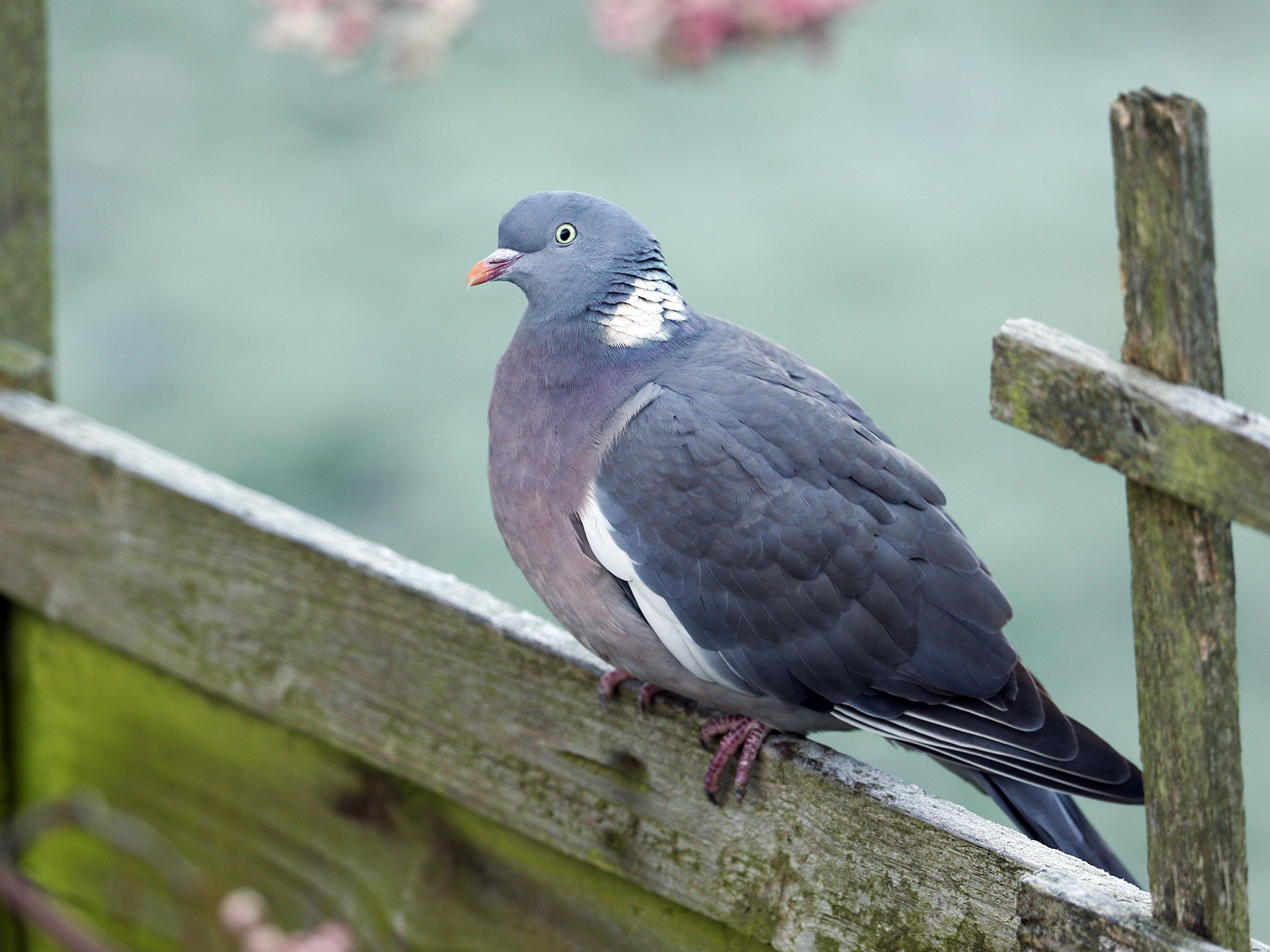
Close up, the white neck patch sits beside a sheen of green and purple, the breast is mauve-pink fading to cream on the belly, and the grey tail ends in a broad black band. The eye is pale, the bill pinkish at the base and yellow towards the tip with a white patch (the cere) above the nostrils, and the legs are reddish-purple.2
Adult Woodpigeons weighed by BTO ringers average 507 g.3 When one flies off, listen for the loud clatter of its wings.
Male, female and young
Males and females look alike. In females the white neck patches tend to be a little smaller and the breast less pink, but the difference is slight. Males are a little heavier on average, 529 g against 488 g for females in BTO's samples, though the ranges overlap.3 See male and female Woodpigeons for what can and cannot tell them apart.
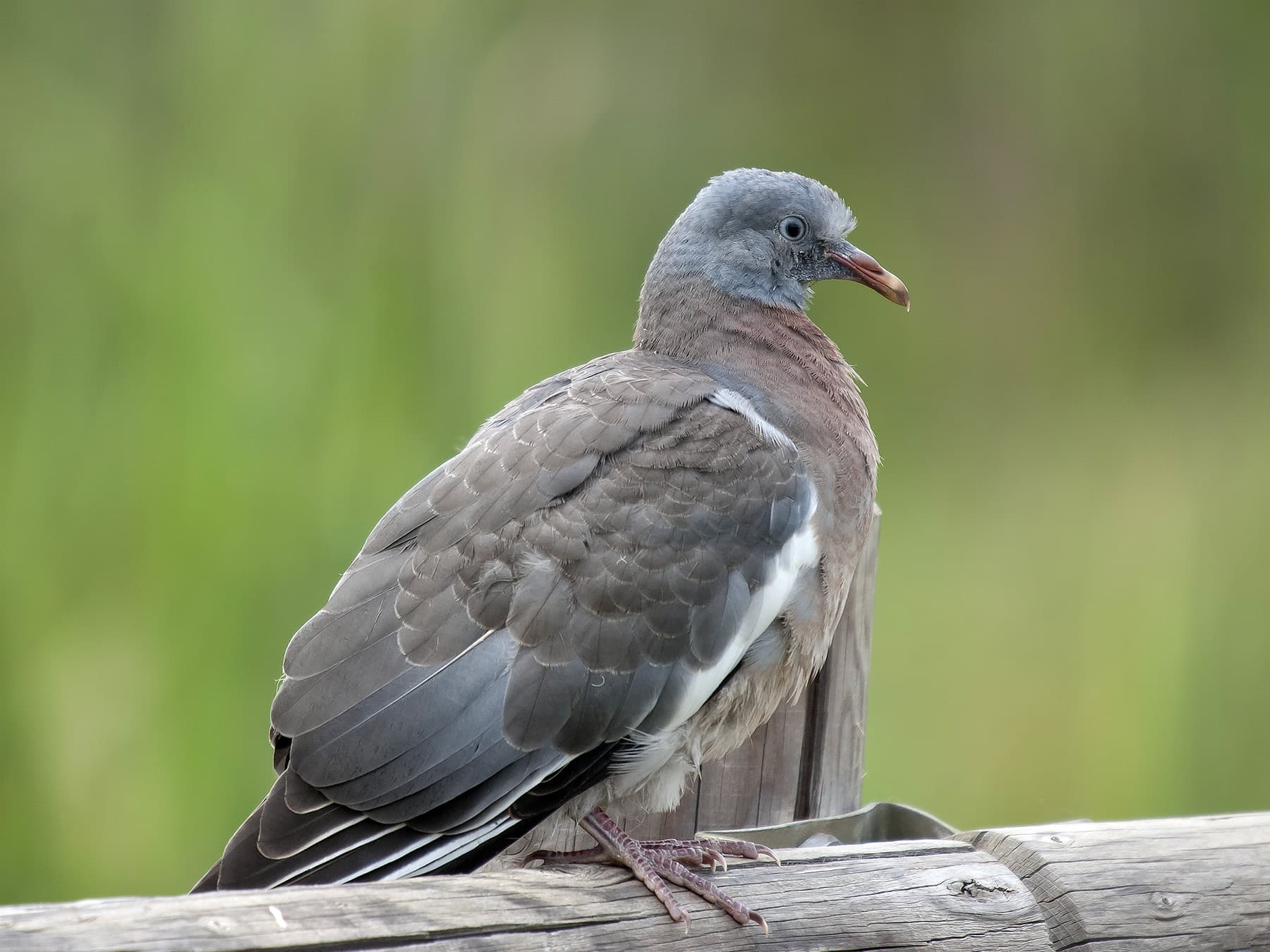
Young birds lack the white neck patch and the green sheen. They are duller and paler than adults, with fawn or rusty edges to the feathers and a rusty-fawn breast.
Identification: similar birds
Pigeons and doves are one family, and the names mark no real difference.4 Of the pigeons you are likely to see in the UK, the Woodpigeon is the biggest, and the only wild one with a white patch on each side of the neck.
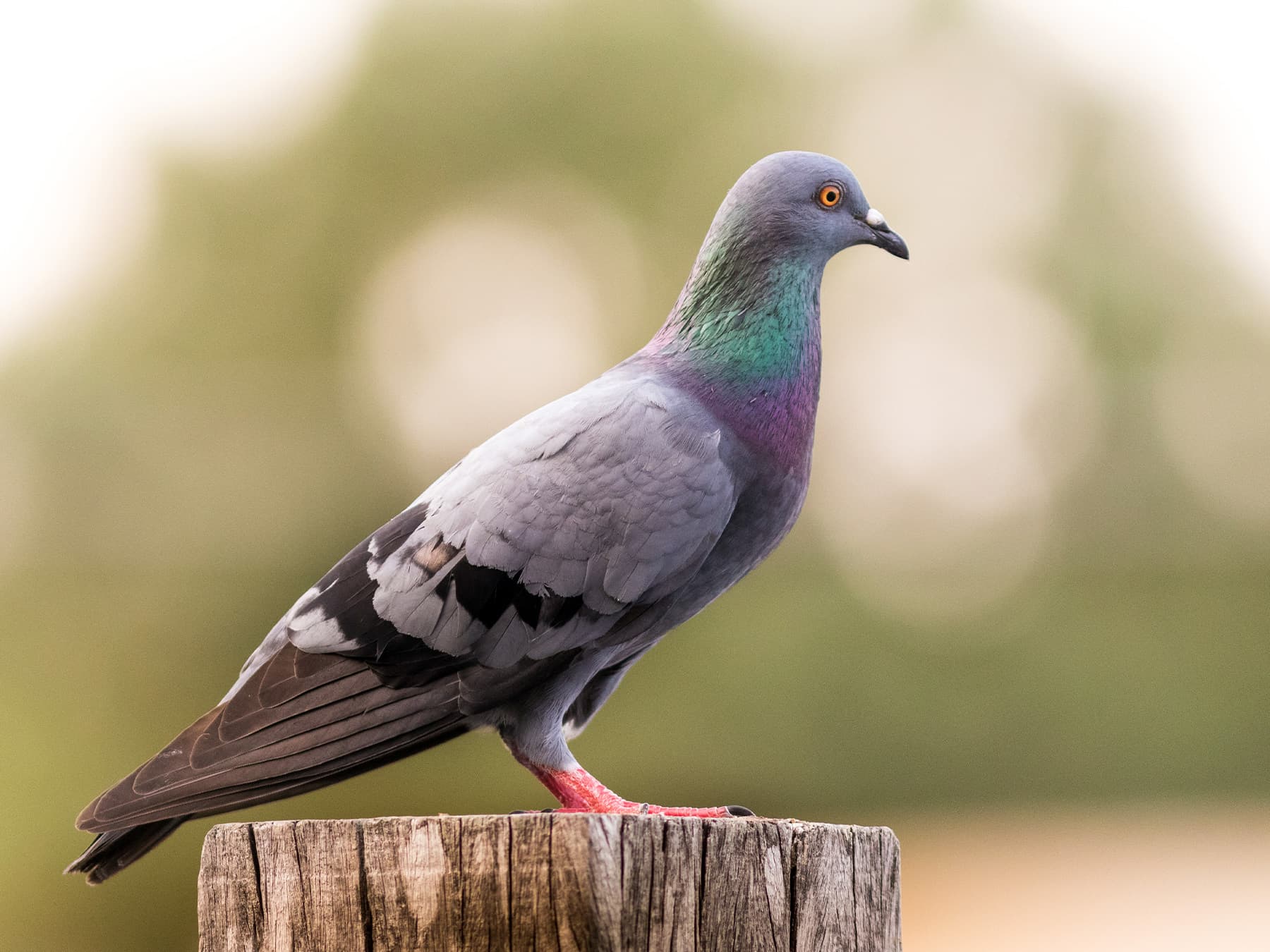
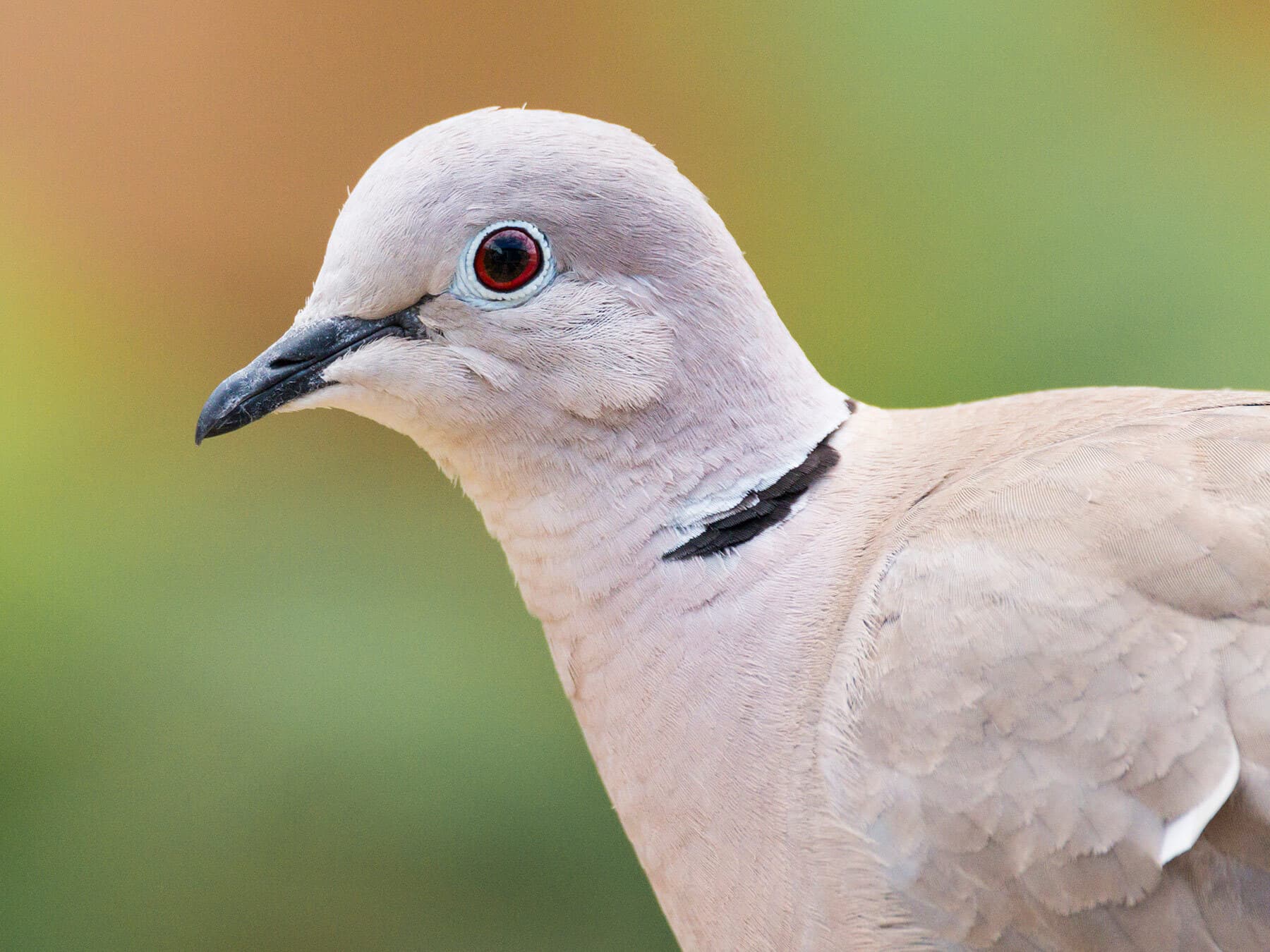
The Stock Dove is smaller and has no white on the neck, only a metallic neck patch. A Rock Dove is smaller and light grey, with bold black wing bars and a metallic neck patch; town pigeons are the same species but come in many colours. The Collared Dove is smaller and beige-grey, with a black collar edged with white.
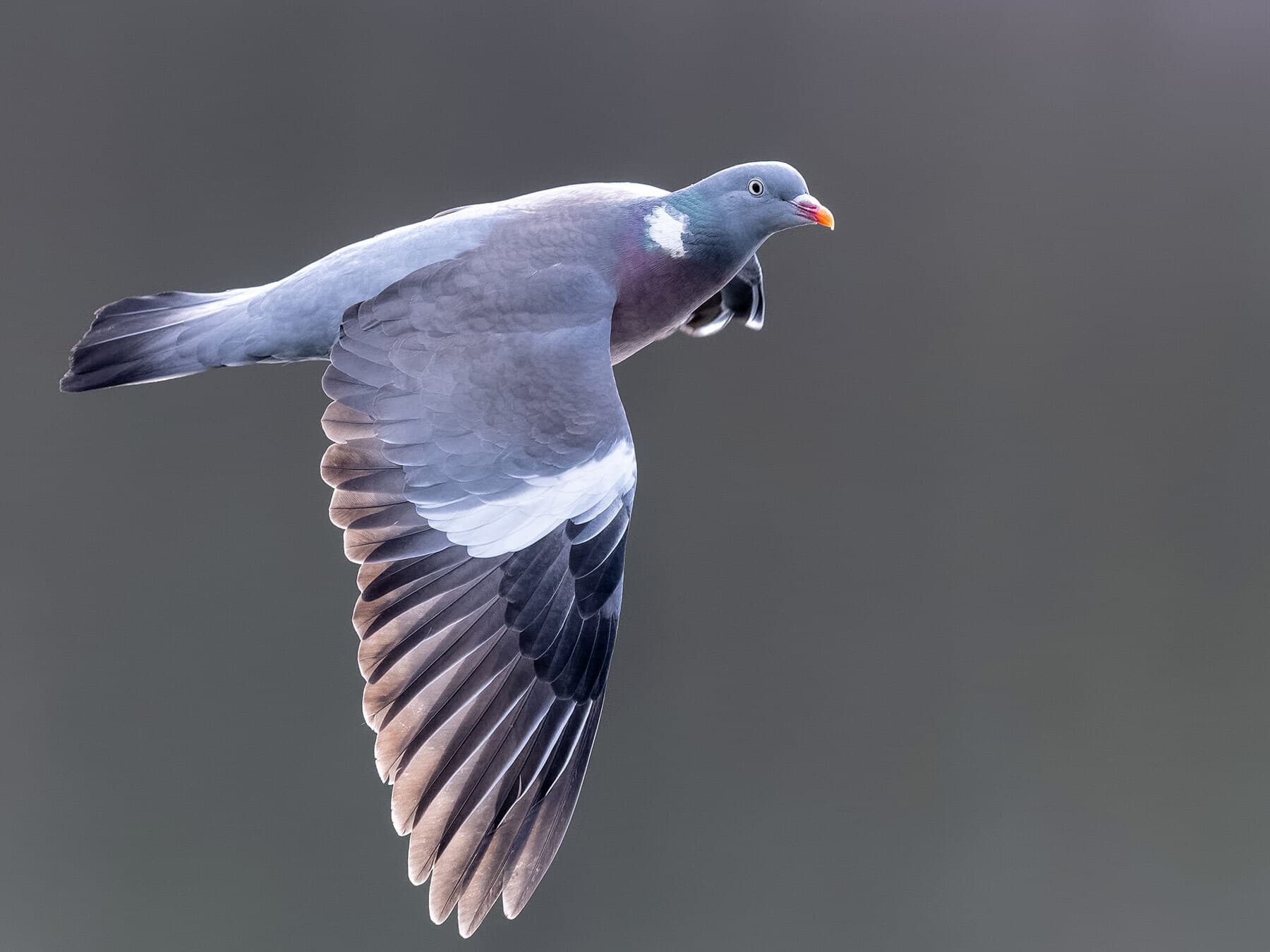
Its size
Adults- Length
- 40–42 cm
- Wingspan
- 75–80 cm
- Weight
- 480–550 g
Its song and calls
The song is the familiar cooing of gardens and woods: a phrase of four or five deep coos, the second usually stressed, repeated with hardly a pause so that it can sound continuous, and usually ending with a single short note. Woodpigeons also give a gruffer double coo at longer intervals. Listen to British recordings and see the coo drawn as a spectrogram in Woodpigeon call and song.
Not every sound is vocal. In the display flight a bird climbs, sometimes claps its wings, then glides down on stiff wings. In central London in the 1950s, song was heard from December to September and most of all from March to June.5
- Song0:00 / 0:11
Recorded in East Sussex, United Kingdom · August 2024
When and where to see it
OctoberHere all year
Most recorded in October
- 1. Dundee8.0%
- 2. Buckinghamshire5.5%
- 3. Bristol5.3%
- 4. Rhondda, Cynon, Taff5.0%
- 5. Wiltshire5.0%
Each dot is a county, state or province: the bigger and darker, the larger the bird’s share of that place’s bird records that month. Grey dots: no regular records. The ringed point is the centre of the bird’s records this month; the arrow shows how it moved since last month, and the dashed loop its path through the year. “Arrivals” colours places where it becomes regular this month (orange) or is in its last regular month (grey). GBIF eBird Observation Dataset, 2019–2024. Map data: Natural Earth, US Census Bureau; place centres © OpenStreetMap contributors.
In your area
See when the Woodpigeon is recorded in your county, state or province.
How often the Woodpigeon turns up in the UK and Ireland through the year, from birdwatchers' records.
United Kingdom
Resident · all year · most records in July
Ireland
Resident · all year · most records in April
Show as a table
| Month | United Kingdom | Ireland |
|---|---|---|
| January | 3.4% (regular) | 2.5% (regular) |
| February | 3.5% (regular) | 2.5% (regular) |
| March | 3.4% (regular) | 3.0% (regular) |
| April | 3.2% (regular) | 3.3% (regular) |
| May | 3.1% (regular) | 3.1% (regular) |
| June | 3.5% (regular) | 3.3% (regular) |
| July | 3.8% (regular) | 3.2% (regular) |
| August | 3.7% (regular) | 2.9% (regular) |
| September | 3.4% (regular) | 2.5% (regular) |
| October | 3.0% (regular) | 2.0% (regular) |
| November | 3.1% (regular) | 2.2% (regular) |
| December | 3.4% (regular) | 2.5% (regular) |
Recorded regularly in
Worldwide: recorded regularly in 75 countries
Countries where it was recorded in at least 3 of the 6 years 2019–2024. Linked countries have their own bird list.
Europe (49)
- Åland Islands
- Albania
- Andorra
- Austria
- Belarus
- Belgium
- Bosnia & Herzegovina
- Bulgaria
- Croatia
- Czechia
- Denmark
- Estonia
- Faroe Islands
- Finland
- France
- Germany
- Greece
- Guernsey
- Hungary
- Iceland
- Ireland
- Isle of Man
- Italy
- Jersey
- Kosovo
- Latvia
- Liechtenstein
- Lithuania
- Luxembourg
- Moldova
- Monaco
- Montenegro
- Netherlands
- North Macedonia
- Norway
- Poland
- Portugal
- Romania
- Russia
- San Marino
- Serbia
- Slovakia
- Slovenia
- Spain
- Sweden
- Switzerland
- Ukraine
- United Kingdom
- Vatican City
Asia (23)
- Armenia
- Azerbaijan
- China
- Cyprus
- Georgia
- India
- Iran
- Iraq
- Israel
- Kazakhstan
- Kuwait
- Kyrgyzstan
- Lebanon
- Mongolia
- Nepal
- Oman
- Pakistan
- Palestinian Territories
- Saudi Arabia
- Tajikistan
- Turkey
- United Arab Emirates
- Uzbekistan
Data: EOD – eBird Observation Dataset (Cornell Lab of Ornithology), accessed via GBIF.org, CC BY 4.0. Records from 2019–2024, aggregated and filtered by Birdfact. How these lists are made
Almost anywhere, all year. Woodpigeons are found in virtually every 10-km square of Britain and Ireland except the higher Scottish mountains and some islands with little woodland, and they are most numerous in the arable east. They are commonest in broadleaved woodland, and common on farmland, in scrub, villages and towns.
Shy in the countryside, they can be tame in towns, parks and gardens, where many feed on lawns.
Spotting tips
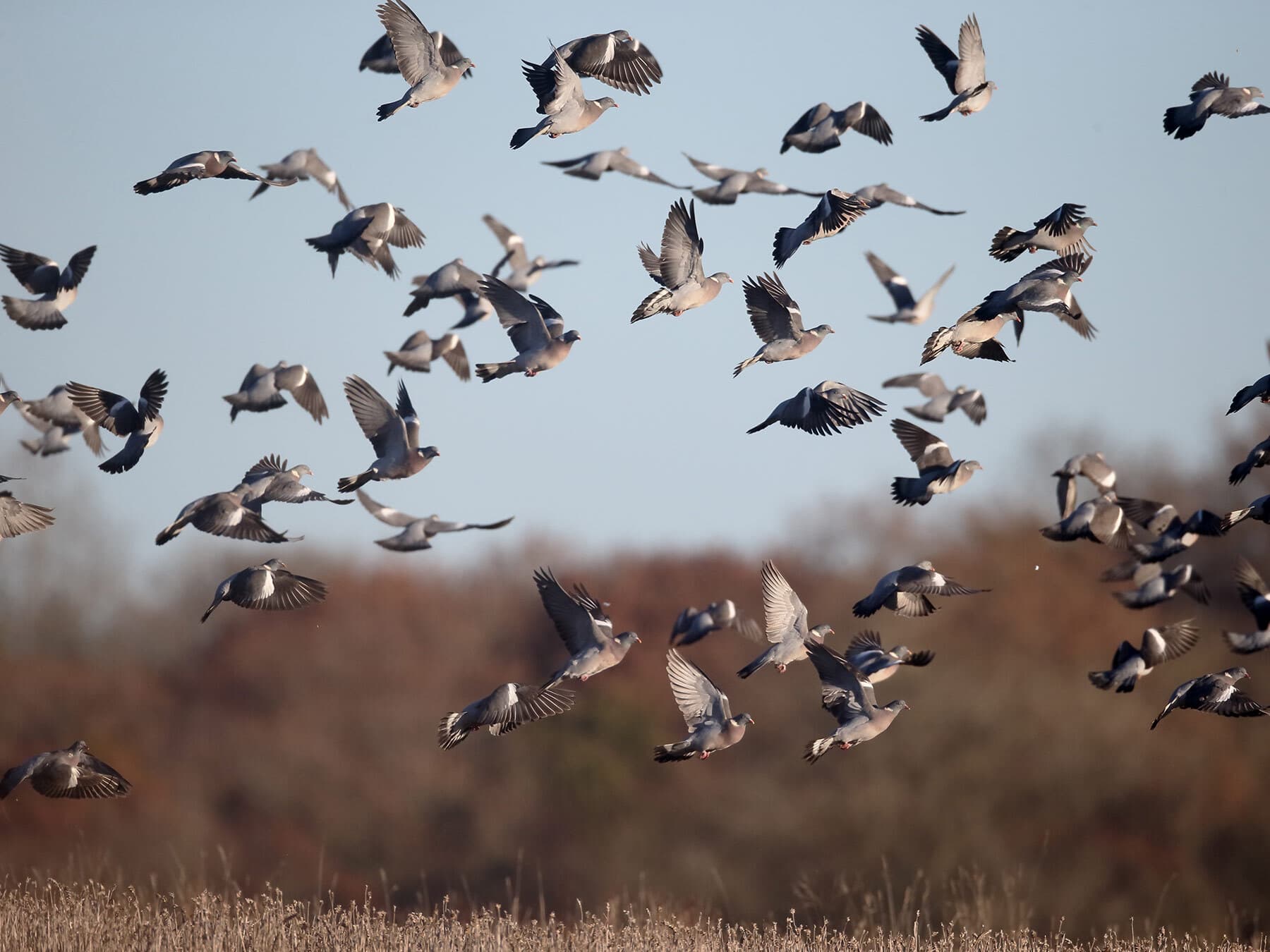
Watch for big grey pigeons feeding on lawns and fields, listen for the deep cooing phrase from a treetop, and look for the white wing bands as a flock lifts off.
Do they migrate?
British and Irish Woodpigeons mostly stay put. Ringing shows that a few reach France, and a handful of birds ringed on the Continent turn up here.6 In winter, numbers in the UK are boosted by birds from the Continent.1
Every autumn there is a mystery. From late October through November, flocks of thousands, sometimes tens of thousands, fly high and south on clear days, especially over south-west England and south Wales. Where they are going is not known for sure: they may be birds from further north heading for milder parts of Britain, or birds from as far as Scandinavia heading for France and Spain. Across northern and eastern Europe most Woodpigeons do migrate, and millions winter in Spain and Portugal.
Where do they sleep at night?
In trees. Outside the breeding season Woodpigeons gather in flocks that feed together by day and roost together in woods at night, often flying some distance between the two. In central London in the 1950s, Stanley Cramp found territory-holding males flying in each morning from a communal roost on the island in the Regent's Park lake.5
What it eats
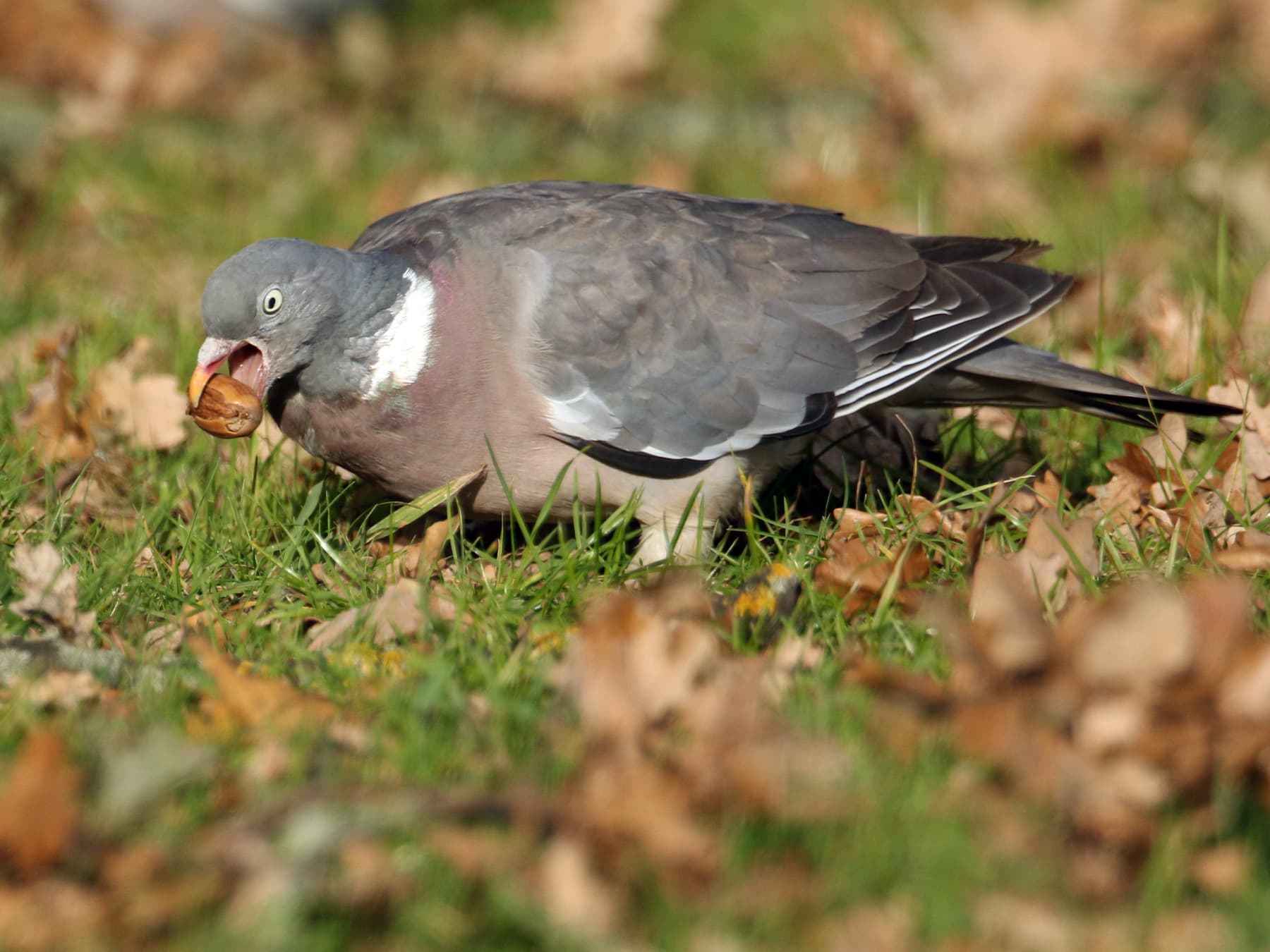
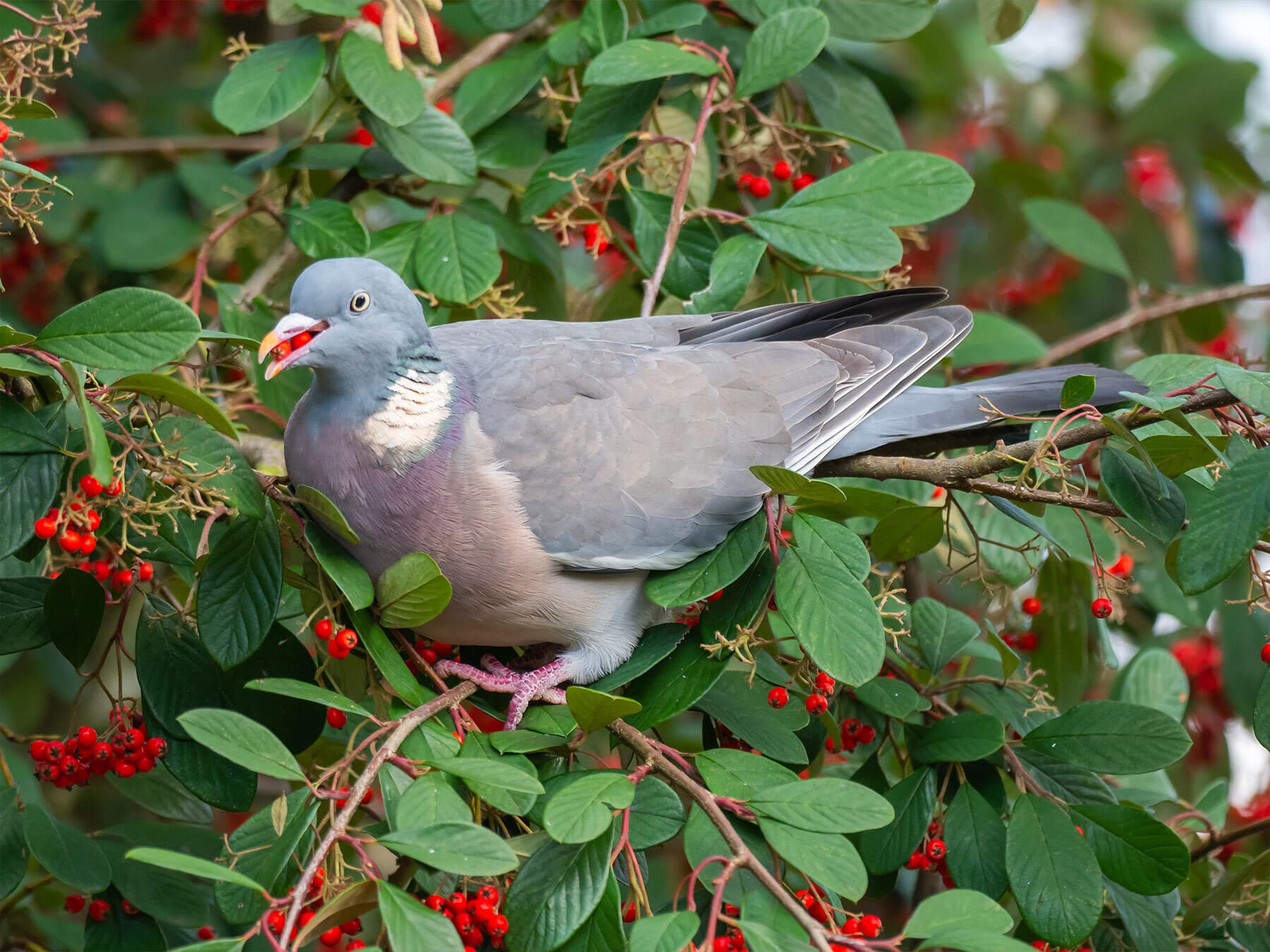
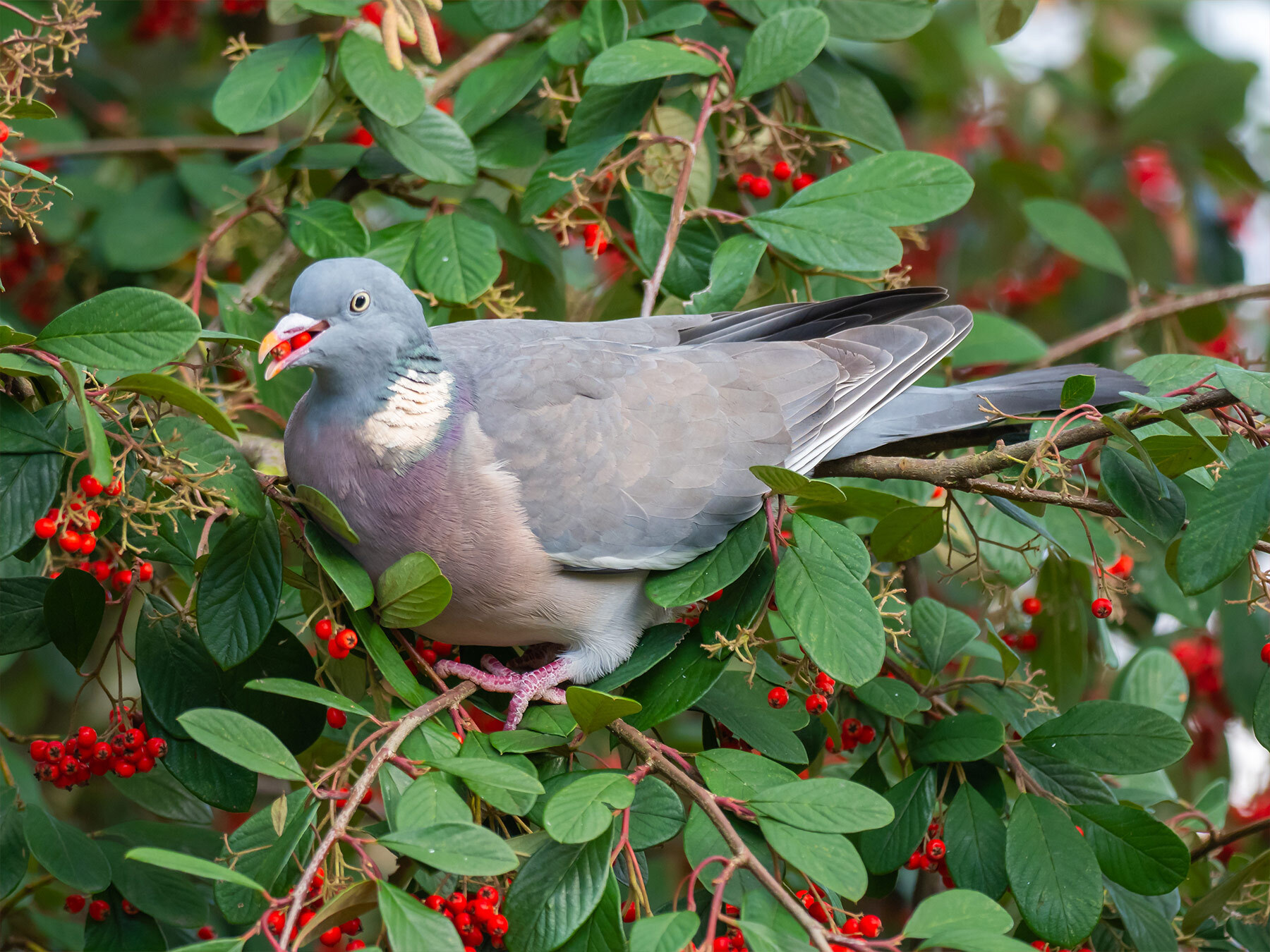
Almost entirely plants: green leaves such as clover and oilseed rape, grain, buds, seeds, and the fruits and seeds of trees, such as ivy berries, acorns and beech-mast. A few snails, slugs and other small animals are taken too. See what Woodpigeons eat for the year's menu and feeding them in your garden.
Nesting and breeding
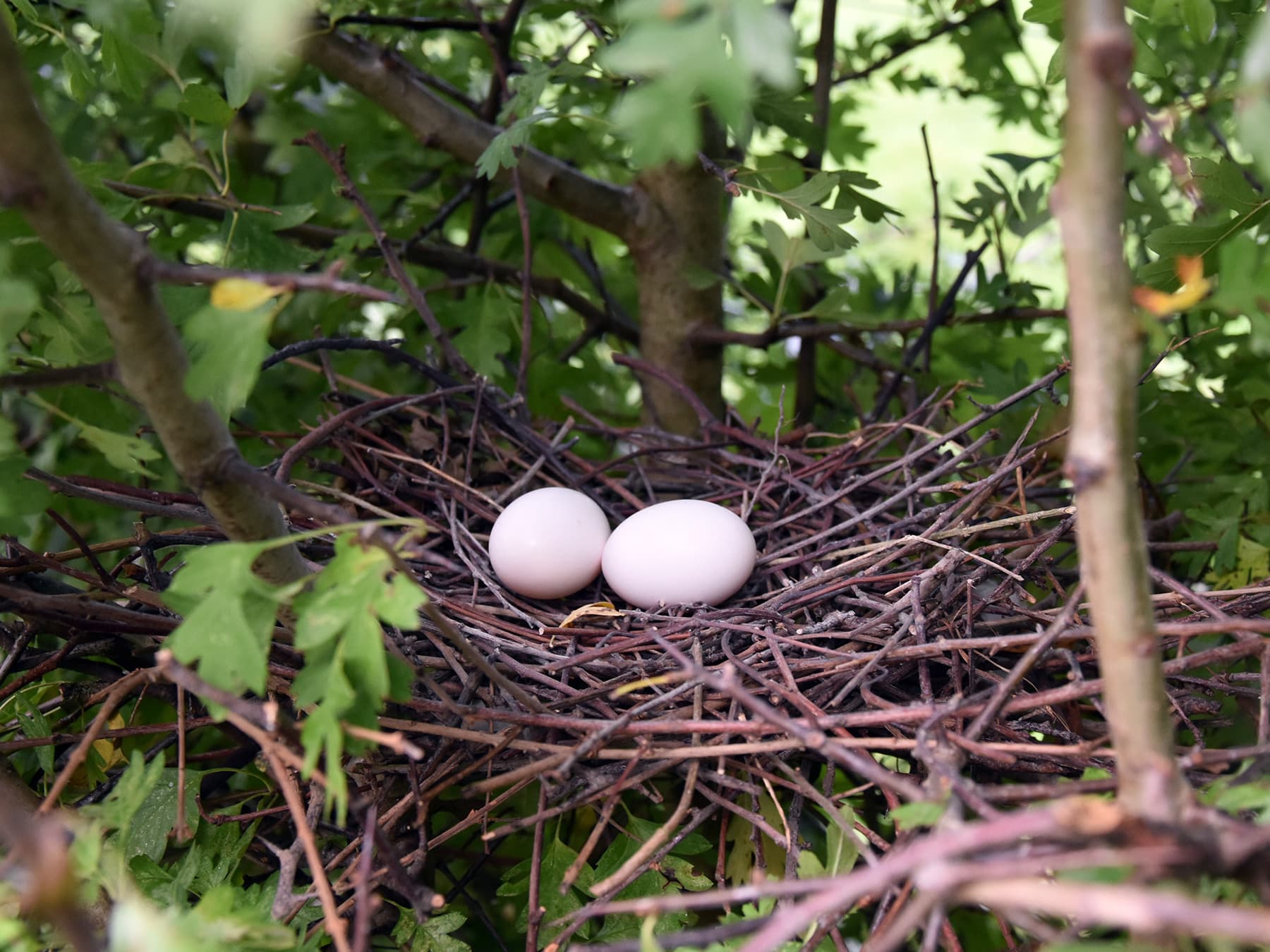
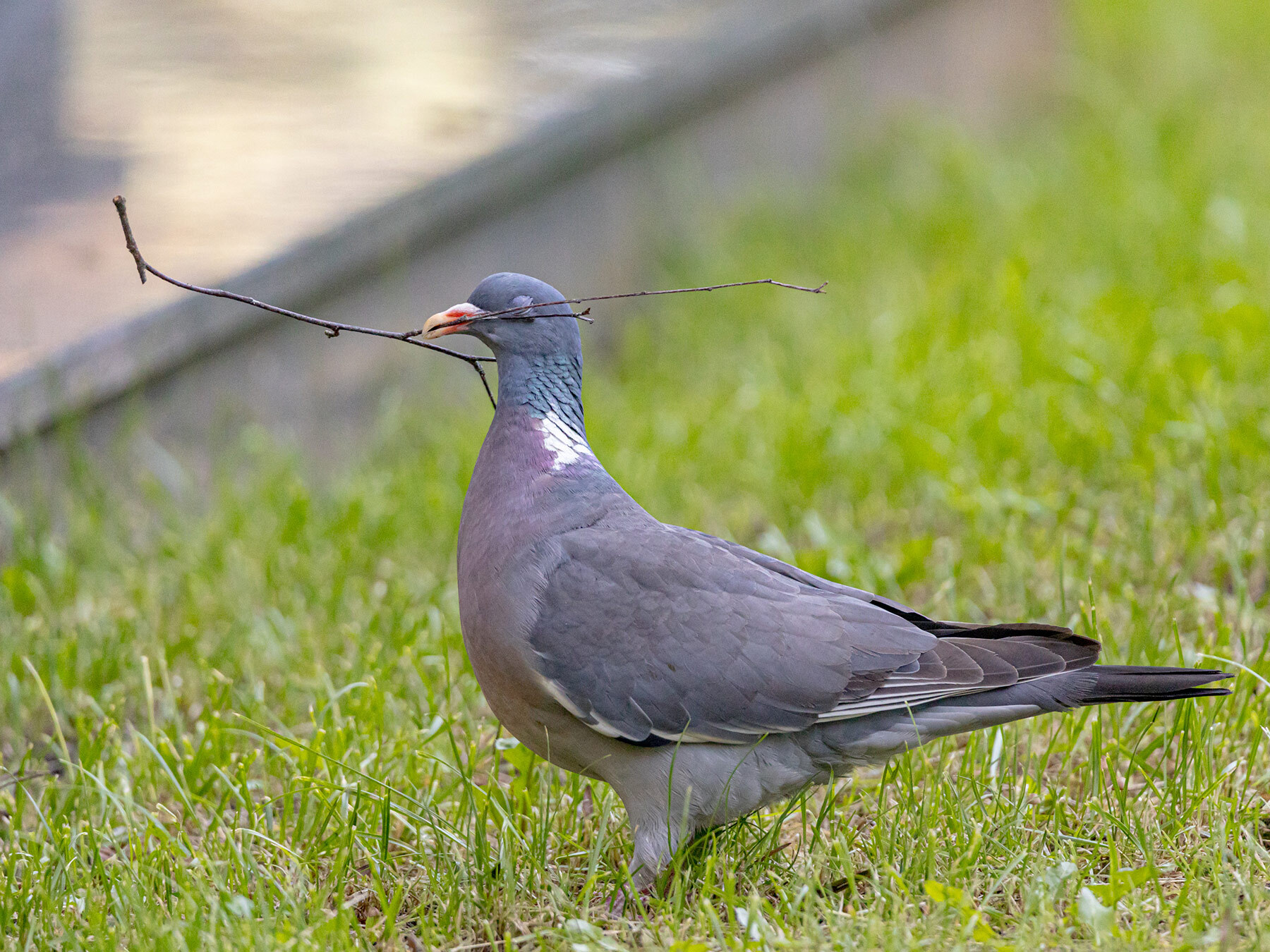
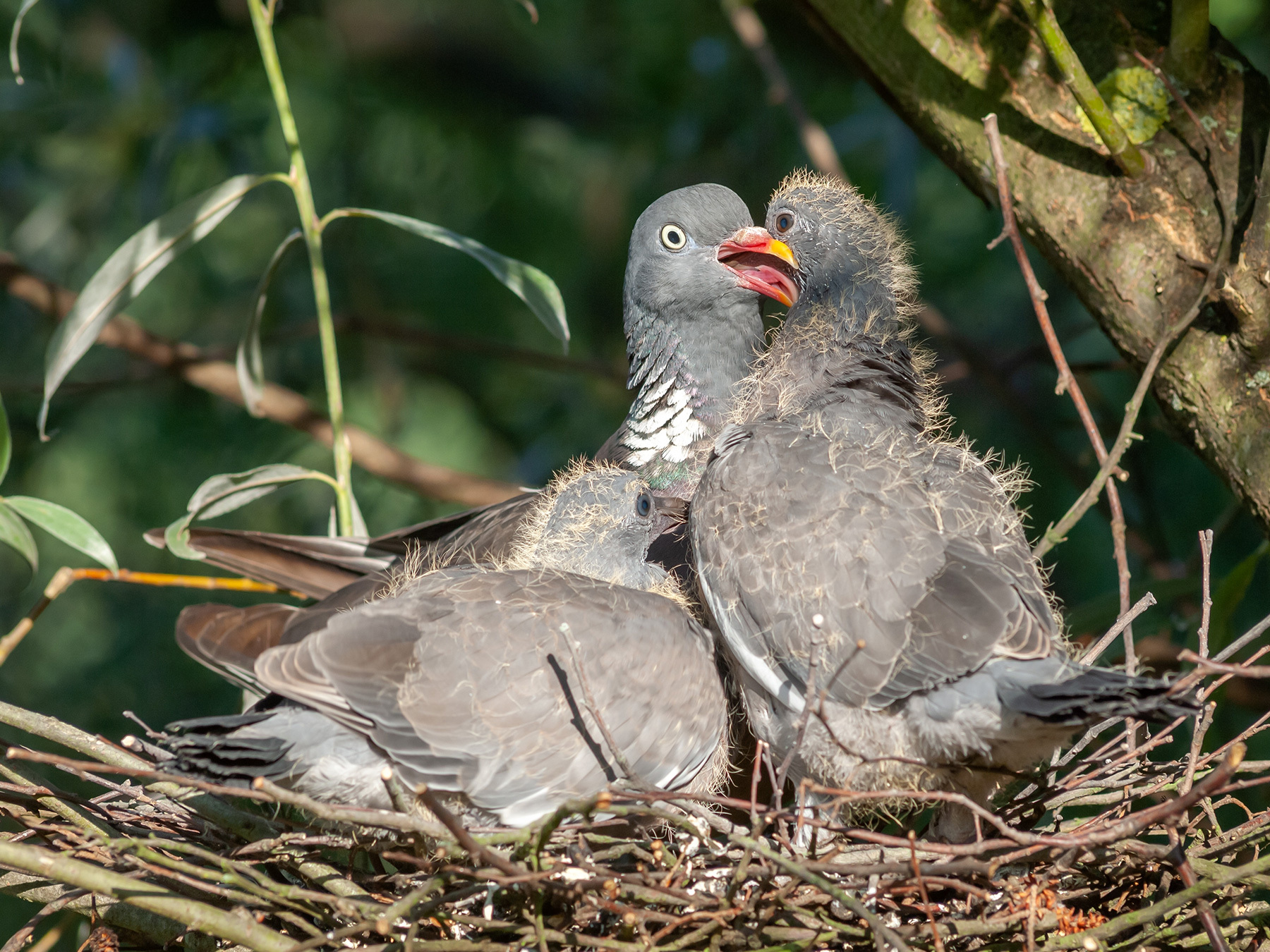
Woodpigeons nest late. A pair's first clutch is laid, on average, around the end of April, and nesting peaks in the summer.3 The nest is a platform of twigs in a tree, and the clutch is usually 2 white eggs, incubated by both parents for about 17 days. Like all pigeons, the parents feed their chicks on "crop milk" at first.
See Woodpigeon nesting for the nest, eggs, young and the late season, and do Woodpigeons mate for life? for courtship and pairs.
Behaviour
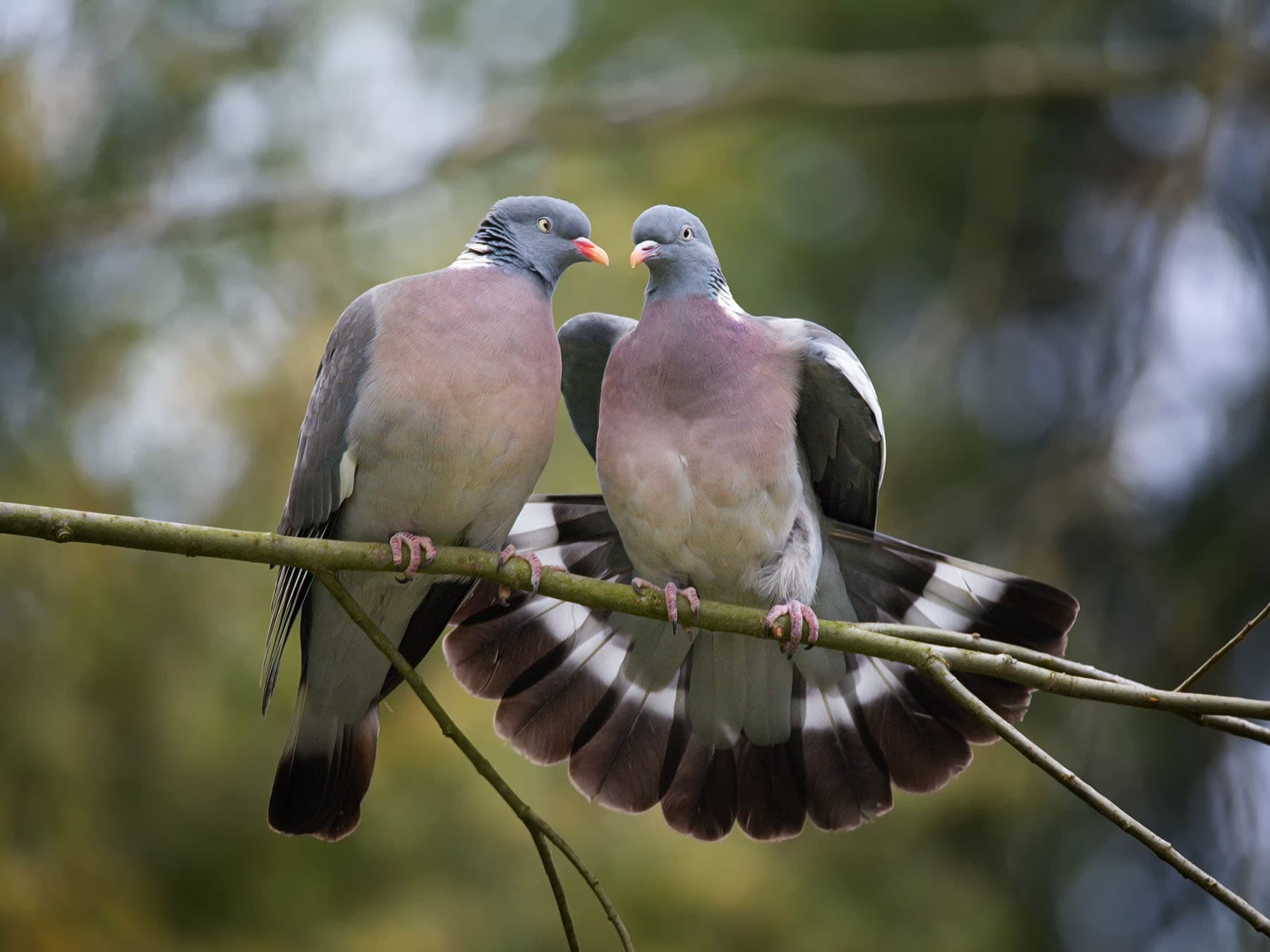
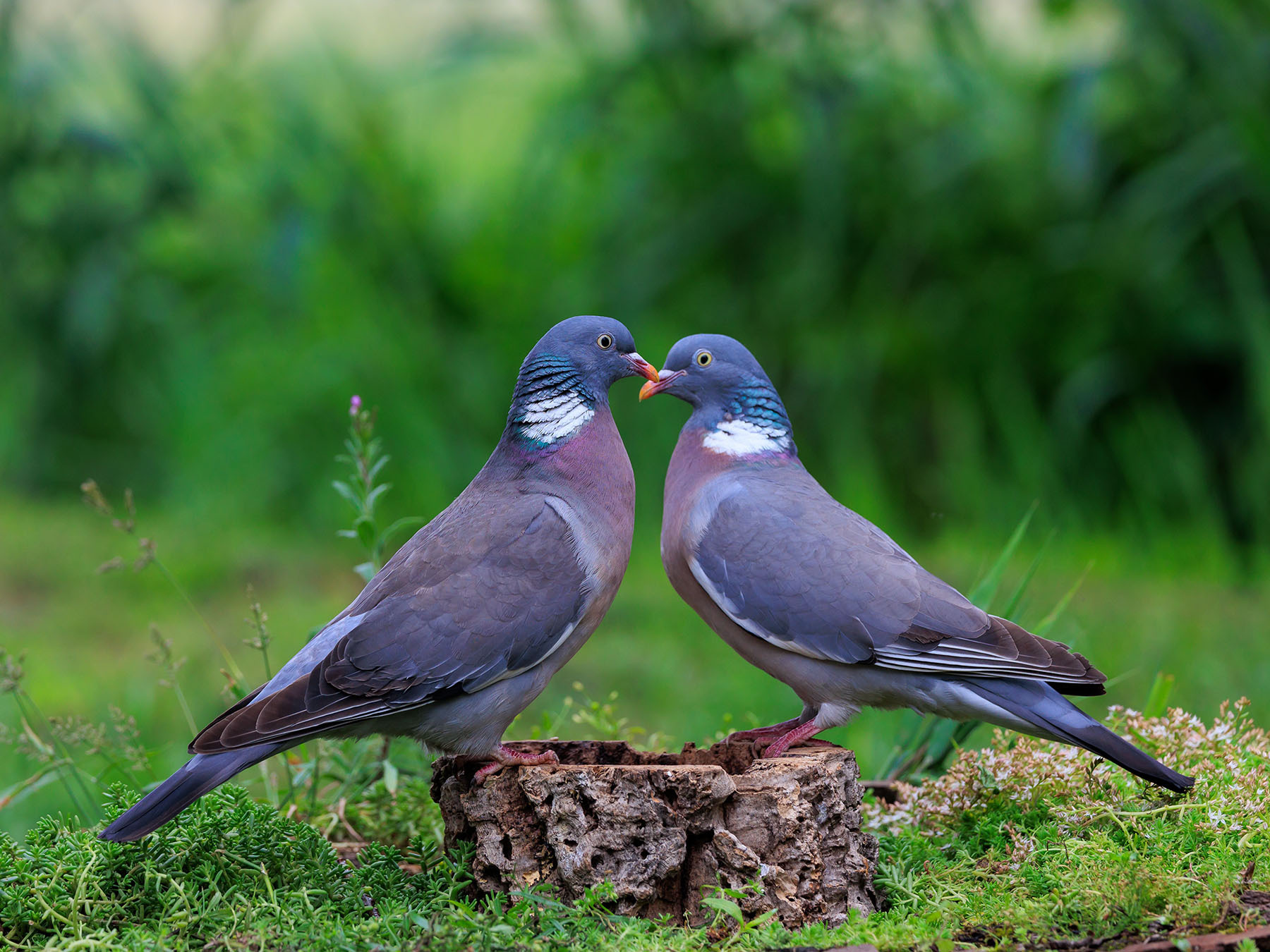
In winter Woodpigeons live in flocks, which on farmland can number many thousands; each bird keeps a little space around itself as it feeds. From winter into spring, pairs settle on territories. A male proclaims his with song and the display flight, and courts a female with a low bow, neck puffed out to show the white patches and tail fanned.
Fights can be fierce: rivals strike each other with heavy blows of the wings.
Lifespan and predators
A Woodpigeon that survives to breed typically lives about 3 years; around six in ten adults survive from one year to the next.3
Some live far longer. The oldest on the BTO's ringing list is a female ringed as an adult at Gamlingay, Cambridgeshire, in July 2004 and found there in March 2024, 19 years 8 months 16 days later, so she was older still.7 A bird ringed at Sandwich Bay, Kent, in 2005 was caught there again in 2023, 17 years 10 months on.6 The European longevity list of 2023 had an Orkney bird at 17 years 8 months as its oldest Woodpigeon.8
Predators and other dangers
Most nest losses are eggs taken by predators. In Murton's 1966 study, crows and their relatives took most of the eggs that were lost, mainly from nests left unguarded.9 In London parks, Cramp saw Carrion Crows rob many early nests in the bare plane trees, and a 1978 study of London parks found Woodpigeon numbers were lower where there were more crows.10
Birds of prey take full-grown birds too: one ringed on North Ronaldsay, Orkney, was found 850 km away in Gloucestershire, killed by a bird of prey.
Conservation
The Woodpigeon is on the UK Amber List and is of Least Concern worldwide. There are about 5.2 million pairs in the UK (2016).3 Numbers rose 152% between 1967 and 2024. There is some evidence that the spread of winter cereals and oilseed rape helped, probably by giving them more food in winter: unlike most seed-eaters, Woodpigeons can live on green leaves.
The rise has levelled off. UK numbers were up 33% between 1995 and 2024, but changed little between 2014 and 2024 (down 2%), and fell 10% between 2024 and 2025.11
Legal status
Like all wild birds, Woodpigeons and their nests in use are protected by law in Great Britain12 and Northern Ireland.13 In each UK country the licensing body (Natural England, Natural Resources Wales, NatureScot and DAERA) also issues general licences that let authorised people, such as landowners, kill or take certain birds, and take or destroy their nests and eggs, in set circumstances. The Woodpigeon is listed in those for preventing serious damage, mainly to crops, and in some cases the spread of disease: GL42 in England14, General Licence 001 in Wales15, GL02 in Scotland16 and TPG/2 in Northern Ireland17 (all 2026). In England, users must make reasonable efforts to solve the problem by other lawful means, such as scaring or netting, unless these would be impractical, ineffective or disproportionate; Wales gives the same advice.
Similar birds
Often mistaken for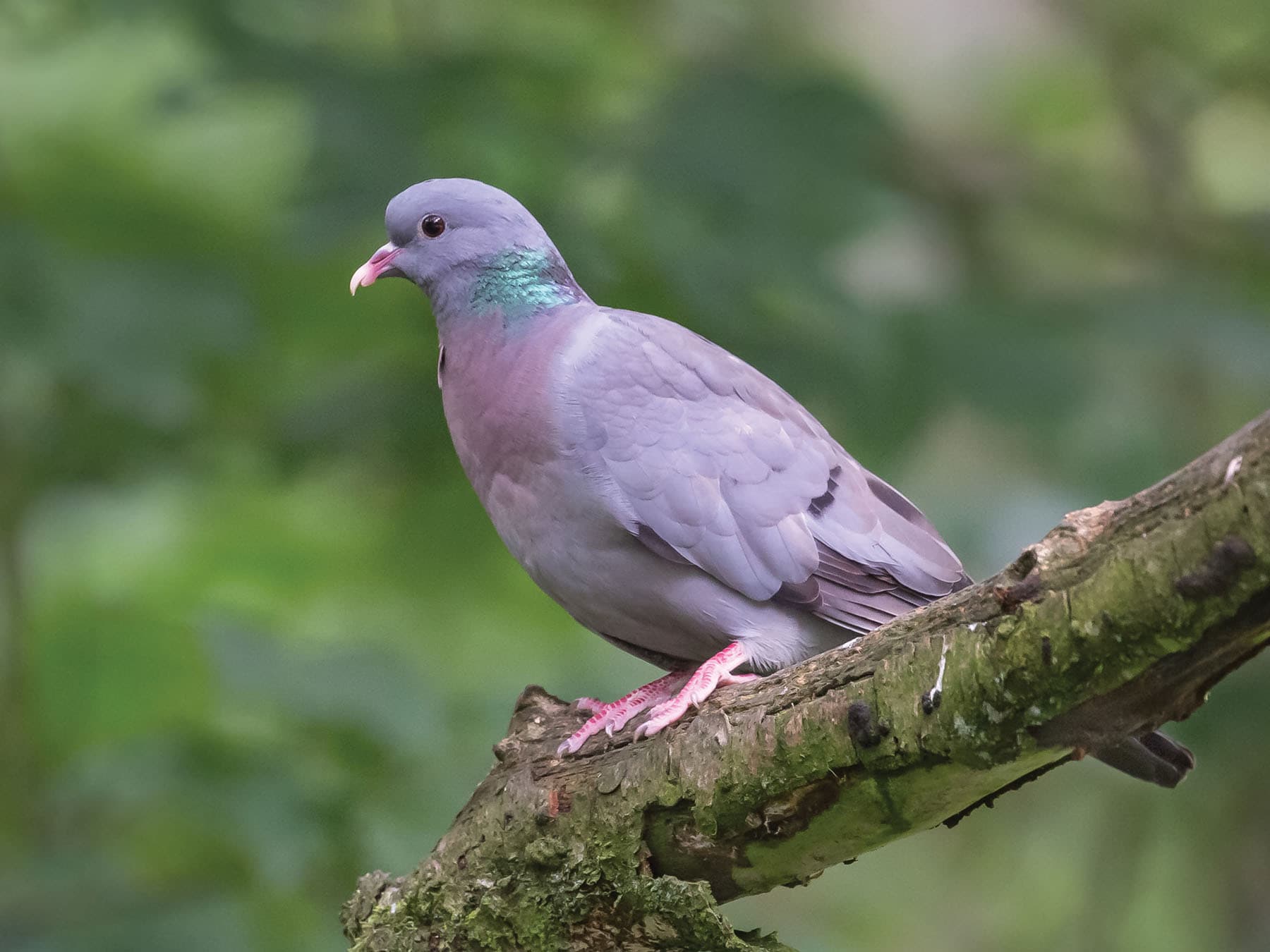
More photos
10 photos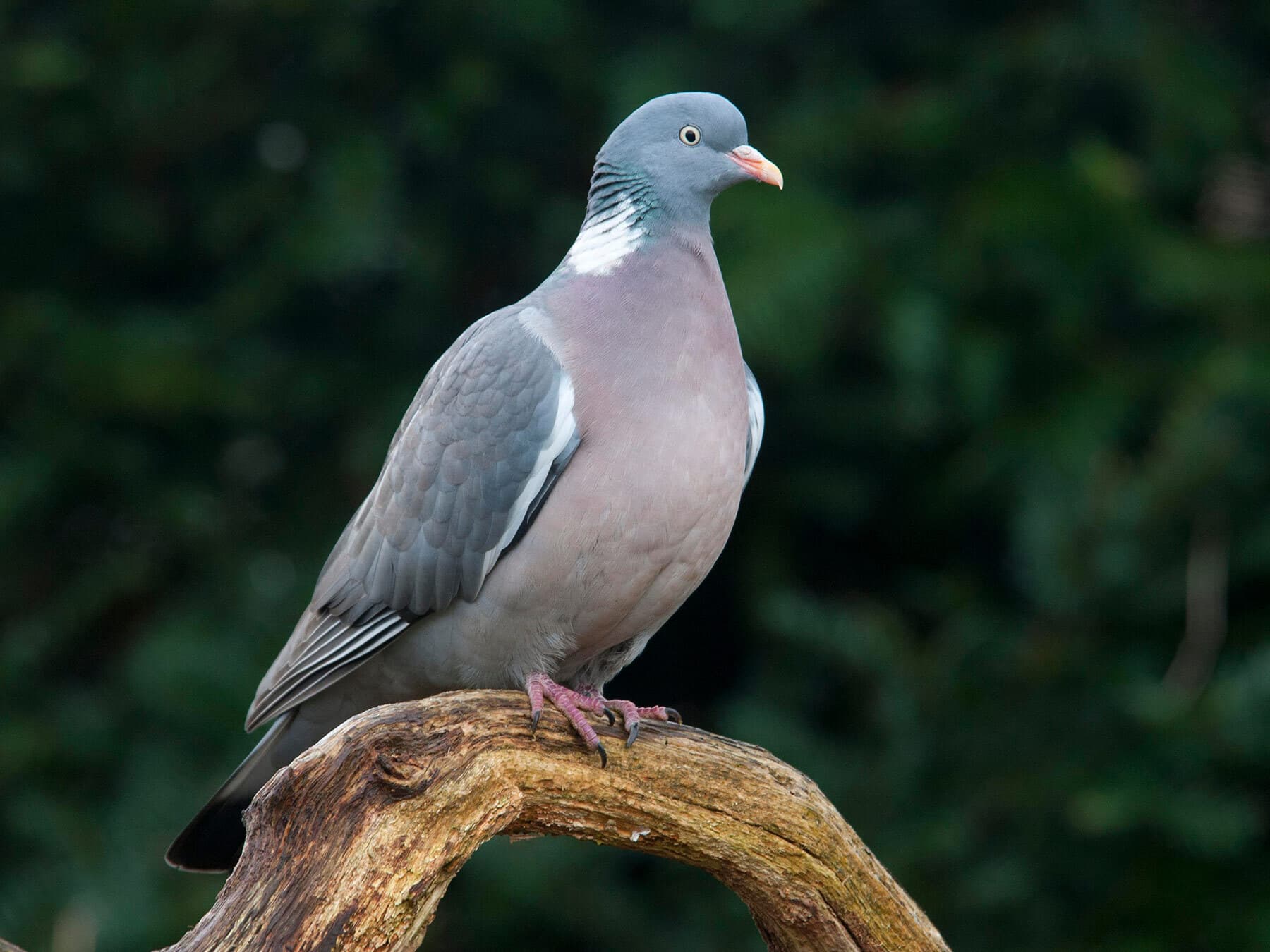 A Woodpigeon on a branch: grey and pink, with a white neck patch
 A Woodpigeon in flight, white wing bands showing
 A Woodpigeon eating red berries in a bush
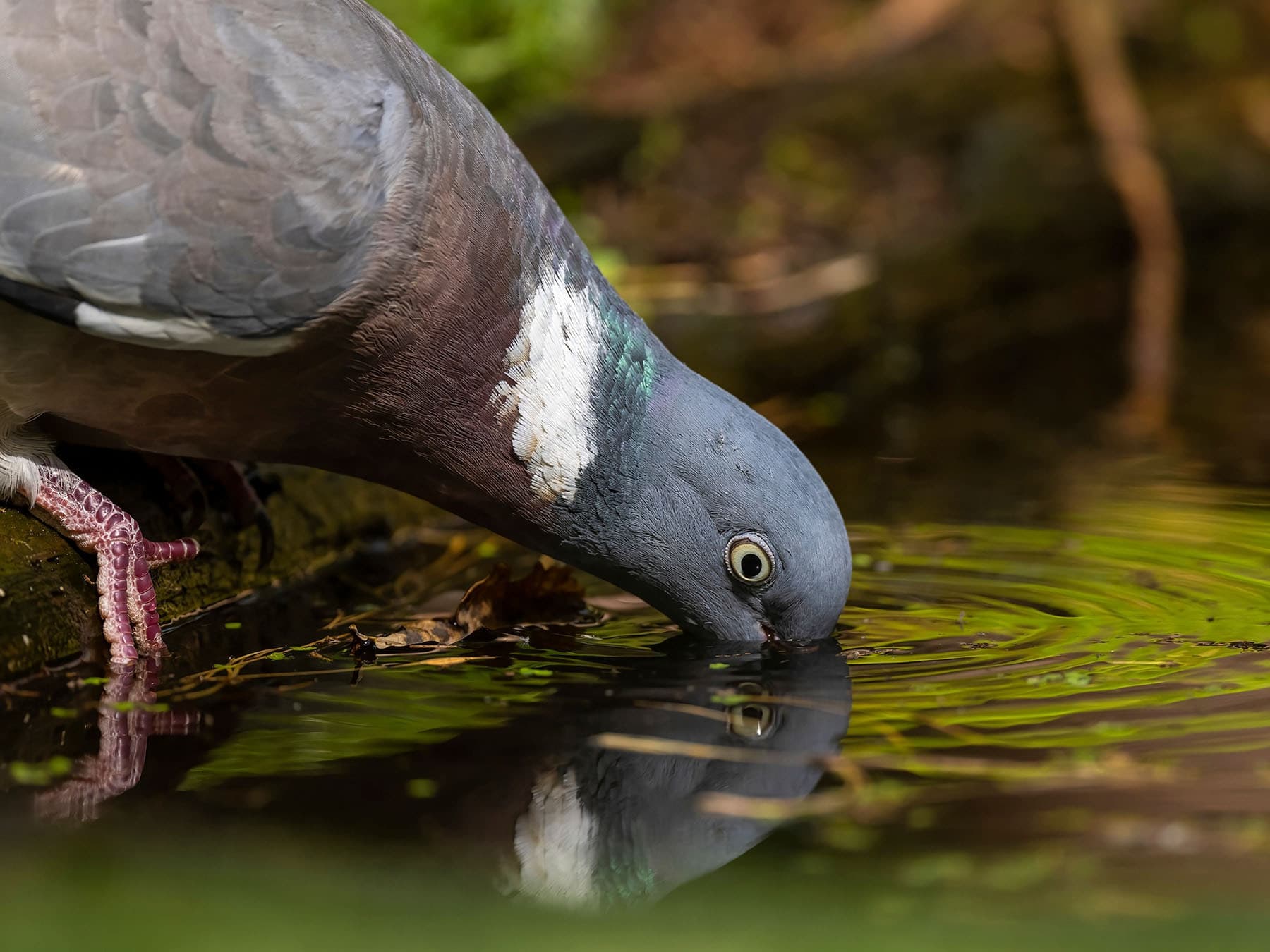 A Woodpigeon drinking at a pool
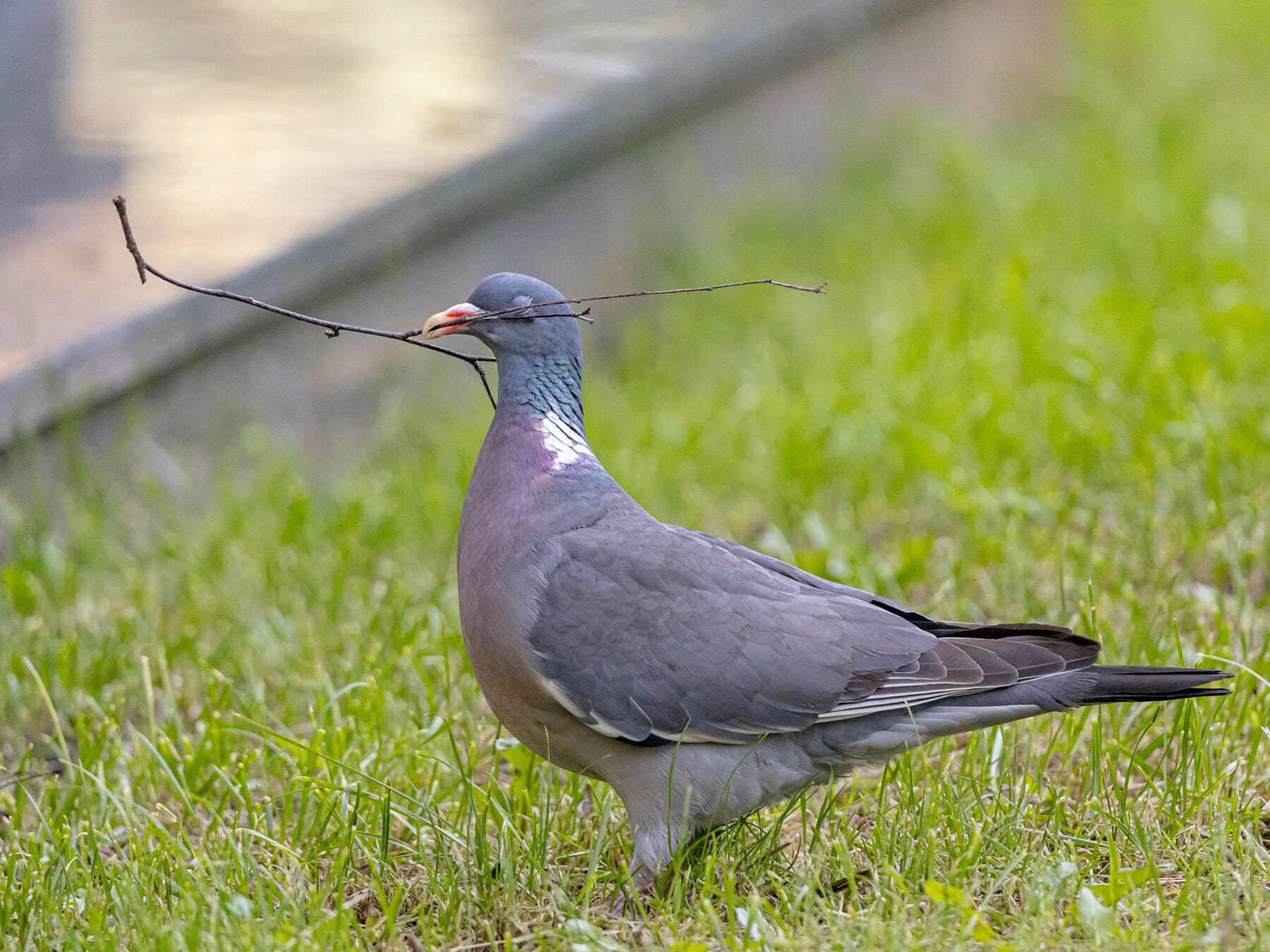 A Woodpigeon carrying a twig across a lawn
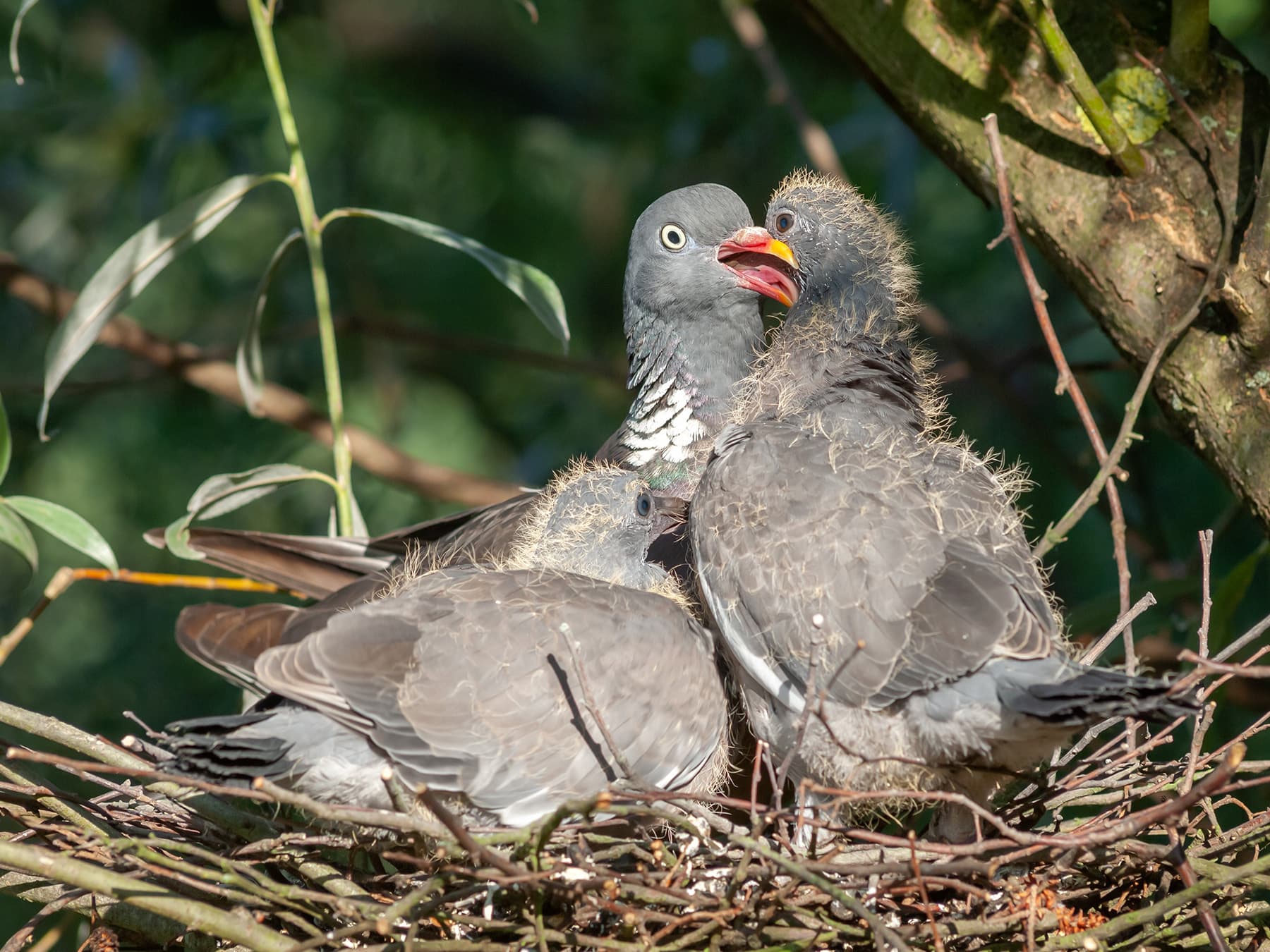 An adult Woodpigeon on the nest with two large young
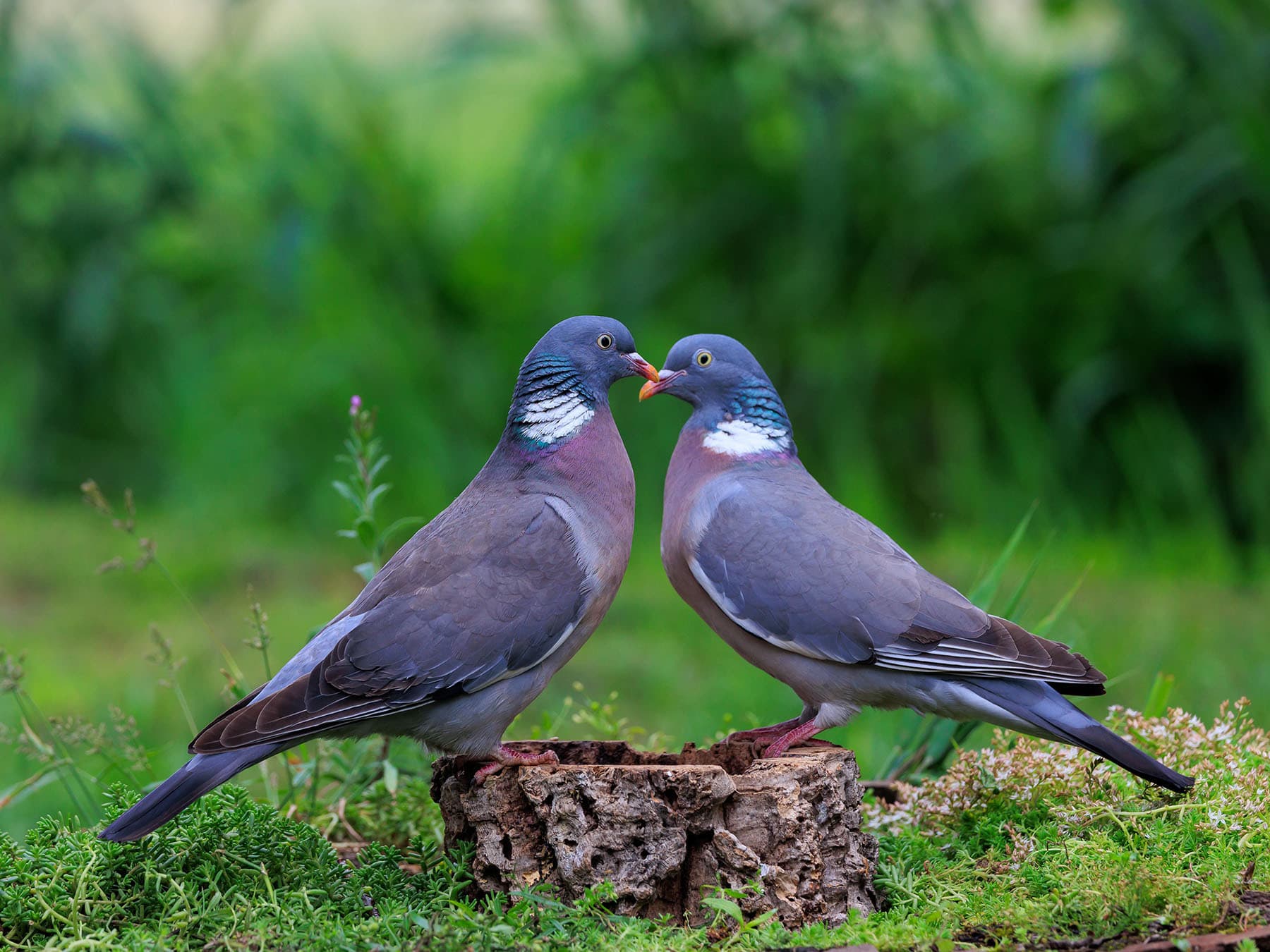 A pair of Woodpigeons touching bills
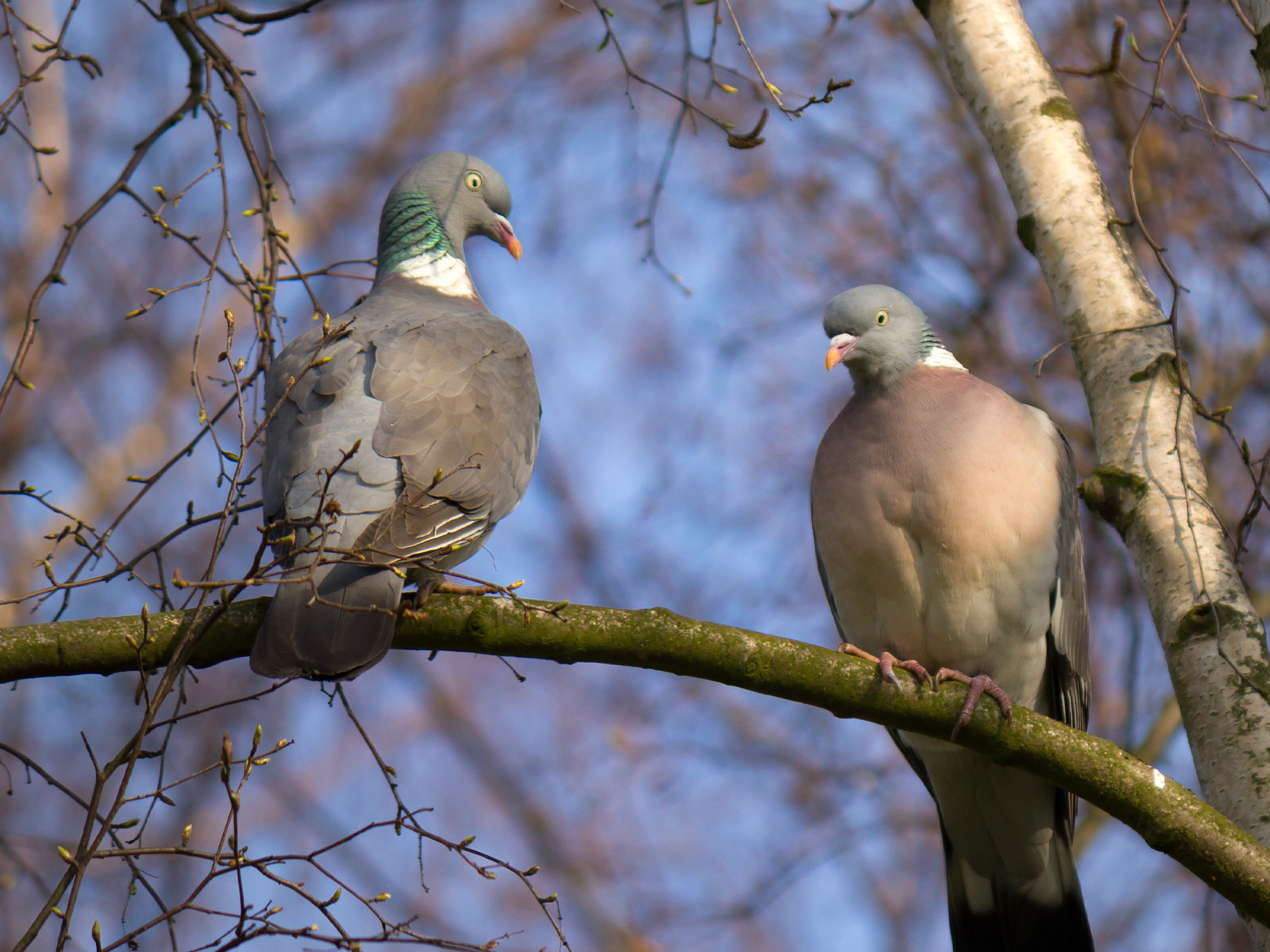
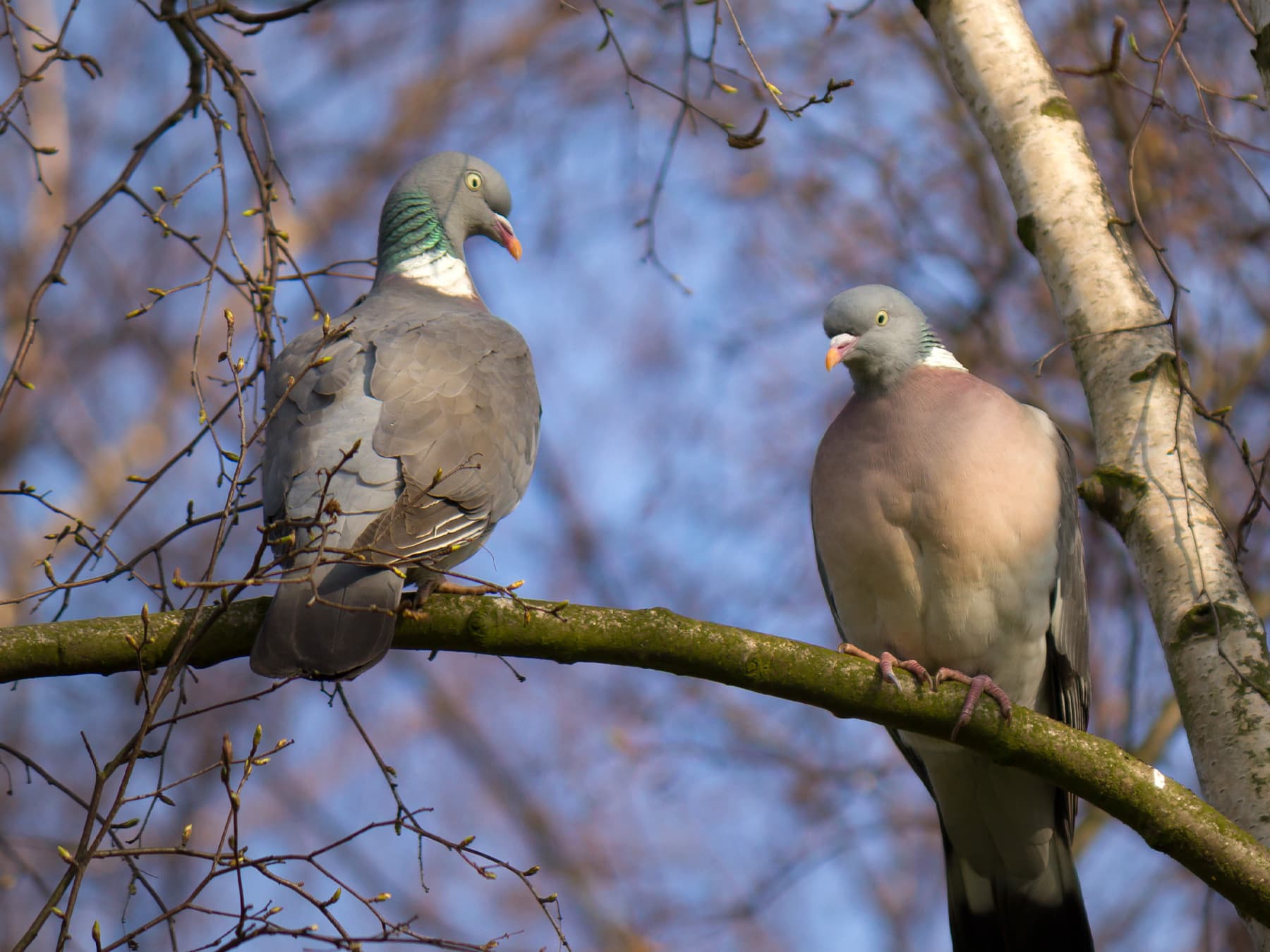 Two Woodpigeons perched in a bare tree
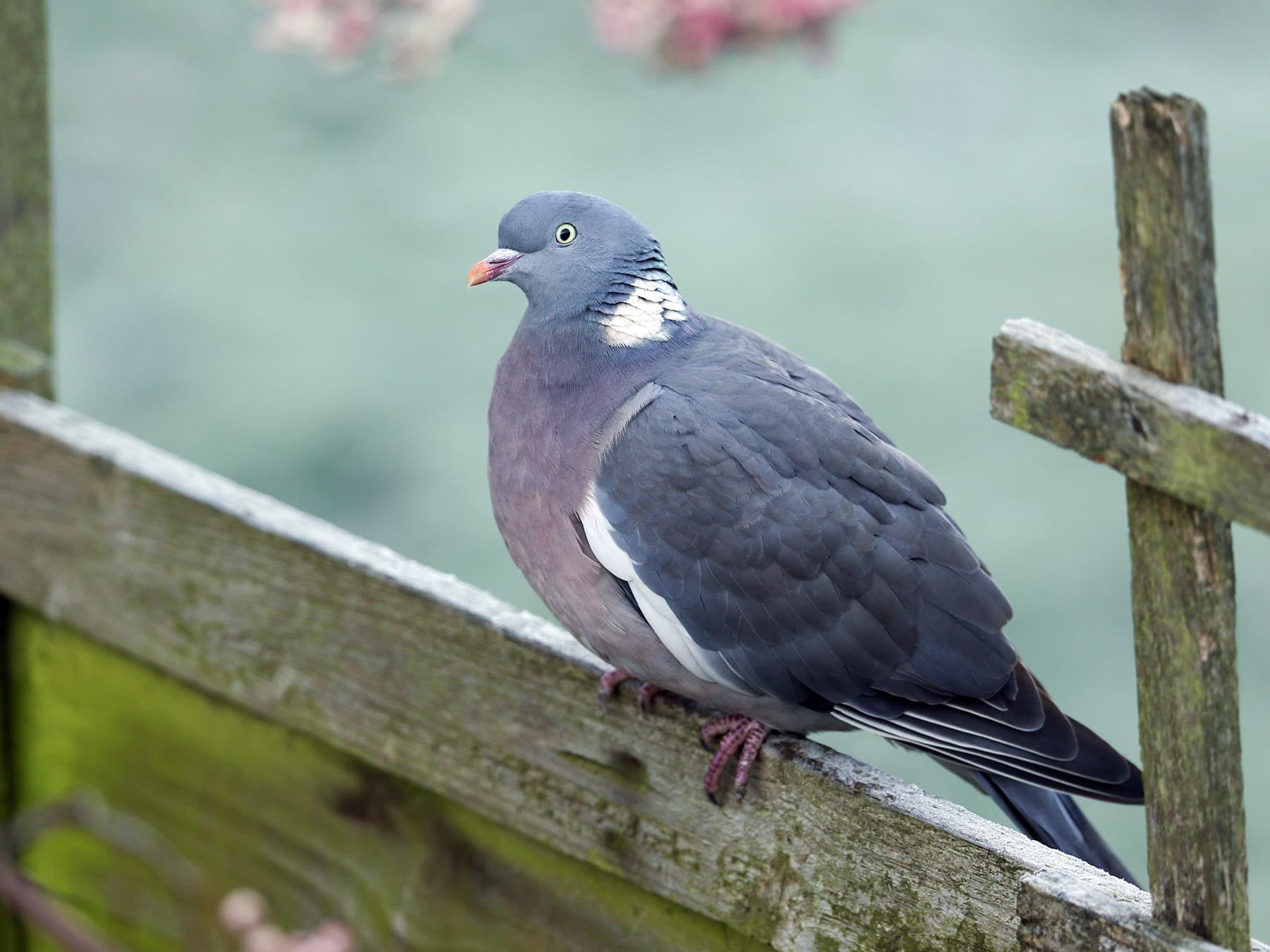 A Woodpigeon on a fence
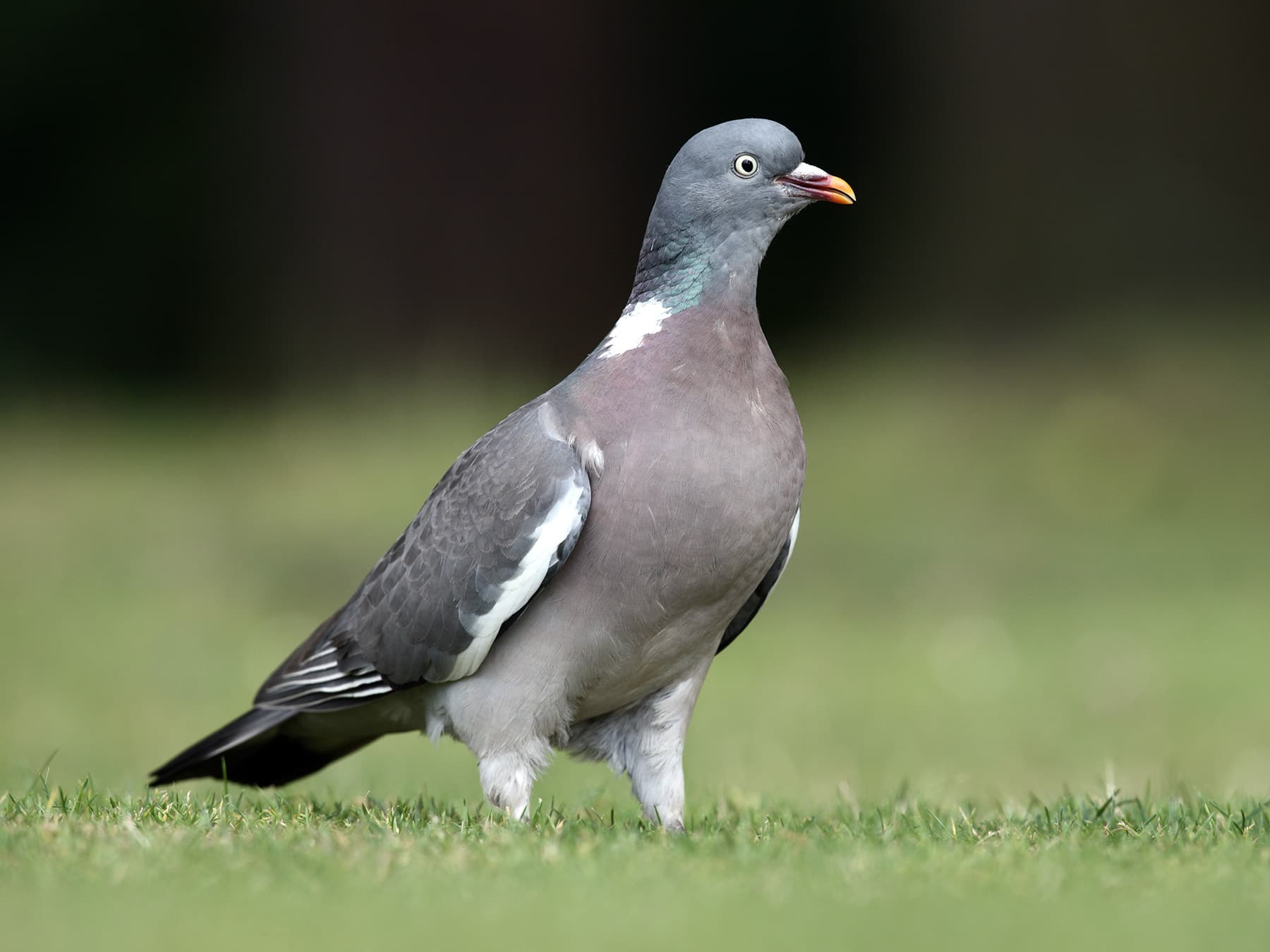 A Woodpigeon on a lawn
Woodpigeon guides
6 guides- Do Woodpigeons Mate for Life? Pairs, Bowing and Courtship
- Woodpigeon Call and Song: What a Woodpigeon Sounds Like
- Woodpigeon Nesting: When and Where They Nest, Eggs and Young
- Male vs Female Woodpigeons: How to Tell Them Apart
- Collared Dove Call and Song: What a Collared Dove Sounds Like
- What Do Woodpigeons Eat? Diet Through the Year and in Gardens
Quick facts
- Length
- 40–42 cm
- Wingspan
- 75–80 cm
- Weight
- 480–550 g
- Lifespan
- 3 years · oldest recorded 19 years 8 months
- Family
- Pigeons & Doves
- Migration
- Partial migrant
- Global status (IUCN)
- Least Concern
- Population trend
- Numbers more than doubled after the 1960s, with some evidence that winter cereals and oilseed rape helped, and have levelled off since about 2010; UK numbers fell 10% between 2024 and 2025 (BTO, BBS)
- Also called
- Common Wood Pigeon, Wood Pigeon, Ring Dove
- Scientific name
- Columba palumbus
Questions
3Is a Woodpigeon a pigeon or a dove?
Both words are right: pigeons and doves are one family, and the names mark no real difference. The Woodpigeon is the UK's largest pigeon. See similar birds.
Is a Woodpigeon the same as a town pigeon?
No. The pigeons of city streets are feral pigeons, descended from domesticated pigeons and the same species as the wild Rock Dove. The Woodpigeon is a separate, wild species: bigger, with white neck patches and white wing bands. See the Rock Dove.
Are Woodpigeons native to the UK?
Yes. They have been recorded in Britain since Anglo-Saxon times. The old English folk name is Ring Dove; in Welsh the bird is Ysguthan, in Irish Colm Coille.
Sources
20- 1RSPB. Woodpigeon. RSPB Birds A-Z. Accessed 8 October 2026. Source (opens in a new tab)
- 2Baptista, L. F. et al. (2025). Common Wood-Pigeon (Columba palumbus), version 1.1. Birds of the World (J. del Hoyo, A. Elliott, J. Sargatal, D. A. Christie, E. de Juana and M. G. Smith, editors). Cornell Lab of Ornithology. doi:10.2173/bow.cowpig1.01.1 (opens in a new tab)
- 3BTO. Woodpigeon (Columba palumbus). BTO BirdFacts. Accessed 8 October 2026. Source (opens in a new tab)
- 4RSPB (2025). Doves vs Pigeons. What's the difference?. RSPB, Identifying birds. Accessed 8 October 2026. Source (opens in a new tab)
- 5Cramp, S. (1958). Territorial and other behaviour of the Woodpigeon. Bird Study 5(2): 55-66. doi:10.1080/00063655809475903 (opens in a new tab)
- 6Robinson, R. A., Leech, D. I. and Clark, J. A. (2025). Summary of all recoveries for Woodpigeon (Columba palumbus). The Online Demography Report: bird ringing and nest recording in Britain & Ireland in 2024 (BTO). Accessed 8 October 2026. Source (opens in a new tab)
- 7BTO. Longevity records for Britain & Ireland in 2024. BTO Online Ringing and Nest Recording Report. Accessed 8 October 2026. Source (opens in a new tab)
- 8Fransson, T., Kolehmainen, T., Moss, D. and Robinson, R. (2023). EURING list of longevity records for European birds (1 September 2023). EURING. Accessed 8 October 2026. Source (opens in a new tab)
- 9Murton, R. K. (1966). Natural selection and the breeding seasons of the Stock Dove and Wood Pigeon. Bird Study 13(4): 311-327. doi:10.1080/00063656609476135 (opens in a new tab)
- 10Tomiałojć, L. (1978). The influence of predators on breeding Woodpigeons in London parks. Bird Study 25(1): 2-10. doi:10.1080/00063657809476568 (opens in a new tab)
- 11Heywood, J. J. N., Massimino, D., Baker, L., Balmer, D. E. et al. (2026). The Breeding Bird Survey 2025. BTO Research Report 802. British Trust for Ornithology, Thetford. Accessed 8 October 2026. Source (opens in a new tab)
- 12UK Parliament (1981). Wildlife and Countryside Act 1981, section 1. Accessed 7 October 2026. Source (opens in a new tab)
- 13UK Government (1985). The Wildlife (Northern Ireland) Order 1985, Article 4. Accessed 8 October 2026. Source (opens in a new tab)
- 14Natural England (2026). GL42: general licence to kill or take certain species of wild birds to prevent serious damage. Accessed 8 October 2026. Source (opens in a new tab)
- 15Natural Resources Wales (2026). General Licence 001 (WCA/GEN/001/2026): prevent serious damage or spread of disease. Accessed 8 October 2026. Source (opens in a new tab)
- 16NatureScot (2026). General licence for birds GL02/2026: prevention of serious damage to livestock, foodstuffs for livestock, crops, vegetables and fruit. Accessed 8 October 2026. Source (opens in a new tab)
- 17Department of Agriculture, Environment and Rural Affairs (2026). General licence TPG/2/2026 (Wildlife (Northern Ireland) Order 1985). Accessed 8 October 2026. Source (opens in a new tab)
- 18Ó hUallacháin, D. and Dunne, J. (2013). Seasonal variation in the diet and food preference of the Woodpigeon Columba palumbus in Ireland. Bird Study 60: 417-422. doi:10.1080/00063657.2013.798259 (opens in a new tab)
- 19Horseman, N. D. and Buntin, J. D. (1995). Regulation of pigeon cropmilk secretion and parental behaviors by prolactin. Annual Review of Nutrition 15: 213-238. doi:10.1146/annurev.nu.15.070195.001241 (opens in a new tab)
- 20Murton, R. K. and Isaacson, A. J. (1962). The functional basis of some behaviour in the Woodpigeon Columba palumbus. Ibis 104: 503-521. doi:10.1111/j.1474-919x.1962.tb08683.x (opens in a new tab)

Checked by
Nathan Cope, founder and editor
Nathan founded Birdfact and leads its writers and contributors in the UK, the US and Canada. He has watched and studied birds for more than ten years, and checks every article and species guide before it’s published.