Published 7 Oct 2026
Great Tit Song and Calls: What They Sound Like
By the Birdfact teamChecked by Nathan Cope
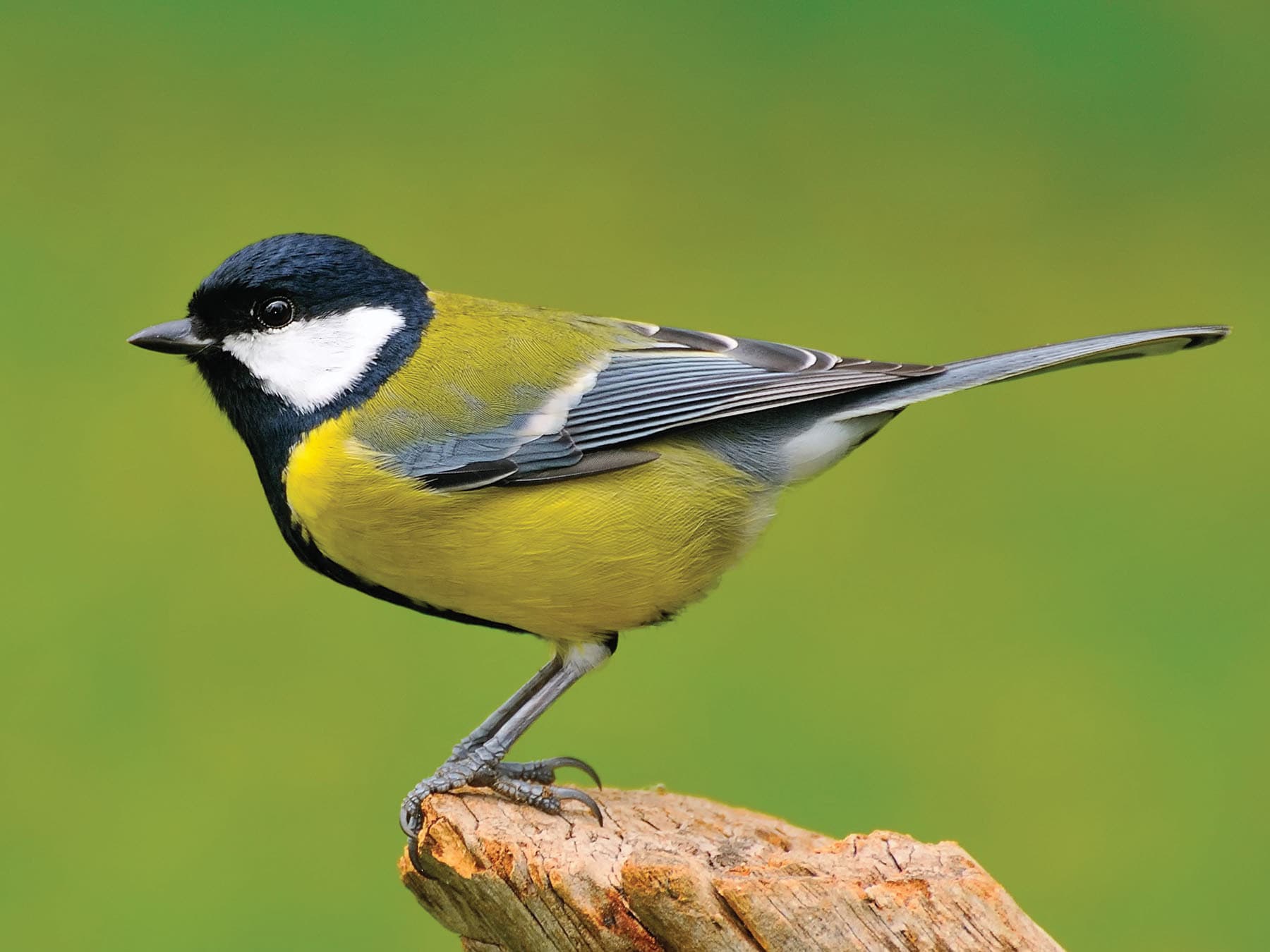
The Great Tit's song is a loud, sharp tea-cher, tea-cher, but each male has several versions. Listen to its songs, its churring alarm, its hawk alarm and the begging calls of its young.
On this page9 sections

This page is a listening guide to the Great Tit: its song and why it varies so much, when and where it sings, its alarm and contact calls, and the sounds of its young, with recordings of each. For the bird itself, see Great Tit identification and facts.
What does a Great Tit sound like?
The song is loud, sharp and a little metallic: a two- or three-note phrase repeated several times, usually written tea-cher, tea-cher. Other versions are written teechuwee, tsi-tsi-daa or zizibaah. Phrases of one or four notes occur too, and a phrase can be repeated up to ten times.1
Why does every Great Tit sound different?
Because each male has several songs. A male usually has three or four common song types and sometimes as many as 18, and he switches between them. Even experienced birders can be puzzled by a version they have not heard before.1
Where a bird lives changes its song too. Great Tits in dense forest sing lower, with a narrower range of pitch and fewer notes in each phrase, than birds in open woodland. In noisy cities they sing at a higher pitch, so their songs carry over the noise.2
Females have a very similar song but rarely use it.
When and where do Great Tits sing?
Males call all year, but they sing mainly from late winter to the end of the nesting season. Song peaks in a brief dawn chorus, often while the male waits for his mate to leave the nest hole, about 20 to 35 minutes after the sky starts to lighten, and lasts about 35 to 45 minutes. There is sometimes a second peak in the evening.1
They sing mostly from a high perch. In one English wood, Great Tits sang from an average of 9.3 m up, higher than they did anything else, often from the top of a hawthorn.
Alarm calls: the churr
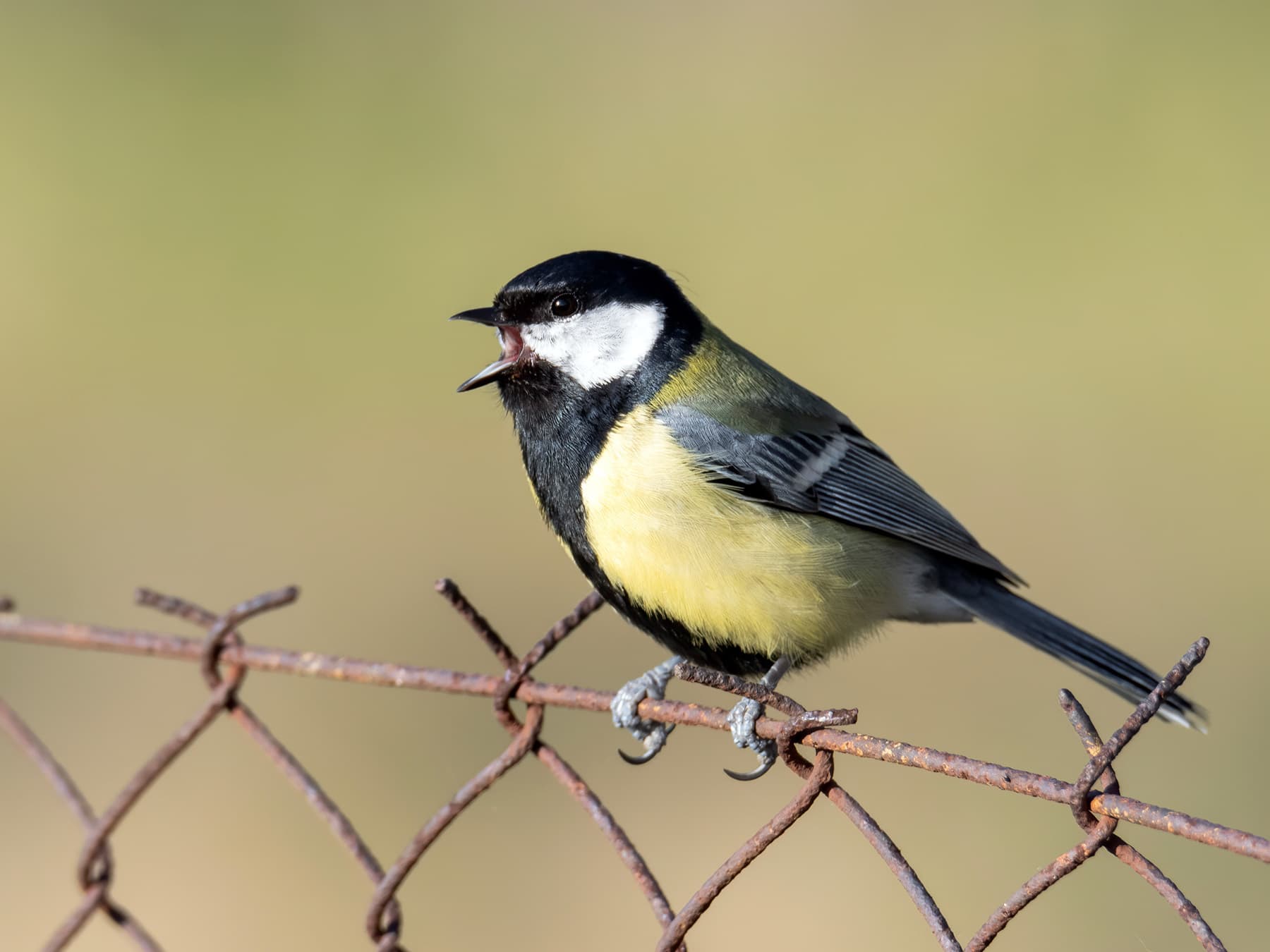
The commonest call is a harsh, churring scold, chich-ich-ich, often after one or more thin tsee or tink notes. Partners use it quietly to keep in touch, but it becomes longer and harsher when a bird is alarmed and mobs a predator, and it draws other birds in to help.1
The churr carries real information. When researchers showed Great Tits a mounted Sparrowhawk, which hunts small birds, and a mounted Tawny Owl, which mostly hunts small mammals, the tits gave more churring calls at the Sparrowhawk, each one longer, with more notes and longer gaps between them.3
Alarm calls: the hawk alarm
When a hawk flies over, a Great Tit gives a high-pitched trill and dives into cover. Other birds in its flock do the same, and they stay silent for minutes.1
Other calls
A loud, metallic tink or chink, given almost only by males, is used in alarm, in winter flocks and in "tinking duels" between neighbours at a territory edge. It sounds very like a Chaffinch's call, especially when doubled or tripled.
While feeding, Great Tits keep in touch with soft pit, spick and chit notes. In late winter both sexes give a quiet, warbling subsong, audible only close by. In courtship the male gives a low warble and the female answers with a lower zeedle-zeedle, much like the call she gives when begging him for food.1
A female disturbed on the nest hisses, snaps her bill and claps her wings.
Sounds of young Great Tits
Fledglings are noisy. They beg with a high, repeated tsee-tsee-tsee or zi-zi-zi while shivering their wings, and keep it up for the first week or so out of the nest, while their parents still feed them.1
In the nest, chicks from about 6 to 8 days old go silent and crouch when a parent gives the alarm. More: Great Tit nesting.
Great Tit or a similar song?
Coal Tit song has the same two-syllable rhythm, but it is higher pitched and more slurred.4 Blue Tit song is a clear, high, lilting phrase, often running into a trill, rather than a sharp two- or three-note phrase.5 Side-by-side guides: Coal Tit vs Great Tit and Blue Tit vs Great Tit.
Sources
- Kirwan, G. M., Sly, N. D., Gosler, A., Clement, P., Christie, D. A., Moura, N., Pyle, P. (2024). Great Tit (Parus major), version 2.0. Birds of the World (G. M. Kirwan and N. D. Sly, editors). Cornell Lab of Ornithology. doi:10.2173/bow.gretit1.02
- Slabbekoorn, H., Peet, M. (2003). Birds sing at a higher pitch in urban noise. Nature 424(6946): 267. doi:10.1038/424267a
- Kalb, N., Anger, F., Randler, C. (2019). Subtle variations in mobbing calls are predator-specific in great tits (Parus major). Scientific Reports 9(1): 6572. doi:10.1038/s41598-019-43087-9
- BTO. Coal Tit (Periparus ater). BTO BirdFacts. Accessed 7 October 2026. Source
- Kirwan, G. M., Gosler, A., Clement, P., Christie, D. A., Pyle, P. (2024). Eurasian Blue Tit (Cyanistes caeruleus), version 1.1. Birds of the World (J. del Hoyo, A. Elliott, J. Sargatal, D. A. Christie, E. de Juana and M. G. Smith, editors). Cornell Lab of Ornithology. doi:10.2173/bow.blutit.01.1
- BTO. Great Tit (Parus major). BTO BirdFacts. Accessed 6 October 2026. Source
- RSPB. Great tit. RSPB Birds A-Z. Accessed 6 October 2026. Source