


Great Tit
Eurasian Great Tit · Parus major
By the Birdfact teamChecked by Nathan Cope
See it in 3D
2 plumages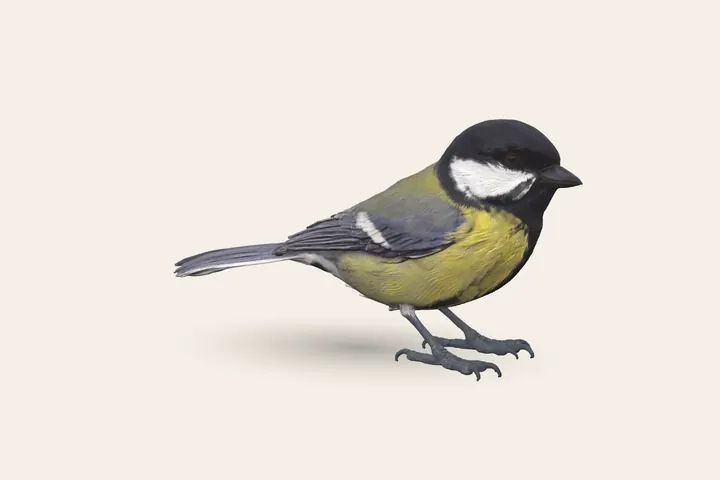 3D model
A Great Tit is 14 cm (5.5 in) long, bill to tail.
3D model · Male · Length 14 cm (5.5 in) · How we make our birds · Report a problem
© 2026 NC Digital Limited (Birdfact). All rights reserved. This 3D model may be viewed on this page and shared by link only. Downloading, extracting, copying or reusing it, or using it to train machine-learning models, is not permitted without our written permission. Using our models
On this page16 sections
How to recognise it
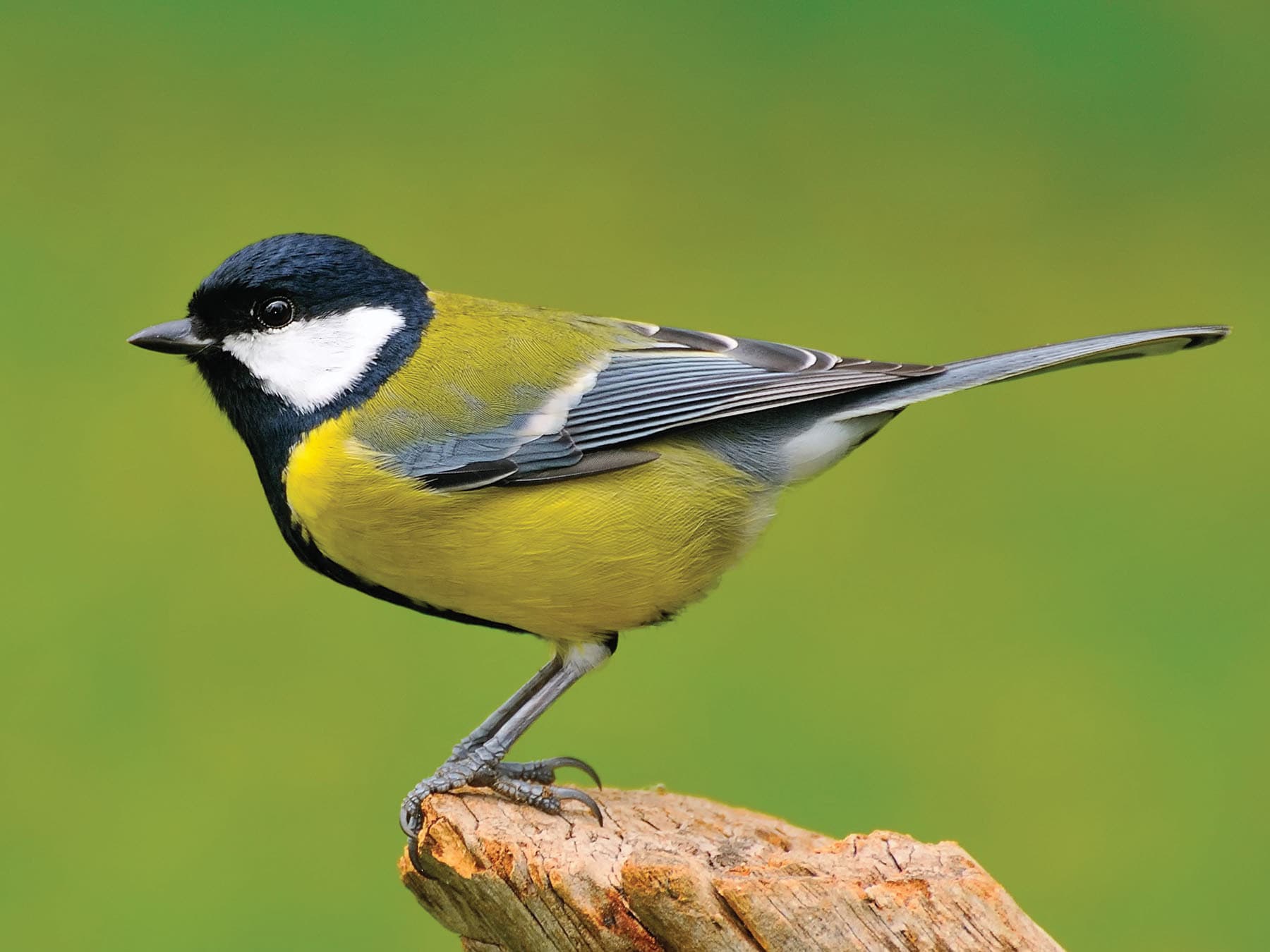
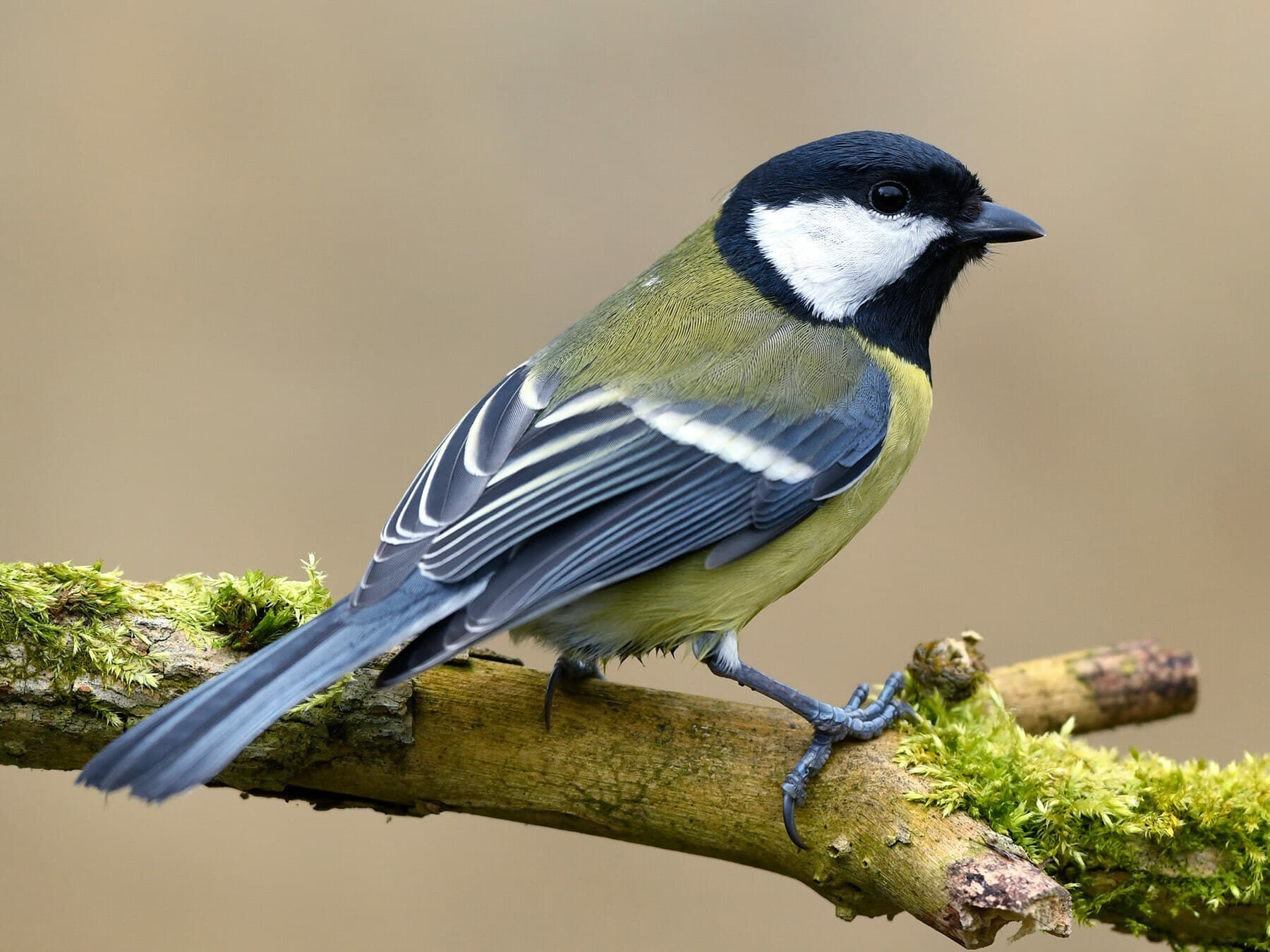
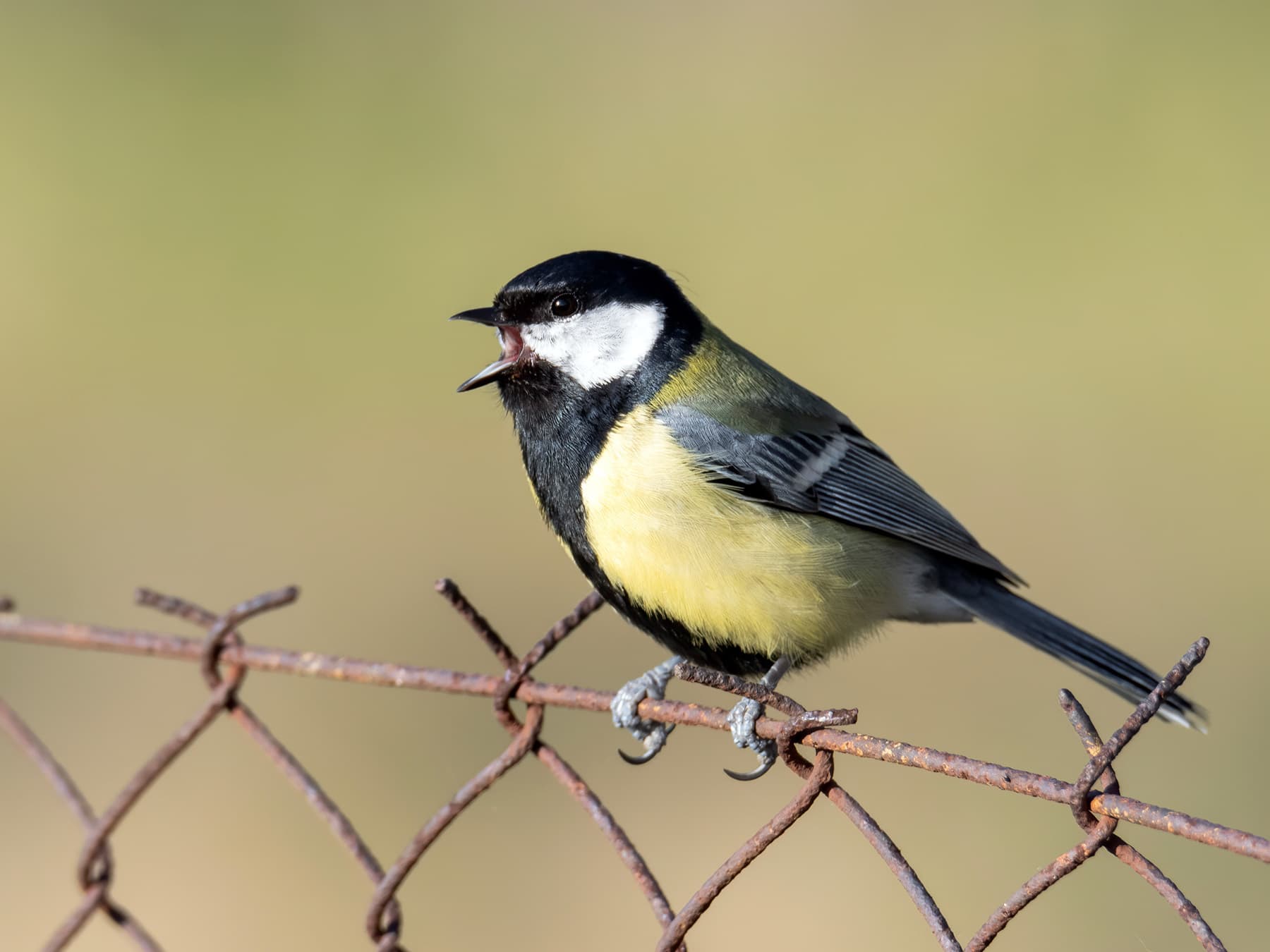
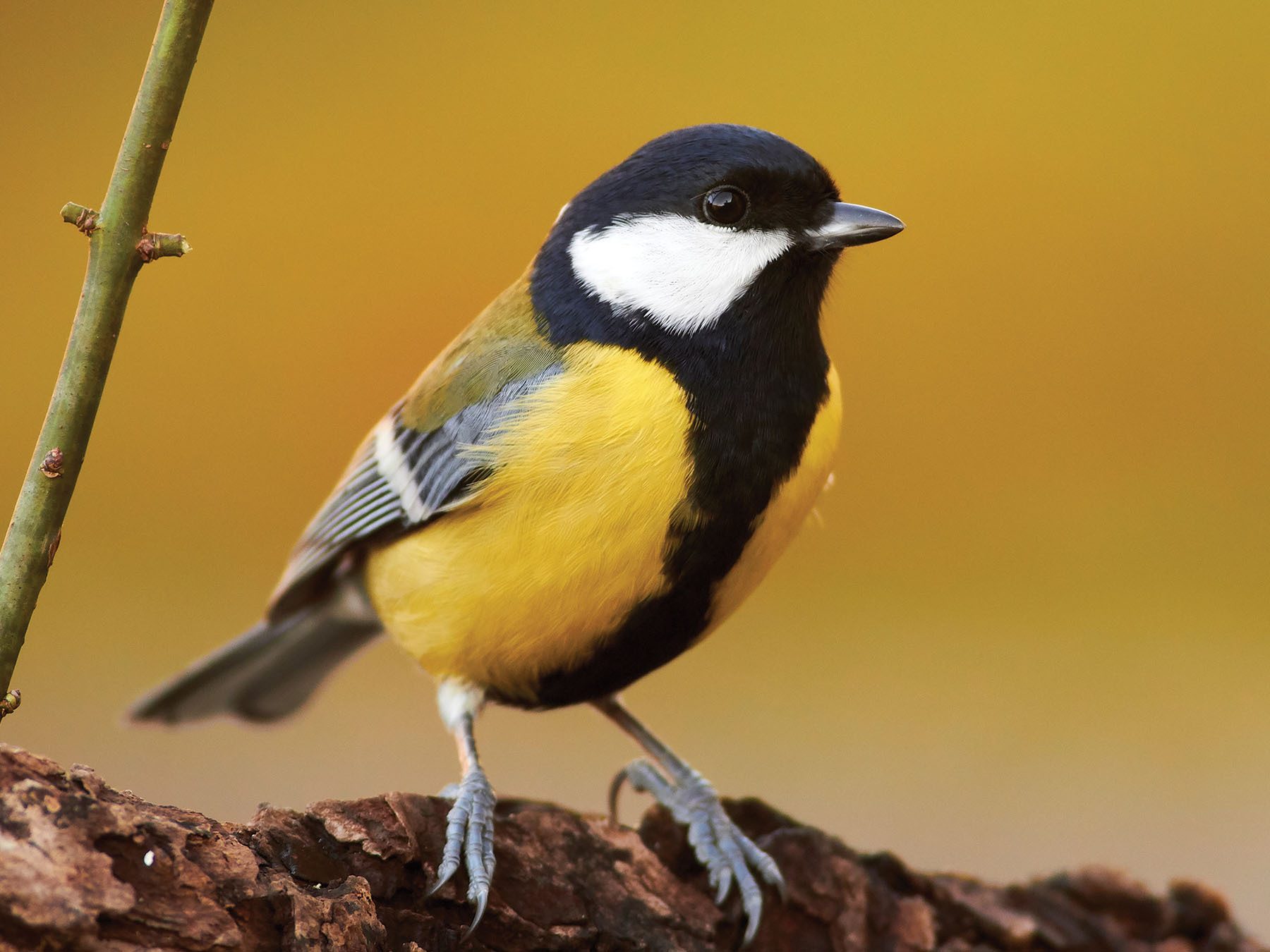
The Great Tit is the biggest tit in a British garden, about 14 cm long with a wingspan of 24 cm. It has a glossy black head with large white cheeks, a green back, blue-grey wings with a single white wing bar, and yellow underparts split by a black stripe that runs down from the black throat.
Close up, the bill is short, stout and black, the eyes are dark brown and the legs are slate blue-grey. There is a small whitish patch at the back of the black cap, and the outer tail feathers are edged white.
Live adults weighed by BTO ringers average 18.6 g, males a little heavier than females.1
Male, female and young
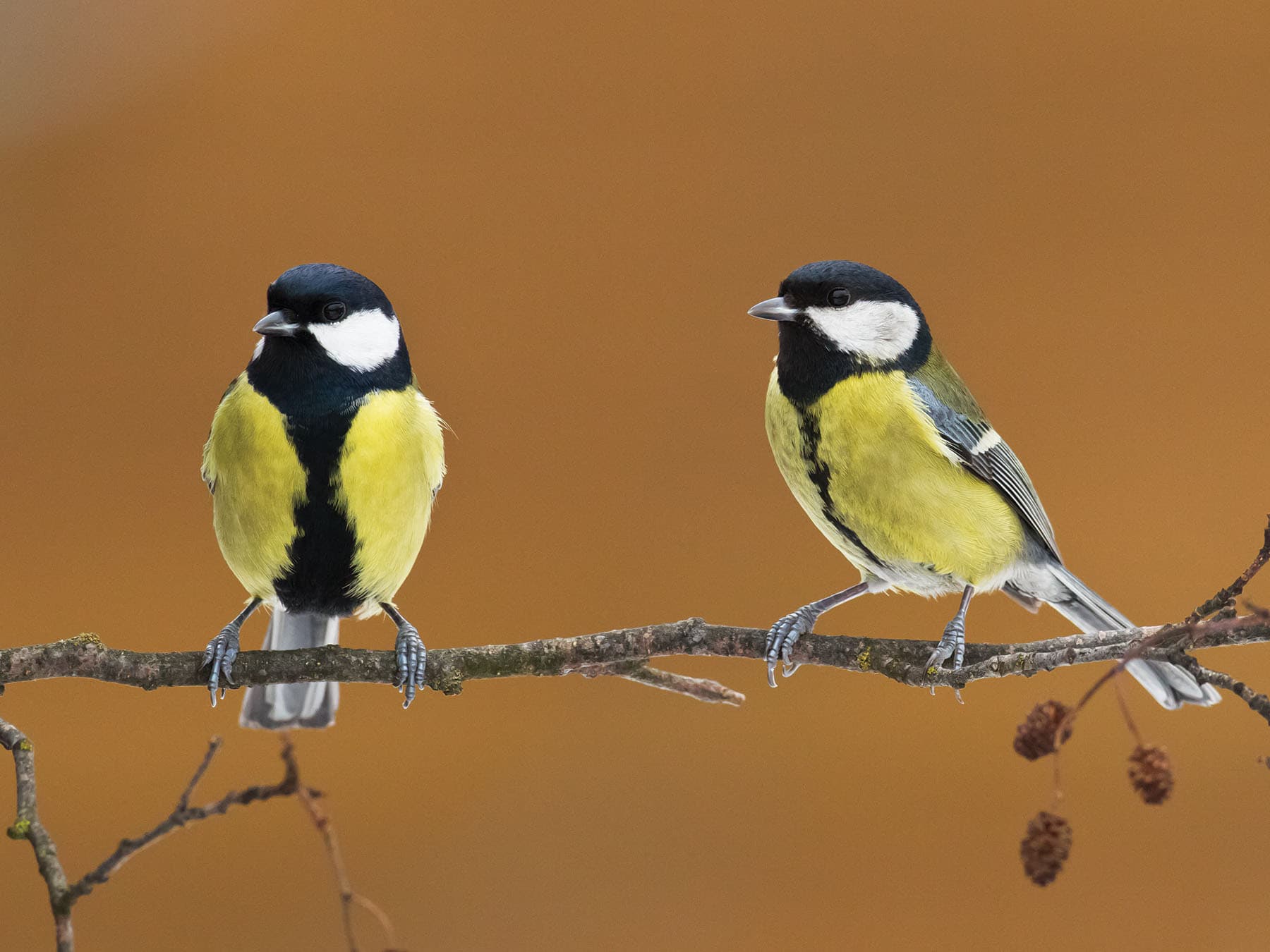
Look at the black stripe down the breast. A male's is broad and widens into a black patch between the legs. A female's is narrower, often broken, and fades out before it reaches the legs. She is also a little duller, with a less glossy cap.2
The stripe is also a badge of status: in a flock, the birds with wider stripes tend to be the more dominant ones.
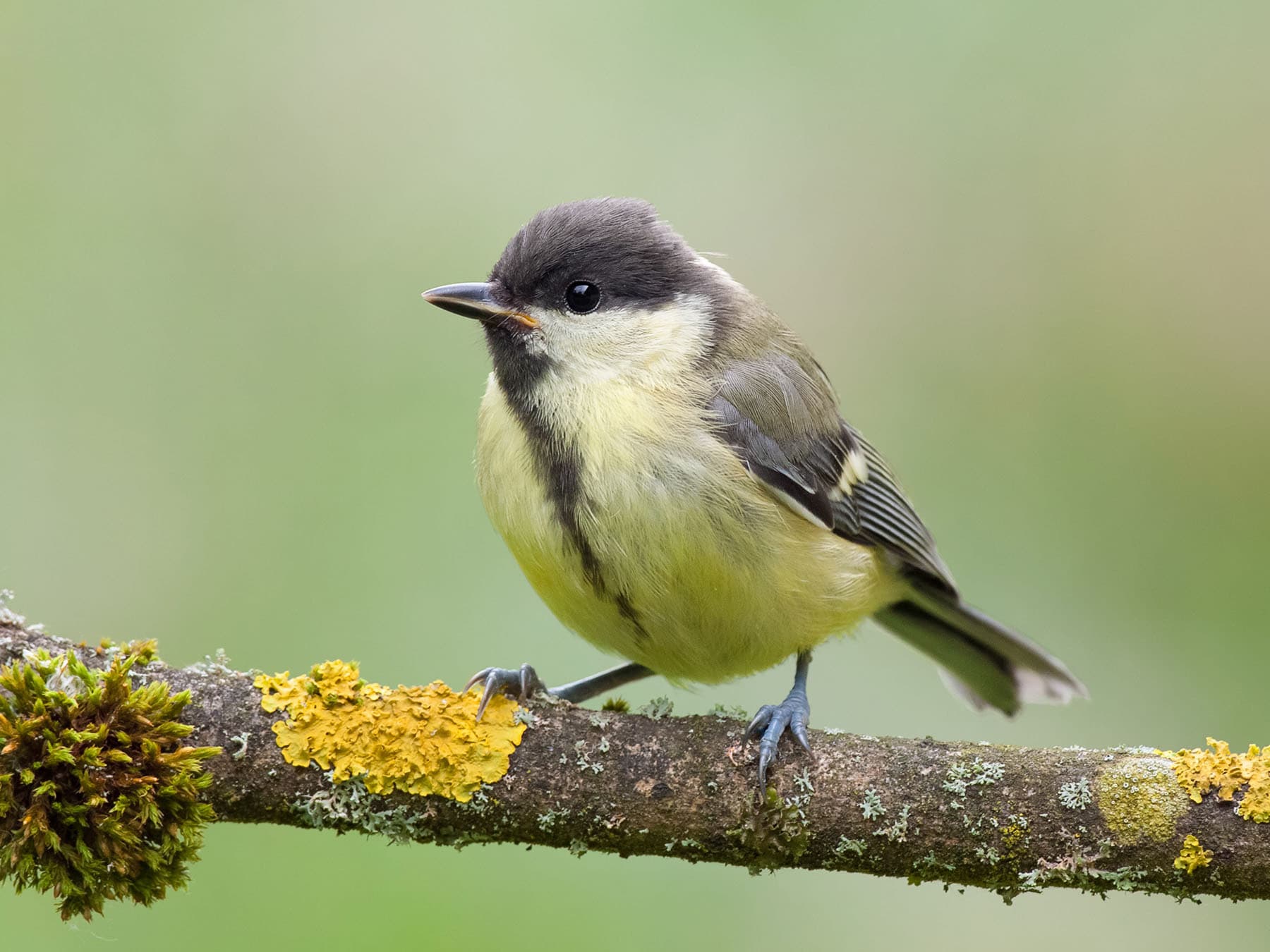
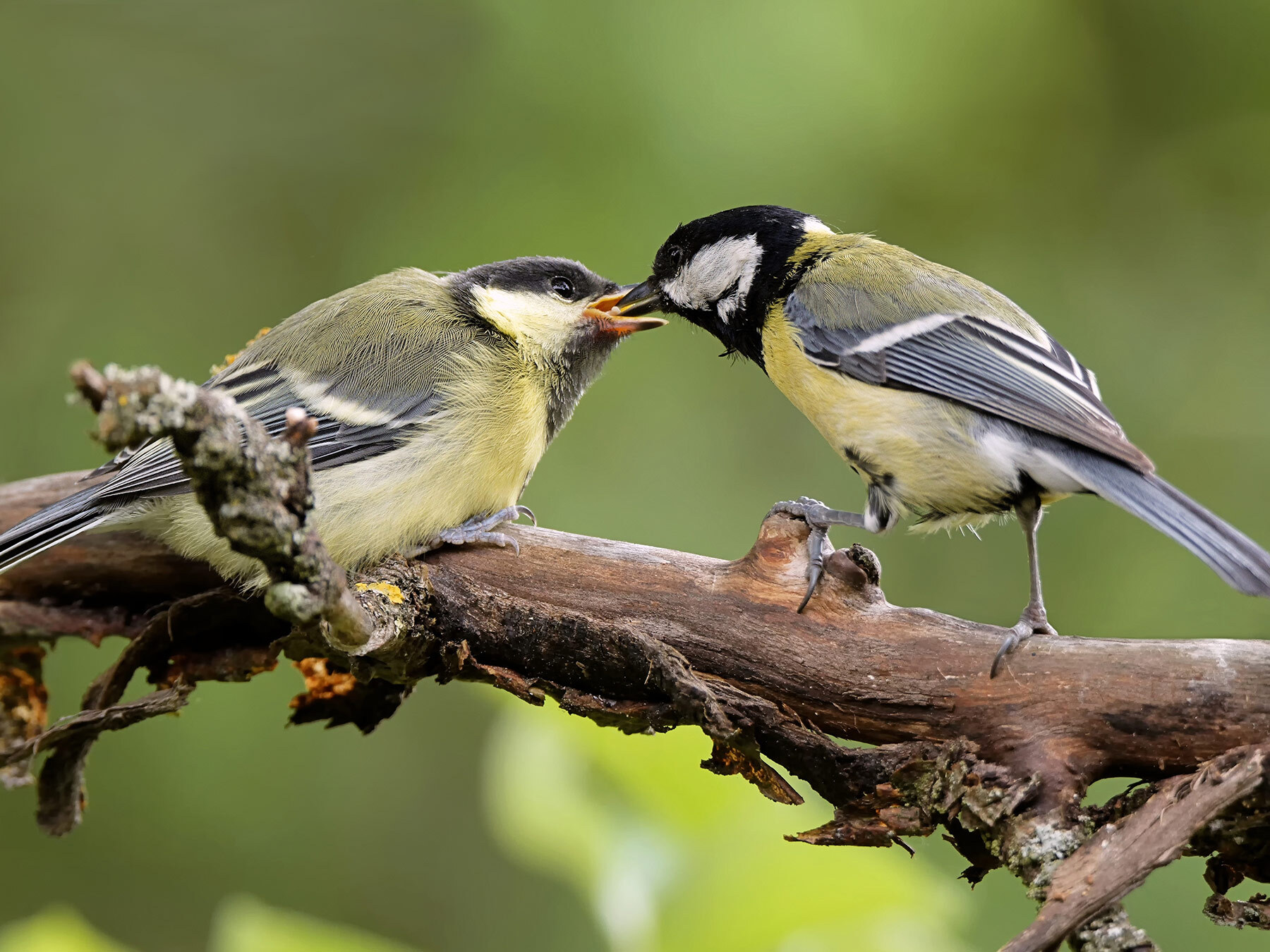
Young Great Tits, seen from June to August, look like washed-out females. The cheeks are tinged yellow, the cap is brownish rather than glossy black, the bib and stripe are dark grey, and the bill often has yellow edges. Between July and September they replace their body feathers and, usually, the tail in a partial moult.
Identification: similar birds
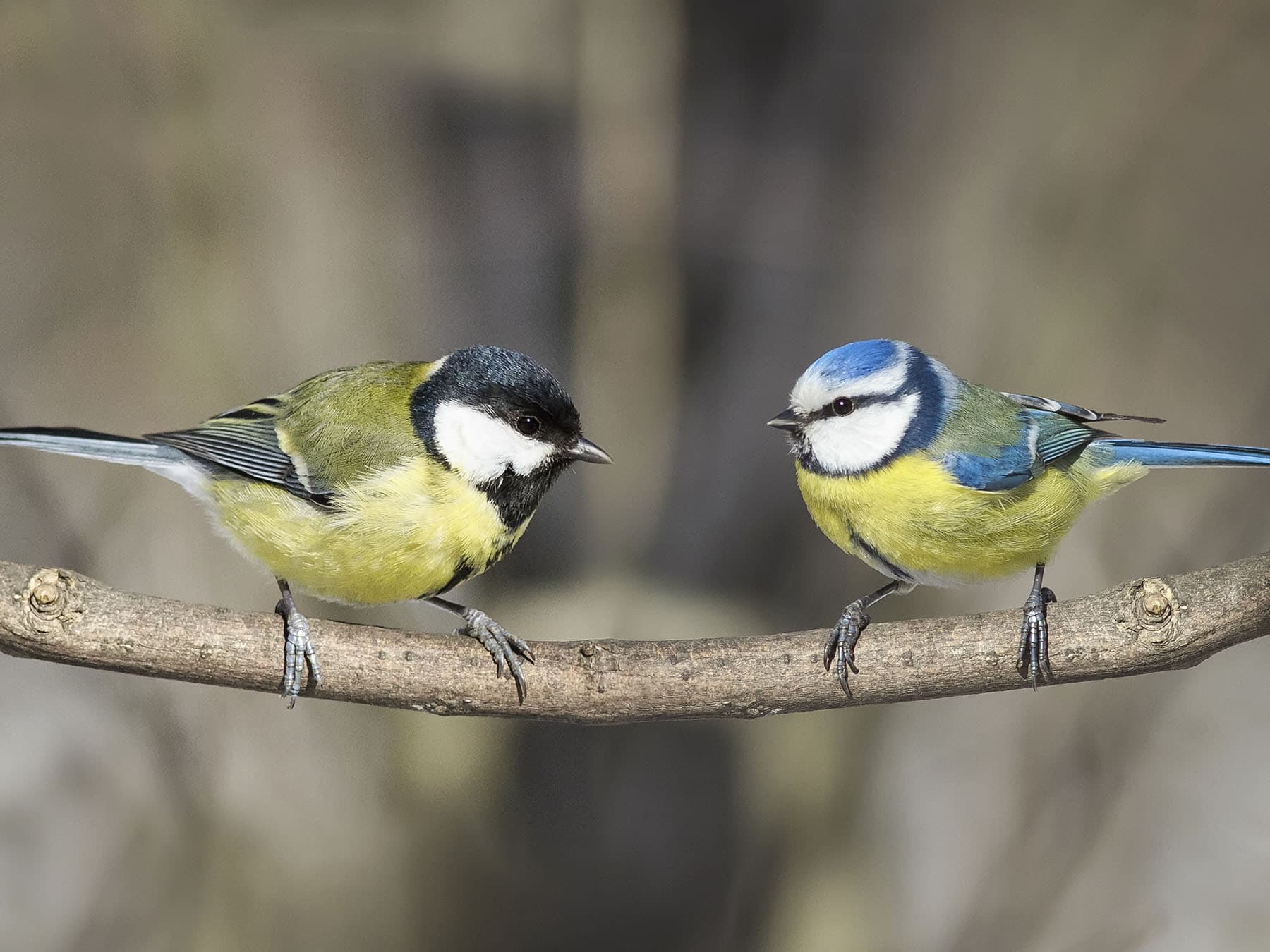
The Blue Tit is the usual mix-up. It is smaller, with a blue cap ringed in white and a dark line through the eye, and it has no broad black stripe down the breast. More: Blue Tit vs Great Tit.
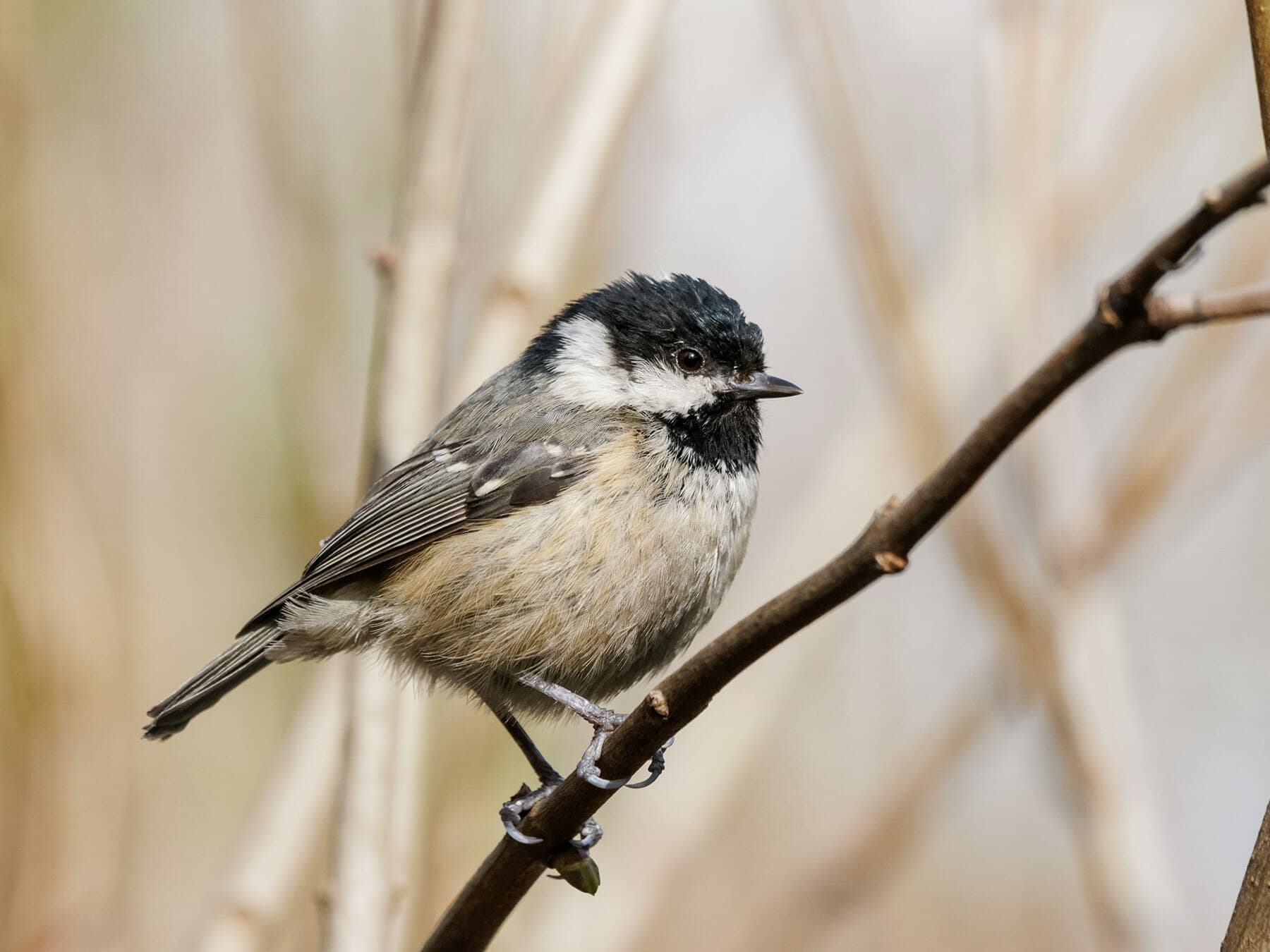
The Coal Tit is also smaller, with a big white patch on the back of its black head, buff underparts and two white wing bars. More: Coal Tit vs Great Tit.
Its size
Adults- Length
- 14 cm
- Wingspan
- 22.5–25.5 cm
- Weight
- 16.6–20.8 g
Its song and calls
The song is a loud, sharp tea-cher, tea-cher: a two- or three-note phrase, repeated several times. Males sing mainly from late winter to the end of the nesting season, though they call all year.2
It is famously variable. A male usually has three or four common song types and sometimes as many as 18, so even experienced birders can be puzzled by a version they have not heard before. Females have a very similar song but rarely use it.
The calls are just as varied: a male may use up to 40 distinct notes. Listen for a harsh, churring chich-ich-ich when Great Tits mob a predator, a loud metallic tink rather like a Chaffinch's call, and soft pit notes as a flock feeds. The churr carries information: Great Tits give longer churring calls for a Sparrowhawk, which hunts small birds, than for a Tawny Owl. Listen to more recordings: Great Tit song and calls.
- Song0:00 / 0:32
Recorded in Pays de la Loire, France · April 2026
- Call0:00 / 0:54
Recorded in Hauts-de-France, France · April 2025
When and where to see it
OctoberIn season
Most recorded in October
- 1. Neath Port Talbot4.1%
- 2. Down3.8%
- 3. Stirling3.7%
- 4. Bristol3.7%
- 5. Wrexham3.6%
Each dot is a county, state or province: the bigger and darker, the larger the bird’s share of that place’s bird records that month. Grey dots: no regular records. The ringed point is the centre of the bird’s records this month; the arrow shows how it moved since last month, and the dashed loop its path through the year. “Arrivals” colours places where it becomes regular this month (orange) or is in its last regular month (grey). GBIF eBird Observation Dataset, 2019–2024. Map data: Natural Earth, US Census Bureau; place centres © OpenStreetMap contributors.
In your area
See when the Great Tit is recorded in your county, state or province.
How often the Great Tit turns up in the UK and Ireland through the year, from birdwatchers' records.
United Kingdom
Resident · all year · most records in February
Ireland
Resident · all year · most records in April
Show as a table
| Month | United Kingdom | Ireland |
|---|---|---|
| January | 2.5% (regular) | 1.4% (regular) |
| February | 2.7% (regular) | 1.6% (regular) |
| March | 2.6% (regular) | 1.7% (regular) |
| April | 2.3% (regular) | 1.9% (regular) |
| May | 1.8% (regular) | 1.5% (regular) |
| June | 1.6% (regular) | 1.1% (regular) |
| July | 1.5% (regular) | 0.77% (regular) |
| August | 1.6% (regular) | 0.75% (regular) |
| September | 1.8% (regular) | 0.99% (regular) |
| October | 1.9% (regular) | 1.2% (regular) |
| November | 2.1% (regular) | 1.3% (regular) |
| December | 2.4% (regular) | 1.4% (regular) |
Recorded regularly in
Worldwide: recorded regularly in 69 countries
Countries where it was recorded in at least 3 of the 6 years 2019–2024. Linked countries have their own bird list.
Europe (48)
- Åland Islands
- Albania
- Andorra
- Austria
- Belarus
- Belgium
- Bosnia & Herzegovina
- Bulgaria
- Croatia
- Czechia
- Denmark
- Estonia
- Finland
- France
- Germany
- Gibraltar
- Greece
- Guernsey
- Hungary
- Ireland
- Isle of Man
- Italy
- Jersey
- Kosovo
- Latvia
- Liechtenstein
- Lithuania
- Luxembourg
- Moldova
- Monaco
- Montenegro
- Netherlands
- North Macedonia
- Norway
- Poland
- Portugal
- Romania
- Russia
- San Marino
- Serbia
- Slovakia
- Slovenia
- Spain
- Sweden
- Switzerland
- Ukraine
- United Kingdom
- Vatican City
Asia (18)
- Armenia
- Azerbaijan
- China
- Cyprus
- Georgia
- Iran
- Iraq
- Israel
- Jordan
- Kazakhstan
- Kyrgyzstan
- Lebanon
- Mongolia
- Palestinian Territories
- Syria
- Tajikistan
- Turkey
- Uzbekistan
Data: EOD – eBird Observation Dataset (Cornell Lab of Ornithology), accessed via GBIF.org, CC BY 4.0. Records from 2019–2024, aggregated and filtered by Birdfact. How these lists are made
All year, almost anywhere with trees: woods, parks, hedgerows and gardens, in towns and villages as well as the countryside. In the breeding season the BTO's surveys find them most often in deciduous woodland. They occur in 90% of the 10-km squares in Britain and Ireland, missing only from treeless moorland in the Scottish Highlands, the Outer Hebrides and the Northern Isles.1
Beyond Britain they live across Europe, in north-west Africa and across Asia to the Amur valley, mainly in open deciduous and mixed woods; in Europe they prefer oaks. In Britain they are lowland birds, rare above 500 m in Scotland.
Spotting tips
In winter, watch hanging peanut and seed feeders, and listen for mixed flocks of tits working through the trees. From late winter, listen for the tea-cher song from a high perch.
Do Great Tits migrate?
Not in Britain. British Great Tits stay all year, and ringing shows that most of their movements are within 10 km. In some autumns, when numbers are high and the beech crop fails, young birds from northern and eastern Europe move south and west, and a few reach Britain and Ireland.2
What it eats
Insects and spiders in spring and summer, seeds and nuts in autumn and winter. The chicks are fed mostly on caterpillars, and nesting is timed so that the chicks are growing when caterpillars are most plentiful.1
In winter they eat beech mast, hazelnuts and other seeds, carrying a hard seed to a branch, holding it under one foot and hammering it open, and they come readily to feeders. More: what Great Tits eat.
Unusual food: bats
At a cave in Hungary, Great Tits have been seen searching out, killing and eating hibernating pipistrelle bats in winter. The researchers watched 18 kills over two winters, and when they put out food for the tits, the bat hunting dropped sharply: a sign that the tits turn to bats when other food is short.3
Feeding them in your garden
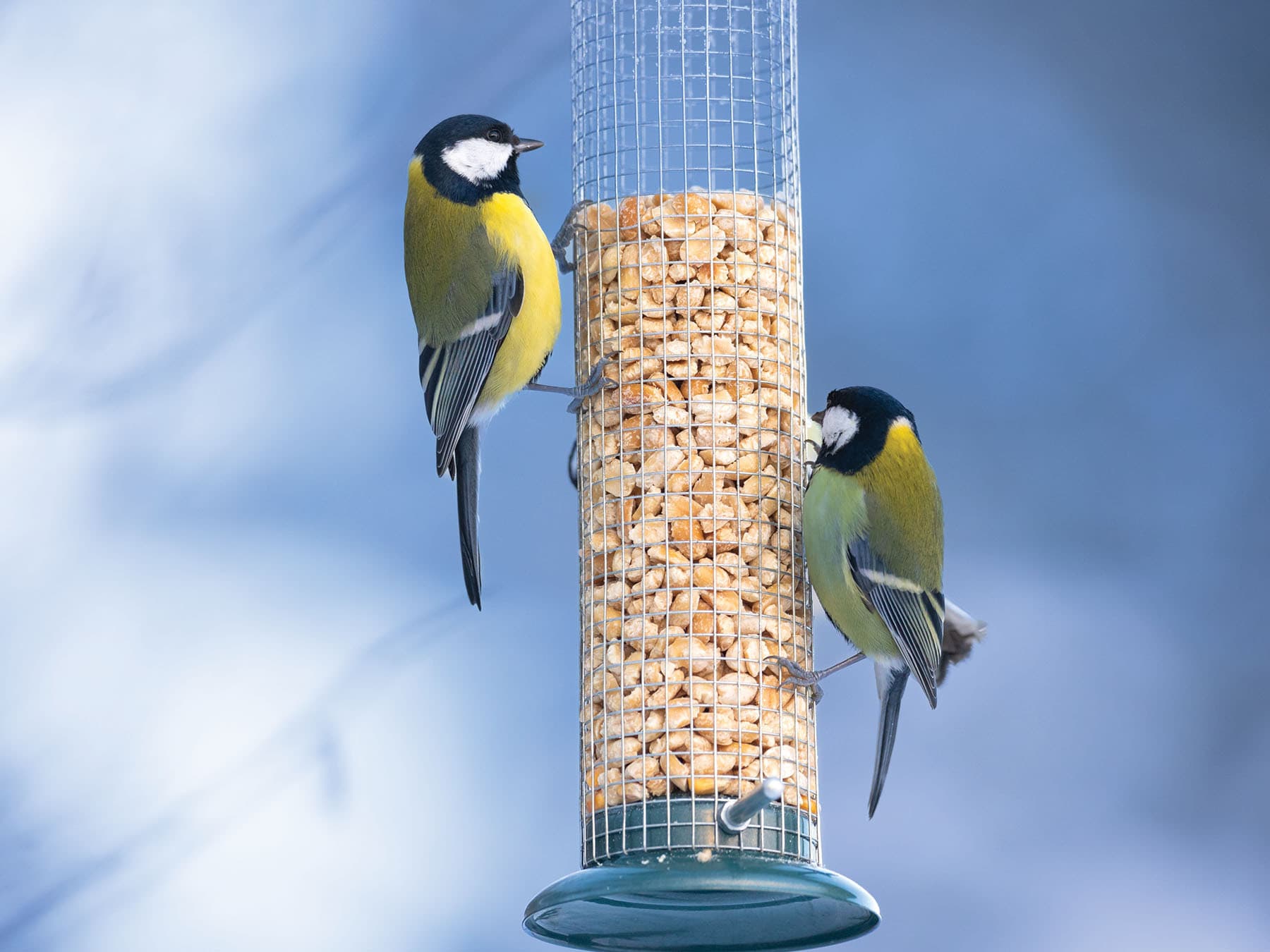
Sunflower hearts in a hanging seed feeder, peanuts in a mesh feeder (never a mesh bag) and fat balls in a mesh feeder all suit tits. The RSPB now advises hanging feeders only, not bird tables or trays, where disease spreads more easily. Pause seed and peanuts from 1 May to 31 October, when small amounts of fat balls or suet are fine, and clean feeders weekly.4
Nesting and breeding
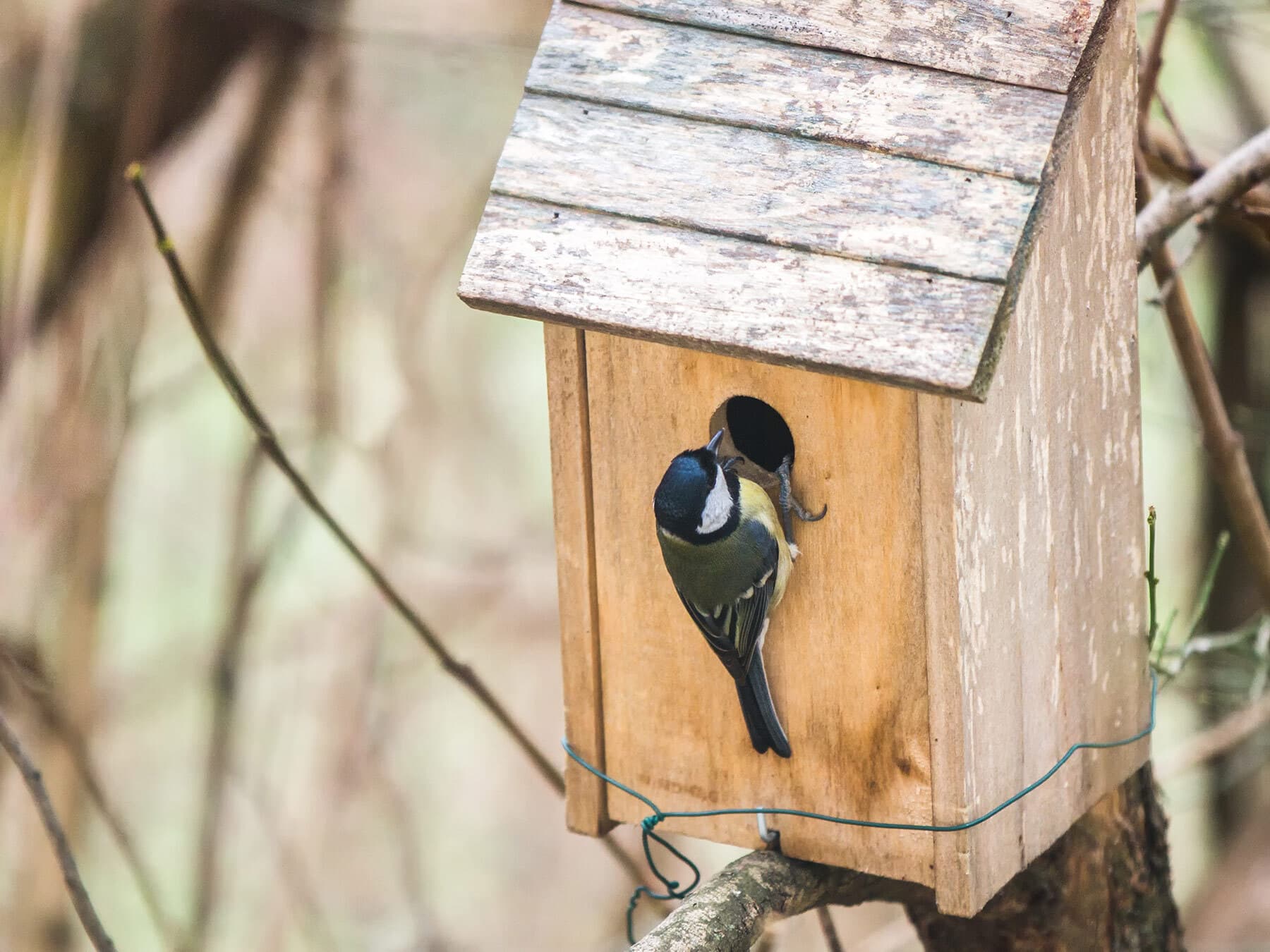
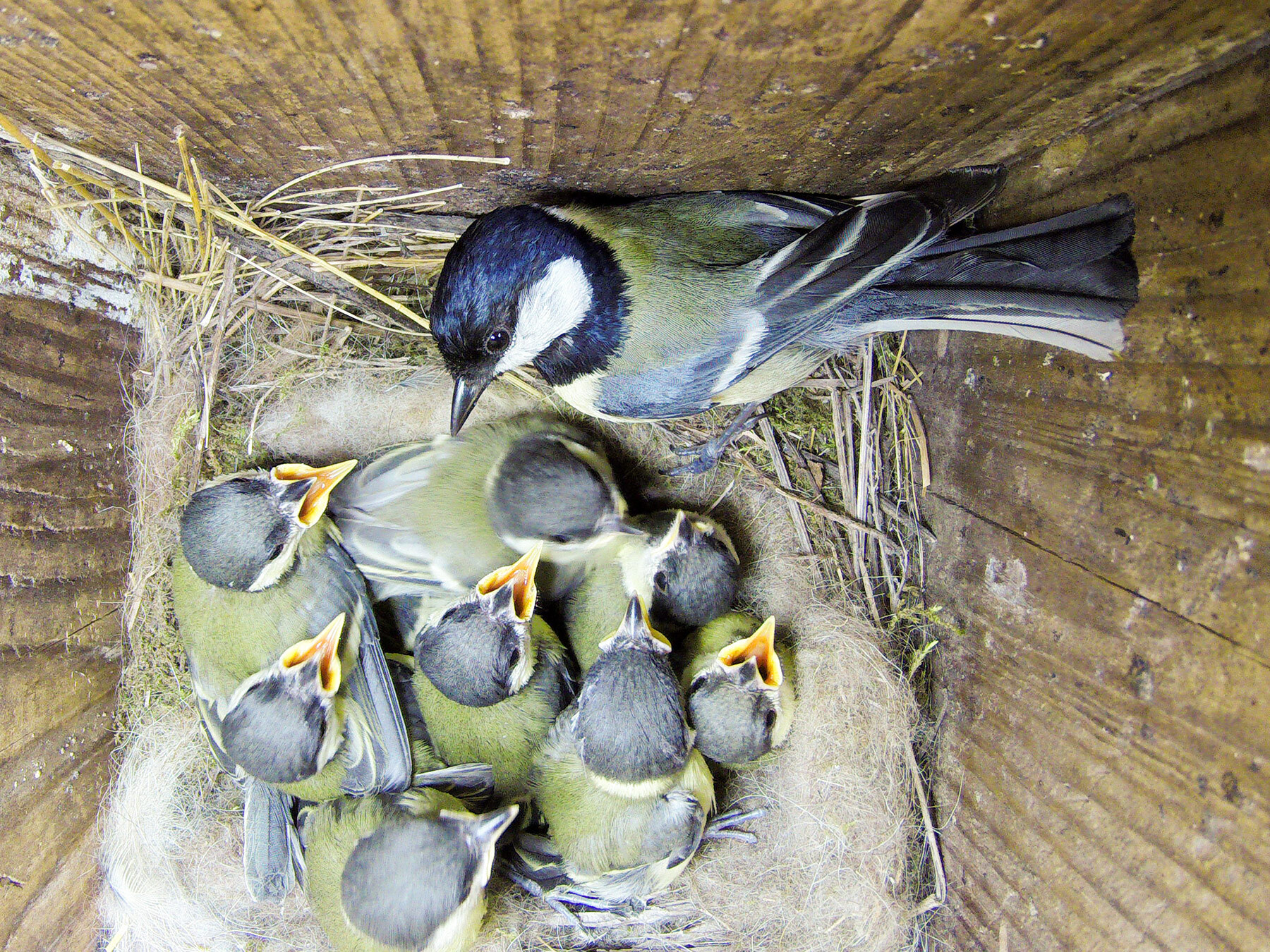
Great Tits nest in holes: in trees and, readily, in nest boxes, which they prefer where they are offered. The female builds a cup of moss lined with hair, fur or wool inside the hole. In Britain the first eggs are laid around 26 April on average.1
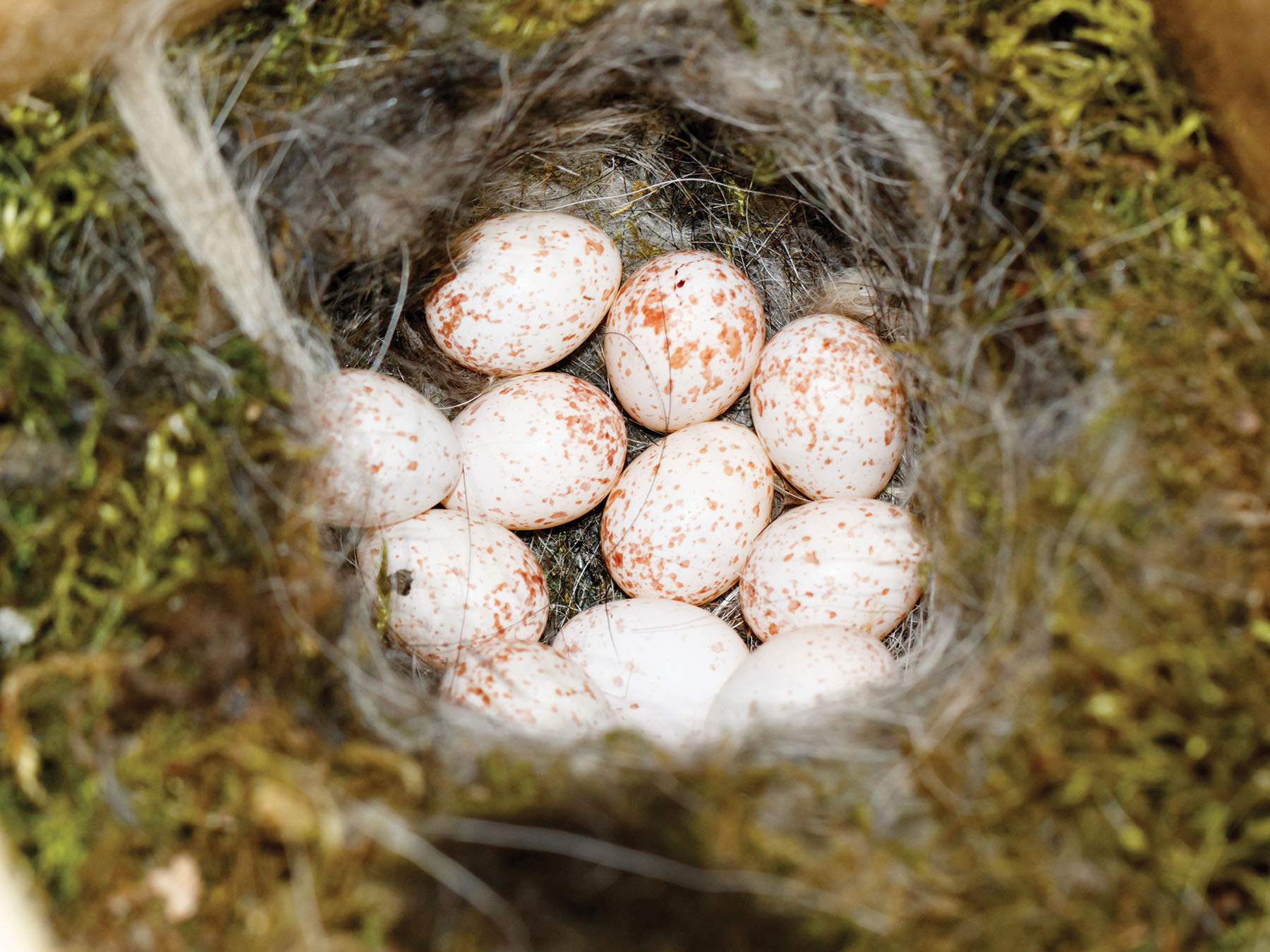
A clutch is usually 7 to 9 white eggs speckled with reddish-brown. The female incubates them for 13 to 14 days, and the chicks leave the nest at 18 to 21 days old. Most pairs raise one brood a year; a few raise two. More: Great Tit nesting.
Nest boxes
A small hole-fronted box suits them. The BTO recommends a 32 mm entrance hole, which suits all the small hole-nesting birds, with the box fixed 1 to 3 m up a tree trunk, sheltered from strong sun, wind and rain, and no perch.5
Behaviour
Great Tits are bold, busy birds. They hop and clamber through trees, feeding mostly on the lower and inner branches, and in winter they often feed on the ground. At a bird table they can be quite aggressive, chasing off smaller tits.6
Social behaviour: flocks and pecking orders
From late summer to early spring they join flocks with Blue Tits, Coal Tits, Long-tailed Tits, Nuthatches, Treecreepers and Goldcrests, of up to 50 birds in winter. The Great Tit is the top bird in these mixed flocks, and among Great Tits males outrank females and adults outrank young birds.2
In spring the flocks break up and pairs hold territories, mostly of half a hectare to one and a half hectares. Older birds take back the same territory.
Clever behaviour: learning from each other
Great Tits learn fast, especially from each other. In an experiment by Oxford researchers, two birds in each of several wild groups were taught one of two new ways of getting food. The technique spread through each group's social network to an average of 75% of the birds, and each group kept to its own method for two generations.7
They are one of the few birds known to use a tool: one was seen using a conifer needle to pull larvae from a hole in a tree. Like Blue Tits, they learned to open milk-bottle tops on doorsteps to drink the cream.2
Roosting behaviour
In summer Great Tits roost among leaves, but a nesting female sleeps in the nest hole until her chicks are about two weeks old. In winter they roost alone in tree holes, holes in buildings, dense conifers and nest boxes.
Lifespan and predators
A Great Tit that survives to breeding age typically lives about 3 years. About 54% of adults survive from one year to the next, but only 38% of young birds survive their first year.1
Lifespan records
Predators
Sparrowhawks are among the main predators of adults. In southern England the Weasel is the main nest predator: in one long study it took about a quarter of nests. Squirrels, Pine Martens and Great Spotted Woodpeckers raid nests too, and Jays and Sparrowhawks take fledglings.2
Conservation
Great Tits are doing well. They are Green-listed in the UK, and the breeding population grew by 67% between 1967 and 2024, to an estimated 2.4 million territories (2016). Numbers have levelled off since about 2010, with a shallow decline in the last ten years.1 Worldwide they are of Least Concern.
The rise seems to come from better survival rather than better breeding: milder winters and garden feeding may have carried more adults through the winter. Warmer springs have also moved nesting earlier: UK Great Tits now lay about nine days earlier than in 1968.
A form of avian pox, first recorded in UK Great Tits in 2006, is increasing but has not been shown to affect numbers; keeping feeders clean helps.
Similar birds
Often mistaken for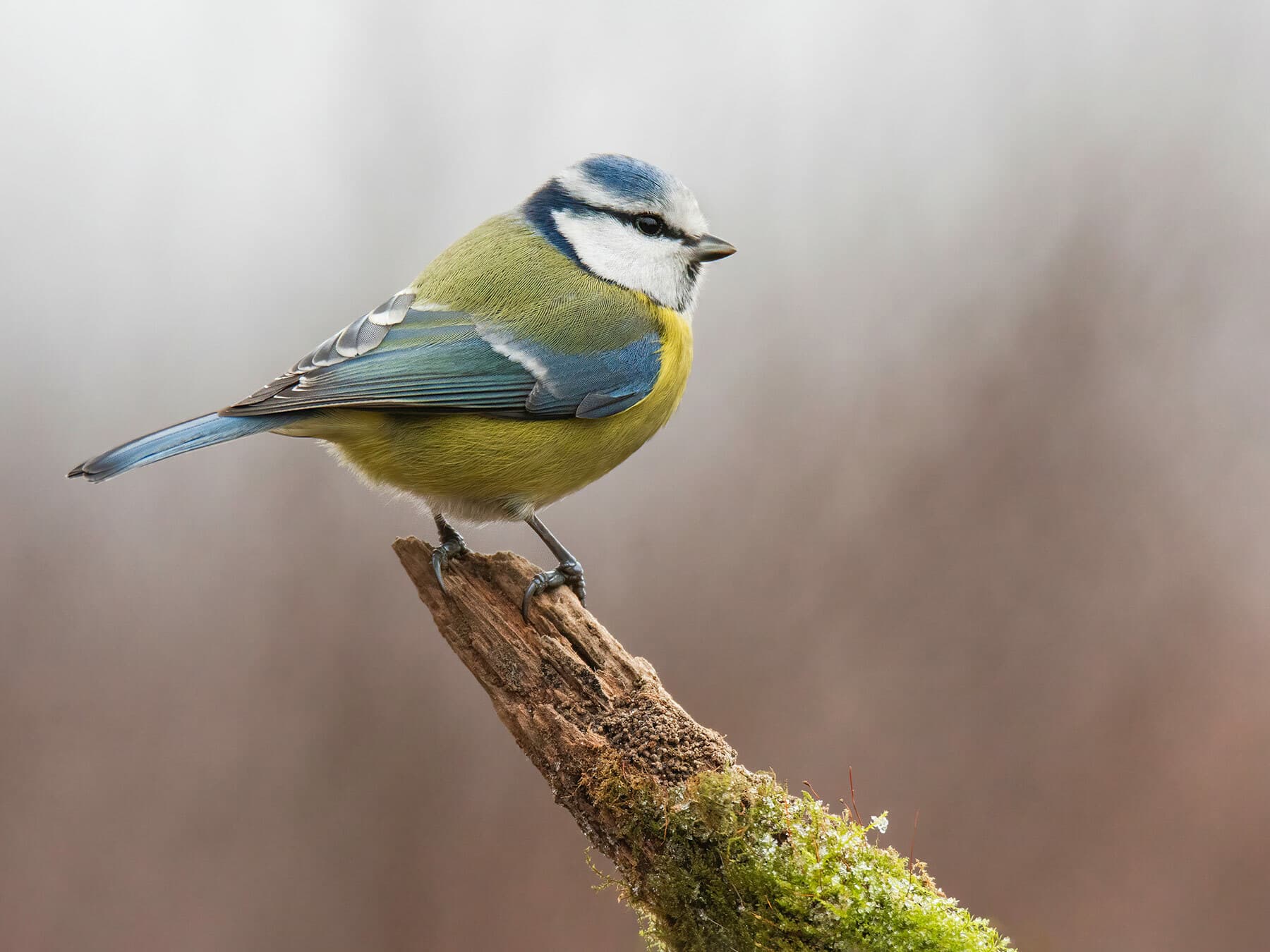
More photos
7 photos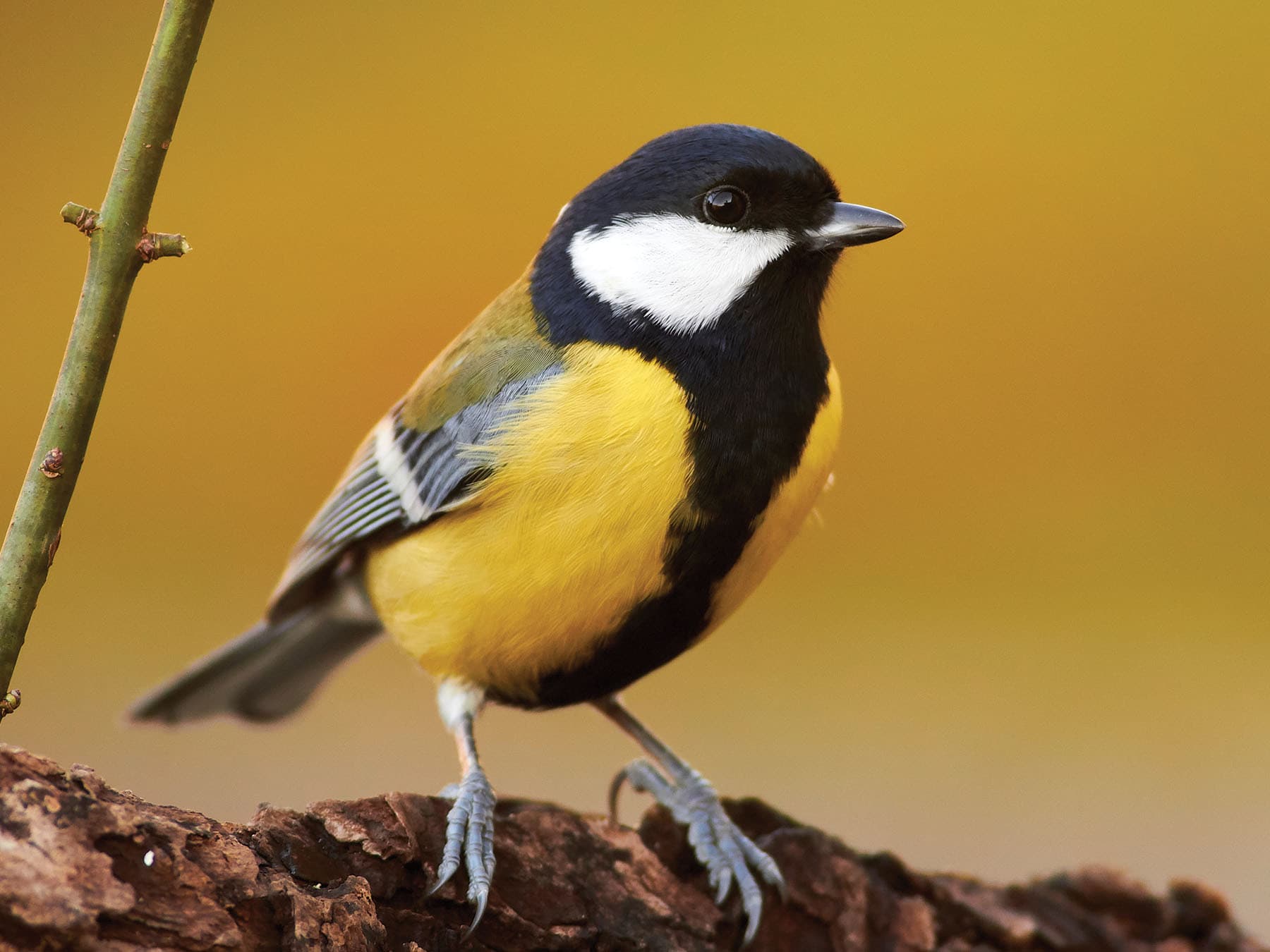 A male Great Tit, with a broad black stripe down his yellow breast
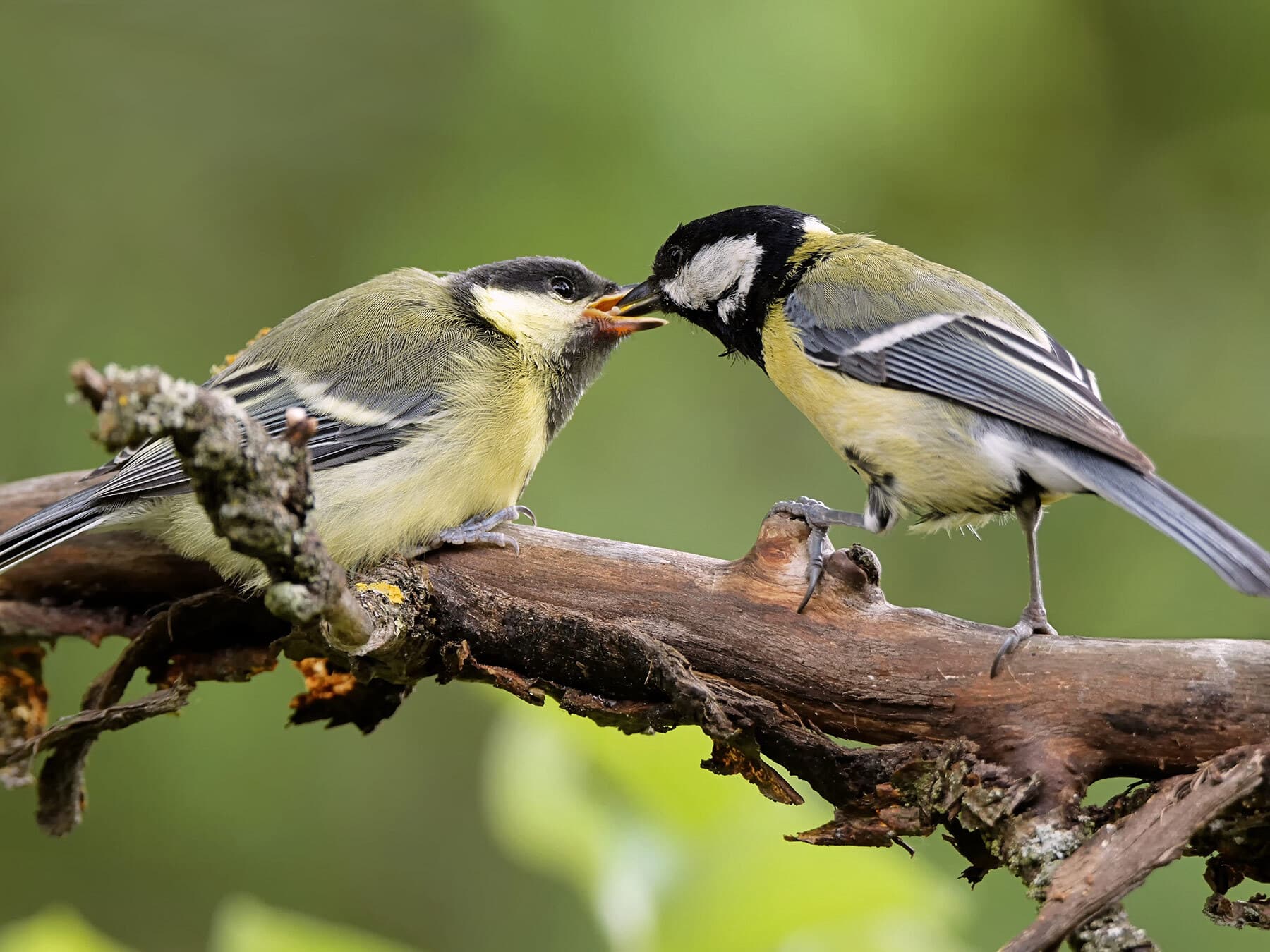 An adult Great Tit feeding a begging youngster
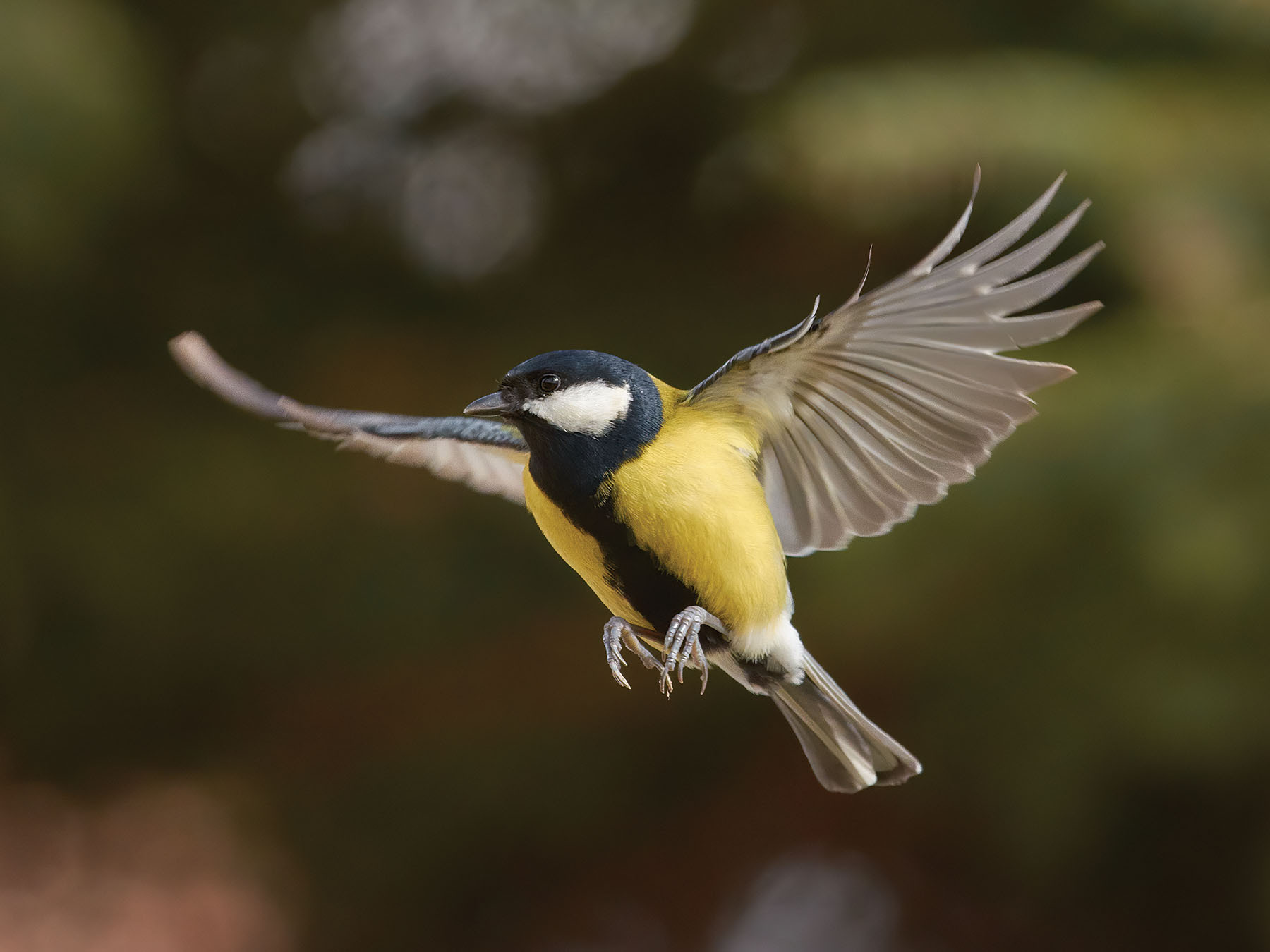
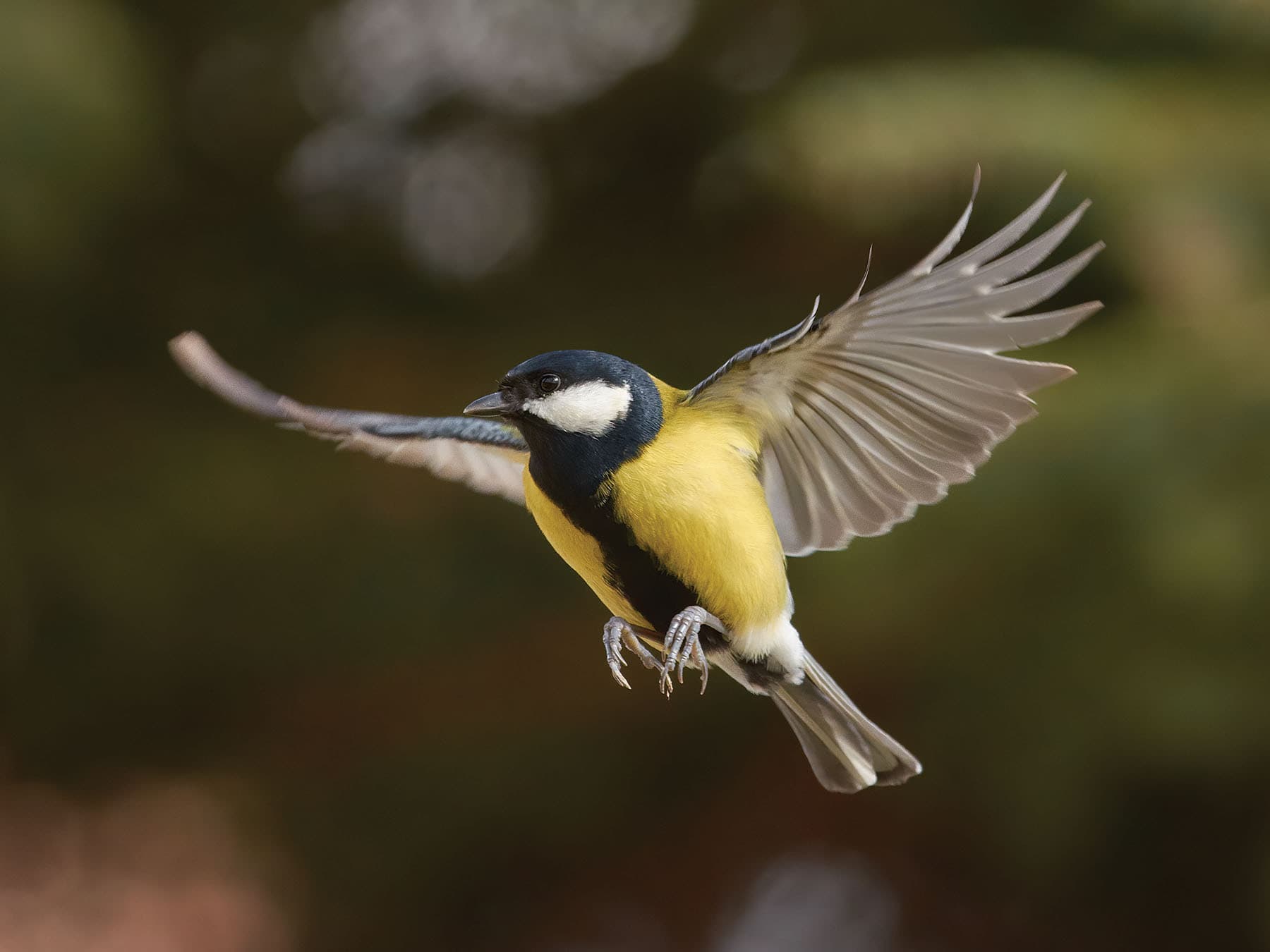 A Great Tit in flight
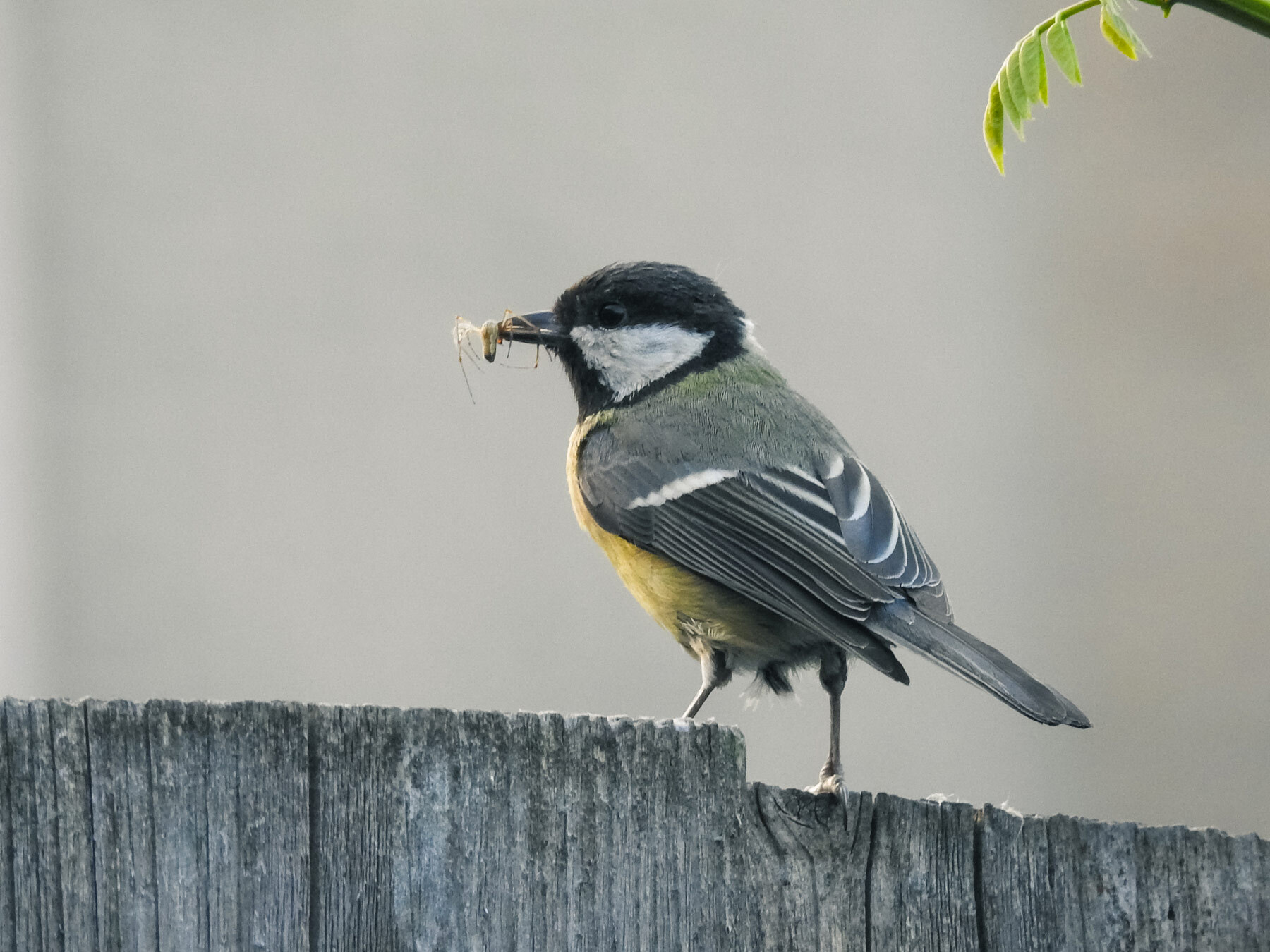
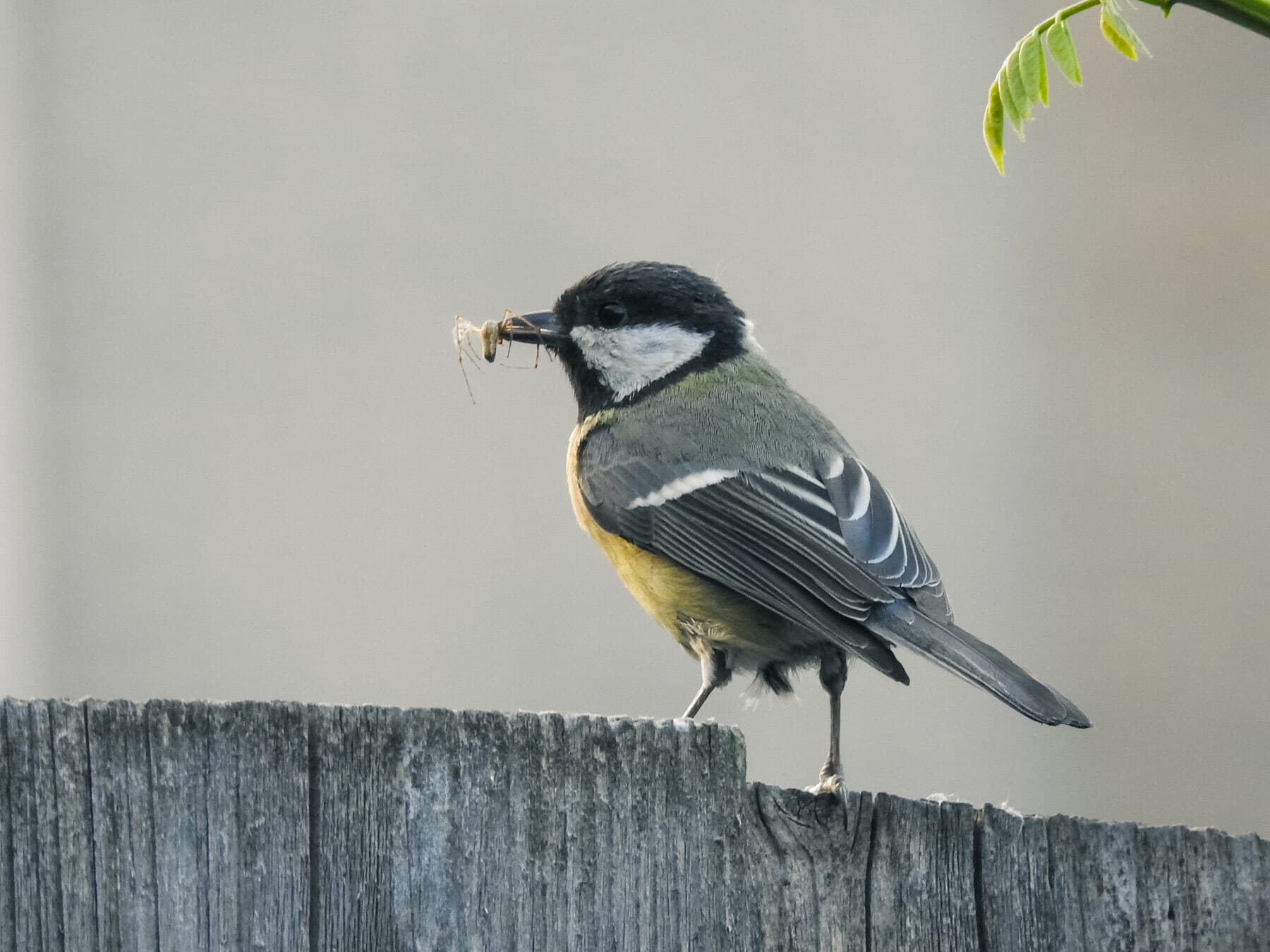 A Great Tit with a spider in its bill
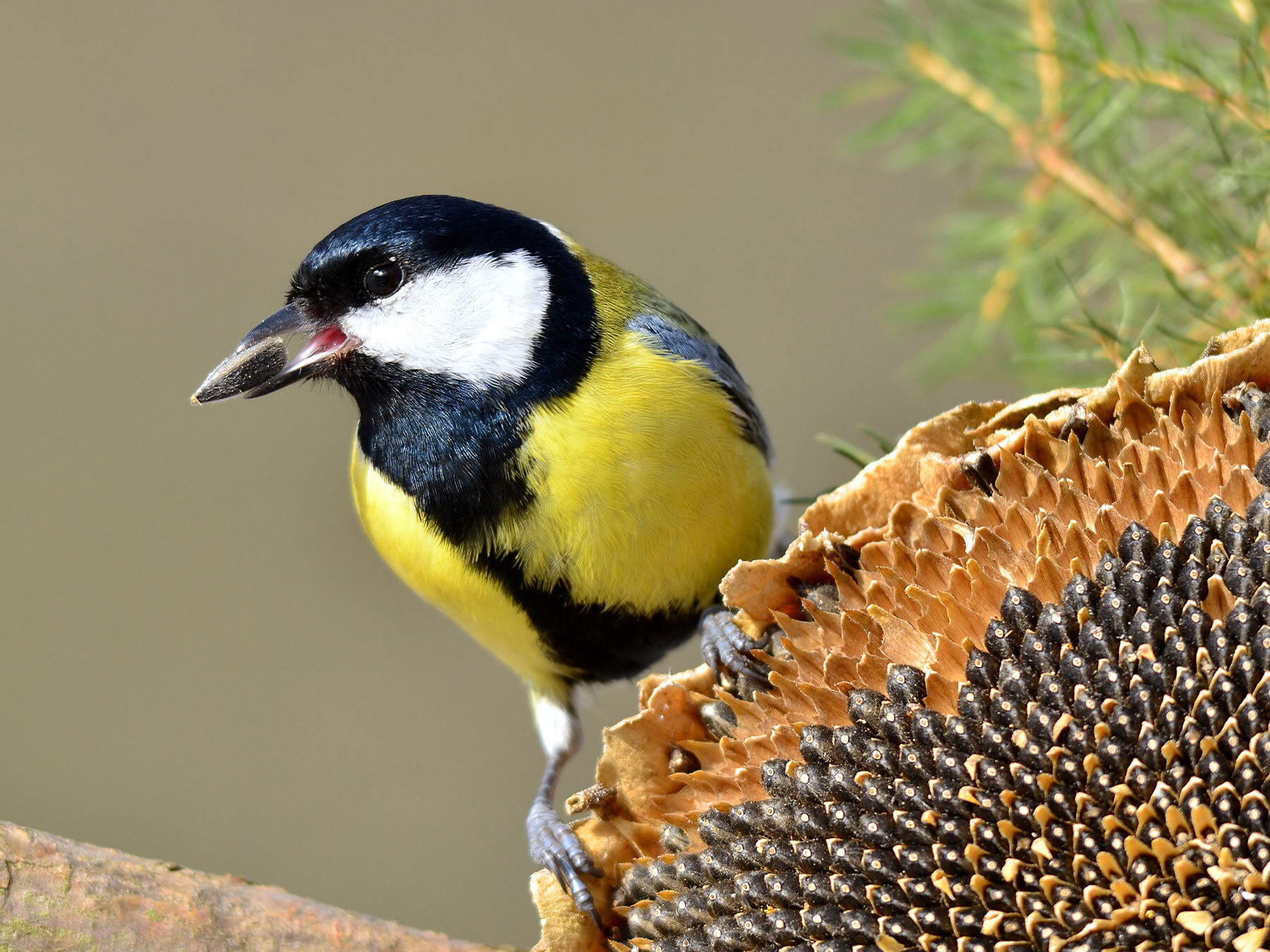
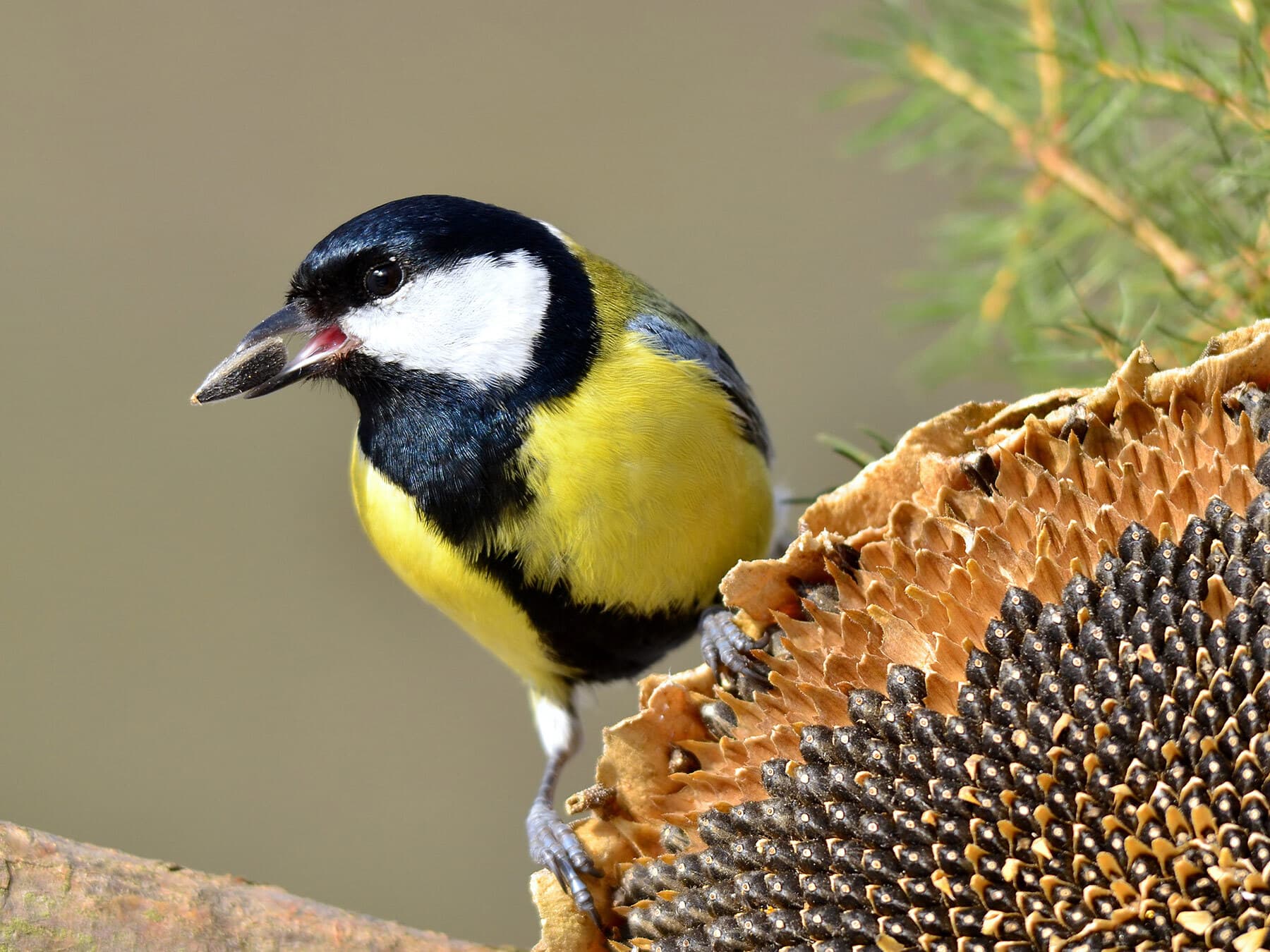 A Great Tit on a sunflower head
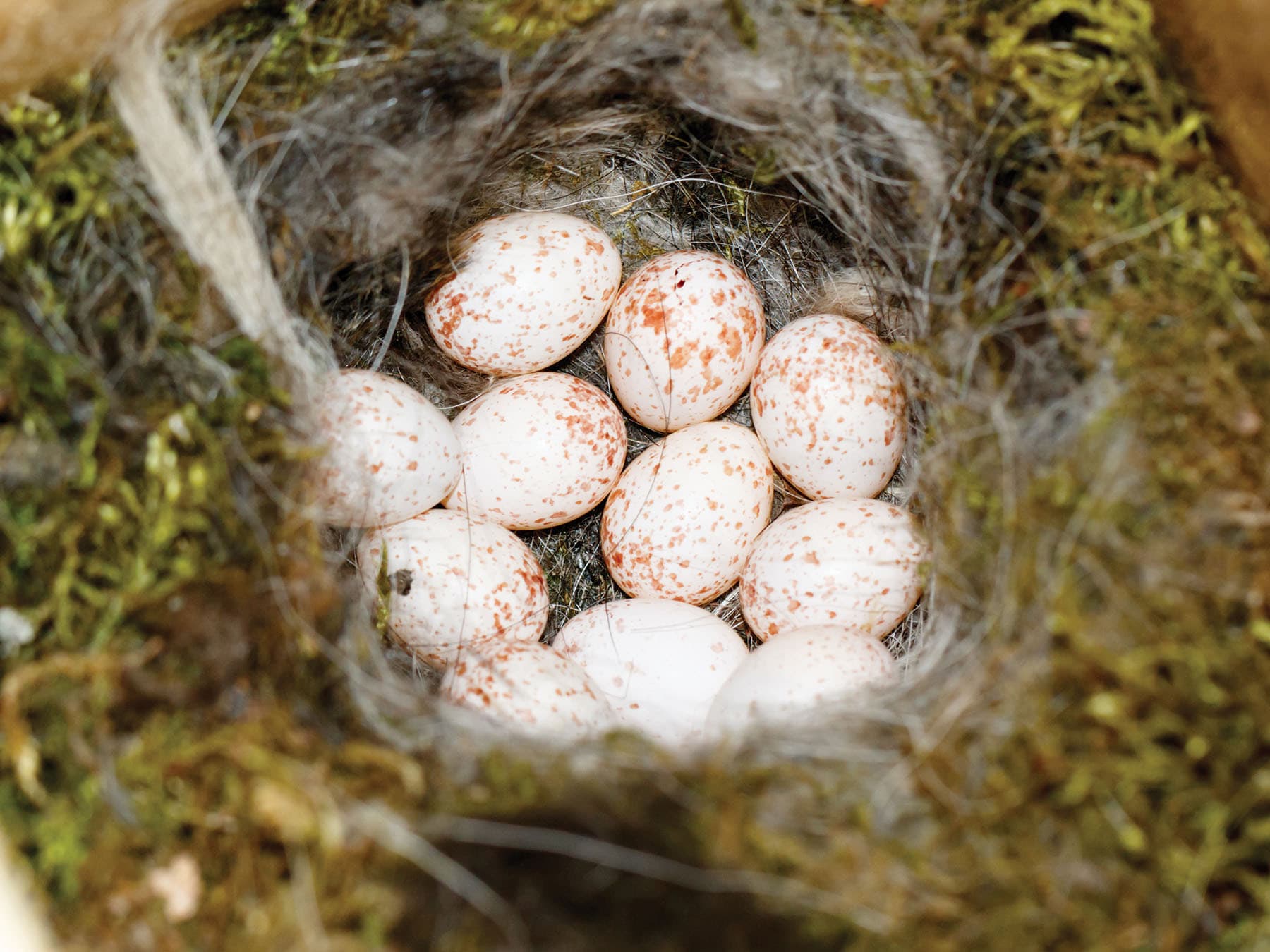 A clutch of Great Tit eggs, white with reddish-brown speckles
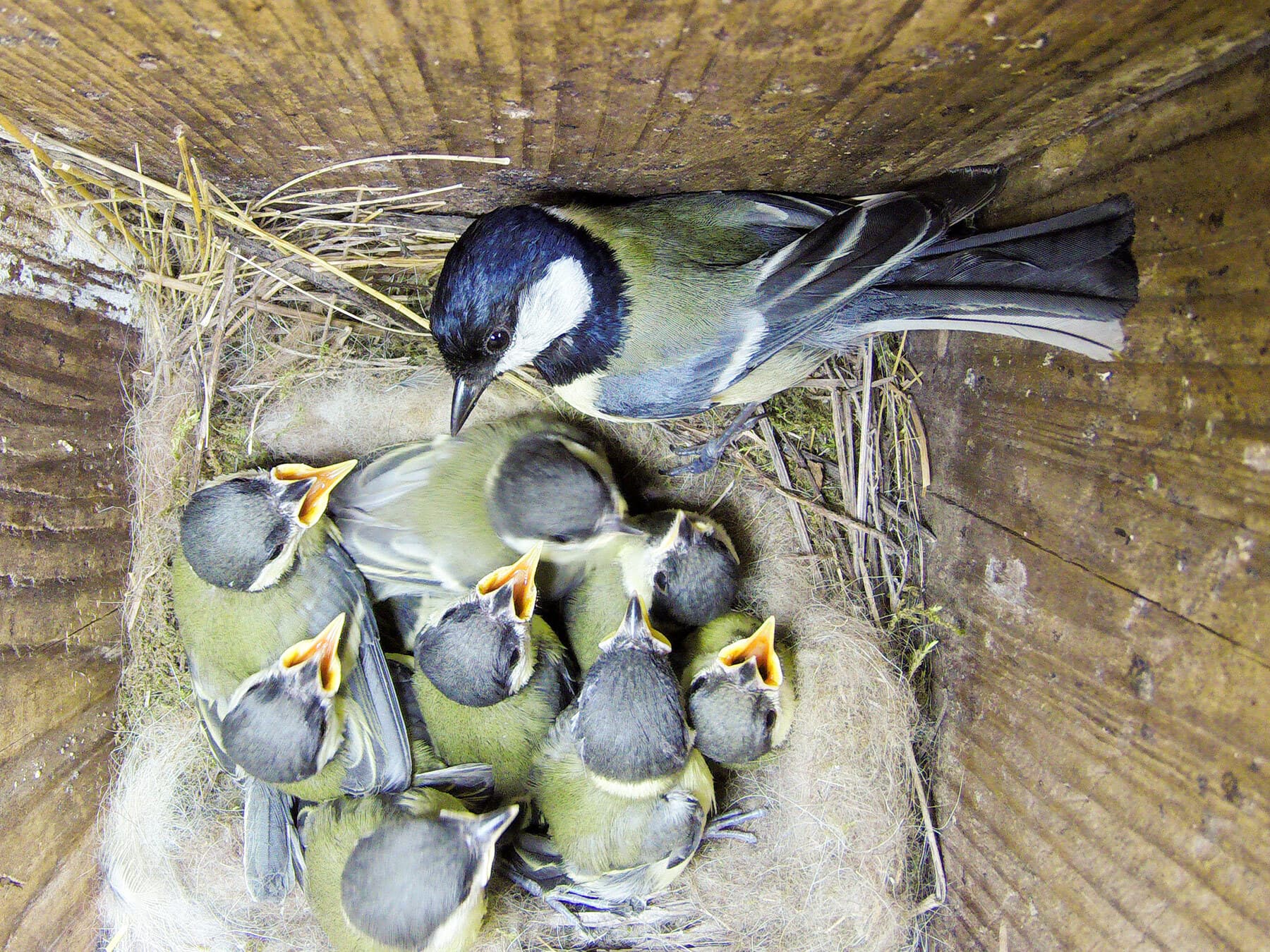 A Great Tit feeding its chicks in a nest box
Great Tit guides
6 guidesQuick facts
- Length
- 14 cm
- Wingspan
- 22.5–25.5 cm
- Weight
- 16.6–20.8 g
- Lifespan
- 3 years · oldest recorded 16.6 years · UK record 10 years 10 months
- Family
- Tits & Chickadees
- Migration
- Resident
- Global status (IUCN)
- Least Concern
- Population trend
- Up 67% in the UK since 1967; stable since about 2010
- Also called
- Eurasian Great Tit
- Scientific name
- Parus major
Questions
6Do Great Tits mate for life?
Not always. In western Europe pairs split up after breeding and, if both survive, they get back together by January in 58 to 77% of cases. A study in Wytham Woods, Oxford found that pairs heading for divorce behave differently from early winter.10
Are Great Tits aggressive?
They can be at feeders, chasing off smaller tits, and winter flocks settle their pecking order with threat displays. Fights rarely last more than a few seconds. See behaviour.
Are Great Tits rare?
No. They are one of the UK's commonest birds, with about 2.4 million territories, and Green-listed. See conservation.
How can you tell a male Great Tit from a female?
By the black breast stripe: broad in males, widening between the legs; narrow and often broken in females. See male, female and young.
How big is a Great Tit?
About 14 cm long and 18.6 g: the largest tit in the UK.
Where do Great Tits sleep at night?
Among leaves in summer; in winter alone in tree holes, holes in buildings, dense conifers or nest boxes. See roosting.
Sources
18- 1BTO. Great Tit (Parus major). BTO BirdFacts. Accessed 6 October 2026. Source (opens in a new tab)
- 2Kirwan, G. M. et al. (2024). Great Tit (Parus major), version 2.0. Birds of the World (G. M. Kirwan and N. D. Sly, editors). Cornell Lab of Ornithology. doi:10.2173/bow.gretit1.02 (opens in a new tab)
- 3Estók, P., Zsebők, S. and Siemers, B. M. (2010). Great tits search for, capture, kill and eat hibernating bats. Biology Letters 6(1): 59-62. doi:10.1098/rsbl.2009.0611 (opens in a new tab)
- 4RSPB (2026). How to help garden birds. RSPB news. Accessed 6 October 2026. Source (opens in a new tab)
- 5BTO. Buying a nest box. Accessed 6 October 2026. Source (opens in a new tab)
- 6RSPB. Great tit. RSPB Birds A-Z. Accessed 6 October 2026. Source (opens in a new tab)
- 7Aplin, L. M. et al. (2015). Experimentally induced innovations lead to persistent culture via conformity in wild birds. Nature 518(7540): 538-541. doi:10.1038/nature13998 (opens in a new tab)
- 8BTO (2024). Longevity records for Britain & Ireland in 2024. BTO Online Ringing Report. Accessed 6 October 2026. Source (opens in a new tab)
- 9Fransson, T., Kolehmainen, T., Moss, D. and Robinson, R. (2023). EURING list of longevity records for European birds (1 September 2023). EURING. Accessed 6 October 2026. Source (opens in a new tab)
- 10Abraham, A. D., Sheldon, B. C. and Firth, J. A. (2025). Timing and social dynamics of divorce in wild great tits: a phenomenological approach. Proceedings of the Royal Society B 292(2051): 20243065. doi:10.1098/rspb.2024.3065 (opens in a new tab)
- 11RSPB. How and what to feed your garden birds. RSPB. Accessed 6 October 2026. Source (opens in a new tab)
- 12BTO. Putting up a nest box. Accessed 6 October 2026. Source (opens in a new tab)
- 13Stanbury, A. et al. (2021). The status of our bird populations: the fifth Birds of Conservation Concern in the United Kingdom, Channel Islands and Isle of Man and second IUCN Red List assessment of extinction risk for Great Britain. British Birds 114: 723-747. Accessed 6 October 2026.
- 14Kirwan, G. M. et al. (2024). Eurasian Blue Tit (Cyanistes caeruleus), version 1.1. Birds of the World (J. del Hoyo, A. Elliott, J. Sargatal, D. A. Christie, E. de Juana and M. G. Smith, editors). Cornell Lab of Ornithology. doi:10.2173/bow.blutit.01.1 (opens in a new tab)
- 15RSPB. Blue tit. RSPB Birds A-Z. Accessed 7 October 2026. Source (opens in a new tab)
- 16Gosler, A. and Clement, P. (2023). Coal Tit (Periparus ater), version 1.1. Birds of the World (B. K. Keeney and S. M. Billerman, editors). Cornell Lab of Ornithology. doi:10.2173/bow.coatit2.01.1 (opens in a new tab)
- 17RSPB. Coal tit. RSPB Birds A-Z. Accessed 7 October 2026. Source (opens in a new tab)
- 18BTO. Nest boxes for birds. Accessed 6 October 2026. Source (opens in a new tab)

Checked by
Nathan Cope, founder and editor
Nathan founded Birdfact and leads its writers and contributors in the UK, the US and Canada. He has watched and studied birds for more than ten years, and checks every article and species guide before it’s published.