


Blue Tit
Eurasian Blue Tit · Cyanistes caeruleus
By the Birdfact teamChecked by Nathan Cope
See it in 3D
2 plumages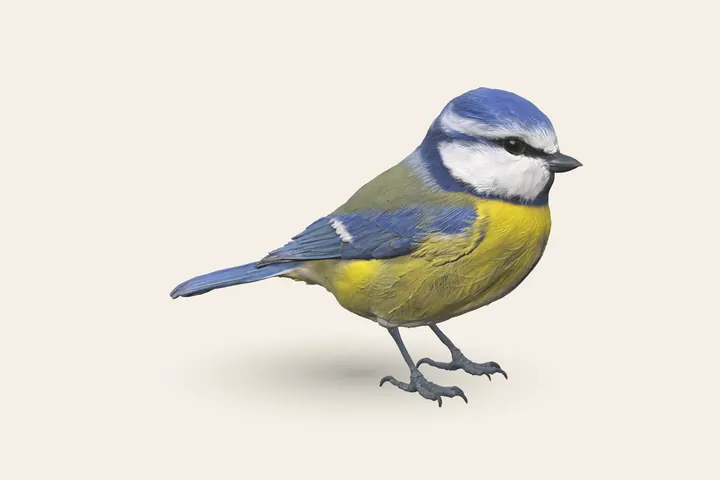 3D model
A Blue Tit is 11–12 cm (4.5 in) long, bill to tail.
3D model · Adult · Length 11–12 cm (4.5 in) · How we make our birds · Report a problem
© 2026 NC Digital Limited (Birdfact). All rights reserved. This 3D model may be viewed on this page and shared by link only. Downloading, extracting, copying or reusing it, or using it to train machine-learning models, is not permitted without our written permission. Using our models
On this page16 sections
How to recognise it
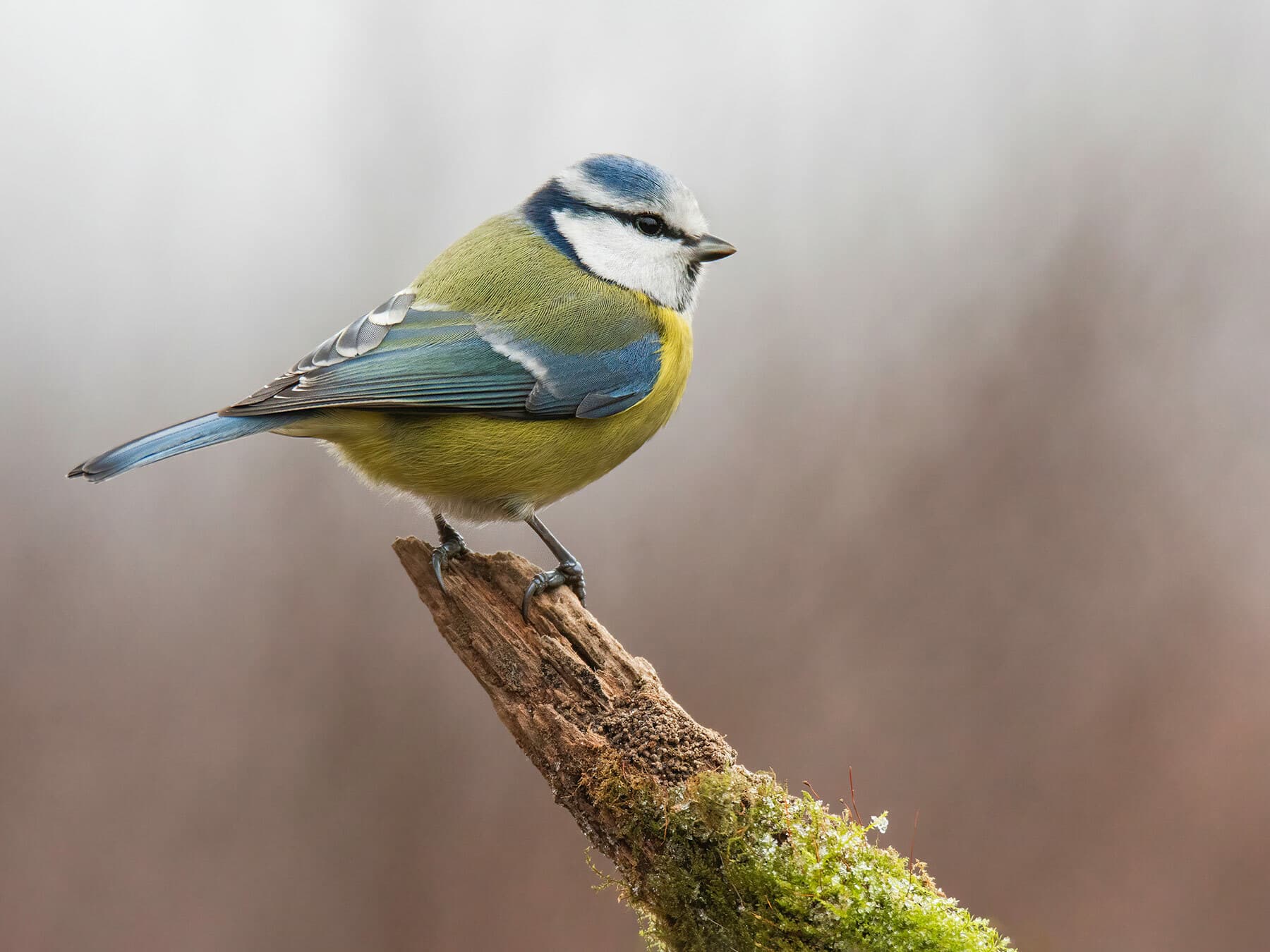
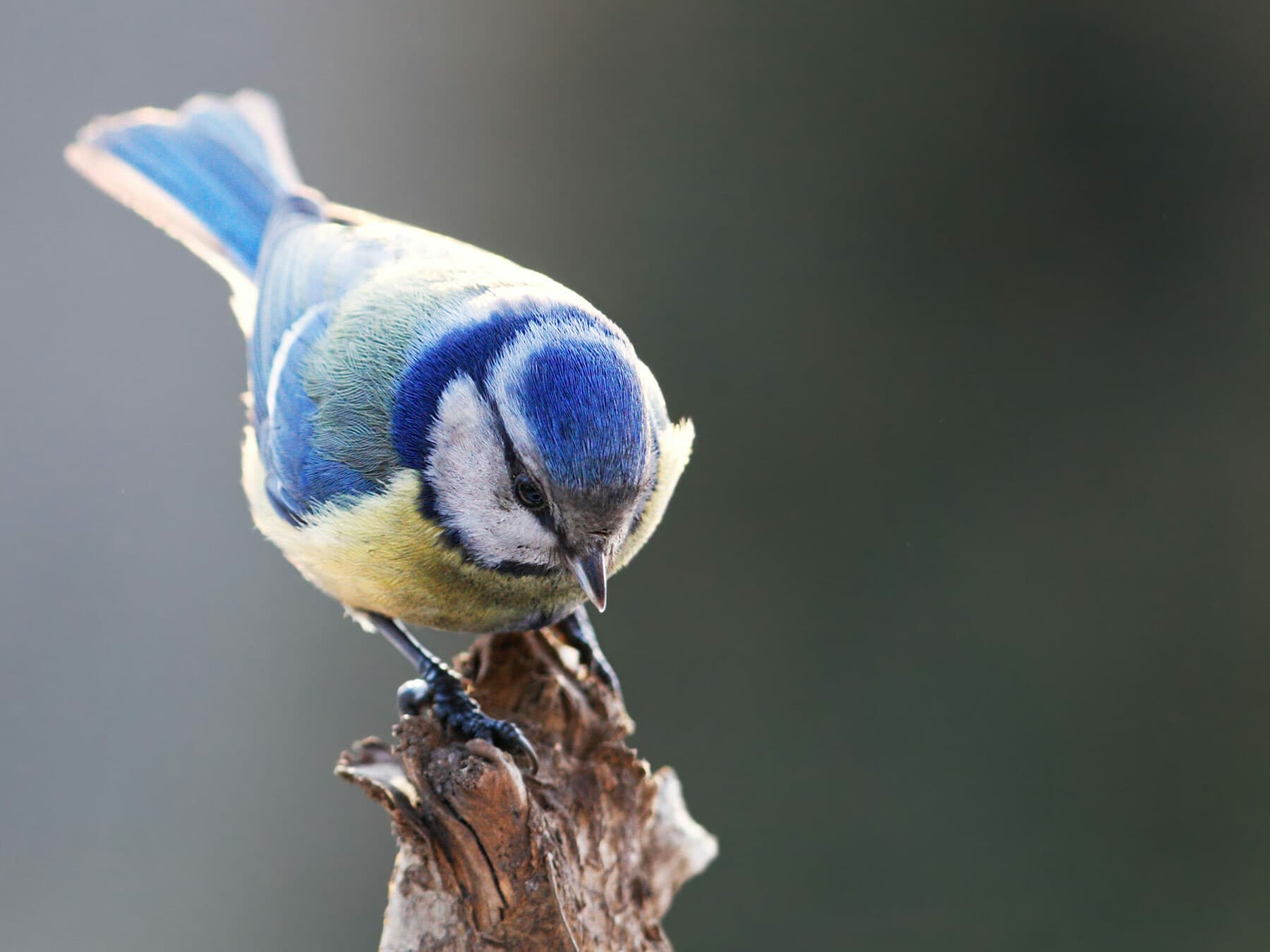
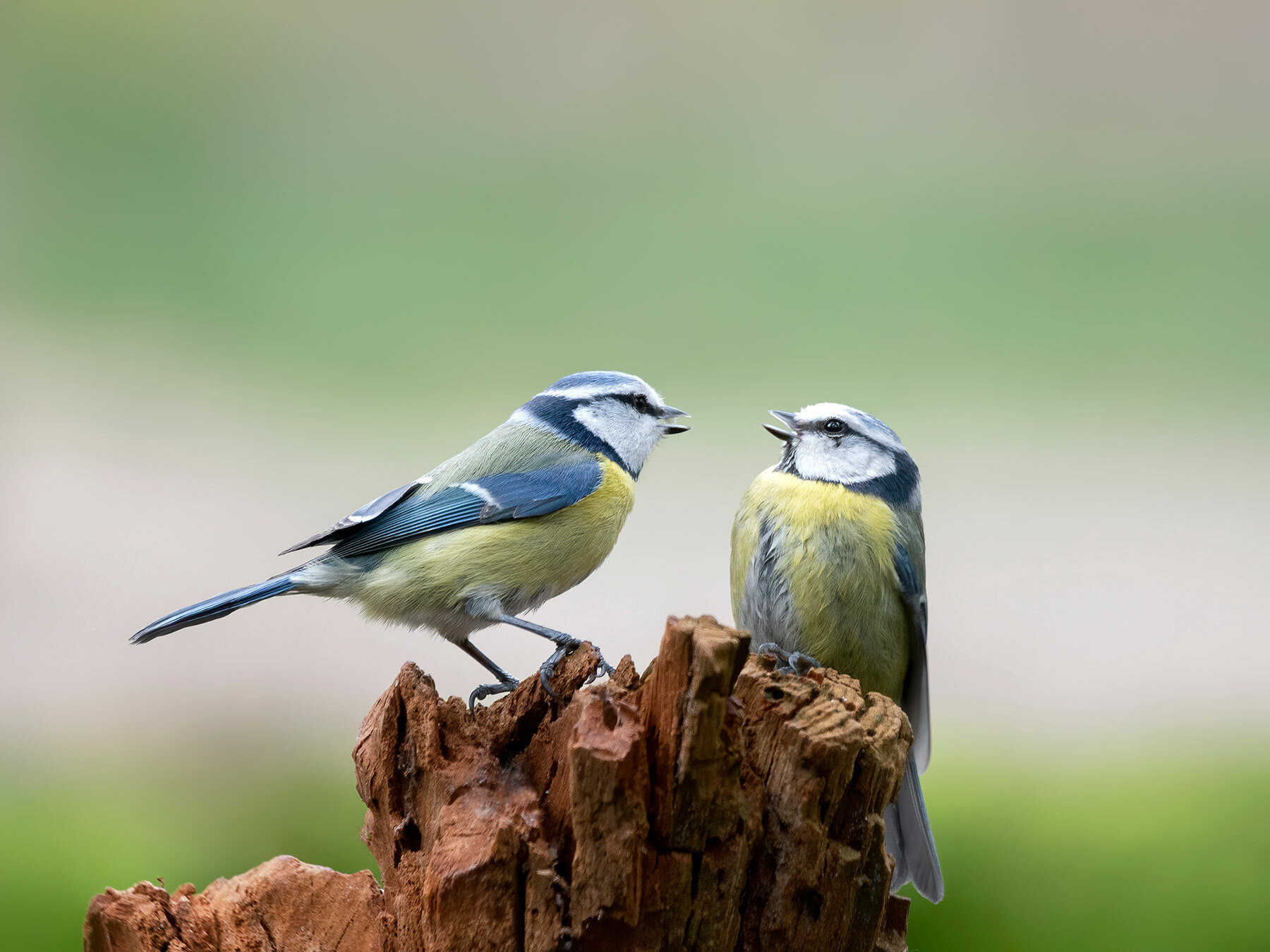
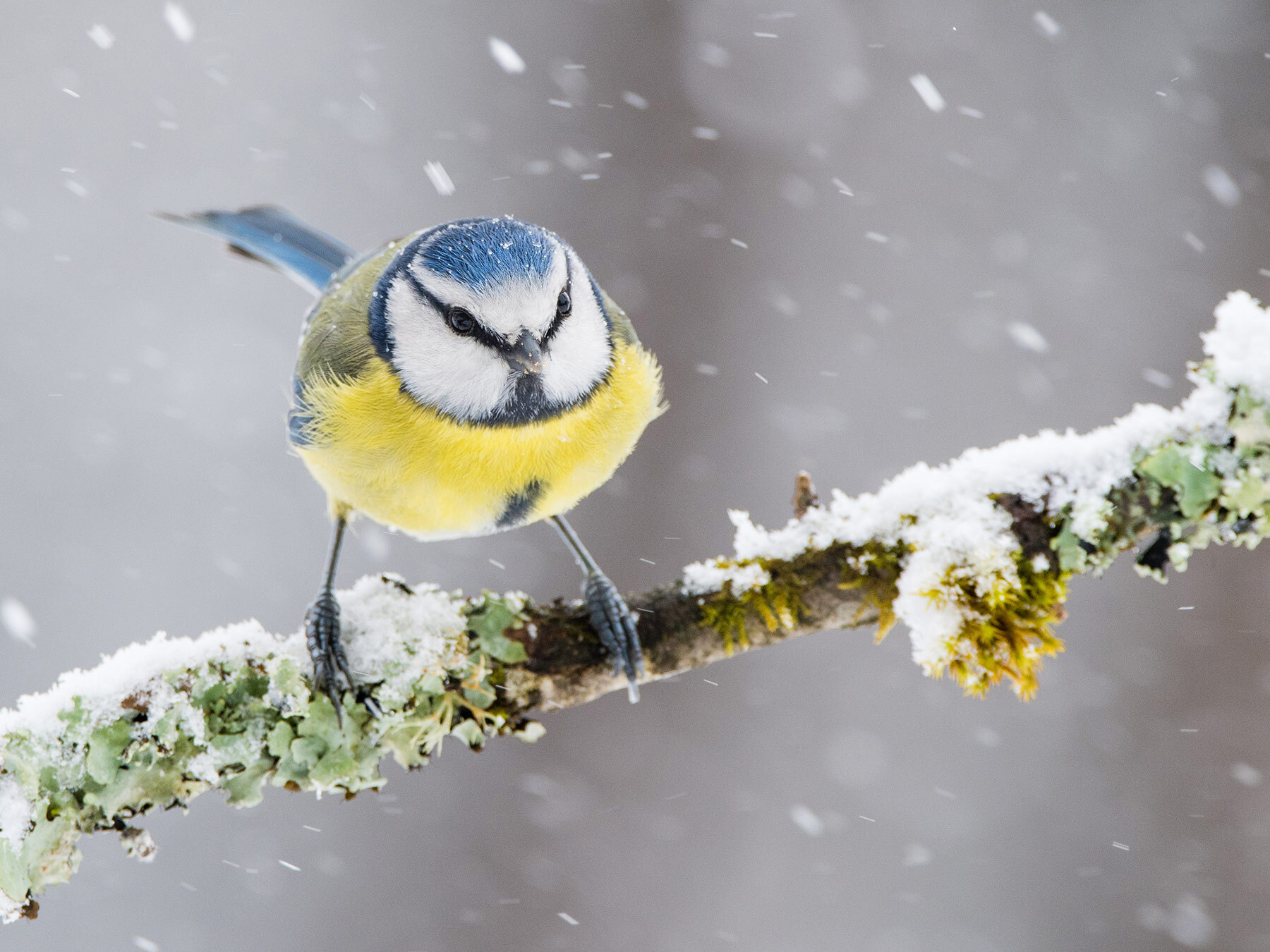
A small, round, busy bird, about 12 cm long and 11 g.1 The head is the giveaway: a bright blue cap ringed all the way round with white, a white face with a narrow dark line through the eye, and a dark blue collar that runs down to a small black bib. Below it is yellow; the back is olive-green, and the wings and tail are blue, with one narrow white bar across the wing.
Close up, the bill is small and very short, dark grey with paler edges, the eyes are dark brown and the legs are slate blue-grey.2 Some birds show a faint dark line down the middle of the belly, but it is often hidden and never joins the bib.
Male, female and young
Males and females look almost the same to us. On average a male is brighter, with a brighter blue cap and wings, a greener back and stronger yellow below, but the difference is small and overlaps. Blue Tits themselves can see a difference: the blue crown reflects ultraviolet light, which birds can see and we cannot, and in ultraviolet the sexes differ clearly.3
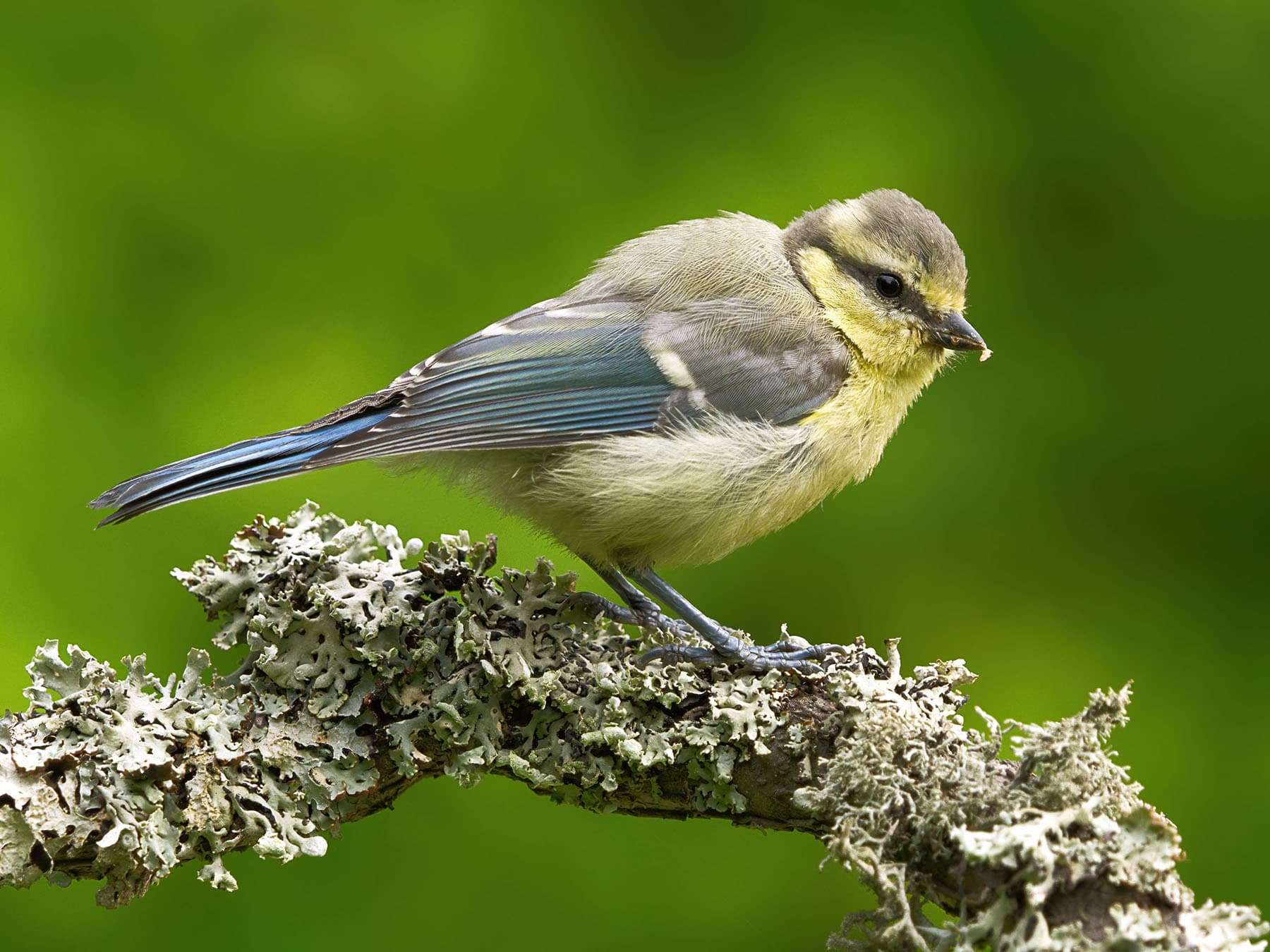
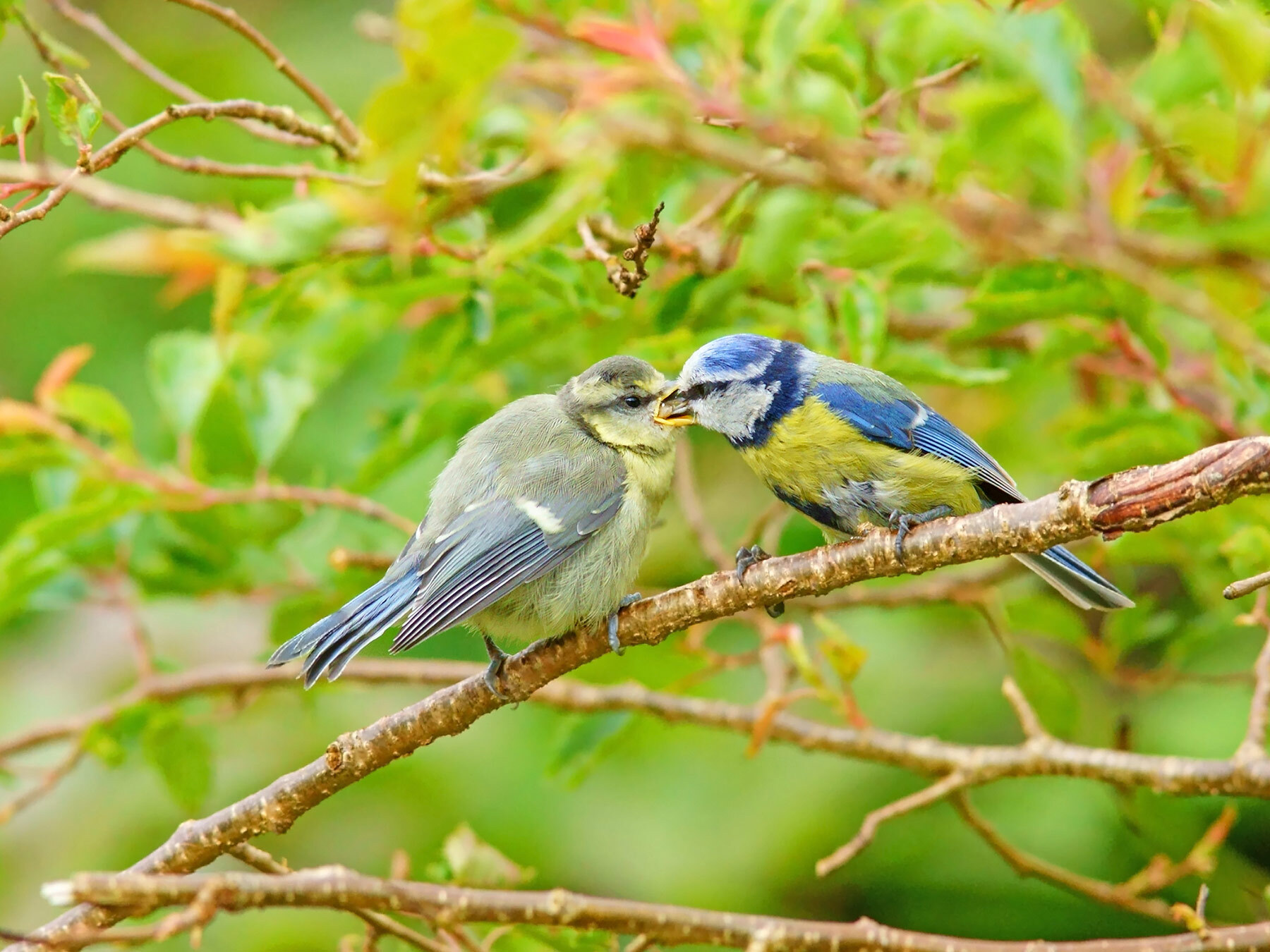
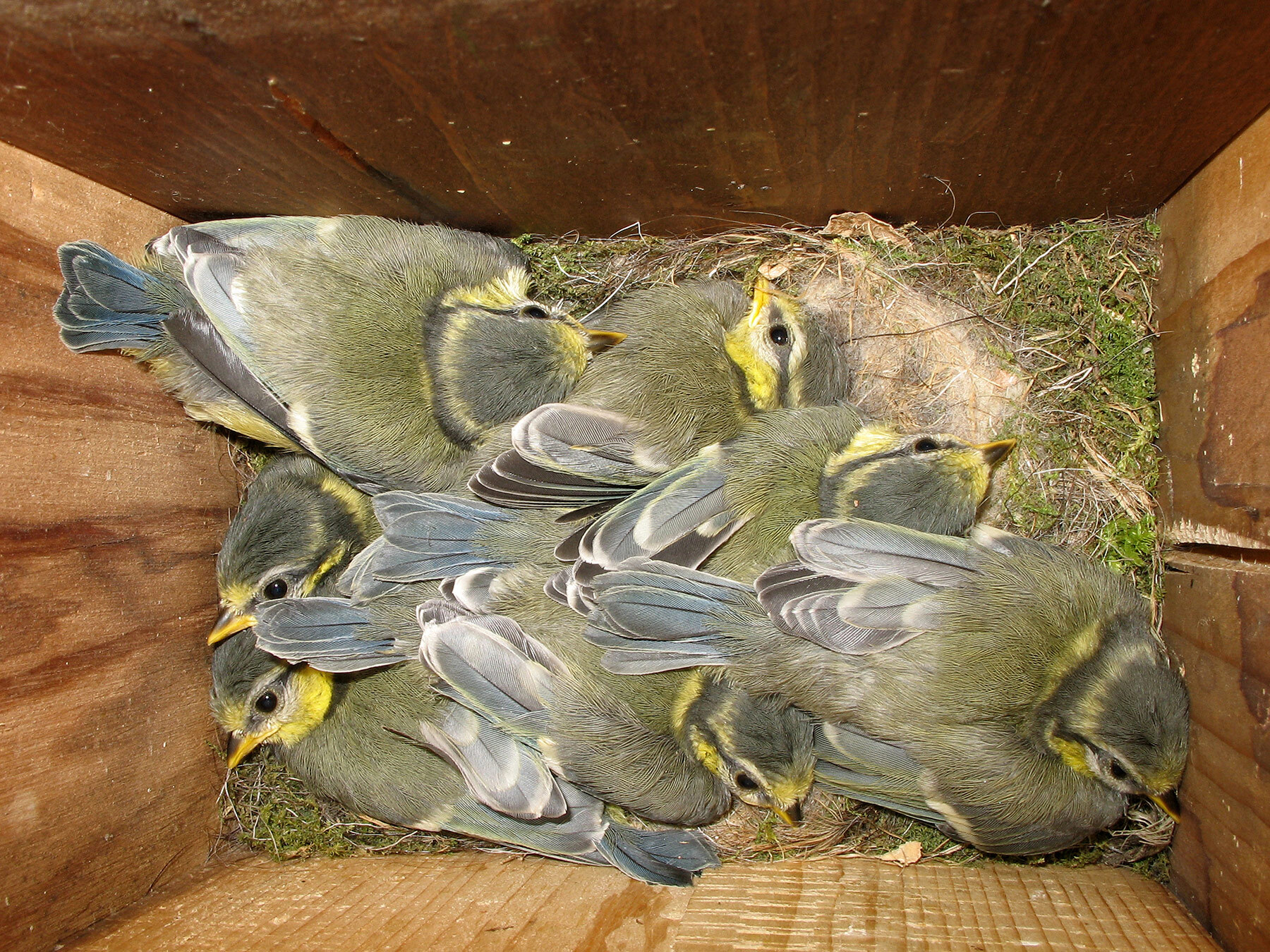
Young Blue Tits, from June to August, are easy to pick out once you know: the face is pale yellow, not white, the cap is dull olive with no blue, and the wings are a duller blue.4 By autumn they have moulted their body feathers and look like adults. More: male, female and young Blue Tits.
Identification: Blue Tit and Great Tit
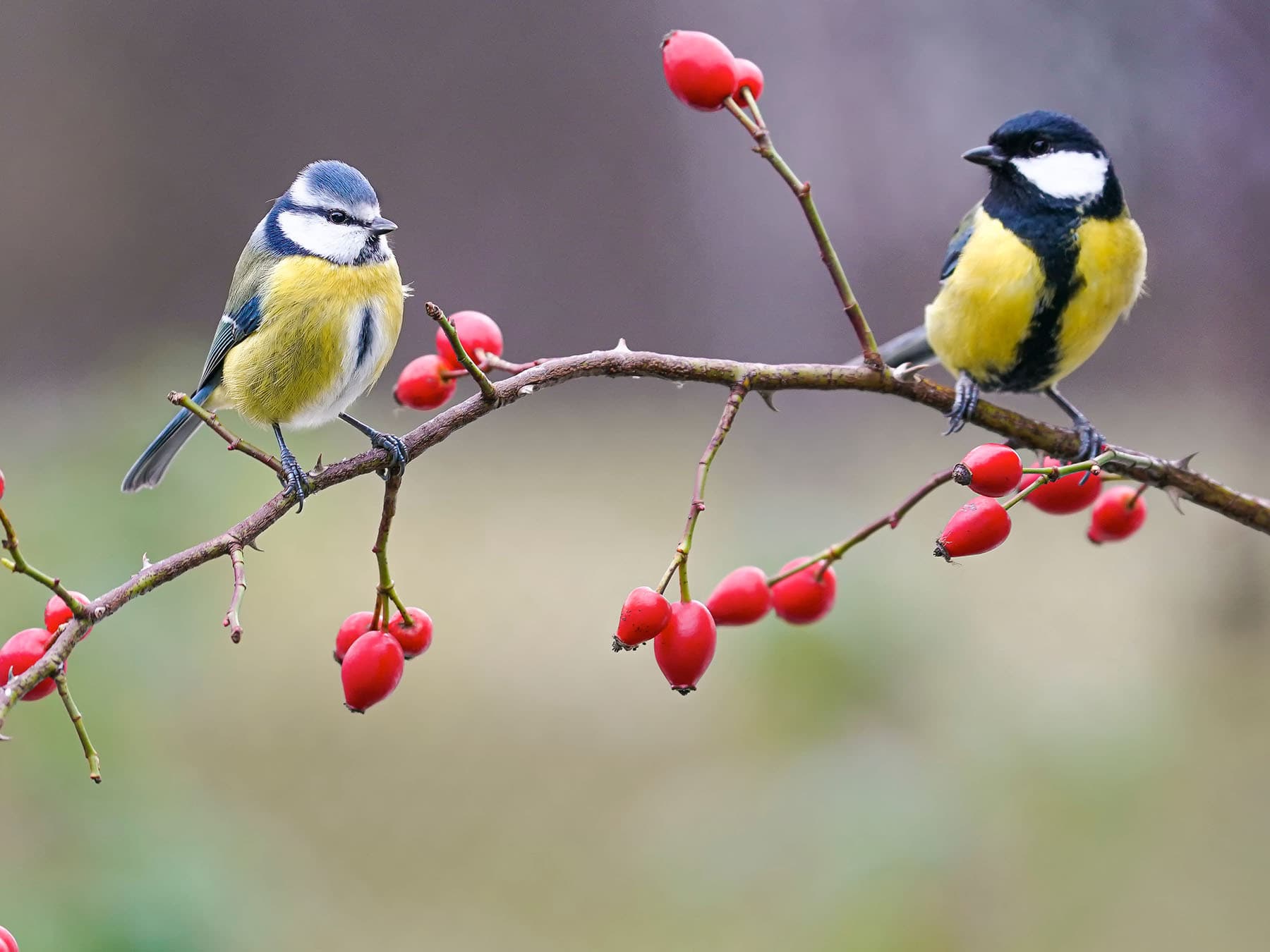
The Great Tit is the usual mix-up. It is bigger, about 1.7 times the weight of a Blue Tit, with a glossy black head and white cheeks instead of a blue cap, and a broad black stripe down the yellow breast.5 More: Blue Tit vs Great Tit.
Its size
Adults- Length
- 11–12 cm
- Wingspan
- 17.5–20 cm
- Weight
- 9.7–12.2 g
Its song and calls
Blue Tits are very vocal all year. The call you hear most is a short, thin tsee, alone or in a run, which keeps partners and flocks in touch. When a predator comes close they scold with a churring churrrrit, rising at the end, sometimes with sharp pit notes.
The song is clear, high and lilting, often ending in a trill, something like tsee-tsee-tsee-tsu-tsuhuhuhu, repeated after short pauses. Each male has 3 to 8 song types, and females sing a similar song. Chicks in the nest and new fledglings beg with an almost non-stop tsee-tsee-tsee. More, with seven recordings: Blue Tit song and calls.
- Song0:00 / 0:53
Recorded in London, United Kingdom · April 2013
- Call0:00 / 0:16
Recorded in Normandie, France · July 2024
When and where to see it
OctoberHere all year
Most recorded in October
- 1. Dundee5.5%
- 2. Monmouthshire4.3%
- 3. Stirling4.2%
- 4. Meath4.2%
- 5. Herefordshire4.1%
Each dot is a county, state or province: the bigger and darker, the larger the bird’s share of that place’s bird records that month. Grey dots: no regular records. The ringed point is the centre of the bird’s records this month; the arrow shows how it moved since last month, and the dashed loop its path through the year. “Arrivals” colours places where it becomes regular this month (orange) or is in its last regular month (grey). GBIF eBird Observation Dataset, 2019–2024. Map data: Natural Earth, US Census Bureau; place centres © OpenStreetMap contributors.
In your area
See when the Blue Tit is recorded in your county, state or province.
How often the Blue Tit turns up in the UK and Ireland through the year, from birdwatchers' records.
United Kingdom
Resident · all year · most records in February
Ireland
Resident · all year · most records in April
Show as a table
| Month | United Kingdom | Ireland |
|---|---|---|
| January | 3.0% (regular) | 2.2% (regular) |
| February | 3.1% (regular) | 2.2% (regular) |
| March | 2.9% (regular) | 2.3% (regular) |
| April | 2.6% (regular) | 2.4% (regular) |
| May | 2.1% (regular) | 1.9% (regular) |
| June | 2.1% (regular) | 1.8% (regular) |
| July | 2.0% (regular) | 1.4% (regular) |
| August | 2.2% (regular) | 1.3% (regular) |
| September | 2.3% (regular) | 1.5% (regular) |
| October | 2.3% (regular) | 1.7% (regular) |
| November | 2.6% (regular) | 2.0% (regular) |
| December | 3.0% (regular) | 2.3% (regular) |
Recorded regularly in
Worldwide: recorded regularly in 57 countries
Countries where it was recorded in at least 3 of the 6 years 2019–2024. Linked countries have their own bird list.
Europe (48)
- Åland Islands
- Albania
- Andorra
- Austria
- Belarus
- Belgium
- Bosnia & Herzegovina
- Bulgaria
- Croatia
- Czechia
- Denmark
- Estonia
- Finland
- France
- Germany
- Gibraltar
- Greece
- Guernsey
- Hungary
- Ireland
- Isle of Man
- Italy
- Jersey
- Kosovo
- Latvia
- Liechtenstein
- Lithuania
- Luxembourg
- Moldova
- Monaco
- Montenegro
- Netherlands
- North Macedonia
- Norway
- Poland
- Portugal
- Romania
- Russia
- San Marino
- Serbia
- Slovakia
- Slovenia
- Spain
- Sweden
- Switzerland
- Ukraine
- United Kingdom
- Vatican City
Asia (9)
- Armenia
- Azerbaijan
- Georgia
- Iran
- Iraq
- Jordan
- Kazakhstan
- Lebanon
- Turkey
Data: EOD – eBird Observation Dataset (Cornell Lab of Ornithology), accessed via GBIF.org, CC BY 4.0. Records from 2019–2024, aggregated and filtered by Birdfact. How these lists are made
All year, anywhere with trees and bushes: woods, hedgerows, parks and gardens, villages and towns. The BTO's surveys find them most often in broadleaved woodland, but they are common in farmland and towns too, and they live in 90% of the UK's 10-km squares. Only the Northern Isles and parts of the Hebrides lack them.
Beyond Britain they live across Europe to the Urals, and in Turkey and Iran. Oak and birch woods suit them best. In winter they also feed in reedbeds and scrub. The blue tits of North Africa and the Canary Islands are a separate species, the African Blue Tit.
Spotting tips
Watch hanging feeders in winter, and listen for the thin tsee calls of a mixed flock moving through the trees. In spring, watch nest boxes: from February pairs inspect the holes.
Do Blue Tits migrate?
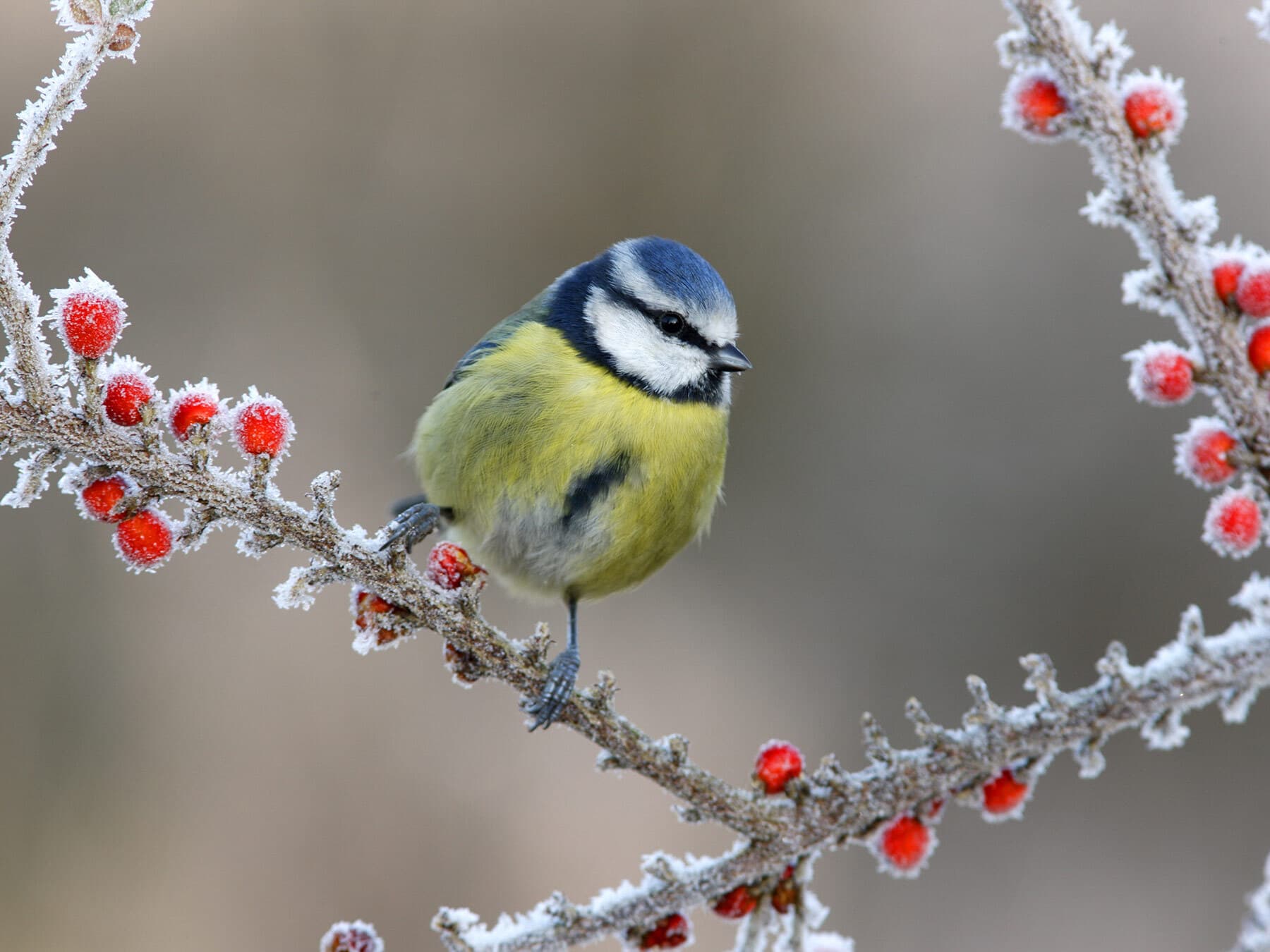
Not in Britain. British Blue Tits stay all year, and ringing in Britain shows that 95% of recoveries are within 10 km of where the bird was ringed. In the north of Europe they are part migrants: young birds move south and west in autumn, and a few reach Britain, among them a Blue Tit ringed in Lithuania and caught in Kent, 1,389 km away.6 More: do Blue Tits migrate?
What it eats
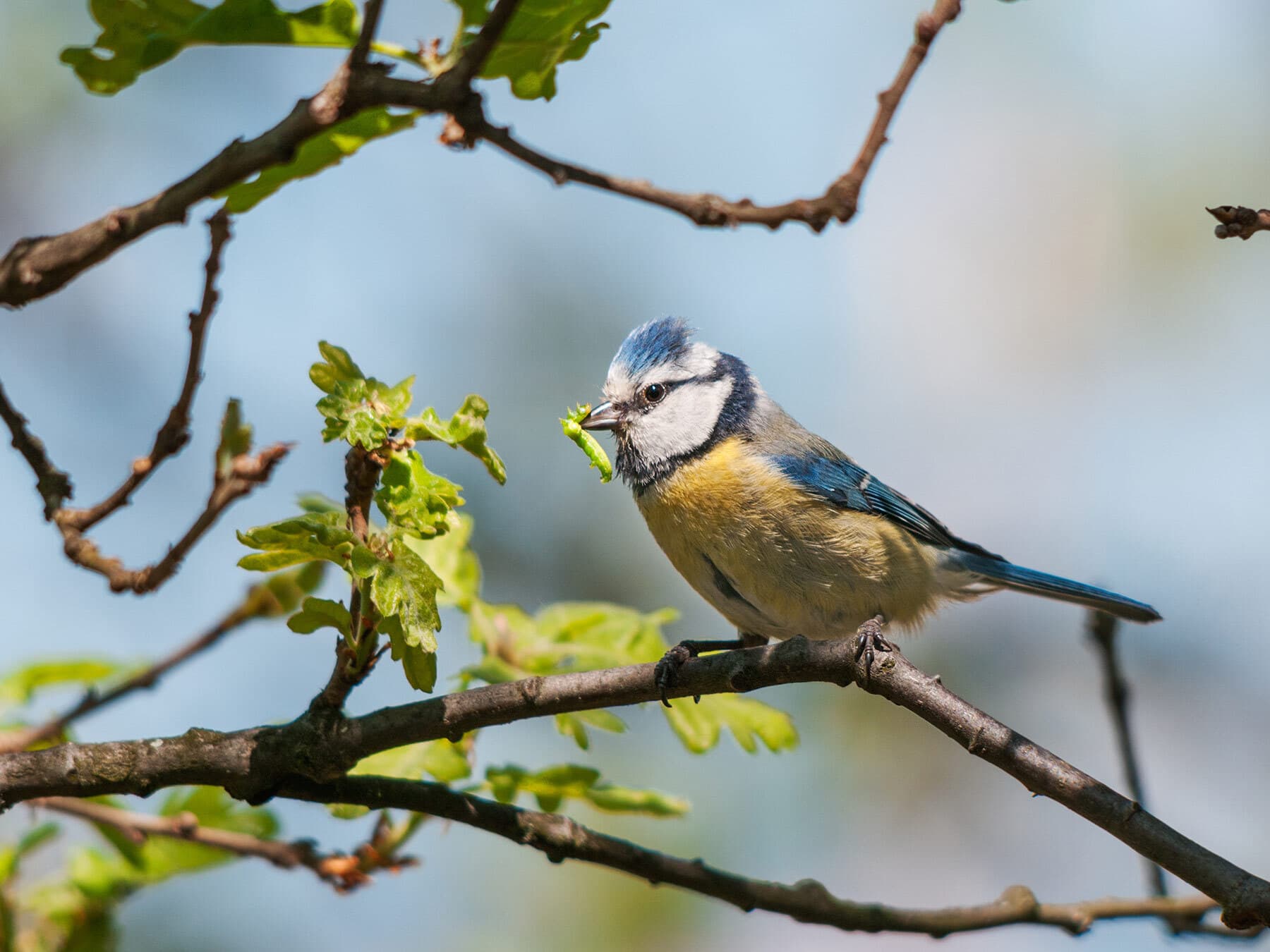
Insects and spiders, especially caterpillars, from spring to autumn; seeds, berries and other fruit in winter, with tree sap, and nectar from willow and fruit-tree flowers, in spring. Their chicks are raised on caterpillars, mostly those of small tortrix moths that feed on tree leaves.
Garden food reaches them far beyond the garden. In a study across 220 km of Scotland, peanut was the single commonest item in Blue Tit droppings in early spring, and garden food was still being eaten 1.4 km from the nearest house.7 More: what Blue Tits eat.
Feeding them in your garden
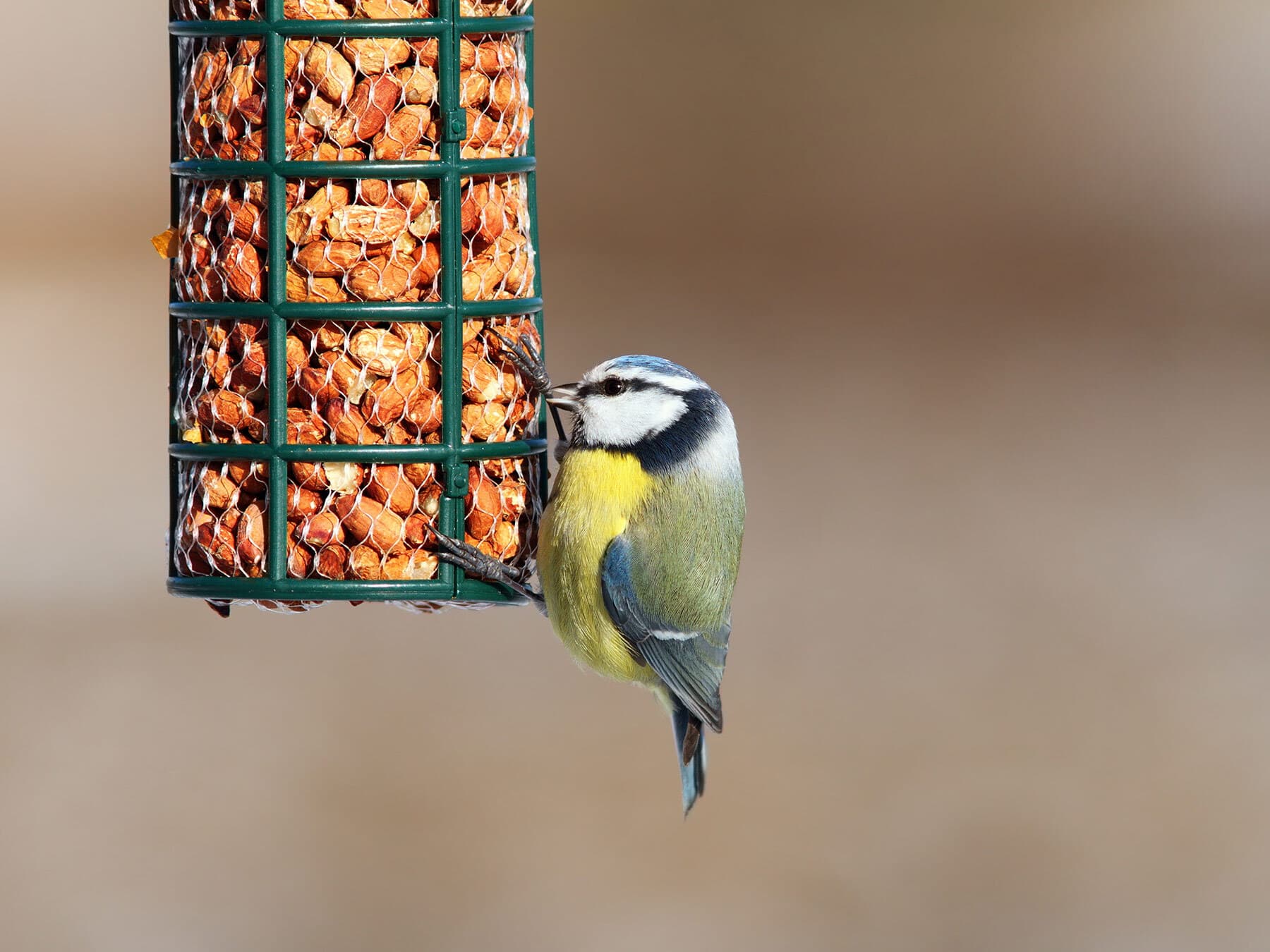
Sunflower hearts in a hanging seed feeder, peanuts in a mesh feeder (never a mesh bag) and fat balls in a hanging mesh feeder all suit tits. The RSPB now advises hanging feeders only, not bird tables or trays, where disease spreads more easily. Pause seed and peanuts from 1 May to 31 October, when small amounts of fat balls or suet are fine, and clean feeders weekly.8
Nesting and breeding
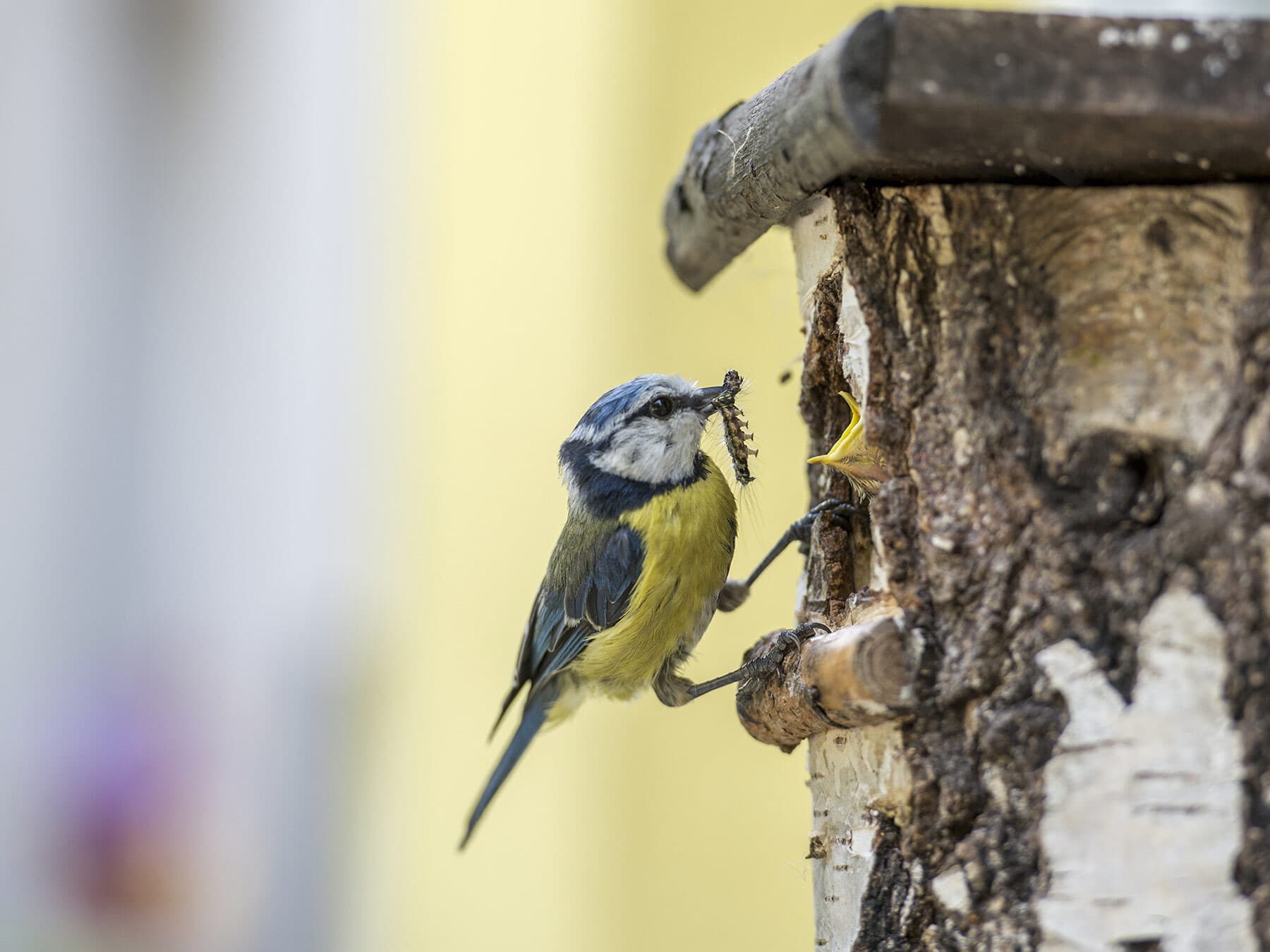
Blue Tits nest in holes: in trees, walls and posts, and very often in nest boxes. Pairs pick a site from February, and in April the female builds a cup of moss lined with feathers, fur or wool, usually over one to two weeks.9 In Britain the first eggs are laid around 26 April on average.5
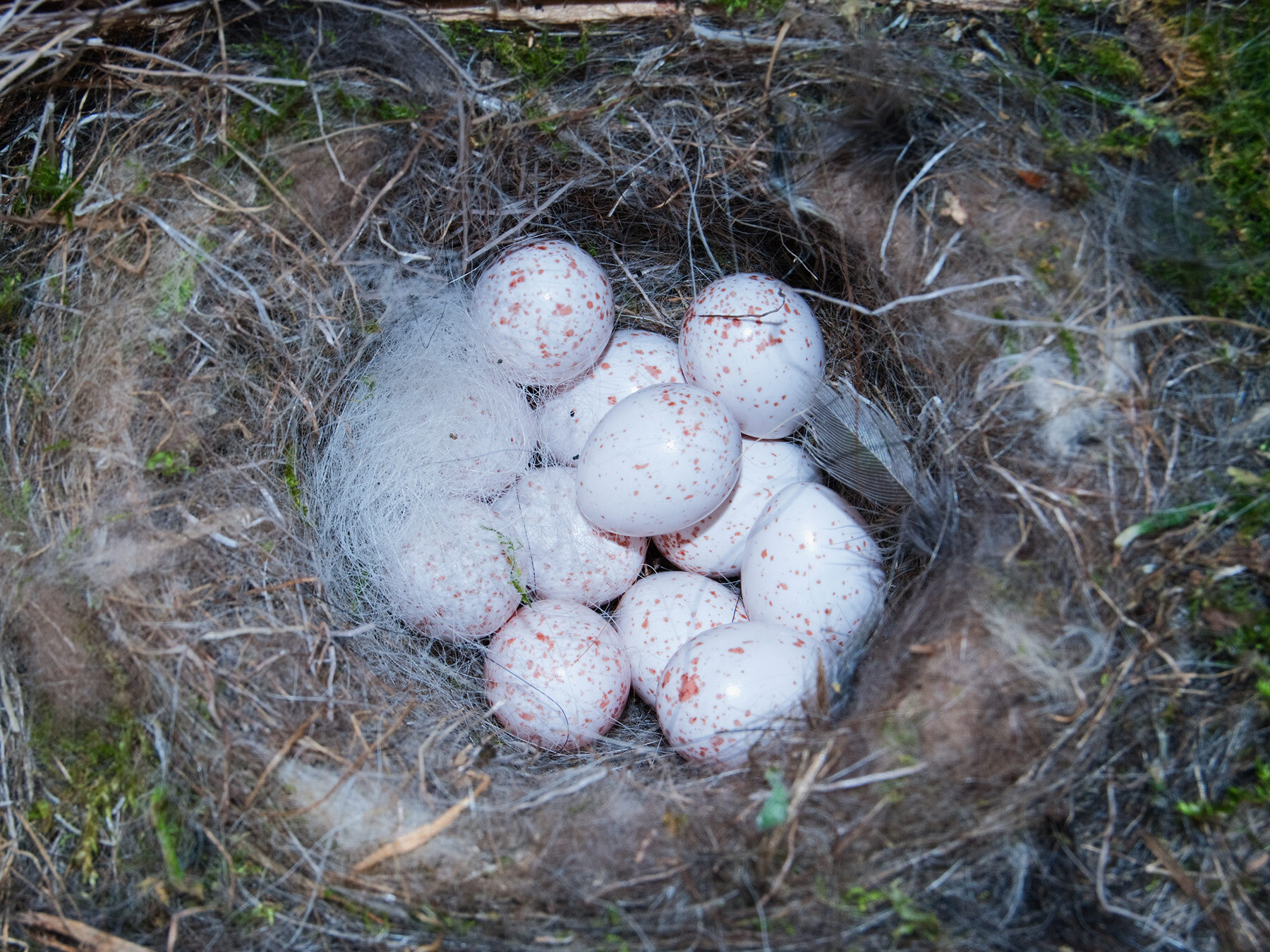
A clutch is usually 8 to 10 white eggs with reddish-brown spots, one of the largest clutches of any bird. The female incubates them for 13 to 14 days, both parents feed the chicks, and the young fly at 18 to 21 days old, usually in early June. Most pairs raise one brood a year. More: Blue Tit nesting.
Nest boxes
A small hole-fronted box suits them. The BTO recommends a 32 mm hole, which suits all the small hole-nesting birds, or a 28 mm hole if you want to keep the box for Blue Tits. Fix it 1 to 3 m up a tree trunk with a clear flight path, out of the wind, rain and strong sun, and leave off the perch.10
Behaviour
Active, agile and restless. Blue Tits work through trees and bushes at every height, searching leaves, buds and thin twigs, often hanging by one leg from a slender twig. They strip loose bark for insects, find grubs in leaf mines and galls, and even tap reed stems for hidden larvae, but they feed on the ground only briefly.2
In winter, pairs stay near their territory and roam with Long-tailed Tits, Goldcrests and Treecreepers in mixed flocks that cover up to 10 ha. The RSPB notes that four or five Blue Tits at a feeder at once can mean 20 or more using the garden through the day.
Social behaviour: pairs and courtship
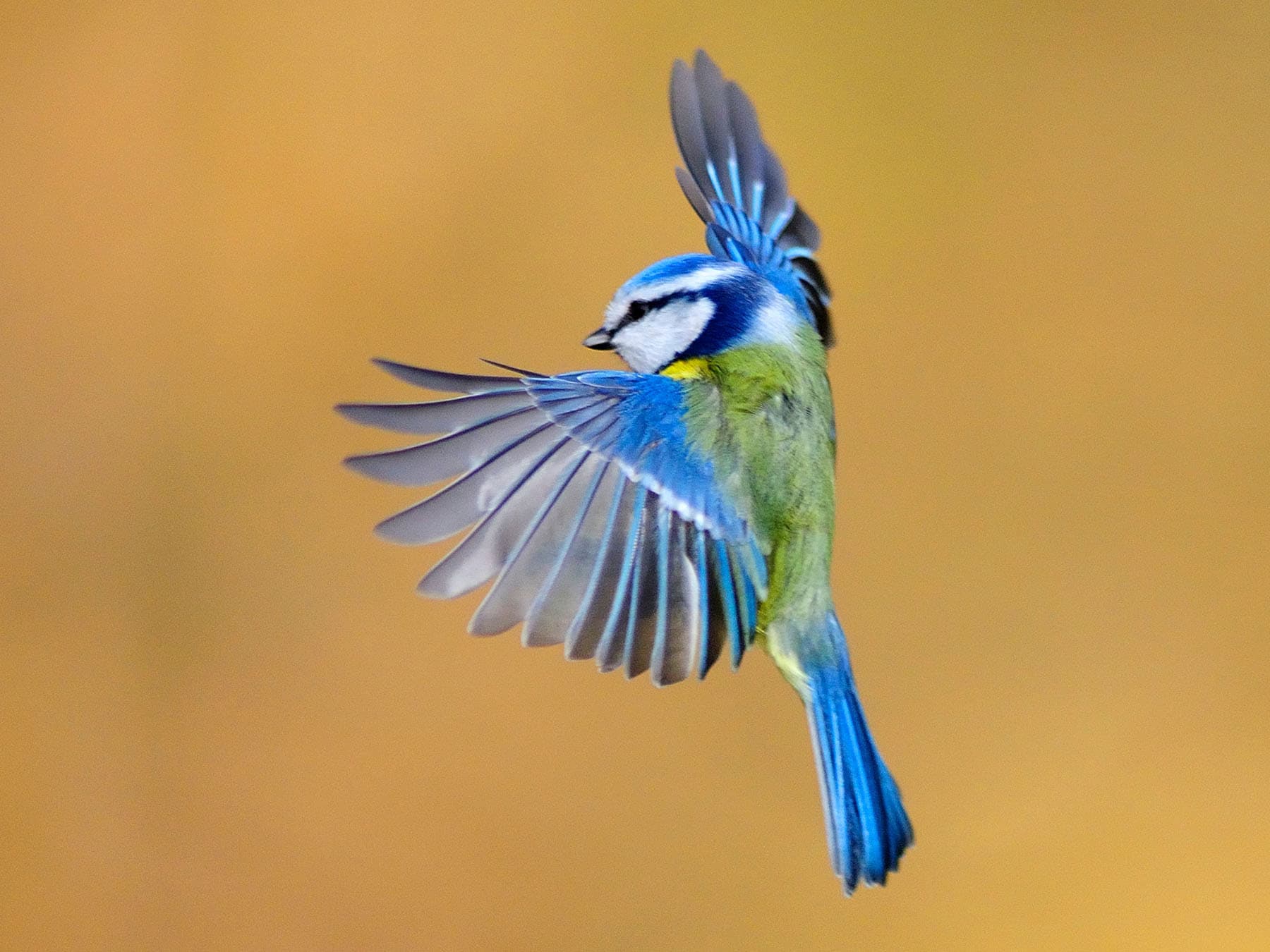
Blue Tits are monogamous, and the pair bond usually lasts for life; where they nest densely, some males have more than one mate. In courtship the male makes slow, moth-like flights towards the female, and dances with his tail fanned and the feathers of his nape raised to show his dark blue collar. Through laying and incubation he brings her food. In the wild, pairs are matched by the ultraviolet colour of their crowns11, and in trials females chose the males with the brightest crowns.
Behaviour: winter roosts and milk bottles
On winter nights some Blue Tits shelter in nest boxes. And they were once famous for pecking through the tops of milk bottles on doorsteps to drink the cream. Bottle opening by birds was first reported at Swaythling, near Southampton, in 1921, and by 1947 it had been recorded across the UK. It probably started in several places and spread faster and faster.12 The habit seems to have died out with doorstep deliveries.
Lifespan and predators
A Blue Tit that survives to breed lives about 3 years on average. Life is short for the young: only about 38% survive their first year, and about 53% of adults survive from one year to the next. They breed when one year old.5
Lifespan records
The oldest Blue Tit on the BTO's longevity list for Britain and Ireland was ringed as a young male at Attenborough, Nottinghamshire, in 1974 and caught again there in 1984, 9 years, 8 months and 16 days later.13
Predators
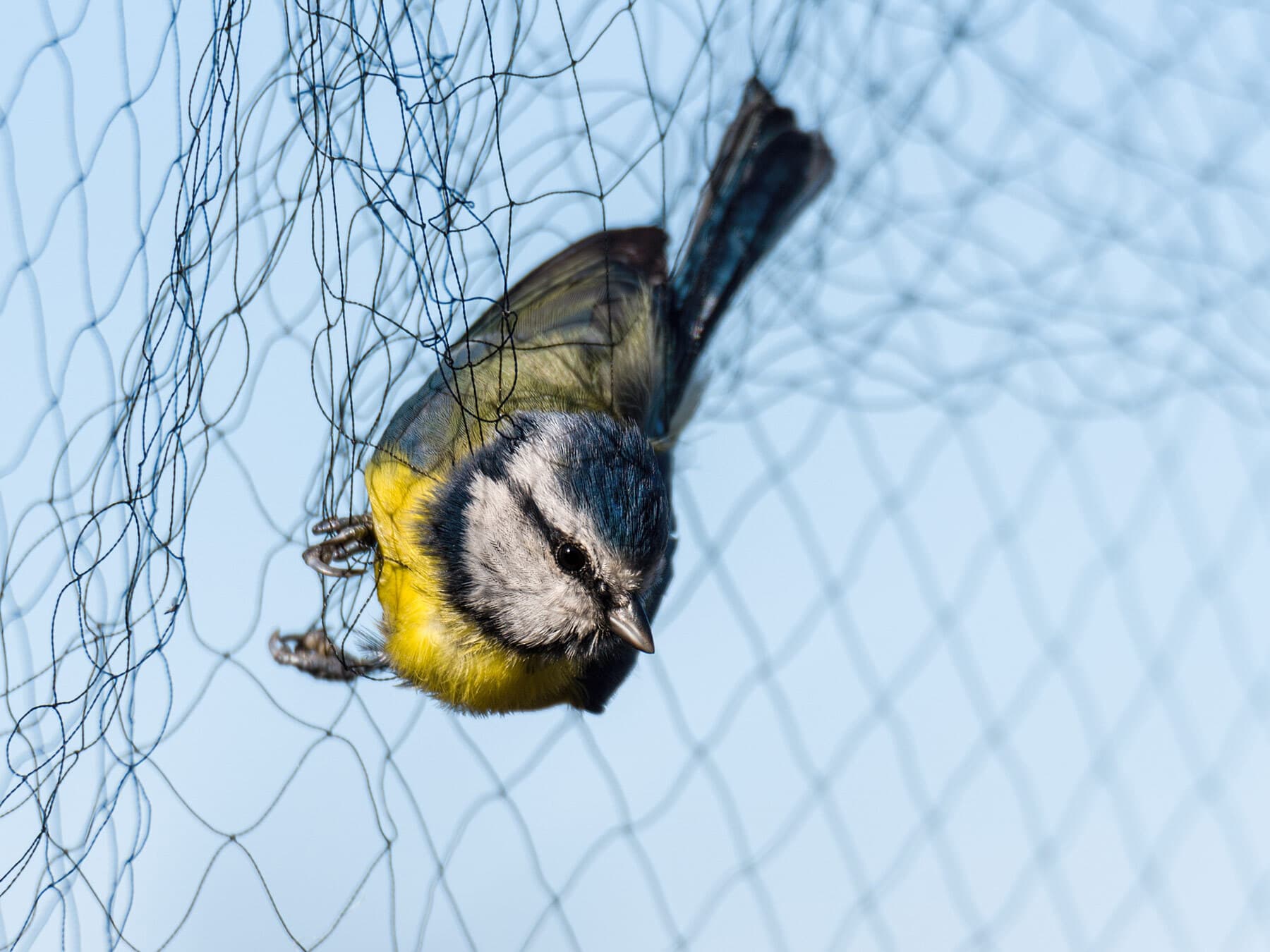
Nests are the weak point. In British nest-box studies the main losses were to Weasels, Grey Squirrels, rodents and Great Spotted Woodpeckers, and Tree Sparrows sometimes evicted a pair. The RSPB adds cats, rats, mice and stoats to the list of nest-box predators, and the BTO advises a box with no perch.
Conservation
Green-listed in the UK. The breeding population is about 3.4 million territories (2016). Numbers rose by 20% between 1967 and 2024, but have fallen gently since about 2008.5 Across Europe numbers grew by more than 30% between 1980 and 2016, probably helped by maturing woods, greener suburbs, nest boxes and garden feeding. Worldwide the species is of Least Concern.
Competition with the bigger Great Tit, and among Blue Tits themselves, may help explain why the Blue Tit has increased less. Avian pox affects Blue Tits less often than Great Tits.
Similar birds
Often mistaken for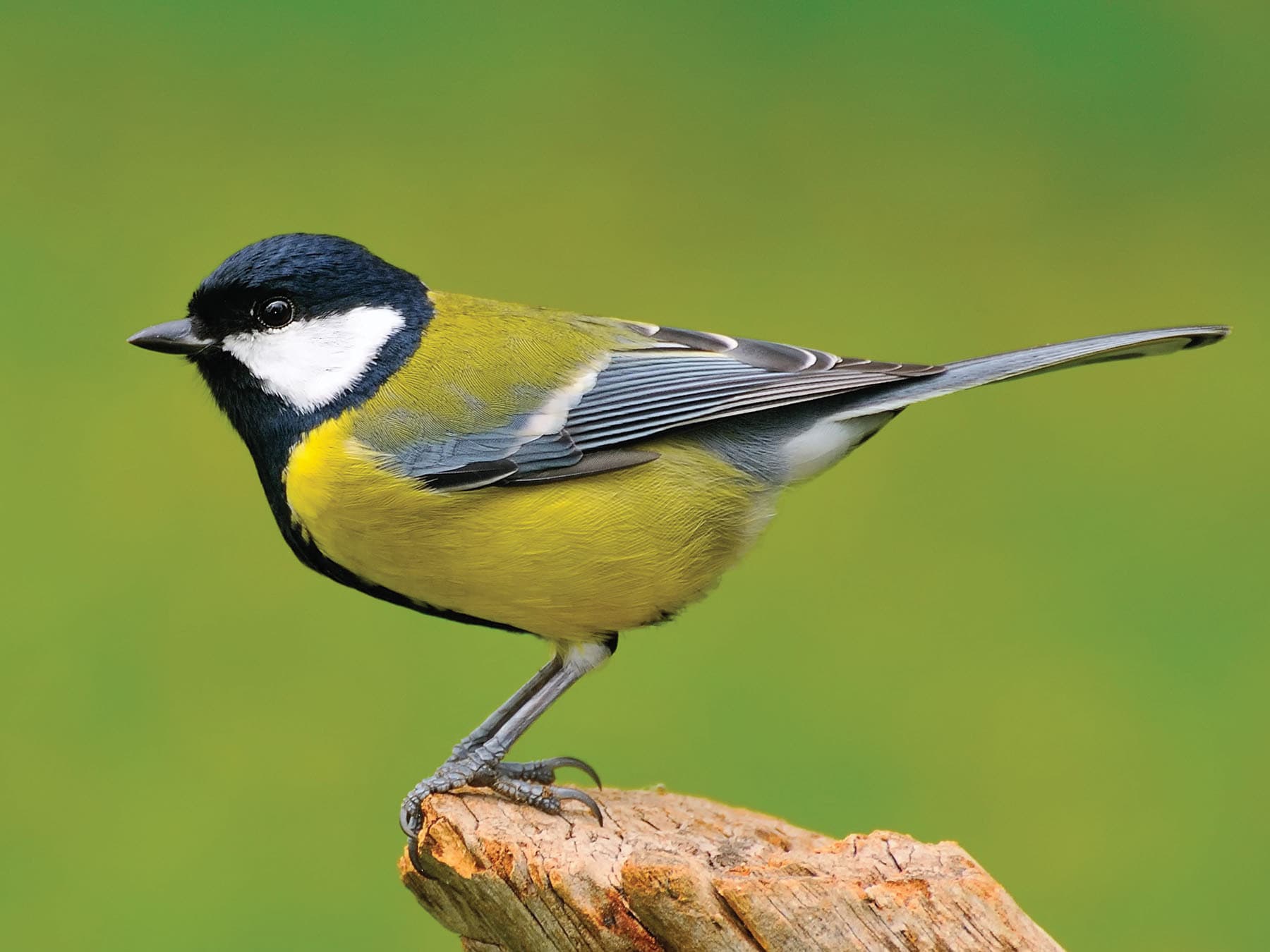
More photos
8 photos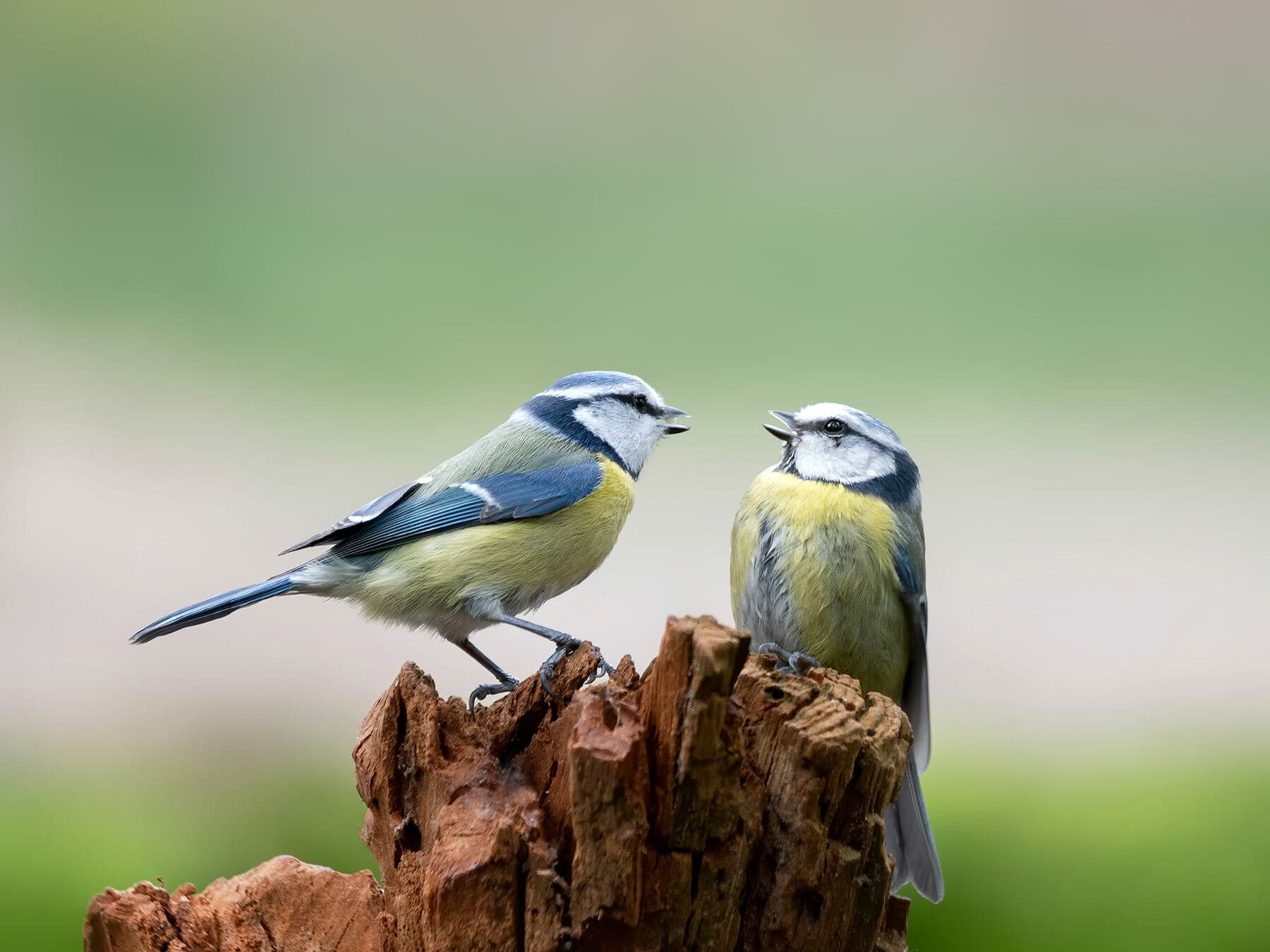 A pair of Blue Tits on an old stump
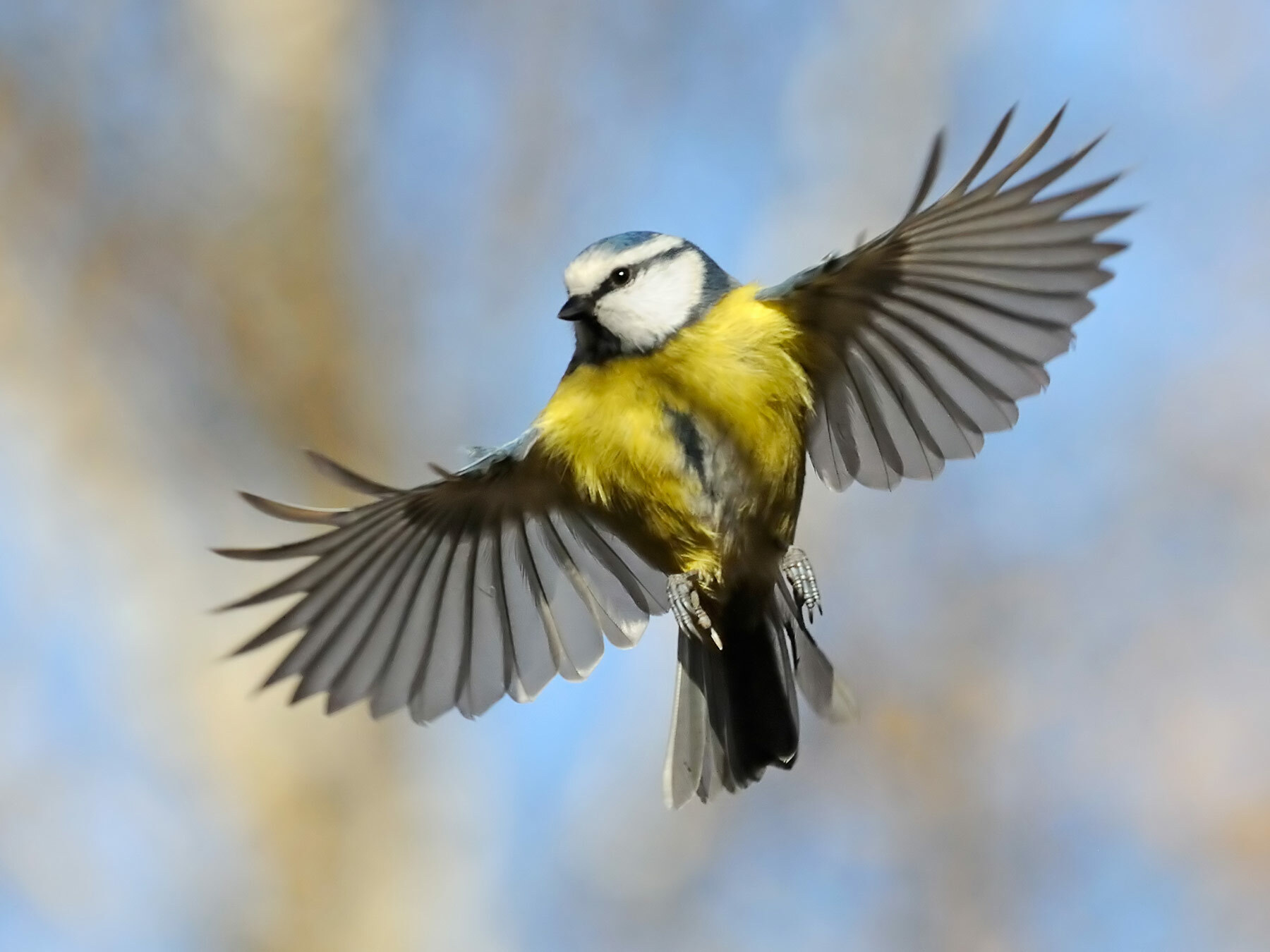
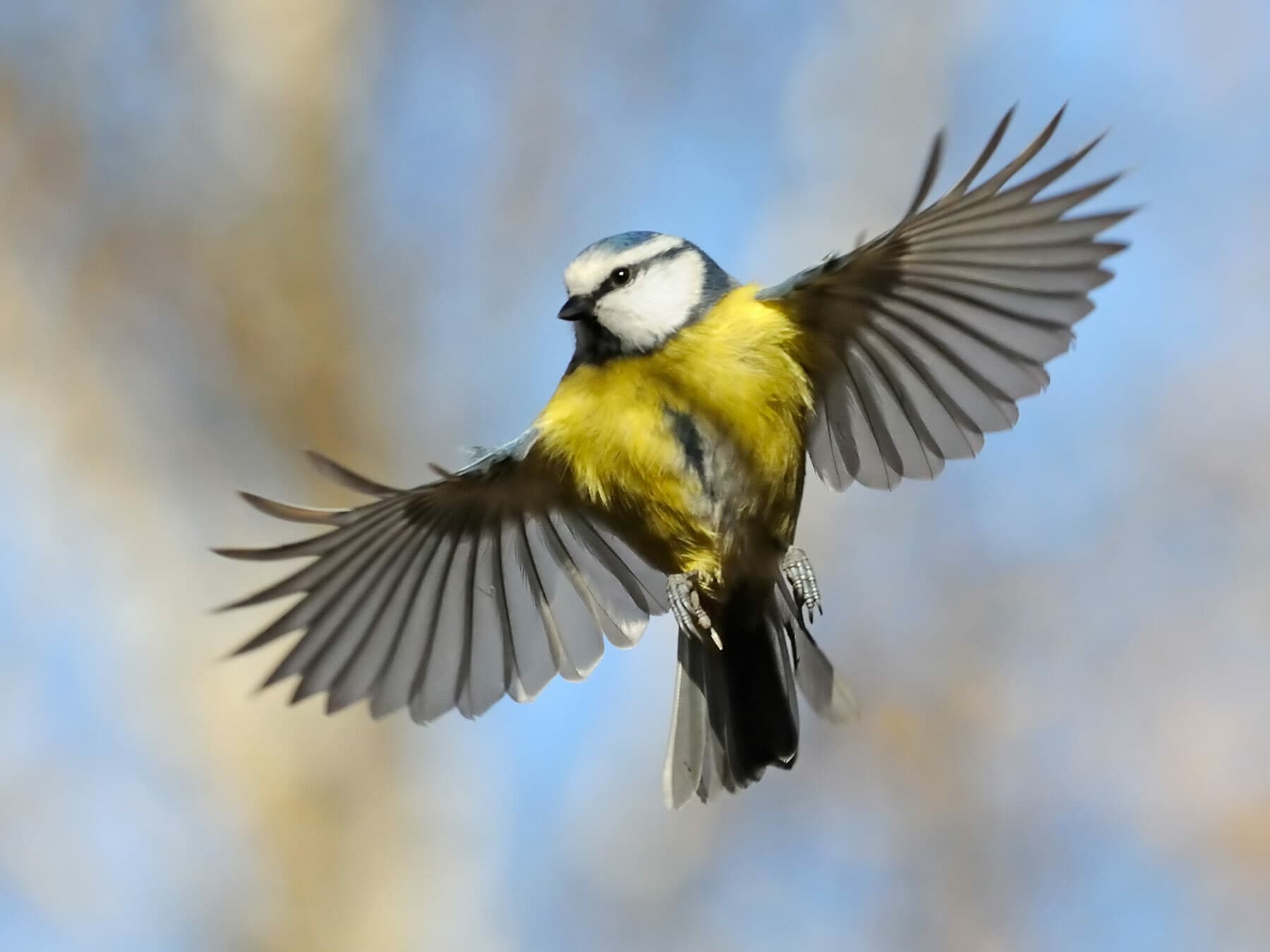 A Blue Tit in flight, wings spread
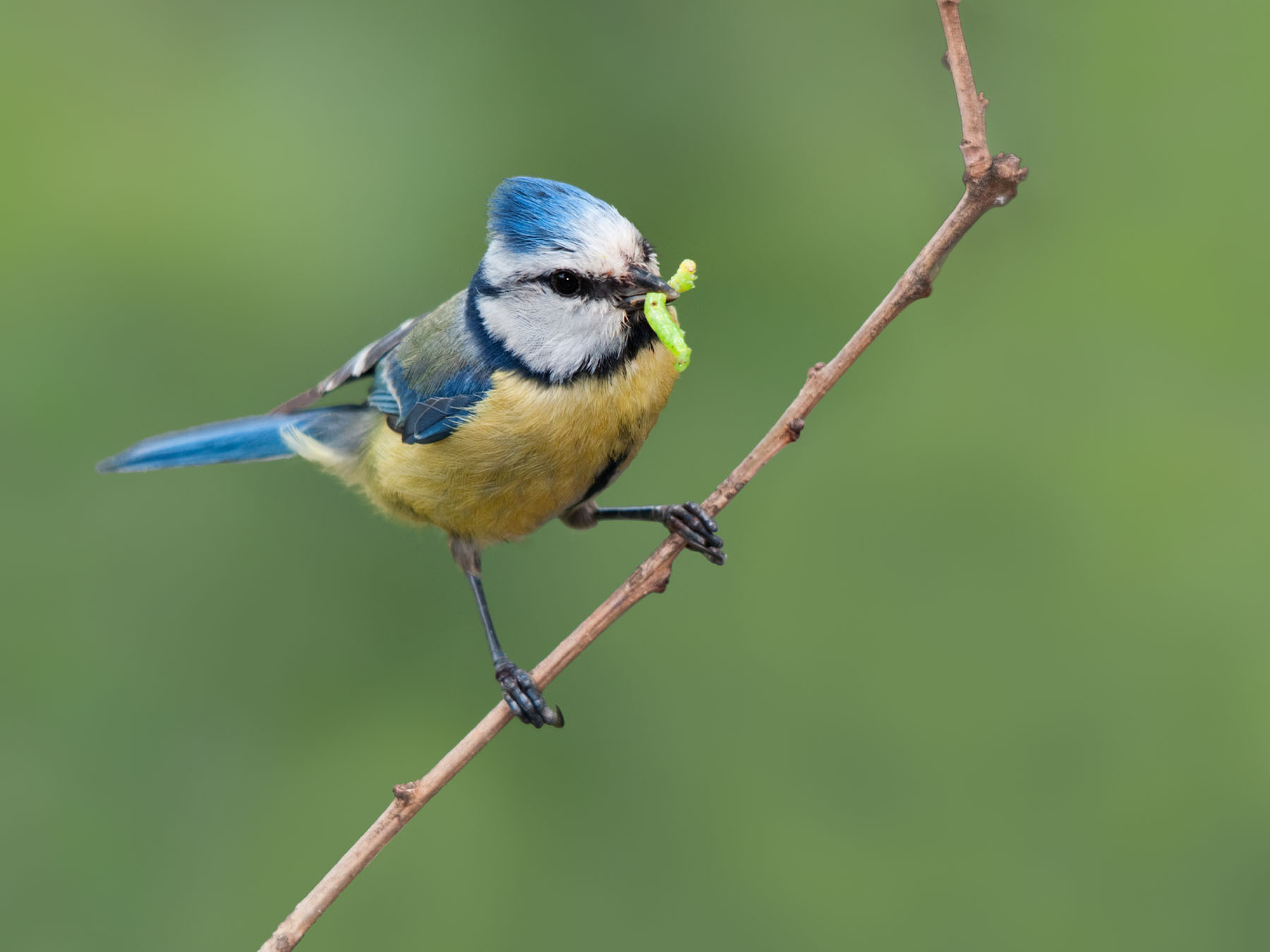
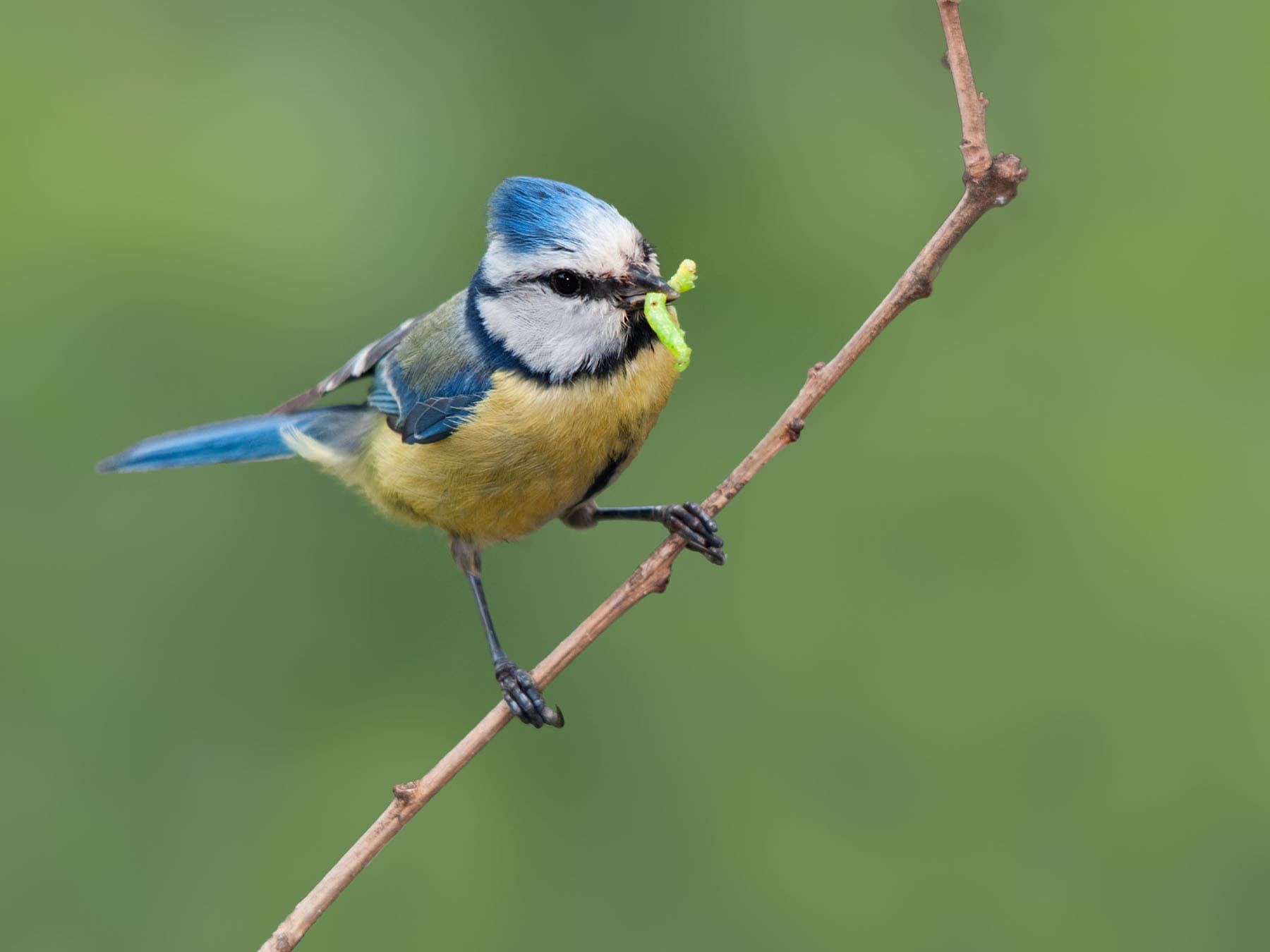 A Blue Tit with a caterpillar in its bill
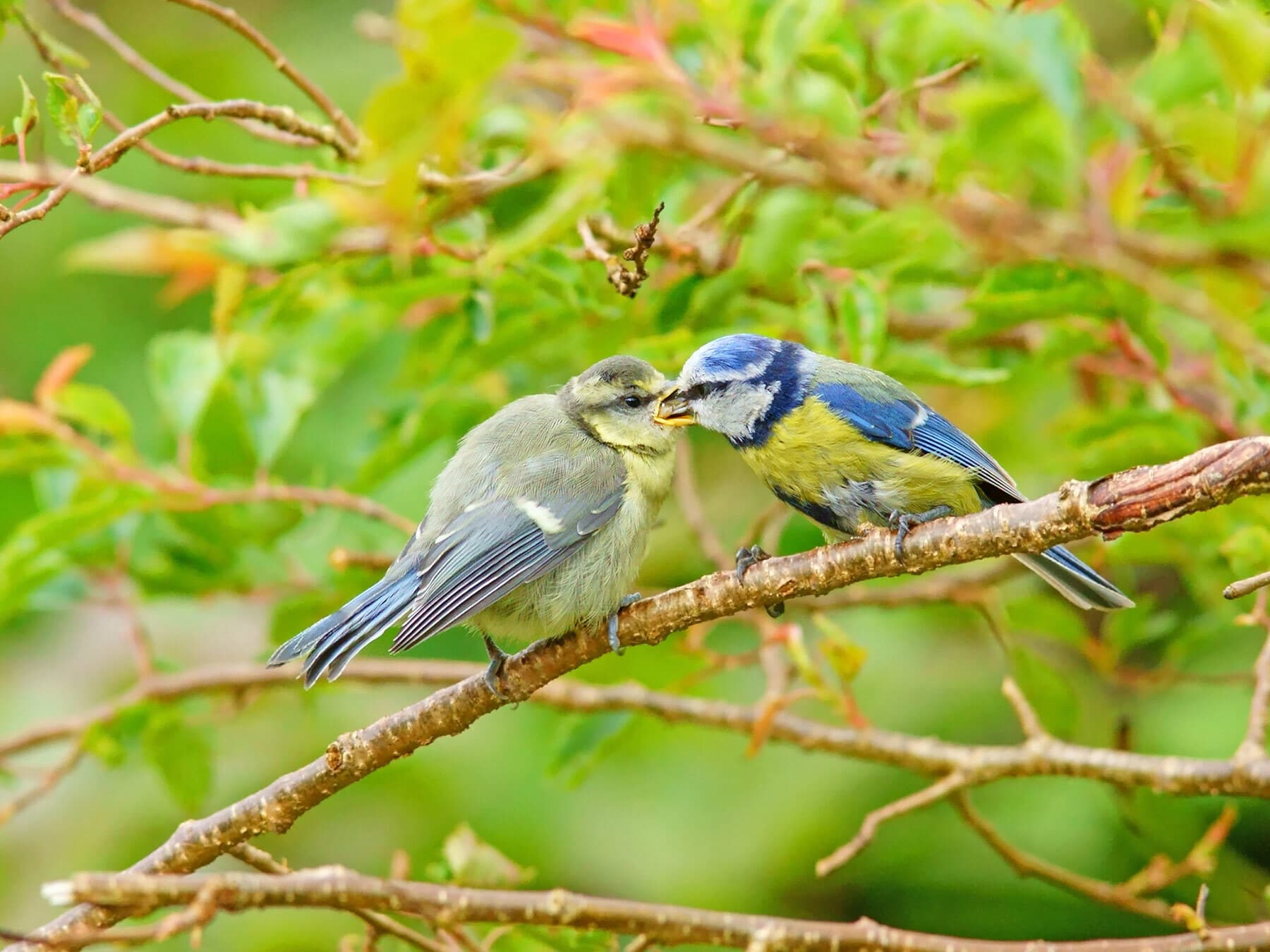 An adult Blue Tit feeding a yellow-faced young bird
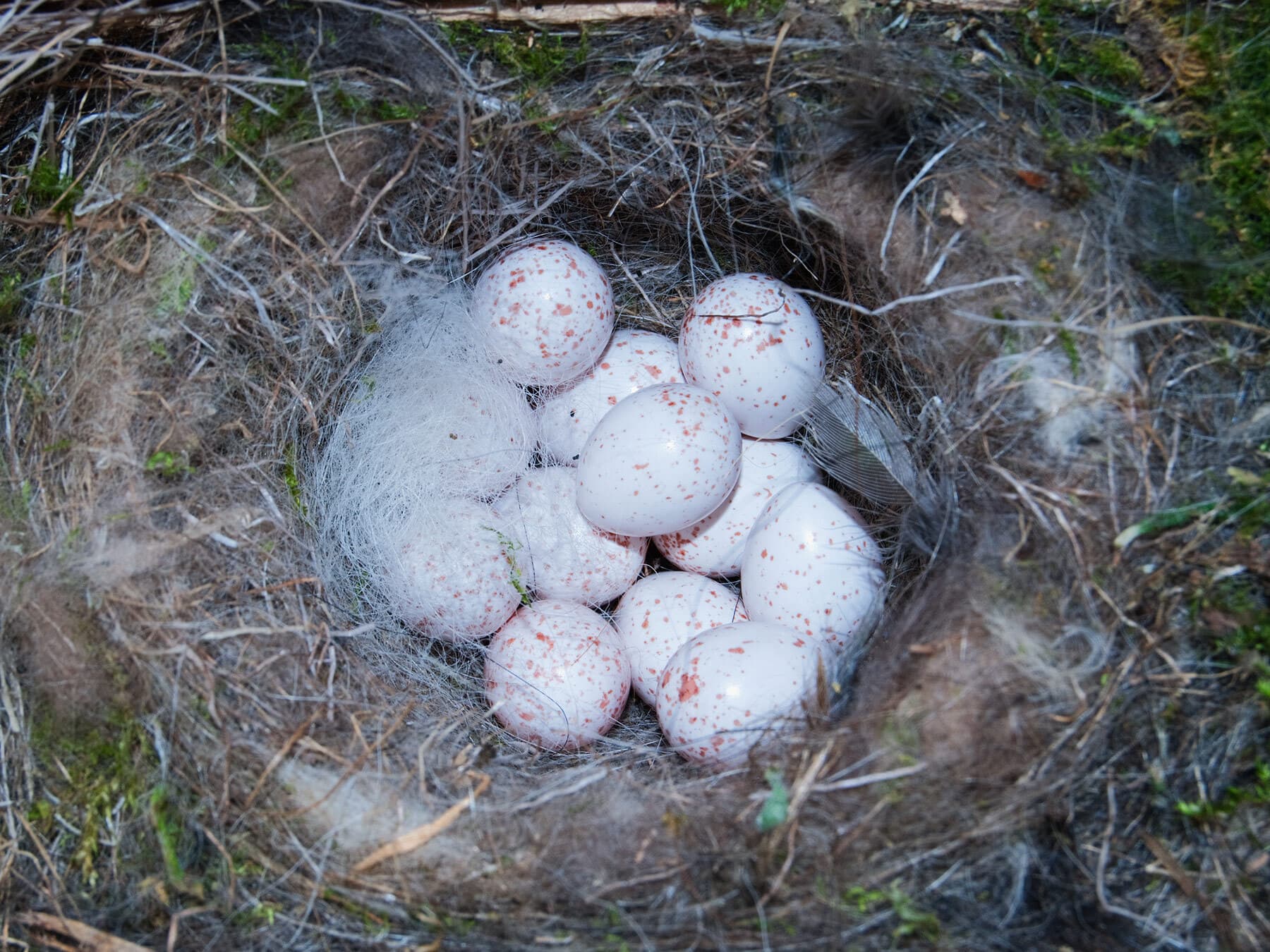 A clutch of Blue Tit eggs: white with reddish-brown spots
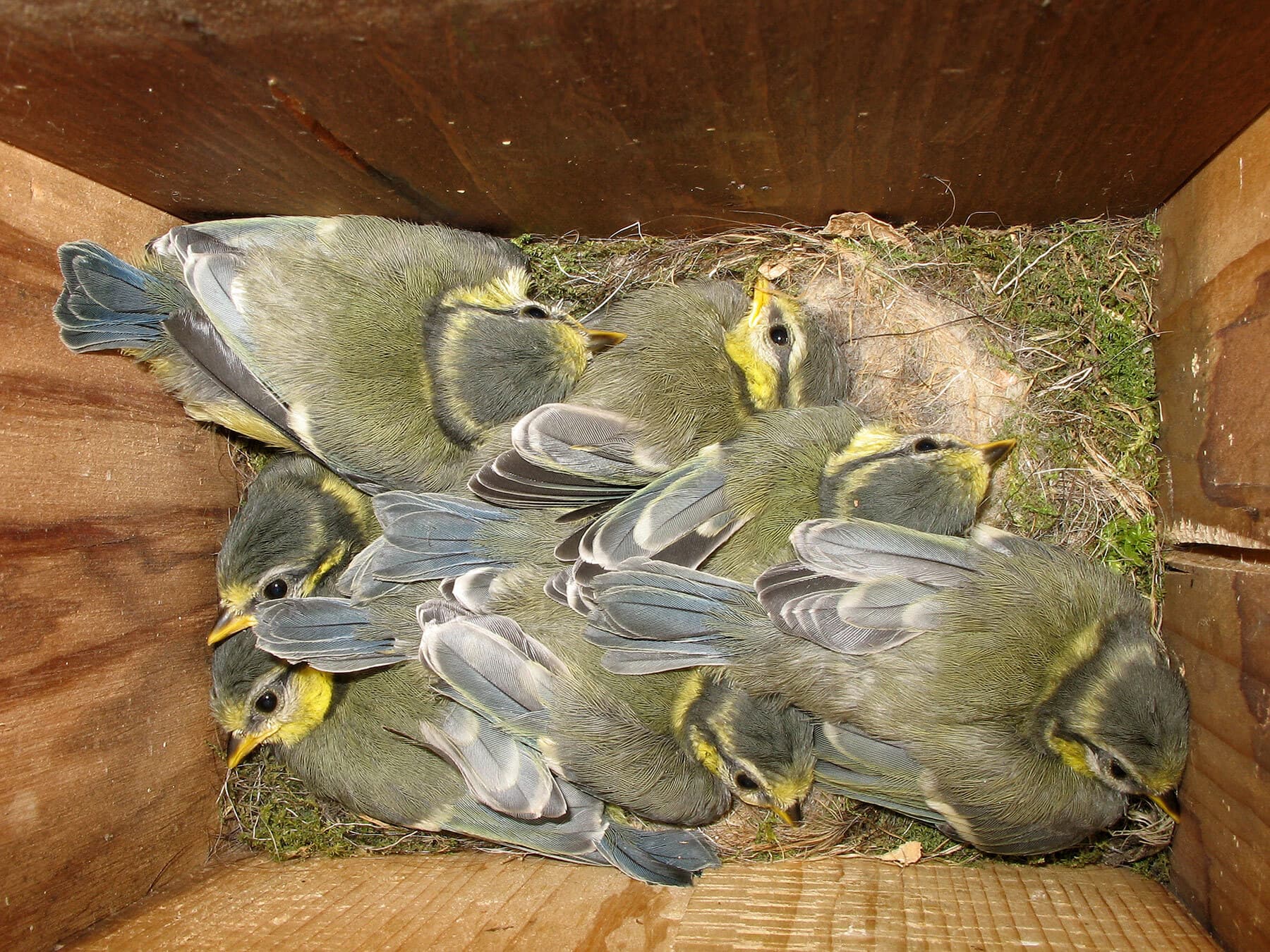 Well-grown Blue Tit chicks in a nest box
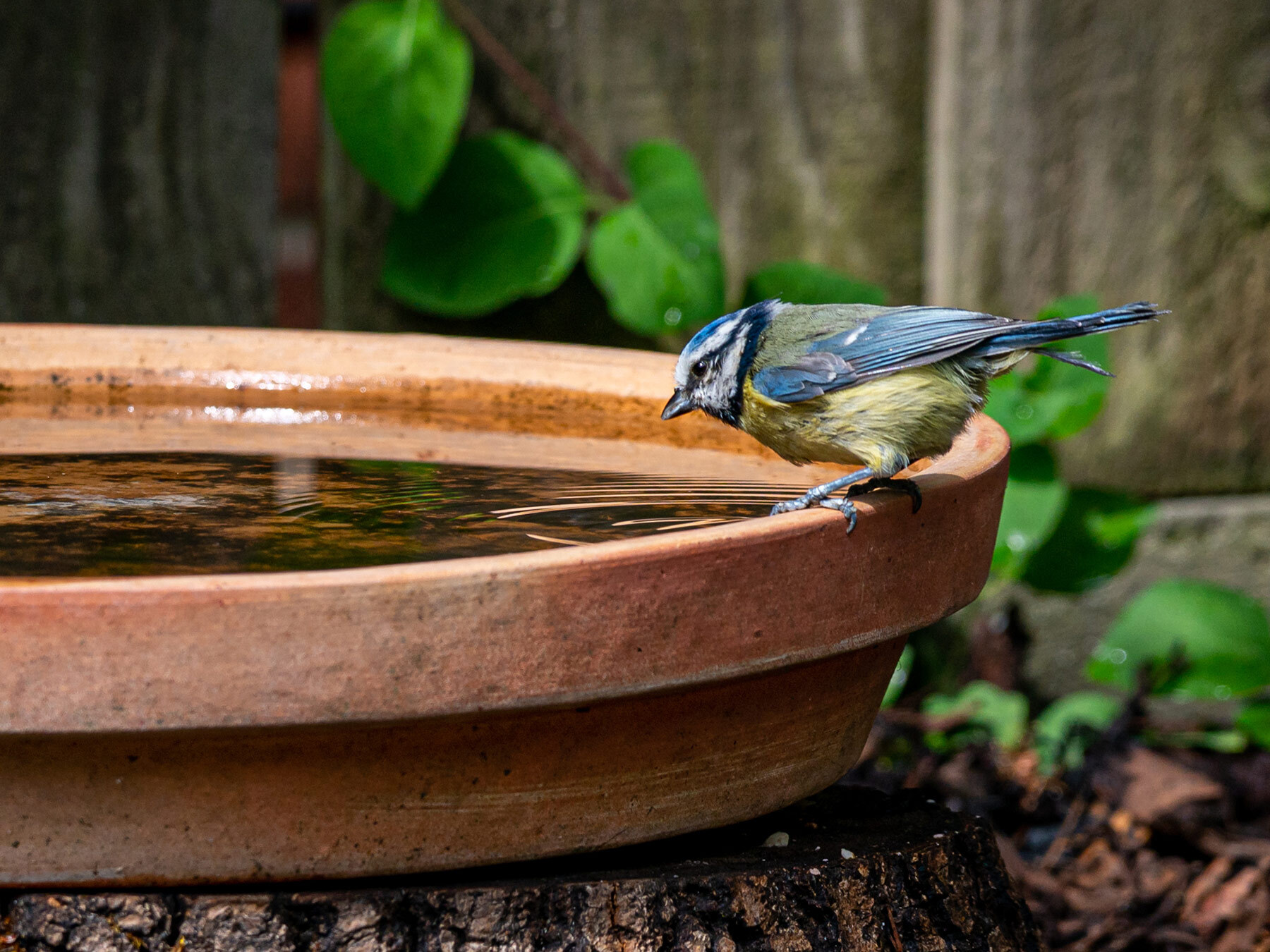
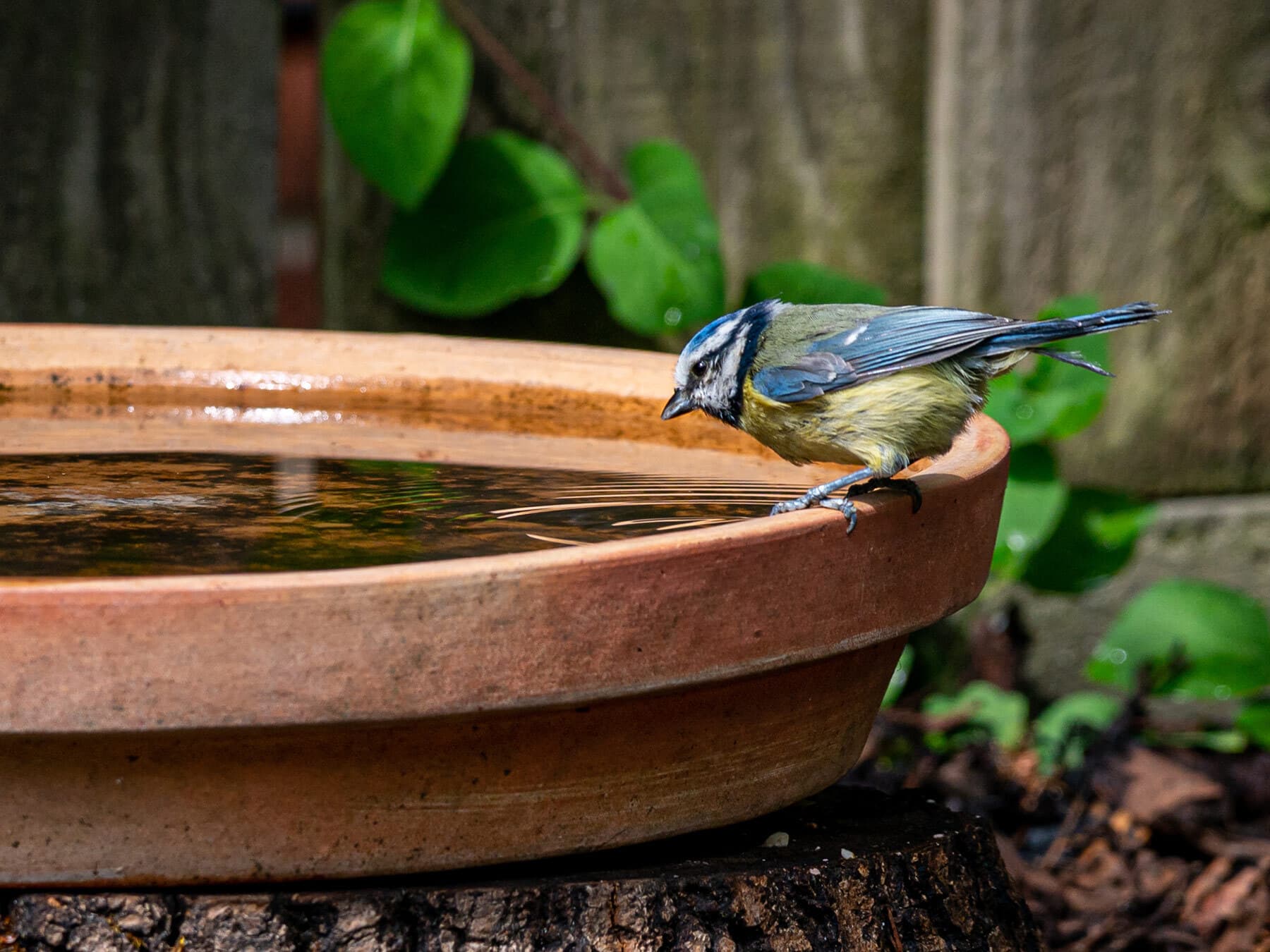 A Blue Tit drinking at a bird bath
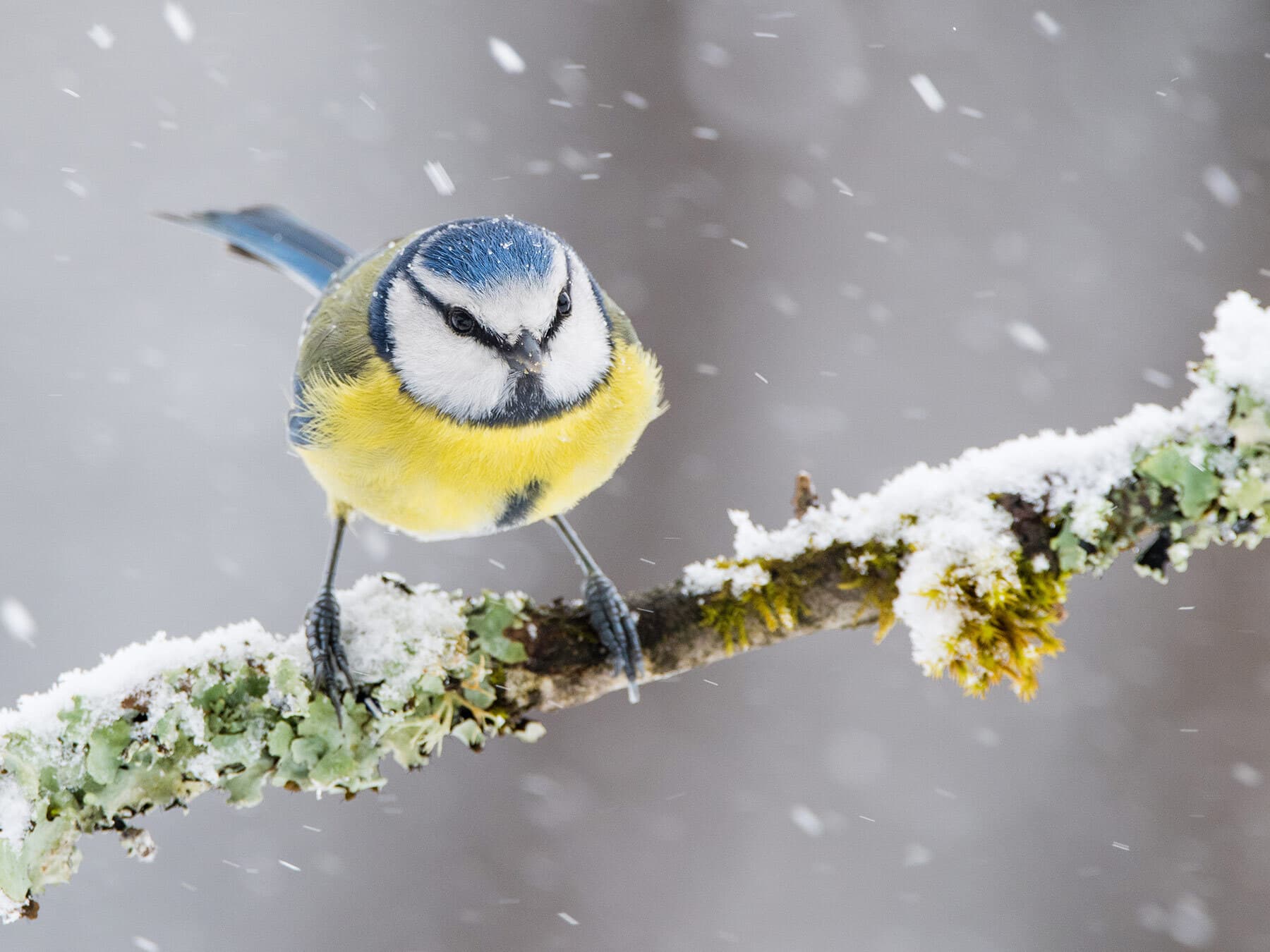 A Blue Tit on a snowy branch
Blue Tit guides
6 guidesQuick facts
- Length
- 11–12 cm
- Wingspan
- 17.5–20 cm
- Weight
- 9.7–12.2 g
- Lifespan
- 3 years · oldest recorded 9 years 8 months
- Family
- Tits & Chickadees
- Migration
- Resident
- Global status (IUCN)
- Least Concern
- Population trend
- Up 20% in the UK since 1967; shallow decline since about 2008
- Also called
- Eurasian Blue Tit
- Scientific name
- Cyanistes caeruleus
Questions
5Do Blue Tits mate for life?
Usually, yes. The pair bond is usually lifelong, about 75% of breeding pairs survive to the next season, and some pairs stay together four years running. See behaviour.
How big is a Blue Tit?
About 12 cm long, with a wingspan of 17.5 to 20 cm. BTO ringers find that adults weigh 9.7 to 12.2 g, 10.9 g on average. See appearance.
Can you tell a male Blue Tit from a female?
Only roughly: males are on average brighter blue and yellow. See male, female and young Blue Tits.
Why does a young Blue Tit have a yellow face?
Juveniles have pale yellow faces and olive caps until they moult in late summer. See male, female and young.
Are Blue Tits rare?
No. They are one of the UK's commonest birds, with about 3.4 million territories, and Green-listed. See conservation.
Sources
18- 1RSPB. Blue tit. RSPB Birds A-Z. Accessed 7 October 2026. Source (opens in a new tab)
- 2Kirwan, G. M. et al. (2024). Eurasian Blue Tit (Cyanistes caeruleus), version 1.1. Birds of the World (J. del Hoyo, A. Elliott, J. Sargatal, D. A. Christie, E. de Juana and M. G. Smith, editors). Cornell Lab of Ornithology. doi:10.2173/bow.blutit.01.1 (opens in a new tab)
- 3Hunt, S., Bennett, A. T. D., Cuthill, I. C. and Griffiths, R. (1998). Blue tits are ultraviolet tits. Proceedings of the Royal Society B 265: 451-455. doi:10.1098/rspb.1998.0316 (opens in a new tab)
- 4BTO. Identifying young birds. BTO Develop your skills. Accessed 7 October 2026. Source (opens in a new tab)
- 5BTO. Blue Tit (Cyanistes caeruleus). BTO BirdFacts. Accessed 7 October 2026. Source (opens in a new tab)
- 6Robinson, R. A., Leech, D. I. and Clark, J. A. (2025). The Online Demography Report: Bird ringing and nest recording in Britain & Ireland in 2024. Summary of all recoveries: Blue Tit. BTO. Accessed 7 October 2026. Source (opens in a new tab)
- 7Shutt, J. D., Trivedi, U. H. and Nicholls, J. A. (2021). Faecal metabarcoding reveals pervasive long-distance impacts of garden bird feeding. Proceedings of the Royal Society B 288: 20210480. doi:10.1098/rspb.2021.0480 (opens in a new tab)
- 8RSPB (2026). How to help garden birds. RSPB news. Accessed 6 October 2026. Source (opens in a new tab)
- 9McCambridge, H.. A Blue Tit Diary. BTO Masterclass articles. Accessed 7 October 2026. Source (opens in a new tab)
- 10BTO. Buying a nest box. Accessed 7 October 2026. Source (opens in a new tab)
- 11Andersson, S., Örnborg, J. and Andersson, M. (1998). Ultraviolet sexual dimorphism and assortative mating in blue tits. Proceedings of the Royal Society B 265: 445-450. doi:10.1098/rspb.1998.0315 (opens in a new tab)
- 12Lefebvre, L. (1995). The opening of milk bottles by birds: evidence for accelerating learning rates, but against the wave-of-advance model of cultural transmission. Behavioural Processes 34: 43-53. doi:10.1016/0376-6357(94)00051-h (opens in a new tab)
- 13BTO (2024). Longevity records for Britain & Ireland in 2024. BTO Online Ringing Report. Accessed 7 October 2026. Source (opens in a new tab)
- 14RSPB. How and what to feed your garden birds. RSPB. Accessed 6 October 2026. Source (opens in a new tab)
- 15BTO. Putting up a nest box. Accessed 6 October 2026. Source (opens in a new tab)
- 16Stanbury, A. et al. (2021). The status of our bird populations: the fifth Birds of Conservation Concern in the United Kingdom, Channel Islands and Isle of Man and second IUCN Red List assessment of extinction risk for Great Britain. British Birds 114: 723-747. Accessed 6 October 2026.
- 17Kirwan, G. M. et al. (2024). Great Tit (Parus major), version 2.0. Birds of the World (G. M. Kirwan and N. D. Sly, editors). Cornell Lab of Ornithology. doi:10.2173/bow.gretit1.02 (opens in a new tab)
- 18RSPB. Great tit. RSPB Birds A-Z. Accessed 6 October 2026. Source (opens in a new tab)

Checked by
Nathan Cope, founder and editor
Nathan founded Birdfact and leads its writers and contributors in the UK, the US and Canada. He has watched and studied birds for more than ten years, and checks every article and species guide before it’s published.