


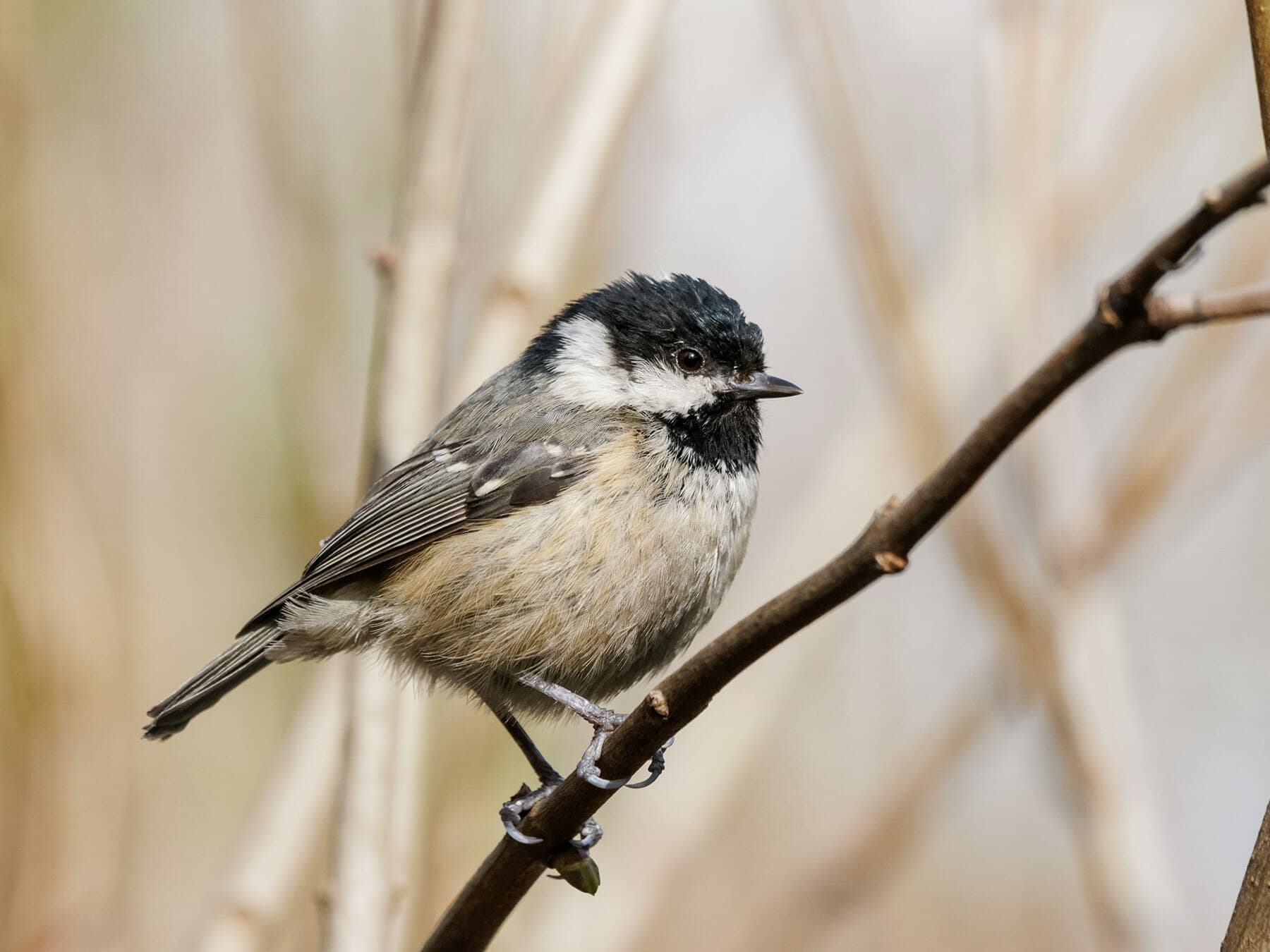
Coal Tit
Cole Tit · Periparus ater
By the Birdfact teamChecked by Nathan Cope
See it in 3D
3D model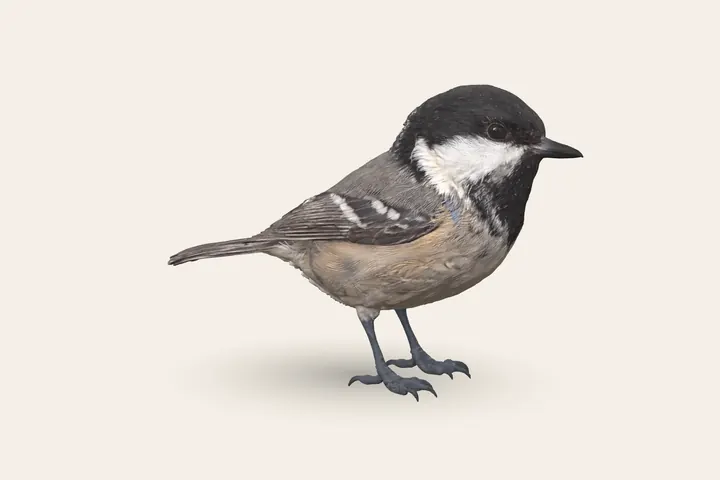 3D model
A Coal Tit is 10–12 cm (4–4.5 in) long, bill to tail.
3D model · Adult · Length 10–12 cm (4–4.5 in) · How we make our birds · Report a problem
© 2026 NC Digital Limited (Birdfact). All rights reserved. This 3D model may be viewed on this page and shared by link only. Downloading, extracting, copying or reusing it, or using it to train machine-learning models, is not permitted without our written permission. Using our models
On this page16 sections
How to recognise it
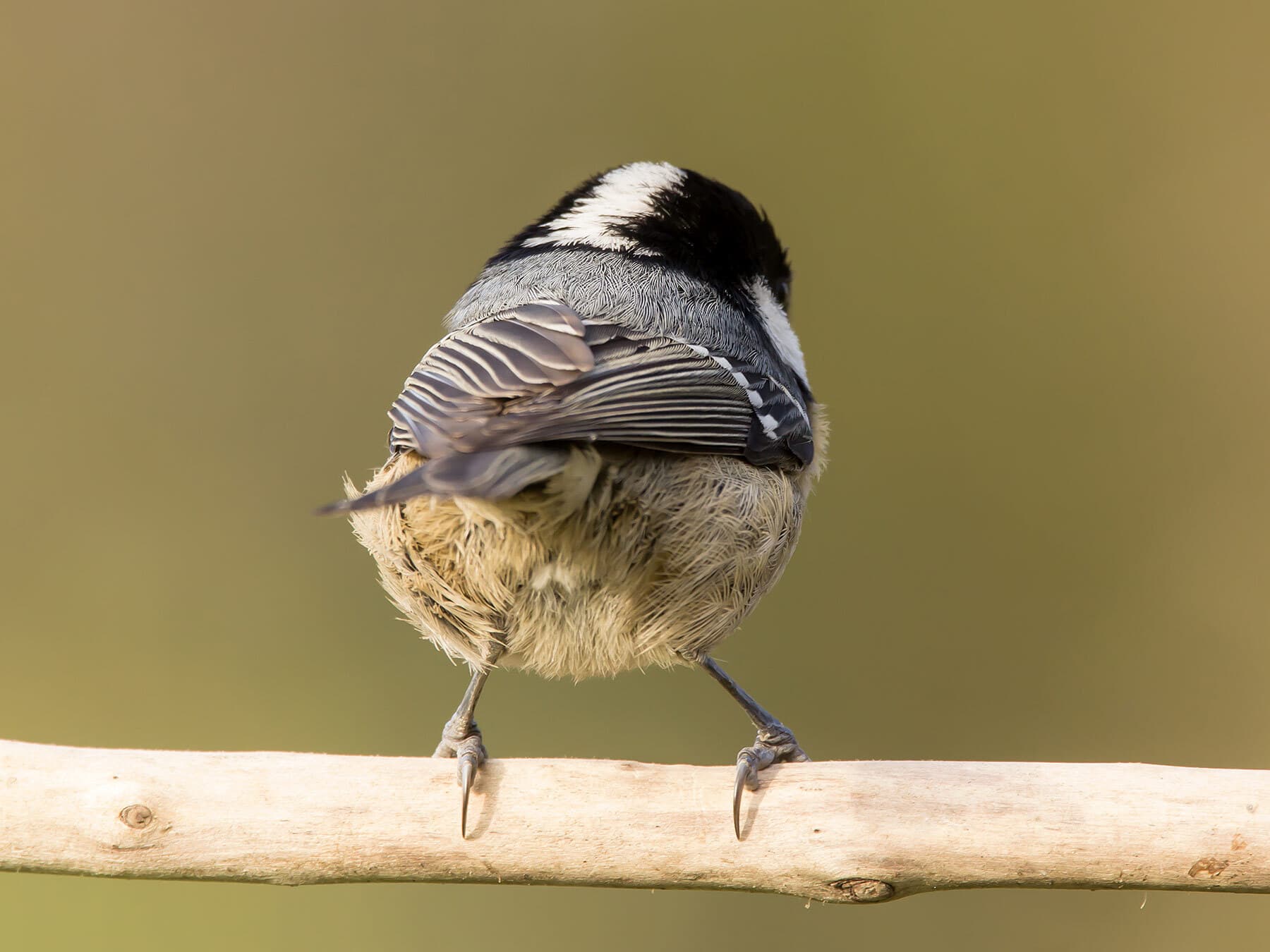
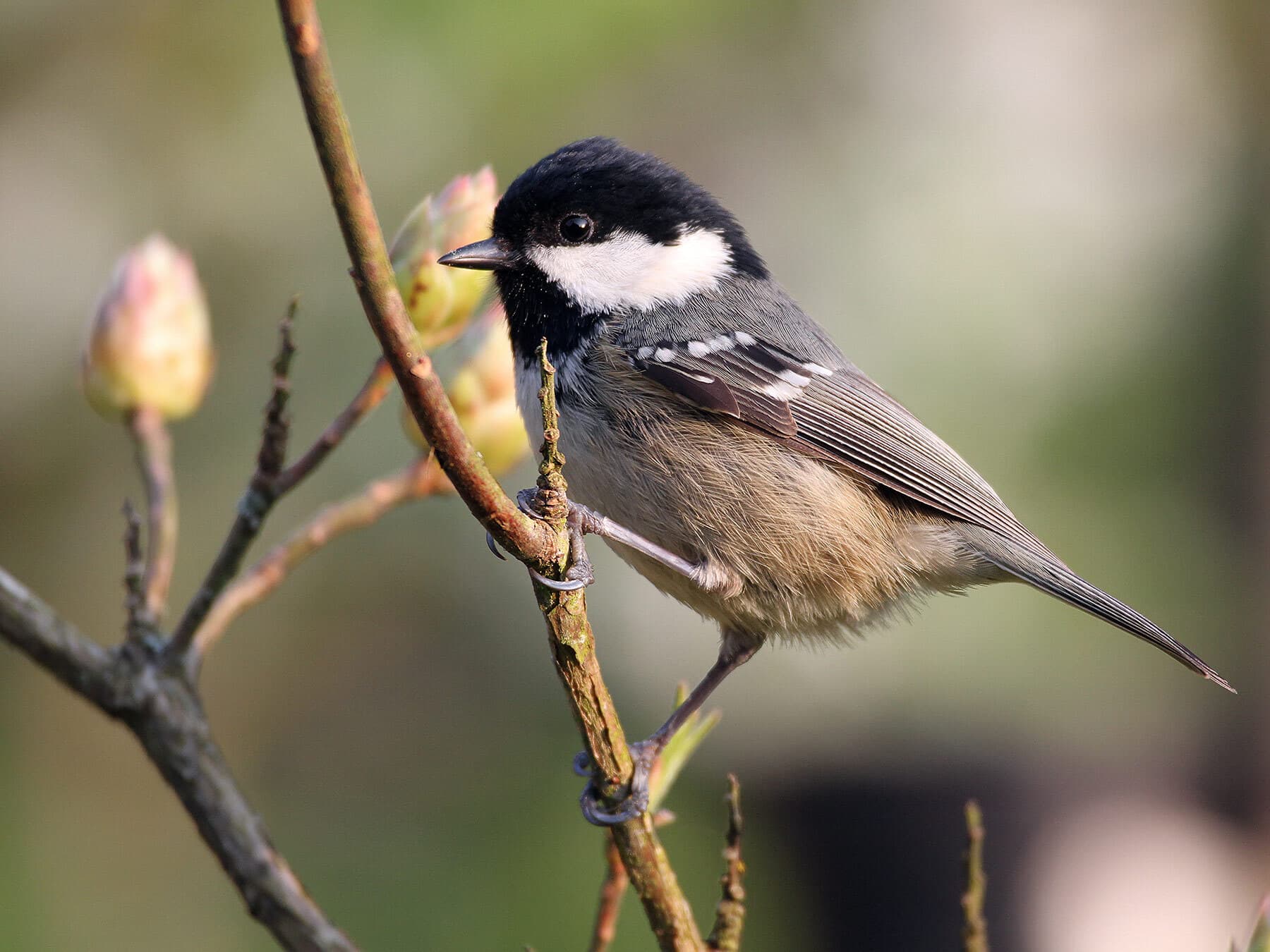
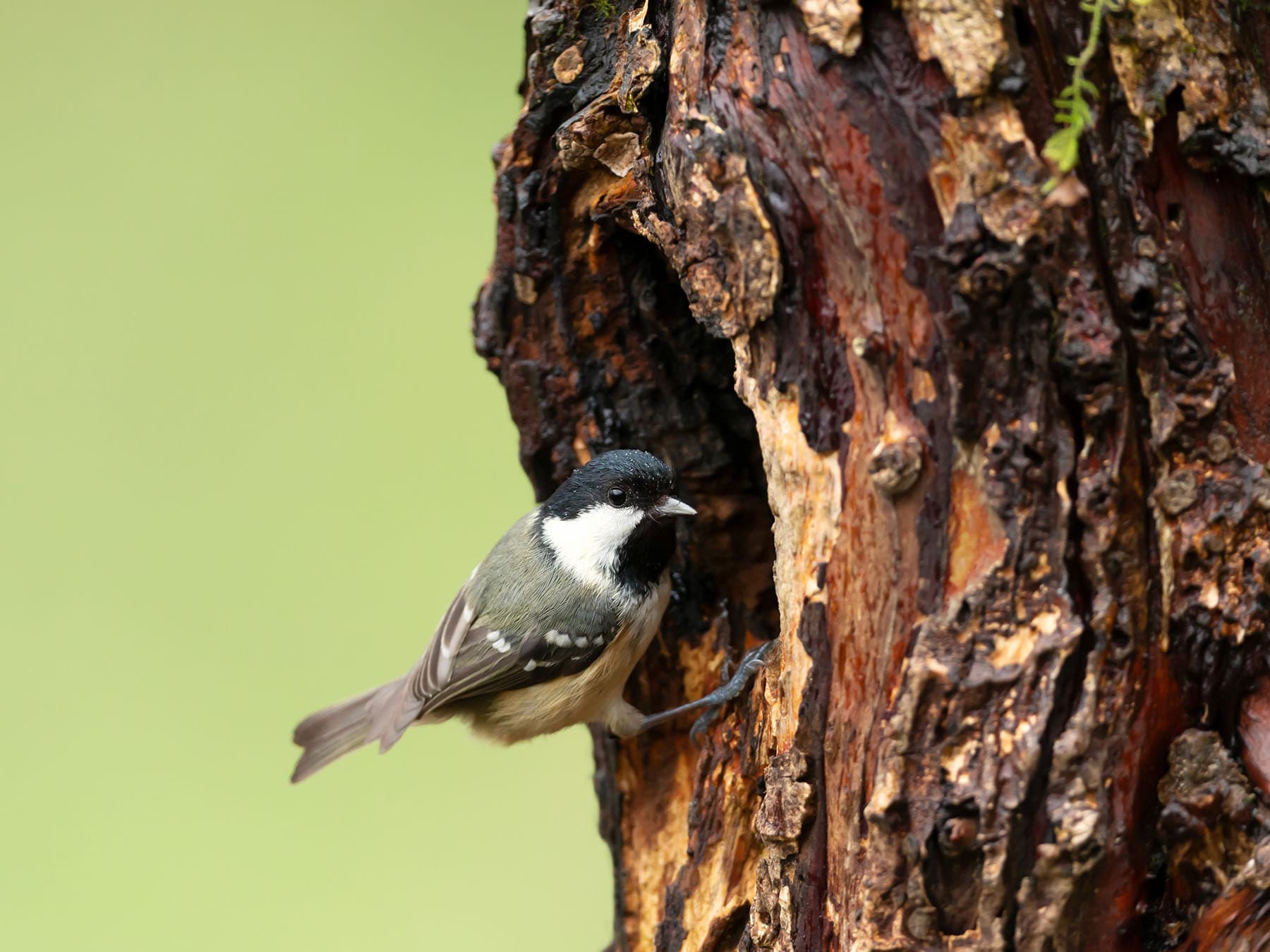
A Coal Tit is tiny: about 11.5 cm long and about 9 g. It has a glossy black cap and a black bib, white cheeks, and a large white patch on the nape, the back of the head. The back is grey, the underparts are pale with buff flanks, and the wings show two white bars. It is less colourful than its Blue and Great Tit relatives, and British adults show no bright yellow.1
The nape patch is the mark to look for. Marsh and Willow Tits have none, and a Great Tit has at most a small whitish spot that fades into its green back, so a clear look at the back of the head settles it. The bill is black, fine and slimmer than a Blue or Great Tit's, built for working among conifer needles and cones. The legs are lead grey.2
Adults weighed by BTO ringers average 9.1 g, and most weigh between 8.1 and 10 g.3
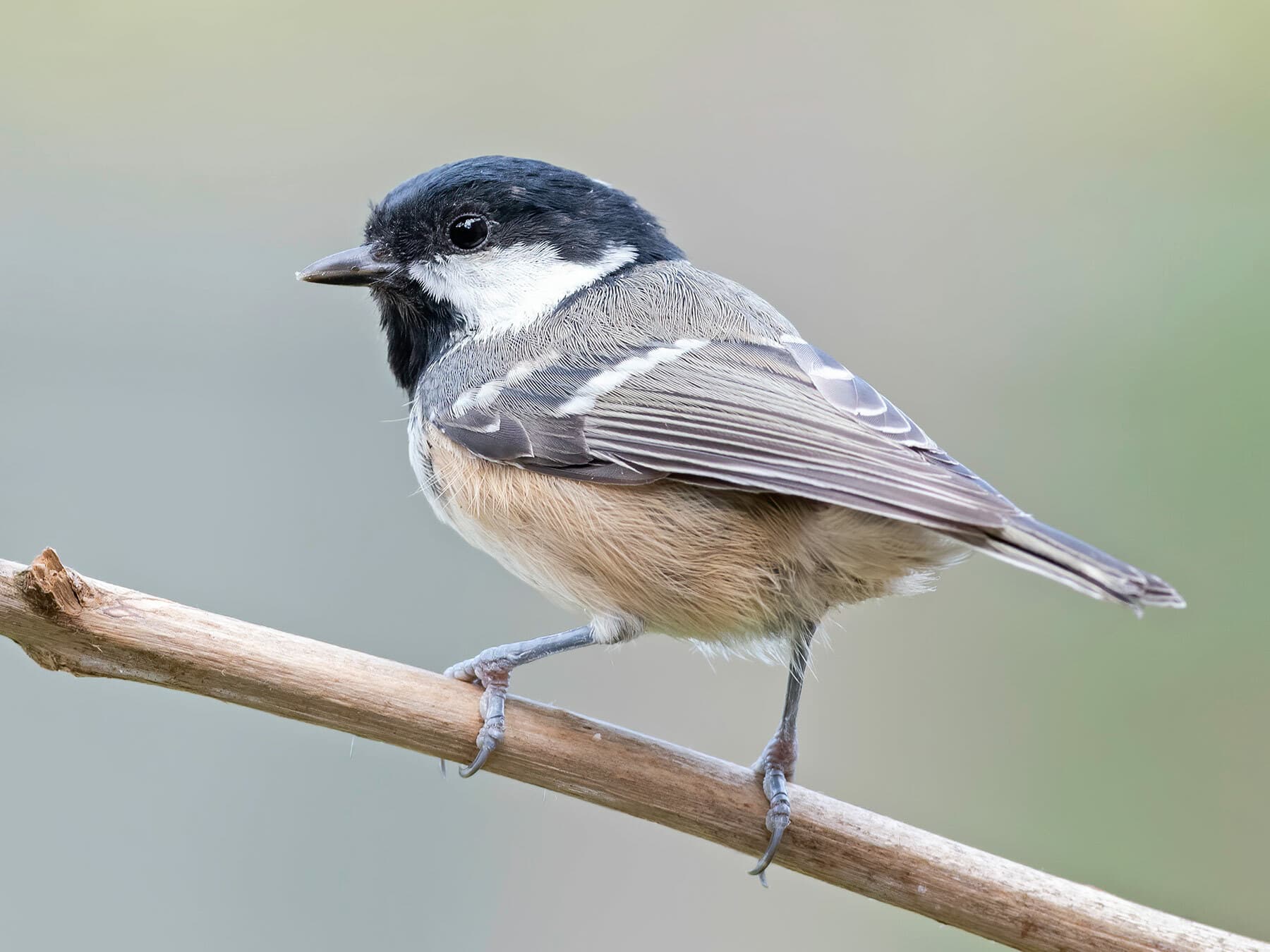
Male, female and young
Males and females look alike. A female's cap is a little less glossy and her bib a little browner, but the difference is slight. In BTO measurements males have slightly longer wings, 61.4 mm against 59.1 mm on average.
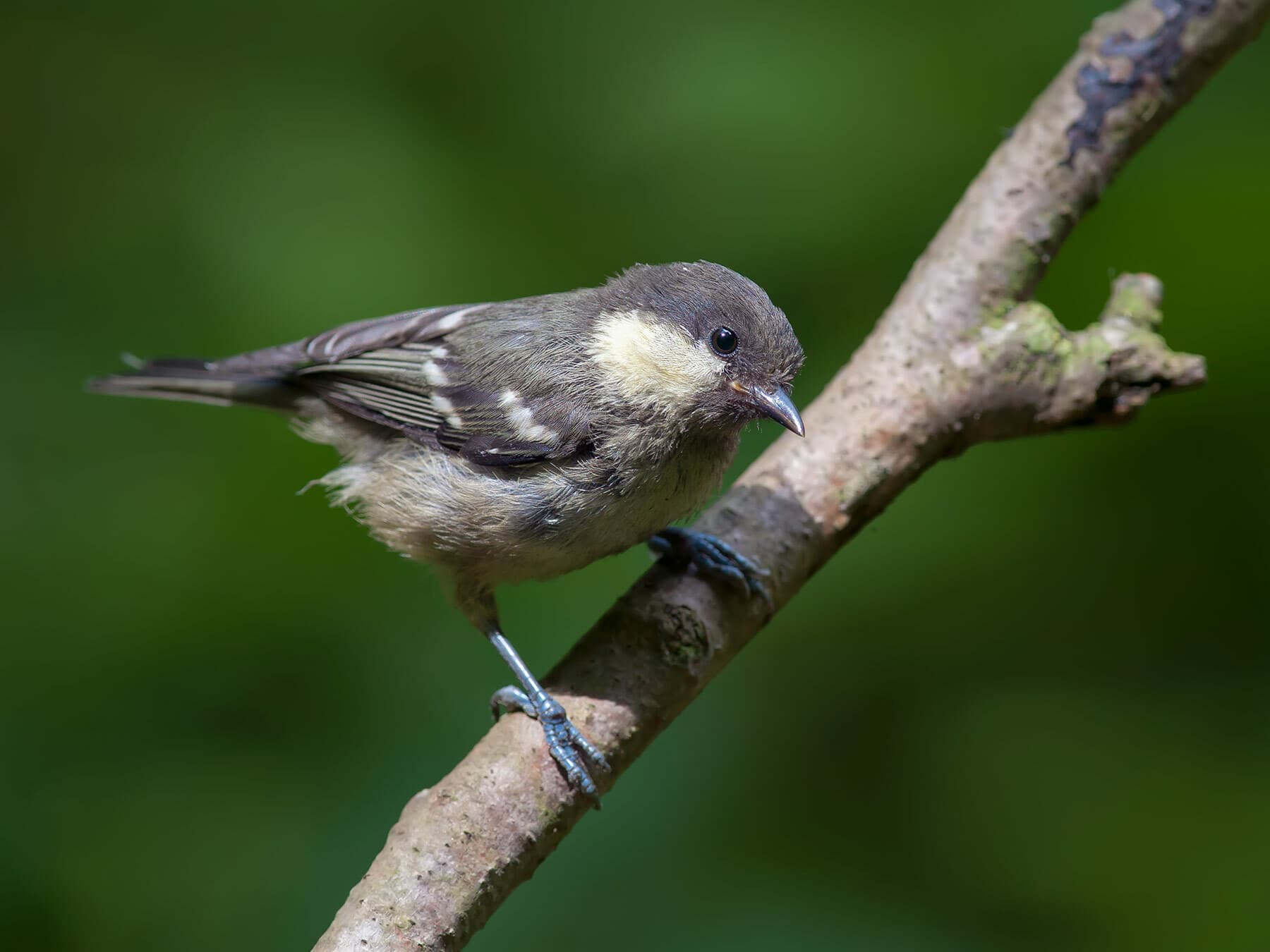
Young Coal Tits are duller. The cap is sooty grey rather than black, the cheeks are washed pale yellow, the nape patch is smaller and yellowish, and the underparts are yellowish. They still show the two wing bars.
Identification: British and Irish birds
Coal Tits in Britain belong to their own subspecies, britannicus. In fresh plumage their cheeks and nape patch are creamy rather than pure white, the back is a greyish olive-buff, and the flanks are pale rufous-buff to cinnamon-buff. Birds from mainland northern and central Europe are bluer-grey above, with whiter cheeks.
In most of Ireland the subspecies is hibernicus, and adults have pale yellow cheeks, nape patch and underparts, whiter when worn, and a greener back. In all, 21 subspecies are recognised across Europe, North Africa and Asia, some of them crested.
Identification: similar birds
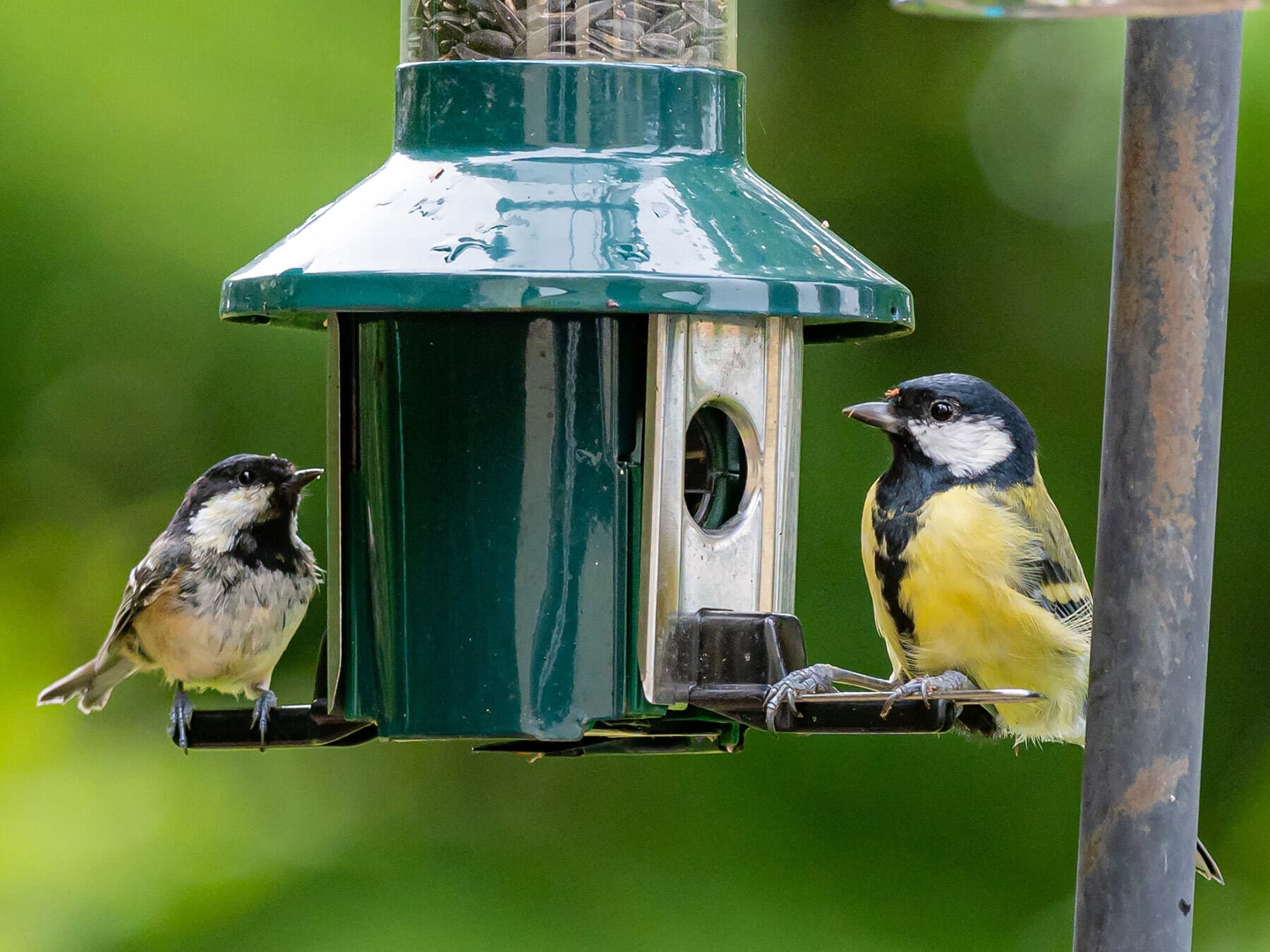
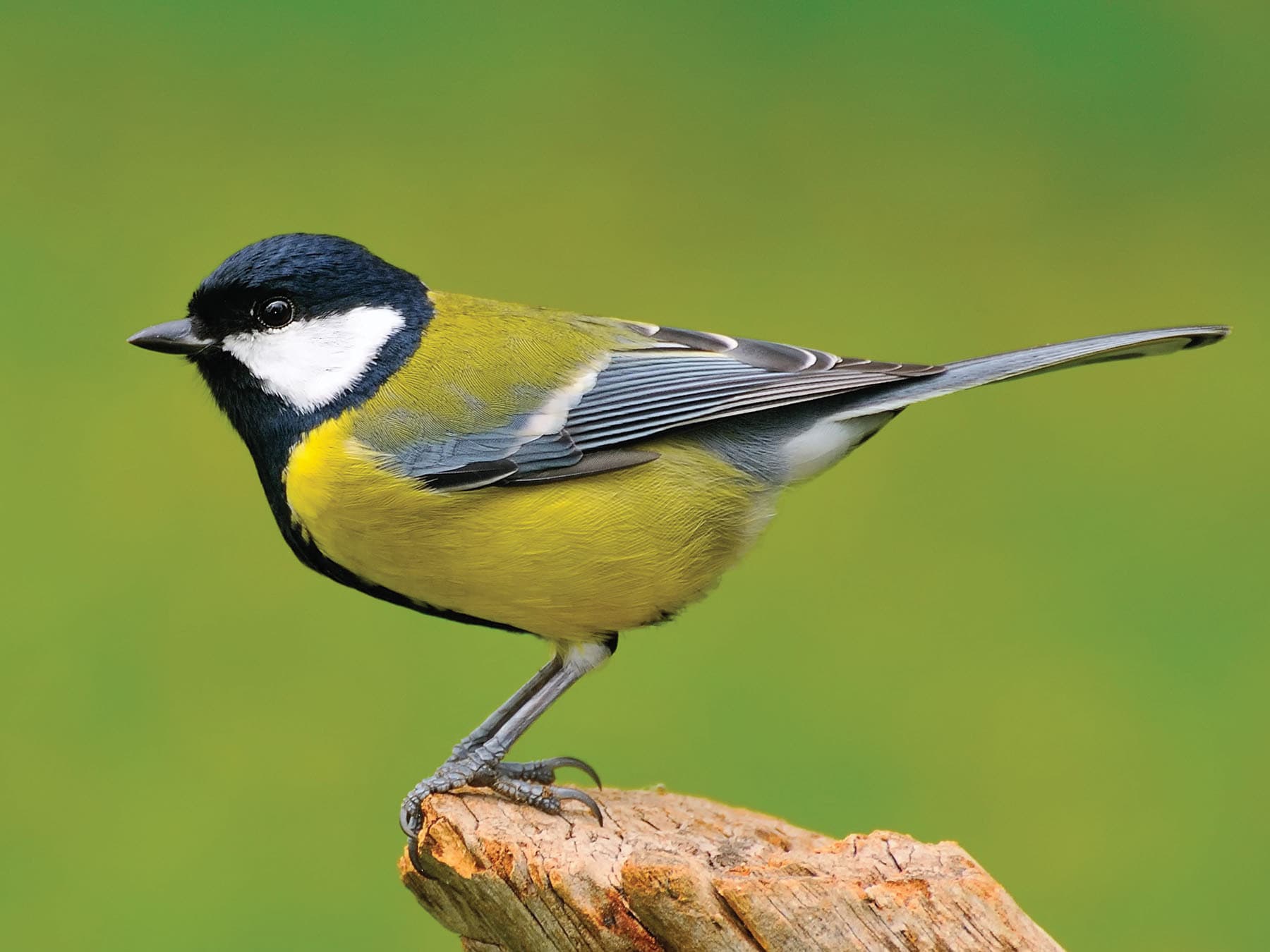
Great Tit. A Great Tit is much bigger, about 14 cm.4 It has a yellow breast split by a black stripe, a greenish back and one white wing bar, and its nape shows at most a small whitish spot.5 Side by side, with photos: Coal Tit or Great Tit?
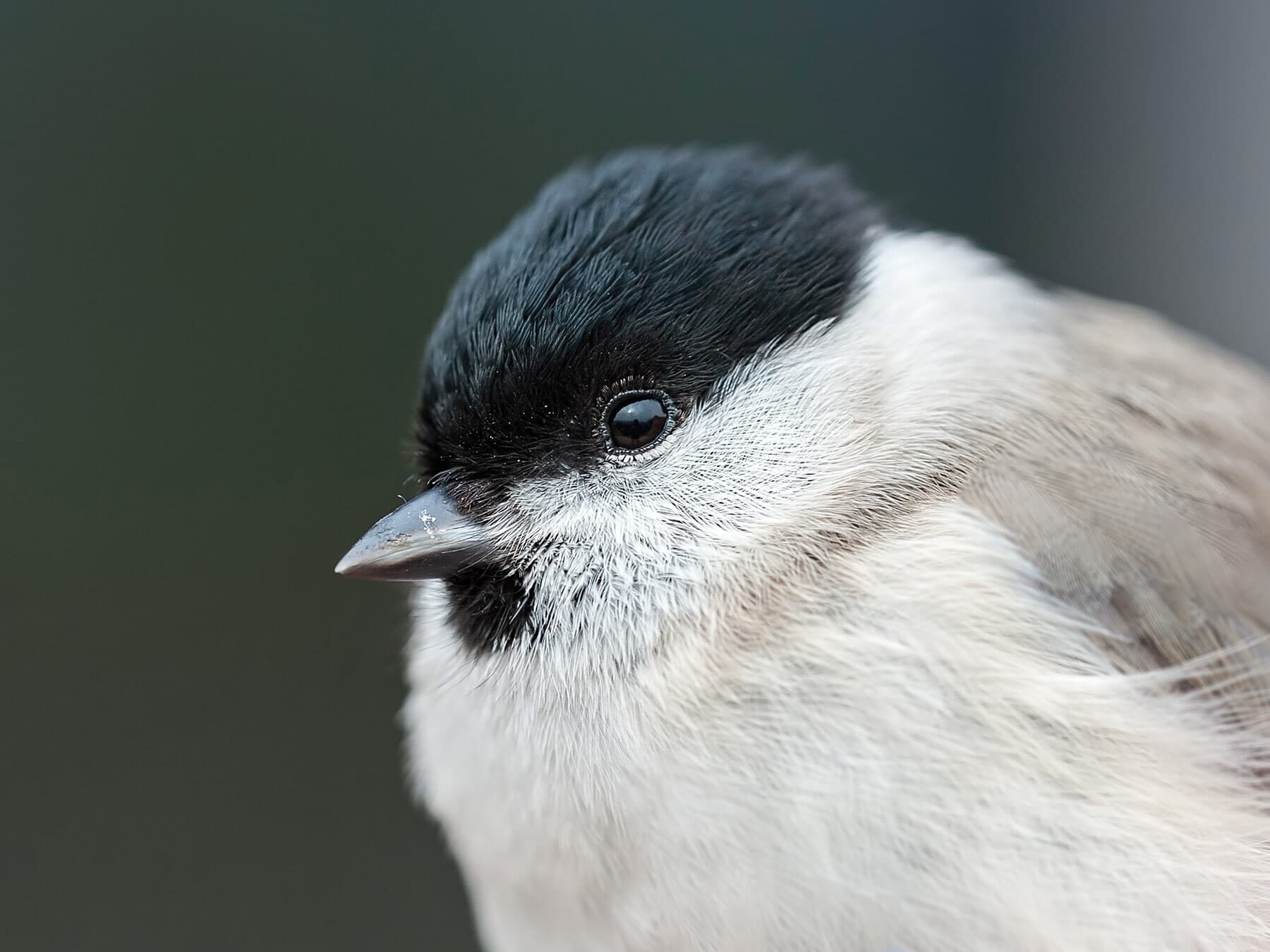
Marsh and Willow Tits. Both have a black cap and bib, but a Marsh Tit is mainly brown6, and a Willow Tit is mid-brown with a sooty cap and a pale panel on the wing.7 Check the back of the head and the wing: a white nape patch and two white wing bars mean Coal Tit.1
Blue Tit. A Blue Tit has a blue cap and wings and yellow underparts, so it is easy to tell apart once seen well. Blue and Great Tits both join Coal Tits in winter flocks.
Its size
Adults- Length
- 10–12 cm
- Wingspan
- 17–21 cm
- Weight
- 8–10 g
Its song and calls
The song is a phrase of two or three notes repeated several times at varying speed, something like "peechoo-peechoo-peechoo". Birds of the World gives March to September as the song season.
Each male has up to 16 slightly different song types, and females sing too, usually more quietly. One call is a mellow or plaintive "pui" or "tsuee"; there is also a thin "sisisi" much like a Goldcrest's. The alarm is a run of sharp "pwee" notes, and at the nest the adults, usually the female, and the feathered young give a long hiss when a predator comes near. Listen to recordings and see them drawn as spectrograms: Coal Tit song and calls.
- Song0:00 / 0:11
Recorded in Vale of Glamorgan, Wales · March 2024
- Calls0:00 / 0:10
Recorded in Île-de-France, France · December 2019
When and where to see it
OctoberIn season
Most recorded in October
- 1. Down5.0%
- 2. Longford3.4%
- 3. Cardiff2.8%
- 4. West Dunbartonshire2.8%
- 5. Perthshire and Kinross2.6%
Each dot is a county, state or province: the bigger and darker, the larger the bird’s share of that place’s bird records that month. Grey dots: no regular records. The ringed point is the centre of the bird’s records this month; the arrow shows how it moved since last month, and the dashed loop its path through the year. “Arrivals” colours places where it becomes regular this month (orange) or is in its last regular month (grey). GBIF eBird Observation Dataset, 2019–2024. Map data: Natural Earth, US Census Bureau; place centres © OpenStreetMap contributors.
In your area
See when the Coal Tit is recorded in your county, state or province.
How often the Coal Tit turns up in the UK and Ireland through the year, from birdwatchers' records.
United Kingdom
Resident · all year · most records in January
Ireland
Resident · all year · most records in April
Show as a table
| Month | United Kingdom | Ireland |
|---|---|---|
| January | 0.92% (regular) | 0.88% (regular) |
| February | 0.91% (regular) | 0.88% (regular) |
| March | 0.82% (regular) | 0.93% (regular) |
| April | 0.64% (regular) | 0.93% (regular) |
| May | 0.47% (regular) | 0.66% (regular) |
| June | 0.55% (regular) | 0.74% (regular) |
| July | 0.56% (regular) | 0.56% (regular) |
| August | 0.62% (regular) | 0.55% (regular) |
| September | 0.63% (regular) | 0.53% (regular) |
| October | 0.66% (regular) | 0.64% (regular) |
| November | 0.77% (regular) | 0.73% (regular) |
| December | 0.86% (regular) | 0.89% (regular) |
Recorded regularly in
Worldwide: recorded regularly in 64 countries
Countries where it was recorded in at least 3 of the 6 years 2019–2024. Linked countries have their own bird list.
Europe (43)
- Åland Islands
- Albania
- Andorra
- Austria
- Belarus
- Belgium
- Bosnia & Herzegovina
- Bulgaria
- Croatia
- Czechia
- Denmark
- Estonia
- Finland
- France
- Germany
- Greece
- Hungary
- Ireland
- Isle of Man
- Italy
- Kosovo
- Latvia
- Liechtenstein
- Lithuania
- Luxembourg
- Moldova
- Montenegro
- Netherlands
- North Macedonia
- Norway
- Poland
- Portugal
- Romania
- Russia
- San Marino
- Serbia
- Slovakia
- Slovenia
- Spain
- Sweden
- Switzerland
- Ukraine
- United Kingdom
Data: EOD – eBird Observation Dataset (Cornell Lab of Ornithology), accessed via GBIF.org, CC BY 4.0. Records from 2019–2024, aggregated and filtered by Birdfact. How these lists are made
Coal Tits live across Britain and Ireland all year. In the last national atlas they were found in 87% of the UK's 10-km squares in the breeding season and 89% in winter. The gaps are mostly on high Scottish hills, in the Northern Isles and parts of the Hebrides, and in the Fens.3
They are birds of conifers. BTO surveys find them most often in coniferous woods, and they are most numerous in conifer plantations: densities are highest across Ireland, in the forested parts of Scotland and Wales, and in places such as Thetford Forest and the New Forest. Parks and gardens with conifers suit them too, and in winter they spread more into broadleaved woods and gardens.
Across their wider range Coal Tits breed from sea level to about 1,800 m in Europe, and up to 4,000 m and more in the Himalayas and south-western China.
Spotting tips
Look and listen high in conifers, where Coal Tits work along the outer twigs and hang from cones. In gardens, watch the feeder: Coal Tits take food away to store it. In winter, check flocks of Blue and Great Tits for a smaller bird with a white nape patch.
Do they migrate?
Not in Britain. British Coal Tits stay close to home: very few ringed birds have been found more than 20 km away, and most less than 10 km. The longest move on record within Britain and Ireland was from Northumberland to Bristol, 434 km.8
Coal Tits in Scandinavia and central Europe are different: young birds move south-west in autumn, and in years when the seed crop is poor or fails these movements become irruptions: as many as 35,000 have been counted passing Hanko in southern Finland. In irruption years some reach the south and east coasts of Britain. BTO ringing has ten reports of young Coal Tits ringed in Belgium, the Netherlands, Germany and France and found here.
What it eats
Tiny insects and seeds. Coal Tits take small insects, usually no more than 2 to 3 mm long, such as aphids and other bugs, beetles, and moths and their caterpillars, along with spiders and other small invertebrates, gleaned from needles, twigs and leaves. Their fine bill is ideal for prising seeds from conifer cones, and they eat many seeds: spruce is preferred, but they also take pine, fir, larch, yew, beech, birch and others.
They feed acrobatically, high in the trees, perching on cones and hanging from upright clumps of needles, and sometimes hover to pick insects off the outside of the foliage. They also feed on the ground, especially for fallen beech mast, sweet chestnuts and acorns. Seeds are stabbed repeatedly with the bill to remove the husk, or held under a foot while the outer layer is torn off.
Food storing
Coal Tits are hoarders. From June to December they hide food, mostly spruce seeds, or insects when spruce seed is scarce: in bark crevices and lichen high in trees, at the base of hedges, and in holes in the ground. They come back to these stores in hard winter weather, though how much they depend on them varies from place to place.
In gardens they do the same with food from feeders, taking it away to store for later.1 Remembering where everything is takes a good memory, and in memory tests Coal Tits remembered locations for longer than Great Tits, which do not store food.9
Feeding them in your garden
Coal Tits are regular visitors to most feeders. The RSPB recommends sunflower hearts in a hanging feeder and peanuts or fat balls in a hanging mesh feeder for tits; never use mesh bags, which can trap birds' feet.10
Follow the RSPB's current advice to slow the spread of disease. Put out seed and peanuts only from 1 November to 30 April; between 1 May and 31 October offer only small amounts of fat balls, suet or mealworms. Use hanging feeders rather than flat ones such as bird tables and trays, and clean them every week.11
Nesting and breeding
Coal Tits nest in holes, sometimes right at ground level. The female builds a cup almost entirely of moss, with some hair, wool and feathers, in a hole, usually with a very narrow entrance: in a tree trunk or old stump, an old woodpecker or rodent hole, a crevice in a wall or among rocks, among the roots of a fallen tree, or even in the ground under stones or in a mouse hole.
In Britain a clutch is usually 9 or 10 eggs, small and about 1 g each. The female incubates them for 14 to 16 days, and the chicks leave the nest at 16 to 19 days.3 Both parents feed them. Pairs raise one or two broods a year. Once out of the nest, the young stay together in thick cover for the first few days, rather than following their parents as most young tits do.
Coal Tits use small hole-fronted nest boxes; the BTO recommends a 32 mm entrance hole for tits.12 More detail: Coal Tit nests, eggs and young.
Behaviour
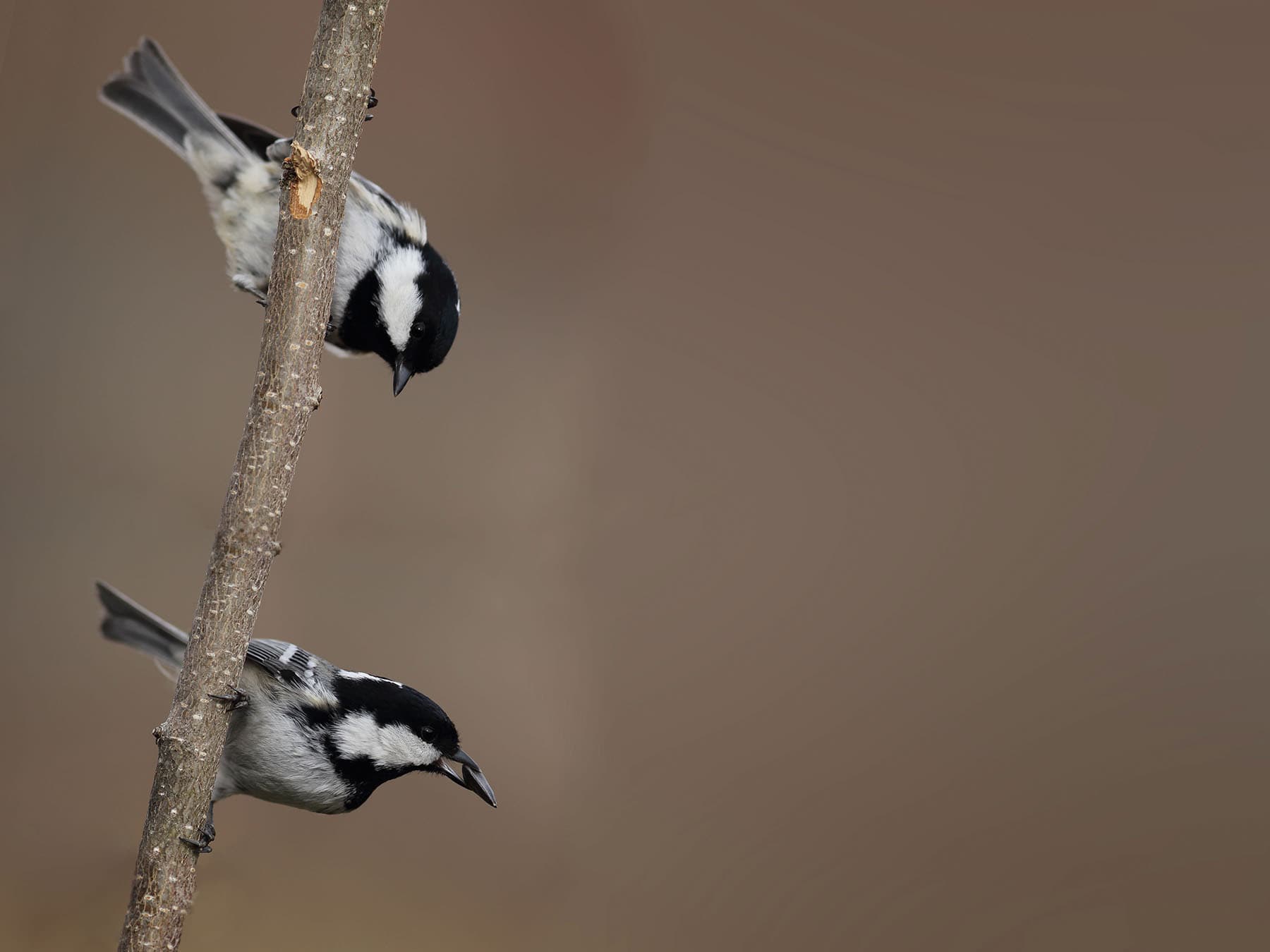
In the breeding season Coal Tits live in pairs and hold territories. Pairs are monogamous, and Birds of the World describes the bond as lifelong: one pair was recorded together for six years. Courtship involves long bouts of wing-shivering with wheezing calls, and the male glides slowly past the female with wings and tail spread; long spells of courtship feeding follow.
In winter they join flocks, often of up to 50 birds, roaming woods and gardens with other tits, Goldcrests and Treecreepers. Blue and Great Tits are both dominant over them.3
Lifespan and predators
A Coal Tit that survives to breed typically lives about 2 years, and first breeds when a year old. About 43% of adults survive from one year to the next. The BTO notes some effect of the cold winters of the 1960s and 1980s on their numbers.
The oldest Coal Tit on the BTO's ringing list is a bird ringed in its first year at Cnoc, Argyll, in October 1999 and caught there by a ringer in December 2008, 9 years 2 months 25 days later.13 It also tops the European longevity list, which estimates its age at 9 years 5 months.14
Conservation
The Coal Tit is on the UK Green List and is of Least Concern worldwide. The BTO estimated 660,000 territories in the UK in 2016. Numbers rose quickly until the mid-1970s and have been fairly stable since; the BTO links the species' modest spread and increase to conifer plantations and evergreens in gardens.3
Recent survey figures agree: UK numbers changed little between 1995 and 2024 (up 5%, not a significant change) and between 2014 and 2024 (down 1%), though Northern Ireland saw an 18% fall over those ten years.15 In Europe there are thought to be 13 to 27 million pairs.
Similar birds
Often mistaken for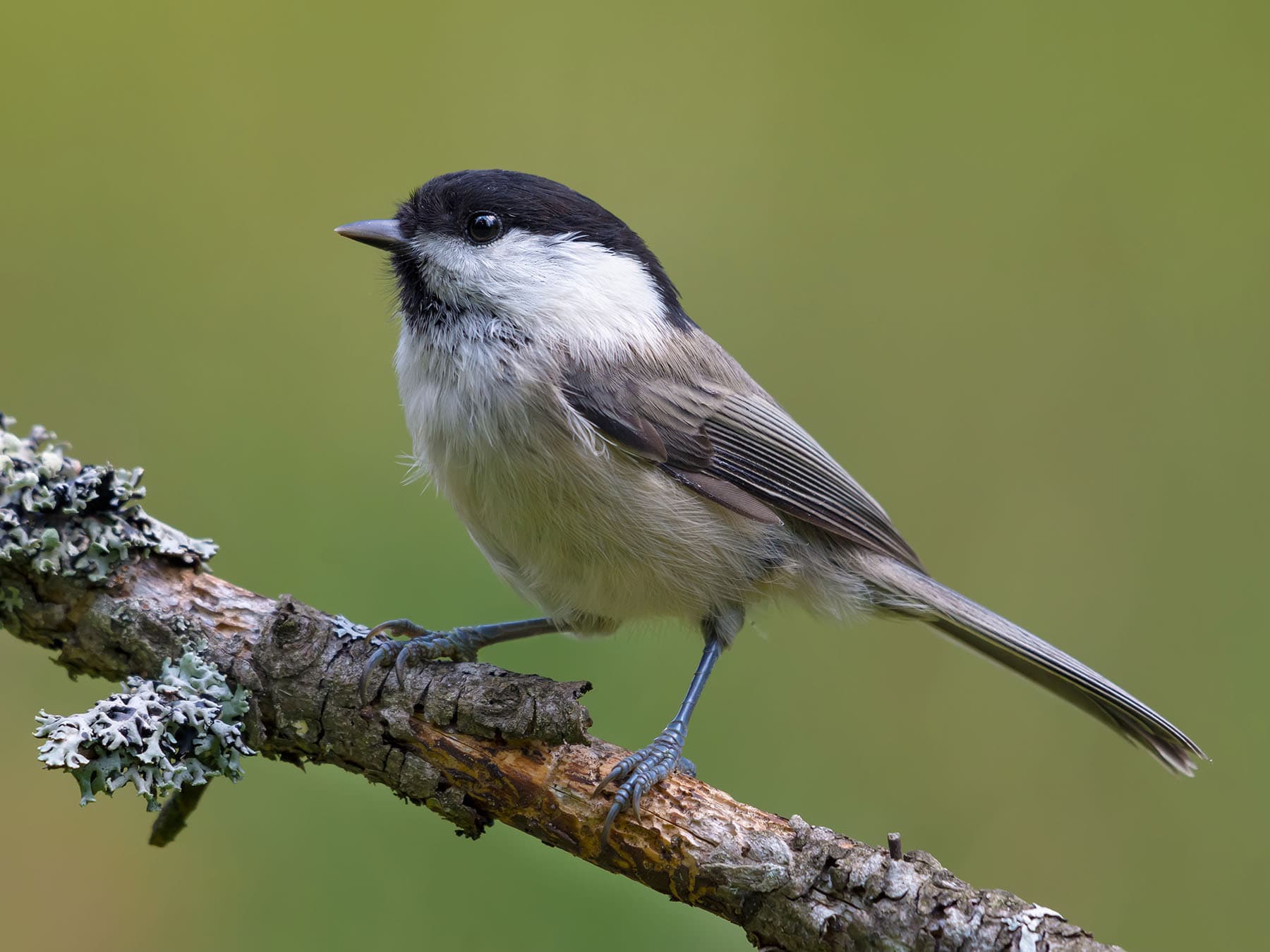
More photos
1 photos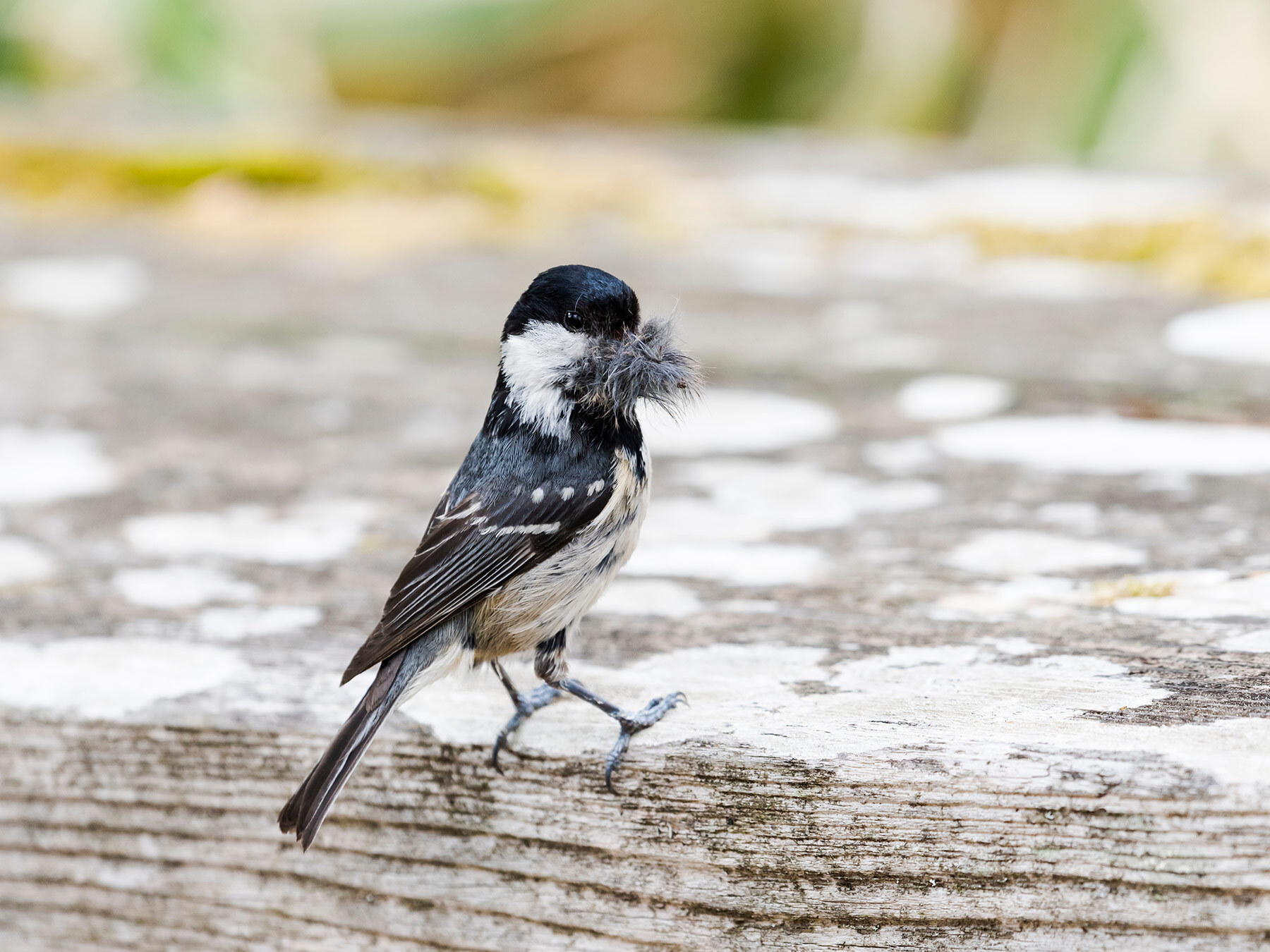
Coal Tit guides
4 guidesQuick facts
- Length
- 10–12 cm
- Wingspan
- 17–21 cm
- Weight
- 8–10 g
- Lifespan
- 2 years · oldest recorded 9.4 years · UK record 9 years 2 months
- Family
- Tits & Chickadees
- Migration
- Resident
- Global status (IUCN)
- Least Concern
- Population trend
- Fairly stable in the UK since the mid-1970s, after an earlier rise; BTO classes 1967-2024 as stable
- Also called
- Cole Tit
- Scientific name
- Periparus ater
Questions
2Are Coal Tits rare?
No. There were about 660,000 territories in the UK in 2016, and the last national atlas found them in 87% of the UK's 10-km squares in the breeding season. See conservation status.
Why do some Coal Tits have yellow cheeks?
Usually because it is a young bird or an Irish Coal Tit: adults of the Irish subspecies have pale yellow cheeks and underparts. See identification.
Sources
19- 1RSPB. Coal tit. RSPB Birds A-Z. Accessed 8 October 2026. Source (opens in a new tab)
- 2Gosler, A. and Clement, P. (2023). Coal Tit (Periparus ater), version 1.1. Birds of the World (B. K. Keeney and S. M. Billerman, editors). Cornell Lab of Ornithology. doi:10.2173/bow.coatit2.01.1 (opens in a new tab)
- 3BTO. Coal Tit (Periparus ater). BTO BirdFacts. Accessed 8 October 2026. Source (opens in a new tab)
- 4RSPB. Great tit. RSPB Birds A-Z. Accessed 6 October 2026. Source (opens in a new tab)
- 5Kirwan, G. M. et al. (2024). Great Tit (Parus major), version 2.0. Birds of the World (G. M. Kirwan and N. D. Sly, editors). Cornell Lab of Ornithology. doi:10.2173/bow.gretit1.02 (opens in a new tab)
- 6RSPB. Marsh tit. RSPB Birds A-Z. Accessed 8 October 2026. Source (opens in a new tab)
- 7RSPB. Willow tit. RSPB Birds A-Z. Accessed 8 October 2026. Source (opens in a new tab)
- 8Robinson, R. A., Leech, D. I. and Clark, J. A. (2025). Summary of all recoveries for Coal Tit (Periparus ater). The Online Demography Report: bird ringing and nest recording in Britain & Ireland in 2024 (BTO). Accessed 8 October 2026. Source (opens in a new tab)
- 9Biegler, R., McGregor, A., Krebs, J. R. and Healy, S. D. (2001). A larger hippocampus is associated with longer-lasting spatial memory. Proceedings of the National Academy of Sciences 98(12): 6941-6944. doi:10.1073/pnas.121034798 (opens in a new tab)
- 10RSPB. How and what to feed your garden birds. RSPB. Accessed 8 October 2026. Source (opens in a new tab)
- 11RSPB (2026). Our latest guidance on feeding garden birds. RSPB news. Accessed 8 October 2026. Source (opens in a new tab)
- 12BTO. Buying a nest box. BTO, Helping birds. Accessed 8 October 2026. Source (opens in a new tab)
- 13BTO. Longevity records for Britain & Ireland in 2024. BTO Online Ringing and Nest Recording Report. Accessed 8 October 2026. Source (opens in a new tab)
- 14Fransson, T., Kolehmainen, T., Moss, D. and Robinson, R. (2023). EURING list of longevity records for European birds (1 September 2023). EURING. Accessed 8 October 2026. Source (opens in a new tab)
- 15Heywood, J. J. N., Massimino, D., Baker, L., Balmer, D. E. et al. (2026). The Breeding Bird Survey 2025. BTO Research Report 802. British Trust for Ornithology, Thetford. Accessed 8 October 2026. Source (opens in a new tab)
- 16RSPB. Bird food buying guide. RSPB Shop. Accessed 8 October 2026. Source (opens in a new tab)
- 17BTO. Nest boxes for birds. BTO, Helping birds. Accessed 8 October 2026. Source (opens in a new tab)
- 18AviList Core Team (2025). AviList: The Global Avian Checklist, v2025b. doi:10.2173/avilist.v2025b (opens in a new tab)
- 19Kirwan, G. M. et al. (2024). Eurasian Blue Tit (Cyanistes caeruleus), version 1.1. Birds of the World (J. del Hoyo, A. Elliott, J. Sargatal, D. A. Christie, E. de Juana and M. G. Smith, editors). Cornell Lab of Ornithology. doi:10.2173/bow.blutit.01.1 (opens in a new tab)

Checked by
Nathan Cope, founder and editor
Nathan founded Birdfact and leads its writers and contributors in the UK, the US and Canada. He has watched and studied birds for more than ten years, and checks every article and species guide before it’s published.