


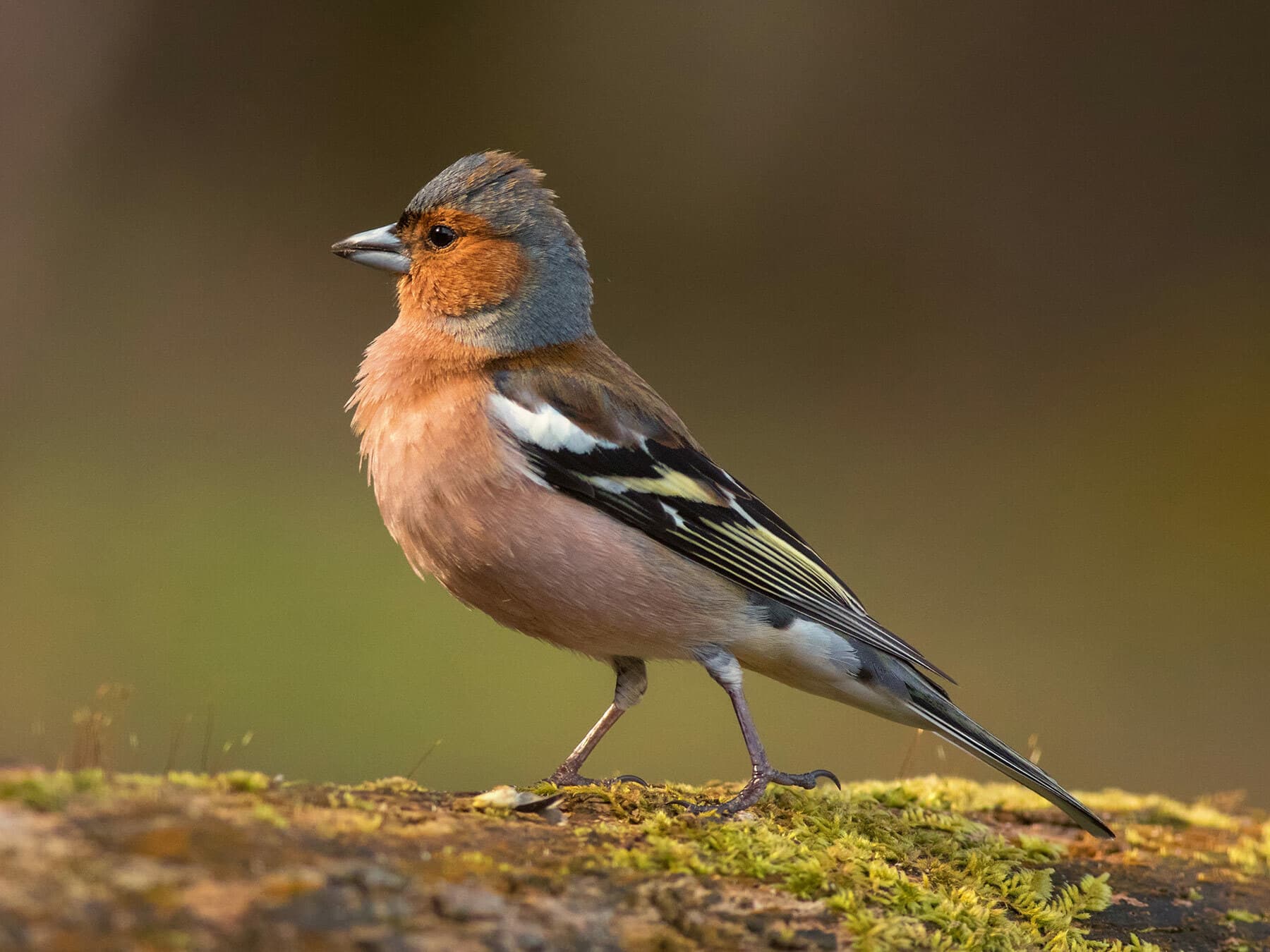
Chaffinch
Common Chaffinch · Fringilla coelebs
By the Birdfact teamChecked by Nathan Cope
See it in 3D
2 plumages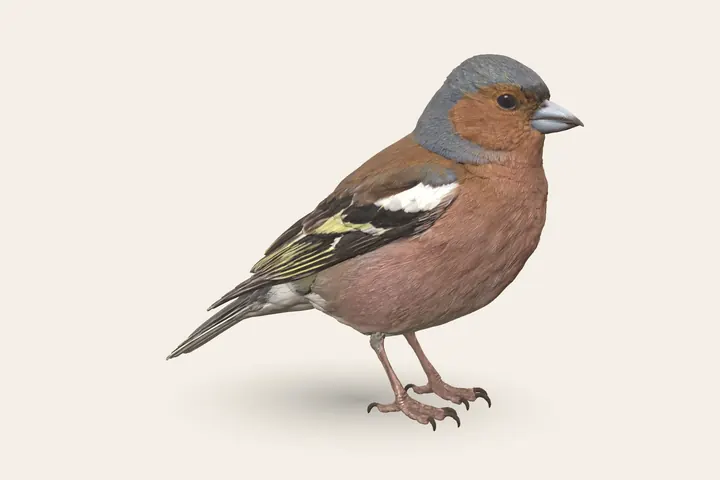 3D model
A Chaffinch is 14–16 cm (5.5–6.5 in) long, bill to tail.
3D model · Male · Length 14–16 cm (5.5–6.5 in) · How we make our birds · Report a problem
© 2026 NC Digital Limited (Birdfact). All rights reserved. This 3D model may be viewed on this page and shared by link only. Downloading, extracting, copying or reusing it, or using it to train machine-learning models, is not permitted without our written permission. Using our models
On this page16 sections
How to recognise it
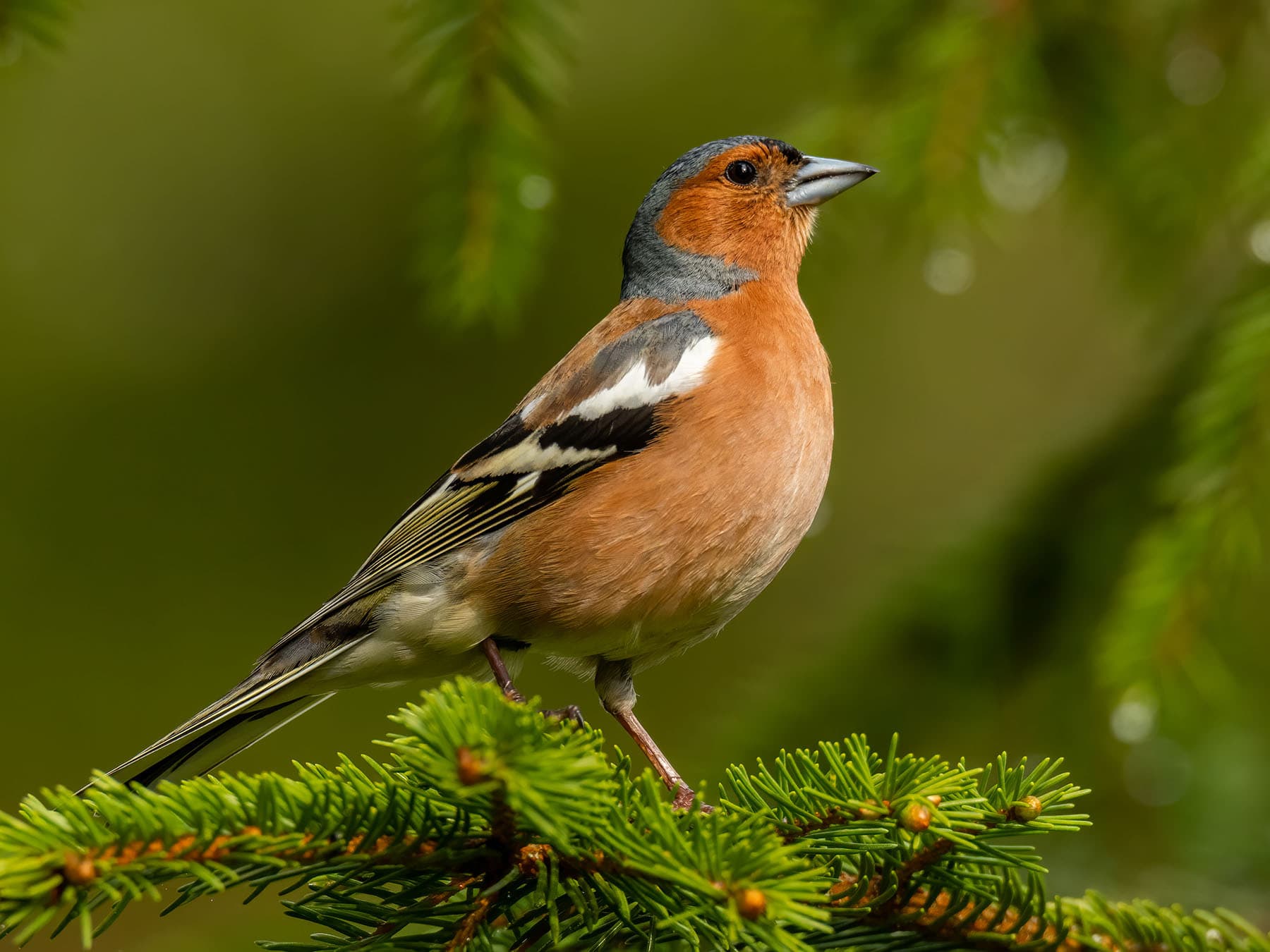
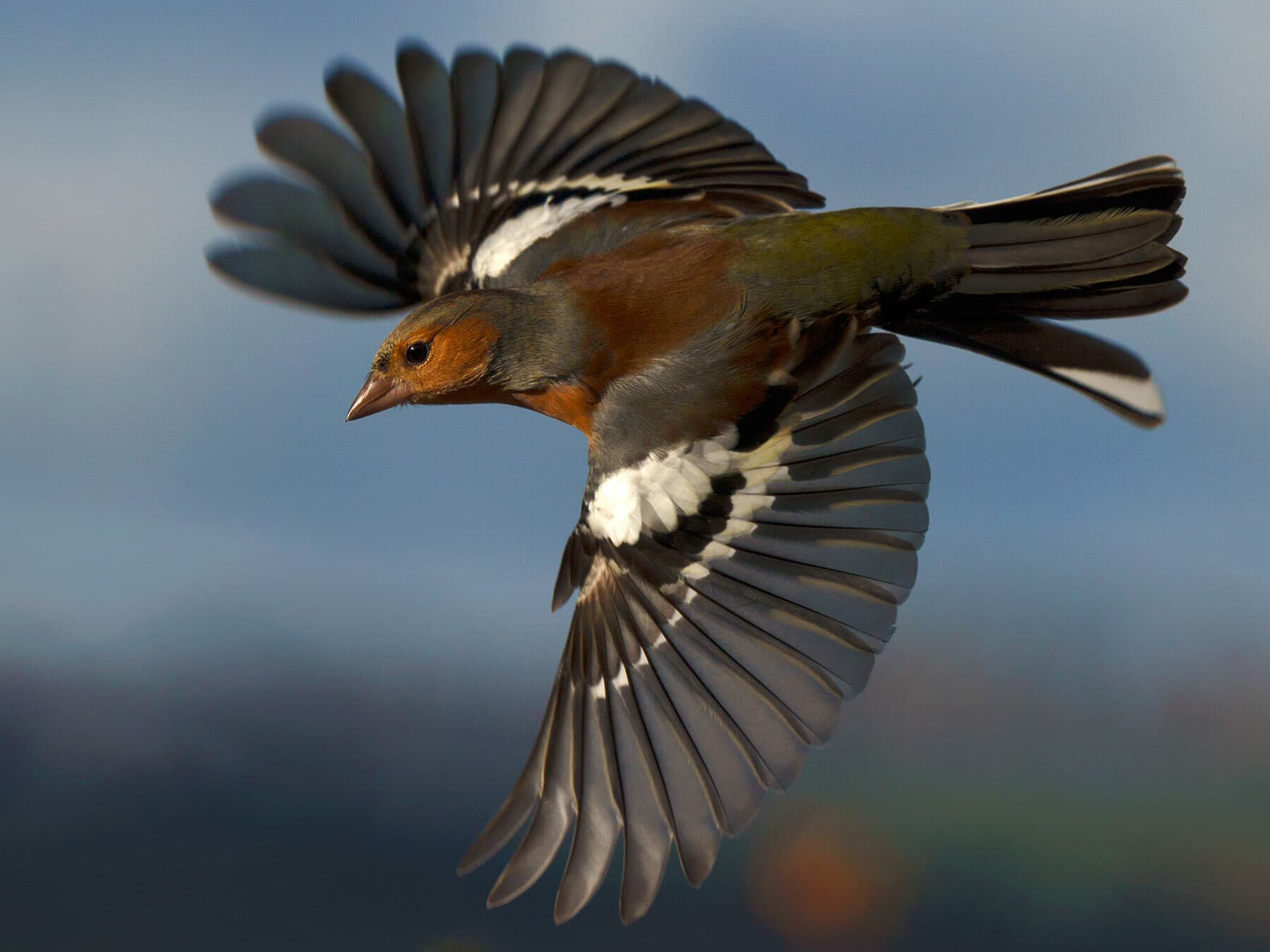
Look for the white in the wings. Every Chaffinch, male or female, has a bold white patch on the shoulder with a white bar below it, and white sides to the tail that flash as it flies off.
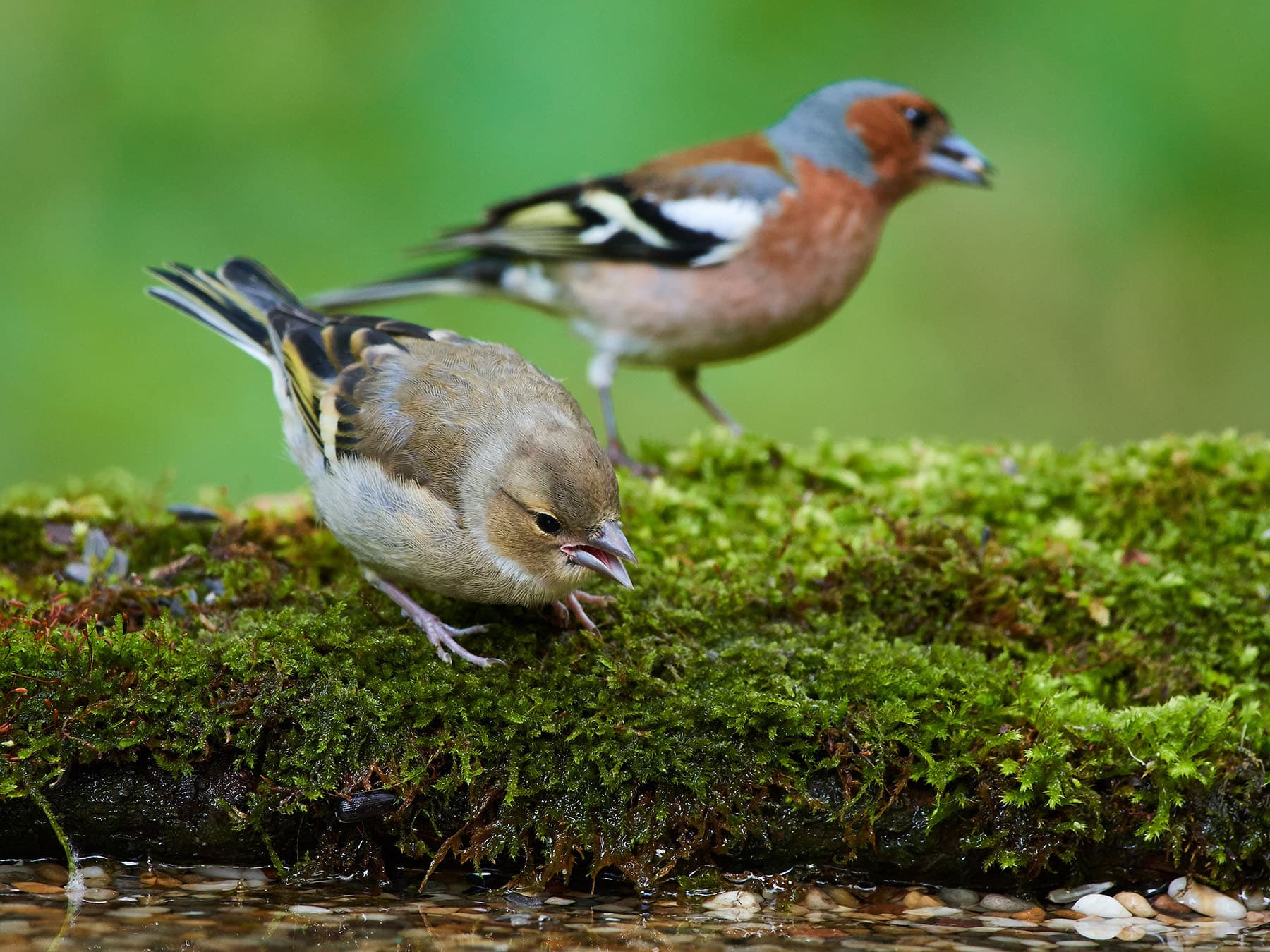
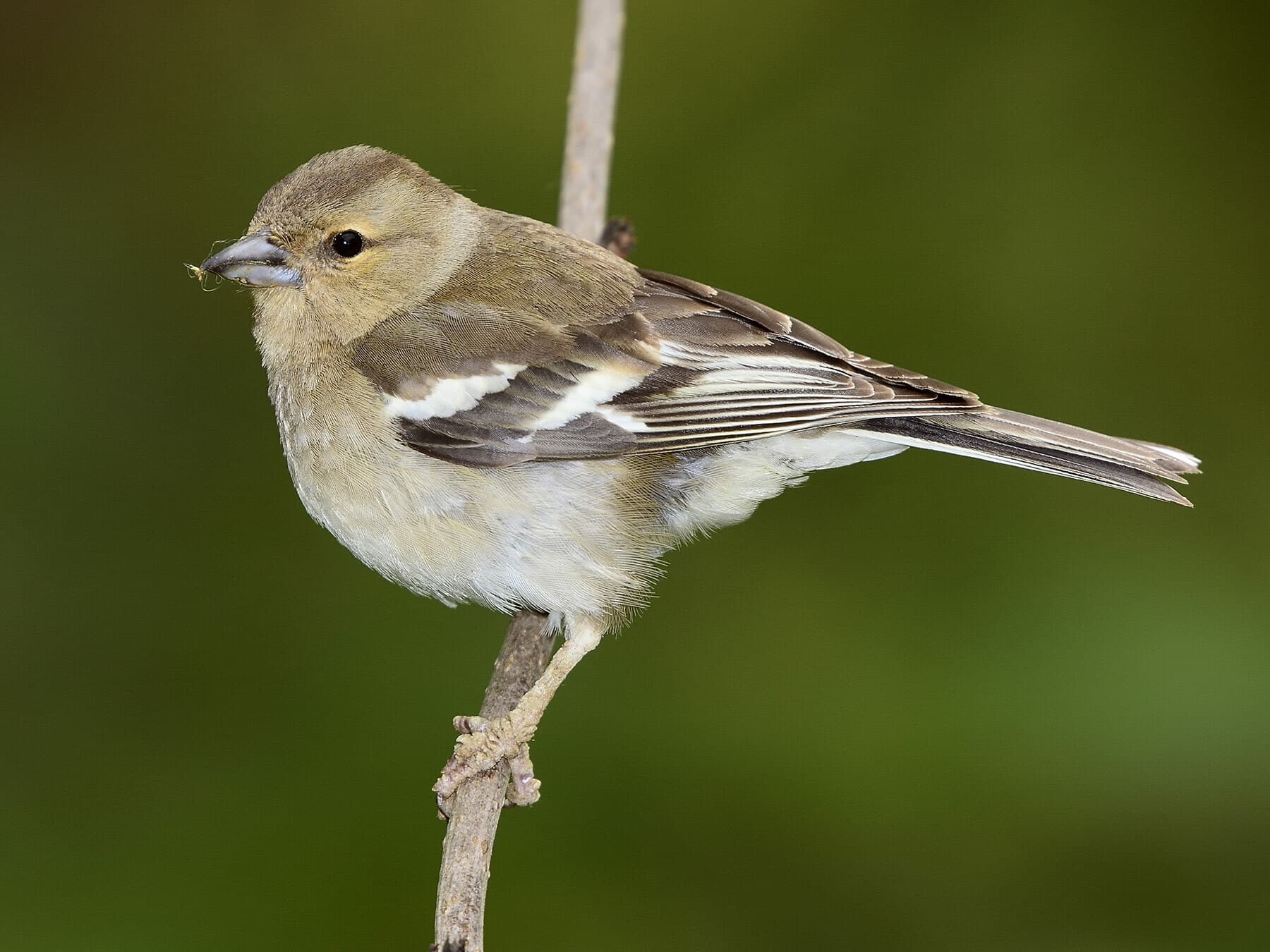
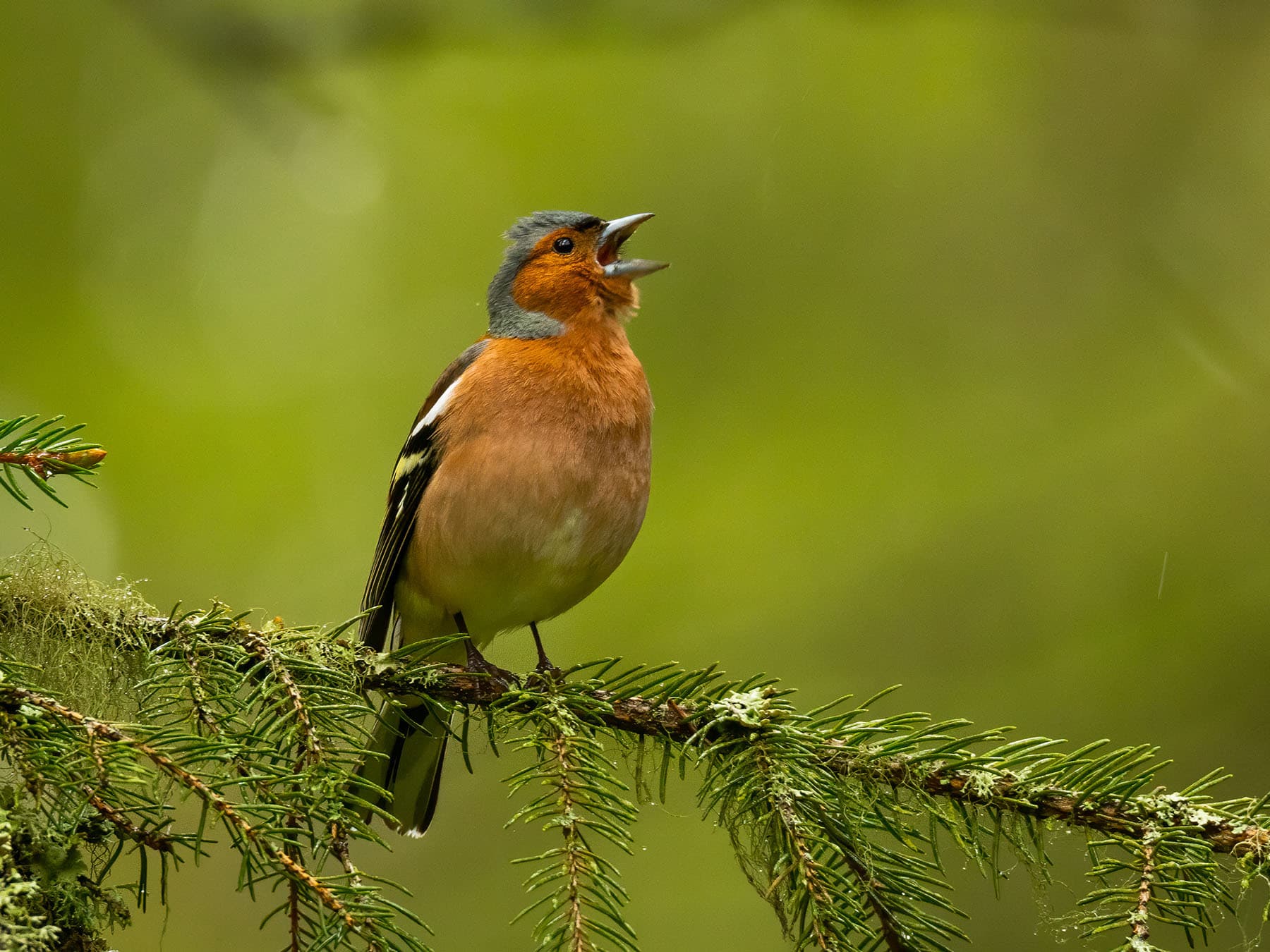
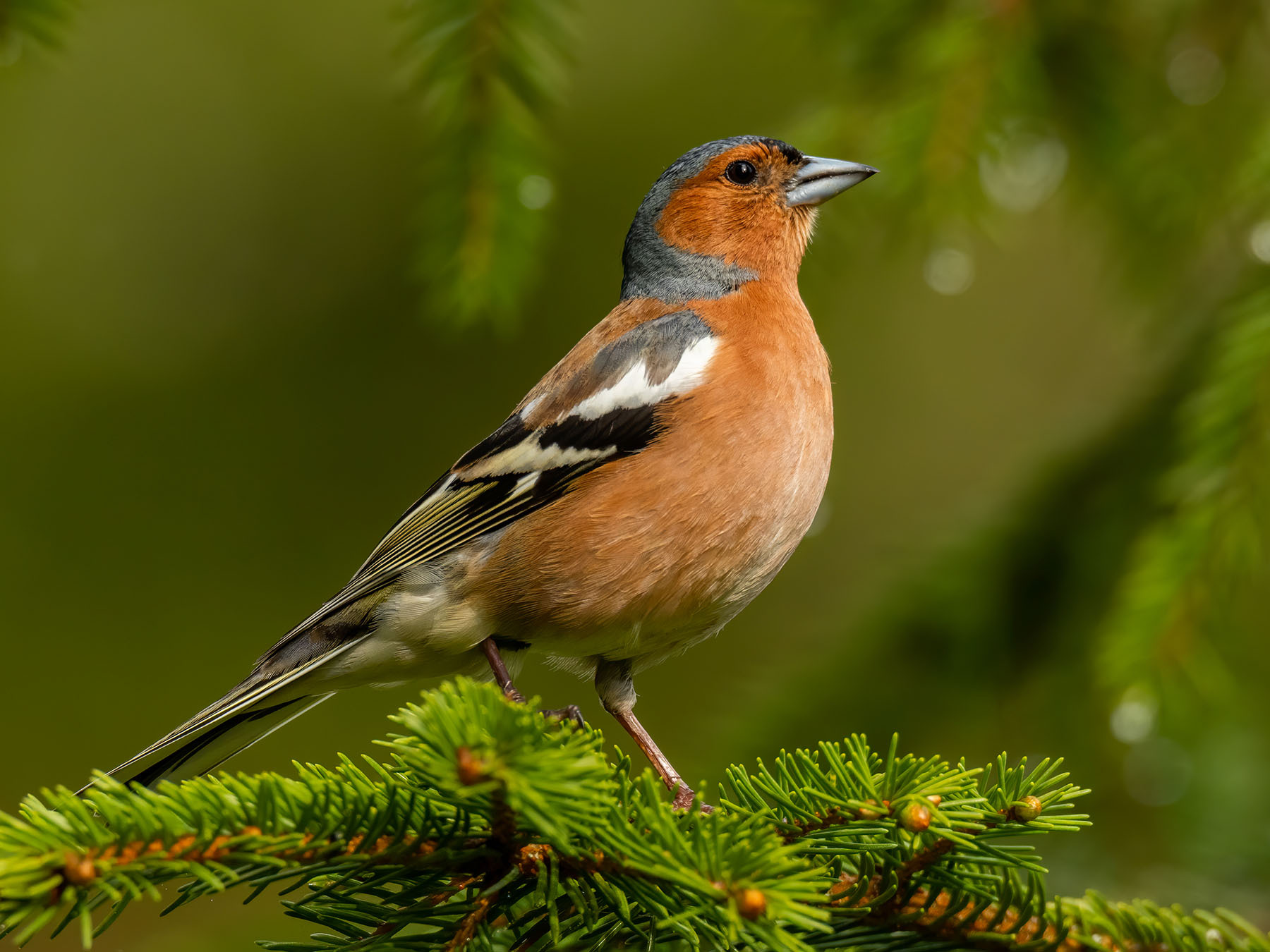
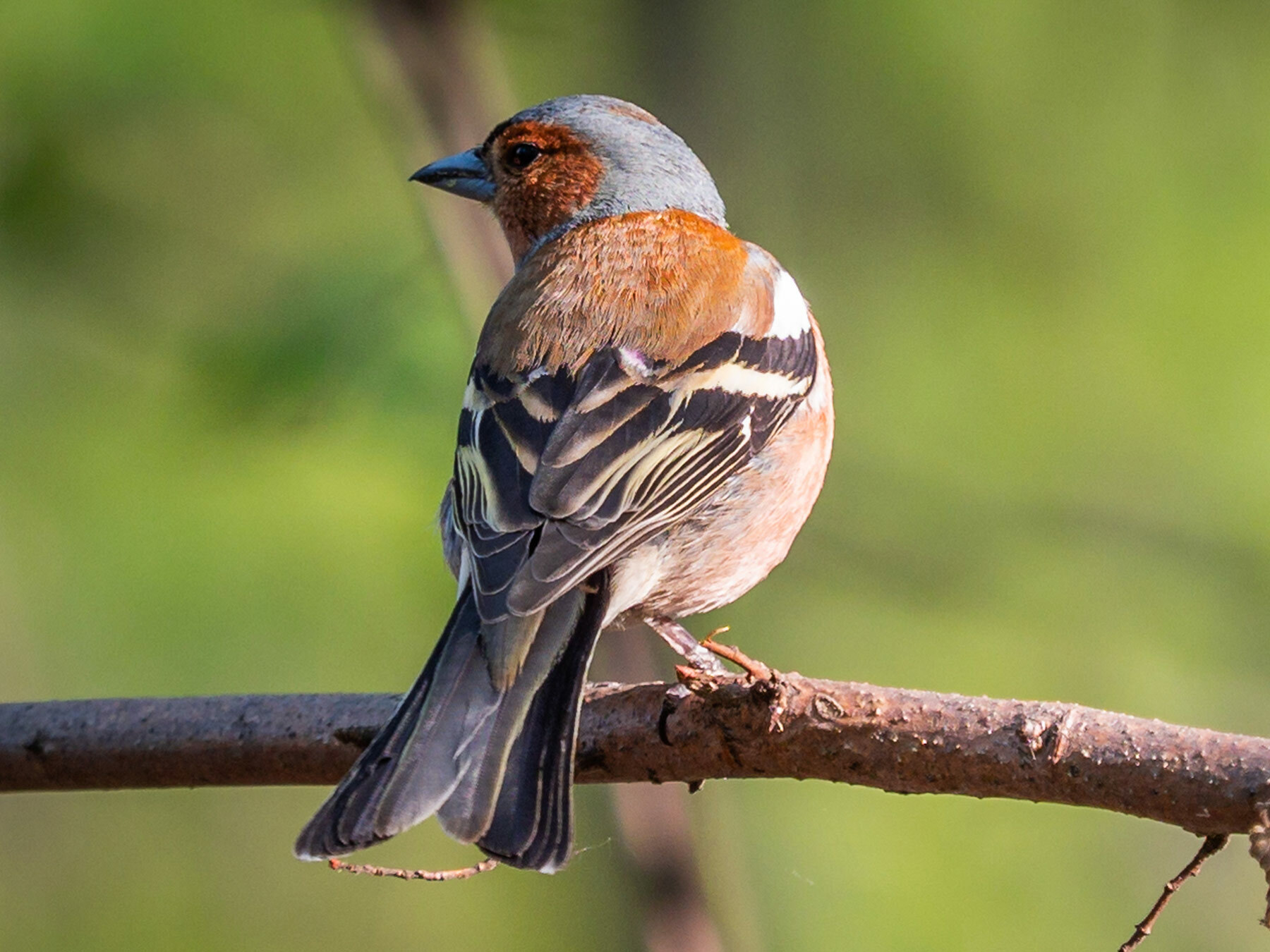
The male is the colourful one: a blue-grey cap and nape, a pinkish-chestnut face and breast, a chestnut back and a yellowish-green rump. The female is a plain olive-brown version of him, buff-grey underneath, with the same white wing pattern.
A Chaffinch is 14.5 cm long, with a wingspan of 24.5 to 28.5 cm, and weighs 18 to 29 g. BTO measurements of live birds put the average adult at 21.8 g, males a little heavier than females.1
British Chaffinches belong to the subspecies gengleri, with a browner face and deeper rufous underparts than most birds on the Continent. In autumn a male looks duller, because his new feathers have brownish tips; these wear off over the winter to reveal the bright spring colours. His bill is blue-grey with a dark tip for most of the year, the female's brownish.
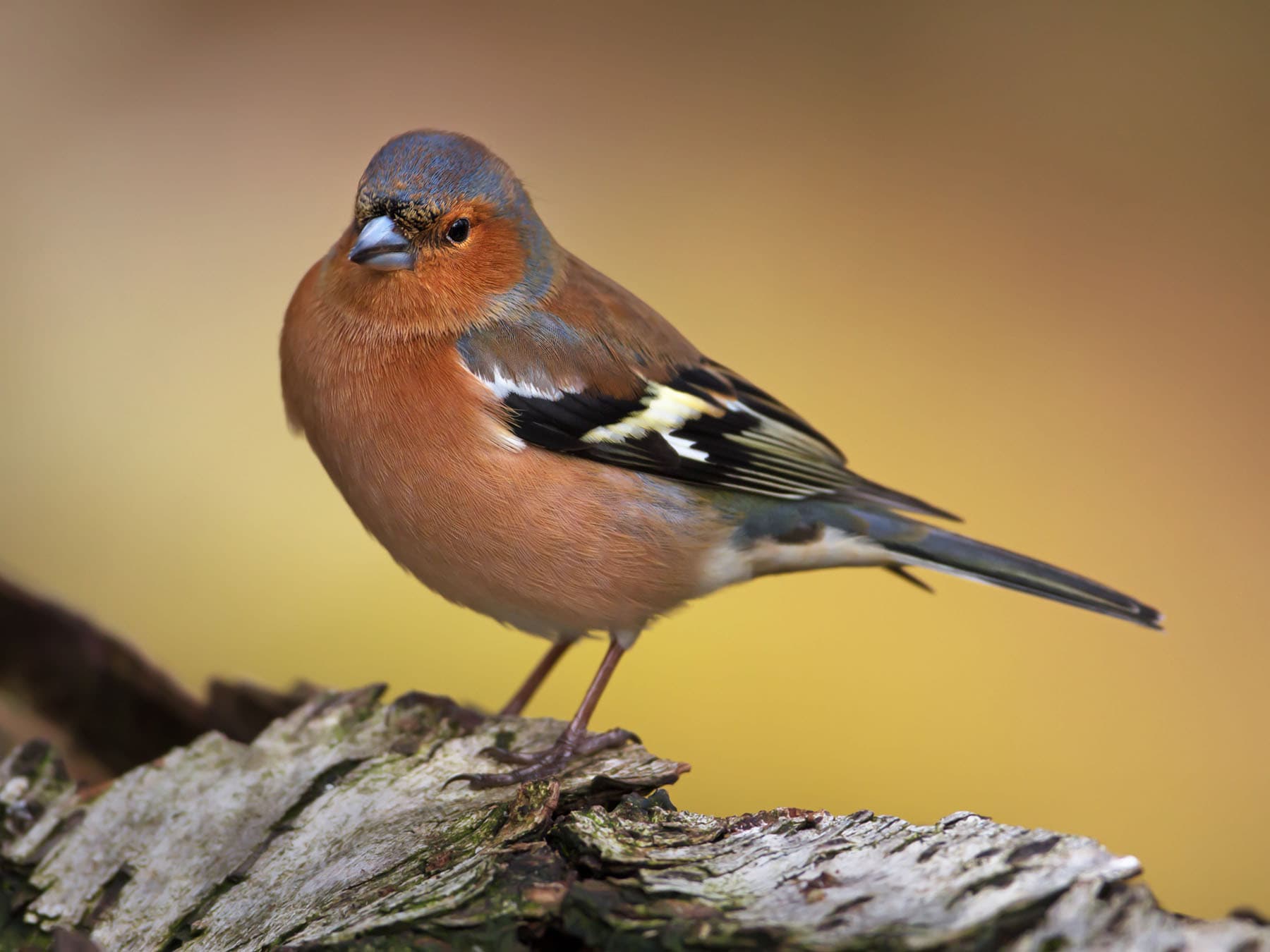
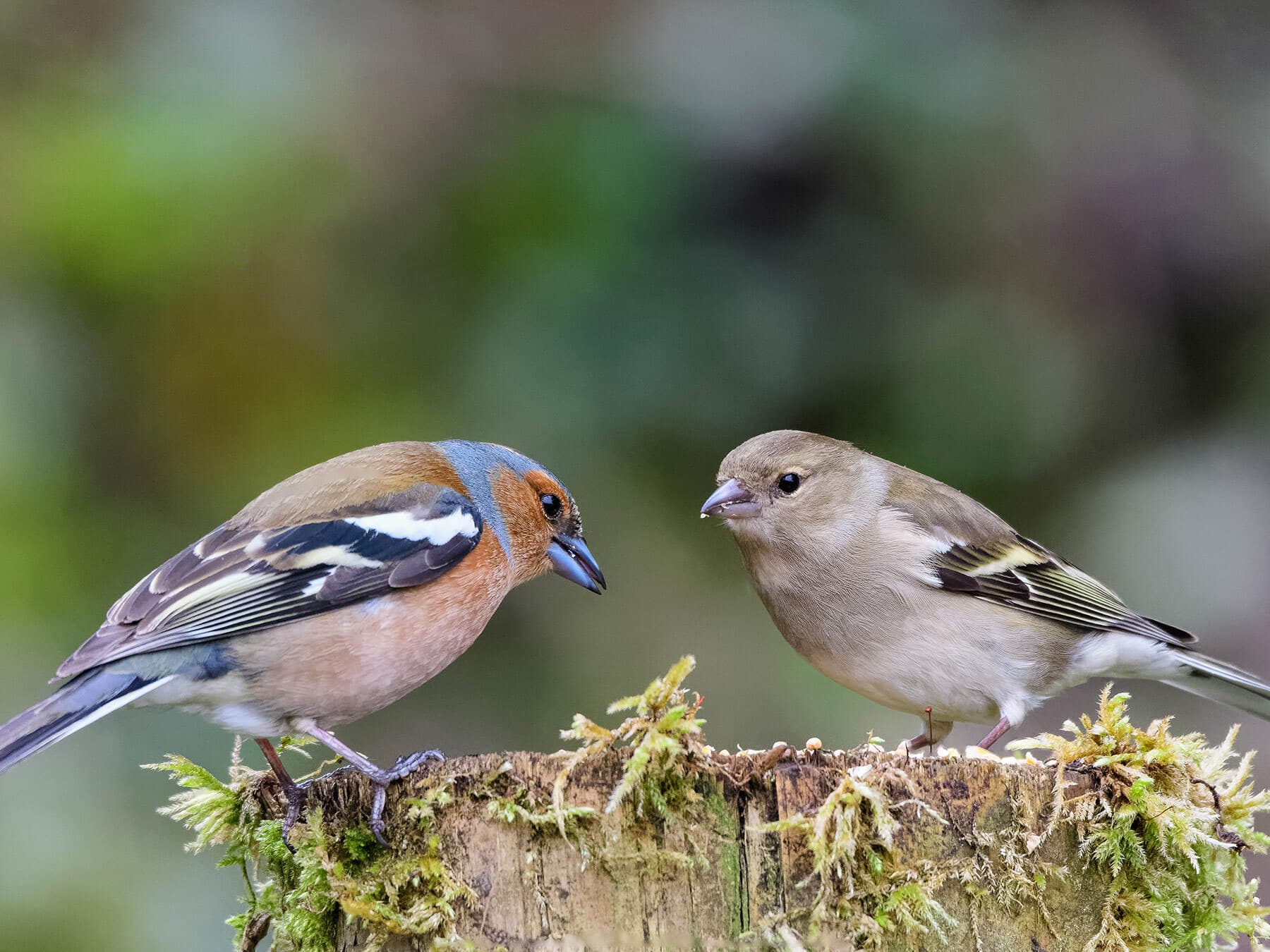
Male, female and young
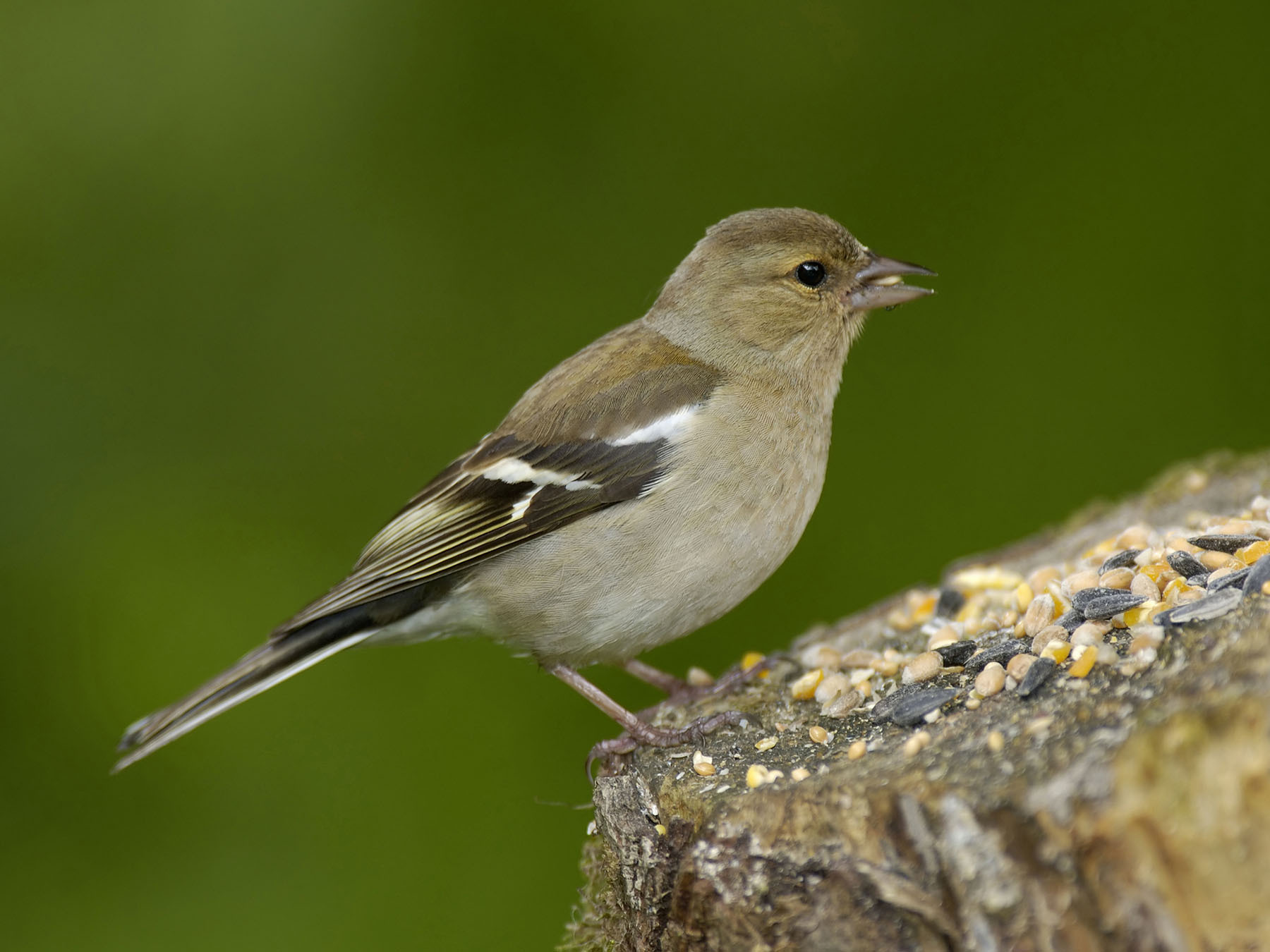
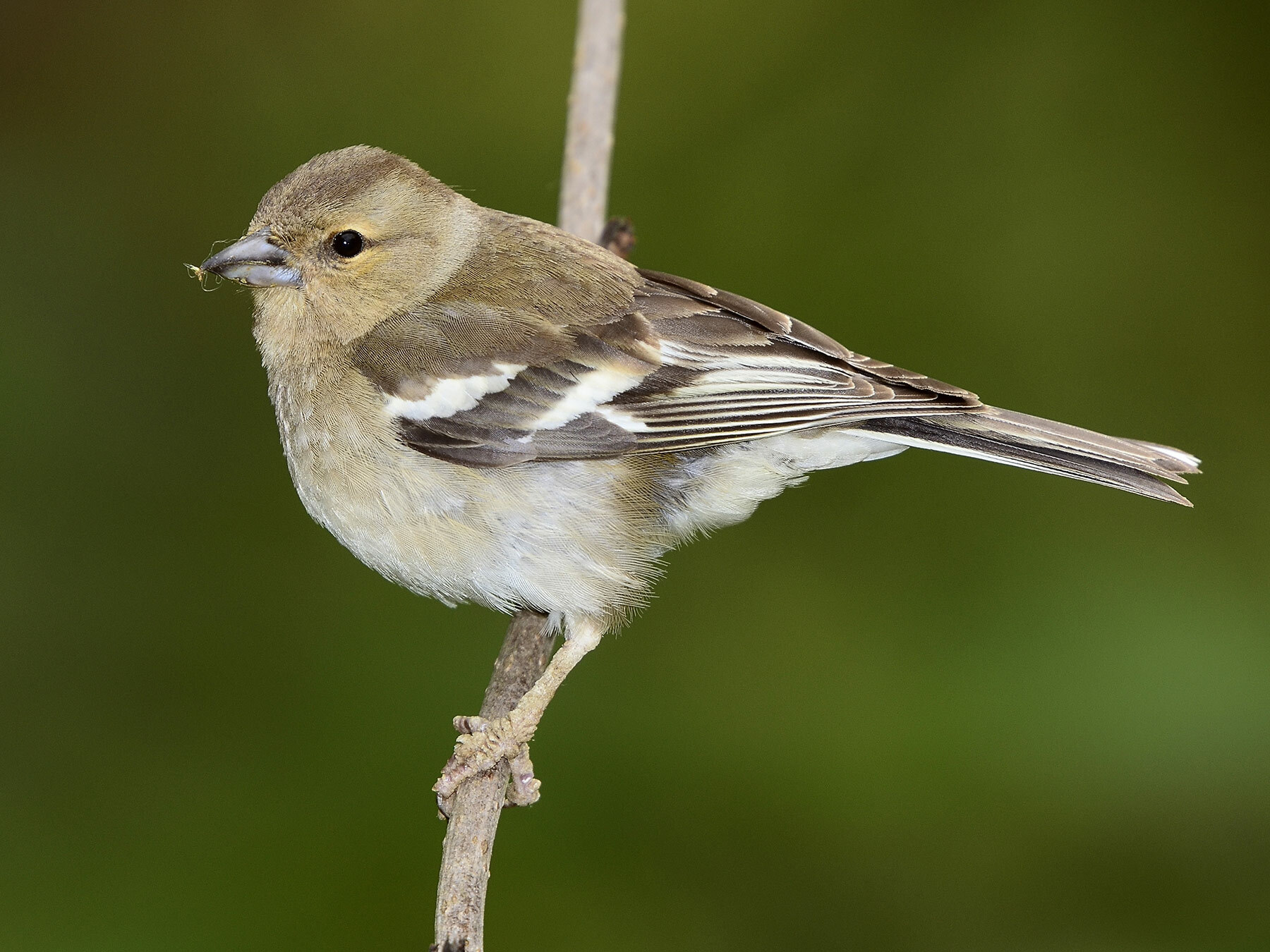
Males and females are easy to tell apart. She has none of his blue-grey or pink: her head and back are greyish olive-brown, with a paler grey nape, and her underparts are dull buff, greyer on the breast. Her bill is brownish horn.
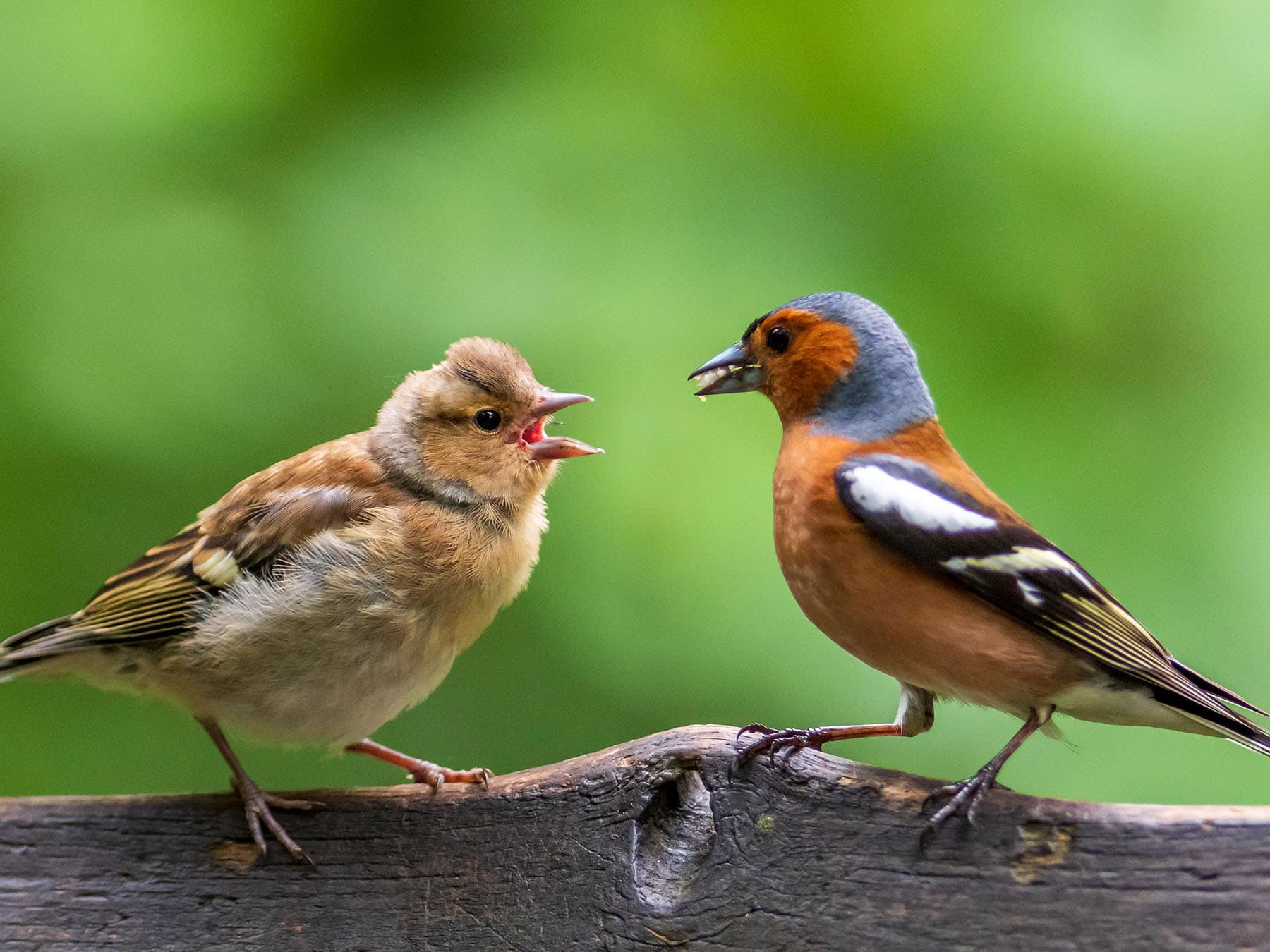
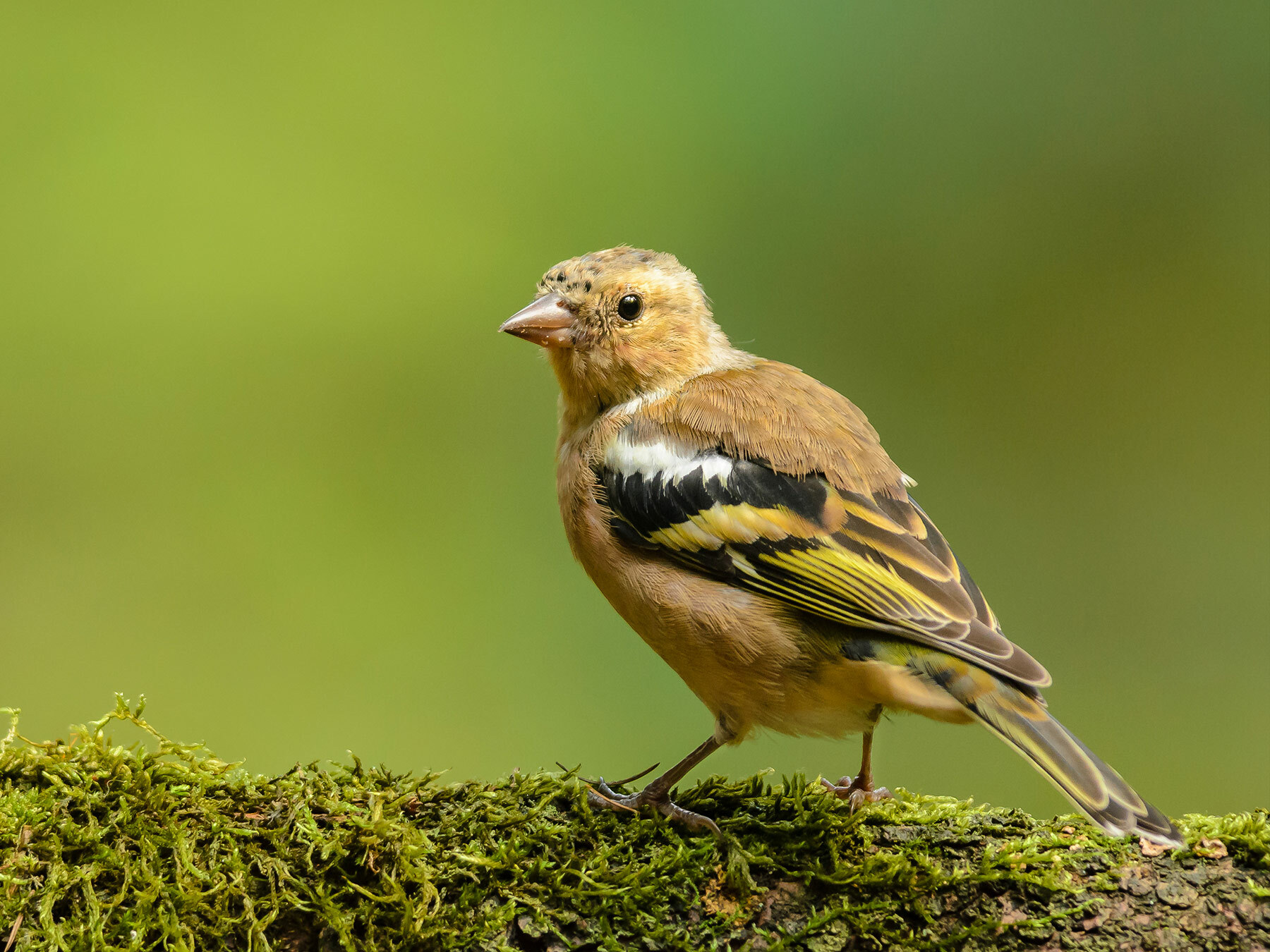
Young Chaffinches, seen in July and August, look like a dull female, and young males and females look alike. Look for a pale buffish patch on the back of the neck. For photos of each and how to tell them apart, see female Chaffinches.
Identification: similar birds
Many people ask whether a bird is a Bullfinch or a Chaffinch. A male Bullfinch has a glossy black cap, a grey back, a deeper, purer pink breast, a stubby black bill and a white rump. He has one broad pale wing bar and no white shoulder patch. See Bullfinch or Chaffinch.
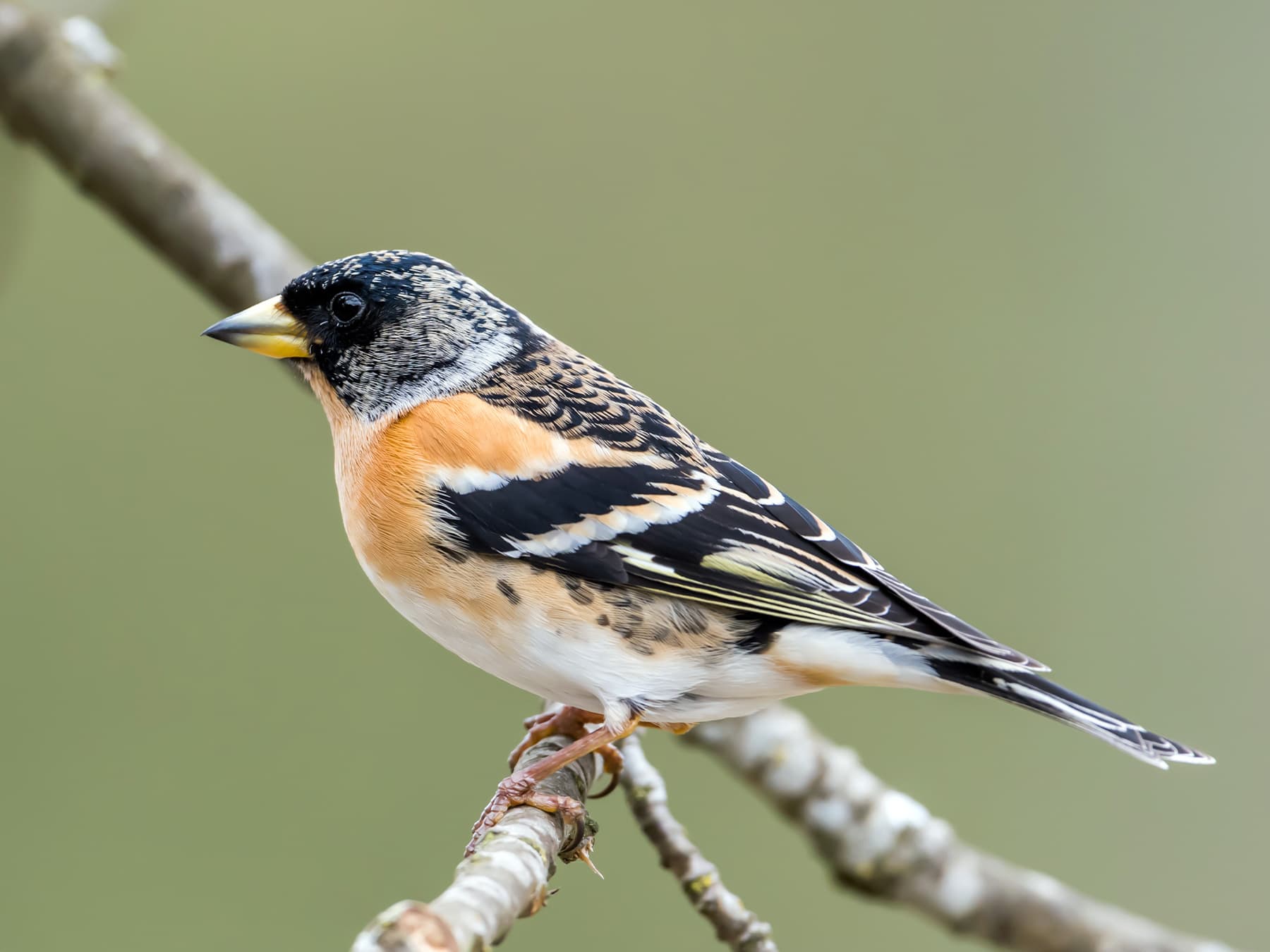
The Brambling, the Chaffinch's northern cousin, comes to Britain only in winter, from October to April, and often feeds with Chaffinches under feeders. Look at the rump as it flies: white on a Brambling of any age, green on a Chaffinch. A Brambling also has orange-brown shoulders and no white sides to its tail.2
Its size
Adults- Length
- 14–16 cm
- Wingspan
- 24.5–28.5 cm
- Weight
- 18–29 g
Its song and calls
You will often hear a Chaffinch before you see it. The song is a short, bright run of notes that tumbles down the scale and speeds up into a flourish at the end, repeated over and over from a perch in a tree or bush. Only males sing it, mainly from March to mid-July.
The commonest call is a sharp pink or chink, sometimes doubled. In flight, listen for a soft tsup. Males also give a loud, drawn-out hooeed, the "rain call", so called because it is often heard on wet or overcast days. It differs from region to region, and is one of the best-documented examples of a call dialect in any bird.3
Song: learned, not inherited
Each male has two to four song types. In experiments at Cambridge in the 1950s, William Thorpe found that young Chaffinches raised alone developed only a rudimentary song, while young birds that heard adults copied the local dialect. It was the start of the modern study of how birds learn to sing.4
- Song0:00 / 0:11
Recorded in Decentralized Administration of Attica, Greece · April 2023
- Call0:00 / 0:11
Recorded in Emilia-Romagna, Italy · April 2025
When and where to see it
OctoberArriving
Most recorded in October
- 1. Offaly4.0%
- 2. Tipperary4.0%
- 3. Longford3.9%
- 4. Stirling3.9%
- 5. Dundee3.7%
Each dot is a county, state or province: the bigger and darker, the larger the bird’s share of that place’s bird records that month. Grey dots: no regular records. The ringed point is the centre of the bird’s records this month; the arrow shows how it moved since last month, and the dashed loop its path through the year. “Arrivals” colours places where it becomes regular this month (orange) or is in its last regular month (grey). GBIF eBird Observation Dataset, 2019–2024. Map data: Natural Earth, US Census Bureau; place centres © OpenStreetMap contributors.
In your area
See when the Chaffinch is recorded in your county, state or province.
How often the Chaffinch turns up in the UK and Ireland through the year, from birdwatchers' records.
United Kingdom
Resident · all year · most records in March
Ireland
Resident · all year · most records in May
Show as a table
| Month | United Kingdom | Ireland |
|---|---|---|
| January | 1.8% (regular) | 1.7% (regular) |
| February | 1.9% (regular) | 1.9% (regular) |
| March | 2.0% (regular) | 2.1% (regular) |
| April | 1.8% (regular) | 2.2% (regular) |
| May | 1.8% (regular) | 2.2% (regular) |
| June | 1.7% (regular) | 2.0% (regular) |
| July | 1.1% (regular) | 1.1% (regular) |
| August | 0.94% (regular) | 0.87% (regular) |
| September | 1.0% (regular) | 0.91% (regular) |
| October | 1.5% (regular) | 1.3% (regular) |
| November | 1.8% (regular) | 1.6% (regular) |
| December | 1.8% (regular) | 1.8% (regular) |
Recorded regularly in
Worldwide: recorded regularly in 76 countries
Countries where it was recorded in at least 3 of the 6 years 2019–2024. Linked countries have their own bird list.
Europe (50)
- Åland Islands
- Albania
- Andorra
- Austria
- Belarus
- Belgium
- Bosnia & Herzegovina
- Bulgaria
- Croatia
- Czechia
- Denmark
- Estonia
- Faroe Islands
- Finland
- France
- Germany
- Gibraltar
- Greece
- Guernsey
- Hungary
- Iceland
- Ireland
- Isle of Man
- Italy
- Jersey
- Kosovo
- Latvia
- Liechtenstein
- Lithuania
- Luxembourg
- Malta
- Moldova
- Monaco
- Montenegro
- Netherlands
- North Macedonia
- Norway
- Poland
- Portugal
- Romania
- Russia
- San Marino
- Serbia
- Slovakia
- Slovenia
- Spain
- Sweden
- Switzerland
- Ukraine
- United Kingdom
Africa (5)
Asia (20)
- Armenia
- Azerbaijan
- China
- Cyprus
- Georgia
- India
- Iran
- Iraq
- Israel
- Jordan
- Kazakhstan
- Kyrgyzstan
- Lebanon
- Mongolia
- Nepal
- Pakistan
- Palestinian Territories
- Tajikistan
- Turkey
- Uzbekistan
Oceania (1)
Data: EOD – eBird Observation Dataset (Cornell Lab of Ornithology), accessed via GBIF.org, CC BY 4.0. Records from 2019–2024, aggregated and filtered by Birdfact. How these lists are made
Almost anywhere with trees: gardens, parks, woods of every kind, hedgerows and farmland. The Chaffinch bred in 94% of the UK's 10-km squares in the last national atlas, missing only parts of the Northern Isles and Outer Hebrides and a few west-coast squares in Ireland.1
You can see Chaffinches in every month. In winter they gather in flocks on stubble fields and under bird feeders, often with Bramblings, Greenfinches and House Sparrows.
Spotting tips
In spring, listen for the song: a singing male sits up on the top of a bush or a branch. In winter, look on the ground under feeders and hedges, where Chaffinches shuffle along in little hops and steps, nodding their heads as they pick up seed.
Do Chaffinches migrate?
British Chaffinches hardly move: 90% of ringing recoveries come from within 5 km of where the bird hatched. But every autumn large numbers arrive from Scandinavia and Finland. They reach south-east England mainly in the second half of October, spread north and west to Wales and Ireland, and leave again from late February to early May, males first.3 One study puts the winter increase at 30 to 50%.5
That explains the scientific name. Linnaeus called the Chaffinch coelebs, "bachelor", because the winter flocks he saw in Sweden were mostly males: the females had gone further south. Ringing shows the same split here, with winter migrants in Britain mostly males and those in Ireland mostly females.
What it eats
Seeds for much of the year, insects in spring and summer. On the ground they pick up fallen seeds of weeds, grasses, cereals and trees such as beech; in spring they eat tree buds and hunt small insects and other invertebrates in trees and bushes. Their chicks are raised almost entirely on insects, mainly caterpillars and aphids.
More detail, from the seasons to feeding in gardens: what Chaffinches eat.
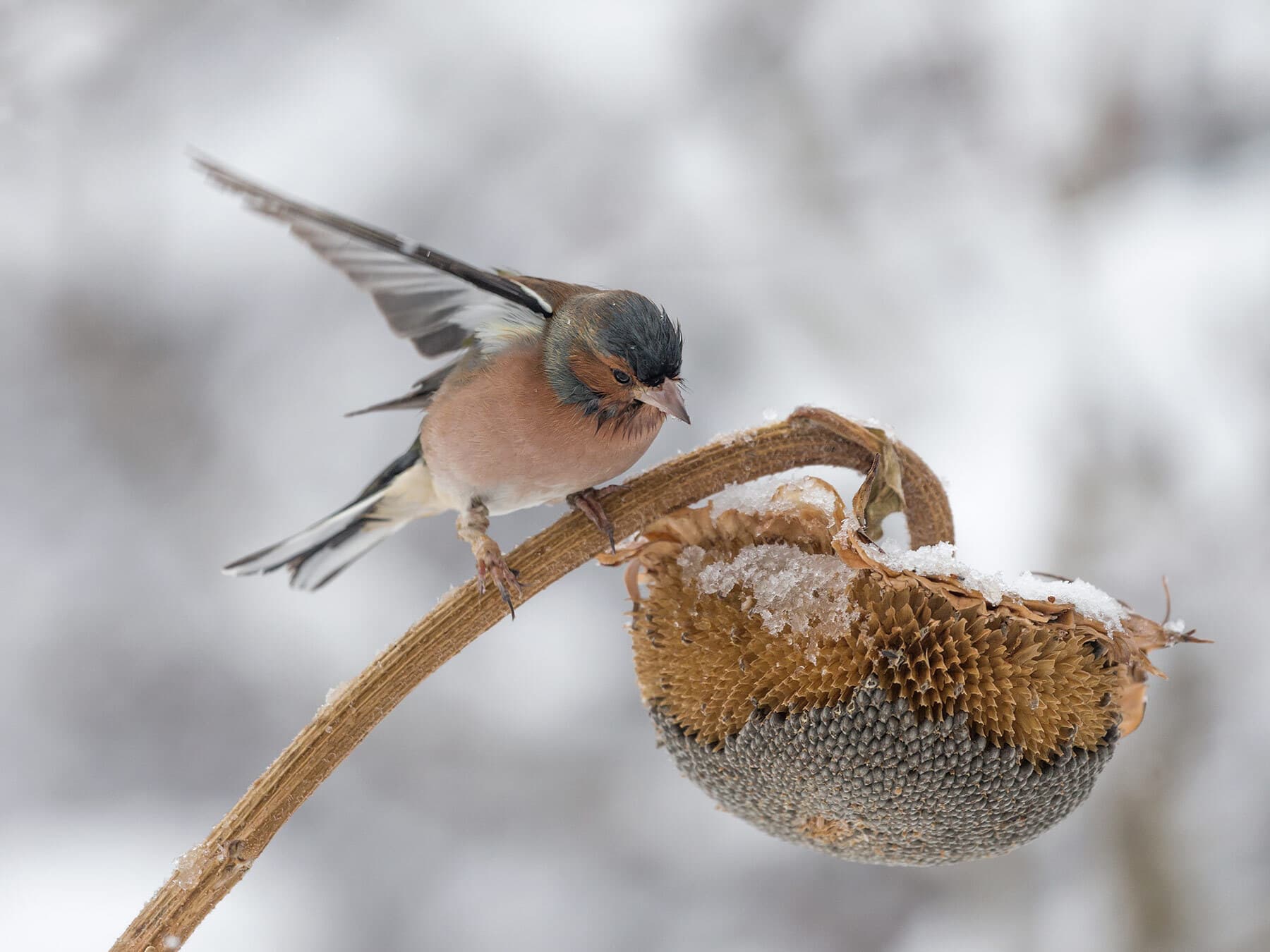
Feeding them in your garden
Chaffinches often feed on the ground under a feeder or bird table rather than on it. Sunflower hearts and a good seed mix, with little cereal, suit finches.
The RSPB's latest guidance (July 2026) is to put out seed only from 1 November to 30 April and pausing it from 1 May to 31 October, when disease spreads most easily; in summer it suggests small amounts of mealworms, fat or suet, which finches are less drawn to. Use hanging feeders rather than tables or trays, clean them every week and change the water every day.6
Nesting and breeding
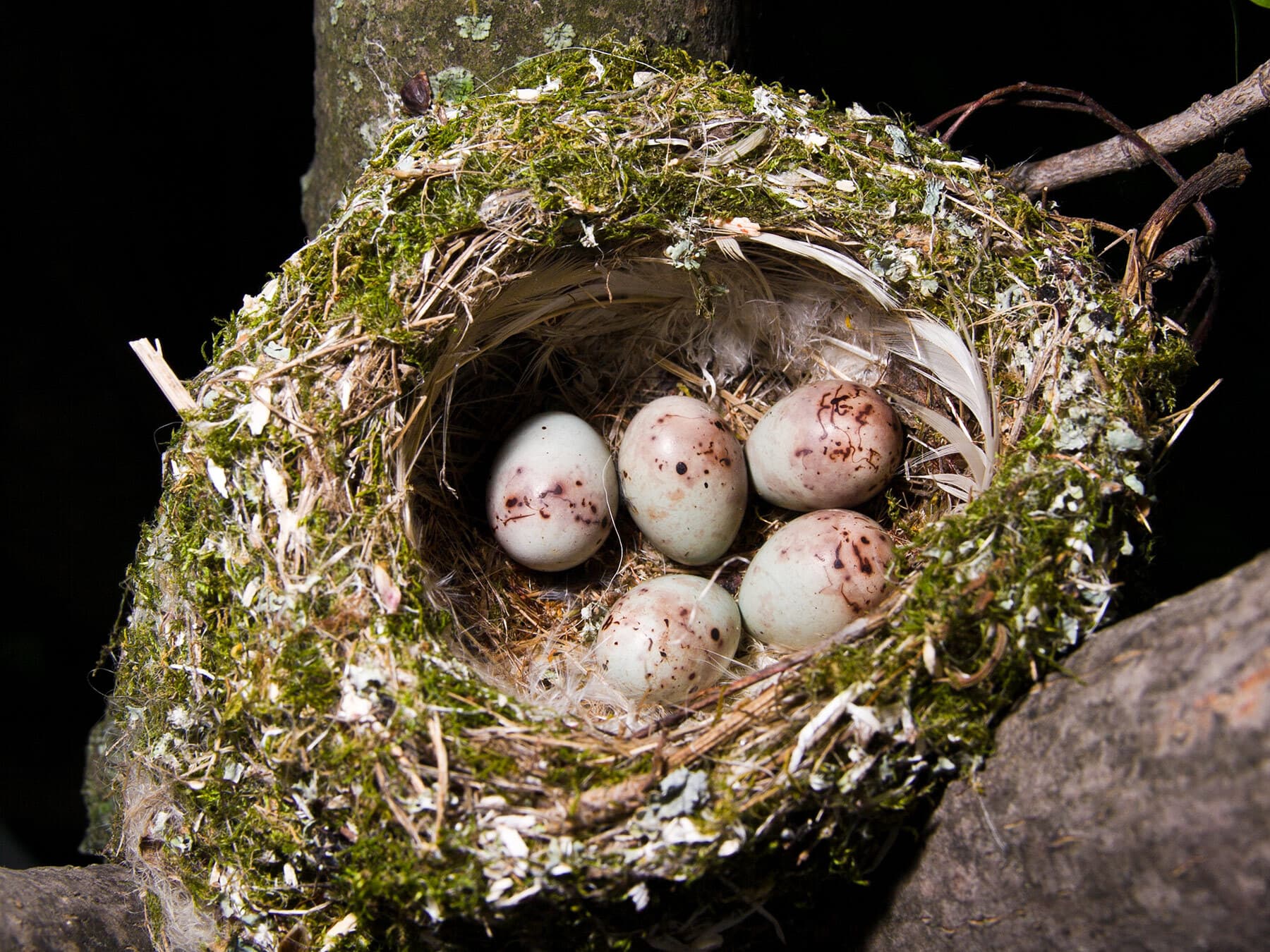
The female builds the nest alone: a neat, deep cup of moss, grass and roots, decorated with lichen and bound with spider silk, in the fork of a tree or bush. Lichen-covered, it is very hard to spot.
In Britain the first eggs are laid on 30 April on average, with first clutches between 12 April and 30 May. She lays 4 or 5 eggs, pale blue-green to reddish with purple-brown blotches, and incubates them alone for 12 to 13 days. The chicks leave the nest at 13 to 15.5 days old. Most pairs raise just one brood a year.1
Behaviour
On the ground a Chaffinch moves in small, jerky hops or shuffling steps, nodding its head as it goes. In spring and summer pairs hold territories; outside the breeding season Chaffinches feed in flocks.
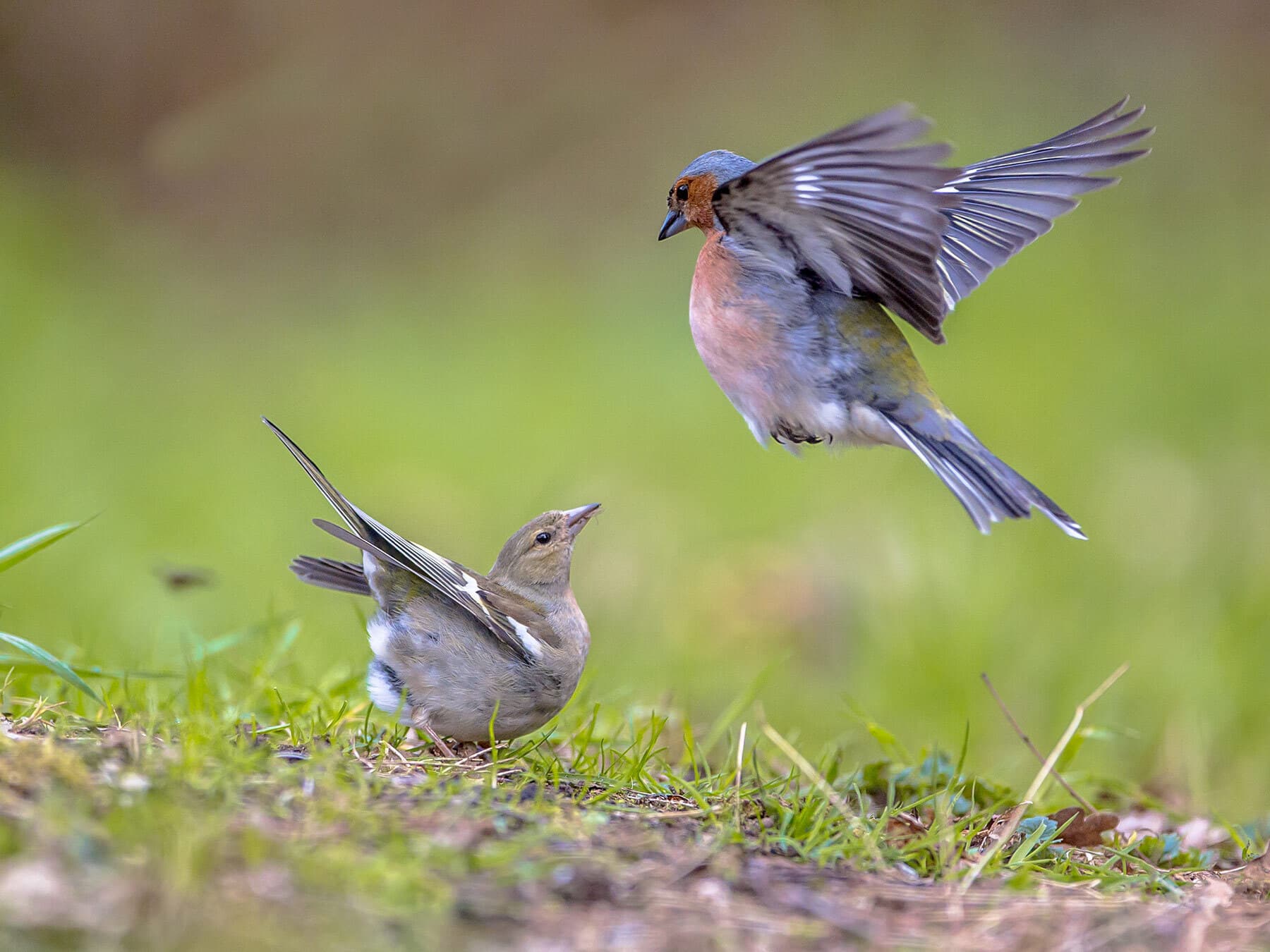
In courtship the male sleeks his feathers so the white wing bars stand out, crouches side-on to the female and raises one wing. In Britain, where Chaffinches stay put all year, a pair often stays together into later years.
Behaviour at windows: tapping on the glass
A male Chaffinch that taps and flutters at a window is fighting his own reflection: he takes it for a rival in his territory. It usually eases off after the breeding season. To help him, cover the outside of the glass with a non-reflective film, or hang something in front of it that moves in the wind.7
It is an old story. In 1903 the naturalist C. B. Moffat described how he watched male Chaffinches and Blackbirds battling their reflections in his windows, and concluded that the birds were fighting over space, not over females.8
Lifespan and predators
A Chaffinch that survives to breed typically lives about 3 years. About 59% of adults survive from one year to the next, and 53% of young birds survive their first year.1
Lifespan records
Predators and other dangers
Crows, red and grey squirrels, cats, stoats and weasels all take eggs and chicks. In one large British sample of 10,967 eggs, 59% hatched, and 41% of those produced young that left the nest.3
Conservation
The Chaffinch is Green-listed in the UK and of Least Concern worldwide, and there were still about 5.1 million territories in the UK in 2016. But it is no longer as common as it was. UK numbers rose by about a third from the early 1970s, then fell sharply from about 2010, and the breeding population is now 26% lower than in 1967.1 It has dropped from the second to the fifth commonest bird in Britain.5
The decline has been linked to trichomonosis, a disease caused by a parasite that can spread between birds through shared food and water. It appeared in British finches in 2005, and by 2007 Chaffinch numbers had fallen 21% in the region where it was worst.9 Adult survival has fallen most around houses, where birds are fed. The BTO notes that the evidence is less strong for the Chaffinch than for the Greenfinch, and that other causes may be at work in the steeper fall since about 2012. In Wales the decline has put the Chaffinch on the Amber list.1
You can help by keeping feeders clean, feeding seed in winter only, and stopping feeding for a while if you see sick birds. Signs and advice: feeder hygiene and disease.
Similar birds
Often mistaken for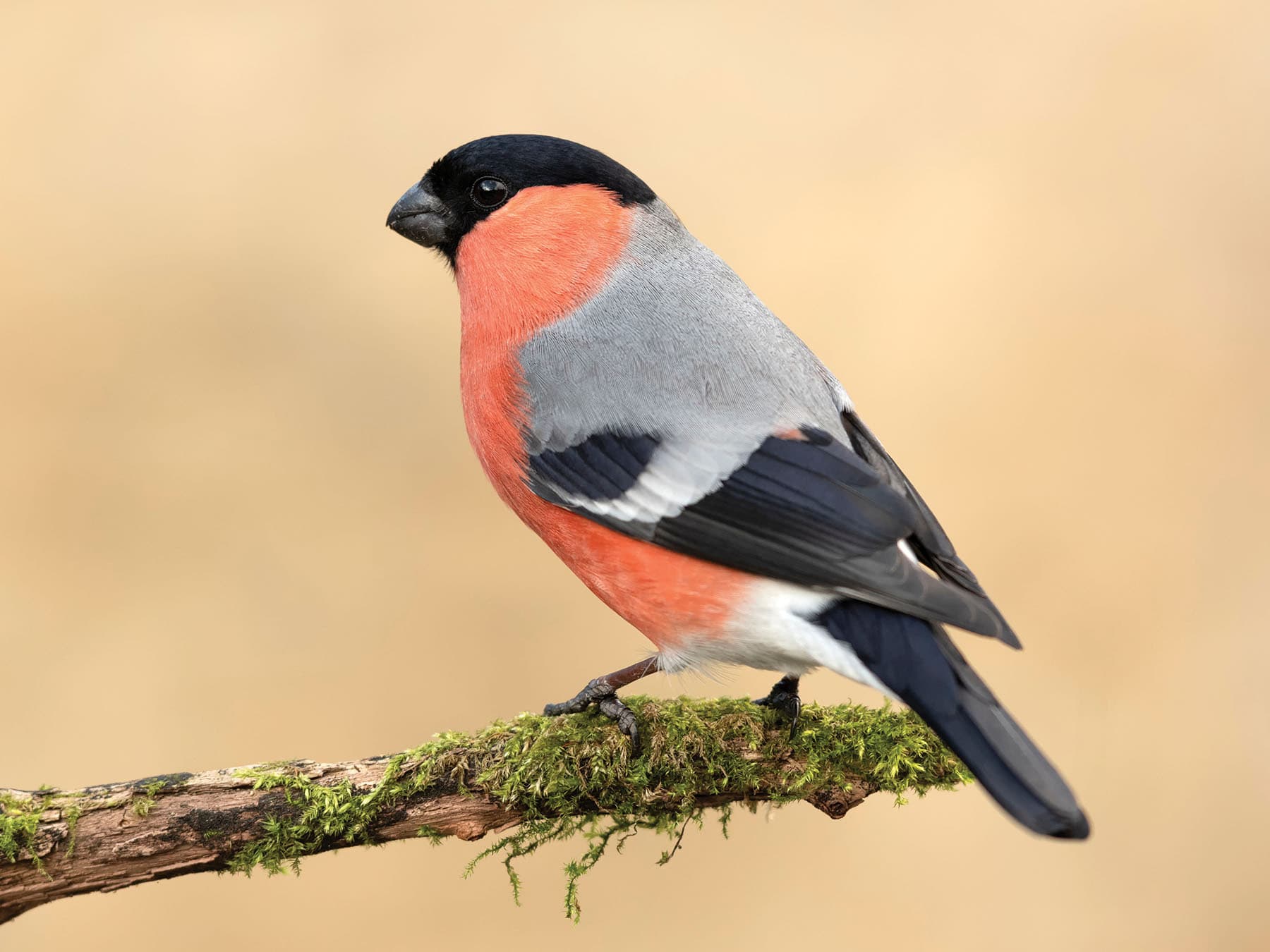
More photos
11 photos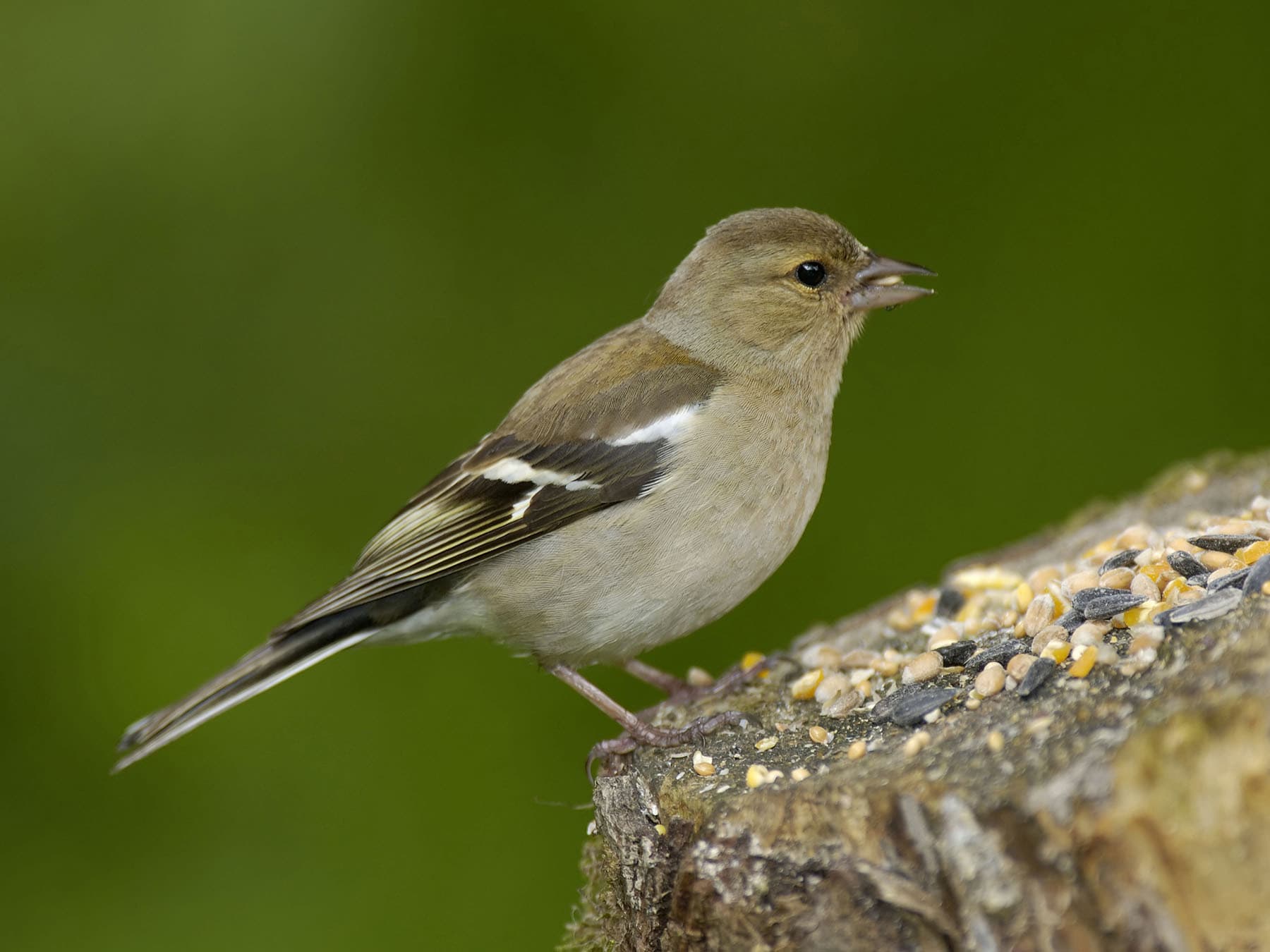 Female Chaffinch feeding on seeds
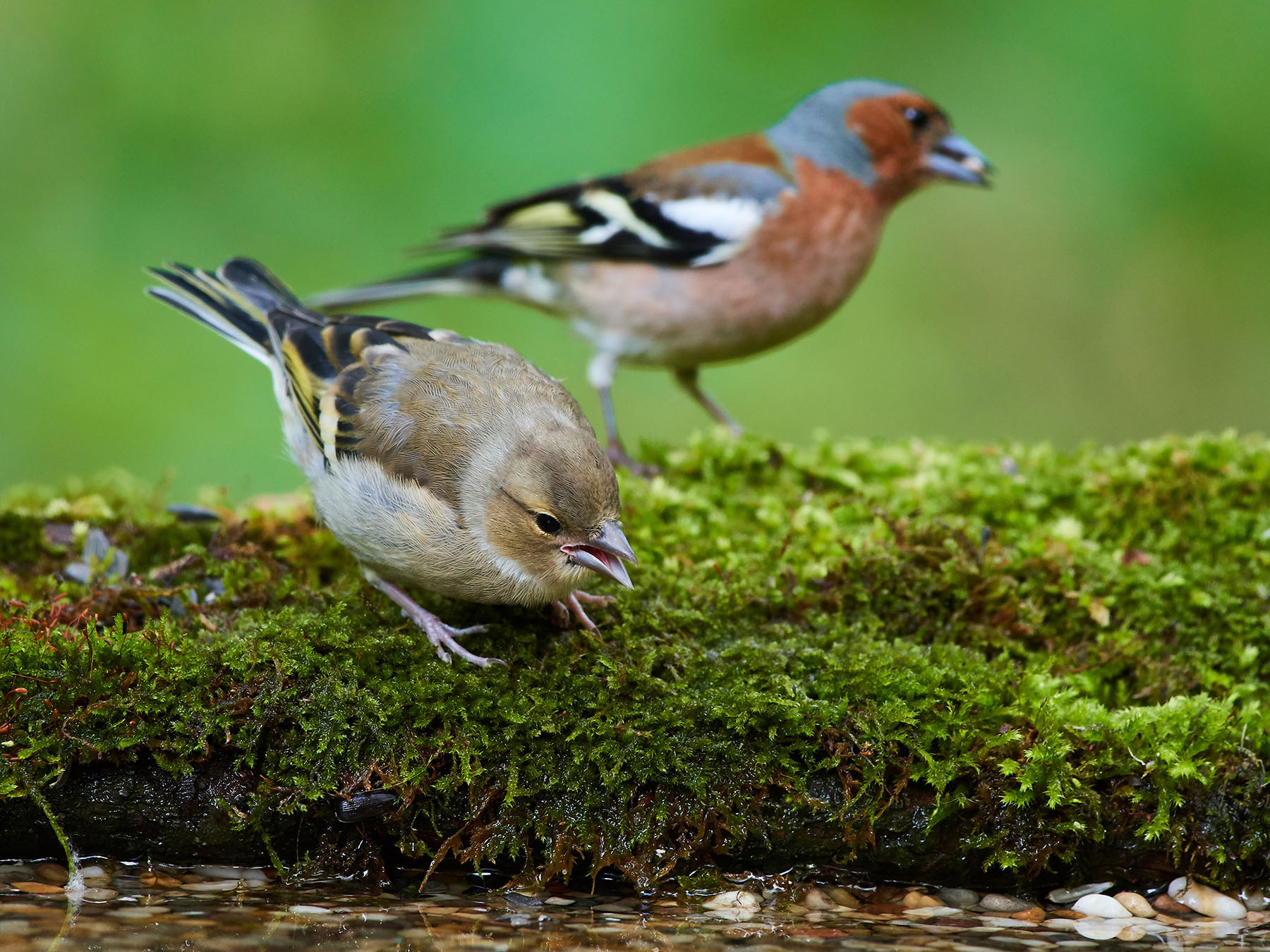
 Pair of Chaffinches foraging - female at the front, male in the background
 Close up of an adult male Chaffinch
 Female Chaffinch
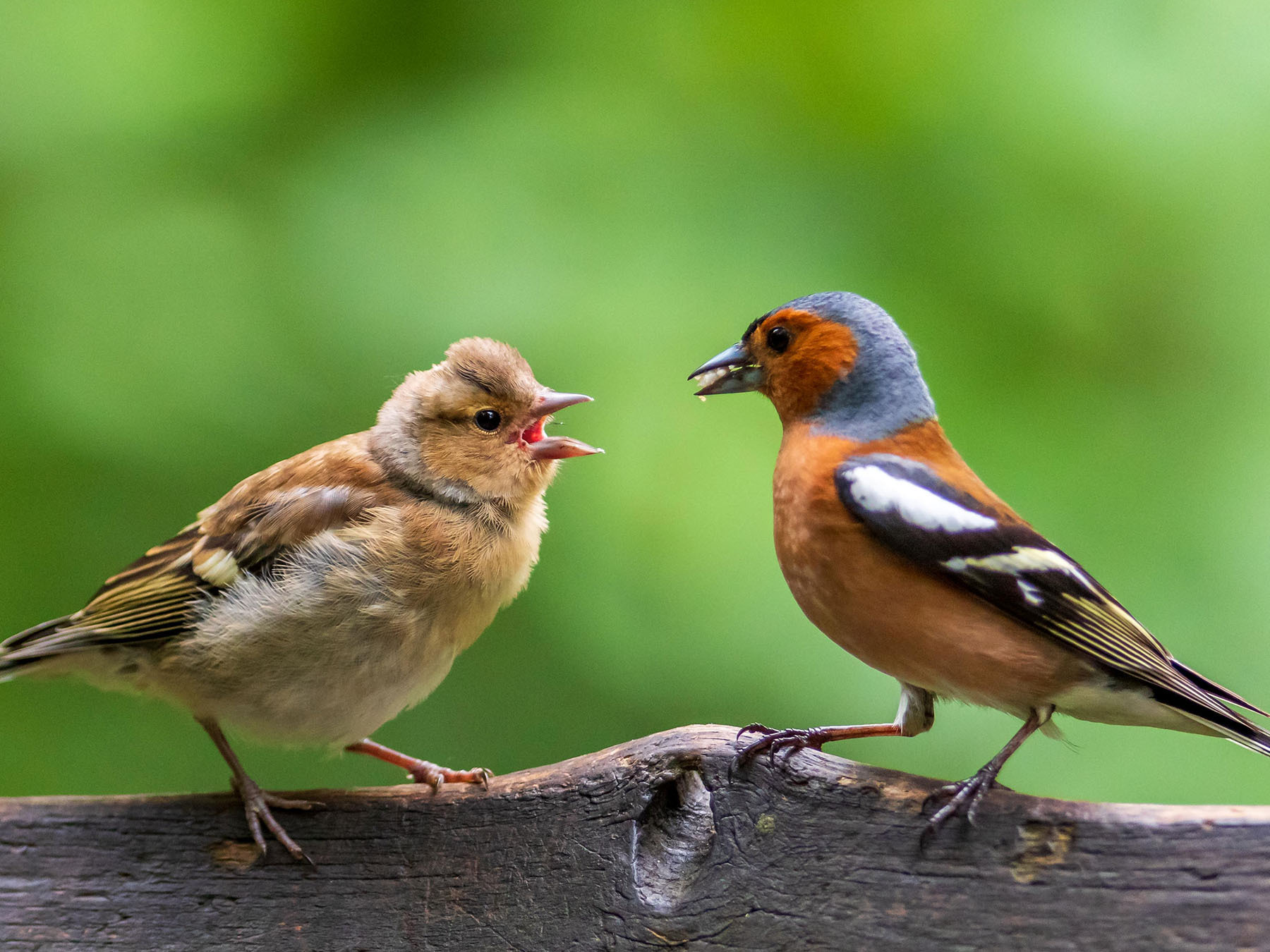
 Close up of a Chaffinch fledgling being fed by adult bird
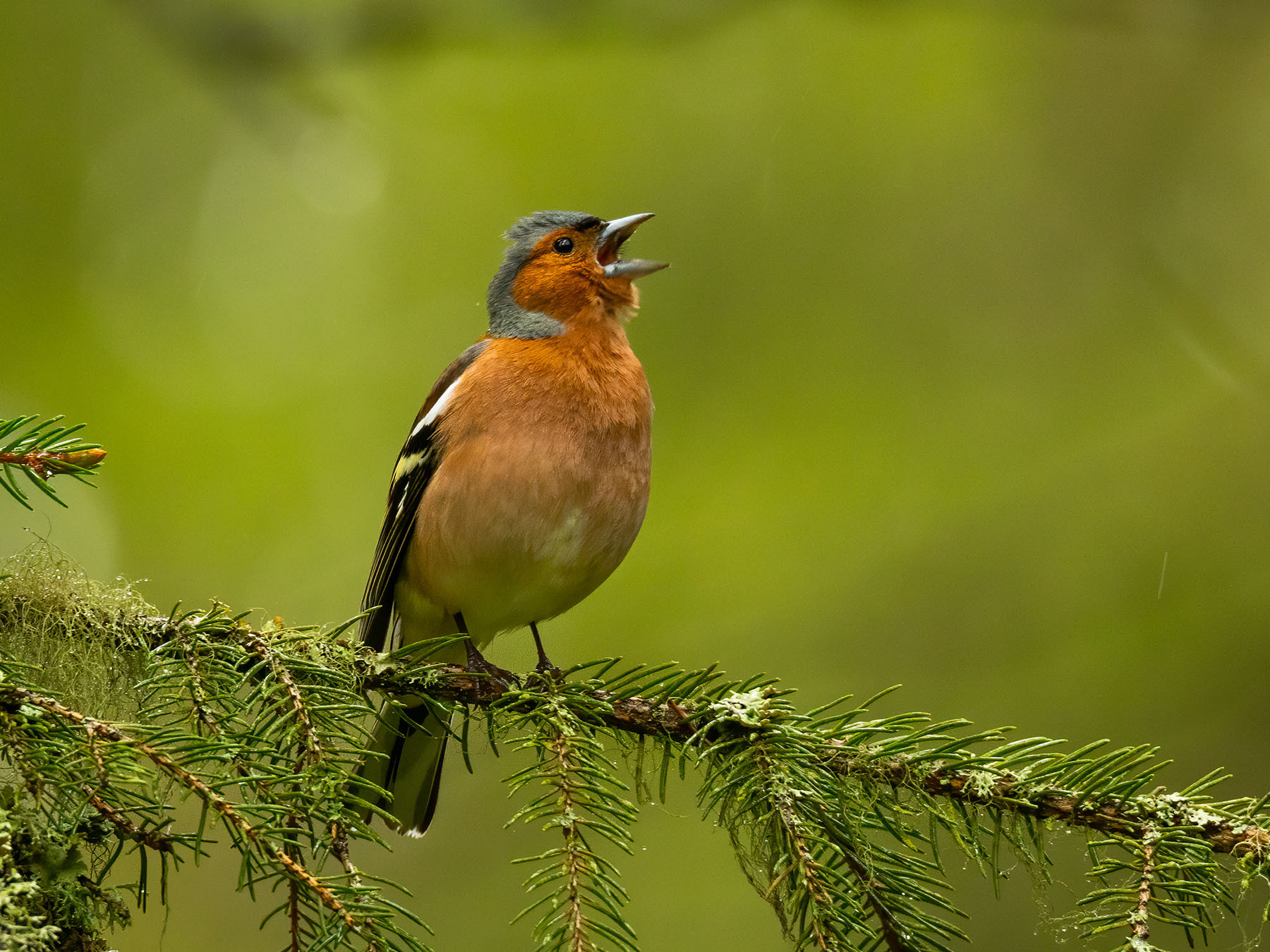
 Close up of a singing Chaffinch in its natural habitat
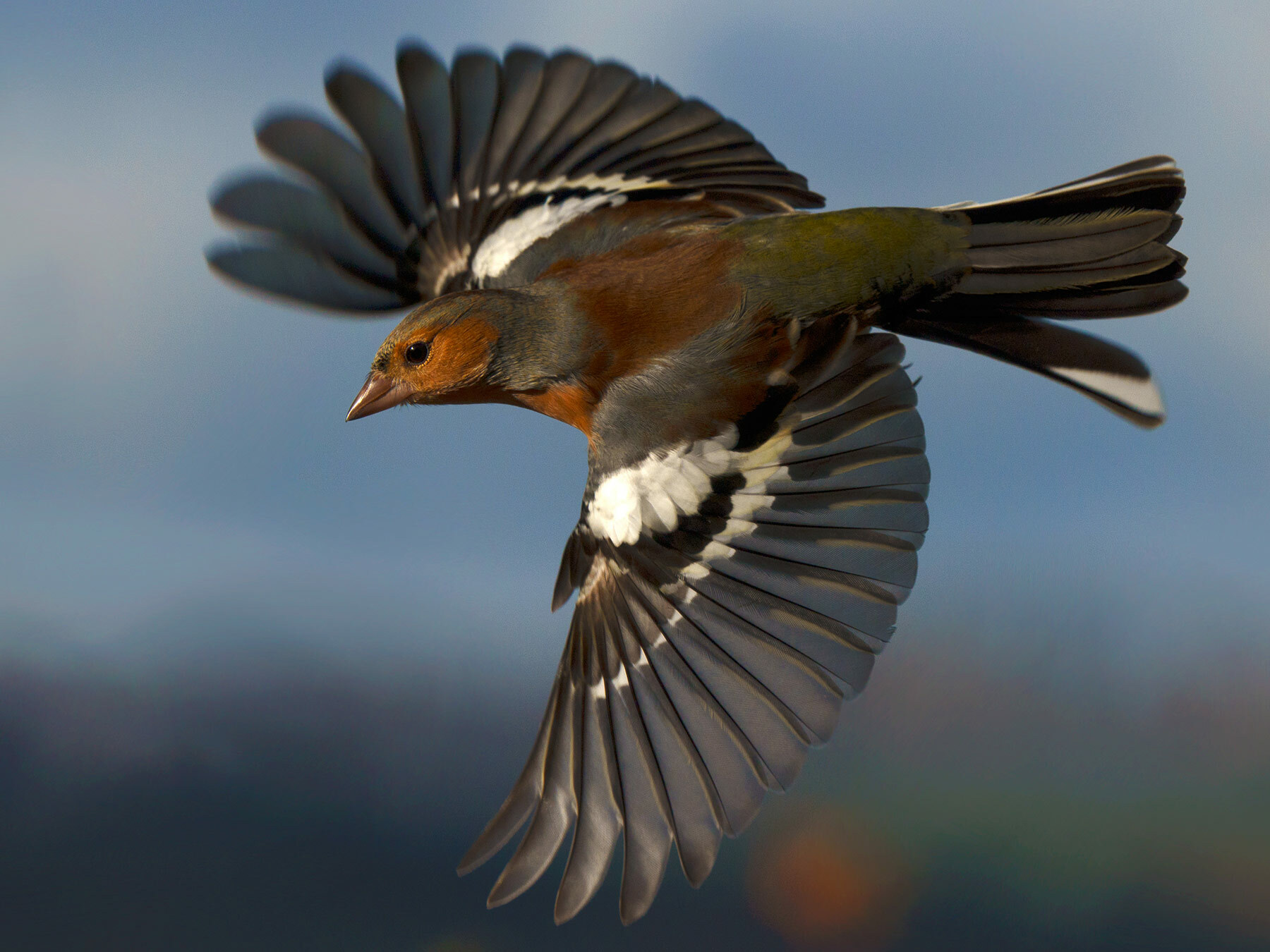
 Chaffinch Flying
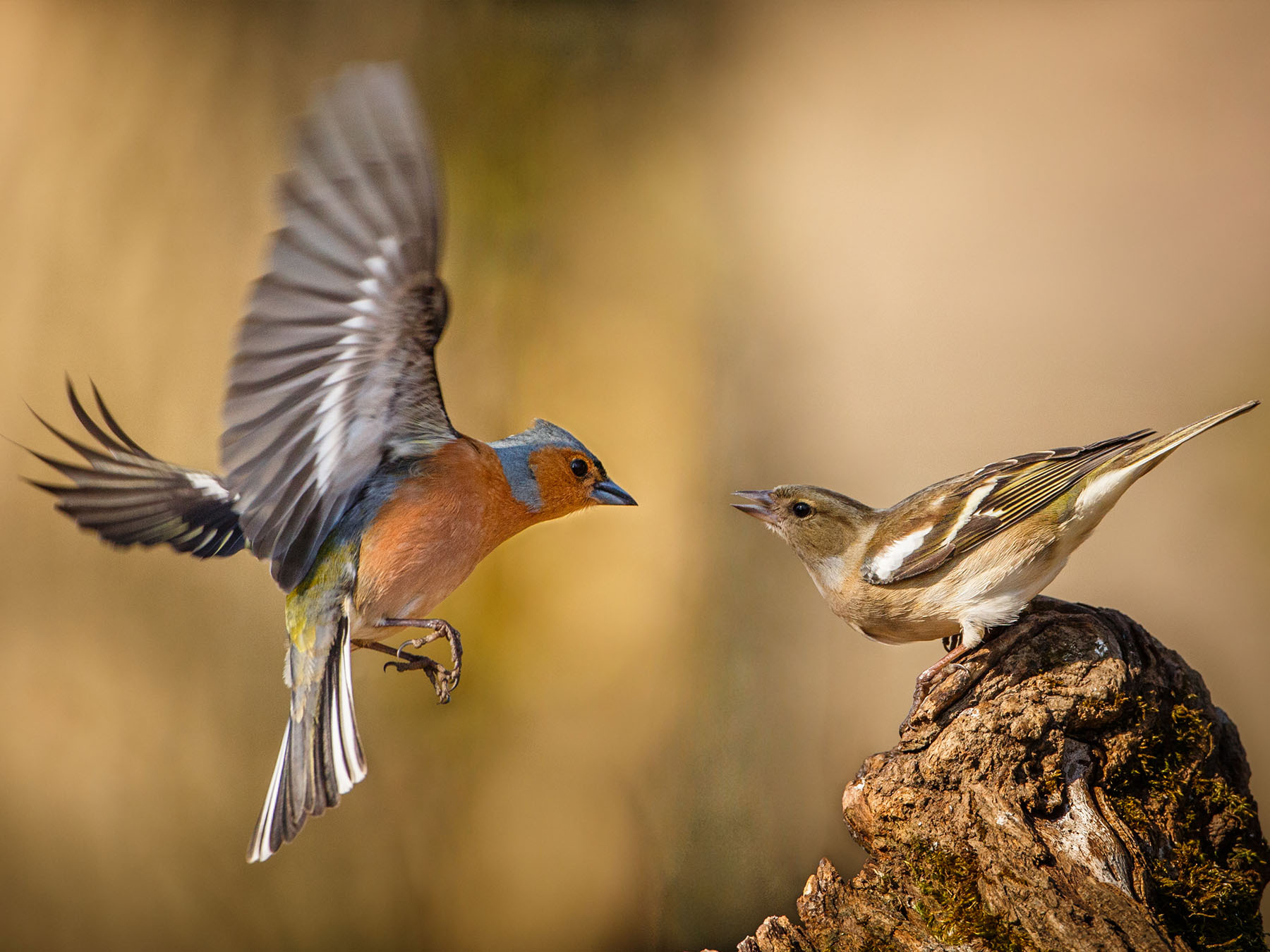
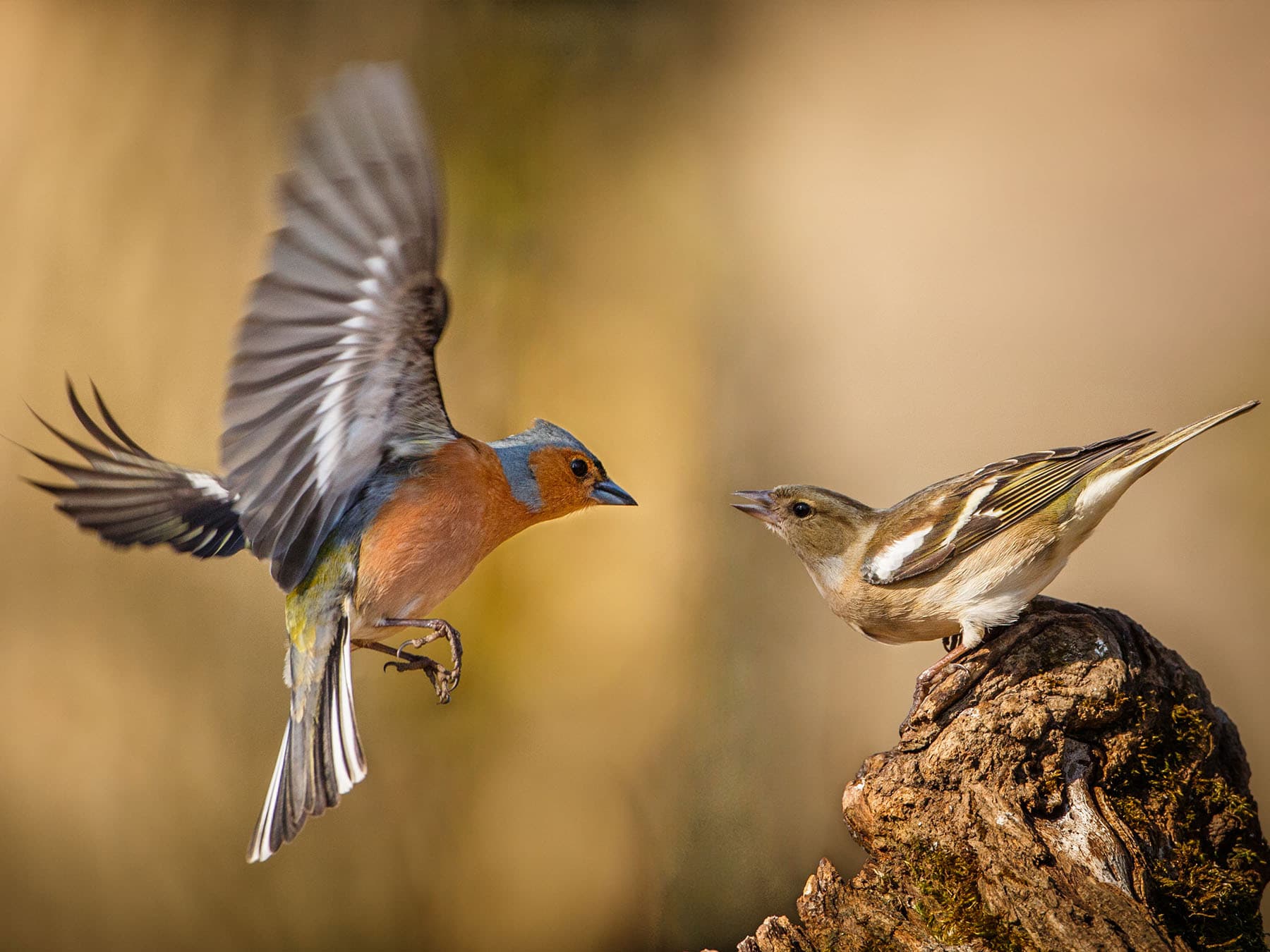 Male Chaffinch in flight, greeting a perched female
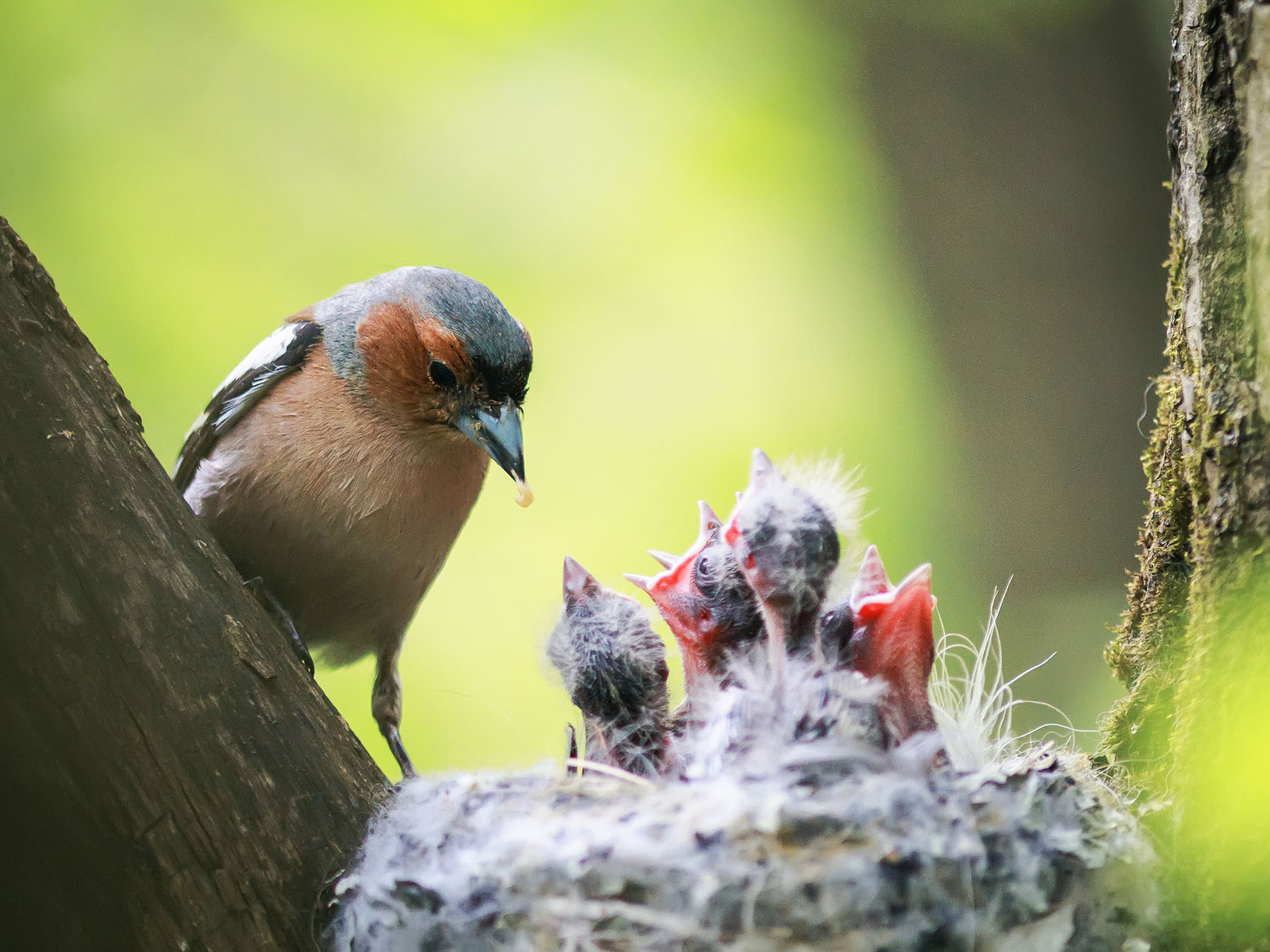
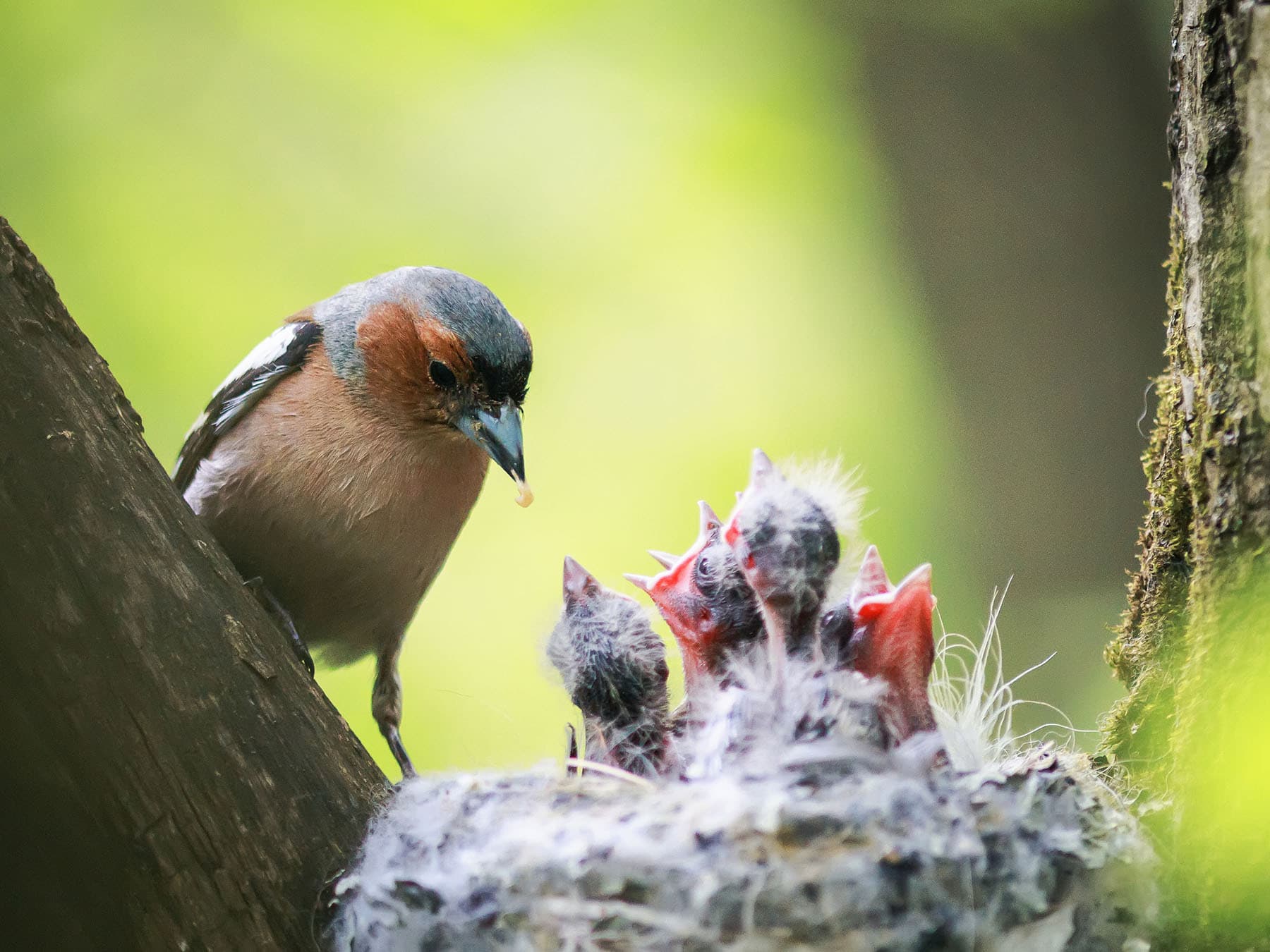 Male Chaffinch looking after the young chicks in the nest
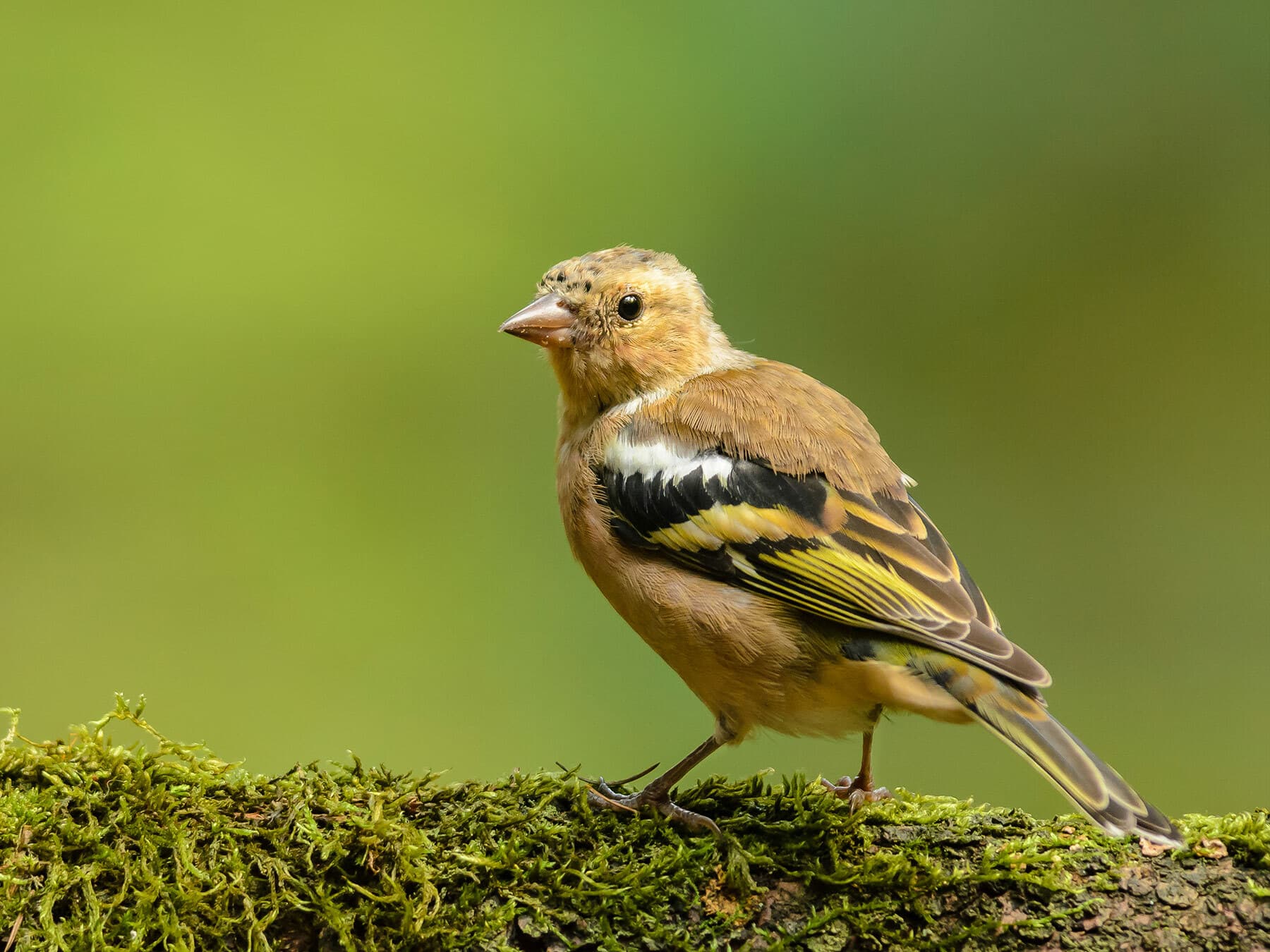 Juvenile Chaffinch
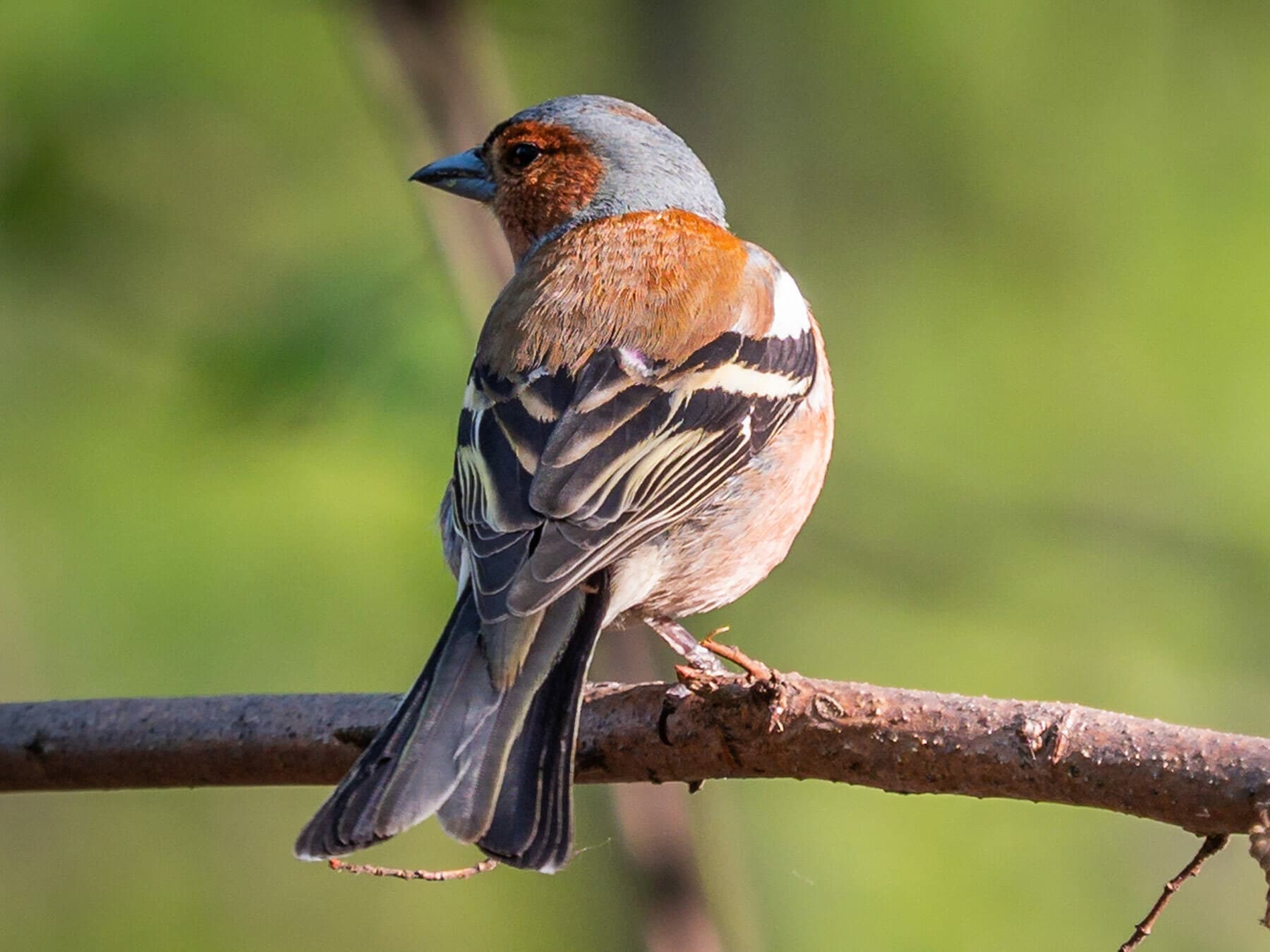 Chaffinch from behind
Chaffinch guides
6 guides- What Do Chaffinches Eat? Diet and Feeding in the Garden
- Female Chaffinch: How to Identify Her, and Male vs Female
- Chaffinch Nesting: Nests, Eggs and Baby Chaffinches
- Bullfinch or Chaffinch? How to Tell Them Apart
- Types of Finches in the UK: Identification Guide
- 23 Common Garden Birds in the UK (Full Guide with Pictures)
Quick facts
- Length
- 14–16 cm
- Wingspan
- 24.5–28.5 cm
- Weight
- 18–29 g
- Lifespan
- 3 years · oldest recorded 21.3 years · UK record 13 years 11 months
- Family
- Finches
- Migration
- Partial migrant
- Global status (IUCN)
- Least Concern
- World population
- 530,000,000 - 767,000,000 mature individuals
- Population trend
- Increasing
- Also called
- Common Chaffinch
- Scientific name
- Fringilla coelebs
Questions
6How big is a Chaffinch?
About 14.5 cm long and 18 to 29 g, with a wingspan of 24.5 to 28.5 cm. See how to recognise it.
Are Chaffinches rare?
No: there are millions in the UK and they breed almost everywhere. But numbers have fallen sharply since about 2010. See conservation status.
What does the name Chaffinch mean?
"Chaffinch" comes from Old English, probably from the bird's habit of feeding among the chaff on threshing floors. The scientific name Fringilla coelebs means "bachelor finch".
Why does a Chaffinch keep tapping on my window?
It is a male fighting his reflection, which he takes for a rival. See behaviour.
What is the Chaffinch's rain call?
A loud, drawn-out hooeed given by males, often on wet or overcast days. It differs from region to region. See song and calls.
What are the growths on a Chaffinch's legs?
Studies of dead finches found two causes: a virus, the Fringilla coelebs papillomavirus, and mites. Most affected birds behave normally.10 See feeder hygiene and disease.
Sources
23- 1BTO. Chaffinch (Fringilla coelebs). BTO BirdFacts. Accessed 6 October 2026. Source (opens in a new tab)
- 2Toms, M. (2007). Beautiful Bramblings. Bird Table 52 (BTO Garden BirdWatch). Accessed 6 October 2026. Source (opens in a new tab)
- 3Clement, P. et al. (2026). Common Chaffinch (Fringilla coelebs), version 1.3. Birds of the World (R. Ahmed, B. K. Keeney, N. D. Sly and S. M. Billerman, editors). Cornell Lab of Ornithology. doi:10.2173/bow.comcha.01.3 (opens in a new tab)
- 4Thorpe, W. H. (1958). The learning of song patterns by birds, with especial reference to the song of the chaffinch Fringilla coelebs. Ibis 100: 535-570. doi:10.1111/j.1474-919x.1958.tb07960.x (opens in a new tab)
- 5Hanmer, H. J., Cunningham, A. A., John, S. K., Magregor, S. K., Robinson, R. A., Seilern-Moy, K. et al. (2022). Habitat-use influences severe disease-mediated population declines in two of the most common garden bird species in Great Britain. Scientific Reports 12: 15055. doi:10.1038/s41598-022-18880-8 (opens in a new tab)
- 6RSPB (2026). How to help garden birds. RSPB news. Accessed 6 October 2026. Source (opens in a new tab)
- 7BTO. Window strikes. BTO, Helping birds. Accessed 6 October 2026. Source (opens in a new tab)
- 8Moffat, C. B. (1903). The spring rivalry of birds. Some views on the limit to multiplication. The Irish Naturalist 12: 152-166. Accessed 6 October 2026.
- 9Robinson, R. A., Lawson, B., Toms, M. P., Peck, K. M., Kirkwood, J. K., Chantrey, J. et al. (2010). Emerging infectious disease leads to rapid population declines of common British birds. PLoS ONE 5: e12215. doi:10.1371/journal.pone.0012215 (opens in a new tab)
- 10Lawson, B., Robinson, R. A., Rodriguez-Ramos Fernandez, J., John, S. K., Benitez, L., Tolf, C. et al. (2018). Spatio-temporal dynamics and aetiology of proliferative leg skin lesions in wild British finches. Scientific Reports 8: 14670. doi:10.1038/s41598-018-32255-y (opens in a new tab)
- 11Fransson, T., Kolehmainen, T., Moss, D. and Robinson, R. (2023). EURING list of longevity records for European birds (1 September 2023). EURING. Accessed 7 October 2026. Source (opens in a new tab)
- 12RSPB. Chaffinch. RSPB Birds A-Z. Accessed 6 October 2026. Source (opens in a new tab)
- 13RSPB. How and what to feed your garden birds. RSPB. Accessed 6 October 2026. Source (opens in a new tab)
- 14BTO. Feeding garden birds. BTO, Helping birds. Accessed 6 October 2026. Source (opens in a new tab)
- 15Clement, P. and Christie, D. A. (2020). Eurasian Bullfinch (Pyrrhula pyrrhula), version 1.0. Birds of the World (J. del Hoyo et al., editors). Cornell Lab of Ornithology. doi:10.2173/bow.eurbul.01 (opens in a new tab)
- 16RSPB. Brambling. RSPB Birds A-Z. Accessed 6 October 2026. Source (opens in a new tab)
- 17Montgomerie, B. (2018). The Spring Rivalry of Birds. American Ornithological Society, Wing Beat. Accessed 6 October 2026. Source (opens in a new tab)
- 18Stanbury, A. et al. (2021). The status of our bird populations: the fifth Birds of Conservation Concern in the United Kingdom, Channel Islands and Isle of Man and second IUCN Red List assessment of extinction risk for Great Britain. British Birds 114: 723-747. Accessed 6 October 2026.
- 19BirdLife International (2019). Fringilla coelebs (amended version of 2018 assessment). The IUCN Red List of Threatened Species 2019: e.T22720030A155432370. doi:10.2305/IUCN.UK.2018-2.RLTS.T22720030A155432370.en (opens in a new tab)
- 20BTO (2024). Longevity records for Britain & Ireland in 2024. BTO Online Ringing and Nest Recording Report. Accessed 9 October 2026. Source (opens in a new tab)
- 21BTO. Bullfinch (Pyrrhula pyrrhula). BTO BirdFacts. Accessed 6 October 2026. Source (opens in a new tab)
- 22BTO. Brambling (Fringilla montifringilla). BTO BirdFacts. Accessed 6 October 2026. Source (opens in a new tab)
- 23Lowther, P. E. and Cink, C. L. (2020). House Sparrow (Passer domesticus), version 1.0. Birds of the World (S. M. Billerman, editor). Cornell Lab of Ornithology. doi:10.2173/bow.houspa.01 (opens in a new tab)

Checked by
Nathan Cope, founder and editor
Nathan founded Birdfact and leads its writers and contributors in the UK, the US and Canada. He has watched and studied birds for more than ten years, and checks every article and species guide before it’s published.