


Osprey
Fish Hawk, Sea Hawk · Pandion haliaetus
By the Birdfact teamChecked by Nathan Cope
On this page14 sections
How to recognise it
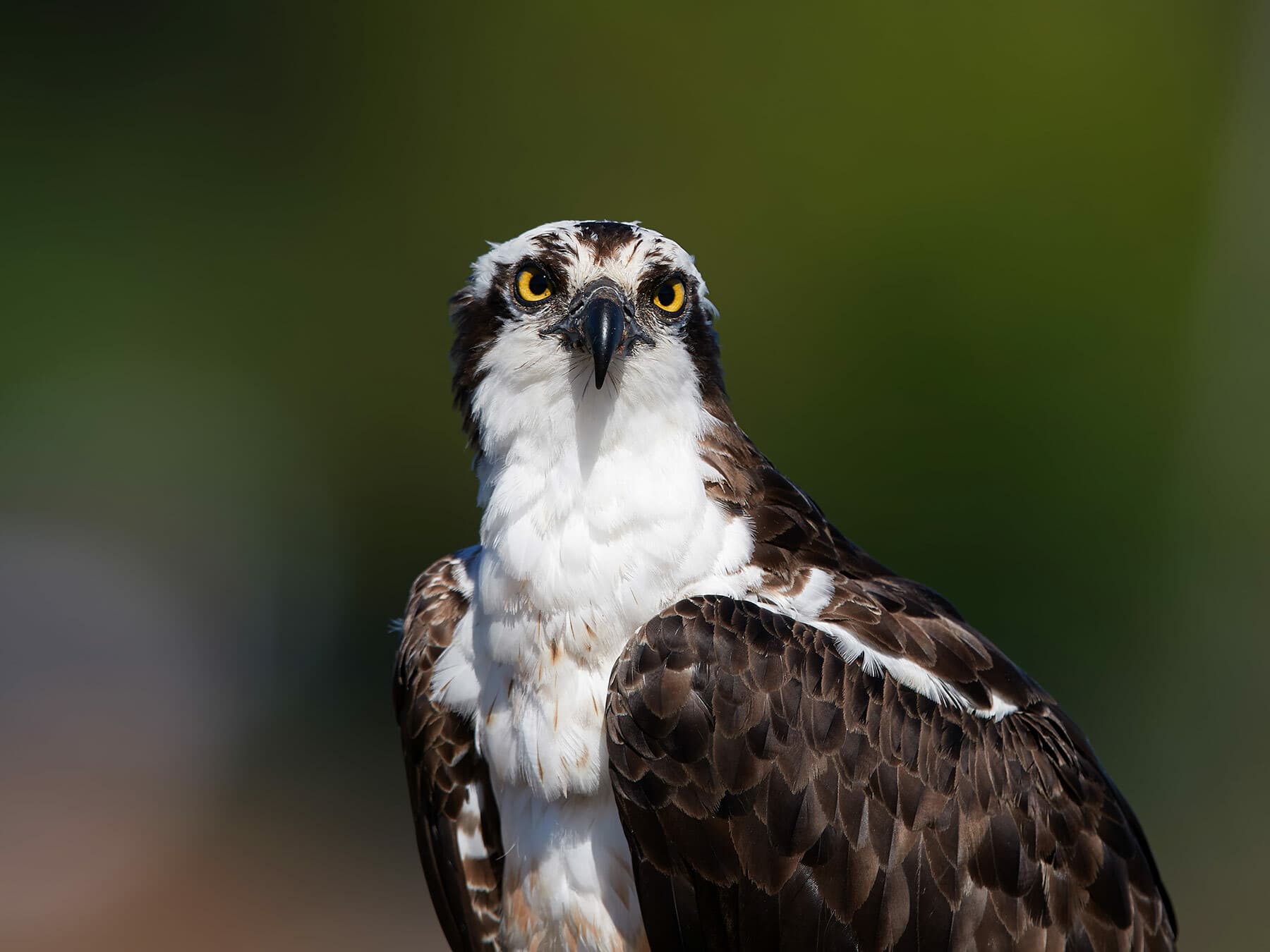
The Osprey is a striking raptor with a white head, brown upperparts, and predominantly white underparts.
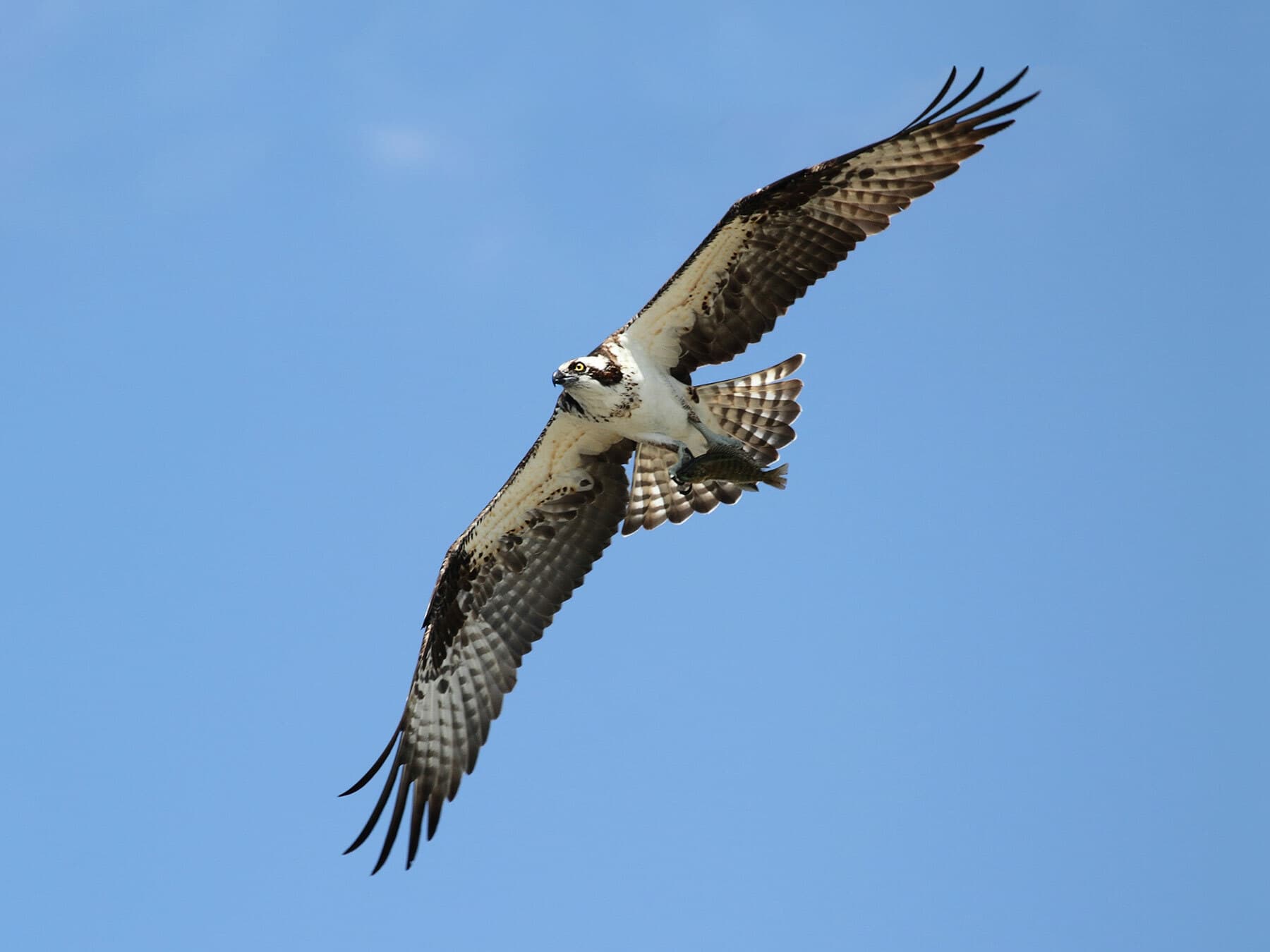
Its wings are long and narrow, with a distinctive bend at the 'wrist'. The bird's eyes are golden, and a dark brown stripe runs through each eye to the back of its head. The legs are long and white with large black claws.
Females are up to twenty per cent larger than males and have a more prominent brown necklace across their chest.
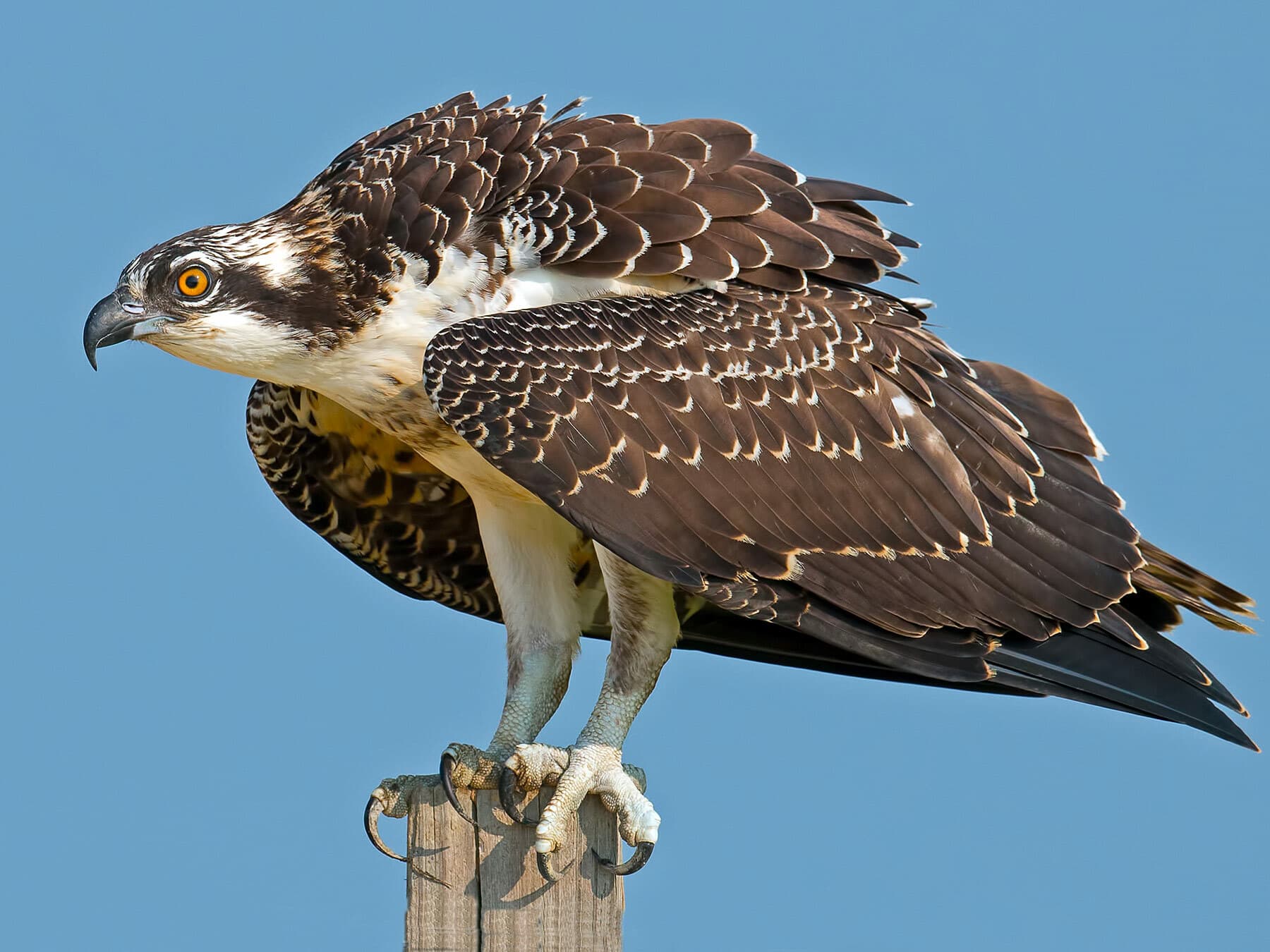
Juveniles resemble adults but have buff-tipped feathers on their upperparts, giving them a speckled appearance.
Its size
Adults- Length
- 54–58 cm
- Wingspan
- 150–180 cm
- Weight
- 1200–2000 g
Its song and calls
A loud, often repeated yelping sound similar to ‘pyew- pyew- pyew’ signifies the presence of a nearby osprey particularly in the vicinity of its nest.
- Song0:00 / 2:08
Recorded in Hagneck, Switzerland · April 2025
- Call0:00 / 0:48
Recorded in the Scottish Highlands, United Kingdom
Lawrence Shove / The British Library Board · Wikimedia Commons · CC BY-SA 4.0
When and where to see it
OctoberLeaving
Most recorded in October
- 1. West Dunbartonshire0.14%
- 2. Ceredigion0.13%
- 3. Dorset0.11%
- 4. Pembrokeshire0.10%
- 5. Corkunder 0.1%
Each dot is a county, state or province: the bigger and darker, the larger the bird’s share of that place’s bird records that month. Grey dots: no regular records. The ringed point is the centre of the bird’s records this month; the arrow shows how it moved since last month, and the dashed loop its path through the year. “Arrivals” colours places where it becomes regular this month (orange) or is in its last regular month (grey). GBIF eBird Observation Dataset, 2019–2024. Map data: Natural Earth, US Census Bureau; place centres © OpenStreetMap contributors.
In your area
See when the Osprey is recorded in your county, state or province.
How often the Osprey turns up in the UK, Ireland, the United States and Canada through the year, from birdwatchers' records.
United Kingdom
Summer visitor · regularly Mar–Oct · most records in August
Ireland
Summer visitor · regularly Apr–Oct · most records in August
United States
Resident · all year · most records in August
Canada
Summer visitor · regularly Apr–Oct · most records in August
Show as a table
| Month | United Kingdom | Ireland | United States | Canada |
|---|---|---|---|---|
| January | – | – | 0.34% (regular) | <0.001% |
| February | <0.001% | – | 0.33% (regular) | <0.001% |
| March | 0.013% (regular) | – | 0.46% (regular) | 0.013% |
| April | 0.055% (regular) | 0.006% (regular) | 0.64% (regular) | 0.35% (regular) |
| May | 0.058% (regular) | 0.010% (regular) | 0.48% (regular) | 0.34% (regular) |
| June | 0.073% (regular) | 0.015% (regular) | 0.56% (regular) | 0.33% (regular) |
| July | 0.080% (regular) | 0.013% (regular) | 0.71% (regular) | 0.46% (regular) |
| August | 0.13% (regular) | 0.046% (regular) | 0.88% (regular) | 0.65% (regular) |
| September | 0.082% (regular) | 0.020% (regular) | 0.65% (regular) | 0.41% (regular) |
| October | 0.018% (regular) | 0.015% (regular) | 0.42% (regular) | 0.071% (regular) |
| November | 0.002% | – | 0.31% (regular) | 0.007% |
| December | – | – | 0.30% (regular) | <0.001% |
Recorded regularly in
Worldwide: recorded regularly in 177 countries
Countries where it was recorded in at least 3 of the 6 years 2019–2024. Linked countries have their own bird list.
Europe (40)
- Åland Islands
- Albania
- Austria
- Belarus
- Belgium
- Bulgaria
- Croatia
- Czechia
- Denmark
- Estonia
- Finland
- France
- Germany
- Gibraltar
- Greece
- Hungary
- Ireland
- Isle of Man
- Italy
- Kosovo
- Latvia
- Lithuania
- Luxembourg
- Malta
- Moldova
- Montenegro
- Netherlands
- Norway
- Poland
- Portugal
- Romania
- Russia
- Serbia
- Slovakia
- Slovenia
- Spain
- Sweden
- Switzerland
- Ukraine
- United Kingdom
Africa (37)
- Algeria
- Angola
- Benin
- Botswana
- Burkina Faso
- Cameroon
- Cape Verde
- Chad
- Congo - Kinshasa
- Côte d’Ivoire
- Djibouti
- Egypt
- Equatorial Guinea
- Ethiopia
- Gabon
- Gambia
- Ghana
- Guinea
- Guinea-Bissau
- Kenya
- Liberia
- Malawi
- Mauritania
- Morocco
- Mozambique
- Namibia
- Nigeria
- Rwanda
- Senegal
- Sierra Leone
- South Africa
- Tanzania
- Tunisia
- Uganda
- Western Sahara
- Zambia
- Zimbabwe
Asia (43)
- Armenia
- Azerbaijan
- Bahrain
- Bangladesh
- Bhutan
- Brunei
- Cambodia
- China
- Cyprus
- Georgia
- Hong Kong SAR China
- India
- Indonesia
- Iran
- Israel
- Japan
- Jordan
- Kazakhstan
- Kuwait
- Kyrgyzstan
- Laos
- Lebanon
- Macao SAR China
- Malaysia
- Mongolia
- Myanmar (Burma)
- Nepal
- Oman
- Pakistan
- Palestinian Territories
- Philippines
- Qatar
- Saudi Arabia
- Singapore
- South Korea
- Sri Lanka
- Taiwan
- Thailand
- Turkey
- United Arab Emirates
- Uzbekistan
- Vietnam
- Yemen
North America (40)
- Anguilla
- Antigua & Barbuda
- Aruba
- Bahamas
- Barbados
- Belize
- Bermuda
- British Virgin Islands
- Canada
- Caribbean Netherlands
- Cayman Islands
- Costa Rica
- Cuba
- Curaçao
- Dominica
- Dominican Republic
- El Salvador
- Grenada
- Guadeloupe
- Guatemala
- Haiti
- Honduras
- Jamaica
- Martinique
- Mexico
- Montserrat
- Nicaragua
- Panama
- Puerto Rico
- Sint Maarten
- St Barthélemy
- St Kitts & Nevis
- St Lucia
- St Martin
- St Pierre & Miquelon
- St Vincent & the Grenadines
- Trinidad & Tobago
- Turks & Caicos Islands
- United States
- US Virgin Islands
South America (13)
Oceania (4)
- Australia
- New Caledonia
- Papua New Guinea
- Solomon Islands
Data: EOD – eBird Observation Dataset (Cornell Lab of Ornithology), accessed via GBIF.org, CC BY 4.0. Records from 2019–2024, aggregated and filtered by Birdfact. How these lists are made
Between March to October the western osprey is found throughout Europe except Iceland. Normally only seen close to water they migrate south to Africa for over-wintering. Ospreys prefer shallow lakes, reservoirs and rivers or coastal waters.
For a full guide on the migration of ospreys, check out this article.
Signs and Spotting tips
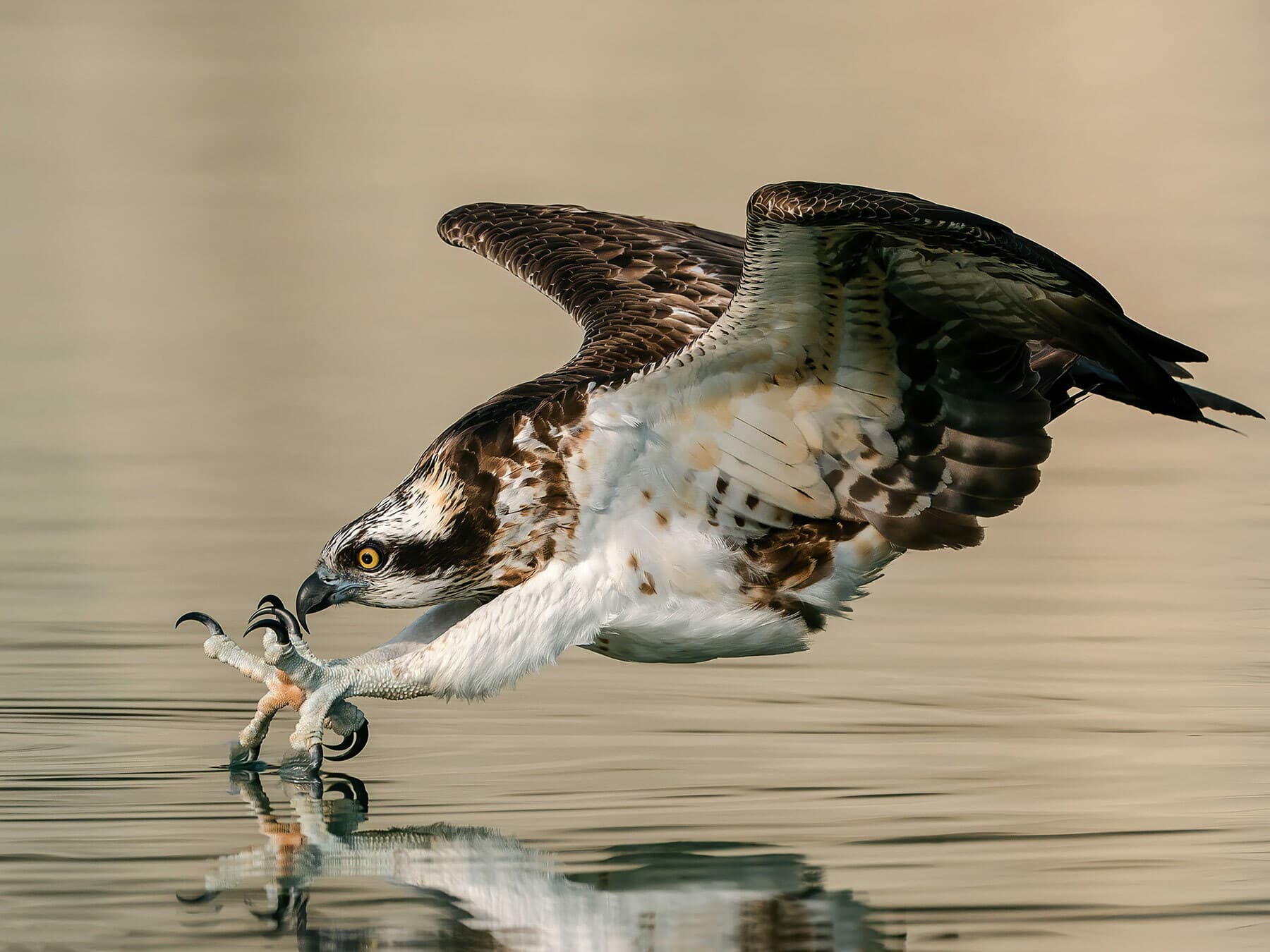
From a distance the western osprey could be mistaken for a juvenile gull. However, when viewed hovering above a large expanse of water or soaring over its nest area it is unmistakable with its kinked wings with well pronounced fingered wingtips, long legs and claws. Its often steep dive to pick up its prey as it strikes the water feet first is a remarkable sight. Many countries have reintroduction programmes and the western osprey population continues to grow. Conservation societies and nature reserves often have publicly accessible live webcam sites of nesting pairs.
What it eats
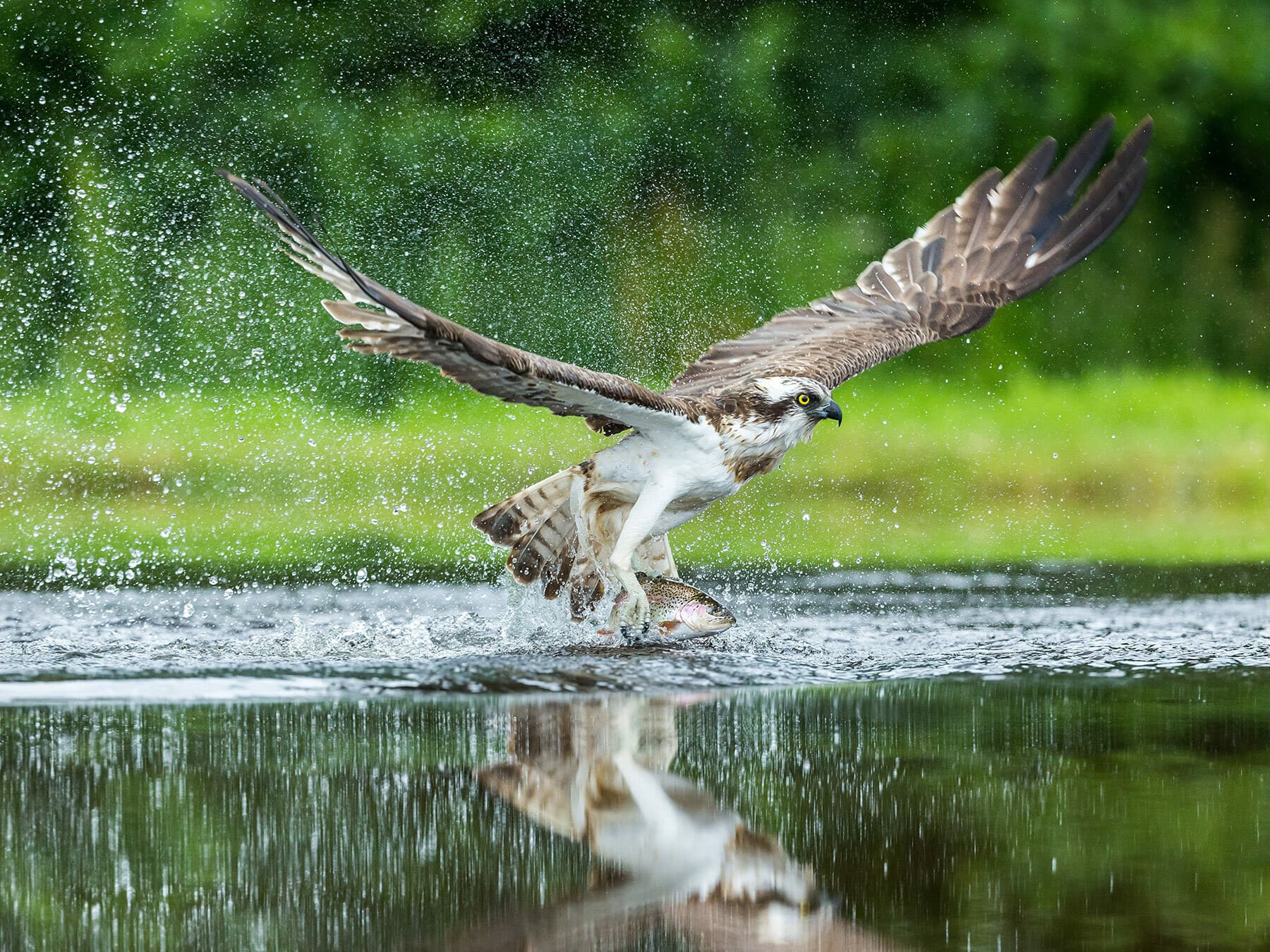
Ospreys survive almost entirely on a diet of fresh fish which they catch in shallow water after diving down feet first and outstretched towards the water before grabbing their prey in extremely long and sharp talons. Usually they will return to their nest or perch before consuming their meal.
To find out more about the diet of an osprey, check out this guide.
Nesting and breeding
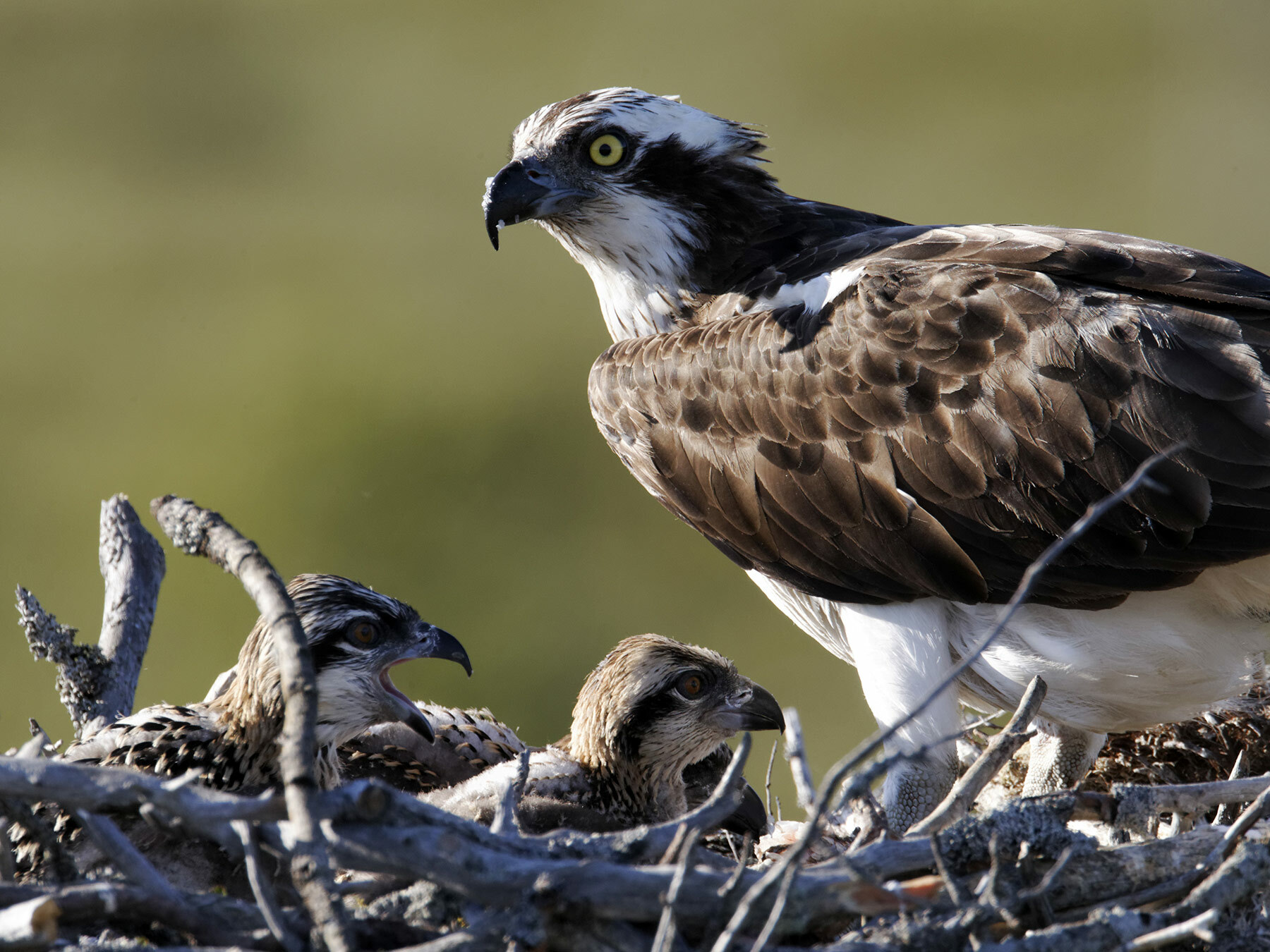
One brood of two to four creamy white eggs with red brown spots is produced annually within a few days of the completion of the nest. Within western Europe this occurs between April and July. Nests are often used year on year and are constructed of mainly large sticks low down in trees or on artificial platforms and occasionally at ground level. Both parents take turns in incubation although during the hours of darkness the female usually performs this task. Eggs hatch approximately forty days after laying and fledging occurs between fifty to sixty days thereafter.
For more information on osprey nesting, check out this article.
Behaviour
Ospreys are renowned for their fishing prowess. They often hover over water before plunging feet-first into the water to catch fish. They are highly adaptable, nesting on natural and artificial structures near water bodies.
During migration, Ospreys can cover vast distances, with some individuals travelling over 4,000 kilometres (around 2,500 miles) between breeding and wintering grounds.
Lifespan and predators
The life expectancy of the western osprey is thirty years.
For more information on the lifespan of an osprey, check out this guide.
Conservation
While Ospreys are currently listed as Least Concern globally, they face ongoing threats from habitat loss, water pollution, and collisions with power lines.
Conservation efforts, including providing artificial nesting platforms and banning certain pesticides, have helped many populations recover from previous declines.
What does an Osprey look like?
Adult western ospreys are similar in colour and patternation although females are normally up to twenty per cent larger than their male counterparts. In general ospreys are brown above and white below. The head has a white crown with a grey brown and white forehead and white cheeks. There is a black stripe through the yellow coloured eye extending almost to the nape of the neck. Throat and upper breast are predominantly white with a brown mottling and the remainder of the underparts and flanks are white. Underwing areas are white with a black patch across the primary coverts and a dark brown band running along the mid-wing section. In flight their wings appear narrow and they have four distinct long feathers and one slightly shorter on each wing tip. The legs are long and white with large black claws. Juveniles are similar but more of a buff colour particularly on the underparts.
More photos
2 photos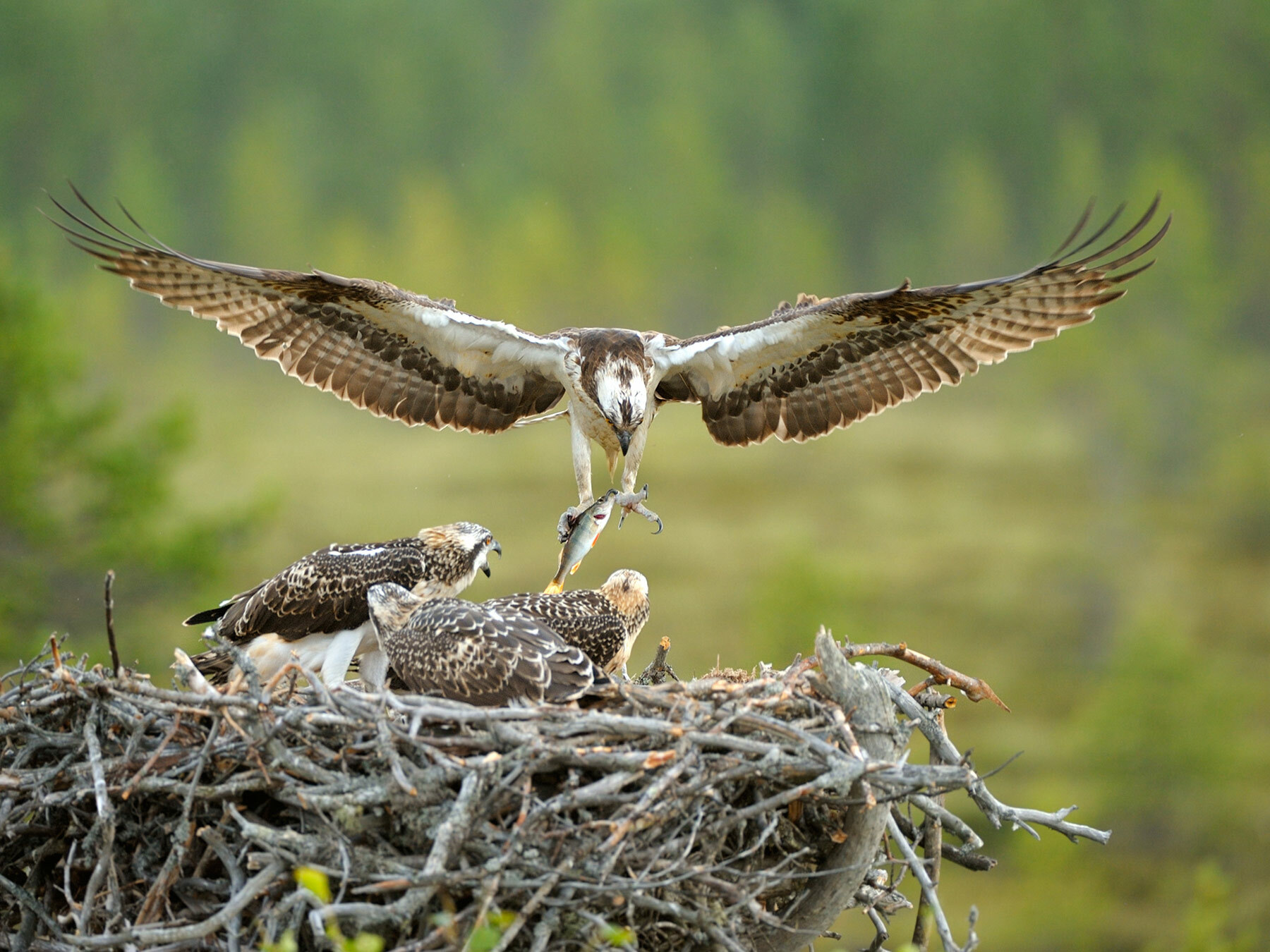
Osprey guides
4 guidesQuick facts
- Length
- 54–58 cm
- Wingspan
- 150–180 cm
- Weight
- 1200–2000 g
- Lifespan
- 8–10 years · oldest recorded 32 years
- Family
- Ospreys
- Migration
- Long-distance Migrant
- Global status (IUCN)
- Least Concern
- World population
- 1,200,000 mature individuals
- Population trend
- Increasing
- Also called
- Fish Hawk, Sea Hawk
- Scientific name
- Pandion haliaetus
Sources
4- 1BirdLife International. 2021. Pandion haliaetus. The IUCN Red List of Threatened Species 2021: e.T22694938A206628879. Source (opens in a new tab)
- 2BirdLife International. 2021. Pandion haliaetus. The IUCN Red List of Threatened Species 2021: e.T22694938A206628879. Source (opens in a new tab)
- 3Partners in Flight (2022) Source (opens in a new tab)
- 4BBL - Longevity Records of North American Birds Source (opens in a new tab)

Checked by
Nathan Cope, founder and editor
Nathan founded Birdfact and leads its writers and contributors in the UK, the US and Canada. He has watched and studied birds for more than ten years, and checks every article and species guide before it’s published.