


Oak Titmouse
Baeolophus inornatus
By the Birdfact teamChecked by Nathan Cope
On this page13 sections
How to recognise it
This page is about the Oak Titmouse, the crested titmouse of the Pacific slope's oak woodlands from southwestern Oregon to Baja California (until 1997 it shared the name Plain Titmouse with the Juniper Titmouse).
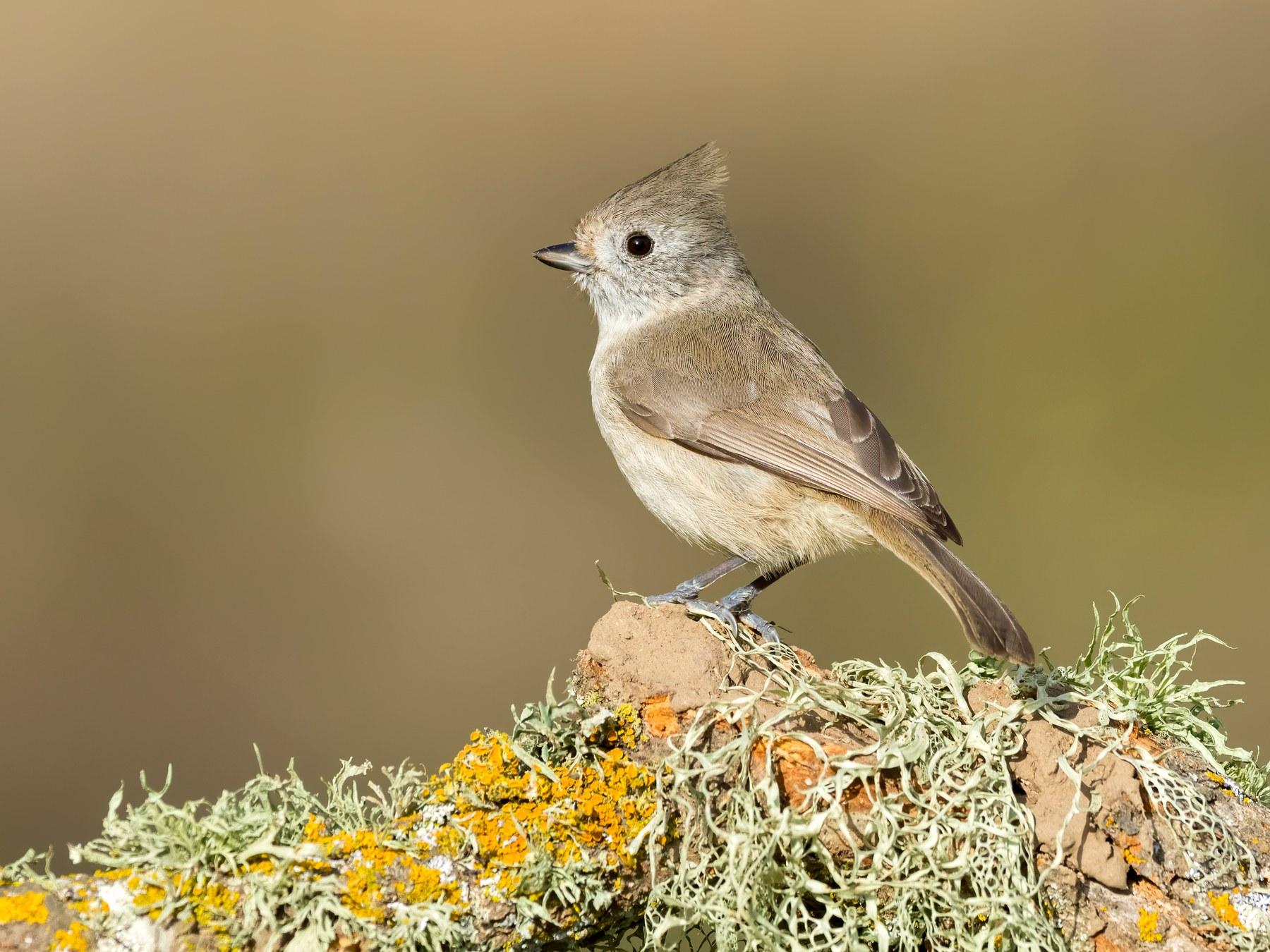
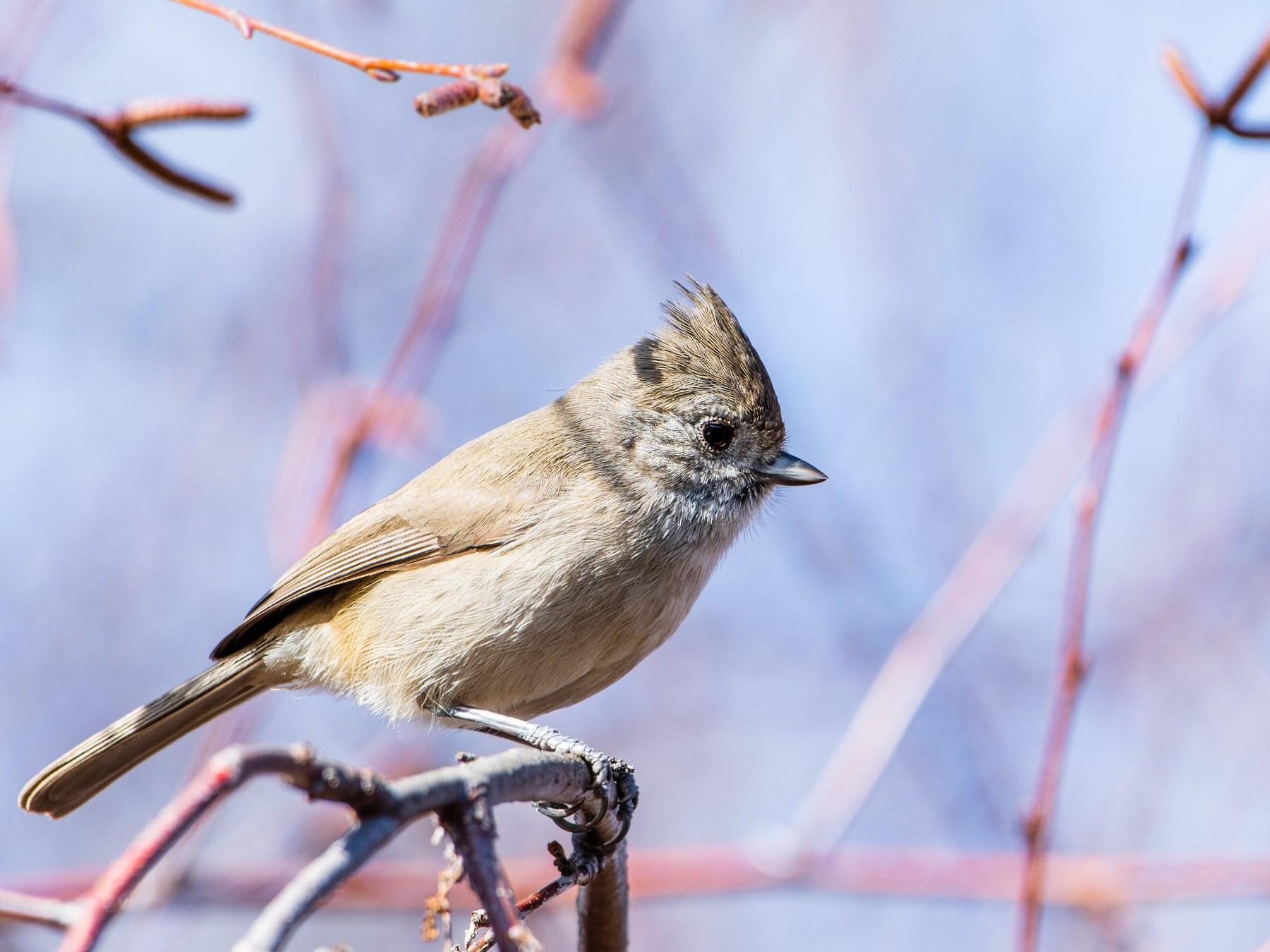
It is a small, drab bird with a short crest that it may raise into a point or lay almost flat. The crest, back, wings and tail are a plain brownish gray to olive-brown, with no wing bars, and the face is a mix of whitish and gray with no bold pattern. Below it is pale gray to grayish white, with a faint brown wash low on the flanks. There is no black cap or bib. The bill and legs are leaden blue to black, and the eye is brown.
Out birding, the mark to look for is the short crest on an otherwise plain, brownish bird with no cap, bib or wing bars.
Size and weight
Oak Titmice are about 5-6 in (12-15 cm) long, with a wingspan of 8-9 in (20-23 cm), and weigh about 0.5-0.7 oz (14-20 g): about the size of a sparrow. Birds of southwestern California and northwestern Baja California average larger than those farther north.
Male and female
Males and females look alike in every plumage, and the plumage does not change with the seasons, apart from looking ragged when worn. Males are only slightly larger on average, from about 1.4% in bill length to 6% in body mass.1
Juvenile plumage and molt
Juveniles, seen mainly from May to August, look much like adults. Their body feathers, especially under the tail, are loose and hair-like, the wing coverts are paler, and the larger coverts may have faint buff tips. Fledglings show a yellowish gape at the base of the bill. After that stage, no reliable plumage feature tells a young bird from an adult.
Adults replace all their feathers once a year, mainly from June to October, usually starting about two weeks after their young leave the nest. Young birds replace most of their body feathers between July and September.
Regional plumage differences
There are four subspecies. The nominate subspecies, inornatus, lives from southwestern Oregon and northern California south to Santa Barbara and Kern counties, and affabilis from Ventura County into northern Baja California. Mohavensis is found in the Little San Bernardino Mountains of southern California, and cineraceus in the Cape district at the southern tip of Baja California.
Northern birds are smaller and paler, with a smaller bill, while affabilis is darker and larger. Mohavensis is grayer and less brown, and cineraceus is grayer, paler and smaller still. Size falls into two groups: smaller birds in the north and at the southern tip of Baja California, larger ones in southwestern California and northwestern Baja. That fall in size toward the north runs against Bergmann's rule.
Identification: the closest lookalike
The bird most like it is the Juniper Titmouse, which has the same shape but is a medium gray above with no brown tone. It is generally larger, with a bigger, longer bill. Range is the surest guide: the two meet only at the far north of California, around Lava Beds National Monument where Siskiyou and Modoc counties meet, and everywhere else range alone separates them.
Voice helps too. Oak Titmouse songs are usually slower, with fewer notes and a clearer, sweeter tone, and its calls have fewer introductory notes and are given more slowly. Some songs overlap, though, and not every one can be told apart.1
Identification: the 1997 split and hybrids
The American Ornithologists' Union divided the Plain Titmouse in its 41st Check-list supplement in 1997, following studies of the two birds' genetics, shape and size, ecology and voice, and moved both into the genus Baeolophus.2 The two look very alike but differ in a range of measurements, color, genes, voice (above all the male's song) and habitat.
Where they meet in northeastern California they interbreed: pairs of one of each species and an exchange of genes have both been recorded.1 A 2004 study of this recent, narrow contact zone found that the genetic and body-measurement changeover lies east of the limit of oaks, where Oak Titmice live in a climate more like the Juniper Titmouse's. The author concluded that the Oak Titmouse can adapt and spread locally into the Juniper Titmouse's range, 'but not vice versa'.3
Identification: other small birds
The Tufted Titmouse of the East is larger, with a gray pointed crest, a blackish forehead and a rusty wash on the flanks; the western titmice are smaller and drabber, with no rusty flanks, and their calls tend to be hoarser. Their ranges do not meet. The Bridled Titmouse does not meet it either.
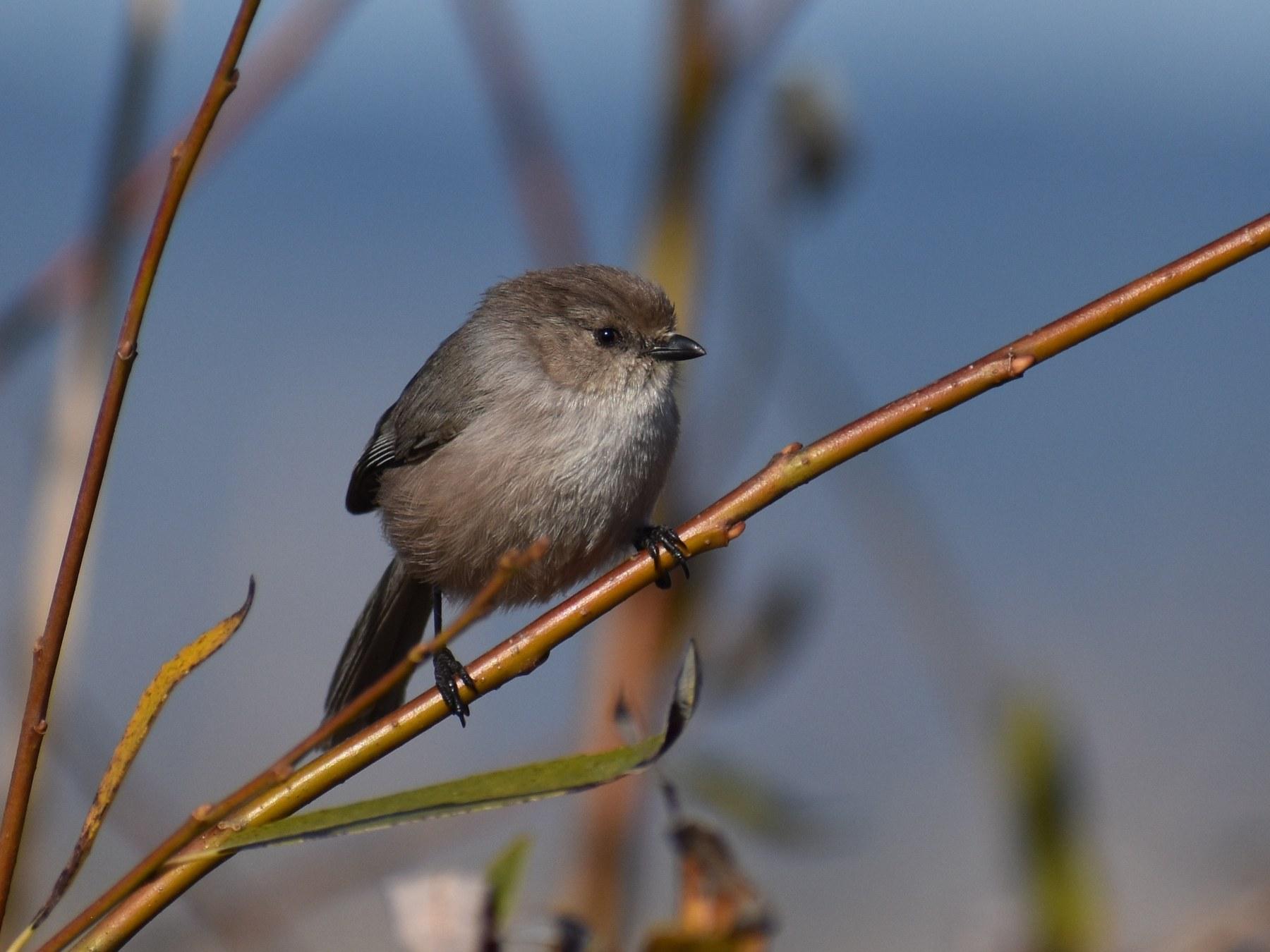
A Bushtit is much smaller, about the size of a kinglet, and plain gray, with a long tail, short wings and a tiny black bill; it travels in flocks for much of the year. The Chestnut-backed Chickadee has a chestnut back, a dark cap and bib and white cheeks, and the Mountain Chickadee a black cap and bib and a white stripe over the eye. Aggression between Oak Titmice and Chestnut-backed Chickadees has been read in one study as mistaken identity, because the two species' call notes are similar.1
Not sure it’s a Oak Titmouse? Check your photo: Birdfact names the bird and shows the look-alike side by side.
Its size
Adults- Length
- 12–15 cm
- Wingspan
- 20–23 cm
- Weight
- 14–20 g
Its song and calls
The Oak Titmouse is a vocal bird, and the call you will hear most is a scratchy tsicka dee dee, given by both sexes all year: one to four very high notes followed by several lower, harsh chattering ones. It serves to advertise the territory, to raise the alarm and to keep in touch with a mate. One field guide writes it as chick-a-dee-dee.
The song varies a great deal. Typically it is a medium-pitched run of 3-7 alternating, whistled syllables lasting 1-2 seconds. Some versions include much higher notes, and an uncommon one without alternating notes sounds like a fast trill. Near Berkeley in the 1940s, males whistled phrases usually repeated three to five times, mostly peter peter peter and, more rarely, a rising sweet sweet sweet.4
Despite how much it calls, its singing behavior has had little detailed study, and we found no report of a female Oak Titmouse singing.1
Calls
Other calls include a very high, thin see-see-see, usually an alarm, and a fast, harsh chatter when mobbing or when people come near a nest. A female on her eggs gives a loud, snake-like hiss. There is also a rare sit-sit-sit twitter given with quivering wings, and soft, lisping sip notes near the nest. The study at Berkeley described nine distinct call notes, each with its own use.4
Song season and dialects
Males may sing softly and now and then outside the breeding season. Singing builds from mid-to-late winter into spring, mostly in the morning and from high perches, and it is not known to sing in flight. Song mainly defends the territory; it matters less for finding a mate, because pairs form for good in late summer and fall, when singing is rare.
Each male has on average 3.2-4.8 song types (from 1 to 12, in a sample of 21 males and 2,055 songs). Neighbors answer each other and share song types, which gives local dialects: types that were rare in Monterey County were common 100 miles (160 km) away in Alameda County.1
- Song (heard, not seen)0:00 / 0:14
Recorded in Black Diamond Mines, United States · May 2020
- Calls0:00 / 0:19
Recorded in McClellan Ranch Preserve, United States · September 2012
- Call0:00 / 0:12
Recorded in Harvard Road, United States · August 2021
Heard one and not sure? Let the bird song identifier listen.
When and where to see it
Oak Titmice live all year on the Pacific slope. The range runs from the Rogue River valley of southwestern Oregon south through California's Coast, Transverse and Peninsular ranges and the western foothills of the Sierra Nevada to the Sierra Juarez and Sierra San Pedro Martir of northwestern Baja California. A separate population lives in the Sierra de la Laguna and Victoria Mountains of the Cape district.
Within California they are missing from the humid northwestern coast and from the floor of the San Joaquin Valley. No source we read gives them a range in Nevada or Arizona, and records away from the range are scarce.
In the United States they live from about 40 ft to about 6,500 ft (12-1,981 m), and up to about 7,200 ft (2,194 m) in the mountains of southern Baja California. In Yosemite National Park the species is a fairly common resident below 3,000 ft, a rare visitor up to 4,000 ft and an extremely rare visitor higher.5
Habitat
Look for it in warm, dry, open oak and oak-pine woodland. It is among the most common birds of California's oak woodlands, and it uses scrub oak and other brush only where woodland is close by.
Some populations manage without oaks: in western juniper woodland in the far north of California, in open pine forest on San Benito Mountain, and among Joshua trees with pinyon or California juniper on the range's desert edge. It also lives in well-wooded suburbs, and Partners in Flight counts it as a bird commonly found in urban and suburban habitat.6
Do they migrate?
No. Oak Titmice stay on their territories all year, so the winter range is the same as the breeding range. Affabilis, the subspecies of southwestern California and northwestern Baja California, occasionally wanders down to desert lowlands in winter.
Spotting tips
Walk slowly through open oak woodland and listen for the scratchy call. Then scan the trunks and larger branches below the canopy, where it does most of its feeding, and check feeders near trees.
What it eats
Oak Titmice eat seeds and other plant food as well as insects, spiders and other small invertebrates, and plant food makes up most of the diet in fall and winter. In 94 stomachs analyzed for a 1951 handbook, plant food was 24% of the diet in spring (7 stomachs), 31% in summer (28), 68% in fall (20) and 84% in winter (39).1
The main plant foods are seeds of oaks, pines, oats, thistles, weeds and poison oak, along with oak and willow catkins, leaf buds, galls and berries. The animal food is mostly small insects: leafhoppers, treehoppers, aphids and scale insects, caterpillars, beetles, ants and wasps, and flies.
For nestlings, one study found caterpillars and grasshoppers made up 53% and 30% of the prey identified in their droppings (14 samples).1
How they feed
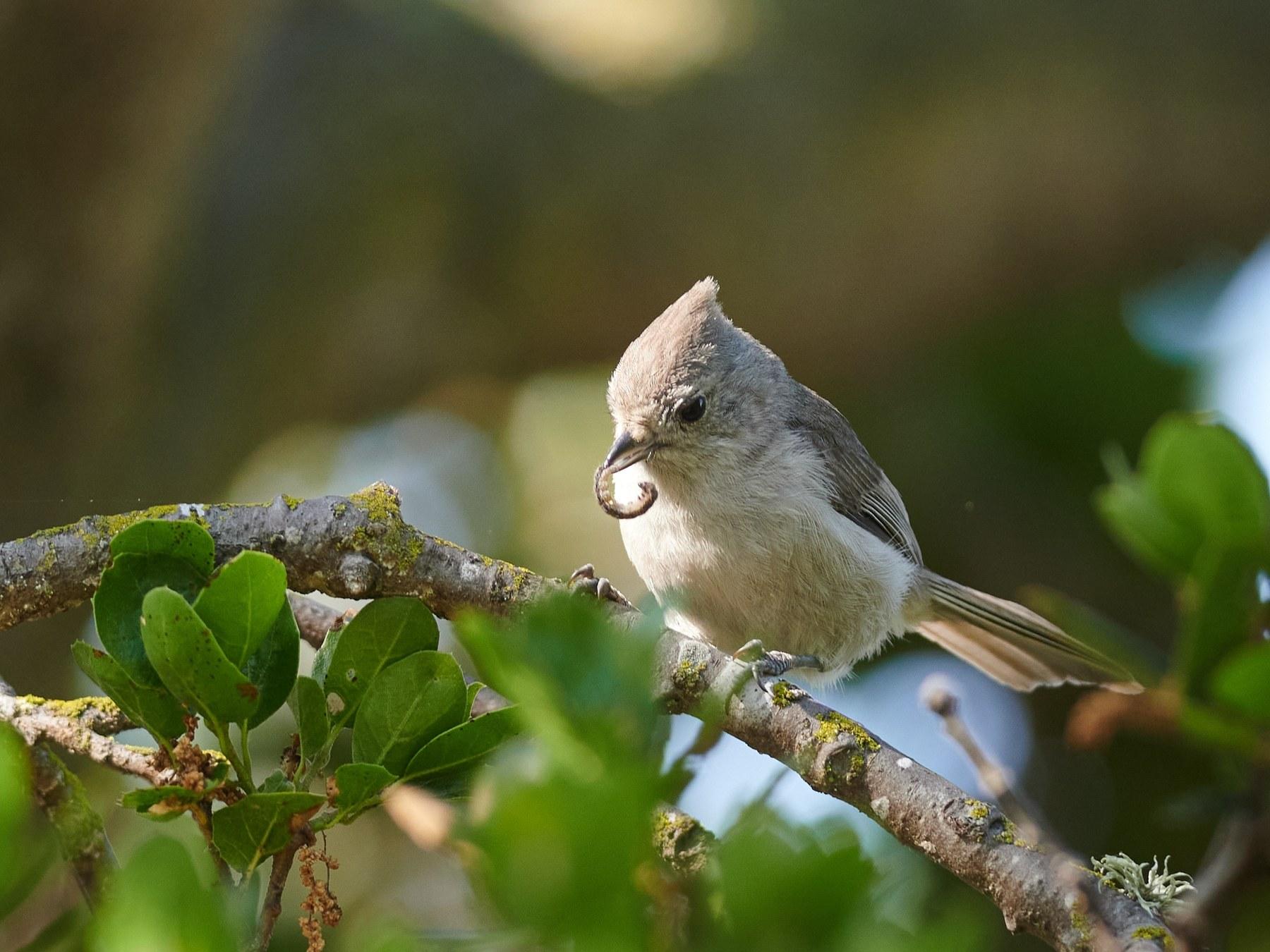
It finds most of its insects on bark and fewer on leaves, pecking and probing crevices, chipping off bark and pulling apart galls, flowers and curled dead leaves. It hangs from twigs and holds large items under a foot while it hammers them. Acorns, pinyon nuts and other seeds are opened by hammering them against a branch, and it eats grubs out of acorns.
In coastal oak woodland most natural foraging happens below about 30 ft (9 m); in one study, 67% was on trunks and branches, 29% on foliage and 4% on the ground.1 It seldom feeds out on open ground and usually carries food up to a perch to eat. It is known to store seeds, but we found no study of how it caches them.
Feeders and yards
In wooded areas it is a common visitor to feeders, especially where trees are close by. Offer black-oil sunflower seed on a raised tray or in a tube or hopper rather than on the ground; it also takes hulled sunflower, suet, peanuts and peanut hearts, safflower and mealworms.7, 8 In feeding trials, birds preferred seeds on raised trays to those at ground level, and chose large sunflower seeds over small ones.1
Nesting and breeding
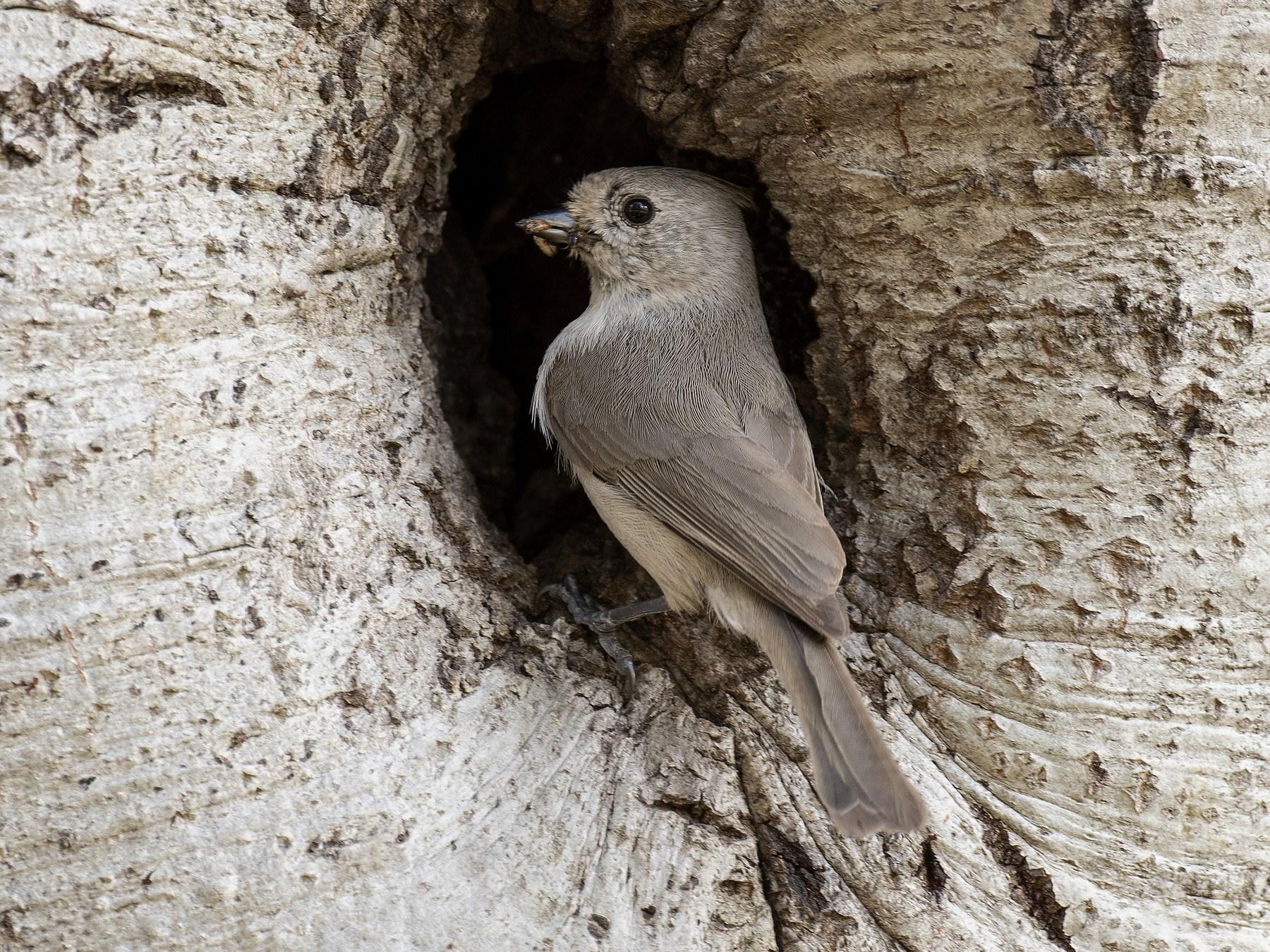
Oak Titmice nest in tree holes, mostly natural, rotted-out cavities, otherwise old woodpecker holes, and a bird may dig out a little more of the cavity in soft wood. They also readily use nest boxes, and odd sites such as pipes, fence posts and the eaves of buildings. In Mendocino County, 170 of 196 nest cavities (87%) were natural and 26 were woodpecker holes, and in museum egg records most nests outside boxes and other artificial sites were in oaks (95 of 138).1
The female mainly chooses the site and builds the nest, which takes 4-10 days, while the male feeds her and goes with her to gather material. The nest is a base of grass, weeds, moss, feathers and shredded bark, lined with hair, mostly rabbit, and feathers. Nests average about 13 ft (3.9 m) up in museum egg records, from 2 to 40 ft (0.6-12.2 m).1
In central California pairs pick a site in late February and March and build mainly from mid-March through April. Museum egg sets of the northern subspecies were laid from mid-March to early May, and the southern affabilis lays later, to the end of May.
Eggs and incubation
A clutch is usually 6-7 white eggs, plain or faintly speckled with pale reddish brown, and ranges from 3 to 9. Museum egg sets average 6.2 eggs in the northern subspecies (129 sets) and 6.6 in affabilis farther south (124 sets).1 In a Stanford nest-box study, 62 complete clutches averaged 6.75 eggs.9 In affabilis each egg weighs roughly a tenth of the female's weight.1
The female alone incubates, for 14-16 days, and the male feeds her; only she has a brood patch.
Nestlings and fledglings
The young leave the nest at 16-21 days old; in the Berkeley study it was about three weeks.4 Both parents feed them and carry away their droppings, and only the female broods them. Fledglings stay with their parents, are feeding themselves by 5 weeks old, and the family breaks up about a month after fledging.
Pairs usually raise one brood a year. There is some evidence they may occasionally raise two, and they will lay again if a clutch is lost. They first breed at one year old. We found no evidence of helpers at the nest, and no report of cowbirds or other birds laying in its nests; the handbook rests this on a 1985 review of cowbird hosts.
In Mendocino County blue oak woodland, 86% of 161 nests fledged at least one young (78-91% over two years); losses there included nests taken by scrub-jays and gopher snakes, and young drowned by rain in upward-facing cavities.1 At Berkeley, 13 broods averaged 5.0 fledglings, a figure the author thought may be low because some fledglings were missed.10
Nest boxes
Oak Titmice often take to nest boxes. In a box study over 12 years in central coastal California, they used boxes near streamside vegetation and chaparral.11 Two pairs nested at a new box site near Sacramento.12
Put a box up well before the breeding season and fit a predator guard.7 We found no recommended entrance-hole size for this species in the sources we read.
Birds often nest in the same box again. In the Stanford box study of 1928-33, in 51 cases of a banded adult nesting again, 33 were in the same box and 17 in a box 43-90 yards away, probably in the same territory.9
Behaviour
Oak Titmice live in pairs. Both birds defend their territory all year and use it for feeding, nesting and roosting, and territories stay much the same from year to year. Unlike many of their relatives they are not known to form winter flocks; any loose groups with other species after the breeding season seem to be chance meetings. It is among the most sedentary members of its family.
It flies between trees in a shallow, undulating flight and hops on the ground. It roosts in natural or artificial cavities or dense evergreen foliage. Mates usually roost apart, as much as 150 ft (45 m) apart in late fall, and a female often roosts in the nest cavity for up to a month before laying.1
Social behavior: pairs and territories
Pairs form in the first year, and the bond usually lasts unless one bird disappears. At Stanford in 1928-33, 11 of the 14 banded pairs that were recaptured stayed together for at least two years, with one known divorce.9
Territories in the San Francisco Bay region averaged about 4.2-6.4 acres (1.7-2.6 ha) in studies from 1949 to 1972, and ranged from about 1.7 to 12.6 acres (0.7-5.1 ha).1 Intruders are met with song and counter-singing, harsh scolding, quivering wings and a threat posture with the crest raised, then chases. The male dominates the female in the breeding season, with no clear difference in fall and winter.
Young birds settle close to home, and those that fail to pair are pushed out into poorer habitat. At Stanford only 2 of 145 nestlings banded were found nesting later, about 700 and 1,200 yards (640 and 1,100 m) away.9 Adding four young banded at Berkeley to those two, the Berkeley author put the median distance moved at about 650 yards (just under 600 m), or three or four territories away.4
Social behavior: mobbing
Oak and Juniper Titmice mob predators strongly, often with other small birds, and imitated calls of the Western Screech-Owl and Northern Pygmy-Owl, as well as stuffed models, draw the same response.1
Lifespan and predators
The oldest Oak Titmouse on the US banding records was at least 9 years old. It was banded in California in August 1956 as a bird hatched in an earlier year, and caught again and released there in June 1964. A second California bird reached at least 8 years 5 months (1956-1963).13
In the Stanford and Berkeley studies, about three in four established adults (76%) came back to breed the next year. The Berkeley author turned this into an average further life of about 3.5 years for an adult. Most young birds do not reach breeding age. Counting pairs that raised no brood, the Berkeley population fledged about four young per pair, and from the rate at which adults were replaced the author estimated that only one of those four survives to breed the next spring.10
Predators
Its enemies include accipiter hawks, small owls, mammals and snakes. The California Scrub-Jay is described as an important one, taking mainly eggs, nestlings and fledglings, and Steller's Jays may also be important in the coast ranges.1
Conservation
The Oak Titmouse is rated Least Concern on the IUCN Red List (BirdLife International; Red List version 2025-2).14 Partners in Flight estimates about 840,000 breeding-age birds worldwide around 2010, 710,000 of them in the United States. It gives the species a Continental Concern Score of 14 out of 20 and puts it on its Yellow Watch List.6
Population trend
Numbers are falling slowly. The North American Breeding Bird Survey shows a significant long-term decline of about 1% a year from 1968 to 2025 (-0.97% a year, 95% credible interval -1.53 to -0.43), leaving its index about 43% lower. Over the last ten years (2015-2025) the trend is about -0.8% a year and not statistically significant.15
Partners in Flight, working from the same survey for 1970-2021, gives about -1.0% a year and a total fall of about 41%.6 In Oregon, at the edge of the range, the survey's ten-year trend is a steep decline, but it rests on only 9 routes.15
Conservation: woodland loss
The bird is closely tied to oaks. By 1944 it had been seen to spread into areas where trees were planted and to decline locally where oaks were removed. California's oak woodlands are under pressure from clearing for farming, grazing land and housing, and from firewood cutting. Sources from 1991-1997 estimated that 25-50% of the state's oak woodland area had been lost since 1900, most in southern California, the Central Valley and the western Sierra foothills, and poor oak regeneration is a problem in many areas.1
Over 80% of California's oak woodland is privately owned. The handbook account advises protecting older, larger nest trees, especially those with natural cavities, and keeping a mix of tree species, and an earlier study recommended management units of at least 125-250 acres (50-100 ha).1
In a model of 27 years of point counts at one Madera County site, Oak Titmouse numbers were lower in warmer conditions, and the authors say rising mean temperatures are likely to affect it negatively. This is a modelled link, not a measured decline.16
Legal status
In the United States the Oak Titmouse is protected under the Migratory Bird Treaty Act and is listed by name in 50 CFR 10.13.17 The US Fish and Wildlife Service's ECOS database gives its status as 'Species of Concern'; it is not listed as threatened or endangered.18
California law makes it unlawful to take, or needlessly destroy, any bird's nest or eggs, and Oregon protects all non-game birds except three introduced species.19, 20 In Mexico, only the Cape district subspecies, cineraceus, is listed under NOM-059, as an endemic subject to special protection (Pr).21
Similar birds
Often mistaken for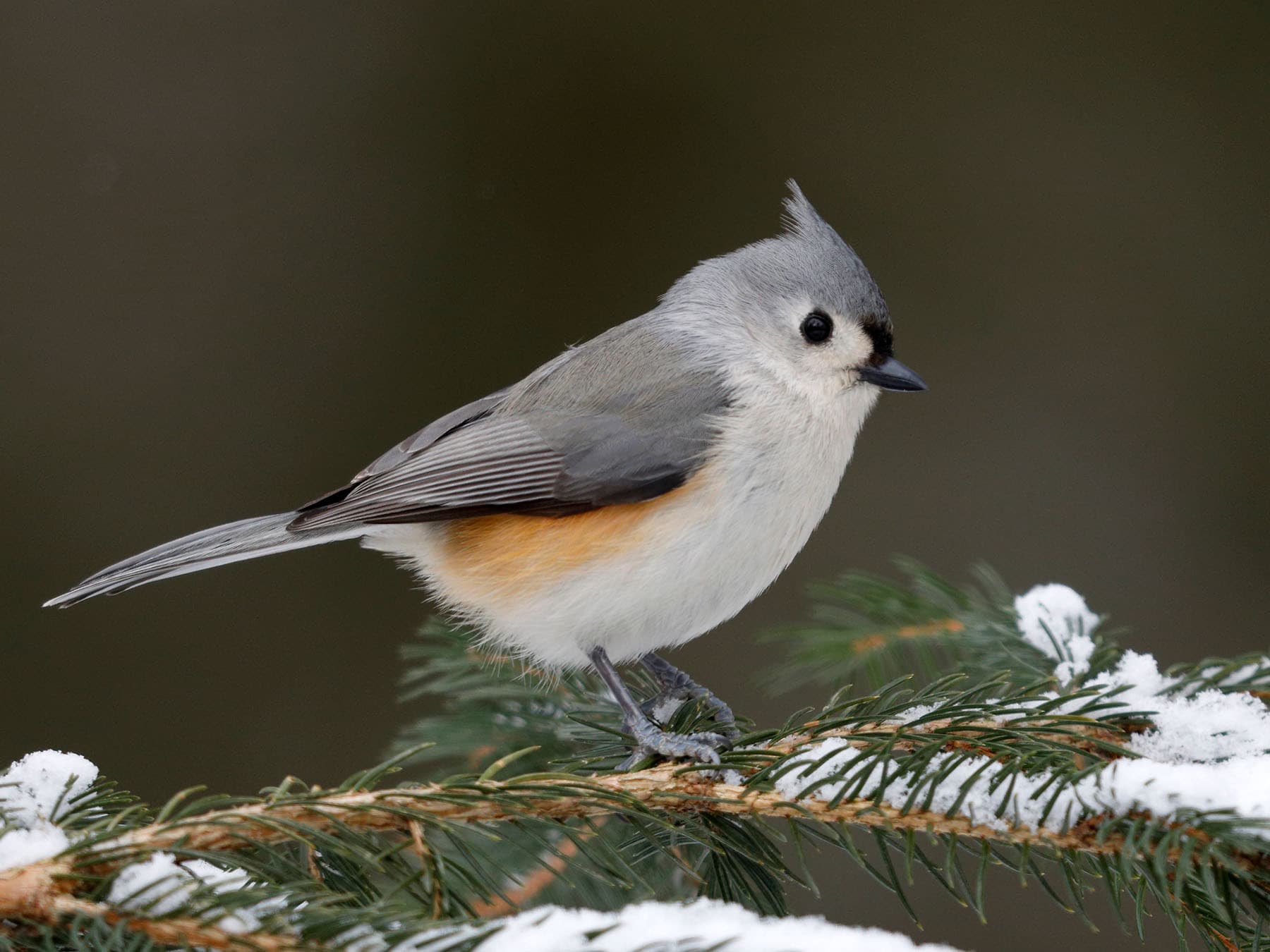
Quick facts
- Length
- 12–15 cm
- Wingspan
- 20–23 cm
- Weight
- 14–20 g
- Lifespan
- oldest recorded 9 years
- Family
- Tits & Chickadees
- Migration
- Resident
- Global status (IUCN)
- Least Concern
- World population
- About 840,000 breeding-age birds (Partners in Flight, around 2010)
- Population trend
- Decreasing: a significant long-term decline of about 1% a year since 1968 on the Breeding Bird Survey; the last ten years show a smaller fall that is not statistically significant
- Scientific name
- Baeolophus inornatus
Questions
2Is the Oak Titmouse the same as the Plain Titmouse?
Not quite: until 1997 the Plain Titmouse was one species, now split into the Oak Titmouse and the Juniper Titmouse. Books from before 1997 use the old name for both; see the 1997 split.
What is the Oak Titmouse's scientific name?
Baeolophus inornatus. It was first described by Gambel in 1845 as Parus inornatus, from 'Upper California', taken to be near Monterey. Until the late 20th century all North American tits, chickadees and titmice were placed in the single genus Parus.
Sources
29- 1Cicero, C., Pyle, P. and Patten, M. A. (2020). Oak Titmouse (Baeolophus inornatus), version 1.0. Birds of the World (P. G. Rodewald, editor). Cornell Lab of Ornithology. doi:10.2173/bow.oaktit.01 (opens in a new tab)
- 2American Ornithologists' Union (1997). Forty-first Supplement to the American Ornithologists' Union Check-list of North American Birds. The Auk 114: 542-552. doi:10.2307/4089270 (opens in a new tab)
- 3Cicero, C. (2004). Barriers to sympatry between avian sibling species (Paridae: Baeolophus) in local secondary contact. Evolution 58: 1573-1587. doi:10.1111/j.0014-3820.2004.tb01737.x (opens in a new tab)
- 4Dixon, K. L. (1949). Behavior of the Plain Titmouse. The Condor 51: 110-136. doi:10.2307/1365105 (opens in a new tab)
- 5National Park Service. NPSpecies profile: Baeolophus inornatus, Yosemite National Park. NPSpecies. Accessed 22 November 2026. Source (opens in a new tab)
- 6Partners in Flight (2023). Avian Conservation Assessment Database, global sheet (2023). Partners in Flight. Accessed 22 November 2026. Source (opens in a new tab)
- 7Cornell Lab of Ornithology. Oak Titmouse. All About Birds. Accessed 22 November 2026. Source (opens in a new tab)
- 8Cornell Lab of Ornithology and Birds Canada. Common Feeder Birds: Oak Titmouse. Project FeederWatch. Accessed 22 November 2026. Source (opens in a new tab)
- 9Price, J. B. (1936). The Family Relations of the Plain Titmouse. The Condor 38: 23-28. doi:10.2307/1363588 (opens in a new tab)
- 10Dixon, K. L. (1956). Territoriality and Survival in the Plain Titmouse. The Condor 58: 169-182. doi:10.2307/1364672 (opens in a new tab)
- 11Milligan, M. C. and Dickinson, J. L. (2016). Habitat quality and nest-box occupancy by five species of oak woodland birds. The Auk 133: 429-438. doi:10.1642/auk-15-187.1 (opens in a new tab)
- 12Airola, D. A., Hall, R. and Stine, P. (2024). High First-Year Occupancy and Success by Cavity-Nesting Birds in Nest Boxes at a Woodland Mitigation Site near Sacramento, California. Central Valley Birds 27: 152-161. doi:10.64555/29e6km79 (opens in a new tab)
- 13USGS Bird Banding Laboratory. North American Bird Banding Program Longevity Records, version 2025 (current through December 2025). USGS Patuxent. Accessed 22 November 2026. Source (opens in a new tab)
- 14BirdLife International (2025). Baeolophus inornatus. The IUCN Red List of Threatened Species 2025 (via GBIF's IUCN Red List checklist, version 2026-1). IUCN Red List. doi:10.2305/IUCN.UK.2025-2.RLTS.T22711978A137637409.en (opens in a new tab)
- 15Hostetler, J. A. et al. (2026). The North American Breeding Bird Survey, Analysis Results 1966 - 2025. U.S. Geological Survey data release. doi:10.5066/P1OSNSFC (opens in a new tab)
- 16Purcell, K. L. and Mori, S. R. (2017). Modeling the response of oak woodland birds to changing climate using 27 years of monitoring data. Trends and Traditions: Avifaunal Change in Western North America: 344-373. doi:10.21199/swb3.19 (opens in a new tab)
- 17U.S. Fish and Wildlife Service (2026). 50 CFR 10.13, List of Birds Protected by the Migratory Bird Treaty Act. eCFR (issue date 17 Nov 2026). Accessed 22 November 2026. Source (opens in a new tab)
- 18U.S. Fish and Wildlife Service. ECOS species profile: Oak Titmouse (Baeolophus inornatus). ECOS. Accessed 22 November 2026. Source (opens in a new tab)
- 19State of California (1971). California Fish and Game Code section 3503. California Legislative Information (Wayback capture 18 May 2026). Accessed 22 November 2026. Source (opens in a new tab)
- 20Oregon Department of Fish and Wildlife (2026). OAR 635-044-0430 Protected Wildlife. Oregon Administrative Rules (oregon.public.law copy). Accessed 22 November 2026. Source (opens in a new tab)
- 21SEMARNAT (2019). Modificacion del Anexo Normativo III de la NOM-059-SEMARNAT-2010. Diario Oficial de la Federacion, 14 Nov 2019. Accessed 22 November 2026. Source (opens in a new tab)
- 22AviList Core Team (2025). AviList: The Global Avian Checklist, v2025b. doi:10.2173/avilist.v2025b (opens in a new tab)
- 23National Audubon Society and Kaufman, K.. Oak Titmouse. Audubon Guide to North American Birds. Accessed 22 November 2026. Source (opens in a new tab)
- 24Cicero, C., Pyle, P. and Patten, M. A. (2020). Juniper Titmouse (Baeolophus ridgwayi), version 1.0. Birds of the World. Cornell Lab of Ornithology. Accessed 22 November 2026. Source (opens in a new tab)
- 25Ritchison, G., Grubb, T. C., Jr. and Pravosudov, V. V. (2020). Tufted Titmouse (Baeolophus bicolor), version 1.0. Birds of the World. Cornell Lab of Ornithology. Accessed 22 November 2026. Source (opens in a new tab)
- 26Sloane, S. A. (2020). Bushtit (Psaltriparus minimus), version 1.0. Birds of the World. Cornell Lab of Ornithology. Accessed 22 November 2026. Source (opens in a new tab)
- 27Dahlsten, D. L. et al. (2024). Chestnut-backed Chickadee (Poecile rufescens), version 1.1. Birds of the World. Cornell Lab of Ornithology. Accessed 22 November 2026. Source (opens in a new tab)
- 28McCallum, D. A., Grundel, R. and Dahlsten, D. L. (2020). Mountain Chickadee (Poecile gambeli), version 1.0. Birds of the World. Cornell Lab of Ornithology. Accessed 22 November 2026. Source (opens in a new tab)
- 29Salis, A. et al. (2025). Birds combined calls more than 11 million years ago. Scientific Reports 15. doi:10.1038/s41598-025-05497-w (opens in a new tab)

Checked by
Nathan Cope, founder and editor
Nathan founded Birdfact and leads its writers and contributors in the UK, the US and Canada. He has watched and studied birds for more than ten years, and checks every article and species guide before it’s published.