


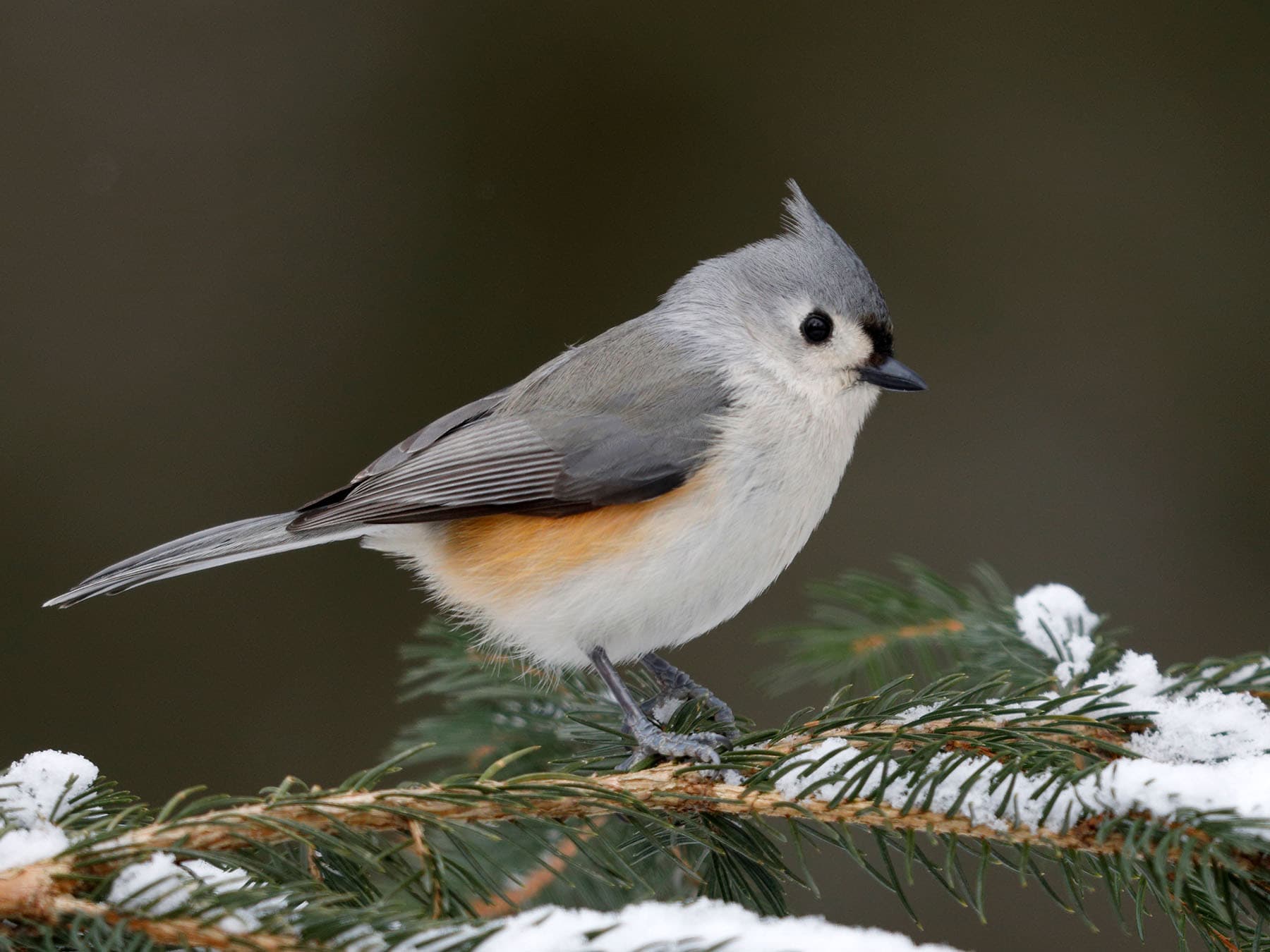
Tufted Titmouse
Crested Titmouse · Baeolophus bicolor
By the Birdfact teamChecked by Nathan Cope
On this page13 sections
How to recognise it
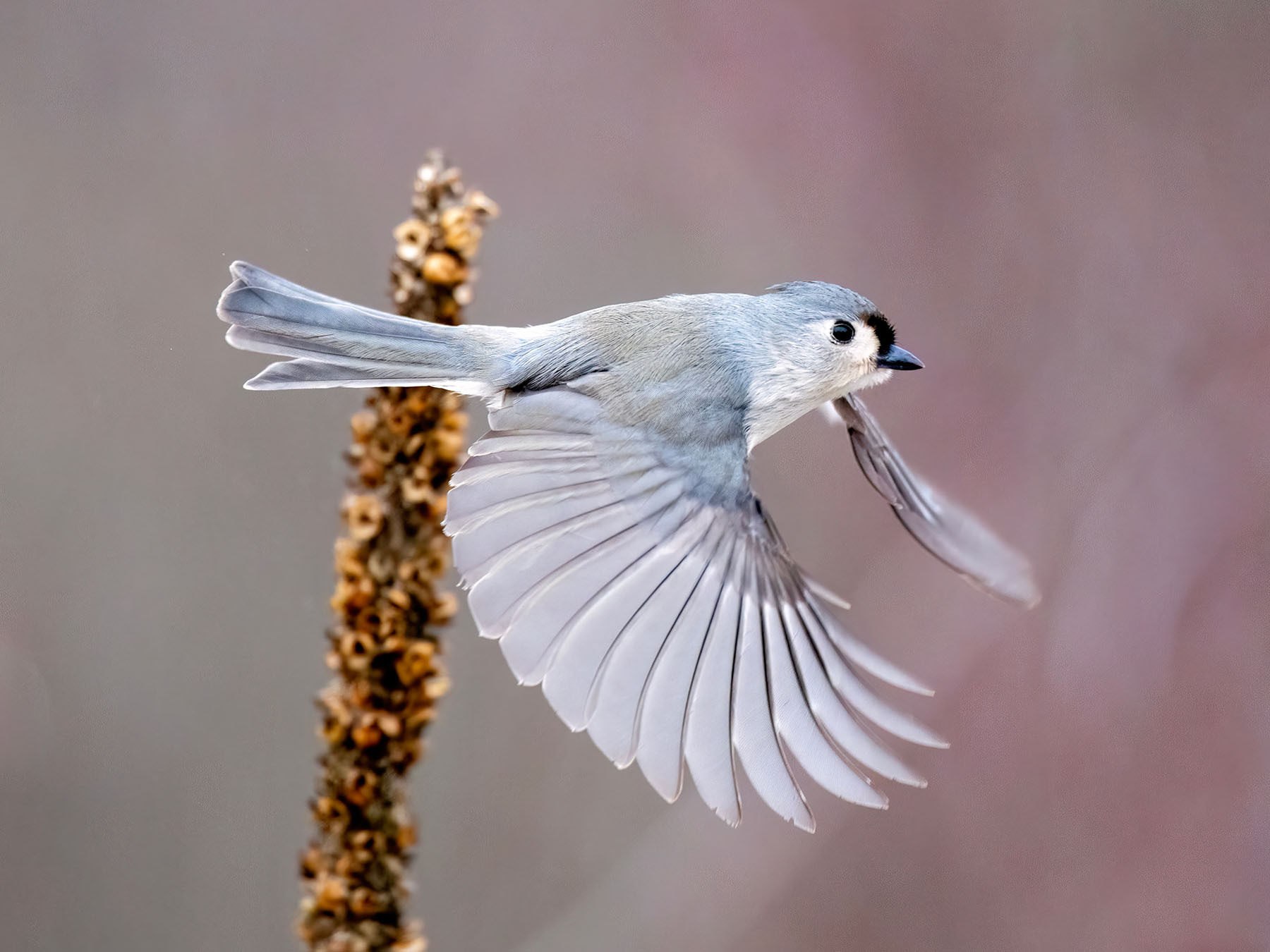
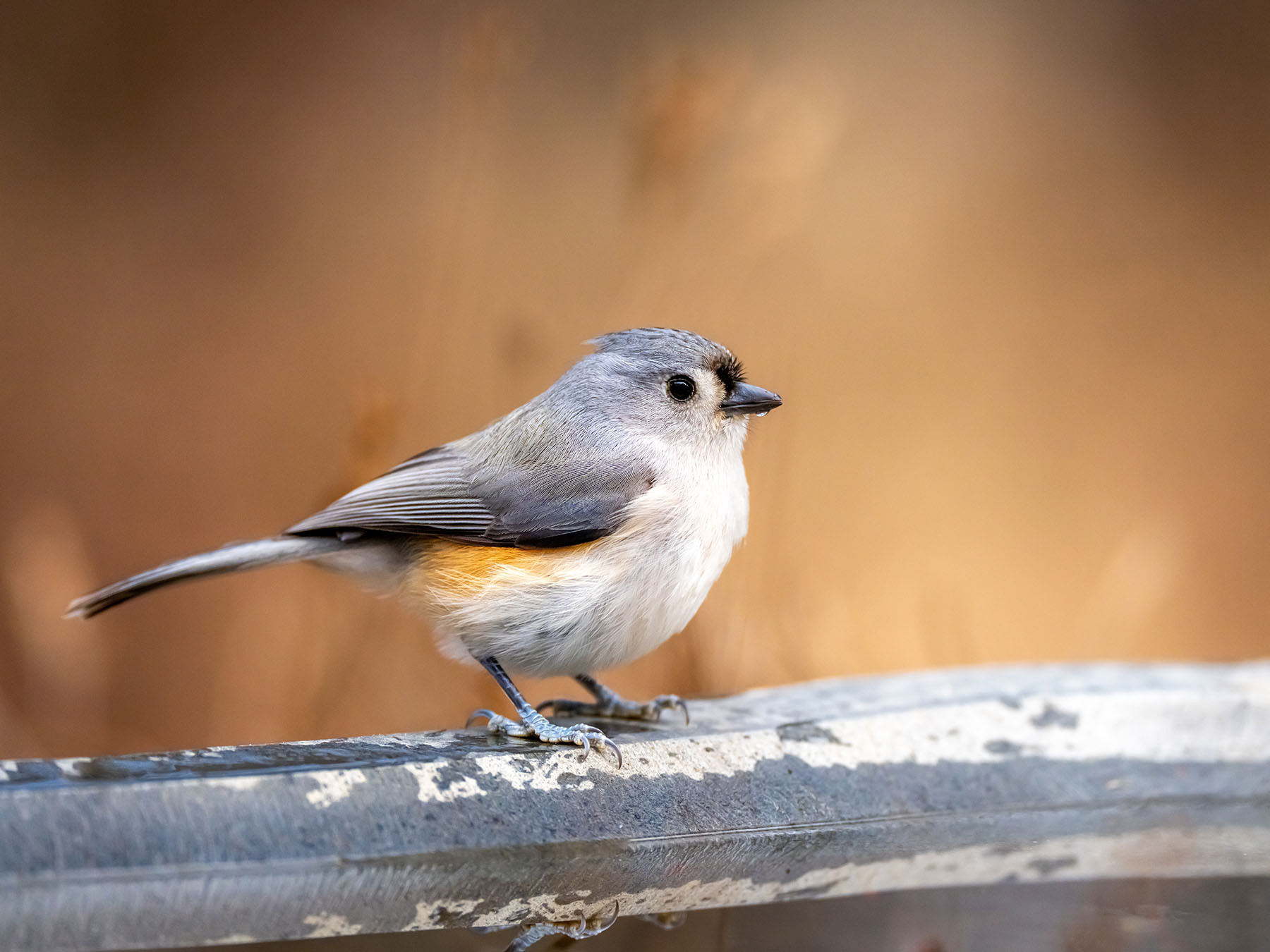
The Tufted Titmouse is a small, plump bird with a distinctive crest on its head. Its upperparts are soft gray, contrasting with white underparts and rusty flanks. The forehead is black, and it has a pale ring around its large, dark eye.
Both sexes look alike, with juveniles closely resembling adults. The bird's appearance remains consistent throughout the year, with no seasonal plumage changes.
Its size
Adults- Length
- 14–16.5 cm
- Wingspan
- 20–25 cm
- Weight
- 18–26 g
Its song and calls
The Tufted Titmouse is known for its clear, whistled 'peter-peter-peter' song, often repeated in sets of three or four.
They also produce a variety of calls, including a nasal 'tsee-day-day-day' when alarmed and soft, musical chirps during social interactions. Their vocalizations are loud and carry well through wooded areas.
- Song0:00 / 0:57
Recorded in North Carolina, United States · March 2024
- Call0:00 / 0:41
Recorded in Vermont, United States · March 2023
When and where to see it
OctoberHere all year
Most recorded in October
- 1. Tennessee3.3%
- 2. West Virginia3.2%
- 3. Kentucky3.2%
- 4. Arkansas3.0%
- 5. Georgia3.0%
Each dot is a county, state or province: the bigger and darker, the larger the bird’s share of that place’s bird records that month. Grey dots: no regular records. The ringed point is the centre of the bird’s records this month; the arrow shows how it moved since last month, and the dashed loop its path through the year. “Arrivals” colours places where it becomes regular this month (orange) or is in its last regular month (grey). GBIF eBird Observation Dataset, 2019–2024. Map data: Natural Earth, US Census Bureau; place centres © OpenStreetMap contributors.
In your area
See when the Tufted Titmouse is recorded in your county, state or province.
How often the Tufted Titmouse turns up in the United States and Canada through the year, from birdwatchers' records.
United States
Resident · all year · most records in February
Canada
Resident · all year · most records in February
Show as a table
| Month | United States | Canada |
|---|---|---|
| January | 1.4% (regular) | 0.13% (regular) |
| February | 1.7% (regular) | 0.15% (regular) |
| March | 1.5% (regular) | 0.12% (regular) |
| April | 1.4% (regular) | 0.078% (regular) |
| May | 1.1% (regular) | 0.054% (regular) |
| June | 1.0% (regular) | 0.029% (regular) |
| July | 1.0% (regular) | 0.030% (regular) |
| August | 1.00% (regular) | 0.037% (regular) |
| September | 1.3% (regular) | 0.045% (regular) |
| October | 1.4% (regular) | 0.074% (regular) |
| November | 1.3% (regular) | 0.10% (regular) |
| December | 1.5% (regular) | 0.13% (regular) |
Worldwide: recorded regularly in 2 countries
Countries where it was recorded in at least 3 of the 6 years 2019–2024. Linked countries have their own bird list.
North America (2)
Data: EOD – eBird Observation Dataset (Cornell Lab of Ornithology), accessed via GBIF.org, CC BY 4.0. Records from 2019–2024, aggregated and filtered by Birdfact. How these lists are made
Tips for seeing it
- Look for Tufted Titmice in deciduous and mixed woodlands, especially near forest edges.
- Listen for their distinctive 'peter-peter-peter' call, which is often repeated.
- Check bird feeders, as they readily visit for sunflower seeds and suet.
- Observe their quick, jerky movements as they forage in trees and shrubs.
What it eats
Tufted Titmice have a varied diet consisting of insects, seeds, and berries. In spring and summer, they primarily consume caterpillars, beetles, and other arthropods.
During fall and winter, they shift to a diet rich in acorns, beechnuts, and sunflower seeds, often caching food for later consumption.
Nesting and breeding
Tufted Titmice form monogamous pairs and begin breeding in early spring. Males court females with soft calls and by offering food.
Nests are built in tree cavities or nest boxes, typically 3-6 meters above ground. The female constructs the nest using moss, leaves, and bark strips, lining it with soft materials like animal fur.
The female lays 5-7 white eggs with reddish-brown spots and incubates them for about 14 days. Both parents feed the nestlings, which fledge after 15-18 days but may remain with the family group for several weeks.
Behaviour
Tufted Titmice are active and acrobatic foragers, often seen hanging upside down to glean insects from tree branches. They are known for their habit of carrying large seeds to a perch, holding them with their feet, and hammering them open with their strong beak.
These birds are social, frequently joining mixed-species flocks outside of breeding season.
Conservation
While the Tufted Titmouse is currently listed as Least Concern, it faces challenges from habitat loss due to urbanization and climate change.
Conservation efforts focus on preserving deciduous forests and promoting bird-friendly urban landscapes. Citizen science projects help monitor population trends.
Similar birds
Often mistaken for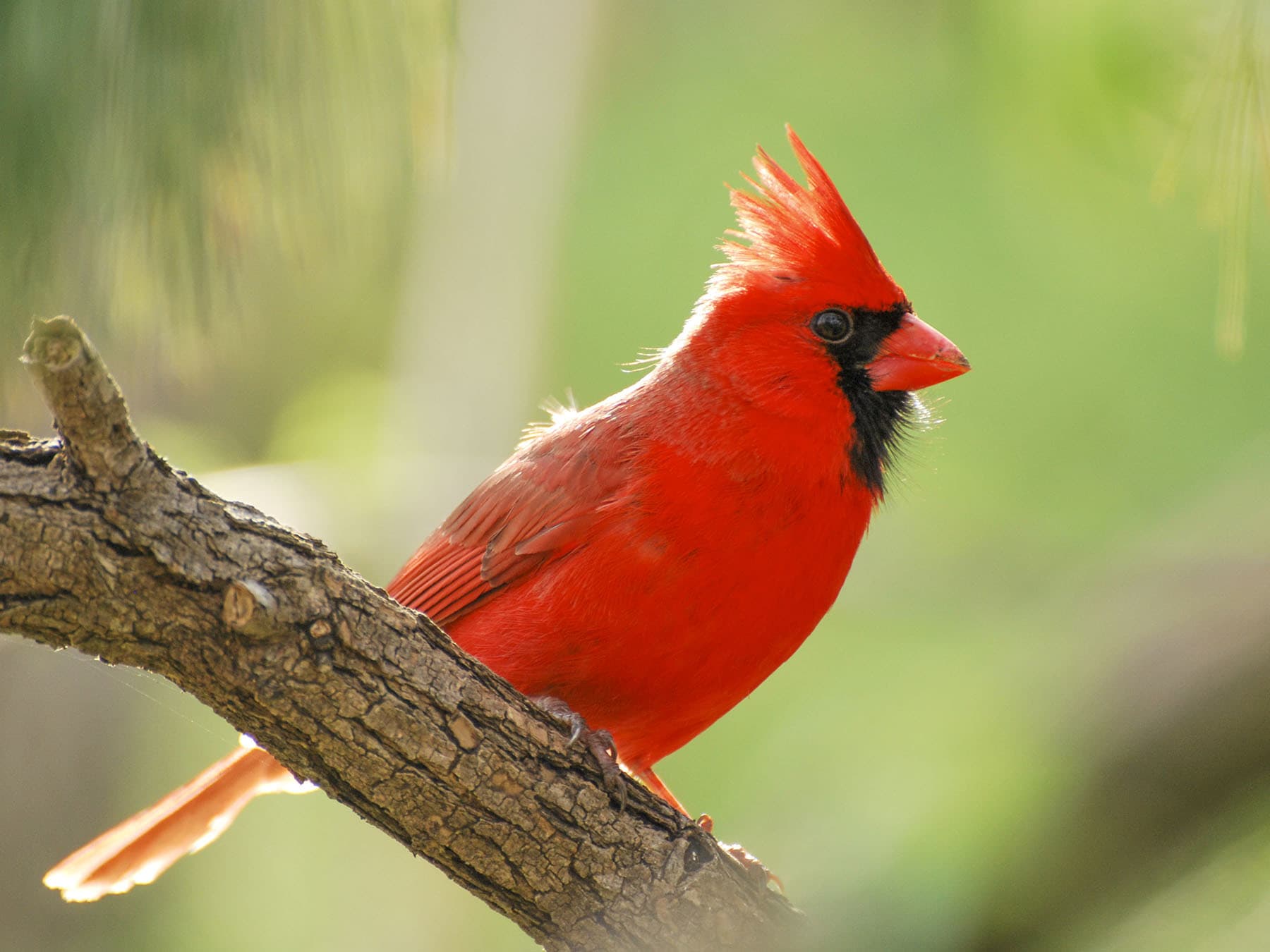
More photos
4 photos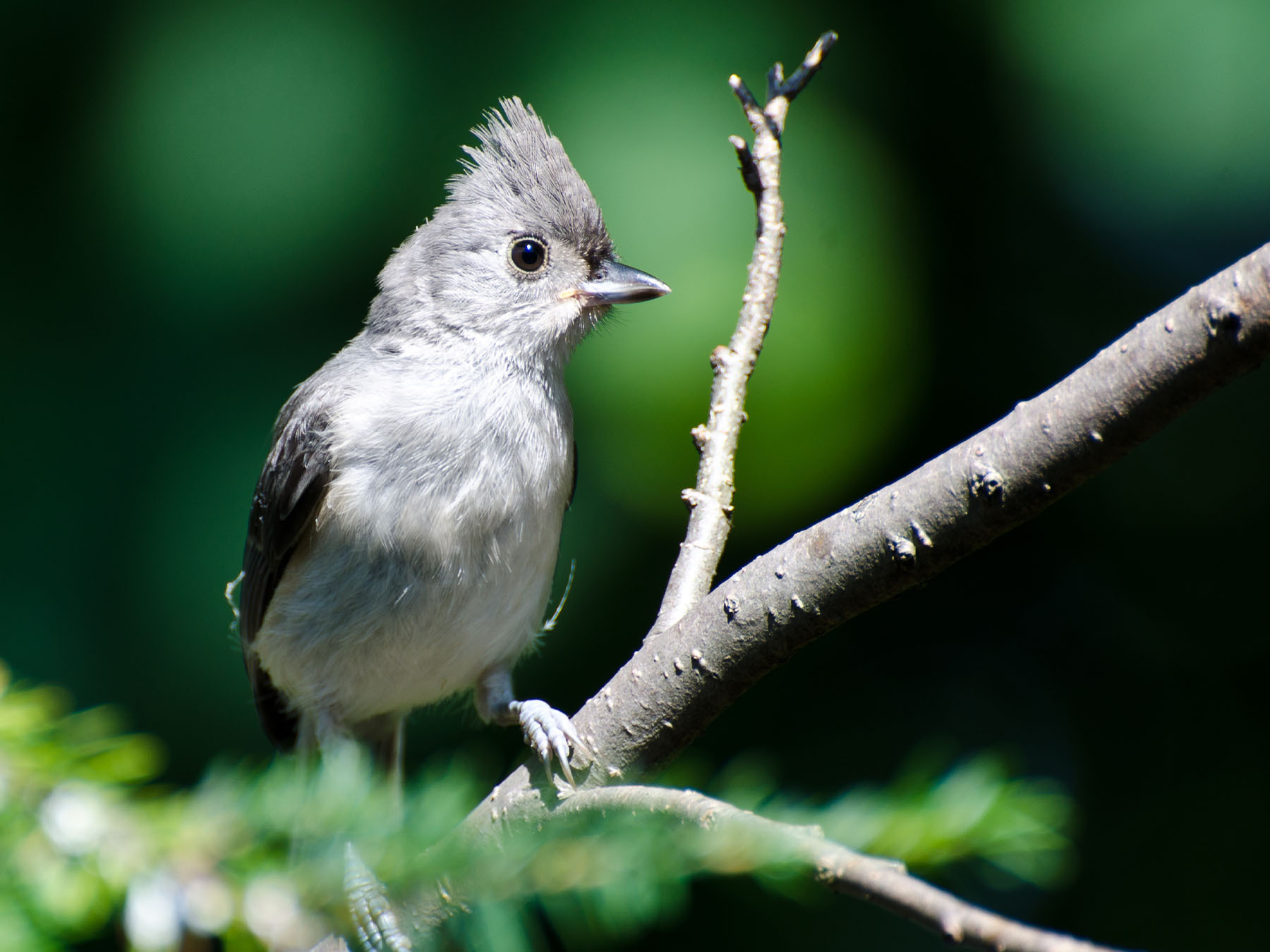
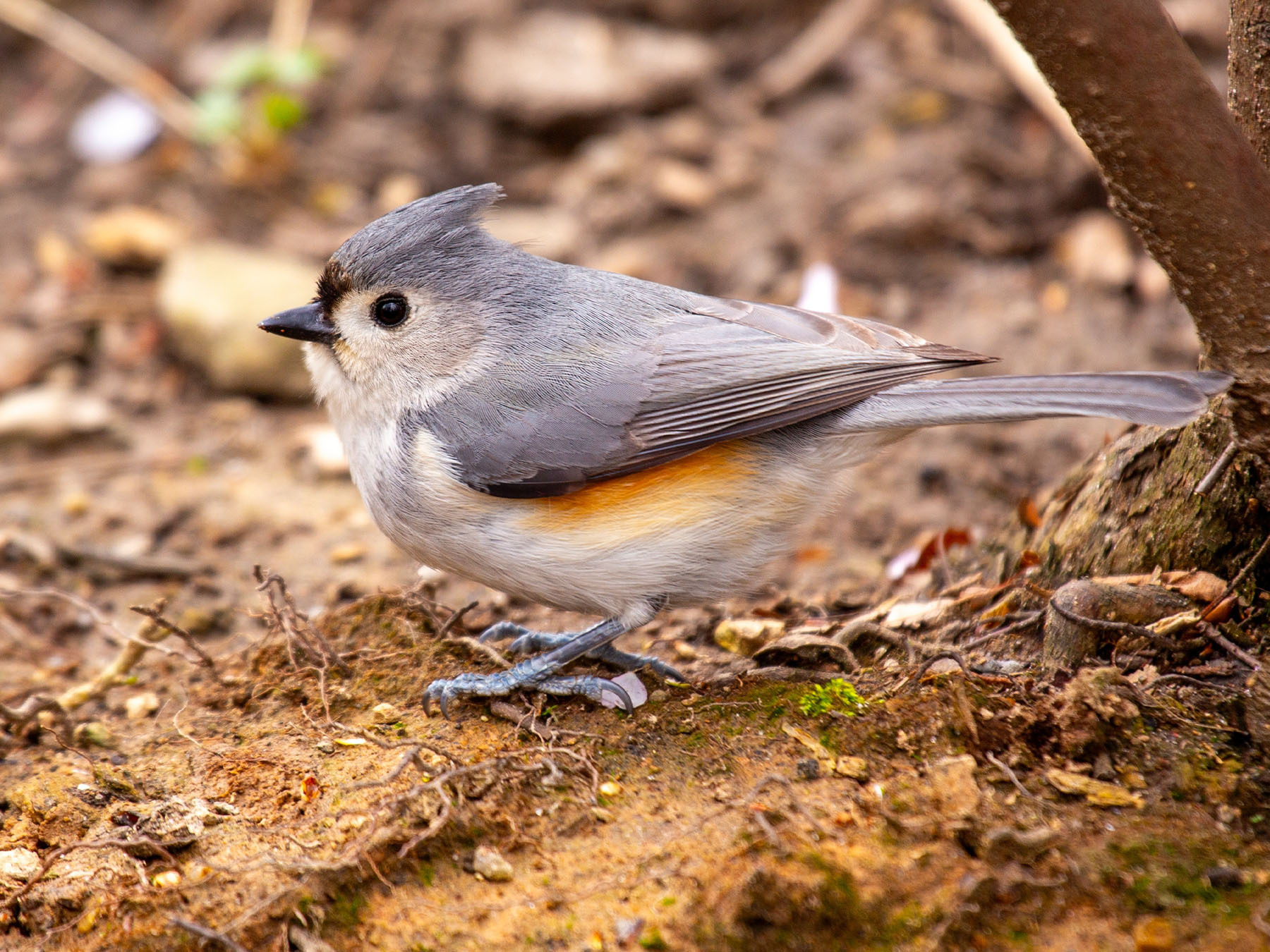
Tufted Titmouse guides
1 guidesQuick facts
- Length
- 14–16.5 cm
- Wingspan
- 20–25 cm
- Weight
- 18–26 g
- Lifespan
- 2–3 years · oldest recorded 13.3 years
- Family
- Tits & Chickadees
- Migration
- Resident
- Global status (IUCN)
- Least Concern
- World population
- 12,000,000 mature individuals
- Population trend
- Population stable and slightly increasing
- Also called
- Crested Titmouse
- Scientific name
- Baeolophus bicolor
Sources
4- 1BirdLife International. 2016. Baeolophus bicolor. The IUCN Red List of Threatened Species 2016: e.T22711983A94314102. Source (opens in a new tab)
- 2Breeding Bird Survey and/or Christmas Bird Count: Butcher and Niven (2007)
- 3Partners in Flight (2022) Source (opens in a new tab)
- 4Clapp et al., Longevity records of North American birds: Columbidae through Paridae, J Field Ornithol, 54:123-137 (1983)

Checked by
Nathan Cope, founder and editor
Nathan founded Birdfact and leads its writers and contributors in the UK, the US and Canada. He has watched and studied birds for more than ten years, and checks every article and species guide before it’s published.