


Bushtit
American Bushtit · Psaltriparus minimus
By the Birdfact teamChecked by Nathan Cope
On this page12 sections
How to recognise it
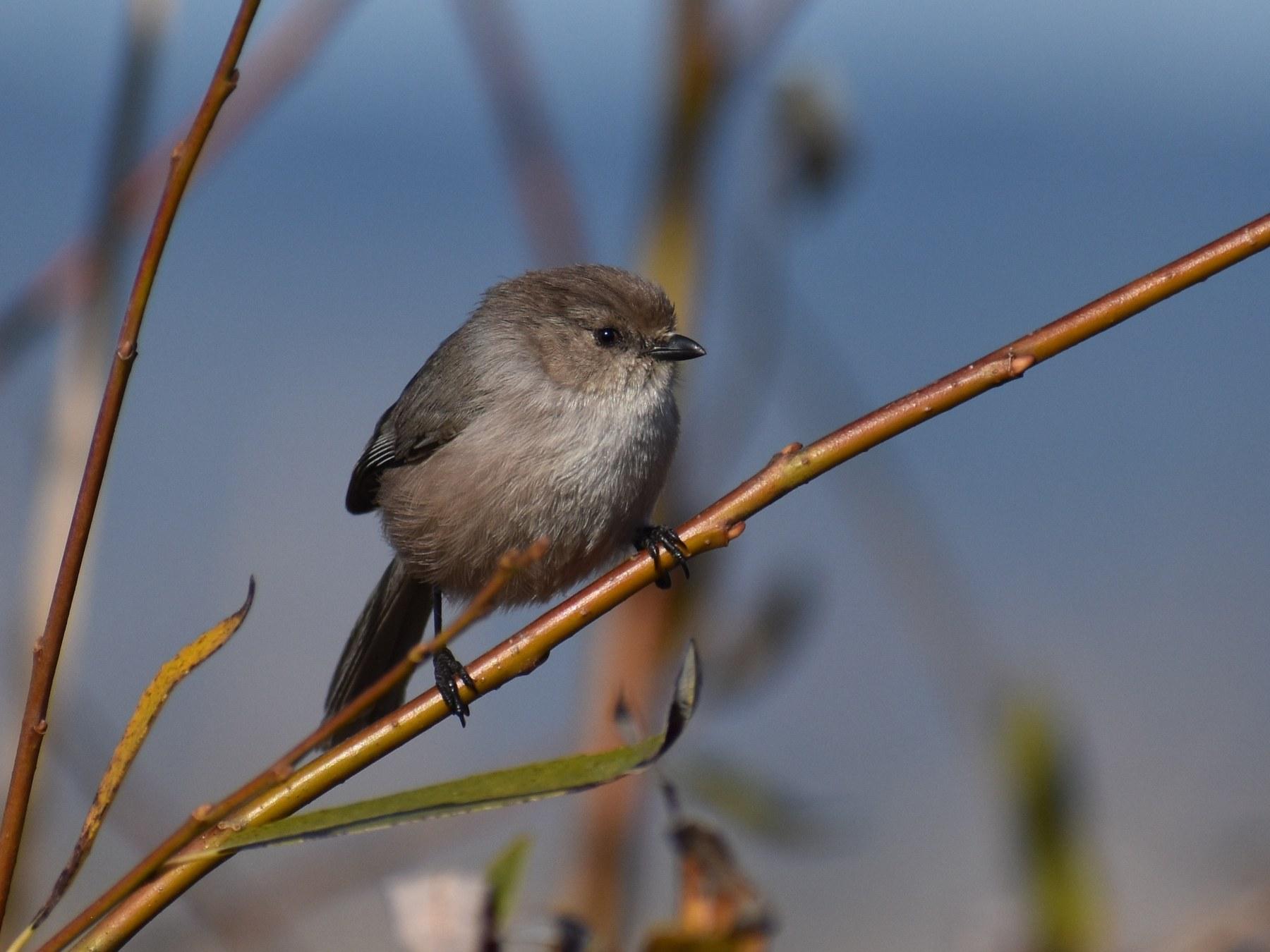
The Bushtit is a tiny, plain gray bird with a long tail, short wings and a short black bill. For most of the year it travels through trees and shrubs in busy flocks that keep up soft calls, often hanging upside down from twigs as they feed. In the nesting season, from late February to July, you may also see one alone or in a pair.
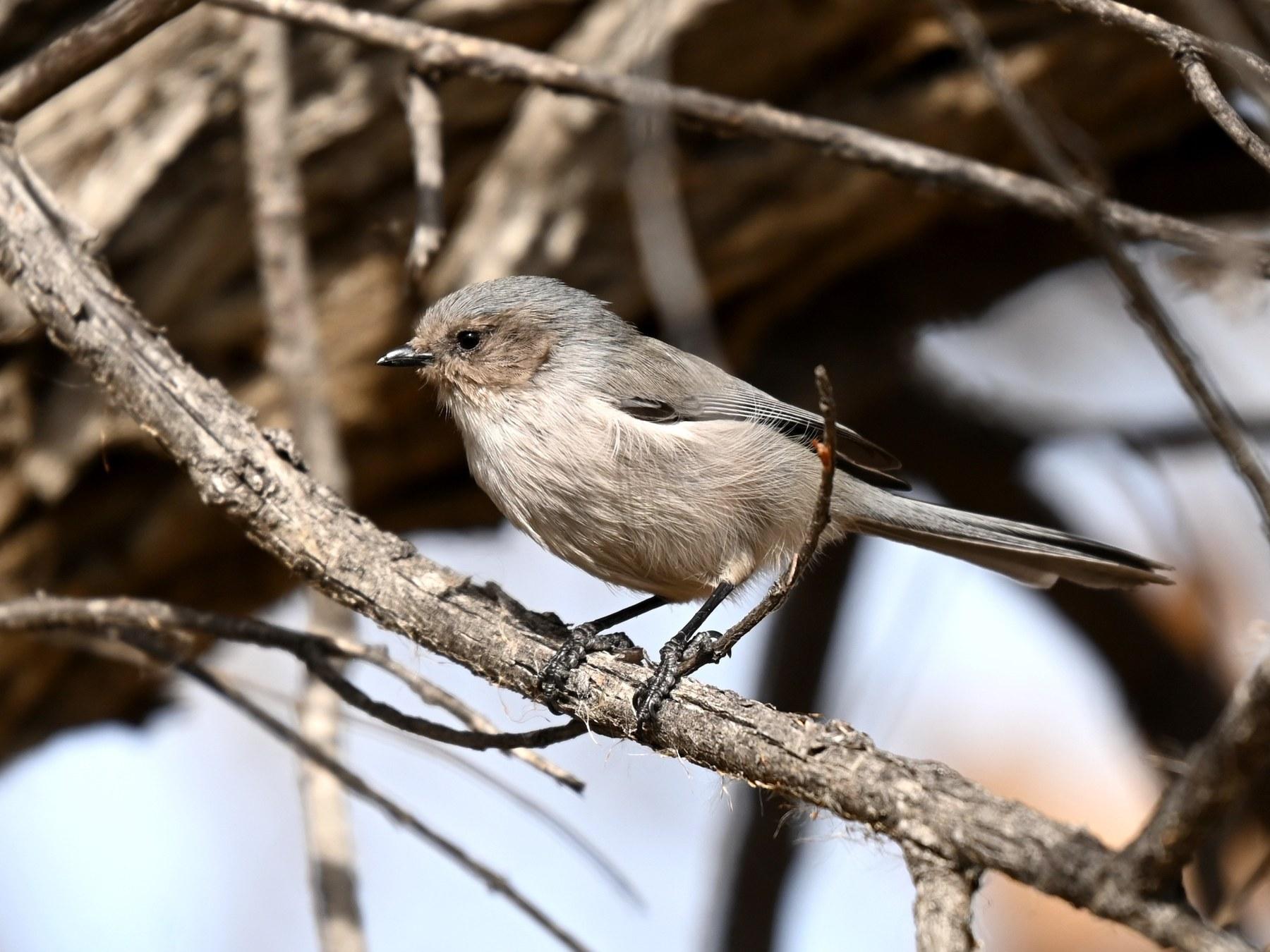
The head pattern depends on where you are. Along the Pacific coast, from British Columbia to Baja California, birds have a pale brown cap from the forehead to the nape, on a body that is plain gray above and paler below. Inland birds, from eastern Oregon and Wyoming south to central Texas and northern Mexico, are leaden gray above with a gray crown and a plain brownish mask through the eye. In the Mexican group, found from southwest Texas southward, males have a glossy black mask and females a brownish one.
Across the range, birds are darker and browner where the climate is humid and paler and grayer where it is dry. The bill, legs and feet are black.
Size and weight
It is 4.3–4.7 in (11–12 cm) long with a wingspan of 6.3–7.1 in (16–18 cm)1 and weighs only about 0.2 oz (4.5–6 g): kinglet-sized and slightly smaller than a chickadee, with a tail longer than its wing. Males average slightly larger than females, with plenty of overlap, and the brown-capped Pacific birds are a little smaller than those of the other groups.
Male, female and young birds
The sexes are told apart by the eye. In plumage they look alike, except that black on the face marks a male: the glossy black mask of Mexican-group males, or the partial mask of some inland males. An adult male keeps a dark brown eye for life, while an adult female's eye is pale: cream, yellow or white.
Young birds blur the rule, because nestlings of both sexes have dark eyes. A young female's eye starts to lighten after about two weeks, can look different from a male's as early as three weeks and is fully pale by about 46 days old.2 Juveniles otherwise look much like adults, but slightly mottled and uneven, with shorter, fluffier body feathers, a shorter tail when they leave the nest and a fleshy gape at the base of the bill.
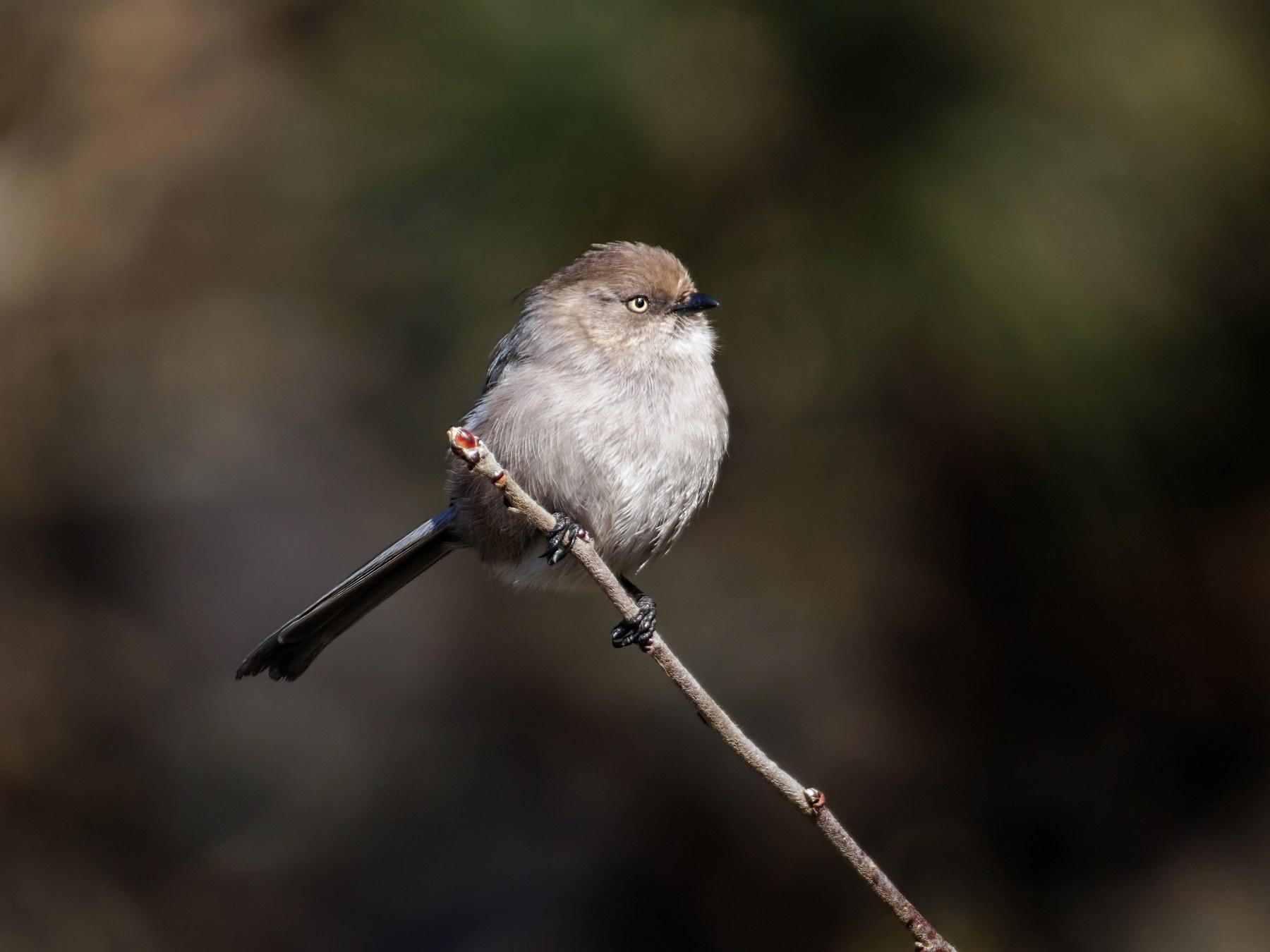
Black in the face is generally absent in the north, becomes commoner southward from northern Mexico and is commoner in males than in females. Among inland birds, some young males, and occasionally older males in the south of the range, show a partial black mask that marks them as males, since inland females never have black on the face. In Guatemala every male has a fully black mask.2
A young male banded in New Mexico with scattered black feathers around its eyes had none when it was caught again the next April.3
Identification: similar birds
Its tiny size, long tail, plain gray plumage and chickadee-like habits set it apart from the other small birds in its range. A young Verdin can be mistaken for it, especially for a just-fledged Bushtit with its short tail. The young Verdin has a plain gray face with dark lores and gray ear patches and a shorter tail, where a Bushtit shows a brown cap or a brown, sometimes black, ear patch.
A Blue-gray Gnatcatcher is bluish gray with a bold white eye-ring and a black tail with white outer feathers, which it often fans; a Bushtit is plainer, with a dark brownish-gray tail. Oak and Juniper Titmice are plain gray or gray-brown too, but each has a short crest and weighs roughly two to four times as much.
Not sure it’s a Bushtit? Check your photo: Birdfact names the bird and shows the look-alike side by side.
Its size
Adults- Length
- 11–12 cm
- Wingspan
- 16–18 cm
- Weight
- 4.5–6 g
Its song and calls
The Bushtit has no true song. What you hear from a flock is a stream of contact calls, a distinct "tsit" or "spit": soft between birds feeding together, louder and faster while a pair builds its nest, and very loud and emphatic, sometimes doubled, when birds mob a predator or fight.
A bird that has lost its flock gives a very high, ringing "sre-e-e-e" that carries a long way. When a predatory bird passes overhead, one or several birds give a high, warbling "sre-e-e-e e-e-e" alarm, and the whole flock stops calling and freezes in silence for about 20 seconds.2
At dusk, as a flock settles to roost huddled together, the birds keep up a quiet twittering of soft contact notes and light, begging-like notes. That somewhat musical, apparently unstructured group twittering is the nearest thing it has to a song.
- Flock contact calls0:00 / 0:44
Recorded in Santa Clara, United States · September 2012
- Contact calls0:00 / 0:08
Recorded in Washington, United States · July 2022
- Contact calls0:00 / 0:06
Recorded in California, United States · February 2025
Heard one and not sure? Let the bird song identifier listen.
When and where to see it
The Bushtit lives all year in western North America: from southwestern British Columbia through western Washington, western and southern Oregon and most of California to Baja California. Inland it ranges from Utah and western Colorado through Arizona and New Mexico, and on through the highlands of Mexico to southwestern Guatemala.
In Canada it is found on southeastern Vancouver Island and in the Fraser Lowlands. It lives more locally in west and central Texas, southern Idaho, Nevada, southwestern Wyoming and western Oklahoma, and is casual in central Kansas.
Look for it in open mixed woodland with evergreen foliage or a shrubby understory, such as pinyon-juniper and pine-oak, and in oak woodland, coastal chaparral and sage scrub, and brushy streamsides. It settles readily in suburbs and residential areas with trees and shrubs. It avoids open desert and the highest mountains, and it occurs at up to about 11,500 ft (3,505 m).
It does not migrate, but in the mountains some birds move lower in winter, often down into desert, and higher in summer. It turns up every year along the lower Colorado River from late October to early March. Some of these movements may be young birds leaving the flock they hatched in. Because its numbers rise and fall, it can seem to be missing from good habitat in some years.
Over the last century it has spread north and west. In British Columbia it was probably confined to the Fraser River delta and nearby towns until the mid-1930s and was first confirmed breeding at Victoria in 1937, a spread linked to milder winters and probably to forest clearing. In Washington it moved inland and onto islands from the Puget Sound coast as conifer forest gave way to suburbs and shrubby second growth.2 A century ago it was considered only an irregular visitor to British Columbia, and today it is common in the province's southwest.4 It has also been lost from places: it disappeared from Santa Catalina Island after 1905 and from the more cultivated parts of California's San Joaquin Valley, where it may be recolonizing.2
Tips for seeing it
What it eats
Bushtits eat mainly small insects and spiders picked from leaves and twigs. True bugs make up a large part of the diet, among them scale insects, leafhoppers, treehoppers and aphids, along with beetles, caterpillars, wasps and ants. Plant food is a small share, mostly tiny seeds and galls, with some willow seeds, olives and berries.
Watch a flock feed and you will see the birds move in short hops, often hanging upside down, and pull foliage back with one foot to reach the middle of a clump. It is a specialist at gleaning foliage: in northern Arizona, birds were hanging in 55.5% of foraging observations.2 On stems it works the small twigs near the branch tips. It usually swallows prey whole, but beats a long caterpillar against a branch until it goes limp, and it does not store food.
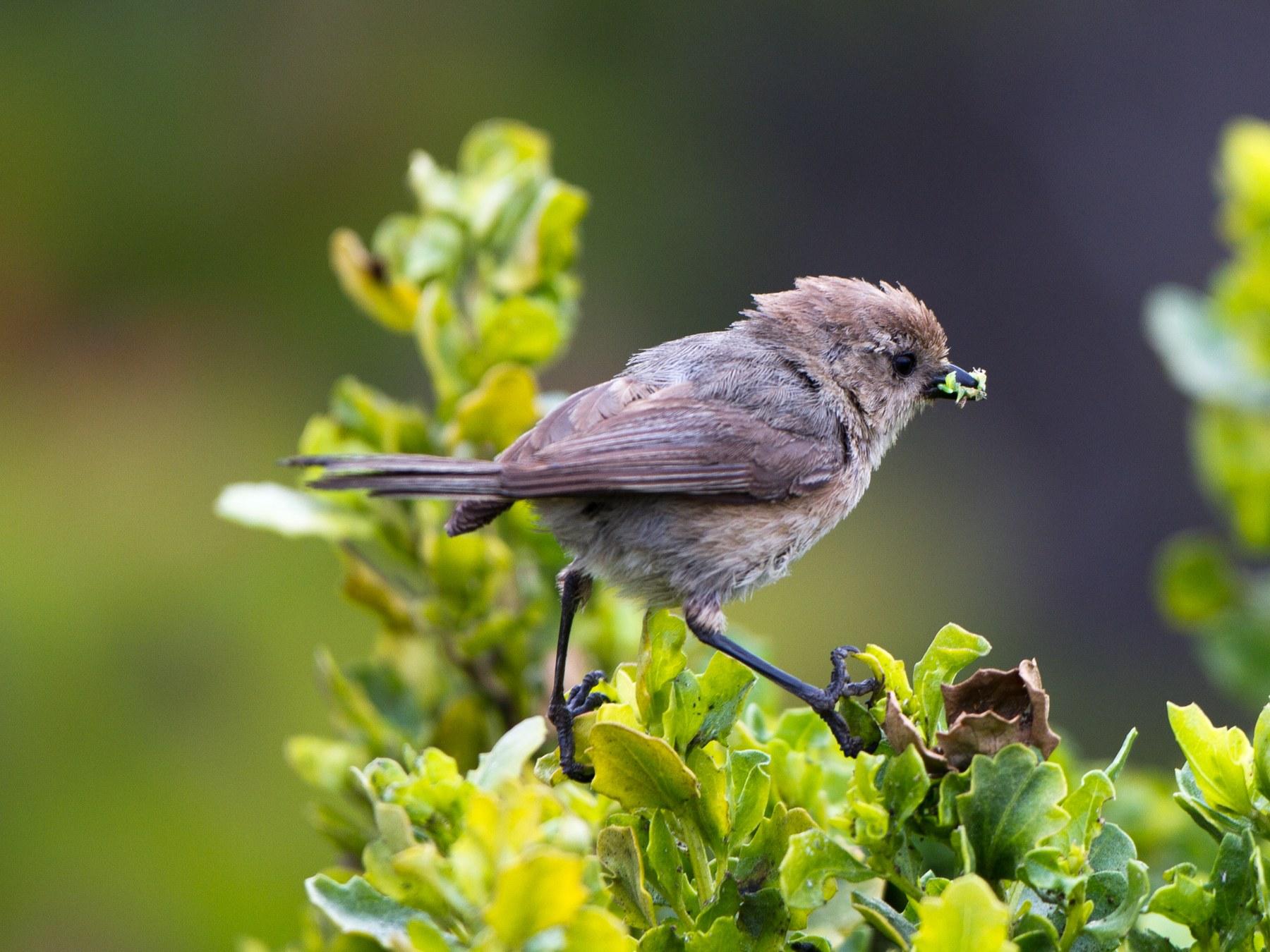
The fullest diet study is old. In 353 stomachs from California examined for a 1907 study, 81% of the food items were animal and 19% plant. True bugs made up 44% of all items, caterpillars and moth pupae 16%, beetles over 10% and spiders with some insects 8%, while fruit was under 1%.2 Item counts may not reflect how much each food is worth to the bird. Nestlings get more caterpillars than adults eat: in 8 nestling stomachs from the same study, 80% of the food was caterpillars and moth pupae, and most of the rest was bugs and spiders.2
Being so small takes a lot of food. In a laboratory study, a Bushtit kept at 68°F (20°C) had to eat about 80% of its body weight in insects a day to avoid losing weight.2
Feeding in your garden
Because it lives mostly on small insects, the Bushtit can be hard to attract to feeders. Native shrubs and small trees give a flock places to feed.5 It also visits bird baths.
Nesting and breeding
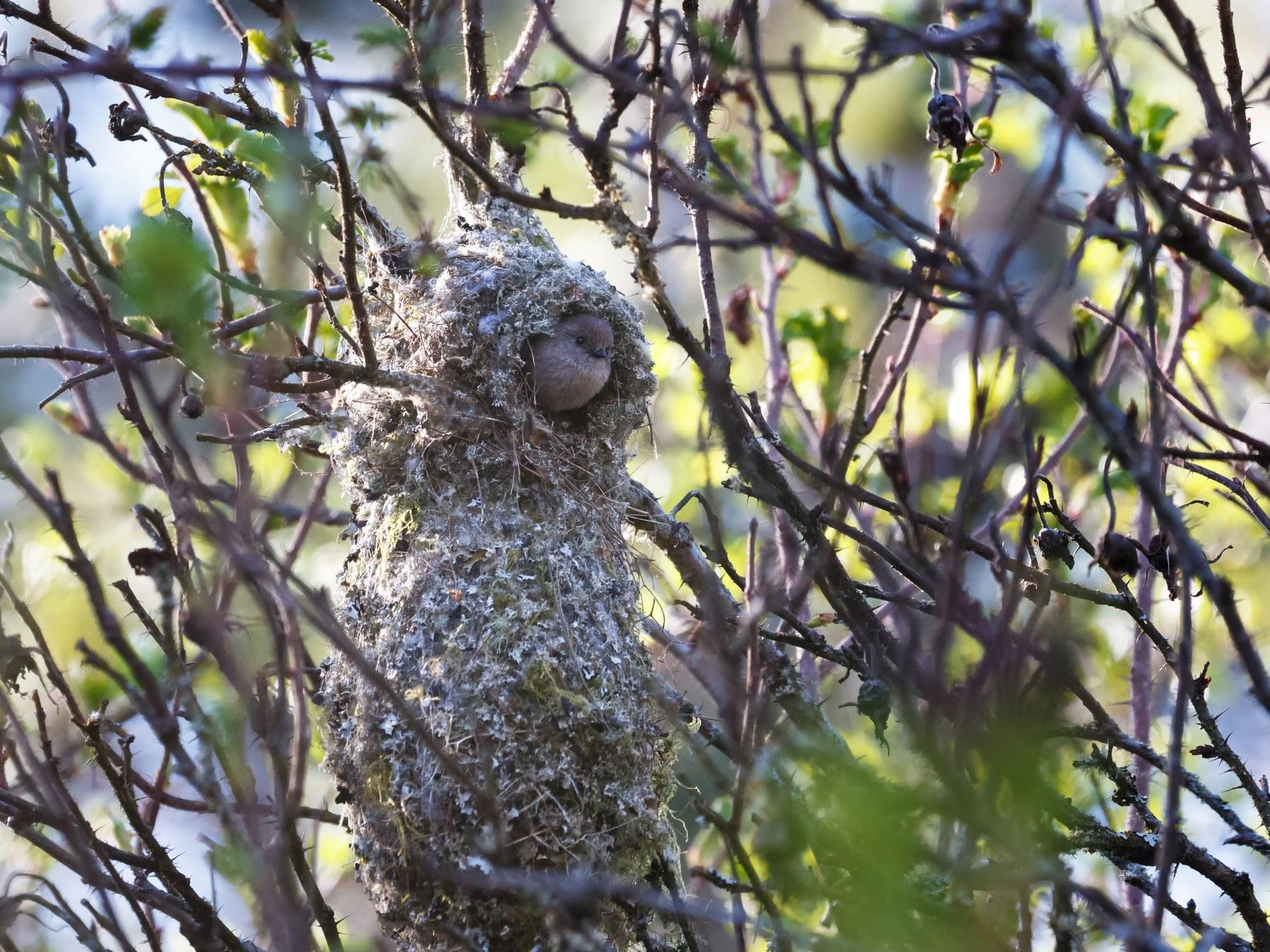
The nest is a long, soft, hanging pouch, shaped like a gourd or a sock, with a small, round, hooded entrance on one side near the top. It is typically about 6–12 in (15–30 cm) long, built of spider silk, moss, lichen, grass and leaves, disguised with material usually taken from the tree it hangs in, and thickly lined with feathers, fur or plant down.
The nest hangs from or is woven into mistletoe or other plants, anywhere from low brush to high in a tree, about 3–100 ft (1–30 m) up. Pairs try out a site by attaching spider silk in several places, and a pair that nests successfully often comes back to the same area, even the same tree, the next year. Pairs disturbed while building or incubating may desert the nest, though not later on.
Both sexes build. They lay a platform of spider web and plant matter across a fork, then one bird settles into it and pulls it down into a long, loose bag. The female does more of the shaping inside and the male adds material outside. Building can take a month or more and stops in bad weather: in Santa Clara County, California, first nests took 13–51 days from the start of building to laying, 33 days on average across 8 nests.2
Eggs and young
Most clutches are begun in April across the range, though California egg dates run from late February to mid-July. The eggs are tiny, white and smooth. Clutch size varies from place to place: an average of 6.3 eggs (4–10) in the north of the range and 3–10 (average 5) in southeast Arizona, and possibly fewer in the south, where three nests in Mexico and Guatemala held 4 eggs each.2 Clutches of more than 8 may come from two females laying in one nest.
Both sexes incubate, though only the female has a brood patch, and the eggs hatch after 12–13 days. The nest holds heat in and keeps the sun's heat out: in Arizona the inside of an empty nest in full sun reached only about 85°F (29.5°C) when its surface was over 111°F (44°C).2
The chicks hatch naked and helpless and open their eyes at about 8 days. They leave the nest at about 18 days old, able to fly, usually early in the morning.2 The Audubon field guide and NatureServe give 14–15 days,1, 6 and a disturbed brood may leave at 14 days, before it can fly.
After fledging, all the adults that tended the nest feed the young for at least two weeks. A pair raises one or two broods a season, and a second clutch goes into the same nest, laid on average 3.4 days after the first brood leaves (10 nests), while those fledglings still depend on their parents.2 Most young stay with the flock they hatched in through the winter, and both sexes can breed in their first year.
Helpers at the nest
The Bushtit is a cooperative breeder: some nests are tended by more birds than the breeding pair. In a study in the Chiricahua Mountains of Arizona from 1986 to 1990, 37% of 200 nests had one to four extra birds, most of them adult males, and one nest had six attendants. The share of nests with extra birds rose from 19% during building to 35% at the nestling stage.7
Of 19 helpers whose origin was known, 12 were birds of either sex whose own nests had failed, 3 were unmated males and 4 were juveniles, all from the same flock. The study suggests that birds whose nests fail try to take over other pairs' nests and, if that fails, sometimes join them as helpers or extra breeders.7
Helpers were reported at Bushtit nests in Guatemala as early as 1935, making it one of the first three species known to have them, but studies in California found them rare, at 1 of 171 nests in one study. The habit is more likely flexible than fixed, varying with local ecology and population.2
Extra birds do not always mean shared parentage. DNA fingerprinting of nine families (10 broods) in the same Arizona population in 1992 found that every brood was the young of one male and one female, and that helpers were not close relatives of the family. At one nest, though, a helping male that had not fathered the first brood fathered the second.8 That year was unusual, with numbers about a quarter of normal.2
Behaviour
Bushtits live in flocks all year, usually of about 10 to more than 40 birds, and adults stay in the same flock from year to year. Flocks are active from dawn to dusk. Their flight is fairly weak, from shrub to shrub, though a bird can cover about 650 ft (200 m) in one go.
They often join mixed flocks of other small birds. In the Chiricahua Mountains their commonest companions were Brown Creepers, Golden-crowned Kinglets, Bridled Titmice and White-breasted Nuthatches.2
A flock shares a home area rather than defending a territory. In the Chiricahua study a flock's foraging range was about 250 acres (100 ha), and the area holding all its nests about 80 acres (32 ha) within it, not overlapping other flocks' nesting areas.7 While feeding young, a pair did 80% of its foraging within about 330 ft (100 m) of the nest.2
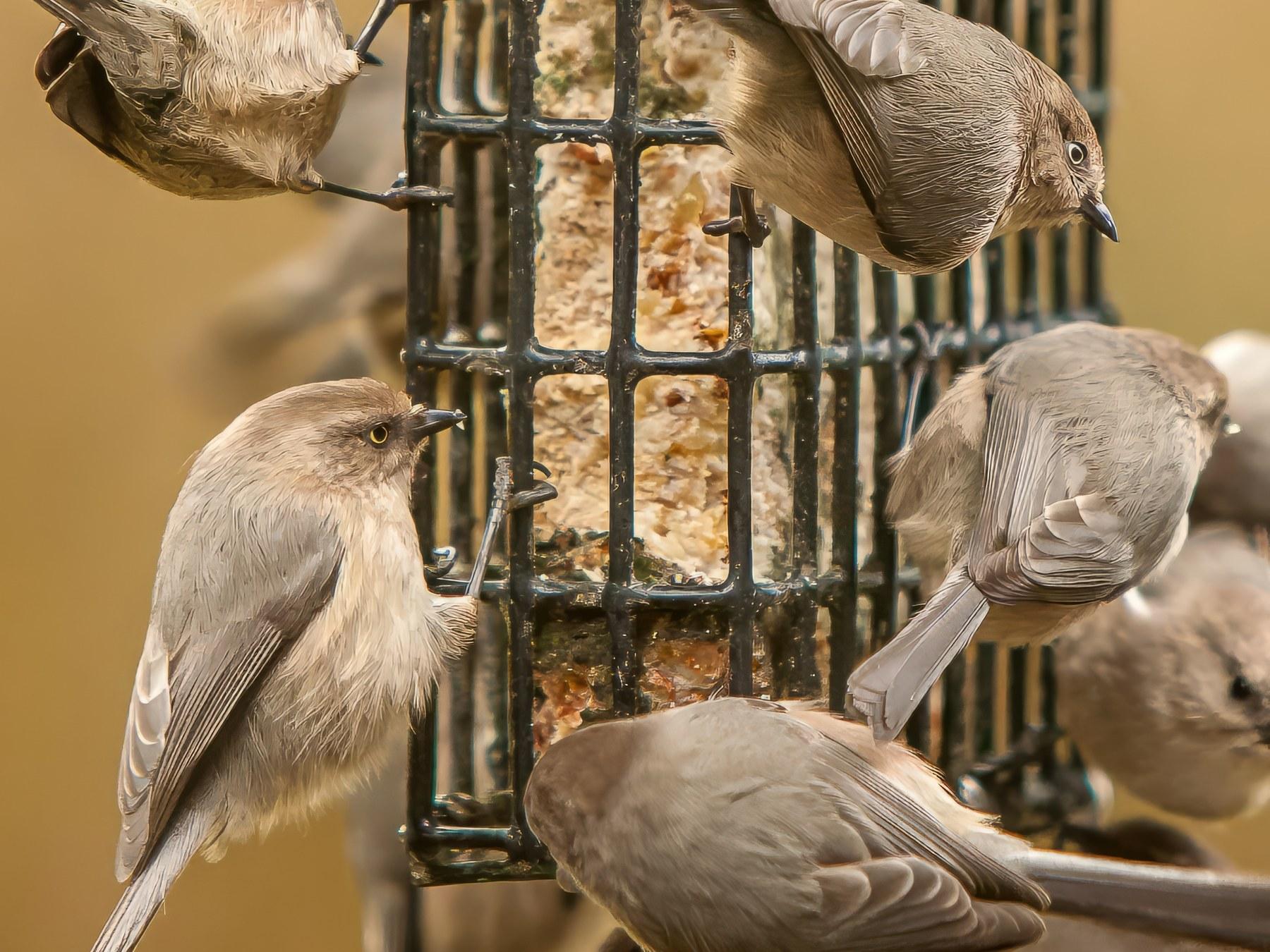
At night the flock roosts in dense cover, packed together. In Arizona they huddle at night even in warm weather, and fledglings huddle by day, jostling for the middle. Huddling saves energy, and probably has a social role too: in a laboratory study, each of two birds kept together at 68°F (20°C) used only 79% of the daily energy of a bird kept alone.2
Cold brings them closer. In Seattle in January 1969, a flock of 29 roosting in a hawthorn on the University of Washington campus normally slept at least 2 inches (5 cm) apart. Through a 10-day cold spell they packed into a tight row each night, with 25 birds touching on 21 January, and spread out again after the first night above freezing.9
Fights are usually chases, but now and then two birds grapple, tumble to the ground and peck at each other's heads, taking no notice of people nearby. In one researcher's observations, the two fighters were always the same sex.2
Lifespan and predators
The oldest known wild Bushtit was at least 9 years 1 month old: a female banded in California in 2000 and caught and released alive at a California banding station in 2008.10 No source we read gives a typical lifespan. In the Chiricahua Mountains, only 27% of the birds banded or seen in 1987 were seen again in 1988, and only 6% of 102 nestlings, though it is not clear how many died and how many moved away.2
Gopher snakes take nestlings, and in the Chiricahua Mountains Mexican Jays take eggs and nestlings. There, only 53% of 161 nests fledged young in 1986–1989, the rest presumed lost to predators, and how well a nest was hidden made no difference.2 Bushtits mob snakes, owls, hawks and crows and their relatives, though they mob jays only near the nest. Once, a male drew a Mexican Jay away from a nest by giving nestlings' begging calls.2
Cowbirds rarely lay in its nests. There are only a few reports of a Brown-headed Cowbird egg in a Bushtit nest, one egg each time: 5 from southern California, 2 from British Columbia and 1 from Washington. None turned up in more than 250 nests in the Chiricahua Mountains, and there is no record of a Bushtit raising a cowbird.2
Conservation
The Bushtit is rated Least Concern on the IUCN Red List.11 Partners in Flight estimates about 4.3 million birds, as of around 2010, about 2.3 million of them in the US and Canada.12 Canada holds only about 16,000, under 1% of the world population.4
Its trend is mixed. Across the whole North American Breeding Bird Survey, the long-term trend from 1967 to 2025 is -1.08% a year, a probable decline that is not statistically clear, while in the lower 48 states the decline of 1.16% a year is credible.13 Shorter windows are clearer: survey-wide, counts fell by 1.45% a year from 1995 to 2025 and 2.04% a year from 2005 to 2025. By 2025 the survey-wide index was about 46% below its 1967 level; the ten-year trend to 2025 is uncertain.13 By state, only Oregon shows a clear long-term decline, and California, with the most survey routes, shows no clear change.13
In Canada the Christmas Bird Count shows a large rise since the early 1970s and the few Breeding Bird Survey routes a 40% decrease since 1970; the State of Canada's Birds rates the Canadian trend a Large Increase, with medium confidence.4
Numbers can swing locally. In the Chiricahua Mountains, active nests in one area fell from 27 to 7 in 1992, possibly a response to unusual weather after a wetter, warmer winter, and years with many Mexican Jays there were years with few Bushtits, with no rise in nest predation.2 It is ranked secure overall, though scarcer at some edges of its range, such as Wyoming, Oklahoma and Idaho.6 Its main handbook account, written in 2001, calls it not endangered, with a range slowly expanding north and west and a good fit with suburban habitat.2
Legal status
In the United States the Bushtit is on the federal list of birds protected under the Migratory Bird Treaty Act.14 The Act makes it unlawful to pursue, hunt, take, capture, kill or possess such birds, among other acts, except as its regulations permit.15 It has no Endangered Species Act status.16
In Canada it is protected under the Migratory Birds Convention Act, 1994, whose schedule names the long-tailed tits and bushtits among the migratory insectivorous birds,17 and it is on the Government of Canada's list of birds the Act protects.18 The Migratory Birds Regulations, 2022 forbid capturing, killing, injuring or harassing such birds and destroying or disturbing their eggs or nests, unless a permit or the Regulations allow it.19 The Bushtit is not in the Regulations' Schedule 1, and the nest of such a species may be disturbed without a permit once it holds no live bird or viable egg.19
Names and relatives
The Bushtit, Psaltriparus minimus, is the only member of the long-tailed tit family, the Aegithalidae, in the Americas. Despite its chickadee-like habits it is not a chickadee or a titmouse: molecular studies place its family near the Old World warblers. AviList and BirdLife International call it the American Bushtit.
A 2010 study using several genetic markers found the American bushtits to be the closest relatives of the Old World long-tailed tits, such as the Long-tailed Tit, and found a clear split, dated to the Pleistocene, between the Pacific and interior groups.20 The Long-tailed Tit shares many Bushtit habits, including breeding with helpers.2
Ten weakly marked subspecies are recognized, in three groups: Pacific, Interior and Mexican. The black-masked birds of the south were long treated as a separate species, the Black-eared Bushtit. A 1967 study then showed that birds from a single population range from gray-eared to black-eared, with the amount of black varying with sex and age. Those findings seemed to settle the question: the black face is a variation whose frequency changes from place to place.2
Quick facts
- Length
- 11–12 cm
- Wingspan
- 16–18 cm
- Weight
- 4.5–6 g
- Lifespan
- oldest recorded 9 years 1 month
- Family
- Long-tailed Tits
- Migration
- Resident
- Global status (IUCN)
- Least Concern
- World population
- About 4.3 million (Partners in Flight, around 2010)
- Population trend
- Across the whole Breeding Bird Survey the long-term trend since 1967 (-1.1% a year) is not statistically clear, but the lower 48 states show a credible decline of about 1.2% a year, survey-wide declines since 1995 and 2005 are clear, and the 2025 survey-wide index was about 46% below 1967
- Also called
- American Bushtit
- Scientific name
- Psaltriparus minimus
Sources
29- 1National Audubon Society and Kaufman, K.. Bushtit. Audubon Guide to North American Birds. Accessed 20 November 2026. Source (opens in a new tab)
- 2Sloane, S. A. (2020). Bushtit (Psaltriparus minimus), version 1.0. Birds of the World (A. F. Poole and F. B. Gill, editors). Cornell Lab of Ornithology. doi:10.2173/bow.bushti.01 (opens in a new tab)
- 3McKnight, B. C. (1969). Change in facial coloration in a Bushtit. The Auk 86(3): 570. doi:10.2307/4083430 (opens in a new tab)
- 4Environment and Climate Change Canada and Birds Canada (2024). The State of Canada's Birds - Bushtit. NatureCounts, Birds Canada. Accessed 20 November 2026. Source (opens in a new tab)
- 5Cornell Lab of Ornithology. Bushtit: Overview, Identification and Life History. All About Birds. Accessed 20 November 2026. Source (opens in a new tab)
- 6NatureServe. Psaltriparus minimus, Bushtit (ELEMENT_GLOBAL.2.102220). NatureServe Explorer. Accessed 20 November 2026. Source (opens in a new tab)
- 7Sloane, S. A. (1996). Incidence and origins of supernumeraries at Bushtit (Psaltriparus minimus) nests. The Auk 113(4): 757-770. doi:10.2307/4088855 (opens in a new tab)
- 8Bruce, J. P., Quinn, J. S., Sloane, S. A. and White, B. N. (1996). DNA fingerprinting reveals monogamy in the Bushtit, a cooperatively breeding species. The Auk 113(2): 511-516. doi:10.2307/4088921 (opens in a new tab)
- 9Smith, S. M. (1972). Roosting aggregations of Bushtits in response to cold temperatures. The Condor 74(4): 478-479. doi:10.2307/1365903 (opens in a new tab)
- 10USGS Bird Banding Laboratory. Longevity records, AOU 7430 (current and historical tables). U.S. Geological Survey, Eastern Ecological Science Center. Accessed 20 November 2026. Source (opens in a new tab)
- 11BirdLife International (2021). Psaltriparus minimus. The IUCN Red List of Threatened Species 2021 (via GBIF's copy of the IUCN checklist). IUCN Red List / GBIF. doi:10.2305/IUCN.UK.2021-3.RLTS.T22712028A139819769.en (opens in a new tab)
- 12Partners in Flight (2024). Avian Conservation Assessment Database, Global (version 2024.05.23). Partners in Flight. Accessed 20 November 2026. Source (opens in a new tab)
- 13Hostetler, J. A. et al. (2026). The North American Breeding Bird Survey, Analysis Results 1966 - 2025. U.S. Geological Survey. doi:10.5066/P1OSNSFC (opens in a new tab)
- 14U.S. Fish and Wildlife Service (2023). 50 CFR 10.13, List of Migratory Birds. Electronic Code of Federal Regulations (version of 2026-11-18). Accessed 20 November 2026. Source (opens in a new tab)
- 15United States Congress (1918). 16 U.S.C. 703, Taking, killing, or possessing migratory birds unlawful. United States Code (Cornell LII copy). Accessed 20 November 2026. Source (opens in a new tab)
- 16U.S. Fish and Wildlife Service. ECOS species search: Psaltriparus minimus (no listing found). Environmental Conservation Online System. Accessed 20 November 2026. Source (opens in a new tab)
- 17Parliament of Canada (1994). Migratory Birds Convention Act, 1994 (S.C. 1994, c. 22). Justice Laws Website (current to 2026-10-29). Accessed 20 November 2026. Source (opens in a new tab)
- 18Environment and Climate Change Canada. Birds protected in Canada under the Migratory Birds Convention Act, 1994 (partial list). Government of Canada (Internet Archive copy of 4 Oct 2026). Accessed 20 November 2026. Source (opens in a new tab)
- 19Government of Canada (2022). Migratory Birds Regulations, 2022 (SOR/2022-105). Justice Laws Website (current to 2026-10-29). Accessed 20 November 2026. Source (opens in a new tab)
- 20Päckert, M., Martens, J. and Sun, Y.-H. (2010). Phylogeny of long-tailed tits and allies inferred from mitochondrial and nuclear markers (Aves: Passeriformes, Aegithalidae). Molecular Phylogenetics and Evolution 55: 952-967. doi:10.1016/j.ympev.2010.01.024 (opens in a new tab)
- 21Webster, M. D. (2020). Verdin (Auriparus flaviceps), version 1.0: Identification. Birds of the World. Cornell Lab of Ornithology. doi:10.2173/bow.verdin.01 (opens in a new tab)
- 22Kershner, E. L. and Ellison, W. G. (2020). Blue-gray Gnatcatcher (Polioptila caerulea), version 1.0: Identification. Birds of the World. Cornell Lab of Ornithology. doi:10.2173/bow.buggna.01 (opens in a new tab)
- 23Cicero, C., Pyle, P. and Patten, M. A. (2020). Oak Titmouse (Baeolophus inornatus), version 1.0: Identification. Birds of the World. Cornell Lab of Ornithology. doi:10.2173/bow.oaktit.01 (opens in a new tab)
- 24Cicero, C., Pyle, P. and Patten, M. A. (2020). Juniper Titmouse (Baeolophus ridgwayi), version 1.0: Identification. Birds of the World. Cornell Lab of Ornithology. doi:10.2173/bow.juntit1.01 (opens in a new tab)
- 25AviList Core Team (2026). AviList: The Global Avian Checklist, v2025b. AviList. doi:10.2173/avilist.v2025b (opens in a new tab)
- 26Cornell Lab of Ornithology. eBird taxonomy record, bushti. eBird API. Accessed 20 November 2026. Source (opens in a new tab)
- 27Washington Department of Fish and Wildlife. American bushtit (Psaltriparus minimus). WDFW species and habitats. Accessed 20 November 2026. Source (opens in a new tab)
- 28Perseus Digital Library. Latin Word Study Tool: minimus. Perseus, Tufts University. Accessed 20 November 2026. Source (opens in a new tab)
- 29Skoracki, M., Hendricks, S. A. and Spicer, G. S. (2010). New species of parasitic quill mites of the genus Picobia (Acari: Syringophilidae: Picobiinae) from North American birds. Journal of Medical Entomology 47(5): 727-742. doi:10.1603/me09265 (opens in a new tab)

Checked by
Nathan Cope, founder and editor
Nathan founded Birdfact and leads its writers and contributors in the UK, the US and Canada. He has watched and studied birds for more than ten years, and checks every article and species guide before it’s published.