


Long-tailed Tit
Aegithalos caudatus
By the Birdfact teamChecked by Nathan Cope
See it in 3D
3D model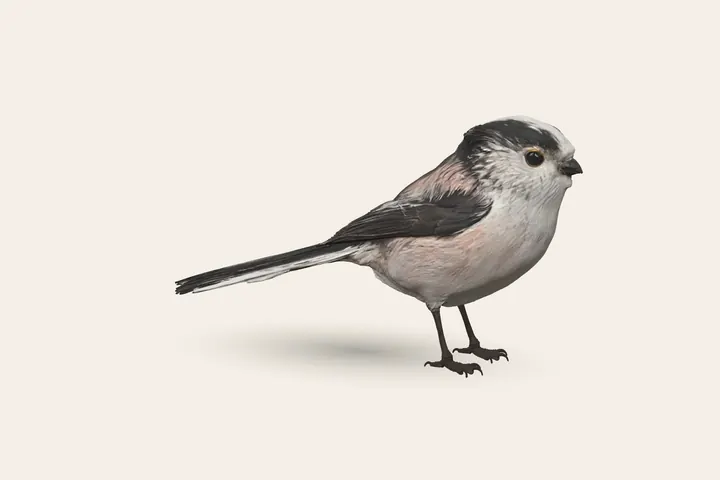 3D model
A Long-tailed Tit is 13–16 cm (5–6.5 in) long, bill to tail.
3D model · Adult · Length 13–16 cm (5–6.5 in) · How we make our birds · Report a problem
© 2026 NC Digital Limited (Birdfact). All rights reserved. This 3D model may be viewed on this page and shared by link only. Downloading, extracting, copying or reusing it, or using it to train machine-learning models, is not permitted without our written permission. Using our models
On this page16 sections
How to recognise it
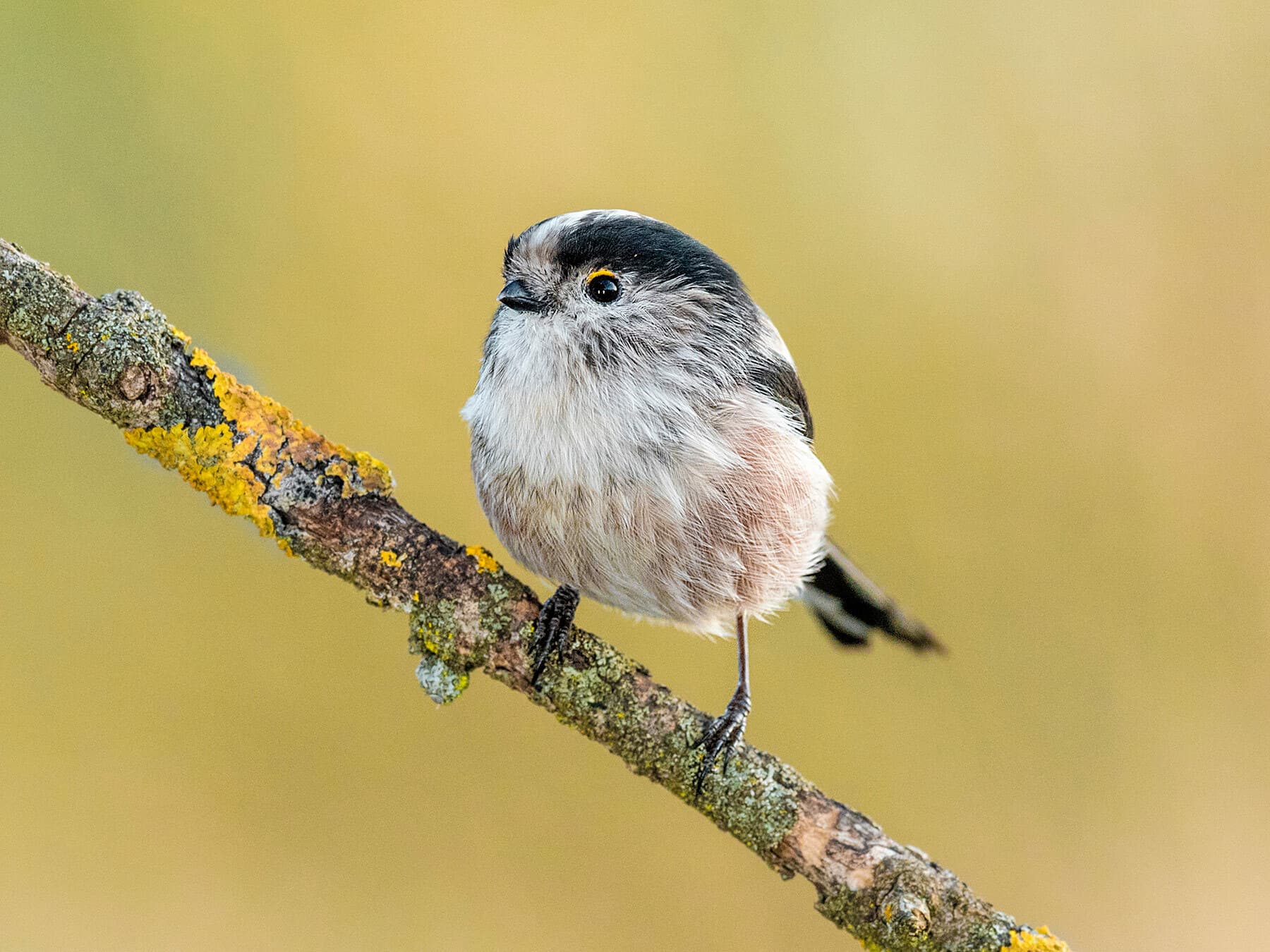
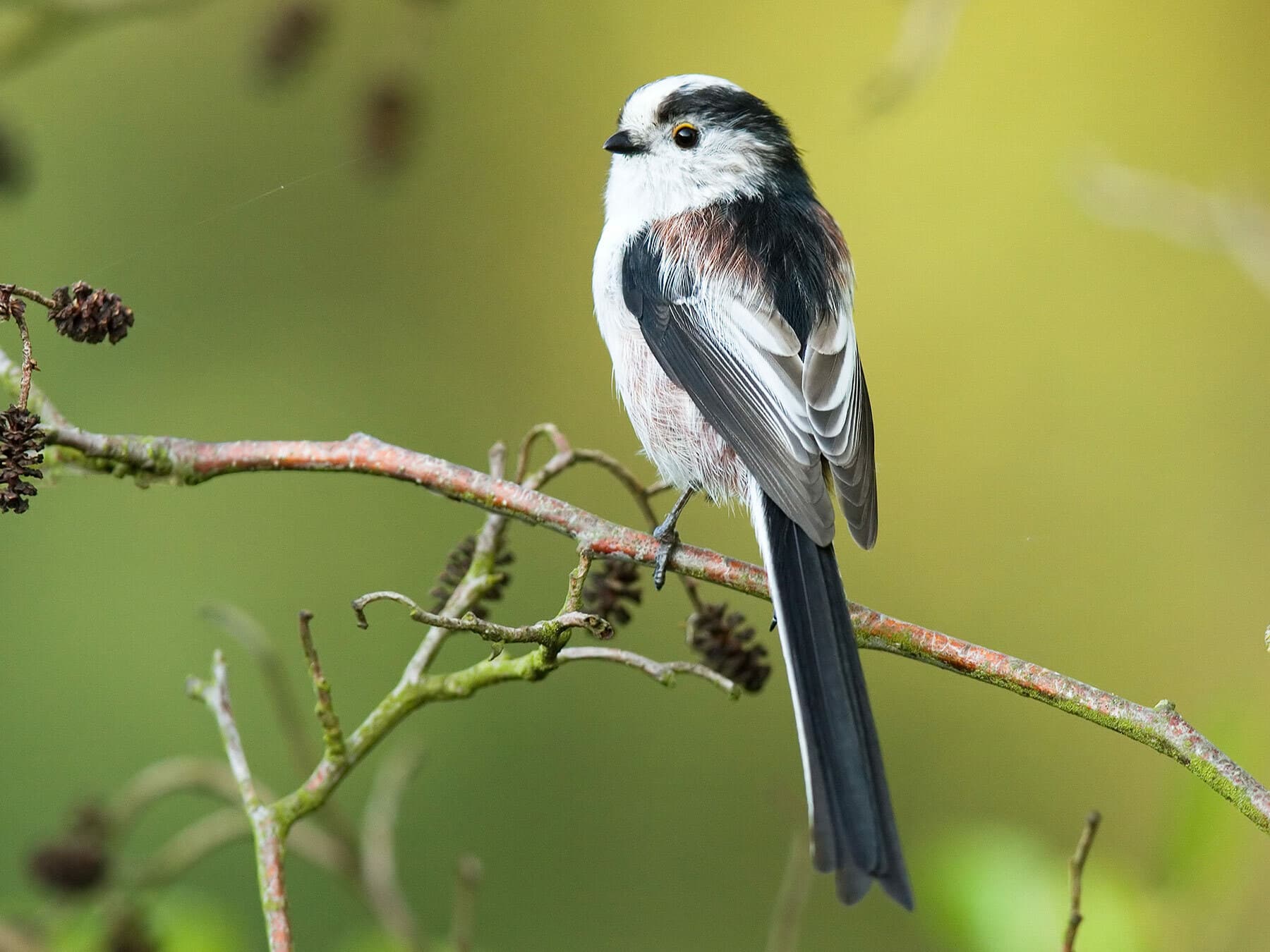
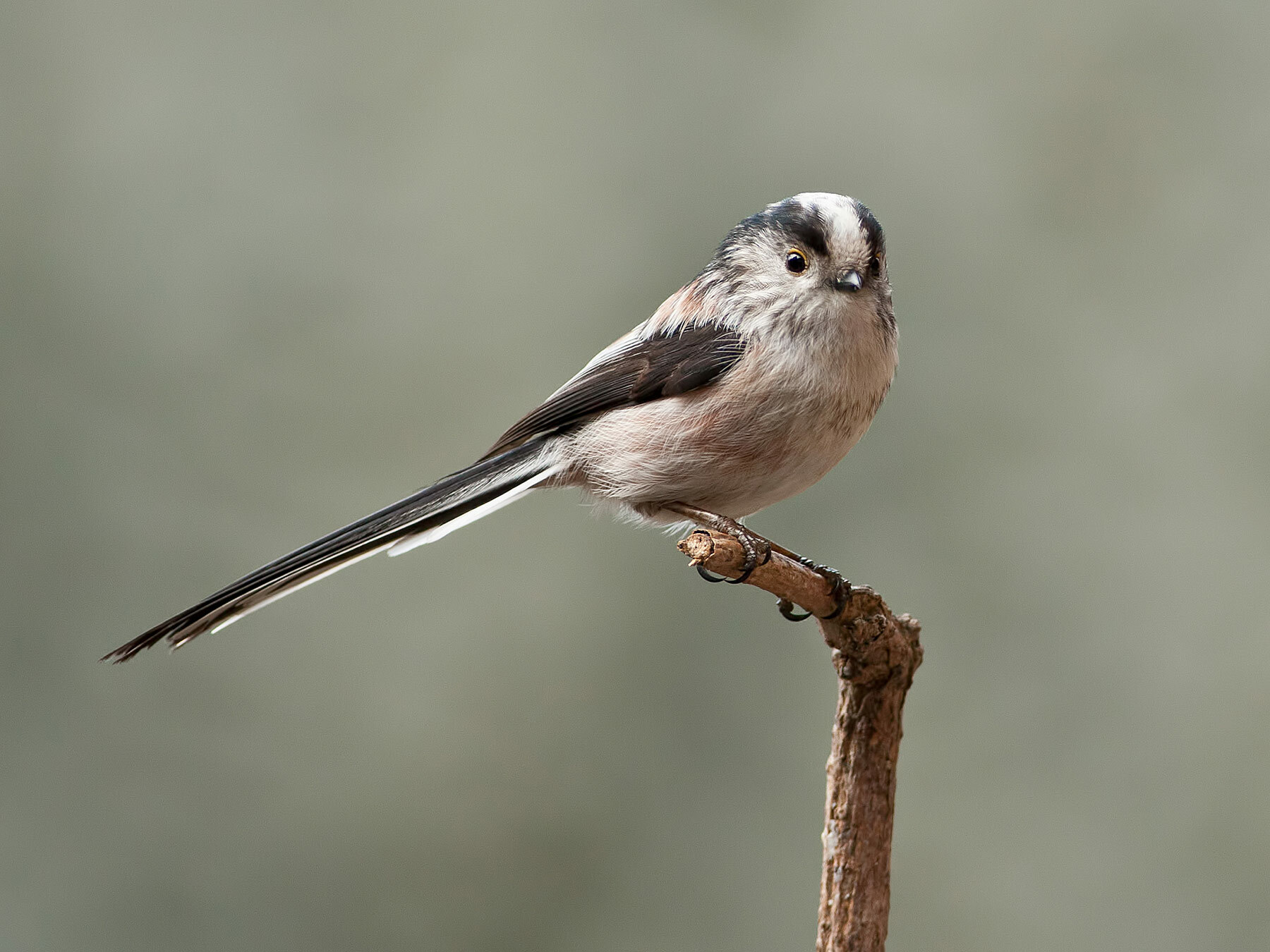
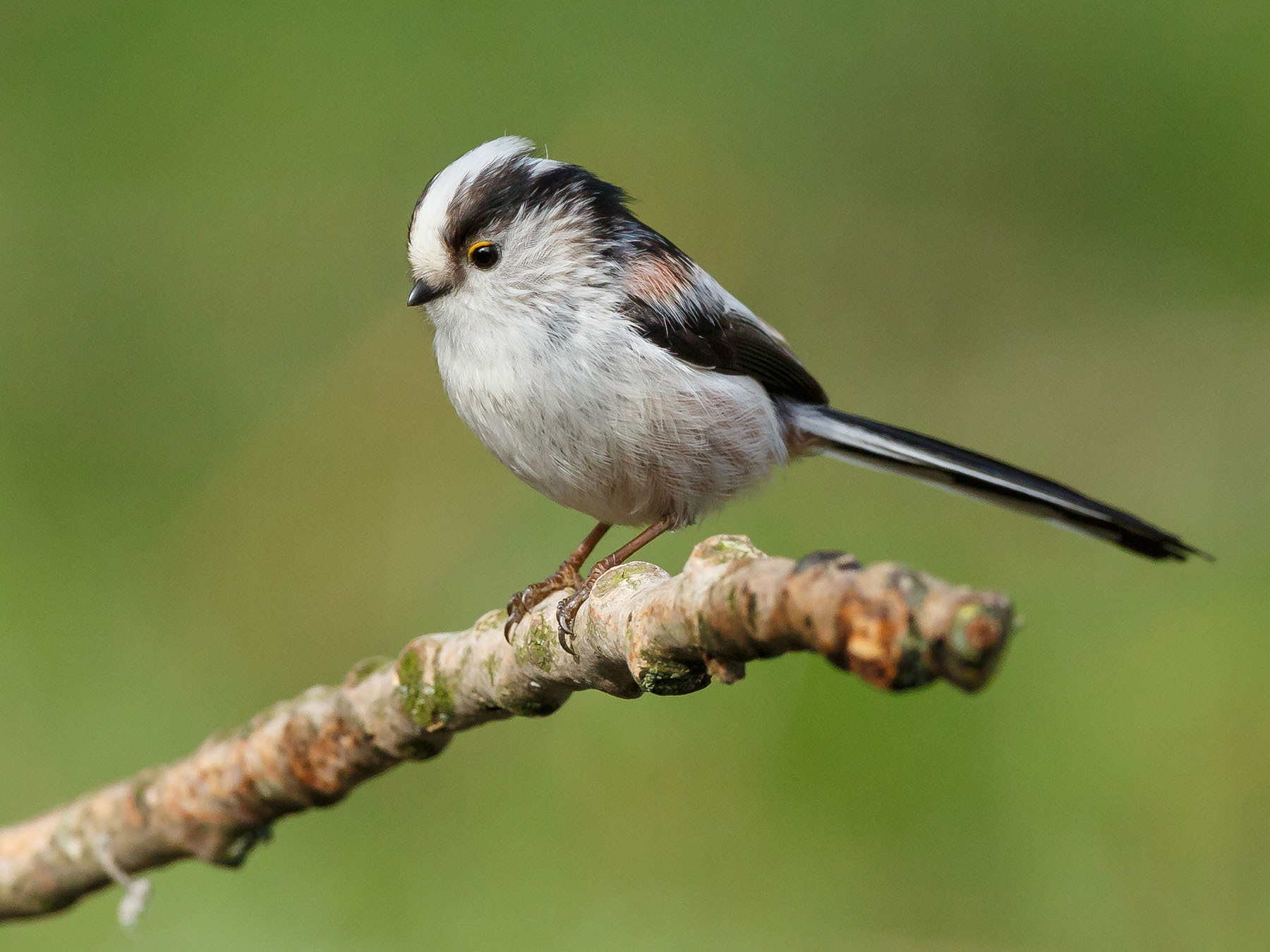
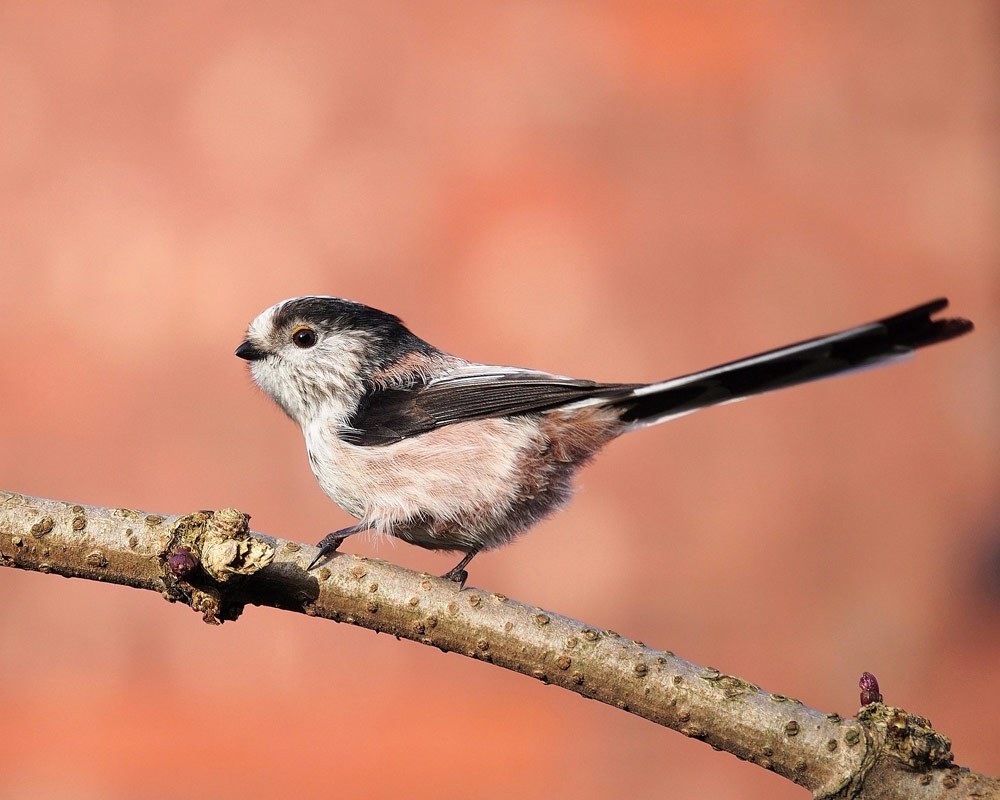
A Long-tailed Tit is easy to recognise: a tiny, round ball of a bird with a stubby black bill and a very long, narrow tail, black with white edges. Its colours are black, white and a soft, dusky pink.1
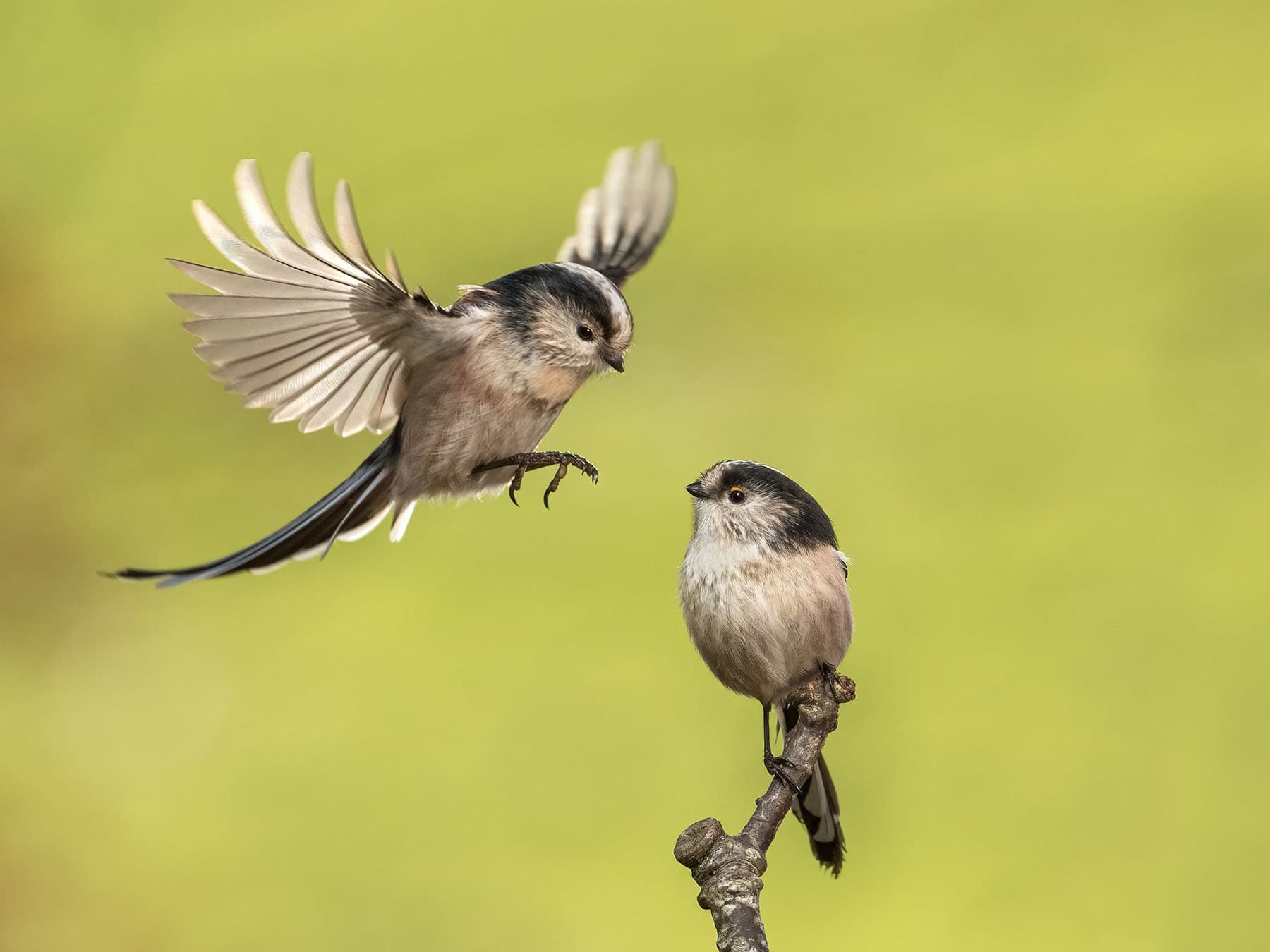
British birds have a white crown with a broad black band on each side, running from just in front of the eye back to the nape. The back is black with pinkish shoulders, the underparts are off-white with dull pink flanks, and the closed black wing shows a white panel. Round the dark eye is a ring of bare skin, yellow to red: Birds of the World says yellow is the commonest colour, and that it probably also reflects the bird's mood.2
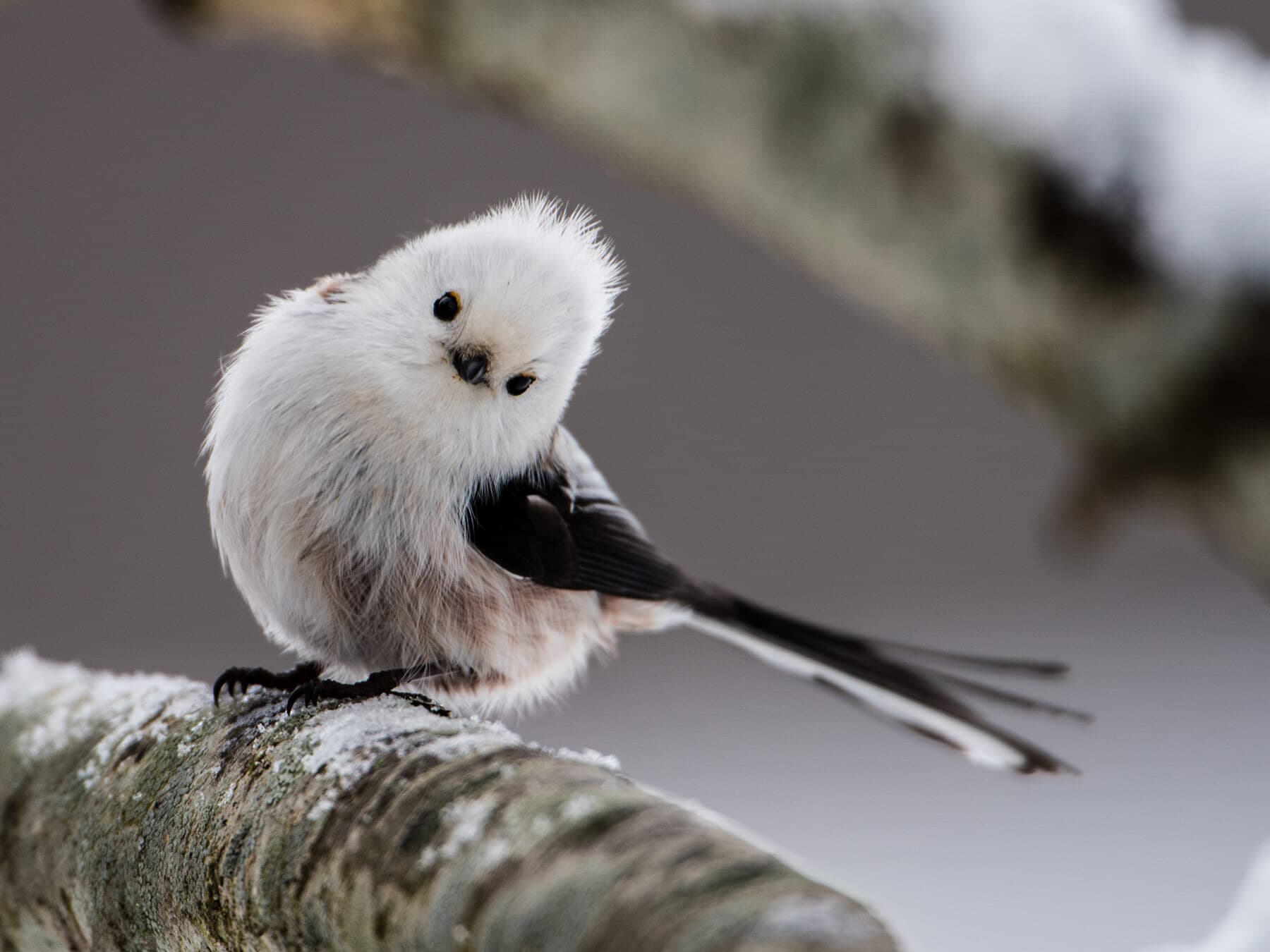
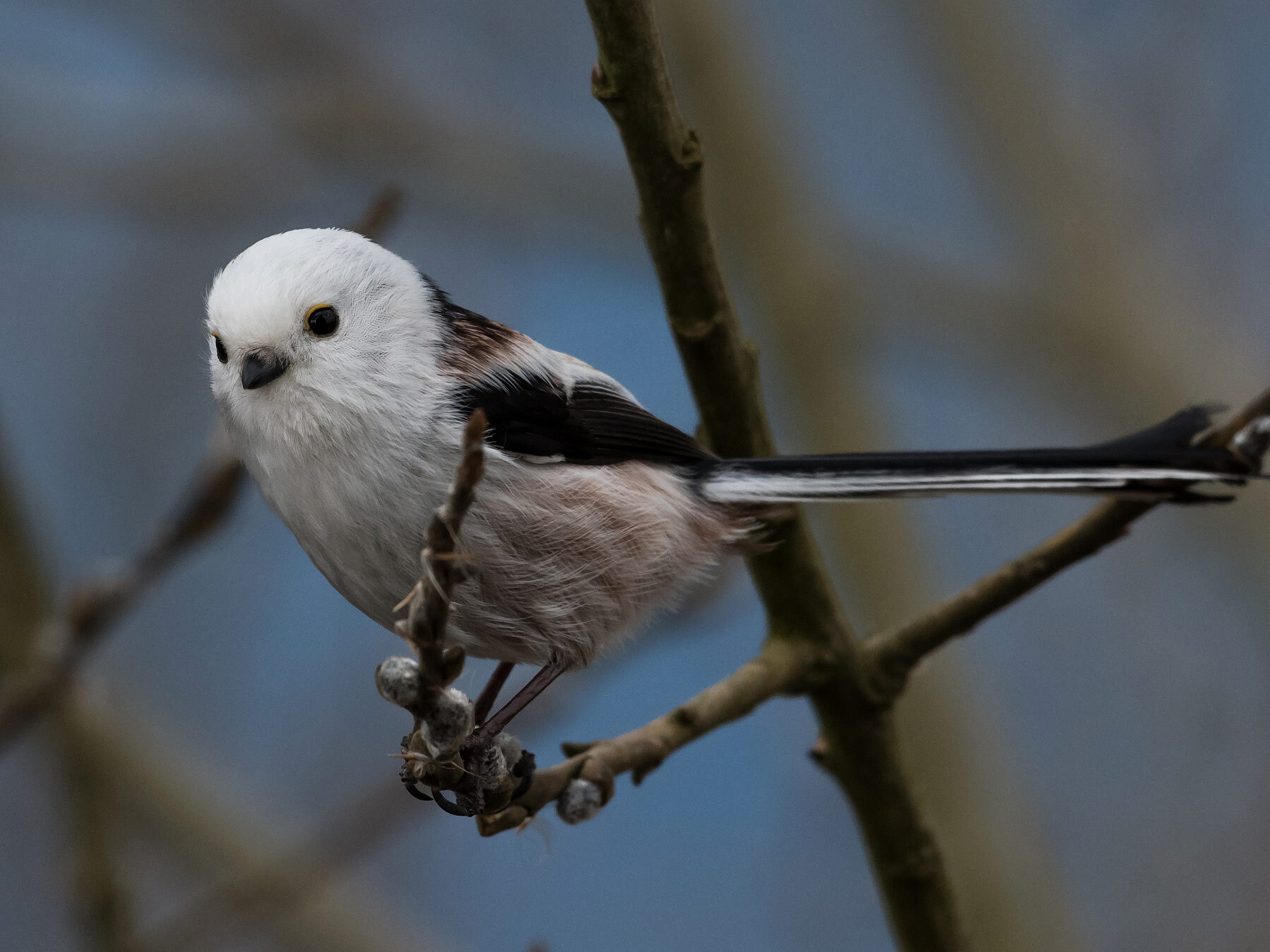
British and Irish birds belong to their own race, rosaceus, named in 1938 from a specimen from Selborne in Hampshire.3 They are smaller than the white-headed birds of northern Europe and Asia, with a darker pink, and the white crown is flecked with dark brown. In Hokkaido, Japan, the white-headed birds are the famous shima enaga, the "snow fairy".
Size
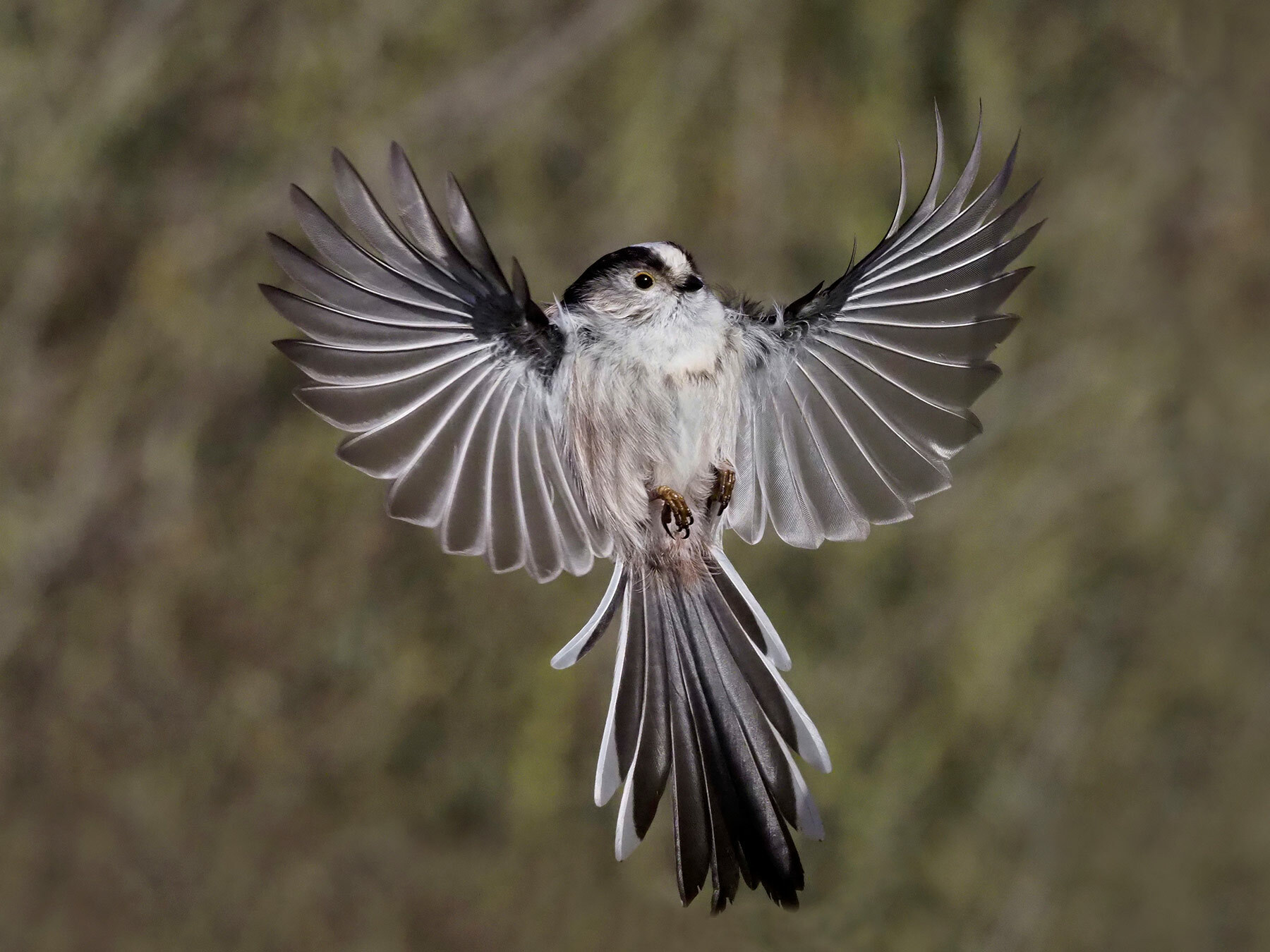
A Long-tailed Tit is about 14 cm (5.5 in) long, but much of that is tail: across its range the tail alone measures 6 to 10 cm, and the RSPB and BTO both describe it as longer than the body. The wingspan is 16 to 19 cm.2, 1
Adults weighed by BTO ringers average just 7.8 g (about 0.3 oz), and most weigh between 7 and 8.7 g.4 That is less than half the weight of a Robin, though a Goldcrest, at about 5.3 g, is lighter still.
Male, female and young
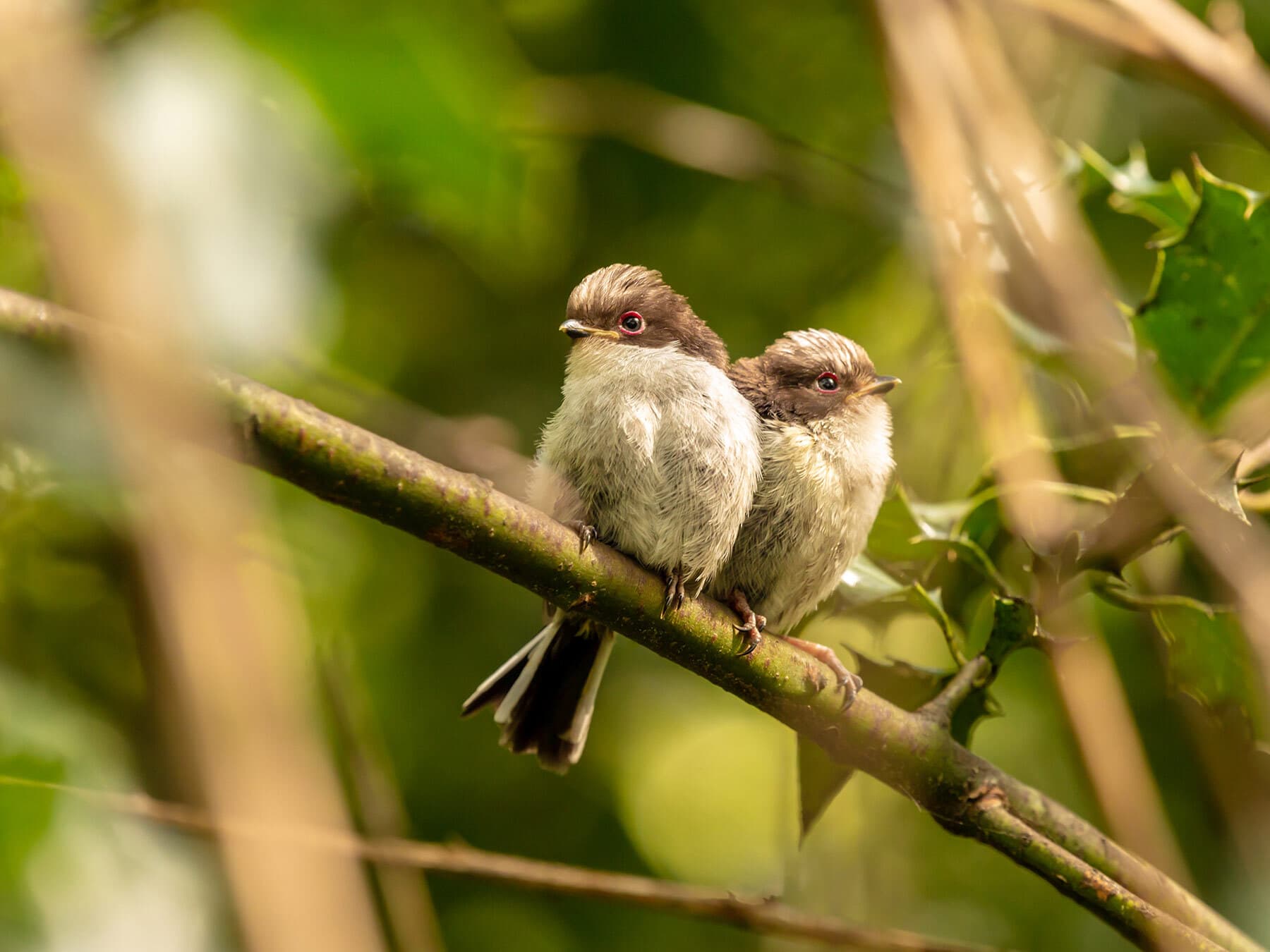
Males and females look the same. Young birds just out of the nest look different: their cheeks are dark, so the ring round the eye stands out; only the centre of the crown is whitish; the back is brown, the underparts are dirty white with no pink, and the tail is shorter and browner.
Identification: similar birds
No other British bird has quite the same shape. A Pied Wagtail is also black and white with a long tail, but it is bigger, at 18 cm, has no pink, and walks and runs across lawns and car parks wagging its tail.5 A Long-tailed Tit keeps to bushes and trees.
The Long-tailed Tits of northern Europe and Asia, east to Kamchatka and south to Hokkaido in Japan, have an all-white head with no black band. Flocks of these white-headed birds sometimes spread west in large numbers, as when 200 reached the Netherlands in December 1971, but they avoid crossing water, so they very rarely reach Britain.2
Its size
Adults- Length
- 13–16 cm
- Wingspan
- 16–19 cm
- Weight
- 7–10 g
Its song and calls
Long-tailed Tits are very vocal. One contact call is a high, thin "see-see-see", given especially in flight and by a bird that has lost touch with the flock. There is also a lower, clipped "tup", and a short, rattling trill, "tsirrup", that drops at the end: an alarm or excitement call, often given for no obvious reason. Listen to them, with British recordings drawn as spectrograms, on our Long-tailed Tit call and song page.
They have no territorial song. Both sexes now and then give a quiet twitter of "tup" and "tsirrup" notes, especially in squabbles with other Long-tailed Tits, while building the nest and when feeding young.
Calls also carry family identity. Research at the University of Sheffield showed that Long-tailed Tits tell relatives from other birds by small, individual differences in their contact calls, which they learn from the adults that fed them in the nest;6 birds swapped into another nest as chicks later treated foster and true brood-mates alike when deciding whom to help.7
- Calls0:00 / 0:22
Recorded in Derbyshire, England · September 2025
- Call0:00 / 0:29
Recorded in Cambridgeshire, England · December 2012
When and where to see it
OctoberPeak season
Most recorded in October
- 1. Neath Port Talbot3.6%
- 2. Wrexham3.6%
- 3. Bristol2.6%
- 4. Monmouthshire2.6%
- 5. Berkshire2.2%
Each dot is a county, state or province: the bigger and darker, the larger the bird’s share of that place’s bird records that month. Grey dots: no regular records. The ringed point is the centre of the bird’s records this month; the arrow shows how it moved since last month, and the dashed loop its path through the year. “Arrivals” colours places where it becomes regular this month (orange) or is in its last regular month (grey). GBIF eBird Observation Dataset, 2019–2024. Map data: Natural Earth, US Census Bureau; place centres © OpenStreetMap contributors.
In your area
See when the Long-tailed Tit is recorded in your county, state or province.
How often the Long-tailed Tit turns up in the UK and Ireland through the year, from birdwatchers' records.
United Kingdom
Resident · all year · most records in February
Ireland
Resident · all year · most records in November
Show as a table
| Month | United Kingdom | Ireland |
|---|---|---|
| January | 1.4% (regular) | 0.81% (regular) |
| February | 1.5% (regular) | 0.81% (regular) |
| March | 1.4% (regular) | 0.73% (regular) |
| April | 1.1% (regular) | 0.59% (regular) |
| May | 0.89% (regular) | 0.51% (regular) |
| June | 0.71% (regular) | 0.44% (regular) |
| July | 0.69% (regular) | 0.36% (regular) |
| August | 0.90% (regular) | 0.36% (regular) |
| September | 1.0% (regular) | 0.46% (regular) |
| October | 1.3% (regular) | 0.68% (regular) |
| November | 1.4% (regular) | 0.93% (regular) |
| December | 1.4% (regular) | 0.84% (regular) |
Recorded regularly in
Worldwide: recorded regularly in 57 countries
Countries where it was recorded in at least 3 of the 6 years 2019–2024. Linked countries have their own bird list.
Europe (46)
- Åland Islands
- Albania
- Andorra
- Austria
- Belarus
- Belgium
- Bosnia & Herzegovina
- Bulgaria
- Croatia
- Czechia
- Denmark
- Estonia
- Finland
- France
- Germany
- Greece
- Guernsey
- Hungary
- Ireland
- Isle of Man
- Italy
- Jersey
- Kosovo
- Latvia
- Liechtenstein
- Lithuania
- Luxembourg
- Moldova
- Monaco
- Montenegro
- Netherlands
- North Macedonia
- Norway
- Poland
- Portugal
- Romania
- Russia
- San Marino
- Serbia
- Slovakia
- Slovenia
- Spain
- Sweden
- Switzerland
- Ukraine
- United Kingdom
Asia (11)
- Armenia
- Azerbaijan
- China
- Georgia
- Iran
- Iraq
- Japan
- Kazakhstan
- Mongolia
- South Korea
- Turkey
Data: EOD – eBird Observation Dataset (Cornell Lab of Ornithology), accessed via GBIF.org, CC BY 4.0. Records from 2019–2024, aggregated and filtered by Birdfact. How these lists are made
Long-tailed Tits live in Britain and Ireland all year. Look in deciduous and mixed woodland with plenty of undergrowth, especially along the edges, and in scrub, heaths with bushes, farmland hedges and well-wooded parks and gardens.
They are found in about four in five of Britain and Ireland's 10-km squares. The gaps are upland moors in mainland Scotland, the Outer Hebrides and Northern Isles, and parts of central and western Ireland, and numbers are highest in wooded lowlands. They are recorded more often outside the breeding season, when their big, noisy, roving flocks are easy to find.4
Do they migrate?
No: British and Irish Long-tailed Tits are resident and stay close to home all year, though a few wander in autumn to islands such as Scilly, the Isle of May, the Outer Hebrides and Orkney. Farther north, in northern Siberia, they are partly migratory, and northern birds sometimes irrupt west and south in large numbers.
Ringing has recorded some longer journeys. The furthest within Britain and Ireland was 521 km, from Hampshire to Northumberland in 2021-22, and three birds ringed together in Belgium on 10 October 2001 were caught together at Walton-on-the-Naze in Essex 11 days later.8
Tips for seeing it
What it eats
Mostly insects and other small invertebrates, all year round. Long-tailed Tits pick them delicately off twigs, leaves and buds, mostly in bushes and the tree canopy and only now and then on the ground; the Woodland Trust names caterpillars and the eggs of moths and butterflies as common prey.
In autumn and winter they occasionally take seeds and buds, and they have been recorded drinking sap. They can hover, and sometimes catch insects in flight. When an insect is too big to swallow at once, a Long-tailed Tit may hang from a twig by one foot, hold the prey in the other and peck at it.
Feeding them in your garden
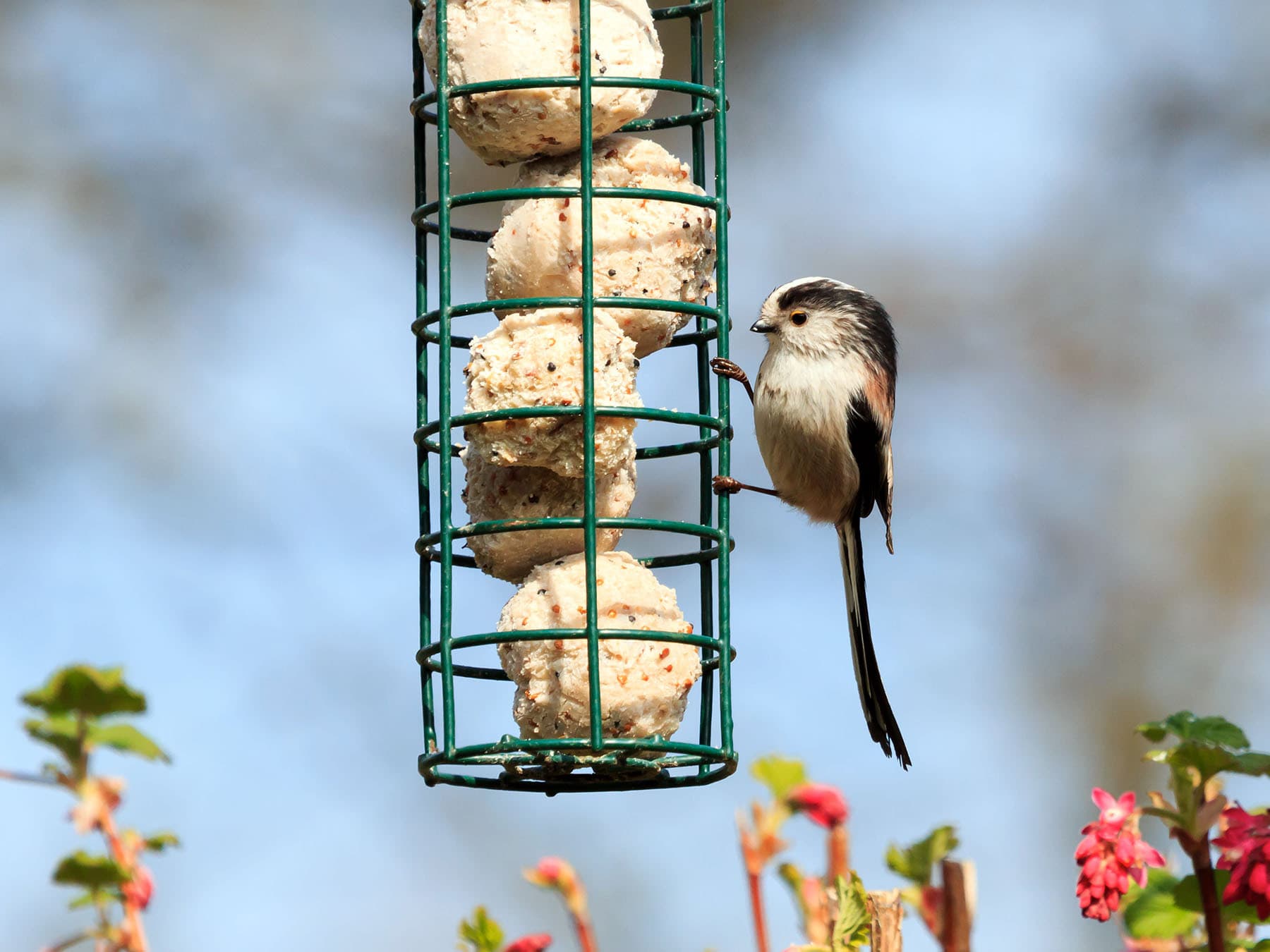
The Woodland Trust says Long-tailed Tits will often visit bird feeders, and the BTO says peanut cake, a mix of fats and peanut flour, attracts them.9 Offer it, or other fat or suet, in a hanging feeder.
They have become far more common in gardens. The BTO's Garden Bird Feeding Survey found them visiting 3% of its gardens in an average week in the 1970s, and 29% in autumn and winter 2010-11,10 and they were the tenth most counted bird in the RSPB's Big Garden Birdwatch in 2026.11
Follow the RSPB's current advice: use hanging feeders rather than bird tables or trays, offer only small amounts of suet from 1 May to 31 October, take uneaten suet away after seven days, and clean feeders every week.12
Nesting and breeding
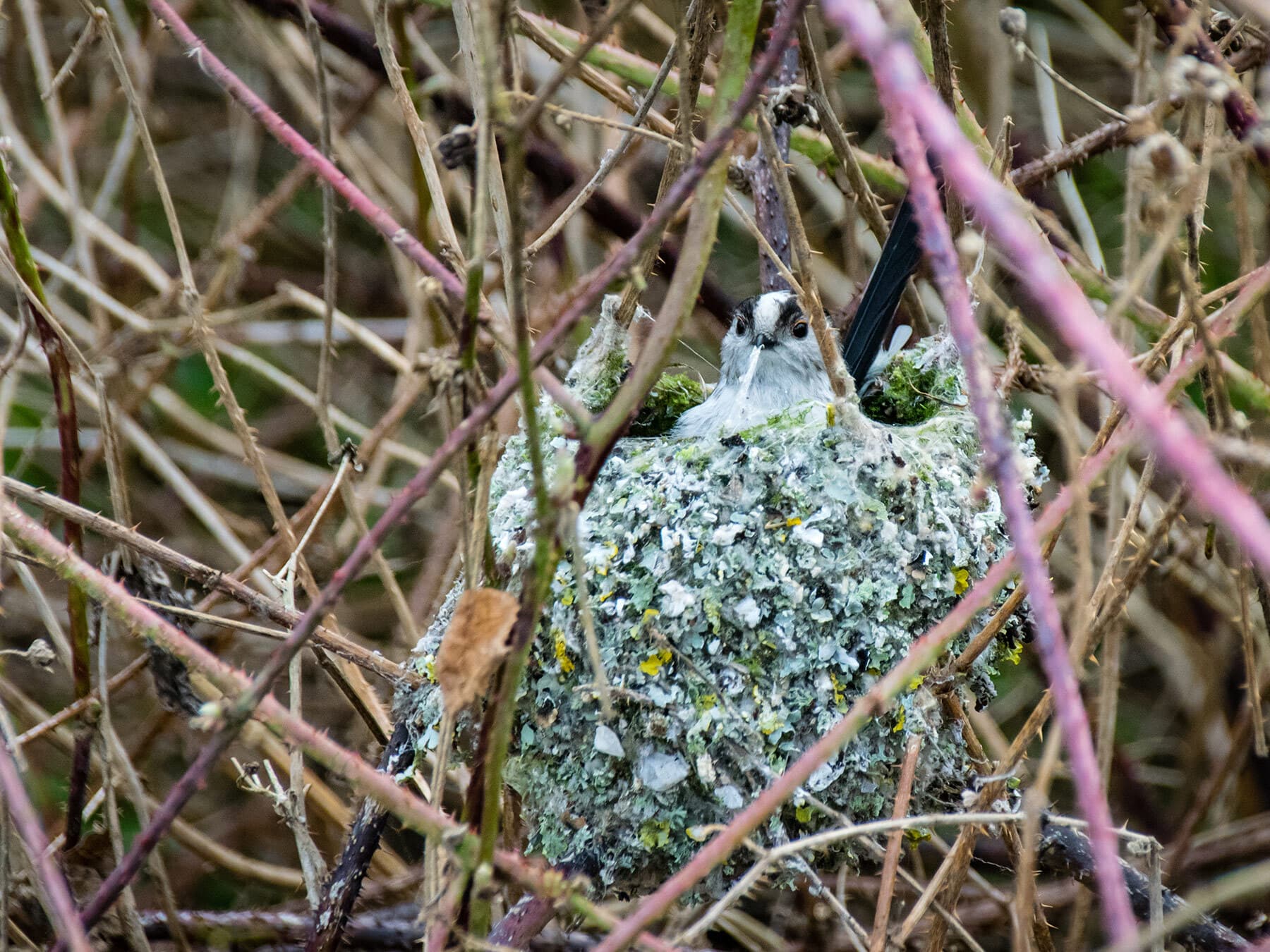
The nest is a small wonder: a domed ball of moss and cobweb, covered with thousands of flakes of lichen and lined with feathers, with a small entrance near the top on one side. Birds of the World gives up to about 3,000 lichen flakes and often about 1,500 feathers. Both birds build it, and in a study near Doncaster first nests took 38 days on average.13 Most nests are under 3 m up in a thorny bush such as bramble or gorse, but some are 6 to 25 m up in a tree fork or in the twigs of a conifer.
In Britain the first eggs are laid between late March and late April, on average around 8 April. A clutch is usually 6 to 8 tiny white eggs; the female incubates them for 15 to 18 days, and the chicks leave the nest at about 16 days old. Pairs raise one brood a year, and they do not normally use nest boxes. More: Long-tailed Tit nests, eggs and helpers.
An active nest is protected by law: in England and Wales it is an offence to intentionally take, damage or destroy the nest of any wild bird while it is in use or being built,14 in Scotland the law also covers reckless damage and any other interference,14 and in Northern Ireland reckless damage.15 Check hedges and scrub before cutting them in spring.
Behaviour
Long-tailed Tits are tame and very sociable. For most of the year they live in family-based flocks of about 3 to 30 birds, built around a breeding pair, their young of the year and any adults that helped raise them. A flock feeds quietly for a while, then moves on noisily, follow-my-leader, to the next spot; to cross open ground the birds bunch together, call, and then cross in single file.
On winter nights a flock roosts in a line along a branch, pressed together, and the birds compete to avoid the two ends. In a study of captive flocks, roosting birds lost about 9% of their weight overnight, and those at the ends lost more.16
Long-tailed Tits are also cooperative breeders. In the Sheffield study, about half of all broods were fed by one or more helpers as well as the parents.17 Helpers are birds whose own nest has failed: around a quarter of failed breeders become helpers, most of them males, and they usually help a close relative, most often a brother.18 Helpers do not raise more chicks in the short term, but chicks from helped nests are more likely to survive and breed.
Lifespan and predators
A Long-tailed Tit that survives to breed typically lives about 2 years, and breeds when a year old. Each year about 44% of adults survive to the next, and about a quarter of young birds survive their first year.
The oldest on the BTO's ringing list was ringed at Burton on the Wirral in December 2011 and caught alive by a ringer 7 km away in September 2021, 9 years 8 months 20 days later.19 The European longevity list, which gives a minimum age rather than time since ringing, has a Danish bird that a ringer caught alive at a minimum age of 11 years 1 month; the Wirral bird comes next, at 10 years 2 months.20
Predators and other dangers
For so small a bird, weather matters a great deal. Birds of the World says hard winters can cut numbers by up to 80%, and that populations can take several years to recover.2 In England, numbers were low after the hard winters of the early 1960s, and again in the cold spell of winters that began in the late 1970s, though the BTO notes that winter deaths may not have been the main cause.4 But in the long-running Sheffield study, from 1994 to 2012, warm springs and autumns raised adult survival, wet springs lowered it, and winter weather made little difference, though no winter in that time was exceptionally harsh.21
Nests are lost far more often than adults. In the same study 79% of breeding attempts failed, three-quarters of them to predators; most identified predators were Jays, Magpies and Carrion Crows, the rest mammals such as weasels, stoats and squirrels.22 Sparrowhawks take adults.
Conservation
The Long-tailed Tit is on the UK Green List and is of Least Concern worldwide. The BTO estimated 380,000 territories in the UK in 2016. Numbers swing from year to year with the weather, but the long-term picture is good: the BTO records steady increases from the early 1980s, though it notes that its long-term trend starts at a low point.
The Breeding Bird Survey shows the UK population up 16% between 1995 and 2024, roughly level over the last ten years (up 1%) and up 17% between 2024 and 2025. In Scotland numbers rose 122% between 1995 and 2024.23
Similar birds
Often mistaken for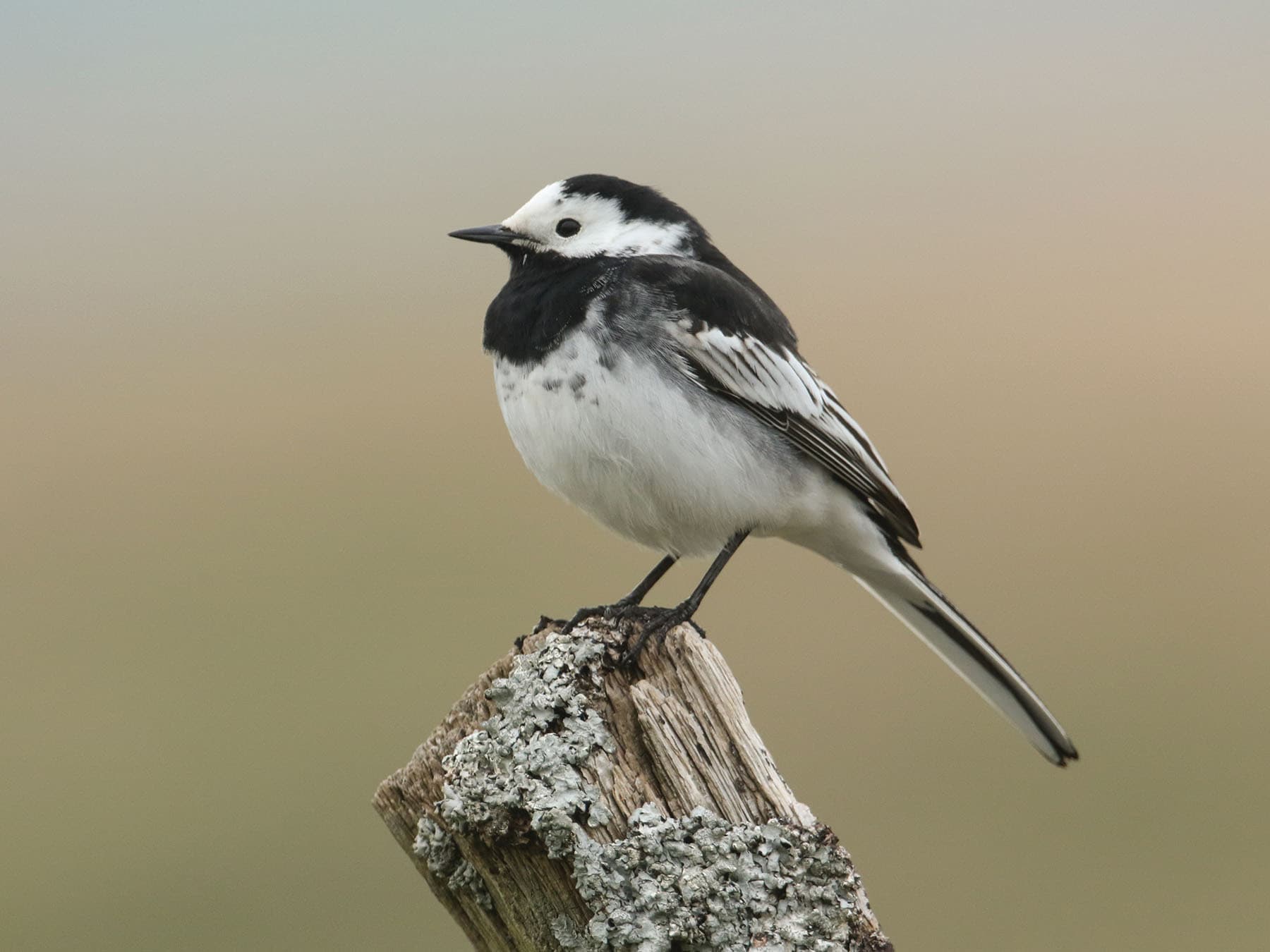
More photos
6 photos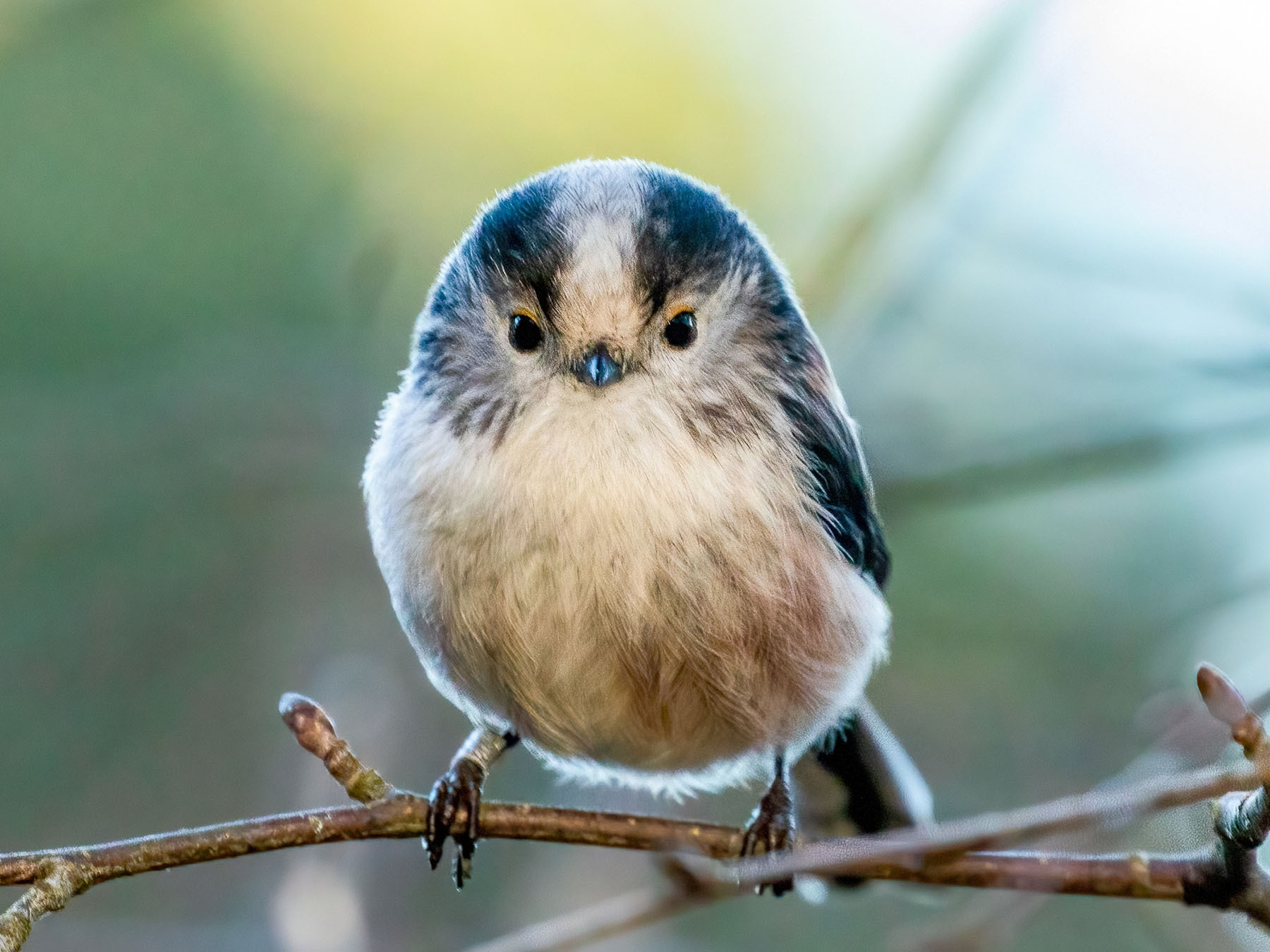
Long-tailed Tit guides
5 guidesQuick facts
- Length
- 13–16 cm
- Wingspan
- 16–19 cm
- Weight
- 7–10 g
- Lifespan
- 2 years · oldest recorded 11.1 years · UK record 9 years 8 months
- Family
- Long-tailed Tits
- Migration
- Resident
- Global status (IUCN)
- Least Concern
- Population trend
- Up 16% in the UK between 1995 and 2024 (BTO), little changed over the last ten years, and numbers rise and fall with the weather; Green-listed
- Scientific name
- Aegithalos caudatus
Questions
2Is a Long-tailed Tit a tit?
Not a true tit. Linnaeus named it Parus caudatus in 1758, in the true tits' genus, but it is now placed in a small family of its own, the Aegithalidae, with the bushtits and tit-warblers. DNA studies put the family among the warbler-like birds, nearer to the leaf warblers and bush warblers than to Blue and Great Tits.24
Do Long-tailed Tits use nest boxes?
Not as a rule. They build their own domed nest in a bush or tree, and are not on any of the BTO's lists of nest-box birds. See nests, eggs and helpers.
Sources
33- 1RSPB. Long-tailed Tit. RSPB Birds A-Z. Accessed 10 October 2026. Source (opens in a new tab)
- 2Harrap, S. (2020). Long-tailed Tit (Aegithalos caudatus), version 1.0. Birds of the World (J. del Hoyo, A. Elliott, J. Sargatal, D. A. Christie and E. de Juana, editors). Cornell Lab of Ornithology. doi:10.2173/bow.lottit1.01 (opens in a new tab)
- 3AviList Core Team (2025). AviList: The Global Avian Checklist, v2025b. doi:10.2173/avilist.v2025b (opens in a new tab)
- 4BTO. Long-tailed Tit (Aegithalos caudatus). BTO BirdFacts. Accessed 10 October 2026. Source (opens in a new tab)
- 5RSPB. Pied Wagtail. RSPB Birds A-Z. Accessed 10 October 2026. Source (opens in a new tab)
- 6Sharp, S. P., McGowan, A., Wood, M. J. A. and Hatchwell, B. J. (2005). Learned kin recognition cues in a social bird. Nature 434: 1127-1130. doi:10.1038/nature03522 (opens in a new tab)
- 7Hatchwell, B. J., Ross, D. J., Fowlie, M. K. and McGowan, A. (2001). Kin discrimination in cooperatively breeding long-tailed tits. Proceedings of the Royal Society B 268: 885-890. doi:10.1098/rspb.2001.1598 (opens in a new tab)
- 8Robinson, R. A., Leech, D. I. and Clark, J. A. (2025). Summary of all recoveries for Long-tailed Tit (Aegithalos caudatus). The Online Demography Report: bird ringing and nest recording in Britain & Ireland in 2024 (BTO). Accessed 10 October 2026. Source (opens in a new tab)
- 9BTO. Feeding garden birds. BTO, Helping birds. Accessed 10 October 2026. Source (opens in a new tab)
- 10BTO (2011). Garden feeders support more birds than ever (News Release 2011-41). BTO (Wayback Machine copy). Accessed 10 October 2026. Source (opens in a new tab)
- 11RSPB (2026). Big Garden Birdwatch 2026 results. RSPB. Accessed 10 October 2026. Source (opens in a new tab)
- 12RSPB (2026). Our latest guidance on feeding garden birds. RSPB news. Accessed 10 October 2026. Source (opens in a new tab)
- 13McGowan, A., Sharp, S. P. and Hatchwell, B. J. (2004). The structure and function of nests of long-tailed tits Aegithalos caudatus. Functional Ecology 18: 578-583. doi:10.1111/j.0269-8463.2004.00883.x (opens in a new tab)
- 14UK Parliament (1981). Wildlife and Countryside Act 1981, section 1. Accessed 7 October 2026. Source (opens in a new tab)
- 15UK (1985). The Wildlife (Northern Ireland) Order 1985, article 4. Accessed 7 October 2026. Source (opens in a new tab)
- 16Hatchwell, B. J., Sharp, S. P., Simeoni, M. and McGowan, A. (2009). Factors influencing overnight loss of body mass in the communal roosts of a social bird. Functional Ecology 23: 367-372. doi:10.1111/j.1365-2435.2008.01511.x (opens in a new tab)
- 17Hatchwell, B. J. et al. (2004). Helpers increase long-term but not short-term productivity in cooperatively breeding long-tailed tits. Behavioral Ecology 15: 1-10. doi:10.1093/beheco/arg091 (opens in a new tab)
- 18Morinay, J. et al. (2025). Ecological and demographic drivers of kin-directed cooperation in a social bird: insights from a long-term study. Journal of Animal Ecology 94: 485-500. doi:10.1111/1365-2656.14237 (opens in a new tab)
- 19BTO. Longevity records for Britain & Ireland in 2024. BTO Online Ringing and Nest Recording Report. Accessed 10 October 2026. Source (opens in a new tab)
- 20Fransson, T., Kolehmainen, T., Moss, D. and Robinson, R. (2023). EURING list of longevity records for European birds (1 September 2023). EURING. Accessed 10 October 2026. Source (opens in a new tab)
- 21Gullett, P. R., Evans, K. L., Robinson, R. A. and Hatchwell, B. J. (2014). Climate change and annual survival in a temperate passerine: partitioning seasonal effects and predicting future patterns. Oikos 123: 389-400. doi:10.1111/j.1600-0706.2013.00620.x (opens in a new tab)
- 22Higgott, C. G. (2019). Evolutionary ecology of avian nest design and function in a variable environment. PhD thesis, University of Sheffield. Accessed 10 October 2026. Source (opens in a new tab)
- 23Heywood, J. J. N., Massimino, D., Baker, L., Balmer, D. E. et al. (2026). The Breeding Bird Survey 2025. BTO Research Report 802. British Trust for Ornithology, Thetford. Accessed 10 October 2026. Source (opens in a new tab)
- 24Alström, P., Olsson, U. and Lei, F. (2013). A review of the recent advances in the systematics of the avian superfamily Sylvioidea. Chinese Birds 4: 99-131. doi:10.5122/cbirds.2013.0016 (opens in a new tab)
- 25Woodland Trust. Long-tailed tit (Aegithalos caudatus). Woodland Trust. Accessed 10 October 2026. Source (opens in a new tab)
- 26BTO. Goldcrest (Regulus regulus). BTO BirdFacts. Accessed 9 October 2026. Source (opens in a new tab)
- 27BTO. Robin (Erithacus rubecula). BTO BirdFacts. Accessed 25 September 2026. Source (opens in a new tab)
- 28BTO. Nest boxes for birds. BTO, Helping birds. Accessed 10 October 2026. Source (opens in a new tab)
- 29McGowan, A., Hatchwell, B. J. and Woodburn, R. J. W. (2003). The effect of helping behaviour on the survival of juvenile and adult long-tailed tits Aegithalos caudatus. Journal of Animal Ecology 72: 491-499. doi:10.1046/j.1365-2656.2003.00719.x (opens in a new tab)
- 30Päckert, M., Martens, J. and Sun, Y.-H. (2010). Phylogeny of long-tailed tits and allies inferred from mitochondrial and nuclear markers (Aves: Passeriformes, Aegithalidae). Molecular Phylogenetics and Evolution 55: 952-967. doi:10.1016/j.ympev.2010.01.024 (opens in a new tab)
- 31Swainson, C. (1885). The Provincial Names and Folk Lore of British Birds. English Dialect Society / Trübner, London. Accessed 10 October 2026. Source (opens in a new tab)
- 32RSPB. How and what to feed your garden birds. RSPB. Accessed 10 October 2026. Source (opens in a new tab)
- 33BirdLife International (2025). Aegithalos caudatus. IUCN Red List (via AviList v2025b and BTO BirdFacts). Accessed 10 October 2026.

Checked by
Nathan Cope, founder and editor
Nathan founded Birdfact and leads its writers and contributors in the UK, the US and Canada. He has watched and studied birds for more than ten years, and checks every article and species guide before it’s published.