


Eastern Towhee
Rufous-sided Towhee · Pipilo erythrophthalmus
By the Birdfact teamChecked by Nathan Cope
See it in 3D
5 plumages 3D model
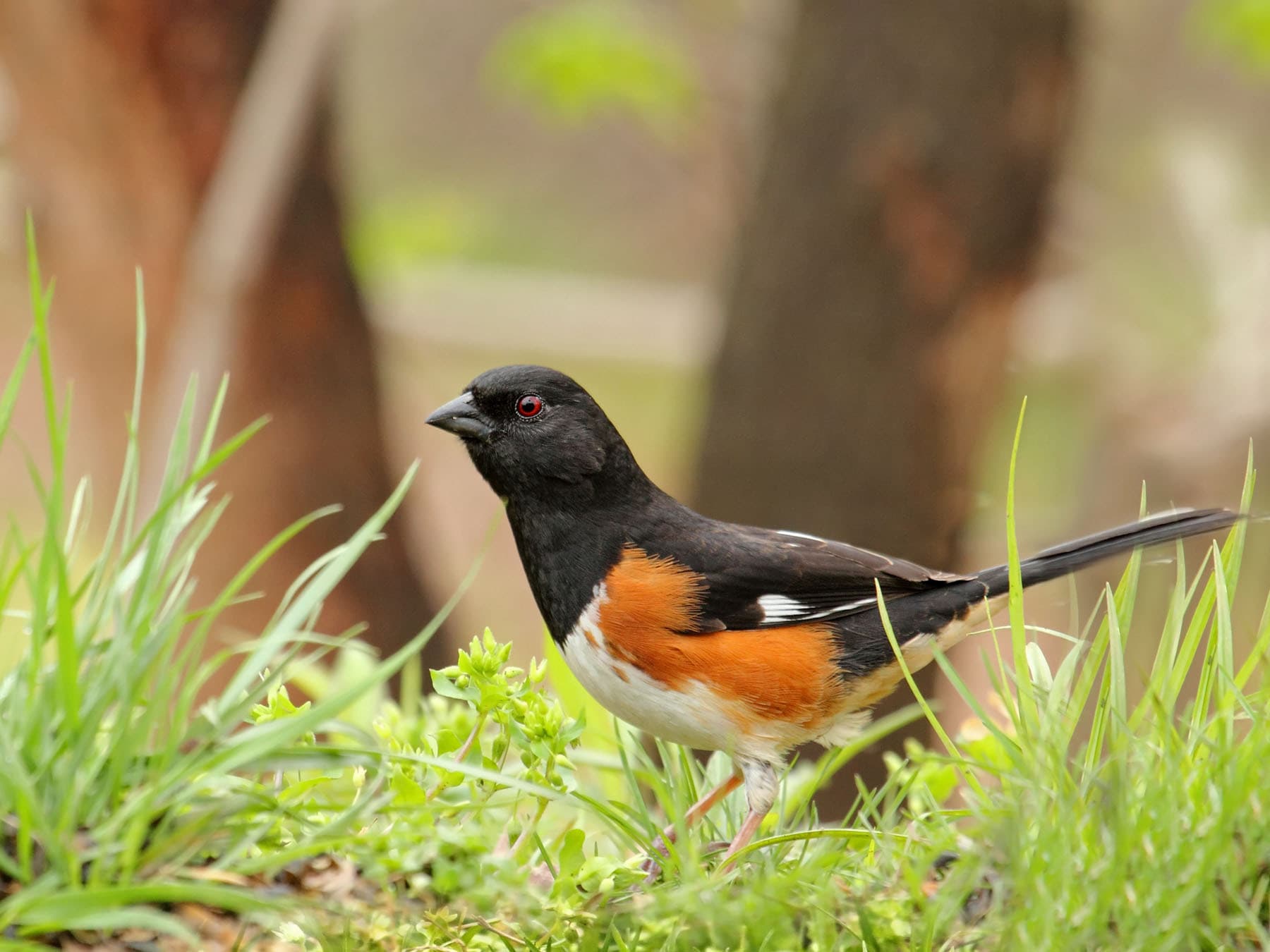
A male Eastern Towhee is 6.5–8.5 in (17–21 cm) long, bill to tail.
3D model · Male · Length 6.5–8.5 in (17–21 cm) · How we make our birds · Report a problem
© 2026 NC Digital Limited (Birdfact). All rights reserved. This 3D model may be viewed on this page and shared by link only. Downloading, extracting, copying or reusing it, or using it to train machine-learning models, is not permitted without our written permission. Using our models
On this page15 sections
How to recognise it
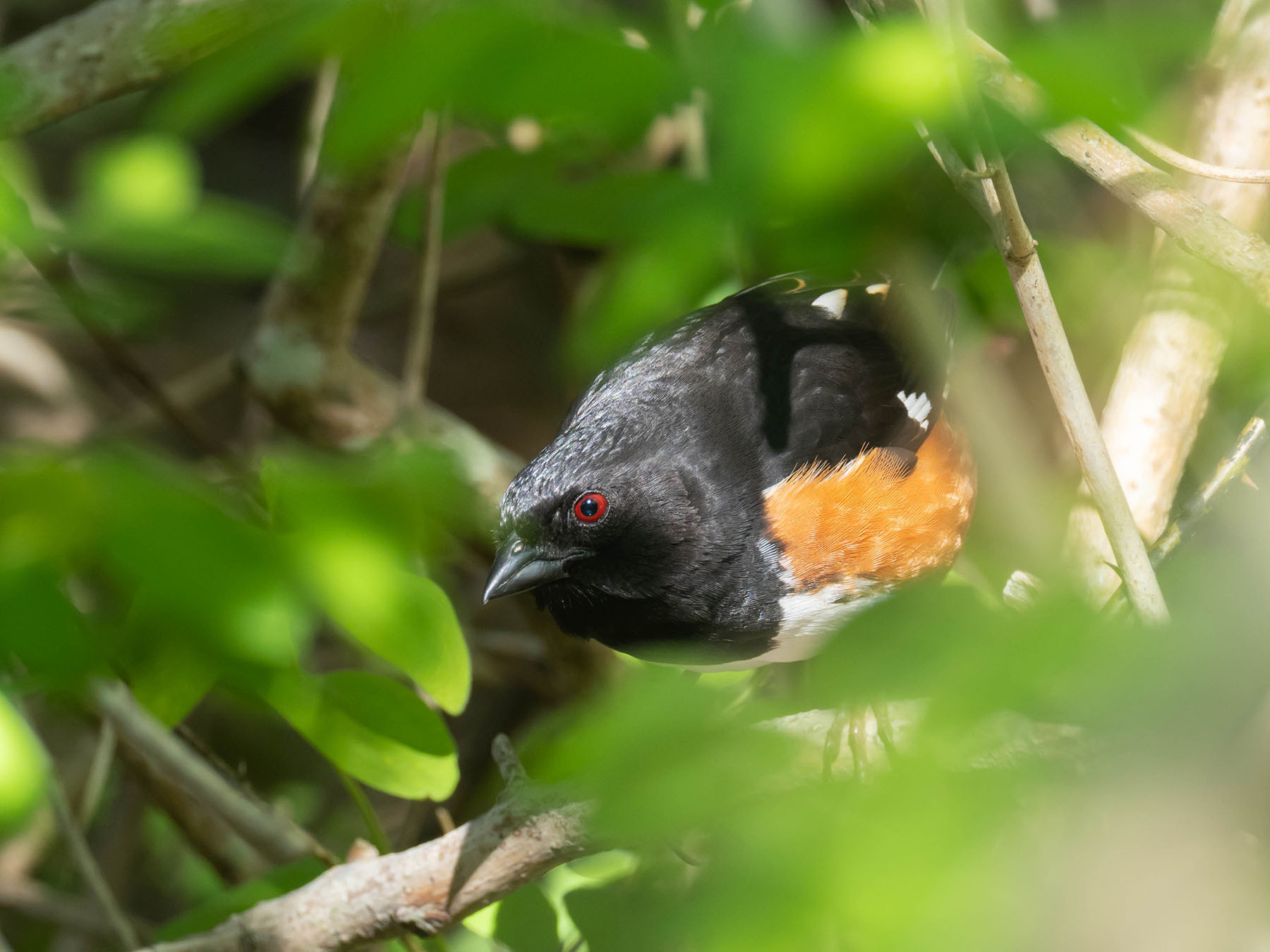
The Eastern Towhee is a big, long-tailed sparrow of thickets and brushy edges, and the male is hard to mistake: a black hood and back, rufous sides and a white belly, with the black ending in a clean line across the breast. The folded wing shows a small white patch and a pale edge, and the long, rounded tail has white corners that flash as the bird flies off. The bill is black and cone-shaped.
Most sightings start with a sound: a chewink from somewhere out of view, or dry leaves rustling under a shrub as though something much bigger were moving about. In spring, males climb to sing from a high perch, which is the best chance of a clear look.
Size and shape
Eastern Towhees are 6.8 to 8.2 inches (17-21 cm) long, with a wingspan of 7.9 to 11 inches (20-28 cm), and weigh 1.1 to 1.8 ounces (32-52 g). That is about twice the weight of a Song Sparrow, but smaller than an American Robin. The shape is chunky, with a thick, triangular bill and a long tail.
Males, females and young
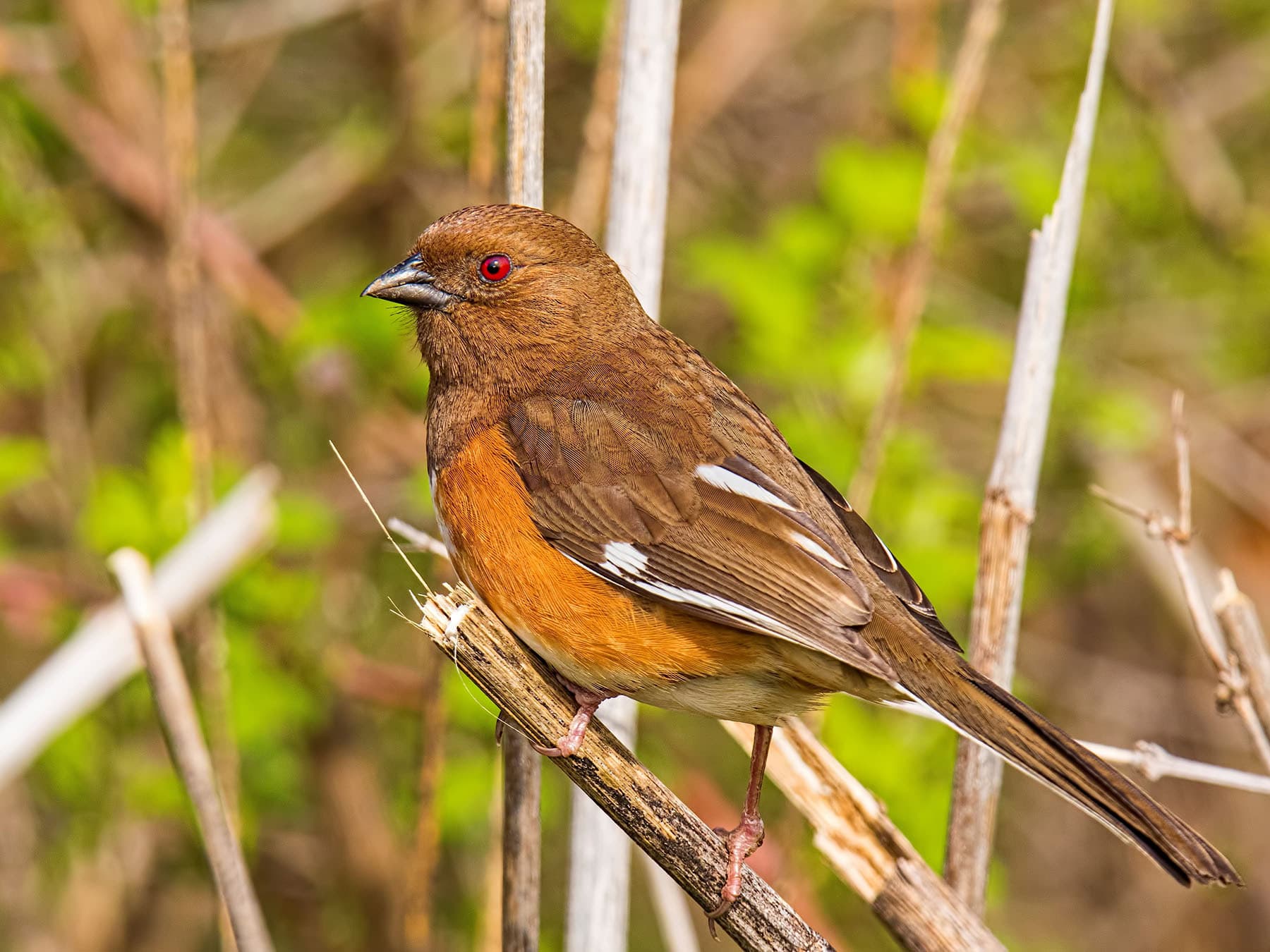
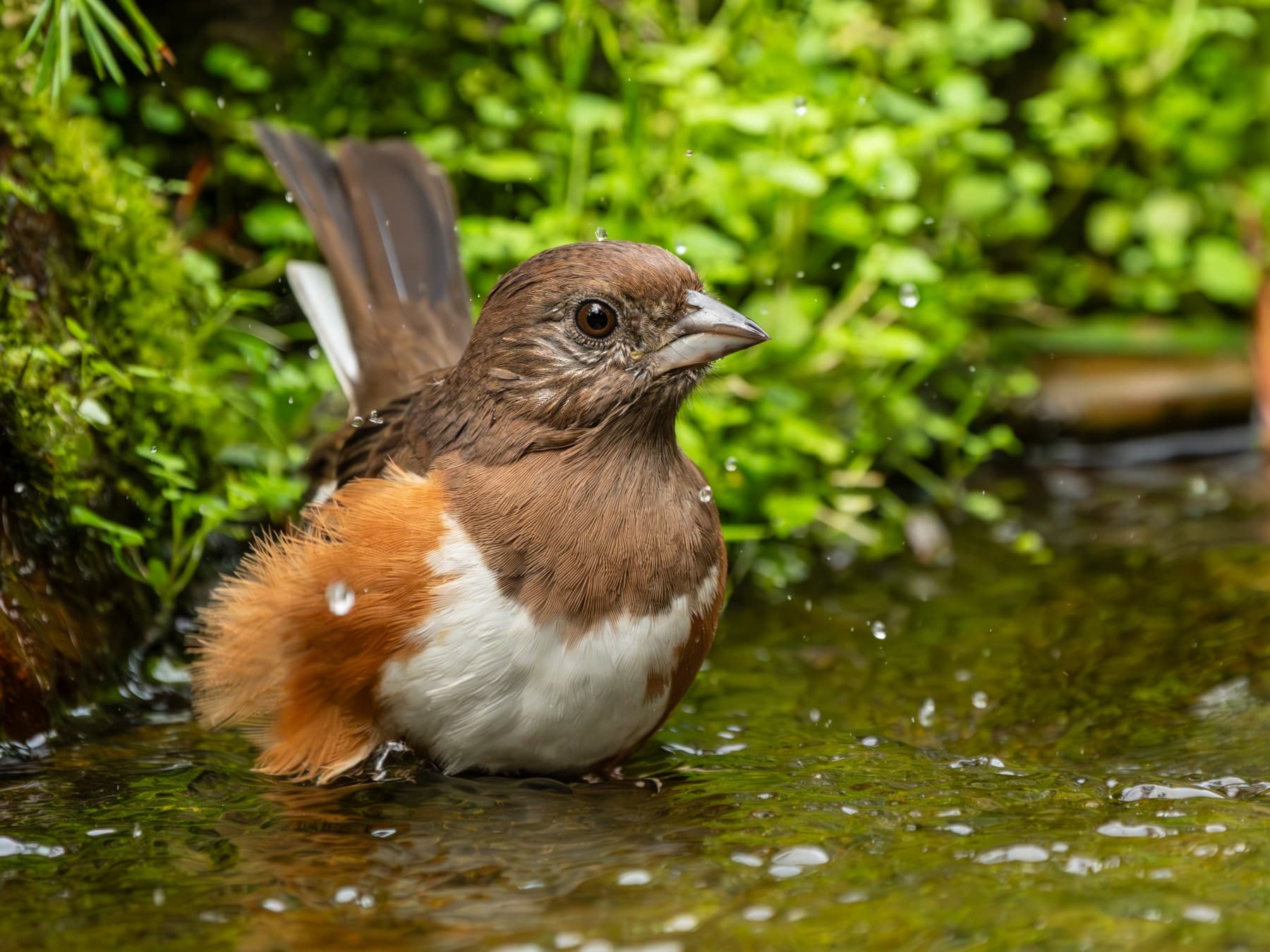
The female has the male's pattern in warm brown: brown hood, back, wings and tail, similar rufous sides and the same white belly, and a little less white in the wing and tail.
Males look sharpest in spring. Their fresh black feathers have chestnut fringes in fall, and these wear away over the winter to leave the bird blacker and glossier.
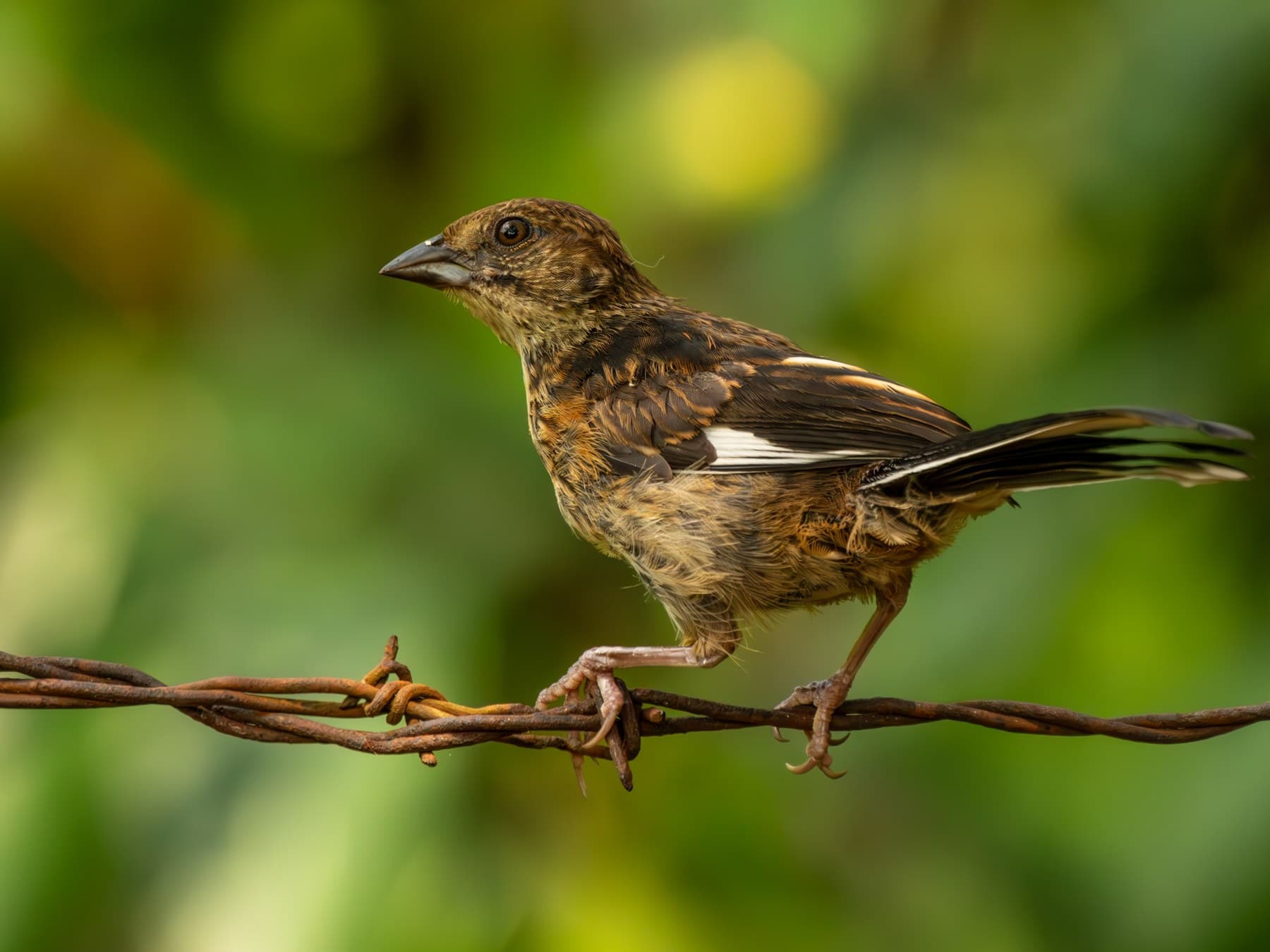
Juveniles look nothing like their parents. They are cinnamon-brown above and buffy below, heavily streaked on the back, breast and flanks with a plain pale center to the belly, and are seen mainly from May to August. The size and the long, dark tail with white corners tell them from streaky sparrows. By about September a molt has given them an adult-like look, though young males can be duller, with a brown wash, and first-fall birds still have brown eyes.
Identification: red or white eyes
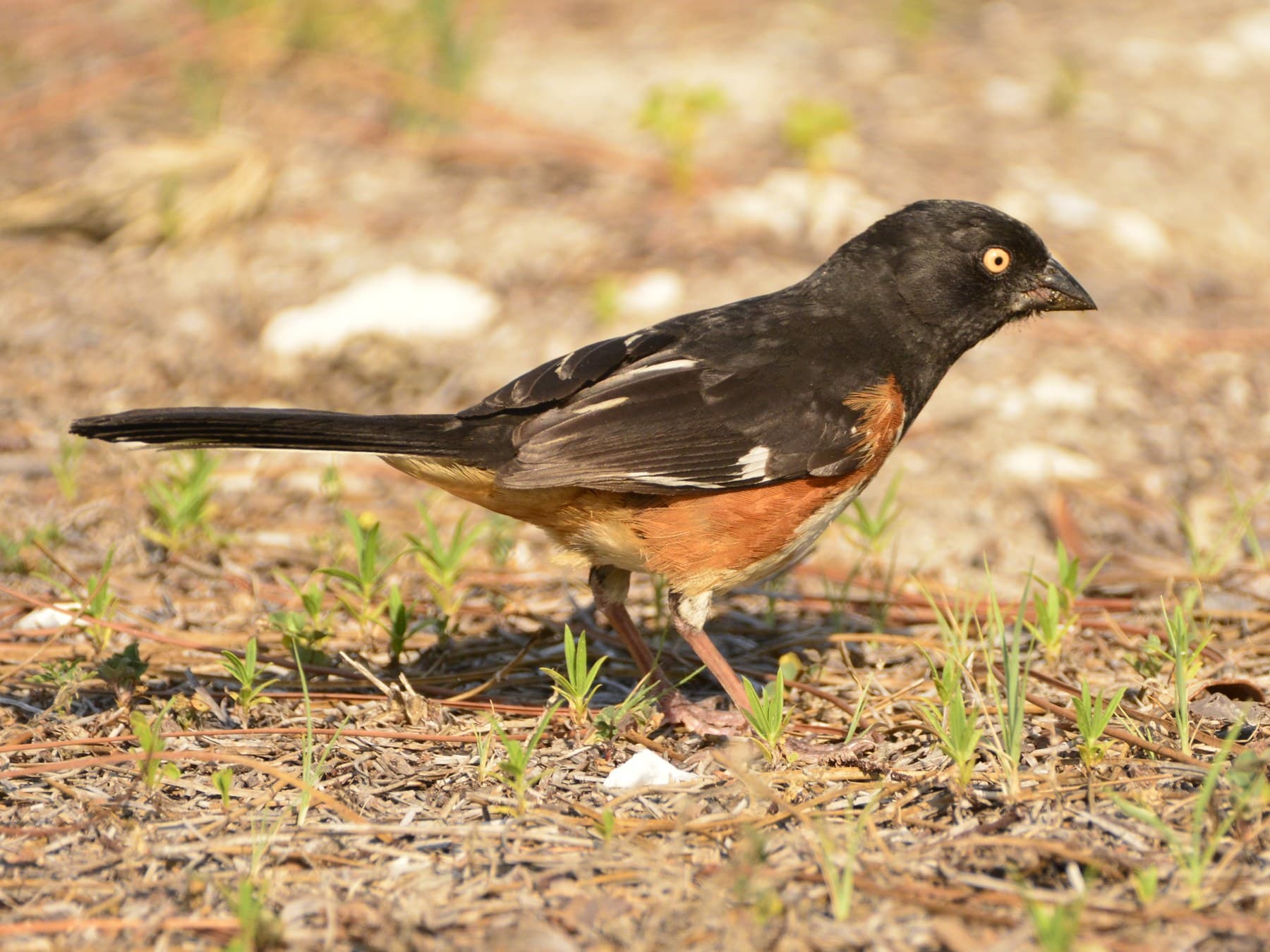
Across the North and the Midwest, adult towhees have red eyes. On the Florida peninsula the eye is whitish or pale straw, and across parts of the far Southeast it can be yellow or orange, with a mixed band running from southern Alabama to southeast North Carolina.1 Birders call these two groups Red-eyed and White-eyed, and between them they hold four subspecies.
Florida peninsula birds are also paler and shorter-winged, with much less white in the tail. The white spot on the outer tail feather averages about 0.75 inch (19 mm) on Florida males and about 1.5 inches (38 mm) on northern males.2
Identification: similar birds
Spotted Towhee. The closest lookalike, and until 1995 the same species: together they were the Rufous-sided Towhee. They meet along river valleys on the Great Plains and sometimes interbreed there. Pure birds of both kinds are common in that zone.3 A Spotted Towhee has bold white spots on its back and wings. An Eastern Towhee has a plain black or brown back and only the small white wing mark, although a few birds far from the Plains show a little white on the shoulder or wing coverts.
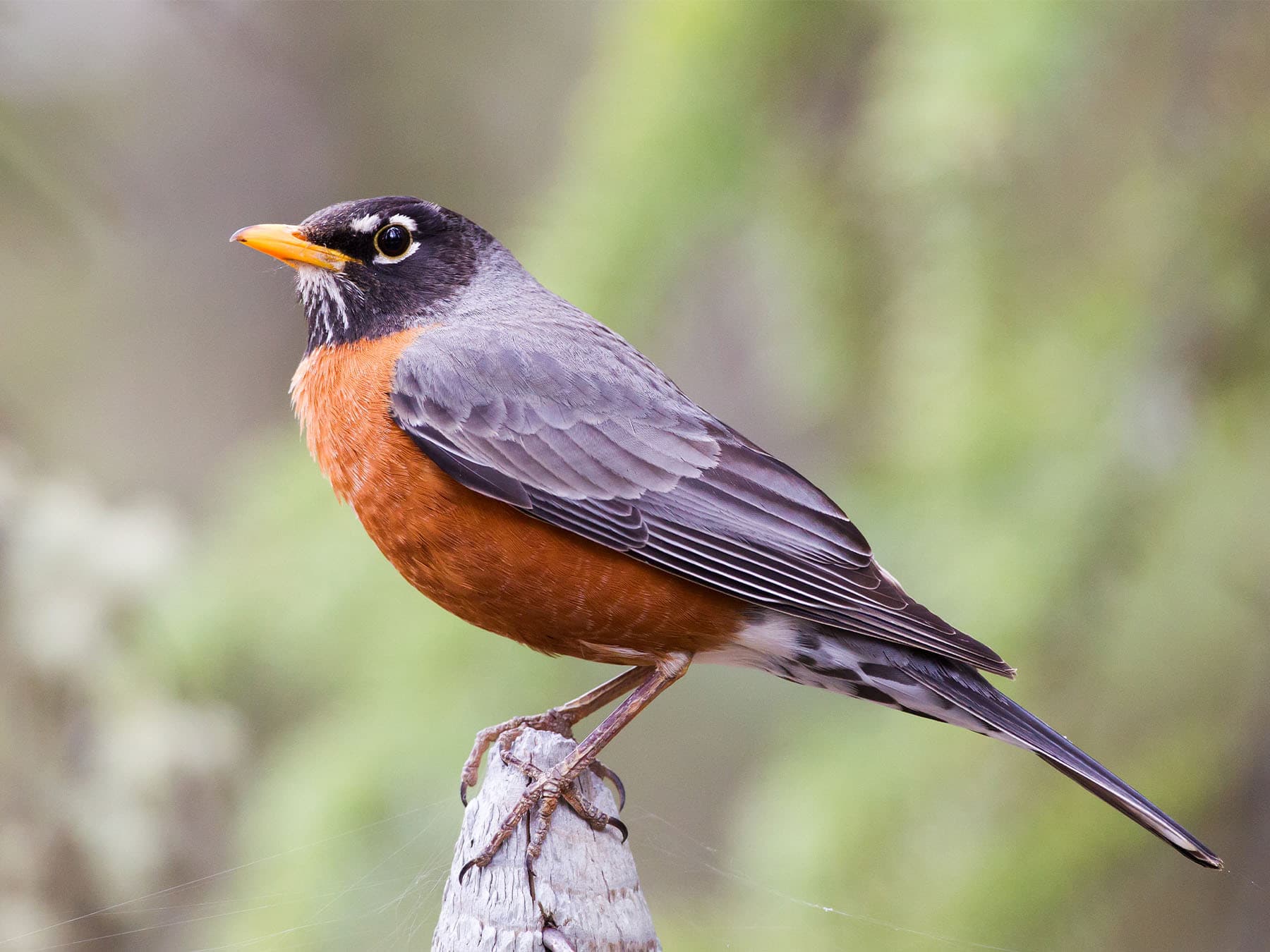
American Robin. Bigger, with a gray back, a red-orange breast right across the front and a yellow bill. A towhee's rufous is only on its sides, with a white belly between.
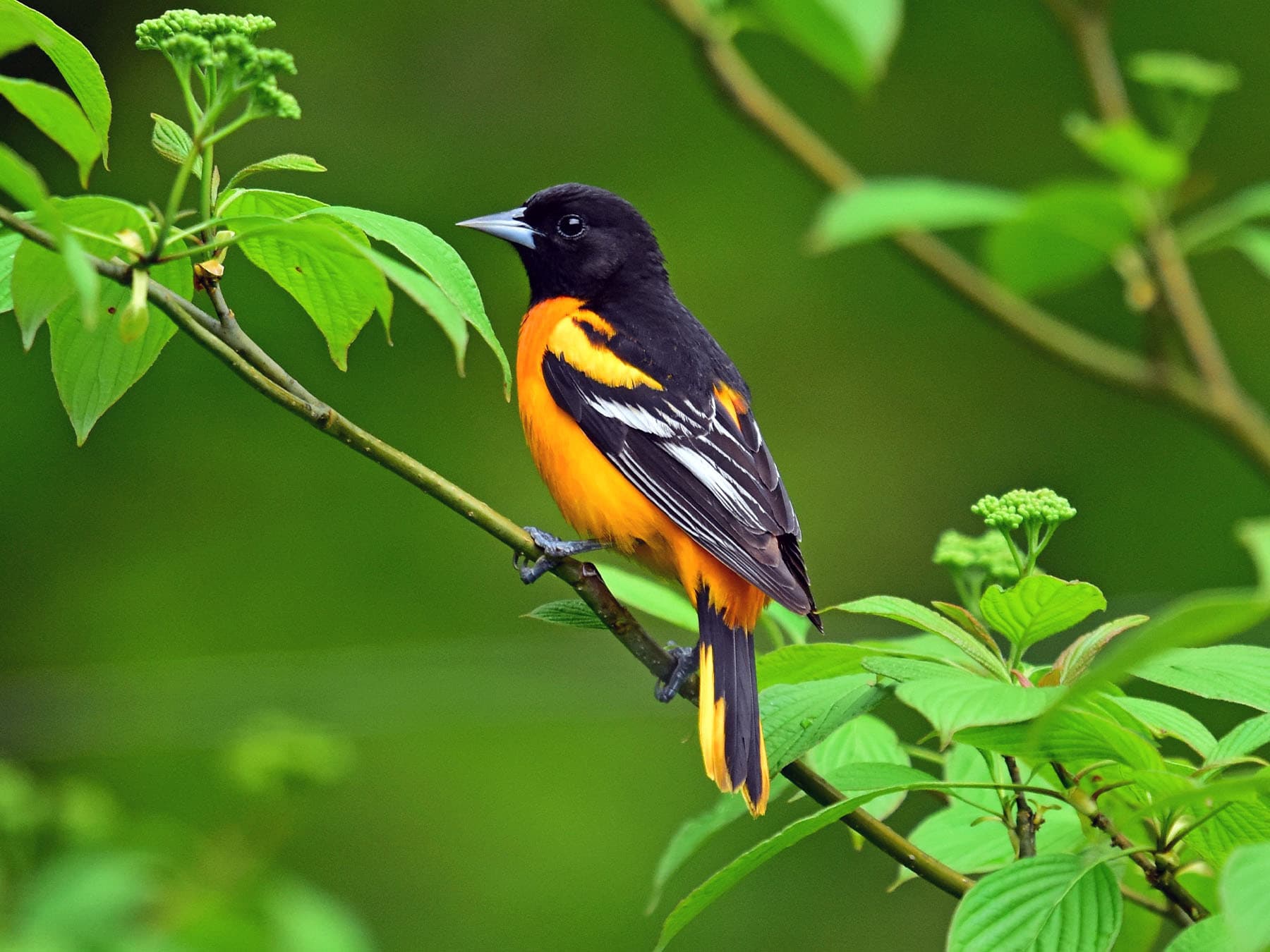
Baltimore Oriole. A male is also black-hooded, but flame-orange below, with a white wing bar and a long, pointed bill, and it feeds high in trees rather than on the ground.
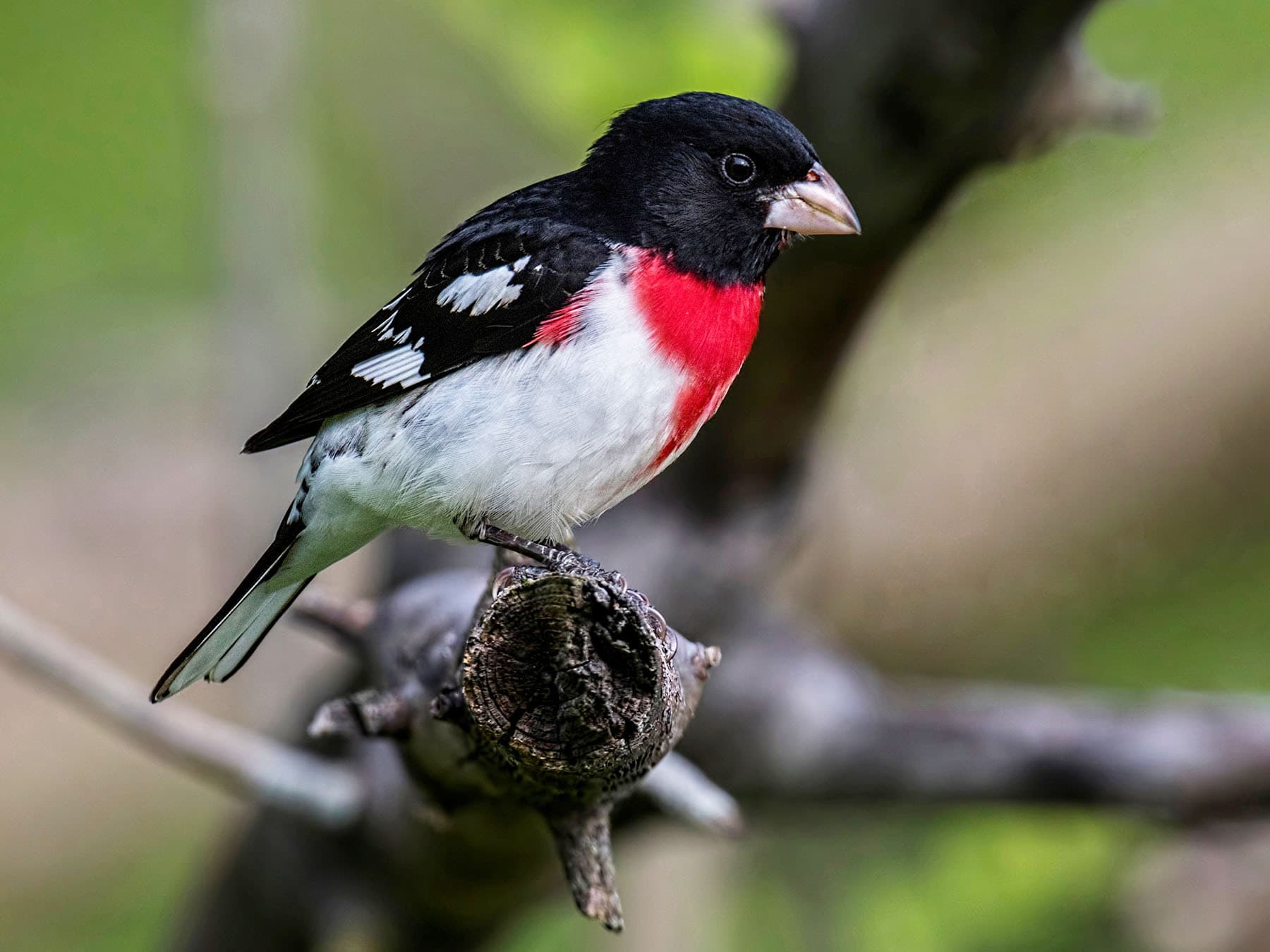
Rose-breasted Grosbeak. A male has a black head and back, a white belly, a red chevron down its breast and a very large bill. Females are brown and heavily streaked, with a pale stripe above the eye.
Dark-eyed Junco. Much smaller, with a pale pink bill. Eastern birds are slate gray and white, with no rufous on the sides.
Streaky sparrows. A juvenile towhee can pass for a Song Sparrow until you see its size and long, dark, white-cornered tail.
Not sure it’s a Eastern Towhee? Check your photo: Birdfact names the bird and shows the look-alike side by side.
Its size
Adults- Length
- 17–21 cm
- Wingspan
- 20–28 cm
- Weight
- 32–52 g
Its song and calls
The song is a short phrase, usually written as drink-your-tea: one to three sharp opening notes, then a ringing trill. It varies a lot from bird to bird. The opening notes carry further than the trill and seem to work as an attention-getter for the trill that follows.2, 4 Within a bout, a male sings about 9.6 songs a minute on average.5 Neighbors often alternate, each answering the other.
The call gave the bird its names: towhee, chewink and joree all copy it. Both sexes and all ages give it, in every season but mostly when breeding, and mainly in alarm. It changes across the range: a clear, slurred chwee in the North, a hoarser version on the mid-Gulf coast, and a clear whistled swee in Florida.
Two other common calls are worth learning: a thin lisp that keeps pairs and groups in touch, barely audible beyond a few yards, and a sharp, abrupt tic of alarm.

How the song is learned
Each male keeps a small set of song types, singing one for a while before moving to the next. Florida birds, which stay all year, average 8 types and New York birds, which migrate, average 3.5, and Florida neighbors share far more of them: 45% of 130 song types were shared by local males, against 5% of 409 in New York.6
A young male has to hear it done. One raised alone from the egg never sang a normal towhee song, even by his second spring; his song stayed harsher and slower, with no trills.7 Rarely, towhees borrow from other birds, working parts of Carolina Wren and Field Sparrow songs into their own8 and copying the alarm calls of Blue Jays, Brown Thrashers and American Robins.9
Song season
Migrant males start singing when they reach their breeding grounds. Birds that stay for the winter can begin in March, and Florida residents start up in February and March. Song ends around the start of the molt, in late July or early August.
Singing peaks around sunrise and again, less strongly, toward sunset, and in New Jersey males began about 65 minutes before sunrise in open pine-oak woods and 37 minutes before in shady oak forest.10 Males usually sing from a high, exposed perch, as much as 60 feet (18 m) up, and sometimes from the ground.
Males also have a soft, rambling quiet song, for up to 20 minutes at a time, given while feeding or from a low perch, often after a dispute; females rarely sing at all.2
- Song0:00 / 0:12
Recorded in Virginia, United States · May 2025
- Song (Florida)0:00 / 0:23
Recorded in Florida, United States · May 2020
- Chewink calls0:00 / 0:10
Recorded in Louisiana, United States · April 2024
- Call (Florida)0:00 / 0:02
Recorded in Florida, United States · February 2023
Heard one and not sure? Let the bird song identifier listen.
When and where to see it
Eastern Towhees breed across the eastern US and just into southern Canada, from southern Manitoba, Ontario and Quebec and northern New England south to the Gulf Coast and Florida, and west to eastern Nebraska, Kansas and Louisiana. They are missing from the Florida Keys.
What they need is dense, low cover over deep leaf litter, in many kinds of place: old-field thickets, forest edges and clearings, pine barrens, oak scrub, swamp margins and overgrown yards. Numbers are highest where shrubs are growing back, in old fields and after fire, and they thin out as the trees close over. On mountains they favor dry, sunny slopes, reaching about 6,500 feet (1,980 m) in the Appalachians.
Spotting tips
Listen first. A chewink, a song from a shrub top or leaves being kicked about will tell you where to look, and the place to look is at ground level, under the shrubs. Be patient at a brushy edge: a bird that crosses a gap shows those white tail corners.
Migration and winter range
Northern towhees mostly head south for the winter, while birds of the Southeast and the Gulf states largely stay put. Migrants travel at night. They reach northern states from late April to early May, males first, and leave from mid-September to mid-October. Most do not reach the Southeast until mid-October, when they join the residents.
Banding records suggest two routes: 42 of 45 from the Northeast wintered between Virginia and Florida, and 13 of 16 from the Midwest between Kentucky and the Gulf Coast.2
In winter the range reaches north to southern New England, Pennsylvania, Ohio and Illinois, and west to eastern Texas, with most birds in the southern states. A few stay farther north, usually near feeders, and more do so in mild winters.
What it eats
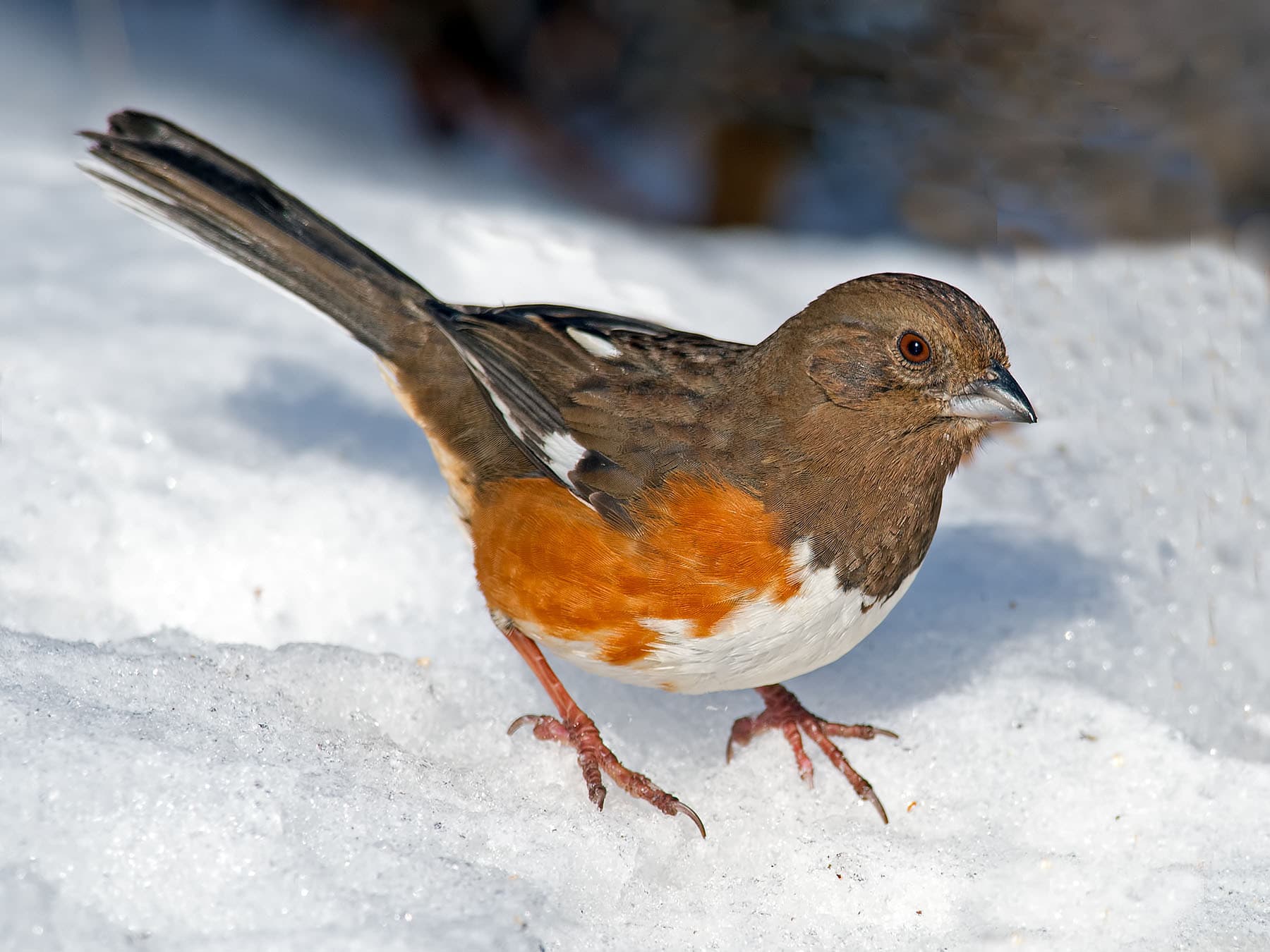
Towhees eat small animals from the leaf litter alongside seeds and fruit, and the balance shifts through the year. Spring and summer bring beetles, grasshoppers and crickets, caterpillars and moths, ants, bugs, spiders, millipedes and snails. From late summer the diet turns to ragweed, smartweed and grass seeds, acorns, blackberries and blueberries, with some wheat, corn and oats.
In old stomach samples from the US Fish and Wildlife Service, plant food made up 41% to 64% of the diet from March to June, depending on region and month; in fall it was 61% in the Midwest and about 97% in the Northeast and Southeast, though those two samples were small.2
What a towhee eats also depends on what is there. In New Jersey pine barrens, where ants were the commonest arthropods in the litter, they made up 40% of what adults ate in early summer; in oak forest, with fewer ants, none turned up in the diet.10
How it finds food: the double-scratch
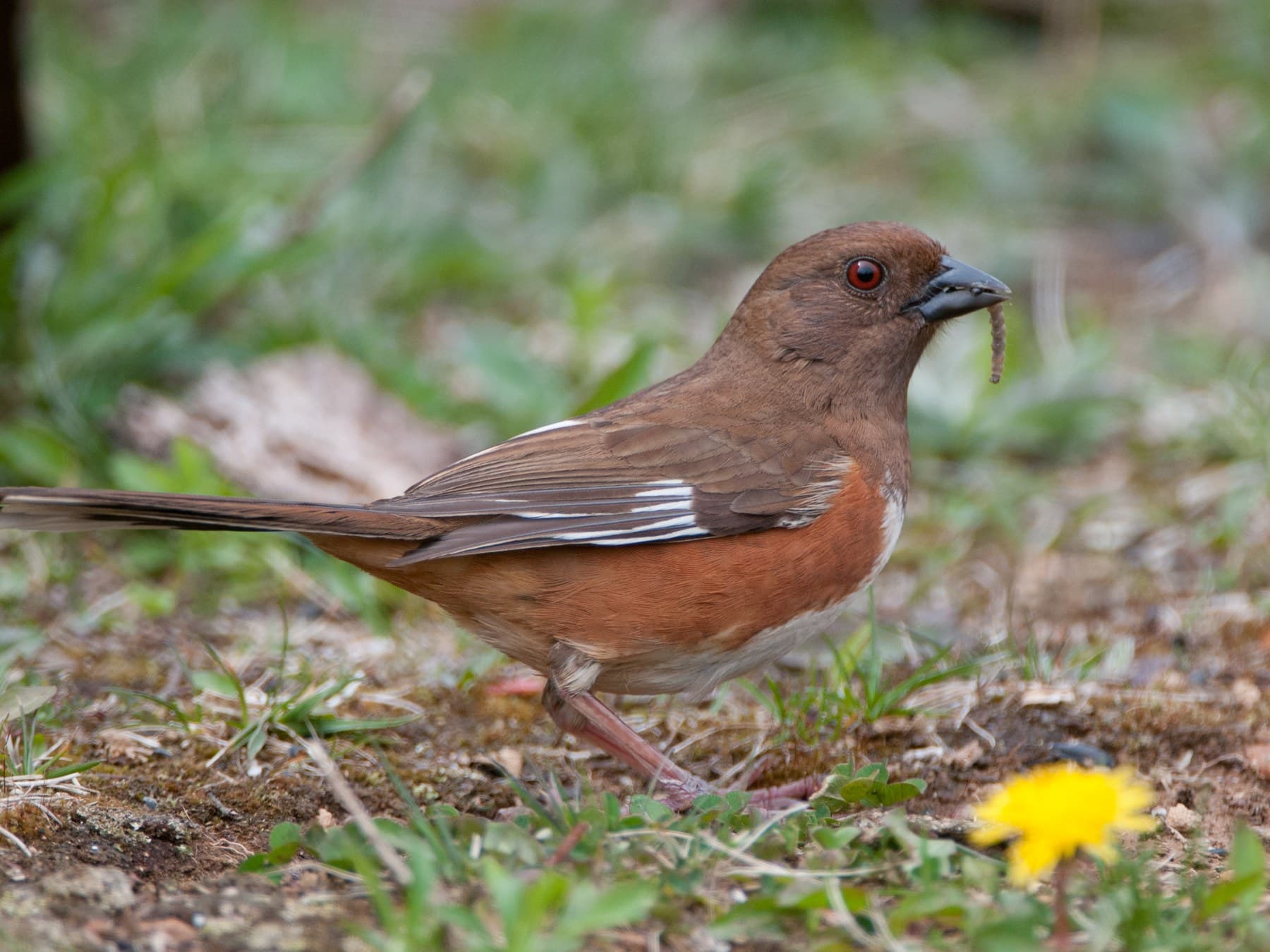
The towhee's signature move is a two-footed scratch: a small hop forward, then a hop backward that rakes both feet through the leaf litter at once and uncovers whatever is underneath. It is the commonest way they find food in fall and winter in the Northeast.
They seldom feed far from cover. In late spring and summer both sexes also climb into shrubs and trees after insects, especially caterpillars: in Massachusetts pine barrens, 26.5% of the males' foraging moves and 19.6% of the females' were above the ground.11 They look awkward up there, and can lose their balance on thin, springy twigs. Large prey gets shaken or beaten against the ground or a perch before it is eaten.
Feeders and yards
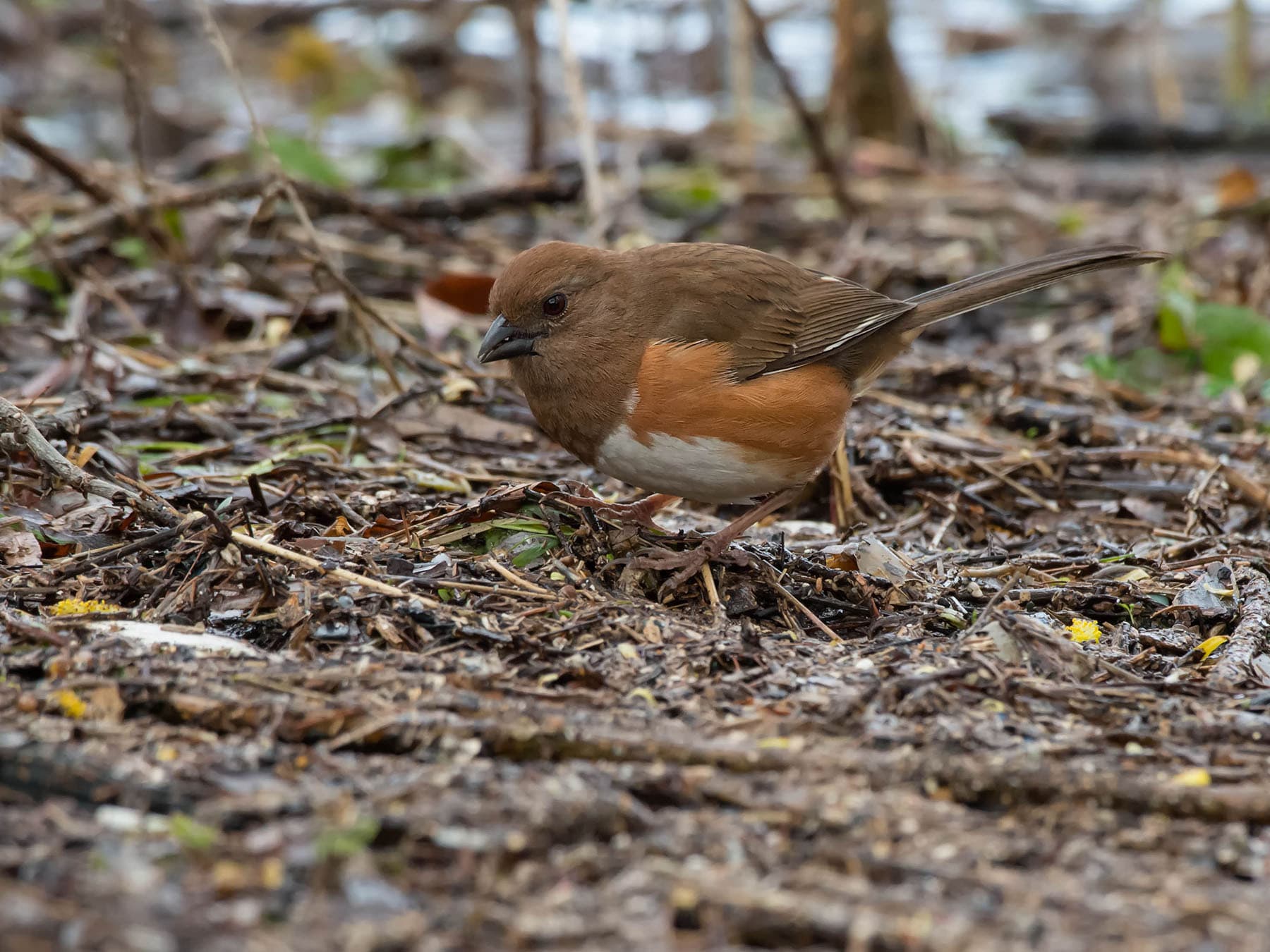
Towhees visit yards with brushy, overgrown borders. They take seed on the ground or a platform: sunflower seed, cracked corn, millet and peanut hearts. Scatter it close to cover rather than filling a hanging feeder, and leave the fallen leaves under your shrubs, which is where they naturally feed.
Nesting and breeding
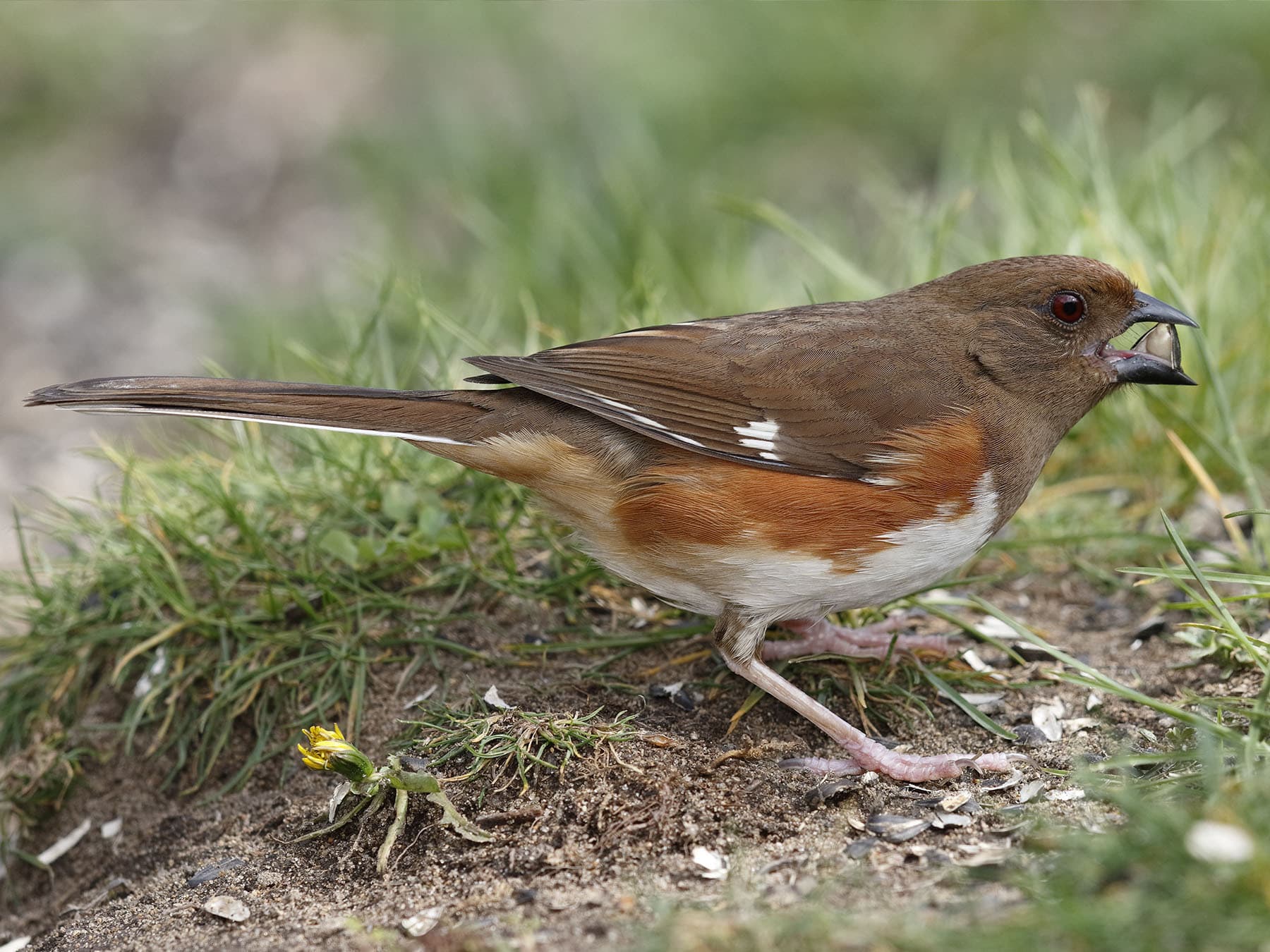
In the Northeast the nest is usually on the ground, sunk into the leaf litter up to its rim at the base of a shrub or grass clump, but in the Southeast it is most often above ground. Those higher nests sit in a vine tangle, briar or shrub, usually under 5 feet (1.5 m) and occasionally up to 18 feet (5.5 m). The share varies: 95% of 59 New Jersey nests were on the ground, but only 53% of 19 in Kentucky.2, 12 Renests and second broods are also more likely to be off the ground.
The female alone builds it, taking up to 5 days. She uses bark strips, dead leaves, stems, twigs and pine needles, sometimes string or even cardboard, around a lining of fine grass and rootlets, sometimes with hair. The finished nest is about 4 inches (10 cm) across.
Laying starts in late March or early April in Florida and Georgia, in mid to late April in Illinois and southern Ohio, and not until mid-May in northern New England. Most breeding is over by late July, though a few eggs turn up into August.
A male at first chases a new female, then within days is keeping close to her, and she starts the nest about a week after they pair. Pairs appear to be monogamous and stay together through the season, and one banded pair shared a territory for at least 3 seasons, though one male with two mates is on record.2
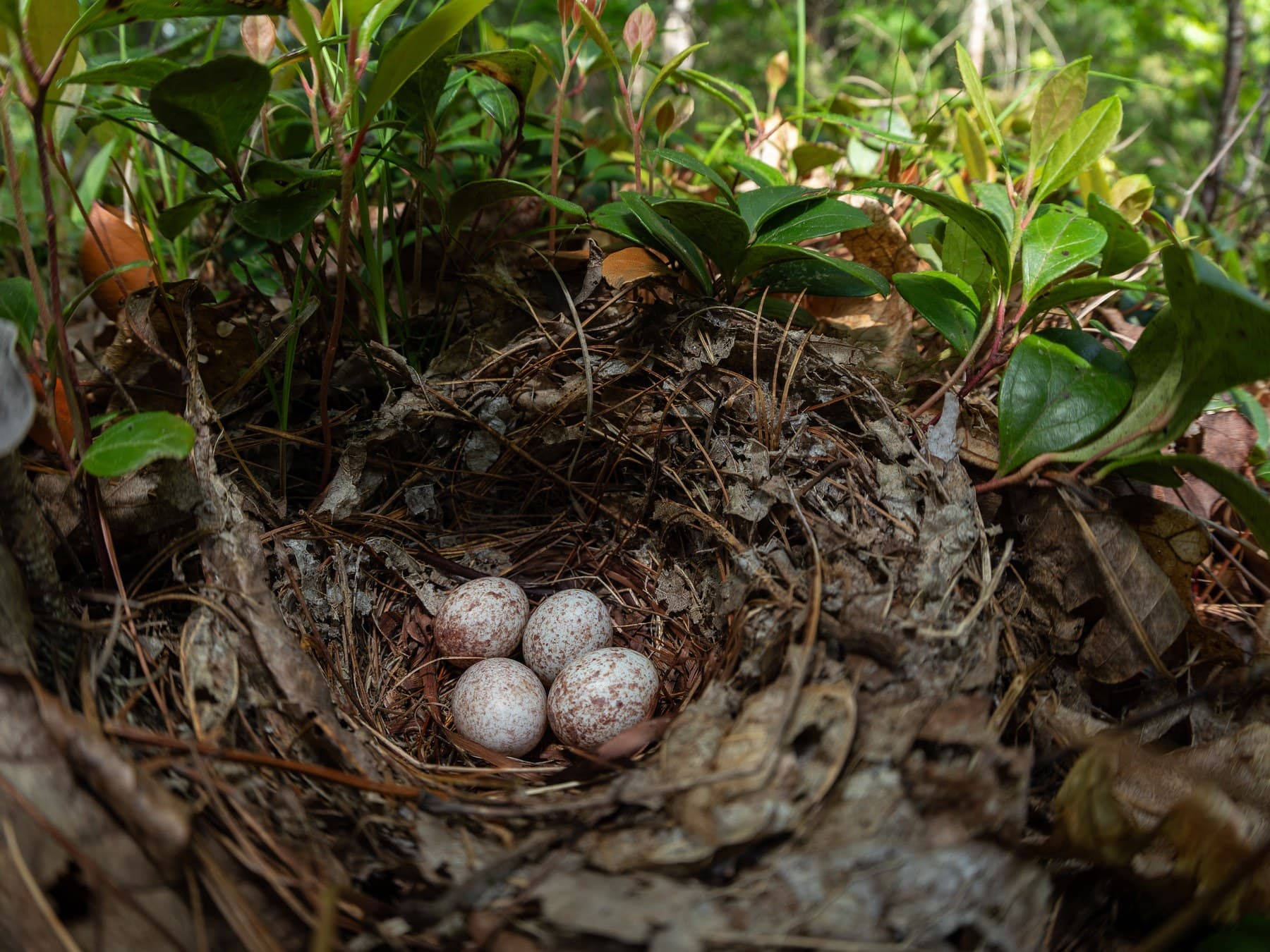
Eggs and incubation
A clutch is 2 to 6 eggs, usually 3 to 5. Averages include 3.6 in Indiana (19 nests), 3.4 in New Jersey (16) and 2.4 in Florida (11).2 New Jersey clutches were bigger in food-rich oak forest than in dry, sandy barrens.13
The eggs are pale, anything from gray or pink to cream or a faint green, thickly speckled with brown and reddish brown, often in a ring at the large end. The female incubates alone for 12 or 13 days, and the male warns her of trouble with his calls.
Young and fledglings
Both parents feed the young, mostly on caterpillars, other insects and spiders, with some fruit later on. In Kentucky, parents made 53 food deliveries in 19.4 hours of watching, 41.5% of them by the male.14 The young leave at 10 to 11 days old, or as early as 7 or 8 if disturbed, and are fed for another 3 to 4 weeks. One New York pair split the fledglings between them, each adult tending its own.2
Guides give one to three broods a year, but the evidence is thin, because a pair that renests after a failure is easily counted as raising a second brood. In New Jersey, 7 of 14 oak forest pairs tried a second brood after a successful first, and none was known to in pine barrens; in Kentucky, 1 of 6 pairs did.2
Cowbirds and nest predators
Most nests that fail are lost to predators, and ground nests are exposed. New Jersey pairs lost 73% of 11 nests in pine-oak woods and 31% of 13 in oak forest, and a New York site lost 88% of 17.10 Known nest robbers include bullsnakes, rat snakes, garter snakes and eastern chipmunks. Both parents scold and mob, and a flushed female may run off in a crouch with her tail dragging to draw an intruder away.
Towhees are common hosts of the Brown-headed Cowbird, and they accept the eggs. Older studies found cowbird eggs in 13 of 24 nests in Pennsylvania15 and 21 of 42 in Wisconsin,16 but only 4 of 81 in Massachusetts and 2 of 58 in New Jersey and New York.2 Those counts date from 1947 to 1969, so they may not match today's rates.
Behaviour
Towhees nearly always hop, on the ground and through branches. On a longer flight the wingbeats come in slight jerks or dips. A disturbed bird goes only a short way, almost stalling, with its tail opening and closing.
Males hold territories with song, chases and fights. In New Jersey territories averaged about 4 acres (1.6 ha) in oak forest, while a crowded Massachusetts pine barrens population averaged about two-thirds of an acre (0.26 ha).10, 17 Evenly matched rivals fly up chest to chest, grappling with their feet, then tumble down and carry on, sometimes ignoring a person standing close by. A wing raised and quivered, or a fanned tail, works as a threat, and a subordinate male may carry a leaf or twig about.
In summer they keep to themselves or to pairs. Migrants and winter birds form loose flocks: in Kentucky they averaged 17 birds, about three-quarters of them males, often mixed with juncos, sparrows, cardinals and titmice.18 Towhees bathe in shallow water, or in leaves wet with dew where water is scarce.
Parental instinct can misfire: one male spent more than 5 days feeding young at a Wood Thrush nest.19
Lifespan and predators
The oldest Eastern Towhee on the US Bird Banding Laboratory's list was at least 9 years old: banded in South Carolina in March 1937, and caught and released there in March 1946.20 A 1987 list gave a wild South Carolina male at least 12 years and 3 months,21 but that bird is not on the list today.
Most live far shorter lives. About 58% of adults survived each year in a Pennsylvania woodlot.22 Birds start breeding in their second year. Adults are taken by Sharp-shinned and Cooper's Hawks, Short-eared Owls and Loggerhead Shrikes.
Conservation
The Eastern Towhee is common, but it is in long-term decline. The North American Breeding Bird Survey puts the fall at 1.56% a year since 1966, a statistically clear drop of about 60%, and numbers have dropped by about 24% since 2015 alone.23 Declines are significant in 24 states and sharpest in the Northeast, where New Jersey and Massachusetts each lose about 3.9% a year, and only Iowa and Kansas show a clear rise.23
Partners in Flight estimated about 29 million birds around 2010, before that recent fall, and scores the species 13 out of 20 for continental concern, on its Orange Watch List and as a Tipping Point species.24 The IUCN Red List still has it as Least Concern, last assessed in 2021: its range and numbers are huge, and the decline was judged too slow to reach the threshold for a threatened species.25
Why the population is falling
Towhees need the shrubby stage between field and forest, so their numbers have followed the land. Abandoned farms grew into thickets and suited them, then those thickets aged into forest, and from the mid-1940s the spread of suburbs made the decline worse; near houses, ground nests also face cats, raccoons and Blue Jays, and more cowbirds.2 By the early 1990s, northeastern numbers were only about 13% of 1966 levels.26
Keeping young shrubland is what helps. In Florida, densities were highest about 4 years after a fire, then fell where fire was kept out.27 On Nantucket, mowing cut towhee numbers but prescribed burning did not.28
Similar birds
Often mistaken for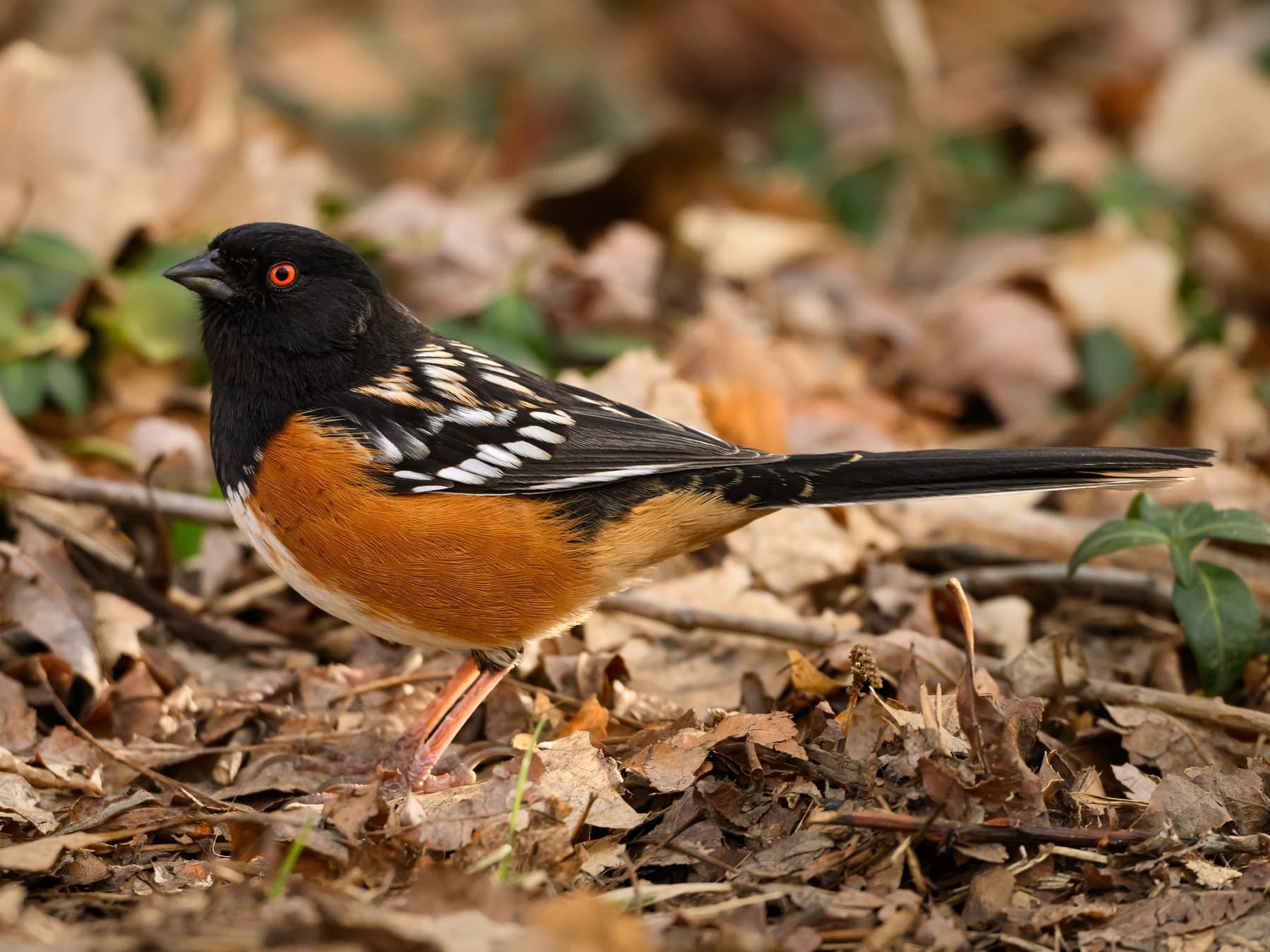

More photos
2 photos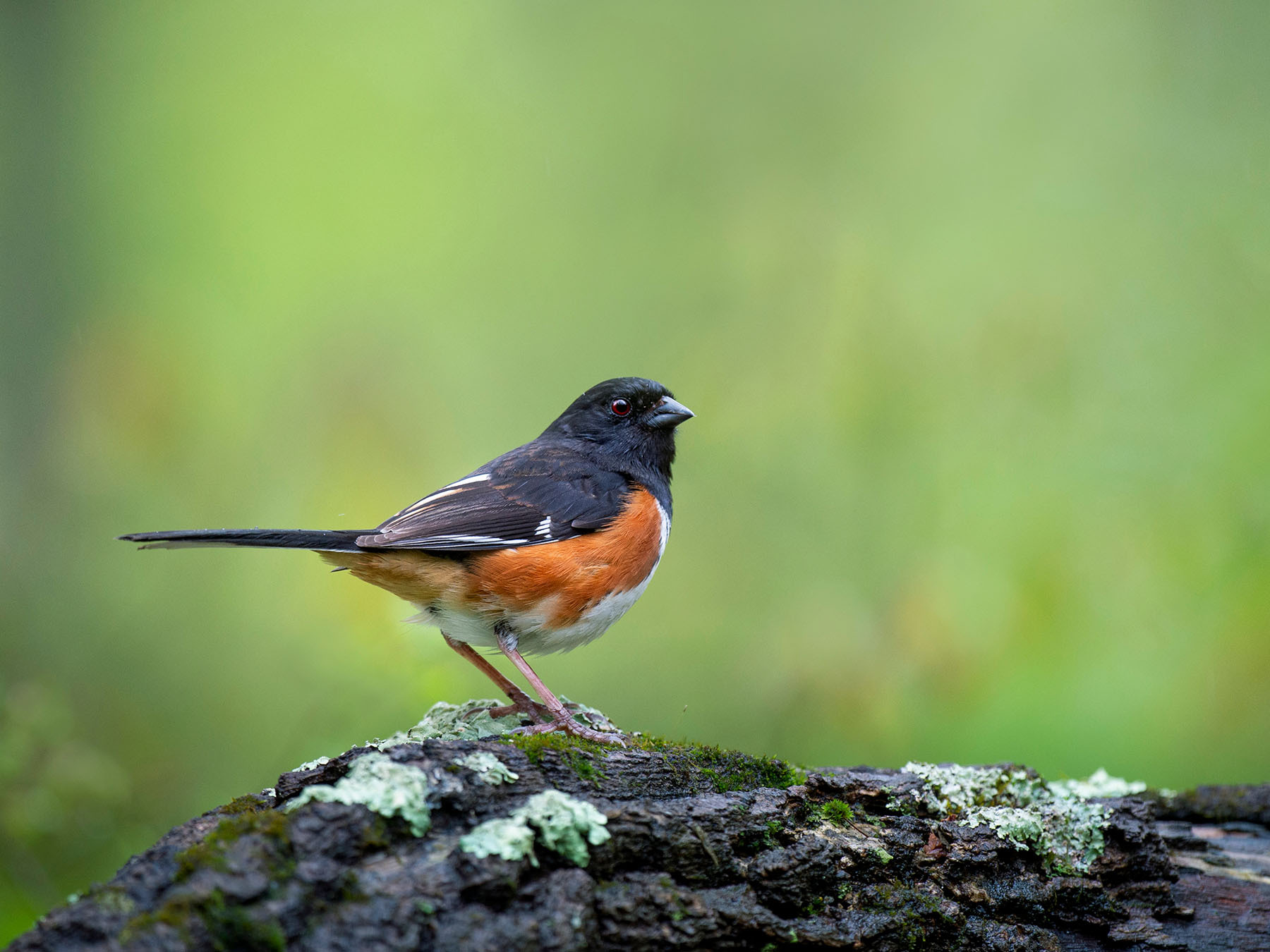
Quick facts
- Length
- 17–21 cm
- Wingspan
- 20–28 cm
- Weight
- 32–52 g
- Lifespan
- oldest recorded at least 9 years
- Family
- New World Sparrows
- Migration
- Partial migrant
- Global status (IUCN)
- Least Concern
- World population
- About 29 million around 2010 (Partners in Flight)
- Population trend
- Common but in long-term decline
- Also called
- Rufous-sided Towhee
- Scientific name
- Pipilo erythrophthalmus
Questions
4Are Eastern Towhees sparrows?
Yes. Towhees are big members of the New World sparrow family, Passerellidae, and the Eastern Towhee's closest relative is the Spotted Towhee. See how to identify one.
Is the Eastern Towhee the same as the Rufous-sided Towhee?
It used to be. Until 1995 the Eastern and Spotted Towhees were treated as one species, the Rufous-sided Towhee, and older books still use the name. See similar birds.
Are Eastern Towhees rare?
No. They are common in the right habitat, and were estimated at about 29 million around 2010, but they have fallen by about 60% since 1966. See conservation.
Do Eastern Towhees mate for life?
Some may. Pairs stay together through a breeding season, and one banded pair shared a territory for at least 3 seasons, but there is too little evidence to say how often. See nesting.
Sources
43- 1Dickinson, J. C., Jr. (1952). Geographic variation in the Red-eyed Towhee of the eastern United States. Bulletin of the Museum of Comparative Zoology 107: 273-352. Accessed 5 November 2026.
- 2Greenlaw, J. S. (2020). Eastern Towhee (Pipilo erythrophthalmus), version 1.0. Birds of the World (P. G. Rodewald, editor). Cornell Lab of Ornithology. doi:10.2173/bow.eastow.01 (opens in a new tab)
- 3American Ornithologists' Union (1995). Fortieth supplement to the American Ornithologists' Union Check-list of North American Birds. Auk 112: 819-830. Accessed 5 November 2026.
- 4Richards, D. G. (1981). Alerting and message components in songs of Rufous-sided Towhees. Behaviour 76: 223-249. doi:10.1163/156853981x00095 (opens in a new tab)
- 5Borror, D. J. (1975). Songs of the Rufous-sided Towhee. Condor 77: 183-195. Accessed 5 November 2026.
- 6Ewert, D. N. and Kroodsma, D. E. (1994). Song sharing and repertoires among migratory and resident Rufous-sided Towhees. Condor 96: 190-196. doi:10.2307/1369076 (opens in a new tab)
- 7Ewert, D. N. (1979). Development of song of a Rufous-sided Towhee raised in acoustic isolation. Condor 81: 313-316. doi:10.2307/1367644 (opens in a new tab)
- 8Borror, D. J. (1977). Rufous-sided Towhee mimicking Carolina Wren and Field Sparrow. Wilson Bulletin 89: 477-480. Accessed 5 November 2026.
- 9Greenlaw, J. S., Shackelford, C. E. and Brown, R. E. (1998). Call mimicry by Eastern Towhees and its significance in relation to auditory learning. Wilson Bulletin 110: 431-434. Accessed 5 November 2026.
- 10Greenlaw, J. S. (1969). The importance of food in the breeding system of the Rufous-sided Towhee, Pipilo erythrophthalmus (L.). PhD thesis, Rutgers, the State University of New Jersey. Accessed 5 November 2026.
- 11Morimoto, D. C. and Wasserman, F. E. (1991). Intersexual and interspecific differences in the foraging behavior of Rufous-sided Towhees, Common Yellowthroats, and Prairie Warblers in the pine barrens of southeastern Massachusetts. Journal of Field Ornithology 62: 436-449. Accessed 5 November 2026.
- 12Mengel, R. M. (1965). The Birds of Kentucky. Ornithological Monographs 3, American Ornithologists' Union. Accessed 5 November 2026.
- 13Greenlaw, J. S. (1978). The relation of breeding schedule and clutch size to food supply in the Rufous-sided Towhee. Condor 80: 24-33. doi:10.2307/1367787 (opens in a new tab)
- 14Barbour, R. W. (1951). Observations on the breeding habits of the Red-eyed Towhee. American Midland Naturalist 45: 672-678. doi:10.2307/2421997 (opens in a new tab)
- 15Norris, R. T. (1947). The cowbirds of Preston Frith. Wilson Bulletin 59: 83-101. Accessed 5 November 2026.
- 16Young, H. (1963). Breeding success of the Cowbird. Wilson Bulletin 75: 115-122. Accessed 5 November 2026.
- 17Morimoto, D. C. and Wasserman, F. E. (1991). Dispersion patterns and habitat associations of Rufous-sided Towhees, Common Yellowthroats, and Prairie Warblers in the southeastern Massachusetts pine barrens. Auk 108: 264-276. Accessed 5 November 2026.
- 18Barbour, R. W. (1941). Winter habits of the Red-eyed Towhee in eastern Kentucky. American Midland Naturalist 26: 593-595. doi:10.2307/2420736 (opens in a new tab)
- 19Schaeffer, K. M., Brown, W. P. and Shriver, W. G. (2009). Misdirected parental care by a male Eastern Towhee at a Wood Thrush nest. Wilson Journal of Ornithology 121: 427-429. doi:10.1676/08-085.1 (opens in a new tab)
- 20USGS Bird Banding Laboratory. Longevity records of North American birds. USGS Eastern Ecological Science Center, Bird Banding Laboratory. Accessed 5 November 2026. Source (opens in a new tab)
- 21Klimkiewicz, M. K. and Futcher, A. G. (1987). Longevity records of North American birds: Coerebinae through Estrildidae. Journal of Field Ornithology 58: 318-333. Accessed 5 November 2026.
- 22Savidge, I. R. and Davis, D. E. (1974). Survival of some common passerines in a Pennsylvania woodlot. Bird-Banding 45: 152-155. doi:10.2307/4512023 (opens in a new tab)
- 23Hostetler, J. A. et al. (2026). The North American Breeding Bird Survey, Analysis Results 1966-2025. U.S. Geological Survey data release. doi:10.5066/P1OSNSFC (opens in a new tab)
- 24Partners in Flight (2023). Avian Conservation Assessment Database and Population Estimates Database. Bird Conservancy of the Rockies. Accessed 5 November 2026. Source (opens in a new tab)
- 25BirdLife International (2021). Eastern Towhee Pipilo erythrophthalmus: species factsheet. BirdLife DataZone (IUCN Red List assessment 2021). Accessed 5 November 2026. Source (opens in a new tab)
- 26Hagan, J. M., III (1993). Decline of the Rufous-sided Towhee in the eastern United States. Auk 110: 863-874. doi:10.2307/4088640 (opens in a new tab)
- 27Engstrom, R. T., Crawford, R. L. and Baker, W. W. (1984). Breeding bird populations in relation to changing forest structure following fire exclusion: a 15-year study. Wilson Bulletin 96: 437-450. Accessed 5 November 2026.
- 28Zuckerberg, B. and Vickery, P. D. (2006). Effects of mowing and burning on shrubland and grassland birds on Nantucket Island, Massachusetts. Wilson Journal of Ornithology 118: 353-363. doi:10.1676/05-065.1 (opens in a new tab)
- 29Cornell Lab of Ornithology. Eastern Towhee. All About Birds. Accessed 5 November 2026. Source (opens in a new tab)
- 30National Audubon Society. Eastern Towhee. Guide to North American Birds. Accessed 5 November 2026. Source (opens in a new tab)
- 31Cornell Lab of Ornithology. Spotted Towhee. All About Birds. Accessed 5 November 2026. Source (opens in a new tab)
- 32Cornell Lab of Ornithology. American Robin. All About Birds. Accessed 5 November 2026. Source (opens in a new tab)
- 33Cornell Lab of Ornithology. Baltimore Oriole. All About Birds. Accessed 5 November 2026. Source (opens in a new tab)
- 34Cornell Lab of Ornithology. Rose-breasted Grosbeak. All About Birds. Accessed 5 November 2026. Source (opens in a new tab)
- 35Cornell Lab of Ornithology. Dark-eyed Junco. All About Birds. Accessed 5 November 2026. Source (opens in a new tab)
- 36Sibley, C. G. and West, D. A. (1959). Hybridization in the Rufous-sided Towhees of the Great Plains. Auk 76: 326-338. doi:10.2307/4081810 (opens in a new tab)
- 37DaCosta, J. M., Spellman, G. M., Escalante, P. and Klicka, J. (2009). A molecular systematic revision of two historically problematic songbird clades: Aimophila and Pipilo. Journal of Avian Biology 40: 206-216. doi:10.1111/j.1600-048X.2009.04514.x (opens in a new tab)
- 38Greenlaw, J. S. (1976). Use of bilateral scratching behavior by emberizines and icterids. Condor 78: 94-97. doi:10.2307/1366921 (opens in a new tab)
- 39Martin, A. C., Zim, H. S. and Nelson, A. L. (1951). American Wildlife and Plants: A Guide to Wildlife Food Habits. Dover Publications, New York. Accessed 5 November 2026.
- 40Project FeederWatch. Common Feeder Birds: Eastern Towhee. Cornell Lab of Ornithology and Birds Canada. Accessed 5 November 2026. Source (opens in a new tab)
- 41Storer, R. W. (1966). Sexual dimorphism and food habits in three North American accipiters. Auk 83: 423-436. doi:10.2307/4083053 (opens in a new tab)
- 42Olson, S. L. and Wingate, D. B. (2012). A new species of towhee (Aves: Emberizidae: Pipilo) from Quaternary deposits on Bermuda. Proceedings of the Biological Society of Washington 125: 85-96. doi:10.2988/11-21.1 (opens in a new tab)
- 43AviList Core Team (2025). AviList: The Global Avian Checklist, v2025b. Accessed 5 November 2026. Source (opens in a new tab)

Checked by
Nathan Cope, founder and editor
Nathan founded Birdfact and leads its writers and contributors in the UK, the US and Canada. He has watched and studied birds for more than ten years, and checks every article and species guide before it’s published.